Mở bài
Chủ đề “Historical Perspectives On Democracy” (Quan điểm lịch sử về dân chủ) là một trong những chủ đề phổ biến và quan trọng trong kỳ thi IELTS Reading. Với tần suất xuất hiện đều đặn trong các đề thi thực tế, chủ đề này không chỉ đánh giá khả năng đọc hiểu mà còn kiểm tra vốn từ vựng học thuật và khả năng phân tích thông tin phức tạp của thí sinh.
Bài viết này cung cấp một bộ đề thi IELTS Reading hoàn chỉnh với 3 passages có độ khó tăng dần từ Easy đến Hard, bao gồm 40 câu hỏi đa dạng giống thi thật. Bạn sẽ được luyện tập với các dạng câu hỏi phổ biến như Multiple Choice, True/False/Not Given, Matching Headings, Summary Completion và nhiều dạng khác. Mỗi câu hỏi đều có đáp án chi tiết kèm giải thích cụ thể về vị trí thông tin và cách paraphrase.
Ngoài ra, bài viết còn cung cấp bảng từ vựng quan trọng được phân loại theo từng passage, giúp bạn nâng cao vốn từ học thuật và cải thiện khả năng đọc hiểu. Đề thi này phù hợp cho học viên từ band 5.0 trở lên, đặc biệt hữu ích cho những ai đang hướng tới band điểm 6.5-7.5.
Hướng dẫn làm bài IELTS Reading
Tổng Quan Về IELTS Reading Test
IELTS Reading Test là một phần quan trọng trong kỳ thi IELTS Academic, đánh giá khả năng đọc hiểu tiếng Anh học thuật của thí sinh. Bài thi bao gồm:
- Thời gian: 60 phút cho 3 passages (không có thời gian chép đáp án)
- Tổng số câu hỏi: 40 câu
- Độ dài mỗi passage: 700-1000 từ
- Điểm số: Mỗi câu đúng được 1 điểm, tổng 40 điểm quy đổi thành band 0-9
Phân bổ thời gian khuyến nghị:
- Passage 1 (Easy): 15-17 phút
- Passage 2 (Medium): 18-20 phút
- Passage 3 (Hard): 23-25 phút
- Kiểm tra đáp án: 2-3 phút
Các Dạng Câu Hỏi Trong Đề Này
Đề thi mẫu này bao gồm đầy đủ các dạng câu hỏi phổ biến nhất trong IELTS Reading:
- Multiple Choice – Trắc nghiệm nhiều lựa chọn
- True/False/Not Given – Đúng/Sai/Không có thông tin
- Yes/No/Not Given – Có/Không/Không có thông tin (với ý kiến tác giả)
- Matching Headings – Nối tiêu đề với đoạn văn
- Sentence Completion – Hoàn thành câu
- Summary Completion – Hoàn thành đoạn tóm tắt
- Matching Features – Nối thông tin đặc điểm
- Short-answer Questions – Câu hỏi trả lời ngắn
IELTS Reading Practice Test
PASSAGE 1 – The Origins of Democratic Thought
Độ khó: Easy (Band 5.0-6.5)
Thời gian đề xuất: 15-17 phút
Democracy, derived from the Greek words “demos” (people) and “kratos” (power or rule), represents a system of government where political power resides in the hands of the people. The concept of democracy has ancient roots, stretching back over two and a half millennia to the city-states of ancient Greece, particularly Athens, where the first democratic experiments took place around 508 BCE.
In ancient Athens, democracy was direct rather than representative. This meant that eligible citizens – though notably excluding women, slaves, and foreigners – participated directly in governmental decision-making through attendance at the Assembly, known as the Ekklesia. This body met regularly on a hill called the Pnyx, where citizens could speak, debate, and vote on laws and policies. The Athenian system also employed random selection for many government positions, believing this method prevented the concentration of power and ensured equal opportunity for participation.
However, Athenian democracy was far from perfect by modern standards. The limited franchise meant that only about 10-20% of the population could participate in political life. Women were systematically excluded from political participation, slaves had no rights whatsoever, and resident foreigners (metics) could not vote despite contributing to the city’s economy. Nevertheless, for those who qualified as citizens, Athens offered an unprecedented level of political engagement and direct involvement in shaping their society’s laws and future direction.
The philosophical foundations of democratic thought were laid by several influential Greek thinkers. Pericles, the prominent Athenian statesman, delivered his famous Funeral Oration in 431 BCE, praising democracy and arguing that Athens’ strength came from its commitment to equality before the law and its encouragement of civic participation. He emphasized that in Athens, poverty was no barrier to public service, and merit rather than social class determined one’s influence in public affairs.
Yet not all ancient philosophers embraced democracy. Plato, in his work “The Republic,” expressed deep skepticism about democratic governance, arguing that it could descend into mob rule and that most citizens lacked the wisdom needed to make sound political decisions. He advocated instead for rule by philosopher-kings – wise and educated leaders who would govern for the common good. Aristotle, Plato’s student, took a more nuanced position. While recognizing democracy’s flaws, he believed that collective wisdom could sometimes surpass individual intelligence, and he developed the concept of “polity” – a mixed constitution combining democratic and aristocratic elements.
The Roman Republic, which lasted from 509 BCE to 27 BCE, represented another important early experiment in non-monarchical governance. Though not a democracy in the Athenian sense, Rome developed republican institutions including the Senate and various popular assemblies. Roman citizens could vote on laws and elect magistrates, though the system was heavily weighted toward the aristocratic class. The Roman model of representative governance and separation of powers would later prove highly influential on modern democratic thinking, particularly during the European Enlightenment and the founding of the United States.
After the fall of Rome, democratic ideas largely lay dormant throughout the Medieval period. The dominant political forms were feudalism and absolute monarchy, with political participation limited to the nobility. However, some historians point to medieval institutions such as the Icelandic Althing (established around 930 CE) and the English Magna Carta (1215 CE) as representing important precedents for later democratic development. These institutions, though limited in scope, introduced principles of law-bound governance and constraints on arbitrary power that would later evolve into more comprehensive democratic systems.
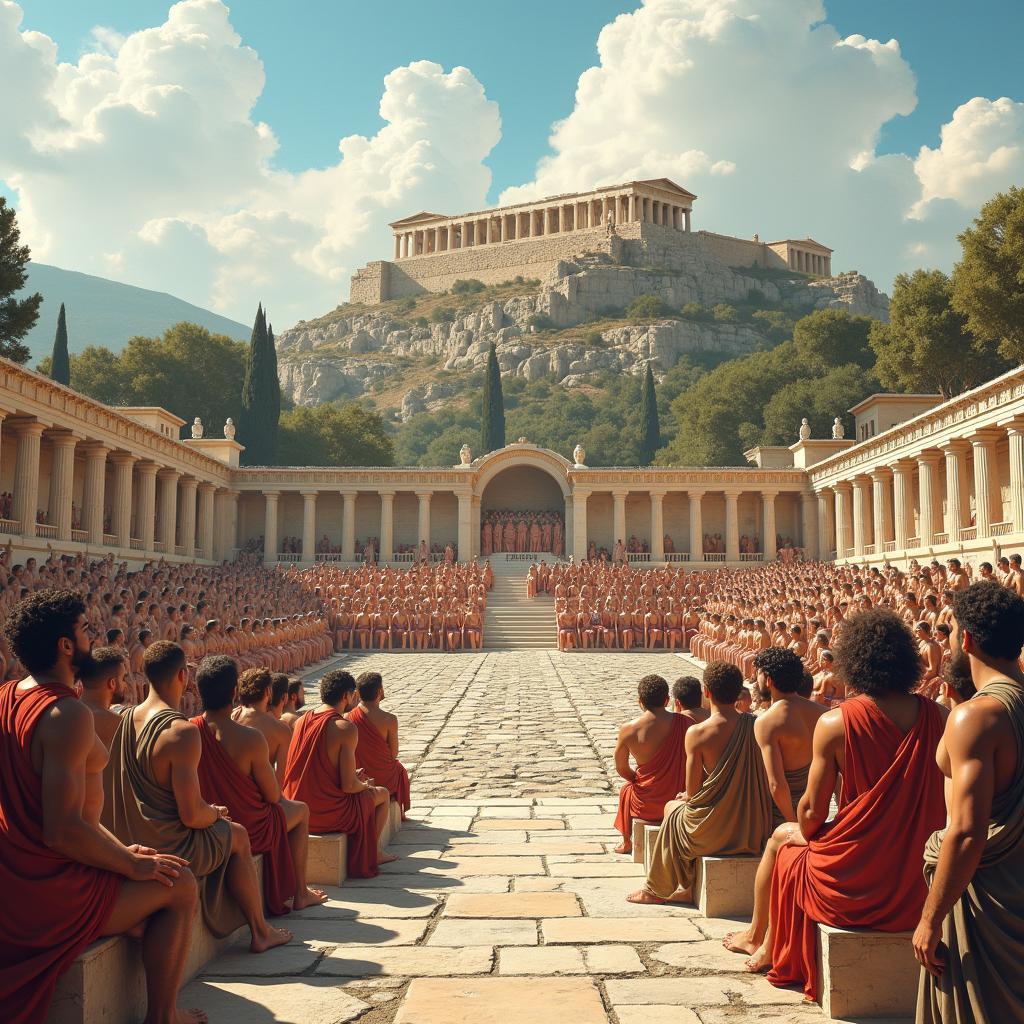 Nguồn gốc tư tưởng dân chủ từ thành bang Athens Hy Lạp cổ đại với hệ thống bỏ phiếu trực tiếp
Questions 1-13
Questions 1-5
Do the following statements agree with the information given in the passage?
Write:
- TRUE if the statement agrees with the information
- FALSE if the statement contradicts the information
- NOT GIVEN if there is no information on this
-
The word “democracy” originates from two Greek terms meaning “people” and “rule.”
-
In ancient Athens, all residents of the city could participate in democratic decision-making.
-
The Athenian Assembly met on a hill called the Pnyx for political discussions.
-
Most government positions in Athens were filled through competitive elections.
-
Pericles believed that social class should determine political influence in Athens.
Questions 6-9
Complete the sentences below.
Choose NO MORE THAN TWO WORDS from the passage for each answer.
-
Plato worried that democracy might deteriorate into __.
-
Aristotle proposed a system called __, which combined different governmental elements.
-
The Roman Republic featured __ where citizens could vote on legislation.
-
During the Medieval period, political power was mainly limited to the __.
Questions 10-13
Choose the correct letter, A, B, C, or D.
-
According to the passage, what percentage of the population in ancient Athens could participate in politics?
- A) About 5-10%
- B) About 10-20%
- C) About 30-40%
- D) About 50-60%
-
What method did Athens use to fill many government positions?
- A) Hereditary succession
- B) Appointment by leaders
- C) Random selection
- D) Popular vote
-
How did Aristotle’s view of democracy differ from Plato’s?
- A) He completely rejected it
- B) He took a more balanced approach
- C) He supported it entirely
- D) He ignored the topic
-
What does the passage suggest about the Magna Carta?
- A) It established full democracy in England
- B) It was a completely democratic document
- C) It represented an early step toward limiting power
- D) It had no influence on later developments
PASSAGE 2 – The Renaissance and Enlightenment Revival of Democratic Ideas
Độ khó: Medium (Band 6.0-7.5)
Thời gian đề xuất: 18-20 phút
The rebirth of democratic ideals in Western thought did not occur suddenly but emerged gradually through the Renaissance and reached its fullest expression during the Age of Enlightenment in the 17th and 18th centuries. This intellectual transformation fundamentally altered how Europeans conceived of political authority, individual rights, and the proper relationship between governors and the governed.
During the Renaissance, renewed interest in classical texts from ancient Greece and Rome prompted scholars to reconsider alternative forms of government beyond the prevailing monarchical systems. Italian city-states such as Venice and Florence developed republican institutions that, while far from democratic by modern standards, represented significant departures from feudal hierarchies. Niccolò Machiavelli, writing in early 16th-century Florence, analyzed republican governance in his “Discourses on Livy,” arguing that republics could prove more stable and powerful than principalities when citizens actively participated in their own governance. His work suggested that political legitimacy should rest not on divine right or hereditary succession but on effective governance and the consent of citizens.
The Protestant Reformation of the 16th century, while primarily a religious movement, carried profound political implications. By challenging the absolute authority of the Catholic Church and emphasizing individual conscience and interpretation of scripture, reformers like Martin Luther and John Calvin inadvertently promoted ideas about personal autonomy and resistance to tyranny that would later inform democratic thinking. Some radical Protestant sects developed congregational governance structures where members elected leaders and made decisions collectively, providing practical models of participatory decision-making.
The English Civil War (1642-1651) and the Glorious Revolution (1688) marked crucial turning points in constitutional development. The conflict between Parliament and the monarchy raised fundamental questions about sovereignty and the limits of royal power. The Levellers, a radical group during this period, advanced remarkably democratic proposals including universal male suffrage, regular elections, and equal representation. Though their specific program failed, their ideas influenced subsequent political discourse. The settlement following the Glorious Revolution established that Parliament, not the monarch, held supreme legislative authority – a principle enshrined in the Bill of Rights (1689).
John Locke, writing in the aftermath of these events, provided the philosophical framework that would prove foundational for modern liberal democracy. In his “Two Treatises of Government” (1689), Locke argued that governments derived their legitimate authority from the consent of the governed and existed to protect natural rights to life, liberty, and property. If governments violated these rights or failed in their protective function, Locke asserted that citizens possessed a right to revolution. His ideas profoundly influenced the American Revolution and the framers of the U.S. Constitution.
The French Enlightenment produced another cluster of influential thinkers who advanced democratic theory. Montesquieu analyzed different governmental systems in “The Spirit of the Laws” (1748), advocating for the separation of powers among executive, legislative, and judicial branches to prevent tyranny through checks and balances. Jean-Jacques Rousseau offered perhaps the most radical democratic vision in “The Social Contract” (1762), arguing that legitimate political authority derived from the “general will” of the people and that true freedom consisted of obedience to laws that citizens prescribed for themselves. Rousseau’s emphasis on popular sovereignty and direct participation inspired revolutionary movements but also raised questions about individual rights versus collective authority that continue to challenge democratic theory.
Voltaire and Denis Diderot, while not primarily political theorists, championed freedom of thought, religious tolerance, and rational inquiry – values essential to democratic culture. Their critiques of arbitrary authority, religious dogmatism, and social inequality contributed to an intellectual climate increasingly skeptical of traditional hierarchies and receptive to democratic alternatives. The Encyclopédie, edited by Diderot, sought to make knowledge accessible to all, reflecting the democratic principle that informed citizenship requires widespread education and access to information.
However, Enlightenment support for democracy was far from universal or uncomplicated. Many philosophes feared that uneducated masses lacked the capacity for sound political judgment and advocated instead for “enlightened despotism” – rule by rational, reform-minded monarchs. This tension between democratic ideals and concerns about popular competence would persist throughout the development of modern democratic institutions, leading to various compromises such as limited suffrage, representative rather than direct democracy, and constitutional constraints on popular majorities.
The American Revolution (1775-1783) represented the first successful implementation of Enlightenment democratic theory on a national scale. The Declaration of Independence (1776), drafted primarily by Thomas Jefferson, embodied Lockean principles, asserting that governments derived “their just powers from the consent of the governed” and that people possessed inalienable rights including “life, liberty, and the pursuit of happiness.” The subsequent U.S. Constitution (1787) and Bill of Rights (1791) established a federal republic with separation of powers, checks and balances, and constitutional protections for individual liberties – a institutional architecture that influenced democratic movements worldwide.
 Thời kỳ Khai sáng châu Âu với các nhà tư tưởng phát triển lý thuyết dân chủ hiện đại
Questions 14-26
Questions 14-18
The passage has nine paragraphs labeled A-I.
Which paragraph contains the following information?
Write the correct letter, A-I.
-
A description of how religious movements influenced political thought
-
Details about a radical group advocating for voting rights during a civil conflict
-
Information about Italian cities developing non-monarchical government systems
-
A discussion of tensions between democratic principles and doubts about citizens’ abilities
-
Examples of thinkers who promoted intellectual freedom and challenged traditional power structures
Questions 19-22
Complete the summary below.
Choose NO MORE THAN TWO WORDS from the passage for each answer.
John Locke argued that governments received their legitimate power from the (19) __ and existed primarily to safeguard natural rights. He maintained that if governments failed to protect these rights, people had a (20) __. His theories significantly influenced the American Revolution and those who created the (21) __. Locke’s concept that government authority requires (22) __ became fundamental to modern liberal democracy.
Questions 23-26
Do the following statements agree with the claims of the writer in the passage?
Write:
- YES if the statement agrees with the claims of the writer
- NO if the statement contradicts the claims of the writer
- NOT GIVEN if it is impossible to say what the writer thinks about this
-
Machiavelli believed that republics could be stronger than kingdoms when citizens engaged in governance.
-
The Levellers successfully implemented all their proposed democratic reforms in England.
-
Rousseau’s ideas about popular sovereignty were completely accepted by all his contemporaries.
-
The U.S. Constitution created a governmental structure that influenced democratic developments in other countries.
PASSAGE 3 – Democracy in the Modern Era: Expansion, Challenges, and Transformations
Độ khó: Hard (Band 7.0-9.0)
Thời gian đề xuất: 23-25 phút
The trajectory of democracy from the late 18th century to the present day constitutes a complex narrative of expansion, retrenchment, adaptation, and ongoing contestation. While the French and American Revolutions appeared to herald an era of inevitable democratic progress, the subsequent two centuries demonstrated that the establishment and maintenance of democratic governance remained fraught with difficulties, requiring constant vigilance, institutional innovation, and cultural transformation.
The French Revolution (1789-1799) initially promised a radical democratic transformation of European society, proclaiming universal rights and popular sovereignty. However, the Revolution’s descent into the Reign of Terror and eventual Napoleonic dictatorship provided ammunition for critics who argued that democracy inevitably degenerates into chaos and authoritarian rule. This cautionary tale influenced 19th-century European political development, leading to various compromise arrangements – constitutional monarchies, limited suffrage systems, and restricted parliamentary governance – that balanced democratic aspirations with elite concerns about social stability and property rights.
Throughout the 19th century, the franchise gradually expanded in Western democracies, though progress occurred unevenly and was frequently contested. The Reform Acts in Britain (1832, 1867, 1884) progressively widened the electorate, though universal male suffrage was not achieved until 1918, and women’s suffrage arrived in 1928. Similar patterns characterized other European nations and the United States, where the formal extension of voting rights often preceded substantive equality in political participation. The post-Civil War amendments to the U.S. Constitution ostensibly granted voting rights to African American men, but systematic disenfranchisement through literacy tests, poll taxes, and violent intimidation effectively nullified these rights until the Civil Rights Movement of the 1950s and 1960s.
The women’s suffrage movement represented another crucial chapter in democracy’s expansion. Beginning in the mid-19th century, activists in numerous countries organized campaigns demanding political equality. New Zealand became the first nation to grant women voting rights in national elections (1893), followed by Australia (1902, though with restrictions), Finland (1906), and Norway (1913). The movement achieved major victories following World War I, with many countries extending suffrage to women, though some nations – including Switzerland, Kuwait, and Saudi Arabia – delayed women’s enfranchisement until the late 20th or early 21st century. This prolonged struggle underscored how exclusionary practices could coexist with ostensibly democratic institutions, revealing the gap between formal structures and inclusive practice.
The interwar period (1918-1939) witnessed both the zenith of democratic optimism following World War I and democracy’s most severe crisis as fascism and communism offered competing visions of political organization. Woodrow Wilson’s Fourteen Points and the establishment of the League of Nations reflected hopes for a democratic international order, yet many new democracies established after the war proved fragile, succumbing to authoritarian takeover. The economic catastrophe of the Great Depression further undermined democratic stability, contributing to the rise of totalitarian regimes in Germany, Italy, Spain, and elsewhere. These developments prompted intense debate about democracy’s viability, with some scholars arguing that successful democratic governance required particular economic conditions, cultural prerequisites, or institutional arrangements.
World War II and its aftermath initiated what political scientist Samuel Huntington later termed the “second wave” of democratization. The defeat of fascism discredited authoritarian alternatives, while the Universal Declaration of Human Rights (1948) and decolonization expanded the global community of nations ostensibly committed to democratic principles. However, the Cold War created a bipolar international system that often subordinated democratic values to geopolitical calculations. Both the United States and Soviet Union supported undemocratic regimes aligned with their interests, demonstrating the tension between democratic rhetoric and realpolitik.
The “third wave” of democratization, beginning in the mid-1970s with transitions in Southern Europe and accelerating after the Cold War’s conclusion, dramatically increased the number of electoral democracies worldwide. The collapse of communist regimes in Eastern Europe and the Soviet Union, democratization in Latin America and parts of Asia and Africa, and South Africa’s transition from apartheid created unprecedented optimism about democracy’s global prospects. Francis Fukuyama’s controversial thesis about the “End of History” captured this mood, suggesting that liberal democracy represented the final form of human government.
However, the 21st century has witnessed what many scholars describe as “democratic recession” or “democratic backsliding.” Established democracies face challenges including political polarization, declining trust in institutions, the proliferation of disinformation, populist movements, and questions about democracy’s capacity to address complex transnational problems such as climate change, economic inequality, and mass migration. Meanwhile, numerous countries that underwent democratic transitions have experienced democratic erosion, with elected leaders undermining checks and balances, restricting press freedom, manipulating electoral systems, and concentrating power. The rise of “competitive authoritarianism” and “illiberal democracy” – systems maintaining electoral competition while systematically disadvantaging opposition forces and restricting civil liberties – challenges the assumption that democratization is irreversible.
Contemporary debates about democracy increasingly focus on substantive rather than procedural questions. Critics argue that formal democratic institutions may coexist with profound inequalities in political influence, with wealthy individuals and corporate interests exercising disproportionate power through campaign contributions, lobbying, and media ownership. The concept of “democratic quality” attempts to move beyond the binary classification of countries as democratic or not, instead assessing democracies along multiple dimensions including electoral integrity, civil liberties, rule of law, governmental effectiveness, and participatory opportunities. Some theorists advocate for “deliberative democracy,” emphasizing reasoned discussion and deliberation rather than mere aggregation of preferences through voting. Others propose “participatory democracy” models that expand citizen involvement beyond periodic elections through participatory budgeting, citizen assemblies, and direct democratic mechanisms.
The digital revolution presents both opportunities and threats for democracy. Social media and internet communication can facilitate political mobilization, enable direct citizen participation, and enhance governmental transparency. However, these technologies also enable unprecedented surveillance, manipulation of public opinion through targeted messaging and algorithmic curation, spread of disinformation, and foreign interference in domestic politics. The question of how to harness technology’s democratic potential while mitigating its dangers represents one of contemporary democracy’s central challenges.
Climate change and other global challenges raise fundamental questions about democracy’s adequacy for addressing long-term collective action problems. Democratic systems may struggle with issues requiring immediate costs for future benefits, particularly when those bearing costs and receiving benefits constitute different populations or generations. Some scholars argue that international cooperation on global challenges requires supranational institutions with limited democratic accountability, creating tensions between democratic governance at national levels and effective action on transnational problems. Others contend that only through enhanced democracy, including mechanisms for representing future generations and affected populations beyond national borders, can humanity adequately address these challenges.
 Cuộc bầu cử dân chủ hiện đại với công dân đi bỏ phiếu tại điểm bầu cử đương đại
Questions 27-40
Questions 27-31
Choose the correct letter, A, B, C, or D.
-
According to the passage, the French Revolution’s outcome
- A) Proved that democracy always succeeds
- B) Demonstrated democracy’s inevitable triumph
- C) Provided evidence for critics of democratic governance
- D) Had no influence on subsequent political thought
-
The passage suggests that voting rights expansion in the 19th century
- A) Occurred uniformly across all Western nations
- B) Immediately resulted in equal political participation
- C) Was contested and proceeded at different rates
- D) Was completed by the mid-1800s
-
What does the passage indicate about the Cold War’s effect on democracy?
- A) It universally promoted democratic values
- B) It had no impact on democratic development
- C) Democratic principles were sometimes sacrificed for strategic interests
- D) It ended all support for authoritarian governments
-
According to the text, “democratic backsliding” in the 21st century involves
- A) Complete abandonment of all democratic institutions
- B) Elected leaders weakening democratic checks and balances
- C) Total elimination of elections
- D) Immediate return to monarchical systems
-
The passage suggests that digital technology’s impact on democracy is
- A) Entirely positive
- B) Completely negative
- C) Both beneficial and harmful
- D) Insignificant
Questions 32-36
Complete the sentences below.
Choose NO MORE THAN THREE WORDS from the passage for each answer.
-
Samuel Huntington described the period of democratization after World War II as the __.
-
Francis Fukuyama’s thesis suggested that liberal democracy might be the __ of human government.
-
Some countries that transitioned to democracy have experienced __, with democratic institutions being undermined.
-
The concept of __ evaluates democracies across multiple dimensions rather than simply categorizing them.
-
Climate change raises questions about democracy’s ability to address __ that require immediate action for future benefits.
Questions 37-40
Match each theorist/movement with the correct description.
Choose FOUR answers from the box and write the correct letters, A-G.
List of descriptions:
- A) Advocated for expanded citizen involvement beyond voting
- B) Proposed that liberal democracy was humanity’s final governmental form
- C) Emphasized reasoned discussion in democratic processes
- D) Led campaigns for women’s political equality
- E) Described waves of global democratization
- F) Supported authoritarian leadership
- G) Focused exclusively on economic systems
-
Samuel Huntington __
-
Women’s suffrage movement __
-
Deliberative democracy theorists __
-
Participatory democracy advocates __
Answer Keys – Đáp Án
PASSAGE 1: Questions 1-13
- TRUE
- FALSE
- TRUE
- FALSE
- FALSE
- mob rule
- polity
- popular assemblies
- nobility
- B
- C
- B
- C
PASSAGE 2: Questions 14-26
- C (Paragraph about Protestant Reformation)
- D (Paragraph about English Civil War and Levellers)
- B (Paragraph about Renaissance and Italian city-states)
- H (Paragraph about Enlightenment concerns)
- G (Paragraph about Voltaire and Diderot)
- consent of the governed
- right to revolution
- U.S. Constitution
- consent of citizens
- YES
- NO
- NOT GIVEN
- YES
PASSAGE 3: Questions 27-40
- C
- C
- C
- B
- C
- second wave
- final form
- democratic erosion
- democratic quality
- long-term collective action problems
- E
- D
- C
- A
Giải Thích Đáp Án Chi Tiết
Passage 1 – Giải Thích
Câu 1: TRUE
- Dạng câu hỏi: True/False/Not Given
- Từ khóa: democracy, originates, Greek terms, people, rule
- Vị trí trong bài: Đoạn 1, dòng 1-2
- Giải thích: Passage nói rõ “Democracy, derived from the Greek words ‘demos’ (people) and ‘kratos’ (power or rule)”. Câu hỏi paraphrase “originates from” cho “derived from” và “meaning” cho dấu ngoặc đơn giải thích. Đáp án đúng là TRUE.
Câu 2: FALSE
- Dạng câu hỏi: True/False/Not Given
- Từ khóa: ancient Athens, all residents, participate, democratic decision-making
- Vị trí trong bài: Đoạn 2, dòng 2-3
- Giải thích: Passage chỉ rõ “eligible citizens – though notably excluding women, slaves, and foreigners”. Từ “all residents” trong câu hỏi mâu thuẫn với việc loại trừ phụ nữ, nô lệ và người nước ngoài. Đáp án là FALSE.
Câu 3: TRUE
- Dạng câu hỏi: True/False/Not Given
- Từ khóa: Athenian Assembly, met, hill, Pnyx, political discussions
- Vị trí trong bài: Đoạn 2, dòng 4-5
- Giải thích: Passage nói “This body met regularly on a hill called the Pnyx, where citizens could speak, debate, and vote”. “Political discussions” là paraphrase của “speak, debate, and vote”. Đáp án TRUE.
Câu 4: FALSE
- Dạng câu hỏi: True/False/Not Given
- Từ khóa: government positions, Athens, filled, competitive elections
- Vị trí trong bài: Đoạn 2, dòng 6-7
- Giải thích: Passage nói “The Athenian system also employed random selection for many government positions”. “Random selection” trái ngược với “competitive elections”. Đáp án FALSE.
Câu 5: FALSE
- Dạng câu hỏi: True/False/Not Given
- Từ khóa: Pericles, believed, social class, determine, political influence
- Vị trí trong bài: Đoạn 4, dòng cuối
- Giải thích: Passage nói “merit rather than social class determined one’s influence in public affairs”. Pericles tin rằng “merit” (công lao) chứ không phải “social class” quyết định ảnh hưởng chính trị. Đáp án FALSE.
Câu 6: mob rule
- Dạng câu hỏi: Sentence Completion
- Từ khóa: Plato, worried, democracy, deteriorate
- Vị trí trong bài: Đoạn 5, dòng 2-3
- Giải thích: Passage nói “Plato…expressed deep skepticism about democratic governance, arguing that it could descend into mob rule”. “Deteriorate into” là paraphrase của “descend into”.
Câu 7: polity
- Dạng câu hỏi: Sentence Completion
- Từ khóa: Aristotle, proposed, system, combined, different governmental elements
- Vị trí trong bài: Đoạn 5, dòng cuối
- Giải thích: Passage nói “he developed the concept of ‘polity’ – a mixed constitution combining democratic and aristocratic elements”. “Different governmental elements” paraphrase “democratic and aristocratic elements”.
Câu 8: popular assemblies
- Dạng câu hỏi: Sentence Completion
- Từ khóa: Roman Republic, featured, citizens, vote, legislation
- Vị trí trong bài: Đoạn 6, dòng 3-4
- Giải thích: Passage nói “Rome developed republican institutions including the Senate and various popular assemblies. Roman citizens could vote on laws”. “Legislation” paraphrase “laws”.
Câu 9: nobility
- Dạng câu hỏi: Sentence Completion
- Từ khóa: Medieval period, political power, mainly limited
- Vị trí trong bài: Đoạn 7, dòng 2-3
- Giải thích: Passage nói “The dominant political forms were feudalism and absolute monarchy, with political participation limited to the nobility”.
Câu 10: B
- Dạng câu hỏi: Multiple Choice
- Từ khóa: percentage, population, ancient Athens, participate, politics
- Vị trí trong bài: Đoạn 3, dòng 2
- Giải thích: Passage nói “The limited franchise meant that only about 10-20% of the population could participate in political life”. Đáp án chính xác là B.
Câu 11: C
- Dạng câu hỏi: Multiple Choice
- Từ khóa: Athens, method, fill, government positions
- Vị trí trong bài: Đoạn 2, dòng 6-7
- Giải thích: Passage nói “The Athenian system also employed random selection for many government positions”. Đáp án là C (Random selection).
Câu 12: B
- Dạng câu hỏi: Multiple Choice
- Từ khóa: Aristotle’s view, differ, Plato’s
- Vị trí trong bài: Đoạn 5, dòng 4-6
- Giải thích: Passage nói “Aristotle…took a more nuanced position”. “Nuanced” có nghĩa là cân nhắc, tinh tế, tức là “more balanced approach”. Đáp án B.
Câu 13: C
- Dạng câu hỏi: Multiple Choice
- Từ khóa: passage suggest, Magna Carta
- Vị trí trong bài: Đoạn 7, dòng cuối
- Giải thích: Passage nói về Magna Carta là “important precedents” và “introduced principles of law-bound governance and constraints on arbitrary power”. Đây là “early step toward limiting power” chứ không phải “full democracy”. Đáp án C.
Passage 2 – Giải Thích
Câu 14: C
- Dạng câu hỏi: Matching Information
- Từ khóa: religious movements, influenced, political thought
- Vị trí trong bài: Đoạn 3 (Paragraph C)
- Giải thích: Đoạn này bắt đầu bằng “The Protestant Reformation of the 16th century, while primarily a religious movement, carried profound political implications” và thảo luận về cách các phong trào tôn giáo ảnh hưởng đến tư tưởng chính trị.
Câu 15: D
- Dạng câu hỏi: Matching Information
- Từ khóa: radical group, advocating, voting rights, civil conflict
- Vị trí trong bài: Đoạn 4 (Paragraph D)
- Giải thích: Đoạn này nói về “The Levellers, a radical group during this period, advanced remarkably democratic proposals including universal male suffrage” trong bối cảnh English Civil War.
Câu 16: B
- Dạng câu hỏi: Matching Information
- Từ khóa: Italian cities, developing, non-monarchical government systems
- Vị trí trong bài: Đoạn 2 (Paragraph B)
- Giải thích: Đoạn này nói về “Italian city-states such as Venice and Florence developed republican institutions”.
Câu 17: H
- Dạng câu hỏi: Matching Information
- Từ khóa: tensions, democratic principles, doubts, citizens’ abilities
- Vị trí trong bài: Đoạn 8 (Paragraph H)
- Giải thích: Đoạn này thảo luận về “This tension between democratic ideals and concerns about popular competence” và lo ngại về năng lực của người dân.
Câu 18: G
- Dạng câu hỏi: Matching Information
- Từ khóa: thinkers, promoted, intellectual freedom, challenged, traditional power
- Vị trí trong bài: Đoạn 7 (Paragraph G)
- Giải thích: Đoạn này nói về Voltaire và Diderot, những người “championed freedom of thought” và có “critiques of arbitrary authority”.
Câu 19: consent of the governed
- Dạng câu hỏi: Summary Completion
- Từ khóa: John Locke, governments, legitimate power
- Vị trí trong bài: Đoạn 5
- Giải thích: “Locke argued that governments derived their legitimate authority from the consent of the governed”.
Câu 20: right to revolution
- Dạng câu hỏi: Summary Completion
- Từ khóa: governments failed, protect rights, people had
- Vị trí trong bài: Đoạn 5
- Giải thích: “If governments violated these rights or failed in their protective function, Locke asserted that citizens possessed a right to revolution”.
Câu 21: U.S. Constitution
- Dạng câu hỏi: Summary Completion
- Từ khóa: theories, influenced, American Revolution, created
- Vị trí trong bài: Đoạn 5
- Giải thích: “His ideas profoundly influenced the American Revolution and the framers of the U.S. Constitution”.
Câu 22: consent of citizens
- Dạng câu hỏi: Summary Completion
- Từ khóa: concept, government authority, requires
- Vị trí trong bài: Đoạn 2
- Giải thích: Machiavelli nói về “political legitimacy should rest…on effective governance and the consent of citizens”.
Câu 23: YES
- Dạng câu hỏi: Yes/No/Not Given
- Từ khóa: Machiavelli, believed, republics, stronger, kingdoms, citizens engaged
- Vị trí trong bài: Đoạn 2
- Giải thích: Passage nói Machiavelli “arguing that republics could prove more stable and powerful than principalities when citizens actively participated”. Đây là quan điểm của writer về Machiavelli. Đáp án YES.
Câu 24: NO
- Dạng câu hỏi: Yes/No/Not Given
- Từ khóa: Levellers, successfully implemented, all proposed reforms
- Vị trí trong bài: Đoạn 4
- Giải thích: Passage nói “Though their specific program failed, their ideas influenced subsequent political discourse”. Đáp án NO vì họ không thành công.
Câu 25: NOT GIVEN
- Dạng câu hỏi: Yes/No/Not Given
- Từ khóa: Rousseau’s ideas, completely accepted, all contemporaries
- Vị trí trong bài: Đoạn 6
- Giải thích: Passage không đề cập đến việc các đương thời có hoàn toàn chấp nhận ý tưởng của Rousseau hay không. Đáp án NOT GIVEN.
Câu 26: YES
- Dạng câu hỏi: Yes/No/Not Given
- Từ khóa: U.S. Constitution, created, governmental structure, influenced, other countries
- Vị trí trong bài: Đoạn 9
- Giải thích: Passage nói “an institutional architecture that influenced democratic movements worldwide”. Đáp án YES.
Passage 3 – Giải Thích
Câu 27: C
- Dạng câu hỏi: Multiple Choice
- Từ khóa: French Revolution’s outcome
- Vị trí trong bài: Đoạn 2
- Giải thích: “The Revolution’s descent into the Reign of Terror and eventual Napoleonic dictatorship provided ammunition for critics who argued that democracy inevitably degenerates into chaos”. Đáp án C đúng.
Câu 28: C
- Dạng câu hỏi: Multiple Choice
- Từ khóa: voting rights expansion, 19th century
- Vị trí trong bài: Đoạn 3
- Giải thích: “Throughout the 19th century, the franchise gradually expanded…though progress occurred unevenly and was frequently contested”. Đáp án C.
Câu 29: C
- Dạng câu hỏi: Multiple Choice
- Từ khóa: Cold War’s effect, democracy
- Vị trí trong bài: Đoạn 6
- Giải thích: “The Cold War created a bipolar international system that often subordinated democratic values to geopolitical calculations”. Đáp án C đúng.
Câu 30: B
- Dạng câu hỏi: Multiple Choice
- Từ khóa: democratic backsliding, 21st century, involves
- Vị trí trong bài: Đoạn 8
- Giải thích: “Numerous countries…have experienced democratic erosion, with elected leaders undermining checks and balances, restricting press freedom”. Đáp án B.
Câu 31: C
- Dạng câu hỏi: Multiple Choice
- Từ khóa: digital technology’s impact, democracy
- Vị trí trong bài: Đoạn 10
- Giải thích: “The digital revolution presents both opportunities and threats for democracy”. Đoạn liệt kê cả lợi ích và nguy hiểm. Đáp án C.
Câu 32: second wave
- Dạng câu hỏi: Sentence Completion
- Từ khóa: Samuel Huntington, described, period, democratization, World War II
- Vị trí trong bài: Đoạn 6
- Giải thích: “World War II and its aftermath initiated what political scientist Samuel Huntington later termed the ‘second wave’ of democratization”.
Câu 33: final form
- Dạng câu hỏi: Sentence Completion
- Từ khóa: Francis Fukuyama’s thesis, liberal democracy
- Vị trí trong bài: Đoạn 7
- Giải thích: “Francis Fukuyama’s controversial thesis…suggesting that liberal democracy represented the final form of human government”.
Câu 34: democratic erosion
- Dạng câu hỏi: Sentence Completion
- Từ khóa: countries, transitioned, democracy, experienced
- Vị trí trong bài: Đoạn 8
- Giải thích: “Numerous countries that underwent democratic transitions have experienced democratic erosion”.
Câu 35: democratic quality
- Dạng câu hỏi: Sentence Completion
- Từ khóa: concept, evaluates, democracies, multiple dimensions
- Vị trí trong bài: Đoạn 9
- Giải thích: “The concept of ‘democratic quality’ attempts to move beyond the binary classification…instead assessing democracies along multiple dimensions”.
Câu 36: long-term collective action problems
- Dạng câu hỏi: Sentence Completion
- Từ khóa: Climate change, questions, democracy’s ability, address
- Vị trí trong bài: Đoạn 11
- Giải thích: “Climate change and other global challenges raise fundamental questions about democracy’s adequacy for addressing long-term collective action problems”.
Câu 37: E
- Dạng câu hỏi: Matching Features
- Từ khóa: Samuel Huntington
- Vị trí trong bài: Đoạn 6
- Giải thích: Huntington “termed the ‘second wave’ of democratization”, mô tả các làn sóng dân chủ hóa toàn cầu. Đáp án E.
Câu 38: D
- Dạng câu hỏi: Matching Features
- Từ khóa: Women’s suffrage movement
- Vị trí trong bài: Đoạn 4
- Giải thích: “The women’s suffrage movement…activists…organized campaigns demanding political equality”. Đáp án D.
Câu 39: C
- Dạng câu hỏi: Matching Features
- Từ khóa: Deliberative democracy theorists
- Vị trí trong bài: Đoạn 9
- Giải thích: “Some theorists advocate for ‘deliberative democracy,’ emphasizing reasoned discussion and deliberation”. Đáp án C.
Câu 40: A
- Dạng câu hỏi: Matching Features
- Từ khóa: Participatory democracy advocates
- Vị trí trong bài: Đoạn 9
- Giải thích: “Others propose ‘participatory democracy’ models that expand citizen involvement beyond periodic elections”. Đáp án A.
Từ Vựng Quan Trọng Theo Passage
Passage 1 – Essential Vocabulary
| Từ vựng | Loại từ | Phiên âm | Nghĩa tiếng Việt | Ví dụ từ bài | Collocation |
|---|---|---|---|---|---|
| democracy | n | /dɪˈmɒkrəsi/ | nền dân chủ | Democracy represents a system of government | democratic system, democracy movement |
| eligible | adj | /ˈelɪdʒəbl/ | đủ điều kiện | eligible citizens participated directly | eligible voter, eligible candidate |
| franchise | n | /ˈfræntʃaɪz/ | quyền bầu cử | The limited franchise meant that only 10-20% could participate | universal franchise, extend the franchise |
| unprecedented | adj | /ʌnˈpresɪdentɪd/ | chưa từng có | Athens offered an unprecedented level of political engagement | unprecedented opportunity, unprecedented scale |
| civic participation | n phrase | /ˈsɪvɪk pɑːˌtɪsɪˈpeɪʃn/ | sự tham gia công dân | encouraging civic participation | promote civic participation |
| skepticism | n | /ˈskeptɪsɪzəm/ | sự hoài nghi | Plato expressed deep skepticism | deep skepticism, healthy skepticism |
| descend into | v phrase | /dɪˈsend ˈɪntuː/ | rơi vào, sa vào | democracy could descend into mob rule | descend into chaos, descend into violence |
| collective wisdom | n phrase | /kəˈlektɪv ˈwɪzdəm/ | trí tuệ tập thể | collective wisdom could surpass individual intelligence | harness collective wisdom |
| republican institutions | n phrase | /rɪˈpʌblɪkən ˌɪnstɪˈtjuːʃnz/ | thể chế cộng hòa | Rome developed republican institutions | establish republican institutions |
| arbitrary power | n phrase | /ˈɑːbɪtrəri ˈpaʊə/ | quyền lực độc đoán | constraints on arbitrary power | limit arbitrary power, arbitrary authority |
| lay dormant | v phrase | /leɪ ˈdɔːmənt/ | nằm im, không phát triển | democratic ideas largely lay dormant | remain dormant, lie dormant |
| magistrate | n | /ˈmædʒɪstreɪt/ | quan tòa, viên chức | Roman citizens could elect magistrates | chief magistrate, local magistrate |
Passage 2 – Essential Vocabulary
| Từ vựng | Loại từ | Phiên âm | Nghĩa tiếng Việt | Ví dụ từ bài | Collocation |
|---|---|---|---|---|---|
| rebirth | n | /ˌriːˈbɜːθ/ | sự tái sinh | The rebirth of democratic ideals | cultural rebirth, economic rebirth |
| intellectual transformation | n phrase | /ˌɪntəˈlektʃuəl ˌtrænsfəˈmeɪʃn/ | sự chuyển đổi trí tuệ | This intellectual transformation altered how Europeans conceived | undergo transformation |
| prevailing | adj | /prɪˈveɪlɪŋ/ | thịnh hành, phổ biến | beyond the prevailing monarchical systems | prevailing view, prevailing conditions |
| political legitimacy | n phrase | /pəˈlɪtɪkl lɪˈdʒɪtɪməsi/ | tính hợp pháp chính trị | political legitimacy should rest on effective governance | establish legitimacy, lack legitimacy |
| inadvertently | adv | /ˌɪnədˈvɜːtntli/ | vô tình, không cố ý | reformers inadvertently promoted ideas about personal autonomy | inadvertently create, inadvertently reveal |
| congregational | adj | /ˌkɒŋɡrɪˈɡeɪʃənl/ | thuộc hội chúng | congregational governance structures | congregational church, congregational system |
| sovereignty | n | /ˈsɒvrɪnti/ | chủ quyền | raised fundamental questions about sovereignty | national sovereignty, popular sovereignty |
| philosophical framework | n phrase | /ˌfɪləˈsɒfɪkl ˈfreɪmwɜːk/ | khung lý thuyết triết học | provided the philosophical framework | theoretical framework, conceptual framework |
| consent of the governed | n phrase | /kənˈsent əv ðə ˈɡʌvənd/ | sự đồng ý của người dân | derived their legitimate authority from the consent of the governed | require consent, obtain consent |
| natural rights | n phrase | /ˈnætʃrəl raɪts/ | quyền tự nhiên | existed to protect natural rights | protect natural rights, inalienable rights |
| separation of powers | n phrase | /ˌsepəˈreɪʃn əv ˈpaʊəz/ | sự phân chia quyền lực | advocating for the separation of powers | principle of separation, ensure separation |
| checks and balances | n phrase | /tʃeks ənd ˈbælənsɪz/ | kiểm soát và cân bằng | prevent tyranny through checks and balances | system of checks and balances |
| general will | n phrase | /ˈdʒenrəl wɪl/ | ý chí chung | legitimate political authority derived from the general will | express the general will |
| arbitrary authority | n phrase | /ˈɑːbɪtrəri ɔːˈθɒrəti/ | quyền lực độc đoán | critiques of arbitrary authority | exercise arbitrary authority |
| inalienable rights | n phrase | /ɪnˈeɪliənəbl raɪts/ | quyền không thể tước đoạt | people possessed inalienable rights | protect inalienable rights |
Passage 3 – Essential Vocabulary
| Từ vựng | Loại từ | Phiên âm | Nghĩa tiếng Việt | Ví dụ từ bài | Collocation |
|---|---|---|---|---|---|
| trajectory | n | /trəˈdʒektəri/ | quỹ đạo phát triển | The trajectory of democracy from the late 18th century | historical trajectory, economic trajectory |
| retrenchment | n | /rɪˈtrentʃmənt/ | sự cắt giảm, thu hẹp | a narrative of expansion, retrenchment, adaptation | economic retrenchment, budget retrenchment |
| contestation | n | /ˌkɒnteˈsteɪʃn/ | sự tranh chấp | ongoing contestation | political contestation, social contestation |
| degenerate | v | /dɪˈdʒenəreɪt/ | thoái hóa, sa sút | democracy inevitably degenerates into chaos | degenerate into violence, degenerate into anarchy |
| franchise | n | /ˈfræntʃaɪz/ | quyền bầu cử | the franchise gradually expanded | extend the franchise, universal franchise |
| disenfranchisement | n | /ˌdɪsɪnˈfræntʃɪzmənt/ | sự tước quyền bầu cử | systematic disenfranchisement through literacy tests | political disenfranchisement, voter disenfranchisement |
| nullify | v | /ˈnʌlɪfaɪ/ | vô hiệu hóa | effectively nullified these rights | nullify the effect, nullify a decision |
| enfranchisement | n | /ɪnˈfræntʃɪzmənt/ | việc trao quyền bầu cử | delayed women’s enfranchisement | political enfranchisement, universal enfranchisement |
| exclusionary practices | n phrase | /ɪkˈskluːʒənəri ˈpræktɪsɪz/ | các thực hành loại trừ | exclusionary practices could coexist with democratic institutions | discriminatory practices, exclusionary policies |
| totalitarian regime | n phrase | /təʊˌtælɪˈteəriən reɪˈʒiːm/ | chế độ toàn trị | contributing to the rise of totalitarian regimes | authoritarian regime, oppressive regime |
| bipolar system | n phrase | /baɪˈpəʊlə ˈsɪstəm/ | hệ thống lưỡng cực | The Cold War created a bipolar international system | bipolar world order |
| subordinate | v | /səˈbɔːdɪneɪt/ | đặt dưới, phụ thuộc | subordinated democratic values to geopolitical calculations | subordinate interests, subordinate to authority |
| realpolitik | n | /reɪˈɑːlpɒlɪtiːk/ | chính sách thực tế | the tension between democratic rhetoric and realpolitik | practice realpolitik |
| democratic backsliding | n phrase | /ˌdeməˈkrætɪk ˈbækslaɪdɪŋ/ | sự thoái lui dân chủ | democratic recession or democratic backsliding | prevent backsliding, democratic erosion |
| polarization | n | /ˌpəʊləraɪˈzeɪʃn/ | sự phân cực | political polarization | increasing polarization, social polarization |
| disinformation | n | /ˌdɪsɪnfəˈmeɪʃn/ | thông tin sai lệch | the proliferation of disinformation | spread disinformation, combat disinformation |
| populist movement | n phrase | /ˈpɒpjəlɪst ˈmuːvmənt/ | phong trào dân túy | populist movements | rise of populism, populist rhetoric |
| transnational problem | n phrase | /trænzˈnæʃnəl ˈprɒbləm/ | vấn đề xuyên quốc gia | complex transnational problems | transnational cooperation, transnational issue |
| competitive authoritarianism | n phrase | /kəmˈpetətɪv ɔːˌθɒrɪˈteəriənɪzəm/ | chủ nghĩa độc quyền cạnh tranh | the rise of competitive authoritarianism | hybrid regime, illiberal democracy |
| democratic erosion | n phrase | /ˌdeməˈkrætɪk ɪˈrəʊʒn/ | sự xói mòn dân chủ | experienced democratic erosion | prevent erosion, institutional erosion |
| disproportionate power | n phrase | /ˌdɪsprəˈpɔːʃənət ˈpaʊə/ | quyền lực không cân xứng | exercising disproportionate power | wield disproportionate power |
| deliberative democracy | n phrase | /dɪˈlɪbərətɪv dɪˈmɒkrəsi/ | dân chủ thảo luận | advocate for deliberative democracy | deliberative process, deliberative forum |
| participatory democracy | n phrase | /pɑːˌtɪsɪˈpeɪtəri dɪˈmɒkrəsi/ | dân chủ tham gia | participatory democracy models | participatory budgeting, participatory governance |
| supranational institution | n phrase | /ˌsuːprəˈnæʃnəl ˌɪnstɪˈtjuːʃn/ | tổ chức siêu quốc gia | requires supranational institutions | supranational authority, supranational governance |
Kết bài
Qua bộ đề thi IELTS Reading hoàn chỉnh về chủ đề “Historical perspectives on democracy”, bạn đã được luyện tập với ba passages có độ khó tăng dần, phản ánh đúng cấu trúc và yêu cầu của bài thi thực tế. Chủ đề dân chủ và lịch sử phát triển của nó không chỉ là một nội dung phổ biến trong IELTS mà còn giúp bạn mở rộng hiểu biết về các khái niệm chính trị, xã hội quan trọng.
Ba passages đã cung cấp góc nhìn đa chiều từ nguồn gốc dân chủ ở Hy Lạp cổ đại (Passage 1 – Easy), sự phục hưng tư tưởng dân chủ qua thời kỳ Phục Hưng và Khai Sáng (Passage 2 – Medium), đến những thách thức và biến đổi của dân chủ hiện đại (Passage 3 – Hard). Mỗi passage không chỉ kiểm tra kỹ năng đọc hiểu mà còn yêu cầu khả năng phân tích, suy luận và hiểu paraphrase ở các mức độ khác nhau.
Phần đáp án chi tiết đã giải thích cụ thể vị trí thông tin, cách paraphrase giữa câu hỏi và passage, giúp bạn hiểu rõ phương pháp làm bài và tránh các sai lầm phổ biến. Bảng từ vựng phân loại theo từng passage cung cấp những academic words và collocations quan trọng, vốn là nền tảng để đạt band điểm cao trong tất cả các phần thi IELTS.
Hãy luyện tập đề thi này nhiều lần, phân tích kỹ các câu trả lời sai, và ghi nhớ từ vựng một cách có hệ thống. Việc hiểu rõ cấu trúc câu hỏi và chiến lược làm bài cho từng dạng sẽ giúp bạn tự tin hơn khi bước vào phòng thi thật. Chúc bạn ôn tập hiệu quả và đạt được band điểm IELTS Reading như mong muốn!