
Mở Bài
Chủ đề về xe điện và tác động của chúng đến môi trường toàn cầu là một trong những nội dung phổ biến trong bài thi IELTS Reading những năm gần đây. Với sự quan tâm ngày càng tăng về biến đổi khí hậu và các giải pháp năng lượng bền vững, chủ đề “How Electric Vehicles Are Reducing The Global Carbon Footprint” đã xuất hiện trong nhiều đề thi IELTS chính thức, đặc biệt từ năm 2019 đến nay.
Bài viết này cung cấp một bộ đề thi IELTS Reading hoàn chỉnh với 3 passages từ dễ đến khó, bao gồm:
- Passage 1 (Easy): Giới thiệu cơ bản về xe điện và lợi ích môi trường
- Passage 2 (Medium): Phân tích chuyên sâu về công nghệ và thách thức
- Passage 3 (Hard): Đánh giá học thuật về tác động kinh tế và chính sách toàn cầu
- 40 câu hỏi đa dạng dạng giống thi thật 100%
- Đáp án chi tiết kèm giải thích vị trí và kỹ thuật paraphrase
- Bảng từ vựng quan trọng theo từng passage với phiên âm và collocation
Bộ đề này phù hợp cho học viên từ band 5.0 trở lên, giúp bạn làm quen với format thi thật và nâng cao kỹ năng làm bài một cách bài bản.
Hướng Dẫn Làm Bài IELTS Reading
Tổng Quan Về IELTS Reading Test
IELTS Reading Test kéo dài 60 phút với 3 passages và tổng cộng 40 câu hỏi. Mỗi câu trả lời đúng được tính là 1 điểm, không bị trừ điểm khi sai.
Phân bổ thời gian khuyến nghị:
- Passage 1: 15-17 phút (độ khó thấp nhất)
- Passage 2: 18-20 phút (độ khó trung bình)
- Passage 3: 23-25 phút (độ khó cao nhất)
Lưu ý dành 3-5 phút cuối để chép đáp án vào answer sheet.
Các Dạng Câu Hỏi Trong Đề Này
Đề thi mẫu này bao gồm 7 dạng câu hỏi phổ biến nhất trong IELTS Reading:
- Multiple Choice – Câu hỏi trắc nghiệm
- True/False/Not Given – Xác định thông tin đúng/sai/không có
- Matching Information – Nối thông tin với đoạn văn
- Sentence Completion – Hoàn thành câu
- Yes/No/Not Given – Xác định quan điểm tác giả
- Summary Completion – Hoàn thành tóm tắt
- Matching Features – Nối đặc điểm với đối tượng
IELTS Reading Practice Test
PASSAGE 1 – The Rise of Electric Vehicles: A Cleaner Future
Độ khó: Easy (Band 5.0-6.5)
Thời gian đề xuất: 15-17 phút
Electric vehicles, or EVs, have become increasingly popular in recent years as people around the world search for ways to reduce their environmental impact. Unlike traditional cars that run on petrol or diesel, electric vehicles are powered by rechargeable batteries, which produce zero direct emissions when the vehicle is in use. This fundamental difference makes them an attractive option for individuals and governments looking to combat climate change.
The concept of electric vehicles is not new. In fact, the first electric cars appeared in the late 19th century, even before petrol-powered vehicles became dominant. However, technological limitations at the time, particularly regarding battery capacity and charging infrastructure, meant that electric vehicles could not compete with the convenience and range of traditional cars. For nearly a century, electric vehicles remained a niche technology, used mainly for short-distance travel in specific applications.
The situation began to change dramatically in the early 21st century. Advances in battery technology, particularly the development of lithium-ion batteries, made it possible to create electric vehicles with much longer ranges and shorter charging times. Companies like Tesla, Nissan, and BMW began producing electric vehicles that could rival traditional cars in terms of performance and practicality. The Nissan Leaf, launched in 2010, became one of the world’s best-selling electric cars, demonstrating that there was significant consumer demand for clean transportation options.
One of the primary advantages of electric vehicles is their positive impact on air quality, especially in urban areas. Traditional vehicles emit a range of pollutants, including nitrogen oxides, particulate matter, and carbon monoxide, which contribute to poor air quality and various health problems such as respiratory diseases and cardiovascular conditions. Electric vehicles, producing no tailpipe emissions, can significantly improve air quality when adopted widely. Cities like Oslo, Amsterdam, and Shenzhen have seen measurable improvements in air quality as electric vehicle adoption has increased.
However, it is important to understand that electric vehicles are not completely emission-free when considering their entire lifecycle. The electricity used to charge these vehicles must come from somewhere, and if it is generated from fossil fuels like coal or natural gas, the overall carbon footprint may still be substantial. This is why the energy source used for charging is crucial to determining the true environmental benefit of electric vehicles. In countries with a high proportion of renewable energy in their electricity grid, such as Norway or Iceland, electric vehicles offer dramatically lower emissions compared to traditional cars. In contrast, in regions heavily dependent on coal power, the emissions reduction may be less significant.
The production process of electric vehicles, particularly the manufacturing of batteries, also has environmental implications. Lithium mining, required for battery production, can have negative effects on local ecosystems and water supplies. Additionally, the energy-intensive process of battery manufacturing currently produces substantial emissions. Researchers and manufacturers are working to address these issues through improved recycling methods, more efficient manufacturing processes, and the development of alternative battery technologies that require fewer rare earth materials.
Despite these challenges, the overall trend is clear: as electricity grids become cleaner and battery technology improves, electric vehicles will play an increasingly important role in reducing global carbon emissions. Many countries have set ambitious targets for electric vehicle adoption. The United Kingdom, for example, has announced plans to ban the sale of new petrol and diesel cars by 2030. Similarly, several European countries, including the Netherlands and Sweden, have set targets to phase out internal combustion engine vehicles by 2030 or 2035.
The automotive industry itself is undergoing a massive transformation. Traditional car manufacturers are investing billions of dollars in electric vehicle technology and production facilities. Volkswagen has committed to spending over 70 billion euros on electric vehicles and digital technology by 2025. Ford has announced plans to make 40% of its global vehicle volume fully electric by 2030. These investments signal that the industry sees electric vehicles not as a temporary trend, but as the future of personal transportation.
Questions 1-6
Do the following statements agree with the information given in Passage 1?
Write:
- TRUE if the statement agrees with the information
- FALSE if the statement contradicts the information
- NOT GIVEN if there is no information on this
- Electric vehicles were first invented in the early 21st century.
- The Nissan Leaf demonstrated that consumers were interested in electric vehicles.
- Electric vehicles produce no emissions from their exhaust pipes while driving.
- All countries see the same level of emission reduction from electric vehicles.
- Battery manufacturing currently produces no carbon emissions.
- The United Kingdom plans to stop selling new petrol and diesel cars by 2030.
Questions 7-10
Complete the sentences below.
Choose NO MORE THAN TWO WORDS from the passage for each answer.
- Electric vehicles are powered by __ rather than petrol or diesel.
- Advances in __ in the early 21st century made electric vehicles more practical.
- Traditional vehicles emit pollutants that can cause __ and cardiovascular problems.
- The __ used to charge electric vehicles affects their environmental benefit.
Questions 11-13
Choose the correct letter, A, B, C, or D.
-
What was the main problem with early electric vehicles?
- A. They were too expensive
- B. They had limited battery capacity and charging infrastructure
- C. They were not safe to drive
- D. They were only available in certain countries
-
According to the passage, what is a negative environmental impact of electric vehicle production?
- A. The high cost of batteries
- B. The noise from factories
- C. Lithium mining’s effects on ecosystems
- D. The shortage of skilled workers
-
What does the passage suggest about the future of the automotive industry?
- A. It will continue to focus mainly on petrol vehicles
- B. It is making significant investments in electric vehicle technology
- C. It is uncertain about electric vehicles
- D. It will only produce electric vehicles for wealthy customers
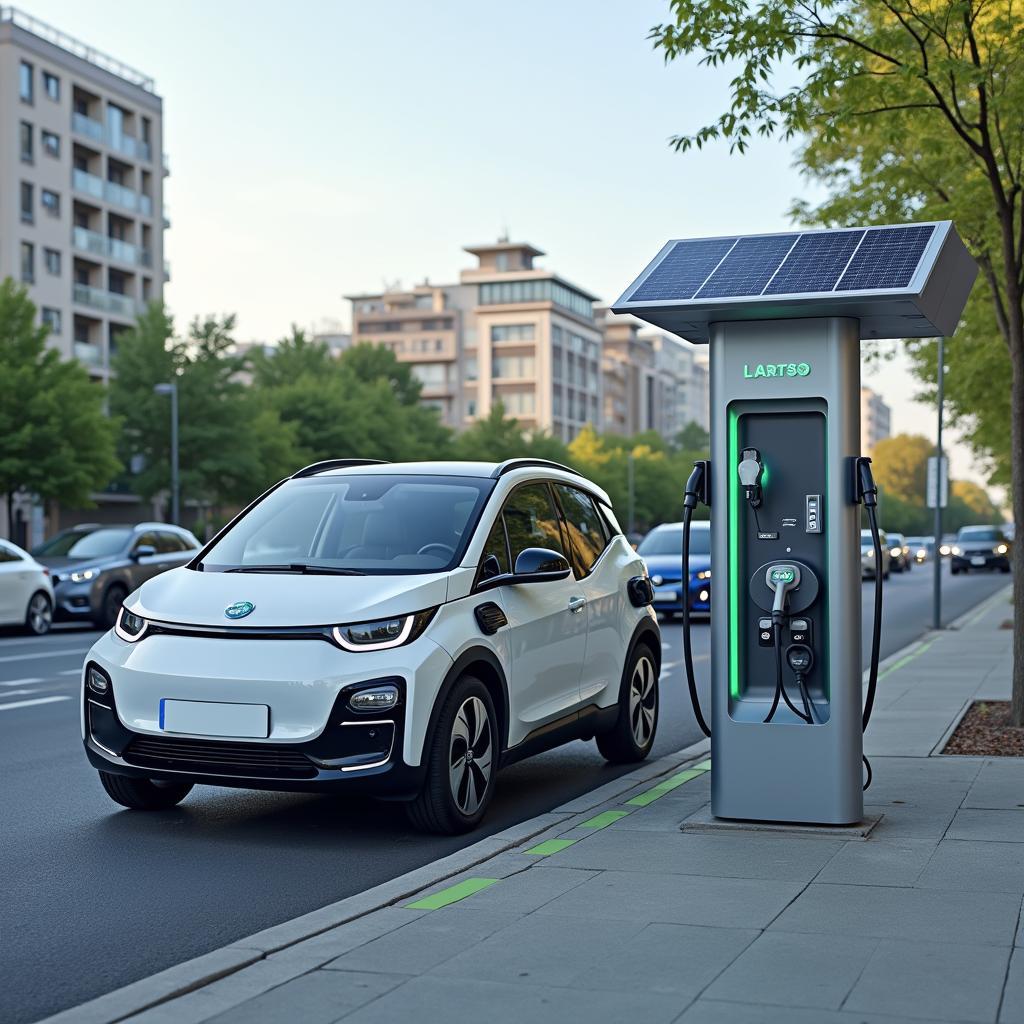 Xe điện đang sạc pin tại trạm sạc công cộng minh họa cho xu hướng giao thông bền vững
PASSAGE 2 – Battery Technology and Infrastructure Challenges
Độ khó: Medium (Band 6.0-7.5)
Thời gian đề xuất: 18-20 phút
The transition to electric vehicles represents one of the most significant technological shifts in the history of transportation, but this transformation faces several formidable challenges that must be addressed to achieve widespread adoption. Chief among these are the limitations of current battery technology and the need for extensive charging infrastructure, both of which require substantial investment and continued innovation.
Lithium-ion batteries, which currently power the vast majority of electric vehicles, have improved dramatically over the past two decades. Their energy density – the amount of energy they can store per unit of weight – has more than doubled since the year 2000, while costs have fallen by approximately 90%. This remarkable progress has made electric vehicles increasingly viable as alternatives to traditional cars. However, despite these advances, lithium-ion batteries still face significant limitations that hinder broader electric vehicle adoption.
One of the most pressing concerns for potential buyers is “range anxiety” – the fear that an electric vehicle will run out of power before reaching a charging station. While modern electric vehicles can now travel 300 to 500 kilometers on a single charge, this still falls short of the range offered by many petrol or diesel vehicles. Moreover, the actual range can vary significantly depending on driving conditions, with factors such as ambient temperature, driving speed, and the use of heating or air conditioning all affecting battery performance. In cold weather, for instance, battery efficiency can drop by 20-40%, substantially reducing the vehicle’s practical range.
Charging time presents another significant challenge. Even with fast-charging technology, which can replenish a battery to 80% capacity in 30-45 minutes, this is considerably longer than the few minutes required to fill a traditional fuel tank. For home charging, using a standard household electrical outlet, fully charging an electric vehicle can take anywhere from 8 to 20 hours, depending on the battery size and the power output of the charging point. This makes electric vehicles particularly suitable for people who can charge overnight at home, but more challenging for those who rely on street parking or lack access to private charging facilities.
The development of adequate charging infrastructure is crucial to overcoming these limitations. As noted in sustainable development in urban planning, cities must adapt their infrastructure to support emerging technologies. Currently, the global distribution of charging stations is highly uneven, with significant disparities between and within countries. Norway, which leads the world in electric vehicle adoption with EVs accounting for over 80% of new car sales, has invested heavily in public charging infrastructure, with charging stations available approximately every 50 kilometers along main roads. In contrast, many developing countries have minimal charging infrastructure, creating a significant barrier to electric vehicle adoption.
The type and location of charging infrastructure also matters considerably. Level 1 chargers, using standard household current, are the slowest but require no special equipment. Level 2 chargers, common in public parking areas and residential buildings, offer faster charging speeds and represent the most practical solution for daily charging needs. DC fast chargers, or Level 3 chargers, provide the quickest charging but are expensive to install and are typically located along highways or in commercial areas. The optimal charging network requires a careful balance of these different charging types, strategically positioned to meet varied user needs.
The electrical grid itself must also evolve to support widespread electric vehicle adoption. If millions of vehicles are charged simultaneously, particularly during peak demand periods, this could strain existing electrical infrastructure and potentially lead to power outages. Smart charging systems that can distribute demand throughout the day, charging vehicles primarily during off-peak hours when electricity demand is lower, represent one solution to this challenge. Some systems can even enable vehicle-to-grid technology, allowing electric vehicles to return power to the grid during peak demand periods, effectively turning them into mobile energy storage units.
Beyond lithium-ion technology, researchers are developing next-generation batteries that could address many current limitations. Solid-state batteries, which replace the liquid electrolyte found in conventional batteries with a solid material, promise higher energy density, faster charging times, and improved safety. Several companies, including Toyota and QuantumScape, are working to commercialize this technology, with production potentially beginning in the mid-2020s. Lithium-sulfur and lithium-air batteries offer even greater theoretical energy densities, though significant technical challenges remain before these technologies become commercially viable.
The environmental impact of battery production and disposal also requires careful consideration. The extraction of lithium, cobalt, and other materials used in batteries can cause environmental damage and has been associated with poor labor conditions in some mining regions. Developing effective recycling processes is essential to creating a truly sustainable electric vehicle ecosystem. Currently, only about 5% of lithium-ion batteries are recycled, but this figure is expected to increase as battery recycling technology improves and regulations become more stringent. Some experts predict that by 2040, recycled materials could supply up to 25% of the materials needed for new battery production.
Questions 14-18
Choose the correct letter, A, B, C, or D.
-
According to the passage, lithium-ion battery costs have:
- A. Increased by 90% since 2000
- B. Decreased by approximately 90%
- C. Remained stable since 2000
- D. Doubled in the past decade
-
What is “range anxiety”?
- A. The fear of driving too fast
- B. Concern about battery life
- C. Worry about running out of power before reaching a charging station
- D. Anxiety about the cost of electric vehicles
-
In cold weather, battery efficiency can decrease by:
- A. 5-10%
- B. 10-15%
- C. 15-20%
- D. 20-40%
-
Which country leads the world in electric vehicle adoption?
- A. China
- B. United States
- C. Norway
- D. Germany
-
What percentage of lithium-ion batteries are currently recycled?
- A. About 5%
- B. About 15%
- C. About 25%
- D. About 40%
Questions 19-23
Complete the summary below.
Choose NO MORE THAN TWO WORDS from the passage for each answer.
Electric vehicles face several challenges that affect their adoption. The 19. __ of current batteries limits how far vehicles can travel, and this is affected by factors like temperature and speed. Charging time is also a concern – while 20. __ can charge a battery to 80% in 30-45 minutes, home charging can take much longer. The 21. __ must also be improved to handle increased demand from electric vehicles, with 22. __ helping to manage when vehicles are charged. Researchers are developing **23. __, which use solid materials instead of liquid, to improve battery performance.
Questions 24-26
Do the following statements agree with the claims of the writer in Passage 2?
Write:
- YES if the statement agrees with the claims of the writer
- NO if the statement contradicts the claims of the writer
- NOT GIVEN if it is impossible to say what the writer thinks about this
- Fast-charging technology is now as quick as filling a petrol tank.
- Smart charging systems can help prevent strain on the electrical grid.
- All countries have equal access to charging infrastructure.
 Công nghệ pin lithium-ion hiện đại cho xe điện thể hiện sự phát triển của ngành công nghiệp ô tô
PASSAGE 3 – Economic Implications and Global Policy Frameworks for Electric Vehicle Transition
Độ khó: Hard (Band 7.0-9.0)
Thời gian đề xuất: 23-25 phút
The paradigm shift toward electric vehicles transcends mere technological innovation; it represents a fundamental reconfiguration of economic structures, industrial policies, and international relationships that have defined the automotive sector for over a century. As nations worldwide implement increasingly stringent environmental regulations and commit to ambitious decarbonization targets, the electric vehicle transition has emerged as a critical nexus where environmental imperatives, economic interests, and geopolitical considerations intersect in complex and sometimes contradictory ways.
From an economic perspective, the transition to electric vehicles presents both unprecedented opportunities and significant challenges. The traditional automotive industry, which employs millions of people globally and represents a substantial portion of manufacturing GDP in many countries, faces existential transformation. Electric vehicles contain significantly fewer components than internal combustion engine vehicles – typically around 20 moving parts in an electric motor compared to over 2,000 in a conventional engine. This fundamental difference has profound implications for employment, particularly in regions heavily dependent on automotive component manufacturing. Some economists estimate that the transition could result in the loss of several hundred thousand jobs in traditional automotive sectors, even as it creates new opportunities in battery production, charging infrastructure, and related technologies.
The geopolitical dimensions of this transition are equally significant. The current automotive industry is built upon a complex global network of oil production and distribution, with major oil-producing nations wielding considerable economic and political influence. Similarly, while examining the role of renewable energy in reducing industrial emissions, we see how energy transitions fundamentally reshape international power dynamics. The shift to electric vehicles threatens to disrupt this established order, potentially diminishing the strategic importance of oil reserves while elevating the significance of rare earth minerals and battery materials. Countries like China, which controls substantial portions of global lithium, cobalt, and rare earth element production and processing capacity, may find themselves in increasingly powerful positions. This has prompted some nations to develop strategies to secure supply chains for critical materials, viewing them as matters of national security rather than merely commercial concerns.
Government policies play a crucial role in facilitating – or hindering – the electric vehicle transition. Various policy mechanisms have been employed worldwide, each with distinct advantages and limitations. Financial incentives, such as purchase subsidies, tax credits, and reduced registration fees, have proven effective in stimulating consumer demand. Norway’s comprehensive incentive package, which includes exemptions from purchase taxes, reduced ferry fees, and free parking in many areas, has contributed to the country achieving the world’s highest electric vehicle adoption rate. However, such generous subsidies impose significant costs on government budgets, raising questions about fiscal sustainability and distributional equity – particularly whether subsidies primarily benefit wealthier consumers who might have purchased electric vehicles regardless.
Regulatory approaches constitute another important policy tool. Zero-emission vehicle mandates, requiring manufacturers to ensure that a certain percentage of their sales are electric vehicles, have been implemented in various jurisdictions including California, China, and several European countries. These mandates effectively internalize the environmental costs of traditional vehicles and can drive manufacturer investment in electric vehicle technology. However, they may also increase vehicle costs overall and potentially disadvantage consumers in regions with insufficient charging infrastructure. The question arises regarding how does renewable energy impact economic stability in small island nations?, which parallels concerns about how vehicle electrification affects different economies.
Infrastructure investment represents perhaps the most substantial policy challenge. Establishing comprehensive charging networks requires coordination between public and private sectors and substantial capital investment. The International Energy Agency estimates that meeting global climate goals would require approximately 40 million public charging points worldwide by 2030 – a more than tenfold increase from current levels. This investment must be carefully planned to avoid creating stranded assets if technology evolves in unexpected directions or if charging patterns differ from projections. Some analysts argue for technology-neutral policies that support various low-emission vehicles rather than focusing exclusively on battery electric vehicles, suggesting that hydrogen fuel cell vehicles or advanced biofuels might prove more suitable for certain applications.
The transition’s impact on developing economies presents particularly complex challenges. While electric vehicles offer potential benefits for reducing urban air pollution and, in contexts with clean electricity, lowering emissions, the high upfront costs of these vehicles may place them beyond the reach of most consumers in lower-income countries. Moreover, many developing nations lack the electrical infrastructure necessary to support widespread electric vehicle adoption. The risk emerges of creating a two-tiered global system where wealthy nations transition to clean vehicles while developing countries continue relying on polluting technologies, potentially exacerbating global inequality. International cooperation and technology transfer mechanisms may be necessary to ensure that the benefits of vehicle electrification are shared more equitably.
The automotive industry’s response to these challenges has been marked by both dramatic pronouncements and careful hedging. Major manufacturers have announced plans to electrify their vehicle lineups, with companies like General Motors committing to an “all-electric future” and others setting targets for electric vehicle sales percentages. However, many companies continue investing in conventional vehicle technology, particularly for markets where electric vehicle adoption remains limited. This dual approach reflects both uncertainty about the pace of transition and pragmatic recognition that different markets will evolve at different rates.
From a lifecycle emissions perspective, the benefits of electric vehicles depend critically on broader energy system transitions. Several comprehensive lifecycle assessments have found that even when accounting for manufacturing emissions and electricity generation, electric vehicles typically produce lower total emissions than comparable conventional vehicles in most regions. However, in areas with carbon-intensive electricity generation, these benefits may be modest in the near term. This interdependency between vehicle electrification and power sector decarbonization suggests that policies promoting both are necessary to maximize emission reductions. The expansion of electric scooters for reducing city traffic emissions demonstrates similar principles at work in urban mobility contexts.
Looking forward, the trajectory of electric vehicle adoption will depend on the interplay of technological advances, policy choices, and market dynamics. Battery technology breakthroughs that significantly increase range and reduce costs could accelerate adoption beyond current projections. Conversely, unforeseen challenges – such as material supply constraints, grid reliability issues, or consumer resistance – could slow the transition. What appears certain is that the shift toward electric vehicles represents not merely a change in automotive technology but a fundamental transformation in transportation systems, energy infrastructure, and the economic and geopolitical landscape. Successfully navigating this transition will require careful policy design, substantial investment, international cooperation, and continued technological innovation. The choices made in the coming decade will have profound implications for climate change mitigation, economic development, and global equity for generations to come.
Questions 27-31
Choose the correct letter, A, B, C, or D.
-
According to the passage, an electric motor typically contains:
- A. Around 20 moving parts
- B. Around 200 moving parts
- C. Around 2,000 moving parts
- D. The same number as conventional engines
-
Which country controls substantial portions of global battery material production?
- A. United States
- B. Norway
- C. China
- D. Germany
-
According to the International Energy Agency, how many public charging points are needed by 2030?
- A. 4 million
- B. 14 million
- C. 40 million
- D. 140 million
-
What does the passage suggest about electric vehicles in developing economies?
- A. They are easily affordable for most consumers
- B. They are banned in most countries
- C. High costs may place them beyond reach for many consumers
- D. They are more popular than in wealthy nations
-
The passage indicates that lifecycle emissions benefits of electric vehicles depend on:
- A. The color of the vehicle
- B. The brand of the manufacturer
- C. Broader energy system transitions
- D. The driving experience of the owner
Questions 32-36
Complete the sentences below.
Choose NO MORE THAN THREE WORDS from the passage for each answer.
- The electric vehicle transition represents a critical __ where environmental, economic, and geopolitical factors meet.
- Some economists estimate the transition could result in the loss of jobs in traditional __.
- Norway’s incentive package has helped achieve the world’s highest __.
- __ require manufacturers to ensure a certain percentage of sales are electric vehicles.
- Several comprehensive __ have shown electric vehicles typically produce lower total emissions.
Questions 37-40
Do the following statements agree with the claims of the writer in Passage 3?
Write:
- YES if the statement agrees with the claims of the writer
- NO if the statement contradicts the claims of the writer
- NOT GIVEN if it is impossible to say what the writer thinks about this
- The transition to electric vehicles will have no impact on employment in the automotive sector.
- Government subsidies for electric vehicles primarily benefit wealthier consumers.
- All automotive manufacturers have stopped investing in conventional vehicle technology.
- Successfully navigating the electric vehicle transition requires international cooperation and continued innovation.
 Bản đồ chính sách khuyến khích xe điện trên toàn cầu với các quốc gia có cam kết mạnh mẽ
Answer Keys – Đáp Án
PASSAGE 1: Questions 1-13
- FALSE
- TRUE
- TRUE
- FALSE
- FALSE
- TRUE
- rechargeable batteries
- battery technology
- respiratory diseases
- energy source
- B
- C
- B
PASSAGE 2: Questions 14-26
- B
- C
- D
- C
- A
- energy density
- fast-charging technology
- electrical grid
- smart charging systems
- solid-state batteries
- NO
- YES
- NO
PASSAGE 3: Questions 27-40
- A
- C
- C
- C
- C
- nexus
- automotive sectors
- electric vehicle adoption rate
- Zero-emission vehicle mandates
- lifecycle assessments
- NO
- YES
- NO
- YES
Giải Thích Đáp Án Chi Tiết
Passage 1 – Giải Thích
Câu 1: FALSE
- Dạng câu hỏi: True/False/Not Given
- Từ khóa: first invented, early 21st century
- Vị trí trong bài: Đoạn 2, dòng 1-2
- Giải thích: Bài viết nói rõ “the first electric cars appeared in the late 19th century” (xe điện đầu tiên xuất hiện vào cuối thế kỷ 19), không phải đầu thế kỷ 21. Đây là paraphrase ngược lại thông tin trong bài.
Câu 2: TRUE
- Dạng câu hỏi: True/False/Not Given
- Từ khóa: Nissan Leaf, demonstrated, consumers interested
- Vị trí trong bài: Đoạn 3, dòng 5-7
- Giải thích: Bài viết nói “The Nissan Leaf… demonstrating that there was significant consumer demand” (chứng minh có nhu cầu người tiêu dùng đáng kể). Câu hỏi dùng “interested” để paraphrase “demand”.
Câu 3: TRUE
- Dạng câu hỏi: True/False/Not Given
- Từ khóa: no emissions, exhaust pipes, driving
- Vị trí trong bài: Đoạn 4, dòng 3-4
- Giải thích: “Electric vehicles, producing no tailpipe emissions” khẳng định xe điện không thải khí từ ống xả. “Tailpipe” được paraphrase thành “exhaust pipes”.
Câu 4: FALSE
- Dạng câu hỏi: True/False/Not Given
- Từ khóa: all countries, same level, emission reduction
- Vị trí trong bài: Đoạn 5, dòng 5-9
- Giải thích: Bài viết so sánh Norway/Iceland (giảm nhiều) với các khu vực dùng than (giảm ít hơn), chứng tỏ không phải tất cả quốc gia đều có cùng mức giảm.
Câu 5: FALSE
- Dạng câu hỏi: True/False/Not Given
- Từ khóa: battery manufacturing, no carbon emissions
- Vị trí trong bài: Đoạn 6, dòng 3-4
- Giải thích: “The energy-intensive process of battery manufacturing currently produces substantial emissions” nói rõ quá trình sản xuất pin tạo ra lượng khí thải đáng kể.
Câu 6: TRUE
- Dạng câu hỏi: True/False/Not Given
- Từ khóa: United Kingdom, stop selling, 2030
- Vị trí trong bài: Đoạn 7, dòng 3-4
- Giải thích: “The United Kingdom… has announced plans to ban the sale of new petrol and diesel cars by 2030” paraphrase “stop selling” thành “ban the sale”.
Câu 7: rechargeable batteries
- Dạng câu hỏi: Sentence Completion
- Từ khóa: powered by, rather than petrol or diesel
- Vị trí trong bài: Đoạn 1, dòng 2-3
- Giải thích: “Electric vehicles are powered by rechargeable batteries” – cụm từ xuất hiện nguyên văn trong câu này.
Câu 8: battery technology
- Dạng câu hỏi: Sentence Completion
- Từ khóa: advances, early 21st century, more practical
- Vị trí trong bài: Đoạn 3, dòng 1-2
- Giải thích: “Advances in battery technology… made it possible to create electric vehicles” – “made possible” được paraphrase thành “made more practical”.
Câu 9: respiratory diseases
- Dạng câu hỏi: Sentence Completion
- Từ khóa: traditional vehicles, pollutants, can cause
- Vị trí trong bài: Đoạn 4, dòng 2-4
- Giải thích: “Contribute to poor air quality and various health problems such as respiratory diseases and cardiovascular conditions”.
Câu 10: energy source
- Dạng câu hỏi: Sentence Completion
- Từ khóa: charge electric vehicles, affects, environmental benefit
- Vị trí trong bài: Đoạn 5, dòng 4-5
- Giải thích: “This is why the energy source used for charging is crucial to determining the true environmental benefit”.
Câu 11: B
- Dạng câu hỏi: Multiple Choice
- Từ khóa: main problem, early electric vehicles
- Vị trí trong bài: Đoạn 2, dòng 3-5
- Giải thích: “Technological limitations… particularly regarding battery capacity and charging infrastructure” giải thích rõ vấn đề chính. Các đáp án khác không được đề cập trong bài.
Câu 12: C
- Dạng câu hỏi: Multiple Choice
- Từ khóa: negative environmental impact, production
- Vị trí trong bài: Đoạn 6, dòng 1-2
- Giải thích: “Lithium mining… can have negative effects on local ecosystems and water supplies” nêu rõ tác động của khai thác lithium.
Câu 13: B
- Dạng câu hỏi: Multiple Choice
- Từ khóa: future, automotive industry
- Vị trí trong bài: Đoạn 8, toàn bộ
- Giải thích: Đoạn cuối nói các hãng xe “investing billions of dollars” và đưa ra các ví dụ cụ thể về Volkswagen và Ford, cho thấy đầu tư mạnh vào công nghệ xe điện.
Passage 2 – Giải Thích
Câu 14: B
- Dạng câu hỏi: Multiple Choice
- Từ khóa: lithium-ion battery costs
- Vị trí trong bài: Đoạn 2, dòng 2-3
- Giải thích: “Costs have fallen by approximately 90%” – đáp án B chính xác. Các đáp án khác sai về hướng hoặc con số.
Câu 15: C
- Dạng câu hỏi: Multiple Choice
- Từ khóa: range anxiety, definition
- Vị trí trong bài: Đoạn 3, dòng 1-2
- Giải thích: Bài định nghĩa rõ “range anxiety – the fear that an electric vehicle will run out of power before reaching a charging station”.
Câu 16: D
- Dạng câu hỏi: Multiple Choice
- Từ khóa: cold weather, battery efficiency
- Vị trí trong bài: Đoạn 3, dòng 5-6
- Giải thích: “In cold weather… battery efficiency can drop by 20-40%” – con số được nêu rõ ràng trong bài.
Câu 17: C
- Dạng câu hỏi: Multiple Choice
- Từ khóa: leads the world, electric vehicle adoption
- Vị trí trong bài: Đoạn 5, dòng 3-5
- Giải thích: “Norway, which leads the world in electric vehicle adoption with EVs accounting for over 80% of new car sales” xác nhận Na Uy dẫn đầu.
Câu 18: A
- Dạng câu hỏi: Multiple Choice
- Từ khóa: percentage, batteries recycled, currently
- Vị trí trong bài: Đoạn 9, dòng 5-6
- Giải thích: “Currently, only about 5% of lithium-ion batteries are recycled” – con số chính xác là 5%.
Câu 19: energy density
- Dạng câu hỏi: Summary Completion
- Từ khóa: limits how far, travel
- Vị trí trong bài: Đoạn 2, dòng 2-3
- Giải thích: “Their energy density… has more than doubled” và khái niệm này liên quan đến khả năng đi xa của xe.
Câu 20: fast-charging technology
- Dạng câu hỏi: Summary Completion
- Từ khóa: charge battery to 80%, 30-45 minutes
- Vị trí trong bài: Đoạn 4, dòng 1-2
- Giải thích: “Even with fast-charging technology, which can replenish a battery to 80% capacity in 30-45 minutes” – khớp chính xác với thông tin.
Câu 21: electrical grid
- Dạng câu hỏi: Summary Completion
- Từ khóa: must be improved, handle increased demand
- Vị trí trong bài: Đoạn 7, dòng 1-2
- Giải thích: “The electrical grid itself must also evolve to support widespread electric vehicle adoption”.
Câu 22: smart charging systems
- Dạng câu hỏi: Summary Completion
- Từ khóa: helping to manage, when vehicles are charged
- Vị trí trong bài: Đoạn 7, dòng 4-5
- Giải thích: “Smart charging systems that can distribute demand throughout the day” quản lý thời gian sạc.
Câu 23: solid-state batteries
- Dạng câu hỏi: Summary Completion
- Từ khóa: solid materials instead of liquid
- Vị trí trong bài: Đoạn 8, dòng 1-2
- Giải thích: “Solid-state batteries, which replace the liquid electrolyte… with a solid material” mô tả chính xác công nghệ này.
Câu 24: NO
- Dạng câu hỏi: Yes/No/Not Given
- Từ khóa: fast-charging, as quick as, filling petrol tank
- Vị trí trong bài: Đoạn 4, dòng 1-3
- Giải thích: Bài nói sạc nhanh mất 30-45 phút “considerably longer than the few minutes required to fill a traditional fuel tank” – rõ ràng là chưa nhanh bằng.
Câu 25: YES
- Dạng câu hỏi: Yes/No/Not Given
- Từ khóa: smart charging systems, prevent strain, electrical grid
- Vị trí trong bài: Đoạn 7, dòng 4-6
- Giải thích: Tác giả khẳng định “Smart charging systems… represent one solution to this challenge” (thách thức về strain on infrastructure).
Câu 26: NO
- Dạng câu hỏi: Yes/No/Not Given
- Từ khóa: all countries, equal access, charging infrastructure
- Vị trí trong bài: Đoạn 5, dòng 1-2
- Giải thích: “The global distribution of charging stations is highly uneven, with significant disparities between and within countries” – rõ ràng không bình đẳng.
Passage 3 – Giải Thích
Câu 27: A
- Dạng câu hỏi: Multiple Choice
- Từ khóa: electric motor, moving parts
- Vị trí trong bài: Đoạn 2, dòng 3-5
- Giải thích: “Typically around 20 moving parts in an electric motor compared to over 2,000 in a conventional engine” – con số 20 được nêu rõ.
Câu 28: C
- Dạng câu hỏi: Multiple Choice
- Từ khóa: controls, battery material production
- Vị trí trong bài: Đoạn 3, dòng 5-7
- Giải thích: “Countries like China, which controls substantial portions of global lithium, cobalt, and rare earth element production” xác định rõ là Trung Quốc.
Câu 29: C
- Dạng câu hỏi: Multiple Choice
- Từ khóa: International Energy Agency, public charging points, 2030
- Vị trí trong bài: Đoạn 6, dòng 2-3
- Giải thích: “The International Energy Agency estimates… approximately 40 million public charging points worldwide by 2030” – con số chính xác là 40 triệu.
Câu 30: C
- Dạng câu hỏi: Multiple Choice
- Từ khóa: developing economies, suggest
- Vị trí trong bài: Đoạn 7, dòng 1-3
- Giải thích: “The high upfront costs of these vehicles may place them beyond the reach of most consumers in lower-income countries” khớp với đáp án C.
Câu 31: C
- Dạng câu hỏi: Multiple Choice
- Từ khóa: lifecycle emissions benefits, depend on
- Vị trí trong bài: Đoạn 9, dòng 1-2
- Giải thích: “From a lifecycle emissions perspective, the benefits… depend critically on broader energy system transitions” – đáp án C chính xác.
Câu 32: nexus
- Dạng câu hỏi: Sentence Completion
- Từ khóa: critical, environmental, economic, geopolitical
- Vị trí trong bài: Đoạn 1, dòng 3-4
- Giải thích: “The electric vehicle transition has emerged as a critical nexus where environmental imperatives, economic interests, and geopolitical considerations intersect”.
Câu 33: automotive sectors
- Dạng câu hỏi: Sentence Completion
- Từ khóa: loss of jobs, traditional
- Vị trí trong bài: Đoạn 2, dòng 6-8
- Giải thích: “The transition could result in the loss of several hundred thousand jobs in traditional automotive sectors” – cụm “automotive sectors” là đáp án chính xác.
Câu 34: electric vehicle adoption rate
- Dạng câu hỏi: Sentence Completion
- Từ khóa: Norway’s incentive package, helped achieve, world’s highest
- Vị trí trong bài: Đoạn 4, dòng 3-5
- Giải thích: “Has contributed to the country achieving the world’s highest electric vehicle adoption rate” – đáp án là “electric vehicle adoption rate”.
Câu 35: Zero-emission vehicle mandates
- Dạng câu hỏi: Sentence Completion
- Từ khóa: require manufacturers, certain percentage
- Vị trí trong bài: Đoạn 5, dòng 1-3
- Giải thích: “Zero-emission vehicle mandates, requiring manufacturers to ensure that a certain percentage of their sales are electric vehicles” – khớp chính xác.
Câu 36: lifecycle assessments
- Dạng câu hỏi: Sentence Completion
- Từ khóa: comprehensive, shown, lower total emissions
- Vị trí trong bài: Đoạn 9, dòng 2-4
- Giải thích: “Several comprehensive lifecycle assessments have found that… electric vehicles typically produce lower total emissions”.
Câu 37: NO
- Dạng câu hỏi: Yes/No/Not Given
- Từ khóa: no impact, employment, automotive sector
- Vị trí trong bài: Đoạn 2, dòng 6-9
- Giải thích: Tác giả nói rõ “could result in the loss of several hundred thousand jobs” – có tác động mạnh đến việc làm, không phải “no impact”.
Câu 38: YES
- Dạng câu hỏi: Yes/No/Not Given
- Từ khóa: subsidies, primarily benefit, wealthier consumers
- Vị trí trong bài: Đoạn 4, dòng 6-8
- Giải thích: Tác giả đặt câu hỏi về “distributional equity – particularly whether subsidies primarily benefit wealthier consumers” – cho thấy tác giả đồng ý quan điểm này.
Câu 39: NO
- Dạng câu hỏi: Yes/No/Not Given
- Từ khóa: all manufacturers, stopped investing, conventional vehicle
- Vị trí trong bài: Đoạn 8, dòng 3-5
- Giải thích: “However, many companies continue investing in conventional vehicle technology” – rõ ràng chưa tất cả đều ngừng đầu tư.
Câu 40: YES
- Dạng câu hỏi: Yes/No/Not Given
- Từ khóa: navigating transition, requires, international cooperation, innovation
- Vị trí trong bài: Đoạn 10, dòng 8-9
- Giải thích: “Successfully navigating this transition will require… international cooperation, and continued technological innovation” – tác giả khẳng định điều này.
Từ Vựng Quan Trọng Theo Passage
Passage 1 – Essential Vocabulary
| Từ vựng | Loại từ | Phiên âm | Nghĩa tiếng Việt | Ví dụ từ bài | Collocation |
|---|---|---|---|---|---|
| environmental impact | noun phrase | /ɪnˌvaɪrənˈmentl ˈɪmpækt/ | tác động môi trường | reduce their environmental impact | minimize/reduce environmental impact |
| rechargeable batteries | noun phrase | /riːˈtʃɑːdʒəbl ˈbætəriz/ | pin sạc được | powered by rechargeable batteries | lithium-ion rechargeable batteries |
| direct emissions | noun phrase | /dəˈrekt ɪˈmɪʃnz/ | khí thải trực tiếp | produce zero direct emissions | reduce/eliminate direct emissions |
| combat climate change | verb phrase | /ˈkɒmbæt ˈklaɪmət tʃeɪndʒ/ | chống biến đổi khí hậu | looking to combat climate change | efforts to combat climate change |
| technological limitations | noun phrase | /ˌteknəˈlɒdʒɪkl ˌlɪmɪˈteɪʃnz/ | hạn chế về công nghệ | technological limitations at the time | overcome technological limitations |
| niche technology | noun phrase | /niːʃ tekˈnɒlədʒi/ | công nghệ ngách | remained a niche technology | develop niche technology |
| consumer demand | noun phrase | /kənˈsjuːmə dɪˈmɑːnd/ | nhu cầu người tiêu dùng | significant consumer demand | meet/satisfy consumer demand |
| tailpipe emissions | noun phrase | /ˈteɪlpaɪp ɪˈmɪʃnz/ | khí thải từ ống xả | producing no tailpipe emissions | reduce/eliminate tailpipe emissions |
| respiratory diseases | noun phrase | /rɪˈspɪrətri dɪˈziːzɪz/ | bệnh hô hấp | contribute to respiratory diseases | cause/prevent respiratory diseases |
| lifecycle | noun | /ˈlaɪfsaɪkl/ | vòng đời sản phẩm | considering their entire lifecycle | product/vehicle lifecycle |
| fossil fuels | noun phrase | /ˈfɒsl fjuːəlz/ | nhiên liệu hóa thạch | generated from fossil fuels | burn/replace fossil fuels |
| renewable energy | noun phrase | /rɪˈnjuːəbl ˈenədʒi/ | năng lượng tái tạo | high proportion of renewable energy | invest in renewable energy |
Passage 2 – Essential Vocabulary
| Từ vựng | Loại từ | Phiên âm | Nghĩa tiếng Việt | Ví dụ từ bài | Collocation |
|---|---|---|---|---|---|
| technological shifts | noun phrase | /ˌteknəˈlɒdʒɪkl ʃɪfts/ | sự chuyển đổi công nghệ | most significant technological shifts | undergo technological shifts |
| formidable challenges | noun phrase | /ˈfɔːmɪdəbl ˈtʃælɪndʒɪz/ | thách thức khó khăn | faces several formidable challenges | overcome formidable challenges |
| energy density | noun phrase | /ˈenədʒi ˈdensəti/ | mật độ năng lượng | their energy density has doubled | increase/improve energy density |
| viable | adjective | /ˈvaɪəbl/ | khả thi | increasingly viable alternatives | commercially/economically viable |
| range anxiety | noun phrase | /reɪndʒ æŋˈzaɪəti/ | lo lắng về quãng đường | most pressing concern is range anxiety | overcome/address range anxiety |
| ambient temperature | noun phrase | /ˈæmbiənt ˈtemprətʃə/ | nhiệt độ môi trường xung quanh | factors such as ambient temperature | affect by ambient temperature |
| replenish | verb | /rɪˈplenɪʃ/ | nạp đầy, bổ sung | can replenish a battery | replenish battery/supplies |
| disparities | noun | /dɪˈspærətiz/ | sự chênh lệch | significant disparities between countries | reduce/address disparities |
| strategically positioned | adjective phrase | /strəˈtiːdʒɪkli pəˈzɪʃnd/ | được bố trí chiến lược | strategically positioned to meet needs | strategically positioned assets |
| peak demand periods | noun phrase | /piːk dɪˈmɑːnd ˈpɪəriədz/ | thời điểm nhu cầu cao nhất | during peak demand periods | manage peak demand periods |
| off-peak hours | noun phrase | /ɒf piːk ˈaʊəz/ | giờ thấp điểm | charging during off-peak hours | take advantage of off-peak hours |
| electrolyte | noun | /ɪˈlektrəlaɪt/ | chất điện phân | replace the liquid electrolyte | solid/liquid electrolyte |
| commercially viable | adjective phrase | /kəˈmɜːʃəli ˈvaɪəbl/ | khả thi về mặt thương mại | become commercially viable | make commercially viable |
| recycling processes | noun phrase | /riːˈsaɪklɪŋ ˈprəʊsesɪz/ | quy trình tái chế | developing effective recycling processes | improve recycling processes |
Passage 3 – Essential Vocabulary
| Từ vựng | Loại từ | Phiên âm | Nghĩa tiếng Việt | Ví dụ từ bài | Collocation |
|---|---|---|---|---|---|
| paradigm shift | noun phrase | /ˈpærədaɪm ʃɪft/ | sự chuyển đổi mô hình tư duy | represents a paradigm shift | undergo a paradigm shift |
| reconfiguration | noun | /riːkənˌfɪɡjəˈreɪʃn/ | sự tái cấu trúc | fundamental reconfiguration | require reconfiguration |
| stringent | adjective | /ˈstrɪndʒənt/ | nghiêm ngặt | increasingly stringent regulations | impose stringent regulations |
| decarbonization targets | noun phrase | /diːˌkɑːbənaɪˈzeɪʃn ˈtɑːɡɪts/ | mục tiêu giảm carbon | ambitious decarbonization targets | achieve decarbonization targets |
| nexus | noun | /ˈneksəs/ | điểm giao thoa, mối liên hệ | critical nexus where factors intersect | form a nexus between |
| existential transformation | noun phrase | /ˌeɡzɪˈstenʃl ˌtrænsfəˈmeɪʃn/ | biến đổi căn bản | faces existential transformation | undergo existential transformation |
| geopolitical dimensions | noun phrase | /ˌdʒiːəʊpəˈlɪtɪkl dɪˈmenʃnz/ | khía cạnh địa chính trị | geopolitical dimensions are significant | consider geopolitical dimensions |
| disrupt | verb | /dɪsˈrʌpt/ | làm gián đoạn, phá vỡ | threatens to disrupt this order | disrupt the market/industry |
| supply chains | noun phrase | /səˈplaɪ tʃeɪnz/ | chuỗi cung ứng | secure supply chains | manage/optimize supply chains |
| facilitating | verb | /fəˈsɪlɪteɪtɪŋ/ | tạo điều kiện thuận lợi | play a role in facilitating | facilitating the transition |
| fiscal sustainability | noun phrase | /ˈfɪskl səˌsteɪnəˈbɪləti/ | tính bền vững tài khóa | questions about fiscal sustainability | ensure fiscal sustainability |
| distributional equity | noun phrase | /ˌdɪstrɪˈbjuːʃənl ˈekwəti/ | công bằng phân phối | questions about distributional equity | promote distributional equity |
| internalize | verb | /ɪnˈtɜːnəlaɪz/ | nội bộ hóa chi phí | effectively internalize costs | internalize environmental costs |
| stranded assets | noun phrase | /ˈstrændɪd ˈæsets/ | tài sản mắc cạn | avoid creating stranded assets | risk of stranded assets |
| technology-neutral policies | noun phrase | /tekˈnɒlədʒi ˈnjuːtrəl ˈpɒləsiz/ | chính sách trung lập công nghệ | argue for technology-neutral policies | adopt technology-neutral policies |
| upfront costs | noun phrase | /ˌʌpˈfrʌnt kɒsts/ | chi phí ban đầu | high upfront costs | reduce upfront costs |
| exacerbating | verb | /ɪɡˈzæsəbeɪtɪŋ/ | làm trầm trọng thêm | potentially exacerbating inequality | avoid exacerbating problems |
| hedging | noun/verb | /ˈhedʒɪŋ/ | dè dặt, phòng ngừa rủi ro | marked by careful hedging | hedging their bets |
| lifecycle assessments | noun phrase | /ˈlaɪfsaɪkl əˈsesmənts/ | đánh giá vòng đời | comprehensive lifecycle assessments | conduct lifecycle assessments |
| interdependency | noun | /ˌɪntədɪˈpendənsi/ | sự phụ thuộc lẫn nhau | this interdependency suggests | recognize interdependency |
| trajectory | noun | /trəˈdʒektəri/ | quỹ đạo, xu hướng phát triển | the trajectory of adoption | change the trajectory |
Kết Bài
Chủ đề “How electric vehicles are reducing the global carbon footprint” không chỉ là một nội dung phổ biến trong kỳ thi IELTS Reading mà còn phản ánh một xu hướng toàn cầu quan trọng về bảo vệ môi trường và phát triển bền vững. Qua bộ đề thi mẫu này, bạn đã được trải nghiệm một bài thi IELTS Reading hoàn chỉnh với ba passages có độ khó tăng dần, từ giới thiệu cơ bản về xe điện đến phân tích chuyên sâu về công nghệ, và cuối cùng là đánh giá học thuật về tác động kinh tế-chính trị toàn cầu.
Bộ đề này cung cấp đầy đủ 40 câu hỏi với 7 dạng khác nhau, giúp bạn làm quen với format thi thật và rèn luyện kỹ năng xử lý các dạng câu hỏi phổ biến nhất. Phần đáp án chi tiết không chỉ cho biết đáp án đúng mà còn giải thích rõ vị trí thông tin trong bài, cách paraphrase được sử dụng, và chiến lược làm bài hiệu quả cho từng dạng câu hỏi.
Bảng từ vựng được tổ chức theo từng passage với phiên âm, nghĩa tiếng Việt, ví dụ và collocation sẽ giúp bạn mở rộng vốn từ học thuật, đặc biệt trong lĩnh vực môi trường và công nghệ – những chủ đề xuất hiện thường xuyên trong IELTS Reading. Hãy lưu lại bộ đề này và luyện tập nhiều lần để cải thiện kỹ năng đọc hiểu và tốc độ làm bài của bạn. Chúc bạn đạt band điểm cao trong kỳ thi IELTS sắp tới!


[…] từ vựng để nâng cao khả năng đọc hiểu học thuật của bạn. Tương tự như How electric vehicles are reducing the global carbon footprint, chủ đề về công nghệ xanh và phát triển bền vững ngày càng trở nên quan […]