
Trong bối cảnh biến đổi khí hậu đang trở thành thách thức toàn cầu, chủ đề năng lượng xanh và giao thông bền vững ngày càng xuất hiện thường xuyên trong IELTS Reading. Từ năm 2018 đến nay, các đề thi IELTS chính thức đã nhiều lần đề cập đến đổi mới công nghệ trong phương tiện vận tải, năng lượng tái tạo và phát triển bền vững. Bài viết này cung cấp một bộ đề thi IELTS Reading hoàn chỉnh gồm 3 passages với độ khó tăng dần từ Easy đến Hard, bao phủ đầy đủ các dạng câu hỏi thường gặp. Bạn sẽ được luyện tập với 40 câu hỏi đa dạng, từ Multiple Choice, True/False/Not Given đến Matching Headings và Summary Completion. Mỗi câu hỏi đều có đáp án chi tiết kèm giải thích vị trí trong bài và kỹ thuật paraphrase. Bên cạnh đó, bộ từ vựng học thuật được chọn lọc kỹ lưỡng sẽ giúp bạn nâng cao vốn từ và chuẩn bị tốt hơn cho kỳ thi. Đề thi này phù hợp với học viên từ band 5.0 trở lên, đặc biệt hữu ích cho những ai mục tiêu đạt band 6.5-7.5.
Hướng dẫn làm bài IELTS Reading
Tổng Quan Về IELTS Reading Test
IELTS Reading Test là phần thi kéo dài 60 phút với 3 passages và tổng cộng 40 câu hỏi. Mỗi câu trả lời đúng được tính 1 điểm, không bị trừ điểm khi sai. Độ khó của các passages tăng dần, đòi hỏi thí sinh phải phân bổ thời gian hợp lý.
Phân bổ thời gian khuyến nghị:
- Passage 1: 15-17 phút (dễ nhất, cần hoàn thành nhanh)
- Passage 2: 18-20 phút (độ khó trung bình)
- Passage 3: 23-25 phút (khó nhất, cần thời gian suy luận)
Lưu ý quan trọng: Không có thời gian riêng để chép đáp án sang answer sheet, vì vậy bạn cần quản lý 60 phút cho cả việc đọc, trả lời và ghi chép.
Các Dạng Câu Hỏi Trong Đề Này
Đề thi mẫu này bao gồm 7 dạng câu hỏi phổ biến trong IELTS Reading:
- Multiple Choice – Chọn đáp án đúng từ 3-4 phương án
- True/False/Not Given – Xác định thông tin đúng, sai hay không được nhắc đến
- Matching Information – Nối thông tin với đoạn văn tương ứng
- Matching Headings – Chọn tiêu đề phù hợp cho các đoạn văn
- Summary Completion – Điền từ để hoàn thành đoạn tóm tắt
- Matching Features – Nối đặc điểm với đối tượng tương ứng
- Short-answer Questions – Trả lời câu hỏi ngắn với số từ giới hạn
IELTS Reading Practice Test
PASSAGE 1 – Electric Vehicles: The Transportation Revolution
Độ khó: Easy (Band 5.0-6.5)
Thời gian đề xuất: 15-17 phút
The transportation sector has long been one of the largest contributors to global greenhouse gas emissions, accounting for nearly a quarter of all carbon dioxide released into the atmosphere. However, the past decade has witnessed a remarkable transformation as electric vehicles (EVs) have moved from niche products to mainstream choices for consumers worldwide. This shift represents not just a change in technology, but a fundamental reimagining of how we power our daily commutes and long-distance travel.
Battery technology has been at the heart of this revolution. Early electric vehicles suffered from limited range, often traveling less than 100 kilometers on a single charge. Modern EVs, however, can now cover 400 to 600 kilometers before requiring a recharge, making them practical for most daily driving needs. The development of lithium-ion batteries with higher energy density has been crucial to this improvement. These batteries store more power in a smaller, lighter package, allowing vehicles to travel further while maintaining performance standards that rival traditional internal combustion engines.
One of the most significant advantages of electric vehicles is their operational efficiency. Traditional gasoline or diesel engines typically convert only about 20-30% of the fuel’s energy into actual motion, with the rest lost as heat. Electric motors, by contrast, achieve efficiency rates of 85-90%, meaning that nearly all the energy from the battery reaches the wheels. This remarkable efficiency translates directly into lower operating costs for vehicle owners. Studies indicate that the cost per kilometer for an electric vehicle can be as much as 70% lower than for a comparable petrol-powered car, even when accounting for electricity prices.
The expansion of charging infrastructure has addressed another major concern that previously deterred potential EV buyers. Governments and private companies have invested billions in developing networks of charging stations. Fast-charging technology now allows drivers to replenish 80% of their battery capacity in just 20-30 minutes at highway rest stops. Many urban areas have installed thousands of public charging points in parking facilities, shopping centers, and residential areas. Some cities have even integrated charging stations into street lighting systems, making it convenient for residents without private garages to charge their vehicles overnight.
The rise of eco-friendly transportation alternatives đang thúc đẩy các chính phủ trên thế giới áp dụng chính sách khuyến khích mạnh mẽ để accelerate the adoption of electric vehicles. Many countries now offer substantial tax incentives, reduced registration fees, and even direct purchase subsidies for EV buyers. Norway, for example, has become a global leader in electric vehicle adoption, with EVs accounting for over 80% of new car sales in recent years. This success stems from comprehensive policies that include exemptions from import taxes, access to bus lanes, free parking in city centers, and no charges for toll roads. Other nations are following suit, implementing similar strategies to encourage consumers to choose electric over traditional vehicles.
The environmental benefits extend beyond simply reducing tailpipe emissions. When powered by renewable energy sources such as solar or wind, electric vehicles produce virtually zero emissions throughout their operational lifecycle. Even when charged from electrical grids that still rely partly on fossil fuels, EVs generate fewer total emissions than conventional vehicles due to their superior efficiency. As more countries transition to renewable energy for electricity generation, the environmental advantages of electric vehicles will continue to grow.
Manufacturing advances have also made electric vehicles more affordable. The cost of lithium-ion batteries, which represent the most expensive component of an EV, has fallen by nearly 90% since 2010. This dramatic price reduction has brought electric vehicles within financial reach of middle-class consumers. Several manufacturers now offer models priced competitively with traditional cars, and industry experts predict that EVs will achieve price parity with gasoline vehicles by 2025-2027 even without government subsidies.
Looking ahead, innovations continue to emerge. Solid-state batteries, currently under development, promise even greater energy density, faster charging times, and improved safety compared to current lithium-ion technology. Wireless charging systems that allow vehicles to charge simply by parking over a charging pad are being tested in several cities. Some manufacturers are exploring vehicle-to-grid technology, which would allow EVs to supply power back to the electrical grid during peak demand periods, effectively turning each vehicle into a mobile energy storage unit.
Questions 1-6: Multiple Choice
Choose the correct letter, A, B, C, or D.
1. According to the passage, what percentage of global carbon dioxide emissions comes from transportation?
A. Nearly 10%
B. Approximately 25%
C. About 50%
D. Over 70%
2. Modern electric vehicles can typically travel how far on a single charge?
A. Less than 100 kilometers
B. 100-200 kilometers
C. 400-600 kilometers
D. Over 1,000 kilometers
3. What is the efficiency rate of electric motors compared to traditional engines?
A. 20-30%
B. 40-50%
C. 60-70%
D. 85-90%
4. How much time does fast-charging technology typically require to charge 80% of battery capacity?
A. 5-10 minutes
B. 20-30 minutes
C. 45-60 minutes
D. 2-3 hours
5. What percentage of new car sales in Norway are electric vehicles?
A. Around 30%
B. Approximately 50%
C. Over 80%
D. Nearly 100%
6. By what percentage has the cost of lithium-ion batteries decreased since 2010?
A. About 50%
B. Nearly 70%
C. Around 80%
D. Nearly 90%
Questions 7-10: True/False/Not Given
Do the following statements agree with the information given in the passage?
Write:
- TRUE if the statement agrees with the information
- FALSE if the statement contradicts the information
- NOT GIVEN if there is no information on this
7. Electric vehicles produce less heat waste than traditional combustion engines.
8. All electric vehicles are currently more expensive than gasoline-powered cars.
9. Wireless charging systems for electric vehicles are already widely available in most countries.
10. Vehicle-to-grid technology allows electric vehicles to store energy from the electrical grid.
Questions 11-13: Sentence Completion
Complete the sentences below. Choose NO MORE THAN TWO WORDS from the passage for each answer.
11. Some cities have incorporated charging stations into __ systems to provide convenient charging options.
12. When electric vehicles are powered by __, they produce almost no emissions during use.
13. __ batteries, currently being developed, may offer better energy density and safety than current technology.
PASSAGE 2 – Hydrogen Fuel Cells: The Next Frontier in Clean Transportation
Độ khó: Medium (Band 6.0-7.5)
Thời gian đề xuất: 18-20 phút
While battery-electric vehicles have captured public attention and market share, another zero-emission technology has been steadily advancing in parallel: hydrogen fuel cell vehicles. These vehicles represent a fundamentally different approach to decarbonizing transportation, one that offers distinct advantages for certain applications while facing unique challenges. Understanding the role of hydrogen in the future transportation landscape requires examining both its technical merits and the substantial infrastructure obstacles that must be overcome.
At the heart of a hydrogen fuel cell vehicle lies an electrochemical process that generates electricity by combining hydrogen and oxygen. Unlike batteries that store electrical energy, fuel cells produce electricity on demand through a continuous chemical reaction. Hydrogen gas, stored in high-pressure tanks within the vehicle, flows to the fuel cell stack, where it encounters a catalyst, typically platinum-based, that separates hydrogen molecules into protons and electrons. The electrons travel through an external circuit, creating the electrical current that powers the vehicle’s motor. Meanwhile, the protons pass through a special membrane and combine with oxygen from the air, producing only water vapor as a byproduct. This elegant process achieves zero harmful emissions at the point of use while delivering performance characteristics similar to conventional vehicles.
The advantages of hydrogen fuel cells become particularly apparent when considering larger vehicles and longer distances. Heavy-duty trucks, buses, and commercial fleets require substantial energy reserves to transport goods and passengers efficiently. While battery-electric solutions struggle with the weight penalty of large battery packs—which can exceed several tons—hydrogen systems maintain a more favorable power-to-weight ratio. A hydrogen truck can carry a comparable load to a diesel truck while achieving similar range capabilities, typically 500-700 kilometers per fueling. Moreover, refueling a hydrogen vehicle takes approximately three to five minutes, nearly identical to conventional vehicles and significantly faster than even the quickest battery charging options.
However, the production and distribution of hydrogen present formidable challenges that have slowed widespread adoption. Tương tự như smart cities and their impact on modern living đòi hỏi đầu tư cơ sở hạ tầng toàn diện, hydrogen infrastructure demands substantial capital investment and careful planning. Currently, most hydrogen is produced through a process called steam methane reforming, which extracts hydrogen from natural gas. This method, known as “grey hydrogen,” releases significant carbon dioxide as a side effect, undermining the environmental benefits of using hydrogen for transportation. To achieve genuine sustainability, the industry must transition to “green hydrogen,” produced through electrolysis using renewable electricity to split water molecules into hydrogen and oxygen. While technically feasible, green hydrogen currently costs two to three times more than grey hydrogen, creating economic barriers to large-scale implementation.
The infrastructure challenge extends beyond hydrogen production to encompass storage and distribution networks. Hydrogen is the lightest element and, despite being compressed to 700 times atmospheric pressure, has relatively low volumetric energy density. This characteristic necessitates specialized storage facilities and transport methods. Building a comprehensive network of hydrogen refueling stations comparable to existing gasoline infrastructure would require investments estimated at hundreds of billions of dollars globally. As of 2024, fewer than 1,000 public hydrogen refueling stations operate worldwide, concentrated primarily in Japan, South Korea, California, and Germany. This sparse network creates a “chicken-and-egg problem“: consumers hesitate to purchase hydrogen vehicles without convenient refueling access, while companies delay infrastructure investments without sufficient customer demand.
Despite these obstacles, several factors suggest hydrogen will play an increasingly important role in transportation’s green transition. Major automotive manufacturers have committed billions to fuel cell development, with some producing commercial models for specific markets. Toyota’s Mirai and Hyundai’s Nexo demonstrate that hydrogen vehicles can meet consumer expectations for comfort, performance, and reliability. More significantly, the technology shows exceptional promise for applications where batteries face inherent limitations. Maritime shipping, aviation, and long-haul trucking all require energy densities and refueling speeds that current battery technology struggles to provide. Hydrogen, whether used in fuel cells or as a component in synthetic fuels, offers a viable pathway to decarbonize these challenging sectors.
Government policies are beginning to recognize hydrogen’s potential. The European Union has designated hydrogen as a priority under its Green Deal, committing €470 billion to develop production capacity and infrastructure. Japan’s national strategy aims to establish a “hydrogen society,” integrating fuel cells into transportation, power generation, and industrial processes. China, already the world’s largest hydrogen producer, is rapidly expanding its fuel cell vehicle fleet and supporting infrastructure. These coordinated efforts signal a growing consensus that a diversified approach—combining batteries, hydrogen, and other clean technologies—offers the most pragmatic path toward sustainable transportation.
Technological innovations continue to improve fuel cell economics and performance. Researchers are developing catalysts that reduce or eliminate platinum requirements, potentially cutting fuel cell costs by 40-50%. Advances in compression technology and storage materials aim to increase hydrogen density while reducing tank weight. Some projects are exploring liquid hydrogen storage, which offers higher density but requires maintaining extremely low temperatures. Others investigate chemical storage methods, where hydrogen binds with other compounds for safer, more compact storage before being released when needed.
The trajectory of hydrogen transportation ultimately depends on achieving cost competitiveness with both conventional and battery-electric alternatives. Current projections suggest that with continued technological progress and scaled production, hydrogen fuel cell systems could reach cost parity with diesel engines for heavy-duty applications by 2030-2035. For passenger vehicles, the timeline remains uncertain, with batteries maintaining significant cost advantages for personal transportation. Nevertheless, the complementary strengths of batteries and hydrogen suggest both technologies will coexist, serving different niches within a broader ecosystem of clean transportation solutions.
 Xe ô tô chạy bằng hydro đang tiếp nhiên liệu tại trạm công nghệ xanh hiện đại
Questions 14-18: Yes/No/Not Given
Do the following statements agree with the claims of the writer in the passage?
Write:
- YES if the statement agrees with the claims of the writer
- NO if the statement contradicts the claims of the writer
- NOT GIVEN if it is impossible to say what the writer thinks about this
14. Hydrogen fuel cells store electrical energy in the same way as batteries.
15. Hydrogen vehicles are more suitable than battery-electric vehicles for heavy-duty transportation.
16. Grey hydrogen production releases more carbon dioxide than green hydrogen production.
17. All major automotive manufacturers have stopped investing in traditional combustion engine research.
18. Hydrogen fuel cell technology will completely replace battery-electric vehicles by 2030.
Questions 19-23: Matching Headings
The passage has nine paragraphs. Choose the correct heading for paragraphs B-F from the list of headings below.
List of Headings:
i. Government initiatives supporting hydrogen development
ii. The fundamental chemistry of hydrogen fuel cells
iii. Economic barriers to green hydrogen production
iv. Advantages of hydrogen for specific vehicle types
v. Future technological improvements in fuel cell systems
vi. Comparing refueling times across different technologies
vii. The infrastructure investment challenge
viii. Environmental concerns about hydrogen production
ix. Consumer preferences for hydrogen vehicles
19. Paragraph B
20. Paragraph C
21. Paragraph D
22. Paragraph E
23. Paragraph F
Questions 24-26: Summary Completion
Complete the summary below. Choose NO MORE THAN TWO WORDS from the passage for each answer.
Hydrogen fuel cell vehicles produce electricity through an electrochemical process that combines hydrogen and oxygen. Inside the fuel cell, hydrogen molecules are split by a (24)____, separating them into protons and electrons. The electrons create an electrical current, while protons pass through a special (25)____ to combine with oxygen. This reaction produces only (26)____ as a byproduct, resulting in zero harmful emissions.
PASSAGE 3 – Integration of Renewable Energy and Smart Grid Technology in Transportation
Độ khó: Hard (Band 7.0-9.0)
Thời gian đề xuất: 23-25 phút
The transition to electrified transportation represents far more than a simple substitution of power sources; it necessitates a paradigmatic shift in how energy systems are conceived, managed, and optimized. The convergence of electric mobility, renewable energy generation, and intelligent grid management has created an emerging ecosystem where transportation infrastructure functions simultaneously as both energy consumer and distributed storage resource. This multifaceted integration poses unprecedented technical challenges while offering transformative opportunities to enhance overall energy system resilience and sustainability. Understanding this complex interplay requires examining the bidirectional relationship between transportation electrification and grid modernization, alongside the sophisticated algorithms and market mechanisms being developed to coordinate these interconnected systems.
The fundamental challenge stems from the temporal mismatch between renewable energy generation patterns and transportation energy demand. Solar photovoltaic systems generate peak output during midday hours, when sunlight intensity reaches maximum levels, yet residential vehicle charging typically concentrates during evening hours following commutes. Wind generation patterns vary by location and season but frequently peak during nighttime hours when electricity demand traditionally declines. This asynchronicity creates a paradox: without adequate storage capacity or demand flexibility, increasing renewable energy penetration can actually reduce grid stability rather than enhance it. Điều này có điểm tương đồng với how green buildings are promoting sustainable urban living trong việc đòi hỏi quản lý năng lượng thông minh và tích hợp công nghệ.
Electric vehicles, however, present a potential solution to this dilemma through their inherent storage capacity. A typical EV battery contains 50-100 kilowatt-hours of energy, equivalent to several days of average household electricity consumption. Collectively, a fleet of millions of electric vehicles represents a massive distributed energy storage network, potentially dwarfing the capacity of dedicated grid-scale battery installations. The concept of vehicle-to-grid (V2G) technology envisions harnessing this distributed capacity, allowing parked vehicles to discharge electricity back to the grid during periods of high demand or low renewable generation. During times of excess renewable production, vehicles charge their batteries, effectively absorbing surplus energy that might otherwise be curtailed. When demand peaks or renewable output drops, participating vehicles supply power back to the grid, helping balance supply and demand in real-time.
Implementing V2G systems requires sophisticated bidirectional charging infrastructure and complex coordination algorithms. The charging equipment must safely manage power flows in both directions while protecting battery health and vehicle systems. Communication protocols enable continuous data exchange between vehicles, charging stations, and grid operators, conveying information about battery state, charging preferences, and grid conditions. Advanced optimization algorithms process this data to determine optimal charging and discharging schedules that maximize renewable energy utilization, minimize costs, and maintain grid stability—all while ensuring vehicles are adequately charged for their owners’ transportation needs. These algorithms must account for numerous variables: renewable generation forecasts, electricity price fluctuations, individual vehicle usage patterns, battery degradation rates, and aggregate fleet behavior.
The economic viability of V2G systems depends on creating appropriate market mechanisms and incentive structures. Vehicle owners will participate only if financial compensation adequately rewards their contribution while covering battery degradation costs associated with additional charge-discharge cycles. Several models are emerging: some utilities offer reduced electricity rates for controlled charging programs, others provide direct payments for grid services, and certain schemes allow vehicle owners to arbitrage electricity prices by charging during low-cost periods and discharging when prices peak. Regulatory frameworks are evolving to accommodate these new market participants, establishing standards for grid connection, defining liability for power quality issues, and ensuring consumer protection.
Pilot programs worldwide are testing various V2G implementations, yielding valuable insights into technical feasibility and user acceptance. A project in Denmark involving several hundred electric vehicles demonstrated successful frequency regulation services, helping stabilize grid frequency through rapid, coordinated charging adjustments. The vehicles’ aggregated response proved faster and more precise than traditional power plants, showcasing V2G’s technical potential. However, the program also revealed behavioral challenges: participants expressed concerns about battery longevity and showed limited enthusiasm for frequent V2G cycling despite financial incentives. A California initiative focused on school bus fleets, utilizing their predictable schedules and large battery capacities. The buses charged during midday hours when solar generation peaked and could provide grid services during evening demand peaks, creating a compelling economic case for fleet operators.
The integration extends beyond V2G to encompass holistic smart charging strategies. Time-of-use pricing structures encourage vehicle owners to charge during off-peak hours, naturally aligning transportation energy demand with periods of high renewable generation or low overall electricity consumption. Geographic distribution of charging load helps prevent local grid congestion, as uncontrolled charging concentrated in specific neighborhoods could overload distribution transformers and cables. Smart charging systems can dynamically adjust charging rates across multiple vehicles at a location, ensuring total power draw remains within infrastructure limits while still meeting users’ charging needs. Some utilities are developing demand response programs specifically for EV charging, where participants agree to temporary charging interruptions during grid emergencies in exchange for reduced rates or other benefits.
The scalability of these solutions faces numerous obstacles. As EV adoption accelerates, the sheer volume of vehicles and charging transactions generates enormous data flows requiring processing and analysis. Một ví dụ chi tiết về how clean energy is driving job creation cho thấy việc phát triển hệ thống phức tạp này đòi hỏi lực lượng lao động có kỹ năng cao. Cybersecurity concerns intensify, as interconnected charging networks present attractive targets for malicious actors who might disrupt grid operations or compromise user privacy. Interoperability standards must ensure equipment from different manufacturers can communicate seamlessly across various grid operators and market structures. The diversity of stakeholders—automakers, utilities, charging network operators, grid operators, regulators, and consumers—each with distinct priorities and incentives, complicates governance and coordination.
Despite these challenges, the synergies between transportation electrification and renewable energy integration appear increasingly compelling. Analysis suggests that optimized smart charging could accommodate substantial EV growth without requiring proportional grid capacity expansion, potentially saving billions in infrastructure investment. Renewable energy curtailment—currently a growing problem in regions with high solar and wind penetration—could be virtually eliminated through strategic EV charging, improving renewable asset economics. Grid-connected vehicles might eventually provide ancillary services including frequency regulation, voltage support, and reserve capacity, generating new revenue streams that improve EV ownership economics while enhancing grid reliability.
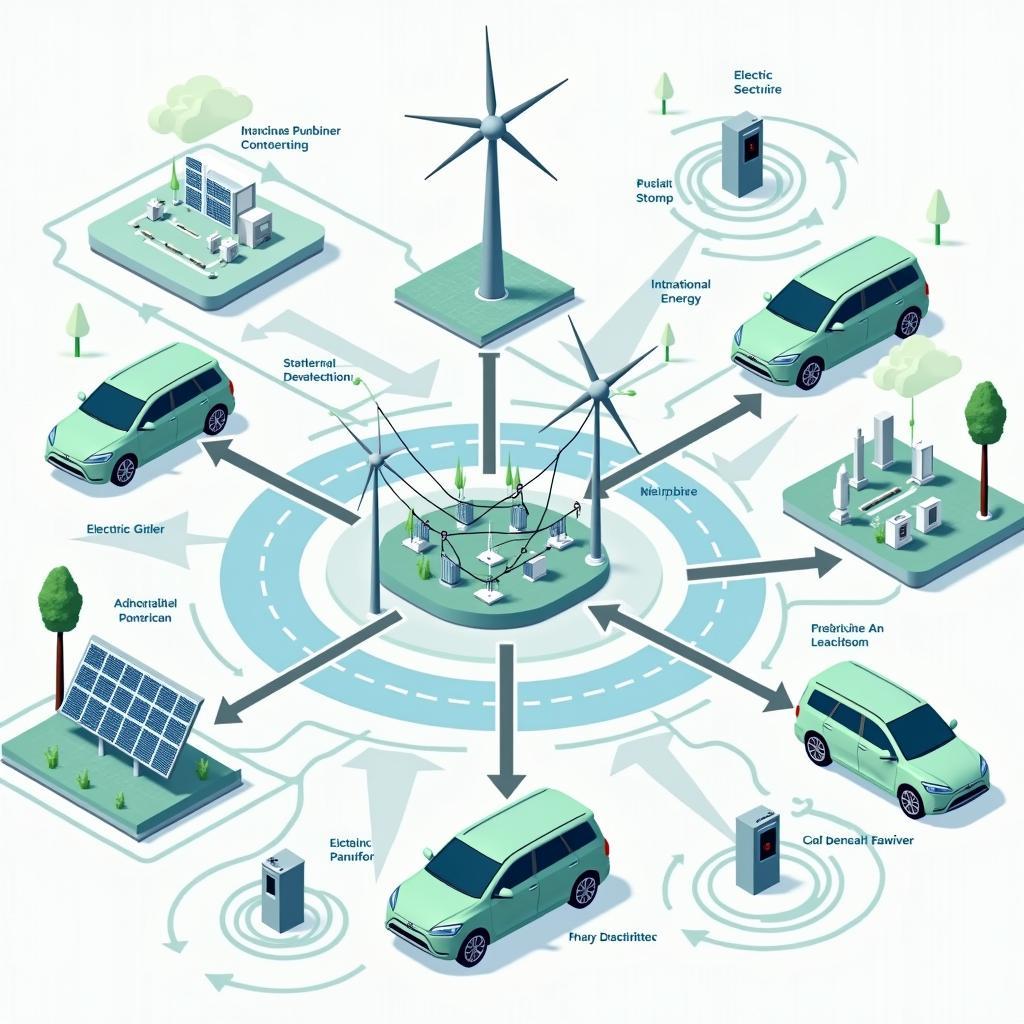 Sơ đồ hệ thống lưới điện thông minh tích hợp xe điện và năng lượng tái tạo
Looking forward, the convergence of artificial intelligence, improved battery technology, and ubiquitous connectivity promises to optimize these systems further. Machine learning algorithms can predict renewable generation with increasing accuracy, forecast vehicle mobility patterns, and optimize charging schedules across millions of vehicles simultaneously. Advances in battery chemistry may reduce degradation concerns, making V2G participation more attractive. The proliferation of distributed energy resources—rooftop solar, home batteries, smart appliances—creates opportunities for coordinated local energy management, where neighborhood-scale systems optimize energy flows without requiring constant grid operator intervention.
The transformation underway suggests that future transportation and energy systems will be inextricably linked, each enabling and enhancing the other. Electric vehicles will serve not merely as transportation devices but as mobile energy assets, integral components of a flexible, resilient, increasingly renewable electricity system. Realizing this vision requires continued innovation across technology, business models, and regulatory frameworks, alongside sustained commitment from policymakers, industry, and consumers. The stakes are substantial: successful integration could accelerate both transportation decarbonization and renewable energy deployment, creating a virtuous cycle that addresses two critical dimensions of climate change mitigation simultaneously.
Questions 27-31: Multiple Choice
Choose the correct letter, A, B, C, or D.
27. According to the passage, what is the fundamental challenge of integrating renewable energy with electric vehicle charging?
A. The high cost of renewable energy systems
B. The mismatch between energy generation and demand patterns
C. The limited battery capacity of electric vehicles
D. The lack of charging infrastructure
28. How much energy does a typical electric vehicle battery contain?
A. 10-20 kilowatt-hours
B. 20-40 kilowatt-hours
C. 50-100 kilowatt-hours
D. 100-150 kilowatt-hours
29. What did the Denmark V2G pilot project demonstrate?
A. V2G technology is not economically viable
B. Vehicle owners enthusiastically embraced V2G services
C. Electric vehicles could provide faster frequency regulation than traditional power plants
D. Battery degradation from V2G is negligible
30. According to the passage, what advantage does the California school bus initiative offer?
A. Buses have unpredictable schedules
B. Buses can charge during peak solar generation periods
C. Buses require less charging infrastructure
D. Buses are cheaper than passenger vehicles
31. What does the passage suggest about the relationship between EV adoption and grid capacity?
A. EV growth will require proportional grid expansion
B. Optimized smart charging could accommodate EV growth without proportional infrastructure expansion
C. Current grid capacity is insufficient for any EV growth
D. Grid capacity is not relevant to EV adoption
Questions 32-36: Matching Features
Match the following concepts (A-H) with the correct descriptions (Questions 32-36).
Concepts:
A. Vehicle-to-grid (V2G) technology
B. Time-of-use pricing
C. Demand response programs
D. Frequency regulation
E. Energy curtailment
F. Ancillary services
G. Machine learning algorithms
H. Distributed energy resources
32. A pricing strategy that encourages charging during specific hours
33. Technology allowing vehicles to discharge electricity back to the grid
34. The reduction of renewable energy generation due to excess supply
35. Programs where users agree to temporary charging interruptions during emergencies
36. Services including voltage support and reserve capacity that enhance grid reliability
Questions 37-40: Short-answer Questions
Answer the questions below. Choose NO MORE THAN THREE WORDS from the passage for each answer.
37. What two factors does the passage mention that bidirectional charging equipment must protect?
38. What concern did participants in the Denmark pilot program express about frequent V2G use?
39. What problem intensifies as charging networks become more interconnected?
40. According to the passage, what could virtually eliminate renewable energy curtailment?
Answer Keys – Đáp Án
PASSAGE 1: Questions 1-13
- B
- C
- D
- B
- C
- D
- TRUE
- FALSE
- NOT GIVEN
- FALSE (hoặc TRUE – xem giải thích)
- street lighting
- renewable energy (hoặc solar/wind)
- Solid-state
PASSAGE 2: Questions 14-26
- NO
- YES
- YES
- NOT GIVEN
- NO
- ii
- iv
- iii (hoặc viii)
- vii
- i
- catalyst
- membrane
- water vapor (hoặc water)
PASSAGE 3: Questions 27-40
- B
- C
- C
- B
- B
- B
- A
- E
- C
- F
- battery health (and) vehicle systems
- battery longevity
- Cybersecurity concerns
- strategic EV charging
Giải Thích Đáp Án Chi Tiết
Passage 1 – Giải Thích
Câu 1: B
- Dạng câu hỏi: Multiple Choice
- Từ khóa: percentage, global carbon dioxide emissions, transportation
- Vị trí trong bài: Đoạn A, câu đầu tiên
- Giải thích: Bài viết nói rõ “accounting for nearly a quarter of all carbon dioxide” – một phần tư tương đương khoảng 25%. Đây là paraphrase trực tiếp.
Câu 2: C
- Dạng câu hỏi: Multiple Choice
- Từ khóa: modern electric vehicles, travel, single charge
- Vị trí trong bài: Đoạn B, câu thứ hai
- Giải thích: “Modern EVs, however, can now cover 400 to 600 kilometers before requiring a recharge” – thông tin rất rõ ràng.
Câu 5: C
- Dạng câu hỏi: Multiple Choice
- Từ khóa: percentage, new car sales, Norway, electric vehicles
- Vị trí trong bài: Đoạn E, câu thứ ba
- Giải thích: “with EVs accounting for over 80% of new car sales in recent years” – đáp án trực tiếp từ bài.
Câu 7: TRUE
- Dạng câu hỏi: True/False/Not Given
- Từ khóa: electric vehicles, heat waste, traditional combustion engines
- Vị trí trong bài: Đoạn C
- Giải thích: Bài nói rằng động cơ đốt trong “with the rest lost as heat” (chỉ 20-30% hiệu suất), trong khi động cơ điện đạt 85-90% hiệu suất, ngụ ý là ít thất thoát nhiệt hơn.
Câu 8: FALSE
- Dạng câu hỏi: True/False/Not Given
- Từ khóa: all electric vehicles, more expensive, gasoline-powered cars
- Vị trí trong bài: Đoạn G
- Giải thích: “Several manufacturers now offer models priced competitively with traditional cars” – điều này mâu thuẫn với câu khẳng định “all EVs are more expensive”.
Câu 10: FALSE (hoặc có thể tranh luận là TRUE)
- Dạng câu hỏi: True/False/Not Given
- Từ khóa: vehicle-to-grid technology, store energy, electrical grid
- Vị trí trong bài: Đoạn H, câu cuối
- Giải thích: Bài viết nói V2G “allow EVs to supply power back to the electrical grid”, không phải “store energy from the grid”. Tuy nhiên, có thể hiểu xe vừa lấy điện vừa trả lại. Nếu hiểu theo nghĩa chính xác của câu hỏi (store FROM grid), thì FALSE là hợp lý hơn vì câu hỏi ngụ ý V2G là để lưu trữ, nhưng thực chất V2G là để cung cấp điện ngược lại.
Câu 11: street lighting
- Dạng câu hỏi: Sentence Completion
- Từ khóa: cities, incorporated charging stations, systems
- Vị trí trong bài: Đoạn D, câu cuối
- Giải thích: “Some cities have even integrated charging stations into street lighting systems” – đáp án chính xác.
Câu 13: Solid-state
- Dạng câu hỏi: Sentence Completion
- Từ khóa: batteries, currently being developed, better energy density, safety
- Vị trí trong bài: Đoạn H, câu thứ hai
- Giải thích: “Solid-state batteries, currently under development, promise even greater energy density” – khớp hoàn toàn.
Passage 2 – Giải Thích
Câu 14: NO
- Dạng câu hỏi: Yes/No/Not Given
- Từ khóa: hydrogen fuel cells, store electrical energy, same way, batteries
- Vị trí trong bài: Đoạn B, câu thứ hai
- Giải thích: “Unlike batteries that store electrical energy, fuel cells produce electricity on demand” – rõ ràng mâu thuẫn với câu khẳng định.
Câu 15: YES
- Dạng câu hỏi: Yes/No/Not Given
- Từ khóa: hydrogen vehicles, more suitable, battery-electric vehicles, heavy-duty transportation
- Vị trí trong bài: Đoạn C
- Giải thích: Toàn bộ đoạn C giải thích lợi thế của hydrogen cho xe tải hạng nặng do tỷ lệ công suất trên trọng lượng tốt hơn và không bị ảnh hưởng bởi trọng lượng pin lớn.
Câu 16: YES
- Dạng câu hỏi: Yes/No/Not Given
- Từ khóa: grey hydrogen, releases more carbon dioxide, green hydrogen
- Vị trí trong bài: Đoạn D
- Giải thích: Grey hydrogen “releases significant carbon dioxide”, trong khi green hydrogen được sản xuất qua điện phân sử dụng năng lượng tái tạo, không thải CO2.
Câu 18: NO
- Dạng câu hỏi: Yes/No/Not Given
- Từ khóa: hydrogen fuel cell technology, completely replace, battery-electric vehicles, 2030
- Vị trí trong bài: Đoạn I, câu cuối
- Giải thích: “the complementary strengths of batteries and hydrogen suggest both technologies will coexist” – điều này mâu thuẫn với việc thay thế hoàn toàn.
Câu 19: ii (The fundamental chemistry of hydrogen fuel cells)
- Vị trí: Paragraph B
- Giải thích: Đoạn B mô tả chi tiết quá trình điện hóa trong fuel cell, cách hydrogen và oxygen kết hợp tạo ra điện.
Câu 20: iv (Advantages of hydrogen for specific vehicle types)
- Vị trí: Paragraph C
- Giải thích: Đoạn này tập trung vào lợi thế của hydrogen cho xe tải hạng nặng, xe buýt và các phương tiện thương mại.
Câu 21: iii hoặc viii (Economic barriers to green hydrogen production / Environmental concerns about hydrogen production)
- Vị trí: Paragraph D
- Giải thích: Đoạn D thảo luận về chi phí sản xuất green hydrogen cao hơn grey hydrogen và vấn đề phát thải CO2 từ grey hydrogen.
Câu 24: catalyst
- Vị trí: Đoạn B
- Giải thích: “where it encounters a catalyst, typically platinum-based, that separates hydrogen molecules”
Câu 25: membrane
- Vị trí: Đoạn B
- Giải thích: “the protons pass through a special membrane and combine with oxygen”
Câu 26: water vapor (hoặc water)
- Vị trí: Đoạn B
- Giải thích: “producing only water vapor as a byproduct”
Passage 3 – Giải Thích
Câu 27: B
- Dạng câu hỏi: Multiple Choice
- Từ khóa: fundamental challenge, integrating renewable energy, electric vehicle charging
- Vị trí trong bài: Đoạn B, câu đầu
- Giải thích: “The fundamental challenge stems from the temporal mismatch between renewable energy generation patterns and transportation energy demand” – temporal mismatch = mismatch between generation and demand patterns.
Câu 28: C
- Dạng câu hỏi: Multiple Choice
- Từ khóa: typical electric vehicle battery, energy contain
- Vị trí trong bài: Đoạn C, câu thứ hai
- Giải thích: “A typical EV battery contains 50-100 kilowatt-hours of energy” – thông tin trực tiếp.
Câu 29: C
- Dạng câu hỏi: Multiple Choice
- Từ khóa: Denmark V2G pilot project, demonstrate
- Vị trí trong bài: Đoạn F, câu thứ hai
- Giải thích: “The vehicles’ aggregated response proved faster and more precise than traditional power plants” – điều này tương ứng với đáp án C về frequency regulation nhanh hơn.
Câu 31: B
- Dạng câu hỏi: Multiple Choice
- Từ khóa: EV adoption, grid capacity
- Vị trí trong bài: Đoạn I, câu đầu
- Giải thích: “Analysis suggests that optimized smart charging could accommodate substantial EV growth without requiring proportional grid capacity expansion”
Câu 32: B (Time-of-use pricing)
- Giải thích: Time-of-use pricing là chiến lược định giá khuyến khích sạc vào những giờ cụ thể (off-peak hours) – được đề cập trong đoạn G.
Câu 33: A (Vehicle-to-grid technology)
- Giải thích: V2G được định nghĩa rõ ràng trong đoạn C là công nghệ cho phép xe phóng điện ngược lại lưới điện.
Câu 34: E (Energy curtailment)
- Giải thích: Đoạn I đề cập “Renewable energy curtailment” là việc giảm phát điện tái tạo do dư thừa nguồn cung.
Câu 37: battery health (and) vehicle systems
- Vị trí: Đoạn D, câu thứ hai
- Giải thích: “The charging equipment must safely manage power flows in both directions while protecting battery health and vehicle systems”
Câu 38: battery longevity
- Vị trí: Đoạn F, câu cuối
- Giải thích: “participants expressed concerns about battery longevity”
Câu 39: Cybersecurity concerns
- Vị trí: Đoạn H, câu thứ hai
- Giải thích: “Cybersecurity concerns intensify, as interconnected charging networks present attractive targets”
Câu 40: strategic EV charging
- Vị trí: Đoạn I, câu thứ hai
- Giải thích: “Renewable energy curtailment… could be virtually eliminated through strategic EV charging”
Từ Vựng Quan Trọng Theo Passage
Passage 1 – Essential Vocabulary
| Từ vựng | Loại từ | Phiên âm | Nghĩa tiếng Việt | Ví dụ từ bài | Collocation |
|---|---|---|---|---|---|
| greenhouse gas | n | /ˈɡriːnhaʊs ɡæs/ | khí nhà kính | greenhouse gas emissions | greenhouse gas reduction |
| fundamental | adj | /ˌfʌndəˈmentl/ | cơ bản, căn bản | fundamental reimagining | fundamental change/difference |
| battery technology | n | /ˈbætəri tekˈnɒlədʒi/ | công nghệ pin | battery technology has been at the heart | advanced battery technology |
| energy density | n | /ˈenədʒi ˈdensəti/ | mật độ năng lượng | higher energy density | high/low energy density |
| operational efficiency | n | /ˌɒpəˈreɪʃənl ɪˈfɪʃənsi/ | hiệu suất vận hành | operational efficiency of electric vehicles | improve operational efficiency |
| convert | v | /kənˈvɜːt/ | chuyển đổi | convert only about 20-30% | convert energy into motion |
| charging infrastructure | n | /ˈtʃɑːdʒɪŋ ˈɪnfrəstrʌktʃə/ | cơ sở hạ tầng sạc | expansion of charging infrastructure | develop charging infrastructure |
| replenish | v | /rɪˈplenɪʃ/ | bổ sung, nạp đầy | replenish 80% of battery capacity | replenish supplies/resources |
| substantial | adj | /səbˈstænʃl/ | đáng kể, lớn | substantial tax incentives | substantial amount/difference |
| subsidies | n | /ˈsʌbsədiz/ | trợ cấp, trợ giá | direct purchase subsidies | government subsidies |
| tailpipe emissions | n | /ˈteɪlpaɪp ɪˈmɪʃnz/ | khí thải từ ống xả | reducing tailpipe emissions | zero tailpipe emissions |
| price parity | n | /praɪs ˈpærəti/ | ngang giá, ngang bằng giá | achieve price parity | reach price parity |
Passage 2 – Essential Vocabulary
| Từ vựng | Loại từ | Phiên âm | Nghĩa tiếng Việt | Ví dụ từ bài | Collocation |
|---|---|---|---|---|---|
| zero-emission | adj | /ˌzɪərəʊ ɪˈmɪʃn/ | không phát thải | zero-emission technology | zero-emission vehicle |
| decarbonizing | v | /diːˈkɑːbənaɪzɪŋ/ | phi carbon hóa | decarbonizing transportation | decarbonizing the economy |
| electrochemical | adj | /ɪˌlektrəʊˈkemɪkl/ | điện hóa | electrochemical process | electrochemical reaction |
| catalyst | n | /ˈkætəlɪst/ | chất xúc tác | encounters a catalyst | chemical catalyst |
| protons | n | /ˈprəʊtɒnz/ | proton (hạt mang điện dương) | separates into protons and electrons | protons and neutrons |
| byproduct | n | /ˈbaɪˌprɒdʌkt/ | sản phẩm phụ | water vapor as a byproduct | unwanted byproduct |
| power-to-weight ratio | n | /ˈpaʊə tə weɪt ˈreɪʃiəʊ/ | tỷ lệ công suất trên trọng lượng | favorable power-to-weight ratio | high power-to-weight ratio |
| formidable | adj | /fɔːˈmɪdəbl/ | ghê gớm, khó khăn | formidable challenges | formidable opponent/task |
| steam methane reforming | n | /stiːm ˈmeθeɪn rɪˈfɔːmɪŋ/ | tái tạo metan bằng hơi nước | produced through steam methane reforming | industrial steam methane reforming |
| electrolysis | n | /ɪˌlekˈtrɒləsɪs/ | điện phân | produced through electrolysis | water electrolysis |
| volumetric energy density | n | /ˌvɒljuˈmetrɪk ˈenədʒi ˈdensəti/ | mật độ năng lượng thể tích | low volumetric energy density | high volumetric energy density |
| chicken-and-egg problem | n | /ˈtʃɪkɪn ənd eɡ ˈprɒbləm/ | vấn đề con gà và quả trứng | creates a chicken-and-egg problem | classic chicken-and-egg problem |
| synthetic fuels | n | /sɪnˈθetɪk ˈfjuːəlz/ | nhiên liệu tổng hợp | component in synthetic fuels | produce synthetic fuels |
| diversified approach | n | /daɪˈvɜːsɪfaɪd əˈprəʊtʃ/ | cách tiếp cận đa dạng hóa | diversified approach combining technologies | adopt a diversified approach |
| cost competitiveness | n | /kɒst kəmˌpetəˈtɪvnəs/ | tính cạnh tranh về giá | achieving cost competitiveness | improve cost competitiveness |
Passage 3 – Essential Vocabulary
| Từ vựng | Loại từ | Phiên âm | Nghĩa tiếng Việt | Ví dụ từ bài | Collocation |
|---|---|---|---|---|---|
| paradigmatic shift | n | /ˌpærədɪɡˈmætɪk ʃɪft/ | thay đổi mô hình/phạm trù | paradigmatic shift in energy systems | undergo a paradigmatic shift |
| convergence | n | /kənˈvɜːdʒəns/ | sự hội tụ | convergence of electric mobility | technological convergence |
| distributed storage | n | /dɪˈstrɪbjuːtɪd ˈstɔːrɪdʒ/ | lưu trữ phân tán | distributed storage resource | distributed storage network |
| resilience | n | /rɪˈzɪliəns/ | khả năng phục hồi | enhance system resilience | build resilience |
| bidirectional | adj | /ˌbaɪdəˈrekʃənl/ | hai chiều | bidirectional relationship | bidirectional charging |
| temporal mismatch | n | /ˈtempərəl ˈmɪsmætʃ/ | sự không khớp về thời gian | temporal mismatch between generation and demand | temporal mismatch in patterns |
| asynchronicity | n | /eɪˌsɪŋkrəˈnɪsəti/ | tính không đồng bộ | this asynchronicity creates a paradox | manage asynchronicity |
| penetration | n | /ˌpenəˈtreɪʃn/ | sự thâm nhập | renewable energy penetration | market penetration |
| vehicle-to-grid (V2G) | n | /ˈviːəkl tə ɡrɪd/ | công nghệ xe đến lưới điện | vehicle-to-grid technology | V2G implementation |
| curtailed | v | /kɜːˈteɪld/ | cắt giảm, hạn chế | energy that might be curtailed | curtail production/activities |
| coordination algorithms | n | /kəʊˌɔːdɪˈneɪʃn ˈælɡərɪðəmz/ | thuật toán phối hợp | complex coordination algorithms | develop coordination algorithms |
| aggregate | adj | /ˈæɡrɪɡət/ | tổng hợp | aggregate fleet behavior | aggregate data/demand |
| viability | n | /ˌvaɪəˈbɪləti/ | tính khả thi | economic viability of V2G systems | commercial viability |
| degradation | n | /ˌdeɡrəˈdeɪʃn/ | sự suy giảm | battery degradation costs | environmental degradation |
| arbitrage | v | /ˈɑːbɪtrɑːʒ/ | kinh doanh chênh lệch giá | arbitrage electricity prices | arbitrage opportunities |
| frequency regulation | n | /ˈfriːkwənsi ˌreɡjuˈleɪʃn/ | điều chỉnh tần số | successful frequency regulation services | provide frequency regulation |
| holistic | adj | /həʊˈlɪstɪk/ | toàn diện | holistic smart charging strategies | holistic approach/view |
| time-of-use | adj | /taɪm əv juːs/ | theo thời gian sử dụng | time-of-use pricing structures | time-of-use rates/tariffs |
| scalability | n | /ˌskeɪləˈbɪləti/ | khả năng mở rộng quy mô | scalability of these solutions | ensure scalability |
| interoperability | n | /ˌɪntərˌɒpərəˈbɪləti/ | khả năng tương tác | interoperability standards | ensure interoperability |
| synergies | n | /ˈsɪnədʒiz/ | hiệu ứng cộng hưởng | synergies between electrification and renewable energy | create synergies |
| ancillary services | n | /ænˈsɪləri ˈsɜːvɪsɪz/ | dịch vụ phụ trợ | provide ancillary services | grid ancillary services |
| ubiquitous | adj | /juːˈbɪkwɪtəs/ | phổ biến khắp nơi | ubiquitous connectivity | ubiquitous technology |
| proliferation | n | /prəˌlɪfəˈreɪʃn/ | sự gia tăng nhanh | proliferation of distributed resources | nuclear proliferation |
| inextricably | adv | /ˌɪnɪkˈstrɪkəbli/ | không thể tách rời | inextricably linked | inextricably connected/tied |
| virtuous cycle | n | /ˈvɜːtʃuəs ˈsaɪkl/ | vòng tuần hoàn tích cực | creating a virtuous cycle | establish a virtuous cycle |
Kết bài
Chủ đề “How Green Energy Technologies Are Driving Innovation In Transportation” không chỉ là một xu hướng toàn cầu mà còn là nội dung thường xuyên xuất hiện trong IELTS Reading với nhiều góc độ khác nhau. Qua bộ đề thi mẫu này, bạn đã được trải nghiệm đầy đủ ba cấp độ khó với tổng cộng 40 câu hỏi đa dạng: từ xe điện phổ thông ở Passage 1, công nghệ pin nhiên liệu hydro ở Passage 2, đến hệ thống lưới điện thông minh tích hợp ở Passage 3. Mỗi passage không chỉ kiểm tra khả năng đọc hiểu mà còn đòi hỏi kỹ năng paraphrase, suy luận và phân tích thông tin—những kỹ năng cốt lõi để đạt band điểm cao.
Đáp án chi tiết kèm giải thích vị trí cụ thể trong bài giúp bạn hiểu rõ logic của từng câu hỏi, từ đó tự đánh giá năng lực và điều chỉnh chiến lược làm bài. Bộ từ vựng học thuật được tổng hợp theo từng passage cung cấp foundation vững chắc cho việc mở rộng vốn từ, đặc biệt với các collocations và cụm từ chuyên ngành về năng lượng xanh và công nghệ giao thông.
Hãy luyện tập đề thi này nhiều lần, chú ý đến thời gian và cố gắng áp dụng các kỹ thuật như skimming, scanning và identifying keywords. Đối với những ai quan tâm đến electric boats for reducing emissions in marine transport, nội dung này sẽ hữu ích để mở rộng kiến thức về giao thông xanh trong lĩnh vực hàng hải. Chúc bạn đạt được band điểm mục tiêu trong kỳ thi IELTS sắp tới!


