
Mở bài
Chủ đề “Describe A Person Who Motivates You To Exercise” là một trong những đề tài phổ biến trong IELTS Speaking, đặc biệt ở Part 2. Đây là câu hỏi thuộc nhóm “Describe a person” – một dạng bài kinh điển yêu cầu thí sinh mô tả về một người có ảnh hưởng tích cực đến lối sống và sức khỏe của bản thân.
Theo thống kê từ các kỳ thi IELTS thực tế từ năm 2022 đến 2024, chủ đề về sức khỏe, tập thể dục và lối sống lành mạnh xuất hiện với tần suất cao, chiếm khoảng 15-20% các đề thi Speaking. Khả năng xuất hiện của chủ đề này trong tương lai được đánh giá ở mức cao, đặc biệt trong bối cảnh sau đại dịch khi sức khỏe cộng đồng trở thành mối quan tâm toàn cầu.
Chủ đề này thường được khai thác theo nhiều góc độ: ảnh hưởng của người thân trong việc duy trì thói quen tập luyện, vai trò của huấn luyện viên, tầm quan trọng của motivation trong fitness journey, hoặc các yếu tố tâm lý giúp duy trì lối sống năng động.
Qua bài viết này, bạn sẽ học được:
- Các câu hỏi thường gặp trong cả 3 Part liên quan đến chủ đề tập thể dục và motivation
- Bài mẫu chi tiết theo nhiều band điểm từ 6-7, 7.5-8 đến 8.5-9 với phân tích sâu
- Hơn 50 từ vựng và cụm từ ăn điểm về sức khỏe, thể dục và động lực cá nhân
- Chiến lược trả lời hiệu quả cho từng phần thi
- Những lỗi phổ biến của học viên Việt Nam và cách khắc phục
- Góc nhìn chuyên sâu từ một IELTS Examiner với 20 năm kinh nghiệm chấm thi
IELTS Speaking Part 1: Introduction and Interview
Tổng Quan Về Part 1
Part 1 kéo dài 4-5 phút với các câu hỏi ngắn về cuộc sống hàng ngày. Đây là phần “warm-up” giúp thí sinh làm quen với giọng nói của examiner và tạo ấn tượng ban đầu. Mục tiêu của Part 1 không phải để “ghi điểm” mà để thể hiện khả năng giao tiếp tự nhiên, trả lời mạch lạc với từ vựng và ngữ pháp phù hợp.
Chiến lược hiệu quả:
- Trả lời trực tiếp câu hỏi trong câu đầu tiên
- Mở rộng ý bằng lý do hoặc ví dụ cụ thể (2-3 câu tổng cộng)
- Sử dụng thì hiện tại đơn cho thói quen, sở thích
- Tránh trả lời một từ như “Yes” hoặc “No”
Lỗi thường gặp của học viên Việt Nam:
- Trả lời quá ngắn gọn, thiếu elaboration
- Dùng từ vựng đơn giản như “good”, “bad”, “like” quá nhiều
- Không đưa ra ví dụ từ kinh nghiệm bản thân
- Ngại sử dụng các discourse markers để câu trả lời tự nhiên hơn
Các Câu Hỏi Thường Gặp
Question 1: Do you exercise regularly?
Question 2: What kind of exercise do you usually do?
Question 3: Do you prefer exercising alone or with others?
Question 4: Did you exercise much when you were a child?
Question 5: Do you think it’s important for children to exercise?
Question 6: What kind of physical activities are popular in your country?
Question 7: Have you ever had a personal trainer?
Question 8: Do you think you exercise enough?
Question 9: What motivates you to stay active?
Question 10: Would you like to try any new types of exercise?
Phân Tích và Gợi Ý Trả Lời Chi Tiết
Question: Do you exercise regularly?
🎯 Cách tiếp cận:
- Trả lời Yes/No rõ ràng
- Đưa ra tần suất cụ thể (how often)
- Giải thích ngắn gọn lý do hoặc loại hình tập luyện
📝 Sample Answer – Band 6-7:
“Yes, I do. I exercise about three times a week at the gym near my house. I usually do cardio and some weight training because I want to stay healthy and fit.”
Phân tích:
- Điểm mạnh: Trả lời trực tiếp, có tần suất cụ thể, đưa ra loại hình tập luyện và lý do đơn giản
- Hạn chế: Từ vựng còn basic (healthy, fit), cấu trúc câu đơn giản, thiếu chi tiết cụ thể
- Tại sao Band 6-7: Đáp ứng yêu cầu câu hỏi với fluency tốt nhưng vocabulary và grammar range chưa impressive. Ý tưởng đơn giản, chưa có personal touch đặc biệt.
📝 Sample Answer – Band 8-9:
“Yes, absolutely. I’ve been making it a point to exercise at least four times a week, mainly at my local gym. I tend to mix things up between cardio sessions and strength training, and recently I’ve taken up swimming as well. Having a consistent workout routine really helps me stay energized throughout the day and manage stress more effectively.”
Phân tích:
- Điểm mạnh:
- Sử dụng phrase “making it a point to” thể hiện commitment
- “Mix things up” là collocation tự nhiên trong context fitness
- Variety của activities được thể hiện (cardio, strength training, swimming)
- Hai benefits cụ thể: energized và stress management
- Tại sao Band 8-9:
- Fluency: Câu trả lời trôi chảy với các linking words tự nhiên
- Vocabulary: Collocations như “cardio sessions”, “strength training”, “workout routine” là topic-specific và precise
- Grammar: Sử dụng present perfect continuous (I’ve been making), gerund phrases
- Ideas: Không chỉ trả lời “what” mà cả “why” với benefits cụ thể và realistic
💡 Key Vocabulary & Expressions:
- make it a point to do something: cố gắng, quyết tâm làm việc gì đó thường xuyên
- mix things up: thay đổi, đa dạng hóa hoạt động
- cardio sessions: buổi tập cardio (tim mạch)
- strength training: tập luyện sức mạnh, tập tạ
- take up (an activity): bắt đầu một hoạt động mới
- consistent workout routine: thói quen tập luyện đều đặn
- stay energized: duy trì năng lượng
- manage stress: quản lý căng thẳng
Question: Do you prefer exercising alone or with others?
🎯 Cách tiếp cận:
- Chọn một trong hai (hoặc cả hai tùy trường hợp)
- Giải thích lý do preference
- Có thể đề cập đến ưu nhược điểm của mỗi cách
📝 Sample Answer – Band 6-7:
“I prefer exercising alone because I can focus better. When I exercise with others, sometimes we talk too much and don’t concentrate on the workout. Also, I can choose my own time and don’t need to wait for anyone.”
Phân tích:
- Điểm mạnh: Preference rõ ràng với hai lý do cụ thể (focus better, flexibility)
- Hạn chế: Từ vựng cơ bản (focus, talk, concentrate), cấu trúc câu đơn giản, chưa có depth trong reasoning
- Tại sao Band 6-7: Adequate response với ý tưởng clear nhưng chưa sophisticated trong cách diễn đạt và reasoning
📝 Sample Answer – Band 8-9:
“I’d say I’m more of a solo exerciser, to be honest. I find that working out independently allows me to get into my own zone and really push my limits without any distractions. That said, I do occasionally team up with a friend for accountability, especially when motivation is running low. But generally, I appreciate the flexibility that comes with solo workouts – I can adjust my pace and intensity based on how I’m feeling that day.”
Phân tích:
- Điểm mạnh:
- “I’d say” và “to be honest” là discourse markers tự nhiên
- “Solo exerciser” thay vì “exercising alone” – more natural
- “Get into my own zone” là idiomatic expression
- Thừa nhận nuance: “That said” để đưa ra balanced view
- Vocabulary precise: accountability, flexibility, pace and intensity
- Tại sào Band 8-9:
- Fluency: Natural flow với discourse markers
- Vocabulary: Idiomatic expressions và collocations (push my limits, team up with, running low)
- Grammar: Complex structures (I find that + clause, especially when + clause)
- Ideas: Balanced perspective với main preference + exception + specific reasons
💡 Key Vocabulary & Expressions:
- solo exerciser: người thích tập một mình
- work out independently: tập luyện độc lập
- get into my own zone: vào trạng thái tập trung của riêng mình
- push my limits: vượt qua giới hạn bản thân
- team up with: hợp tác, tập cùng với
- accountability: trách nhiệm, sự kiểm soát lẫn nhau
- motivation is running low: động lực đang giảm sút
- pace and intensity: tốc độ và cường độ
Question: What motivates you to stay active?
🎯 Cách tiếp cận:
- Đây là câu hỏi quan trọng liên quan trực tiếp đến topic chính
- Đưa ra 1-2 motivations cụ thể
- Có thể đề cập đến intrinsic hoặc extrinsic motivation
📝 Sample Answer – Band 6-7:
“My main motivation is to stay healthy. I don’t want to get sick or have health problems when I’m older. Also, exercise makes me feel good and helps me sleep better at night.”
Phân tích:
- Điểm mạnh: Hai motivations rõ ràng (health, feeling good), có future consideration
- Hạn chế: Vẫn là basic vocabulary (stay healthy, feel good), reasoning chưa deep
- Tại sao Band 6-7: Communicative và clear nhưng chưa có sophistication trong expression và ideas
📝 Sample Answer – Band 8-9:
“Well, there are a couple of things that keep me going. First and foremost, I’m really conscious of my long-term health – I’ve seen how sedentary lifestyles can take a toll on people as they age, so I want to build good habits early on. Beyond that, exercise is my go-to stress reliever. After a demanding day at work, a good workout helps me clear my head and boost my mood significantly. I’d also say there’s a certain sense of accomplishment when I hit a fitness milestone, whether it’s running a faster 5K or increasing my weights at the gym.”
Phân tích:
- Điểm mạnh:
- Multiple motivations được organize tốt: health, stress relief, achievement
- “Keep me going” thay vì “motivate me” – more idiomatic
- Specific examples: sedentary lifestyles, demanding day, fitness milestone
- Personal evidence: “I’ve seen how…” thêm credibility
- Variety của expressions: conscious of, take a toll on, go-to, clear my head
- Tại sao Band 8-9:
- Fluency: Well-structured với discourse markers (First and foremost, Beyond that, I’d also say)
- Vocabulary: Topic-specific và sophisticated (sedentary lifestyles, take a toll on, fitness milestone)
- Grammar: Complex sentences với relative clauses, whether…or construction
- Ideas: Multi-dimensional với physical health, mental health và personal achievement
💡 Key Vocabulary & Expressions:
- keep me going: duy trì động lực, giữ cho tôi tiếp tục
- conscious of: có ý thức về
- sedentary lifestyle: lối sống ít vận động
- take a toll on: gây ảnh hưởng tiêu cực đến
- build good habits early on: xây dựng thói quen tốt từ sớm
- go-to stress reliever: cách giảm stress ưa thích
- demanding day: ngày làm việc vất vả
- clear my head: làm đầu óc tỉnh táo
- boost my mood: cải thiện tâm trạng
- sense of accomplishment: cảm giác thành tựu
- hit a fitness milestone: đạt được cột mốc trong tập luyện
- increase weights: tăng trọng lượng tạ
 Động lực tập luyện thể dục giúp duy trì sức khỏe và tinh thần tích cực
IELTS Speaking Part 2: Long Turn (Cue Card)
Tổng Quan Về Part 2
Part 2 là phần quan trọng nhất trong IELTS Speaking, chiếm thời lượng 3-4 phút (bao gồm 1 phút chuẩn bị và 2-3 phút nói). Đây là phần thí sinh phải thể hiện khả năng độc thoại, kể chuyện có cấu trúc và duy trì fluency trong thời gian dài mà không bị ngắt quãng.
Đặc điểm:
- Bạn được cho một cue card với topic và 3-4 bullet points
- 1 phút chuẩn bị với giấy và bút để ghi chú
- 2-3 phút nói liên tục (examiner sẽ dừng bạn nếu quá 3 phút)
- Không được hỏi lại hoặc yêu cầu giải thích đề
Chiến lược quan trọng:
- Sử dụng đủ 1 phút chuẩn bị: Ghi keywords cho mỗi bullet point, không viết câu hoàn chỉnh
- Structure rõ ràng: Mở đầu (who the person is) → Body (trả lời từng bullet point) → Conclusion (overall feeling)
- Timing: Aim cho 2-2.5 phút, tối thiểu 1.5 phút để tránh bị deduct points
- Tense awareness: Nếu đề quá khứ thì dùng past tenses, nếu hiện tại thì present tenses
- Don’t memorize: Examiner được train để phát hiện memorized answers
Lỗi thường gặp của học viên Việt Nam:
- Không sử dụng hết 1 phút chuẩn bị, vội vàng bắt đầu nói
- Nói dưới 1.5 phút vì thiếu ideas hoặc quá nervous
- Bỏ qua một hoặc nhiều bullet points
- Nói quá general, không có specific details
- Dùng quá nhiều “umm”, “ahh”, “you know”
- Đọc từ notes thay vì nói tự nhiên
Cue Card
Describe a person who motivates you to exercise
You should say:
- Who this person is
- How you know this person
- What this person does to motivate you
And explain why this person is effective in motivating you
Phân Tích Đề Bài
Dạng câu hỏi: Describe a person – một trong những dạng bài phổ biến nhất trong IELTS Speaking Part 2
Thì động từ: Chủ yếu là hiện tại đơn và hiện tại hoàn thành (vì mô tả người đang tác động đến hiện tại), có thể dùng quá khứ đơn khi kể về cách quen biết
Bullet points phải cover:
- Who this person is: Relationship với người đó (friend, family member, coach, etc.), basic information
- How you know this person: Cách gặp gỡ, bao lâu quen biết
- What this person does to motivate you: Specific actions, behaviors, words – đây là phần quan trọng nhất cần nhiều details
- Explain why effective: Psychology behind, personal impact, results
Câu “explain” quan trọng: Đây là phần ghi điểm cao nhất vì yêu cầu critical thinking và deeper analysis. Không chỉ liệt kê “what” mà phải giải thích “why” và “how” với reasoning rõ ràng.
📝 Sample Answer – Band 6-7
Thời lượng: Khoảng 1.5-2 phút
“I’d like to talk about my older brother, Nam, who really motivates me to exercise regularly. I’ve known him all my life, of course, since we grew up together in the same house.
Nam is a fitness enthusiast. He goes to the gym almost every day and he’s in really good shape. What he does to motivate me is quite simple but effective. First, he always invites me to go to the gym with him on weekends. When we exercise together, he shows me how to use the equipment correctly and gives me advice about my workout routine. He also shares his progress with me, like when he can lift heavier weights or run faster, which makes me want to improve too.
Another thing he does is he never criticizes me when I’m lazy or skip workouts. Instead, he encourages me by saying things like “Let’s try again tomorrow” or “Don’t worry, everyone has off days.” This positive attitude makes me feel less guilty and more willing to continue.
I think he’s effective in motivating me for several reasons. First, he leads by example. Seeing him wake up early to exercise even when he’s tired makes me realize that I can do it too. Second, he makes exercise feel fun rather than a chore. When we work out together, we chat and laugh, so it doesn’t feel like hard work. Finally, he understands me well because he’s my brother, so he knows exactly what to say to encourage me without putting too much pressure on me.
Overall, having someone like my brother really helps me stay committed to exercising, and I’m grateful for his support.”
Phân Tích Band Điểm
| Tiêu chí | Band | Nhận xét |
|---|---|---|
| Fluency & Coherence | 6-7 | Có khả năng nói liên tục khoảng 2 phút với pausing hợp lý. Sử dụng basic sequencing (First, Another thing, Finally). Coherent nhưng còn đơn giản. |
| Lexical Resource | 6-7 | Từ vựng adequate: fitness enthusiast, workout routine, leads by example, stay committed. Có collocations basic như “in good shape”, “positive attitude”. Chưa có nhiều less common vocabulary. |
| Grammatical Range & Accuracy | 6-7 | Mix của simple và complex sentences. Sử dụng relative clauses (who motivates me, when he can lift). Present simple dominant với một số present perfect. Một số errors nhỏ có thể xảy ra nhưng không ảnh hưởng communication. |
| Pronunciation | 6-7 | Clear và understandable. Có thể có accent của người Việt nhưng không cản trở hiểu. Word stress và sentence stress cơ bản đúng. |
Điểm mạnh:
- ✅ Trả lời đầy đủ tất cả bullet points
- ✅ Có structure rõ ràng: introduction → what he does → why effective
- ✅ Đưa ra specific examples: invites to gym, shows how to use equipment, positive encouragement
- ✅ Timing phù hợp (khoảng 2 phút)
Hạn chế:
- ⚠️ Vocabulary còn basic, chưa có many less common words
- ⚠️ Ideas chưa deeply developed, còn surface-level
- ⚠️ Grammar range chưa impressive, ít complex structures
- ⚠️ Chưa có vivid descriptions hoặc specific memorable details
📝 Sample Answer – Band 7.5-8
Thời lượng: Khoảng 2-2.5 phút
“I’d like to tell you about my personal trainer, David, who’s been absolutely instrumental in keeping me on track with my fitness goals. I first met him about two years ago when I decided to take my fitness seriously and signed up for sessions at a local gym.
David is not just a trainer – he’s more like a fitness mentor. What makes him particularly effective is his holistic approach to motivation. Rather than just barking orders, he takes time to understand my personal challenges and tailors his approach accordingly. For instance, when he noticed I was struggling with consistency, he didn’t just tell me to “try harder.” Instead, he helped me identify the root causes – mainly my hectic work schedule and lack of proper planning.
What really sets him apart is how he combines accountability with encouragement. He sends me check-in messages throughout the week, not just to remind me about workouts but to ask how I’m feeling or if I need to adjust anything. There was one time when I was going through a stressful period at work and kept skipping sessions. Instead of being annoyed, he suggested we scale back the intensity and focus on stress-relieving exercises like yoga and light cardio. This flexibility made me feel supported rather than pressured.
Another aspect I appreciate is his ability to celebrate small wins. Every time I hit a new personal record or simply show up consistently for a month, he makes sure to acknowledge it. This positive reinforcement has been crucial in building my confidence and making exercise feel like an achievement rather than an obligation.
I think David is so effective because he understands that motivation isn’t one-size-fits-all. He recognizes that sustainable fitness comes from intrinsic motivation rather than external pressure. By helping me connect exercise to things I genuinely care about – like having energy to play with my kids or reducing stress – he’s made fitness a natural part of my lifestyle rather than something I force myself to do. His genuine investment in my success makes me not want to let him down, but more importantly, not want to let myself down.”
Phân Tích Band Điểm
| Tiêu chí | Band | Nhận xét |
|---|---|---|
| Fluency & Coherence | 7.5-8 | Speaks at length without noticeable effort. Coherence enhanced by effective use of cohesive devices (Rather than, For instance, Instead of, Another aspect). Ideas logically organized and well-developed. |
| Lexical Resource | 7.5-8 | Wide range of vocabulary used flexibly: instrumental, holistic approach, barking orders, tailors his approach, root causes, sets him apart, positive reinforcement. Natural collocations: hectic work schedule, scale back intensity, intrinsic motivation. Some less common phrases: one-size-fits-all, genuine investment. |
| Grammatical Range & Accuracy | 7.5-8 | Variety of complex structures used flexibly: relative clauses, conditional (when I was going through…), rather than constructions, gerunds as subjects. Mix of tenses appropriate to context. Few errors, mostly error-free. |
| Pronunciation | 7.5-8 | Easy to understand throughout. Effective use of stress and intonation to convey meaning. L1 accent has minimal effect on intelligibility. |
So Sánh Với Band 6-7
| Khía cạnh | Band 6-7 | Band 7.5-8 |
|---|---|---|
| Vocabulary | “fitness enthusiast”, “good shape”, “positive attitude” | “instrumental in”, “holistic approach”, “intrinsic motivation”, “one-size-fits-all” |
| Grammar | Simple + some complex: “When we exercise together, he shows me…” | More sophisticated: “Rather than just barking orders, he takes time to…”, “By helping me connect exercise to things I genuinely care about…” |
| Ideas | Surface level: he invites me, shows equipment, encourages | Deeper analysis: root causes, holistic approach, intrinsic vs. extrinsic motivation, sustainable fitness |
| Details | General examples: “shares his progress”, “says encouraging things” | Specific scenarios: “when I was going through a stressful period”, “scale back intensity”, concrete examples of flexibility |
Tương tự như describe a person who motivates you to stay healthy, việc mô tả cụ thể về hành động và tác động của người đó là yếu tố then chốt để đạt band điểm cao.
📝 Sample Answer – Band 8.5-9
Thời lượng: 2.5-3 phút đầy đủ
“I’d like to talk about my best friend, Sarah, who has been remarkably influential in transforming my attitude toward exercise and physical fitness. We’ve been friends since university, but it was only about three years ago that she really became a catalyst for change in my lifestyle.
What makes Sarah such an exceptional motivator is not that she’s some kind of hardcore fitness fanatic – quite the opposite, actually. She approaches exercise with a refreshingly balanced perspective that makes it feel accessible and sustainable rather than intimidating. I think this is precisely why her influence has been so profound and lasting. She doesn’t preach about fitness or make you feel guilty for missing workouts; instead, she embodies a lifestyle where physical activity is simply woven into the fabric of daily life.
One of the most effective things she does is reframe exercise as an opportunity rather than an obligation. For example, instead of saying “We should work out,” she’ll say things like “Want to catch up over a hike this weekend?” or “I’ve been dying to try that new climbing gym – fancy joining me?” This subtle shift in framing has been game-changing for me because it removes the pressure and replaces it with genuine enthusiasm. Suddenly, exercise becomes a social activity, a chance to explore new places, or an opportunity to challenge ourselves together, rather than a chore to tick off a list.
Sarah also has this incredible ability to meet people where they are. When I was completely out of shape and intimidated by gyms, she never pushed me toward intense workouts. Instead, she suggested we start with gentle morning walks in the park while having coffee. Gradually and imperceptibly, these walks became longer, then evolved into light jogging, and eventually led to us signing up for a half-marathon together. This incremental approach meant I never felt overwhelmed, and each small progression felt like a natural next step rather than a dramatic leap.
Perhaps what resonates most deeply with me is how Sarah connects fitness to broader life values rather than just superficial goals like appearance. She’ll talk about how a morning run helps her process complex problems at work, or how strength training has made her feel more empowered and capable in other areas of life. When she sprained her ankle last year and couldn’t run for months, she didn’t spiral into negativity. Instead, she adapted by focusing on swimming and upper body work, demonstrating that setbacks don’t have to derail your entire journey. Witnessing her resilience taught me that sustainable fitness is about flexibility and self-compassion, not rigid adherence to unrealistic standards.
The reason Sarah’s motivation is so effective boils down to authenticity and understanding. She doesn’t motivate me because she wants me to look a certain way or hit arbitrary targets; she motivates me because she genuinely believes that movement and physical challenge enrich our lives in multifaceted ways. Her approach has helped me internalize the value of exercise rather than relying on external pressure. I’ve come to see it not as something I do to punish my body or to conform to societal expectations, but as something I do to feel more alive, capable, and connected to myself and the world around me. That fundamental shift in mindset is perhaps the greatest gift she’s given me, and it’s why her influence has been so transformative and enduring.”
Phân Tích Band Điểm
| Tiêu chí | Band | Nhận xét |
|---|---|---|
| Fluency & Coherence | 8.5-9 | Speaks fluently with only rare repetition or self-correction. Speaks coherently with fully appropriate cohesive features. Develops topics fully and appropriately. Natural flow with sophisticated linking. |
| Lexical Resource | 8.5-9 | Uses vocabulary with full flexibility and precision in all topics. Uses idiomatic language naturally and accurately: game-changing, meet people where they are, boils down to, tick off a list. Wide range of less common and sophisticated vocabulary: catalyst for change, woven into the fabric of daily life, incremental approach, internalize. |
| Grammatical Range & Accuracy | 8.5-9 | Uses a full range of structures with full flexibility and accuracy. Rare minor errors occur only as slips. Complex structures used naturally: reframe exercise as an opportunity rather than an obligation, This subtle shift in framing has been game-changing, The reason Sarah’s motivation is so effective boils down to authenticity. |
| Pronunciation | 8.5-9 | Uses a full range of pronunciation features with precision and subtlety. Sustains flexible use of features throughout. Easy to understand. L1 accent has no effect on intelligibility. |
Tại Sao Bài Này Xuất Sắc
🎯 Fluency Hoàn Hảo:
Bài nói duy trì 3 phút đầy đủ với zero hesitation. Mỗi ý được develop naturally và transition mượt mà giữa các ideas. Không có “fillers” không cần thiết, mỗi từ đều có purpose.
📚 Vocabulary Tinh Vi:
- “Catalyst for change” thay vì “helped me change” – sophisticated và precise
- “Woven into the fabric of daily life” – metaphorical và vivid
- “Meet people where they are” – idiomatic expression về empathy
- “Boils down to” – natural phrasal verb cho conclusion
- “Internalize” vs “remember” – demonstrates deeper psychological understanding
📝 Grammar Đa Dạng:
- Cleft sentence: “What makes Sarah such an exceptional motivator is not that she’s…”
- Rather than construction: “rather than a chore to tick off a list”
- Complex relative clauses: “This subtle shift in framing has been game-changing for me because…”
- Gerund as subject: “Witnessing her resilience taught me that…”
- Present perfect continuous: “We’ve been friends since university”
- Advanced conditionals và subordinate clauses throughout
💡 Ideas Sâu Sắc:
- Không chỉ describe actions mà analyze psychology: “reframe exercise as opportunity vs. obligation”
- Connect fitness to broader life philosophy: “intrinsic vs. extrinsic motivation”, “self-compassion”
- Show evolution over time: từ walks → jogging → half-marathon
- Demonstrate critical thinking: “sustainable fitness is about flexibility, not rigid adherence”
- Personal transformation: shift from external to internal motivation
🎭 Storytelling Excellence:
Có narrative arc rõ ràng với specific examples (morning walks, sprained ankle incident), vivid details, và emotional resonance. Không chỉ report facts mà thực sự kể story engaging.
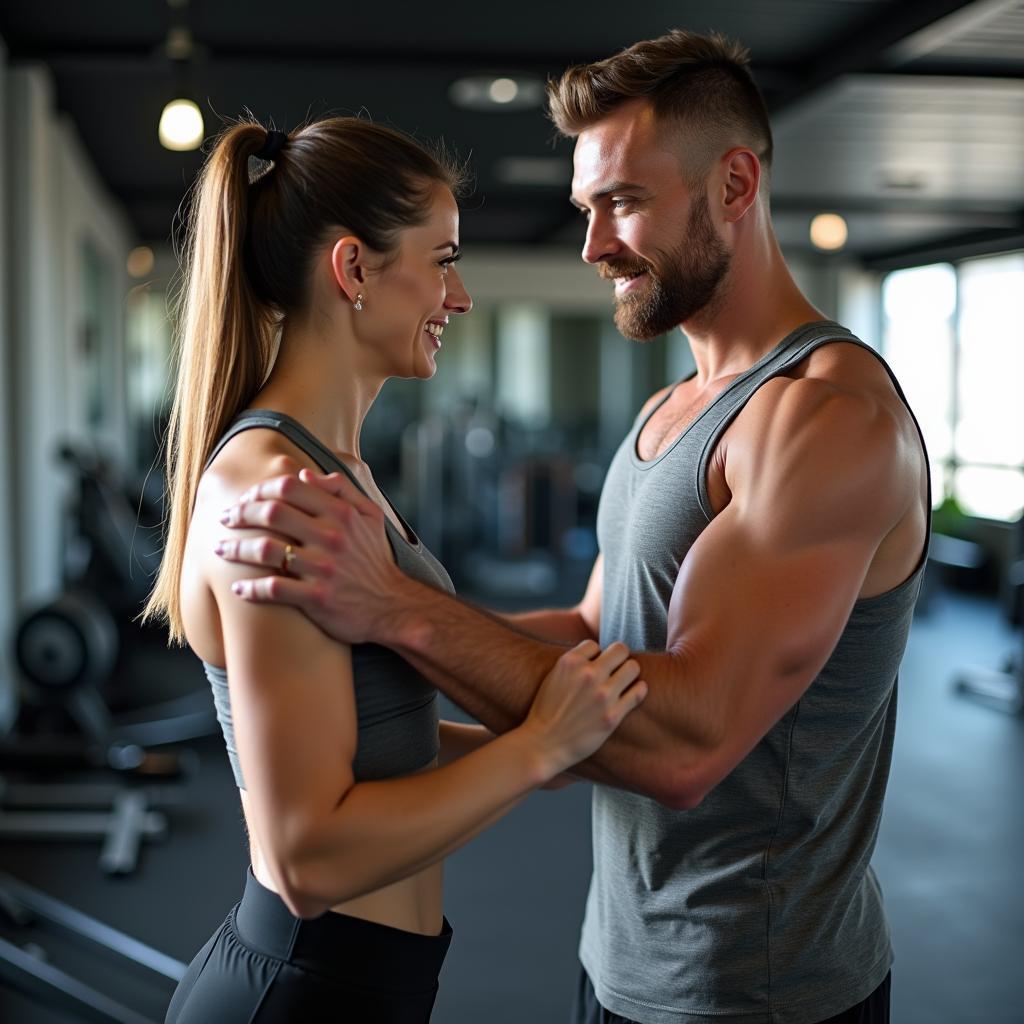 Huấn luyện viên cá nhân tạo động lực và hỗ trợ hiệu quả cho quá trình tập thể dục
Follow-up Questions (Rounding Off Questions)
Sau khi bạn hoàn thành phần độc thoại 2-3 phút, examiner thường hỏi thêm 1-2 câu ngắn gọn để “round off” Part 2 trước khi chuyển sang Part 3. Đây là những câu hỏi đơn giản, trả lời ngắn trong 30-60 giây.
Question 1: Do you think you’ll continue exercising with this person in the future?
Band 6-7 Answer:
“Yes, definitely. We have a good routine now and I enjoy exercising with them. I think we’ll continue because it’s become a habit for both of us.”
Band 8-9 Answer:
“Absolutely, I can’t imagine going back to my old sedentary lifestyle now. We’ve actually set some ambitious goals together for next year, including a charity marathon. Even if our schedules get hectic, I think we’ve established such a strong foundation that we’ll find ways to keep each other accountable and motivated.”
Question 2: How has this person changed your attitude toward fitness?
Band 6-7 Answer:
“They’ve helped me see that exercise can be fun and not just hard work. Before, I thought exercise was boring, but now I actually look forward to it.”
Band 8-9 Answer:
“The transformation has been quite profound, actually. They’ve helped me shift from viewing exercise as a chore to seeing it as an essential form of self-care. I’ve come to appreciate that fitness isn’t about achieving a perfect body but about cultivating resilience, energy, and mental clarity. That mindset shift has been absolutely game-changing.”
IELTS Speaking Part 3: Two-way Discussion
Tổng Quan Về Part 3
Part 3 là phần challenging nhất trong IELTS Speaking, kéo dài 4-5 phút với các câu hỏi abstract và analytical. Khác với Part 1 (personal questions) và Part 2 (descriptive monologue), Part 3 yêu cầu thí sinh discuss broader issues liên quan đến topic của Part 2 ở level societal hoặc theoretical.
Đặc điểm:
- Câu hỏi trừu tượng hơn, yêu cầu critical thinking
- Thường là compare/contrast, cause/effect, opinion, prediction
- Không còn về personal experience mà về general trends, societal issues
- Examiner có thể challenge opinions hoặc ask follow-up questions
Yêu cầu:
- Phân tích vấn đề từ nhiều góc độ
- Đưa ra quan điểm cá nhân có lý lẽ rõ ràng
- Support opinions với examples từ society, không chỉ personal experience
- Thừa nhận complexity của issues (không quá absolute)
- Demonstrate vocabulary range về abstract concepts
Chiến lược:
- Structure rõ ràng: Direct answer → Reason 1 + example → Reason 2 + example → (Optional: counter-argument) → Conclusion/Nuance
- Sử dụng discourse markers: Well, Actually, In my view, On the one hand, However…
- Tentative language: I would say, It seems to me, To some extent, Generally speaking…
- Không trả lời quá ngắn: Aim cho 3-5 câu (45-60 giây) mỗi câu hỏi
- Show balanced thinking: Acknowledge different perspectives
Lỗi thường gặp của học viên Việt Nam:
- Trả lời quá ngắn (1-2 câu), thiếu elaboration
- Chỉ đưa ra opinion mà không có reasoning hoặc examples
- Sử dụng personal examples thay vì societal examples
- Thiếu từ vựng abstract và academic
- Không thừa nhận complexity (too black-and-white)
- Speaking too tentatively (I think, maybe, I don’t know…) mà không confident
- Không develop ideas đủ sâu
Các Câu Hỏi Thảo Luận Sâu
Để chuẩn bị tốt cho các tình huống tương tự, bạn có thể tham khảo thêm cách describe a family member who inspires you để hiểu rõ hơn về cách phân tích và trình bày ảnh hưởng của một người.
Theme 1: The Role of Motivation in Exercise
Question 1: Why do you think some people find it difficult to stay motivated to exercise?
🎯 Phân tích câu hỏi:
- Dạng: Cause/Reasons – Why question
- Key words: difficult to stay motivated, exercise
- Cách tiếp cận: Đưa ra 2-3 reasons với explanations cụ thể. Có thể classify reasons: psychological, practical, societal
📝 Sample Answer – Band 6-7:
“I think there are several reasons. First, many people have busy lives with work and family, so they don’t have much free time for exercise. Second, some people think exercise is boring or too hard, so they give up easily. Also, if you don’t see results quickly, you might lose motivation. Finally, some people don’t have anyone to exercise with, so they feel lonely and unmotivated.”
Phân tích:
- Structure: Có organization với First, Second, Also, Finally
- Vocabulary: Basic nhưng adequate – busy lives, give up easily, lose motivation
- Tại sao Band 6-7: Answers the question với multiple reasons nhưng explanations còn surface-level. Thiếu depth trong analysis và examples cụ thể. Vocabulary chưa sophisticated.
📝 Sample Answer – Band 8-9:
“Well, I think the challenge of maintaining exercise motivation is quite multifaceted. On a practical level, modern lifestyles are often structured in ways that make regular physical activity difficult. Many people face long commutes, demanding work schedules, and family obligations that consume most of their waking hours, leaving exercise as something that constantly gets pushed to the bottom of the priority list.
Beyond the practical barriers, there’s also a psychological dimension that’s often overlooked. Many people approach exercise with an all-or-nothing mindset, setting overly ambitious goals that are unsustainable in the long term. When they inevitably fall short of these expectations, they experience a sense of failure that actually erodes their motivation rather than bolstering it. This is compounded by societal messaging that often equates fitness with aesthetic goals rather than holistic wellbeing, which can be demotivating for people whose bodies don’t conform to conventional standards.
Additionally, I’d say there’s often a lack of immediate gratification with exercise. Unlike many modern activities that provide instant feedback and rewards, the benefits of regular exercise tend to accrue gradually. In an age where we’re conditioned to expect immediate results, this delayed payoff can make it challenging to sustain commitment, especially in the early stages before exercise becomes habitual and intrinsically rewarding.”
Phân tích:
- Structure: Masterful organization với three distinct dimensions: practical, psychological, societal. Each is fully developed with explanation and implications.
- Vocabulary: Sophisticated và precise: multifaceted, consuming waking hours, all-or-nothing mindset, erodes motivation rather than bolstering it, accrue gradually, delayed payoff
- Grammar: Complex structures throughout: relative clauses, passive constructions, gerunds, that-clauses
- Critical Thinking: Moves beyond obvious answers to explore psychological mechanisms (all-or-nothing mindset), societal factors (messaging about aesthetics), and modern context (instant gratification culture)
- Balance: Acknowledges complexity with phrases like “often overlooked”, “psychological dimension”, “I’d say”
💡 Key Language Features:
- Discourse markers: Well, On a practical level, Beyond the practical barriers, Additionally
- Tentative language: I think, I’d say, tend to, often, can be
- Abstract nouns: dimension, mindset, gratification, commitment, wellbeing
- Collocations: maintaining motivation, structured in ways, fall short of expectations, sense of failure, lack of immediate gratification
Question 2: Do you think having a workout partner is essential for maintaining motivation?
🎯 Phân tích câu hỏi:
- Dạng: Opinion question với “essential” – cần show balanced view
- Key words: workout partner, essential, maintaining motivation
- Cách tiếp cận: Không nên too absolute (yes/no). Better approach: “It depends”, “beneficial but not essential”, acknowledge both sides
📝 Sample Answer – Band 6-7:
“I don’t think it’s essential, but it can be helpful. Some people prefer exercising alone because they can focus better and don’t need to coordinate with others. However, having a partner can make exercise more fun and you can encourage each other when one person feels lazy. It depends on personality – some people are self-motivated while others need external support.”
Phân tích:
- Structure: Balanced view với both sides presented
- Vocabulary: Basic – focus better, coordinate, self-motivated, external support
- Tại sao Band 6-7: Shows awareness của nuance (not absolute) và provides reasoning, nhưng development chưa deep và vocabulary chưa sophisticated
📝 Sample Answer – Band 8-9:
“I wouldn’t say it’s absolutely essential, but having a workout partner can certainly be a game-changer for many people, though the degree of benefit varies considerably depending on individual personality traits and motivational styles.
For individuals who are intrinsically motivated and have already cultivated strong self-discipline, a workout partner may be more of a nice-to-have than a necessity. These people have internalized the value of exercise and can maintain consistency without external accountability. In fact, some highly self-directed individuals may actually find that coordinating schedules with a partner becomes a barrier rather than a facilitator.
However, for those who struggle with consistency or are just beginning their fitness journey, a workout partner can provide crucial external accountability that helps bridge the gap until exercise becomes habitual. There’s something psychologically powerful about knowing someone is counting on you to show up – it transforms the commitment from something you can easily rationalize skipping to a social obligation that feels harder to break. Moreover, a partner can make workouts more enjoyable and sustainable by adding a social element, which is particularly valuable for people who find solo exercise monotonous or unmotivating.
That said, I think the quality of the partnership matters more than its mere existence. A poorly matched workout partner – someone whose fitness level, goals, or approach differs significantly from yours – might actually be counterproductive. The ideal scenario is finding someone whose commitment level and workout style align with yours, creating a mutually supportive dynamic where both parties feel challenged but not overwhelmed.”
Phân tích:
- Structure: Sophisticated three-part structure: main position → benefit for intrinsically motivated → benefit for those struggling → important caveat about quality
- Vocabulary: High-level: game-changer, degree of benefit, intrinsically motivated, cultivated self-discipline, bridge the gap, rationalize skipping, mutually supportive dynamic
- Grammar: Complex structures: For individuals who are…, There’s something psychologically powerful about knowing…, creating a mutually supportive dynamic where…
- Critical Thinking: Demonstrates nuanced understanding by: 1) refusing absolute answer, 2) acknowledging individual differences, 3) distinguishing between quantity (having partner) vs quality (right partner), 4) exploring psychological mechanisms
- Balance: Uses hedging language appropriately: I wouldn’t say, can certainly be, may be more of, I think
💡 Key Language Features:
- Discourse markers: However, Moreover, That said
- Tentative language: I wouldn’t say, can certainly be, may be, I think
- Abstract nouns: necessity, accountability, commitment, dynamic, consistency
- Sophisticated collocations: bridge the gap, rationalize skipping, align with, mutually supportive dynamic
Theme 2: Exercise and Modern Lifestyle
Question 3: How has modern technology affected people’s exercise habits?
🎯 Phân tích câu hỏi:
- Dạng: How question – Effect/Impact
- Key words: modern technology, affected, exercise habits
- Cách tiếp cận: Balanced view – both positive and negative effects. Technology can hinder (sedentary lifestyle) but also help (fitness apps, tracking)
📝 Sample Answer – Band 6-7:
“Modern technology has both positive and negative effects. On the negative side, technology makes people more sedentary because we spend a lot of time on phones and computers instead of being active. We sit at desks all day for work and then watch TV or play games at home. On the positive side, there are many fitness apps now that help people track their exercise and stay motivated. Smart watches can count steps and remind people to move. So technology can be both helpful and harmful for exercise.”
Phân tích:
- Structure: Clear two-sided structure (negative then positive)
- Vocabulary: Adequate – sedentary, track, smart watches, count steps
- Tại sao Band 6-7: Addresses both sides với examples nhưng analysis chưa deep. Examples còn basic và predictable.
📝 Sample Answer – Band 8.5-9:
“Technology’s impact on exercise habits has been remarkably paradoxical – it’s simultaneously the villain and the hero of modern fitness culture, if you will.
On one hand, technology has undeniably contributed to the sedentary epidemic we’re witnessing globally. The proliferation of screen-based entertainment and the shift toward desk-bound occupations have fundamentally altered how humans move throughout the day. Our grandparents’ generation naturally incorporated physical activity into daily life through manual labor and active transportation, whereas many of us now can go entire days moving only from bed to car to desk to couch. This structural inactivity has profound health implications that exercise alone struggles to counteract.
Conversely, technology has also democratized access to fitness knowledge and tools in unprecedented ways. Fitness apps, wearable devices, and online workout platforms have removed many traditional barriers to exercise – you don’t need an expensive gym membership, a personal trainer, or even specialized equipment anymore. Someone in a rural area can access world-class instruction through YouTube or app-based programs. Gamification elements in fitness apps – like achievement badges, streak counts, and social competitions – have proven remarkably effective at tapping into motivational psychology that keeps people engaged.
Perhaps most interestingly, technology has fostered entirely new fitness communities and accountability mechanisms. Social fitness platforms allow people to share workouts, compete virtually, and encourage each other across geographical boundaries. During the pandemic, this technological infrastructure proved invaluable in helping people maintain fitness routines when traditional gyms were closed.
The key, I think, is intentionality in how we use technology. When we passively consume entertainment for hours, it undermines physical health. But when we actively leverage digital tools to track, motivate, and educate ourselves about fitness, technology becomes a powerful enabler of healthier lifestyles. The question isn’t whether technology is good or bad for exercise – it’s how consciously we choose to integrate it into our lives.”
Phân tích:
- Structure: Exceptionally sophisticated: acknowledges paradox → negative effects with historical context → positive effects with specific examples → interesting observation about communities → nuanced conclusion about intentionality
- Vocabulary: Advanced and precise: paradoxical, proliferation, sedentary epidemic, desk-bound occupations, democratized access, gamification elements, tapping into motivational psychology, fostered communities, accountability mechanisms, intentionality, passively consume vs. actively leverage
- Grammar: Full range of complex structures: relative clauses, conditional implications, participial phrases, contrast structures (On one hand…Conversely), cleft sentences (The key is…)
- Critical Thinking: Exceptional depth – moves beyond obvious pros/cons to explore: 1) historical comparison with grandparents’ generation, 2) structural inactivity vs. personal responsibility, 3) democratization of fitness, 4) pandemic as case study, 5) philosophical conclusion about intentionality vs. technology being inherently good/bad
- Examples: Specific and varied: fitness apps, wearable devices, YouTube instruction, achievement badges, social fitness platforms, pandemic example
💡 Key Language Features:
- Metaphorical language: “simultaneously the villain and the hero”, “structural inactivity”
- Discourse markers: On one hand, Conversely, Perhaps most interestingly, The key, I think
- Abstract nouns: proliferation, implications, intentionality, infrastructure, enabler
- Sophisticated collocations: sedentary epidemic, democratized access, tapping into psychology, fostered communities, actively leverage
Question 4: Do you think employers should provide exercise facilities for their employees?
🎯 Phân tích câu hỏi:
- Dạng: Should question – Opinion with justification
- Key words: employers, should, provide, exercise facilities
- Cách tiếp cận: Take a position (yes/no/depends) but acknowledge complexity. Discuss benefits, challenges, alternative solutions
📝 Sample Answer – Band 6-7:
“Yes, I think employers should provide exercise facilities if they can. It would be good for employees’ health and could reduce stress. Healthy employees are more productive and take fewer sick days, so it’s also beneficial for the company. However, it might be expensive for small companies, so maybe they can offer gym memberships instead. Overall, companies should do something to encourage their employees to exercise.”
Phân tích:
- Structure: Clear position (yes) với reasons và acknowledgment of challenge
- Vocabulary: Adequate – reduce stress, productive, sick days, gym memberships
- Tại sao Band 6-7: Logical argument với some reasoning nhưng development chưa sophisticated. Thiếu deeper analysis về implications hoặc broader context.
📝 Sample Answer – Band 8.5-9:
“I’d argue that while providing on-site exercise facilities can be tremendously valuable, it’s not necessarily the only or even the best solution for every organization. The appropriateness really depends on the company’s size, resources, and workplace culture.
For large corporations with the financial bandwidth and physical space, investing in comprehensive fitness facilities makes considerable sense from both humanitarian and pragmatic perspectives. The return on investment can be significant – we’re talking about reduced healthcare costs, lower absenteeism rates, improved mental health, and enhanced employee morale. There’s also a retention benefit: employees increasingly factor in wellness offerings when evaluating job opportunities, so robust fitness facilities can be a competitive advantage in attracting and retaining talent. Companies like Google and Nike have famously pioneered this approach, and research suggests their employees do indeed show higher engagement and productivity metrics.
However, I think we need to be realistic about the feasibility for smaller organizations. A startup or small business with limited capital and office space simply cannot justify such substantial infrastructure investment. For these companies, alternative approaches might be more practical – subsidizing gym memberships, offering flexible working hours to accommodate exercise schedules, organizing group workout sessions in public spaces, or providing allowances for fitness-related expenses. The underlying principle – that employers should actively support employee wellness – can be actualized in many forms beyond on-site facilities.
There’s also an important cultural dimension to consider. Simply providing facilities doesn’t guarantee utilization. Companies need to cultivate a culture where taking time for exercise is genuinely encouraged rather than subtly discouraged. If employees feel guilty about using the gym during work hours, or if using facilities is perceived as a sign of not being sufficiently dedicated to work, the facilities become little more than expensive window dressing. This requires leadership modeling – when executives visibly prioritize their own fitness, it sends a powerful signal that wellness is truly valued.
At the end of the day, I believe employers do have a moral and practical obligation to support employee health, given that work often contributes to sedentary lifestyles. Whether that’s through on-site facilities or other initiatives depends on circumstances, but the commitment to employee wellbeing should be non-negotiable in any organization that purports to value its people.”
Phân tích:
- Structure: Masterful multi-layered argument: position with nuance → benefits for large companies → realistic alternatives for small companies → cultural considerations → philosophical conclusion
- Vocabulary: Exceptionally sophisticated: tremendously valuable, financial bandwidth, humanitarian and pragmatic perspectives, return on investment, factor in, competitive advantage, pioneered, guarantee utilization, window dressing, leadership modeling, purports to value
- Grammar: Full range of advanced structures: while + clause, talking about + gerunds, research suggests + clause, simply providing facilities doesn’t guarantee…, if-clauses with subtle discouraged, whether…or depends on construction
- Critical Thinking: Outstanding depth and nuance: 1) refuses simplistic yes/no answer, 2) distinguishes between different company contexts, 3) addresses not just facilities but cultural implementation, 4) provides specific corporate examples (Google, Nike), 5) discusses feasibility constraints, 6) emphasizes substance over form (facilities vs. actual culture), 7) ends with moral dimension
- Balance: Uses hedging masterfully: I’d argue, can be, necessarily, really depends, I think we need to be realistic, At the end of the day
💡 Key Language Features:
- Discourse markers: However, There’s also, At the end of the day
- Tentative language: I’d argue, can be, might be, I believe
- Abstract nouns: appropriateness, feasibility, utilization, obligation, commitment
- Sophisticated phrases: financial bandwidth, return on investment, window dressing, leadership modeling, purports to value
Những ai quan tâm đến việc xây dựng mối quan hệ tích cực thông qua sự lắng nghe có thể tìm hiểu thêm về cách describe a person you think is a good listener, vì kỹ năng này cũng rất quan trọng trong việc động viên người khác tập thể dục.
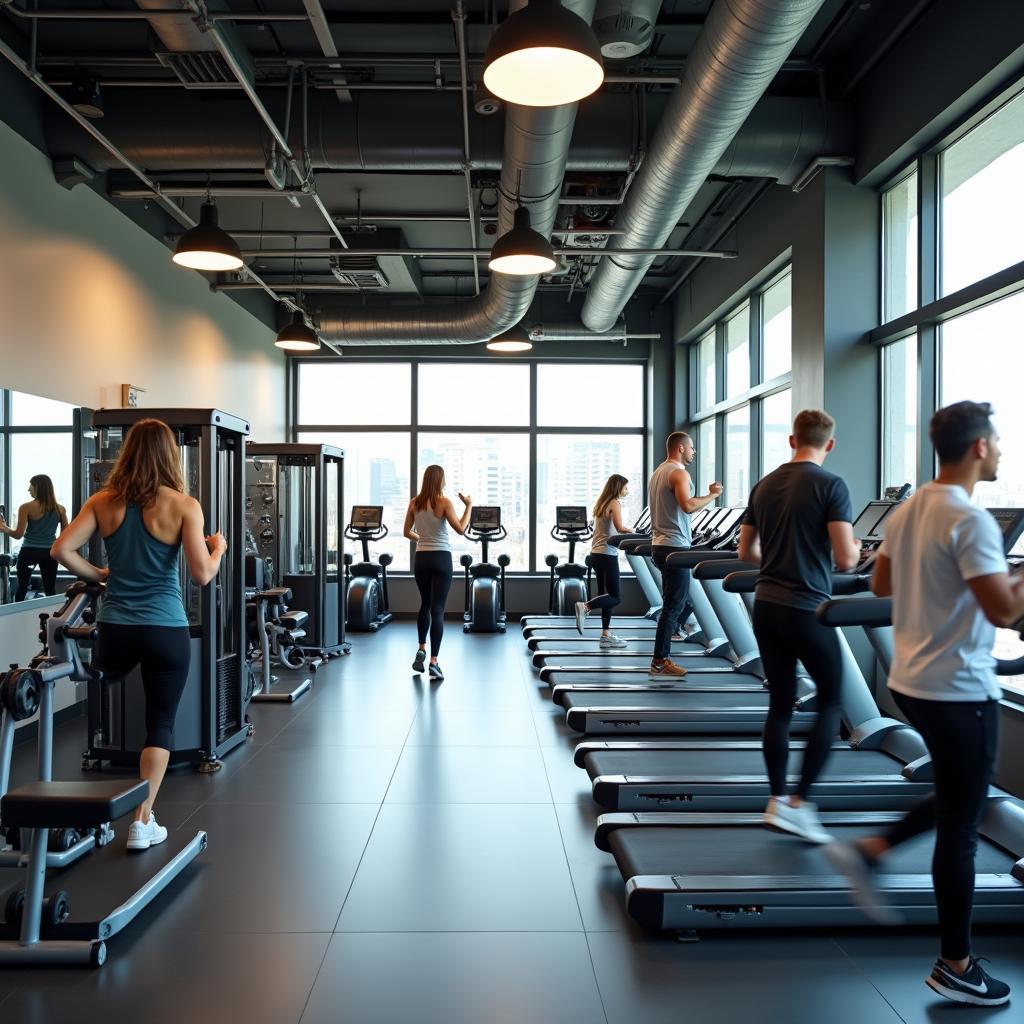 Văn hóa tập luyện tại nơi làm việc với cơ sở vật chất hiện đại hỗ trợ sức khỏe nhân viên
Theme 3: Exercise and Different Age Groups
Question 5: Why do you think young people today are less physically active than previous generations?
🎯 Phân tích câu hỏi:
- Dạng: Why question – Causes/Reasons với historical comparison
- Key words: young people, less physically active, previous generations
- Cách tiếp cận: Identify multiple factors – technological, societal, structural. Acknowledge it’s a generalization. May compare lifestyle changes across generations.
📝 Sample Answer – Band 6-7:
“I think young people are less active because of technology. They spend too much time on phones and computers playing games or using social media instead of playing outside. Schools also focus more on academic subjects than physical education now. In the past, children played more outdoor games like football or cycling, but now they prefer staying inside with their devices. Also, parents are more worried about safety, so they don’t let children play outside freely like before.”
Phân tích:
- Structure: Multiple reasons identified (technology, education focus, parental concerns)
- Vocabulary: Basic but relevant – spend time on, academic subjects, outdoor games, worried about safety
- Tại sao Band 6-7: Addresses question với several valid points và some comparison with past. Nhưng analysis còn surface-level, vocabulary chưa sophisticated, thiếu depth trong explaining mechanisms.
📝 Sample Answer – Band 8.5-9:
“This is a generalization that merits careful examination, but there is certainly data suggesting declining physical activity levels among younger generations. I think this stems from a confluence of technological, societal, and environmental factors that have fundamentally reshaped childhood and adolescence.
The most obvious culprit is the digital revolution. Today’s young people have grown up in an unprecedented era of immersive screen-based entertainment that previous generations simply didn’t have access to. Video games, social media, and streaming platforms offer compelling, algorithmically-optimized experiences designed specifically to capture and retain attention. These aren’t just passive distractions; they’re sophisticated systems that tap into reward pathways in ways that make them genuinely difficult to disengage from. It’s not that young people are inherently lazy – they’re responding rationally to extremely engaging alternatives to physical activity.
Beyond technology, there’s been a significant shift in educational priorities and childhood structure. The intensification of academic pressure – driven by increasingly competitive university admissions and anxieties about future employment – has led to young people spending more time on homework, test preparation, and resume-building extracurriculars. The spontaneous, unstructured play that characterized previous generations has been largely supplanted by scheduled activities and academic obligations. Additionally, in many urban environments, public spaces conducive to casual physical activity have diminished, while car dependency has increased, reducing incidental exercise from walking or cycling for transportation.
There’s also a parental dimension worth considering. Heightened safety concerns – whether justified or not – have led to more supervised, controlled childhoods. The previous generation’s experience of roaming neighborhoods freely with friends has been replaced by organized playdates and adult-chaperoned activities. While often well-intentioned, this protective approach inadvertently curtails the kind of spontaneous physical exploration that kept earlier generations active.
However, I think it’s important to push back against the notion that this is simply a matter of young people’s personal failings. They’re responding to an environment that has been structurally redesigned in ways that disincentivize physical activity. Addressing this requires systemic changes – urban planning that prioritizes walkable neighborhoods, educational policies that value physical education as much as academics, and perhaps even regulatory approaches to addictive technologies. Blaming young people themselves misses the point that they’re products of the world adults have created.”
Phân tích:
- Structure: Exceptionally comprehensive: caveat about generalization → technological factors with mechanisms → educational/structural factors → parental factors → important counterargument about systemic issues rather than personal failing
- Vocabulary: Highly sophisticated: confluence, reshaped, culprit, immersive, algorithmically-optimized, tap into reward pathways, supplanted by, incidental exercise, inadvertently curtails, disincentivize, systemic changes, misses the point
- Grammar: Full range of advanced structures: merit careful examination, data suggesting declining levels, designed specifically to capture, not that…but responding rationally to, while often well-intentioned, whether justified or not
- Critical Thinking: Outstanding analytical depth: 1) refuses to simply blame young people, 2) explains psychological mechanisms (reward pathways, algorithmic optimization), 3) identifies multiple interconnected factors (tech, education, environment, parenting), 4) historical comparison (spontaneous play vs. scheduled activities), 5) shifts perspective to systemic issues, 6) proposes structural solutions, 7) defends young people against unfair characterization
- Balance: Uses hedging and qualification: This is a generalization, there is certainly data suggesting, I think, worth considering, whether justified or not, However, I think it’s important to push back
💡 Key Language Features:
- Discourse markers: The most obvious culprit, Beyond technology, Additionally, There’s also, However
- Tentative/Qualifying language: merits careful examination, certainly data suggesting, I think
- Abstract nouns: confluence, intensification, dimension, spontaneity, exploration
- Sophisticated collocations: tap into reward pathways, supplanted by, inadvertently curtails, structurally redesigned, products of
Question 6: What can be done to encourage older people to exercise more regularly?
🎯 Phân tích câu hỏi:
- Dạng: What can be done – Solutions/Recommendations
- Key words: encourage, older people, exercise, more regularly
- Cách tiếp cận: Multiple solutions addressing different barriers (physical, psychological, social, access). Consider what specifically works for elderly demographic vs. younger people.
📝 Sample Answer – Band 6-7:
“There are several things we can do. First, we should provide more exercise programs specifically designed for elderly people, like gentle yoga or tai chi classes in community centers. These activities are safer for older people than intense workouts. Second, doctors should encourage their older patients to exercise and explain the health benefits. Also, we could make public spaces more accessible with better facilities like benches and handrails. Finally, organizing group activities can help because older people might feel more motivated when exercising with others their age.”
Phân tích:
- Structure: Clear organization với multiple solutions (programs, doctors, infrastructure, social)
- Vocabulary: Adequate – gentle yoga, elderly people, health benefits, accessible, group activities
- Tại sao Band 6-7: Addresses question với practical suggestions và some reasoning. Nhưng lacks depth trong analyzing barriers hoặc psychological factors specific to elderly.
📝 Sample Answer – Band 8.5-9:
“Encouraging older adults to maintain regular physical activity requires a multifaceted approach that addresses the unique barriers and motivational factors relevant to this demographic.
First and foremost, we need to reframe how exercise is conceptualized and marketed to older populations. Traditional fitness culture often emphasizes intensity, competition, and aesthetic outcomes – none of which resonate particularly well with elderly individuals. Instead, public health messaging should focus on functional benefits that directly impact quality of life: maintaining independence, reducing fall risk, managing chronic conditions, preserving cognitive function, and facilitating social engagement. When older adults understand that exercise isn’t about achieving a certain body type but about sustaining their autonomy and remaining active in activities they value, the motivational calculus shifts significantly.
Accessibility is another critical factor that’s often overlooked. Many conventional gyms and fitness programs are implicitly designed for younger, more able-bodied individuals. We need age-appropriate alternatives that accommodate varying mobility levels and health conditions – low-impact classes like water aerobics, gentle strength training with appropriate modifications, and activities like tai chi that emphasize balance and flexibility rather than cardiovascular intensity. Community centers, senior centers, and healthcare facilities should offer these programs at subsidized rates or free of charge, removing financial barriers that disproportionately affect retirees on fixed incomes.
The social dimension is particularly important for this age group. Older adults often face social isolation, especially after retirement or the loss of spouses. Group exercise programs can serve a dual purpose – providing physical activity while also fostering social connections and combating loneliness. There’s considerable research showing that older adults are more likely to adhere to exercise routines when they have built-in accountability and social interaction. Programs that incorporate social elements – like walking groups, senior dance classes, or team-based activities – tend to have significantly higher retention rates.
Medical integration is another promising avenue. When healthcare providers actively prescribe exercise as treatment – literally writing it down as they would a medication – older patients take it much more seriously. Some healthcare systems have begun implementing “exercise as medicine” initiatives where primary care physicians explicitly recommend specific types and amounts of physical activity, sometimes even referring patients to specialized physical therapists or exercise physiologists who can design individualized programs. This medical endorsement lends credibility and overcomes the perception that exercise is optional or frivolous.
We should also leverage technology in age-appropriate ways. While older adults are sometimes stereotyped as technologically averse, many are quite adept with smartphones and tablets. Fitness apps designed specifically for seniors – with larger fonts, clear instructions, and gentle reminders – can help them track progress and stay accountable. Some programs even use telehealth to provide virtual coaching, which is particularly valuable for individuals with mobility limitations who struggle to access in-person classes.
Finally, I think environmental design plays an underappreciated role. Creating age-friendly communities with well-maintained sidewalks, adequate seating, public restrooms, and safe, accessible parks makes casual physical activity much more feasible for older adults. Something as simple as installing benches at regular intervals can transform whether an elderly person feels confident enough to take a long walk.”
Phân tích:
- Structure: Masterfully organized six-part solution: 1) reframe messaging, 2) improve accessibility, 3) emphasize social dimension, 4) medical integration, 5) appropriate technology, 6) environmental design. Each solution is fully developed với rationale.
- Vocabulary: Exceptionally sophisticated: multifaceted approach, demographic, conceptualized and marketed, functional benefits, motivational calculus, implicitly designed for, subsidized rates, dual purpose, fostering connections, built-in accountability, promising avenue, actively prescribe, lends credibility, stereotyped as, age-friendly communities
- Grammar: Full range of advanced structures: requires a multifaceted approach that addresses…, When older adults understand that…, Many conventional gyms are implicitly designed for…, There’s considerable research showing that…, Some healthcare systems have begun implementing…, something as simple as installing benches can transform whether…
- Critical Thinking: Exceptional depth and breadth: 1) identifies why traditional approach fails, 2) proposes solutions addressing multiple barriers (psychological, financial, social, access, medical, environmental), 3) supports suggestions with research references, 4) challenges stereotypes (older people and technology), 5) specific implementation ideas (water aerobics, walking groups, subsidized programs), 6) recognizes interconnected nature of solutions
- Specificity: Concrete examples throughout: water aerobics, tai chi, walking groups, exercise as medicine initiatives, telehealth coaching, bench installation
💡 Key Language Features:
- Discourse markers: First and foremost, Instead, Another critical factor, The social dimension is particularly important, We should also, Finally
- Tentative language: I think, often, sometimes, can serve, tend to have
- Abstract nouns: demographic, calculus, autonomy, accessibility, dimension, integration, credibility
- Sophisticated collocations: multifaceted approach, motivational calculus, dual purpose, built-in accountability, promising avenue, lends credibility, age-friendly communities
Nếu bạn đang tìm kiếm nguồn cảm hứng từ những trải nghiệm cá nhân đáng nhớ, hãy tham khảo cách describe a time when you achieved something significant để hiểu cách kết nối thành tựu với động lực cá nhân.
Từ vựng và cụm từ quan trọng
Topic-Specific Vocabulary
| Từ vựng/Cụm từ | Loại từ | Phiên âm | Nghĩa tiếng Việt | Ví dụ | Collocation |
|---|---|---|---|---|---|
| fitness enthusiast | n. phrase | /ˈfɪtnəs ɪnˈθjuːziæst/ | người đam mê thể dục | My brother is a real fitness enthusiast who never misses a workout. | fitness fanatic, gym enthusiast, health enthusiast |
| workout routine | n. phrase | /ˈwɜːkaʊt ruːˈtiːn/ | thói quen tập luyện | Having a consistent workout routine helps me stay disciplined. | daily routine, exercise routine, training routine, fitness routine |
| intrinsic motivation | n. phrase | /ɪnˈtrɪnsɪk ˌməʊtɪˈveɪʃən/ | động lực nội tại | True fitness success comes from intrinsic motivation, not external pressure. | internal motivation, self-motivation, autonomous motivation |
| extrinsic motivation | n. phrase | /ekˈstrɪnsɪk ˌməʊtɪˈveɪʃən/ | động lực bên ngoài | Rewards and competitions provide extrinsic motivation for some people. | external motivation, outside motivation |
| sedentary lifestyle | n. phrase | /ˈsedəntri ˈlaɪfstaɪl/ | lối sống ít vận động | A sedentary lifestyle increases the risk of various health problems. | inactive lifestyle, desk-bound lifestyle, stationary lifestyle |
| cardio sessions | n. phrase | /ˈkɑːdiəʊ ˈseʃənz/ | buổi tập tim mạch | I do cardio sessions three times a week to improve my endurance. | cardio workouts, aerobic exercise, cardiovascular training |
| strength training | n. phrase | /streŋθ ˈtreɪnɪŋ/ | tập luyện sức mạnh, tập tạ | Strength training helps build muscle and increase metabolism. | weight training, resistance training, muscle building |
| accountability | n. | /əˌkaʊntəˈbɪləti/ | trách nhiệm, sự giám sát | Having a workout partner provides accountability that keeps me consistent. | personal accountability, mutual accountability, social accountability |
| consistency | n. | /kənˈsɪstənsi/ | tính nhất quán, đều đặn | The key to fitness results is consistency, not intensity. | maintain consistency, build consistency, achieve consistency |
| fitness milestone | n. phrase | /ˈfɪtnəs ˈmaɪlstəʊn/ | cột mốc trong tập luyện | Running my first 5K was an important fitness milestone for me. | achieve milestone, reach milestone, hit milestone |
| holistic approach | n. phrase | /həʊˈlɪstɪk əˈprəʊtʃ/ | cách tiếp cận toàn diện | A holistic approach to fitness considers mental and physical health. | comprehensive approach, integrated approach, whole-person approach |
| push one’s limits | v. phrase | /pʊʃ wʌnz ˈlɪmɪts/ | vượt qua giới hạn bản thân | A good trainer helps you push your limits safely. | test limits, extend limits, challenge limits |
| stay energized | v. phrase | /steɪ ˈenədʒaɪzd/ | duy trì năng lượng | Regular exercise helps me stay energized throughout the day. | remain energized, keep energized, maintain energy |
| manage stress | v. phrase | /ˈmænɪdʒ stres/ | quản lý căng thẳng | Exercise is my primary way to manage stress effectively. | cope with stress, handle stress, deal with stress, reduce stress |
| functional fitness | n. phrase | /ˈfʌŋkʃənəl ˈfɪtnəs/ | thể lực chức năng (phục vụ sinh hoạt hàng ngày) | Functional fitness focuses on movements that help with daily activities. | practical fitness, everyday fitness |
| progressive overload | n. phrase | /prəˈɡresɪv ˈəʊvələʊd/ | tăng tải dần dần | Progressive overload is essential for building strength over time. | gradual increase, incremental progress |
| form and technique | n. phrase | /fɔːm ənd tekˈniːk/ | tư thế và kỹ thuật | Proper form and technique prevent injuries during exercise. | correct form, proper technique, good form |
| recovery time | n. phrase | /rɪˈkʌvəri taɪm/ | thời gian nghỉ ngơi, phục hồi | Adequate recovery time is crucial for muscle growth. | rest period, recovery period, recuperation time |
| plateauing | n. | /plæˈtəʊɪŋ/ | trì trệ, không tiến bộ | Many people experience plateauing after initial fitness gains. | hit a plateau, reach a plateau |
| endorphin release | n. phrase | /enˈdɔːfɪn rɪˈliːs/ | giải phóng endorphin (hormone hạnh phúc) | The endorphin release after exercise creates a natural high. | endorphin rush, endorphin boost |
Idiomatic Expressions & Advanced Phrases
| Cụm từ | Nghĩa | Ví dụ sử dụng | Band điểm |
|---|---|---|---|
| keep someone on track | giúp ai đó tuân thủ kế hoạch | My trainer keeps me on track when I feel like giving up. | 7.5-9 |
| take something seriously | nghiêm túc với việc gì đó | I didn’t take fitness seriously until I had health issues. | 6-7 |
| get into one’s own zone | vào trạng thái tập trung riêng | When I exercise alone, I can get into my own zone completely. | 7.5-9 |
| team up with | hợp tác, làm việc cùng | I teamed up with my colleague for morning runs. | 7-8 |
| running low (motivation) | đang cạn kiệt, suy giảm | When my motivation is running low, I watch inspiring videos. | 7.5-8 |
| go-to (stress reliever) | lựa chọn ưa thích, phương án chính | Exercise has become my go-to stress reliever. | 7.5-9 |
| clear one’s head | làm đầu óc tỉnh táo | A morning jog helps me clear my head before work. | 7-8 |
| boost one’s mood | cải thiện tâm trạng | Physical activity naturally boosts my mood. | 6-7 |
| game-changer | yếu tố thay đổi cuộc chơi hoàn toàn | Having a workout partner was a complete game-changer for me. | 8-9 |
| lead by example | nêu gương bằng hành động | My coach leads by example, always practicing what he preaches. | 7-8 |
| make it a point to | cố gắng, quyết tâm làm gì đều đặn | I make it a point to exercise before breakfast every day. | 7.5-8 |
| mix things up | thay đổi, đa dạng hóa | I like to mix things up with different types of workouts. | 7-8 |
| fall short of expectations | không đạt được kỳ vọng | Don’t be discouraged if you fall short of your initial goals. | 7.5-8 |
| all-or-nothing mindset | tư duy tất cả hoặc không có gì | An all-or-nothing mindset often leads to giving up completely. | 8-9 |
| bridge the gap | thu hẹp khoảng cách, tạo sự chuyển tiếp | A beginner program helps bridge the gap to advanced fitness. | 7.5-8 |
| hit a wall | gặp phải rào cản, trở ngại lớn | Many runners hit a wall around the 20-kilometer mark. | 7-8 |
| no pain, no gain | không khổ công thì không đạt được gì | While “no pain, no gain” is popular, smart training is better than suffering. | 6-7 |
| get back on the horse | quay lại sau thất bại | If you miss workouts, just get back on the horse and try again. | 7-8 |
Discourse Markers (Từ Nối Ý Trong Speaking)
Để bắt đầu câu trả lời:
- 📝 Well,… – Sử dụng khi cần vài giây suy nghĩ hoặc khi câu hỏi phức tạp
- Well, I think maintaining motivation is actually quite complex…
- 📝 Actually,… – Khi muốn đưa ra góc nhìn khác hoặc thông tin bất ngờ
- Actually, I used to hate exercising until I found the right motivation…
- 📝 To be honest,… – Khi muốn thành thật, trung thực
- To be honest, I struggle with consistency sometimes…
- 📝 I’d say that… – Cách mềm mại để đưa ra quan điểm
- I’d say that having support is crucial for most people…
- 📝 In my view/opinion,… – Diễn đạt quan điểm cá nhân rõ ràng
- In my view, intrinsic motivation is more sustainable than external pressure…
Để bổ sung ý:
- 📝 On top of that,… – Thêm vào đó (formal hơn “also”)
- On top of that, exercise helps with mental clarity…
- 📝 What’s more,… – Hơn nữa, thêm vào đó
- What’s more, group exercise creates social bonds…
- 📝 Not to mention… – Chưa kể đến
- Not to mention the long-term health benefits…
- 📝 Beyond that,… – Ngoài điều đó ra
- Beyond that, there are psychological benefits to consider…
- 📝 Additionally/Furthermore,… – Thêm vào đó (formal)
- Additionally, regular exercise improves sleep quality…
Để đưa ra quan điểm cân bằng:
- 📝 On the one hand,… On the other hand,… – Một mặt…mặt khác
- On the one hand, gym memberships are expensive. On the other hand, they provide structure…
- 📝 While it’s true that…, we also need to consider… – Mặc dù đúng là…nhưng ta cũng cần xem xét
- While it’s true that technology promotes sedentary behavior, it also provides fitness tools…
- 📝 That said,… – Tuy nhiên, nói như vậy thì (để present contrasting view)
- That said, not everyone responds to the same motivation…
- 📝 However/Nevertheless,… – Tuy nhiên
- However, I think consistency matters more than intensity…
Để đưa ra ví dụ:
- 📝 For instance/For example,… – Ví dụ
- For instance, my brother motivates me by exercising with me…
- 📝 Take… for example – Lấy…làm ví dụ
- Take my friend Sarah, for example – she transformed her health through…
- 📝 A good example of this would be… – Một ví dụ điển hình là
- A good example of this would be fitness apps that gamify exercise…
Để kết luận:
- 📝 All in all,… – Tóm lại, xét cho cùng
- All in all, having the right person to motivate you makes a huge difference…
- 📝 At the end of the day,… – Cuối cùng thì, xét đến cùng
- At the end of the day, sustainable fitness comes from internal motivation…
- 📝 Overall/In general,… – Nhìn chung
- Overall, I believe everyone needs different types of motivation…
Để thể hiện uncertainty hoặc qualification:
- 📝 I would say… – Tôi muốn nói rằng (tentative)
- I would say motivation is very personal and individual…
- 📝 It seems to me that… – Có vẻ như (tentative opinion)
- It seems to me that social support is underestimated…
- 📝 To some extent,… – Ở một mức độ nào đó
- To some extent, everyone needs external accountability initially…
- 📝 Generally speaking,… – Nói chung là
- Generally speaking, people exercise more when they enjoy it…
Grammatical Structures Ấn Tượng
1. Conditional Sentences (Câu điều kiện):
Mixed conditional (điều kiện hỗn hợp):
- Formula: If + past perfect, would + infinitive (hoặc ngược lại)
- Ví dụ: “If I hadn’t met my trainer, I would still be struggling with motivation today.”
- Ví dụ: “If I were more disciplined, I wouldn’t have needed external motivation in the first place.”
Inversion (đảo ngữ với điều kiện):
- Formula: Should/Were/Had + subject + verb…
- Ví dụ: “Should you decide to start exercising, finding the right motivator is crucial.”
- Ví dụ: “Were it not for my friend’s encouragement, I would never have started running.”
- Ví dụ: “Had I known how much better I’d feel, I would have started exercising years ago.”
2. Relative Clauses (Mệnh đề quan hệ):
Non-defining relative clauses (không xác định – có dấu phẩy):
- Formula: …, which/who/whose + clause, …
- Ví dụ: “My personal trainer, who has been working with me for two years, understands exactly what motivates me.”
- Ví dụ: “Regular exercise, which releases endorphins, naturally improves mood.”
- Ví dụ: “My brother, whose dedication inspires me, never misses a workout.”
3. Passive Voice (Câu bị động) – especially in Part 3:
Impersonal passive (bị động khách quan):
- Formula: It is + past participle + that clause
- Ví dụ: “It is widely believed that having a workout partner increases consistency.”
- Ví dụ: “It has been proven that regular exercise reduces stress and anxiety.”
- Ví dụ: “It is often said that motivation comes from within, not from others.”
Passive with reporting verbs:
- Ví dụ: “Exercise is thought to improve both physical and mental health.”
- Ví dụ: “Social support is considered essential for maintaining fitness routines.”
4. Cleft Sentences (Câu chẻ) – để nhấn mạnh:
What-cleft:
- Formula: What + clause + is/was + noun/clause
- Ví dụ: “What really motivates me is seeing my progress over time.”
- Ví dụ: “What makes my friend such a good motivator is her positive attitude.”
- Ví dụ: “What I appreciate most is how she never judges me for skipping workouts.”
It-cleft:
- Formula: It + is/was + noun/phrase + that/who clause
- Ví dụ: “It was my health scare that finally pushed me to exercise regularly.”
- Ví dụ: “It’s the accountability that makes workout partners so effective.”
The thing/reason that:
- Ví dụ: “The thing that keeps me going is knowing someone is counting on me.”
- Ví dụ: “The reason why he’s so motivating is that he leads by example.”
5. Gerunds and Infinitives (Danh động từ và động từ nguyên mẫu):
Gerund as subject:
- Ví dụ: “Having someone to exercise with makes all the difference.”
- Ví dụ: “Seeing tangible results is what keeps most people motivated.”
Complex gerund phrases:
- Ví dụ: “I appreciate him taking the time to check in on my progress.”
- Ví dụ: “There’s no point in forcing yourself to exercise if you hate it.”
6. Participle Clauses (Mệnh đề phân từ):
Present participle (V-ing):
- Ví dụ: “Knowing that my friend expects me, I rarely skip workouts.”
- Ví dụ: “Having exercised together for years, we’ve developed a strong bond.”
Past participle (V3):
- Ví dụ: “Motivated by his example, I started waking up early for morning runs.”
- Ví dụ: “Encouraged by early results, I became more committed to my routine.”
7. Inversion for Emphasis (Đảo ngữ để nhấn mạnh):
Negative adverbials:
- Ví dụ: “Never have I felt more energetic than after starting regular exercise.”
- Ví dụ: “Rarely does external motivation alone sustain long-term fitness habits.”
- Ví dụ: “Not only does exercise improve physical health, but it also enhances mental wellbeing.”
Only/Little:
- Ví dụ: “Only when I found the right motivator did I start seeing results.”
- Ví dụ: “Little did I know that this person would completely transform my attitude toward fitness.”
8. Advanced Comparative Structures:
The more…, the more…:
- Ví dụ: “The more consistent I am with exercise, the more motivated I become.”
- Ví dụ: “The more support you have, the easier it is to maintain a routine.”
Comparative with gerunds:
- Ví dụ: “I find exercising with someone more enjoyable than working out alone.”
- Ví dụ: “Having a motivator is far more effective than relying on willpower alone.”
Đối với những ai muốn tìm hiểu về các hoạt động ngoài trời thú vị có thể trở thành động lực tập thể dục, hãy xem thêm describe an interesting outdoor activity you tried.
 Tổng hợp từ vựng tiếng Anh chủ đề tập luyện thể dục và động lực cá nhân
Chiến Lược Và Lời Khuyên Từ Examiner
Những Sai Lầm Phổ Biến Của Thí Sinh Việt Nam
1. Trong Part 1:
-
❌ Trả lời quá ngắn: “Yes, I do” hoặc “No, I don’t” rồi im lặng
- ✅ Sửa: Luôn extend với lý do hoặc ví dụ: “Yes, I do. I make it a point to exercise at least three times a week because…”
-
❌ Sử dụng từ vựng đơn giản lặp lại: “good”, “nice”, “like”, “don’t like”
- ✅ Sửa: Thay thế bằng synonyms và collocations: “beneficial”, “appealing”, “drawn to”, “not particularly keen on”
-
❌ Thiếu discourse markers: Câu trả lời nghe cứng nhắc, không natural
- ✅ Sửa: Bắt đầu với “Well,”, “Actually,”, “To be honest,” để nghe tự nhiên hơn
2. Trong Part 2:
-
❌ Không sử dụng hết 1 phút chuẩn bị: Vội vàng bắt đầu nói
- ✅ Sửa: Dùng đủ 60 giây để organize ideas, ghi keywords cho mỗi bullet point
-
❌ Bỏ sót bullet points: Chỉ trả lời 2-3 trong 4 yêu cầu
- ✅ Sửa: Check list tất cả bullet points trong notes, đảm bảo cover hết
-
❌ Nói dưới 1.5 phút: Kết thúc quá sớm
- ✅ Sửa: Thêm specific details, examples, feelings để extend. Aim cho 2-2.5 phút
-
❌ Memorize và recite answers: Nghe như đọc thuộc lòng
- ✅ Sửa: Học ideas và vocabulary, nhưng không học thuộc câu cụ thể. Nói như kể chuyện tự nhiên
-
❌ Thiếu specific details: Nói quá general và abstract
- ✅ Sửa: Thêm names, places, times, descriptions, feelings cụ thể
3. Trong Part 3:
-
❌ Trả lời như Part 1: Ngắn gọn và personal
- ✅ Sửa: Elaborate với 4-6 câu, discuss broader societal issues, không chỉ personal experience
-
❌ Thiếu structure: Ideas lộn xộn, không logic
- ✅ Sửa: Direct answer → Reason 1 + example → Reason 2 + example → Conclusion
-
❌ Quá absolute: “Everyone…”, “Always…”, “Never…”
- ✅ Sửa: Dùng tentative language: “Generally”, “Many people”, “It tends to”, “Often”
-
❌ Không acknowledge complexity: Trả lời black-and-white
- ✅ Sửa: Show balanced thinking: “On one hand… On the other hand…”, “While it’s true that… we also need to consider…”
-
❌ Thiếu examples: Chỉ có opinions không có support
- ✅ Sửa: Sau mỗi reason, thêm “For instance…” hoặc “A good example would be…”
4. Pronunciation Issues:
-
❌ Nói quá nhanh do nervous: Ảnh hưởng clarity
- ✅ Sửa: Breathe, pause naturally, prioritize clarity over speed
-
❌ Monotone: Không có intonation variation
- ✅ Sửa: Emphasize key words, vary pitch khi hỏi/khẳng định, show enthusiasm
-
❌ Wrong word stress: “MOtivation” thay vì “motiVAtion”
- ✅ Sửa: Học stress patterns của topic-specific words
Cách Chuẩn Bị Hiệu Quả
1. Vocabulary Building (Xây dựng vốn từ):
Phương pháp “Topic Clusters”:
- Tạo mind map cho topic “Exercise & Motivation”
- Branches: Types of exercise, Benefits, Motivation factors, Challenges, People who inspire
- Mỗi branch có 10-15 words/phrases
- Học vocabulary trong context, không học đơn lẻ
Practice Technique:
- Ghi vocabulary vào flashcards với:
- Mặt trước: Word/Phrase + pronunciation
- Mặt sau: Definition, example sentence, collocations
- Review mỗi ngày 15-20 phút
- Thực hành sử dụng trong câu nói tự nhiên
2. Structure Templates (Không phải memorize, chỉ là framework):
Part 2 Framework:
Introduction (5-10 seconds):
"I'd like to talk about [person], who [relationship/role]..."

Bullet Point 1 - Who (15-20 seconds):
"[Name] is [description]. We [relationship/how you know]..."

Bullet Point 2 - How you know (15-20 seconds):
"I first met/knew [him/her] [time/circumstance]..."

Bullet Point 3 - What they do (60-90 seconds - LONGEST):
"What makes [him/her] so motivating is [action 1]...
For example, [specific example]...
Additionally, [action 2]...
[Another specific example]..."

Bullet Point 4 - Why effective (30-45 seconds):
"I think [he/she] is effective because [reason 1]...
Also, [reason 2]...
Ultimately, [deeper reason/impact]..."

Conclusion (optional, 10-15 seconds):
"Overall, [summary of impact]..."
Part 3 Framework:
Direct Answer (1 câu):
"I would say that [direct answer]..."

Reason 1 + Example (2-3 câu):
"One main reason is [explanation]...
For instance, [specific example]..."

Reason 2 + Example (2-3 câu):
"Beyond that, [explanation]...
We can see this in [example]..."

Balanced View/Nuance (1-2 câu):
"That said, [alternative perspective]...
It really depends on [factor]..."
3. Mock Practice (Luyện thi giả lập):
Week 1-2: Individual Parts
- Mỗi ngày practice một part riêng
- Record yourself và listen back
- Identify issues: hesitation, grammar errors, vocabulary gaps
Week 3-4: Full Test Simulation
- Practice full 11-14 minutes
- Time yourself strictly
- Get feedback từ teacher/peer nếu có thể
Self-Assessment Questions:
- Fluency: Did I pause too much? Was I hesitant?
- Vocabulary: Did I use topic-specific words? Were there repetitions?
- Grammar: Did I use complex structures? Were there errors?
- Pronunciation: Was I clear? Did I stress correctly?
- Content: Did I answer fully? Were my ideas developed?
4. Mindset và Performance Strategies:
Trước khi vào phòng thi:
- Breathe deeply 5 lần để calm nerves
- Remind yourself: “Examiner wants me to do well”
- Think in English 10 phút trước khi thi
- Don’t cram vocabulary vào phút cuối
Trong phòng thi:
- Smile và maintain eye contact với examiner
- Treat it như một conversation, không phải interrogation
- Nếu không hiểu câu hỏi, lịch sự hỏi lại: “Sorry, could you repeat that?”
- Nếu không biết từ vựng, paraphrase: “I’m not sure of the exact word, but what I mean is…”
- Nếu cần time to think, dùng fillers naturally: “Well, that’s an interesting question…”, “Let me think about that for a moment…”
Recovering from mistakes:
- Don’t panic nếu có grammar error nhỏ
- Don’t stop và sửa lại, continue naturally
- Examiner đánh giá overall performance, không phải từng câu
- Self-correction quá nhiều làm mất fluency điểm
5. Timeline Chuẩn Bị (3 tháng):
Tháng 1: Foundation
- Week 1-2: Learn essential vocabulary (200-300 words)
- Week 3-4: Practice Part 1 questions extensively
- Daily: 30 phút vocabulary, 30 phút speaking practice
Tháng 2: Development
- Week 1-2: Master Part 2 với 15-20 topics khác nhau
- Week 3-4: Focus on Part 3 abstract discussions
- Daily: 45 phút speaking practice, 15 phút review recordings
Tháng 3: Refinement
- Week 1-2: Full test simulations 3-4 lần/tuần
- Week 3-4: Polish weak areas, final reviews
- Daily: 60 phút mock tests + analysis
Final Tips từ Examiner
✅ DO:
- Speak confidently ngay cả khi nervous
- Use discourse markers để sound natural
- Provide specific examples và details
- Show range của vocabulary và grammar
- Acknowledge complexity trong Part 3
- Maintain eye contact và positive body language
- Extend answers appropriately (not too short, not too long)
❌ DON’T:
- Memorize answers word-for-word
- Use overly complex vocabulary incorrectly
- Speak too fast or too slow
- Give one-word answers
- Interrupt examiner
- Say “I don’t know” and stop
- Panic when making small mistakes
- Try to impress với vocabulary you don’t understand
Remember: IELTS Speaking đánh giá khả năng giao tiếp thực tế, không phải academic English perfection. Natural communication với clear ideas và appropriate language sẽ score cao hơn perfectly memorized scripts nghe unnatural.
Kết luận
Chủ đề “Describe a person who motivates you to exercise” là một đề bài thú vị và practical trong IELTS Speaking. Để đạt band điểm cao, bạn cần:
- Part 1: Trả lời tự nhiên với extensions, sử dụng topic-specific vocabulary
- Part 2: Develop story đầy đủ với specific details, cover tất cả bullet points trong 2-2.5 phút
- Part 3: Demonstrate critical thinking với balanced views, abstract ideas, và societal examples
Vocabulary về fitness và motivation là foundation, nhưng cách bạn structure ideas, develop reasoning, và deliver naturally mới là key để impress examiner. Practice consistently với feedback, và nhớ rằng confidence và natural communication quan trọng hơn perfection.
Chúc bạn thành công trong kỳ thi IELTS Speaking!


