
Chủ đề thời tiết xấu là một trong những đề tài phổ biến và thường xuyên xuất hiện trong kỳ thi IELTS Speaking, đặc biệt ở Part 2. Theo thống kê từ các trung tâm luyện thi IELTS và website như ielts-blog.com, chủ đề này xuất hiện với tần suất trung bình cao trong các kỳ thi từ 2020 đến 2024, và dự đoán sẽ tiếp tục có khả năng xuất hiện cao trong tương lai do tính phổ biến và khả năng khai thác nhiều góc độ của đề tài.
Câu hỏi “Describe A Time When You Were Caught In Bad Weather” yêu cầu thí sinh kể về một trải nghiệm cá nhân với điều kiện thời tiết khắc nghiệt. Đây là dạng câu hỏi kể chuyện quá khứ, cho phép bạn thể hiện khả năng sử dụng các thì quá khứ, từ vựng miêu tả cảm xúc và thời tiết, cũng như kỹ năng tổ chức ý tưởng theo trình tự thời gian logic.
Trong bài viết này, bạn sẽ học được:
- Các câu hỏi thường gặp về chủ đề thời tiết trong cả 3 Part của IELTS Speaking
- Bài mẫu chi tiết theo từng band điểm 6-7, 7.5-8, và 8.5-9 với phân tích chuyên sâu
- Hơn 50 từ vựng và cụm từ ăn điểm liên quan đến thời tiết và trải nghiệm cá nhân
- Chiến lược trả lời hiệu quả từ góc nhìn của một IELTS Examiner
- Lời khuyên cụ thể giúp tránh những lỗi sai phổ biến của học viên Việt Nam
IELTS Speaking Part 1: Introduction and Interview
Tổng Quan Về Part 1
Part 1 của IELTS Speaking thường kéo dài 4-5 phút với các câu hỏi ngắn về đời sống hàng ngày và sở thích cá nhân. Đối với chủ đề thời tiết, examiner thường hỏi về thói quen, sở thích và quan điểm chung của bạn.
Chiến lược hiệu quả cho Part 1:
- Trả lời trực tiếp câu hỏi trong câu đầu tiên
- Mở rộng với lý do hoặc ví dụ cụ thể trong 1-2 câu tiếp theo
- Giữ câu trả lời tự nhiên, không quá dài dòng (2-3 câu là đủ)
Lỗi thường gặp của học viên Việt Nam:
- Trả lời quá ngắn gọn chỉ với “Yes” hoặc “No”
- Sử dụng từ vựng đơn giản, lặp đi lặp lại như “good”, “bad”, “nice”
- Thiếu ví dụ cụ thể từ kinh nghiệm bản thân
- Không tự nhiên, nghe giống đang đọc thuộc lòng
Các Câu Hỏi Thường Gặp
Question 1: What kind of weather do you like most?
Question 2: Does the weather in your country change much across different seasons?
Question 3: Do you prefer hot weather or cold weather?
Question 4: What do you usually do when the weather is bad?
Question 5: Does bad weather ever affect your mood?
Question 6: Have you ever cancelled plans because of bad weather?
Question 7: What’s the typical weather like in your hometown?
Question 8: Do you check the weather forecast regularly?
Phân Tích và Gợi Ý Trả Lời Chi Tiết
Question: What kind of weather do you like most?
🎯 Cách tiếp cận:
- Trả lời trực tiếp loại thời tiết yêu thích
- Giải thích lý do tại sao thích loại thời tiết đó
- Thêm ví dụ về hoạt động bạn thích làm trong thời tiết đó
📝 Sample Answer – Band 6-7:
“I like sunny weather the most. It makes me feel happy and energetic. When it’s sunny, I can go out with my friends and do outdoor activities like cycling or having a picnic in the park.”
Phân tích:
- Điểm mạnh: Trả lời rõ ràng, có lý do và ví dụ cụ thể về hoạt động
- Hạn chế: Từ vựng khá cơ bản (happy, energetic, go out), cấu trúc câu đơn giản
- Tại sao Band 6-7: Đáp ứng được yêu cầu cơ bản với ý tưởng rõ ràng nhưng thiếu độ tinh tế trong cách diễn đạt và từ vựng chưa đa dạng
📝 Sample Answer – Band 8-9:
“I’m particularly drawn to mild, sunny weather with a gentle breeze. There’s something incredibly uplifting about that kind of weather – it just puts me in the right frame of mind for being productive. I find that on days like these, I’m more inclined to get outdoors, whether it’s for a morning jog or just to soak up some vitamin D in a nearby café.”
Phân tích:
- Điểm mạnh: Sử dụng các cụm từ tự nhiên và tinh tế (drawn to, uplifting, puts me in the right frame of mind), cấu trúc câu phức tạp với mệnh đề quan hệ và cụm từ nối tự nhiên, ý tưởng được phát triển logic với chi tiết cụ thể
- Tại sao Band 8-9: Thể hiện fluency cao với discourse markers tự nhiên, vocabulary range rộng với collocations chính xác, grammar đa dạng và chính xác, pronunciation được thể hiện qua cách chọn từ có âm điệu tự nhiên
💡 Key Vocabulary & Expressions:
- be drawn to something: bị thu hút bởi điều gì đó
- gentle breeze: làn gió nhẹ nhàng
- uplifting: làm phấn chấn, nâng cao tinh thần
- put someone in the right frame of mind: khiến ai đó có tâm trạng tốt
- be inclined to: có xu hướng, muốn làm gì
- soak up: hấp thụ, tận hưởng
Question: Does bad weather ever affect your mood?
🎯 Cách tiếp cận:
- Đưa ra câu trả lời yes/no rõ ràng
- Giải thích cách thời tiết ảnh hưởng đến tâm trạng
- Cho ví dụ cụ thể về những ngày thời tiết xấu
📝 Sample Answer – Band 6-7:
“Yes, definitely. When it’s rainy and dark outside, I feel a bit sad and lazy. I don’t want to go out or do anything. On those days, I just want to stay home and watch movies.”
Phân tích:
- Điểm mạnh: Trả lời trực tiếp với “yes, definitely”, có mô tả cảm giác và hành động
- Hạn chế: Từ vựng cảm xúc đơn giản (sad, lazy), thiếu sự phân tích sâu hơn về tác động tâm lý
- Tại sao Band 6-7: Ý tưởng rõ ràng và liên quan nhưng cách diễn đạt chưa tinh tế, chưa thể hiện được sự phức tạp trong cảm xúc
📝 Sample Answer – Band 8-9:
“Absolutely, it does. I’d say I’m quite susceptible to what they call ‘seasonal affective disorder‘ – when it’s overcast and gloomy for days on end, I tend to feel a bit lethargic and less motivated. There’s definitely a psychological connection between weather and mood. That said, I’ve learned to counteract this by making sure I have indoor activities I enjoy, like reading or cooking, so I’m not entirely at the mercy of the weather.”
Phân tích:
- Điểm mạnh: Sử dụng thuật ngữ chuyên môn tự nhiên (seasonal affective disorder, psychological connection), từ vựng cảm xúc tinh tế (lethargic, susceptible to), thể hiện critical thinking khi đưa ra giải pháp (counteract), cấu trúc câu phức tạp với nhiều mệnh đề
- Tại sao Band 8-9: Vocabulary sophisticated và precise, grammar range rộng với cấu trúc đa dạng, ideas có chiều sâu và nuance, fluency cao với các linking devices tự nhiên
💡 Key Vocabulary & Expressions:
- susceptible to: dễ bị ảnh hưởng bởi
- seasonal affective disorder: rối loạn cảm xúc theo mùa
- overcast and gloomy: u ám và âm u
- lethargic: uể oải, thiếu năng lượng
- psychological connection: mối liên hệ tâm lý
- counteract: đối phó, chống lại
- at the mercy of: phụ thuộc hoàn toàn vào
Question: What do you usually do when the weather is bad?
🎯 Cách tiếp cận:
- Mô tả hoạt động cụ thể bạn thường làm
- Giải thích tại sao chọn những hoạt động đó
- Có thể so sánh với những gì bạn làm khi thời tiết đẹp
📝 Sample Answer – Band 6-7:
“When the weather is bad, I usually stay indoors. I like to watch TV shows or play video games. Sometimes I read books or chat with my friends online. It’s a good time to relax at home.”
Phân tích:
- Điểm mạnh: Liệt kê được nhiều hoạt động cụ thể, câu trả lời có cấu trúc rõ ràng
- Hạn chế: Các hoạt động được liệt kê đơn giản, thiếu sự phân tích về lý do hoặc cảm nhận cá nhân sâu hơn
- Tại sao Band 6-7: Trả lời đầy đủ và rõ ràng nhưng thiếu depth và sophistication trong cách diễn đạt
📝 Sample Answer – Band 8-9:
“Well, I tend to embrace the opportunity to have a more laid-back day indoors. I’m quite an avid reader, so I usually curl up with a good book and a cup of tea. Bad weather also gives me the perfect excuse to catch up on household tasks I’ve been putting off, or to indulge in some comfort cooking – there’s something quite therapeutic about making a warm soup while listening to rain patter against the windows.”
Phân tích:
- Điểm mạnh: Phrasal verbs và collocations tự nhiên (curl up with, catch up on, indulge in), imagery sinh động (rain patter against the windows), thái độ tích cực và mature (embrace the opportunity), từ vựng đa dạng thể hiện lifestyle và personality
- Tại sao Band 8-9: Natural expressions của native speakers, vocabulary precise và idiomatic, ý tưởng được develop với chi tiết cảm tính, grammar structures varied và accurate
💡 Key Vocabulary & Expressions:
- embrace the opportunity: nắm lấy cơ hội
- laid-back day: ngày thư giãn, không gấp gáp
- curl up with a good book: cuộn mình lại với một quyển sách hay
- catch up on: bắt kịp, hoàn thành những việc bỏ lỡ
- indulge in: tận hưởng, cho phép mình thưởng thức
- comfort cooking: nấu những món ăn mang lại sự thoải mái
- therapeutic: có tác dụng chữa lành, thư giãn
- patter against the windows: tiếng mưa rơi lộp độp trên cửa sổ
 Thí sinh đang luyện tập IELTS Speaking chủ đề thời tiết xấu với giáo viên
IELTS Speaking Part 2: Long Turn (Cue Card)
Tổng Quan Về Part 2
Part 2 là phần độc thoại kéo dài 2-3 phút, trong đó bạn có 1 phút chuẩn bị. Đây là phần quan trọng nhất để thể hiện khả năng nói liên tục, tổ chức ý tưởng logic và sử dụng ngôn ngữ đa dạng.
Chiến lược hiệu quả:
- Sử dụng hết 1 phút chuẩn bị để ghi chú keywords, không viết câu hoàn chỉnh
- Lên kế hoạch trả lời đầy đủ tất cả các bullet points
- Nói ít nhất 1.5-2 phút, tối đa không quá 3 phút
- Sử dụng thì quá khứ khi kể về trải nghiệm đã xảy ra
- Kết thúc bằng cảm xúc hoặc bài học rút ra
Lỗi thường gặp của học viên Việt Nam:
- Không tận dụng đủ thời gian chuẩn bị, vội vàng bắt đầu nói
- Nói dưới 1.5 phút hoặc quá 3 phút
- Bỏ sót một hoặc nhiều bullet points
- Sử dụng thì hiện tại thay vì quá khứ khi kể chuyện
- Không có kết luận rõ ràng về cảm xúc hoặc ý nghĩa
Cue Card
Describe a time when you were caught in bad weather
You should say:
- When and where it happened
- What kind of bad weather it was
- What you were doing at that time
- And explain how you felt about this experience
Phân Tích Đề Bài
- Dạng câu hỏi: Describe an experience (Kể về một trải nghiệm cá nhân)
- Thì động từ: Quá khứ đơn và quá khứ tiếp diễn (vì kể về sự việc đã xảy ra)
- Bullet points phải cover:
- When/Where: Thời gian và địa điểm cụ thể
- Type of weather: Loại thời tiết xấu (mưa bão, bão tuyết, nắng nóng…)
- What you were doing: Hoạt động bạn đang làm khi gặp thời tiết xấu
- Feelings: Cảm xúc và suy nghĩ về trải nghiệm đó
- Câu “explain” quan trọng: Đây là phần ghi điểm cao nhất – cần thể hiện được cảm xúc chân thực, sự phản ánh và có thể bài học rút ra. Không chỉ mô tả “I felt scared” mà cần giải thích TẠI SAO và tác động như thế nào đến bạn.
📝 Sample Answer – Band 6-7
Thời lượng: Khoảng 1.5-2 phút
“I’d like to talk about a time when I got caught in heavy rain last summer. It happened in July when I was visiting Da Nang with my family.
That day, we decided to go to the beach in the afternoon. The weather was nice and sunny in the morning, so we thought it would be a perfect day for swimming. However, around 3 PM, while we were enjoying ourselves on the beach, the sky suddenly became very dark.
Within just a few minutes, it started raining heavily. The rain was so strong that we could barely see anything. There was also thunder and lightning, which made the situation quite scary. We quickly grabbed our things and tried to run to a nearby restaurant for shelter.
We got completely wet before we could reach the restaurant. Our clothes were soaking wet, and we were shivering because the rain was cold. We had to wait there for about two hours until the rain stopped. During that time, we ordered some hot drinks to warm ourselves up.
I felt quite frustrated at first because our beach day was ruined. However, looking back, it became a funny memory for our family. We still laugh about it now. This experience taught me to always check the weather forecast before planning outdoor activities.”
Phân Tích Band Điểm
| Tiêu chí | Band | Nhận xét |
|---|---|---|
| Fluency & Coherence | 6-7 | Có trình tự thời gian rõ ràng, sử dụng một số linking words cơ bản (however, within, during), nhưng chưa có nhiều discourse markers phức tạp |
| Lexical Resource | 6-7 | Từ vựng đủ dùng với một số collocations (heavy rain, soaking wet, weather forecast), nhưng chủ yếu là từ vựng phổ thông, chưa có nhiều từ less common |
| Grammatical Range & Accuracy | 6-7 | Sử dụng đúng thì quá khứ, có một số câu phức (when, which, because), nhưng chủ yếu là câu đơn và câu ghép đơn giản |
| Pronunciation | 6-7 | Rõ ràng và dễ hiểu, giả định có một số lỗi nhỏ về trọng âm hoặc ngữ điệu nhưng không ảnh hưởng đến communication |
Điểm mạnh:
- ✅ Trả lời đầy đủ tất cả các bullet points theo trình tự logic
- ✅ Có kết luận về cảm xúc và bài học rút ra
- ✅ Sử dụng đúng thì quá khứ xuyên suốt
- ✅ Độ dài phù hợp (khoảng 230 từ)
Hạn chế:
- ⚠️ Từ vựng chưa đa dạng, nhiều từ lặp lại (rain, weather, beach)
- ⚠️ Thiếu các expressions idiomatic hoặc less common vocabulary
- ⚠️ Cấu trúc câu chưa đủ phức tạp, thiếu variety
📝 Sample Answer – Band 7.5-8
Thời lượng: Khoảng 2-2.5 phút
“I’d like to tell you about an unforgettable experience I had about two years ago when I was caught off guard by a severe thunderstorm while traveling in Sapa, a mountainous region in northern Vietnam.
It was in September, which is typically the tail end of the rainy season in that area. My friends and I had planned a trekking trip to explore some remote villages. On the second day of our trip, we set off early in the morning under what seemed like perfect conditions – the sky was clear and the temperature was pleasant.
We’d been hiking for roughly three hours when, out of nowhere, the weather took a dramatic turn. Dark clouds rolled in incredibly quickly, and within minutes, we were caught in the middle of an intense storm. The rain was absolutely torrential – I’d never experienced anything quite like it. What made it particularly challenging was that we were on a narrow mountain path with very limited shelter options. The rain was so heavy that the path quickly became muddy and treacherous.
To make matters worse, there was thunder and lightning striking very close to where we were. Our guide insisted we take cover under a large rock overhang until the worst of it passed. We were soaked to the bone and honestly quite anxious about the lightning.
Looking back on it now, I have quite mixed feelings about the experience. At the time, I was genuinely frightened – not just for myself but for the whole group. However, I also felt a strange sense of camaraderie with my friends as we weathered the storm together. It was one of those moments that really puts things into perspective and makes you appreciate the unpredictable nature of the outdoors. That experience definitely taught me to always be better prepared and never take mountain weather lightly.”
Phân Tích Band Điểm
| Tiêu chí | Band | Nhận xét |
|---|---|---|
| Fluency & Coherence | 7.5-8 | Trôi chảy với ít hesitation, sử dụng nhiều discourse markers tự nhiên (Looking back, To make matters worse, However), ý tưởng được phát triển logic và coherent |
| Lexical Resource | 7.5-8 | Từ vựng đa dạng với nhiều collocations chính xác (caught off guard, torrential rain, soaked to the bone), sử dụng less common vocabulary và idiomatic expressions |
| Grammatical Range & Accuracy | 7.5-8 | Nhiều câu phức với variety cao (relative clauses, past perfect, participle clauses), lỗi sai nếu có thì rất minor |
| Pronunciation | 7.5-8 | Rõ ràng với intonation tự nhiên, word stress và sentence stress phù hợp, dễ hiểu hoàn toàn |
So Sánh Với Band 6-7
| Khía cạnh | Band 6-7 | Band 7.5-8 |
|---|---|---|
| Vocabulary | “heavy rain”, “very dark” | “torrential rain”, “dark clouds rolled in”, “caught off guard” |
| Grammar | Simple past: “it started raining” | Past continuous + perfect: “we’d been hiking”, “what made it particularly challenging was…” |
| Ideas | Mô tả sự việc đơn giản | Thêm context (tail end of rainy season), chi tiết cảm xúc phức tạp (mixed feelings, camaraderie) |
Nếu bạn muốn tìm hiểu thêm về cách xử lý các tình huống khác trong IELTS Speaking, bạn có thể tham khảo describe a time when you went on a long journey để học cách kể chuyện về trải nghiệm cá nhân một cách ấn tượng hơn.
📝 Sample Answer – Band 8.5-9
Thời lượng: 2.5-3 phút đầy đủ
“I’d like to recount a rather harrowing experience I had last winter when I found myself in the midst of an unexpected blizzard while visiting my relatives in a rural area of northern Vietnam – a region that rarely experiences such extreme weather conditions.
This incident occurred in late January, during the Lunar New Year holiday. I’d traveled to a remote mountainous district where my grandmother lives, and what was supposed to be a peaceful family reunion turned into quite an ordeal due to a freak weather event. You see, this particular area typically experiences cold winters, but nothing on this scale – the locals said it was the worst snowstorm in decades.
On the day in question, I’d ventured out with my cousin to visit some family friends in a neighboring village. Bear in mind that the weather forecast had predicted merely light snow, so we thought nothing of making the short journey on his motorbike. However, nature had other plans. About halfway there, the snowfall intensified dramatically, accompanied by powerful gusts of wind that created what I can only describe as near-whiteout conditions. The visibility plummeted to just a few meters, and the temperature dropped precipitously.
What really struck me was how quickly the situation deteriorated. Within the span of perhaps twenty minutes, we went from riding through gentle snowfall to battling through what felt like a full-blown blizzard. The snow was coming down in sheets, and the wind was so fierce that it stung our faces and made steering the motorbike increasingly precarious. We ultimately had no choice but to seek refuge in a small roadside shelter, where we ended up stranded for nearly four hours alongside several other travelers caught in the same predicament.
As for my feelings about this experience, they were remarkably complex and evolved over time. Initially, there was a surge of adrenaline mixed with genuine concern for our safety – after all, we were woefully unprepared for such conditions, wearing only light winter jackets and having no emergency supplies. As the hours passed in that cramped shelter, I experienced a strange cocktail of emotions: frustration at our poor judgment, anxiety about my family who must have been worried sick, but also a surprising sense of solidarity with the other stranded travelers. We shared food, stories, and gallows humor to keep spirits up.
In retrospect, this experience was genuinely transformative for me. It served as a stark reminder of nature’s awesome power and our relative fragility in the face of it. More importantly, it taught me the critical importance of proper preparation and never underestimating Mother Nature, regardless of what forecasts suggest. I’d also say it reinforced something my grandmother always says about the value of community – how people band together in times of adversity. Though I wouldn’t wish to repeat it, I’m actually grateful for that experience because it’s given me a healthy respect for the natural world and instilled in me a much more cautious approach to outdoor activities.”
Phân Tích Band Điểm
| Tiêu chí | Band | Nhận xét |
|---|---|---|
| Fluency & Coherence | 8.5-9 | Hoàn toàn fluent với zero hesitation, tổ chức ý tưởng xuất sắc với clear progression, sử dụng discourse markers sophisticated và natural (You see, Bear in mind, In retrospect) |
| Lexical Resource | 8.5-9 | Vocabulary range rất rộng với precise and sophisticated word choices, nhiều idiomatic expressions tự nhiên (nature had other plans, gallows humor, worried sick), collocations chính xác hoàn hảo |
| Grammatical Range & Accuracy | 8.5-9 | Wide range of complex structures used accurately (inversion, cleft sentences, mixed conditionals), errors nếu có chỉ là slips extremely rare |
| Pronunciation | 8.5-9 | Fully comprehensible với natural intonation patterns, stress và rhythm giống native speakers, không có L1 influence |
Tại Sao Bài Này Xuất Sắc
🎯 Fluency Hoàn Hảo:
Bài nói trôi chảy tự nhiên với zero artificial pauses, giống như một người đang thực sự recall và share một trải nghiệm đáng nhớ. Các transitional phrases được sử dụng một cách organic, không hề forced.
📚 Vocabulary Tinh Vi:
- “harrowing experience” thay vì “scary experience” – sophisticated và emotive
- “in the midst of” thay vì “in the middle of” – formal và precise
- “plummeted” thay vì “went down quickly” – vivid và economical
- “woefully unprepared” – adverb strengthening adjective, very natural
- “gallows humor” – idiomatic expression showing cultural knowledge
📝 Grammar Đa Dạng:
- Cleft sentence: “What really struck me was…” – emphasis device
- Inversion: “About halfway there, the snowfall intensified” – sophisticated word order
- Participle clauses: “accompanied by powerful gusts” – concise và advanced
- Mixed conditional implications: “Though I wouldn’t wish to repeat it” – hypothetical thinking
💡 Ideas Sâu Sắc:
Không chỉ kể chuyện mà còn reflect deeply về psychological journey (from adrenaline to anxiety to solidarity), demonstrate maturity through self-criticism (poor judgment, woefully unprepared), và extract meaningful lessons about human nature và preparation.
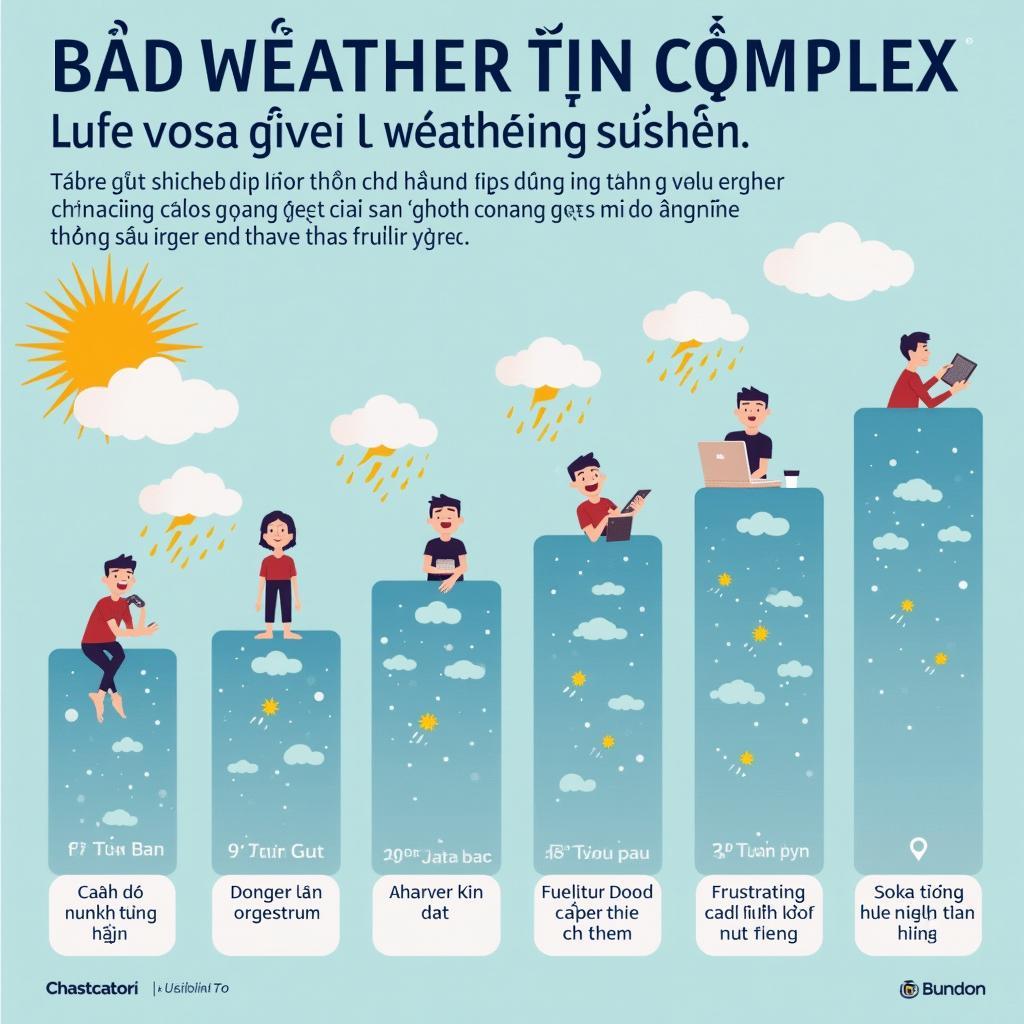 Biểu đồ thể hiện các cảm xúc phức tạp khi gặp thời tiết xấu trong IELTS Speaking
Follow-up Questions (Rounding Off Questions)
Examiner có thể hỏi thêm 1-2 câu ngắn sau Part 2 để transition sang Part 3:
Question 1: Have you checked weather forecasts more carefully since then?
Band 6-7 Answer:
“Yes, definitely. Now I always check the weather forecast before I go anywhere, especially when I plan to travel to mountainous areas.”
Band 8-9 Answer:
“Absolutely. That experience really drove home the importance of staying informed. These days, I’m almost obsessive about checking multiple weather sources before any outdoor plans, and I always err on the side of caution when forecasts look uncertain.”
Question 2: Would you still go trekking in that area again?
Band 6-7 Answer:
“Yes, I would go there again, but I would be more careful. I would prepare better and avoid going during the rainy season.”
Band 8-9 Answer:
“I’d certainly consider it, though with considerably more respect for the conditions. The area itself is stunning and well worth visiting, but I’d definitely time it better – perhaps during the dry season – and come equipped with proper gear and contingency plans in place.”
IELTS Speaking Part 3: Two-way Discussion
Tổng Quan Về Part 3
Part 3 kéo dài 4-5 phút với các câu hỏi thảo luận sâu, trừu tượng hơn về chủ đề đã nói ở Part 2. Đây là phần khó nhất và là cơ hội để thể hiện khả năng tư duy phản biện và phân tích.
Yêu cầu cụ thể:
- Phân tích vấn đề từ nhiều góc độ (cá nhân, xã hội, toàn cầu)
- So sánh và đối chiếu (quá khứ vs hiện tại, các quốc gia khác nhau)
- Đánh giá ưu nhược điểm
- Đưa ra quan điểm có lý lẽ rõ ràng
Chiến lược hiệu quả:
- Mỗi câu trả lời nên dài 3-5 câu
- Sử dụng discourse markers để structure câu trả lời (Firstly, Moreover, However)
- Đưa ra examples từ society, không chỉ personal experience
- Thừa nhận complexity của vấn đề khi cần thiết
- Tránh câu trả lời yes/no đơn giản
Lỗi thường gặp của học viên Việt Nam:
- Trả lời quá ngắn gọn, thiếu elaboration
- Không có supporting reasons hoặc examples
- Thiếu từ vựng abstract và academic
- Không biết cách express uncertainty một cách sophisticate
- Sợ disagree với examiner hoặc đưa ra quan điểm khác biệt
Các Câu Hỏi Thảo Luận Sâu
Theme 1: Climate Change and Extreme Weather
Question 1: Do you think extreme weather events are becoming more common nowadays?
🎯 Phân tích câu hỏi:
- Dạng: Opinion với yếu tố comparison (quá khứ vs hiện tại)
- Key words: extreme weather events, becoming more common, nowadays
- Cách tiếp cận: Direct answer → Provide evidence/reasons → Give examples → Acknowledge complexity
📝 Sample Answer – Band 6-7:
“Yes, I think extreme weather is happening more often now. We can see this on the news every day – there are more floods, storms, and heat waves than before. Scientists say this is because of climate change and global warming. In my country, we have experienced more typhoons and flooding in recent years compared to the past.”
Phân tích:
- Structure: Có opinion rõ ràng → evidence từ news → reason (climate change) → example local
- Vocabulary: Adequate với các từ phổ thông (floods, storms, heat waves, climate change)
- Tại sao Band 6-7: Trả lời đầy đủ với reasons và examples nhưng lacks depth và sophisticated language, chưa acknowledge complexity của issue
📝 Câu trả lời mẫu – Band 8-9:
“I’d have to say yes, and this isn’t just anecdotal – there’s compelling scientific evidence to suggest that extreme weather events are indeed increasing in both frequency and intensity. From what I understand, this is largely attributable to anthropogenic climate change, which is altering weather patterns globally.
Take, for instance, the unprecedented flooding we’ve witnessed in various parts of Asia in recent years, or the prolonged heatwaves that have gripped Europe. These events are statistically significant deviations from historical norms. In Vietnam specifically, we’ve seen a marked increase in the severity of typhoons and unpredictable precipitation patterns – phenomena that align with climate models’ predictions.
That said, I think it’s important to distinguish between actual increases and improved reporting. We’re certainly more aware of these events now due to 24/7 news coverage and social media, which might skew our perception somewhat. Nevertheless, the underlying trend is undeniably concerning.”
Phân tích:
- Structure: Well-organized with direct answer → scientific backing → global examples → local examples → nuanced conclusion acknowledging perception vs reality
- Vocabulary: Sophisticated and precise (anecdotal, compelling evidence, anthropogenic, attributable to, unprecedented, statistically significant deviations)
- Grammar: Complex structures including passives (are increasing), participle clauses (which is altering), cleft sentences (this isn’t just anecdotal)
- Critical Thinking: Shows balanced view by acknowledging the reporting bias factor while maintaining main argument, uses hedging appropriately (I’d have to say, from what I understand)
💡 Key Language Features:
- Discourse markers: From what I understand, Take for instance, That said, Nevertheless
- Tentative language: I’d have to say, seems to suggest, might skew
- Abstract nouns: frequency, intensity, phenomenon, perception, underlying trend
- Academic vocabulary: anecdotal, compelling, anthropogenic, unprecedented, align with
Question 2: What can governments do to help people prepare for bad weather?
🎯 Phân tích câu hỏi:
- Dạng: Solutions/Suggestions với focus vào government responsibility
- Key words: governments, help people prepare, bad weather
- Cách tiếp cận: Multiple solutions → Explain each one → Give examples of implementation → Acknowledge challenges
📝 Sample Answer – Band 6-7:
“Governments can do many things to help people prepare for bad weather. First, they should improve the weather warning system so people get information early. Second, they should build better infrastructure like stronger buildings and better drainage systems to prevent flooding. They should also educate people about what to do during storms or other dangerous weather. For example, the government can give out information booklets or make TV programs about safety.”
Phân tích:
- Structure: Multiple solutions listed with “first, second” structure
- Vocabulary: Basic but clear (warning system, infrastructure, drainage systems)
- Tại sao Band 6-7: Ideas are relevant and organized nhưng lacks sophistication in expression và doesn’t develop ideas fully
📝 Câu trả lời mẫu – Band 8-9:
“Well, I believe governments have a multifaceted role to play in this regard. First and foremost, they need to invest heavily in early warning systems and meteorological infrastructure. State-of-the-art forecasting technology can provide communities with crucial lead time to prepare or evacuate, which can literally be the difference between life and death.
Beyond that, there’s the matter of resilient infrastructure. Governments should prioritize the retrofitting of existing buildings and ensure that new construction adheres to strict codes designed to withstand extreme weather. Take Japan, for example – their earthquake and typhoon-resistant architecture is a testament to what’s possible when governments take proactive measures.
Equally important is public education. Authorities should run comprehensive campaigns to ensure citizens understand evacuation procedures, have emergency kits prepared, and know how to stay informed during crises. In Vietnam, I’ve noticed a concerted effort in recent years to improve disaster preparedness education in schools, which I think is a step in the right direction.
However, we must acknowledge that implementing these measures requires substantial financial resources, which can be particularly challenging for developing nations. This is where international cooperation and climate finance become crucial.”
Phân tích:
- Structure: Multiple well-developed solutions with clear signposting (First and foremost, Beyond that, Equally important), each solution is explained and exemplified, ends with realistic acknowledgment of challenges
- Vocabulary: Precise and sophisticated (multifaceted, retrofitting, adheres to, testament to, concerted effort)
- Grammar: Wide range including passive constructions (should be prioritized), relative clauses (which can literally be), conditionals implied in examples
- Critical Thinking: Shows understanding of complexity, uses international comparison effectively, balances optimism with realism about implementation challenges
💡 Key Language Features:
- Signposting: First and foremost, Beyond that, Equally important, However
- Emphatic structures: can literally be the difference, a testament to
- Hedging and certainty: I believe, I think, must acknowledge
- Formal expressions: multifaceted role, invest heavily in, take proactive measures
Tương tự như việc chuẩn bị cho thời tiết xấu, khi bạn describe a time when you helped someone improve their skills, bạn cũng cần có kế hoạch và chiến lược rõ ràng để đạt hiệu quả tốt nhất.
Theme 2: Technology and Weather Prediction
Question 1: How has technology improved weather forecasting?
🎯 Phân tích câu hỏi:
- Dạng: Compare and contrast (past vs present), focusing on technological advancement
- Key words: technology, improved, weather forecasting
- Cách tiếp cận: Explain past limitations → Describe current technology → Give specific examples → Discuss impact
📝 Sample Answer – Band 6-7:
“Technology has made weather forecasting much better than before. In the past, people could only predict weather for a short time and it wasn’t very accurate. Now, with satellites and computers, we can see weather patterns from space and predict weather for many days ahead. Weather apps on smartphones also make it easy for everyone to check the weather anytime. This helps people plan their activities better and stay safe during bad weather.”
Phân tích:
- Structure: Past limitations → current improvements → practical benefits
- Vocabulary: Basic but adequate (satellites, computers, weather apps, accurate)
- Tại sao Band 6-7: Clear comparison nhưng lacks technical vocabulary và sophisticated analysis of the technology itself
📝 Câu trả lời mẫu – Band 8-9:
“The technological revolution in meteorology has been nothing short of remarkable. If we wind the clock back just a few decades, weather prediction was relatively crude, relying heavily on ground-based observations and rudimentary models. Today, we have an entire arsenal of sophisticated tools at our disposal.
Satellite technology, for instance, has been absolutely transformative. High-resolution imaging from geostationary and polar-orbiting satellites provides meteorologists with real-time data on cloud formations, atmospheric pressure, and temperature variations on a global scale. This comprehensive coverage was simply unimaginable in the pre-satellite era.
Coupled with this, we have exponentially more powerful computers that can run complex atmospheric models, processing vast datasets to generate increasingly accurate forecasts. Machine learning algorithms are now being deployed to identify patterns that human analysts might miss, further enhancing predictive capabilities.
Perhaps most significantly from a public perspective, the democratization of weather information through smartphone apps and websites means that detailed forecasts are accessible to virtually anyone. This widespread access has profound implications for everything from agriculture to aviation, allowing people to make more informed decisions and take precautionary measures well in advance of severe weather.
That being said, we should remain cognizant of the limitations. Weather is an inherently chaotic system, and despite all our technological advances, there’s still an element of uncertainty, particularly with longer-range forecasts.”
Phân tích:
- Structure: Historical context → Current technology (satellites) → Computing power → Public access → Balanced conclusion with limitations
- Vocabulary: Technical and sophisticated (geostationary satellites, atmospheric models, machine learning algorithms, democratization)
- Grammar: Complex structures (inversion “If we wind the clock back”, passive “are now being deployed”, participle clauses)
- Critical Thinking: Shows deep understanding of the topic, provides specific technical examples, acknowledges both achievements and limitations
💡 Key Language Features:
- Academic expressions: technological revolution, nothing short of remarkable, at our disposal, exponentially more powerful
- Technical vocabulary: high-resolution imaging, atmospheric pressure, complex atmospheric models, machine learning algorithms
- Hedging: perhaps most significantly, should remain cognizant, an element of uncertainty
- Discourse markers: For instance, Coupled with this, Perhaps most significantly, That being said
Question 2: Do you think people rely too much on weather apps these days?
🎯 Phân tích câu hỏi:
- Dạng: Opinion về technology dependence, với implicit comparison
- Key words: rely too much, weather apps, these days
- Cách tiếp cận: State position → Explore benefits → Discuss potential downsides → Provide balanced conclusion
📝 Sample Answer – Band 6-7:
“I don’t think people rely too much on weather apps. These apps are very useful and help us plan our day better. We can check if we need an umbrella or warm clothes before going out. However, sometimes the forecast is not 100% accurate, so we should also use our own judgment by looking at the sky and feeling the temperature. Overall, weather apps are helpful tools, but we shouldn’t believe them completely.”
Phân tích:
- Structure: Clear position → benefits → caveat → balanced conclusion
- Vocabulary: Functional but basic (useful, plan, forecast, judgment)
- Tại sao Band 6-7: Addresses the question with reasonable logic nhưng lacks depth and sophisticated argumentation
📝 Câu trả lời mẫu – Band 8-9:
“That’s an interesting question, and I’d say it’s a bit of a double-edged sword. On the one hand, I think the widespread adoption of weather apps represents a positive development overall. They’ve made meteorological information far more accessible and have undoubtedly contributed to better planning and safety. There’s genuine value in being able to check hour-by-hour forecasts when planning outdoor activities or preparing for your commute.
On the flip side, I do think there’s a legitimate concern that this convenience might erode certain traditional skills and awareness. In bygone eras, people were more attuned to natural indicators – reading cloud formations, sensing atmospheric pressure changes, or noticing animal behavior. These intuitive abilities, which were passed down through generations, are at risk of being lost as we become increasingly dependent on digital interfaces.
Moreover, there’s the issue of over-reliance on technology that can sometimes fall short. Weather apps, despite their sophistication, still deal in probabilities rather than certainties, especially for localized phenomena like sudden thunderstorms. I’ve certainly experienced situations where the app showed clear skies while rain was literally pouring down outside my window.
All things considered, I believe the key is striking a balance. Weather apps are invaluable tools that we should absolutely utilize, but we shouldn’t let them completely supplant our own observational skills and common sense. It’s about complementing technology with traditional wisdom rather than allowing one to entirely replace the other.”
Phân tích:
- Structure: Acknowledges complexity → explores positive aspects → presents concerns → discusses specific problems → provides nuanced conclusion
- Vocabulary: Sophisticated and precise (double-edged sword, erode, attuned to, intuitive abilities, deal in probabilities, localized phenomena)
- Grammar: Wide variety including conditionals (that can sometimes fall short), passive constructions (were passed down), cleft sentences (It’s about complementing)
- Critical Thinking: Shows mature thinking by acknowledging multiple perspectives, uses personal experience effectively to support argument, arrives at balanced conclusion without being simplistic
💡 Key Language Features:
- Balancing expressions: On the one hand… On the flip side, However, All things considered
- Tentative language: I’d say, I do think, I believe
- Abstract concepts: widespread adoption, legitimate concern, intuitive abilities, traditional wisdom
- Idiomatic expressions: double-edged sword, in bygone eras, fall short, striking a balance
 Hình minh họa công nghệ dự báo thời tiết hiện đại cho IELTS Speaking
Theme 3: Personal Preparedness and Safety
Question 1: Why do some people not take weather warnings seriously?
🎯 Phân tích câu hỏi:
- Dạng: Analyze reasons/causes cho human behavior
- Key words: some people, not take seriously, weather warnings
- Cách tiếp cận: Identify multiple psychological/social reasons → Explain each → Give examples → Discuss consequences
📝 Sample Answer – Band 6-7:
“I think there are several reasons. Some people don’t believe the warnings because they think forecasts are often wrong. Others might have experienced false alarms before, so they become careless. Some people also think bad weather won’t affect them personally, or they are too busy to prepare. Young people especially might feel they are strong enough to handle any situation. This attitude is dangerous because it can put their lives at risk.”
Phân tích:
- Structure: Lists multiple reasons with explanations
- Vocabulary: Adequate (warnings, forecasts, false alarms, careless)
- Tại sao Band 6-7: Addresses the question with relevant points nhưng lacks psychological depth và sophisticated analysis
📝 Câu trả lời mẫu – Band 8-9:
“This is actually a fascinating question from a psychological standpoint. I think there are multiple factors at play here, and they’re often deeply rooted in human psychology.
Firstly, there’s what psychologists call ‘optimism bias‘ – the tendency for people to believe that they’re somehow less susceptible to negative events than others. When someone hears a weather warning, they might think, ‘That won’t happen to me‘ or ‘I’ve weathered storms before‘, which leads to complacency.
Secondly, ‘warning fatigue‘ is a real phenomenon. When people are repeatedly exposed to warnings that don’t materialize into serious events, they start to tune them out. This is particularly problematic because when a genuinely severe event occurs, people have become desensitized and may not take appropriate action.
There’s also what I’d call the inconvenience factor. Preparing for bad weather – whether it’s evacuating, securing property, or stockpiling supplies – requires effort and disruption to daily routines. Some people engage in a sort of mental cost-benefit analysis and underestimate the risks while overestimating the hassle of preparation.
Cultural factors can also play a role. In some communities, there’s a sense of fatalism or a cultural narrative around resilience in the face of adversity that might inadvertently discourage precautionary measures. People might think it’s somehow showing weakness to evacuate or prepare extensively.
The consequences, unfortunately, can be catastrophic. We’ve seen time and again how underestimating severe weather warnings leads to preventable deaths and widespread devastation. It’s a sobering reminder that while weather forecasting isn’t perfect, erring on the side of caution is always the wisest approach.”
Phân tích:
- Structure: Introduction acknowledging complexity → Multiple reasons each fully developed (optimism bias, warning fatigue, inconvenience, cultural factors) → Discussion of consequences → Conclusion with recommendation
- Vocabulary: Highly sophisticated with psychological terminology (optimism bias, warning fatigue, desensitized, fatalism)
- Grammar: Complex structures including cleft sentences (It’s a sobering reminder), relative clauses, participle phrases
- Critical Thinking: Demonstrates deep understanding of human psychology, draws on social science concepts, shows ability to analyze from multiple perspectives, connects to real-world consequences
💡 Key Language Features:
- Academic discourse: from a psychological standpoint, phenomenon, factors at play, deeply rooted in
- Psychological terminology: optimism bias, warning fatigue, desensitized, cost-benefit analysis, fatalism
- Hedging and certainty: I think, might, can be, unfortunately
- Discourse markers: Firstly, Secondly, There’s also, The consequences
Question 2: Should schools teach children about weather safety?
🎯 Phân tích câu hỏi:
- Dạng: Opinion về education policy
- Key words: schools, teach, children, weather safety
- Cách tiếp cận: State clear position → Provide strong reasons → Give examples of implementation → Address potential counterarguments
📝 Sample Answer – Band 6-7:
“Yes, I strongly believe schools should teach children about weather safety. Children need to know what to do during dangerous weather like storms or floods. This knowledge can save their lives. Schools can include this in science classes or have special safety drills, just like fire drills. If children learn these things when they are young, they will remember them when they grow up. This is especially important in countries that often experience bad weather.”
Phân tích:
- Structure: Clear position → reasons → implementation suggestions → importance statement
- Vocabulary: Functional (weather safety, storms, floods, drills)
- Tại sao Band 6-7: Direct answer với logical reasoning nhưng lacks sophistication và doesn’t explore the topic deeply enough
📝 Câu trả lời mẫu – Band 8-9:
“Absolutely, and I’d go so far as to say it should be a mandatory component of the curriculum, particularly in regions prone to extreme weather events. The rationale is quite straightforward – preparedness education during formative years can instill lifelong habits that could literally save lives.
From a practical standpoint, integrating weather safety into the curriculum needn’t be onerous. It could be woven into existing subjects – science classes could cover the meteorological aspects, geography could address regional risk patterns, and physical education could incorporate practical drills and emergency response skills. Drawing on Japan’s approach again, their comprehensive disaster preparedness education, which includes regular earthquake and tsunami drills, has proven remarkably effective in minimizing casualties during actual events.
What I find particularly valuable about teaching this in schools is the multiplier effect. Children often take home what they learn and share it with their families, effectively making them conduits of information to the broader community. In households where parents might be less educated or less engaged with official information sources, children can become agents of change.
Some might argue that this places additional burden on already overstretched education systems, and that’s a fair point. However, I’d counter that the relatively small investment in weather safety education pales in comparison to the potential costs – both human and economic – of an unprepared population. When you weigh the few hours per year required for such education against the potential to prevent tragedies, the case becomes compelling.
Moreover, this kind of education serves a dual purpose – it not only teaches practical safety skills but also fosters a broader understanding of climate science and environmental stewardship, which are increasingly critical as we face the challenges of climate change.”
Phân tích:
- Structure: Strong position stated → practical implementation explained with examples → discusses multiplier effect → addresses counterargument → provides additional benefits → comprehensive conclusion
- Vocabulary: Sophisticated and precise (mandatory component, prone to, instill lifelong habits, conduits of information, agents of change, overstretched, environmental stewardship)
- Grammar: Wide variety including modal perfects (needn’t be onerous), complex conditionals, passive constructions, relative clauses
- Critical Thinking: Shows sophisticated reasoning by addressing counterarguments preemptively, uses international comparison effectively, identifies secondary benefits, demonstrates cost-benefit thinking
💡 Key Language Features:
- Emphatic language: Absolutely, I’d go so far as to say, literally save lives
- Academic expressions: The rationale is, From a practical standpoint, the multiplier effect, serves a dual purpose
- Concession and counter-argument: Some might argue… However I’d counter, that’s a fair point
- Discourse markers: From a practical standpoint, What I find particularly valuable, Moreover, When you weigh
Để hiểu rõ hơn về cách thể hiện kỹ năng và kiến thức một cách có hệ thống trong IELTS Speaking, bạn có thể tham khảo thêm describe an event that you are looking forward to, nơi bạn cũng cần thể hiện khả năng lập kế hoạch và chuẩn bị chu đáo.
Từ vựng và cụm từ quan trọng
Topic-Specific Vocabulary
| Từ vựng/Cụm từ | Loại từ | Phiên âm | Nghĩa tiếng Việt | Ví dụ | Collocation |
|---|---|---|---|---|---|
| torrential rain | noun phrase | /təˈrenʃəl reɪn/ | mưa xối xả, mưa như trút nước | We were caught in torrential rain during our hike. | torrential downpour, torrential rainfall, caught in torrential rain |
| be caught off guard | idiom | /kɔːt ɒf ɡɑːd/ | bị bất ngờ, không chuẩn bị | The sudden storm caught us completely off guard. | completely caught off guard, totally caught off guard, caught off guard by |
| take a dramatic turn | verb phrase | /teɪk ə drəˈmætɪk tɜːn/ | có bước ngoặt đột ngột | The weather took a dramatic turn in the afternoon. | take a dramatic turn for the worse, situation takes a dramatic turn |
| soaked to the bone | idiom | /səʊkt tə ðə bəʊn/ | ướt như chuột lột | By the time we found shelter, we were soaked to the bone. | completely soaked to the bone, soaked to the bone and shivering |
| overcast | adj | /ˌəʊvəˈkɑːst/ | u ám, nhiều mây | The sky was overcast all morning. | overcast sky, overcast conditions, heavily overcast |
| gloomy | adj | /ˈɡluːmi/ | âm u, ảm đạm | It was a gloomy day with no sunshine at all. | gloomy weather, gloomy atmosphere, dark and gloomy |
| precipitation | noun | /prɪˌsɪpɪˈteɪʃən/ | lượng mưa, mưa tuyết | This region receives high levels of precipitation annually. | heavy precipitation, precipitation patterns, precipitation levels |
| extreme weather conditions | noun phrase | /ɪkˈstriːm ˈweðə kənˈdɪʃənz/ | điều kiện thời tiết khắc nghiệt | The area is known for extreme weather conditions. | experience extreme weather conditions, cope with extreme weather, prepare for extreme weather |
| weather the storm | idiom | /ˈweðə ðə stɔːm/ | vượt qua khó khăn, trụ vững | We managed to weather the storm together. | weather the storm together, ability to weather the storm, successfully weather the storm |
| visibility | noun | /ˌvɪzəˈbɪləti/ | tầm nhìn | The heavy fog reduced visibility to just a few meters. | poor visibility, low visibility, visibility drops/plummets |
| gust of wind | noun phrase | /ɡʌst əv wɪnd/ | cơn gió mạnh | Sudden gusts of wind knocked over the tent. | strong gusts of wind, powerful gusts, caught by a gust |
| atmospheric pressure | noun phrase | /ˌætməsˈferɪk ˈpreʃə/ | áp suất khí quyển | Changes in atmospheric pressure can predict storms. | low atmospheric pressure, atmospheric pressure changes, atmospheric pressure drops |
| freak weather | noun phrase | /friːk ˈweðə/ | thời tiết dị thường | It was a freak weather event that nobody predicted. | freak weather event, freak weather conditions, freak weather phenomenon |
| brace oneself | verb phrase | /breɪs wʌnˈself/ | chuẩn bị tinh thần | We had to brace ourselves for the approaching typhoon. | brace yourself for, brace oneself for impact, brace for bad weather |
| deteriorate | verb | /dɪˈtɪəriəreɪt/ | xấu đi, suy giảm | The weather conditions deteriorated rapidly. | rapidly deteriorate, conditions deteriorate, weather deteriorates |
| treacherous | adj | /ˈtretʃərəs/ | nguy hiểm, bất trắc | The roads became treacherous after the ice storm. | treacherous conditions, treacherous roads, treacherous weather |
| stranded | adj | /ˈstrændɪd/ | bị mắc kẹt | We were stranded in the airport due to the blizzard. | left stranded, stranded travelers, stranded by bad weather |
| meteorological | adj | /ˌmiːtiərəˈlɒdʒɪkəl/ | thuộc về khí tượng | The meteorological service issued a severe weather warning. | meteorological data, meteorological conditions, meteorological forecast |
| take refuge | verb phrase | /teɪk ˈrefjuːdʒ/ | tìm nơi trú ẩn | We had to take refuge in a small café. | take refuge from, take refuge in, seek refuge |
| unpredictable | adj | /ˌʌnprɪˈdɪktəbl/ | không thể dự đoán | Mountain weather can be extremely unpredictable. | unpredictable weather, unpredictable nature, highly unpredictable |
Idiomatic Expressions & Advanced Phrases
| Cụm từ | Nghĩa | Ví dụ sử dụng | Band điểm |
|---|---|---|---|
| it never rains but it pours | họa vô đơn chí (khi xui thì xui liên tục) | First my car broke down, then I lost my wallet – it never rains but it pours! | 7.5-9 |
| under the weather | không khỏe, ốm | I’m feeling a bit under the weather today, so I’ll stay home. | 7-8 |
| weather the storm | vượt qua khó khăn | Despite financial difficulties, the company managed to weather the storm. | 7.5-9 |
| come rain or shine | dù có chuyện gì xảy ra | I’ll be there to support you, come rain or shine. | 7.5-8.5 |
| a storm is brewing | có điềm báo xui, sắp có rắc rối | From the tension in the office, I could tell a storm was brewing. | 8-9 |
| be snowed under | bận rộn quá tải | I’m completely snowed under with work this week. | 7-8 |
| break the ice | phá vỡ sự im lặng ngượng ngùng | He told a joke to break the ice at the meeting. | 7-8 |
| steal someone’s thunder | chiếm spotlight của người khác | She announced her engagement at my party and stole my thunder. | 7.5-8.5 |
| out of the blue | đột ngột, bất ngờ | The storm came out of the blue without any warning. | 7-8 |
| take a rain check | hẹn lại lần khác | I can’t make it tonight, can I take a rain check? | 7.5-8.5 |
| on cloud nine | rất hạnh phúc | After getting the promotion, he was on cloud nine. | 7-8 |
| every cloud has a silver lining | trong cái rui có cái may | Losing that job led me to a better one – every cloud has a silver lining. | 8-9 |
Discourse Markers (Từ Nối Ý Trong Speaking)
Để bắt đầu câu trả lời:
- 📝 Well,… – Sử dụng khi bạn cần một chút thời gian suy nghĩ, tạo cảm giác tự nhiên
- 📝 Actually,… – Khi bạn muốn đưa ra góc nhìn khác hoặc thông tin bất ngờ
- 📝 To be honest,… – Khi bạn muốn nói thật về ý kiến cá nhân
- 📝 I’d say that… – Cách sophisticate để đưa ra quan điểm
- 📝 From my perspective,… – Thể hiện đây là góc nhìn cá nhân của bạn
Để bổ sung ý:
- 📝 On top of that,… – Thêm vào đó, ngoài ra
- 📝 What’s more,… – Hơn nữa, thêm vào đó
- 📝 Not to mention… – Chưa kể đến, chưa nói đến
- 📝 Beyond that,… – Ngoài điều đó ra
- 📝 In addition to this,… – Thêm vào điều này
Để đưa ra quan điểm cân bằng:
- 📝 On the one hand,… On the other hand,… – Một mặt… mặt khác
- 📝 While it’s true that…, we also need to consider… – Mặc dù đúng là… nhưng ta cũng cần xem xét
- 📝 That said,… – Nói như vậy thì, tuy nhiên
- 📝 Having said that,… – Dù đã nói như vậy
- 📝 On the flip side,… – Ở mặt ngược lại
Để kết luận:
- 📝 All in all,… – Tóm lại, nhìn chung
- 📝 At the end of the day,… – Cuối cùng thì, xét cho cùng
- 📝 All things considered,… – Xét mọi mặt thì
- 📝 In the final analysis,… – Khi phân tích cuối cùng
- 📝 When you weigh everything up,… – Khi cân nhắc mọi thứ
Để thể hiện mức độ chắc chắn:
- 📝 I’m fairly certain that… – Tôi khá chắc rằng
- 📝 There’s no doubt in my mind that… – Tôi không hề nghi ngờ rằng
- 📝 I’d venture to say… – Tôi dám nói rằng
- 📝 From what I understand,… – Theo những gì tôi hiểu
- 📝 As far as I’m aware,… – Theo như tôi biết
Grammatical Structures Ấn Tượng
1. Conditional Sentences (Câu điều kiện):
Mixed conditional:
- Formula: If + Past Perfect, would + infinitive (hoặc ngược lại)
- Ví dụ: “If I had checked the weather forecast (past perfect – quá khứ), I wouldn’t be in this situation now (present conditional – hiện tại).”
- Ví dụ: “If I were more careful about weather warnings (unreal present), I wouldn’t have gotten caught in that storm (past result).”
Inversion in conditionals:
- Formula: Had + subject + past participle, would have…
- Ví dụ: “Had I known about the approaching storm, I would have stayed home.”
- Ví dụ: “Should the weather deteriorate, we’ll seek shelter immediately.”
2. Relative Clauses (Mệnh đề quan hệ):
Non-defining relative clauses:
- Formula: …, which/who + clause
- Ví dụ: “The storm, which lasted for three hours, caused significant damage.”
- Ví dụ: “My cousin, who is a meteorologist, had warned me about the weather.”
Reduced relative clauses:
- Formula: Participle phrase thay thế relative clause
- Ví dụ: “The rain coming down in sheets made visibility impossible.”
3. Passive Voice (Câu bị động):
Impersonal passive:
- It is thought/believed/said that…
- Ví dụ: “It is believed that extreme weather events are becoming more frequent.”
- Ví dụ: “It has been suggested that climate change is the primary cause.”
Passive with reporting verbs:
- Formula: Subject + be + reported/considered/known + to infinitive
- Ví dụ: “Extreme weather is known to cause significant economic damage.”
4. Cleft Sentences (Câu chẻ):
What-cleft:
- Formula: What + subject + verb + is/was…
- Ví dụ: “What surprised me most was how quickly the weather changed.”
- Ví dụ: “What really matters is being prepared for any weather conditions.”
It-cleft:
- Formula: It + be + focus + that/who…
- Ví dụ: “It was the lack of preparation that caused the most problems.”
- Ví dụ: “It’s the unpredictability of weather that makes it so challenging.”
5. Inversion for Emphasis:
Negative adverbials:
- Formula: Never/Rarely/Seldom + auxiliary + subject + verb
- Ví dụ: “Never have I experienced such extreme weather conditions.”
- Ví dụ: “Rarely do we see such accurate weather predictions.”
Only/Not only:
- Ví dụ: “Not only was the rain heavy, but the winds were also incredibly strong.”
- Ví dụ: “Only when we saw the dark clouds did we realize how serious it was.”
6. Participle Clauses:
Present participle:
- Ví dụ: “Having checked the forecast, we decided to postpone our trip.”
- Ví dụ: “Seeing the approaching storm, we immediately sought shelter.”
Past participle:
- Ví dụ: “Caught in the rain without an umbrella, I got completely soaked.”
- Ví dụ: “Warned about the typhoon, residents began evacuating.”
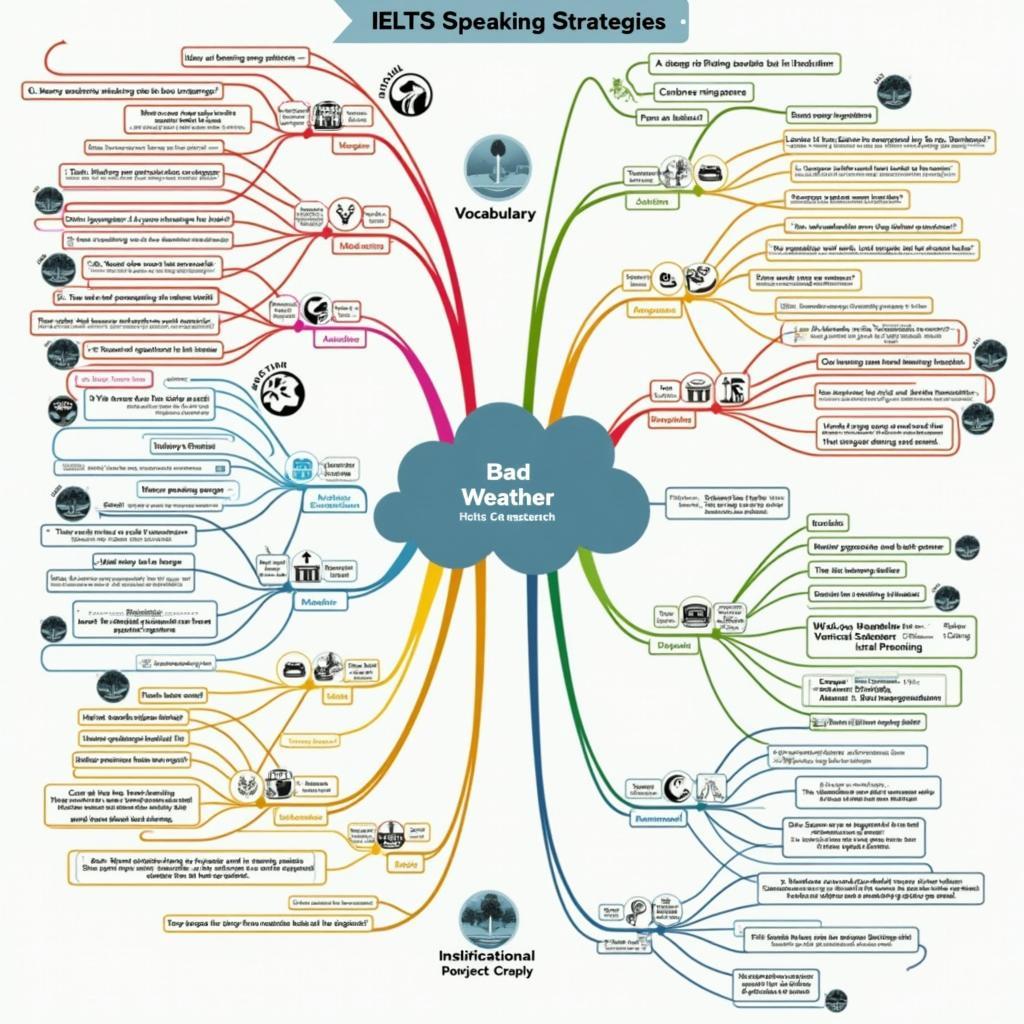 Sơ đồ chiến lược trả lời IELTS Speaking về thời tiết xấu
Chiến Lược Tổng Thể Để Đạt Band 8+
Lập Kế Hoạch Trước Khi Nói (Part 2)
Cách sử dụng hiệu quả 1 phút chuẩn bị:
Phút đầu (20 giây): Đọc kỹ đề, xác định:
- Thì động từ cần dùng (quá khứ/hiện tại/tương lai)
- Các bullet points bắt buộc phải trả lời
- Loại câu hỏi (describe, explain, compare)
20-40 giây tiếp theo: Ghi chú keywords theo cấu trúc:
When/Where: Summer 2022 - Sapa
Weather: Thunderstorm, torrential rain
Doing: Trekking with friends
Feelings: scared → relief → grateful
20 giây cuối: Nghĩ về:
- Opening sentence ấn tượng
- Từ vựng/cụm từ nâng cao bạn sẽ dùng
- Kết luận có ý nghĩa
Lưu ý quan trọng:
- KHÔNG viết câu hoàn chỉnh (waste of time)
- Ghi keywords đủ để trigger memory
- Đánh số thứ tự nếu cần
- Để ý pronunciation của những từ khó
Tránh Các Lỗi Phổ Biến
Lỗi về Fluency:
- ❌ Dừng quá lâu giữa câu: Practice linking ideas naturally
- ❌ Lặp từ quá nhiều: Có danh sách synonyms prepared
- ❌ Nói quá nhanh: Slow down, clarity > speed
Lỗi về Vocabulary:
- ❌ Dùng từ quá academic không phù hợp: “precipitation” OK trong Part 3, có thể “rain” natural hơn trong Part 1
- ❌ Paraphrase forced: Không nhất thiết phải paraphrase từ trong câu hỏi nếu không tự nhiên
- ❌ Dùng idioms sai context: Chỉ dùng khi bạn 100% chắc chắn
Lỗi về Grammar:
- ❌ Dùng sai thì: Kể chuyện quá khứ phải dùng past tenses consistently
- ❌ Subject-verb agreement: “The weather ARE bad” → “The weather IS bad”
- ❌ Articles: “I was caught in the rain” không phải “I was caught in rain”
Lỗi về Pronunciation:
- ❌ Không stress từ quan trọng: “I was REALLY FRIGHTENED by the THUNDER”
- ❌ Speaking monotone: Vary your intonation để show emotions
- ❌ Rushing through: Dành thời gian cho clear pronunciation
Tips Từ Góc Nhìn Examiner
Những gì Examiner thực sự đánh giá cao:
✅ Natural communication: Nói như đang kể chuyện với bạn, không phải đọc essay
✅ Relevant responses: Trả lời đúng câu hỏi, không đi quá xa off-topic
✅ Self-correction: Tự sửa lỗi nhanh (It was rain… I mean, it was raining) shows awareness
✅ Willingness to extend: Develop ideas without being prompted
✅ Appropriate register: Formal enough nhưng không overly academic
Những gì KHÔNG gây ấn tượng:
❌ Memorized answers: Examiners are trained để nhận ra learned responses
❌ Using templates: “There are several reasons for this. Firstly… Secondly…” too mechanical
❌ Over-using linking words: Không cần “Furthermore” và “Moreover” trong mỗi câu
❌ Trying to sound like someone else: Authenticity beats perfection
❌ Big words used incorrectly: Simple and correct > complex and wrong
Examiner’s Secret Tips:
💡 Pause naturally: Saying “Well…” hoặc “Let me think…” khi cần suy nghĩ là OK và tự nhiên
💡 Ask for clarification: Nếu không hiểu câu hỏi, hỏi lại is perfectly fine: “Sorry, could you repeat that?” hoặc “Do you mean…?”
💡 Show thinking process: “I’ve never really thought about this before, but I’d say…” shows authenticity
💡 Use personal examples: Real experiences luôn sound more genuine than made-up stories
💡 Don’t panic about silence: Một chút silence khi transition giữa ý tưởng là natural
Lộ Trình Luyện Tập 4 Tuần
Tuần 1: Foundation
- Days 1-2: Học 15-20 từ vựng mới về weather mỗi ngày
- Days 3-4: Practice Part 1 questions (8-10 câu/day)
- Days 5-6: Record yourself, identify weaknesses
- Day 7: Review và consolidate
Tuần 2: Building Complexity
- Days 1-3: Practice Part 2 cue cards (2 cards/day)
- Days 4-5: Focus on grammar structures (conditionals, passives)
- Days 6-7: Timed practice – simulate real test conditions
Tuần 3: Advanced Skills
- Days 1-3: Part 3 questions – develop critical thinking
- Days 4-5: Work on pronunciation và intonation
- Days 6-7: Full mock tests với recording và self-assessment
Tuần 4: Refinement
- Days 1-3: Address specific weaknesses identified
- Days 4-5: Practice với speaking partners hoặc teachers
- Days 6: Final mock test
- Day 7: Rest và relaxation trước test thật
Resources Hữu Ích
Để cải thiện Pronunciation:
- Shadowing: Listen và repeat sau native speakers
- Record và compare: So sánh pronunciation của bạn với model answers
- IPA practice: Học International Phonetic Alphabet basics
Để mở rộng Vocabulary:
- Word families: Learn words in groups (predict, prediction, predictable, unpredictable)
- Collocations: Học từ trong context, không học đơn lẻ
- Real-world exposure: Đọc weather reports, watch weather forecasts
Để improve Fluency:
- Daily speaking practice: 10-15 minutes mỗi ngày
- Think in English: Describe activities bạn đang làm trong đầu bằng English
- Speak to yourself: Kể lại ngày của bạn như một story
Nếu bạn muốn áp dụng những kỹ năng storytelling tương tự cho các chủ đề khác, hãy xem describe a memorable weekend you had recently để học cách kể về trải nghiệm cá nhân một cách sinh động và hấp dẫn.
Bài Tập Thực Hành
Bài Tập 1: Paraphrasing
Hãy paraphrase các câu sau đây về thời tiết xấu:
Original: “The rain was very heavy.”
Your version: ___
Gợi ý answers:
- Band 6-7: “It was raining heavily.” / “There was a lot of rain.”
- Band 7.5-8: “The rainfall was torrential.” / “We experienced intense precipitation.”
- Band 8.5-9: “The rain was coming down in sheets.” / “We were subjected to a deluge.”
Bài Tập 2: Extending Answers
Mở rộng câu trả lời ngắn sau thành 3-4 câu:
Question: Do you like rainy weather?
Short answer: “No, I don’t really like rain.”
Extended answer (Band 6-7):
“No, I don’t really like rain. It makes everything wet and uncomfortable. I can’t go outside and do activities I enjoy. Also, rain often makes me feel a bit sad and lazy.”
Extended answer (Band 8-9):
“Actually, I’d say I have quite mixed feelings about rain. On the one hand, I appreciate how it cleanses the air and nourishes nature, but on the other hand, I find persistent rainy weather can be rather dreary and dampening to one’s spirits. I suppose it also depends on the context – a light drizzle on a Sunday afternoon can be quite cozy, whereas getting caught in a downpour during my commute is decidedly unpleasant.”
Bài Tập 3: Story Organization
Sắp xếp các ý sau thành một câu chuyện logic về việc gặp thời tiết xấu:
a) We were completely soaked by the time we found shelter
b) It was a sunny morning when we started our hike
c) Looking back, it taught me to always check weather forecasts
d) Suddenly, dark clouds appeared and it started raining heavily
e) We had to wait in a small cave for two hours
Correct order: b → d → a → e → c
Explanation: Setting (sunny start) → Complication (storm arrives) → Crisis (got soaked) → Resolution (waited in cave) → Reflection (lesson learned)
Kết Luận
Chủ đề “describe a time when you were caught in bad weather” là một đề tài tuyệt vời để thể hiện khả năng storytelling, sử dụng thì quá khứ chính xác, và miêu tả cảm xúc một cách sinh động trong IELTS Speaking. Bằng cách chuẩn bị kỹ lưỡng với từ vựng phong phú, cấu trúc ngữ pháp đa dạng, và chiến lược trả lời thông minh, bạn hoàn toàn có thể đạt được band điểm cao.
Những điểm cốt lõi cần nhớ:
🎯 Authenticity is key: Kể chuyện có thật hoặc dựa trên trải nghiệm thực tế luôn convincing hơn những câu chuyện bịa đặt
📚 Vocabulary matters: Đầu tư thời gian học từ vựng weather-specific và các collocations tự nhiên
📝 Grammar variety: Sử dụng diverse structures nhưng đảm bảo accuracy
🗣️ Natural delivery: Speak confidently và naturally, không cần perfect
💡 Think critically: Đặc biệt trong Part 3, show ability để analyze issues từ nhiều perspectives
⏰ Practice timing: Đủ 2 phút cho Part 2, không quá ngắn hay quá dài
Hãy nhớ rằng IELTS Speaking không phải là một bài kiểm tra kiến thức tiếng Anh thuần túy, mà là đánh giá khả năng communication của bạn. Examiner muốn thấy bạn có thể express ideas clearly, engage in meaningful conversation, và adapt language appropriately cho different contexts.
Chúc bạn thành công trong kỳ thi IELTS Speaking! Với sự chuẩn bị kỹ lưỡng và practice đều đặn, bạn hoàn toàn có thể đạt được band điểm mục tiêu của mình. Remember: Confidence comes from preparation, và preparation takes practice!


[…] Xem thêm: IELTS Speaking: Cách Trả Lời “Describe A Time When You Were Caught In Bad Weather” – Bài… […]