
Công nghệ thực tế ảo (VR) đang tạo nên cuộc cách mạng trong lĩnh vực giáo dục ngôn ngữ, mở ra những trải nghiệm học tập tương tác chưa từng có. Chủ đề “Interactive Language Learning Through VR” ngày càng xuất hiện phổ biến trong các kỳ thi IELTS Reading gần đây, phản ánh xu hướng công nghệ giáo dục toàn cầu. Bài viết này cung cấp một bộ đề thi IELTS Reading hoàn chỉnh với 3 passages từ dễ đến khó, bao gồm 40 câu hỏi đa dạng giống như thi thật, đáp án chi tiết kèm giải thích và bộ từ vựng quan trọng. Đề thi này phù hợp cho học viên từ band 5.0 trở lên, giúp bạn làm quen với format đề thi thực tế, rèn luyện kỹ năng đọc hiểu và quản lý thời gian hiệu quả. Thông qua việc luyện tập với đề thi này, bạn sẽ nắm vững các dạng câu hỏi phổ biến, học được cách paraphrase thông tin và xây dựng chiến lược làm bài bài bản cho phần thi Reading.
Hướng Dẫn Làm Bài IELTS Reading
Tổng Quan Về IELTS Reading Test
IELTS Reading Test là phần thi kéo dài 60 phút với 3 passages và tổng cộng 40 câu hỏi. Độ khó của các passages tăng dần từ dễ đến khó, yêu cầu thí sinh có khả năng đọc hiểu, phân tích và xử lý thông tin nhanh chóng.
Phân bổ thời gian khuyến nghị:
- Passage 1: 15-17 phút (độ khó Easy)
- Passage 2: 18-20 phút (độ khó Medium)
- Passage 3: 23-25 phút (độ khó Hard)
Lưu ý quan trọng là bạn cần chuyển đáp án vào Answer Sheet trong thời gian 60 phút này, không có thêm thời gian riêng để chuyển đáp án như phần Listening.
Các Dạng Câu Hỏi Trong Đề Này
Đề thi mẫu này bao gồm 7 dạng câu hỏi phổ biến nhất trong IELTS Reading:
- Multiple Choice – Câu hỏi trắc nghiệm nhiều lựa chọn
- True/False/Not Given – Xác định thông tin đúng/sai/không được đề cập
- Matching Headings – Nối tiêu đề với đoạn văn
- Sentence Completion – Hoàn thành câu
- Summary Completion – Hoàn thành đoạn tóm tắt
- Matching Features – Nối đặc điểm với thông tin
- Short-answer Questions – Câu hỏi trả lời ngắn
IELTS Reading Practice Test
PASSAGE 1 – Virtual Reality: A New Dimension in Language Education
Độ khó: Easy (Band 5.0-6.5)
Thời gian đề xuất: 15-17 phút
Learning a new language has always been a challenging journey that requires not just memorizing vocabulary and grammar rules, but also immersing oneself in real-life situations where the language is used naturally. Traditional classroom methods, while effective to some extent, often fail to provide learners with authentic communicative experiences. However, the emergence of Virtual Reality (VR) technology is revolutionizing how people learn languages by creating immersive environments that simulate real-world scenarios.
VR language learning applications allow students to step into virtual worlds where they can practice their language skills in realistic settings. For instance, a learner studying French can virtually walk through the streets of Paris, order food at a café, or ask for directions from virtual characters. These interactions feel remarkably real because VR engages multiple senses simultaneously – users can see the environment, hear native speakers, and even use hand gestures to communicate, creating a multisensory learning experience that traditional methods cannot match.
One of the most significant advantages of VR language learning is the elimination of anxiety that many students experience when speaking a foreign language. In a traditional classroom, learners often feel self-conscious about making mistakes in front of their peers. This fear of embarrassment can be a major barrier to language acquisition. VR environments, however, provide a safe space where students can practice without judgment. They can repeat conversations as many times as needed, make mistakes freely, and build confidence gradually before engaging with real people.
Personalization is another key benefit of VR language learning platforms. Unlike conventional classes where all students follow the same curriculum at the same pace, VR systems can adapt to individual learning styles and progress rates. Artificial intelligence algorithms track each learner’s performance and adjust the difficulty level accordingly. If a student struggles with vocabulary related to shopping, the system can generate more shopping scenarios until mastery is achieved. This tailored approach ensures that learners spend time on areas where they need the most improvement.
The technology also addresses the problem of limited exposure to native speakers. In many countries, language learners have few opportunities to interact with people who speak their target language fluently. VR can bridge this gap by providing access to realistic conversational partners programmed to speak with authentic accents and use colloquial expressions. Some advanced systems even incorporate cultural elements into the virtual scenarios, teaching learners not just the language but also the customs and social norms of the countries where it is spoken.
Cost-effectiveness represents another compelling advantage of VR language learning. Traditional immersion programs, such as studying abroad, are expensive and not accessible to everyone. Travel costs, accommodation, and tuition fees can add up to thousands of dollars. VR offers a more affordable alternative that delivers many of the same benefits. After the initial investment in a VR headset, learners can access countless immersive experiences at a fraction of the cost of physical travel.
Despite these advantages, VR language learning does face certain challenges. The technology requires significant upfront investment in hardware, which may not be affordable for all educational institutions or individual learners. Additionally, some users experience motion sickness or discomfort when using VR headsets for extended periods. There are also concerns about the lack of genuine human interaction. While VR characters can simulate conversations, they cannot fully replace the spontaneity and emotional connection of real human communication.
Furthermore, the pedagogical effectiveness of VR language learning is still being researched. While early studies show promising results, with learners demonstrating improved vocabulary retention and increased confidence, more long-term research is needed to determine whether VR learning leads to lasting language proficiency. Educators are still developing best practices for integrating VR into language curricula and determining the optimal balance between virtual and traditional learning methods.
Nevertheless, the future of VR in language education looks bright. As the technology becomes more sophisticated and accessible, it is likely to play an increasingly important role in how people learn languages. Schools and universities are beginning to incorporate VR labs into their facilities, and several companies are developing comprehensive VR language courses that cover everything from beginner to advanced levels. The combination of technological innovation and educational expertise promises to make language learning more effective, engaging, and accessible to learners worldwide.
Questions 1-6: Multiple Choice
Choose the correct letter, A, B, C, or D.
-
According to the passage, traditional classroom methods for language learning
A. are completely ineffective for all students
B. provide insufficient real-world communication practice
C. are more expensive than VR learning
D. cause more anxiety than VR learning -
VR language learning helps reduce student anxiety by
A. eliminating the need for speaking practice
B. providing immediate correction of mistakes
C. creating a judgment-free practice environment
D. connecting students with native speakers -
The personalization feature of VR language platforms
A. requires manual adjustment by teachers
B. uses AI to adapt to individual learner needs
C. works the same way for all students
D. focuses only on vocabulary learning -
Compared to traditional study abroad programs, VR language learning is
A. equally expensive
B. more culturally authentic
C. significantly more affordable
D. less effective in all aspects -
One limitation of VR language learning mentioned in the passage is
A. it cannot teach grammar rules
B. it requires expensive ongoing subscriptions
C. it may cause physical discomfort for some users
D. it is only suitable for beginners -
The passage suggests that the future of VR in language education will likely involve
A. completely replacing traditional teaching methods
B. integration with existing educational approaches
C. remaining limited to universities only
D. decreasing in popularity as technology advances
Questions 7-10: True/False/Not Given
Do the following statements agree with the information given in the passage?
Write:
- TRUE if the statement agrees with the information
- FALSE if the statement contradicts the information
- NOT GIVEN if there is no information on this
- VR language learning engages more senses than traditional classroom learning.
- All students prefer VR learning over traditional classroom methods.
- VR systems can create unlimited shopping scenarios for practice.
- Long-term research has definitively proven VR learning is superior to traditional methods.
Questions 11-13: Sentence Completion
Complete the sentences below.
Choose NO MORE THAN THREE WORDS from the passage for each answer.
- VR language platforms can include __ to help learners understand the social customs of target language countries.
- Some users of VR headsets may experience __ when using the technology for long periods.
- Educational institutions are beginning to establish __ as part of their facilities for language learning.
PASSAGE 2 – The Cognitive Science Behind VR Language Acquisition
Độ khó: Medium (Band 6.0-7.5)
Thời gian đề xuất: 18-20 phút
The neuroscientific principles underlying virtual reality language learning represent a fascinating intersection of technology and cognitive psychology. Researchers have long understood that language acquisition is fundamentally different from other types of learning, involving specialized neural pathways that evolved specifically for processing linguistic information. What makes VR particularly intriguing from a cognitive standpoint is its ability to activate these pathways in ways that closely mimic natural language acquisition processes observed in children and successful adult learners.
Embodied cognition theory provides a theoretical framework for understanding why VR language learning can be so effective. This theory posits that cognitive processes are deeply rooted in the body’s interactions with the world. When learning vocabulary, for instance, students who physically act out the meanings of words show significantly better retention than those who simply memorize definitions. VR capitalizes on this principle by allowing learners to perform virtual actions associated with new vocabulary. Instead of merely reading the word “throw,” learners can execute throwing motions in a virtual environment, creating robust neural connections between the word, the action, and the sensorimotor experience.
The concept of situated learning further illuminates VR’s effectiveness. Language is not merely a collection of words and rules but a contextual tool shaped by specific situations and social interactions. Traditional language instruction often decontextualizes vocabulary and grammar, presenting them as abstract entities divorced from meaningful use. VR, by contrast, enables situated practice where learners encounter language embedded in appropriate contexts. Research conducted at Stanford University’s Virtual Human Interaction Lab demonstrated that students who learned Spanish vocabulary for household items by manipulating virtual objects in a kitchen scenario showed 37% better retention after one week compared to students using conventional flashcard methods.
Spatial memory systems also play a crucial role in VR’s pedagogical advantages. The human brain possesses exceptional capabilities for remembering locations and spatial relationships, an evolutionary adaptation that helped our ancestors navigate complex environments. VR language learning leverages this spatial memory by associating vocabulary and phrases with specific virtual locations. When learners practice ordering food in a virtual restaurant, they are not just memorizing vocabulary; they are creating a spatial cognitive map linking words to a particular environment. Later recall becomes easier because retrieval cues include both linguistic and spatial-environmental elements.
The phenomenon of presence—the psychological sensation of “being there” in a virtual environment—constitutes another critical factor in VR’s effectiveness. High levels of presence correlate strongly with learning outcomes because they increase emotional engagement and attention. When learners feel genuinely present in a virtual Paris café, their emotional state more closely resembles that of someone actually visiting Paris. This emotional authenticity is significant because emotions play a vital role in memory consolidation. Neurotransmitters released during emotionally salient experiences strengthen synaptic connections, making the learned material more likely to transfer to long-term memory.
Implicit learning mechanisms represent yet another dimension where VR demonstrates advantages. Much of native-like language competence comes not from explicit rule learning but from unconscious pattern recognition developed through extensive exposure. VR environments can provide the massive input necessary for implicit learning while maintaining engagement through interactive elements. Unlike passive exposure through films or podcasts, VR requires active participation, which research suggests is crucial for triggering the implicit learning systems. A 2022 study published in the Journal of Computer-Assisted Learning found that learners using VR for just 30 minutes daily showed marked improvements in grammatical intuition—the ability to recognize whether sentences “sound right”—despite no explicit grammar instruction.
However, the cognitive load theory raises important considerations about VR implementation. This theory suggests that working memory capacity is limited, and instructional design must carefully manage the cognitive demands placed on learners. VR environments, being information-rich and sensory-intensive, risk overwhelming learners with extraneous cognitive load—mental effort spent processing irrelevant environmental details rather than focusing on language learning objectives. Effective VR language applications must therefore balance environmental realism with cognitive economy, providing sufficient context without creating distracting complexity.
The issue of transfer of learning—whether skills acquired in virtual contexts successfully translate to real-world performance—remains a subject of ongoing investigation. Preliminary evidence suggests positive transfer, particularly for lexical knowledge and pragmatic competence (understanding appropriate language use in social contexts). A longitudinal study tracking university students learning Mandarin Chinese found that those who supplemented traditional instruction with VR practice demonstrated significantly superior performance in real-world conversation assessments compared to control groups. Interestingly, the VR group showed particular strength in paralinguistic features such as appropriate gesture use and proxemics (physical distance norms), suggesting that the embodied nature of VR learning extends beyond purely linguistic elements.
Individual differences in learning styles and preferences also mediate VR’s effectiveness. While many learners respond enthusiastically to immersive technology, some find virtual environments cognitively demanding or prefer traditional methods. Metacognitive awareness—understanding one’s own learning processes—varies considerably among students, influencing how effectively they can leverage VR tools. Research indicates that autonomous learners with strong self-regulation skills tend to benefit most from VR language learning, as they can strategically navigate virtual scenarios to target their specific learning needs.
Looking forward, the integration of adaptive AI with VR promises to address some current limitations. Intelligent tutoring systems can monitor learner performance in real-time, adjusting conversational complexity, providing scaffolded support, and generating personalized scenarios that target individual weaknesses. As natural language processing continues to advance, virtual conversation partners will become increasingly sophisticated, capable of engaging in genuinely flexible dialogue rather than scripted exchanges. This evolution toward truly adaptive, intelligent VR learning environments may finally enable technology to deliver on the long-standing promise of providing individualized instruction at scale.
 Học sinh đang sử dụng công nghệ thực tế ảo VR để học ngôn ngữ trong môi trường học tập tương tác hiện đại
Questions 14-18: Matching Headings
The passage has ten paragraphs (1-10).
Choose the correct heading for paragraphs 2, 4, 6, 7, and 9 from the list of headings below.
List of Headings:
- i. The role of emotional engagement in memory formation
- ii. How physical actions enhance vocabulary retention
- iii. Concerns about overwhelming learners with too much information
- iv. The challenge of applying virtual skills to real situations
- v. Differences in how students respond to VR learning
- vi. Using spatial awareness to improve recall
- vii. Developing unconscious language patterns through VR
- viii. The future of AI-enhanced virtual learning
- ix. Problems with traditional vocabulary teaching methods
- x. How virtual restaurants create better learning contexts
- Paragraph 2
- Paragraph 4
- Paragraph 6
- Paragraph 7
- Paragraph 9
Questions 19-23: Summary Completion
Complete the summary below.
Choose NO MORE THAN TWO WORDS from the passage for each answer.
VR language learning is grounded in several cognitive theories. The theory of (19) __ suggests that physical interactions enhance cognitive processes, which VR exploits by letting learners perform actions while learning vocabulary. Additionally, (20) __ helps explain why VR is effective, as it allows language to be learned in meaningful contexts rather than as abstract concepts. The human brain’s (21) __ can be utilized by VR to associate words with specific locations, making retrieval easier. The sensation of (22) __ in virtual environments increases emotional engagement, which strengthens memory formation. Finally, VR enables (23) __ through extensive interactive exposure, helping learners develop intuitive grammatical understanding.
Questions 24-26: Yes/No/Not Given
Do the following statements agree with the claims of the writer in the passage?
Write:
- YES if the statement agrees with the claims of the writer
- NO if the statement contradicts the claims of the writer
- NOT GIVEN if it is impossible to say what the writer thinks about this
- VR language learning activates brain pathways similar to those used in natural language acquisition.
- All students show equal improvement regardless of their learning style when using VR.
- Future VR systems will completely replace human language teachers.
PASSAGE 3 – Sociocultural Dimensions and Pedagogical Implementation of VR Language Learning
Độ khó: Hard (Band 7.0-9.0)
Thời gian đề xuất: 23-25 phút
The proliferation of virtual reality technologies in language education necessitates a critical examination of not merely their technical affordances but also their broader sociocultural implications and the pedagogical frameworks required for effective implementation. While the cognitive and experiential benefits of VR language learning have been extensively documented, less attention has been paid to how these technologies intersect with issues of cultural representation, educational equity, and the evolving role of language educators in increasingly technology-mediated learning environments. Moreover, the theoretical underpinnings of VR integration into language curricula demand scrutiny through the lens of contemporary second language acquisition research and sociocultural theory.
Sociocultural theory, particularly as articulated by Vygotsky and elaborated by subsequent scholars, emphasizes that language learning is fundamentally a social process mediated by cultural tools and occurring within a zone of proximal development where learners can achieve tasks with appropriate support that they cannot complete independently. VR environments, viewed through this theoretical paradigm, represent sophisticated mediating artifacts that can potentially scaffold learner development in unprecedented ways. However, a crucial question emerges: to what extent do interactions with algorithmically-driven virtual agents constitute the kind of genuine social interaction that sociocultural theory positions as central to language development? The ontological status of VR conversations—whether they represent actual communicative events or merely simulations thereof—carries significant implications for pedagogical validity.
The issue of authentic cultural representation in VR language learning environments presents considerable challenges. Virtual worlds purporting to simulate cultural contexts—a Tokyo street scene for Japanese learners, a Buenos Aires market for Spanish students—necessarily reify and essentialize complex, dynamic cultures into static digital representations. This representational reductionism risks perpetuating stereotypes and presenting monolithic cultural narratives that obscure the heterogeneity and fluidity characteristic of all cultural systems. A virtual Paris café, however meticulously designed, cannot capture the multifaceted reality of contemporary French culture, with its regional variations, socioeconomic diversity, and ongoing cultural evolution. Furthermore, the subjective positioning of VR content creators—their own cultural backgrounds, ideological assumptions, and aesthetic preferences—inevitably shapes the virtual environments they construct, raising questions about whose version of a culture is being represented and what implicit power dynamics such representations encode.
Educational equity constitutes another critical concern in the adoption of VR language learning technologies. While proponents often tout VR as democratizing access to immersive language experiences, this claim warrants careful examination. The digital divide—disparities in access to technology based on socioeconomic status, geographic location, and institutional resources—means that VR language learning risks becoming a privilege of affluent schools and individuals rather than a universally available educational tool. The initial capital outlay for VR infrastructure, including headsets, high-performance computing systems, and bandwidth for content delivery, creates substantial barriers to entry for under-resourced educational institutions. This technological stratification could exacerbate existing educational inequalities, creating a bifurcated system where privileged students access cutting-edge immersive learning while others continue with resource-constrained traditional methods.
The evolving professional identity of language educators in the context of VR integration represents a multifaceted challenge requiring careful navigation. The introduction of immersive technologies fundamentally reconfigures the pedagogical landscape, potentially displacing traditional teacher-centered instruction with student-driven exploratory learning in virtual environments. This shift necessitates that educators develop new competencies and reconceptualize their professional roles—moving from primary knowledge sources to facilitators of technology-enhanced learning, curators of virtual experiences, and guides helping students critically engage with digital language learning tools. However, this transformation is not without tensions and resistance. Many language teachers, trained in conventional pedagogical approaches and lacking digital literacy skills, may experience professional anxiety or pedagogical dissonance when confronted with expectations to integrate technologies they neither fully understand nor necessarily endorse as pedagogically sound.
Empirical research on VR language learning outcomes presents a methodologically complex picture. While numerous studies report positive effects, the heterogeneity of research designs, inconsistent operationalization of key variables, and absence of standardized assessment protocols make it difficult to draw definitive conclusions about effectiveness. Many studies suffer from small sample sizes, short intervention periods, and inadequate control for confounding variables such as novelty effects—the possibility that improved performance stems from enthusiasm for new technology rather than inherent pedagogical superiority. Furthermore, the lack of longitudinal research examining whether gains observed immediately after VR interventions persist over time or successfully transfer to real-world communicative competence represents a significant evidentiary gap. The field requires more rigorous, large-scale studies employing robust experimental designs and ecologically valid assessment measures that capture not just discrete linguistic knowledge but also holistic communicative abilities and intercultural competence.
Theoretical integration of VR language learning within established second language acquisition frameworks remains incomplete. While connections to cognitive theories have been extensively explored, engagement with alternative paradigms such as complexity theory, translanguaging, and critical pedagogy has been limited. Complexity theory, which views language development as a dynamic, non-linear process emerging from the interaction of multiple variables across nested timescales, offers a potentially illuminating lens for understanding how learners navigate and appropriate VR environments in idiosyncratic ways. Translanguaging perspectives, which emphasize the fluid, integrated nature of multilingual speakers’ linguistic repertoires, raise important questions about how VR environments might accommodate and leverage learners’ full linguistic resources rather than artificially constraining them to target language monolingualism. Critical pedagogical approaches challenge us to consider how VR language learning might either reproduce or contest existing power relations and whose interests are served by particular technological implementations.
The sustainability and long-term viability of VR language learning initiatives present practical challenges that extend beyond initial implementation. The rapid obsolescence of hardware and software in consumer technology sectors means that VR systems adopted today may become outdated within short timeframes, requiring ongoing investment to maintain currency. The dependency on proprietary platforms and commercial content providers raises concerns about institutional autonomy and the continuity of access—what happens when a company discontinues a product or substantially increases subscription costs? Open-source alternatives and institutionally-developed content offer potential solutions but require substantial technical expertise and collaborative infrastructure that many educational institutions lack.
Looking toward future trajectories, several developments appear particularly salient. The convergence of VR with augmented reality (AR) and mixed reality (MR) technologies may enable more flexible modalities of immersive language learning that integrate virtual elements into physical environments rather than creating entirely separate virtual worlds. Haptic technologies—devices that simulate tactile sensations—could add additional sensory dimensions to VR language learning, potentially enhancing the embodied cognition effects discussed earlier. The application of sophisticated AI and machine learning to create genuinely responsive virtual conversational partners capable of natural dialogue represents another promising frontier, though it also raises ethical questions about data privacy and the algorithmic shaping of linguistic input learners receive.
Ultimately, the question is not whether VR can contribute to language learning—the evidence suggests it can—but rather how to implement these technologies in ways that are pedagogically sound, culturally responsible, equitably accessible, and theoretically coherent. This requires ongoing dialogue among diverse stakeholders: educators, learners, researchers, technology developers, and policymakers. It demands critical engagement rather than uncritical adoption, careful empirical investigation rather than technology-driven enthusiasm, and a commitment to ensuring that innovation serves genuine educational purposes rather than merely reflecting technological possibility. The future of VR in language education will ultimately be determined not by the sophistication of the technology itself but by the wisdom and thoughtfulness with which we choose to deploy it.
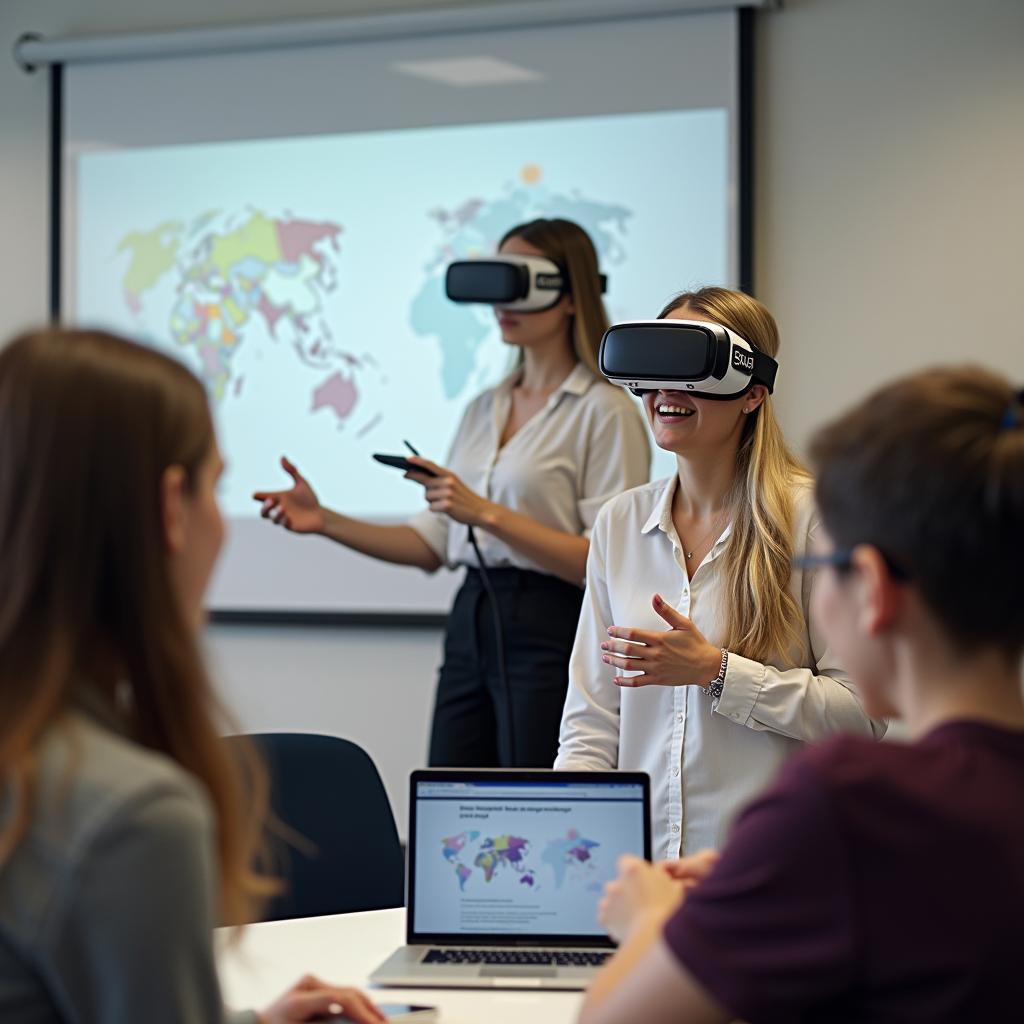 Giáo viên đang hướng dẫn học sinh sử dụng công nghệ thực tế ảo trong lớp học ngôn ngữ hiện đại với thiết bị VR tiên tiến
Questions 27-31: Multiple Choice
Choose the correct letter, A, B, C, or D.
-
According to the passage, sociocultural theory questions whether VR interactions
A. can provide any educational benefits at all
B. represent genuine social communication
C. are more effective than traditional methods
D. should be used in language classrooms -
The passage suggests that virtual representations of cultures
A. accurately capture all aspects of cultural diversity
B. necessarily simplify complex cultural realities
C. are always created with cultural sensitivity
D. have no educational value whatsoever -
The term “digital divide” in the passage refers to
A. differences in student learning abilities
B. various types of VR technology available
C. unequal access to technology based on resources
D. the gap between teacher and student skills -
The passage indicates that language teachers integrating VR must
A. abandon all traditional teaching methods
B. develop expertise in computer programming
C. redefine their professional roles and skills
D. teach only through virtual environments -
Research on VR language learning is described as being limited by
A. complete absence of any positive findings
B. methodological inconsistencies and small studies
C. excessive focus on long-term outcomes
D. too many large-scale studies with conflicting results
Questions 32-36: Matching Features
Match each theoretical perspective (32-36) with the correct concern or question it raises about VR language learning (A-H).
Theoretical Perspectives:
32. Complexity theory
33. Translanguaging perspectives
34. Critical pedagogy
35. Sociocultural theory
36. Embodied cognition
Concerns/Questions:
- A. Whether VR allows learners to use their full linguistic resources
- B. How physical sensations might enhance VR learning
- C. Whether learners navigate VR environments in unique, non-linear ways
- D. If VR perpetuates or challenges existing power structures
- E. Whether virtual interactions constitute genuine social communication
- F. How VR content reflects creators’ cultural backgrounds
- G. If VR should completely replace classroom instruction
- H. Whether all students prefer VR to traditional methods
Questions 37-40: Short-answer Questions
Answer the questions below.
Choose NO MORE THAN THREE WORDS from the passage for each answer.
- What type of technology is mentioned as potentially converging with VR to integrate virtual elements into physical environments?
- What devices could add tactile sensations to VR language learning experiences?
- What two things does the passage say will determine VR’s future in language education rather than just technological sophistication?
- What does the passage say creates substantial barriers for under-resourced schools wanting to adopt VR?
Answer Keys – Đáp Án
PASSAGE 1: Questions 1-13
- B
- C
- B
- C
- C
- B
- TRUE
- NOT GIVEN
- NOT GIVEN
- FALSE
- cultural elements
- motion sickness
- VR labs
PASSAGE 2: Questions 14-26
- ii
- vi
- vii
- iii
- v
- embodied cognition
- situated learning
- spatial memory (systems)
- presence
- implicit learning
- YES
- NO
- NOT GIVEN
PASSAGE 3: Questions 27-40
- B
- B
- C
- C
- B
- C
- A
- D
- E
- B
- augmented reality / AR
- haptic technologies
- wisdom and thoughtfulness
- initial capital outlay
Giải Thích Đáp Án Chi Tiết
Passage 1 – Giải Thích
Câu 1: B
- Dạng câu hỏi: Multiple Choice
- Từ khóa: traditional classroom methods
- Vị trí trong bài: Đoạn 1, dòng 3-5
- Giải thích: Bài viết nói “Traditional classroom methods, while effective to some extent, often fail to provide learners with authentic communicative experiences.” Điều này được paraphrase thành đáp án B – “provide insufficient real-world communication practice”. Các đáp án khác không được đề cập hoặc sai thông tin.
Câu 2: C
- Dạng câu hỏi: Multiple Choice
- Từ khóa: reduce student anxiety
- Vị trí trong bài: Đoạn 3, dòng 1-6
- Giải thích: Bài viết giải thích “VR environments provide a safe space where students can practice without judgment.” Từ “safe space” và “without judgment” được paraphrase thành “judgment-free practice environment” trong đáp án C.
Câu 5: C
- Dạng câu hỏi: Multiple Choice
- Từ khóa: limitation
- Vị trí trong bài: Đoạn 7, dòng 3-4
- Giải thích: Bài viết đề cập “some users experience motion sickness or discomfort when using VR headsets for extended periods”, tương ứng với đáp án C về physical discomfort.
Câu 7: TRUE
- Dạng câu hỏi: True/False/Not Given
- Từ khóa: engages more senses
- Vị trí trong bài: Đoạn 2, dòng 5-7
- Giải thích: Bài viết nói rõ “VR engages multiple senses simultaneously” và tạo ra “multisensory learning experience that traditional methods cannot match”, khẳng định VR kích thích nhiều giác quan hơn phương pháp truyền thống.
Câu 8: NOT GIVEN
- Dạng câu hỏi: True/False/Not Given
- Từ khóa: all students prefer
- Giải thích: Bài viết không đề cập đến việc tất cả học sinh có thích VR hơn phương pháp truyền thống hay không. Đây là thông tin không được cung cấp.
Câu 10: FALSE
- Dạng câu hỏi: True/False/Not Given
- Từ khóa: long-term research, definitively proven
- Vị trí trong bài: Đoạn 8, dòng 1-3
- Giải thích: Bài viết nói “more long-term research is needed to determine whether VR learning leads to lasting language proficiency”, nghĩa là nghiên cứu dài hạn CHƯA chứng minh được điều này, mâu thuẫn với câu khẳng định trong đề.
Câu 11: cultural elements
- Dạng câu hỏi: Sentence Completion
- Từ khóa: help learners understand social customs
- Vị trí trong bài: Đoạn 5, dòng 5-7
- Giải thích: Câu trong bài viết “Some advanced systems even incorporate cultural elements into the virtual scenarios, teaching learners not just the language but also the customs and social norms” cung cấp đáp án chính xác.
Passage 2 – Giải Thích
Câu 14: ii (Paragraph 2)
- Dạng câu hỏi: Matching Headings
- Giải thích: Đoạn 2 tập trung vào “embodied cognition theory” và giải thích cách “physically act out” và “perform virtual actions” giúp cải thiện việc ghi nhớ từ vựng. Tiêu đề “How physical actions enhance vocabulary retention” phù hợp nhất.
Câu 15: vi (Paragraph 4)
- Dạng câu hỏi: Matching Headings
- Giải thích: Đoạn 4 thảo luận về “spatial memory systems” và cách VR “leverages this spatial memory” để tạo “spatial cognitive map”, giúp việc nhớ lại dễ dàng hơn. Tiêu đề phù hợp là “Using spatial awareness to improve recall”.
Câu 17: iii (Paragraph 7)
- Dạng câu hỏi: Matching Headings
- Giải thích: Đoạn 7 nói về “cognitive load theory” và nguy cơ VR “overwhelming learners” với “extraneous cognitive load” và “distracting complexity”. Tiêu đề “Concerns about overwhelming learners with too much information” khớp hoàn toàn.
Câu 19: embodied cognition
- Dạng câu hỏi: Summary Completion
- Vị trí trong bài: Đoạn 2, dòng 1
- Giải thích: Câu tóm tắt đề cập đến theory về physical interactions, trong bài là “Embodied cognition theory provides a theoretical framework”.
Câu 22: presence
- Dạng câu hỏi: Summary Completion
- Vị trí trong bài: Đoạn 5, dòng 1
- Giải thích: Bài viết nói về “The phenomenon of presence—the psychological sensation of ‘being there'” và “High levels of presence correlate strongly with learning outcomes”.
Câu 24: YES
- Dạng câu hỏi: Yes/No/Not Given
- Vị trí trong bài: Đoạn 1, dòng 6-8
- Giải thích: Bài viết khẳng định “VR’s ability to activate these pathways in ways that closely mimic natural language acquisition processes”, hoàn toàn đồng ý với quan điểm trong câu hỏi.
Câu 25: NO
- Dạng câu hỏi: Yes/No/Not Given
- Vị trí trong bài: Đoạn 9
- Giải thích: Đoạn cuối nói rõ “Individual differences in learning styles and preferences also mediate VR’s effectiveness”, nghĩa là không phải tất cả học sinh đều cải thiện như nhau, mâu thuẫn với câu hỏi.
Passage 3 – Giải Thích
Câu 27: B
- Dạng câu hỏi: Multiple Choice
- Từ khóa: sociocultural theory questions
- Vị trí trong bài: Đoạn 2, dòng 4-6
- Giải thích: Bài viết đặt câu hỏi “to what extent do interactions with algorithmically-driven virtual agents constitute the kind of genuine social interaction”, tương ứng với đáp án B về việc VR có thể hiện giao tiếp xã hội thực sự hay không.
Câu 28: B
- Dạng câu hỏi: Multiple Choice
- Từ khóa: virtual representations of cultures
- Vị trí trong bài: Đoạn 3, dòng 2-5
- Giải thích: Bài viết nói “Virtual worlds necessarily reify and essentialize complex, dynamic cultures into static digital representations” và “This representational reductionism risks perpetuating stereotypes”, chỉ rõ việc đơn giản hóa văn hóa phức tạp (đáp án B).
Câu 29: C
- Dạng câu hỏi: Multiple Choice
- Từ khóa: digital divide
- Vị trí trong bài: Đoạn 4, dòng 3-4
- Giải thích: Bài viết định nghĩa “The digital divide—disparities in access to technology based on socioeconomic status, geographic location, and institutional resources”, chính xác là đáp án C.
Câu 32: C (Complexity theory)
- Dạng câu hỏi: Matching Features
- Vị trí trong bài: Đoạn 7, dòng 3-5
- Giải thích: Bài viết nói “Complexity theory…views language development as a dynamic, non-linear process” và “offers a potentially illuminating lens for understanding how learners navigate and appropriate VR environments in idiosyncratic ways”, khớp với đáp án C.
Câu 33: A (Translanguaging perspectives)
- Dạng câu hỏi: Matching Features
- Vị trí trong bài: Đoạn 7, dòng 6-8
- Giải thích: Bài viết nói về “Translanguaging perspectives…raise important questions about how VR environments might accommodate and leverage learners’ full linguistic resources”, tương ứng đáp án A.
Câu 37: augmented reality / AR
- Dạng câu hỏi: Short-answer
- Vị trí trong bài: Đoạn 9, dòng 1-3
- Giải thích: Bài viết đề cập “The convergence of VR with augmented reality (AR) and mixed reality (MR) technologies may enable more flexible modalities…that integrate virtual elements into physical environments”.
Câu 39: wisdom and thoughtfulness
- Dạng câu hỏi: Short-answer
- Vị trí trong bài: Đoạn 10, dòng cuối
- Giải thích: Câu cuối bài viết nói rõ “The future of VR in language education will ultimately be determined not by the sophistication of the technology itself but by the wisdom and thoughtfulness with which we choose to deploy it”.
Từ Vựng Quan Trọng Theo Passage
Passage 1 – Essential Vocabulary
| Từ vựng | Loại từ | Phiên âm | Nghĩa tiếng Việt | Ví dụ từ bài | Collocation |
|---|---|---|---|---|---|
| immersing oneself | verb phrase | /ɪˈmɜːsɪŋ wʌnˈself/ | đắm mình, hòa mình vào | immersing oneself in real-life situations | immerse in culture/experience |
| authentic | adj | /ɔːˈθentɪk/ | chân thực, xác thực | authentic communicative experiences | authentic materials/interaction |
| virtually | adv | /ˈvɜːtʃuəli/ | hầu như, gần như; một cách ảo | virtually walk through the streets | virtually certain/impossible |
| multisensory | adj | /ˌmʌltiˈsensəri/ | đa giác quan | multisensory learning experience | multisensory approach/environment |
| self-conscious | adj | /ˌself ˈkɒnʃəs/ | tự ý thức, ngượng ngùng | feel self-conscious about making mistakes | become/feel self-conscious |
| personalization | noun | /ˌpɜːsənəlaɪˈzeɪʃən/ | cá nhân hóa | personalization is a key benefit | allow/enable personalization |
| curriculum | noun | /kəˈrɪkjələm/ | chương trình giảng dạy | all students follow the same curriculum | design/develop curriculum |
| colloquial | adj | /kəˈləʊkwiəl/ | thông tục, khẩu ngữ | use colloquial expressions | colloquial language/speech |
| cost-effectiveness | noun | /kɒst ɪˈfektɪvnəs/ | hiệu quả về chi phí | cost-effectiveness represents an advantage | improve/demonstrate cost-effectiveness |
| motion sickness | noun | /ˈməʊʃən ˈsɪknəs/ | say tàu xe, chóng mặt | experience motion sickness | suffer from/prevent motion sickness |
| pedagogical | adj | /ˌpedəˈɡɒdʒɪkəl/ | thuộc về sư phạm | pedagogical effectiveness | pedagogical approach/methods |
| sophisticated | adj | /səˈfɪstɪkeɪtɪd/ | tinh vi, phức tạp | become more sophisticated | highly/increasingly sophisticated |
Passage 2 – Essential Vocabulary
| Từ vựng | Loại từ | Phiên âm | Nghĩa tiếng Việt | Ví dụ từ bài | Collocation |
|---|---|---|---|---|---|
| neuroscientific | adj | /ˌnjʊərəʊˌsaɪənˈtɪfɪk/ | thuộc về khoa học thần kinh | neuroscientific principles | neuroscientific research/evidence |
| neural pathways | noun phrase | /ˈnjʊərəl ˈpɑːθweɪz/ | đường dẫn thần kinh | specialized neural pathways | develop/activate neural pathways |
| embodied cognition | noun phrase | /ɪmˈbɒdid kɒɡˈnɪʃən/ | nhận thức được thể hiện | embodied cognition theory | theory of embodied cognition |
| sensorimotor | adj | /ˌsensəriˈməʊtə/ | cảm giác vận động | sensorimotor experience | sensorimotor skills/development |
| situated learning | noun phrase | /ˈsɪtʃueɪtɪd ˈlɜːnɪŋ/ | học tập theo tình huống | concept of situated learning | promote/facilitate situated learning |
| decontextualize | verb | /ˌdiːkənˈtekstʃuəlaɪz/ | tách khỏi ngữ cảnh | often decontextualizes vocabulary | avoid/overcome decontextualization |
| retention | noun | /rɪˈtenʃən/ | sự ghi nhớ, giữ lại | 37% better retention | improve/enhance retention |
| spatial memory | noun phrase | /ˈspeɪʃəl ˈmeməri/ | trí nhớ không gian | spatial memory systems | utilize/enhance spatial memory |
| presence | noun | /ˈprezəns/ | sự hiện diện, hiện hữu | phenomenon of presence | sense of/feeling of presence |
| implicit learning | noun phrase | /ɪmˈplɪsɪt ˈlɜːnɪŋ/ | học tập ngầm | implicit learning mechanisms | facilitate/enable implicit learning |
| cognitive load | noun phrase | /ˈkɒɡnətɪv ləʊd/ | tải nhận thức | cognitive load theory | manage/reduce cognitive load |
| extraneous | adj | /ɪkˈstreɪniəs/ | không liên quan, ngoại lai | extraneous cognitive load | eliminate/minimize extraneous factors |
| pragmatic competence | noun phrase | /præɡˈmætɪk ˈkɒmpɪtəns/ | năng lực dụng học | pragmatic competence | develop/demonstrate pragmatic competence |
| paralinguistic | adj | /ˌpærəlɪŋˈɡwɪstɪk/ | cận ngôn ngữ | paralinguistic features | paralinguistic cues/elements |
| metacognitive | adj | /ˌmetəˈkɒɡnətɪv/ | siêu nhận thức | metacognitive awareness | metacognitive strategies/skills |
Passage 3 – Essential Vocabulary
| Từ vựng | Loại từ | Phiên âm | Nghĩa tiếng Việt | Ví dụ từ bài | Collocation |
|---|---|---|---|---|---|
| proliferation | noun | /prəˌlɪfəˈreɪʃən/ | sự gia tăng nhanh | proliferation of VR technologies | rapid/nuclear proliferation |
| affordances | noun | /əˈfɔːdənsɪz/ | khả năng cung cấp | technical affordances | digital/technological affordances |
| sociocultural | adj | /ˌsəʊsiəʊˈkʌltʃərəl/ | thuộc về văn hóa xã hội | sociocultural implications | sociocultural context/factors |
| pedagogical frameworks | noun phrase | /ˌpedəˈɡɒdʒɪkəl ˈfreɪmwɜːks/ | khung sư phạm | pedagogical frameworks required | develop/establish frameworks |
| mediating artifacts | noun phrase | /ˈmiːdieɪtɪŋ ˈɑːtɪfækts/ | công cụ trung gian | sophisticated mediating artifacts | cultural/cognitive mediating artifacts |
| algorithmically-driven | adj | /ˌælɡəˈrɪðmɪkli drɪvən/ | điều khiển bởi thuật toán | algorithmically-driven virtual agents | algorithmically-driven decisions/systems |
| ontological | adj | /ˌɒntəˈlɒdʒɪkəl/ | thuộc về bản thể luận | ontological status | ontological questions/assumptions |
| reify | verb | /ˈreɪɪfaɪ/ | cụ thể hóa, vật hóa | reify and essentialize cultures | tend to/serve to reify |
| essentialize | verb | /ɪˈsenʃəlaɪz/ | bản chất hóa | essentialize complex cultures | avoid/resist essentializing |
| representational reductionism | noun phrase | /ˌreprɪzenˈteɪʃənəl rɪˈdʌkʃənɪzəm/ | chủ nghĩa rút gọn biểu tượng | representational reductionism risks | avoid/overcome reductionism |
| perpetuate | verb | /pəˈpetʃueɪt/ | duy trì, kéo dài | perpetuating stereotypes | tend to/serve to perpetuate |
| heterogeneity | noun | /ˌhetərədʒəˈniːəti/ | tính không đồng nhất | heterogeneity and fluidity | cultural/linguistic heterogeneity |
| digital divide | noun phrase | /ˈdɪdʒɪtəl dɪˈvaɪd/ | khoảng cách số | the digital divide means | bridge/narrow the digital divide |
| tout | verb | /taʊt/ | quảng cáo, ca ngợi | proponents tout VR as democratizing | widely/often touted as |
| bifurcated | adj | /ˈbaɪfəkeɪtɪd/ | chia đôi, phân nhánh | bifurcated system | highly/increasingly bifurcated |
| pedagogical dissonance | noun phrase | /ˌpedəˈɡɒdʒɪkəl ˈdɪsənəns/ | sự bất hòa sư phạm | experience pedagogical dissonance | create/experience dissonance |
| empirical research | noun phrase | /ɪmˈpɪrɪkəl rɪˈsɜːtʃ/ | nghiên cứu thực nghiệm | empirical research on VR | conduct/support empirical research |
| confounding variables | noun phrase | /kənˈfaʊndɪŋ ˈveəriəbəlz/ | biến gây nhiễu | inadequate control for confounding variables | control for/account for variables |
| novelty effects | noun phrase | /ˈnɒvəlti ɪˈfekts/ | hiệu ứng mới lạ | enthusiasm for novelty effects | account for/distinguish novelty effects |
| ecologically valid | adj phrase | /ˌiːkəˈlɒdʒɪkəli ˈvælɪd/ | có giá trị sinh thái | ecologically valid assessment measures | ensure/maintain ecological validity |
| translanguaging | noun | /trænzˈlæŋɡwɪdʒɪŋ/ | dịch chuyển ngôn ngữ | translanguaging perspectives | practice/promote translanguaging |
| idiosyncratic | adj | /ˌɪdiəsɪŋˈkrætɪk/ | đặc thù, riêng biệt | in idiosyncratic ways | highly/distinctly idiosyncratic |
| obsolescence | noun | /ˌɒbsəˈlesəns/ | sự lỗi thời | rapid obsolescence of hardware | planned/technological obsolescence |
| haptic technologies | noun phrase | /ˈhæptɪk tekˈnɒlədʒiz/ | công nghệ xúc giác | haptic technologies could add | develop/utilize haptic technologies |
Kết Bài
Chủ đề “Interactive language learning through VR” không chỉ phản ánh xu hướng công nghệ giáo dục hiện đại mà còn mở ra những góc nhìn đa chiều về tương lai của việc học ngôn ngữ. Qua bộ đề thi IELTS Reading hoàn chỉnh này với 3 passages từ dễ đến khó, bạn đã có cơ hội làm quen với các dạng câu hỏi đa dạng từ Multiple Choice, True/False/Not Given, Matching Headings đến Summary Completion và Short-answer Questions. Đáp án chi tiết kèm giải thích đã giúp bạn hiểu rõ cách paraphrase thông tin, xác định vị trí đáp án trong bài đọc và áp dụng các chiến lược làm bài hiệu quả.
Bộ từ vựng phong phú được tổng hợp từ ba passages – từ những từ cơ bản như “immersing oneself” và “authentic” trong Passage 1, đến các thuật ngữ học thuật như “embodied cognition” và “spatial memory” trong Passage 2, cho đến những khái niệm phức tạp như “representational reductionism” và “translanguaging” trong Passage 3 – sẽ là hành trang quý giá cho kỳ thi IELTS của bạn. Hãy thường xuyên ôn tập các từ vựng này cùng với collocations và ví dụ thực tế để nâng cao khả năng đọc hiểu.
Việc luyện tập đều đặn với các đề thi mẫu chất lượng cao như thế này sẽ giúp bạn xây dựng sự tự tin, cải thiện tốc độ đọc và nâng cao khả năng xử lý thông tin phức tạp – những kỹ năng then chốt để đạt band điểm cao trong IELTS Reading. Chúc bạn học tập hiệu quả và đạt kết quả như mong muốn trong kỳ thi sắp tới!


[…] which can be both an advantage and a liability. For instance, those who engage frequently with interactive language learning through VR might find transitions between different question types smoother due to enhanced digital navigation […]