
Chủ đề về tác động của công nghiệp hóa đến cấu trúc xã hội (Impact Of Industrialization On Social Structures) là một trong những chủ đề xuất hiện thường xuyên trong bài thi IELTS Reading, đặc biệt ở các đề thi Academic. Theo thống kê từ Cambridge IELTS và British Council, các bài đọc liên quan đến lịch sử kinh tế-xã hội, sự chuyển đổi cấu trúc lao động và những thay đổi trong tổ chức xã hội chiếm khoảng 15-20% tổng số passages trong các kỳ thi IELTS gần đây.
Bài viết này cung cấp cho bạn một bộ đề thi IELTS Reading hoàn chỉnh với 3 passages theo đúng format thi thật, từ độ khó Easy đến Hard. Bạn sẽ được thực hành với 40 câu hỏi thuộc nhiều dạng khác nhau: Multiple Choice, True/False/Not Given, Yes/No/Not Given, Matching Headings, Summary Completion, và Short-answer Questions. Mỗi câu hỏi đều có đáp án chính xác kèm giải thích chi tiết về vị trí thông tin trong bài, kỹ thuật paraphrase, và cách xác định đáp án đúng.
Ngoài ra, bài viết còn cung cấp bảng từ vựng quan trọng theo từng passage với phiên âm, nghĩa tiếng Việt, ví dụ minh họa và các collocations thường gặp. Đề thi này phù hợp cho học viên từ band 5.0 trở lên, giúp bạn làm quen với cấu trúc đề thi thật và nâng cao khả năng đọc hiểu học thuật.
Hướng Dẫn Làm Bài IELTS Reading
Tổng Quan Về IELTS Reading Test
IELTS Reading Test bao gồm 3 passages với tổng cộng 40 câu hỏi, thời gian hoàn thành là 60 phút. Đây là bài thi kiểm tra khả năng đọc hiểu của bạn qua các văn bản học thuật với độ dài khoảng 2000-2750 từ tổng cộng.
Phân bổ thời gian khuyến nghị cho từng passage:
- Passage 1 (Easy): 15-17 phút – Bài đọc ngắn nhất với nội dung dễ hiểu, thông tin rõ ràng
- Passage 2 (Medium): 18-20 phút – Bài đọc có độ phức tạp trung bình, yêu cầu kỹ năng paraphrase tốt
- Passage 3 (Hard): 23-25 phút – Bài đọc dài và khó nhất, cần kỹ năng phân tích và suy luận cao
Lưu ý quan trọng: Bạn cần tự chuyển đáp án vào Answer Sheet trong thời gian 60 phút, không có thời gian bổ sung như bài thi Listening.
Các Dạng Câu Hỏi Trong Đề Này
Đề thi mẫu này bao gồm 7 dạng câu hỏi phổ biến nhất trong IELTS Reading:
- Multiple Choice – Câu hỏi trắc nghiệm nhiều lựa chọn
- True/False/Not Given – Xác định thông tin đúng/sai/không được đề cập
- Matching Information – Nối thông tin với đoạn văn tương ứng
- Yes/No/Not Given – Xác định quan điểm của tác giả
- Matching Headings – Nối tiêu đề với đoạn văn
- Summary Completion – Hoàn thành đoạn tóm tắt
- Short-answer Questions – Câu hỏi trả lời ngắn
IELTS Reading Practice Test
PASSAGE 1 – The Dawn of Industrial Society
Độ khó: Easy (Band 5.0-6.5)
Thời gian đề xuất: 15-17 phút
The transformation of society through industrialization began in Britain during the late 18th century and rapidly spread across Europe and North America throughout the 19th century. This period, commonly known as the Industrial Revolution, fundamentally altered not only the way goods were produced but also reshaped the entire social fabric of communities. Prior to industrialization, most people lived in rural areas and worked in agriculture, following seasonal patterns that had remained largely unchanged for centuries. Extended families often lived together, with multiple generations sharing the same household and working the land collectively.
The introduction of mechanized production in factories created entirely new economic opportunities but also demanded significant changes in where and how people lived. As factories required large concentrations of workers, urbanization accelerated dramatically. Cities grew at an unprecedented rate, with populations sometimes doubling or tripling within a single generation. Manchester, England, for example, saw its population increase from approximately 25,000 in 1772 to over 300,000 by 1850. This mass migration from countryside to city represented one of the most significant demographic shifts in human history.
The factory system introduced a completely different rhythm to daily life. Unlike agricultural work, which varied with seasons and daylight hours, factory work operated on fixed schedules determined by machinery and production demands. Workers were required to arrive at specific times, work for predetermined hours (often 12-14 hours daily), and follow strict regulations. This regimented lifestyle was initially difficult for many workers accustomed to the relative flexibility of farm work. The concept of “industrial time” – measured precisely by clocks rather than natural cycles – became a defining feature of modern life.
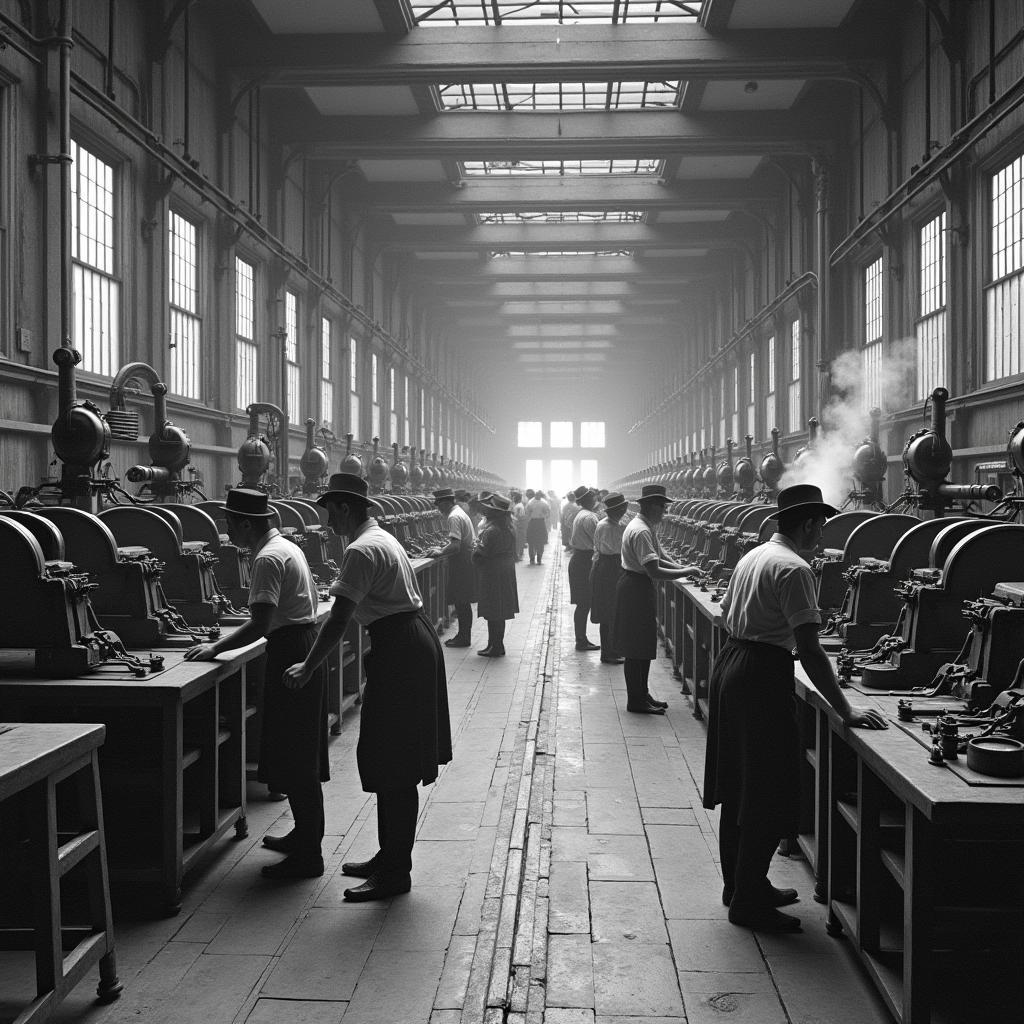 Công nhân trong nhà máy thời kỳ Cách mạng công nghiệp với máy móc và môi trường làm việc khắc nghiệt
Social relationships within families also underwent profound changes. The nuclear family – consisting of just parents and their children – became more common as economic pressures made it difficult to support extended family members in crowded urban housing. Young people increasingly left their parental homes to seek employment in cities, weakening traditional kinship networks. Women and children became important parts of the industrial workforce, though they typically received lower wages than adult men for similar work. In textile mills, children as young as six or seven worked alongside adults, a practice that eventually led to social reform movements and the introduction of child labor laws.
The class structure of society became more clearly defined during industrialization. The bourgeoisie – factory owners, merchants, and professionals – emerged as a powerful new middle class with significant economic influence. Meanwhile, the proletariat – industrial workers who owned no property and sold their labor for wages – formed a distinct working class. This social stratification was more rigid and economically based than previous systems, which had been primarily determined by birth and land ownership. The physical separation between these classes was visible in the organization of cities, where affluent neighborhoods developed far from the industrial districts where workers lived in cramped, unsanitary conditions.
Education systems evolved to meet the needs of industrial society. Basic literacy and numeracy became increasingly important for workers who needed to read instructions, operate machinery, and keep track of production. Compulsory education was gradually introduced in many industrialized nations, representing both a social investment in workforce capabilities and a response to concerns about child welfare. Schools began teaching not just reading and arithmetic but also values like punctuality, obedience, and discipline – qualities deemed essential for factory workers.
Religious life and community traditions also transformed. In rural areas, the church had served as the center of social life, with religious festivals marking the passage of time and providing opportunities for community gathering. In industrial cities, traditional religious observances often weakened as work schedules conflicted with church services and as people from diverse backgrounds mixed in cosmopolitan urban environments. However, new forms of voluntary associations emerged, including labor unions, mutual aid societies, and social clubs, which provided workers with support networks and collective voice.
The pace of change varied considerably across different regions and industries. Some areas industrialized rapidly, while others maintained traditional production methods for decades. Resistance to industrialization took various forms, from Luddite movements that destroyed machinery to political campaigns for workers’ rights and better conditions. These responses highlighted the social tensions inherent in such rapid structural transformation and ultimately contributed to reforms that made industrial society more equitable and sustainable.
Questions 1-13
Questions 1-5: Multiple Choice
Choose the correct letter, A, B, C, or D.
-
Before industrialization, most families
A. lived in cities
B. worked in factories
C. followed agricultural patterns
D. moved frequently -
The population of Manchester between 1772 and 1850
A. decreased significantly
B. remained stable
C. increased more than ten times
D. doubled every year -
Factory work differed from agricultural work because it
A. paid better wages
B. required less skill
C. followed seasonal patterns
D. operated on fixed schedules -
The nuclear family became more common because
A. people preferred smaller families
B. urban housing was expensive and limited
C. laws prohibited extended families
D. factories required it -
Schools during industrialization taught values such as
A. creativity and independence
B. punctuality and discipline
C. artistic skills
D. agricultural techniques
Questions 6-9: True/False/Not Given
Do the following statements agree with the information given in the passage?
Write:
- TRUE if the statement agrees with the information
- FALSE if the statement contradicts the information
- NOT GIVEN if there is no information on this
- The Industrial Revolution started simultaneously in Britain and North America.
- Children as young as six worked in textile mills during early industrialization.
- Factory owners always treated their workers fairly.
- Traditional religious practices declined in industrial cities.
Questions 10-13: Matching Information
Match each statement with the correct paragraph (A-H). You may use any letter more than once.
A – Paragraph 1
B – Paragraph 2
C – Paragraph 3
D – Paragraph 4
E – Paragraph 5
F – Paragraph 6
G – Paragraph 7
H – Paragraph 8
- The development of new social organizations in urban areas
- The emergence of distinct social classes based on economic position
- Changes in family structure due to economic pressures
- Differences in how industrialization progressed in various regions
PASSAGE 2 – Industrialization and the Reconfiguration of Gender Roles
Độ khó: Medium (Band 6.0-7.5)
Thời gian đề xuất: 18-20 phút
The advent of industrialization precipitated a fundamental reconfiguration of gender roles that reverberated through all levels of society. In pre-industrial agrarian societies, the household had functioned as both a domestic sphere and a productive unit, with men, women, and children all contributing to family survival through various forms of labor. Women’s work encompassed not only childcare and food preparation but also textile production, dairy management, brewing, and participation in agricultural cultivation. This integrated economic model meant that productive and reproductive labor existed within the same physical and social space, and women’s contributions were economically visible and often indispensable to household prosperity.
The separation of workplace from home, which characterized factory-based production, created what historians describe as the “doctrine of separate spheres.” This ideological framework positioned men as breadwinners working in the public sphere of commerce and industry, while women were increasingly associated with the private, domestic sphere of home and family. The concept of the “cult of domesticity” or “cult of true womanhood” emerged primarily among middle-class families who could afford to have wives remain at home. This ideology valorized qualities such as piety, purity, submissiveness, and domesticity as the essence of femininity, representing a significant departure from the pragmatic partnership that had characterized many pre-industrial marriages.
 Sự thay đổi vai trò giới tính trong xã hội thời kỳ công nghiệp hóa với phân biệt công việc nam nữ
However, the reality for working-class women diverged sharply from this ideal. Economic necessity compelled vast numbers of women, both married and unmarried, to seek wage employment in factories, particularly in textile mills where they often constituted the majority of the workforce. Young, unmarried women from rural areas were especially sought after by factory owners, who perceived them as docile, dexterous, and willing to work for lower wages than men. In Lowell, Massachusetts, for instance, the famous “mill girls” system recruited young women from farming families, housing them in supervised boardinghouses and subjecting them to paternalistic oversight that extended beyond working hours into their personal conduct and moral behavior.
The wages women earned in factories, though substantially lower than men’s pay for comparable work, nonetheless provided a degree of economic autonomy previously unavailable to many. For the first time, large numbers of women earned money that, while often sent home to support families, sometimes allowed for personal savings or expenditure. This nascent financial independence, however limited, began to shift power dynamics within families and communities. Women factory workers developed collective consciousness and occasionally engaged in labor activism, participating in strikes and forming associations to demand better wages and working conditions, thus entering the public sphere of political discourse despite lacking formal political rights such as voting.
The proliferation of middle-class female philanthropic and reform movements represented another significant development. Educated middle-class women, excluded from most professional opportunities, channeled their energies into voluntary associations addressing social problems such as poverty, child welfare, temperance, and eventually women’s suffrage. Organizations like the Women’s Christian Temperance Union and various settlement house movements allowed women to claim moral authority on social issues and gradually expand their influence into the public realm. These activities were often justified using the rhetoric of maternal feminism – the argument that women’s supposedly natural qualities of nurturing and moral superiority made them uniquely qualified to address social problems.
The industrialization process also created new occupational categories that became gender-segregated. As businesses expanded, administrative work increased, leading to the development of clerical positions. Initially male-dominated, secretarial and clerical work became increasingly feminized by the late 19th century as education levels rose among women and employers discovered they could pay female clerks less than male counterparts. Similarly, the professionalization of teaching, nursing, and social work created respectable employment opportunities for educated women, though these professions were characterized by lower pay and status compared to male-dominated professions like law, medicine, and engineering.
The intersection of industrialization with existing systems of racial and ethnic stratification created particularly complex experiences for women of color and immigrant women. In the United States, African American women were largely excluded from factory employment in many regions and sectors, relegated instead to domestic service or agricultural labor under conditions that often differed little from their antebellum experiences. Immigrant women, particularly from Southern and Eastern Europe, found employment in the garment industry’s sweatshops or as domestic servants, facing both class exploitation and ethnic discrimination. These intersecting inequalities meant that the ideology of separate spheres and domestic femininity remained largely irrelevant to their lived experiences.
Legal frameworks evolved slowly to address women’s changing economic roles. Married women’s property acts, gradually enacted across industrialized nations during the 19th century, began to grant women rights to own property and control their earnings, representing a fundamental challenge to coverture laws that had previously treated married women as legally subsumed under their husbands’ identity. The struggle for women’s suffrage gained momentum partly from the contradiction between women’s expanding economic participation and their lack of political representation. These juridical transformations, though incremental, reflected and reinforced the broader reconfiguration of gender relations precipitated by industrial capitalism.
Questions 14-26
Questions 14-18: Yes/No/Not Given
Do the following statements agree with the views of the writer in the passage?
Write:
- YES if the statement agrees with the views of the writer
- NO if the statement contradicts the views of the writer
- NOT GIVEN if it is impossible to say what the writer thinks about this
- In pre-industrial societies, women’s economic contributions were less important than men’s.
- The “cult of domesticity” ideology was primarily relevant to middle-class families.
- Factory owners preferred hiring young unmarried women because they were more skilled.
- Women’s participation in reform movements eventually helped them gain political influence.
- All industrialized nations granted women voting rights by the end of the 19th century.
Questions 19-23: Matching Headings
Choose the correct heading for paragraphs B-F from the list of headings below.
List of Headings:
i. The development of gender-segregated occupations
ii. Economic necessity versus social ideals for working-class women
iii. Legal changes affecting women’s rights and property
iv. The emergence of the separate spheres ideology
v. How race and ethnicity complicated women’s industrial experiences
vi. Women’s financial independence through factory wages
vii. Middle-class women’s entrance into public reform activities
viii. Pre-industrial integration of work and home
- Paragraph B
- Paragraph C
- Paragraph D
- Paragraph E
- Paragraph F
Questions 24-26: Summary Completion
Complete the summary below using words from the box.
Word Box:
subordinate / visible / textile / identical / professional / agricultural / domestic / manufacturing / equal / invisible
In pre-industrial societies, women performed 24.__ production, dairy work, and participated in 25.__ activities, making their economic contributions 26.__ to the household economy. This changed significantly when industrialization separated home and workplace.
PASSAGE 3 – The Dialectical Relationship Between Industrialization and Social Mobility
Độ khó: Hard (Band 7.0-9.0)
Thời gian đề xuất: 23-25 phút
The question of whether industrialization fostered or impeded social mobility remains one of the most contested issues among historians and sociologists examining the transformation of Western societies during the 19th and early 20th centuries. The orthodox narrative has traditionally emphasized industrialization as a liberating force that dismantled feudal hierarchies and created meritocratic pathways for individual advancement. According to this interpretation, the burgeoning industrial economy generated unprecedented opportunities for ambitious individuals to transcend their circumstances through entrepreneurship, acquisition of technical expertise, or geographic relocation. The archetypal success stories of self-made industrialists who rose from humble origins – figures such as Andrew Carnegie, who began as a telegraph messenger and became a steel magnate, or Richard Arkwright, a barber’s apprentice who revolutionized textile manufacturing – seemed to epitomize this promise of upward mobility.
However, revisionist historiography has substantially complicated this optimistic assessment by emphasizing the structural constraints that limited mobility for most industrial workers. Quantitative analyses of occupational mobility patterns, intergenerational wealth transfers, and marriage patterns suggest that while industrialization did create some new pathways to prosperity, it simultaneously calcified certain class boundaries and created new forms of stratification. The concentration of capital in industrial enterprises meant that the barriers to entry for aspiring entrepreneurs became increasingly prohibitive. Unlike earlier periods when a skilled craftsperson might gradually accumulate resources to establish an independent workshop, the capital-intensive nature of industrial production placed factory ownership beyond the reach of ordinary workers. Statistical evidence from industrial cities indicates that the probability of a factory worker’s son becoming a business owner or professional was remarkably low, typically below 5%, suggesting considerable structural rigidity despite the rhetoric of opportunity.
The concept of social mobility itself requires disaggregation into multiple dimensions to be analytically useful. Absolute mobility – whether individuals’ living standards improved compared to their parents – must be distinguished from relative mobility – whether individuals moved to different positions in the social hierarchy. Industrialization generally facilitated absolute mobility; most industrial workers enjoyed material conditions superior to those of peasants or pre-industrial laborers, with access to mass-produced goods, albeit often at the cost of occupational autonomy and subsistence security. However, relative mobility – the likelihood of moving between social classes – appears to have been more restricted. The emergent class structure of industrial capitalism, with its relatively impermeable boundaries between bourgeoisie and proletariat, may have been less fluid than the status systems of some pre-industrial societies, where mechanisms such as apprenticeship, patronage, or strategic marriage alliances provided alternative mobility pathways.
 Cấu trúc tầng lớp xã hội thời kỳ công nghiệp hóa với các tầng lớp phân biệt rõ ràng
Furthermore, the temporality and geography of mobility patterns exhibited considerable heterogeneity. Early industrialization in Britain (approximately 1780-1840) may have offered somewhat greater entrepreneurial opportunities than the mature industrial capitalism of the late 19th century, when markets became dominated by large corporations rather than individual proprietors. Similarly, frontier regions of industrial expansion – such as the American Midwest in the mid-19th century or the German Ruhr Valley – potentially provided more opportunities than established industrial centers where entrenched elites controlled resources. The sectoral composition of industrial development also mattered; regions specializing in heavy industries like steel or coal mining, with their large capital requirements and hierarchical labor organization, likely offered fewer mobility opportunities than regions with more diverse manufacturing bases including smaller-scale consumer goods production.
Educational institutions played an ambiguous role in mediating social mobility during industrialization. The expansion of public education represented a potentially democratizing force, providing children from modest backgrounds with literacy and numeracy skills that might enable occupational advancement. Proponents of educational expansion explicitly framed it as a mobility mechanism, arguing that schools would identify and cultivate talent regardless of social origin. However, critical analyses suggest that educational systems often reproduced rather than challenged class hierarchies. Curriculum differentiation, with working-class children directed toward vocational training and elite children receiving classical education preparing them for university and professional careers, effectively channeled students toward class-appropriate destinies. Moreover, the opportunity costs of extended education – forgone wages during school years – represented a significant barrier for poor families, even when schooling itself was free.
The role of human capital acquisition in enabling mobility must be distinguished from the signaling function of education and training. Human capital theory posits that education increases productivity, thereby justifying higher wages and enabling occupational advancement. However, credentialism theory suggests that educational qualifications often function primarily as screening devices that ratify existing class positions rather than creating opportunities for mobility. The proliferation of professional certification requirements during industrialization – for engineering, accounting, teaching, and other occupations – arguably served to restrict access to middle-class positions and protect the privileges of incumbent groups as much as to ensure competence. This interpretation gains support from evidence that credential requirements often increased without corresponding changes in actual job tasks, and that individuals with equivalent skills but differing credentials experienced markedly different career trajectories.
Gender and ethnicity constituted critical axes along which mobility opportunities were differentially distributed. For women, industrialization created some new employment opportunities but generally within occupationally segregated sectors offering limited advancement prospects. The preponderance of women in textile factories, garment production, and domestic service – sectors characterized by low wages, minimal skill development, and restricted promotional hierarchies – meant that wage employment rarely translated into substantive upward mobility. Marriage remained the primary mobility mechanism for most women, though this represented a fundamentally different and more precarious pathway than the occupational mobility available to men. Ethnic minorities and immigrant populations faced additional constraints, with discriminatory practices often relegating them to the most arduous and poorly compensated positions while blocking access to more remunerative opportunities. The experience of Irish immigrants in mid-19th century Britain or Italian immigrants in early 20th century America illustrates how ethnic stratification created parallel but unequal mobility trajectories.
Collective mobility strategies through labor organization represented an alternative response to the limitations of individual advancement. When structural barriers made individual mobility improbable, workers sometimes pursued collective improvements in wages, working conditions, and political rights through trade unions and labor parties. This strategy aimed not to transcend class boundaries but to improve conditions within them, representing a fundamentally different conception of progress than the individualistic mobility emphasized in liberal ideology. The success of such collective action varied considerably across national contexts, depending on factors including state repression, employer strategies, and the organizational capacity of workers themselves. In some cases, strong labor movements achieved substantial welfare provisions and political representation, effectively creating mobility through collective bargaining rather than individual striving.
Questions 27-40
Questions 27-31: Multiple Choice
Choose the correct letter, A, B, C, or D.
-
According to the orthodox narrative, industrialization
A. maintained feudal hierarchies
B. created opportunities for advancement
C. primarily benefited wealthy individuals
D. reduced entrepreneurial possibilities -
Revisionist historians argue that
A. everyone benefited equally from industrialization
B. mobility increased dramatically in industrial societies
C. structural constraints limited most workers’ mobility
D. class boundaries disappeared completely -
The difference between absolute and relative mobility is that
A. they measure different aspects of social change
B. they are exactly the same concept
C. absolute mobility is more important
D. relative mobility only applies to women -
Educational systems during industrialization
A. guaranteed mobility for all students
B. often reinforced existing class structures
C. completely eliminated class differences
D. were only available to wealthy families -
Collective mobility strategies involved
A. individual workers changing occupations
B. workers immigrating to other countries
C. labor unions improving conditions for all workers
D. workers becoming business owners
Questions 32-36: Matching Features
Match each statement (32-36) with the correct factor (A-G) from the box below.
Factors:
A. Geography
B. Gender
C. Education
D. Timing
E. Ethnicity
F. Capital concentration
G. Sector type
- Made factory ownership inaccessible to ordinary workers
- Determined whether regions offered more entrepreneurial opportunities
- Created occupationally segregated employment with limited advancement
- Early periods offered more opportunities than mature industrial capitalism
- Subjected certain groups to discriminatory practices in employment
Questions 37-40: Short-answer Questions
Answer the questions below using NO MORE THAN THREE WORDS from the passage for each answer.
- What did Andrew Carnegie work as before becoming a steel magnate?
- What percentage of factory workers’ sons typically became business owners or professionals?
- What theory suggests educational qualifications primarily function as screening devices?
- What remained the primary mobility mechanism for most women during industrialization?
Answer Keys – Đáp Án
PASSAGE 1: Questions 1-13
- C
- C
- D
- B
- B
- FALSE
- TRUE
- NOT GIVEN
- TRUE
- G
- E
- D
- H
PASSAGE 2: Questions 14-26
- NO
- YES
- NO
- YES
- NOT GIVEN
- iv
- ii
- vi
- vii
- i
- textile
- agricultural
- visible
PASSAGE 3: Questions 27-40
- B
- C
- A
- B
- C
- F
- A
- B
- D
- E
- telegraph messenger
- below 5%
- credentialism theory
- marriage
Giải Thích Đáp Án Chi Tiết
Passage 1 – Giải Thích
Câu 1: C
- Dạng câu hỏi: Multiple Choice
- Từ khóa: Before industrialization, families
- Vị trí trong bài: Đoạn 1, dòng 4-5
- Giải thích: Bài đọc nói rõ “Prior to industrialization, most people lived in rural areas and worked in agriculture, following seasonal patterns.” Đây là paraphrase của “followed agricultural patterns” trong đáp án C.
Câu 2: C
- Dạng câu hỏi: Multiple Choice
- Từ khóa: Manchester population, 1772 and 1850
- Vị trí trong bài: Đoạn 2, dòng 5-6
- Giải thích: Bài viết nói “Manchester… saw its population increase from approximately 25,000 in 1772 to over 300,000 by 1850.” Từ 25,000 lên 300,000 nghĩa là tăng hơn 12 lần, tương ứng với “increased more than ten times.”
Câu 3: D
- Dạng câu hỏi: Multiple Choice
- Từ khóa: Factory work differed from agricultural work
- Vị trí trong bài: Đoạn 3, dòng 1-3
- Giải thích: Câu “Unlike agricultural work, which varied with seasons… factory work operated on fixed schedules” chỉ ra sự khác biệt chính là lịch làm việc cố định.
Câu 6: FALSE
- Dạng câu hỏi: True/False/Not Given
- Từ khóa: Industrial Revolution, simultaneously, Britain and North America
- Vị trí trong bài: Đoạn 1, dòng 1-2
- Giải thích: Bài viết nói “began in Britain during the late 18th century and rapidly spread across Europe and North America.” Từ “spread” cho thấy nó bắt đầu ở Britain trước, sau đó mới lan sang North America, không phải đồng thời (simultaneously).
Câu 7: TRUE
- Dạng câu hỏi: True/False/Not Given
- Từ khóa: Children, six, textile mills
- Vị trí trong bài: Đoạn 4, dòng 6-7
- Giải thích: Bài viết nói rõ “In textile mills, children as young as six or seven worked alongside adults.”
Câu 9: TRUE
- Dạng câu hỏi: True/False/Not Given
- Từ khóa: Traditional religious practices, declined, industrial cities
- Vị trí trong bài: Đoạn 7, dòng 3-5
- Giải thích: “In industrial cities, traditional religious observances often weakened” là paraphrase của “declined.”
Câu 10: G
- Dạng câu hỏi: Matching Information
- Từ khóa: new social organizations, urban areas
- Vị trí trong bài: Đoạn 7 (Paragraph G)
- Giải thích: Đoạn 7 đề cập đến “new forms of voluntary associations emerged, including labor unions, mutual aid societies, and social clubs.”
Câu 11: E
- Dạng câu hỏi: Matching Information
- Từ khóa: distinct social classes, economic position
- Vị trí trong bài: Đoạn 5 (Paragraph E)
- Giải thích: Đoạn 5 nói về “The class structure” và “This social stratification was more rigid and economically based.”
Passage 2 – Giải Thích
Câu 14: NO
- Dạng câu hỏi: Yes/No/Not Given
- Từ khóa: Pre-industrial societies, women’s economic contributions, less important
- Vị trí trong bài: Đoạn A, dòng 5-7
- Giải thích: Tác giả viết “women’s contributions were economically visible and often indispensable,” cho thấy quan điểm rằng đóng góp của phụ nữ rất quan trọng, trái ngược với câu phát biểu.
Câu 15: YES
- Dạng câu hỏi: Yes/No/Not Given
- Từ khóa: cult of domesticity, primarily, middle-class families
- Vị trí trong bài: Đoạn B, dòng 5-6
- Giải thích: “The concept of the ‘cult of domesticity’… emerged primarily among middle-class families” khớp hoàn toàn với câu phát biểu.
Câu 16: NO
- Dạng câu hỏi: Yes/No/Not Given
- Từ khóa: Factory owners, young unmarried women, more skilled
- Vị trí trong bài: Đoạn C, dòng 3-4
- Giải thích: Bài viết nói họ được tuyển vì “docile, dexterous, and willing to work for lower wages,” không phải vì có nhiều kỹ năng hơn (more skilled).
Câu 17: YES
- Dạng câu hỏi: Yes/No/Not Given
- Từ khóa: Women’s participation, reform movements, political influence
- Vị trí trong bài: Đoạn E, dòng 5-6
- Giải thích: “These activities… allowed women to claim moral authority on social issues and gradually expand their influence into the public realm” thể hiện quan điểm của tác giả về việc phụ nữ dần có ảnh hưởng chính trị.
Câu 19: iv
- Dạng câu hỏi: Matching Headings
- Vị trí: Paragraph B
- Giải thích: Đoạn B nói về “doctrine of separate spheres” và “cult of domesticity,” khớp với heading “The emergence of the separate spheres ideology.”
Câu 20: ii
- Dạng câu hỏi: Matching Headings
- Vị trí: Paragraph C
- Giải thích: Đoạn C bắt đầu với “However, the reality for working-class women diverged sharply from this ideal,” thảo luận về sự khác biệt giữa lý tưởng xã hội và thực tế kinh tế, phù hợp với heading ii.
Câu 24-26: textile, agricultural, visible
- Dạng câu hỏi: Summary Completion
- Vị trí trong bài: Đoạn A
- Giải thích: Các từ này được lấy trực tiếp từ câu “Women’s work encompassed… textile production, dairy management, brewing, and participation in agricultural cultivation” và “women’s contributions were economically visible.”
Passage 3 – Giải Thích
Câu 27: B
- Dạng câu hỏi: Multiple Choice
- Từ khóa: orthodox narrative, industrialization
- Vị trí trong bài: Đoạn 1, dòng 2-4
- Giải thích: “The orthodox narrative has traditionally emphasized industrialization as a liberating force that dismantled feudal hierarchies and created meritocratic pathways” được paraphrase thành “created opportunities for advancement.”
Câu 28: C
- Dạng câu hỏi: Multiple Choice
- Từ khóa: Revisionist historians
- Vị trí trong bài: Đoạn 2, dòng 1-2
- Giải thích: “revisionist historiography has substantially complicated this optimistic assessment by emphasizing the structural constraints that limited mobility.”
Câu 30: B
- Dạng câu hỏi: Multiple Choice
- Từ khóa: Educational systems
- Vị trí trong bài: Đoạn 5, dòng 4-6
- Giải thích: “critical analyses suggest that educational systems often reproduced rather than challenged class hierarchies” tương ứng với đáp án B.
Câu 32: F
- Dạng câu hỏi: Matching Features
- Từ khóa: factory ownership inaccessible
- Vị trí trong bài: Đoạn 2, dòng 7-8
- Giải thích: “The concentration of capital in industrial enterprises meant that the barriers to entry… became increasingly prohibitive.”
Câu 37: telegraph messenger
- Dạng câu hỏi: Short-answer
- Vị trí trong bài: Đoạn 1, dòng 8
- Giải thích: “Andrew Carnegie, who began as a telegraph messenger and became a steel magnate.”
Câu 38: below 5%
- Dạng câu hỏi: Short-answer
- Vị trí trong bài: Đoạn 2, dòng 11
- Giải thích: “the probability of a factory worker’s son becoming a business owner or professional was remarkably low, typically below 5%.”
Câu 40: marriage
- Dạng câu hỏi: Short-answer
- Vị trí trong bài: Đoạn 7, dòng 5-6
- Giải thích: “Marriage remained the primary mobility mechanism for most women.”
Từ Vựng Quan Trọng Theo Passage
Passage 1 – Essential Vocabulary
| Từ vựng | Loại từ | Phiên âm | Nghĩa tiếng Việt | Ví dụ từ bài | Collocation |
|---|---|---|---|---|---|
| transformation | n | /ˌtrænsfəˈmeɪʃn/ | sự chuyển đổi, biến đổi | The transformation of society through industrialization | social transformation, economic transformation |
| industrialization | n | /ɪnˌdʌstriəlaɪˈzeɪʃn/ | công nghiệp hóa | This period of industrialization began in Britain | rapid industrialization, early industrialization |
| urbanization | n | /ˌɜːbənaɪˈzeɪʃn/ | đô thị hóa | Urbanization accelerated dramatically | rapid urbanization, mass urbanization |
| unprecedented | adj | /ʌnˈpresɪdentɪd/ | chưa từng có | Cities grew at an unprecedented rate | unprecedented growth, unprecedented scale |
| demographic | adj | /ˌdeməˈɡræfɪk/ | thuộc về nhân khẩu học | This mass migration represented significant demographic shifts | demographic change, demographic pattern |
| mechanized | adj | /ˈmekənaɪzd/ | được cơ giới hóa | The introduction of mechanized production | mechanized production, mechanized agriculture |
| regimented | adj | /ˈredʒɪmentɪd/ | được tổ chức chặt chẽ, kỷ luật | This regimented lifestyle was difficult | regimented schedule, regimented system |
| proletariat | n | /ˌprəʊləˈteəriət/ | giai cấp vô sản | Industrial workers formed the proletariat | urban proletariat, industrial proletariat |
| bourgeoisie | n | /ˌbʊəʒwɑːˈziː/ | giai cấp tư sản | The bourgeoisie emerged as a powerful class | rising bourgeoisie, urban bourgeoisie |
| stratification | n | /ˌstrætɪfɪˈkeɪʃn/ | sự phân tầng | This social stratification was more rigid | social stratification, class stratification |
| compulsory | adj | /kəmˈpʌlsəri/ | bắt buộc | Compulsory education was gradually introduced | compulsory education, compulsory attendance |
| cosmopolitan | adj | /ˌkɒzməˈpɒlɪtən/ | thuộc về đô thị lớn, quốc tế | In cosmopolitan urban environments | cosmopolitan city, cosmopolitan atmosphere |
Passage 2 – Essential Vocabulary
| Từ vựng | Loại từ | Phiên âm | Nghĩa tiếng Việt | Ví dụ từ bài | Collocation |
|---|---|---|---|---|---|
| advent | n | /ˈædvent/ | sự ra đời, sự xuất hiện | The advent of industrialization | the advent of technology, with the advent of |
| precipitate | v | /prɪˈsɪpɪteɪt/ | gây ra, thúc đẩy nhanh | The advent precipitated a fundamental reconfiguration | precipitate a crisis, precipitate change |
| reconfiguration | n | /ˌriːkənˌfɪɡjəˈreɪʃn/ | sự cấu hình lại | A reconfiguration of gender roles | reconfiguration of power, structural reconfiguration |
| agrarian | adj | /əˈɡreəriən/ | thuộc về nông nghiệp | In pre-industrial agrarian societies | agrarian society, agrarian economy |
| doctrine | n | /ˈdɒktrɪn/ | học thuyết, tín điều | The doctrine of separate spheres | political doctrine, economic doctrine |
| valorize | v | /ˈvæləraɪz/ | tôn vinh, đề cao | This ideology valorized qualities such as piety | valorize tradition, valorize femininity |
| submissiveness | n | /səbˈmɪsɪvnəs/ | sự phục종, sự quy phục | Valorized submissiveness and domesticity | show submissiveness, cultural submissiveness |
| compel | v | /kəmˈpel/ | buộc, ép buộc | Economic necessity compelled vast numbers | compel someone to do, legally compel |
| docile | adj | /ˈdəʊsaɪl/ | dễ bảo, ngoan ngoãn | Perceived them as docile and dexterous | docile worker, docile nature |
| autonomy | n | /ɔːˈtɒnəmi/ | quyền tự chủ | Provided a degree of economic autonomy | personal autonomy, financial autonomy |
| philanthropic | adj | /ˌfɪlənˈθrɒpɪk/ | từ thiện | Female philanthropic and reform movements | philanthropic work, philanthropic organization |
| temperance | n | /ˈtempərəns/ | sự tiết độ (đặc biệt là rượu) | Addressing issues like temperance | temperance movement, practice temperance |
| professionalization | n | /prəˌfeʃənəlaɪˈzeɪʃn/ | sự chuyên nghiệp hóa | The professionalization of teaching | professionalization of work, rapid professionalization |
| intersection | n | /ˌɪntəˈsekʃn/ | sự giao nhau, điểm giao | The intersection of industrialization with racial stratification | at the intersection of, intersection between |
| juridical | adj | /dʒʊəˈrɪdɪkl/ | thuộc về pháp lý | These juridical transformations | juridical system, juridical framework |
Passage 3 – Essential Vocabulary
| Từ vựng | Loại từ | Phiên âm | Nghĩa tiếng Việt | Ví dụ từ bài | Collocation |
|---|---|---|---|---|---|
| foster | v | /ˈfɒstə(r)/ | thúc đẩy, nuôi dưỡng | Whether industrialization fostered or impeded mobility | foster development, foster growth |
| impede | v | /ɪmˈpiːd/ | cản trở, ngăn cản | Fostered or impeded social mobility | impede progress, impede development |
| contested | adj | /kənˈtestɪd/ | gây tranh cãi | One of the most contested issues | hotly contested, heavily contested |
| orthodox | adj | /ˈɔːθədɒks/ | chính thống | The orthodox narrative | orthodox view, orthodox interpretation |
| dismantle | v | /dɪsˈmæntl/ | phá bỏ, tháo dỡ | Dismantled feudal hierarchies | dismantle system, dismantle structure |
| meritocratic | adj | /ˌmerɪtəˈkrætɪk/ | dựa trên năng lực | Created meritocratic pathways | meritocratic system, meritocratic society |
| burgeoning | adj | /ˈbɜːdʒənɪŋ/ | đang phát triển nhanh | The burgeoning industrial economy | burgeoning industry, burgeoning population |
| epitomize | v | /ɪˈpɪtəmaɪz/ | minh họa điển hình | Stories that epitomize this promise | epitomize success, epitomize ideal |
| revisionist | adj | /rɪˈvɪʒənɪst/ | thuộc về chủ nghĩa xét lại | Revisionist historiography | revisionist history, revisionist interpretation |
| calcify | v | /ˈkælsɪfaɪ/ | làm cứng lại, cố định | Simultaneously calcified certain class boundaries | calcify into, calcified system |
| prohibitive | adj | /prəˈhɪbətɪv/ | cấm đoán, quá cao | Barriers became increasingly prohibitive | prohibitively expensive, prohibitive cost |
| disaggregation | n | /ˌdɪsæɡrɪˈɡeɪʃn/ | sự tách rời, phân tách | Requires disaggregation into multiple dimensions | data disaggregation, disaggregation analysis |
| impermeable | adj | /ɪmˈpɜːmiəbl/ | không thể xuyên qua | Relatively impermeable boundaries | impermeable barrier, impermeable to |
| heterogeneity | n | /ˌhetərəʊdʒəˈniːəti/ | tính không đồng nhất | Exhibited considerable heterogeneity | cultural heterogeneity, regional heterogeneity |
| entrenched | adj | /ɪnˈtrentʃt/ | đã ăn sâu, bám rễ | Entrenched elites controlled resources | deeply entrenched, entrenched interests |
| credentialism | n | /krɪˈdenʃəlɪzəm/ | chủ nghĩa bằng cấp | Credentialism theory suggests | academic credentialism, rise of credentialism |
| preponderance | n | /prɪˈpɒndərəns/ | sự chiếm ưu thế | The preponderance of women in textile factories | preponderance of evidence, clear preponderance |
| arduous | adj | /ˈɑːdjuəs/ | khó khăn, vất vả | The most arduous and poorly compensated positions | arduous task, arduous journey |
Kết Bài
Chủ đề về tác động của công nghiệp hóa đến cấu trúc xã hội là một chủ đề quan trọng và xuất hiện thường xuyên trong IELTS Reading, đòi hỏi người học phải có khả năng đọc hiểu các văn bản học thuật phức tạp về lịch sử, kinh tế và xã hội học. Bộ đề thi mẫu này đã cung cấp cho bạn ba passages với độ khó tăng dần, từ Easy (Band 5.0-6.5) đến Medium (Band 6.0-7.5) và Hard (Band 7.0-9.0), phản ánh chính xác cấu trúc và yêu cầu của bài thi IELTS Reading thực tế.
Các 40 câu hỏi được thiết kế đa dạng về dạng bài, bao gồm Multiple Choice, True/False/Not Given, Yes/No/Not Given, Matching Headings, Matching Information, Summary Completion, Matching Features và Short-answer Questions. Đáp án chi tiết kèm giải thích về vị trí thông tin, cách paraphrase và kỹ thuật làm bài sẽ giúp bạn hiểu rõ cách tiếp cận từng dạng câu hỏi một cách bài bản và hiệu quả. Như đã thấy trong Economic impacts of automation on service industries, việc hiểu sâu về các chủ đề kinh tế-xã hội sẽ giúp bạn tự tin hơn khi đối mặt với các bài đọc tương tự.
Bảng từ vựng quan trọng theo từng passage cung cấp hơn 40 từ vựng học thuật chuyên ngành với phiên âm, nghĩa tiếng Việt, ví dụ trong ngữ cảnh và collocations thường gặp. Những từ vựng này không chỉ giúp bạn hiểu bài đọc tốt hơn mà còn có thể áp dụng vào các phần thi Writing Task 2 và Speaking Part 3 khi thảo luận về các chủ đề xã hội. Tương tự, những ai quan tâm đến What are the social implications of increasing use of automation in manufacturing? sẽ thấy nhiều điểm tương đồng về cách xã hội thay đổi trước những tiến bộ công nghệ.
Để đạt kết quả tốt nhất, hãy làm bài trong điều kiện thi thật với thời gian giới hạn 60 phút, sau đó đối chiếu đáp án và đọc kỹ phần giải thích để hiểu rõ lý do tại sao đáp án đó đúng. Đừng chỉ tập trung vào số câu đúng mà hãy phân tích cách thông tin được paraphrase giữa câu hỏi và passage, đây chính là kỹ năng cốt lõi để đạt band điểm cao trong IELTS Reading. Chúc bạn ôn tập hiệu quả và đạt được mục tiêu IELTS của mình!

