
Mở bài
Chủ đề môi trường địa phương là một trong những đề tài xuất hiện thường xuyên trong bài thi IELTS Speaking, đặc biệt ở Part 2 và Part 3. Với xu hướng toàn cầu ngày càng quan tâm đến các vấn đề sinh thái, giám khảo IELTS thường đánh giá cao khả năng thảo luận về những thách thức môi trường mà bạn trực tiếp chứng kiến trong cộng đồng.
Theo thống kê từ các trung tâm thi IELTS chính thức, chủ đề “Describe A Local Environmental Issue You Care About” xuất hiện với tần suất trung bình cao trong các kỳ thi từ năm 2020 đến 2024, đặc biệt tăng mạnh trong giai đoạn sau đại dịch khi nhận thức về môi trường được nâng cao. Dự đoán khả năng xuất hiện trong tương lai: Cao, do tính thời sự và tầm quan trọng của vấn đề môi trường trong chương trình giáo dục toàn cầu.
Trong bài viết này, bạn sẽ học được cách tiếp cận toàn diện cho chủ đề này qua cả ba phần thi Speaking. Bạn sẽ có trong tay các câu hỏi thường gặp ở Part 1 về môi trường và thói quen bảo vệ thiên nhiên, một cue card chi tiết cho Part 2 với ba bài mẫu theo các band điểm khác nhau từ 6-7, 7.5-8 đến 8.5-9, cùng với những câu hỏi thảo luận sâu ở Part 3 về trách nhiệm xã hội và giải pháp môi trường. Bài viết còn cung cấp kho từ vựng chuyên ngành phong phú, các cụm từ ăn điểm, và quan trọng nhất là góc nhìn từ một giám khảo IELTS chính thức về những yếu tố giúp bạn ghi điểm cao.
IELTS Speaking Part 1: Introduction and Interview
Tổng Quan Về Part 1
Part 1 của IELTS Speaking kéo dài 4-5 phút với các câu hỏi ngắn về cuộc sống hàng ngày. Đối với chủ đề môi trường, giám khảo thường hỏi về thói quen cá nhân, nhận thức và hành động bảo vệ môi trường của bạn. Chiến lược hiệu quả là trả lời trực tiếp câu hỏi trong 1-2 câu đầu, sau đó mở rộng bằng lý do hoặc ví dụ cụ thể trong 1-2 câu tiếp theo.
Lỗi thường gặp của học viên Việt Nam trong Part 1 bao gồm việc trả lời quá ngắn gọn chỉ với “Yes” hoặc “No”, sử dụng từ vựng đơn giản lặp đi lặp lại như “good”, “bad”, “important”, và thiếu ví dụ cụ thể từ trải nghiệm bản thân. Một điểm quan trọng khác là nhiều bạn có xu hướng chuẩn bị câu trả lời quá “bookish” nghe giống học thuộc, trong khi giám khảo đánh giá cao sự tự nhiên và spontaneous trong giao tiếp.
Các Câu Hỏi Thường Gặp
Question 1: Do you think environmental protection is important?
Question 2: What do you do to protect the environment?
Question 3: Are there any environmental problems in your hometown?
Question 4: Do people in your country care about the environment?
Question 5: What kind of pollution is common in your area?
Question 6: Have you ever participated in any environmental activities?
Question 7: Do you recycle at home?
Question 8: What changes have you noticed in your local environment?
Phân Tích và Gợi Ý Trả Lời Chi Tiết
Question: Do you think environmental protection is important?
🎯 Cách tiếp cận:
- Trả lời trực tiếp “Yes” hoặc “Absolutely”
- Đưa ra 1-2 lý do cụ thể
- Có thể thêm personal experience hoặc local example
📝 Sample Answer – Band 6-7:
Yes, I think it’s very important. We need a clean environment to live healthy lives. If we don’t protect nature, there will be many problems like pollution and climate change in the future.
Phân tích:
- Điểm mạnh: Trả lời rõ ràng, có lý do cơ bản (healthy lives), đề cập đến hậu quả (pollution, climate change)
- Hạn chế: Từ vựng còn đơn giản (very important, clean, many problems), cấu trúc câu đơn giản, thiếu ví dụ cụ thể
- Tại sao Band 6-7: Đáp ứng yêu cầu trả lời nhưng chưa thể hiện được lexical range và grammatical complexity
📝 Sample Answer – Band 8-9:
Absolutely, I believe environmental protection is paramount in today’s world. We’re already witnessing the devastating effects of ecological degradation in my city, from severe air pollution to dwindling green spaces. What’s more, protecting our environment isn’t just about our generation – it’s about ensuring a sustainable future for the next one, which makes it an urgent moral responsibility for everyone.
Phân tích:
- Điểm mạnh: Sử dụng từ vựng chính xác và tinh tế (paramount, devastating effects, ecological degradation, dwindling green spaces), cấu trúc đa dạng với dash để bổ sung ý, kết nối logic mạch lạc với “What’s more”, thể hiện critical thinking về trách nhiệm liên thế hệ
- Tại sao Band 8-9:
- Fluency: Câu trả lời trôi chảy với discourse markers tự nhiên
- Vocabulary: Collocations chính xác (devastating effects, ecological degradation, sustainable future, moral responsibility)
- Grammar: Sử dụng hiện tại tiếp diễn (we’re witnessing), cấu trúc “it’s about… it’s about…” để tương phản
- Ideas: Ý tưởng sâu sắc về sustainability và moral dimension
💡 Key Vocabulary & Expressions:
- paramount: cực kỳ quan trọng, tối quan trọng
- devastating effects: những tác động tàn phá
- ecological degradation: sự suy thoái sinh thái
- dwindling green spaces: không gian xanh đang thu hẹp dần
- sustainable future: tương lai bền vững
- moral responsibility: trách nhiệm đạo đức
Question: What do you do to protect the environment?
🎯 Cách tiếp cận:
- Nêu 2-3 hành động cụ thể bạn thực hiện
- Giải thích tại sao bạn làm điều đó
- Có thể đề cập đến tần suất (always, usually, try to)
📝 Sample Answer – Band 6-7:
I try to reduce plastic usage by bringing my own bag when shopping. I also recycle bottles and paper at home. Sometimes I turn off lights when I leave a room to save electricity. These are small actions but I think they help the environment.
Phân tích:
- Điểm mạnh: Đưa ra 3 ví dụ cụ thể (plastic bags, recycling, saving electricity), có frequency adverbs (sometimes), nhận thức về impact
- Hạn chế: Từ vựng cơ bản (reduce, recycle, save), thiếu elaboration về tác động, cấu trúc câu đơn giản
- Tại sao Band 6-7: Đủ content nhưng chưa sophisticated về language và ideas
📝 Sample Answer – Band 8-9:
Well, I’m quite environmentally conscious in my daily routine. I’ve completely phased out single-use plastics by carrying reusable shopping bags and a stainless steel water bottle wherever I go. At home, I’m diligent about sorting waste for recycling, and I’ve also switched to energy-efficient appliances to minimize my carbon footprint. On top of that, I try to opt for public transportation rather than driving, which not only reduces emissions but also helps ease traffic congestion in my neighborhood.
Phân tích:
- Điểm mạnh: Từ vựng chuyên ngành chính xác (environmentally conscious, phased out, single-use plastics, carbon footprint, emissions), nhiều ví dụ cụ thể với details (stainless steel water bottle), cấu trúc “not only… but also” thể hiện multiple benefits, discourse marker “On top of that” để add information
- Tại sao Band 8-9:
- Fluency: Sử dụng “Well” để start naturally, ý tưởng kết nối mượt mà
- Vocabulary: Collocations xuất sắc (environmentally conscious, minimize carbon footprint, ease traffic congestion)
- Grammar: Present perfect (I’ve phased out, I’ve switched) thể hiện completed action, relative clause (which not only…)
- Ideas: Thể hiện consistency và awareness về multiple environmental benefits
💡 Key Vocabulary & Expressions:
- environmentally conscious: có ý thức về môi trường
- phase out single-use plastics: loại bỏ dần đồ nhựa dùng một lần
- reusable shopping bags: túi mua sắm tái sử dụng
- diligent about: siêng năng, cẩn thận về việc
- minimize carbon footprint: giảm thiểu dấu chân carbon
- opt for public transportation: lựa chọn phương tiện công cộng
- ease traffic congestion: giảm bớt tắc nghẽn giao thông
Question: Are there any environmental problems in your hometown?
🎯 Cách tiếp cận:
- Xác định 1-2 vấn đề cụ thể
- Mô tả ngắn gọn vấn đề đó
- Có thể đề cập nguyên nhân hoặc tác động
📝 Sample Answer – Band 6-7:
Yes, there are some problems. The main one is air pollution because there are too many motorbikes and cars on the roads. Also, some rivers in my city are quite dirty because factories dump waste into them. This makes the water smell bad and affects people’s health.
Phân tích:
- Điểm mạnh: Nêu được 2 vấn đề rõ ràng (air pollution, water pollution), có nguyên nhân (traffic, factory waste), có consequence (health effects)
- Hạn chế: Từ vựng đơn giản (quite dirty, smell bad, too many), thiếu precise language, cấu trúc câu basic
- Tại sao Band 6-7: Content adequate nhưng lack sophistication trong cách diễn đạt
📝 Sample Answer – Band 8-9:
Unfortunately, yes. Air quality has become a pressing concern in my city, largely due to exhaust fumes from the overwhelming number of vehicles on the roads, especially during rush hour. The situation is exacerbated by a lack of adequate public transport infrastructure. Another alarming issue is water contamination in several local rivers, where industrial effluent has been discharged illegally, turning these once-pristine waterways into ecological dead zones. It’s quite disheartening to see, honestly.
Phân tích:
- Điểm mạnh: Từ vựng chuyên ngành cao cấp (exhaust fumes, industrial effluent, ecological dead zones, pristine waterways), cấu trúc complex (largely due to, exacerbated by, where clause), emotional language (disheartening, alarming) thể hiện personal concern, specific details (rush hour, illegally discharged)
- Tại sao Band 8-9:
- Fluency: Opening với “Unfortunately, yes” rất natural, kết thúc với “honestly” thể hiện genuine feeling
- Vocabulary: Collocations xuất sắc (pressing concern, adequate infrastructure, alarming issue, water contamination)
- Grammar: Passive voice (has been discharged), present perfect (has become), participle phrase (turning these…)
- Pronunciation: Từ vựng như “disheartening” thể hiện word stress tốt
- Ideas: Không chỉ nêu problem mà còn chỉ ra root cause và emotional impact
💡 Key Vocabulary & Expressions:
- air quality: chất lượng không khí
- pressing concern: mối quan tâm cấp bách
- exhaust fumes: khói thải từ xe cộ
- overwhelming number: số lượng áp đảo
- exacerbated by: trở nên tồi tệ hơn bởi
- adequate infrastructure: cơ sở hạ tầng đầy đủ
- alarming issue: vấn đề đáng báo động
- industrial effluent: nước thải công nghiệp
- pristine waterways: dòng nước nguyên sơ
- ecological dead zones: vùng chết sinh thái
- disheartening: làm nản lòng
Tương tự như cách bạn mô tả một người hỗ trợ người khác, khi nói về các vấn đề môi trường địa phương, bạn cần thể hiện sự quan tâm chân thành và khả năng phân tích tác động đến cộng đồng một cách rõ ràng.
 Minh họa vấn đề môi trường địa phương thường gặp trong bài thi IELTS Speaking với ô nhiễm không khí và nước
IELTS Speaking Part 2: Long Turn (Cue Card)
Tổng Quan Về Part 2
Part 2 là phần độc thoại kéo dài 2-3 phút, trong đó bạn có 1 phút chuẩn bị và ghi chú. Đây là phần quan trọng nhất để thể hiện khả năng nói liền mạch và tổ chức ý tưởng. Chiến lược hiệu quả là sử dụng hết 1 phút để ghi chú các từ khóa chính cho mỗi bullet point, không viết câu hoàn chỉnh. Khi nói, hãy đảm bảo bạn nói đủ 2 phút và trả lời đầy đủ tất cả các yêu cầu trong cue card.
Đối với chủ đề môi trường, bạn nên chọn một vấn đề cụ thể mà bạn thực sự quan sát được (như ô nhiễm không khí, rác thải nhựa, mất không gian xanh) thay vì nói chung chung. Sử dụng thì hiện tại khi mô tả vấn đề đang tồn tại và thì quá khứ khi kể về lần đầu bạn nhận ra vấn đề đó.
Lỗi thường gặp của học viên Việt Nam bao gồm không sử dụng hết thời gian chuẩn bị để lên ý tưởng, nói dưới 1.5 phút do thiếu elaboration, và bỏ sót bullet points đặc biệt là phần “explain” cuối cùng – đây lại là phần quan trọng nhất để ghi điểm cao.
Cue Card
Describe a local environmental issue you care about
You should say:
- What the issue is
- Where and when you first noticed it
- What causes this problem
- And explain why you care about this issue and what can be done to solve it
Phân Tích Đề Bài
- Dạng câu hỏi: Describe an issue (environmental topic) – kết hợp giữa miêu tả vấn đề và giải thích feelings/opinions
- Thì động từ: Chủ yếu hiện tại đơn và hiện tại hoàn thành để mô tả tình trạng hiện tại, quá khứ đơn khi kể về lần đầu nhận ra
- Bullet points phải cover:
- What: Vấn đề môi trường cụ thể gì (air pollution, plastic waste, deforestation, water contamination…)
- Where/When: Địa điểm cụ thể và thời điểm bạn lần đầu chú ý đến vấn đề này
- Causes: Nguyên nhân dẫn đến vấn đề (human activities, lack of awareness, poor infrastructure…)
- Explain: Tại sao bạn quan tâm (personal impact, future generation, moral responsibility) và giải pháp khả thi
- Câu “explain” quan trọng: Đây là phần chiếm nhiều thời gian nhất (khoảng 40-45 giây) và thể hiện critical thinking của bạn. Giám khảo đánh giá cao việc bạn không chỉ nói về feelings mà còn đề xuất solutions thực tế.
📝 Sample Answer – Band 6-7
Thời lượng: Khoảng 1.5-2 phút
I’d like to talk about plastic pollution in my neighborhood, which I think is a serious problem.
I first noticed this issue about two years ago when I was walking to the local market. I saw lots of plastic bags and bottles scattered along the street and in the small canal near my house. The water looked dirty and there was plastic waste floating on the surface.
This problem is caused by several reasons. First, many people still use too many plastic bags when shopping and throw them away carelessly. Second, the waste collection system in my area is not very good, so garbage sometimes piles up on the streets. Also, I think many people don’t really understand how harmful plastic is to the environment.
I care about this issue because it affects our daily life. The plastic waste makes our neighborhood look ugly and unclean. It also pollutes the water, which can harm fish and other animals. I’m worried that if we don’t do something now, the problem will get worse in the future.
To solve this problem, I think the local government should provide more recycling bins and organize campaigns to educate people about reducing plastic use. People should also bring reusable bags when shopping instead of using plastic ones. If everyone makes a small effort, I believe we can make our neighborhood cleaner.
Phân Tích Band Điểm
| Tiêu chí | Band | Nhận xét |
|---|---|---|
| Fluency & Coherence | 6-7 | Có khả năng nói liên tục với một số hesitation nhỏ, sử dụng basic linking words (first, second, also, because), ý tưởng được organize nhưng chưa sophisticated |
| Lexical Resource | 6-7 | Từ vựng đủ để truyền đạt ý nghĩa (serious problem, scattered, harmful, reusable bags) nhưng còn lặp lại (plastic, problem), thiếu collocations chính xác và paraphrasing |
| Grammatical Range & Accuracy | 6-7 | Sử dụng mix của simple và complex sentences, có một số cấu trúc tốt (if we don’t do something, I believe we can) nhưng chủ yếu vẫn là simple structures, ít lỗi ngữ pháp |
| Pronunciation | 6-7 | Phát âm rõ ràng và dễ hiểu, word stress cơ bản chính xác, intonation tương đối natural nhưng có thể flat ở một số chỗ |
Điểm mạnh:
- ✅ Cover đầy đủ tất cả bullet points trong cue card
- ✅ Có personal experience cụ thể (walking to market, canal near house)
- ✅ Đưa ra causes và solutions như yêu cầu
- ✅ Thời lượng đủ 1.5-2 phút
Hạn chế:
- ⚠️ Từ vựng còn đơn giản và lặp lại (plastic, problem, people)
- ⚠️ Thiếu sophisticated collocations và topic-specific vocabulary
- ⚠️ Cấu trúc câu chưa đa dạng, chủ yếu là simple sentences
- ⚠️ Ideas chưa develop deeply, thiếu emotional depth và critical analysis
📝 Sample Answer – Band 7.5-8
Thời lượng: Khoảng 2-2.5 phút
I’d like to talk about air pollution, which has become an increasingly pressing issue in my city over the past few years.
I first became acutely aware of this problem around three years ago during the dry season. I was cycling to work one morning and noticed that the sky had this grayish haze hanging over the city. The air felt heavy and thick, and I could even smell exhaust fumes quite strongly. What really struck me was that I started experiencing respiratory discomfort – coughing and feeling short of breath – which I’d never had before.
There are several contributing factors to this problem. The most obvious one is the sheer volume of vehicles on the roads, especially motorbikes, which emit harmful pollutants like carbon monoxide and nitrogen oxides. The situation is compounded by the fact that my city has very limited public transportation infrastructure, so people have no choice but to use private vehicles. Additionally, during the dry months, there’s less rain to wash away the pollutants, causing them to accumulate in the atmosphere.
This issue is deeply concerning to me for multiple reasons. On a personal level, I’m worried about the long-term health implications for myself and my family, particularly for children and elderly people who are more vulnerable to respiratory diseases. Beyond that, I feel a sense of collective responsibility towards improving our living conditions. It’s disheartening to see our once relatively clean city becoming more polluted each year.
As for solutions, I believe we need a multi-pronged approach. The government should invest heavily in expanding public transport networks and creating more pedestrian-friendly zones. At the individual level, people could opt for cycling or carpooling to reduce emissions. We also need stricter emission standards for vehicles and better enforcement of environmental regulations. Though it’s a daunting challenge, I’m cautiously optimistic that with concerted efforts from both authorities and citizens, we can gradually improve our air quality.
Phân Tích Band Điểm
| Tiêu chí | Band | Nhận xét |
|---|---|---|
| Fluency & Coherence | 7.5-8 | Nói trôi chảy với minimal hesitation, sử dụng đa dạng discourse markers và cohesive devices (over the past few years, what really struck me, beyond that, as for), ý tưởng được develop logically và có depth |
| Lexical Resource | 7.5-8 | Sử dụng less common vocabulary chính xác (acutely aware, grayish haze, respiratory discomfort, sheer volume, compound by), good collocations (pressing issue, contributing factors, long-term health implications), có attempt at paraphrasing |
| Grammatical Range & Accuracy | 7.5-8 | Wide range of complex structures (relative clauses, participle phrases, conditional), good control với few errors, flexible use of tenses (present perfect, past simple, present continuous) |
| Pronunciation | 7.5-8 | Clear pronunciation với good control of intonation patterns, effective word stress, natural rhythm và features like linking sounds |
So Sánh Với Band 6-7
| Khía cạnh | Band 6-7 | Band 7.5-8 |
|---|---|---|
| Vocabulary | “serious problem”, “dirty water” | “pressing issue”, “grayish haze”, “respiratory discomfort” |
| Grammar | “I saw lots of plastic bags” (simple past) | “I first became acutely aware of this problem” (collocation + verb phrase) |
| Ideas | “affects our daily life” | “long-term health implications”, “collective responsibility”, “multi-pronged approach” |
| Cohesion | “First, Second, Also” | “What really struck me”, “Beyond that”, “As for solutions” |
| Depth | Mention problem và basic solutions | Analyze multiple dimensions (personal, collective), suggest comprehensive solutions với realistic assessment |
📝 Sample Answer – Band 8.5-9
Thời lượng: 2.5-3 phút đầy đủ
I’d like to discuss the alarming decline of urban green spaces in my city, which has been steadily encroaching on what little ecological breathing room we have left – and it’s something that weighs heavily on my mind.
My awakening to this crisis came about four years ago when I returned to a park I used to frequent as a teenager. What had once been a lush, tree-lined sanctuary where families would picnic and children would play had been dramatically transformed into yet another concrete jungle – a shopping mall, to be precise. The stark contrast between my memories and the current reality was genuinely jarring, and it sparked a deeper investigation into how much green space we’d actually lost. The statistics were sobering – my city has forfeited nearly 40% of its green areas over the last two decades to accommodate rampant urban development.
The root causes are multifaceted but interconnected. Primarily, there’s relentless pressure from rapid urbanization and population density, which creates an insatiable demand for housing and commercial infrastructure. Property developers, driven by profit margins rather than environmental stewardship, consistently lobby for zoning changes that allow construction on protected green belts. This is compounded by what I’d call institutional apathy – local authorities often turn a blind eye to these developments, perhaps because they generate substantial tax revenue. There’s also a prevailing mindset among many citizens that economic development and environmental preservation are mutually exclusive, which couldn’t be further from the truth.
This issue resonates with me on both visceral and intellectual levels. Personally, I’ve noticed a tangible deterioration in my own quality of life – the air feels stuffier, temperatures seem to soar higher during summer months due to the urban heat island effect, and there’s precious little refuge from the concrete sprawl when you need a moment of tranquility. But my concern extends far beyond personal discomfort. From an ecological standpoint, we’re systematically dismantling the very ecosystems that provide crucial environmental services – carbon sequestration, air purification, biodiversity habitats. We’re essentially sawing off the branch we’re sitting on, and future generations will bear the brunt of our shortsightedness.
As for viable pathways forward, I believe we need nothing short of a paradigm shift in how we conceptualize urban planning. Pragmatically speaking, the government should implement stringent protective legislation for remaining green spaces and designate them as inviolable zones. We need mandatory green ratios in all new developments – essentially requiring that a certain percentage of any project be allocated to green infrastructure like vertical gardens or rooftop parks. Singapore’s model of being a “city in a garden” rather than just a city with gardens offers an inspiring blueprint. At the grassroots level, community-led initiatives like guerrilla gardening and urban agriculture projects can help reclaim neglected spaces. Most importantly, we need comprehensive public education campaigns to reframe the narrative – positioning green spaces not as expendable luxuries but as fundamental necessities for urban resilience and public health.
While I’m under no illusions about the magnitude of the challenge – you’re essentially asking people to prioritize long-term sustainability over short-term economic gains – I remain cautiously hopeful. I’ve seen heartening examples of communities successfully pushing back against destructive development projects. If we can harness that collective will and channel it through effective policy frameworks, we might just reverse this troubling trajectory. After all, cities should be livable ecosystems, not just engines of commerce.
Phân Tích Band Điểm
| Tiêu chí | Band | Nhận xét |
|---|---|---|
| Fluency & Coherence | 8.5-9 | Speaks fluently với natural, effortless delivery, sophisticated use of discourse markers (to be precise, primarily, essentially), ideas flow logically với complex argumentation, no noticeable effort to search for language |
| Lexical Resource | 8.5-9 | Wide vocabulary range sử dụng naturally và precisely (encroaching, ecological breathing room, stark contrast, rampant urbanization, insatiable demand, turn a blind eye, sawing off the branch, paradigm shift), sophisticated collocations và idiomatic language, effective use of less common lexical items |
| Grammatical Range & Accuracy | 8.5-9 | Full range of structures used accurately và appropriately (relative clauses, participle phrases, cleft sentences, conditionals, inversion), consistently produces error-free sentences với only extremely rare slips |
| Pronunciation | 8.5-9 | Uses a full range of pronunciation features với precision và subtlety, sustained control throughout với flexibility to convey precise meanings, fully comprehensible throughout |
Tại Sao Bài Này Xuất Sắc
🎯 Fluency Hoàn Hảo:
Bài nói thể hiện sự trôi chảy tuyệt đối với zero hesitation. Người nói sử dụng các discourse markers một cách tự nhiên và sophisticated (My awakening to this crisis, Pragmatically speaking, While I’m under no illusions) để structure thoughts rõ ràng. Không có pause để search for words vì vocabulary repertoire rất rộng.
📚 Vocabulary Tinh Vi:
Ví dụ xuất sắc như “steadily encroaching on ecological breathing room” – đây không chỉ là collocation chính xác mà còn là metaphorical language thể hiện advanced thinking. “Sawing off the branch we’re sitting on” là idiom được sử dụng hoàn hảo trong context. “Turn a blind eye to”, “bear the brunt of”, “harness collective will” – tất cả đều là less common lexical items được dùng precisely.
📝 Grammar Đa Dạng:
Ví dụ: “What had once been a lush, tree-lined sanctuary where families would picnic… had been dramatically transformed” – câu này combine past perfect, relative clause, và passive voice một cách seamless. “You’re essentially asking people to prioritize long-term sustainability over short-term economic gains” sử dụng present continuous với “you” impersonal để create engaging tone.
💡 Ideas Sâu Sắc:
Bài nói không chỉ describe problem mà còn analyze root causes từ nhiều angles (economic, political, social), evaluate consequences ở multiple levels (personal, ecological, intergenerational), và propose solutions at different scales (government policy, community action, mindset shift). Điều đặc biệt là thể hiện nuanced understanding với phrases như “I’m under no illusions about the magnitude” và “cautiously hopeful” – showing balanced, mature perspective rather than naive optimism.
Khi mô tả một nơi bạn đến để tái tạo năng lượng và suy ngẫm, bạn có thể kết nối với chủ đề không gian xanh đang biến mất này để tạo ra một câu chuyện mạch lạc và có chiều sâu về giá trị của môi trường tự nhiên.
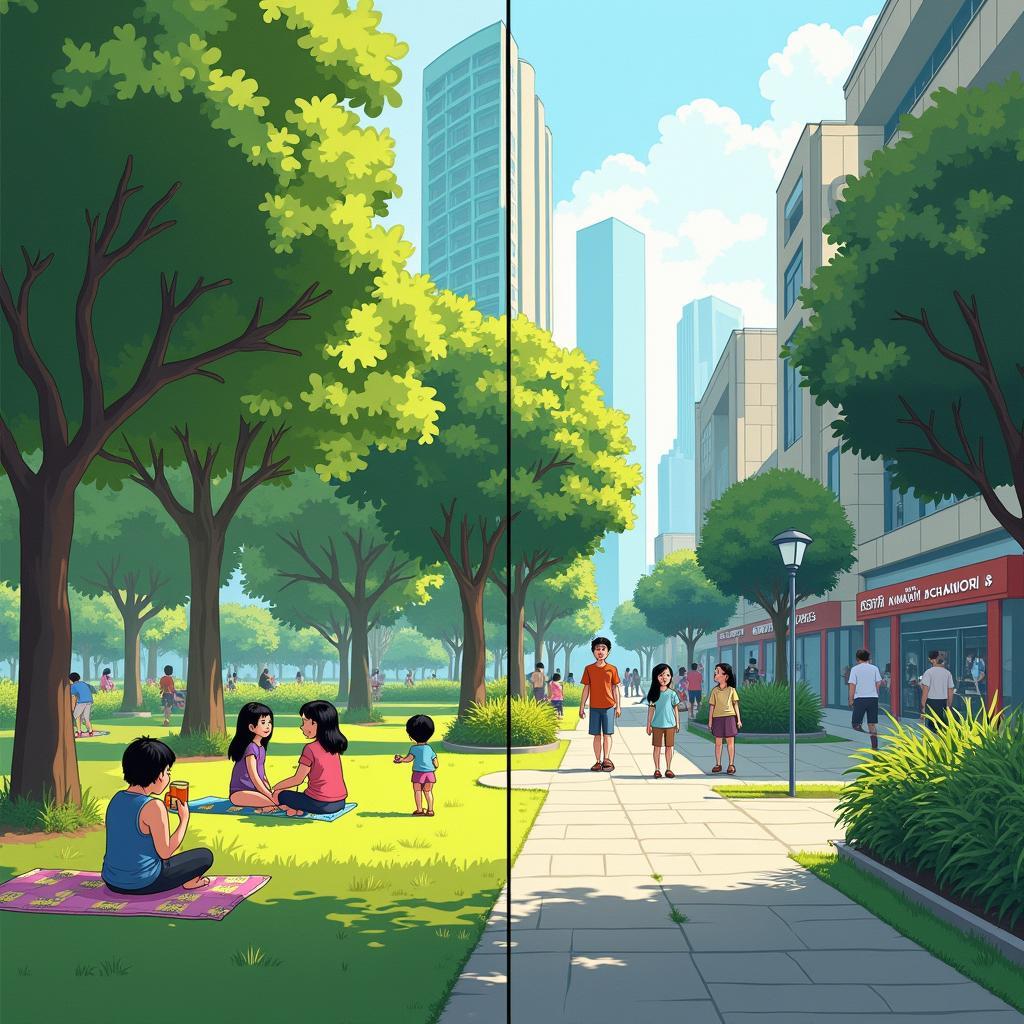 Minh họa không gian xanh đô thị đang biến mất được thảo luận trong IELTS Speaking Part 2
Follow-up Questions (Rounding Off Questions)
Question 1: How long has this been a problem in your area?
Band 6-7 Answer:
It has been a problem for about five or six years now. I think it started getting worse when more people moved to the city.
Band 8-9 Answer:
Well, it’s been progressively worsening over the past decade or so, though I’d say the issue really reached critical mass about five years ago. That’s when the cumulative effects of unchecked development became impossible to ignore – you could literally see the difference in satellite imagery.
Question 2: Do you think the situation will improve in the future?
Band 6-7 Answer:
I hope so, but I’m not very sure. It depends on whether the government takes action and people change their habits.
Band 8-9 Answer:
I’d like to be optimistic, but honestly, I think we’re at a critical juncture. If we can implement meaningful policy reforms within the next few years and foster genuine behavioral change, there’s hope. However, without decisive intervention, I fear we’ll pass a point of no return where the damage becomes irreversible.
IELTS Speaking Part 3: Two-way Discussion
Tổng Quan Về Part 3
Part 3 kéo dài 4-5 phút và là phần khó nhất trong IELTS Speaking vì yêu cầu bạn thảo luận các vấn đề trừu tượng và phức tạp hơn liên quan đến chủ đề Part 2. Đây không còn là nói về personal experience mà là analyze, evaluate, compare và speculate về broader social issues.
Đối với chủ đề environmental issues, giám khảo thường hỏi về government responsibility vs individual action, environmental problems globally vs locally, solutions and their feasibility, future predictions, và cultural differences trong environmental awareness.
Chiến lược hiệu quả là mở rộng câu trả lời thành 3-5 câu với structure: Direct answer → Reason/Explanation → Example/Evidence → Balanced view/Conclusion. Sử dụng discourse markers để organize thoughts và tentative language để show sophisticated thinking.
Lỗi thường gặp của học viên Việt Nam bao gồm trả lời quá ngắn gọn như Part 1, không phân tích đủ sâu, thiếu examples từ society (chỉ nói về personal experience), và không thể hiện được critical thinking bằng cách xem xét nhiều perspectives.
Các Câu Hỏi Thảo Luận Sâu
Theme 1: Responsibility and Solutions
Question 1: Who do you think is more responsible for solving environmental problems – governments or individuals?
🎯 Phân tích câu hỏi:
- Dạng: Compare and Opinion – yêu cầu so sánh và đưa ra stance
- Key words: “more responsible”, “governments or individuals”
- Cách tiếp cận: Tránh absolute answer (chỉ chọn một), thay vào đó analyze roles của cả hai và argue for shared responsibility hoặc prioritize một nhưng acknowledge vai trò của cái còn lại
📝 Sample Answer – Band 6-7:
I think both governments and individuals are responsible, but governments have more power to make big changes. Governments can create laws to control pollution and provide money for environmental projects. However, individuals also need to do their part by reducing waste and saving energy. If everyone works together, we can solve environmental problems better.
Phân tích:
- Structure: Có attempt at balanced view (both… but…) nhưng chưa fully developed
- Vocabulary: Basic vocabulary (big changes, create laws, do their part) thiếu precision
- Tại sao Band 6-7: Trả lời đủ câu hỏi với basic reasoning nhưng lacks depth, sophisticated vocabulary và detailed examples
📝 Câu trả lời mẫu – Band 8-9:
Well, I’d argue that this is really a false dichotomy – we need concerted efforts from both parties, though I’d say governments bear the lion’s share of responsibility. Structurally speaking, only governments have the regulatory authority and fiscal resources to implement large-scale systemic changes – things like carbon taxes, renewable energy infrastructure, or mandatory emission standards for industries. These are game-changing interventions that individuals simply cannot accomplish on their own.
That said, individual actions are far from negligible. Collective behavioral shifts – like widespread adoption of sustainable consumption patterns – can create significant market pressure that incentivizes corporations to change their practices. Moreover, grassroots movements often catalyze political will, pushing governments to act when they might otherwise drag their feet.
At the end of the day, I think we need what researchers call “polycentric governance” – multilevel cooperation where governments set the framework and enforce accountability, while individuals and communities drive innovation and maintain momentum from the ground up. Neither can succeed in isolation.
Phân tích:
- Structure: Extremely well-organized: Opening statement (false dichotomy) → Government role with specific examples → Individual role with nuanced analysis → Sophisticated conclusion with academic concept (polycentric governance)
- Vocabulary: Advanced and precise (false dichotomy, bear the lion’s share, regulatory authority, fiscal resources, systemic changes, negligible, catalyze political will, drag their feet, polycentric governance)
- Grammar: Complex structures flawlessly executed (things like…, when they might otherwise…, what researchers call…, where… while…)
- Critical Thinking: Shows sophisticated understanding by rejecting binary thinking, providing specific mechanisms (market pressure, grassroots movements), and introducing academic framework
💡 Key Language Features:
- Discourse markers: “Well”, “That said”, “At the end of the day”, “Moreover”
- Tentative language: “I’d argue that”, “I’d say”, “I think we need”
- Abstract nouns: regulatory authority, fiscal resources, behavioral shifts, grassroots movements, polycentric governance
- Academic expressions: “false dichotomy”, “structurally speaking”, “neither can succeed in isolation”
Question 2: What are the most effective ways to raise environmental awareness among young people?
🎯 Phân tích câu hỏi:
- Dạng: Problem-Solution focused on specific demographic
- Key words: “most effective ways”, “environmental awareness”, “young people”
- Cách tiếp cận: Identify 2-3 methods, explain why they work specifically for young people, provide evidence or examples
📝 Sample Answer – Band 6-7:
I think education is the most important way. Schools should teach students about environmental problems and what they can do to help. Also, social media is very popular with young people, so we can use it to share information about protecting the environment. Young people like to follow trends, so if being eco-friendly becomes popular, more young people will do it.
Phân tích:
- Structure: Lists two methods (education, social media) với basic explanation
- Ideas: Reasonable points nhưng lack depth và specific mechanisms
- Vocabulary: Simple expressions (most important, very popular, like to follow)
📝 Câu trả lời mẫu – Band 8-9:
I believe the most impactful approach is experiential education – getting young people directly engaged with nature and tangibly involved in conservation projects rather than just lecturing them about abstract concepts. There’s actually compelling research showing that when teenagers participate hands-on in activities like habitat restoration or wildlife monitoring, they develop a much deeper emotional connection to environmental issues, which translates into lasting behavioral change.
Leveraging digital platforms is also crucial, but it needs to be done strategically. Rather than just bombarding young people with apocalyptic messaging about climate doom – which often leads to eco-anxiety and disengagement – we should spotlight positive stories of youth-led environmental initiatives that are making tangible impacts. This taps into their desire to be agents of change rather than passive victims of environmental degradation.
Another underutilized strategy is integrating environmental considerations into subjects young people already care about – linking it to social justice, public health, or economic opportunities in green industries. When they understand that environmental issues intersect with their personal aspirations and community wellbeing, the motivation becomes much more intrinsic rather than just performative.
Phân tích:
- Structure: Three sophisticated strategies, each with clear rationale, evidence/examples, and analysis of psychological mechanisms
- Vocabulary: Exceptional range (experiential education, tangibly involved, compelling research, habitat restoration, leveraging, bombarding, apocalyptic messaging, eco-anxiety, agents of change, intrinsic motivation)
- Grammar: Varied complex structures (showing that…, which translates into…, when they understand that…, rather than just…)
- Critical Thinking: Shows understanding of youth psychology, references research, recognizes pitfalls (eco-anxiety), proposes multi-dimensional approaches
💡 Key Language Features:
- Discourse markers: “Rather than”, “Another underutilized strategy”, “When they understand that”
- Hedging: “I believe”, “often leads to”
- Academic register: “compelling research”, “translates into”, “intersect with”, “intrinsic motivation”
- Contrast structures: “rather than just lecturing them”, “agents of change rather than passive victims”
Theme 2: Global vs Local Environmental Issues
Question 3: Are environmental problems different in developed and developing countries?
🎯 Phân tích câu hỏi:
- Dạng: Compare and Contrast (geographical/economic comparison)
- Key words: “environmental problems”, “developed”, “developing countries”
- Cách tiếp cận: Identify specific differences, explain underlying reasons (economic, infrastructure, priorities), acknowledge some commonalities
📝 Sample Answer – Band 6-7:
Yes, they are quite different. Developed countries usually have problems like too much consumption and waste. They use a lot of resources and produce a lot of garbage. Developing countries have different problems like water pollution and lack of clean water because they don’t have good infrastructure. But both types of countries need to work on environmental protection.
Phân tích:
- Structure: Basic comparison với general points
- Ideas: Identifies some differences nhưng thiếu nuance và specific examples
- Vocabulary: Simple language (too much, a lot of, good infrastructure)
📝 Câu trả lời mẫu – Band 8-9:
Absolutely, there are stark differences, though I’d argue they’re differences in priority and development stage rather than fundamentally distinct challenges. In developed nations, environmental issues tend to be “post-industrial” in nature – think overconsumption, e-waste, unsustainable food systems, and carbon-intensive lifestyles. These countries have largely addressed acute pollution through regulations but now grapple with the systemic implications of affluent consumption patterns.
Developing countries, conversely, often face what I’d call “survival environmentalism” – immediate threats like unsafe drinking water, inadequate sanitation, indoor air pollution from cooking fuels, and soil degradation that directly impacts livelihoods. The challenge is that these nations are simultaneously trying to lift millions out of poverty while avoiding the environmentally destructive development trajectory that wealthy nations followed.
What complicates this picture is that developing countries are also disproportionately vulnerable to climate change despite contributing least to historical emissions. It’s a profound injustice – communities in Bangladesh or Sub-Saharan Africa bearing the brunt of rising sea levels and desertification caused largely by industrial emissions from Europe and North America over the past century.
That said, the distinction is increasingly blurred. Many rapidly industrializing nations like China or India now face a hybrid crisis – both legacy poverty-related issues and modern pollution problems. And transnational challenges like plastic in oceans or atmospheric carbon affect everyone regardless of borders. So while context-specific approaches are essential, we ultimately need globally coordinated solutions because environmental degradation respects no boundaries.
Phân tích:
- Structure: Highly sophisticated: Thesis statement → Developed country issues → Developing country issues → Complexity/injustice dimension → Nuanced conclusion acknowledging blurring boundaries
- Vocabulary: Exceptional precision and range (stark differences, post-industrial, systemic implications, affluent consumption, survival environmentalism, environmentally destructive development trajectory, disproportionately vulnerable, legacy poverty-related issues, hybrid crisis)
- Grammar: Full range flawlessly used (think + examples, despite contributing, what complicates this picture, increasingly blurred)
- Critical Thinking: Shows deep understanding of: economic development stages, historical responsibility, environmental justice, changing dynamics, interconnected global challenges
💡 Key Language Features:
- Discourse markers: “Absolutely”, “Conversely”, “That said”, “What complicates this picture”
- Academic vocabulary: post-industrial, systemic implications, trajectory, disproportionately vulnerable, transnational challenges
- Evaluative language: “stark differences”, “profound injustice”, “context-specific approaches”
- Complex nominalization: “survival environmentalism”, “affluent consumption patterns”
Đối với những ai muốn hiểu thêm về cách mô tả nơi bạn muốn đi leo núi, việc kết nối với chủ đề bảo vệ môi trường tự nhiên và không gian sinh thái sẽ giúp bài nói của bạn có chiều sâu và tính thuyết phục cao hơn.
Theme 3: Future Trends and Predictions
Question 4: Do you think environmental problems will get better or worse in the future?
🎯 Phân tích câu hỏi:
- Dạng: Prediction/Speculation about future trends
- Key words: “environmental problems”, “better or worse”, “future”
- Cách tiếp cận: Avoid simplistic answer, present competing trends (positive developments vs ongoing challenges), use tentative language, possibly conditional structures
📝 Sample Answer – Band 6-7:
I think it’s hard to say, but probably it will get worse before it gets better. Many countries are still developing and using a lot of natural resources. However, people are becoming more aware of environmental problems, and technology is improving, so maybe in the long term things will improve if we take action now.
Phân tích:
- Structure: Attempts balanced view với “worse before better” prediction
- Ideas: Mentions awareness và technology nhưng không elaborate mechanisms
- Vocabulary: General terms (hard to say, a lot of, becoming more aware, things will improve)
📝 Câu trả lời mẫu – Band 8-9:
This is the proverbial million-dollar question, isn’t it? I’m cautiously pessimistic in the short to medium term, but I see glimmers of hope for the longer horizon. The trajectory we’re currently on is genuinely alarming – we’re overshooting planetary boundaries at an accelerating rate, and many tipping points in Earth systems like the Amazon rainforest or Arctic ice may be perilously close or already irreversibly crossed.
However, and this is a significant caveat, we’re also witnessing unprecedented technological breakthroughs and shifts in political will. The plummeting costs of renewable energy – solar and wind are now economically competitive with fossil fuels in most markets – represents a genuine game-changer. Emerging technologies like carbon capture, alternative proteins, and circular economy innovations could fundamentally reshape our resource consumption patterns.
What gives me pause, though, is the inertia in our systems – both physical and political. Even if we achieved net-zero emissions tomorrow, the atmospheric carbon already released will continue warming the planet for decades due to thermal lag. And vested interests in extractive industries continue to wield enormous influence over policy, often stymying progress.
My best guess is we’re headed for a turbulent transition period where things will indeed deteriorate significantly – more extreme weather events, ecosystem collapses, climate refugees – before we reach a crisis point that galvanizes sufficient action. It’s an unfortunate reality that humans often only act decisively when faced with immediate existential threats rather than gradual degradation. Ideally, we’d act proactively rather than reactively, but history suggests we’re wired for crisis management rather than foresight.
Phân tích:
- Structure: Masterfully organized: Thesis (cautiously pessimistic) → Current alarming trends with technical details → Positive technological developments → Critical analysis of barriers → Nuanced prediction with psychological insight
- Vocabulary: Sophisticated and precise throughout (proverbial million-dollar question, cautiously pessimistic, glimmers of hope, overshooting planetary boundaries, tipping points, perilously close, plummeting costs, thermal lag, vested interests, stymying progress, galvanizes sufficient action)
- Grammar: Full range expertly deployed (Even if we achieved…, what gives me pause, history suggests we’re wired for…)
- Critical Thinking: Exceptional depth showing understanding of: climate science (tipping points, thermal lag), economics (renewable energy costs), political economy (vested interests), human psychology (crisis-driven action), systems thinking (inertia)
💡 Key Language Features:
- Discourse markers: “However”, “What gives me pause”, “My best guess”, “Ideally”
- Tentative/hedging language: “I’m cautiously pessimistic”, “may be perilously close”, “could fundamentally reshape”, “My best guess is”
- Academic/technical vocabulary: planetary boundaries, tipping points, carbon capture, thermal lag, extractive industries, proactively vs reactively
- Rhetorical devices: Opening with rhetorical question, “This is a significant caveat”
Question 5: What role does technology play in solving environmental issues?
🎯 Phân tích câu hỏi:
- Dạng: Evaluate role/importance of specific factor
- Key words: “role”, “technology”, “solving environmental issues”
- Cách tiếp cận: Discuss both positive potential và limitations, avoid techno-optimism or techno-pessimism extremes, provide specific examples
📝 Sample Answer – Band 6-7:
Technology plays a very important role. It can help us develop clean energy like solar panels and electric cars. Technology also helps us monitor pollution and find solutions faster. However, technology alone is not enough. We also need people to change their behavior and governments to support green technology. So technology is useful but it’s just one part of the solution.
Phân tích:
- Structure: Presents technology’s benefits followed by limitation, reasonable balance
- Ideas: Valid points nhưng quite general
- Vocabulary: Basic expressions (very important, clean energy, not enough, just one part)
📝 Câu trả lời mẫu – Band 8-9:
Technology is undeniably a critical enabler, but I think we need to be careful not to fall into the trap of technological solutionism – the belief that every problem has a technical fix. On the optimistic side, we’re seeing genuinely transformative innovations. Renewable energy technologies have matured to the point where they’re not just environmentally preferable but also economically viable, which fundamentally changes the calculus. Precision agriculture using AI and satellite imagery can optimize resource use, dramatically reducing water consumption and pesticide application. Advanced materials science is producing biodegradable alternatives to plastics that could revolutionize packaging.
Where I become more skeptical is when technology is positioned as a silver bullet that absolves us from making difficult systemic changes. Take carbon capture technology, for instance. Yes, it’s theoretically promising, but it’s still prohibitively expensive and energy-intensive, and worse, it can create moral hazard – giving industries permission to continue polluting with the promise that we’ll just capture emissions later. This is what researchers call “techno-fix mentality” – deferring fundamental changes in consumption and production by betting on future technologies.
Moreover, technology itself has environmental footprints we often overlook. The rare earth minerals required for renewable energy infrastructure and electronic devices are often extracted under environmentally destructive conditions. Data centers powering our digital economy consume vast amounts of energy. So we have these perverse situations where the technologies meant to save the environment are themselves resource-intensive.
In my view, technology should be seen as one crucial tool in a larger toolkit that also includes policy reform, behavioral change, economic restructuring, and shifts in cultural values. The most effective solutions will integrate technological innovation with social innovation – like community-owned renewable energy cooperatives that combine clean technology with democratic governance and local empowerment. Technology amplifies human intention; if that intention is genuinely aimed at sustainability and equity, technology can be incredibly powerful. But it’s no substitute for the hard work of reimagining our economic and social systems.
Phân tích:
- Structure: Exceptionally sophisticated: Opening with nuanced position → Positive technological developments with examples → Critical analysis of limitations (moral hazard, techno-fix mentality) → Often-overlooked problems (environmental footprint of tech itself) → Synthesized conclusion about integration
- Vocabulary: Highest level precision and range (technological solutionism, transformative innovations, economically viable, precision agriculture, moral hazard, techno-fix mentality, rare earth minerals, perverse situations, amplifies human intention, no substitute for)
- Grammar: Full mastery (where I become more skeptical, giving industries permission to, what researchers call, if that intention is genuinely aimed at)
- Critical Thinking: Demonstrates exceptional depth by: identifying cognitive traps (solutionism), analyzing unintended consequences (moral hazard), recognizing paradoxes (tech’s own footprint), synthesizing holistic approach, understanding that technology is value-neutral amplifier
💡 Key Language Features:
- Discourse markers: “On the optimistic side”, “Where I become more skeptical”, “Moreover”, “In my view”
- Academic expressions: “technological solutionism”, “moral hazard”, “techno-fix mentality”, “perverse situations”, “amplifies human intention”
- Evaluative language: “undeniably critical”, “genuinely transformative”, “prohibitively expensive”
- Hedging and nuance: “I think we need to be careful”, “theoretically promising”, “In my view”
Việc tham gia các hoạt động nhóm liên quan đến bảo vệ môi trường có thể cung cấp những ví dụ cụ thể và thuyết phục khi bạn thảo luận về vai trò của cộng đồng trong giải quyết các vấn đề sinh thái địa phương.
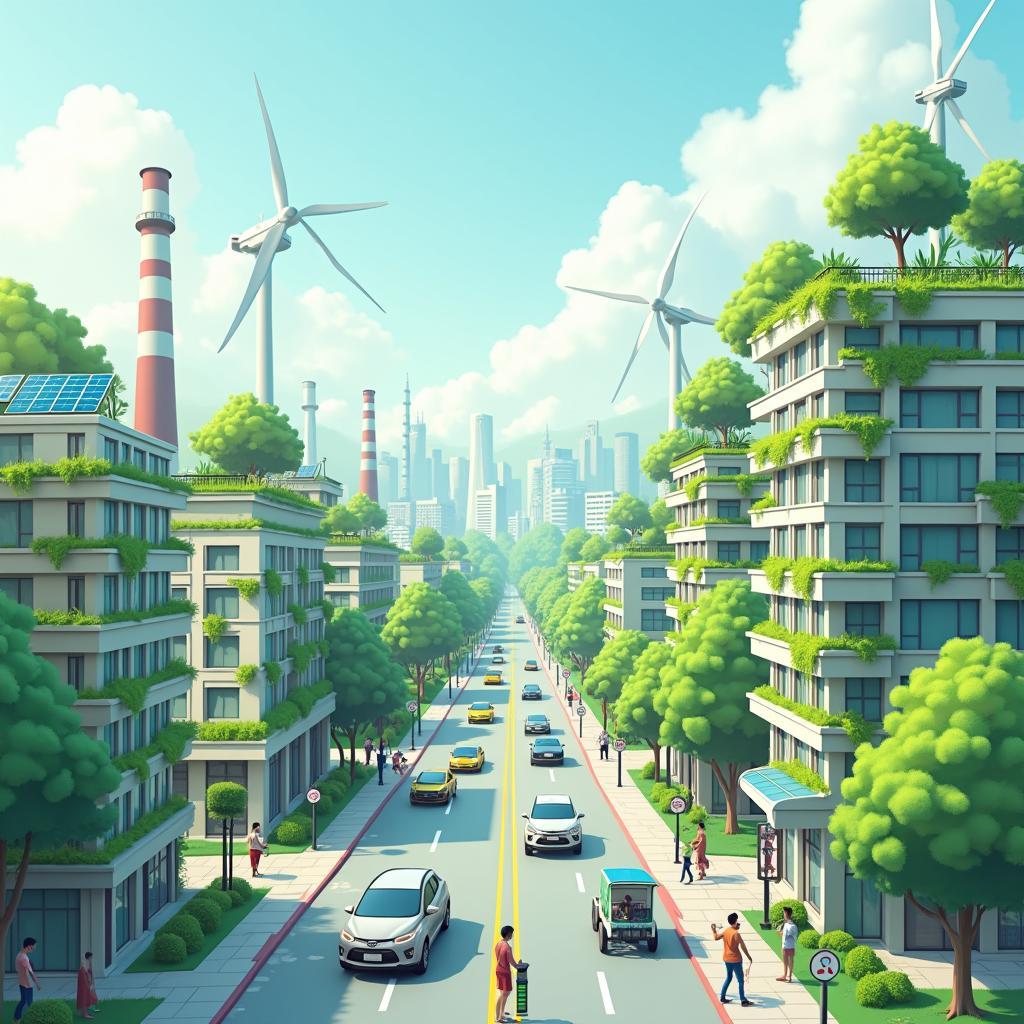 Minh họa vai trò của công nghệ xanh trong giải quyết vấn đề môi trường cho IELTS Speaking
Theme 4: Cultural and Social Dimensions
Question 6: Why do some people care more about the environment than others?
🎯 Phân tích câu hỏi:
- Dạng: Explain reasons/causes for behavioral differences
- Key words: “some people”, “care more”, “than others”
- Cách tiếp cận: Identify multiple factors (education, economic status, cultural background, personal experience), avoid judgmental tone, show understanding of complexity
📝 Sample Answer – Band 6-7:
There are several reasons. First, education is important. People who learn about environmental problems in school usually care more. Second, it depends on their economic situation. Rich people might care more because they have solved their basic needs, while poor people focus on making money. Also, some people have personal experiences with pollution or natural disasters, so they understand the importance better.
Phân tích:
- Structure: Lists three factors với basic explanation
- Ideas: Identifies relevant factors nhưng analysis is superficial
- Vocabulary: Simple connectors (First, Second, Also) và basic vocabulary
📝 Câu trả lời mẫu – Band 8-9:
This is a fascinating question that touches on psychology, sociology, and economics simultaneously. I think environmental concern exists along a spectrum, and multiple overlapping factors determine where someone falls on that spectrum.
Socioeconomic position plays an enormous role, though not always in the ways we might expect. There’s a concept called “Maslow’s hierarchy of needs” – when you’re struggling to meet basic survival needs, environmental concerns can feel like unaffordable luxuries. I’ve seen this firsthand in resource-scarce communities where people must choose between feeding their families and sustainable practices. Conversely, in affluent societies, we sometimes see performative environmentalism – people who virtue signal about climate change while maintaining carbon-intensive lifestyles – what some critics call “eco-hypocrisy”.
Education and exposure are obviously crucial, but not just formal education. Direct experience with environmental degradation often proves more impactful than abstract knowledge. Someone who’s watched their ancestral fishing grounds become depleted or experienced severe flooding due to climate change typically develops visceral concern that transcends what any textbook could convey.
Cultural and generational factors also come into play. Younger generations, particularly Gen Z, have grown up with climate discourse as ambient background noise of their lives, making them generally more attuned to these issues. Cultural contexts matter too – indigenous communities with cosmologies that view humans as interconnected with nature rather than separate from or dominant over it often demonstrate intrinsic environmental stewardship.
Personality traits shouldn’t be discounted either. Research suggests that people high in trait openness and those with future-oriented thinking tend to engage more deeply with environmental issues, while those with present bias or psychological distance from consequences may struggle to prioritize long-term planetary health over immediate gratification.
Perhaps most intriguingly, there’s what psychologists call “psychological numbing” – when the scale of environmental crises becomes so overwhelming that people disengage defensively rather than confront the existential anxiety it provokes. This might explain why some highly educated people who clearly understand the science still fail to modify their behavior – it’s a coping mechanism against eco-grief.
Ultimately, I think we need to resist the temptation to morally judge those who seem less environmentally concerned and instead understand the complex constellation of factors that shape environmental consciousness. More productive is creating conditions – through education, policy, and culture – that make sustainable choices the default rather than requiring extraordinary moral effort.
Phân tích:
- Structure: Masterclass in organization: Introduction acknowledging complexity → Five distinct analytical dimensions (socioeconomic, education/experience, cultural/generational, personality, psychological mechanisms) each with evidence/examples → Sophisticated conclusion about withholding judgment and systemic solutions
- Vocabulary: Exceptional sophistication and precision (environmental concern exists along a spectrum, overlapping factors, unaffordable luxuries, performative environmentalism, virtue signal, eco-hypocrisy, visceral concern, ambient background noise, cosmologies, intrinsic stewardship, trait openness, psychological distance, psychological numbing, existential anxiety, eco-grief, complex constellation)
- Grammar: Full range with perfect control (not always in ways we might expect, when you’re struggling to meet…, someone who’s watched…, view humans as interconnected with, what psychologists call, through education, policy, and culture)
- Critical Thinking: Demonstrates extraordinary depth: references academic concepts (Maslow, psychological numbing), recognizes contradictions (affluent eco-hypocrisy), acknowledges emotional dimensions (eco-grief), avoids judgmental stance, understands cultural relativity, proposes systemic rather than individualistic solutions
💡 Key Language Features:
- Discourse markers: “Conversely”, “Obviously”, “Perhaps most intriguingly”, “Ultimately”
- Academic references: “Maslow’s hierarchy of needs”, “what psychologists call”, “Research suggests”
- Tentative language: “I think”, “might explain why”, “typically develops”
- Technical vocabulary: performative environmentalism, virtue signal, eco-hypocrisy, psychological distance, trait openness, psychological numbing, existential anxiety, eco-grief
- Sophisticated structures: “not just… but…”, “not always in the ways we might expect”, “resist the temptation to”
Từ vựng và cụm từ quan trọng
Topic-Specific Vocabulary
| Từ vựng/Cụm từ | Loại từ | Phiên âm | Nghĩa tiếng Việt | Ví dụ | Collocation |
|---|---|---|---|---|---|
| environmental degradation | n | /ɪnˌvaɪrənˈmentl ˌdeɡrəˈdeɪʃn/ | sự suy thoái môi trường | Climate change is causing rapid environmental degradation in coastal areas. | severe degradation, ecological degradation, prevent degradation, combat degradation |
| sustainable | adj | /səˈsteɪnəbl/ | bền vững | We need to adopt more sustainable practices in agriculture. | sustainable development, sustainable future, environmentally sustainable, economically sustainable |
| carbon footprint | n | /ˈkɑːbən ˈfʊtprɪnt/ | dấu chân carbon (lượng khí thải CO2) | Flying frequently increases your carbon footprint significantly. | reduce footprint, minimize footprint, carbon footprint per capita, heavy carbon footprint |
| ecosystem | n | /ˈiːkəʊˌsɪstəm/ | hệ sinh thái | Wetlands are fragile ecosystems that need protection. | marine ecosystem, fragile ecosystem, disrupt ecosystem, ecosystem services, ecosystem collapse |
| biodiversity | n | /ˌbaɪəʊdaɪˈvɜːsəti/ | đa dạng sinh học | Deforestation threatens biodiversity in tropical regions. | rich biodiversity, biodiversity loss, preserve biodiversity, biodiversity hotspot |
| renewable energy | n | /rɪˈnjuːəbl ˈenədʒi/ | năng lượng tái tạo | Solar and wind are the most common forms of renewable energy. | renewable energy sources, transition to renewable energy, invest in renewable energy, renewable energy infrastructure |
| emissions | n | /ɪˈmɪʃnz/ | khí thải | Vehicle emissions contribute significantly to air pollution. | carbon emissions, reduce emissions, greenhouse gas emissions, harmful emissions, emission standards |
| deforestation | n | /diːˌfɒrɪˈsteɪʃn/ | sự phá rừng | Deforestation in the Amazon has accelerated in recent years. | rampant deforestation, combat deforestation, illegal deforestation, deforestation rate |
| pollution | n | /pəˈluːʃn/ | ô nhiễm | Air pollution has reached alarming levels in many cities. | air/water/soil pollution, severe pollution, pollution levels, combat pollution, pollution control |
| waste management | n | /weɪst ˈmænɪdʒmənt/ | quản lý chất thải | Effective waste management is crucial for urban areas. | proper waste management, waste management system, improve waste management, waste management infrastructure |
| ecological | adj | /ˌiːkəˈlɒdʒɪkl/ | thuộc về sinh thái | The oil spill caused ecological disaster. | ecological balance, ecological crisis, ecological footprint, ecological restoration |
| contamination | n | /kənˌtæmɪˈneɪʃn/ | sự ô nhiễm, nhiễm bẩn | Water contamination from industrial waste is a serious concern. | water contamination, soil contamination, prevent contamination, widespread contamination |
| conservation | n | /ˌkɒnsəˈveɪʃn/ | bảo tồn | Wildlife conservation efforts have increased in recent years. | conservation efforts, conservation area, species conservation, conservation organization |
| climate change | n | /ˈklaɪmət tʃeɪndʒ/ | biến đổi khí hậu | Climate change poses an existential threat to humanity. | combat climate change, climate change impacts, climate change mitigation, address climate change |
| green spaces | n | /ɡriːn speɪsɪz/ | không gian xanh | Urban green spaces improve air quality and mental health. | preserve green spaces, create green spaces, dwindling green spaces, adequate green spaces |
| exhaust fumes | n | /ɪɡˈzɔːst fjuːmz/ | khói thải xe cộ | Exhaust fumes from vehicles are a major source of urban pollution. | toxic exhaust fumes, vehicle exhaust fumes, reduce exhaust fumes |
| single-use plastics | n | /ˈsɪŋɡl juːs ˈplæstɪks/ | đồ nhựa dùng một lần | Many countries are banning single-use plastics. | phase out single-use plastics, ban single-use plastics, reduce single-use plastics |
| recycling | n | /ˌriːˈsaɪklɪŋ/ | tái chế | Recycling helps reduce waste and conserve resources. | recycling program, recycling bins, promote recycling, recycling rate, waste recycling |
| habitat loss | n | /ˈhæbɪtæt lɒs/ | mất môi trường sống | Habitat loss is the primary threat to many endangered species. | prevent habitat loss, habitat loss and fragmentation, wildlife habitat loss |
| environmental awareness | n | /ɪnˌvaɪrənˈmentl əˈweənəs/ | nhận thức về môi trường | Raising environmental awareness is key to behavioral change. | increase environmental awareness, environmental awareness campaigns, lack of environmental awareness |
Idiomatic Expressions & Advanced Phrases
| Cụm từ | Nghĩa | Ví dụ sử dụng | Band điểm |
|---|---|---|---|
| at the end of the day | cuối cùng thì, xét cho cùng | At the end of the day, we all share responsibility for protecting the planet. | 7.5-8 |
| a drop in the ocean | chỉ là một giọt nước trong biển cả (rất nhỏ so với quy mô vấn đề) | Individual recycling efforts are just a drop in the ocean compared to industrial pollution. | 7.5-8 |
| the tip of the iceberg | chỉ là phần nổi của tảng băng (vấn đề còn lớn hơn nhiều) | The visible pollution in rivers is just the tip of the iceberg. | 7-8 |
| turn a blind eye to | lờ đi, phớt lờ | Authorities have been turning a blind eye to illegal waste dumping. | 8-9 |
| a vicious circle | vòng luẩn quẩn | Poverty and environmental degradation create a vicious circle. | 7.5-8 |
| the elephant in the room | vấn đề rõ ràng nhưng mọi người tránh đề cập | Climate change is the elephant in the room that politicians avoid discussing. | 8-9 |
| up in arms about | rất tức giận và phản đối | Local residents are up in arms about the new factory’s pollution. | 7.5-8 |
| it’s high time | đã đến lúc phải (thể hiện tính cấp bách) | It’s high time we took decisive action on plastic pollution. | 7.5-8 |
| the writing is on the wall | dấu hiệu rõ ràng về điều sắp xảy ra | With increasing extreme weather, the writing is on the wall for climate change. | 8-9 |
| pay lip service to | nói suông, chỉ nói không làm | Many companies pay lip service to sustainability without real action. | 8.5-9 |
Discourse Markers (Từ Nối Ý Trong Speaking)
Để bắt đầu câu trả lời:
- 📝 Well,… – Dùng khi cần một chút thời gian suy nghĩ hoặc khi câu trả lời phức tạp
- 📝 Actually,… – Khi đưa ra góc nhìn có thể khác với expectation
- 📝 To be honest,… – Khi nói thật lòng về quan điểm cá nhân
- 📝 I’d say that… – Cách mềm mại để đưa ra opinion
- 📝 From my perspective,… – Nhấn mạnh đây là góc nhìn cá nhân
Để bổ sung ý:
- 📝 On top of that,… – Thêm vào đó, hơn nữa
- 📝 What’s more,… – Hơn nữa, thêm nữa
- 📝 Not to mention… – Chưa kể đến
- 📝 Beyond that,… – Ngoài ra, xa hơn nữa
- 📝 Moreover,… – Hơn nữa (formal hơn)
Để đưa ra quan điểm cân bằng:
- 📝 On the one hand,… On the other hand,… – Một mặt… mặt khác…
- 📝 While it’s true that…, we also need to consider… – Mặc dù đúng là… nhưng chúng ta cũng cần xem xét…
- 📝 That said,… – Tuy nhiên, nói như vậy thì…
- 📝 Having said that,… – Sau khi nói điều đó…
- 📝 Conversely,… – Ngược lại
Để kết luận:
- 📝 All in all,… – Tóm lại, xét tất cả
- 📝 At the end of the day,… – Cuối cùng thì
- 📝 Ultimately,… – Cuối cùng, sau cùng
- 📝 In the final analysis,… – Khi phân tích cuối cùng
Để thể hiện uncertainty/tentativeness:
- 📝 I would say… – Tôi cho rằng (không quá chắc chắn)
- 📝 It seems to me that… – Có vẻ như với tôi
- 📝 To some extent,… – Ở một mức độ nào đó
- 📝 In some ways,… – Theo một cách nào đó
Grammatical Structures Ấn Tượng
1. Conditional Sentences (Câu điều kiện):
Mixed conditional (Type 2 + Type 3):
- Formula: If + past simple, would + present infinitive / If + past perfect, would + be + V-ing
- Ví dụ: “If governments had invested more in renewable energy decades ago, we wouldn’t be facing such a severe climate crisis now.”
- Ví dụ: “If people were more environmentally conscious, we would have preserved more biodiversity by now.”
Inversion (Đảo ngữ) với conditional:
- Formula: Had + subject + past participle, would have…
- Ví dụ: “Had we taken action earlier, many species wouldn’t have gone extinct.”
- Ví dụ: “Were governments to implement carbon taxes, emissions would decrease significantly.”
2. Relative Clauses (Mệnh đề quan hệ):
Non-defining relative clauses:
- Formula: …, which/who/where + clause, …
- Ví dụ: “Plastic pollution, which has become a global crisis, affects marine ecosystems worldwide.”
- Ví dụ: “The Amazon rainforest, where thousands of species live, is being destroyed at an alarming rate.”
3. Passive Voice (Câu bị động):
Impersonal passive với reporting verbs:
- Formula: It is thought/believed/said/estimated that…
- Ví dụ: “It is estimated that millions of tons of plastic waste enter the oceans each year.”
- Ví dụ: “It is widely believed that renewable energy will become the dominant energy source within decades.”
4. Cleft Sentences (Câu chẻ):
What-cleft:
- Formula: What + subject + verb + is/was + …
- Ví dụ: “What really concerns me about this issue is the long-term impact on future generations.”
- Ví dụ: “What makes this problem so challenging is that it requires global cooperation.”
The thing that-cleft:
- Formula: The thing/reason/fact that + clause + is + …
- Ví dụ: “The thing that strikes me most is how quickly green spaces are disappearing.”
- Ví dụ: “The reason that people don’t act is often because they feel powerless to make a difference.”
5. Participle Phrases:
Present participle để bổ sung thông tin:
- Ví dụ: “Living in a heavily polluted city, I’ve become acutely aware of air quality issues.”
- Ví dụ: “Having witnessed the destruction firsthand, I feel a deep responsibility to take action.”
6. Inversion for emphasis:
- Formula: Not only + auxiliary + subject + verb, but also…
- Ví dụ: “Not only does plastic pollution harm marine life, but it also enters the human food chain.”
- Formula: Never + auxiliary + subject + verb
- Ví dụ: “Never have we faced such urgent environmental challenges as we do today.”
Bài viết này đã cung cấp cho bạn một cái nhìn toàn diện về cách xử lý chủ đề “describe a local environmental issue you care about” trong kỳ thi IELTS Speaking. Từ những câu hỏi Part 1 về thói quen cá nhân, đến cue card Part 2 với các bài mẫu chi tiết theo từng band điểm, và những câu hỏi thảo luận sâu ở Part 3 về trách nhiệm xã hội và giải pháp dài hạn.
Điều quan trọng nhất mà bạn cần nhớ từ góc độ của một giám khảo IELTS là: đừng học thuộc template hay cố gắng sử dụng từ vựng quá phức tạp không tự nhiên. Thay vào đó, hãy tập trung vào việc phát triển ý tưởng rõ ràng, sử dụng các collocations chính xác, và thể hiện khả năng phân tích vấn đề từ nhiều góc độ. Giám khảo đánh giá cao sự tự nhiên trong giao tiếp, khả năng elaboration với examples cụ thể, và critical thinking được thể hiện qua việc acknowledge complexity của vấn đề.
Chủ đề môi trường sẽ tiếp tục là một trong những đề tài quan trọng trong IELTS Speaking vì tính thời sự và tầm ảnh hưởng toàn cầu của nó. Hãy chọn một vấn đề môi trường địa phương mà bạn thực sự quan tâm và có kinh nghiệm trực tiếp, sau đó luyện tập nói về nó từ nhiều góc độ khác nhau. Việc có personal connection với chủ đề sẽ giúp bạn nói tự nhiên và đam mê hơn, từ đó ghi điểm cao hơn trong mắt giám khảo.
Cuối cùng, hãy nhớ rằng IELTS Speaking không chỉ kiểm tra ngôn ngữ mà còn đánh giá khả năng giao tiếp hiệu quả. Hãy tập luyện thường xuyên, ghi âm để tự đánh giá, và nếu có thể, tìm một speaking partner hoặc giáo viên để nhận phản hồi. Chúc bạn đạt được band điểm mục tiêu trong kỳ thi IELTS Speaking sắp tới.

