Mở bài
Chủ đề về gia đình và truyền thống là một trong những đề tài phổ biến và gần gũi nhất trong kỳ thi IELTS Speaking. Đặc biệt, câu hỏi “Describe An Interesting Tradition In Your Family” thường xuyên xuất hiện trong Part 2, đồng thời có thể được mở rộng sang Part 1 và Part 3 với nhiều góc độ khác nhau về phong tục, tập quán gia đình và vai trò của truyền thống trong xã hội hiện đại.
Theo thống kê từ các kỳ thi thực tế, chủ đề này xuất hiện với tần suất cao trong các đề thi IELTS từ năm 2020 đến nay, chiếm khoảng 15-20% tổng số đề thi Speaking Part 2. Dự đoán khả năng xuất hiện trong tương lai vẫn ở mức cao do tính phổ biến và khả năng đánh giá toàn diện năng lực ngôn ngữ của thí sinh.
Bài viết này sẽ trang bị cho bạn:
- Các câu hỏi thường gặp trong cả 3 Part với phân tích chi tiết
- Bài mẫu theo nhiều band điểm (6-7, 7.5-8, 8.5-9) để bạn có thể học hỏi và so sánh
- Kho từ vựng và cụm từ ăn điểm được giảng viên chấm thi khuyên dùng
- Chiến lược trả lời hiệu quả từ góc nhìn của Examiner
- Lời khuyên thực tế giúp tránh những lỗi phổ biến của học viên Việt Nam
IELTS Speaking Part 1: Introduction and Interview
Tổng Quan Về Part 1
Part 1 của IELTS Speaking kéo dài 4-5 phút với các câu hỏi ngắn về cuộc sống hàng ngày và kinh nghiệm cá nhân. Examiner muốn đánh giá khả năng giao tiếp tự nhiên của bạn trong các tình huống quen thuộc.
Chiến lược hiệu quả:
- Trả lời trực tiếp câu hỏi ngay trong câu đầu tiên
- Mở rộng với lý do hoặc ví dụ cụ thể (2-3 câu)
- Thể hiện sự tự nhiên, không cần quá phức tạp
Lỗi thường gặp của học viên Việt Nam:
- Trả lời quá ngắn chỉ “Yes” hoặc “No” mà không giải thích
- Sử dụng từ vựng quá đơn giản, lặp đi lặp lại
- Thiếu ví dụ cụ thể từ kinh nghiệm bản thân
- Nói quá nhanh hoặc quá chậm, không tự nhiên
Các Câu Hỏi Thường Gặp
Question 1: Do you have any family traditions?
Question 2: What traditions are important in your family?
Question 3: How often does your family celebrate together?
Question 4: Did your family have any special traditions when you were a child?
Question 5: Do you think family traditions are important?
Question 6: Have any of your family traditions changed over time?
Question 7: What’s your favorite family celebration?
Question 8: Do you prefer family gatherings or meeting friends?
Phân Tích và Gợi Ý Trả Lời Chi Tiết
Question: Do you have any family traditions?
🎯 Cách tiếp cận:
- Trả lời trực tiếp có hay không
- Đưa ra một truyền thống cụ thể
- Giải thích ngắn gọn tại sao nó có ý nghĩa
📝 Sample Answer – Band 6-7:
“Yes, we do. Every Lunar New Year, my family gathers at my grandparents’ house to have a big meal together. We also visit relatives during the first three days of the new year. It’s a tradition we’ve followed for many years.”
Phân tích:
- Điểm mạnh: Trả lời rõ ràng, có ví dụ cụ thể về dịp Tết, cấu trúc câu đơn giản nhưng đúng ngữ pháp
- Hạn chế: Từ vựng còn basic (big meal, many years), thiếu chi tiết về cảm xúc hoặc ý nghĩa sâu hơn
- Tại sao Band 6-7: Đạt yêu cầu trả lời đầy đủ với ví dụ nhưng chưa thể hiện độ tinh tế trong ngôn ngữ và ý tưởng
📝 Sample Answer – Band 8-9:
“Absolutely! One of our most cherished traditions is the annual reunion dinner during Lunar New Year. My entire extended family, including aunts, uncles, and cousins, congregates at my grandparents’ home for an elaborate feast. What makes it particularly special is that we still uphold the custom of preparing traditional dishes together, which really strengthens our family bonds. It’s something I genuinely look forward to every year.”
Phân tích:
- Điểm mạnh:
- Từ vựng tinh tế và đa dạng: cherished traditions, annual reunion dinner, elaborate feast, uphold the custom, strengthen family bonds
- Cấu trúc câu phức hợp với mệnh đề quan hệ
- Thể hiện cảm xúc cá nhân với “genuinely look forward to”
- Giải thích được ý nghĩa của truyền thống
- Tại sao Band 8-9: Thể hiện Fluency tốt với câu dài nhưng tự nhiên, Vocabulary range rộng với collocations chính xác, Grammar đa dạng, và Ideas có chiều sâu về mặt văn hóa
💡 Key Vocabulary & Expressions:
- cherished tradition: truyền thống được trân trọng
- annual reunion dinner: bữa tiệc đoàn tụ hàng năm
- elaborate feast: bữa tiệc thịnh soạn
- uphold the custom: duy trì phong tục
- strengthen family bonds: củng cố mối quan hệ gia đình
Question: Did your family have any special traditions when you were a child?
🎯 Cách tiếp cận:
- Sử dụng thì quá khứ nhất quán
- Kể về một truyền thống cụ thể từ tuổi thơ
- Thể hiện cảm xúc hoặc kỷ niệm đặc biệt
📝 Sample Answer – Band 6-7:
“Yes, when I was young, my parents always took me and my brother to visit our grandparents every weekend. We would have lunch together and my grandmother cooked delicious food. I have good memories of those times.”
Phân tích:
- Điểm mạnh: Sử dụng đúng thì quá khứ, có ví dụ cụ thể về hoạt động hàng tuần
- Hạn chế: Từ vựng đơn giản (good memories, delicious food), cấu trúc câu cơ bản, thiếu chi tiết về cảm xúc
- Tại sao Band 6-7: Trả lời đầy đủ nhưng chưa impressive về mặt ngôn ngữ
📝 Sample Answer – Band 8-9:
“Oh definitely! One tradition that really stands out in my memory is our Sunday visits to my grandparents’ home. Without fail, every Sunday morning, my parents would bundle us into the car and we’d make the journey to their countryside house. My grandmother would always prepare a sumptuous home-cooked meal, and those afternoons were filled with storytelling sessions where she’d share fascinating tales from her youth. Looking back, those moments really shaped my appreciation for family values and intergenerational connections.”
Phân tích:
- Điểm mạnh:
- Opening phrase tự nhiên: “Oh definitely!”
- Vocabulary sophisticated: stands out in my memory, bundle us into the car, sumptuous home-cooked meal, storytelling sessions, intergenerational connections
- Cấu trúc đa dạng: mệnh đề quan hệ, past continuous for background
- Reflection về ý nghĩa: shaped my appreciation, intergenerational connections
- Tại sao Band 8-9: Fluency xuất sắc với discourse markers tự nhiên, Vocabulary range rộng và precise, Grammar structures phức tạp nhưng accurate, Ideas có depth với reflection
💡 Key Vocabulary & Expressions:
- stand out in my memory: nổi bật trong ký ức
- bundle someone into the car: vội vàng đưa ai đó lên xe
- sumptuous home-cooked meal: bữa ăn nhà làm thịnh soạn
- storytelling session: buổi kể chuyện
- shape one’s appreciation: hình thành sự trân trọng của ai đó
- intergenerational connection: sự kết nối liên thế hệ
Question: Do you think family traditions are important?
🎯 Cách tiếp cận:
- Đưa ra quan điểm rõ ràng (Yes/No/Depends)
- Giải thích lý do với ít nhất 2 points
- Có thể đưa ra ví dụ ngắn gọn
📝 Sample Answer – Band 6-7:
“Yes, I think they’re very important. Family traditions help people stay close to their relatives and maintain relationships. They also help children learn about their culture and history. So I believe every family should have some traditions.”
Phân tích:
- Điểm mạnh: Quan điểm rõ ràng, có 2 lý do cụ thể
- Hạn chế: Từ vựng simple (stay close, maintain relationships), thiếu examples cụ thể, cấu trúc câu đơn giản
- Tại sao Band 6-7: Trả lời logic và đầy đủ nhưng chưa sophisticated
📝 Sample Answer – Band 8-9:
“Absolutely, I’d say they’re invaluable. Firstly, family traditions serve as a glue that binds generations together, creating a sense of continuity and belonging. In today’s fast-paced world where families are increasingly scattered geographically, these shared rituals become even more crucial in maintaining emotional connections. Secondly, they play a vital role in cultural transmission, helping younger generations understand their heritage and root identity. So yes, I firmly believe traditions are the backbone of strong family relationships.”
Phân tích:
- Điểm mạnh:
- Opening với “Absolutely, I’d say” – tự nhiên và confident
- Vocabulary tinh vi: invaluable, glue that binds generations, sense of continuity, fast-paced world, scattered geographically, cultural transmission, root identity, backbone
- Structure rõ ràng: Firstly… Secondly…
- Context awareness: đề cập đến thực trạng xã hội hiện đại
- Metaphors ấn tượng: glue, backbone
- Tại sao Band 8-9: Fluency với signposting rõ ràng, Vocabulary range exceptionally wide với abstract nouns và metaphors, Grammar với complex sentences, Ideas profound và well-developed
💡 Key Vocabulary & Expressions:
- invaluable: vô giá, cực kỳ quý báu
- a glue that binds generations together: chất keo gắn kết các thế hệ
- sense of continuity: cảm giác liên tục, kế thừa
- fast-paced world: thế giới nhịp độ nhanh
- scattered geographically: phân tán về mặt địa lý
- cultural transmission: sự truyền tải văn hóa
- root identity: bản sắc gốc rễ
- the backbone: xương sống, nền tảng
 Truyền thống gia đình Việt Nam với bữa cơm sum họp ngày Tết cùng nhiều thế hệ quây quần bên mâm cỗ truyền thống
IELTS Speaking Part 2: Long Turn (Cue Card)
Tổng Quan Về Part 2
Part 2 là phần độc thoại kéo dài 2-3 phút, nơi bạn cần thể hiện khả năng nói liên tục về một chủ đề cụ thể. Đây là phần quan trọng nhất để Examiner đánh giá khả năng tổ chức ý tưởng và sử dụng ngôn ngữ của bạn.
Thời gian chuẩn bị: 1 phút
- Không viết câu đầy đủ, chỉ ghi keywords và ideas
- Lập outline nhanh theo bullet points
- Ghi chú số liệu, tên riêng nếu có
Thời gian nói: 2-3 phút
- Không bị ngắt giữa chừng
- Nói đủ 2 phút (tối thiểu 1.5 phút)
- Examiner sẽ dừng bạn khi hết giờ
Chiến lược hiệu quả:
- Cover đầy đủ tất cả bullet points trong thẻ
- Sử dụng thì động từ phù hợp (thường là quá khứ)
- Dành nhiều thời gian cho phần “explain” cuối cùng
- Dùng linking words để tạo mạch lạc
Lỗi thường gặp:
- Không sử dụng hết 1 phút chuẩn bị
- Nói dưới 1.5 phút hoặc quá 3 phút
- Bỏ sót một số bullet points
- Không giải thích đầy đủ phần “why” hoặc “how you feel”
Cue Card
Describe an interesting tradition in your family
You should say:
- What the tradition is
- When and how you follow this tradition
- Who participates in this tradition
- And explain why you find it interesting and meaningful
Phân Tích Đề Bài
Dạng câu hỏi: Describe an object/custom/tradition (miêu tả một sự vật/phong tục)
Thì động từ: Chủ yếu là hiện tại đơn (vì là thói quen/truyền thống lặp lại) và quá khứ đơn (nếu kể về nguồn gốc hoặc lần đầu tiên)
Bullet points phải cover:
- What: Truyền thống cụ thể là gì – cần mô tả rõ ràng
- When/How: Thời điểm diễn ra và cách thức thực hiện
- Who: Những thành viên nào tham gia
- Explain: Tại sao thú vị và có ý nghĩa – đây là phần quan trọng nhất
Câu “explain” quan trọng: Đây là phần ghi điểm cao nhất vì thể hiện khả năng phân tích, suy ngẫm sâu sắc về ý nghĩa văn hóa, cảm xúc cá nhân và giá trị gia đình. Đừng chỉ nói “it’s interesting” mà cần giải thích WHY và HOW.
📝 Sample Answer – Band 6-7
Thời lượng: Khoảng 1.5-2 phút
“I’d like to talk about a tradition in my family that happens every year during Tet holiday. It’s the tradition of making banh chung together.
Every year, a few days before Tet, my whole family gathers at my grandparents’ house. We start preparing all the ingredients like sticky rice, pork, and green beans. Then we sit together and wrap the cakes. This usually takes a whole day to finish.
All family members participate in this tradition. My grandmother directs everyone and teaches the younger ones how to wrap properly. My father and uncles prepare the big pot to boil the cakes overnight. My mother and aunts prepare the ingredients. Even children help with small tasks.
I find this tradition interesting because it brings everyone together. We can talk and laugh while working. It also helps us learn about our culture and understand the meaning of Tet better. The tradition has been in our family for many generations, so it makes me feel connected to my ancestors. I really enjoy this time with my family every year.”
Phân Tích Band Điểm
| Tiêu chí | Band | Nhận xét |
|---|---|---|
| Fluency & Coherence | 6-7 | Có cấu trúc rõ ràng theo bullet points, sử dụng một số linking words (then, also, every year) nhưng còn đơn giản. Không có hesitation rõ rệt |
| Lexical Resource | 6-7 | Từ vựng đủ dùng với một số topic words (sticky rice, wrap, ingredients) nhưng còn basic. Thiếu collocations và idiomatic expressions |
| Grammatical Range & Accuracy | 6-7 | Sử dụng đúng thì hiện tại đơn cho habits. Có một số complex sentences nhưng chủ yếu là simple và compound sentences |
| Pronunciation | 6-7 | Giả định phát âm rõ ràng, có thể có một vài lỗi nhỏ về trọng âm |
Điểm mạnh:
- ✅ Trả lời đầy đủ tất cả bullet points
- ✅ Cấu trúc logic, dễ theo dõi
- ✅ Có ví dụ cụ thể về hoạt động
- ✅ Thời lượng đạt yêu cầu tối thiểu
Hạn chế:
- ⚠️ Từ vựng còn simple, lặp lại một số từ (family, tradition)
- ⚠️ Thiếu descriptive language để tạo hình ảnh sinh động
- ⚠️ Phần explain chưa sâu sắc, chưa thể hiện emotions mạnh mẽ
📝 Sample Answer – Band 7.5-8
Thời lượng: Khoảng 2-2.5 phút
“I’d like to share with you a cherished family tradition that we’ve been keeping alive for generations – the art of making banh chung, which are traditional square rice cakes, during the Lunar New Year period.
This tradition typically takes place about two to three days before Tet. The entire extended family, including my grandparents, parents, aunts, uncles, and cousins, converges at my grandparents’ ancestral home in the countryside. We dedicate an entire day to this elaborate process, starting from the early morning.
The preparation is quite meticulous. First, we soak the sticky rice and green beans overnight. Then comes the most labor-intensive part – wrapping the cakes. My grandmother, who’s the matriarch of the family, oversees the operation and passes down her expertise to the younger generation. She’s incredibly particular about getting the proportions just right. Meanwhile, my father and uncles set up the large outdoor stove and maintain the fire throughout the night to boil the cakes for at least 12 hours.
What makes this tradition particularly meaningful to me is that it serves multiple purposes. On a practical level, we’re preserving an age-old culinary technique that might otherwise be lost in our increasingly modern lifestyle. Emotionally, it’s a rare opportunity for our geographically scattered family to reconnect and strengthen bonds. There’s something almost therapeutic about sitting together, wrapping cakes, and sharing stories. I also find it fascinating how each generation contributes differently – the elders share wisdom and techniques, while we younger ones bring energy and enthusiasm. This tradition has taught me the importance of cultural heritage and given me a profound appreciation for the effort our ancestors put into celebrating Tet.”
Phân Tích Band Điểm
| Tiêu chí | Band | Nhận xét |
|---|---|---|
| Fluency & Coherence | 7.5-8 | Flow tự nhiên với cohesive devices đa dạng (typically, meanwhile, particularly). Ý tưởng được phát triển logic và có depth |
| Lexical Resource | 7.5-8 | Vocabulary range rộng với nhiều collocations (cherished tradition, keeping alive, labor-intensive, matriarch, age-old technique). Sử dụng less common words phù hợp |
| Grammatical Range & Accuracy | 7.5-8 | Mix tốt giữa simple và complex structures. Sử dụng relative clauses, participle clauses, và passive voice chính xác |
| Pronunciation | 7.5-8 | Giả định pronunciation rõ ràng với intonation tốt |
So Sánh Với Band 6-7
| Khía cạnh | Band 6-7 | Band 7.5-8 |
|---|---|---|
| Vocabulary | “tradition happens”, “whole family gathers” | “cherished family tradition”, “extended family converges” |
| Grammar | “We start preparing” | “Starting from the early morning, we dedicate an entire day to this elaborate process” |
| Ideas | “It brings everyone together” | “It serves multiple purposes…preserving age-old culinary technique…geographically scattered family reconnect” |
📝 Sample Answer – Band 8.5-9
Thời lượng: 2.5-3 phút đầy đủ
“I’m delighted to talk about what I’d consider the cornerstone of our family’s cultural identity – our annual banh chung making ceremony, which has been meticulously observed in my family for as far back as anyone can remember, spanning at least four or five generations.
This time-honored ritual unfolds in the days leading up to Tet, typically around the 27th or 28th of the final lunar month. The entire clan – and I’m talking about 20 to 30 people spanning from my octogenarian grandparents to my youngest cousins – descends upon my grandparents’ century-old home in the Mekong Delta. What ensues is essentially a day-long culinary marathon that seamlessly blends tradition with togetherness.
The process itself is remarkably intricate. We begin at the crack of dawn by preparing premium sticky rice, meticulously sorted mung beans, and succulent cuts of pork belly that have been marinated overnight in fish sauce and pepper. My grandmother, who’s the undisputed guardian of this tradition, orchestrates the entire affair with the precision of a conductor leading a symphony. She’s extraordinarily particular about every detail – from the tautness of the bamboo leaf wrapping to the exact ratio of ingredients. Her decades of experience mean she can tell just by touch whether the rice has been soaked sufficiently. Meanwhile, my father and uncles transform our courtyard into a makeshift outdoor kitchen, tending to massive pots bubbling over wood fires, their faces illuminated by the flickering flames as they maintain the overnight vigil required to properly cook the cakes.
What strikes me as profoundly meaningful about this tradition operates on multiple dimensions. On the surface, we’re engaging in cultural preservation – keeping alive a culinary art form that risks being relegated to supermarket shelves in our rapidly modernizing society. But dig deeper, and you’ll find it’s really about intergenerational knowledge transfer and the reinforcement of family identity. The tradition serves as a bridge connecting us to our ancestors and their struggles, reminding us that these cakes were originally created as humble offerings during times of scarcity. There’s also something inherently therapeutic about the collective endeavor – the repetitive motion of wrapping, the aromatic symphony of banana leaves and cooking rice, the animated banter that flows as freely as the tea we share. It’s in these moments that family stories are passed down, that my grandmother imparts her wisdom, and that we younger members develop a visceral connection to our roots. Unlike the increasingly atomized nature of modern life where families might only exchange messages on group chats, this tradition mandates physical presence and genuine engagement. Personally, I’ve come to see it as our family’s way of pushing back against the homogenizing forces of globalization, asserting that we refuse to let convenience erode what makes us uniquely who we are.”
Phân Tích Band Điểm
| Tiêu chí | Band | Nhận xét |
|---|---|---|
| Fluency & Coherence | 8.5-9 | Exceptionally fluent với sophisticated linking. Ý tưởng phát triển một cách tự nhiên và có depth đáng kể. Coherence devices xuất sắc (On the surface…But dig deeper, Unlike…) |
| Lexical Resource | 8.5-9 | Vocabulary range rộng và precise với nhiều idiomatic expressions (the cornerstone of, as far back as anyone can remember, descends upon, pushes back against). Collocations chính xác và sophisticated |
| Grammatical Range & Accuracy | 8.5-9 | Structures đa dạng và phức tạp: participle clauses, relative clauses, inversion, cleft sentences. Hầu như không có lỗi |
| Pronunciation | 8.5-9 | Giả định pronunciation chuẩn với intonation patterns xuất sắc |
Tại Sao Bài Này Xuất Sắc
🎯 Fluency Hoàn Hảo:
Bài nói flow tự nhiên như native speaker với các transitions tinh tế. Sử dụng parenthetical expressions (and I’m talking about…) và rhetorical devices (dig deeper) để tạo engagement.
📚 Vocabulary Tinh Vi:
- “the cornerstone of our family’s cultural identity” – metaphor mạnh mẽ thay vì “important tradition”
- “octogenarian grandparents” – specific vocabulary thay vì “very old”
- “descends upon” – idiomatic verb thay vì “comes to”
- “culinary marathon” – creative collocation
- “atomized nature of modern life” – sophisticated abstract concept
📝 Grammar Đa Dạng:
- Cleft sentence: “What strikes me as profoundly meaningful…” – nhấn mạnh ý quan trọng
- Participle clauses: “spanning at least four or five generations”, “tending to massive pots”
- Complex nominal phrases: “the reinforcement of family identity”
- Inversion: “Unlike the increasingly atomized nature…”
💡 Ideas Sâu Sắc:
Không chỉ mô tả tradition mà còn phân tích nhiều layers:
- Cultural preservation vs modernization
- Intergenerational knowledge transfer
- Family identity formation
- Resistance against globalization
- Contrast với modern communication patterns
Follow-up Questions (Rounding Off Questions)
Examiner có thể hỏi thêm 1-2 câu ngắn sau Part 2 để transition sang Part 3:
Question 1: Do all your family members enjoy this tradition?
Band 6-7 Answer:
“Yes, most of them do. The adults like it because it’s meaningful, and children enjoy the fun activities. Some younger members find it a bit tiring, but they still participate.”
Band 8-9 Answer:
“For the most part, yes, though I’d say the enthusiasm varies across generations. The older members are deeply invested in preserving every aspect, while us younger ones appreciate it more for the social bonding it facilitates. Interestingly enough, even those who initially viewed it as somewhat laborious tend to develop a genuine fondness for it over time.”
Question 2: How long does it take to make these cakes?
Band 6-7 Answer:
“It takes quite long. We spend about 8-10 hours preparing and wrapping them during the day. Then they need to boil for 12 hours overnight. So in total, it’s more than 20 hours.”
Band 8-9 Answer:
“The entire process is remarkably time-intensive. The hands-on preparation and wrapping typically spans a full working day – roughly 8 to 10 hours. Then comes the overnight cooking phase, where the cakes must simmer continuously for at least 12 hours to achieve the proper texture. So all told, we’re looking at upwards of 20 hours from start to finish, though the actual active involvement is concentrated in that initial day.”
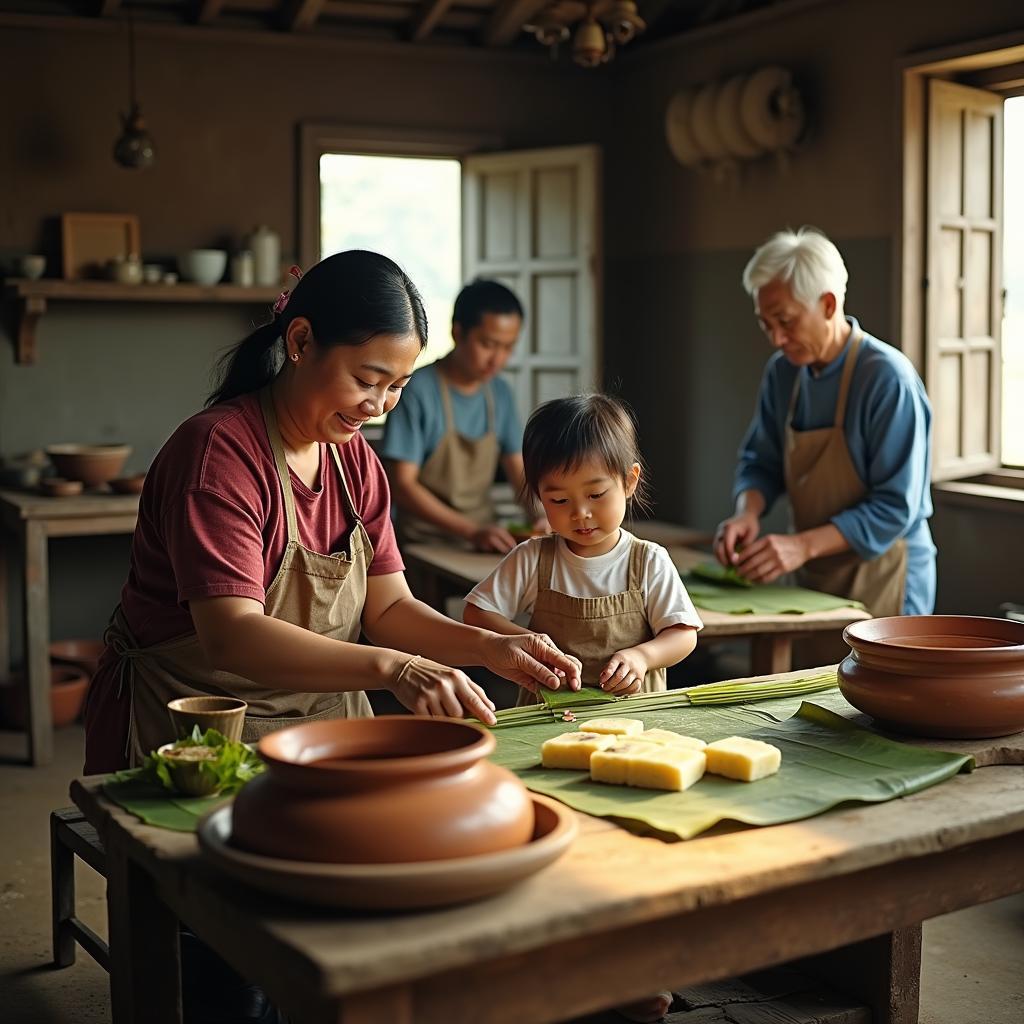 Gia đình ba thế hệ người Việt cùng nhau gói bánh chưng theo truyền thống chuẩn bị đón Tết Nguyên Đán
IELTS Speaking Part 3: Two-way Discussion
Tổng Quan Về Part 3
Part 3 kéo dài 4-5 phút với các câu hỏi trừu tượng và sâu sắc hơn, yêu cầu bạn phân tích, so sánh, đánh giá các vấn đề xã hội liên quan đến chủ đề Part 2.
Đặc điểm:
- Câu hỏi mang tính analytical và conceptual
- Yêu cầu perspective rộng hơn (societal level)
- Cần đưa ra opinions có supporting reasons
- Thường có dạng: Why, How, Compare, Advantages/Disadvantages
Yêu cầu:
- Mở rộng câu trả lời (3-5 câu minimum)
- Đưa ra lý lẽ logic và examples
- Xem xét nhiều góc độ của vấn đề
- Thừa nhận complexity nếu cần
Chiến lược:
- Sử dụng discourse markers để tổ chức ý (Well, Actually, In my view…)
- Đưa ra examples từ society, không chỉ personal
- Acknowledge different perspectives
- Sử dụng tentative language (tend to, generally, to some extent)
Lỗi thường gặp của học viên Việt Nam:
- Trả lời quá ngắn gọn như Part 1
- Không có reasoning rõ ràng
- Thiếu từ vựng abstract và academic
- Không có examples để minh họa
- Nói quá general, không specific enough
Các Câu Hỏi Thảo Luận Sâu
Theme 1: Traditions and Modern Society
Question 1: Why do you think some family traditions disappear over time?
🎯 Phân tích câu hỏi:
- Dạng: Cause and Effect (tại sao – nguyên nhân)
- Key words: disappear, over time (thay đổi theo thời gian)
- Cách tiếp cận: Đưa ra 2-3 reasons với examples cụ thể cho mỗi reason
📝 Sample Answer – Band 6-7:
“Well, I think there are several reasons. First, modern life is very busy, so people don’t have much time to practice traditions. For example, many young people work far from their hometown and can’t go back often. Second, younger generations might not understand the meaning of old traditions, so they lose interest. Also, Western culture influences young people a lot, making them prefer modern celebrations instead of traditional ones.”
Phân tích:
- Structure: Có intro sentence và 2-3 reasons, logical
- Vocabulary: Basic (modern life, lose interest, Western culture)
- Tại sao Band 6-7: Trả lời đầy đủ với reasons và examples nhưng chưa sophisticated
📝 Câu trả lời mẫu – Band 8-9:
“Well, I’d say this phenomenon stems from multiple interconnected factors. First and foremost, the accelerating pace of modern life plays a significant role. With urbanization and career demands, families are increasingly fragmented geographically, making it logistically challenging to maintain traditions that require physical gathering. For instance, in Vietnam, you’ll find that many young professionals relocate to major cities like Hanoi or Ho Chi Minh City for work opportunities, which means they might only return to their ancestral homes once or twice a year, if that.
Beyond that, there’s what I’d call a generational disconnect in terms of cultural values. Younger generations, particularly those immersed in globalized media, may perceive traditional practices as outdated or irrelevant to their contemporary lifestyles. They’re more likely to gravitate toward celebrations that align with their modern sensibilities. That said, I think it’s important to note that this isn’t necessarily about rejecting heritage outright, but rather about traditions failing to evolve and remain meaningful in changed contexts. Those that manage to adapt while retaining their essence tend to survive, while rigid ones fall by the wayside.”
Phân tích:
- Structure: Well-organized: Direct answer → Reason 1 + explanation + example → Reason 2 + explanation → Nuanced conclusion
- Vocabulary: Precise and sophisticated (interconnected factors, accelerating pace, fragmented geographically, logistically challenging, generational disconnect, gravitate toward, fall by the wayside)
- Grammar: Complex structures (relative clauses, participle phrases, conditionals)
- Critical Thinking: Shows balanced view, acknowledges complexity (“That said”, “not necessarily”), considers adaptation
💡 Key Language Features:
- Discourse markers: Well, First and foremost, Beyond that, That said
- Tentative language: I’d say, may perceive, tend to
- Abstract nouns: phenomenon, urbanization, disconnect, sensibilities, essence
- Academic collocations: stems from, plays a significant role, fall by the wayside
Question 2: Do you think it’s the responsibility of parents to pass on family traditions?
🎯 Phân tích câu hỏi:
- Dạng: Opinion (Do you think…)
- Key words: responsibility, parents, pass on
- Cách tiếp cận: State opinion → reasons → acknowledge other view → conclusion
📝 Sample Answer – Band 6-7:
“Yes, I think parents have this responsibility. They are the ones who know the traditions well, so they should teach their children. If parents don’t do this, the traditions will be lost. However, children also need to be interested and willing to learn. Parents can’t force them to follow traditions they don’t like.”
Phân tích:
- Structure: Clear opinion với reason
- Vocabulary: Basic vocabulary
- Tại sao Band 6-7: Có opinion và reasoning nhưng chưa deep
📝 Câu trả lời mẫu – Band 8-9:
“To a large extent, yes, though I wouldn’t characterize it as an absolute obligation. Parents are naturally positioned as cultural custodians and serve as the primary conduit through which heritage gets transmitted to the next generation. They possess both the knowledge and the emotional investment necessary to instill an appreciation for family traditions. Moreover, childhood and adolescence represent critical windows for cultural imprinting – values and practices absorbed during these formative years tend to leave lasting impressions.
However, I think it’s crucial to recognize that this isn’t solely parental territory. For tradition transmission to be effective, it requires a collaborative ecosystem involving extended family, community, and even educational institutions. Grandparents, for instance, often play an indispensable role as repositories of historical knowledge and authentic practice. Furthermore, I’d argue that the approach matters as much as the intent. Rather than imposing traditions in an authoritarian manner, which often breeds resentment, parents should strive to make these practices engaging and relevant, helping children understand the underlying significance rather than just going through the motions. Ultimately, while parents bear primary responsibility, successful cultural continuity requires buy-in from multiple stakeholders.”
Phân tích:
- Structure: Nuanced answer: Yes with qualification → Main argument with reasons → Counter-consideration → Expanded perspective → Conclusion
- Vocabulary: Sophisticated (cultural custodians, primary conduit, heritage transmission, emotional investment, formative years, collaborative ecosystem, repositories of knowledge, breeds resentment, buy-in from stakeholders)
- Grammar: Advanced structures (characterize as, positioned as, rather than…which, helping children understand…)
- Critical Thinking: Balanced view considering multiple perspectives, practical approach to tradition transmission
💡 Key Language Features:
- Qualifying language: To a large extent, I wouldn’t characterize it as absolute, solely
- Academic expressions: serves as, represents critical windows, requires buy-in from
- Contrast markers: However, Furthermore, Ultimately
Theme 2: Cultural Change and Preservation
Question 3: How have family traditions changed in your country compared to the past?
🎯 Phân tích câu hỏi:
- Dạng: Compare (past vs present)
- Key words: changed, compared to the past
- Cách tiếp cận: Past situation → Present situation → Reasons for change → Examples
📝 Sample Answer – Band 6-7:
“Family traditions in Vietnam have changed a lot. In the past, families were very traditional and strictly followed customs. For example, everyone had to return home for Tet. Now, many families are more flexible. Some people travel abroad during Tet instead of staying home. Also, traditional ceremonies have become simpler because people are busier. However, some important traditions like ancestor worship are still maintained by most families.”
Phân tích:
- Structure: Clear comparison với past và present
- Vocabulary: Adequate nhưng repetitive (traditional, families)
- Tại sao Band 6-7: Có comparison và examples nhưng thiếu depth trong analysis
📝 Câu trả lời mẫu – Band 8-9:
“The landscape of family traditions in Vietnam has undergone quite a dramatic transformation over the past few decades. Historically, family traditions were characterized by rigorous adherence to established rituals and a collective mentality that prioritized communal obligations over individual preferences. Take Tet celebrations, for instance – returning to one’s ancestral village was virtually non-negotiable, and elaborate multi-day ceremonies were the norm, with families meticulously observing every customary detail from the ancestral altar preparations to the specific protocols for visiting relatives.
Fast forward to today, and you’ll see a markedly different picture. While the core essence remains, the execution has become considerably more pragmatic. Urbanization and lifestyle changes have necessitated adaptations – families might condense three-day celebrations into single-day events, or opt for restaurant gatherings rather than home-cooked feasts. There’s also been a shift toward what I’d call ‘personalized tradition’ – families are increasingly selective, maintaining traditions that resonate personally while letting go of those that feel obligatory rather than meaningful.
Interestingly, technology has become a double-edged sword. On one hand, it enables virtual participation for geographically dispersed family members. On the other, it’s contributed to shortened attention spans and a preference for convenience. That said, I’ve observed a curious counter-trend among younger Vietnamese – some are actively reclaiming traditional practices, viewing them as anchors of identity in an increasingly globalized world. So it’s not a straightforward narrative of decline, but rather an evolution where traditions are being reinterpreted and adapted to contemporary contexts.”
Phân tích:
- Structure: Sophisticated: Historical context → Current situation with specific examples → Technology’s dual impact → Counter-trend → Nuanced conclusion
- Vocabulary: Extensive range (rigorous adherence, collective mentality, virtually non-negotiable, condense celebrations, double-edged sword, counter-trend, anchors of identity)
- Grammar: Complex sentences with multiple clauses, participle phrases, relative clauses
- Critical Thinking: Multi-dimensional analysis, recognizes complexity and counter-trends, avoids oversimplification
💡 Key Language Features:
- Describing change: has undergone transformation, fast forward to today, markedly different, shift toward
- Comparatives: more pragmatic, increasingly selective
- Academic phrases: characterized by, necessitated adaptations, contributed to
Theme 3: The Value of Traditions
Question 4: What are the benefits of maintaining family traditions?
🎯 Phân tích câu hỏi:
- Dạng: Benefits/Advantages
- Key words: benefits, maintaining
- Cách tiếp cận: List multiple benefits với explanation và examples cho mỗi benefit
📝 Sample Answer – Band 6-7:
“There are many benefits. First, traditions help families stay close and connected. When families practice traditions together, they spend quality time and strengthen relationships. Second, traditions teach children about their culture and history, which is important for their identity. Third, traditions create good memories that people remember throughout their lives. These memories make people feel happy and give them a sense of belonging to their family and culture.”
Phân tích:
- Structure: Clear listing với First, Second, Third
- Vocabulary: Functional (stay close, quality time, good memories)
- Tại sao Band 6-7: Coverage đầy đủ các benefits chính nhưng explanation chưa sophisticated
📝 Câu trả lời mẫu – Band 8-9:
“The benefits are actually quite multifaceted and operate on various levels – personal, familial, and even societal.
On an emotional and psychological level, family traditions serve as powerful bonding mechanisms. They create shared experiences and collective memories that become part of the family’s narrative. There’s compelling research suggesting that children who grow up with consistent family traditions tend to have stronger emotional resilience and a more secure sense of identity. These rituals provide a comforting sense of continuity and predictability in an otherwise chaotic world.
From a cultural preservation standpoint, traditions function as living archives of heritage. They embody accumulated wisdom, values, and practices that might otherwise be lost to time. This is particularly crucial in our current era of rapid globalization, where cultural homogenization poses a real threat to local identities and diversity. When families maintain traditions, they’re essentially serving as custodians of cultural knowledge for future generations.
Beyond that, I’d argue there are significant developmental benefits for children. Participating in traditions teaches practical skills – whether it’s cooking traditional dishes, performing customary practices, or understanding nuanced social protocols. It also fosters intergenerational dialogue, creating natural opportunities for knowledge transfer and storytelling that might not occur otherwise.
On a broader societal level, families that maintain traditions contribute to social cohesion and community vitality. These practices often extend beyond the nuclear family to involve extended networks, thereby strengthening social fabric and creating support systems. In essence, maintaining family traditions isn’t just about preserving the past – it’s about creating continuity between past, present, and future while fostering meaningful connections in increasingly fragmented modern lives.”
Phân tích:
- Structure: Extremely well-organized: Multiple levels explicitly stated (emotional, cultural, developmental, societal) with detailed explanations
- Vocabulary: Highly sophisticated (multifaceted, bonding mechanisms, emotional resilience, living archives, cultural homogenization, custodians, intergenerational dialogue, social cohesion, social fabric)
- Grammar: Varied complex structures, gerunds as subjects, relative clauses, parallel structures
- Critical Thinking: Multi-dimensional analysis with reference to research, considers micro to macro levels, synthesizes various perspectives
💡 Key Language Features:
- Organizing language: On an emotional level, From a cultural standpoint, Beyond that, On a broader level, In essence
- Academic vocabulary: multifaceted, compelling research, accumulated wisdom, nuanced protocols
- Cause-effect language: serve as, function as, poses a threat to, contributes to, fosters
Question 5: Do you think modern technology helps or harms the preservation of family traditions?
🎯 Phân tích câu hỏi:
- Dạng: Balanced opinion (helps or harms – likely both)
- Key words: modern technology, helps/harms, preservation
- Cách tiếp cận: Acknowledge both sides → Explain how it helps → Explain potential harms → Personal stance
📝 Sample Answer – Band 6-7:
“I think technology can both help and harm traditions. On the positive side, technology allows families who live far apart to connect through video calls during celebrations. People can also share recipes and tradition information online easily. However, technology can be harmful because people spend too much time on phones and computers instead of participating in family activities. Young people especially might prefer digital entertainment over traditional practices. So I believe we need to use technology wisely to support traditions, not replace them.”
Phân tích:
- Structure: Balanced approach với both sides
- Vocabulary: Basic expressions (positive side, harmful, spend time)
- Tại sao Band 6-7: Covers both perspectives nhưng analysis còn surface-level
📝 Câu trả lời mẫu – Band 8-9:
“This is genuinely a double-edged sword, and I think the answer depends largely on how technology is leveraged rather than technology itself being inherently beneficial or detrimental.
On the positive side, technology has democratized access to traditional knowledge in unprecedented ways. Online platforms have become virtual repositories of traditional recipes, craft techniques, and cultural practices that might otherwise remain within small circles. I’ve seen numerous YouTube channels run by Vietnamese grandmothers teaching traditional cooking, reaching audiences of hundreds of thousands – something inconceivable in the pre-digital era. Moreover, for diaspora communities and geographically dispersed families, video conferencing technology enables virtual participation in family rituals, maintaining connections that would otherwise fray due to distance. There are even apps now that help families coordinate traditional celebrations and share ancestral stories.
However, technology also presents legitimate concerns. There’s what sociologists call ‘digital distraction’ – family gatherings where everyone’s glued to their screens rather than engaging meaningfully with each other or the traditions at hand. The ease of digital substitutes can also diminish the perceived value of hands-on participation. Why spend hours making banh chung when you can order it online and spend that time scrolling through social media? Additionally, the curated, Instagram-worthy version of traditions can overshadow their authentic essence, where the focus shifts from meaningful practice to performative display for online audiences.
In my view, the key lies in intentional integration. Technology should be seen as a tool to augment, not replace, tradition. When used thoughtfully – documenting elders sharing stories, creating family recipe archives, or facilitating remote participation – it strengthens tradition preservation. But when it becomes a passive substitute for active engagement or a source of distraction, it undermines the very connections traditions are meant to foster. Ultimately, I’m cautiously optimistic – if we maintain conscious awareness of these pitfalls while harnessing technology’s potential, it can be a powerful ally in keeping traditions alive for future generations.”
Phân tích:
- Structure: Sophisticated balanced argument: Intro establishing complexity → Positive aspects with specific examples → Negative aspects with sociological concepts → Personal nuanced stance with conditions
- Vocabulary: Exceptional range (double-edged sword, democratized access, virtual repositories, diaspora communities, fray due to distance, digital distraction, curated version, performative display, intentional integration, cautiously optimistic, pitfalls)
- Grammar: Complex structures throughout, conditional sentences, relative clauses, rhetorical question, parallel structures
- Critical Thinking: Highly nuanced, considers sociological concepts, avoids binary thinking, proposes conditional framework, specific examples grounded in reality
💡 Key Language Features:
- Balanced discourse: On the positive side, However, In my view, Ultimately
- Academic collocations: democratized access, legitimate concerns, diminish the perceived value, conscious awareness, powerful ally
- Conditional language: depends on, rather than being, when used thoughtfully, if we maintain
Question 6: Why do some people find old family traditions boring or irrelevant?
🎯 Phân tích câu hỏi:
- Dạng: Cause and Effect / Explanation
- Key words: find boring/irrelevant, why
- Cách tiếp cận: Identify multiple reasons → Explain each → Consider generational and social factors
📝 Sample Answer – Band 6-7:
“I think several reasons explain this. First, young people today have different interests and lifestyles compared to older generations. They are interested in modern entertainment like social media and games. Second, some traditions take a lot of time and effort, which busy people don’t want to spend. Third, if the meaning of traditions is not explained well, young people don’t understand why they should follow them. Finally, global culture influences young people, making them feel local traditions are old-fashioned.”
Phân tích:
- Structure: Clear with multiple reasons listed logically
- Vocabulary: Basic (different interests, old-fashioned, busy people)
- Tại sao Band 6-7: Comprehensive coverage nhưng thiếu psychological depth và sophisticated vocabulary
📝 Câu trả lời mẫu – Band 8-9:
“This is actually quite a nuanced issue that touches on generational psychology, cultural shifts, and communication gaps within families.
Primarily, I think it comes down to a disconnect between form and meaning. Many traditions have been passed down mechanistically – people are told what to do but not the underlying rationale or the historical context that made these practices meaningful. When traditions become empty rituals divorced from their original significance, they naturally feel arbitrary and tedious, especially to younger people who crave authentic meaning and purpose.
There’s also a generational perception gap regarding time investment. Traditional practices often require considerable time commitment and delayed gratification – qualities increasingly at odds with contemporary lifestyle expectations shaped by instant connectivity and on-demand everything. Younger generations, accustomed to immediate results and constant stimulation, may find the slow, repetitive nature of many traditions to be fundamentally incompatible with their internal rhythms and expectations.
Furthermore, I’d argue there’s often a pedagogical failure in how traditions are transmitted. If they’re imposed authoritarily with phrases like ‘because we’ve always done it this way,’ without intellectual engagement or allowing for questioning, it’s natural for recipients to push back or disengage. Traditions need to be contextualized, not just performed.
Another factor is what I’d call ‘comparative cultural exposure’. Thanks to globalization and digital media, young people today are exposed to a dizzying array of cultural practices from around the world. Seen against this cosmopolitan backdrop, local traditions might appear provincial or restrictive unless their unique value is articulated compellingly. There’s also the appeal of the novel – traditions are by definition familiar and predictable, while new experiences offer excitement.
That said, I don’t think this is an insurmountable problem. Many traditions that successfully evolve – maintaining their core while adapting their expression to contemporary sensibilities – manage to remain relevant across generations. The key is creating space for dialogue about why these practices matter and being open to reinterpretation rather than insisting on rigid adherence.”
Phân tích:
- Structure: Exceptionally sophisticated: Establishes complexity → Multiple layered reasons (meaning disconnect, generational perception, pedagogical failure, cultural exposure) → Optimistic conclusion with solution
- Vocabulary: Highly advanced (nuanced issue, mechanistically, arbitrary and tedious, delayed gratification, pedagogical failure, dizzying array, cosmopolitan backdrop, provincial, insurmountable problem, rigid adherence)
- Grammar: Complex structures with embedded clauses, participle phrases, conditional structures, relative clauses
- Critical Thinking: Multi-disciplinary analysis drawing on psychology, sociology, pedagogy; avoids simplistic judgments; proposes solutions
💡 Key Language Features:
- Introducing complexity: quite a nuanced issue, touches on, comes down to
- Cause-effect structures: it comes down to, shaped by, accustomed to, thanks to
- Academic phrases: generational perception gap, pedagogical failure, comparative cultural exposure, insurmountable problem
 Thế hệ trẻ Việt Nam học truyền thống gia đình từ người cao tuổi trong không gian hiện đại kết hợp truyền thống
Để hiểu rõ hơn về việc xử lý các tình huống cảm xúc đặc biệt trong IELTS Speaking, các kỹ năng bạn phát triển khi mô tả truyền thống gia đình cũng có thể áp dụng cho nhiều chủ đề khác. Tương tự, khi thảo luận về những cuộc trò chuyện thú vị gần đây, bạn có thể sử dụng nhiều cấu trúc và từ vựng tương tự để miêu tả cách các thành viên trong gia đình chia sẻ câu chuyện về truyền thống.
Từ vựng và cụm từ quan trọng
Topic-Specific Vocabulary
| Từ vựng/Cụm từ | Loại từ | Phiên âm | Nghĩa tiếng Việt | Ví dụ | Collocation |
|---|---|---|---|---|---|
| cherished tradition | noun phrase | /ˈtʃerɪʃt trəˈdɪʃn/ | truyền thống được trân trọng | Our annual reunion is a cherished tradition in my family. | maintain/uphold/preserve a cherished tradition |
| ancestral home | noun phrase | /ænˈsestrəl həʊm/ | nhà tổ, quê hương tổ tiên | We always gather at our ancestral home during Tet. | return to/visit/preserve the ancestral home |
| extended family | noun phrase | /ɪkˈstendɪd ˈfæməli/ | đại gia đình, họ hàng | The entire extended family participates in this celebration. | extended family members/gathering/reunion |
| matriarch/patriarch | noun | /ˈmeɪtriɑːk/ /ˈpeɪtriɑːk/ | bà trưởng/ông trưởng trong gia đình | My grandmother is the matriarch who oversees all traditions. | family matriarch/patriarch, respected matriarch |
| pass down | phrasal verb | /pɑːs daʊn/ | truyền lại, kế thừa | These customs have been passed down for generations. | pass down traditions/knowledge/wisdom/stories |
| uphold a custom | verb phrase | /ʌpˈhəʊld ə ˈkʌstəm/ | duy trì một phong tục | We still uphold the custom of ancestor worship. | uphold/maintain/observe a custom |
| intergenerational | adjective | /ˌɪntədʒenəˈreɪʃənl/ | liên thế hệ | These gatherings strengthen intergenerational bonds. | intergenerational connection/dialogue/transmission |
| cultural heritage | noun phrase | /ˈkʌltʃərəl ˈherɪtɪdʒ/ | di sản văn hóa | Preserving our cultural heritage is very important. | preserve/protect/maintain cultural heritage |
| time-honored | adjective | /taɪm ˈɒnəd/ | lâu đời, truyền thống lâu đời | This is a time-honored ritual in our family. | time-honored tradition/ritual/practice/custom |
| congregate | verb | /ˈkɒŋɡrɪɡeɪt/ | tụ họp, tập trung | Family members congregate at our house each year. | congregate at/in, family congregates |
| meticulous | adjective | /məˈtɪkjələs/ | tỉ mỉ, cẩn thận | My grandmother is meticulous about preparing traditional dishes. | meticulous preparation/attention/care |
| elaborate feast | noun phrase | /ɪˈlæbərət fiːst/ | bữa tiệc thịnh soạn | We prepare an elaborate feast for the celebration. | prepare/serve/enjoy an elaborate feast |
| strengthen bonds | verb phrase | /ˈstreŋθən bɒndz/ | củng cố mối quan hệ | These traditions strengthen family bonds significantly. | strengthen/forge/maintain bonds |
| sense of belonging | noun phrase | /sens əv bɪˈlɒŋɪŋ/ | cảm giác thuộc về | Traditions give children a sense of belonging. | provide/create/foster a sense of belonging |
| cultural custodian | noun phrase | /ˈkʌltʃərəl kʌˈstəʊdiən/ | người bảo vệ văn hóa | Grandparents serve as cultural custodians. | serve as/act as cultural custodians |
| repository of knowledge | noun phrase | /rɪˈpɒzətri əv ˈnɒlɪdʒ/ | kho tàng kiến thức | Elders are repositories of traditional knowledge. | living repository, vast repository |
| diaspora community | noun phrase | /daɪˈæspərə kəˈmjuːnəti/ | cộng đồng người xa xứ | Diaspora communities work hard to maintain traditions. | Vietnamese diaspora, diaspora population |
| collective memory | noun phrase | /kəˈlektɪv ˈmeməri/ | ký ức tập thể | Traditions form part of our collective memory. | shape/preserve collective memory |
Idiomatic Expressions & Advanced Phrases
| Cụm từ | Nghĩa | Ví dụ sử dụng | Band điểm |
|---|---|---|---|
| the backbone of | xương sống, nền tảng của | Family traditions are the backbone of our cultural identity. | 8-9 |
| stand the test of time | trường tồn theo thời gian | This tradition has stood the test of time for centuries. | 7.5-8 |
| fall by the wayside | bị bỏ rơi, mất đi | Many traditions have fallen by the wayside in modern society. | 8-9 |
| keep something alive | duy trì, giữ gìn cho sống | We’re working hard to keep these customs alive. | 7-8 |
| bridge the gap | kết nối, thu hẹp khoảng cách | These traditions bridge the gap between generations. | 7.5-8 |
| at the heart of | ở trung tâm, là cốt lõi của | Family unity is at the heart of our traditions. | 7-8 |
| resonate with | gây tiếng vang với, có ý nghĩa với | This tradition really resonates with younger members. | 8-9 |
| come full circle | quay trở lại điểm ban đầu | Interestingly, traditional values are coming full circle among youth. | 8-9 |
| a sense of continuity | cảm giác liên tục, kế thừa | Traditions provide a sense of continuity across time. | 7.5-8 |
| the glue that binds | chất keo gắn kết | Shared traditions are the glue that binds our family. | 8-9 |
| weather the storm | vượt qua thử thách | Our family traditions have weathered the storm of modernization. | 8-9 |
| set in stone | cố định không đổi | These practices aren’t set in stone; they can evolve. | 7-8 |
Discourse Markers (Từ Nối Ý Trong Speaking)
Để bắt đầu câu trả lời:
- 📝 Well,… – Khi cần thời gian suy nghĩ nhẹ, tạo tính tự nhiên
- 📝 Actually,… – Khi muốn đưa ra góc nhìn bất ngờ hoặc thú vị
- 📝 To be honest,… – Khi muốn thể hiện sự thành thật, chân thành
- 📝 I’d say that… – Khi đưa ra quan điểm cá nhân một cách tự tin
- 📝 In my view,… – Khi express opinion mang tính academic hơn
Để bổ sung ý:
- 📝 On top of that,… – Thêm vào đó (informal, natural)
- 📝 What’s more,… – Hơn nữa, thêm vào đó
- 📝 Not to mention… – Chưa kể đến, chưa nói đến
- 📝 Beyond that,… – Ngoài ra, xa hơn thế
- 📝 Furthermore,… – Hơn nữa (formal hơn)
- 📝 Additionally,… – Thêm vào đó (academic style)
Để đưa ra quan điểm cân bằng:
- 📝 On the one hand,… On the other hand,… – Một mặt… mặt khác
- 📝 While it’s true that…, we also need to consider… – Dù đúng là… nhưng ta cũng cần xem xét
- 📝 That said,… – Điều đó đã nói, tuy nhiên
- 📝 Having said that,… – Sau khi đã nói điều đó
- 📝 However,… – Tuy nhiên
Để kết luận:
- 📝 All in all,… – Tóm lại, xét cho cùng
- 📝 At the end of the day,… – Cuối cùng thì
- 📝 Ultimately,… – Rút cuộc, sau cùng
- 📝 In essence,… – Về bản chất, về cơ bản
Để làm rõ hoặc elaborate:
- 📝 What I mean is… – Ý tôi là
- 📝 To put it another way,… – Nói cách khác
- 📝 In other words,… – Nói cách khác
- 📝 To elaborate on that,… – Để nói rõ hơn về điều đó
Grammatical Structures Ấn Tượng
1. Conditional Sentences (Câu điều kiện):
Mixed conditional:
- Formula: If + past perfect, would/could + infinitive
- Ví dụ: “If my grandmother hadn’t preserved these recipes, we wouldn’t have this connection to our past today.”
Inversion for emphasis:
- Formula: Had/Were/Should + subject + verb
- Ví dụ: “Had we not maintained this tradition, our family bonds would be much weaker.”
2. Relative Clauses (Mệnh đề quan hệ):
Non-defining relative clauses:
- Formula: …, which/who/where + clause, …
- Ví dụ: “Our annual reunion, which has been celebrated for over 50 years, brings the entire family together.”
Reduced relative clauses:
- Formula: Noun + participle phrase
- Ví dụ: “Traditions passed down through generations form the foundation of our identity.”
3. Passive Voice (Câu bị động):
Impersonal passive:
- Formula: It is thought/believed/said/considered that…
- Ví dụ: “It is widely believed that maintaining traditions strengthens family cohesion.”
Passive with reporting verbs:
- Ví dụ: “These customs are said to have originated in the 18th century.”
4. Cleft Sentences (Câu chẻ):
What-cleft:
- Formula: What + clause + is/was…
- Ví dụ: “What I find most meaningful about this tradition is the sense of continuity it provides.”
It-cleft:
- Formula: It is/was + focus + that/who…
- Ví dụ: “It’s the intergenerational dialogue that makes these gatherings so valuable.”
5. Participle Clauses:
Present participle:
- Ví dụ: “Sitting together and wrapping cakes, we share stories from different generations.”
Past participle:
- Ví dụ: “Traditions preserved carefully can serve as anchors in rapidly changing times.”
6. Inversion Structures:
After negative adverbials:
- Ví dụ: “Not only do these traditions strengthen bonds, but they also preserve cultural knowledge.”
- Ví dụ: “Rarely have I experienced such a profound sense of belonging.”
Khi bạn cần xử lý thất bại trong IELTS Speaking, những kỹ năng phân tích và reflection mà bạn đã học từ việc nói về truyền thống gia đình sẽ rất hữu ích. Điều này cũng tương tự khi bạn mô tả tình huống bất ngờ, nơi khả năng kể chuyện có cấu trúc và sử dụng từ vựng đa dạng là then chốt.
Chiến Lược Tổng Thể Cho Chủ Đề Family Traditions
Preparation Strategy (Chiến lược chuẩn bị)
1. Brainstorm các traditions trong gia đình bạn:
- Liệt kê ít nhất 5-6 traditions khác nhau
- Chọn 2-3 traditions mà bạn có thể nói chi tiết nhất
- Chuẩn bị vocabulary cụ thể cho từng tradition
2. Phát triển stories và details:
- Với mỗi tradition, chuẩn bị:
- When and how it started
- Who participates
- Specific activities and rituals
- Personal memories và emotions
- Why it’s meaningful
3. Practice various angles:
Một tradition có thể được nói từ nhiều góc độ:
- Personal experience (Part 2)
- Social significance (Part 3)
- Changes over time (Part 3)
- Comparison with other cultures (Part 3)
4. Build vocabulary bank:
- Tạo mindmap với tradition ở giữa
- Nhánh ra các categories: people, activities, emotions, values, objects
- Học collocations thay vì từ đơn lẻ
Common Mistakes của học viên Việt Nam
1. Lỗi về nội dung:
- ❌ Nói quá general, không có details cụ thể
- ✅ Thêm names, dates, specific activities
- ❌ Chỉ mô tả what mà không explain why
- ✅ Luôn giải thích ý nghĩa và cảm xúc
2. Lỗi về ngôn ngữ:
- ❌ Lạm dụng “very” và các từ đơn giản
- ✅ Sử dụng intensifiers đa dạng: extremely, particularly, remarkably
- ❌ Lặp từ: tradition, family, important
- ✅ Sử dụng synonyms và paraphrasing
3. Lỗi về structure:
- ❌ Trả lời không có organization rõ ràng
- ✅ Sử dụng signposting: Firstly, Moreover, In addition
- ❌ Không có conclusion trong Part 2
- ✅ Kết thúc với overall reflection hoặc current status
4. Lỗi về cultural sensitivity:
- ❌ So sánh văn hóa theo kiểu judgmental
- ✅ Sử dụng neutral language: different rather than better/worse
- ❌ Quá cố gắng impress với traditions phức tạp không thật
- ✅ Nói về traditions thật và authentic
Tips từ Examiner
1. Authenticity wins over complexity:
Examiners có thể nhận ra khi bạn nói về điều không thật. Một tradition đơn giản được kể chân thực với emotions và details sẽ impressive hơn một tradition phức tạp nhưng gượng ép.
2. Show, don’t tell:
Thay vì nói “This tradition is very meaningful,” hãy show bằng cách:
- Mô tả emotions cụ thể
- Kể một specific moment memorable
- Giải thích impact lên bạn hoặc gia đình
3. Balance past và present:
Nếu nói về tradition từ childhood (Part 2 past tense), hãy thêm một câu về present:
“While we still maintain this tradition today, the way we celebrate has evolved slightly…”
4. Prepare flexible stories:
Một tradition có thể adapt cho nhiều đề bài:
- Family tradition → topic này
- Happy memory → childhood tradition
- Special meal → traditional feast
- Time spent with family → gathering for tradition
5. Don’t memorize, internalize:
Thay vì học thuộc câu, hãy:
- Ghi nhớ key points và vocabulary
- Practice nói về cùng topic theo nhiều cách khác nhau
- Record và listen lại để tự sửa
Practice Activities
Activity 1: Vocabulary Building
Mỗi ngày, chọn 5 words/phrases từ bài viết này:
- Viết 2 sentences riêng
- Tìm 3 collocations liên quan
- Record pronunciation của bạn
Activity 2: Structure Practice
Chọn 1 grammatical structure mỗi tuần:
- Cleft sentences trong Week 1
- Passive voice trong Week 2
- Mixed conditionals trong Week 3
- Practice sử dụng trong topic này
Activity 3: Timed Speaking
- Set timer 2 minutes cho Part 2
- Ghi âm câu trả lời
- Listen và note:
- Từ bị lặp
- Grammatical errors
- Hesitations nhiều
- Missing vocabulary
- Re-record sau khi sửa
Activity 4: Part 3 Discussion
Practice với partner hoặc teacher:
- Mỗi người prepare 3 Part 3 questions
- Practice giving extended answers (3-5 câu)
- Give feedback về:
- Coherence
- Vocabulary range
- Depth of analysis
Ngoài ra, việc kể về chuyến du lịch cùng bạn bè có thể giúp bạn practice các kỹ năng kể chuyện tương tự với việc miêu tả family gatherings. Khả năng tổ chức ý tưởng chronologically và sử dụng descriptive language sẽ được strengthen qua cả hai topics.
Sample Study Plan (4 weeks)
Week 1: Foundation
- Day 1-2: Learn vocabulary (20 words)
- Day 3-4: Practice Part 1 questions
- Day 5-6: Write và memorize Part 2 structure
- Day 7: Record Part 2, self-evaluate
Week 2: Development
- Day 1-2: Learn advanced phrases (15 expressions)
- Day 3-4: Practice Part 2 với variations
- Day 5-6: Study sample Part 3 answers
- Day 7: Mock test với friend/teacher
Week 3: Refinement
- Day 1-2: Focus on grammar structures
- Day 3-4: Practice spontaneous Part 3 responses
- Day 5-6: Work on pronunciation và intonation
- Day 7: Full mock test recording
Week 4: Mastery
- Day 1-2: Review all materials
- Day 3-4: Practice với unexpected questions
- Day 5-6: Final polish trên weaknesses
- Day 7: Confidence-building practice
Kết Luận
Chủ đề “describe an interesting tradition in your family” là một topic vừa familiar vừa challenging trong IELTS Speaking. Nó cho phép bạn showcase không chỉ khả năng ngôn ngữ mà còn cultural awareness và emotional intelligence.
Key takeaways:
1. Content is king:
- Chọn traditions authentic mà bạn thật sự biết rõ
- Include specific details: names, dates, activities
- Explain meanings và emotions, không chỉ describe
2. Language matters:
- Sử dụng topic-specific vocabulary thay vì general words
- Incorporate collocations và idiomatic expressions tự nhiên
- Vary grammatical structures để show range
3. Structure đảm bảo clarity:
- Part 1: Direct answer + reason + example (2-3 câu)
- Part 2: Follow bullet points, extend phần explain
- Part 3: Multiple perspectives, balanced arguments (3-5 câu)
4. Practice strategically:
- Record và analyze recordings
- Get feedback từ teachers hoặc proficient speakers
- Practice flexibility – một story nhiều applications
5. Authenticity > Perfection:
- Examiners đánh giá communication, không phải perfection
- Showing genuine emotions và personal connection ghi điểm
- Natural hesitations acceptable, forced fluency không
Final advice:
Đừng chỉ học “bài mẫu” – hãy học cách think và express ideas trong tiếng Anh. Traditions là một phần cuộc sống, vì vậy việc nói về chúng nên tự nhiên và từ trái tim. Khi bạn truly engage với topic thay vì recite memorized answers, Examiner sẽ cảm nhận được sự authentic đó.
Remember: The goal is not to sound like a textbook, but to sound like yourself – just in better English.
Chúc bạn thành công trong kỳ thi IELTS Speaking!