Biến đổi khí hậu đang tác động sâu rộng đến hệ sinh thái biển, một chủ đề nóng hổi xuất hiện thường xuyên trong các đề thi IELTS Reading gần đây. Với tính chất cấp thiết và tầm quan trọng toàn cầu, các bài đọc về tác động của khí hậu đến đại dương đòi hỏi người học không chỉ hiểu từ vựng học thuật mà còn phải nắm vững kỹ thuật phân tích thông tin khoa học phức tạp.
Bài viết này cung cấp một đề thi IELTS Reading hoàn chỉnh với 3 passages được thiết kế từ mức độ dễ đến khó, phản ánh chính xác cấu trúc đề thi thật. Bạn sẽ được luyện tập với đầy đủ các dạng câu hỏi phổ biến như Multiple Choice, True/False/Not Given, Matching Headings, và Summary Completion. Mỗi passage không chỉ kiểm tra khả năng đọc hiểu mà còn giúp bạn làm quen với từ vựng chuyên ngành về môi trường, sinh học biển và khoa học khí hậu.
Đề thi này phù hợp cho học viên từ band 5.0 trở lên, với đáp án chi tiết kèm giải thích cụ thể giúp bạn hiểu rõ cách xác định thông tin trong bài và áp dụng chiến lược làm bài hiệu quả. Hãy chuẩn bị đồng hồ, tập trung và trải nghiệm một bài thi Reading chất lượng cao như thi thật!
Hướng Dẫn Làm Bài IELTS Reading
Tổng Quan Về IELTS Reading Test
IELTS Reading Test kéo dài 60 phút với 3 passages và tổng cộng 40 câu hỏi. Mỗi câu trả lời đúng được tính 1 điểm thô, sau đó sẽ được quy đổi sang band điểm từ 1-9. Đề thi này mô phỏng chính xác format của bài thi thật với độ khó tăng dần.
Phân bổ thời gian khuyến nghị:
- Passage 1: 15-17 phút (13 câu hỏi, độ khó Easy)
- Passage 2: 18-20 phút (13 câu hỏi, độ khó Medium)
- Passage 3: 23-25 phút (14 câu hỏi, độ khó Hard)
Lưu ý quan trọng: Bạn cần tự quản lý thời gian và chuyển đáp án vào answer sheet trong thời gian làm bài. Không có thời gian bổ sung để chuyển đáp án.
Các Dạng Câu Hỏi Trong Đề Này
Đề thi này bao gồm 7 dạng câu hỏi phổ biến nhất:
- Multiple Choice: Chọn đáp án đúng từ các phương án cho sẵn
- True/False/Not Given: Xác định thông tin đúng, sai hoặc không được đề cập
- Yes/No/Not Given: Xác định ý kiến của tác giả
- Matching Headings: Nối tiêu đề phù hợp với đoạn văn
- Sentence Completion: Hoàn thành câu với từ trong bài
- Matching Features: Nối thông tin với nhân vật/tổ chức
- Summary Completion: Điền từ vào tóm tắt
IELTS Reading Practice Test
PASSAGE 1 – Coral Reefs Under Threat
Độ khó: Easy (Band 5.0-6.5)
Thời gian đề xuất: 15-17 phút
Coral reefs are among the most diverse ecosystems on Earth, often called the “rainforests of the sea.” These underwater structures, built by tiny animals called coral polyps, provide homes for approximately 25% of all marine species despite covering less than 1% of the ocean floor. However, climate change is posing unprecedented threats to these vital habitats, with consequences that extend far beyond the ocean.
The primary threat to coral reefs comes from rising ocean temperatures. When water becomes too warm, corals experience a phenomenon called coral bleaching. During bleaching events, corals expel the symbiotic algae (zooxanthellae) living in their tissues, which give them their vibrant colors and provide them with up to 90% of their energy through photosynthesis. Without these algae, corals turn white and become severely weakened. While corals can recover if temperatures return to normal quickly, prolonged bleaching often results in death.
Scientists have documented increasingly frequent bleaching events worldwide. The Great Barrier Reef in Australia, the world’s largest coral reef system, has suffered five mass bleaching events since 1998, with the most severe occurring in 2016 and 2017. These consecutive events killed approximately half of the reef’s corals, leaving insufficient time for recovery between episodes. Dr. Terry Hughes, a leading coral reef expert, notes that “the gap between bleaching events has shrunk dramatically from decades to just a few years.”
Ocean acidification represents another serious threat to coral reefs. As the ocean absorbs excess carbon dioxide from the atmosphere, chemical reactions occur that make seawater more acidic. This process reduces the availability of carbonate ions, which corals need to build their calcium carbonate skeletons. Studies show that ocean acidity has increased by approximately 30% since the Industrial Revolution, and projections suggest it could rise by another 150% by 2100 if current emissions continue.
The impacts of acidification are already visible. Research conducted in Papua New Guinea near natural CO2 seeps provides a glimpse of future conditions. In areas with higher acidity, coral diversity decreases significantly, and the reef structures become more fragile and susceptible to erosion. Young corals struggle to establish themselves, threatening the long-term viability of reef systems.
Climate change also affects coral reefs through intensified storm activity. Warmer ocean temperatures fuel more powerful hurricanes and cyclones, which can physically destroy reef structures that took centuries to form. The Caribbean has experienced particularly devastating storm seasons in recent years, with hurricanes like Maria and Irma in 2017 causing extensive reef damage. While healthy reefs can typically recover from storm damage over time, corals already stressed by bleaching and acidification have reduced resilience.
The loss of coral reefs would have catastrophic consequences for both marine life and human communities. Over 500 million people worldwide depend on coral reefs for food, income from tourism and fishing, and coastal protection. Reefs act as natural barriers, reducing wave energy by up to 97% and protecting shorelines from erosion and storm damage. The economic value of coral reefs is estimated at $375 billion annually in goods and services.
Conservation efforts are underway to help coral reefs adapt to changing conditions. Scientists are identifying “super corals” that show greater heat tolerance and researching methods to selectively breed these resilient varieties. Some projects involve creating coral nurseries where fragments are grown and later transplanted to damaged reefs. In the Maldives, one successful program has replanted over 6,000 coral fragments with a survival rate exceeding 80%.
However, experts agree that these localized conservation efforts, while valuable, cannot substitute for global action on climate change. Limiting global temperature rise to 1.5°C above pre-industrial levels, as outlined in the Paris Agreement, is crucial for coral reef survival. Even at this level, scientists predict that 70-90% of current coral reefs may be lost. At 2°C of warming, this figure rises to over 99%.
Reducing greenhouse gas emissions remains the most effective long-term strategy for protecting coral reefs. Complementary measures include reducing local stressors such as pollution, overfishing, and coastal development, which can improve reef resilience. Marine protected areas, where fishing and development are restricted, have shown that corals in healthier overall conditions can better withstand climate-related stresses.
The fate of coral reefs serves as a powerful indicator of ocean health and the broader impacts of climate change. As these ecosystems face an uncertain future, the actions taken in the coming decades will determine whether future generations can experience the extraordinary biodiversity and beauty that coral reefs provide.
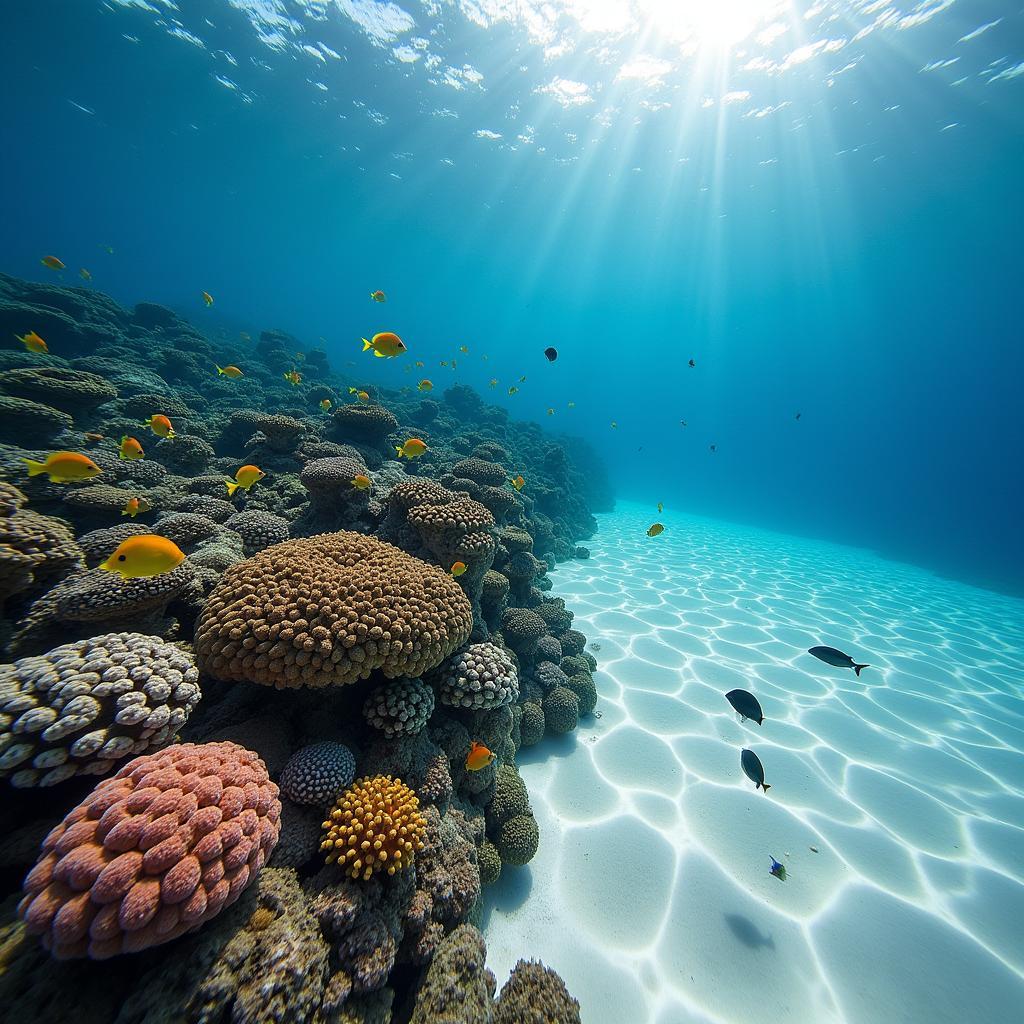 Rạn san hô bị tẩy trắng do nhiệt độ nước biển tăng cao
Questions 1-13
Questions 1-5
Do the following statements agree with the information given in the passage?
Write:
- TRUE if the statement agrees with the information
- FALSE if the statement contradicts the information
- NOT GIVEN if there is no information on this
-
Coral reefs cover more than 1% of the ocean floor but support a quarter of marine species.
-
Coral bleaching occurs when corals release the algae that provide them with energy and color.
-
The Great Barrier Reef has experienced more bleaching events since 2000 than in the entire 20th century.
-
Ocean acidification makes it easier for corals to build their skeletons.
-
Corals in areas near natural CO2 seeps show greater diversity than those in normal conditions.
Questions 6-9
Complete the sentences below.
Choose NO MORE THAN TWO WORDS from the passage for each answer.
-
Coral reefs can reduce wave energy by up to __, protecting coastlines from damage.
-
Scientists are trying to breed corals that show greater __ to rising temperatures.
-
A conservation program in the Maldives has achieved a survival rate of over __ for replanted coral fragments.
-
Limiting global warming to 1.5°C is described as __ for ensuring coral reefs survive.
Questions 10-13
Choose the correct letter, A, B, C or D.
- According to the passage, what is the main cause of coral bleaching?
- A. Ocean pollution
- B. Overfishing
- C. Rising water temperatures
- D. Storm damage
- What does Dr. Terry Hughes say about the time between bleaching events?
- A. It has increased from years to decades
- B. It has decreased from decades to years
- C. It has remained constant over time
- D. It varies depending on location
- What is the estimated annual economic value of coral reefs?
- A. $97 billion
- B. $150 billion
- C. $375 billion
- D. $500 billion
- What do experts say about local conservation efforts?
- A. They are sufficient to save coral reefs
- B. They are more important than reducing emissions
- C. They are valuable but cannot replace global climate action
- D. They have proven ineffective in most locations
PASSAGE 2 – Marine Species Migration and Adaptation
Độ khó: Medium (Band 6.0-7.5)
Thời gian đề xuất: 18-20 phút
As ocean temperatures continue to climb due to anthropogenic climate change, marine species are responding in diverse and sometimes unexpected ways. The phenomenon of poleward migration, whereby species move toward cooler waters at higher latitudes, has become increasingly documented across taxonomic groups. However, the capacity to adapt varies significantly between species, creating complex ecological ramifications that scientists are only beginning to understand.
A. Research conducted by Dr. Malin Pinsky at Rutgers University has revealed that marine species are shifting their ranges toward the poles at an average rate of 72 kilometers per decade—significantly faster than terrestrial species, which move at approximately 17 kilometers per decade. This accelerated pace reflects the interconnected nature of ocean systems, where currents can facilitate movement and temperature gradients are less steep than on land. Fish species, in particular, demonstrate remarkable mobility, with some commercial species like mackerel and herring moving hundreds of kilometers from their historical ranges.
B. The mechanisms driving these migrations involve not just temperature, but a complex interplay of factors. Temperature directly affects metabolic rates in ectothermic (cold-blooded) marine animals, influencing their energy requirements, growth rates, and reproductive success. Additionally, temperature determines the solubility of oxygen in water—warmer water holds less dissolved oxygen, creating physiological stress for species with high oxygen demands. For some species, such as large, active fish like tuna and marlin, oxygen availability may prove more limiting than temperature itself.
C. Phenological shifts—changes in the timing of biological events—represent another critical response to climate change. Many marine species synchronize their spawning, migration, and feeding patterns with seasonal temperature cues or the availability of prey. As oceans warm, these carefully timed events are becoming desynchronized, creating ecological mismatches. For instance, if fish larvae hatch earlier due to warmer spring temperatures but their zooplankton prey has not yet peaked in abundance, larval survival rates plummet. Research in the North Sea has documented such temporal mismatches between cod larvae and their copepod prey, contributing to recruitment failures and declining cod populations.
D. Not all species possess the physiological flexibility or mobility to respond effectively to changing conditions. Sedentary species and those with narrow thermal tolerances face particular challenges. Coral reef fish, despite their ability to swim, often show strong site fidelity and may not relocate even when conditions deteriorate. Similarly, species with complex life cycles that depend on specific conditions at different stages may struggle when these conditions no longer align temporally or spatially.
E. The Antarctic ecosystem provides a compelling case study of climate vulnerability. Species in polar regions have evolved in extremely stable, cold conditions and often lack the adaptive capacity to cope with warming. Antarctic fish, including the commercially important Antarctic toothfish, have specialized antifreeze proteins that allow them to survive in sub-zero waters. However, these physiological adaptations come at a cost: many Antarctic species have extremely slow metabolisms, prolonged development times, and low reproductive rates, making population recovery from disturbances exceptionally slow.
F. Ocean stratification—the formation of distinct layers in the water column—is increasing as climate change progresses. Warming surface waters become less dense and mix less readily with cooler, deeper waters. This reduced mixing has profound implications for nutrient distribution. In many ocean regions, nutrient-rich deep waters traditionally upwell to the surface, supporting phytoplankton growth that forms the base of marine food webs. Increased stratification inhibits this upwelling, potentially reducing primary productivity in surface waters and cascading effects throughout the ecosystem.
G. Some marine species demonstrate surprising adaptive potential. Research on three-spined sticklebacks in the Baltic Sea has identified genetic variations that allow certain populations to tolerate warmer, more acidic conditions. This phenotypic plasticity—the ability of organisms to change their physiology, behavior, or morphology in response to environmental conditions—may provide a buffer against rapid climate change. However, scientists caution that evolutionary adaptation typically requires many generations, and the pace of current climate change may outstrip the adaptive capacity of most species.
H. Trophic interactions—the feeding relationships between species—are being disrupted as species respond differently to climate change. Predators and prey may shift their ranges at different rates or in different directions, creating spatial mismatches. In the California Current ecosystem, juvenile salmon are encountering reduced populations of lipid-rich prey species like anchovies, which have moved to cooler waters, while encountering increased numbers of nutrient-poor jellyfish. This dietary shift has been linked to decreased salmon growth rates and survival, with implications for both ecosystem structure and commercial fisheries.
The responses of marine species to climate change underscore the intricate connections within ocean ecosystems. As species shift their distributions, alter their behaviors, and adapt physiologically, the resulting ecosystem reconfigurations will determine which communities persist and which collapse. Understanding these complex dynamics is essential for developing effective conservation strategies and managing marine resources in an era of unprecedented environmental change. As Impact of climate change on fishing industries demonstrates, these ecological shifts have profound economic and social consequences that extend well beyond the ocean itself.
 Sơ đồ di chuyển của các loài hải sản do biến đổi khí hậu
Questions 14-26
Questions 14-19
The passage has eight paragraphs, A-H.
Which paragraph contains the following information?
You may use any letter more than once.
-
An example of how feeding quality has declined for a particular species
-
Information about species that have evolved to survive in extremely cold water
-
A comparison of migration speeds between ocean and land animals
-
An explanation of why reduced mixing of water layers affects food chains
-
Evidence that some populations have genetic advantages for surviving climate change
-
A description of how temperature affects oxygen levels in seawater
Questions 20-23
Complete the summary below.
Choose NO MORE THAN TWO WORDS from the passage for each answer.
Marine species are shifting toward the poles at about 72 kilometers per decade, much faster than land species. This migration is driven by factors including temperature and the availability of (20) __ in water. Changes in the timing of biological events, known as (21) __, can cause problems when species and their food sources become (22) __. This has been observed in the North Sea, where cod larvae and their prey no longer match up properly, leading to (23) __.
Questions 24-26
Choose THREE letters, A-G.
Which THREE of the following statements are true according to the passage?
A. Marine species migrate toward the poles faster than terrestrial species.
B. All marine fish species show strong attachment to their home locations.
C. Increased ocean stratification can reduce nutrient availability in surface waters.
D. Antarctic fish have fast metabolisms due to cold water conditions.
E. Evolutionary adaptation can typically keep pace with current climate change.
F. Predators and prey may shift their ranges at different speeds.
G. Warmer water can hold more dissolved oxygen than cooler water.
PASSAGE 3 – Biogeochemical Cycles and Marine Ecosystem Resilience
Độ khó: Hard (Band 7.0-9.0)
Thời gian đề xuất: 23-25 phút
The perturbation of marine biogeochemical cycles by anthropogenic climate change represents one of the most profound alterations to Earth’s systems in geological history. These cycles—particularly those involving carbon, nitrogen, and oxygen—are intrinsically linked to the functional integrity of marine ecosystems and their capacity to provide ecosystem services. Understanding the mechanistic relationships between climate-driven changes in biogeochemical processes and ecosystem-level responses has become paramount for predicting future ocean conditions and developing adaptive management strategies.
The ocean’s role in the global carbon cycle extends far beyond simple atmospheric CO2 sequestration. Marine ecosystems actively participate in what scientists term the “biological carbon pump”—a process whereby photosynthetic organisms in surface waters fix carbon dioxide into organic matter, which subsequently sinks to deeper waters, effectively removing carbon from the atmosphere for centuries to millennia. Phytoplankton, microscopic photosynthetic organisms that drift in surface waters, contribute approximately half of global primary productivity despite their ephemeral nature and minuscule biomass relative to terrestrial plants.
Climate change impinges upon this biological pump through multiple pathways. Thermal stratification of the water column, intensified by differential warming of surface waters, creates a more pronounced density barrier between surface and deep waters. This enhanced stability reduces vertical mixing, thereby limiting the flux of nutrients from nutrient-rich deep waters to the euphotic zone where phytoplankton conduct photosynthesis. Empirical evidence from long-term monitoring stations, particularly in oligotrophic gyres of subtropical oceans, demonstrates declining chlorophyll concentrations—a proxy for phytoplankton biomass—correlating with increased stratification.
However, the relationship between warming and productivity exhibits marked regional heterogeneity. In certain high-latitude regions, particularly the Arctic Ocean, reduced sea ice coverage extends the growing season and increases light availability, potentially augmenting productivity. Conversely, in upwelling systems—such as the California Current, Humboldt Current, and Benguela Current—where wind-driven processes bring deep, cold, nutrient-rich water to the surface, changes in atmospheric circulation patterns may alter upwelling intensity with profound ramifications for regional productivity. These upwelling zones, though representing less than 1% of ocean area, contribute approximately 20% of global fish catches, making them disproportionately important for food security.
The stoichiometric imbalances resulting from climate change further complicate ecosystem responses. Organisms require nutrients in specific ratios, approximated by the Redfield ratio (C:N:P = 106:16:1). Climate-induced changes in nutrient availability can skew these ratios, potentially favoring certain taxonomic groups over others. For instance, increased stratification may deplete nitrogen and phosphorus in surface waters while CO2 remains abundant, potentially favoring organisms less dependent on these nutrients, such as nitrogen-fixing cyanobacteria. Shifts in phytoplankton community composition have cascading consequences throughout trophic levels, as different phytoplankton species vary in their nutritional value, digestibility, and toxin production.
Ocean deoxygenation represents an emerging crisis that intersects with climate change and biogeochemical cycles in insidious ways. The ocean has lost approximately 2% of its dissolved oxygen since 1950, with projections suggesting a further 3-4% decline by 2100 under high-emission scenarios. This deoxygenation results from two primary mechanisms: decreased oxygen solubility in warmer water (thermodynamic effect) and reduced ventilation of deep waters due to stratification (circulation effect). The expansion of oxygen minimum zones (OMZs)—regions where oxygen concentrations fall below levels required by most aerobic organisms—compresses the habitable depth range for many species, forcing them into narrower surface layers where they become more vulnerable to predation, temperature stress, and fishing pressure.
The nitrogen cycle in marine systems faces substantial perturbation through multiple climate-related vectors. Deoxygenation favors anaerobic microbial processes, particularly denitrification, which converts bioavailable nitrate into gaseous nitrogen compounds that escape to the atmosphere, effectively removing fixed nitrogen from ecosystems. Simultaneously, warming may stimulate nitrogen fixation in some regions. These counteracting processes create spatial and temporal variability in nitrogen availability, with ramifications for productivity patterns. Furthermore, anthropogenic nitrogen loading from agricultural runoff exacerbates these issues, particularly in coastal zones where eutrophication leads to hypoxic or anoxic conditions following algal blooms.
The concept of ecosystem resilience—the capacity of a system to absorb disturbances while maintaining its fundamental structure and function—provides a useful framework for understanding marine ecosystem responses to climate change. Resilient ecosystems possess redundancy (multiple species performing similar functions), modularity (compartmentalized interactions that prevent disturbances from spreading), and diversity (variety in species traits allowing different responses to stress). However, climate change acts as a “press disturbance”—a persistent, ongoing stressor rather than a discrete event—which progressively erodes resilience by maintaining systems in chronically stressed states.
Regime shifts—abrupt, large-scale changes in ecosystem structure and function—represent a critical concern as marine systems approach ecological thresholds or tipping points. These shifts often exhibit hysteresis, meaning the system does not simply revert to its previous state when stressors are removed. The Atlantic cod collapse off Newfoundland in the early 1990s exemplifies such a shift: despite nearly three decades of fishing moratorium, cod populations have not recovered to previous levels, partly because ecosystem changes, including climate warming, have favored alternative community structures dominated by invertebrates and forage fish.
Paleoceanographic evidence offers sobering insights into potential futures. The Paleocene-Eocene Thermal Maximum (PETM), occurring approximately 56 million years ago, involved rapid carbon release and warming of similar magnitude to current projections. Proxy records indicate substantial extinctions of benthic foraminifera, major shifts in phytoplankton communities, and expansion of oxygen-depleted waters. While the timescale of the PETM unfolded over thousands of years—allowing more opportunity for adaptation than current anthropogenically-driven change—the event underscores the potential for profound and long-lasting ecosystem restructuring. Understanding what are the effects of climate change on global fisheries becomes increasingly critical as we observe similar patterns emerging today.
Integrated modeling approaches that couple physical ocean models with biogeochemical and ecosystem components represent our most sophisticated tools for projecting future conditions. These Earth System Models indicate that under high-emission trajectories, profound changes to marine biogeochemistry are virtually certain: continued deoxygenation, altered nutrient cycles, declining calcification rates in shell-forming organisms, and shifts in the efficiency of the biological carbon pump. The magnitude of these changes, however, depends critically on mitigation efforts in coming decades.
The imperative for both drastic emissions reductions and adaptive management strategies cannot be overstated. While addressing the root cause—greenhouse gas emissions—remains paramount, additional interventions may prove necessary. These include establishing comprehensive marine protected area networks, reducing co-stressors such as pollution and overfishing, and potentially novel approaches like artificial upwelling or marine afforestation with kelp forests. However, such interventions must be approached cautiously, as they carry risks of unintended consequences in complex, poorly understood systems.
The intricate connections between biogeochemical cycles and marine ecosystems demand an approach that recognizes both the global scale of climate impacts and the regional specificity of responses. As human activities continue to alter the fundamental chemistry and physics of the ocean, the resulting changes to marine life—from microscopic plankton to apex predators—will reshape ocean ecosystems in ways that reverberate through human societies dependent on ocean resources. The coming decades will test whether human ingenuity and collective action can preserve the ecological integrity and functional capacity of marine systems that have supported life on Earth for billions of years. As demonstrated by research on how to reduce plastic use in daily life, individual actions combined with systemic changes can create meaningful environmental progress.
 Chu trình carbon đại dương và tác động của biến đổi khí hậu
Questions 27-40
Questions 27-31
Choose the correct letter, A, B, C or D.
- According to the passage, the biological carbon pump works by:
- A. Dissolving carbon dioxide directly into deep ocean waters
- B. Converting CO2 into organic matter that sinks to deeper waters
- C. Storing carbon in the bodies of large marine animals
- D. Releasing carbon through volcanic activity on the ocean floor
- What does the passage suggest about the relationship between stratification and productivity?
- A. It is consistent across all ocean regions
- B. It always leads to decreased productivity
- C. It varies significantly between different regions
- D. It has no measurable impact on phytoplankton
- Upwelling systems are described as “disproportionately important” because they:
- A. Cover the largest area of the ocean
- B. Produce 20% of fish catches despite covering less than 1% of ocean area
- C. Are located near major population centers
- D. Experience the most severe climate change impacts
- The Redfield ratio refers to:
- A. The speed at which nutrients sink in the ocean
- B. The proportion of different nutrients organisms require
- C. The ratio of fish to plankton in healthy ecosystems
- D. The relationship between temperature and productivity
- What does the passage indicate about the Atlantic cod collapse?
- A. It was caused entirely by climate change
- B. The population recovered fully within ten years
- C. The ecosystem has not returned to its previous state despite fishing bans
- D. It had no connection to temperature changes
Questions 32-36
Complete the summary using the list of words, A-L, below.
Ocean deoxygenation has caused the ocean to lose approximately 2% of its oxygen since 1950. This occurs through two main processes: decreased oxygen (32) __ in warmer water and reduced mixing of waters due to stratification. The expansion of oxygen minimum zones forces many species into narrower (33) __, making them more vulnerable. Climate change also affects the nitrogen cycle by favoring denitrification in low-oxygen conditions, which removes (34) __ nitrogen from ecosystems. Meanwhile, climate change acts as a (35) __ disturbance—an ongoing stressor that continuously erodes ecosystem (36) __.
A. resilience
B. press
C. pulse
D. solubility
E. density
F. depth ranges
G. temperature zones
H. bioavailable
I. toxic
J. dissolved
K. resistance
L. diversity
Questions 37-40
Do the following statements agree with the claims of the writer in the passage?
Write:
- YES if the statement agrees with the claims of the writer
- NO if the statement contradicts the claims of the writer
- NOT GIVEN if it is impossible to say what the writer thinks about this
-
The Paleocene-Eocene Thermal Maximum occurred more slowly than current climate change, allowing more time for species to adapt.
-
Artificial upwelling is a proven solution that should be implemented immediately in all ocean regions.
-
Marine protected areas can help reduce additional stressors on marine ecosystems.
-
The impact of climate change on marine biogeochemical cycles is completely reversible if emissions are reduced.
Answer Keys – Đáp Án
PASSAGE 1: Questions 1-13
- FALSE
- TRUE
- NOT GIVEN
- FALSE
- FALSE
- 97%
- heat tolerance
- 80%
- crucial
- C
- B
- C
- C
PASSAGE 2: Questions 14-26
- H
- E
- A
- F
- G
- B
- oxygen
- phenological shifts
- desynchronized
- recruitment failures
24-26. A, C, F (in any order)
PASSAGE 3: Questions 27-40
- B
- C
- B
- B
- C
- D
- F
- H
- B
- A
- YES
- NO
- YES
- NOT GIVEN
Giải Thích Đáp Án Chi Tiết
Passage 1 – Giải Thích
Câu 1: FALSE
- Dạng câu hỏi: True/False/Not Given
- Từ khóa: cover more than 1%, support a quarter
- Vị trí trong bài: Đoạn 1, dòng 2-4
- Giải thích: Bài viết nói “provide homes for approximately 25% of all marine species despite covering less than 1%”. Câu hỏi nói “cover more than 1%” nên mâu thuẫn với thông tin trong bài. Đáp án là FALSE.
Câu 2: TRUE
- Dạng câu hỏi: True/False/Not Given
- Từ khóa: coral bleaching, release algae, energy and color
- Vị trí trong bài: Đoạn 2, dòng 3-5
- Giải thích: Bài viết nói “corals expel the symbiotic algae living in their tissues, which give them their vibrant colors and provide them with up to 90% of their energy”. Câu hỏi paraphrase chính xác thông tin này (expel = release, vibrant colors = color, energy = energy).
Câu 3: NOT GIVEN
- Dạng câu hỏi: True/False/Not Given
- Từ khóa: Great Barrier Reef, more bleaching events since 2000, 20th century
- Vị trí trong bài: Đoạn 3
- Giải thích: Bài viết chỉ nói về 5 mass bleaching events since 1998 nhưng không so sánh với số lượng sự kiện trong thế kỷ 20. Không đủ thông tin để xác định TRUE hay FALSE.
Câu 4: FALSE
- Dạng câu hỏi: True/False/Not Given
- Từ khóa: ocean acidification, easier, build skeletons
- Vị trí trong bài: Đoạn 4, dòng 3-5
- Giải thích: Bài viết nói “reduces the availability of carbonate ions, which corals need to build their calcium carbonate skeletons”. Điều này làm khó hơn, không phải dễ hơn (easier), nên đáp án là FALSE.
Câu 5: FALSE
- Dạng câu hỏi: True/False/Not Given
- Từ khóa: CO2 seeps, greater diversity
- Vị trí trong bài: Đoạn 5, dòng 3-4
- Giải thích: Bài viết nói “In areas with higher acidity, coral diversity decreases significantly”. Câu hỏi nói “greater diversity” nên mâu thuẫn với “decreases significantly”.
Câu 6: 97%
- Dạng câu hỏi: Sentence Completion
- Từ khóa: reduce wave energy
- Vị trí trong bài: Đoạn 7, dòng 3-4
- Giải thích: “Reefs act as natural barriers, reducing wave energy by up to 97%”.
Câu 7: heat tolerance
- Dạng câu hỏi: Sentence Completion
- Từ khóa: breed corals, rising temperatures
- Vị trí trong bài: Đoạn 8, dòng 2-3
- Giải thích: “Scientists are identifying ‘super corals’ that show greater heat tolerance and researching methods to selectively breed these resilient varieties”.
Câu 8: 80%
- Dạng câu hỏi: Sentence Completion
- Từ khóa: Maldives, survival rate
- Vị trí trong bài: Đoạn 8, dòng 5-6
- Giải thích: “In the Maldives, one successful program has replanted over 6,000 coral fragments with a survival rate exceeding 80%”.
Câu 9: crucial
- Dạng câu hỏi: Sentence Completion
- Từ khóa: 1.5°C, coral reef survival
- Vị trí trong bài: Đoạn 9, dòng 2-4
- Giải thích: “Limiting global temperature rise to 1.5°C above pre-industrial levels, as outlined in the Paris Agreement, is crucial for coral reef survival”.
Câu 10: C
- Dạng câu hỏi: Multiple Choice
- Từ khóa: main cause, coral bleaching
- Vị trí trong bài: Đoạn 2, dòng 1-2
- Giải thích: “The primary threat to coral reefs comes from rising ocean temperatures. When water becomes too warm, corals experience a phenomenon called coral bleaching”. Rising water temperatures = C.
Câu 11: B
- Dạng câu hỏi: Multiple Choice
- Từ khóa: Dr. Terry Hughes, time between bleaching events
- Vị trí trong bài: Đoạn 3, dòng 5-6
- Giải thích: “the gap between bleaching events has shrunk dramatically from decades to just a few years”. Shrunk from decades to years = decreased from decades to years (đáp án B).
Câu 12: C
- Dạng câu hỏi: Multiple Choice
- Từ khóa: annual economic value
- Vị trí trong bài: Đoạn 7, dòng cuối
- Giải thích: “The economic value of coral reefs is estimated at $375 billion annually”.
Câu 13: C
- Dạng câu hỏi: Multiple Choice
- Từ khóa: experts, local conservation efforts
- Vị trí trong bài: Đoạn 9, dòng 1-2
- Giải thích: “experts agree that these localized conservation efforts, while valuable, cannot substitute for global action on climate change”. Valuable but cannot substitute = valuable but cannot replace (đáp án C).
Passage 2 – Giải Thích
Câu 14: H
- Dạng câu hỏi: Matching Information
- Từ khóa: feeding quality declined
- Vị trí trong bài: Đoạn H
- Giải thích: Đoạn H mô tả juvenile salmon encountering reduced populations of lipid-rich prey và increased nutrient-poor jellyfish, dẫn đến “dietary shift has been linked to decreased salmon growth rates”.
Câu 15: E
- Dạng câu hỏi: Matching Information
- Từ khóa: evolved, extremely cold water
- Vị trí trong bài: Đoạn E
- Giải thích: Đoạn E nói về Antarctic fish với “specialized antifreeze proteins that allow them to survive in sub-zero waters”.
Câu 16: A
- Dạng câu hỏi: Matching Information
- Từ khóa: comparison, migration speeds, ocean and land
- Vị trí trong bài: Đoạn A
- Giải thích: Đoạn A có so sánh: “marine species are shifting their ranges toward the poles at an average rate of 72 kilometers per decade—significantly faster than terrestrial species, which move at approximately 17 kilometers per decade”.
Câu 17: F
- Dạng câu hỏi: Matching Information
- Từ khóa: reduced mixing, water layers, food chains
- Vị trí trong bài: Đoạn F
- Giải thích: Đoạn F giải thích stratification và “reduced mixing” leads to inhibited upwelling, “potentially reducing primary productivity in surface waters and cascading effects throughout the ecosystem”.
Câu 18: G
- Dạng câu hỏi: Matching Information
- Từ khóa: genetic advantages, surviving climate change
- Vị trí trong bài: Đoạn G
- Giải thích: Đoạn G nói về three-spined sticklebacks với “genetic variations that allow certain populations to tolerate warmer, more acidic conditions”.
Câu 19: B
- Dạng câu hỏi: Matching Information
- Từ khóa: temperature affects oxygen levels
- Vị trí trong bài: Đoạn B
- Giải thích: Đoạn B giải thích “temperature determines the solubility of oxygen in water—warmer water holds less dissolved oxygen”.
Câu 20: oxygen
- Dạng câu hỏi: Summary Completion
- Vị trí trong bài: Đoạn B
- Giải thích: Câu summary nói về “the availability of _____ in water”, tương ứng với “oxygen availability may prove more limiting” trong đoạn B.
Câu 21: phenological shifts
- Dạng câu hỏi: Summary Completion
- Vị trí trong bài: Đoạn C, dòng 1
- Giải thích: “Phenological shifts—changes in the timing of biological events”.
Câu 22: desynchronized
- Dạng câu hỏi: Summary Completion
- Vị trí trong bài: Đoạn C
- Giải thích: “these carefully timed events are becoming desynchronized, creating ecological mismatches”.
Câu 23: recruitment failures
- Dạng câu hỏi: Summary Completion
- Vị trí trong bài: Đoạn C, câu cuối
- Giải thích: “temporal mismatches between cod larvae and their copepod prey, contributing to recruitment failures and declining cod populations”.
Câu 24-26: A, C, F
- Dạng câu hỏi: Multiple Matching
- A – TRUE: Đoạn A nói marine species shift 72km/decade vs terrestrial 17km/decade
- C – TRUE: Đoạn F nói stratification “inhibits this upwelling, potentially reducing primary productivity”
- F – TRUE: Đoạn H nói “Predators and prey may shift their ranges at different rates or in different directions”
- B – FALSE: Đoạn D nói “Coral reef fish…often show strong site fidelity” nhưng không phải tất cả
- D – FALSE: Đoạn E nói Antarctic species có “extremely slow metabolisms”
- E – FALSE: Đoạn G nói “the pace of current climate change may outstrip the adaptive capacity”
- G – FALSE: Đoạn B nói “warmer water holds less dissolved oxygen”
Passage 3 – Giải Thích
Câu 27: B
- Dạng câu hỏi: Multiple Choice
- Từ khóa: biological carbon pump works by
- Vị trí trong bài: Đoạn 2
- Giải thích: “photosynthetic organisms in surface waters fix carbon dioxide into organic matter, which subsequently sinks to deeper waters”. Đây chính xác là đáp án B.
Câu 28: C
- Dạng câu hỏi: Multiple Choice
- Từ khóa: stratification and productivity relationship
- Vị trí trong bài: Đoạn 4
- Giải thích: “the relationship between warming and productivity exhibits marked regional heterogeneity” – điều này có nghĩa là varies significantly between regions (đáp án C).
Câu 29: B
- Dạng câu hỏi: Multiple Choice
- Từ khóa: upwelling systems, disproportionately important
- Vị trí trong bài: Đoạn 4, câu cuối
- Giải thích: “representing less than 1% of ocean area, contribute approximately 20% of global fish catches, making them disproportionately important”.
Câu 30: B
- Dạng câu hỏi: Multiple Choice
- Từ khóa: Redfield ratio
- Vị trí trong bài: Đoạn 5
- Giải thích: “Organisms require nutrients in specific ratios, approximated by the Redfield ratio (C:N:P = 106:16:1)”. Đây là tỷ lệ dinh dưỡng các sinh vật cần (đáp án B).
Câu 31: C
- Dạng câu hỏi: Multiple Choice
- Từ khóa: Atlantic cod collapse
- Vị trí trong bài: Đoạn 9
- Giải thích: “despite nearly three decades of fishing moratorium, cod populations have not recovered to previous levels, partly because ecosystem changes, including climate warming, have favored alternative community structures”. Đáp án C đúng.
Câu 32: D (solubility)
- Dạng câu hỏi: Summary Completion
- Vị trí trong bài: Đoạn 6
- Giải thích: “decreased oxygen solubility in warmer water (thermodynamic effect)”.
Câu 33: F (depth ranges)
- Dạng câu hỏi: Summary Completion
- Vị trí trong bài: Đoạn 6
- Giải thích: “compresses the habitable depth range for many species, forcing them into narrower surface layers”.
Câu 34: H (bioavailable)
- Dạng câu hỏi: Summary Completion
- Vị trí trong bài: Đoạn 7
- Giải thích: “denitrification, which converts bioavailable nitrate into gaseous nitrogen compounds…effectively removing fixed nitrogen from ecosystems”.
Câu 35: B (press)
- Dạng câu hỏi: Summary Completion
- Vị trí trong bài: Đoạn 8
- Giải thích: “climate change acts as a ‘press disturbance’—a persistent, ongoing stressor”.
Câu 36: A (resilience)
- Dạng câu hỏi: Summary Completion
- Vị trí trong bài: Đoạn 8
- Giải thích: “which progressively erodes resilience by maintaining systems in chronically stressed states”.
Câu 37: YES
- Dạng câu hỏi: Yes/No/Not Given
- Từ khóa: PETM, occurred more slowly, more time to adapt
- Vị trí trong bài: Đoạn 10
- Giải thích: “While the timescale of the PETM unfolded over thousands of years—allowing more opportunity for adaptation than current anthropogenically-driven change”. Tác giả đồng ý với statement này.
Câu 38: NO
- Dạng câu hỏi: Yes/No/Not Given
- Từ khóa: artificial upwelling, proven solution, implemented immediately
- Vị trí trong bài: Đoạn 12
- Giải thích: “potentially novel approaches like artificial upwelling…However, such interventions must be approached cautiously, as they carry risks of unintended consequences”. Tác giả không đồng ý nó là proven solution cần implement immediately.
Câu 39: YES
- Dạng câu hỏi: Yes/No/Not Given
- Từ khóa: marine protected areas, reduce additional stressors
- Vị trí trong bài: Đoạn 12
- Giải thích: “establishing comprehensive marine protected area networks, reducing co-stressors such as pollution and overfishing”. Tác giả ủng hộ việc này.
Câu 40: NOT GIVEN
- Dạng câu hỏi: Yes/No/Not Given
- Từ khóa: completely reversible, emissions reduced
- Vị trí trong bài: Toàn bài
- Giải thích: Bài viết không bao giờ nói rõ liệu các tác động có “completely reversible” hay không. Có đề cập đến hysteresis (không revert đơn giản) nhưng không nói về tình huống cụ thể này.
Từ Vựng Quan Trọng Theo Passage
Passage 1 – Essential Vocabulary
| Từ vựng | Loại từ | Phiên âm | Nghĩa tiếng Việt | Ví dụ từ bài | Collocation |
|---|---|---|---|---|---|
| diverse ecosystems | noun phrase | /daɪˈvɜːs ˈiːkəʊˌsɪstəmz/ | hệ sinh thái đa dạng | Coral reefs are among the most diverse ecosystems on Earth | marine ecosystems, terrestrial ecosystems |
| coral bleaching | noun phrase | /ˈkɒrəl ˈbliːtʃɪŋ/ | hiện tượng tẩy trắng san hô | When water becomes too warm, corals experience coral bleaching | mass bleaching event, bleaching phenomenon |
| symbiotic algae | noun phrase | /ˌsɪmbɪˈɒtɪk ˈældʒiː/ | tảo cộng sinh | Corals expel the symbiotic algae living in their tissues | symbiotic relationship, algae expulsion |
| ocean acidification | noun phrase | /ˈəʊʃən əˌsɪdɪfɪˈkeɪʃən/ | axit hóa đại dương | Ocean acidification represents another serious threat | increased acidification, acidification process |
| carbonate ions | noun phrase | /ˈkɑːbəneɪt ˈaɪənz/ | ion cacbonat | This reduces the availability of carbonate ions | calcium carbonate, carbonate concentration |
| intensified storm activity | noun phrase | /ɪnˈtensɪfaɪd stɔːm ækˈtɪvəti/ | hoạt động bão tăng cường | Climate change affects coral reefs through intensified storm activity | storm intensity, hurricane activity |
| coastal protection | noun phrase | /ˈkəʊstəl prəˈtekʃən/ | bảo vệ bờ biển | Reefs provide coastal protection from erosion | provide protection, natural protection |
| heat tolerance | noun phrase | /hiːt ˈtɒlərəns/ | khả năng chịu nhiệt | Scientists are identifying corals that show greater heat tolerance | thermal tolerance, temperature tolerance |
| coral nurseries | noun phrase | /ˈkɒrəl ˈnɜːsəriz/ | vườn ươm san hô | Some projects involve creating coral nurseries | nursery program, coral cultivation |
| greenhouse gas emissions | noun phrase | /ˈɡriːnhaʊs ɡæs ɪˈmɪʃənz/ | khí thải nhà kính | Reducing greenhouse gas emissions remains the most effective strategy | reduce emissions, carbon emissions |
| marine protected areas | noun phrase | /məˈriːn prəˈtektɪd ˈeəriəz/ | khu bảo tồn biển | Marine protected areas have shown that corals can better withstand stresses | establish protected areas, conservation areas |
| extraordinary biodiversity | noun phrase | /ɪkˈstrɔːdənri ˌbaɪəʊdaɪˈvɜːsəti/ | đa dạng sinh học phi thường | Future generations can experience the extraordinary biodiversity | rich biodiversity, biodiversity loss |
Passage 2 – Essential Vocabulary
| Từ vựng | Loại từ | Phiên âm | Nghĩa tiếng Việt | Ví dụ từ bài | Collocation |
|---|---|---|---|---|---|
| poleward migration | noun phrase | /ˈpəʊlwəd maɪˈɡreɪʃən/ | di cư về phía cực | The phenomenon of poleward migration has become increasingly documented | migration pattern, species migration |
| taxonomic groups | noun phrase | /ˌtæksəˈnɒmɪk ɡruːps/ | nhóm phân loại | This has been documented across taxonomic groups | taxonomic diversity, different taxa |
| metabolic rates | noun phrase | /ˌmetəˈbɒlɪk reɪts/ | tốc độ trao đổi chất | Temperature directly affects metabolic rates in ectothermic animals | increased metabolic rate, basal metabolism |
| phenological shifts | noun phrase | /ˌfiːnəˈlɒdʒɪkəl ʃɪfts/ | sự thay đổi về thời điểm sinh học | Phenological shifts represent another critical response | temporal shifts, seasonal shifts |
| ecological mismatches | noun phrase | /ˌiːkəˈlɒdʒɪkəl ˈmɪsmætʃɪz/ | sự không khớp sinh thái | These events are becoming desynchronized, creating ecological mismatches | temporal mismatch, mismatch between species |
| larval survival rates | noun phrase | /ˈlɑːvəl səˈvaɪvəl reɪts/ | tỷ lệ sống của ấu trùng | If prey has not peaked in abundance, larval survival rates plummet | survival rate, recruitment success |
| thermal tolerances | noun phrase | /ˈθɜːməl ˈtɒlərənsɪz/ | khả năng chịu nhiệt độ | Species with narrow thermal tolerances face particular challenges | temperature tolerance, tolerance range |
| site fidelity | noun phrase | /saɪt fɪˈdeləti/ | tính trung thành với nơi ở | Coral reef fish often show strong site fidelity | habitat fidelity, home range fidelity |
| ocean stratification | noun phrase | /ˈəʊʃən ˌstrætɪfɪˈkeɪʃən/ | hiện tượng phân tầng đại dương | Ocean stratification is increasing as climate change progresses | water column stratification, thermal stratification |
| primary productivity | noun phrase | /ˈpraɪməri ˌprɒdʌkˈtɪvəti/ | năng suất sơ cấp | Increased stratification may reduce primary productivity | ocean productivity, phytoplankton productivity |
| phenotypic plasticity | noun phrase | /ˌfiːnəʊˈtɪpɪk plæˈstɪsəti/ | tính linh hoạt kiểu hình | This phenotypic plasticity may provide a buffer against climate change | adaptive plasticity, developmental plasticity |
| trophic interactions | noun phrase | /ˈtrɒfɪk ˌɪntərˈækʃənz/ | tương tác dinh dưỡng | Trophic interactions are being disrupted as species respond differently | food web interactions, predator-prey interactions |
| spatial mismatches | noun phrase | /ˈspeɪʃəl ˈmɪsmætʃɪz/ | sự không khớp về không gian | Predators and prey may shift ranges at different rates, creating spatial mismatches | geographic mismatch, distributional mismatch |
| ecosystem structure | noun phrase | /ˈiːkəʊˌsɪstəm ˈstrʌktʃə/ | cấu trúc hệ sinh thái | This dietary shift has implications for ecosystem structure | community structure, food web structure |
| intricate connections | noun phrase | /ˈɪntrɪkət kəˈnekʃənz/ | những kết nối phức tạp | The responses underscore the intricate connections within ocean ecosystems | complex connections, interconnections |
Passage 3 – Essential Vocabulary
| Từ vựng | Loại từ | Phiên âm | Nghĩa tiếng Việt | Ví dụ từ bài | Collocation |
|---|---|---|---|---|---|
| biogeochemical cycles | noun phrase | /ˌbaɪəʊˌdʒiːəʊˈkemɪkəl ˈsaɪkəlz/ | chu trình địa hóa sinh học | The perturbation of marine biogeochemical cycles by climate change | carbon cycle, nitrogen cycle |
| biological carbon pump | noun phrase | /ˌbaɪəˈlɒdʒɪkəl ˈkɑːbən pʌmp/ | bơm carbon sinh học | The ocean actively participates in the biological carbon pump | carbon sequestration, carbon sink |
| atmospheric CO2 sequestration | noun phrase | /ˌætməsˈferɪk siːˈkwestreɪʃən/ | sự cô lập CO2 khí quyển | The ocean’s role extends beyond simple atmospheric CO2 sequestration | carbon sequestration, CO2 capture |
| phytoplankton | noun | /ˌfaɪtəʊˈplæŋktən/ | thực vật phù du | Phytoplankton contribute approximately half of global primary productivity | marine phytoplankton, plankton bloom |
| thermal stratification | noun phrase | /ˈθɜːməl ˌstrætɪfɪˈkeɪʃən/ | phân tầng nhiệt | Thermal stratification of the water column is intensified by warming | water column stratification, ocean layering |
| euphotic zone | noun phrase | /juːˈfəʊtɪk zəʊn/ | vùng ưu quang | This reduces nutrient flux to the euphotic zone where phytoplankton photosynthesize | surface layer, sunlight zone |
| upwelling systems | noun phrase | /ˈʌpˌwelɪŋ ˈsɪstəmz/ | hệ thống nước trồi | In upwelling systems, wind-driven processes bring nutrient-rich water to surface | coastal upwelling, upwelling regions |
| stoichiometric imbalances | noun phrase | /ˌstɔɪkiəʊˈmetrɪk ɪmˈbælənsɪz/ | sự mất cân bằng hóa học định lượng | The stoichiometric imbalances resulting from climate change complicate responses | nutrient imbalance, elemental ratios |
| Redfield ratio | noun phrase | /ˈredfɪld ˈreɪʃiəʊ/ | tỷ lệ Redfield | Organisms require nutrients in specific ratios, approximated by the Redfield ratio | nutrient ratio, C:N:P ratio |
| nitrogen-fixing cyanobacteria | noun phrase | /ˈnaɪtrədʒən ˈfɪksɪŋ ˌsaɪænəʊbækˈtɪəriə/ | vi khuẩn lam cố định nitơ | This may favor nitrogen-fixing cyanobacteria | nitrogen fixation, diazotrophs |
| ocean deoxygenation | noun phrase | /ˈəʊʃən diːˌɒksɪdʒəˈneɪʃən/ | hiện tượng mất oxy đại dương | Ocean deoxygenation represents an emerging crisis | oxygen loss, declining oxygen |
| oxygen minimum zones | noun phrase | /ˈɒksɪdʒən ˈmɪnɪməm zəʊnz/ | vùng oxy tối thiểu | The expansion of oxygen minimum zones compresses habitable depth range | OMZ expansion, low-oxygen zones |
| denitrification | noun | /diːˌnaɪtrɪfɪˈkeɪʃən/ | quá trình khử nitơ | Deoxygenation favors anaerobic processes, particularly denitrification | nitrogen removal, nitrate reduction |
| ecosystem resilience | noun phrase | /ˈiːkəʊˌsɪstəm rɪˈzɪliəns/ | khả năng phục hồi của hệ sinh thái | Ecosystem resilience is the capacity to absorb disturbances | ecological resilience, system resilience |
| regime shifts | noun phrase | /reɪˈʒiːm ʃɪfts/ | sự chuyển đổi trạng thái | Regime shifts represent abrupt, large-scale changes in ecosystem structure | ecological regime shift, phase shift |
| tipping points | noun phrase | /ˈtɪpɪŋ pɔɪnts/ | ngưỡng tới hạn | Marine systems are approaching ecological tipping points | critical threshold, ecological threshold |
| paleoceanographic evidence | noun phrase | /ˌpeɪliəʊˌəʊʃənəˈɡræfɪk ˈevɪdəns/ | bằng chứng cổ đại dương học | Paleoceanographic evidence offers sobering insights into potential futures | fossil record, geological evidence |
| mitigation efforts | noun phrase | /ˌmɪtɪˈɡeɪʃən ˈefəts/ | nỗ lực giảm thiểu | The magnitude of changes depends on mitigation efforts in coming decades | climate mitigation, emissions reduction |
Kết Bài
Chủ đề “How Climate Change Is Impacting Marine Ecosystems” không chỉ xuất hiện thường xuyên trong kỳ thi IELTS Reading mà còn phản ánh một vấn đề cấp bách của thời đại chúng ta. Qua ba passages với độ khó tăng dần, bạn đã được trải nghiệm đầy đủ các dạng câu hỏi và phong cách viết học thuật giống thi thật.
Passage 1 cung cấp nền tảng về tác động của biến đổi khí hậu lên rạn san hô với ngôn ngữ dễ tiếp cận. Passage 2 đi sâu vào sự di cư và thích nghi của sinh vật biển với từ vựng phức tạp hơn. Passage 3 thách thức khả năng phân tích của bạn với nội dung học thuật cao về chu trình địa hóa sinh học và khả năng phục hồi của hệ sinh thái.
Đáp án chi tiết kèm giải thích cụ thể giúp bạn hiểu rõ cách xác định thông tin trong bài, nhận diện paraphrase, và áp dụng các chiến lược làm bài hiệu quả. Phần từ vựng được tổng hợp cẩn thận sẽ giúp bạn mở rộng vốn từ vựng chuyên ngành, đặc biệt hữu ích cho cả Writing Task 2 khi gặp các chủ đề môi trường.
Hãy sử dụng đề thi này như một công cụ luyện tập thực chiến, tuân thủ thời gian quy định và phân tích kỹ những câu trả lời sai để rút kinh nghiệm. Luyện tập đều đặn với các đề thi chất lượng như thế này sẽ giúp bạn tự tin đạt band điểm mục tiêu trong kỳ thi IELTS Reading sắp tới!