
Chủ đề về bữa ăn cùng bạn bè là một trong những đề tài phổ biến và thực tế nhất trong IELTS Speaking. Đây không chỉ là câu chuyện về món ăn mà còn là cơ hội để bạn thể hiện khả năng miêu tả trải nghiệm cá nhân, cảm xúc và các mối quan hệ xã hội. Từ góc nhìn của một examiner với hơn 20 năm kinh nghiệm, tôi nhận thấy đây là chủ đề mà nhiều thí sinh Việt Nam cảm thấy tự tin nhưng lại thường mắc phải những lỗi điển hình như tập trung quá nhiều vào món ăn mà quên mất phần “with friends” – yếu tố quan trọng tạo nên sự khác biệt giữa các band điểm.
Chủ đề “Describe A Meal You Had With Friends” xuất hiện với tần suất cao trong các kỳ thi IELTS từ năm 2020 đến nay, đặc biệt phổ biến trong quý 1 và quý 3 hàng năm. Theo thống kê từ các trung tâm thi IELTS tại Việt Nam và các diễn đàn chia sẻ đề thi như IELTS-blog.com, chủ đề này xuất hiện khoảng 15-20% trong tổng số đề thi Speaking Part 2. Khả năng xuất hiện trong tương lai vẫn ở mức cao do tính universal và relatable của đề tài.
Trong bài viết này, bạn sẽ học được:
- Phân tích chi tiết cách tiếp cận câu hỏi ở cả 3 Part của IELTS Speaking
- 3 bài mẫu hoàn chỉnh cho Part 2 theo các band điểm 6-7, 7.5-8 và 8.5-9 với phân tích chuyên sâu
- Hơn 15 câu hỏi thực tế cho Part 1 và Part 3 kèm sample answers đa dạng
- Bộ từ vựng chuyên biệt về food, dining experience và social gatherings với hơn 50 từ/cụm từ ăn điểm
- Chiến lược trả lời từ góc nhìn examiner, giúp bạn tránh được những lỗi phổ biến và tối đa hóa band điểm
Tương tự như describe a situation when you were very happy, chủ đề này yêu cầu bạn không chỉ miêu tả sự kiện mà còn phải truyền tải được cảm xúc và ý nghĩa của trải nghiệm đó.
IELTS Speaking Part 1: Introduction and Interview
Tổng Quan Về Part 1
Part 1 của IELTS Speaking kéo dài 4-5 phút với các câu hỏi về đời sống hàng ngày, sở thích cá nhân và những chủ đề quen thuộc. Đây là phần “warm-up” giúp bạn làm quen với examiner và tạo ấn tượng ban đầu.
Đặc điểm chính của Part 1:
- Câu hỏi ngắn gọn, trực tiếp
- Yêu cầu trả lời trong 2-3 câu (khoảng 10-15 giây)
- Tập trung vào kinh nghiệm và quan điểm cá nhân
- Không cần phân tích quá sâu hay đưa ra lý lẽ phức tạp
Chiến lược hiệu quả:
- Trả lời trực tiếp câu hỏi ngay ở câu đầu tiên
- Mở rộng bằng cách đưa ra lý do hoặc ví dụ cụ thể
- Sử dụng thì động từ chính xác (hiện tại đơn cho thói quen, quá khứ đơn cho kinh nghiệm)
- Thể hiện sự tự nhiên, không cần quá formal
Lỗi thường gặp của học viên Việt Nam:
- Trả lời quá ngắn kiểu “Yes, I do” hoặc “No, I don’t” mà không mở rộng
- Sử dụng từ vựng quá đơn giản như “good”, “nice”, “interesting” lặp đi lặp lại
- Thiếu ví dụ cụ thể từ trải nghiệm bản thân
- Trả lời như đọc thuộc lòng, thiếu tự nhiên
- Lo sợ sai ngữ pháp nên nói quá chậm, có quá nhiều hesitation
Các Câu Hỏi Thường Gặp
Question 1: Do you enjoy eating meals with your friends?
Question 2: How often do you have meals with your friends?
Question 3: What kind of food do you usually eat when dining with friends?
Question 4: Do you prefer eating at home or at restaurants with friends?
Question 5: What makes a meal with friends enjoyable for you?
Question 6: Do you like trying new restaurants with your friends?
Question 7: Who do you usually eat with during weekdays?
Question 8: Is there any special occasion when you always eat with friends?
Question 9: Do you think eating together helps maintain friendships?
Question 10: What’s your favorite type of restaurant to visit with friends?
Phân Tích và Gợi Ý Trả Lời Chi Tiết
Question: Do you enjoy eating meals with your friends?
🎯 Cách tiếp cận:
- Trả lời trực tiếp: Yes/No/It depends
- Đưa ra lý do tại sao bạn thích hoặc không thích
- Thêm một ví dụ ngắn hoặc chi tiết cụ thể về trải nghiệm
📝 Sample Answer – Band 6-7:
Yes, I really enjoy eating with my friends. It’s a good time to talk and relax after a busy day at work. We usually go to restaurants near my house and share different dishes together.
Phân tích:
- Điểm mạnh: Trả lời rõ ràng, có đưa ra lý do (talk and relax) và thông tin cụ thể (restaurants near my house)
- Hạn chế: Từ vựng còn basic (good time, busy day, talk), cấu trúc câu đơn giản, thiếu collocations
- Tại sao Band 6-7: Đủ để truyền đạt ý tưởng nhưng chưa impressive. Vocabulary và grammar ở mức adequate, chưa có flexibility hay sophistication
📝 Sample Answer – Band 8-9:
Absolutely! I find dining with friends incredibly enjoyable because it’s not just about the food – it’s really about the social connection. There’s something special about sharing a meal while catching up on each other’s lives. I especially love those moments when we bond over trying new cuisines together, like when we recently discovered this hidden gem of a Vietnamese fusion restaurant downtown.
Phân tích:
- Điểm mạnh:
- Vocabulary phong phú: “dining” thay vì “eating”, “social connection”, “bond over”, “hidden gem”
- Cấu trúc đa dạng: “it’s not just about… it’s really about…”, “There’s something special about…”
- Ý tưởng sâu sắc hơn: không chỉ nói về việc ăn mà nhấn mạnh yếu tố kết nối
- Ví dụ cụ thể và vivid: Vietnamese fusion restaurant downtown
- Tại sao Band 8-9:
- Fluency: Flow tự nhiên với discourse markers như “Absolutely!”, “especially”
- Vocabulary: Precise collocations (dining with friends, social connection, catching up, bond over)
- Grammar: Complex structures (it’s not just about X, it’s about Y; when-clause)
- Ideas: Shows depth – phân tích tại sao thích (social connection) không chỉ đơn thuần là “vui”
💡 Key Vocabulary & Expressions:
- dining with friends: ăn tối cùng bạn bè (formal hơn “eating”)
- social connection: sự kết nối xã hội
- catching up: cập nhật, trò chuyện sau thời gian dài
- bond over something: gắn kết thông qua việc gì đó
- hidden gem: viên ngọc ẩn (nhà hàng/địa điểm tuyệt vời ít người biết)
Question: How often do you have meals with your friends?
🎯 Cách tiếp cận:
- Đưa ra tần suất cụ thể (once a week, twice a month…)
- Giải thích tại sao với tần suất đó
- Có thể so sánh với trước đây hoặc đề cập đến schedule
📝 Sample Answer – Band 6-7:
I eat with my friends about twice a month, usually on weekends. We are all busy with work during weekdays, so it’s difficult to meet more often. Sometimes we also meet for lunch if we have free time.
Phân tích:
- Điểm mạnh: Có tần suất cụ thể (twice a month), giải thích lý do (busy with work), có thêm thông tin về lunch
- Hạn chế: Từ nối đơn giản (usually, sometimes), thiếu variety trong sentence structure
- Tại sao Band 6-7: Adequate communication nhưng chưa có sophisticated language hoặc complex ideas
📝 Sample Answer – Band 8-9:
Well, I’d say we get together for meals roughly once or twice a week, though it really depends on our schedules. We’ve actually made it a habit to have weekly catch-up dinners every Friday night, which helps us stay connected despite our hectic work lives. Occasionally, we’ll also squeeze in a quick lunch during weekdays if someone’s free.
Phân tích:
- Điểm mạnh:
- Discourse markers natural: “Well, I’d say”, “actually”, “Occasionally”
- Collocations chính xác: “get together for meals”, “made it a habit”, “stay connected”, “squeeze in”
- Showing flexibility: “depends on”, “roughly”, “Occasionally”
- Grammar: Complex structures (though-clause, if-clause), present perfect (“have made”)
- Ideas: Không chỉ nói tần suất mà còn giải thích pattern và intention (made it a habit to stay connected)
- Tại sao Band 8-9:
- Fluency: Natural hesitation devices (“Well”, “I’d say”), smooth transitions
- Vocabulary: Topic-specific và precise (get together, catch-up dinners, hectic, squeeze in)
- Grammar: Mix của simple và complex structures một cách tự nhiên
- Coherence: Logical flow từ general frequency → specific habit → occasional variation
💡 Key Vocabulary & Expressions:
- get together for meals: tụ họp để ăn uống
- depends on our schedules: tùy thuộc vào lịch trình
- make it a habit: biến thành thói quen
- catch-up dinner: bữa tối trò chuyện cập nhật tin tức
- stay connected: giữ liên lạc, duy trì kết nối
- squeeze in: chen vào (lịch trình bận)
- hectic work lives: cuộc sống công việc bận rộn
Question: What kind of food do you usually eat when dining with friends?
🎯 Cách tiếp cận:
- Nêu loại món ăn hoặc ẩm thực cụ thể
- Giải thích tại sao chọn loại đó (preferences, suitable for sharing, variety…)
- Có thể đề cập đến sự đa dạng trong lựa chọn
📝 Sample Answer – Band 6-7:
We usually eat Asian food like Vietnamese, Korean or Japanese. My friends and I like spicy food, so we often choose Korean restaurants. Sometimes we also eat Western food like pasta or pizza when we want something different.
Phân tích:
- Điểm mạnh: Đưa ra examples cụ thể (Vietnamese, Korean, Japanese), có lý do (like spicy food), mention alternatives
- Hạn chế: Sentence structures đơn giản, thiếu descriptive adjectives, “like” được dùng lặp lại
- Tại sao Band 6-7: Clear communication nhưng limited range of vocabulary và grammar
📝 Sample Answer – Band 8-9:
We’re actually quite adventurous eaters, so we love exploring different cuisines. More often than not, we gravitate towards Asian food – anything from authentic Vietnamese street food to Korean BBQ or Japanese izakaya-style dining. What we particularly enjoy are dishes that are designed for sharing, like hotpot or tapas, because they create this wonderful communal dining experience. That said, we’re not opposed to branching out and trying fusion restaurants or upscale Western establishments when we’re in the mood for something different.
Phân tích:
- Điểm mạnh:
- Vocabulary sophisticated: “adventurous eaters”, “exploring cuisines”, “gravitate towards”, “authentic”, “communal dining experience”, “branching out”
- Collocations chính xác: “designed for sharing”, “izakaya-style dining”, “upscale establishments”
- Sentence variety: Simple, compound, complex sentences đan xen
- Ideas có depth: không chỉ list món ăn mà giải thích philosophy (adventurous, prefer sharing dishes for communal experience)
- Showing nuance: “More often than not”, “That said”, “when we’re in the mood for”
- Tại sao Band 8-9:
- Fluency: Natural flow với appropriate discourse markers
- Vocabulary: Precise, topic-specific, idiomatic (adventurous eaters, gravitate towards, branching out)
- Grammar: Range of complex structures (anything from X to Y, what-clause, when-clause)
- Coherence: Well-organized từ general preference → specific examples → reasoning → alternatives
💡 Key Vocabulary & Expressions:
- adventurous eaters: người thích khám phá món ăn mới
- explore different cuisines: khám phá các nền ẩm thực khác nhau
- gravitate towards: có xu hướng nghiêng về, thích
- authentic street food: món ăn đường phố chính gốc
- designed for sharing: được thiết kế để chia sẻ
- communal dining experience: trải nghiệm ăn uống cùng nhau
- branch out: mở rộng, thử cái mới
- upscale establishments: nhà hàng cao cấp
 Nhóm bạn trẻ thưởng thức bữa ăn tại nhà hàng Hàn Quốc với món Korean BBQ trên bàn
IELTS Speaking Part 2: Long Turn (Cue Card)
Tổng Quan Về Part 2
Part 2 là phần quan trọng nhất trong IELTS Speaking, chiếm thời gian 3-4 phút (bao gồm 1 phút chuẩn bị và 2-3 phút nói). Đây là lúc bạn phải thể hiện khả năng độc thoại một cách trôi chảy về một chủ đề cụ thể.
Đặc điểm chính:
- Bạn nhận một cue card với chủ đề và các bullet points cần cover
- Có 1 phút để chuẩn bị và ghi chú
- Phải nói liên tục 2-3 phút (examiner không ngắt lời)
- Sau đó có 1-2 câu hỏi follow-up ngắn
Chiến lược hiệu quả:
- Sử dụng hết 1 phút chuẩn bị: Ghi keywords, không viết câu hoàn chỉnh. Sử dụng mind-map hoặc bullet points
- Cấu trúc rõ ràng: Introduction → Trả lời từng bullet point → Conclusion/Final thoughts
- Timing: Nói ít nhất 1.5 phút, tốt nhất là đủ 2 phút. Nếu nói quá 2 phút, examiner sẽ ngắt lời (điều này không ảnh hưởng điểm)
- Tenses: Chú ý sử dụng đúng thì (thường là quá khứ khi kể về trải nghiệm)
- Details: Càng cụ thể càng tốt – who, what, when, where, why, how
Lỗi thường gặp:
- Không sử dụng hết thời gian chuẩn bị, vội vã bắt đầu nói
- Nói dưới 1.5 phút (thiếu content hoặc quá ngắn gọn)
- Bỏ sót một hoặc nhiều bullet points
- Nói không theo logic, nhảy lung tung giữa các ý
- Quá general, thiếu chi tiết cụ thể
- Mất tự nhiên vì lo lắng về từ vựng khó
Khi chuẩn bị cho bài nói về bữa ăn với bạn bè, cũng giống như describe a person who has a positive influence on your life, bạn cần tập trung vào việc truyền tải cảm xúc và ý nghĩa của trải nghiệm, không chỉ đơn thuần miêu tả sự việc.
Cue Card
Describe a meal you had with friends
You should say:
- When and where you had this meal
- Who you had the meal with
- What you ate during this meal
- And explain why this meal was memorable or special to you
Phân Tích Đề Bài
Dạng câu hỏi: Describe an experience/event – Miêu tả một trải nghiệm trong quá khứ
Thì động từ: Chủ yếu là Past Simple và Past Continuous để kể chuyện. Có thể dùng Present Perfect ở phần giải thích nếu nói về impact đến hiện tại.
Bullet points phải cover:
- When and where: Thời gian cụ thể (không nhất thiết phải chính xác đến ngày tháng, có thể nói “last summer”, “a few months ago”) và địa điểm (tên nhà hàng, loại hình địa điểm)
- Who: Bạn bè nào (số lượng, mối quan hệ, có thể đặt tên hoặc mô tả)
- What you ate: Món ăn cụ thể, không chỉ nói chung chung
- Why memorable/special: Đây là phần QUAN TRỌNG NHẤT – cần giải thích rõ ràng với lý do cụ thể và cảm xúc
Câu “explain” quan trọng: Bullet point cuối cùng về “why memorable/special” là nơi bạn có thể ghi điểm cao nhất. Đây không chỉ là nơi bạn đưa ra opinion mà còn thể hiện:
- Depth of thinking (suy nghĩ sâu sắc)
- Personal reflection (suy ngẫm cá nhân)
- Emotional connection (kết nối cảm xúc)
- Ability to analyze (khả năng phân tích)
Nhiều thí sinh chỉ dành 10-15 giây cho phần này, trong khi nên dành ít nhất 30-40 giây để develop ý tưởng một cách đầy đủ.
📝 Sample Answer – Band 6-7
Thời lượng: Khoảng 1.5-2 phút
I’d like to talk about a special meal I had with my friends about six months ago. We went to a Korean restaurant called Seoul House in the city center. I was with three of my close friends from university – we have been friends for many years.
The restaurant was quite famous for its Korean BBQ, so we ordered several types of meat including beef and pork. We also had some traditional side dishes like kimchi and pickled vegetables. The food was really delicious and we enjoyed grilling the meat ourselves at the table. We also ordered some fried rice and Korean soup to share.
What made this meal memorable was that it was a celebration. One of my friends had just got a new job after looking for work for several months, so we wanted to congratulate her. We were all very happy and excited for her success. During the meal, we talked a lot about our future plans and our dreams. We also took many photos together.
I think this meal was special because it wasn’t just about the food. It was about spending quality time with people I care about and sharing their happiness. The atmosphere was very warm and friendly. Even though the restaurant was crowded and noisy, we had a really good time together. After that meal, I felt our friendship became even stronger. This is why I still remember this meal clearly and I hope we can have more meals like this in the future.
Phân Tích Band Điểm
| Tiêu chí | Band | Nhận xét |
|---|---|---|
| Fluency & Coherence | 6-7 | Có thể nói liên tục mà không bị ngắt quãng nhiều. Sử dụng các linking words cơ bản (about, also, during, after). Có structure rõ ràng nhưng transitions chưa thực sự smooth |
| Lexical Resource | 6-7 | Từ vựng đủ để miêu tả nhưng còn đơn giản (delicious, happy, excited, good time). Có một số collocations (close friends, side dishes, quality time) nhưng chưa nhiều |
| Grammatical Range & Accuracy | 6-7 | Mix simple và complex sentences. Sử dụng đúng các thì (past simple chủ yếu). Có relative clauses và conjunctions nhưng chưa đa dạng |
| Pronunciation | 6-7 | Rõ ràng, dễ hiểu. Có thể có một số lỗi nhỏ về pronunciation hoặc intonation nhưng không ảnh hưởng communication |
Điểm mạnh:
- ✅ Cover đầy đủ tất cả bullet points
- ✅ Có structure logic: Where/When → Who → What → Why
- ✅ Đủ length (khoảng 1.5-2 phút)
- ✅ Có personal details và context cụ thể
Hạn chế:
- ⚠️ Vocabulary còn basic và lặp lại (delicious, happy, good time)
- ⚠️ Thiếu idiomatic expressions và sophisticated language
- ⚠️ Phần “why memorable” chưa được develop sâu, còn surface-level
- ⚠️ Grammar structures chưa đa dạng, chủ yếu là simple và compound sentences
📝 Sample Answer – Band 7.5-8
Thời lượng: Khoảng 2-2.5 phút
I’d like to share with you a truly memorable dining experience I had with my close friends roughly three months ago. We decided to treat ourselves to dinner at this upscale Vietnamese fusion restaurant called The Muse, which had just opened in the downtown area and had been getting rave reviews online.
I was with my inner circle of four friends – we’ve known each other since our university days and try to get together regularly to catch up. That evening was particularly special because we were celebrating my best friend’s promotion to senior manager, which she’d been working towards for years.
The meal itself was absolutely exquisite. We opted for the chef’s tasting menu, which featured a creative blend of traditional Vietnamese dishes with modern culinary techniques. I particularly remember this beautifully presented dish of crispy soft-shell crab served with green mango salad and a tangy fish sauce dressing. We also had slow-cooked beef cheeks that were so tender they melted in your mouth, and a refreshing dessert made with tropical fruits and coconut sorbet. The presentation of each dish was like a work of art, and the flavors were perfectly balanced.
What made this meal truly special wasn’t just the exceptional food – it was the whole experience. The ambiance was elegant yet comfortable, with soft lighting and subtle background music that created an intimate atmosphere. But more importantly, it was about the quality of time we spent together. We spent nearly three hours at the restaurant, just sharing stories, reminiscing about old times, and supporting each other through the challenges we were facing in our lives.
I think what struck me most about that evening was how food can bring people together and create lasting memories. While we were enjoying these amazing dishes, we were also strengthening our bond and creating new memories. It reminded me that the best meals aren’t necessarily about expensive food or fancy restaurants – they’re about the people you share them with. That dinner has become one of my cherished memories, and it’s made me more appreciative of these moments of connection with the people I care about.
Phân Tích Band Điểm
| Tiêu chí | Band | Nhận xét |
|---|---|---|
| Fluency & Coherence | 7.5-8 | Nói trôi chảy với minimal hesitation. Sử dụng discourse markers hiệu quả (I’d like to share, particularly, more importantly). Transitions mượt mà giữa các ý |
| Lexical Resource | 7.5-8 | Wide range của vocabulary với nhiều topic-specific words (fusion restaurant, chef’s tasting menu, culinary techniques). Có paraphrasing (memorable → cherished, delicious → exquisite). Một số collocations chính xác (rave reviews, inner circle, work of art) |
| Grammatical Range & Accuracy | 7.5-8 | Variety của complex structures (relative clauses, that-clauses, participle phrases). Sử dụng đa dạng thì động từ phù hợp. Passive voice (was presented, were facing) được dùng tự nhiên |
| Pronunciation | 7.5-8 | Clear và natural. Word stress và sentence stress chính xác. Intonation phù hợp với ý nghĩa |
So Sánh Với Band 6-7
| Khía cạnh | Band 6-7 | Band 7.5-8 |
|---|---|---|
| Vocabulary | “The food was delicious” | “The meal was absolutely exquisite” / “tender they melted in your mouth” |
| Grammar | “We talked a lot about our future” | “We spent nearly three hours just sharing stories and reminiscing about old times” |
| Ideas | “It was special because we celebrated” | “What struck me most was how food can bring people together and create lasting memories” – có reflection sâu hơn |
| Details | “Korean BBQ, kimchi” – general | “Crispy soft-shell crab with green mango salad and tangy fish sauce dressing” – very specific |
Điểm khác biệt chính:
- Vocabulary precise và vivid hơn nhiều
- Grammar structures đa dạng với nhiều complex sentences
- Ideas có depth – không chỉ miêu tả mà còn reflect về meaning
- Details cụ thể và sensory (tender, melted, tangy, crispy)
📝 Sample Answer – Band 8.5-9
Thời lượng: 2.5-3 phút đầy đủ
I’d love to tell you about an absolutely unforgettable dining experience I shared with my closest friends last summer, which has since become one of those treasured moments I often look back on with genuine fondness.
It was a balmy evening in late July when five of us – my tight-knit group of friends from university – decided to venture out to this hole-in-the-wall Vietnamese restaurant tucked away in a quiet alley in the Old Quarter. Now, this wasn’t your typical tourist trap – quite the opposite, actually. We’d heard about it through word of mouth from a local foodie, who raved about its authentic, home-style cooking that had been passed down through generations. The place itself was modest and unpretentious, with just a handful of weathered wooden tables and plastic stools, but there was something genuinely charming about its no-frills approach.
The meal we had that evening was nothing short of spectacular, though not in the way you might expect from a fine dining establishment. We ordered what I can only describe as a feast of Northern Vietnamese specialties. The pièce de résistance was definitely the bún chả – perfectly charred pork patties sizzling over charcoal, served with vermicelli noodles and a complex fish sauce that had this incredible harmonious balance of sweet, sour, salty, and savory. We also had chả cá Lã Vọng – this legendary Hanoi dish of turmeric-marinated fish pan-fried with dill and spring onions that was bursting with aromatic flavors. And then there was the crispy Vietnamese spring rolls with the most delicate, paper-thin rice paper that shattered at the first bite, alongside fresh herbs and a peanut dipping sauce that was utterly divine.
But what truly elevated this meal from merely excellent to absolutely unforgettable was the context and the emotional resonance it carried. You see, this dinner coincided with a bittersweet moment in our friendship – one of our group, Lisa, was about to embark on a two-year overseas assignment in Singapore. So this was, in many ways, our farewell gathering, though we were all deliberately avoiding using that word. Throughout the meal, there was this palpable mix of joy and melancholy, as we reminisced about our shared experiences – the late-night study sessions, the adventures we’d had, the trials and tribulations we’d weathered together.
What struck me most profoundly about that evening – and this is something I’ve reflected on considerably since – was how this simple meal in this unassuming little restaurant became such a powerful vehicle for connection and meaning. There’s something almost ritualistic about sharing food, isn’t there? It’s one of humanity’s oldest forms of bonding and community-building. As we sat there, passing dishes around, pouring each other tea, and raising our glasses in endless toasts, I was acutely aware that we were participating in something much deeper than just eating. We were creating a shared memory, a touchstone that we could all return to whenever we needed to reaffirm our friendship.
Looking back now, several months later, what makes this meal stand out in my memory isn’t just the exceptional flavors or even the poignancy of the occasion. It’s the realization that the most meaningful experiences often come from the simplest moments – authentic food, genuine friendship, and the willingness to be fully present with the people we care about. That evening reinforced my belief that at the heart of every memorable meal are the relationships we nourish alongside the food we consume. It’s a lesson I carry with me, and it’s made me more intentional about creating these moments of connection, because ultimately, these are the experiences that enrich our lives and sustain us through everything else.
Phân Tích Band Điểm
| Tiêu chí | Band | Nhận xét |
|---|---|---|
| Fluency & Coherence | 8.5-9 | Hoàn toàn fluent với natural speech patterns. Sophisticated cohesive devices (You see, Looking back now, ultimately). Develops topic coherently với clear progression of ideas |
| Lexical Resource | 8.5-9 | Extensive vocabulary với idiomatic và sophisticated expressions. Natural collocations (treasured moments, hole-in-the-wall restaurant, pièce de résistance, emotional resonance). Precise word choice (palpable, poignancy, reaffirm, nourish) |
| Grammatical Range & Accuracy | 8.5-9 | Wide range of structures used naturally (relative clauses, participle phrases, inversion, cleft sentences). Error-free với complex sentences. Perfect tense usage for temporal relationships |
| Pronunciation | 8.5-9 | Clear, natural pronunciation với appropriate stress, rhythm, và intonation patterns. Native-like features |
Tại Sao Bài Này Xuất Sắc
🎯 Fluency Hoàn Hảo:
- Speech flows completely naturally mà không có hesitation
- Sử dụng discourse markers một cách tinh tế: “You see”, “Looking back now”, “ultimately”
- Self-correction natural: “this wasn’t your typical tourist trap – quite the opposite, actually”
- Parenthetical comments tự nhiên: “though not in the way you might expect”
📚 Vocabulary Tinh Vi:
- Idiomatic expressions: “hole-in-the-wall restaurant”, “word of mouth”, “no-frills approach”, “nothing short of spectacular”
- Sophisticated descriptors: “palpable mix”, “emotional resonance”, “poignancy”, “acutely aware”
- Precise culinary vocabulary: “pièce de résistance”, “harmonious balance”, “bursting with aromatic flavors”, “paper-thin rice paper”
- Abstract nouns showing depth: “touchstone”, “ritualistic”, “vehicle for connection”
📝 Grammar Đa Dạng:
- Complex relative clauses: “a feast of Northern Vietnamese specialties that had been passed down through generations”
- Participle phrases: “tucked away in a quiet alley”, “raising our glasses in endless toasts”
- Cleft sentences: “What truly elevated this meal… was the context”
- Perfect tenses: “has since become”, “I’ve reflected on”
- Inversion: “So this was, in many ways, our farewell gathering”
💡 Ideas Sâu Sắc:
- Không chỉ describe mà còn analyze và reflect về meaning
- Có philosophical dimension: “There’s something almost ritualistic about sharing food”
- Personal growth evident: “It’s a lesson I carry with me”
- Universal themes: “humanity’s oldest forms of bonding”
- Meta-commentary: “I was acutely aware that we were participating in something much deeper”
🎨 Sensory Details Vivid:
- Visual: “weathered wooden tables”, “perfectly charred”, “paper-thin rice paper”
- Sound: “sizzling over charcoal”
- Taste: “harmonious balance of sweet, sour, salty, and savory”
- Texture: “shattered at the first bite”
- Atmosphere: “balmy evening”, “palpable mix of joy and melancholy”
Đặc điểm nổi bật khiến bài này đạt 8.5-9:
- Storytelling ability: Bài nói như một câu chuyện hoàn chỉnh với setup, development, climax, và reflection
- Emotional intelligence: Thể hiện understanding về emotions và human connections
- Cultural awareness: Reference đến Vietnamese culinary tradition và social customs
- Philosophical depth: Không chỉ describe event mà còn explore meaning và life lessons
- Linguistic sophistication: Vocabulary và grammar ở mức near-native
- Authenticity: Despite sophisticated language, vẫn sound natural và genuine
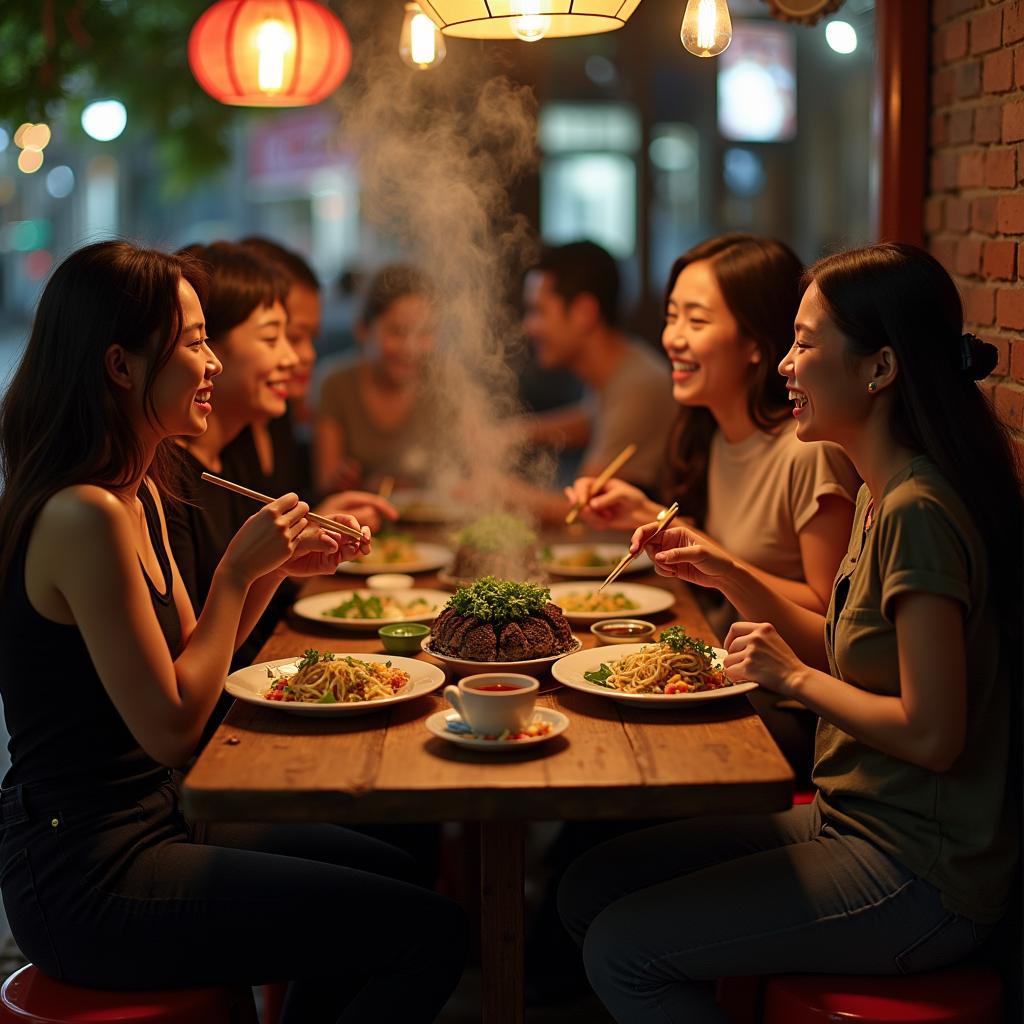 Bữa ăn đậm chất Hà Nội tại quán bình dân với nhóm bạn thân
Follow-up Questions (Rounding Off Questions)
Sau khi bạn hoàn thành phần nói 2 phút, examiner thường sẽ hỏi 1-2 câu follow-up ngắn để kết thúc Part 2 trước khi chuyển sang Part 3. Những câu hỏi này thường liên quan trực tiếp đến story bạn vừa kể.
Question 1: Do you still keep in touch with those friends?
Band 6-7 Answer:
Yes, we still contact each other regularly. We usually meet once or twice a month and also chat online almost every day.
Band 8-9 Answer:
Absolutely! We’ve actually made a conscious effort to stay connected despite our increasingly busy schedules. We have a group chat that’s constantly buzzing with updates, and we try to carve out time for regular meetups, usually over meals, which has become our tradition.
Question 2: Would you go back to that restaurant again?
Band 6-7 Answer:
Yes, definitely. The food was excellent and the atmosphere was nice. I would recommend it to other people too.
Band 8-9 Answer:
Without a doubt! That place has actually become one of our go-to spots whenever we want to recapture that special evening. What’s remarkable is that the quality has remained consistently outstanding, and every visit evokes those fond memories we created that first time. It’s become almost sacred to our friendship group.
IELTS Speaking Part 3: Two-way Discussion
Tổng Quan Về Part 3
Part 3 là phần thử thách nhất trong IELTS Speaking, kéo dài 4-5 phút với các câu hỏi abstract và requires deeper analysis. Đây là nơi examiner đánh giá khả năng critical thinking và ability to discuss complex issues của bạn.
Đặc điểm chính:
- Câu hỏi trừu tượng, mang tính phân tích cao
- Yêu cầu discuss about society, trends, comparisons, causes & effects
- Không còn về personal experience nữa mà về general ideas
- Cần demonstrate ability to justify opinions và see different perspectives
Yêu cầu:
- Depth of analysis: Phân tích sâu, không chỉ surface-level answers
- Critical thinking: Xem xét nhiều góc độ của vấn đề
- Abstract vocabulary: Sử dụng từ vựng academic và abstract nouns
- Complex grammar: Conditional sentences, passive voice, complex structures
- Examples: Đưa ra examples từ society, research, trends, không chỉ personal
Chiến lược hiệu quả:
- Mở rộng câu trả lời: Aim for 3-5 câu (30-45 giây) cho mỗi question
- Structure rõ ràng: Direct answer → Explanation/Reason → Example → Conclusion/Nuance
- Acknowledge complexity: Sử dụng phrases như “It’s not straightforward”, “It depends on”, “To some extent”
- Balance views: “On the one hand… On the other hand…”
- Use discourse markers: Well, Actually, I suppose, In my view
Lỗi thường gặp của học viên Việt Nam:
- Trả lời quá ngắn (1-2 câu), không expand ideas
- Chỉ nói về personal experience thay vì general society
- Không đưa ra reasoning rõ ràng
- Thiếu từ vựng abstract và academic
- Không thừa nhận complexity của issues
- Grammar errors nhiều hơn do pressure
- Hesitation quá nhiều khi suy nghĩ
Để thành công trong Part 3, bạn cần kết hợp khả năng analyze như trong describe a place you visited that exceeded your expectations, trong đó bạn không chỉ miêu tả mà còn giải thích tại sao và đánh giá ý nghĩa của trải nghiệm.
Các Câu Hỏi Thảo Luận Sâu
Theme 1: Social Impact of Dining Together
Question 1: Why do you think eating together is important for maintaining relationships?
🎯 Phân tích câu hỏi:
- Dạng: Why question – yêu cầu explain causes/reasons
- Key words: “eating together”, “important”, “maintaining relationships”
- Cách tiếp cận:
- Direct answer về tầm quan trọng
- Explain 2-3 reasons với examples
- Có thể reference psychological/social aspects
📝 Sample Answer – Band 6-7:
I think eating together is very important for relationships. When people eat together, they can talk and share their feelings. It’s a good time to communicate without work or stress. For example, families often become closer when they have dinner together every day. Also, sharing food is a traditional way to show friendship in many cultures.
Phân tích:
- Structure: Có direct answer → reasons → example, nhưng còn đơn giản
- Vocabulary: Basic (very important, good time, become closer)
- Ideas: Có mention communication và cultural aspect nhưng chưa develop sâu
- Tại sao Band 6-7: Adequate communication nhưng lacks depth và sophisticated language
📝 Sample Answer – Band 8-9:
Well, I’d argue that communal dining plays a pivotal role in nurturing relationships for several compelling reasons.
First and foremost, sharing a meal creates what psychologists call “synchronous activity” – when people eat together, they’re engaging in a shared experience that naturally fosters connection. There’s something about breaking bread together, as the saying goes, that breaks down barriers and makes people feel more comfortable opening up to one another.
Moreover, meals provide a natural setting for meaningful conversation in today’s fast-paced world. Unlike other interactions that might be rushed or task-oriented, dining together implicitly requires us to slow down and be present. It’s during these moments that people often have their most candid discussions and forge deeper bonds.
From a sociological perspective, communal eating has been integral to human societies throughout history. It’s not merely about sustenance – it’s a ritual that reinforces social ties and strengthens group identity. When we consistently share meals with certain people, we’re essentially reaffirming our commitment to those relationships and creating a shared narrative through repeated experiences.
Phân tích:
- Structure: Well-organized với clear progression: Direct answer → Reason 1 (psychological) → Reason 2 (practical) → Reason 3 (sociological) → Implicit conclusion
- Vocabulary: Sophisticated academic vocabulary (pivotal role, nurturing, synchronous activity, integral to, reaffirming)
- Grammar: Complex structures (what-clause, when-clause, unlike-comparison, it’s not merely about X – it’s about Y)
- Critical Thinking: Multi-dimensional analysis (psychological, practical, sociological perspectives)
- Cohesion: Smooth transitions (First and foremost, Moreover, From a sociological perspective)
💡 Key Language Features:
- Discourse markers: Well, I’d argue, First and foremost, Moreover, From a sociological perspective
- Hedging language: I’d argue, naturally, often, essentially (shows nuanced thinking)
- Abstract nouns: synchronous activity, sustenance, ritual, narrative, identity
- Idiomatic expressions: breaking bread together, breaks down barriers, opening up
- Academic collocations: pivotal role, nurturing relationships, forge deeper bonds, strengthen group identity
Question 2: How has the way people dine together changed over the past few decades?
🎯 Phân tích câu hỏi:
- Dạng: Compare/Contrast – past vs present
- Key words: “changed”, “over the past few decades”
- Cách tiếp cận:
- Identify main changes
- Explain causes of these changes
- Có thể evaluate whether positive or negative
📝 Sample Answer – Band 6-7:
Dining together has changed a lot in recent years. In the past, families always ate together at home, but now many people eat out at restaurants. Also, people are busier with work, so they don’t have much time for family meals. Another change is that many young people use their phones during meals, which wasn’t possible before. I think these changes are not always good for relationships.
Phân tích:
- Structure: Lists changes nhưng chưa có in-depth analysis
- Vocabulary: Simple (a lot, always, many people, not always good)
- Ideas: Identifies relevant changes nhưng lacks sophistication
- Tại sao Band 6-7: Communicates main ideas nhưng lacks depth và advanced language
📝 Sample Answer – Band 8-9:
The landscape of communal dining has undergone dramatic transformations over recent decades, largely driven by technological advances and shifting societal norms.
Perhaps the most conspicuous change is the pervasive presence of technology at the dining table. Where meals were once sacred spaces for undivided attention and conversation, we now see families and friends simultaneously engaging with their smartphones, checking messages, or even taking photos of their food – a phenomenon that’s become so common it has its own term: “food porn.” This has, arguably, diluted the quality of interpersonal interaction during meals.
Additionally, there’s been a marked shift from home-cooked meals to dining out or ordering takeaway. Economic prosperity and the proliferation of food delivery services have made restaurant dining and home delivery far more accessible and affordable than in previous generations. While this offers convenience and variety, it’s also meant that the ritual of cooking together and the bonding that comes with shared meal preparation has become less prevalent.
That said, it’s not all negative. We’re also witnessing interesting counter-trends – the rise of foodie culture, for instance, has made dining a more intentional and experiential activity for many people. There’s growing awareness about mindful eating and the importance of being present during meals, which has sparked a kind of backlash against constant digital distraction.
Phân tích:
- Structure: Well-developed với identification of main change → supporting change → acknowledgment of positive counter-trends
- Vocabulary: Sophisticated (pervasive presence, diluted the quality, marked shift, counter-trends, backlash)
- Grammar: Varied structures (where-clause creating contrast, phenomenon that has its own term, while-clause showing concession)
- Critical Thinking: Balanced view – acknowledges negatives but also positives, shows awareness of complexity
- Evaluation: Uses hedging (arguably, That said) to show nuanced thinking
💡 Key Language Features:
- Change vocabulary: undergone transformations, conspicuous change, marked shift, counter-trends
- Cause language: largely driven by, has meant that, has sparked
- Contrast structures: Where X was once Y, we now see Z; While X, it’s also meant Y
- Evaluation language: arguably, That said, it’s not all negative
- Abstract nouns: landscape, phenomenon, ritual, proliferation, backlash
Theme 2: Food Culture and Society
Question 3: Do you think traditional food culture is being lost in modern society?
🎯 Phân tích câu hỏi:
- Dạng: Opinion question with evaluation
- Key words: “traditional food culture”, “being lost”, “modern society”
- Cách tiếp cận:
- Give clear position (Yes/No/Partially)
- Provide evidence and reasoning
- Acknowledge counter-arguments
- Conclude with nuanced view
📝 Sample Answer – Band 6-7:
I think traditional food culture is disappearing in some ways. Many young people prefer fast food and international food instead of traditional dishes. They don’t know how to cook traditional recipes like their grandparents. However, some people still care about traditional food and try to keep it alive. Restaurants serving traditional food are still popular in my country. So I think it’s not completely lost, but it’s changing.
Phân tích:
- Structure: Has position → reasons → counter-point → conclusion
- Vocabulary: Basic (disappearing, prefer, care about, keep it alive)
- Ideas: Addresses both sides nhưng lacks sophistication
- Tại sao Band 6-7: Clear communication nhưng analysis chưa sâu, vocabulary limited
📝 Sample Answer – Band 8.5-9:
This is quite a nuanced issue, and I’d say the reality is more complex than simply “lost” or “preserved.” What we’re witnessing is more of an evolution rather than an extinction of traditional food culture.
On one hand, there are certainly concerning trends. Globalization and the dominance of fast-food chains have homogenized eating habits across the world to some extent. The art of preparing traditional dishes, which often requires time-intensive techniques and specialized knowledge passed down through generations, is increasingly at risk as younger generations gravitate towards convenience and speed. In Vietnam, for instance, fewer young people know how to properly prepare labor-intensive dishes like phở from scratch or traditional bánh chưng for Tết.
However, I’d argue we’re simultaneously seeing a fascinating resurgence of interest in traditional cuisines. The rise of the slow food movement, the popularity of cooking shows showcasing traditional recipes, and the designation of certain cuisines as UNESCO Intangible Cultural Heritage all point to a growing consciousness about preserving culinary traditions. Social media, ironically, has played a paradoxical role – while contributing to cultural homogenization in some ways, it’s also become a powerful tool for documenting and celebrating traditional food practices.
What’s emerging, I believe, is a hybrid food culture where traditional and modern elements coexist and even cross-pollinate. We see this in the fusion cuisine trend, where chefs reinterpret traditional dishes with contemporary techniques, or in how traditional street food is being elevated to fine dining status. This isn’t necessarily a loss – it’s an adaptation, and arguably, it’s always been how food cultures evolve.
Phân tích:
- Structure: Sophisticated organization – complexity acknowledged → negative trends → positive counter-trends → synthesis/conclusion showing evolved understanding
- Vocabulary: Advanced academic vocabulary (nuanced issue, extinction, homogenized, resurgence, paradoxical role, hybrid culture, cross-pollinate)
- Grammar: Complex structures (what we’re witnessing is, what’s emerging is, it’s not X – it’s Y), perfect tenses showing ongoing processes
- Critical Thinking: Multi-layered analysis acknowledging complexity, provides specific examples (Vietnam), considers contradictions (social media’s paradoxical role)
- Evaluation: Shows sophisticated understanding that change doesn’t equal loss but can be evolution
💡 Key Language Features:
- Nuancing language: quite nuanced, more complex than, to some extent, arguably, I’d argue
- Abstract vocabulary: evolution vs extinction, homogenization, resurgence, consciousness, paradoxical role
- Evaluative expressions: concerning trends, fascinating resurgence, ironically, isn’t necessarily
- Academic collocations: at risk, gravitate towards, point to, played a role in, coexist and cross-pollinate
Question 4: Why do you think people today are more interested in trying international cuisines?
🎯 Phân tích câu hỏi:
- Dạng: Cause & Effect – explain reasons for a trend
- Key words: “why”, “more interested”, “international cuisines”
- Cách tiếp cận:
- Identify multiple reasons (economic, social, cultural, technological)
- Provide explanation and examples for each
- Consider both positive and potential negative aspects
📝 Sample Answer – Band 8.5-9:
There are several interrelated factors driving this trend toward culinary adventurousness, and they reflect broader changes in how we live and interact with the world.
First and foremost, globalization has made the world considerably smaller. International travel has become exponentially more accessible compared to previous generations, exposing people to different food cultures firsthand. When someone travels to Thailand and falls in love with authentic pad thai, they naturally seek out similar experiences when they return home. This creates demand that restaurants and food services are eager to meet.
Coupled with this is the transformative impact of social media and food culture. Platforms like Instagram have turned food into a form of visual currency – people don’t just eat anymore; they document and share their culinary experiences. Exotic and photogenic dishes from international cuisines often generate more engagement than familiar local food, incentivizing people to venture beyond their culinary comfort zones. The rise of food influencers and celebrity chefs has also cultivated a culture where culinary exploration is seen as sophisticated and desirable.
Additionally, there’s an economic dimension to consider. As disposable incomes have risen in many countries, dining has evolved from mere sustenance to a form of entertainment and status signaling. Being well-versed in international cuisines has become a marker of cosmopolitanism and cultural capital. There’s a certain social cachet in being able to discuss the authenticity of Japanese ramen or debate the merits of different regional Italian pastas.
However, we should also acknowledge that this trend toward international cuisines might reflect a curious paradox. While people are eager to try “authentic” international food, what they’re often experiencing is a localized adaptation rather than the genuine article. The Thai food served in London differs significantly from what you’d find in Bangkok. Nevertheless, this cross-cultural culinary exchange, even in its adapted forms, enriches our food landscape and broadens our culinary horizons.
Phân tích:
- Structure: Highly organized with clear categorization of reasons (travel/globalization → social media → economic factors → critical reflection)
- Vocabulary: Sophisticated with precise academic vocabulary (interrelated factors, exponentially, transformative impact, visual currency, status signaling, cultural capital, paradox)
- Grammar: Advanced structures (when-clause, what-clause, being able to + infinitive), perfect tenses showing ongoing processes
- Critical Thinking: Multi-dimensional analysis (economic, social, cultural, technological), includes critical perspective on “authenticity”
- Coherence: Excellent use of discourse markers and linking phrases
💡 Key Language Features:
- Cause markers: driving, reflect, has made, coupled with, incentivizing
- Sequencing: First and foremost, Coupled with, Additionally, However
- Academic vocabulary: interrelated factors, exponentially, transformative impact, cultivated, cosmopolitanism, paradox
- Tentative language: might reflect, often, Nevertheless (showing nuanced thinking)
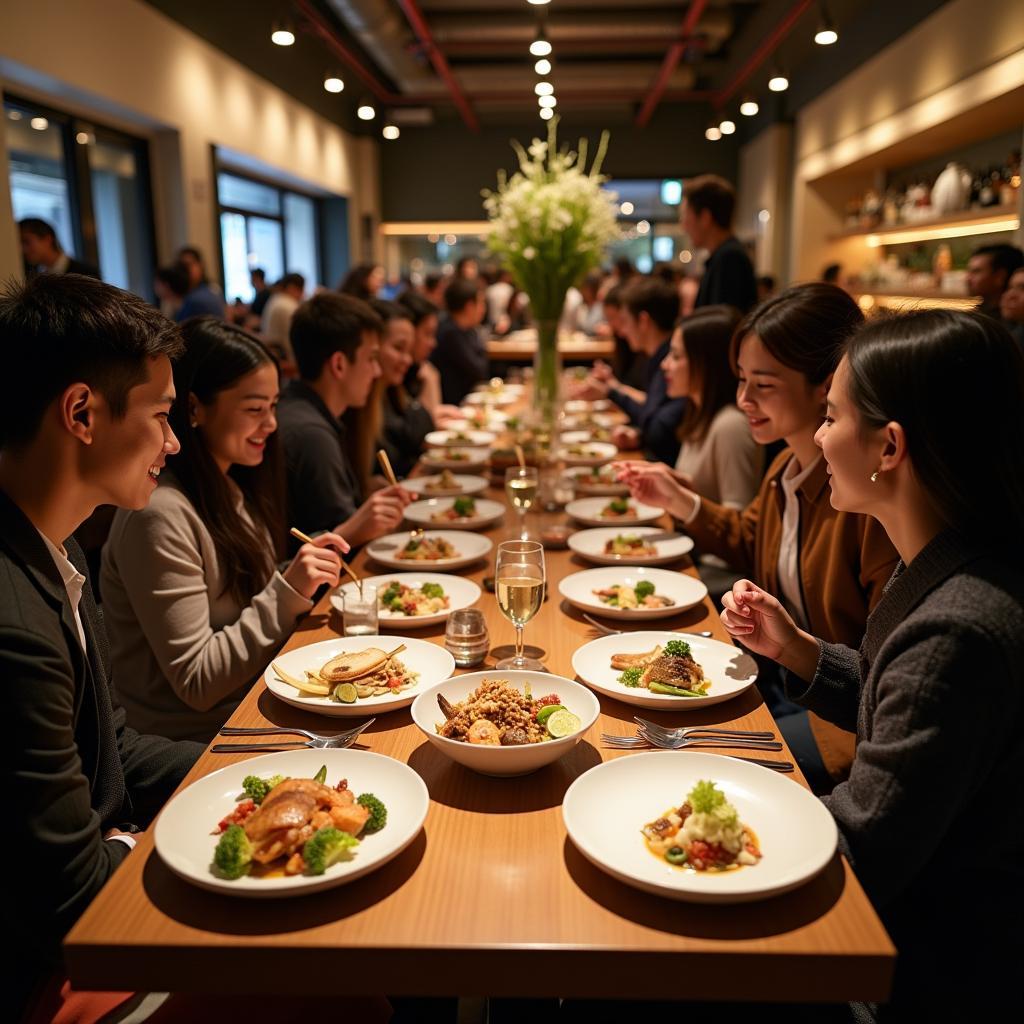 Nhóm bạn trẻ thưởng thức món ăn fusion tại nhà hàng hiện đại
Theme 3: Health and Social Dining
Question 5: How do you think social dining affects people’s eating habits and health?
🎯 Phân tích câu hỏi:
- Dạng: Impact/Effect question requiring analysis of consequences
- Key words: “social dining”, “affects”, “eating habits”, “health”
- Cách tiếp cận:
- Discuss both positive and negative impacts
- Consider physical health và mental/social wellbeing
- Provide examples and evidence
📝 Sample Answer – Band 6-7:
Social dining can affect people’s health in different ways. On the positive side, eating with friends is enjoyable and reduces stress, which is good for health. People also eat more variety when dining together. However, social dining can lead to overeating because people eat more when they’re with others. They might also choose unhealthy food at restaurants. So it has both good and bad effects.
Phân tích:
- Structure: Presents both sides (positive and negative)
- Vocabulary: Simple (enjoyable, reduces stress, good for health, overeating)
- Ideas: Identifies relevant points nhưng lacks depth
- Tại sao Band 6-7: Adequate communication nhưng chưa sophisticated
📝 Sample Answer – Band 8.5-9:
Social dining presents a fascinating paradox when it comes to health impacts – it can be both beneficial and detrimental, often simultaneously.
From a positive standpoint, the psychological and emotional benefits of social dining are well-documented. Communal eating has been linked to reduced stress levels, enhanced mood, and stronger social bonds, all of which contribute to overall wellbeing. There’s compelling research suggesting that people who regularly share meals with others tend to have lower rates of depression and greater life satisfaction. The social support that comes from regular shared meals acts as a buffer against various mental health challenges.
Moreover, social dining can actually promote healthier eating patterns in certain contexts. When eating with health-conscious friends or family members, there’s often a positive peer pressure toward more nutritious choices. Parents dining with children, for instance, can model healthy eating behaviors. Additionally, shared meals tend to be more elaborate and balanced compared to solitary eating, which often involves convenience foods or mindless snacking.
However, the flip side is equally significant. Research has shown that people consistently consume substantially more calories when eating in social settings – a phenomenon psychologists call “social facilitation of eating.” There’s also the social norm effect, where people unconsciously mirror the eating behaviors of their dining companions. If everyone’s indulging in rich foods and multiple courses, individuals may feel pressure to conform, even if they’d normally make different choices.
Furthermore, social dining often occurs at restaurants, where portions are typically oversized and options are calorie-dense. The celebratory nature of many social meals can also normalize excessive consumption – it becomes easy to justify ordering that extra dessert or additional drinks because “it’s a special occasion.”
I think the key lies in mindful awareness. Social dining doesn’t inherently need to be unhealthy. By being conscious of portion sizes, actively choosing nutritious options, and focusing on the social connection rather than just the food, people can reap the mental health benefits of communal dining while minimizing the potential negative impacts on physical health.
Phân tích:
- Structure: Exceptionally well-organized: Introduction acknowledging paradox → Positive impacts (psychological → behavioral) → Negative impacts (overconsumption → social pressure) → Nuanced conclusion
- Vocabulary: Advanced academic language (well-documented, buffer, social facilitation, unconsciously mirror, normalize, reap the benefits)
- Grammar: Complex structures (when-clauses, where-clauses, suggesting that-clause), perfect tenses, passive voice
- Critical Thinking: Sophisticated analysis referencing research, psychological concepts, considers multiple dimensions (mental vs physical health)
- Balance: Presents both sides thoroughly with specific mechanisms explained
💡 Key Language Features:
- Contrasting structures: From a positive standpoint / However, the flip side; can be both X and Y
- Academic references: well-documented, research has shown, psychologists call, phenomenon
- Cause-effect language: has been linked to, contribute to, acts as, leads to
- Hedging: often, tend to, may feel, doesn’t inherently need to
- Mental health vocabulary: reduced stress levels, enhanced mood, buffer, mental health challenges
Question 6: What do you think restaurants can do to encourage more social interaction among diners?
🎯 Phân tích câu hỏi:
- Dạng: Problem-solution / Suggestion question
- Key words: “restaurants”, “encourage”, “social interaction”
- Cách tiếp cận:
- Suggest multiple practical strategies
- Explain how each strategy works
- Consider potential challenges
📝 Sample Answer – Band 8.5-9:
This is an interesting question because it touches on a real tension in modern dining culture – while technology has made many aspects of dining more convenient, it’s also created barriers to genuine social connection.
I think restaurants could implement several strategic approaches to foster more interaction. First and foremost, they could reconsider their spatial design. Communal tables or family-style seating arrangements, which have gained popularity in recent years, naturally facilitate conversation not just within groups but potentially between different parties. Some innovative restaurants have even experimented with “no reservation” policies that encourage strangers to share tables during peak hours, mimicking the social dynamics of traditional Asian eateries.
Technology policies also play a crucial role. While outright phone bans might be too heavy-handed, restaurants could incentivize disconnection through creative means – perhaps offering a discount to groups who agree to check their phones at the entrance, or designing “conversation starters” into the menu or table settings. I’ve seen some establishments that provide card games or discussion prompts on coasters, which subtly encourage interaction.
The menu structure itself presents opportunities for social facilitation. Tapas-style dining or sharing platters inherently require more interaction than individual meals – people must communicate, negotiate, and physically share food, which inherently creates more touchpoints for conversation. Tasting menus with wine pairings also naturally pace the meal in a way that encourages discussion between courses.
Ambient factors shouldn’t be overlooked either. Many restaurants play music that’s prohibitively loud, which actually inhibits conversation. More thoughtful acoustics and appropriate lighting – not too dim, not too bright – can significantly enhance the social atmosphere. Some restaurants are now using adaptive sound systems that adjust volume based on the ambient noise level, striking a balance between energy and conversation.
That said, we should be cautious about over-engineering social interaction. The best atmosphere is often one that feels organic rather than forced. Perhaps the most important thing restaurants can do is simply create an environment that values lingering – through attentive but not rushed service, comfortable seating, and a general ethos that meals are meant to be savored rather than expedited.
Phân tích:
- Structure: Sophisticated organization with multiple categories of suggestions (spatial design → technology → menu → atmosphere → philosophical conclusion)
- Vocabulary: Advanced and precise (touches on, foster, facilitate, mimicking, incentivize, prohibitively, ethos, expedited)
- Grammar: Complex structures with variety (while-clause, which-clause, that-clause), passive voice used effectively
- Critical Thinking: Considers practical implementation, acknowledges tension between control and organic development
- Examples: Specific and diverse (communal tables, conversation cards, tapas-style, adaptive sound systems)
💡 Key Language Features:
- Suggestion language: could implement, could reconsider, presents opportunities, shouldn’t be overlooked
- Sequencing: First and foremost, also, itself, That said
- Cause-effect: naturally facilitate, inherently creates, significantly enhance
- Evaluation: While X might be too Y, Perhaps the most important, we should be cautious
- Abstract nouns: tension, barriers, dynamics, touchpoints, ethos
Từ vựng và cụm từ quan trọng
Topic-Specific Vocabulary
| Từ vựng/Cụm từ | Loại từ | Phiên âm | Nghĩa tiếng Việt | Ví dụ | Collocation |
|---|---|---|---|---|---|
| dining experience | noun phrase | /ˈdaɪnɪŋ ɪkˈspɪəriəns/ | trải nghiệm ăn uống | We had an unforgettable dining experience at that restaurant. | memorable/exceptional/pleasant dining experience |
| culinary journey | noun phrase | /ˈkʌlɪnəri ˈdʒɜːrni/ | hành trình ẩm thực | The chef took us on a culinary journey through Asia. | embark on/take someone on a culinary journey |
| comfort food | noun phrase | /ˈkʌmfərt fuːd/ | đồ ăn an ủi, món quen thuộc | Sometimes you just need comfort food when you’re feeling down. | crave/enjoy/serve comfort food |
| foodie culture | noun phrase | /ˈfuːdi ˈkʌltʃər/ | văn hóa sành ăn | The rise of foodie culture has changed how we view restaurants. | embrace/part of foodie culture |
| fusion cuisine | noun phrase | /ˈfjuːʒən kwɪˈziːn/ | ẩm thực kết hợp | The restaurant specializes in Vietnamese-French fusion cuisine. | modern/creative/innovative fusion cuisine |
| tasting menu | noun phrase | /ˈteɪstɪŋ ˈmenjuː/ | thực đơn nếm thử nhiều món | We opted for the chef’s tasting menu to try various dishes. | order/choose/offer a tasting menu |
| communal dining | noun phrase | /kəˈmjuːnl ˈdaɪnɪŋ/ | ăn uống tập thể | Communal dining creates a sense of togetherness. | promote/enjoy/experience communal dining |
| culinary tradition | noun phrase | /ˈkʌlɪnəri trəˈdɪʃn/ | truyền thống ẩm thực | Vietnamese culinary traditions have been passed down for generations. | preserve/maintain/honor culinary traditions |
| gastronomic adventure | noun phrase | /ˌɡæstrəˈnɒmɪk ədˈventʃər/ | cuộc phiêu lưu ẩm thực | Every meal at that restaurant is a gastronomic adventure. | embark on/experience a gastronomic adventure |
| palate | noun | /ˈpælət/ | vị giác | This dish will satisfy even the most discerning palate. | sophisticated/discerning/refined palate |
| savor | verb | /ˈseɪvər/ | thưởng thức, nếm từ từ | We savored every bite of the exquisite dessert. | savor the moment/flavor/experience |
| indulge | verb | /ɪnˈdʌldʒ/ | thỏa mãn, chiều chuộng bản thân | We decided to indulge in a five-course meal. | indulge in/yourself |
| delectable | adjective | /dɪˈlektəbl/ | ngon tuyệt | The chef prepared a delectable array of dishes. | absolutely/truly delectable |
| mouth-watering | adjective | /maʊθ ˈwɔːtərɪŋ/ | hấp dẫn, thèm thuồng | The aroma of the food was absolutely mouth-watering. | mouth-watering aroma/dishes/selection |
| exquisite | adjective | /ɪkˈskwɪzɪt/ | tinh tế, tuyệt hảo | The presentation of each dish was exquisite. | exquisite taste/presentation/quality |
| sumptuous | adjective | /ˈsʌmptʃuəs/ | xa hoa, thịnh soạn | They served us a sumptuous feast. | sumptuous meal/feast/spread |
| tantalizing | adjective | /ˈtæntəlaɪzɪŋ/ | hấp dẫn, kích thích | The tantalizing smells coming from the kitchen made us hungry. | tantalizing aroma/flavors/menu |
| hearty | adjective | /ˈhɑːrti/ | thịnh soạn, no nê | We enjoyed a hearty meal after the long hike. | hearty meal/breakfast/portion |
| ambiance | noun | /ˈæmbiəns/ | không khí, bầu không khí | The restaurant had a romantic ambiance. | create/enjoy/perfect ambiance |
| catch up | phrasal verb | /kætʃ ʌp/ | trò chuyện cập nhật | We met for dinner to catch up on each other’s lives. | catch up with friends/over lunch |
Idiomatic Expressions & Advanced Phrases
| Cụm từ | Nghĩa | Ví dụ sử dụng | Band điểm |
|---|---|---|---|
| break bread together | ăn uống cùng nhau (mang ý nghĩa gắn kết) | There’s something special about breaking bread together with close friends. | 8-9 |
| whet one’s appetite | kích thích sự thèm ăn | The appetizers really whetted our appetite for the main course. | 7.5-8 |
| food for thought | điều đáng suy nghĩ | Our discussion over dinner gave me food for thought. | 7.5-8 |
| a feast for the eyes | đẹp mắt, hấp dẫn về mặt thị giác | The beautifully plated dishes were a feast for the eyes. | 8-9 |
| melt in your mouth | tan chảy trong miệng, mềm như bơ | The beef was so tender it literally melted in your mouth. | 7.5-8 |
| hit the spot | thỏa mãn đúng lúc | After a long day, that hot bowl of phở really hit the spot. | 7-8 |
| acquire a taste for | dần thích, làm quen với (món ăn mới) | It took me a while to acquire a taste for durian. | 7.5-8 |
| worth its weight in gold | vô cùng quý giá | Those moments sharing meals with friends are worth their weight in gold. | 8-9 |
| the icing on the cake | điểm nhấn hoàn hảo | The live music was the icing on the cake for our dinner. | 7-8 |
| spoiled for choice | có quá nhiều lựa chọn | The menu was so extensive we were spoiled for choice. | 7.5-8 |
| dig in | bắt đầu ăn (thân mật) | Once all the dishes arrived, we couldn’t wait to dig in. | 6-7 |
| go Dutch | mỗi người trả phần của mình | We usually go Dutch when dining out with friends. | 7-8 |
Discourse Markers (Từ Nối Ý Trong Speaking)
Để bắt đầu câu trả lời:
- 📝 Well,… – Vâng, À thì… (khi cần một chút thời gian suy nghĩ)
- 📝 Actually,… – Thực ra thì… (khi đưa ra góc nhìn khác hoặc correct information)
- 📝 To be honest,… – Thành thật mà nói… (khi chia sẻ opinion trung thực)
- 📝 I’d say that… – Tôi cho rằng… (khi đưa ra quan điểm)
- 📝 From my perspective,… – Theo quan điểm của tôi… (formal hơn)
Để bổ sung ý:
- 📝 On top of that,… – Thêm vào đó… (add information)
- 📝 What’s more,… – Hơn nữa… (emphasize addition)
- 📝 Not to mention… – Chưa kể đến… (add important point)
- 📝 Additionally,… – Ngoài ra… (formal)
- 📝 Moreover,… – Hơn thế nữa… (academic)
Để đưa ra quan điểm cân bằng:
- 📝 On the one hand,… On the other hand,… – Một mặt… mặt khác…
- 📝 While it’s true that…, we also need to consider… – Mặc dù đúng là… nhưng ta cũng cần xem xét…
- 📝 That said,… – Tuy nhiên… (introduce contrasting point)
- 📝 Having said that,… – Đã nói vậy nhưng…
Để kết luận:
- 📝 All in all,… – Tóm lại…
- 📝 At the end of the day,… – Cuối cùng thì…
- 📝 In the grand scheme of things,… – Nhìn tổng thể thì…
- 📝 Ultimately,… – Rốt cuộc thì…
Để thể hiện uncertainty hoặc nuance:
- 📝 To some extent,… – Ở một mức độ nào đó…
- 📝 I suppose… – Tôi cho là…
- 📝 I would argue that… – Tôi có thể lập luận rằng…
- 📝 It seems to me that… – Có vẻ như với tôi…
Grammatical Structures Ấn Tượng
1. Conditional Sentences (Câu điều kiện):
Mixed conditional:
- Formula: If + past perfect, would + present infinitive
- Ví dụ: “If we hadn’t decided to try that restaurant, we would still be missing out on amazing Vietnamese fusion cuisine.”
Inversion trong điều kiện:
- Formula: Had/Were/Should + subject + verb
- Ví dụ: “Had we known how popular the restaurant was, we would have made a reservation earlier.”
2. Relative Clauses (Mệnh đề quan hệ):
Non-defining relative clauses:
- Formula: , which/who/where +…
- Ví dụ: “The restaurant, which had just opened last month, quickly became our favorite spot for gathering.”
What-clauses (Cleft sentences):
- Formula: What + clause + is/was…
- Ví dụ: “What made the evening truly special was the quality of conversation we had.”
3. Passive Voice (Câu bị động):
Impersonal passives:
- Formula: It is thought/believed/said that…
- Ví dụ: “It is widely believed that sharing meals strengthens social bonds.”
Get-passive (informal):
- Formula: get + past participle
- Ví dụ: “We got seated at a cozy corner table with a great view.”
4. Cleft Sentences (Câu chẻ):
What-clefts:
- Formula: What I find/enjoy/love most…, is…
- Ví dụ: “What I find most enjoyable about dining with friends is the spontaneous laughter and genuine connection.”
It-clefts:
- Formula: It is/was… that/who…
- Ví dụ: “It was the warm atmosphere that made the restaurant so memorable.”
5. Participle Clauses:
Present participle:
- Formula: verb-ing…, main clause
- Ví dụ: “Sitting around the table sharing stories, we lost track of time completely.”
Past participle:
- Formula: past participle…, main clause
- Ví dụ: “Surrounded by close friends, I felt completely relaxed and content.”
6. Inversion for emphasis:
Never/Rarely/Seldom:
- Formula: Never/Rarely + auxiliary + subject + verb
- Ví dụ: “Rarely have I experienced such authentic Vietnamese cuisine outside of Vietnam.”
Not only:
- Formula: Not only + auxiliary + subject + verb, but also…
- Ví dụ: “Not only did we enjoy excellent food, but we also strengthened our friendships.”
Chiến Lược Tối Đa Hóa Band Điểm
Tips Từ Góc Nhìn Examiner
Những gì Examiners thực sự đánh giá cao:
-
Authenticity over perfection: Examiners prefer natural mistakes to robotic perfect answers. Nói tự nhiên quan trọng hơn nói hoàn hảo 100%.
-
Storytelling ability: Especially ở Part 2, khả năng kể chuyện engaging với details vivid sẽ impress examiner hơn là vocabulary phức tạp nhưng boring.
-
Depth of ideas: Ở Part 3, một answer ngắn nhưng insightful thường được đánh giá cao hơn một answer dài nhưng superficial.
-
Recovery from mistakes: Khi bạn nhận ra mình sai và tự correct một cách tự nhiên, đây actually là dấu hiệu của strong language awareness.
-
Engagement with the question: Đừng học thuộc answers sẵn. Examiners easily spot memorized responses và sẽ đặt follow-up questions để test authenticity.
Lỗi Thường Gặp Cần Tránh
Part 1:
- ❌ Trả lời chỉ “Yes” hoặc “No” không expand
- ❌ Dùng “very good”, “very interesting” lặp đi lặp lại
- ❌ Nói như đọc essay, quá formal và không natural
- ✅ Solution: Practice với 2-3 sentence structure: Direct answer → Reason → Example
Part 2:
- ❌ Không sử dụng hết 1 phút preparation time
- ❌ Nói dưới 1.5 phút (thiếu content)
- ❌ Bỏ sót bullet points quan trọng
- ❌ Quá focus vào vocabulary khó mà quên storytelling
- ✅ Solution: Record yourself và check timing + coverage of all points
Part 3:
- ❌ Trả lời based purely on personal experience thay vì general analysis
- ❌ Không develop ideas đủ sâu (chỉ 1-2 câu)
- ❌ Thiếu examples cụ thể để support opinions
- ❌ Không acknowledge complexity của issues
- ✅ Solution: Practice thinking about “Why?” và “What are the implications?” cho every opinion
Practice Strategies
Để cải thiện Fluency:
- Record 2-minute talks hàng ngày về random topics
- Practice shadowing (lặp lại theo) podcast hoặc TED talks
- Tập nói với timer để build comfort với extended speaking
Để nâng cao Vocabulary:
- Học từ vựng trong context (sentences, không phải lists)
- Tạo personal examples cho mỗi từ mới
- Review vocabulary theo topics (food, travel, technology, etc.)
- Focus vào collocations hơn là individual words
Để improve Grammar:
- Không cần học grammar rules mới – focus vào sử dụng tự nhiên những gì bạn đã biết
- Practice one complex structure mỗi tuần until nó becomes automatic
- Record và transcribe để identify pattern errors
Để develop Ideas:
- Read opinion articles và analyze how writers develop arguments
- Practice “Why? Why? Why?” technique – ask why 3 times cho mỗi opinion
- Discuss IELTS topics với friends hoặc study partners
Mindset Trước và Trong Thi
Trước khi vào phòng thi:
- Đừng cố nhồi nhét vocabulary phút chót – sẽ khiến bạn nervous và unnatural
- Review topics bạn đã prepare nhưng be ready to adapt
- Warm up giọng nói bằng cách nói chuyện với ai đó hoặc self-talk
Trong phòng thi:
- Treat examiner như một conversation partner, không phải judge
- Nếu không hiểu câu hỏi, hỏi lại: “Could you please repeat that?” hoặc “Do you mean…?”
- Nếu cần time để think, dùng fillers tự nhiên: “Well, let me think…”, “That’s an interesting question…”
- Maintain eye contact và smile – confidence matters!
- Nếu làm mistake, đừng panic – tự correct và continue
Sau mỗi part:
- Đừng dwell on mistakes – focus on part tiếp theo
- Reset mentally giữa các parts
- Part 2 finished? Let it go và prepare mentally cho Part 3 abstract questions
Việc chuẩn bị cho IELTS Speaking giống như describe an interesting tradition in your family – bạn cần có nội dung thực, cảm xúc chân thật và khả năng kể chuyện hấp dẫn, không chỉ học thuộc lòng những câu trả lời sẵn.
Kết Luận
Chủ đề “describe a meal you had with friends” là một trong những đề tài đẹp nhất trong IELTS Speaking vì nó cho phép bạn chia sẻ những trải nghiệm thực sự personal và meaningful. Từ góc nhìn của một examiner, tôi thấy rằng những câu trả lời hay nhất không phải là những câu có vocabulary khó nhất hay grammar phức tạp nhất, mà là những câu truyền tải được authentic emotions và genuine connections.
Key takeaways từ bài viết này:
🎯 For Part 1: Keep it natural, extend with reasons and examples, but don’t over-complicate. Aim for 2-3 sentences per question.
🎯 For Part 2: Tell a story với vivid details. Cover all bullet points, speak for at least 1.5 minutes, và most importantly – make the “why memorable” part substantial và heartfelt.
🎯 For Part 3: Think beyond personal experience. Analyze issues từ multiple perspectives, use academic vocabulary naturally, và acknowledge complexity. Quality of ideas matters more than length.
Remember:
- Authenticity beats perfection
- Natural mistakes are better than robotic correctness
- Storytelling ability is as important as language accuracy
- Depth of thinking impresses more than sophisticated vocabulary used awkwardly
The journey to improve IELTS Speaking không phải là về việc học thuộc lòng answers hay cố nhồi nhét từ vựng khó. It’s about developing your ability to communicate ideas clearly, naturally, và engagingly trong English. Practice regularly, record yourself, learn from mistakes, và most importantly – enjoy the process of sharing your stories and ideas.
Chúc bạn thành công trong kỳ thi IELTS Speaking! May your dining experiences với friends continue to bring joy, connection, và memorable moments worth sharing.


