
Chủ đề về vai trò của các tổ chức quốc tế trong y tế toàn cầu (The Role Of International Organizations In Global Health) là một trong những đề tài xuất hiện thường xuyên trong kỳ thi IELTS Reading. Chủ đề này không chỉ có tính thời sự cao mà còn phản ánh xu hướng toàn cầu hóa và sự hợp tác quốc tế trong lĩnh vực y tế – đặc biệt sau đại dịch COVID-19. Qua kinh nghiệm giảng dạy hơn 20 năm, tôi nhận thấy các bài đọc về tổ chức quốc tế và y tế công cộng chiếm khoảng 12-15% tổng số đề thi IELTS Reading.
Bài viết này cung cấp cho bạn một bộ đề thi IELTS Reading hoàn chỉnh với 3 passages tăng dần độ khó từ Easy (Band 5.0-6.5), Medium (Band 6.0-7.5) đến Hard (Band 7.0-9.0). Bạn sẽ được luyện tập với 40 câu hỏi đa dạng theo đúng format thi thật, kèm đáp án chi tiết và giải thích cụ thể cho từng câu. Đặc biệt, bài viết còn tổng hợp từ vựng quan trọng theo từng passage, giúp bạn nâng cao vốn từ học thuật và các kỹ thuật làm bài hiệu quả. Đề thi này phù hợp cho học viên từ band 5.0 trở lên, đặc biệt là những ai đang chuẩn bị cho kỳ thi IELTS Academic trong 3-6 tháng tới.
Hướng Dẫn Làm Bài IELTS Reading
Tổng Quan Về IELTS Reading Test
IELTS Reading test kéo dài 60 phút với 3 passages và tổng cộng 40 câu hỏi. Mỗi câu trả lời đúng được tính 1 điểm, không bị trừ điểm khi sai. Điều quan trọng là bạn cần phân bổ thời gian hợp lý cho từng passage để hoàn thành đầy đủ bài thi.
Phân bổ thời gian khuyến nghị:
- Passage 1 (Easy): 15-17 phút – Bài đọc ngắn nhất, câu hỏi trực tiếp, từ vựng đơn giản
- Passage 2 (Medium): 18-20 phút – Độ dài và độ khó tăng lên, yêu cầu kỹ năng paraphrase
- Passage 3 (Hard): 23-25 phút – Bài đọc dài và phức tạp nhất, yêu cầu tư duy phân tích cao
Lưu ý quan trọng: Dành 2-3 phút cuối để chuyển đáp án vào Answer Sheet. Đáp án viết trên đề bài sẽ không được chấm điểm.
Các Dạng Câu Hỏi Trong Đề Này
Đề thi mẫu này bao gồm 7 dạng câu hỏi phổ biến nhất trong IELTS Reading:
- Multiple Choice – Trắc nghiệm nhiều lựa chọn
- True/False/Not Given – Xác định thông tin đúng/sai/không đề cập
- Yes/No/Not Given – Xác định quan điểm tác giả
- Matching Headings – Nối tiêu đề với đoạn văn
- Sentence Completion – Hoàn thành câu
- Summary Completion – Hoàn thành đoạn tóm tắt
- Short-answer Questions – Câu hỏi ngắn
 Các tổ chức quốc tế đóng vai trò quan trọng trong y tế toàn cầu và phòng chống dịch bệnh
IELTS Reading Practice Test
PASSAGE 1 – The World Health Organization: Guardian of Global Health
Độ khó: Easy (Band 5.0-6.5)
Thời gian đề xuất: 15-17 phút
The World Health Organization (WHO), established in 1948, stands as the premier international body responsible for coordinating global health initiatives and setting standards for healthcare worldwide. With its headquarters in Geneva, Switzerland, the organization operates through six regional offices and works in more than 150 countries, making it one of the most extensive international networks in existence.
The primary mandate of WHO is to ensure that all people can achieve the highest possible level of health. This ambitious goal is pursued through various means, including disease prevention programs, emergency response coordination, and the establishment of international health regulations. The organization’s work covers a broad spectrum of health issues, from infectious diseases like malaria and tuberculosis to non-communicable diseases such as diabetes and heart disease. In recent years, WHO has also increasingly focused on mental health awareness and the impact of environmental factors on human wellbeing.
One of WHO’s most significant achievements was the eradication of smallpox, officially declared in 1980. This monumental success demonstrated the power of coordinated international action and remains a testament to what can be accomplished when nations work together toward a common health objective. The smallpox eradication campaign required decades of sustained effort, involving mass vaccination programs across continents and the training of thousands of healthcare workers in remote areas.
The organization’s structure is designed to be both comprehensive and responsive. The World Health Assembly, WHO’s decision-making body, meets annually and includes delegates from all 194 member states. These representatives discuss health policies, approve budgets, and set strategic priorities for the coming years. The Assembly’s decisions are implemented by the Executive Board, which consists of 34 members elected for three-year terms. This democratic structure ensures that even smaller nations have a voice in shaping global health policy.
Funding for WHO comes from two main sources: assessed contributions from member states and voluntary contributions from governments, foundations, and other donors. However, the organization has faced financial challenges in recent decades, as voluntary funding has grown to represent a larger proportion of its budget. This shift has raised concerns about the organization’s independence, as donors can often specify how their contributions should be used, potentially limiting WHO’s ability to respond flexibly to emerging health crises.
WHO’s technical expertise is another crucial asset. The organization employs thousands of health professionals, including doctors, epidemiologists, scientists, and public health experts. These specialists provide evidence-based guidance on everything from vaccination schedules to treatment protocols for various diseases. During health emergencies, WHO can quickly deploy teams of experts to affected areas to assist local authorities in managing outbreaks and implementing control measures.
The organization also plays a vital role in health information collection and dissemination. Through its Global Health Observatory, WHO compiles data on health trends, disease patterns, and health system performance from around the world. This information helps governments and health organizations make informed decisions about resource allocation and policy development. Additionally, WHO publishes the International Classification of Diseases (ICD), a standardized system used globally for recording causes of death and disease, which facilitates international comparison and research.
Public health education represents another important aspect of WHO’s mission. The organization develops educational materials and training programs for healthcare workers worldwide, helping to build capacity in countries with limited resources. These initiatives range from basic hygiene promotion in communities with poor sanitation to advanced training in disease surveillance and outbreak investigation.
Despite its achievements, WHO faces ongoing challenges. Political tensions between member states can complicate decision-making, and the organization must often navigate competing interests and priorities. Funding constraints limit its ability to respond to all health needs, forcing difficult choices about where to focus resources. Furthermore, the rise of global health threats such as antimicrobial resistance, climate change-related health impacts, and emerging infectious diseases requires WHO to constantly adapt its strategies and approaches.
The COVID-19 pandemic highlighted both WHO’s essential role and its limitations. The organization worked tirelessly to coordinate the global response, providing technical guidance, facilitating research, and helping countries access medical supplies and vaccines. However, it also faced criticism for its early handling of the outbreak and struggled with resource limitations that affected its ability to support all countries equally. This experience has sparked discussions about strengthening WHO’s authority and funding to better prepare for future health emergencies.
Questions 1-5: Multiple Choice
Choose the correct letter, A, B, C, or D.
-
According to the passage, WHO was established in
A. 1940
B. 1945
C. 1948
D. 1950 -
The eradication of smallpox was officially declared in
A. 1970
B. 1975
C. 1980
D. 1985 -
The World Health Assembly meets
A. monthly
B. quarterly
C. twice a year
D. annually -
The Executive Board consists of
A. 24 members
B. 34 members
C. 44 members
D. 54 members -
WHO’s Global Health Observatory is primarily used for
A. treating patients
B. training doctors
C. compiling health data
D. manufacturing medicines
Questions 6-10: True/False/Not Given
Do the following statements agree with the information in the passage?
Write:
- TRUE if the statement agrees with the information
- FALSE if the statement contradicts the information
- NOT GIVEN if there is no information on this
- WHO operates in more than 150 countries worldwide.
- Mental health has always been a primary focus of WHO since its establishment.
- Voluntary funding now represents a larger proportion of WHO’s budget than in previous decades.
- The International Classification of Diseases is only used in European countries.
- WHO faced criticism during the COVID-19 pandemic for its early response.
Questions 11-13: Sentence Completion
Complete the sentences below.
Choose NO MORE THAN TWO WORDS from the passage for each answer.
- The smallpox eradication campaign required __ of sustained effort across continents.
- WHO’s democratic structure ensures that even __ have a voice in global health policy.
- The rise of __ requires WHO to constantly adapt its strategies and approaches.
PASSAGE 2 – International Cooperation in Disease Control: UNICEF’s Health Mission
Độ khó: Medium (Band 6.0-7.5)
Thời gian đề xuất: 18-20 phút
While the World Health Organization typically garners the most attention in discussions of global health governance, the United Nations Children’s Fund (UNICEF) plays an equally indispensable role in protecting and improving children’s health worldwide. Established in 1946, initially to provide emergency relief to children in post-war Europe, UNICEF has evolved into a permanent fixture of the international health landscape, with operations in over 190 countries and territories.
UNICEF’s health mandate centers specifically on maternal and child health, an area where the disparities between developed and developing nations remain stark and troubling. Every year, millions of children under five die from preventable causes, including pneumonia, diarrhea, malaria, and malnutrition. Many of these deaths occur in sub-Saharan Africa and South Asia, regions where healthcare infrastructure is often inadequate and access to basic health services remains severely limited. UNICEF’s programs target these vulnerable populations, working to ensure that every child, regardless of where they are born, has access to life-saving interventions.
One of UNICEF’s most impactful initiatives is its immunization program, which has contributed to a dramatic reduction in child mortality rates globally. The organization works with governments to strengthen national immunization systems, ensuring that vaccines reach even the most remote communities. This involves not only procuring and distributing vaccines but also training healthcare workers, maintaining cold chain systems that keep vaccines effective, and conducting public awareness campaigns to address vaccine hesitancy. Through these efforts, UNICEF helps immunize nearly half of the world’s children against deadly diseases such as measles, polio, and diphtheria.
The fight against polio exemplifies UNICEF’s collaborative approach to disease eradication. Working alongside WHO, Rotary International, and the Gates Foundation as part of the Global Polio Eradication Initiative, UNICEF has helped reduce polio cases by 99.9% since 1988. This remarkable achievement required overcoming formidable obstacles, including reaching children in conflict zones, addressing cultural resistance to vaccination in some communities, and maintaining surveillance systems to quickly detect and respond to any new cases. The near-eradication of polio demonstrates how sustained international cooperation, backed by adequate funding and political commitment, can achieve seemingly impossible public health goals.
UNICEF’s approach to health extends beyond disease prevention to address the underlying determinants of health. The organization recognizes that children’s health is inextricably linked to factors such as nutrition, clean water access, sanitation, and education. Consequently, UNICEF programs often take a holistic approach, integrating health interventions with initiatives in these related areas. For instance, in communities where waterborne diseases are prevalent, UNICEF might simultaneously work on improving water supply systems, promoting hygiene practices, and treating children suffering from diarrheal diseases.
Malnutrition represents another critical focus area for UNICEF. The organization estimates that undernutrition contributes to nearly half of all deaths in children under five, weakening their immune systems and making them more susceptible to disease. UNICEF addresses malnutrition through multiple strategies: distributing therapeutic foods for severely malnourished children, promoting breastfeeding and appropriate complementary feeding practices, providing micronutrient supplements, and working to improve household food security. In emergency situations, such as famines or refugee crises, UNICEF rapidly scales up these nutrition interventions to prevent mass malnutrition and save lives.
The organization’s work during health emergencies showcases its operational capacity and expertise in crisis response. Whether responding to disease outbreaks, natural disasters, or humanitarian crises, UNICEF can quickly mobilize resources and deploy specialized teams to affected areas. During the 2014-2016 Ebola outbreak in West Africa, UNICEF worked to prevent the disease’s spread among children, supported the care of children orphaned by Ebola, and helped maintain essential health services in affected communities. Similarly, during the COVID-19 pandemic, UNICEF played a pivotal role in the global vaccine distribution effort, leveraging its extensive supply chain infrastructure to deliver vaccines to low and middle-income countries.
UNICEF’s funding model differs somewhat from WHO’s, relying more heavily on voluntary contributions from governments, private donors, and corporations. This approach offers flexibility but also creates uncertainty regarding long-term funding for programs. The organization has increasingly sought to diversify its funding sources, including through private sector partnerships and individual donations. These partnerships can bring additional resources and expertise but also raise questions about potential conflicts of interest and the influence of donors on programmatic priorities.
Innovation has become a hallmark of UNICEF’s recent work. The organization has embraced digital technology and data-driven approaches to improve health outcomes. For example, UNICEF uses mobile phone networks to track vaccine coverage, employs drone technology to deliver medical supplies to remote areas, and utilizes artificial intelligence to predict disease outbreaks. These technological innovations promise to make health interventions more efficient and effective, particularly in resource-constrained settings.
However, UNICEF faces persistent challenges that limit its impact. Insufficient funding constrains the scale and scope of programs, forcing difficult decisions about where to allocate resources. Political instability and armed conflict in many countries where UNICEF operates make it difficult to reach children in need and maintain continuity of health services. Additionally, addressing the root causes of poor child health—such as poverty, inequality, and weak governance—requires long-term commitment and systemic change that extends beyond UNICEF’s mandate and capacity.
Looking forward, UNICEF recognizes that achieving its goals will require not only scaling up proven interventions but also addressing emerging health threats. Climate change is already affecting children’s health through increased heat stress, changing disease patterns, and more frequent extreme weather events. Antimicrobial resistance threatens to undermine decades of progress in treating childhood infections. And health inequalities within and between countries continue to grow, leaving the most marginalized children behind.
Questions 14-18: Yes/No/Not Given
Do the following statements agree with the views of the writer in the passage?
Write:
- YES if the statement agrees with the views of the writer
- NO if the statement contradicts the views of the writer
- NOT GIVEN if it is impossible to say what the writer thinks about this
- UNICEF plays a less important role than WHO in global health.
- The disparities in maternal and child health between developed and developing countries remain significant.
- UNICEF’s immunization program has been completely successful in eradicating all childhood diseases.
- The near-eradication of polio demonstrates the effectiveness of sustained international cooperation.
- Private sector partnerships with UNICEF never raise concerns about conflicts of interest.
Questions 19-23: Matching Information
Match the following statements (19-23) with the correct program or initiative (A-F).
A. Immunization program
B. Polio eradication
C. Malnutrition interventions
D. Emergency response
E. Technology innovations
F. Water and sanitation projects
- Involves distributing therapeutic foods to severely malnourished children
- Uses mobile phone networks to track coverage
- Requires maintaining cold chain systems
- Included responding to the 2014-2016 West Africa crisis
- Demonstrates collaboration between multiple international organizations
Questions 24-26: Summary Completion
Complete the summary below.
Choose NO MORE THAN TWO WORDS from the passage for each answer.
UNICEF’s approach to children’s health is holistic, recognizing that health is linked to various factors including nutrition, clean water, and education. The organization addresses malnutrition through strategies such as distributing therapeutic foods, promoting (24) __, and improving household food security. During emergencies like famines or (25) __, UNICEF rapidly increases these interventions. The organization has also embraced innovation, using technologies such as drones and (26) __ to improve health outcomes.
PASSAGE 3 – The Complex Web of Global Health Governance: Challenges and Transformations
Độ khó: Hard (Band 7.0-9.0)
Thời gian đề xuất: 23-25 phút
The contemporary landscape of global health governance represents a multifaceted ecosystem that extends far beyond the traditional purview of intergovernmental organizations like WHO and UNICEF. In recent decades, the proliferation of actors involved in international health has given rise to what scholars term “global health pluralism“—a system characterized by the coexistence of diverse institutions, funding mechanisms, and normative frameworks that collectively shape health policies and interventions worldwide. This paradigm shift has brought both unprecedented opportunities for health improvement and complex coordination challenges that threaten to undermine the coherence and effectiveness of global health efforts.
The transformation of global health governance can be traced to several converging trends that emerged in the late twentieth century. First, the securitization of health—the framing of disease outbreaks as threats to national and international security—elevated health issues on political agendas and attracted new sources of funding and attention. The HIV/AIDS pandemic particularly catalyzed this shift, as its devastating impact on populations and economies compelled governments to recognize infectious diseases as matters of high politics rather than merely technical health concerns. Second, the rise of private philanthropy, most notably through the Bill & Melinda Gates Foundation, introduced unprecedented financial resources into global health while also shifting power dynamics and priority-setting processes. Third, globalization increased both the interconnectedness of health systems and the speed at which diseases could spread, necessitating more robust mechanisms for international health cooperation.
These developments have given rise to a proliferation of global health initiatives (GHIs) that operate alongside, and sometimes in competition with, traditional international organizations. Entities such as the Global Fund to Fight AIDS, Tuberculosis and Malaria, Gavi, the Vaccine Alliance, and the President’s Emergency Plan for AIDS Relief (PEPFAR) represent hybrid governance structures that combine public and private funding, emphasize results-based approaches, and focus on specific diseases or interventions rather than comprehensive health system strengthening. These initiatives have demonstrably contributed to improved health outcomes—the Global Fund alone has saved an estimated 44 million lives since its creation in 2002—yet they have also been criticized for creating parallel systems that may fragment health services and distort national health priorities in recipient countries.
The proliferation of actors and initiatives has engendered what some analysts describe as “institutional congestion” in global health governance. With multiple organizations pursuing similar goals but with different mandates, accountability structures, and operational approaches, overlaps and inefficiencies are inevitable. For instance, numerous organizations work on maternal and child health, each with their own programs, reporting requirements, and implementation strategies. This fragmentation can place substantial burdens on recipient country governments, which must navigate relationships with multiple donors and align diverse programs with national health plans. Moreover, the lack of a clear hierarchical structure or overarching authority in global health means that coordination depends largely on voluntary cooperation and informal networks, which may prove inadequate** during crises requiring rapid, unified responses.
The question of legitimacy and accountability constitutes another critical challenge in contemporary global health governance. Traditional international organizations like WHO derive their legitimacy from their intergovernmental nature—they are accountable to member states through formal governance structures. However, many newer global health actors, particularly private foundations and public-private partnerships, lack such democratic accountability mechanisms. While these organizations may involve diverse stakeholders in their governance, ultimate decision-making power often resides with donors or boards that are not representative of the populations they serve. This democratic deficit raises concerns about whose voices shape global health priorities and whether interventions adequately address the needs and preferences of communities in low and middle-income countries.
Power asymmetries between donors and recipient countries further complicate global health governance. Despite rhetoric about country ownership and partnership, the reality is that those who provide funding often wield disproportionate influence over priority-setting and program design. Donor preferences may reflect their own strategic interests or ideological commitments rather than evidence-based assessments of health needs in recipient countries. For example, the emphasis on vertical programs targeting specific diseases has been driven partly by donor preferences for measurable outcomes and visible impact, even when comprehensive health system strengthening might yield greater long-term benefits. This dynamic can perpetuate dependency relationships and limit countries’ ability to chart their own health development paths.
The COVID-19 pandemic starkly illuminated both the strengths and weaknesses of the current global health governance architecture. On one hand, the rapid development of multiple effective vaccines within a year of the pandemic’s onset represented a remarkable scientific achievement facilitated by unprecedented international collaboration and resource mobilization. Organizations like WHO provided essential coordination and technical guidance, while initiatives like COVAX (co-led by WHO, Gavi, and the Coalition for Epidemic Preparedness Innovations) aimed to ensure equitable vaccine access globally. On the other hand, the pandemic exposed severe limitations in the system’s capacity to ensure equity, enforce compliance with international health regulations, and overcome nationalist impulses that led to vaccine hoarding by wealthy countries. The fact that, by mid-2021, high-income countries had administered roughly 50 times more vaccine doses per capita than low-income countries underscored the persistent inequalities that pervade global health.
These challenges have spurred calls for reforming global health governance to make it more effective, equitable, and responsive to 21st-century health challenges. Proposals range from incremental adjustments—such as improving coordination mechanisms between organizations—to more radical restructuring, including creating a new apex body with binding authority over global health matters. Some advocates argue for strengthening WHO’s mandate and funding to enable it to serve as a more authoritative coordinating body. Others propose establishing a global health threats council within the United Nations Security Council framework to ensure high-level political attention to health security issues. Still others emphasize the need to address underlying structural determinants of health—including economic inequality, climate change, and weak governance—that no single health organization can tackle alone.
The governance of pandemic preparedness has emerged as a particularly urgent reform priority. The establishment of the Pandemic Preparedness and Response Independent Panel and subsequent negotiations toward a “pandemic treaty” reflect recognition that existing mechanisms proved inadequate during COVID-19. Key issues under discussion include: strengthening disease surveillance systems and ensuring timely information sharing; establishing mechanisms to guarantee equitable access to medical countermeasures during health emergencies; creating sustainable financing for pandemic preparedness; and developing compliance mechanisms with sufficient teeth to ensure countries fulfill their international health obligations. However, reaching consensus on these matters has proved contentious, as they touch on sensitive issues of national sovereignty, intellectual property rights, and resource allocation between pandemic preparedness and other health priorities.
Looking forward, the future of global health governance will likely be shaped by several critical tensions. First, between vertical disease-specific programs that can demonstrate rapid, measurable impact and horizontal health system strengthening that builds long-term capacity but shows results more slowly. Second, between centralized coordination through organizations like WHO and the pluralistic reality of multiple actors with their own mandates and approaches. Third, between state sovereignty and the need for binding international rules to address transnational health threats. Finally, between the urgent imperatives of responding to immediate health crises and the longer-term work of addressing social determinants and building resilient health systems. How the global health community navigates these tensions will determine whether the system evolves toward greater coherence and equity or continues its current trajectory of fragmentation and inequality.
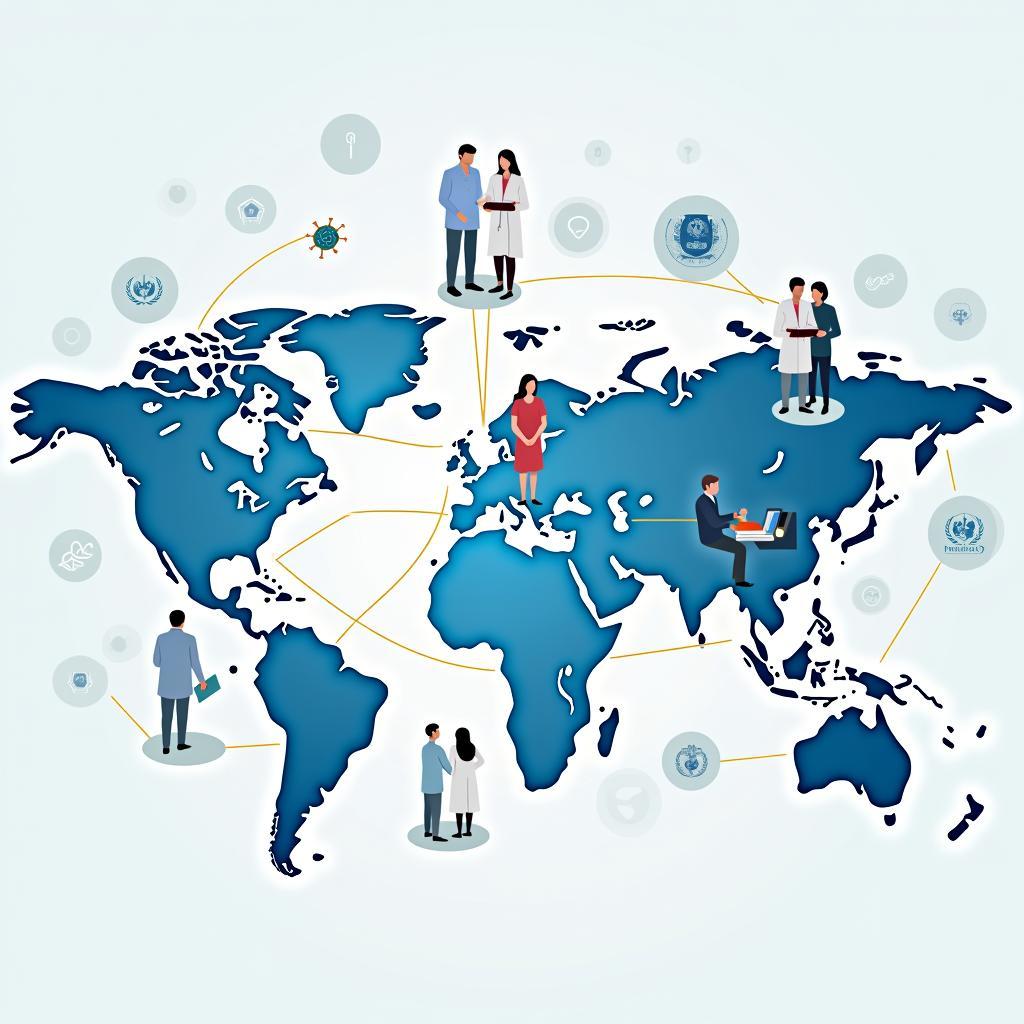 Sự hợp tác quốc tế giữa các tổ chức y tế trong việc chống dịch bệnh toàn cầu
Questions 27-31: Multiple Choice
Choose the correct letter, A, B, C, or D.
-
According to the passage, “global health pluralism” refers to
A. a system with only one international health organization
B. a system with diverse institutions and funding mechanisms
C. a system controlled by wealthy countries
D. a system focused only on infectious diseases -
The securitization of health means that
A. health facilities need better security systems
B. disease outbreaks are framed as security threats
C. only military personnel can handle health crises
D. health information must be kept confidential -
The Global Fund to Fight AIDS, Tuberculosis and Malaria has saved approximately
A. 24 million lives
B. 34 million lives
C. 44 million lives
D. 54 million lives -
“Institutional congestion” in global health governance refers to
A. too many patients in health facilities
B. traffic problems near hospitals
C. overlaps and inefficiencies due to multiple organizations
D. lack of health organizations -
According to the passage, by mid-2021, high-income countries had administered approximately how many more vaccine doses per capita than low-income countries?
A. 20 times more
B. 30 times more
C. 50 times more
D. 100 times more
Questions 32-36: Matching Features
Match the following characteristics (32-36) with the correct organization or concept (A-F).
A. WHO
B. UNICEF
C. Global health initiatives (GHIs)
D. Private foundations
E. COVAX
F. Pandemic treaty
- Derives legitimacy from intergovernmental nature
- Emphasizes results-based approaches and focuses on specific diseases
- Lacks democratic accountability mechanisms
- Aims to ensure equitable vaccine access globally
- Under discussion to strengthen disease surveillance systems
Questions 37-40: Short-answer Questions
Answer the questions below.
Choose NO MORE THAN THREE WORDS from the passage for each answer.
- What term do scholars use to describe the system with diverse institutions in global health?
- What type of relationships can power asymmetries between donors and recipients perpetuate?
- What type of programs do donors prefer because they can demonstrate measurable outcomes?
- What are the underlying factors that affect health but that no single health organization can tackle alone?
Answer Keys – Đáp Án
PASSAGE 1: Questions 1-13
- C
- C
- D
- B
- C
- TRUE
- FALSE
- TRUE
- FALSE
- TRUE
- decades
- smaller nations
- global health threats
PASSAGE 2: Questions 14-26
- NO
- YES
- NOT GIVEN
- YES
- NO
- C
- E
- A
- D
- B
- breastfeeding
- refugee crises
- artificial intelligence
PASSAGE 3: Questions 27-40
- B
- B
- C
- C
- C
- A
- C
- D
- E
- F
- global health pluralism
- dependency relationships
- vertical programs
- structural determinants / underlying structural determinants
Giải Thích Đáp Án Chi Tiết
Passage 1 – Giải Thích
Câu 1: C
- Dạng câu hỏi: Multiple Choice
- Từ khóa: WHO, established
- Vị trí trong bài: Đoạn 1, dòng 1
- Giải thích: Câu đầu tiên của bài đọc nói rõ “The World Health Organization (WHO), established in 1948”. Đây là thông tin trực tiếp, không có paraphrase.
Câu 2: C
- Dạng câu hỏi: Multiple Choice
- Từ khóa: smallpox, eradication, declared
- Vị trí trong bài: Đoạn 3, dòng 1-2
- Giải thích: Đoạn văn nêu rõ “eradication of smallpox, officially declared in 1980”. Đây là một trong những thành tựu quan trọng nhất của WHO.
Câu 6: TRUE
- Dạng câu hỏi: True/False/Not Given
- Từ khóa: WHO, operates, more than 150 countries
- Vị trí trong bài: Đoạn 1, dòng 2-3
- Giải thích: Bài đọc nêu rõ “works in more than 150 countries”, trùng khớp hoàn toàn với thông tin trong câu hỏi.
Câu 7: FALSE
- Dạng câu hỏi: True/False/Not Given
- Từ khóa: mental health, primary focus, since establishment
- Vị trí trong bài: Đoạn 2, dòng cuối
- Giải thích: Bài đọc nói “In recent years, WHO has also increasingly focused on mental health awareness”, từ “in recent years” và “increasingly” cho thấy đây không phải là trọng tâm từ khi thành lập, mà là xu hướng gần đây.
Câu 11: decades
- Dạng câu hỏi: Sentence Completion
- Từ khóa: smallpox eradication campaign, sustained effort
- Vị trí trong bài: Đoạn 3, dòng 5
- Giải thích: “The smallpox eradication campaign required decades of sustained effort”. Từ cần điền là “decades” – một danh từ chỉ khoảng thời gian dài.
Câu 13: global health threats
- Dạng câu hỏi: Sentence Completion
- Từ khóa: rise, requires WHO, adapt strategies
- Vị trí trong bài: Đoạn 9, dòng 4-5
- Giải thích: “The rise of global health threats… requires WHO to constantly adapt its strategies”. Đây là paraphrase từ “the rise of” với cấu trúc câu trong đề bài.
Passage 2 – Giải Thích
Câu 14: NO
- Dạng câu hỏi: Yes/No/Not Given
- Từ khóa: UNICEF, less important, WHO
- Vị trí trong bài: Đoạn 1, dòng 1
- Giải thích: Bài đọc nói UNICEF “plays an equally indispensable role”, từ “equally” (tương đương) cho thấy quan điểm của tác giả là UNICEF không kém quan trọng hơn WHO.
Câu 15: YES
- Dạng câu hỏi: Yes/No/Not Given
- Từ khóa: disparities, maternal and child health, developed and developing countries
- Vị trí trong bài: Đoạn 2, dòng 1-2
- Giải thích: Tác giả nói “the disparities between developed and developing nations remain stark and troubling”, “stark” (rõ rệt) và “troubling” (đáng lo ngại) thể hiện quan điểm về sự khác biệt lớn và vẫn tồn tại.
Câu 19: C
- Dạng câu hỏi: Matching Information
- Từ khóa: therapeutic foods, severely malnourished children
- Vị trí trong bài: Đoạn 6, dòng 4-5
- Giải thích: “UNICEF addresses malnutrition through multiple strategies: distributing therapeutic foods for severely malnourished children”. Đây thuộc về malnutrition interventions (C).
Câu 23: B
- Dạng câu hỏi: Matching Information
- Từ khóa: collaboration, multiple international organizations
- Vị trí trong bài: Đoạn 4, dòng 2-3
- Giải thích: Việc chống bại liệt “Working alongside WHO, Rotary International, and the Gates Foundation” thể hiện sự hợp tác giữa nhiều tổ chức quốc tế.
Câu 24: breastfeeding
- Dạng câu hỏi: Summary Completion
- Từ khóa: malnutrition, promoting
- Vị trí trong bài: Đoạn 6, dòng 5
- Giải thích: Danh sách các chiến lược bao gồm “promoting breastfeeding and appropriate complementary feeding practices”.
Passage 3 – Giải Thích
Câu 27: B
- Dạng câu hỏi: Multiple Choice
- Từ khóa: global health pluralism
- Vị trí trong bài: Đoạn 1, dòng 3-4
- Giải thích: Bài đọc định nghĩa rõ “global health pluralism” là “a system characterized by the coexistence of diverse institutions, funding mechanisms, and normative frameworks”. Đây chính là đáp án B.
Câu 29: C
- Dạng câu hỏi: Multiple Choice
- Từ khóa: Global Fund, saved, lives
- Vị trí trong bài: Đoạn 3, dòng 6-7
- Giải thích: “The Global Fund alone has saved an estimated 44 million lives since its creation in 2002”. Con số cụ thể là 44 million.
Câu 31: C
- Dạng câu hỏi: Multiple Choice
- Từ khóa: mid-2021, high-income countries, vaccine doses, low-income countries
- Vị trí trong bài: Đoạn 7, dòng cuối
- Giải thích: “By mid-2021, high-income countries had administered roughly 50 times more vaccine doses per capita than low-income countries”. Con số là 50 lần.
Câu 32: A
- Dạng câu hỏi: Matching Features
- Từ khóa: legitimacy, intergovernmental nature
- Vị trí trong bài: Đoạn 5, dòng 2-3
- Giải thích: “Traditional international organizations like WHO derive their legitimacy from their intergovernmental nature”. WHO được nhắc đến cụ thể.
Câu 37: global health pluralism
- Dạng câu hỏi: Short-answer Questions
- Từ khóa: term, scholars use, diverse institutions
- Vị trí trong bài: Đoạn 1, dòng 3
- Giải thích: “What scholars term ‘global health pluralism'”. Cụm từ này chính xác ba từ và là thuật ngữ học thuật.
Câu 39: vertical programs
- Dạng câu hỏi: Short-answer Questions
- Từ khóa: donors prefer, measurable outcomes
- Vị trí trong bài: Đoạn 6, dòng 6-7
- Giải thích: “The emphasis on vertical programs targeting specific diseases has been driven partly by donor preferences for measurable outcomes”. Donor preferences (sở thích của nhà tài trợ) liên quan đến vertical programs.
Từ Vựng Quan Trọng Theo Passage
Passage 1 – Essential Vocabulary
| Từ vựng | Loại từ | Phiên âm | Nghĩa tiếng Việt | Ví dụ từ bài | Collocation |
|---|---|---|---|---|---|
| premier | adj | /prɪˈmɪər/ | hàng đầu, quan trọng nhất | the premier international body | premier league, premier position |
| coordinate | v | /kəʊˈɔːdɪneɪt/ | phối hợp, điều phối | coordinating global health initiatives | coordinate efforts, coordinate activities |
| mandate | n | /ˈmændeɪt/ | nhiệm vụ, quyền hạn | The primary mandate of WHO | have a mandate, mandate to do something |
| eradication | n | /ɪˌrædɪˈkeɪʃn/ | sự xóa bỏ hoàn toàn | eradication of smallpox | disease eradication, eradication campaign |
| testament | n | /ˈtestəmənt/ | minh chứng, bằng chứng | remains a testament to | testament to success, living testament |
| comprehensive | adj | /ˌkɒmprɪˈhensɪv/ | toàn diện, bao quát | comprehensive and responsive | comprehensive approach, comprehensive coverage |
| voluntary | adj | /ˈvɒləntri/ | tự nguyện, tự do | voluntary contributions | voluntary work, voluntary organization |
| deploy | v | /dɪˈplɔɪ/ | triển khai, điều động | deploy teams of experts | deploy resources, deploy troops |
| facilitate | v | /fəˈsɪlɪteɪt/ | tạo điều kiện, hỗ trợ | facilitates international comparison | facilitate learning, facilitate access |
| navigate | v | /ˈnævɪɡeɪt/ | điều hướng, vượt qua | navigate competing interests | navigate challenges, navigate through |
| antimicrobial | adj | /ˌæntɪmaɪˈkrəʊbiəl/ | kháng kháng sinh | antimicrobial resistance | antimicrobial agents, antimicrobial therapy |
| constraint | n | /kənˈstreɪnt/ | hạn chế, ràng buộc | funding constraints | budget constraint, time constraint |
Passage 2 – Essential Vocabulary
| Từ vựng | Loại từ | Phiên âm | Nghĩa tiếng Việt | Ví dụ từ bài | Collocation |
|---|---|---|---|---|---|
| garner | v | /ˈɡɑːnər/ | thu hút, giành được | garners the most attention | garner support, garner attention |
| indispensable | adj | /ˌɪndɪˈspensəbl/ | không thể thiếu | indispensable role | indispensable part, indispensable tool |
| disparity | n | /dɪˈspærəti/ | sự khác biệt, chênh lệch | disparities between developed and developing nations | health disparity, income disparity |
| preventable | adj | /prɪˈventəbl/ | có thể phòng ngừa | preventable causes | preventable disease, preventable death |
| inadequate | adj | /ɪnˈædɪkwət/ | không đầy đủ, thiếu thốn | healthcare infrastructure is inadequate | inadequate funding, inadequate resources |
| exemplify | v | /ɪɡˈzemplɪfaɪ/ | minh họa, làm ví dụ | exemplifies UNICEF’s collaborative approach | exemplify excellence, exemplify values |
| formidable | adj | /ˈfɔːmɪdəbl/ | ghê gớm, đáng gờm | overcoming formidable obstacles | formidable challenge, formidable opponent |
| holistic | adj | /həʊˈlɪstɪk/ | toàn diện, tổng thể | holistic approach | holistic view, holistic medicine |
| inextricably | adv | /ˌɪnɪkˈstrɪkəbli/ | không thể tách rời | inextricably linked to factors | inextricably linked, inextricably connected |
| therapeutic | adj | /ˌθerəˈpjuːtɪk/ | điều trị, chữa bệnh | therapeutic foods | therapeutic intervention, therapeutic effect |
| orphaned | adj | /ˈɔːfənd/ | mồ côi | children orphaned by Ebola | orphaned children, become orphaned |
| pivotal | adj | /ˈpɪvətl/ | then chốt, cực kỳ quan trọng | played a pivotal role | pivotal moment, pivotal role |
| hallmark | n | /ˈhɔːlmɑːk/ | dấu hiệu đặc trưng | hallmark of UNICEF’s work | hallmark of success, distinctive hallmark |
| marginalized | adj | /ˈmɑːdʒɪnəlaɪzd/ | bị gạt ra ngoài lề | marginalized children | marginalized communities, marginalized groups |
| emerging | adj | /ɪˈmɜːdʒɪŋ/ | đang nổi lên, mới xuất hiện | emerging health threats | emerging markets, emerging issues |
Passage 3 – Essential Vocabulary
| Từ vựng | Loại từ | Phiên âm | Nghĩa tiếng Việt | Ví dụ từ bài | Collocation |
|---|---|---|---|---|---|
| multifaceted | adj | /ˌmʌltɪˈfæsɪtɪd/ | nhiều mặt, đa chiều | multifaceted ecosystem | multifaceted approach, multifaceted problem |
| purview | n | /ˈpɜːvjuː/ | phạm vi, thẩm quyền | traditional purview of organizations | within the purview, beyond the purview |
| proliferation | n | /prəˌlɪfəˈreɪʃn/ | sự gia tăng nhanh chóng | proliferation of actors | nuclear proliferation, proliferation of weapons |
| coexistence | n | /ˌkəʊɪɡˈzɪstəns/ | sự cùng tồn tại | coexistence of diverse institutions | peaceful coexistence, coexistence with |
| paradigm | n | /ˈpærədaɪm/ | mô hình, khuôn mẫu | paradigm shift | paradigm shift, new paradigm |
| securitization | n | /sɪˌkjʊərɪtaɪˈzeɪʃn/ | việc chứng khoán hóa; việc an ninh hóa | securitization of health | securitization process, securitization market |
| catalyze | v | /ˈkætəlaɪz/ | xúc tác, thúc đẩy | catalyzed this shift | catalyze change, catalyze reaction |
| hybrid | adj | /ˈhaɪbrɪd/ | lai, hỗn hợp | hybrid governance structures | hybrid model, hybrid system |
| congestion | n | /kənˈdʒestʃən/ | sự ách tắc, tắc nghẽn | institutional congestion | traffic congestion, congestion charge |
| fragmentation | n | /ˌfræɡmenˈteɪʃn/ | sự phân mảnh | fragmentation of services | fragmentation of markets, habitat fragmentation |
| legitimacy | n | /lɪˈdʒɪtɪməsi/ | tính hợp pháp | question of legitimacy | political legitimacy, legitimacy of authority |
| asymmetry | n | /eɪˈsɪmətri/ | sự bất cân xứng | power asymmetries | information asymmetry, asymmetry in power |
| rhetoric | n | /ˈretərɪk/ | lời nói hoa mỹ, hùng biện | rhetoric about partnership | empty rhetoric, political rhetoric |
| wield | v | /wiːld/ | sử dụng, vận dụng (quyền lực) | wield disproportionate influence | wield power, wield influence |
| perpetuate | v | /pəˈpetʃueɪt/ | duy trì, làm trường tồn | perpetuate dependency relationships | perpetuate inequality, perpetuate myths |
| illuminate | v | /ɪˈluːmɪneɪt/ | làm sáng tỏ, chiếu sáng | starkly illuminated weaknesses | illuminate the issue, illuminate understanding |
| equity | n | /ˈekwəti/ | sự công bằng | ensure equity | health equity, equity in access |
| apex | n | /ˈeɪpeks/ | đỉnh cao, chóp | apex body | apex of power, apex predator |
| contentious | adj | /kənˈtenʃəs/ | gây tranh cãi | proved contentious | contentious issue, contentious debate |
Kết Bài
Chủ đề về vai trò của các tổ chức quốc tế trong y tế toàn cầu không chỉ phổ biến trong kỳ thi IELTS Reading mà còn phản ánh những vấn đề sống còn của nhân loại trong thế kỷ 21. Qua bộ đề thi mẫu này, bạn đã được trải nghiệm đầy đủ cả 3 mức độ khó từ Easy đến Hard, với tổng cộng 40 câu hỏi đa dạng dạng giống như thi thật. Passage 1 giới thiệu về WHO và vai trò cơ bản của tổ chức này, Passage 2 đi sâu vào hoạt động cụ thể của UNICEF với trẻ em và sức khỏe bà mẹ, còn Passage 3 phân tích sâu sắc về hệ thống quản trị y tế toàn cầu phức tạp với những thách thức và cơ hội.
Việc luyện tập với đề thi này giúp bạn làm quen với các dạng câu hỏi phổ biến như Multiple Choice, True/False/Not Given, Yes/No/Not Given, Matching, Summary Completion và Short-answer Questions. Phần đáp án chi tiết không chỉ cung cấp đáp án đúng mà còn giải thích rõ ràng vị trí thông tin, cách paraphrase và lý do tại sao đáp án đó chính xác. Đây chính là chìa khóa giúp bạn hiểu sâu về cách làm bài và tránh được những sai lầm phổ biến.
Bảng từ vựng chi tiết theo từng passage với phiên âm, nghĩa tiếng Việt và collocation sẽ giúp bạn mở rộng vốn từ học thuật một cách có hệ thống. Hãy dành thời gian học kỹ những từ này vì chúng thường xuyên xuất hiện trong các bài thi IELTS Reading về chủ đề y tế, khoa học và xã hội. Hãy nhớ rằng, thành công trong IELTS Reading không chỉ đến từ việc làm nhiều đề mà còn từ việc phân tích kỹ càng từng câu trả lời, hiểu rõ lý do đúng sai và rút ra bài học cho bản thân. Chúc bạn ôn tập hiệu quả và đạt band điểm mong muốn trong kỳ thi sắp tới!


