Chủ đề về ảnh hưởng văn hóa đến thiết kế môi trường học tập (Cultural Influences On The Design Of Learning Environments) là một trong những chủ đề quan trọng và thường xuyên xuất hiện trong kỳ thi IELTS Reading, đặc biệt trong các đề thi gần đây. Chủ đề này kết hợp giữa khoa học giáo dục, kiến trúc, và nhân học văn hóa, tạo nên những bài đọc phong phú và đầy thử thách.
Bài viết này cung cấp một bộ đề thi IELTS Reading hoàn chỉnh với 3 passages từ dễ đến khó, bám sát chuẩn đề thi thật từ Cambridge IELTS. Bạn sẽ được luyện tập với 40 câu hỏi đa dạng bao gồm Multiple Choice, True/False/Not Given, Matching Headings, Summary Completion và nhiều dạng bài khác. Mỗi câu hỏi đều có đáp án chi tiết kèm giải thích cụ thể về vị trí thông tin, kỹ thuật paraphrase và chiến lược làm bài. Đặc biệt, phần từ vựng được tổng hợp theo từng passage với phiên âm, nghĩa tiếng Việt và cách sử dụng thực tế.
Đề thi này phù hợp cho học viên có trình độ từ band 5.0 trở lên, giúp bạn làm quen với format đề thi thực tế, nâng cao kỹ năng đọc hiểu và tích lũy vốn từ vựng học thuật quan trọng cho kỳ thi IELTS.
Hướng Dẫn Làm Bài IELTS Reading
Tổng Quan Về IELTS Reading Test
IELTS Reading Test kéo dài 60 phút với 3 passages và tổng cộng 40 câu hỏi. Mỗi câu trả lời đúng được tính là 1 điểm, không có điểm âm khi trả lời sai. Độ khó của các passages tăng dần từ Passage 1 đến Passage 3, đòi hỏi học viên phải có chiến lược phân bổ thời gian hợp lý:
Phân bổ thời gian khuyến nghị:
- Passage 1 (Easy): 15-17 phút cho 13 câu hỏi
- Passage 2 (Medium): 18-20 phút cho 13 câu hỏi
- Passage 3 (Hard): 23-25 phút cho 14 câu hỏi
Lưu ý quan trọng là bạn cần tự ghi đáp án vào answer sheet, vì vậy nên dành 2-3 phút cuối để kiểm tra và chuyển đáp án cẩn thận.
Các Dạng Câu Hỏi Trong Đề Này
Đề thi mẫu này bao gồm đầy đủ các dạng câu hỏi phổ biến nhất trong IELTS Reading:
- Multiple Choice (Passage 1 & 3): Chọn đáp án đúng nhất từ các phương án A, B, C, D
- True/False/Not Given (Passage 1): Xác định thông tin đúng, sai hay không được đề cập
- Matching Headings (Passage 2): Nối tiêu đề phù hợp với từng đoạn văn
- Summary Completion (Passage 2): Điền từ vào chỗ trống trong đoạn tóm tắt
- Matching Features (Passage 3): Nối thông tin với các đối tượng được đề cập
- Short-answer Questions (Passage 3): Trả lời ngắn gọn các câu hỏi
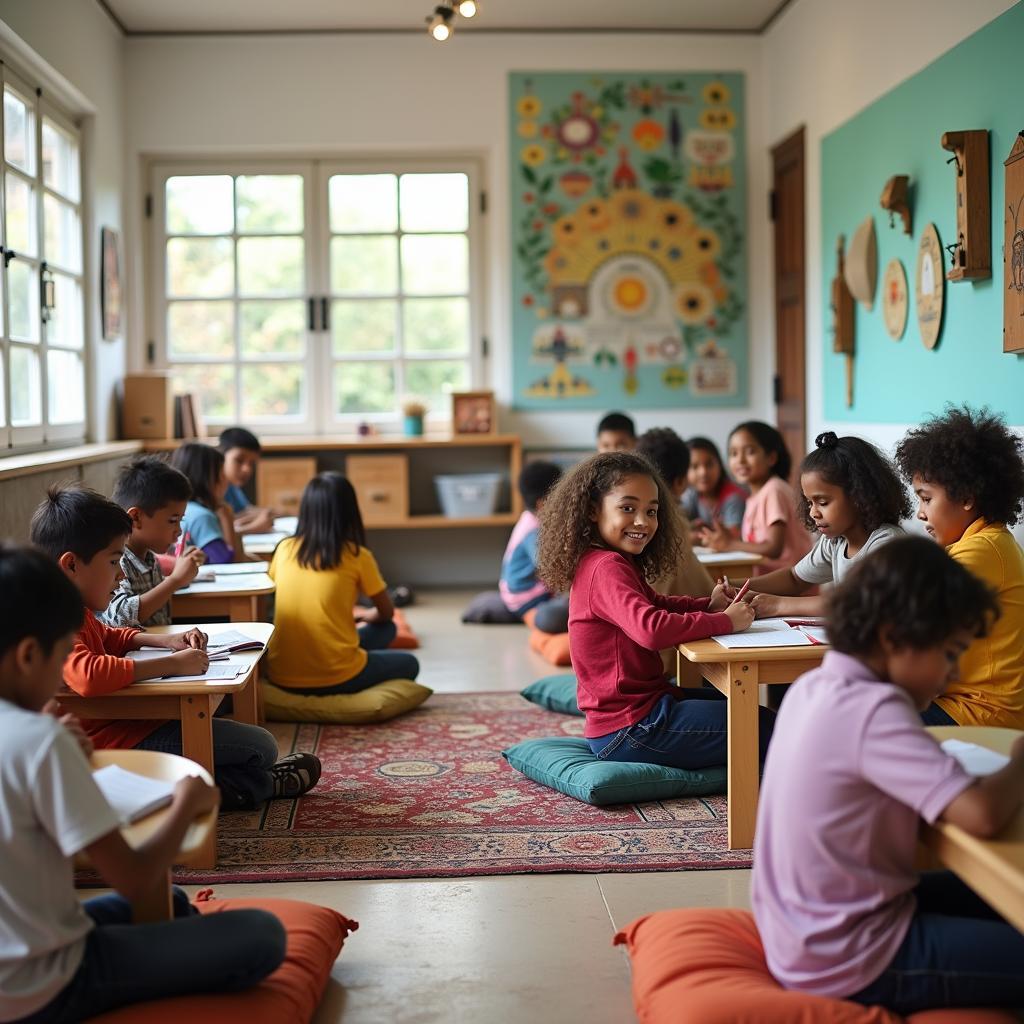 Môi trường học tập đa văn hóa trong bài thi IELTS Reading về thiết kế giáo dục
IELTS Reading Practice Test
PASSAGE 1 – The Evolution of Classroom Design Across Cultures
Độ khó: Easy (Band 5.0-6.5)
Thời gian đề xuất: 15-17 phút
The physical environment in which learning takes place has been shaped by cultural values and educational philosophies for centuries. From the rigid rows of desks in traditional Western classrooms to the flexible, communal spaces found in many indigenous learning settings, the design of educational environments reflects deeply held beliefs about knowledge, authority, and the learning process itself.
In Western educational traditions, particularly those influenced by European models, classrooms have historically been designed with a clear hierarchical structure. The teacher’s desk sits at the front, elevated or positioned to command attention, while students’ desks face forward in orderly rows. This arrangement embodies the transmission model of education, where knowledge flows primarily from teacher to student. The architecture reinforces the idea that learning is an individual endeavour, with each student working independently at their own desk. This design became standardised during the Industrial Revolution when mass education emerged as a means to prepare workers for factory environments that valued discipline, punctuality, and conformity.
Contrasting sharply with this model, many East Asian educational settings incorporate elements that reflect Confucian values of collective harmony and respect for authority. While Japanese classrooms, for instance, may appear similar to Western ones at first glance, subtle differences reveal cultural priorities. Students often remain in the same classroom throughout the day while teachers rotate between rooms, fostering a sense of group identity. The practice of han or small group arrangements within the classroom encourages collaborative learning and peer support, reflecting the cultural emphasis on interdependence rather than independence. Additionally, students typically take responsibility for cleaning their own classrooms, reinforcing communal values and respect for shared spaces.
Indigenous learning environments across various cultures present even more dramatic departures from the Western model. Traditional Māori education in New Zealand, for example, often takes place in a wharenui (meeting house), a space that is both physically and spiritually significant. The open layout allows for intergenerational learning, where knowledge is passed down through oral storytelling, practical demonstration, and observation. There are no fixed desks or formal seating arrangements; instead, learners may sit on the floor in circles, creating a more egalitarian atmosphere. This design reflects a holistic view of education that encompasses not just academic skills but also cultural identity, spiritual development, and connection to community and land.
In recent decades, educational researchers have begun to seriously examine how physical space affects learning outcomes. Studies have shown that classroom design can significantly impact student engagement, behaviour, and academic performance. This research has sparked a movement toward more culturally responsive and flexible learning environments. The concept of “learning landscapes” has emerged, which moves away from the traditional classroom model toward spaces that can be adapted for different learning activities and cultural preferences.
Scandinavian countries, particularly Finland and Sweden, have been at the forefront of innovative classroom design. These nations have developed educational spaces that reflect their cultural values of equality, autonomy, and wellbeing. Finnish schools often feature open-plan classrooms with moveable furniture, comfortable seating areas, and extensive use of natural materials and lighting. Students are given considerable freedom to choose where and how they work, whether at traditional desks, on floor cushions, or in informal lounging areas. This design philosophy aligns with the Finnish educational approach that emphasises student agency, self-directed learning, and the importance of reducing stress in the learning environment.
The influence of cultural values on educational spaces extends beyond the classroom itself to encompass entire school buildings and campuses. In many Middle Eastern and South Asian countries, schools are often designed around courtyards, reflecting both climatic considerations and cultural traditions of communal gathering spaces. These courtyards serve as outdoor classrooms, social spaces, and places for reflection, connecting students with nature and providing relief from enclosed indoor environments. The use of Islamic geometric patterns and calligraphy in architectural details reinforces cultural and religious identity within the learning environment.
Technology is now adding another dimension to the cultural conversation about learning spaces. As education becomes increasingly digital, questions arise about how to integrate technology in ways that respect cultural values. Some cultures embrace technology-rich environments with interactive whiteboards, personal devices for every student, and virtual reality learning experiences. Others worry that excessive technology use may undermine traditional values of face-to-face interaction, handwriting, and contemplative thinking.
Questions 1-5
Choose the correct letter, A, B, C or D.
-
According to the passage, traditional Western classroom design was primarily influenced by:
A. Cultural diversity and inclusion
B. Industrial Revolution values
C. Student comfort and wellbeing
D. Environmental sustainability -
The arrangement of desks in rows facing the teacher represents:
A. Democratic education principles
B. Collaborative learning approaches
C. Knowledge transmission from teacher to student
D. Student-centred learning methods -
In Japanese classrooms, the practice of “han” refers to:
A. Individual study spaces
B. Teacher rotation systems
C. Small group arrangements
D. Classroom cleaning duties -
Traditional Māori learning environments are characterised by:
A. Fixed desks and formal seating
B. Circles on the floor and open layouts
C. Technology-rich spaces
D. Separate rooms for different subjects -
Finnish classroom design primarily reflects values of:
A. Competition and individual achievement
B. Traditional authority structures
C. Strict discipline and control
D. Equality and student autonomy
Questions 6-9
Do the following statements agree with the information given in the passage?
Write:
- TRUE if the statement agrees with the information
- FALSE if the statement contradicts the information
- NOT GIVEN if there is no information on this
-
Western classroom design has remained unchanged since the Industrial Revolution.
-
East Asian educational settings completely reject Western classroom models.
-
Research has demonstrated that physical classroom design can affect student performance.
-
All cultures have embraced technology equally in their learning environments.
Questions 10-13
Complete the sentences below.
Write NO MORE THAN TWO WORDS from the passage for each answer.
-
In many Middle Eastern and South Asian schools, buildings are designed around __ which serve multiple educational and social purposes.
-
The concept of __ represents a modern approach that moves away from fixed classroom models toward adaptable spaces.
-
Finnish schools often use __ and natural lighting to create comfortable learning environments.
-
Indigenous Māori education incorporates __ as a method of passing knowledge between generations.
PASSAGE 2 – Neurological and Psychological Impacts of Culturally-Designed Learning Spaces
Độ khó: Medium (Band 6.0-7.5)
Thời gian đề xuất: 18-20 phút
The relationship between physical learning environments and cognitive development has become a subject of intense interdisciplinary research, bringing together insights from neuroscience, psychology, anthropology, and educational theory. Recent advances in brain imaging technology and cross-cultural studies have revealed that the design of learning spaces does not merely reflect cultural values—it actively shapes how students think, learn, and develop cognitive frameworks that are culturally specific.
A. Neuroscientists have discovered that the human brain is remarkably plastic, continuously rewiring itself in response to environmental stimuli. When students spend significant time in particular types of learning environments, their neural pathways adapt accordingly. Research conducted by Dr. Sarah Martinez at the Cognitive Architecture Institute found that children educated in open-plan, collaborative spaces showed increased activity in brain regions associated with social cognition and emotional regulation compared to those in traditional classroom settings. Conversely, students in more structured, individual-focused environments demonstrated enhanced activation in areas related to sustained attention and independent problem-solving. Neither pattern is inherently superior; rather, they reflect different cognitive strengths aligned with different cultural values and educational goals.
B. The spatial arrangement of learning environments influences not only cognitive development but also psychological wellbeing and identity formation. Environmental psychologist Professor James Chen argues that learning spaces function as “cultural mirrors” that reflect back to students messages about who they are and their place in society. In his longitudinal study following 500 students across twelve countries, Chen found that students whose learning environments incorporated elements of their cultural heritage—such as traditional art, architectural styles, or symbolic objects—reported higher levels of belonging, self-esteem, and academic motivation. This was particularly pronounced among students from minority cultural backgrounds attending schools in different cultural contexts.
C. The phenomenon known as “environmental press” describes how physical settings exert subtle psychological pressure on behaviour and attitudes. Classrooms designed with high ceilings and abundant natural light tend to promote expansive thinking and creativity, while smaller, more enclosed spaces can enhance focus and concentration. Cultural preferences regarding these qualities vary significantly. Research in Northern European countries, where egalitarian values prevail, shows that students respond positively to flexible spaces without clear hierarchical demarcation. In contrast, students from cultures with higher power distance—where hierarchical relationships are more valued—may initially feel disoriented in overly flexible environments, preferring clearer structural boundaries that define roles and expectations.
D. Colour psychology research has revealed fascinating cultural variations in how different hues affect learning and behaviour. While blue is generally considered calming and conducive to concentration across many cultures, its psychological impact varies. In Western contexts, blue classrooms have been associated with enhanced mathematical performance and reduced anxiety. However, studies in some East Asian countries suggest that green—symbolising growth, harmony, and balance in many Eastern traditions—may be more effective at promoting relaxed alertness. Red, which can increase heart rate and arousal in Western subjects, is considered auspicious and energising in Chinese culture, potentially making red accents in learning spaces more acceptable or even beneficial in Chinese educational contexts.
E. The concept of “proxemics”—the study of personal space and physical distance in social interactions—has important implications for learning environment design. Anthropologist Edward T. Hall identified significant cultural differences in comfortable interpersonal distances, with what he termed “contact cultures” (including many Latin American, Middle Eastern, and Southern European societies) preferring closer physical proximity, while “non-contact cultures” (such as those in Northern Europe and East Asia) favour greater personal space. These preferences manifest in classroom design: schools in contact cultures often feature clustered seating arrangements and communal work areas that would feel cramped to students from non-contact cultures, who might design similar spaces with greater spatial buffers between students.
F. The integration of outdoor spaces into learning environments reflects diverse cultural relationships with nature. Biophilic design—the incorporation of natural elements into built environments—has gained considerable attention in educational contexts. Studies demonstrate that exposure to natural environments reduces stress hormones, improves attention span, and enhances creative problem-solving. However, how nature is incorporated varies culturally. Japanese schools might feature carefully curated gardens that reflect Zen Buddhist principles of simplicity and contemplation. Australian schools with significant Indigenous student populations might include bush tucker gardens and outdoor learning areas that connect to traditional ecological knowledge. Scandinavian forest schools take this further, conducting much of the curriculum outdoors regardless of weather, reflecting cultural values of hardiness, outdoor life, and connection to nature.
G. Acoustic design—often overlooked—profoundly affects learning experiences in culturally specific ways. Research by the International Acoustic Ecology Association found that acceptable noise levels and acoustic preferences vary significantly across cultures. Students from cultures that value group interaction and verbal participation may function well in acoustically lively environments, while those from cultures emphasising quiet contemplation and individual study may require more sound absorption and acoustic privacy. The challenge for architects and educators is creating learning environments that can accommodate diverse acoustic preferences within increasingly multicultural student populations.
Recent neurological research using functional MRI scanning has provided compelling evidence that culturally-shaped learning environments activate different neural networks. Dr. Lin Wang’s team at the Shanghai Neuroscience Institute compared brain activity in students solving identical problems in different physical settings—a traditional Chinese classroom, a Western-style open-plan space, and a traditional Chinese study garden. They found that students’ brain activation patterns shifted dramatically depending on the environment, with some students showing optimal cognitive performance in settings aligned with their cultural background, while others adapted readily to different environments. This research suggests that cultural congruence between students and their learning environments can enhance educational outcomes, but also that the brain’s plasticity allows for successful learning across diverse settings.
Questions 14-20
The passage has seven sections, A-G. Choose the correct heading for each section from the list of headings below.
List of Headings:
i. The role of personal space in educational settings
ii. Cultural variations in acoustic preferences for learning
iii. How brain structure adapts to different classroom environments
iv. The psychological importance of cultural representation in schools
v. Natural elements in educational design across cultures
vi. The effect of ceiling height on student creativity
vii. Cultural differences in colour perception and learning
viii. Cross-cultural research methods in educational neuroscience
ix. Student adaptation to unfamiliar learning environments
x. Environmental factors influencing thinking patterns
-
Section A
-
Section B
-
Section C
-
Section D
-
Section E
-
Section F
-
Section G
Questions 21-23
Choose THREE letters, A-G.
Which THREE of the following statements are mentioned in the passage as findings from research studies?
A. Students show different brain activity patterns in traditional versus open-plan classrooms.
B. All students perform better in flexible learning environments.
C. Cultural heritage elements in schools improve student wellbeing.
D. Technology integration reduces cultural differences in learning.
E. Blue-coloured classrooms universally enhance mathematical performance.
F. Outdoor learning exposure reduces stress in students.
G. Acoustic preferences are identical across all cultures.
 Thiết kế lớp học theo văn hóa trong đề thi IELTS Reading về môi trường giáo dục
Questions 24-26
Complete the summary below.
Write NO MORE THAN TWO WORDS from the passage for each answer.
Environmental psychologist James Chen describes learning spaces as 24. __ that communicate messages to students about their identity and social position. His research showed that incorporating elements like traditional art and 25. __ into learning environments increased students’ sense of belonging. This effect was especially significant for students from 26. __ attending schools in different cultural contexts.
PASSAGE 3 – Designing Inclusive Learning Environments in an Era of Globalisation
Độ khó: Hard (Band 7.0-9.0)
Thời gian đề xuất: 23-25 phút
The inexorable process of globalisation has fundamentally transformed educational landscapes worldwide, creating an imperative for learning environment design that transcends parochial cultural boundaries while simultaneously honouring cultural specificity. This paradoxical challenge—simultaneously accommodating universalist and particularist perspectives—represents one of the most intellectually demanding problems confronting contemporary educational architects, pedagogical theorists, and policy makers. The question is no longer simply how to design effective learning spaces for monocultural student populations, but rather how to create environments that serve increasingly diverse, multicultural cohorts while avoiding the homogenising tendencies that can marginalise non-dominant cultural perspectives.
The theoretical framework guiding contemporary approaches to culturally inclusive design has evolved considerably from earlier assimilationist models that essentially imposed dominant cultural spatial paradigms on all students, expecting minority students to adapt. The current paradigm, informed by critical pedagogy, postcolonial theory, and intercultural education research, recognises that learning environments constitute powerful ideological texts that can either legitimise or marginalise particular ways of knowing and being. Dr. Amira Kassem, director of the Centre for Intercultural Educational Design at the University of Oslo, articulates this perspective: “Every design choice—from ceiling height to furniture configuration, from colour palettes to acoustic properties—encodes cultural assumptions about learning, authority, individuality, and knowledge itself. The challenge is making these implicit assumptions explicit and then deliberately designing for cultural pluralism rather than cultural dominance.”
Several design principles have emerged from cross-cultural educational research that attempt to address this challenge. The concept of “spatial flexibility” or “adaptive environments” has gained considerable traction, proposing that learning spaces should be designed not as static, predetermined configurations but as malleable frameworks that can be reconfigured to support different cultural preferences and pedagogical approaches. This might involve modular furniture systems that can be rapidly rearranged from rows to circles to clusters; acoustic zones that provide both collaborative social spaces and quiet individual retreats; variable lighting systems that can create either bright, stimulating environments or dimmer, contemplative atmospheres; and technological infrastructure that supports both high-tech and low-tech pedagogical approaches.
However, critics argue that the flexibility approach, while well-intentioned, may constitute a form of “cultural relativism” that ultimately abdicates responsibility for making substantive design commitments. Professor Thomas Weinberg of MIT’s School of Architecture contends that truly effective learning environments require coherent design philosophies rooted in evidence-based understanding of human cognition and development, not merely “anything goes” flexibility. “The research is clear that certain environmental qualities—natural light, good air quality, acoustic control, connection to nature—enhance learning across cultural contexts,” Weinberg argues. “We should distinguish between genuinely culturally-specific preferences and universal human needs. The danger of excessive cultural relativism is designing spaces so neutral and generic that they lack the richness and identity that make places meaningful and conducive to deep learning.”
This tension between universalism and particularism manifests prominently in debates about incorporating cultural symbols and aesthetic elements into multicultural learning environments. One approach, termed “cultural layering”, involves designing spaces that can accommodate sequential or simultaneous representation of multiple cultural traditions. The International School of Geneva, serving students from over 140 nations, exemplifies this approach with rotating art installations, multipurpose spaces that can be reconfigured for different cultural celebrations, and architectural elements that reference diverse cultural traditions without privileging any single culture. The school’s architectural firm, Designscapes International, deliberately avoided dominant Western institutional aesthetics, instead creating what they describe as a “culturally neutral base” onto which specific cultural elements can be “layered” temporarily or permanently depending on community needs.
Yet this approach raises questions about authenticity and tokenism. Cultural theorist Dr. Mei-Lin Wu warns that superficial incorporation of cultural symbols—what she terms “aesthetic multiculturalism”—may create an illusion of inclusion while failing to address deeper structural inequalities in how learning environments privilege certain epistemologies and learning styles. “You can put whakairo (Māori carving) on the walls and Aboriginal dot paintings in the corridors,” Wu observes, “but if the fundamental spatial organisation, temporal rhythms, and pedagogical structures remain those of Western institutional education, you’ve merely engaged in decorative multiculturalism rather than substantive cultural inclusion.”
An alternative approach, “nested environments,” attempts to provide culturally specific spaces within larger multicultural institutions. This model, implemented in various forms at institutions like the University of British Columbia and Massey University in New Zealand, involves creating dedicated spaces designed according to the principles of specific cultural traditions—such as Indigenous student centres featuring culturally appropriate architectural elements, ceremonial spaces, and design languages—while these spaces remain embedded within and connected to larger campus environments. Proponents argue this approach allows students to access both culturally familiar environments that provide psychological safety and identity affirmation, and multicultural spaces that develop intercultural competencies. Critics counter that such approaches risk ghettoisation, creating parallel systems rather than genuinely integrated environments.
Empirical research on the effectiveness of different design approaches remains nascent but suggestive. A comprehensive meta-analysis conducted by the Global Education Design Consortium examined learning outcomes, psychological wellbeing indicators, and intercultural competency development across 78 schools representing diverse design approaches in 23 countries. The research identified several factors associated with positive outcomes: student involvement in design processes appeared more significant than any particular design solution; environments that provided both communal and private spaces served diverse students better than those skewed toward either extreme; and perhaps most surprisingly, students in schools with clearly articulated design philosophies—even when those philosophies reflected specific cultural traditions—reported higher satisfaction than those in explicitly neutral environments, provided the institution demonstrated genuine respect for cultural differences in pedagogical practices and curricula, not merely physical design.
The neuroscience of learning environments adds another dimension to these debates. Recent research utilising EEG monitoring, cortisol measurement, and functional brain imaging suggests that environmental familiarity—being in spaces that align with early developmental experiences—reduces cognitive load associated with environmental processing, freeing mental resources for learning tasks. This finding has significant implications: it suggests that students learning in culturally unfamiliar environments may face an additional, often unrecognised cognitive burden that affects performance independently of their actual academic capabilities. However, the research also indicates adaptation occurs: after approximately 6-12 months in novel environments, students’ neurological stress responses typically normalise, suggesting a window of particular vulnerability during transition periods that might warrant targeted design interventions.
Indigenous scholars and decolonial theorists have contributed crucial perspectives to these discussions, arguing that dominant frameworks for thinking about learning environments remain epistemologically constrained by Western ontological assumptions. Professor Rangi Walker, a Māori education scholar, points out that concepts like “classroom” and “school” already embody particular cultural assumptions about learning’s spatial and temporal dimensions. “In traditional Māori pedagogy,” Walker explains, “learning wasn’t confined to designated buildings or scheduled times; it permeated daily life and occurred in natural settings—forests, rivers, marae (communal grounds). The very project of designing “learning environments” as distinct architectural spaces already represents a culturally specific conception of education.” This perspective suggests that truly inclusive approaches might require reconceptualising the fundamental categories through which we imagine educational spaces, not merely redesigning within existing paradigms.
As educational institutions worldwide grapple with these complex challenges, several principles are emerging to guide practice. First, participatory design processes that genuinely engage diverse community stakeholders—including students, families, and cultural knowledge-keepers—appear crucial for creating environments that serve multicultural populations effectively. Second, avoiding false dichotomies between universal and particular, between flexibility and commitment, seems essential; effective design likely requires both principled stands on evidence-based universals and thoughtful accommodation of cultural specificity. Third, recognising that physical design alone cannot create culturally inclusive education—that environment interacts with pedagogy, curriculum, institutional culture, and power relations—prevents over-reliance on architectural solutions to fundamentally social and political challenges. Finally, embracing humility about the partiality of all perspectives, including our own, while maintaining commitment to equity and inclusion as overarching values, may offer the most promising path forward in this inherently contested terrain.
Questions 27-31
Choose the correct letter, A, B, C or D.
-
According to the passage, the main challenge in designing contemporary learning environments is:
A. Limiting costs while maximising space
B. Balancing universal and culturally-specific needs
C. Incorporating the latest technology
D. Creating larger, more flexible spaces -
Dr. Amira Kassem’s perspective emphasises that:
A. All design choices should be avoided in multicultural schools
B. Design elements reflect cultural assumptions about learning
C. Height and furniture are irrelevant to learning outcomes
D. Cultural assumptions cannot be made explicit -
Professor Thomas Weinberg criticises excessive flexibility because:
A. It is too expensive to implement
B. Students prefer fixed classroom arrangements
C. It may result in spaces lacking meaningful identity
D. It requires too much teacher training -
The concept of “aesthetic multiculturalism” refers to:
A. Deep structural changes in educational approaches
B. Authentic representation of cultural values
C. Superficial incorporation of cultural symbols
D. Complete cultural transformation of schools -
The neuroscience research mentioned in the passage suggests that:
A. Students never adapt to unfamiliar learning environments
B. Cultural familiarity in environments reduces cognitive processing demands
C. All students respond identically to environmental changes
D. Physical design has no impact on learning outcomes
Questions 32-36
Complete each sentence with the correct ending, A-I, below.
-
The International School of Geneva’s design approach
-
Dr. Mei-Lin Wu’s criticism
-
The “nested environments” model
-
The Global Education Design Consortium’s meta-analysis
-
Professor Rangi Walker’s argument
A. found student participation in design more important than specific solutions.
B. creates separate culturally-specific spaces within larger institutions.
C. eliminates all cultural references from learning spaces.
D. focuses exclusively on Western educational traditions.
E. uses rotating installations to represent multiple cultural traditions.
F. warns that surface-level cultural symbols don’t address deeper inequalities.
G. proves that traditional classrooms are most effective.
H. challenges the Western concept of learning as occurring in designated buildings.
I. recommends using only Indigenous design principles.
Questions 37-40
Answer the questions below.
Write NO MORE THAN THREE WORDS from the passage for each answer.
-
What type of furniture systems are suggested to allow rapid reconfiguration of learning spaces?
-
How long does the research suggest it takes for students’ neurological stress responses to normalise in new environments?
-
What term describes the additional burden students face when learning in unfamiliar cultural environments?
-
According to the passage, what should be engaged in participatory design processes alongside students and families?
Answer Keys – Đáp Án
PASSAGE 1: Questions 1-13
- B
- C
- C
- B
- D
- FALSE
- FALSE
- TRUE
- FALSE
- courtyards
- learning landscapes
- natural materials
- oral storytelling
PASSAGE 2: Questions 14-26
- iii
- iv
- x
- vii
- i
- v
- ii
- A
- C
- F
- cultural mirrors
- architectural styles
- minority cultural backgrounds
PASSAGE 3: Questions 27-40
- B
- B
- C
- C
- B
- E
- F
- B
- A
- H
- modular furniture systems
- 6-12 months
- cognitive burden/load
- cultural knowledge-keepers
Giải Thích Đáp Án Chi Tiết
Passage 1 – Giải Thích
Câu 1: B
- Dạng câu hỏi: Multiple Choice
- Từ khóa: traditional Western classroom design, primarily influenced
- Vị trí trong bài: Đoạn 2, dòng 5-7
- Giải thích: Bài đọc nói rõ “This arrangement embodies the transmission model of education… This design became standardised during the Industrial Revolution when mass education emerged.” Từ “standardised” trong bài được paraphrase thành “primarily influenced” trong câu hỏi. Đáp án B đúng vì thiết kế lớp học phương Tây chịu ảnh hưởng của các giá trị Cách mạng Công nghiệp như kỷ luật và tuân thủ.
Câu 2: C
- Dạng câu hỏi: Multiple Choice
- Từ khóa: arrangement of desks in rows, represents
- Vị trí trong bài: Đoạn 2, dòng 3-4
- Giải thích: Bài viết nói “This arrangement embodies the transmission model of education, where knowledge flows primarily from teacher to student.” Cụm “knowledge flows from teacher to student” chính là paraphrase của đáp án C “Knowledge transmission from teacher to student”.
Câu 3: C
- Dạng câu hỏi: Multiple Choice
- Từ khóa: Japanese classrooms, practice of “han”
- Vị trí trong bài: Đoạn 3, dòng 4-5
- Giải thích: Đoạn văn nói rõ “The practice of han or small group arrangements within the classroom encourages collaborative learning and peer support.” Đáp án C “Small group arrangements” là định nghĩa trực tiếp của “han”.
Câu 4: B
- Dạng câu hỏi: Multiple Choice
- Từ khóa: Traditional Māori learning environments, characterised
- Vị trí trong bài: Đoạn 4, dòng 5-6
- Giải thích: Bài đọc mô tả “There are no fixed desks or formal seating arrangements; instead, learners may sit on the floor in circles, creating a more egalitarian atmosphere.” Đáp án B “Circles on the floor and open layouts” khớp với mô tả này.
Câu 5: D
- Dạng câu hỏi: Multiple Choice
- Từ khóa: Finnish classroom design, reflects values
- Vị trí trong bài: Đoạn 6, dòng 2-3
- Giải thích: “These nations have developed educational spaces that reflect their cultural values of equality, autonomy, and wellbeing.” Đáp án D “Equality and student autonomy” trùng khớp với “equality” và “autonomy” được nhắc đến.
Câu 6: FALSE
- Dạng câu hỏi: True/False/Not Given
- Từ khóa: Western classroom design, unchanged since Industrial Revolution
- Vị trí trong bài: Đoạn 5, toàn đoạn
- Giải thích: Đoạn 5 nói “In recent decades, educational researchers have begun to seriously examine how physical space affects learning outcomes. This research has sparked a movement toward more culturally responsive and flexible learning environments.” Điều này cho thấy thiết kế lớp học đã thay đổi, mâu thuẫn với câu nói “unchanged” (không thay đổi).
Câu 7: FALSE
- Dạng câu hỏi: True/False/Not Given
- Từ khóa: East Asian educational settings, completely reject Western classroom models
- Vị trí trong bài: Đoạn 3, dòng 1-2
- Giải thích: Bài viết nói “While Japanese classrooms, for instance, may appear similar to Western ones at first glance, subtle differences reveal cultural priorities.” Từ “appear similar” cho thấy không hoàn toàn bác bỏ mô hình phương Tây, do đó “completely reject” là sai.
Câu 8: TRUE
- Dạng câu hỏi: True/False/Not Given
- Từ khóa: Research, physical classroom design, affect student performance
- Vị trí trong bài: Đoạn 5, dòng 2-3
- Giải thích: “Studies have shown that classroom design can significantly impact student engagement, behaviour, and academic performance.” Từ “academic performance” khớp với “student performance” trong câu hỏi.
Câu 9: FALSE
- Dạng câu hỏi: True/False/Not Given
- Từ khóa: All cultures, embraced technology equally
- Vị trí trong bài: Đoạn 8, dòng cuối
- Giải thích: “Some cultures embrace technology-rich environments… Others worry that excessive technology use may undermine traditional values.” Từ “Some… Others” cho thấy không phải tất cả văn hóa đều chấp nhận công nghệ như nhau, do đó “equally” là sai.
Câu 10: courtyards
- Dạng câu hỏi: Sentence Completion
- Từ khóa: Middle Eastern, South Asian schools, designed around
- Vị trí trong bài: Đoạn 7, dòng 1-2
- Giải thích: “In many Middle Eastern and South Asian countries, schools are often designed around courtyards.” Đáp án chính xác là “courtyards”.
Câu 11: learning landscapes
- Dạng câu hỏi: Sentence Completion
- Từ khóa: concept, moves away from fixed classroom models
- Vị trí trong bài: Đoạn 5, dòng cuối
- Giải thích: “The concept of ‘learning landscapes’ has emerged, which moves away from the traditional classroom model toward spaces that can be adapted.” Đáp án là “learning landscapes”.
Câu 12: natural materials
- Dạng câu hỏi: Sentence Completion
- Từ khóa: Finnish schools, natural lighting
- Vị trí trong bài: Đoạn 6, dòng 4
- Giải thích: “Finnish schools often feature open-plan classrooms with moveable furniture, comfortable seating areas, and extensive use of natural materials and lighting.” Đáp án là “natural materials”.
Câu 13: oral storytelling
- Dạng câu hỏi: Sentence Completion
- Từ khóa: Indigenous Māori education, passing knowledge between generations
- Vị trí trong bài: Đoạn 4, dòng 3-4
- Giải thích: “The open layout allows for intergenerational learning, where knowledge is passed down through oral storytelling, practical demonstration, and observation.” Đáp án là “oral storytelling”.
Passage 2 – Giải Thích
Câu 14: iii
- Dạng câu hỏi: Matching Headings
- Tiêu đề: How brain structure adapts to different classroom environments
- Vị trí trong bài: Section A, toàn đoạn
- Giải thích: Đoạn A tập trung vào nghiên cứu của neuroscience về cách não bộ thích nghi với các môi trường học tập khác nhau. Câu “their neural pathways adapt accordingly” và “children educated in open-plan, collaborative spaces showed increased activity in brain regions” là bằng chứng chính.
Câu 15: iv
- Dạng câu hỏi: Matching Headings
- Tiêu đề: The psychological importance of cultural representation in schools
- Vị trí trong bài: Section B, toàn đoạn
- Giải thích: Đoạn B thảo luận về nghiên cứu của Professor James Chen về cách môi trường học tập phản ánh văn hóa ảnh hưởng đến sự hình thành bản sắc và sức khỏe tâm lý. Cụm “cultural mirrors” và việc kết hợp các yếu tố văn hóa làm tăng “belonging, self-esteem” là bằng chứng.
Câu 16: x
- Dạng câu hỏi: Matching Headings
- Tiêu đề: Environmental factors influencing thinking patterns
- Vị trí trong bài: Section C, toàn đoạn
- Giải thích: Đoạn C nói về “environmental press” và cách các yếu tố như trần cao, ánh sáng tự nhiên ảnh hưởng đến “expansive thinking” và “creativity” so với không gian nhỏ hơn. Đây là về các yếu tố môi trường ảnh hưởng đến cách suy nghĩ.
Câu 17: vii
- Dạng câu hỏi: Matching Headings
- Tiêu đề: Cultural differences in colour perception and learning
- Vị trí trong bài: Section D, toàn đoạn
- Giải thích: Toàn bộ đoạn D tập trung vào nghiên cứu về tâm lý màu sắc và sự khác biệt văn hóa trong cách màu sắc ảnh hưởng đến học tập (xanh dương, xanh lá, đỏ trong các văn hóa khác nhau).
Câu 18: i
- Dạng câu hỏi: Matching Headings
- Tiêu đề: The role of personal space in educational settings
- Vị trí trong bài: Section E, toàn đoạn
- Giải thích: Đoạn E thảo luận về “proxemics” – nghiên cứu về không gian cá nhân và cách các văn hóa khác nhau có sở thích về khoảng cách giữa các cá nhân, ảnh hưởng đến thiết kế lớp học.
Câu 19: v
- Dạng câu hỏi: Matching Headings
- Tiêu đề: Natural elements in educational design across cultures
- Vị trí trong bài: Section F, toàn đoạn
- Giải thích: Đoạn F nói về “biophilic design” và cách các văn hóa khác nhau tích hợp thiên nhiên vào môi trường học tập (vườn Nhật Bản, vườn bush tucker của Úc, trường rừng Scandinavia).
Câu 20: ii
- Dạng câu hỏi: Matching Headings
- Tiêu đề: Cultural variations in acoustic preferences for learning
- Vị trí trong bài: Section G, toàn đoạn
- Giải thích: Đoạn G tập trung vào thiết kế âm thanh và cách các văn hóa khác nhau có sở thích về mức độ ồn và tính chất âm thanh trong môi trường học tập.
Câu 21: A ✓
- Dạng câu hỏi: Multiple Choice (chọn 3 đáp án)
- Vị trí trong bài: Section A, dòng 4-6
- Giải thích: “children educated in open-plan, collaborative spaces showed increased activity in brain regions… compared to those in traditional classroom settings.”
Câu 22: C ✓
- Dạng câu hỏi: Multiple Choice (chọn 3 đáp án)
- Vị trí trong bài: Section B, dòng 5-7
- Giải thích: “students whose learning environments incorporated elements of their cultural heritage… reported higher levels of belonging, self-esteem, and academic motivation.”
Câu 23: F ✓
- Dạng câu hỏi: Multiple Choice (chọn 3 đáp án)
- Vị trí trong bài: Section F, dòng 3-4
- Giải thích: “Studies demonstrate that exposure to natural environments reduces stress hormones, improves attention span, and enhances creative problem-solving.”
Câu 24: cultural mirrors
- Dạng câu hỏi: Summary Completion
- Từ khóa: learning spaces, communicate messages to students
- Vị trí trong bài: Section B, dòng 3
- Giải thích: “learning spaces function as ‘cultural mirrors’ that reflect back to students messages about who they are.”
Câu 25: architectural styles
- Dạng câu hỏi: Summary Completion
- Từ khóa: traditional art
- Vị trí trong bài: Section B, dòng 5
- Giải thích: “students whose learning environments incorporated elements of their cultural heritage—such as traditional art, architectural styles, or symbolic objects.”
Câu 26: minority cultural backgrounds
- Dạng câu hỏi: Summary Completion
- Từ khóa: especially significant for students
- Vị trí trong bài: Section B, dòng cuối
- Giải thích: “This was particularly pronounced among students from minority cultural backgrounds attending schools in different cultural contexts.”
Passage 3 – Giải Thích
Câu 27: B
- Dạng câu hỏi: Multiple Choice
- Từ khóa: main challenge, designing contemporary learning environments
- Vị trí trong bài: Đoạn 1, dòng 2-4
- Giải thích: “This paradoxical challenge—simultaneously accommodating universalist and particularist perspectives” chỉ ra thách thức chính là cân bằng giữa quan điểm phổ quát và đặc thù văn hóa. Đáp án B “Balancing universal and culturally-specific needs” là paraphrase chính xác.
Câu 28: B
- Dạng câu hỏi: Multiple Choice
- Từ khóa: Dr. Amira Kassem’s perspective
- Vị trí trong bài: Đoạn 2, dòng cuối
- Giải thích: Kassem nói “Every design choice… encodes cultural assumptions about learning, authority, individuality, and knowledge itself.” Đáp án B “Design elements reflect cultural assumptions about learning” phản ánh đúng quan điểm này.
Câu 29: C
- Dạng câu hỏi: Multiple Choice
- Từ khóa: Professor Thomas Weinberg, criticises excessive flexibility
- Vị trí trong bài: Đoạn 4, dòng cuối
- Giải thích: Weinberg nói “The danger of excessive cultural relativism is designing spaces so neutral and generic that they lack the richness and identity that make places meaningful.” Đáp án C “It may result in spaces lacking meaningful identity” khớp với ý này.
Câu 30: C
- Dạng câu hỏi: Multiple Choice
- Từ khóa: “aesthetic multiculturalism” refers to
- Vị trí trong bài: Đoạn 6, dòng 2
- Giải thích: Dr. Wu cảnh báo về “superficial incorporation of cultural symbols—what she terms ‘aesthetic multiculturalism'”. Đáp án C “Superficial incorporation of cultural symbols” là định nghĩa trực tiếp.
Câu 31: B
- Dạng câu hỏi: Multiple Choice
- Từ khóa: neuroscience research, suggests
- Vị trí trong bài: Đoạn 9, dòng 3-5
- Giải thích: “environmental familiarity… reduces cognitive load associated with environmental processing, freeing mental resources for learning tasks.” Đáp án B “Cultural familiarity in environments reduces cognitive processing demands” paraphrase chính xác ý này.
Câu 32: E
- Dạng câu hỏi: Matching Sentence Endings
- Vị trí trong bài: Đoạn 5, dòng 4-6
- Giải thích: “The International School of Geneva… with rotating art installations, multipurpose spaces that can be reconfigured for different cultural celebrations.”
Câu 33: F
- Dạng câu hỏi: Matching Sentence Endings
- Vị trí trong bài: Đoạn 6, dòng 2-4
- Giải thích: Dr. Wu “warns that superficial incorporation of cultural symbols… may create an illusion of inclusion while failing to address deeper structural inequalities.”
Câu 34: B
- Dạng câu hỏi: Matching Sentence Endings
- Vị trí trong bài: Đoạn 7, dòng 1-3
- Giải thích: “‘nested environments,’ attempts to provide culturally specific spaces within larger multicultural institutions.”
Câu 35: A
- Dạng câu hỏi: Matching Sentence Endings
- Vị trí trong bài: Đoạn 8, dòng cuối
- Giải thích: “student involvement in design processes appeared more significant than any particular design solution.”
Câu 36: H
- Dạng câu hỏi: Matching Sentence Endings
- Vị trí trong bài: Đoạn 10, dòng cuối
- Giải thích: Walker giải thích “learning wasn’t confined to designated buildings or scheduled times” và “The very project of designing ‘learning environments’ as distinct architectural spaces already represents a culturally specific conception.”
Câu 37: modular furniture systems
- Dạng câu hỏi: Short-answer Question
- Từ khóa: furniture systems, rapid reconfiguration
- Vị trí trong bài: Đoạn 3, dòng 5
- Giải thích: “This might involve modular furniture systems that can be rapidly rearranged from rows to circles to clusters.”
Câu 38: 6-12 months
- Dạng câu hỏi: Short-answer Question
- Từ khóa: neurological stress responses, normalise
- Vị trí trong bài: Đoạn 9, dòng cuối
- Giải thích: “after approximately 6-12 months in novel environments, students’ neurological stress responses typically normalise.”
Câu 39: cognitive burden/load
- Dạng câu hỏi: Short-answer Question
- Từ khóa: additional burden, unfamiliar cultural environments
- Vị trí trong bài: Đoạn 9, dòng 6
- Giải thích: “students learning in culturally unfamiliar environments may face an additional, often unrecognised cognitive burden.”
Câu 40: cultural knowledge-keepers
- Dạng câu hỏi: Short-answer Question
- Từ khóa: participatory design processes, alongside students and families
- Vị trí trong bài: Đoạn 11, dòng 2
- Giải thích: “participatory design processes that genuinely engage diverse community stakeholders—including students, families, and cultural knowledge-keepers.”
Từ Vựng Quan Trọng Theo Passage
Passage 1 – Essential Vocabulary
| Từ vựng | Loại từ | Phiên âm | Nghĩa tiếng Việt | Ví dụ từ bài | Collocation |
|---|---|---|---|---|---|
| rigid | adj | /ˈrɪdʒɪd/ | Cứng nhắc, nghiêm ngặt | rigid rows of desks | rigid structure/system |
| hierarchical | adj | /ˌhaɪəˈrɑːkɪkl/ | Có tính phân cấp | hierarchical structure | hierarchical organisation |
| embody | v | /ɪmˈbɒdi/ | Thể hiện, hiện thân | embodies the transmission model | embody values/principles |
| conformity | n | /kənˈfɔːməti/ | Sự tuân thủ, phù hợp | valued discipline and conformity | social conformity |
| foster | v | /ˈfɒstə(r)/ | Nuôi dưỡng, thúc đẩy | fostering a sense of group identity | foster development/growth |
| intergenerational | adj | /ˌɪntədʒenəˈreɪʃənl/ | Liên thế hệ | intergenerational learning | intergenerational transfer |
| egalitarian | adj | /ɪˌɡæləˈteəriən/ | Bình đẳng | egalitarian atmosphere | egalitarian society |
| holistic | adj | /həʊˈlɪstɪk/ | Toàn diện | holistic view of education | holistic approach |
| engagement | n | /ɪnˈɡeɪdʒmənt/ | Sự tham gia, gắn kết | student engagement | civic engagement |
| autonomy | n | /ɔːˈtɒnəmi/ | Sự tự chủ | values of equality and autonomy | personal autonomy |
| contemplative | adj | /kənˈtemplətɪv/ | Suy ngẫm, trầm tư | contemplative thinking | contemplative practice |
Passage 2 – Essential Vocabulary
| Từ vựng | Loại từ | Phiên âm | Nghĩa tiếng Việt | Ví dụ từ bài | Collocation |
|---|---|---|---|---|---|
| interdisciplinary | adj | /ˌɪntədɪsəˈplɪnəri/ | Liên ngành | interdisciplinary research | interdisciplinary approach |
| plastic | adj | /ˈplæstɪk/ | Dẻo, có thể thay đổi | remarkably plastic (brain) | plastic surgery/material |
| neural pathways | n | /ˈnjʊərəl ˈpɑːθweɪz/ | Đường dẫn thần kinh | neural pathways adapt | neural network |
| cognitive | adj | /ˈkɒɡnətɪv/ | Thuộc về nhận thức | cognitive development | cognitive ability/function |
| longitudinal study | n | /ˌlɒŋɡɪˈtjuːdɪnl ˈstʌdi/ | Nghiên cứu dọc | longitudinal study following 500 students | conduct a longitudinal study |
| belonging | n | /bɪˈlɒŋɪŋ/ | Cảm giác thuộc về | sense of belonging | sense of belonging |
| subtle | adj | /ˈsʌtl/ | Tinh vi, khéo léo | subtle psychological pressure | subtle difference |
| egalitarian | adj | /ɪˌɡæləˈteəriən/ | Bình đẳng | egalitarian values | egalitarian society |
| disoriented | adj | /dɪsˈɔːrientɪd/ | Mất phương hướng | feel disoriented | become disoriented |
| auspicious | adj | /ɔːˈspɪʃəs/ | Tốt lành, may mắn | considered auspicious | auspicious occasion |
| proxemics | n | /prɒkˈsiːmɪks/ | Nghiên cứu không gian cá nhân | concept of proxemics | study proxemics |
| clustered | adj | /ˈklʌstəd/ | Tập trung thành cụm | clustered seating arrangements | clustered housing |
| biophilic | adj | /ˌbaɪəʊˈfɪlɪk/ | Yêu thiên nhiên | biophilic design | biophilic architecture |
| curated | adj | /kjʊəˈreɪtɪd/ | Được tuyển chọn cẩn thận | carefully curated gardens | curated collection |
| acoustic | adj | /əˈkuːstɪk/ | Thuộc về âm thanh | acoustic design | acoustic properties |
Passage 3 – Essential Vocabulary
| Từ vựng | Loại từ | Phiên âm | Nghĩa tiếng Việt | Ví dụ từ bài | Collocation |
|---|---|---|---|---|---|
| inexorable | adj | /ɪnˈeksərəbl/ | Không thể cưỡng lại | inexorable process | inexorable march |
| transcend | v | /trænˈsend/ | Vượt qua | transcends cultural boundaries | transcend limitations |
| parochial | adj | /pəˈrəʊkiəl/ | Hẹp hòi | parochial cultural boundaries | parochial attitudes |
| paradoxical | adj | /ˌpærəˈdɒksɪkl/ | Nghịch lý | paradoxical challenge | paradoxical situation |
| universalist | adj | /ˌjuːnɪˈvɜːsəlɪst/ | Theo chủ nghĩa phổ quát | universalist perspectives | universalist approach |
| particularist | adj | /pəˈtɪkjələrɪst/ | Theo chủ nghĩa đặc thù | particularist perspectives | particularist view |
| homogenising | adj | /həˈmɒdʒənaɪzɪŋ/ | Đồng nhất hóa | homogenising tendencies | homogenising effect |
| marginalise | v | /ˈmɑːdʒɪnəlaɪz/ | Đẩy ra lề | marginalise non-dominant perspectives | marginalise communities |
| assimilationist | adj | /əˌsɪmɪˈleɪʃənɪst/ | Theo chủ nghĩa đồng hóa | assimilationist models | assimilationist policies |
| postcolonial | adj | /ˌpəʊstkəˈləʊniəl/ | Hậu thuộc địa | postcolonial theory | postcolonial literature |
| epistemology | n | /ɪˌpɪstəˈmɒlədʒi/ | Nhận thức luận | privileging certain epistemologies | feminist epistemology |
| malleable | adj | /ˈmæliəbl/ | Dễ uốn nắn, linh hoạt | malleable frameworks | malleable material |
| modular | adj | /ˈmɒdjʊlə(r)/ | Theo mô-đun | modular furniture systems | modular design |
| abdicate | v | /ˈæbdɪkeɪt/ | Từ bỏ (trách nhiệm) | abdicate responsibility | abdicate the throne |
| substantive | adj | /səbˈstæntɪv/ | Thực chất, quan trọng | substantive design commitments | substantive change |
| tokenism | n | /ˈtəʊkənɪzəm/ | Hình thức, làm cho có | questions about tokenism | avoid tokenism |
| ghettoisation | n | /ˌɡetəʊaɪˈzeɪʃn/ | Sự cách ly, tạo khu riêng biệt | risk ghettoisation | urban ghettoisation |
| nascent | adj | /ˈnæsnt/ | Mới nảy sinh | research remains nascent | nascent industry |
| meta-analysis | n | /ˌmetə əˈnæləsɪs/ | Phân tích tổng hợp | comprehensive meta-analysis | conduct a meta-analysis |
| ontological | adj | /ˌɒntəˈlɒdʒɪkl/ | Thuộc về bản thể luận | ontological assumptions | ontological questions |
| epistemologically | adv | /ɪˌpɪstəməˈlɒdʒɪkli/ | Về mặt nhận thức luận | epistemologically constrained | epistemologically diverse |
| decolonial | adj | /diːkəˈləʊniəl/ | Phi thực dân hóa | decolonial theorists | decolonial approach |
| permeate | v | /ˈpɜːmieɪt/ | Thấm, lan tỏa | learning permeated daily life | permeate society |
| reconceptualise | v | /ˌriːkənˈseptʃuəlaɪz/ | Tái khái niệm hóa | reconceptualising categories | reconceptualise the problem |
Kết Bài
Chủ đề về ảnh hưởng văn hóa đến thiết kế môi trường học tập không chỉ là một đề tài học thuật quan trọng mà còn phản ánh thực tế giáo dục đang thay đổi nhanh chóng trong bối cảnh toàn cầu hóa. Bộ đề thi IELTS Reading hoàn chỉnh này đã cung cấp cho bạn ba passages với độ khó tăng dần, từ Easy (Band 5.0-6.5) đến Medium (Band 6.0-7.5) và Hard (Band 7.0-9.0), giúp bạn làm quen với format đề thi thực tế và rèn luyện kỹ năng làm bài một cách toàn diện.
Các câu hỏi đa dạng bao gồm Multiple Choice, True/False/Not Given, Matching Headings, Summary Completion, Matching Features và Short-answer Questions đã được thiết kế bám sát chuẩn Cambridge IELTS, đảm bảo bạn có trải nghiệm luyện tập chân thực nhất. Phần đáp án chi tiết với giải thích cụ thể về vị trí thông tin, kỹ thuật paraphrase và chiến lược làm bài sẽ giúp bạn hiểu rõ cách tiếp cận từng dạng câu hỏi một cách hiệu quả. Tương tự như vai trò của các chương trình trao đổi trong thúc đẩy sự hiểu biết văn hóa toàn cầu, việc thiết kế môi trường học tập có tính đến yếu tố văn hóa cũng đóng vai trò quan trọng trong việc tạo ra không gian giáo dục hòa nhập và hiệu quả.
Hơn 60 từ vựng quan trọng được tổng hợp theo từng passage với phiên âm, nghĩa tiếng Việt, ví dụ thực tế và collocation sẽ giúp bạn không chỉ mở rộng vốn từ vựng học thuật mà còn hiểu cách sử dụng chúng trong ngữ cảnh cụ thể. Đây là những từ vựng thường xuyên xuất hiện trong các bài thi IELTS Reading thực tế, đặc biệt trong các chủ đề liên quan đến giáo dục, văn hóa và khoa học xã hội.
Khi luyện tập với đề thi này, hãy chú ý đến thời gian làm bài và cố gắng áp dụng các kỹ thuật đọc hiểu như skimming (đọc lướt), scanning (đọc tìm thông tin cụ thể), và paraphrasing (diễn đạt lại). Khi nghĩ về cách giảm tác động môi trường tại nơi làm việc, chúng ta cũng có thể thấy mối liên hệ với thiết kế không gian học tập bền vững và thân thiện với môi trường. Hãy nhớ rằng IELTS Reading không chỉ đánh giá khả năng hiểu từ ngữ mà còn kiểm tra kỹ năng phân tích, suy luận và tổng hợp thông tin từ các nguồn học thuật phức tạp.
Việc hiểu về những thách thức của hẹn hò trực tuyến hay cách tạo ra văn hóa làm việc tích cực cũng cho thấy tầm quan trọng của việc thiết kế môi trường – dù là trực tuyến hay vật lý – phù hợp với nhu cầu và giá trị văn hóa của con người. Tương tự, khi tìm hiểu cách thu hút thêm khách hàng, việc hiểu được sự đa dạng văn hóa trong cách tiếp cận và giao tiếp cũng trở nên cực kỳ quan trọng trong bối cảnh toàn cầu hóa.
Chúc bạn ôn tập hiệu quả và đạt band điểm cao trong kỳ thi IELTS Reading sắp tới. Hãy luyện tập thường xuyên, phân tích kỹ các lỗi sai và không ngừng mở rộng vốn từ vựng để nâng cao khả năng đọc hiểu của mình!