Chủ đề về nhà hàng nổi tiếng là một đề bài vô cùng phổ biến trong IELTS Speaking, đặc biệt ở Part 2. Đây là chủ đề gần gũi với cuộc sống hàng ngày nhưng lại yêu cầu thí sinh phải miêu tả chi tiết về địa điểm, không khí, món ăn và cảm nhận cá nhân. Từ góc nhìn của một examiner với hơn 20 năm kinh nghiệm, tôi nhận thấy nhiều học viên Việt Nam thường gặp khó khăn trong việc mở rộng ý tưởng và sử dụng từ vựng đa dạng khi nói về chủ đề ẩm thực.
Tần suất xuất hiện: Chủ đề này xuất hiện với tần suất khá cao trong các kỳ thi IELTS thực tế từ 2020 đến 2024, đặc biệt trong quý 2 và quý 4 hàng năm. Dự đoán khả năng xuất hiện trong tương lai vẫn ở mức cao do tính universal và practical của đề tài.
Những gì bạn sẽ học được:
- 12+ câu hỏi thực tế xuất hiện trong cả 3 Part của IELTS Speaking
- Bài mẫu chi tiết theo 3 mức band điểm (6-7, 7.5-8, 8.5-9) với phân tích sâu
- 30+ từ vựng và cụm từ ăn điểm về chủ đề restaurant và food
- Chiến lược trả lời hiệu quả từ góc nhìn examiner
- Lỗi thường gặp của học viên Việt Nam và cách khắc phục
IELTS Speaking Part 1: Introduction and Interview
Tổng Quan Về Part 1
Part 1 kéo dài 4-5 phút với các câu hỏi ngắn về cuộc sống hàng ngày. Đối với chủ đề restaurants, examiner thường hỏi về thói quen ăn uống, sở thích cá nhân và trải nghiệm của bạn. Chiến lược quan trọng nhất là trả lời tự nhiên, mở rộng câu trả lời thành 2-3 câu thay vì chỉ Yes/No đơn thuần.
Lỗi thường gặp của học viên Việt Nam:
- Trả lời quá ngắn gọn, thiếu elaboration
- Sử dụng từ vựng lặp đi lặp lại như “good”, “nice”, “delicious”
- Thiếu ví dụ cụ thể từ kinh nghiệm bản thân
- Ngại sử dụng thì hiện tại hoàn thành để nói về kinh nghiệm
Các Câu Hỏi Thường Gặp
Question 1: Do you often eat out at restaurants?
Question 2: What kind of restaurants do you prefer?
Question 3: Did you enjoy eating out when you were a child?
Question 4: What’s your favorite type of food?
Question 5: Do you think restaurants are popular in your country?
Question 6: Would you like to try a new restaurant you’ve never been to before?
Question 7: What do you usually order at a restaurant?
Question 8: Do you prefer eating at home or at restaurants?
Question 9: Have you ever worked in a restaurant?
Question 10: What makes a restaurant successful in your opinion?
Phân Tích và Gợi Ý Trả Lời Chi Tiết
Question: Do you often eat out at restaurants?
🎯 Cách tiếp cận:
- Trả lời trực tiếp về tần suất (often/sometimes/rarely)
- Đưa ra lý do tại sao có tần suất đó
- Thêm ví dụ cụ thể về thói quen của bạn
📝 Sample Answer – Band 6-7:
“Yes, I eat out quite often, maybe two or three times a week. I usually go to restaurants with my friends on weekends because we’re all busy during the week. It’s a good way to relax and catch up with them.”
Phân tích:
- Điểm mạnh: Trả lời rõ ràng tần suất, có lý do và ngữ cảnh cụ thể
- Hạn chế: Từ vựng còn basic (good way, catch up), thiếu variety trong cấu trúc câu
- Tại sao Band 6-7: Fluency tốt, ý rõ ràng nhưng lexical resource chưa impressive
📝 Sample Answer – Band 8-9:
“Well, I’d say I dine out fairly regularly, probably a couple of times a week on average. During weekdays, I’m usually tied up with work, so I tend to grab a quick bite at nearby eateries. However, weekends are when I really enjoy exploring new restaurants with friends, especially those trendy spots that serve fusion cuisine. It’s become somewhat of a ritual for us.”
Phân tích:
- Điểm mạnh: Sử dụng paraphrasing tốt (dine out thay vì eat out), collocations tự nhiên (tied up with work, grab a quick bite, trendy spots), cấu trúc đa dạng với mệnh đề quan hệ
- Tại sao Band 8-9: Vocabulary precise và idiomatic, grammar range rộng với relative clauses, discourse markers tự nhiên (Well, However)
💡 Key Vocabulary & Expressions:
- dine out: ăn ở nhà hàng (formal hơn eat out)
- tied up with work: bận rộn với công việc
- grab a quick bite: ăn nhanh một bữa
- fusion cuisine: ẩm thực kết hợp nhiều nền văn hóa
- somewhat of a ritual: như một thói quen, nghi lễ
Question: What kind of restaurants do you prefer?
🎯 Cách tiếp cận:
- Nêu rõ loại nhà hàng ưa thích
- Giải thích tại sao thích loại đó (atmosphere, food quality, price…)
- Có thể contrast với loại khác nếu muốn
📝 Sample Answer – Band 6-7:
“I prefer casual restaurants because they have a comfortable atmosphere. I don’t like very formal restaurants because they make me feel nervous. I also like restaurants that serve Asian food, especially Vietnamese and Japanese cuisine.”
Phân tích:
- Điểm mạnh: Có so sánh, đưa ra preference rõ ràng
- Hạn chế: Cấu trúc câu đơn giản, lý do chưa chi tiết, thiếu specific examples
- Tại sao Band 6-7: Communicative nhưng thiếu sophistication trong cách diễn đạt
📝 Sample Answer – Band 8-9:
“I’m particularly drawn to cozy, family-run establishments rather than upscale fine dining venues. What I appreciate most is the authentic, homestyle cooking and the warm, welcoming ambiance you get at these places. For instance, there’s this little Vietnamese eatery near my house where the owner greets you by name – that personal touch really makes a difference. I find that unpretentious restaurants often serve the most flavorful, honest food without the hefty price tag.”
Phân tích:
- Điểm mạnh: Vocabulary tinh vi (drawn to, establishments, upscale, unpretentious, hefty price tag), concrete example với detail, balanced view với contrast giữa formal và casual
- Tại sao Band 8-9: Lexical resource xuất sắc với collocations tự nhiên, grammatical structures đa dạng, ideas well-developed với specific example
💡 Key Vocabulary & Expressions:
- drawn to something: bị thu hút bởi cái gì
- family-run establishments: cơ sở do gia đình điều hành
- upscale fine dining: nhà hàng cao cấp
- personal touch: nét cá nhân, sự quan tâm riêng
- unpretentious: không cầu kỳ, giản dị
- hefty price tag: giá cao, đắt đỏ
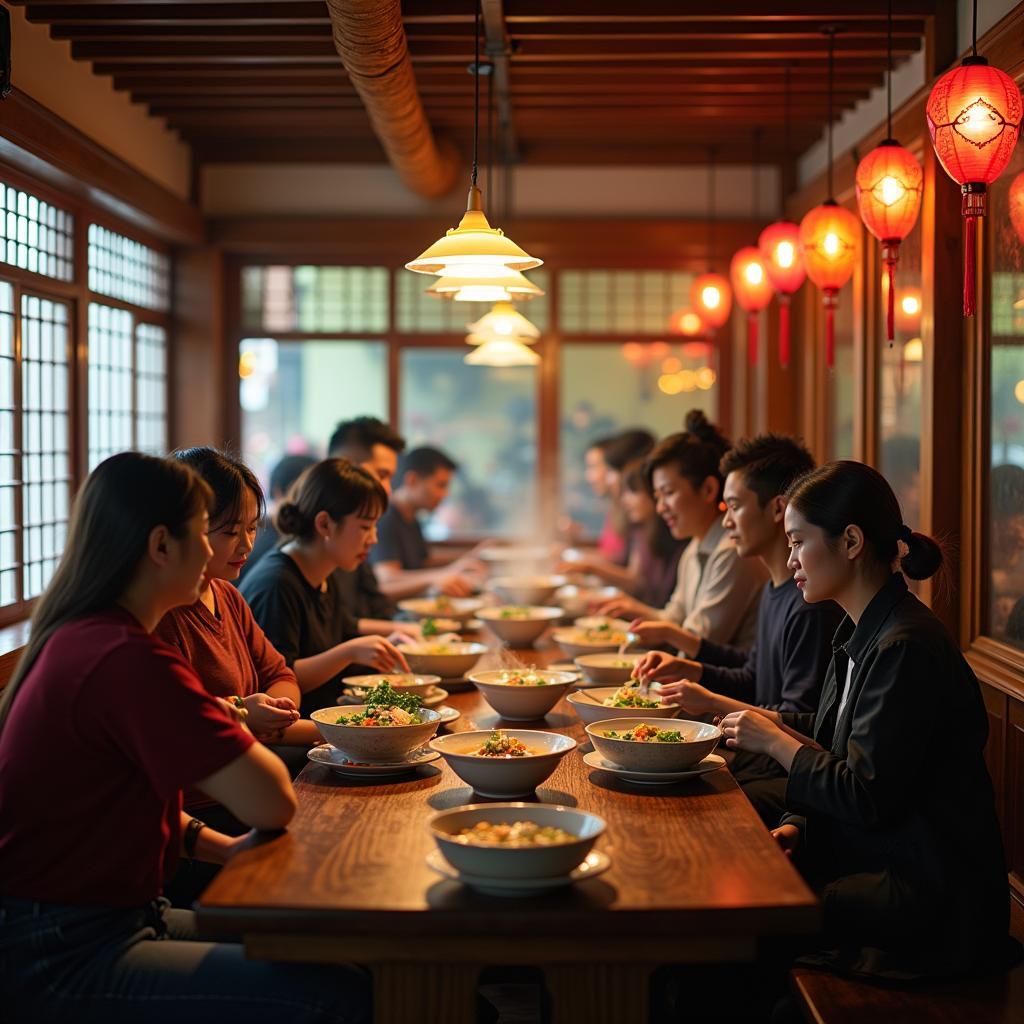 Nhà hàng gia đình ấm cúng với không khí thân thiện và món ăn truyền thống Việt Nam đậm chất gia đình
Question: Did you enjoy eating out when you were a child?
🎯 Cách tiếp cận:
- Sử dụng thì quá khứ consistently
- Miêu tả memories cụ thể
- So sánh với hiện tại nếu có thể
📝 Sample Answer – Band 6-7:
“Yes, I really enjoyed it. My parents took me to restaurants on special occasions like birthdays. I remember I always ordered fried chicken and French fries because they were my favorite foods when I was young.”
Phân tích:
- Điểm mạnh: Thì quá khứ chính xác, có specific memory
- Hạn chế: Thiếu emotional language, description chưa vivid
- Tại sao Band 6-7: Adequate response nhưng lacks depth và descriptive language
📝 Sample Answer – Band 8-9:
“Absolutely! Eating out was quite a treat when I was younger since my family didn’t do it very often. I have fond memories of going to this local hotpot restaurant where we’d gather around the bubbling pot and cook our own food. What made it particularly memorable was the sense of occasion – we’d only go there for milestone celebrations like exam results or family reunions. Looking back, I think those experiences shaped my appreciation for communal dining and instilled in me a love for trying different cuisines.”
Phân tích:
- Điểm mạnh: Vivid description với sensory details (bubbling pot), emotional connection (fond memories, sense of occasion), reflective ending cho thấy mature thinking
- Tại sao Band 8-9: Sophisticated vocabulary, complex sentences với relative clauses, shows ability to reflect on past experiences và link đến present values
💡 Key Vocabulary & Expressions:
- quite a treat: một điều đặc biệt, xa xỉ
- fond memories: những kỷ niệm đẹp
- gather around: tụ tập quanh
- sense of occasion: cảm giác đặc biệt của dịp lễ
- shaped my appreciation: hình thành sự trân trọng của tôi
- instilled in me: thấm nhuần vào tôi
IELTS Speaking Part 2: Long Turn (Cue Card)
Tổng Quan Về Part 2
Part 2 là phần độc thoại kéo dài 2-3 phút, trong đó bạn có 1 phút chuẩn bị để ghi chú. Đây là phần quan trọng nhất để thể hiện khả năng nói liền mạch và tổ chức ý tưởng logic. Với chủ đề restaurant, bạn cần cân bằng giữa description (miêu tả địa điểm, món ăn) và evaluation (cảm nhận, đánh giá).
Chiến lược quan trọng:
- Sử dụng hết 1 phút để ghi chú keywords, không viết câu hoàn chỉnh
- Nói tối thiểu 2 phút – examiners đánh giá cao sustained speech
- Trả lời đầy đủ tất cả bullet points, đặc biệt câu “explain why” là cơ hội ghi điểm
- Sử dụng thì quá khứ nếu mô tả trải nghiệm cụ thể, hiện tại nếu nói về đặc điểm chung
Lỗi thường gặp:
- Không tận dụng thời gian chuẩn bị, vội vàng bắt đầu
- Nói dưới 1.5 phút rồi im lặng chờ examiner
- Bỏ qua bullet point cuối cùng (thường là phần quan trọng nhất)
- Miêu tả quá chung chung, thiếu specific details
Cue Card
Describe A Famous Restaurant In Your City
You should say:
- Where it is located
- What kind of food it serves
- What the restaurant looks like
- And explain why it is famous
Phân Tích Đề Bài
- Dạng câu hỏi: Describe a place (restaurant) – đòi hỏi description skills
- Thì động từ: Hiện tại đơn (vì restaurant vẫn tồn tại) hoặc quá khứ (nếu bạn muốn focus vào một lần đến cụ thể)
- Bullet points phải cover:
- Location: Địa chỉ cụ thể, vị trí trong thành phố
- Food type: Món ăn đặc trưng, phong cách ẩm thực
- Appearance: Kiến trúc, trang trí, không khí
- Reason for fame: Đây là phần quan trọng nhất – cần elaborate nhiều
- Câu “explain” quan trọng: Phần này chiếm 40-50% câu trả lời, nơi bạn phân tích, đưa ra opinions và showcase vocabulary range
📝 Sample Answer – Band 6-7
Thời lượng: Khoảng 1.5-2 phút
“I’d like to talk about Pho Thin, which is a very famous restaurant in Hanoi. It’s located on Lo Duc Street in the Old Quarter, which is the historic center of the city. The restaurant is quite easy to find because it’s on a busy street.
The restaurant specializes in beef noodle soup, which we call pho in Vietnam. They only serve one dish, which is pho with stir-fried beef. The beef is cooked in a special way that makes it very tasty. They also give you fresh herbs and lime on the side.
The restaurant is quite small and simple. It has about ten tables and the decoration is very basic. The walls are painted white and there are some old photos hanging on them. It’s usually very crowded, especially at lunch time, so you might have to wait for a table.
This restaurant is famous for several reasons. First, it has been operating for more than 30 years, so many people trust the quality. Second, the taste is really good and consistent. Every time I go there, the pho tastes the same. Third, many famous people and foreign tourists visit this place, which makes it more popular. I think the combination of good food, reasonable prices, and traditional cooking methods makes it famous in Hanoi.”
Phân Tích Band Điểm
| Tiêu chí | Band | Nhận xét |
|---|---|---|
| Fluency & Coherence | 6.5 | Nói liền mạch, có sequencing (First, Second, Third) nhưng còn đơn giản. Một số hesitation nhẹ. |
| Lexical Resource | 6.5 | Vocabulary adequate (historic center, stir-fried, consistent) nhưng còn basic. Có một số collocations tốt nhưng chưa nhiều. |
| Grammatical Range & Accuracy | 6.5 | Sử dụng relative clauses đơn giản, passive voice cơ bản. Mostly simple và compound sentences. |
| Pronunciation | 7.0 | Clear và understandable với good sentence stress. |
Điểm mạnh:
- ✅ Cover đầy đủ tất cả bullet points
- ✅ Có structure rõ ràng với sequencing
- ✅ Đưa ra nhiều lý do cho fame
- ✅ Thời lượng đủ 2 phút
Hạn chế:
- ⚠️ Vocabulary còn basic và repetitive (famous, good, very)
- ⚠️ Thiếu sensory descriptions (smell, atmosphere, sounds)
- ⚠️ Grammar structures chưa đa dạng, ít complex sentences
- ⚠️ Personal feelings chưa được express sâu sắc
📝 Sample Answer – Band 7.5-8
Thời lượng: Khoảng 2-2.5 phút
“I’d like to describe The Gourmet Corner, which is arguably one of the most renowned restaurants in Ho Chi Minh City. It’s strategically situated in the heart of District 1, right on Nguyen Hue Walking Street, making it incredibly accessible for both locals and tourists.
This establishment is celebrated for its contemporary Vietnamese cuisine with a modern twist. What sets it apart is how they elevate traditional dishes using premium ingredients and innovative presentation techniques. Their signature dish is slow-cooked caramelized pork served in a clay pot, which perfectly balances sweet and savory flavors. They also offer an extensive menu featuring regional specialties from North to South Vietnam.
In terms of aesthetics, the restaurant is absolutely stunning. The interior features a harmonious blend of traditional Vietnamese elements and modern design. Exposed brick walls are adorned with contemporary Vietnamese art, while suspended lanterns cast a warm, ambient glow throughout the space. The open kitchen concept allows diners to watch chefs at work, adding an element of theater to the dining experience. The restaurant spans three floors, with the rooftop area offering panoramic views of the city skyline.
Now, regarding why it’s become so famous, there are several factors. Firstly, it has garnered numerous accolades, including being featured in the Michelin Guide. Additionally, its chef, who trained in France, has built quite a reputation for championing local ingredients while applying French techniques. The restaurant has also become a social media sensation thanks to its Instagram-worthy presentations. Personally, I think what really distinguishes this place is the meticulous attention to detail in every aspect, from the impeccable service to the artfully plated dishes. It’s not just about eating; it’s about experiencing Vietnamese culture through a refined culinary lens.”
Phân Tích Band Điểm
| Tiêu chí | Band | Nhận xét |
|---|---|---|
| Fluency & Coherence | 7.5-8 | Nói mạch lạc với clear progression. Sử dụng discourse markers hiệu quả (In terms of, Now regarding, Additionally). Minimal hesitation. |
| Lexical Resource | 8.0 | Wide range với sophisticated vocabulary (renowned, strategically situated, garnered accolades). Natural collocations (perfectly balances, meticulous attention). |
| Grammatical Range & Accuracy | 7.5 | Complex structures với relative clauses, participle clauses. Tuy nhiên chưa có inversion hoặc conditional phức tạp. |
| Pronunciation | 8.0 | Clear với varied intonation patterns. Good use of sentence stress. |
So Sánh Với Band 6-7
| Khía cạnh | Band 6-7 | Band 7.5-8 |
|---|---|---|
| Vocabulary | “famous restaurant” / “very tasty” | “renowned establishment” / “perfectly balances sweet and savory flavors” |
| Grammar | “It’s located on Lo Duc Street” | “strategically situated in the heart of District 1” (participle phrase) |
| Ideas | “The decoration is very basic” | “harmonious blend of traditional Vietnamese elements and modern design” with specific examples |
| Description | General statements | Sensory details (ambient glow, panoramic views) |
Tương tự như khi describe a time when you visited an exhibition, việc sử dụng các chi tiết cảm quan và miêu tả cụ thể sẽ giúp câu trả lời của bạn sinh động và ấn tượng hơn rất nhiều.
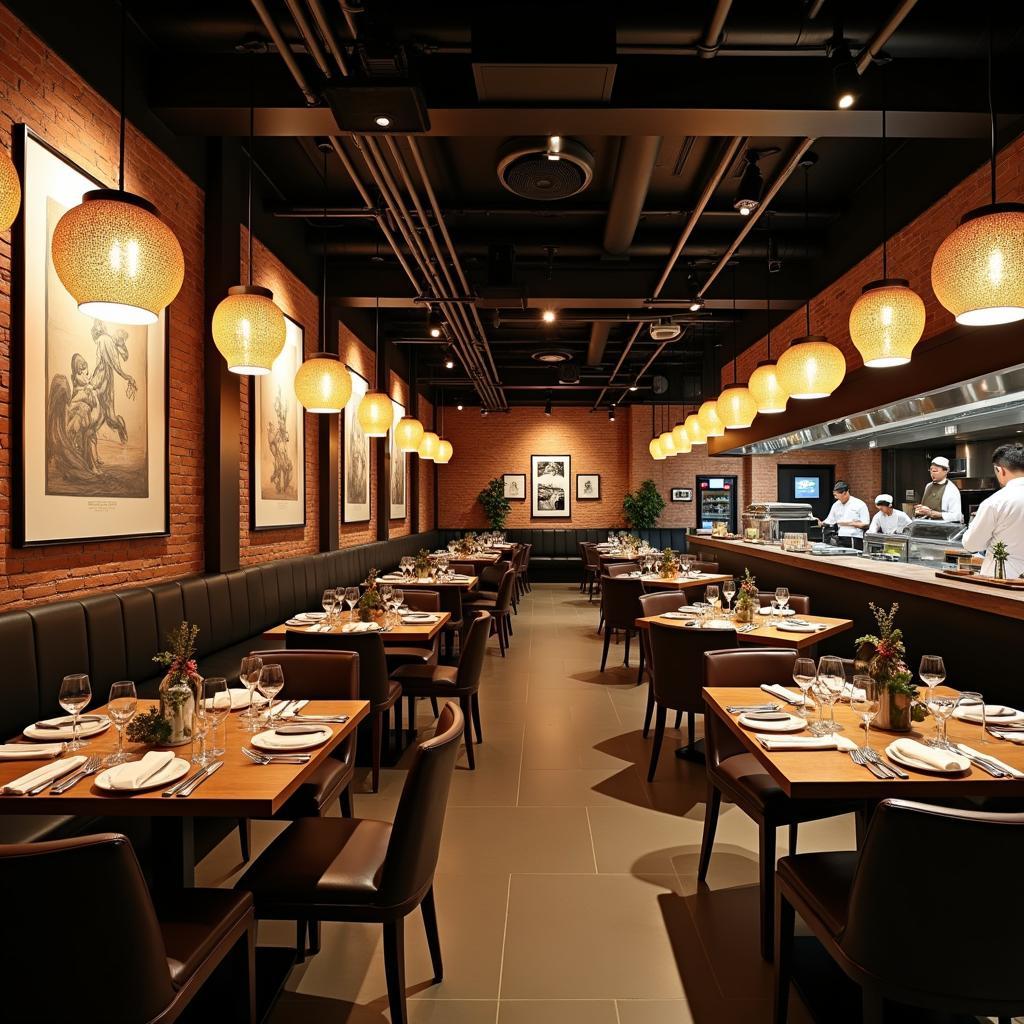 Nhà hàng hiện đại với thiết kế pha trộn yếu tố truyền thống Việt Nam và phong cách đương đại sang trọng
📝 Sample Answer – Band 8.5-9
Thời lượng: 2.5-3 phút đầy đủ
“I’d like to talk about Madame Hien, which has become something of a culinary institution in Hanoi’s dining scene. This restaurant is nestled in the French Quarter, specifically on Chan Cam Street, a stone’s throw from Hoan Kiem Lake, which lends itself to a particularly charming location steeped in colonial history.
What makes this establishment truly exceptional is its unwavering commitment to preserving authentic Vietnamese flavors while catering to modern palates. The restaurant specializes in what I’d call heritage cuisine – dishes that have been passed down through generations but are now rarely found in contemporary Hanoi. Their menu is a culinary journey through Northern Vietnamese gastronomy, featuring dishes like grilled fish in banana leaf, fermented pork roll, and my personal favorite, Vietnamese beef tartare known as ‘bo tai chanh’. What’s particularly noteworthy is their meticulous sourcing – they work exclusively with local farmers and have established direct partnerships to ensure the utmost freshness and traceability of ingredients.
Architecturally speaking, the restaurant is housed in a beautifully restored French colonial villa, which exudes old-world elegance. The moment you step through the doors, you’re transported back to 1930s Indochina. The interior showcases ornate wooden fixtures, vintage tile flooring, and period furniture that has been lovingly maintained. Soft lighting emanates from antique fixtures, creating an intimate, almost nostalgic ambiance. The pièce de résistance is their garden courtyard, where tropical greenery intertwines with weathered brick walls, offering a secluded oasis in the bustling city center. Adding to the authenticity, servers wear traditional ao dai, and classic Vietnamese music plays softly in the background.
As for why it’s achieved such prominence, I’d argue it’s multifaceted. On one hand, it has received critical acclaim from food critics internationally, being featured in publications like the New York Times and Condé Nast Traveler. Beyond the accolades, though, I think its fame stems from its ability to strike a delicate balance between honoring tradition and meeting contemporary expectations of service and presentation. The owner, Madame Hien herself, has become a custodian of Hanoian food culture, and her personal narrative – having fled Vietnam and returned decades later – resonates deeply with many diners. Furthermore, in an era where many restaurants opt for fusion concepts, Madame Hien’s steadfast dedication to authenticity has made it stand out as a beacon of cultural preservation. What strikes me most is how they’ve managed to maintain their standards despite their success – there’s no hint of commercialization or compromise on quality. It’s this integrity that has cemented its reputation as not just a famous restaurant, but a cultural landmark in Hanoi.”
Phân Tích Band Điểm
| Tiêu chí | Band | Nhận xét |
|---|---|---|
| Fluency & Coherence | 9.0 | Completely fluent với sophisticated discourse markers (Architecturally speaking, Beyond the accolades, Furthermore). Ideas logically sequenced và fully developed. |
| Lexical Resource | 9.0 | Precise, sophisticated, natural (culinary institution, nestled, unwavering commitment). Wide range of idiomatic language (a stone’s throw from, pièce de résistance). |
| Grammatical Range & Accuracy | 9.0 | Full range of structures including participle clauses, relative clauses, passive forms, cleft sentences. Error-free. |
| Pronunciation | 9.0 | Fully operational command với sustained appropriate intonation. |
Tại Sao Bài Này Xuất Sắc
🎯 Fluency Hoàn Hảo:
- Không có hesitation, ideas flow naturally từ location → food → appearance → reasons for fame
- Sử dụng sophisticated discourse markers để connect ideas seamlessly
- Sustained speech trong 2.5+ phút without repetition
📚 Vocabulary Tinh Vi:
- “something of a culinary institution” – phrase này sophisticated hơn nhiều so với “famous restaurant”, cho thấy native-like expression
- “steeped in colonial history” – collocation mạnh mẽ thay vì “has a lot of history”
- “unwavering commitment” – precise adjective thể hiện dedication
- “pièce de résistance” – French borrowing cho thấy vocabulary breadth
- “cemented its reputation” – strong collocation
📝 Grammar Đa Dạng:
- Participle clauses: “nestled in the French Quarter”, “housed in a beautifully restored villa”
- Relative clauses: “dishes that have been passed down through generations”
- Cleft sentences: “What strikes me most is how they’ve managed…”
- Passive constructions: “servers wear traditional ao dai”
- Complex conditionals implied trong argument structure
💡 Ideas Sâu Sắc:
- Không chỉ describe bề mặt mà analyze deeper meaning (cultural preservation, owner’s personal narrative)
- Show critical thinking: “strike a delicate balance”, “multifaceted reasons”
- Personal reflection: “What strikes me most”
- Social commentary: contrast với fusion trend
Giống như khi describe a person who has positively influenced your life, việc kết hợp story-telling với personal reflection sẽ tạo nên một câu trả lời có chiều sâu và đầy cảm xúc.
Follow-up Questions (Rounding Off Questions)
Sau Part 2, examiner thường hỏi 1-2 câu ngắn để transition sang Part 3:
Question 1: Have you been to this restaurant recently?
Band 6-7 Answer:
“Yes, I went there about two months ago with my family. We had a great time and the food was delicious as usual.”
Band 8-9 Answer:
“Actually, I was there just last month for a friend’s birthday celebration. It never fails to impress – the quality has remained consistently high over the years, which is quite a testament to their unwavering standards.”
Question 2: Would you recommend this restaurant to visitors?
Band 6-7 Answer:
“Yes, definitely. I think foreign visitors would enjoy the authentic Vietnamese food and the beautiful atmosphere.”
Band 8-9 Answer:
“Absolutely, I’d recommend it wholeheartedly, especially to visitors who are keen to experience authentic Vietnamese cuisine in an atmospheric setting. It offers a genuine taste of our culinary heritage without the tourist-trap feel that some places have.”
IELTS Speaking Part 3: Two-way Discussion
Tổng Quan Về Part 3
Part 3 kéo dài 4-5 phút với các câu hỏi trừu tượng và sâu sắc hơn về chủ đề restaurants, food culture, và hospitality industry. Đây là phần khó nhất vì yêu cầu analytical thinking, ability to discuss broader issues, và express opinions với justification rõ ràng.
Yêu cầu cao hơn Part 1 và 2:
- Phân tích causes/effects của social phenomena
- So sánh past/present hoặc different perspectives
- Đưa ra predictions về future trends
- Evaluate advantages/disadvantages
- Express personal views nhưng acknowledge other viewpoints
Chiến lược hiệu quả:
- Mở rộng câu trả lời thành 4-6 câu (longer than Part 1)
- Sử dụng discourse markers để structure ideas (Well, I think, On the one hand…)
- Đưa ra examples từ society, không chỉ personal experience
- Thừa nhận complexity: “It’s a complex issue”, “There’s no simple answer”
- Sử dụng tentative language để sound diplomatic: “I’d say”, “It seems to me”
Lỗi thường gặp của học viên Việt Nam:
- Trả lời quá ngắn, thiếu elaboration
- Chỉ nói về personal experience thay vì broader context
- Thiếu từ vựng abstract và academic
- Không justify opinions với clear reasoning
- Avoid controversial topics thay vì discuss diplomatically
Các Câu Hỏi Thảo Luận Sâu
Theme 1: Changes in Dining Culture
Question 1: How have restaurants changed in your country over the past decade?
🎯 Phân tích câu hỏi:
- Dạng: Compare past and present – yêu cầu contrast và explain changes
- Key words: “changed”, “over the past decade” – focus vào transformation
- Cách tiếp cận: Identify 2-3 major changes → explain causes → mention impact
📝 Sample Answer – Band 6-7:
“Restaurants in Vietnam have changed a lot in the last ten years. Before, most restaurants were traditional and served only Vietnamese food. Now, we have many international restaurants like Japanese, Korean, and Western food. Also, the service has improved a lot. Restaurants now have better decoration and more comfortable seating. I think this happened because Vietnam’s economy has grown and people have more money to spend on dining out.”
Phân tích:
- Structure: Has comparison và identifies changes nhưng somewhat superficial
- Vocabulary: Basic (changed a lot, improved a lot, better)
- Tại sao Band 6-7: Communicates ideas clearly nhưng lacks sophistication và depth
📝 Câu trả lời mẫu – Band 8-9:
“Well, the restaurant landscape in Vietnam has undergone a dramatic transformation over the past decade, I’d say. Most notably, there’s been a proliferation of international cuisines – we’ve seen everything from authentic Italian trattorias to Korean BBQ joints spring up across major cities. But beyond just diversity, what’s really changed is the entire dining paradigm. Gone are the days when eating out was purely functional; nowadays, it’s become an experience-driven activity. Restaurants have elevated their game in terms of ambiance, service standards, and culinary innovation.
I’d attribute these changes to several interconnected factors. Primarily, Vietnam’s burgeoning middle class has cultivated more sophisticated palates and higher expectations for service quality. Coupled with increased exposure to global food trends through social media and travel, diners are now seeking novel experiences rather than just sustenance. Moreover, the influx of foreign investment in the hospitality sector has introduced international standards and best practices. What’s particularly interesting is how many Vietnamese chefs who trained abroad have returned home, bringing cutting-edge techniques while staying rooted in local ingredients – this has sparked a sort of culinary renaissance.”
Phân tích:
- Structure: Clear organization: identify changes → explain causes → analyze impact. Uses signposting effectively.
- Vocabulary: Sophisticated và precise (undergone transformation, proliferation, burgeoning middle class, culinary renaissance)
- Grammar: Complex structures including inversions (Gone are the days), participle clauses, passive constructions
- Critical Thinking: Connects economic development → changing consumer behavior → industry transformation. Shows nuanced understanding.
💡 Key Language Features:
- Discourse markers: Well, Most notably, Beyond just, Moreover, What’s particularly interesting
- Tentative language: I’d say, I’d attribute these changes to
- Abstract nouns: transformation, proliferation, paradigm, renaissance, sophistication
- Strong collocations: undergo transformation, cultivate palates, influx of investment, spark a renaissance
Question 2: Why do you think some restaurants become popular while others fail?
🎯 Phân tích câu hỏi:
- Dạng: Cause and effect analysis – explain reasons for success/failure
- Key words: “become popular”, “fail” – contrast hai extremes
- Cách tiếp cận: Identify multiple factors → prioritize most important → acknowledge complexity
📝 Sample Answer – Band 6-7:
“I think restaurants become popular because of good food and good service. If the food is delicious and the price is reasonable, people will come back. Also, location is important. Restaurants in busy areas get more customers. Some restaurants fail because the food is not good or the service is bad. Sometimes the prices are too high and people don’t want to pay.”
Phân tích:
- Structure: Lists reasons nhưng chưa prioritize hoặc analyze deeply
- Vocabulary: Repetitive (good, bad) và simplistic
- Tại sao Band 6-7: Addresses question nhưng lacks sophistication
📝 Câu trả lời mẫu – Band 8-9:
“Well, restaurant success is multifaceted and hinges on numerous variables, but I’d argue that certain factors are paramount. First and foremost, it’s about delivering consistent quality – not just in food, but in the overall dining experience. Successful restaurants have mastered the art of meeting or exceeding customer expectations time and time again. This consistency breeds trust and cultivates loyal patronage.
Beyond the fundamentals, though, I think what separates thriving establishments from failing ones is their ability to adapt and innovate. The restaurant industry is notoriously competitive and subject to rapidly shifting trends. Establishments that rest on their laurels or fail to evolve with changing consumer preferences often find themselves struggling. Conversely, successful restaurants stay attuned to market dynamics – they refresh their menus, embrace new dining concepts, and leverage technology for reservations and marketing.
Another critical factor is brand positioning and marketing savvy. In today’s digital age, restaurants need a strong social media presence and positive online reviews. Those that neglect their digital footprint or fail to engage with customers online are at a distinct disadvantage. Having said that, I should mention that sometimes failure has little to do with quality and more to do with factors like poor financial management or unsustainable business models. It’s rarely just one thing – usually it’s a confluence of factors that determines whether a restaurant thrives or merely survives.”
Phân tích:
- Structure: Multi-layered analysis: fundamental factors → differentiation → modern considerations → acknowledge complexity
- Vocabulary: Precise và varied (multifaceted, paramount, cultivates patronage, rest on laurels, confluence of factors)
- Grammar: Complex conditionals, relative clauses, participle phrases
- Critical Thinking: Shows ability to prioritize factors, consider multiple perspectives, acknowledge that success is complex
💡 Key Language Features:
- Emphasis structures: First and foremost, What separates…from, Another critical factor
- Contrast markers: Conversely, Having said that, Beyond the fundamentals
- Hedging language: I’d argue, I think, usually, rarely just one thing
- Sophisticated expressions: hinges on, breeds trust, rest on laurels, at a distinct disadvantage
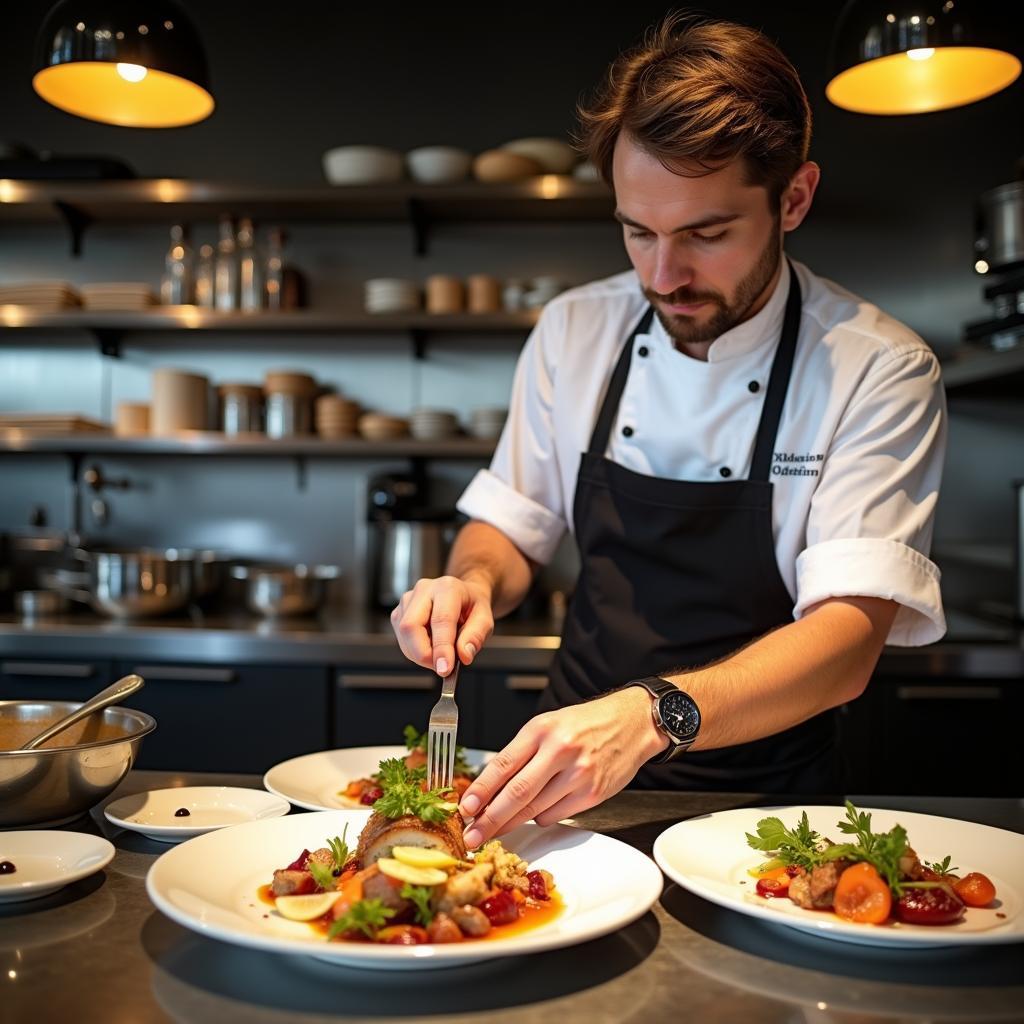 Đầu bếp chuyên nghiệp trong nhà hàng cao cấp đang tỉ mỉ chế biến món ăn với nguyên liệu tươi ngon
Theme 2: Food Quality and Health
Question 3: Do you think people are more health-conscious when choosing restaurants nowadays?
🎯 Phân tích câu hỏi:
- Dạng: Opinion + trend analysis
- Key words: “health-conscious”, “nowadays” – compare với past
- Cách tiếp cận: State opinion → provide evidence → acknowledge exceptions
📝 Sample Answer – Band 6-7:
“Yes, I think people care more about health now when they eat out. Many restaurants now offer healthy options like salads and organic food. People also check the ingredients and avoid restaurants that use too much oil or MSG. However, some people still prefer tasty food even if it’s not very healthy.”
Phân tích:
- Structure: Direct answer với basic reasoning và acknowledges alternative view
- Vocabulary: Basic (care about, healthy options, tasty food)
- Tại sao Band 6-7: Clear communication nhưng lacks depth và sophisticated language
📝 Câu trả lời mẫu – Band 8-9:
“Absolutely, and I’d say this shift is quite pronounced, especially among urban demographics. There’s been a marked increase in health awareness, and this is reflected in dining choices. We’re seeing a surge in demand for restaurants that offer nutritionally transparent menus, organic ingredients, and dietary-specific options like vegan, gluten-free, or low-carb alternatives. Many establishments now prominently display calorie counts and source information, which would have been virtually unheard of a decade ago.
That said, I think we need to distinguish between different consumer segments. While it’s true that health consciousness has permeated mainstream dining culture, it’s particularly prominent among younger, more affluent demographics who have both the awareness and the means to prioritize health. For other segments – say, value-conscious consumers or those dining for pure indulgence – taste and price often trump health considerations.
What’s interesting is how the restaurant industry has capitalized on this trend. Even fast-food chains have pivoted toward offering healthier alternatives, though whether this is genuine commitment or mere marketing is debatable. I’d argue it’s probably a bit of both – restaurants recognize that appeasing health-conscious consumers is not just ethical but also commercially viable. Ultimately, while health consciousness is definitely on an upward trajectory, we’re still a far cry from it being the predominant factor in most people’s restaurant choices.”
Phân tích:
- Structure: Affirmative answer → provide evidence → nuance về different demographics → industry response → balanced conclusion
- Vocabulary: Sophisticated (pronounced, permeated, trump, capitalized on, upward trajectory)
- Grammar: Complex structures với concessive clauses (While it’s true that…), embedded questions (whether this is…)
- Critical Thinking: Acknowledges complexity, distinguishes between demographics, questions motives, provides balanced view
💡 Key Language Features:
- Strong affirmation: Absolutely, quite pronounced, marked increase
- Qualifying language: That said, While it’s true that, Ultimately
- Academic expressions: distinguish between, permeated mainstream culture, commercially viable
- Metaphorical language: on an upward trajectory, a far cry from
Cũng giống như describe an event that made you laugh a lot, việc cân bằng giữa personal feelings và broader social observations sẽ làm cho câu trả lời phong phú hơn.
Theme 3: Economic and Social Impact
Question 4: What impact do you think the restaurant industry has on a city’s economy?
🎯 Phân tích câu hỏi:
- Dạng: Analyze impact – cause and effect
- Key words: “impact”, “economy” – discuss economic implications
- Cách tiếp cận: Identify multiple impacts → explain mechanisms → consider broader effects
📝 Sample Answer – Band 6-7:
“The restaurant industry is very important for a city’s economy. It creates many jobs for people like cooks, waiters, and managers. Restaurants also pay taxes to the government, which helps the city. When tourists visit, they spend money at restaurants, which brings more income to the city. So I think restaurants help the economy grow.”
Phân tích:
- Structure: Lists impacts straightforwardly
- Vocabulary: Basic economic terms (jobs, taxes, income)
- Tại sao Band 6-7: Addresses question adequately but lacks sophisticated analysis
📝 Câu trả lời mẫu – Band 8-9:
“The restaurant industry’s economic footprint is actually far more substantial than many people realize – it functions as a cornerstone of urban economies in multiple, interconnected ways. Most obviously, it’s a significant employment generator, creating jobs across various skill levels from entry-level positions to highly specialized culinary roles. But beyond direct employment, there’s also a substantial multiplier effect – restaurants drive demand for agricultural produce, beverages, equipment, and professional services, thereby sustaining entire supply chains.
From a revenue perspective, the industry contributes substantially to municipal coffers through taxes, licenses, and fees. Perhaps more importantly, successful restaurant scenes enhance a city’s appeal as both a tourist destination and a desirable place to live and work. Cities with vibrant dining cultures – think Melbourne or San Francisco – often command higher property values and attract talent from other regions, creating a virtuous economic cycle.
There’s also a cultural and social dimension that has economic implications. Restaurants serve as community gathering spaces and cultural ambassadors – they can revitalize neighborhoods, spur gentrification (for better or worse), and put cities on the global map. Copenhagen, for instance, leveraged its restaurant scene to transform its international profile.
On the flip side, we should acknowledge potential downsides. Over-reliance on hospitality can create economic vulnerability, as we saw during the COVID-19 pandemic when restaurants were severely impacted. There are also concerns about wage inequality and job security in the sector. So while the economic impact is generally positive and substantial, it’s not without its complications.”
Phân tích:
- Structure: Multi-dimensional analysis: direct impact → multiplier effects → broader economic benefits → cultural aspects → potential downsides
- Vocabulary: Economic terminology (economic footprint, multiplier effect, municipal coffers, virtuous cycle)
- Grammar: Complex structures including participle phrases, relative clauses, as-clauses
- Critical Thinking: Goes beyond obvious impacts, provides specific examples (Melbourne, Copenhagen), acknowledges complexity and potential negatives
💡 Key Language Features:
- Academic expressions: economic footprint, multiplier effect, sustaining supply chains, virtuous cycle
- Emphasis: far more substantial, Most obviously, Perhaps more importantly
- Contrast: On the flip side, for better or worse
- Hedging: actually, generally, not without its complications
Question 5: Do you think traditional restaurants will survive in the future?
🎯 Phân tích câu hỏi:
- Dạng: Prediction about future – speculation với reasoning
- Key words: “traditional”, “survive”, “future” – discuss sustainability
- Cách tiếp cận: Make prediction → identify challenges → discuss adaptation strategies
📝 Sample Answer – Band 6-7:
“I think traditional restaurants will survive but they need to change. Young people today like modern restaurants with new styles. Traditional restaurants need to use social media to attract customers. They also need to improve their service. If they can do these things, they will survive. Some traditional restaurants are already doing well because they keep their traditional food but update their decoration and marketing.”
Phân tích:
- Structure: Makes prediction với some supporting points
- Vocabulary: Basic (survive, change, do well, update)
- Tại sao Band 6-7: Adequate response with some development but lacks sophistication
📝 Câu trả lời mẫu – Band 8-9:
“Well, I’d say the outlook for traditional restaurants is rather nuanced and depends largely on their ability to strike a balance between preserving authenticity and embracing necessary evolution. In my view, they’ll certainly survive, but perhaps in a more selective capacity – we’ll likely see a bifurcation where some successfully carve out niche markets while others fall by the wayside.
The key challenge traditional establishments face is remaining relevant in an era of rapidly shifting consumer preferences and disruptive technologies. Younger generations, in particular, are drawn to novelty and innovation, and they wield considerable influence through social media. However – and this is crucial – there’s also a growing counter-trend of people seeking authentic, heritage experiences. In an increasingly homogenized world, traditional restaurants offer something that chains and modern eateries can’t replicate: a genuine connection to cultural roots and culinary history.
For traditional restaurants to thrive, I think they need to adopt a dual strategy. On one hand, they must stay true to what makes them special – the time-honored recipes, traditional cooking methods, and familial atmosphere that define them. On the other hand, they need to modernize aspects of their operations – implementing digital ordering systems, maintaining an active social media presence, and perhaps refining their ambiance to appeal to contemporary aesthetics without sacrificing authenticity.
There are encouraging precedents. Look at how many traditional Japanese izakayas or French bistros have successfully bridged old and new, or how family-run Vietnamese restaurants have garnered international acclaim while staying rooted in tradition. What distinguishes survivors from casualties will be adaptability and the ability to articulate their value proposition to new generations.
Ultimately, I’m cautiously optimistic. While not all will make it, those that approach tradition as a living practice rather than a museum piece – that evolve thoughtfully while honoring their essence – have every chance of not just surviving but thriving in tomorrow’s dining landscape.”
Phân tích:
- Structure: Nuanced prediction → challenges → counter-trends → strategies for survival → examples → optimistic conclusion
- Vocabulary: Sophisticated (nuanced, bifurcation, wield influence, homogenized, time-honored, value proposition)
- Grammar: Full range including conditionals, relative clauses, participle phrases, cleft sentences (What distinguishes…)
- Critical Thinking: Acknowledges complexity, considers multiple perspectives, provides specific examples, offers balanced prediction with conditions
💡 Key Language Features:
- Hedging: I’d say, rather nuanced, depends largely on, likely, perhaps, cautiously optimistic
- Contrast structures: On one hand…On the other hand, While not all will make it
- Sophisticated expressions: fall by the wayside, carve out niche markets, strike a balance, bridge old and new
- Emphasis through structure: However – and this is crucial, What distinguishes…will be
Đối với những ai quan tâm đến việc phát triển kỹ năng đưa ra dự đoán trong IELTS Speaking, describe a difficult decision you had to make cũng là một chủ đề tuyệt vời để luyện tập việc cân nhắc nhiều yếu tố trước khi đưa ra kết luận.
Theme 4: Service and Customer Experience
Question 6: How important is customer service in the restaurant business?
🎯 Phân tích câu hỏi:
- Dạng: Evaluate importance – discuss significance
- Key words: “how important”, “customer service”
- Cách tiếp cận: Assert importance → explain why → provide examples → acknowledge limitations
📝 Sample Answer – Band 6-7:
“Customer service is very important in restaurants. If the service is bad, customers won’t come back even if the food is good. Good service means friendly staff, fast service, and clean environment. When customers feel welcome, they enjoy their meal more and recommend the restaurant to friends. So restaurants should train their staff to provide good service.”
Phân tích:
- Structure: Direct answer với basic reasoning
- Vocabulary: Repetitive (good, bad, important)
- Tại sao Band 6-7: Clear but lacks depth và sophisticated language
📝 Câu trả lời mẫu – Band 8-9:
“I’d go so far as to say that customer service is absolutely paramount in the restaurant industry – in many cases, it’s the decisive factor that determines whether an establishment flourishes or flounders. Think about it this way: while food quality is obviously critical, the reality is that dining out is fundamentally a service experience. People aren’t just paying for sustenance; they’re paying for the entire sensory and emotional journey from the moment they walk through the door until they leave.
Exceptional service has the power to elevate even average food, whereas poor service can taint even the most exquisite cuisine. I’ve witnessed this firsthand – restaurants with mediocre food but impeccable service often outperform those with outstanding cuisine but lackluster hospitality. What’s at play here is that people form emotional connections with how they’re treated. Feeling valued, attended to, and respected creates positive associations that transcend the meal itself.
Moreover, in today’s digital landscape, customer service has taken on amplified significance. A single negative experience can go viral on social media and inflict substantial reputational damage, while consistently excellent service generates organic word-of-mouth marketing that money can’t buy. Restaurants with stellar service reputations often enjoy higher customer retention rates, premium pricing power, and greater resilience during economic downturns.
That being said, I should add a caveat: the definition of “good service” is somewhat subjective and culturally contingent. What constitutes attentive service in America might be considered intrusive in Japan. So while the importance of customer service is universal, its manifestation varies across contexts.
In essence, I’d argue that in an increasingly competitive market where food quality has become somewhat commoditized – meaning many places can produce decent food – customer service has emerged as the key differentiator and a crucial competitive advantage.”
Phân tích:
- Structure: Strong assertion → explain why → provide evidence → discuss modern implications → acknowledge cultural nuance → reinforce conclusion
- Vocabulary: Sophisticated (paramount, decisive factor, flourishes or flounders, lackluster, transcend, inflict damage, commoditized)
- Grammar: Complex structures including relative clauses, participle phrases, whereas-clauses, conditional implications
- Critical Thinking: Distinguishes between food and experience, considers digital age implications, acknowledges cultural variations, synthesizes multiple perspectives
💡 Key Language Features:
- Emphatic expressions: I’d go so far as to say, absolutely paramount, fundamentally
- Rhetorical devices: Think about it this way, What’s at play here
- Contrast: whereas, That being said, So while
- Academic style: has taken on amplified significance, somewhat subjective, culturally contingent
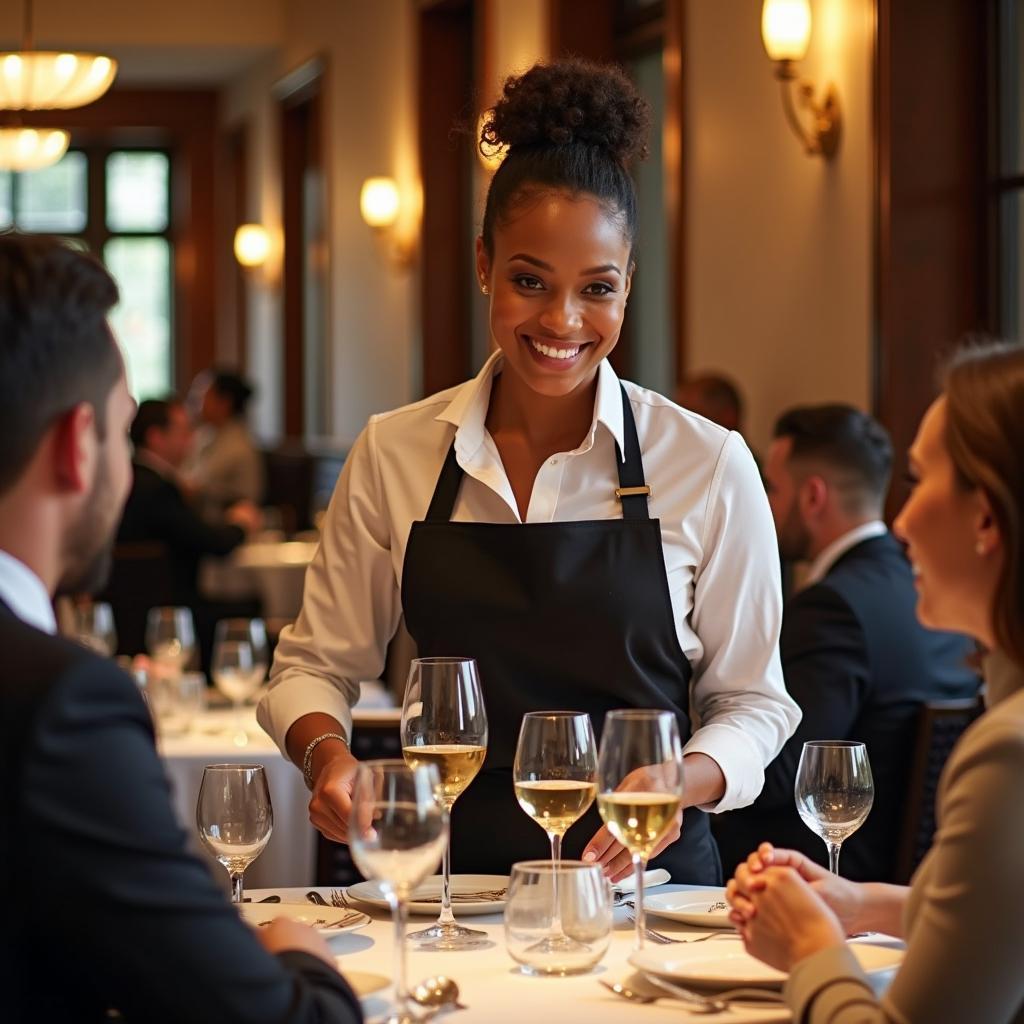 Nhân viên phục vụ nhà hàng chuyên nghiệp với thái độ thân thiện đang phục vụ khách hàng chu đáo
Từ vựng và cụm từ quan trọng
Topic-Specific Vocabulary
| Từ vựng/Cụm từ | Loại từ | Phiên âm | Nghĩa tiếng Việt | Ví dụ | Collocation |
|---|---|---|---|---|---|
| culinary | adj | /ˈkʌl.ɪ.ner.i/ | thuộc về ẩm thực | The restaurant offers a unique culinary experience. | culinary arts, culinary skills, culinary heritage, culinary excellence |
| ambiance/ambience | n | /ˈæm.bi.əns/ | không khí, bầu không khí | The restaurant has a romantic ambiance. | create an ambiance, cozy ambiance, elegant ambiance, intimate ambiance |
| establishment | n | /ɪˈstæb.lɪʃ.mənt/ | cơ sở kinh doanh, nhà hàng | This establishment has been serving customers for decades. | dining establishment, reputable establishment, family-run establishment |
| palate | n | /ˈpæl.ət/ | khẩu vị, vị giác | The dish appeals to sophisticated palates. | cultivate one’s palate, refined palate, sophisticated palate, suit different palates |
| renowned | adj | /rɪˈnaʊnd/ | nổi tiếng, có danh tiếng | It’s a renowned restaurant in the city. | internationally renowned, widely renowned, renowned for |
| signature dish | n phrase | /ˈsɪɡ.nə.tʃər dɪʃ/ | món ăn đặc trưng | Their signature dish is slow-cooked beef stew. | create a signature dish, famous signature dish, restaurant’s signature dish |
| gastronomic | adj | /ˌɡæs.trəˈnɒm.ɪk/ | thuộc về ẩm thực cao cấp | The city offers diverse gastronomic delights. | gastronomic experience, gastronomic journey, gastronomic excellence |
| patron | n | /ˈpeɪ.trən/ | khách hàng, thực khách | Regular patrons appreciate the consistent quality. | loyal patron, regular patron, attract patrons |
| savory | adj | /ˈseɪ.vər.i/ | mặn, có vị đậm đà (không ngọt) | They specialize in savory dishes. | savory flavors, savory dishes, perfectly savory |
| delicacy | n | /ˈdel.ɪ.kə.si/ | món ngon, đặc sản | The restaurant serves local delicacies. | local delicacy, regional delicacy, rare delicacy |
| exquisite | adj | /ɪkˈskwɪz.ɪt/ | tinh tế, tuyệt vời | The presentation was exquisite. | exquisite taste, exquisite cuisine, exquisite presentation |
| bustling | adj | /ˈbʌs.əl.ɪŋ/ | nhộn nhịp, tấp nập | The restaurant is always bustling with customers. | bustling atmosphere, bustling with activity |
| upscale | adj | /ˌʌpˈskeɪl/ | cao cấp, hạng sang | It’s an upscale dining venue. | upscale restaurant, upscale establishment, upscale clientele |
| eatery | n | /ˈiː.tər.i/ | quán ăn, nhà hàng (informal) | There’s a cozy eatery around the corner. | local eatery, popular eatery, casual eatery |
| fare | n | /feər/ | món ăn, thức ăn (formal) | The restaurant offers traditional fare. | traditional fare, local fare, excellent fare |
| venue | n | /ˈven.juː/ | địa điểm | It’s a popular venue for celebrations. | dining venue, popular venue, ideal venue |
| tantalizing | adj | /ˈtæn.təl.aɪ.zɪŋ/ | hấp dẫn, kích thích (về đồ ăn) | The tantalizing aroma fills the air. | tantalizing flavors, tantalizing menu, tantalizing dishes |
| contemporary | adj | /kənˈtem.pər.er.i/ | đương đại, hiện đại | They serve contemporary Vietnamese cuisine. | contemporary style, contemporary approach, contemporary dining |
| garnish | v/n | /ˈɡɑː.nɪʃ/ | trang trí món ăn | The dish is garnished with fresh herbs. | garnish with, beautifully garnished, simple garnish |
| impeccable | adj | /ɪmˈpek.ə.bəl/ | hoàn hảo, không tì vết | The service was impeccable. | impeccable service, impeccable standards, impeccable quality |
Idiomatic Expressions & Advanced Phrases
| Cụm từ | Nghĩa | Ví dụ sử dụng | Band điểm |
|---|---|---|---|
| a stone’s throw from | rất gần, ngay gần đó | The restaurant is a stone’s throw from the city center. | 7.5-9 |
| off the beaten path | ở nơi ít người biết, hẻo lánh | It’s a hidden gem off the beaten path. | 7.5-9 |
| worth every penny | xứng đáng với đồng tiền bỏ ra | The meal was expensive but worth every penny. | 7-8 |
| to die for | cực kỳ ngon, tuyệt vời | Their chocolate cake is to die for. | 7-8 |
| whet one’s appetite | kích thích sự thèm ăn | The appetizers really whetted our appetite. | 7.5-9 |
| a feast for the eyes | đẹp mắt, hấp dẫn về mặt thị giác | The presentation was a feast for the eyes. | 7.5-8.5 |
| melt in your mouth | tan chảy trong miệng (rất mềm) | The beef was so tender it melted in my mouth. | 7-8 |
| food for thought | điều đáng suy ngẫm | The chef’s innovative approach gives us food for thought. | 8-9 |
| wine and dine | chiêu đãi ân cần | They really wined and dined us. | 7-8 |
| hit the spot | thỏa mãn chính xác cái mình muốn | That hot soup really hit the spot on a cold day. | 7-8 |
| acquire a taste for | học cách thích một món gì đó | I’ve gradually acquired a taste for spicy food. | 7.5-9 |
| leave a bad taste in one’s mouth | để lại ấn tượng xấu | The poor service left a bad taste in my mouth. | 8-9 |
Discourse Markers (Từ Nối Ý Trong Speaking)
Để bắt đầu câu trả lời:
- 📝 Well,… – Khi cần thời gian suy nghĩ ngắn
- 📝 Actually,… – Khi đưa ra thông tin có thể bất ngờ hoặc contrast
- 📝 To be honest,… / Honestly,… – Khi chia sẻ quan điểm thật của mình
- 📝 I’d say that… – Cách mềm mại để đưa ra opinion
- 📝 From my perspective,… – Nhấn mạnh đây là góc nhìn cá nhân
Để bổ sung ý:
- 📝 On top of that,… – Thêm vào đó, hơn nữa
- 📝 What’s more,… – Hơn thế nữa
- 📝 Not to mention… – Chưa kể đến, không nói đến
- 📝 Besides that,… – Bên cạnh đó
- 📝 Moreover,… / Furthermore,… – Hơn nữa (formal hơn)
- 📝 In addition to that,… – Thêm vào đó
Để đưa ra quan điểm cân bằng:
- 📝 On the one hand,… On the other hand,… – Một mặt… mặt khác
- 📝 While it’s true that…, we also need to consider… – Mặc dù đúng là… nhưng ta cũng cần xem xét
- 📝 Having said that,… – Sau khi nói điều đó (để đưa ra ý ngược lại)
- 📝 That being said,… – Mặc dù vậy
- 📝 Then again,… – Nhưng mà, xét theo khía cạnh khác
Để kết luận:
- 📝 All in all,… – Tóm lại, nói chung
- 📝 At the end of the day,… – Cuối cùng thì, xét cho cùng
- 📝 Ultimately,… – Rút cuộc, sau cùng
- 📝 In essence,… – Về bản chất, nói tóm lại
- 📝 To sum up,… – Tóm lại (formal)
Để cho ví dụ:
- 📝 For instance,… – Ví dụ
- 📝 Take… for example – Lấy… làm ví dụ
- 📝 A good case in point is… – Một ví dụ điển hình là
- 📝 To illustrate this,… – Để minh họa điều này
Để làm rõ hoặc paraphrase:
- 📝 In other words,… – Nói cách khác
- 📝 What I mean is… – Ý tôi là
- 📝 To put it another way,… – Diễn đạt theo cách khác
- 📝 That is to say,… – Có nghĩa là
Grammatical Structures Ấn Tượng
1. Conditional Sentences (Câu điều kiện):
Mixed conditional:
- Formula: If + past perfect, would/could + bare infinitive
- Ví dụ: “If the restaurant had maintained its quality, it would still be popular today.”
Inversion (đảo ngữ):
- Formula: Had + S + past participle, S + would have + past participle
- Ví dụ: “Had they focused more on customer service, they wouldn’t have lost so many patrons.”
2. Relative Clauses (Mệnh đề quan hệ):
Non-defining relative clause:
- Formula: …, which/who/where + clause
- Ví dụ: “The restaurant, which has been operating for 50 years, maintains its traditional recipes.”
Reduced relative clause:
- Formula: …V-ing/V3
- Ví dụ: “Restaurants offering authentic cuisine tend to attract food enthusiasts.”
3. Passive Voice (Câu bị động):
Impersonal passive:
- It is thought/believed/said that…
- Ví dụ: “It is widely believed that service quality matters as much as food quality.”
Get passive (informal):
- Formula: get + past participle
- Ví dụ: “The restaurant got featured in a famous travel magazine.”
4. Cleft Sentences (Câu chẻ):
What-cleft:
- Formula: What + S + V + is/was…
- Ví dụ: “What I find most impressive is their commitment to sustainability.”
It-cleft:
- Formula: It + is/was + focus + that/who…
- Ví dụ: “It was the exceptional service that made the experience memorable.”
5. Participle Clauses:
Present participle:
- Formula: V-ing + object/complement
- Ví dụ: “Being located in the city center, the restaurant attracts many office workers.”
Past participle:
- Formula: V3 + (by…)
- Ví dụ: “Established in 1960, the restaurant has become a local institution.”
6. Inversion for Emphasis:
Negative inversion:
- Formula: Never/Rarely/Seldom + auxiliary + S + V
- Ví dụ: “Rarely have I encountered such impeccable service.”
So/Such inversion:
- Formula: So + adj + be + S + that…
- Ví dụ: “So popular is this restaurant that you need to book weeks in advance.”
7. Concessive Clauses (Mệnh đề nhượng bộ):
While/Whereas:
- Ví dụ: “While the food was excellent, the service left much to be desired.”
Despite/In spite of + noun/V-ing:
- Ví dụ: “Despite being expensive, the restaurant is always fully booked.”
Adjective + as/though + S + be:
- Ví dụ: “Popular as it is, the restaurant has managed to maintain its quality.”
Khi describe a time when you traveled with friends, việc sử dụng các cấu trúc ngữ pháp phức tạp cũng tương tự giúp thí sinh thể hiện năng lực ngôn ngữ đa dạng và linh hoạt.
Chiến Lược Ôn Tập và Lưu Ý Cuối
Để đạt điểm cao trong IELTS Speaking với chủ đề restaurants, bạn cần:
1. Xây dựng vocabulary bank cá nhân:
- Tạo flashcards với 30-40 từ vựng chủ đề
- Học collocations, không chỉ từ đơn lẻ
- Ghi âm bản thân sử dụng từ trong câu
2. Luyện tập mở rộng câu trả lời:
- Công thức PREP: Point → Reason → Example → Personal feeling
- Tránh trả lời Yes/No đơn thuần
- Aim for 3-5 câu cho Part 1, 4-6 câu cho Part 3
3. Record và tự đánh giá:
- Thu âm câu trả lời của mình
- So sánh với các samples trong bài
- Identify các từ/cấu trúc cần cải thiện
4. Thực hành với variety:
- Chuẩn bị nhiều ví dụ restaurants khác nhau
- Có thể adapt một restaurant thành nhiều topics (describe a place, describe a meal, describe an occasion)
- Flexible thinking rất quan trọng trong thi thật
5. Focus vào pronunciation:
- Word stress: REStaurant (không phải restauRANT)
- Sentence stress: nhấn vào content words
- Intonation: giọng lên xuống tự nhiên, không monotone
6. Mindset trong phòng thi:
- Đừng panic nếu không biết từ – paraphrase
- Speak naturally, đừng recite như robot
- Show enthusiasm về topic
- Maintain eye contact với examiner
Lỗi cần tránh tuyệt đối:
- Học thuộc template và áp dụng cứng nhắc
- Sử dụng từ quá phức tạp không phù hợp context
- Nói quá nhanh hoặc quá chậm
- Im lặng kéo dài khi không biết trả lời
- Trả lời không đúng câu hỏi (off-topic)
Chúc bạn đạt band điểm mục tiêu trong kỳ thi IELTS Speaking. Hãy nhớ rằng, examiner đánh giá khả năng communication tự nhiên của bạn, không phải khả năng thuộc lòng. Practice smart, stay confident, và let your personality shine through!