Chủ đề về núi và leo núi là một trong những topic xuất hiện khá thường xuyên trong IELTS Speaking, đặc biệt từ năm 2022 đến nay. Đây là chủ đề thuộc nhóm “Places” và “Travel”, cho phép bạn thể hiện khả năng mô tả địa điểm, giải thích lý do lựa chọn, và chia sẻ cảm xúc cá nhân. Theo thống kê từ các đề thi thực tế trên IELTS-Blog và IELTSLiz, chủ đề này xuất hiện với tần suất trung bình đến cao, khoảng 2-3 lần mỗi quý tại các trung tâm thi Việt Nam và châu Á.
Điểm đặc biệt của topic này là nó cho phép examiner đánh giá được nhiều khía cạnh trong band descriptors: khả năng sử dụng từ vựng về địa lý và thiên nhiên, cấu trúc ngữ pháp để diễn tả mong muốn và giả định, cũng như khả năng lập luận về những trải nghiệm chưa từng có. Khả năng xuất hiện trong tương lai: Cao, vì chủ đề liên quan đến du lịch và sở thích đang được IELTS ưu tiên.
Trong bài viết này, bạn sẽ học được:
- Các câu hỏi thường gặp trong cả 3 Part liên quan đến núi và leo núi
- Bài mẫu chi tiết theo 3 band điểm (6-7, 7.5-8, 8.5-9) với phân tích cụ thể
- Hơn 50 từ vựng và cụm từ ăn điểm về chủ đề này
- Chiến lược trả lời hiệu quả từ góc nhìn examiner
- Những lỗi thường gặp của học viên Việt Nam và cách khắc phục
IELTS Speaking Part 1: Introduction and Interview
Tổng Quan Về Part 1
Part 1 kéo dài 4-5 phút với các câu hỏi về đời sống hàng ngày. Với chủ đề núi và thiên nhiên, examiner thường hỏi về sở thích cá nhân, kinh nghiệm đã có, hoặc môi trường xung quanh nơi bạn sống. Chiến lược quan trọng nhất là trả lời tự nhiên với 2-3 câu, không quá ngắn (Yes/No) nhưng cũng không quá dài dòng.
Lỗi thường gặp của học viên Việt Nam:
- Trả lời quá ngắn gọn, chỉ 1 câu đơn
- Sử dụng từ vựng cơ bản như “good”, “nice”, “beautiful”
- Thiếu ví dụ cụ thể từ kinh nghiệm bản thân
- Không mở rộng ý với lý do hoặc giải thích
Các Câu Hỏi Thường Gặp
Question 1: Do you like going to mountains?
Question 2: Are there any mountains near where you live?
Question 3: Have you ever climbed a mountain before?
Question 4: Do you prefer mountains or beaches?
Question 5: What do you think are the benefits of mountain climbing?
Question 6: Would you like to live in a mountainous area?
Question 7: Do you think mountain climbing is dangerous?
Question 8: Have you ever seen mountains in movies or documentaries?
Phân Tích và Gợi Ý Trả Lời Chi Tiết
Question: Do you like going to mountains?
🎯 Cách tiếp cận:
- Trả lời trực tiếp Yes/No
- Đưa ra lý do tại sao thích hoặc không thích
- Thêm ví dụ cụ thể hoặc cảm nhận cá nhân
📝 Sample Answer – Band 6-7:
“Yes, I do like going to mountains. The air is fresh and the views are beautiful. I feel relaxed when I’m in the mountains because it’s quiet and peaceful.”
Phân tích:
- Điểm mạnh: Trả lời trực tiếp, có lý do đơn giản (fresh air, beautiful views), đề cập đến cảm xúc (relaxed)
- Hạn chế: Từ vựng còn cơ bản (beautiful, quiet, peaceful), cấu trúc câu đơn giản, thiếu ví dụ cụ thể
- Tại sao Band 6-7: Đáp ứng yêu cầu cơ bản nhưng chưa thể hiện được lexical range và grammatical complexity
📝 Sample Answer – Band 8-9:
“Absolutely! I’m quite drawn to mountainous regions because there’s something incredibly rejuvenating about being surrounded by nature. The crisp mountain air and breathtaking panoramic views really help me disconnect from the hustle and bustle of city life. Plus, I find that hiking trails offer a perfect opportunity to both exercise and clear my mind.”
Phân tích:
- Điểm mạnh:
- Từ vựng nâng cao: “drawn to”, “rejuvenating”, “crisp mountain air”, “panoramic views”, “disconnect from the hustle and bustle”
- Cấu trúc phức tạp: “there’s something…about”, “find that…”
- Ý tưởng chi tiết: kết nối cả khía cạnh thể chất (exercise) và tinh thần (clear my mind)
- Tại sao Band 8-9:
- Fluency: Câu trả lời trôi chảy với discourse marker “Absolutely!”, “Plus”
- Vocabulary: Sophisticated collocations và idiomatic expressions
- Grammar: Complex sentences với multiple clauses
- Pronunciation: Natural stress patterns với từ như “rejuvenating”, “panoramic”
💡 Key Vocabulary & Expressions:
- be drawn to: bị thu hút bởi
- rejuvenating: làm trẻ lại, làm tươi mới
- crisp mountain air: không khí trong lành của núi
- breathtaking panoramic views: quang cảnh toàn cảnh ngoạn mục
- disconnect from the hustle and bustle: tách biệt khỏi sự ồn ào náo nhiệt
Question: Have you ever climbed a mountain before?
🎯 Cách tiếp cận:
- Trả lời Yes/No rõ ràng
- Nếu Yes: kể về trải nghiệm cụ thể (khi nào, ở đâu, cảm giác như thế nào)
- Nếu No: giải thích lý do và có thể đề cập đến mong muốn trong tương lai
📝 Sample Answer – Band 6-7:
“Yes, I have. Last year, I climbed Fansipan mountain in Sapa with my family. It was quite difficult because the path was steep, but the view from the top was amazing. I felt very proud when I reached the summit.”
Phân tích:
- Điểm mạnh: Có thông tin cụ thể (tên núi, địa điểm, thời gian), mô tả trải nghiệm, có cảm xúc cá nhân
- Hạn chế: Từ vựng đơn giản (difficult, steep, amazing, proud), thiếu chi tiết về quá trình leo núi
- Tại sao Band 6-7: Cung cấp đủ thông tin nhưng chưa impressive về mặt ngôn ngữ
📝 Sample Answer – Band 8-9:
“Yes, actually I did! Last summer, I tackled Fansipan, which is Vietnam’s highest peak in the Sapa region. It was quite a challenging endeavor – the trail was incredibly steep and we had to navigate through some pretty treacherous terrain. However, when I finally made it to the summit, the sense of accomplishment was overwhelming. The sea of clouds below us was absolutely mesmerizing, and it made every arduous step completely worthwhile.”
Phân tích:
- Điểm mạnh:
- Từ vựng đa dạng: “tackled”, “challenging endeavor”, “treacherous terrain”, “mesmerizing”, “arduous”
- Cấu trúc câu phức: Sử dụng dash để thêm thông tin, relative clause “which is…”
- Ý tưởng phong phú: Mô tả cả khó khăn và phần thưởng, tạo sự tương phản
- Collocations tự nhiên: “navigate through”, “made it to the summit”, “sea of clouds”
- Tại sao Band 8-9:
- Fluency: Smooth flow với linking words “However”, “actually”
- Vocabulary: Topic-specific vocabulary và vivid descriptors
- Grammar: Variety of complex structures, past tense accuracy
- Content: Detailed, engaging narrative với clear progression
💡 Key Vocabulary & Expressions:
- tackle (a mountain): chinh phục (một ngọn núi)
- challenging endeavor: nỗ lực đầy thử thách
- treacherous terrain: địa hình nguy hiểm
- make it to the summit: lên đến đỉnh
- sense of accomplishment: cảm giác thành tựu
- sea of clouds: biển mây
- mesmerizing: mê hoặc, quyến rũ
- arduous step: bước đi gian khổ
Question: Do you prefer mountains or beaches?
🎯 Cách tiếp cận:
- Chọn rõ ràng một trong hai (hoặc có thể nói depends on)
- Giải thích lý do ưu tiên lựa chọn đó
- So sánh ngắn gọn giữa hai options nếu có thể
📝 Sample Answer – Band 6-7:
“I think I prefer mountains more than beaches. Mountains are cooler and more peaceful, while beaches are often crowded and hot. I also like hiking and exploring nature, which is more suitable for mountains. However, beaches are good for swimming and relaxing.”
Phân tích:
- Điểm mạnh: Có so sánh rõ ràng, đưa ra lý do cho lựa chọn, acknowledge cả hai options
- Hạn chế: Từ vựng basic (cooler, peaceful, crowded, hot), cấu trúc đơn giản
- Tại sao Band 6-7: Adequate response nhưng thiếu sophistication
📝 Sample Answer – Band 8-9:
“That’s a tough choice, but I’d have to say I’m more inclined towards mountains. There’s something about the serenity and majesty of mountain landscapes that really resonates with me. I find that mountains offer more diverse experiences – you can go hiking, witness incredible sunrises, or simply enjoy the tranquil atmosphere. Beaches, while certainly beautiful and great for unwinding, can sometimes feel a bit monotonous after a while. That being said, I do appreciate a beach getaway when I need some vitamin D and want to work on my tan!”
Phân tích:
- Điểm mạnh:
- Vocabulary nâng cao: “inclined towards”, “serenity and majesty”, “resonates with me”, “monotonous”
- Idiomatic expressions: “work on my tan”, “vitamin D”
- Balanced view: Thừa nhận giá trị của cả hai
- Natural discourse markers: “That’s a tough choice”, “That being said”
- Tại sao Band 8-9:
- Fluency: Natural hesitation và discourse strategies (“I’d have to say”)
- Vocabulary: Precise word choices và collocations
- Grammar: Complex sentences với relative clauses và modal verbs
- Content: Nuanced opinion với clear reasoning và personal touch
💡 Key Vocabulary & Expressions:
- be inclined towards: có xu hướng nghiêng về
- serenity and majesty: sự thanh bình và hùng vĩ
- resonate with someone: có sự đồng cảm với ai đó
- tranquil atmosphere: bầu không khí yên tĩnh
- unwind: thư giãn, xả stress
- monotonous: đơn điệu
- work on my tan: làm rám da (nằm phơi nắng)
 Học viên luyện tập IELTS Speaking chủ đề núi và thiên nhiên với giảng viên kinh nghiệm
IELTS Speaking Part 2: Long Turn (Cue Card)
Tổng Quan Về Part 2
Part 2 là phần độc thoại quan trọng nhất, kéo dài 2-3 phút. Bạn có đúng 1 phút để chuẩn bị và ghi chú. Đây là lúc examiner đánh giá khả năng duy trì monologue của bạn mà không bị gián đoạn.
Chiến lược hiệu quả:
- Sử dụng hết 1 phút ghi chú keywords (không viết câu hoàn chỉnh)
- Nói tối thiểu 1.5 phút, lý tưởng là 2 phút trở lên
- Cover đầy đủ tất cả bullet points trong thứ tự hoặc lồng ghép tự nhiên
- Sử dụng thì động từ phù hợp (thường là future “would like to” hoặc conditional)
- Câu “explain” cuối cùng là phần quan trọng nhất để ghi điểm
Lỗi thường gặp:
- Chỉ ghi chú 20-30 giây rồi ngồi chờ
- Nói quá ngắn, dưới 1.5 phút
- Bỏ sót bullet points cuối
- Không giải thích đầy đủ phần “why/how you feel”
Cue Card
Describe A Hill Or Mountain That You Would Like To Climb
You should say:
- Where this hill or mountain is located
- How you know about it
- What it looks like
- And explain why you would like to climb it
Phân Tích Đề Bài
-
Dạng câu hỏi: Describe a place (future intention)
-
Thì động từ: Hiện tại (để mô tả) + Would like to/Future forms (để nói về ý định)
-
Bullet points phải cover:
- Location: Vị trí địa lý cụ thể (quốc gia, khu vực)
- How you know: Nguồn thông tin (documentary, friends, social media, books)
- Appearance: Mô tả ngoại hình (height, terrain, features, climate)
- Explain why: Đây là phần quan trọng nhất – phải có lý do sâu sắc, không chỉ “because it’s beautiful”
-
Câu “explain” quan trọng: Phần này chiếm 40-50% thời gian nói, cần thể hiện personal motivation, challenges, dreams, hoặc deeper meaning
📝 Sample Answer – Band 6-7
Thời lượng: Khoảng 1.5-2 phút
“I would like to talk about Mount Everest, which is located in Nepal, near the border with Tibet. It’s the highest mountain in the world, standing at about 8,848 meters above sea level.
I first learned about Mount Everest when I was in school, from my geography class. Later, I watched several documentaries about climbers who tried to reach the summit. I also read some books about the challenges and dangers of climbing this mountain.
Mount Everest looks extremely magnificent and impressive. It has a pyramid shape with snow covering the peak all year round. The mountain has steep slopes and dangerous ice falls. The weather there is very harsh, with strong winds and extremely cold temperatures. Many climbers face difficult conditions when they try to climb it.
I would like to climb Mount Everest for several reasons. First, it’s a personal challenge that would test my physical and mental strength. Reaching the top of the world’s highest mountain would be an incredible achievement. Second, I’m attracted to adventure and pushing my limits. Although I know it’s very dangerous and requires extensive training and preparation, I believe the experience would be unforgettable. Finally, standing at the summit and looking down at the clouds would give me a great sense of accomplishment and make me feel proud of myself.”
Phân Tích Band Điểm
| Tiêu chí | Band | Nhận xét |
|---|---|---|
| Fluency & Coherence | 6-7 | Có linking words cơ bản (First, Second, Finally), flow ổn nhưng chưa sophisticated. Các ý được tổ chức logic nhưng còn predictable |
| Lexical Resource | 6-7 | Từ vựng adequate: “magnificent”, “harsh”, “steep slopes”, “test my limits”. Có một số collocations đơn giản. Chưa có idiomatic expressions |
| Grammatical Range & Accuracy | 6-7 | Mix simple và complex sentences. Có relative clauses và conditionals cơ bản. Accuracy tốt nhưng variety chưa cao |
| Pronunciation | 6-7 | Clear và understandable. Stress patterns cơ bản đúng nhưng chưa có intonation variation đáng kể |
Điểm mạnh:
- ✅ Cover đầy đủ tất cả bullet points
- ✅ Structure rõ ràng với introduction và development của từng ý
- ✅ Có personal reasons cụ thể
- ✅ Thời lượng đủ 1.5-2 phút
Hạn chế:
- ⚠️ Từ vựng còn trong safe zone, chưa impressive
- ⚠️ Thiếu vivid descriptions và sensory details
- ⚠️ Explanation phần cuối chưa deep enough, còn surface-level
📝 Sample Answer – Band 7.5-8
Thời lượng: Khoảng 2-2.5 phút
“The mountain I’ve been dreaming of conquering for years is Mount Kilimanjaro, Africa’s highest peak, which is situated in Tanzania, near the Kenyan border. At approximately 5,895 meters, it’s the world’s tallest free-standing mountain.
I first came across Kilimanjaro while watching a captivating documentary about African wildlife and landscapes on National Geographic. What struck me most was how accessible it is compared to other major peaks – you don’t need technical climbing skills, just determination and physical endurance. Since then, I’ve been following numerous travel blogs and watching vlogs from people who’ve successfully made the trek.
What makes Kilimanjaro visually stunning is its distinctive three volcanic cones and the dramatic contrast between its snow-capped summit and the surrounding savanna. The mountain features five different climate zones, ranging from tropical rainforest at the base to arctic conditions at the peak. The famous glaciers at the top create an almost surreal sight, like a snow-covered island rising from the African plains.
There are several compelling reasons why I’m keen on climbing this mountain. Firstly, it represents a achievable yet significant challenge – unlike Everest, it doesn’t require years of technical training, but it still demands respect and preparation. I’m particularly drawn to the idea of passing through multiple ecosystems in a single journey. Moreover, there’s something profoundly symbolic about standing on the Roof of Africa. The climb typically takes 5-7 days, which would give me time to truly immerse myself in the experience rather than just rushing to the top. Finally, I’ve heard that watching the sunrise from Uhuru Peak is one of the most spiritually moving experiences a person can have, and I’d love to witness that firsthand.”
Phân Tích Band Điểm
| Tiêu chí | Band | Nhận xét |
|---|---|---|
| Fluency & Coherence | 7.5-8 | Smooth flow với sophisticated linking (Firstly, Moreover, Finally). Ý tưởng phát triển tự nhiên và logical. Có topic development rõ ràng |
| Lexical Resource | 7.5-8 | Wide range với paraphrasing tốt: “conquering”, “free-standing”, “struck me”, “keen on”. Collocations natural: “dramatic contrast”, “climate zones”, “demands respect” |
| Grammatical Range & Accuracy | 7.5-8 | Variety structures: relative clauses, participle clauses (“ranging from…”), conditional implications. Minimal errors |
| Pronunciation | 7.5-8 | Clear articulation với good stress và intonation. Natural rhythm và appropriate pausing |
So Sánh Với Band 6-7
| Khía cạnh | Band 6-7 | Band 7.5-8 |
|---|---|---|
| Vocabulary | “magnificent”, “harsh”, “steep slopes” | “free-standing mountain”, “dramatic contrast”, “spiritually moving”, “climate zones” |
| Grammar | “I learned about it when I was in school” | “I first came across Kilimanjaro while watching a captivating documentary” |
| Ideas | “It would test my physical strength” | “It represents an achievable yet significant challenge – it demands respect and preparation” |
Sự khác biệt chính: Bài Band 7.5-8 có depth of explanation và sophistication in expression cao hơn đáng kể. Vocabulary chính xác và topic-specific hơn. Ideas được develop với nuances và personal insights.
📝 Sample Answer – Band 8.5-9
Thời lượng: 2.5-3 phút đầy đủ
“The peak that has been occupying my thoughts lately is Mount Fuji, or Fuji-san as the Japanese reverently call it, which majestically rises from the island of Honshu, about 100 kilometers southwest of Tokyo. Standing at 3,776 meters, it’s not only Japan’s highest mountain but also an iconic symbol deeply embedded in Japanese culture and spirituality.
My fascination with Fuji-san began rather serendipitously when I was leafing through a collection of Hokusai’s woodblock prints, particularly his famous series ‘Thirty-Six Views of Mount Fuji’. The way this mountain has captivated artists and poets for centuries really piqued my interest. I subsequently delved into travel documentaries and read Haruki Murakami’s essays, where he eloquently describes the mountain’s magnetic pull. What sealed my determination was watching the documentary ‘The Birth of Sake,’ which featured breathtaking shots of Fuji backlit by the setting sun, its perfectly symmetrical cone creating what Japanese call ‘a picture of harmony’.
Aesthetically, Fuji-san is remarkably photogenic from virtually any angle. Its near-perfect conical shape has become synonymous with the very concept of a mountain in Japanese art. The summit is perpetually snow-capped from October through May, creating a striking juxtaposition against the lush green landscapes or vibrant pink cherry blossoms below, depending on the season. What’s particularly mesmerizing is how the mountain appears to transform throughout the day – from ethereal and ghostly in the morning mist to bold and commanding in the afternoon sun, and finally taking on purple and crimson hues at sunset.
My desire to climb Fuji stems from multiple interconnected reasons, each resonating deeply with different aspects of my personality. On a purely physical level, I’m intrigued by the challenge of the overnight ascent – most climbers embark on what’s called a ‘goraiko‘ climb, starting in the evening to reach the summit at dawn. The idea of battling fatigue and pushing through the notorious eighth station, where many climbers experience altitude-related difficulties, appeals to my desire to test my limits.
However, there’s a more profound, almost spiritual dimension to this ambition. In Japanese culture, climbing Fuji is considered an act of purification and self-reflection. The mountain has been a pilgrimage site for centuries, and I’m drawn to this notion of the climb being a metaphorical journey rather than merely a physical one. The Japanese proverb says, ‘He who climbs Mt. Fuji once is a wise man; he who climbs it twice is a fool‘ – this perfectly encapsulates the idea that it’s about the singular, transformative experience.
Moreover, I’m particularly captivated by the ritual of watching the sunrise from the summit – the ‘goraiko‘ or ‘arrival of light’ – which is said to be spiritually transcendent. Japanese climbers often perform a tradition of walking around the crater and praying at the shrine at the top. Being part of this centuries-old tradition, surrounded by fellow climbers from around the world, all united in the shared experience of greeting the new day from above the clouds, strikes me as profoundly moving.
Finally, there’s something deeply appealing about Fuji’s accessibility paradox – it’s simultaneously sacred yet democratic. You don’t need to be an elite mountaineer, yet the mountain commands respect. The official climbing season in July and August ensures the routes are well-maintained and adequately equipped, but the mountain still demands preparation and resilience. This delicate balance between achievability and challenge is exactly what I’m looking for in a meaningful adventure.”
Phân Tích Band Điểm
| Tiêu chí | Band | Nhận xét |
|---|---|---|
| Fluency & Coherence | 8.5-9 | Exceptional fluency với natural discourse markers và sophisticated cohesive devices. Ideas flow seamlessly với clear progression từ description đến deeper meaning. Extended speech without strain |
| Lexical Resource | 8.5-9 | Sophisticated vocabulary với precise usage: “serendipitously”, “reverently”, “embedded in”, “piqued my interest”. Natural idiomatic expressions: “sealed my determination”, “purification and self-reflection”. Topic-specific terms: “goraiko”, “pilgrimage site” |
| Grammatical Range & Accuracy | 8.5-9 | Wide range of complex structures: participle clauses, relative clauses, inversion, conditional forms. Consistent accuracy throughout extended speech. Natural use of modal verbs for nuance |
| Pronunciation | 8.5-9 | Clear, effortless delivery với appropriate stress patterns. Natural intonation với emphasis on key points. Smooth rhythm và appropriate pausing for dramatic effect |
Tại Sao Bài Này Xuất Sắc
🎯 Fluency Hoàn Hảo:
- Không có hesitation awkward, natural fillers khi cần suy nghĩ
- Extended monologue duy trì được engagement
- Smooth transitions giữa các ideas
📚 Vocabulary Tinh Vi:
- Sử dụng từ vựng academic nhưng không forced: “serendipitously”, “juxtaposition”, “ethereal”
- Collocations natural: “magnetic pull”, “striking juxtaposition”, “perpetually snow-capped”
- Cultural-specific terms được giải thích tự nhiên: “goraiko”, “Fuji-san”
- Idiomatic expressions phù hợp context: “sealed my determination”, “accessibility paradox”
📝 Grammar Đa Dạng:
- Complex sentences với multiple clauses: “What sealed my determination was watching the documentary…, which featured breathtaking shots…, its perfectly symmetrical cone creating…”
- Participle clauses: “surrounded by fellow climbers”, “battling fatigue”
- Relative clauses để add information: “where many climbers experience difficulties”
- Passive voice cho variety: “are well-maintained”
- Modal verbs cho nuance: “would be”, “should”, “could”
💡 Ideas Sâu Sắc:
- Không chỉ nói về physical challenge mà còn spiritual dimension
- Reference đến văn hóa và lịch sử Nhật Bản
- Personal reflection về meaning của experience
- Multiple layers of reasoning: physical, cultural, spiritual, personal growth
🎨 Structure Hoàn Hảo:
- Clear introduction với context về vị trí
- Detailed development của how you know (với specific references)
- Vivid description (appearance) với sensory details
- Multi-layered explanation với smooth transitions
- Satisfying conclusion tying ideas together
Follow-up Questions (Rounding Off Questions)
Examiner có thể hỏi thêm 1-2 câu ngắn sau Part 2 để chuyển sang Part 3:
Question 1: Have you done any preparation for this climb?
Band 6-7 Answer:
“Not yet, but I plan to start exercising more regularly and maybe join a hiking club to build up my fitness level.”
Band 8-9 Answer:
“Not extensively yet, but I’ve been gradually building up my fitness through regular cardio workouts and weekend hikes. I’m also looking into joining a mountaineering course to learn about altitude acclimatization and proper gear usage. I believe adequate preparation is crucial for making the experience both safe and enjoyable.”
💡 Key expressions: gradually building up, altitude acclimatization, adequate preparation
Question 2: Do you think you will actually climb it one day?
Band 6-7 Answer:
“I hope so! It’s one of my life goals. Maybe in the next few years when I have enough time and money.”
Band 8-9 Answer:
“I certainly hope so! It’s high on my bucket list, and I’m tentatively planning to make it happen within the next two to three years. Of course, it hinges on several factors like financial resources and getting time off work, but I’m fully committed to turning this dream into reality. I believe that having concrete goals like this really gives life purpose and keeps us motivated.”
💡 Key expressions: high on my bucket list, tentatively planning, hinges on, turning this dream into reality, gives life purpose
 Thí sinh IELTS đang trình bày Part 2 Speaking về chủ đề leo núi với giám khảo trong phòng thi chính thức
IELTS Speaking Part 3: Two-way Discussion
Tổng Quan Về Part 3
Part 3 là phần thách thức nhất, kéo dài 4-5 phút với các câu hỏi trừu tượng và sâu hơn. Examiner muốn kiểm tra khả năng phân tích, so sánh, đánh giá và đưa ra quan điểm có lý lẽ về các vấn đề xã hội liên quan đến chủ đề Part 2.
Yêu cầu chính:
- Phân tích nhiều góc độ của vấn đề
- Đưa ra quan điểm cá nhân có supporting reasons
- Xem xét pros/cons, causes/effects
- Sử dụng examples từ xã hội, không chỉ personal experience
Chiến lược hiệu quả:
- Mở rộng câu trả lời đến 3-5 câu (aim cho 45-60 giây mỗi câu)
- Sử dụng discourse markers để tổ chức ý: “Well”, “I think there are several reasons”, “On the one hand… On the other hand…”
- Acknowledge complexity: “It’s a complex issue”, “It depends on various factors”
- Provide balanced views khi có thể
Lỗi thường gặp của học viên Việt Nam:
- Trả lời quá ngắn, chỉ 1-2 câu
- Không có clear structure (opinion → reason → example)
- Thiếu từ vựng trừu tượng để discuss concepts
- Chỉ nói về personal experience thay vì societal perspective
- Sợ disagree hoặc đưa ra controversial opinions
Các Câu Hỏi Thảo Luận Sâu
Theme 1: Benefits and Challenges of Mountain Activities
Question 1: What are the main benefits of mountain climbing for individuals?
🎯 Phân tích câu hỏi:
- Dạng: Benefits question (advantages)
- Key words: main benefits, individuals (personal level)
- Cách tiếp cận: List 2-3 benefits với clear explanations và examples. Structure: Direct answer → Benefit 1 + explanation → Benefit 2 + explanation → Conclusion
📝 Sample Answer – Band 6-7:
“Mountain climbing has several benefits for people. First, it improves physical fitness because climbing requires a lot of energy and strength. Second, it helps people reduce stress and feel more relaxed because they can enjoy nature and fresh air. Finally, climbing mountains can build confidence and mental strength when people overcome difficult challenges.”
Phân tích:
- Structure: Có organization với First, Second, Finally
- Vocabulary: Basic từ vựng: improve, reduce stress, build confidence
- Tại sao Band 6-7: Đáp ứng yêu cầu cơ bản nhưng thiếu depth và sophisticated language
📝 Câu trả lời mẫu – Band 8-9:
“Well, I’d say mountain climbing offers multifaceted benefits that extend far beyond just physical exercise. On a physiological level, it’s an incredibly comprehensive workout that enhances cardiovascular endurance, builds muscular strength, and improves balance and coordination. The high-altitude environment also stimulates the body to produce more red blood cells, which can have lasting health benefits.
However, what I find even more significant are the psychological advantages. Climbing demands intense focus and problem-solving, especially when you’re navigating challenging terrain or dealing with unexpected weather conditions. This kind of mental engagement can be profoundly therapeutic, offering a respite from our typically overstimulated digital lives. Moreover, there’s an undeniable sense of achievement that comes from conquering a summit, which can significantly boost self-confidence and translate into greater resilience in other life areas.
Finally, I think there’s a spiritual or contemplative dimension that shouldn’t be overlooked. Being immersed in nature’s grandeur tends to give people perspective on their daily worries and fosters a sense of humility and interconnectedness with the natural world.”
Phân tích:
- Structure: Well-organized với clear progression: Physical → Psychological → Spiritual dimensions. Sử dụng “However” và “Finally” để transition
- Vocabulary:
- Sophisticated adjectives: “multifaceted”, “comprehensive”, “profound”, “therapeutic”
- Academic nouns: “physiological level”, “cardiovascular endurance”, “psychological advantages”, “resilience”
- Precise verbs: “enhances”, “stimulates”, “fosters”, “translate into”
- Grammar:
- Complex structures: “what I find even more significant”, relative clauses, participle clauses
- Abstract noun phrases: “sense of achievement”, “mental engagement”
- Critical Thinking:
- Multi-layered analysis (physical, mental, spiritual)
- Acknowledges complexity với “However, what I find even more significant”
- Makes connections to broader themes: digital lives, modern society
💡 Key Language Features:
- Discourse markers: Well, However, Moreover, Finally
- Tentative language: I’d say, I find, I think
- Abstract nouns: achievement, resilience, humility, interconnectedness, grandeur
- Academic collocations: physiological level, cardiovascular endurance, mental engagement, lasting health benefits
Question 2: Do you think mountain climbing is becoming more popular nowadays? Why?
🎯 Phân tích câu hỏi:
- Dạng: Opinion + Causes/Reasons
- Key words: becoming more popular, nowadays (trend analysis)
- Cách tiếp cận: Yes/No answer → 2-3 reasons với evidence/examples → Conclusion hoặc future prediction
📝 Sample Answer – Band 6-7:
“Yes, I think mountain climbing is becoming more popular these days. One reason is that people now have more free time and money for outdoor activities. Also, social media makes it easy to share climbing photos, which encourages more people to try it. Another reason is that people want to escape from busy city life and connect with nature.”
Phân tích:
- Structure: Clear answer với reasons listed
- Vocabulary: Basic expressions: “free time”, “busy city life”, “connect with nature”
- Tại sao Band 6-7: Adequate but lacks sophistication và depth of analysis
📝 Câu trả lời mẫu – Band 8-9:
“Absolutely, I think we’re witnessing a significant surge in mountain climbing’s popularity, and this trend can be attributed to several interconnected factors.
Firstly, there’s been a marked shift in how people perceive wellness – it’s no longer just about hitting the gym but rather seeking holistic experiences that engage both body and mind. Mountain climbing perfectly encapsulates this idea of experiential wellness, offering what marketers call ‘transformative travel’.
Secondly, social media has been a game-changer. Platforms like Instagram have turned mountain summits into highly coveted photo opportunities. The #mountainlife hashtag alone has millions of posts, creating a self-perpetuating cycle where people are inspired by others’ adventures and feel compelled to create their own shareable moments. This ‘Instagram effect’ has undeniably democratized adventure travel in some ways.
Moreover, I think there’s a growing disillusionment with hyper-urbanized lifestyles. As cities become increasingly crowded and stressful, people are craving that primal connection with nature that our ancestors once had. Mountain climbing offers an antidote to the constant digital connectivity and sensory overload of modern life.
However, it’s worth noting that this surge in popularity isn’t without concerns. Many famous peaks are now facing overtourism issues, with environmental degradation and safety hazards becoming more prominent. The question is whether this trend will plateau or continue escalating – and how we can manage it sustainably.”
Phân tích:
- Structure:
- Strong opening với clear stance
- Well-organized reasons (wellness shift, social media, urban disillusionment)
- Balanced view với concerns mentioned
- Forward-looking conclusion
- Vocabulary:
- Sophisticated expressions: “witnessing a significant surge”, “attributed to”, “interconnected factors”
- Topic-specific: “experiential wellness”, “transformative travel”, “overtourism”
- Academic: “democratized”, “self-perpetuating cycle”, “disillusionment”
- Grammar:
- Complex sentences với multiple clauses
- Participle constructions: “offering what marketers call”
- Advanced structures: “it’s worth noting that”, relative clauses
- Critical Thinking:
- Multiple perspectives (individual, social, environmental)
- Cause-effect analysis
- Acknowledges complexity và contradictions
- Forward-thinking với sustainability concerns
💡 Key Language Features:
- Trend language: surge, shift, game-changer, plateau, escalating
- Cause-effect phrases: attributed to, due to, as a result, leading to
- Academic phrases: it’s worth noting, moreover, however
- Contemporary references: Instagram effect, hashtag, digital connectivity
Theme 2: Environmental and Safety Concerns
Question 3: What environmental problems can mountain tourism cause?
🎯 Phân tích câu hỏi:
- Dạng: Problem identification
- Key words: environmental problems, mountain tourism
- Cách tiếp cận: List 2-3 major problems với specific examples → Potential consequences → Possible solutions nếu được hỏi thêm
📝 Sample Answer – Band 6-7:
“Mountain tourism can cause several environmental problems. First, there is a lot of trash left by tourists on the mountains. Second, too many people walking on the trails can damage plants and soil. Third, building hotels and facilities in mountain areas can destroy natural habitats for animals. These problems are serious and need attention.”
Phân tích:
- Structure: Clear listing với First, Second, Third
- Vocabulary: Basic environmental terms: trash, damage, destroy
- Tại sao Band 6-7: Identifies problems correctly nhưng lacks sophistication và depth
📝 Câu trả lời mẫu – Band 8-9:
“Unfortunately, mountain tourism can have devastating environmental impacts if not properly managed. The most glaring issue is probably waste accumulation – popular peaks like Everest have become what some people grimly refer to as ‘the world’s highest garbage dump‘. Climbers leave behind everything from oxygen canisters to human waste, and at those extreme altitudes, decomposition is incredibly slow, meaning this pollution persists for decades.
Another pressing concern is trail erosion and vegetation damage. When thousands of people traverse the same paths, especially in fragile alpine ecosystems, it accelerates soil erosion and destroys plant life that took centuries to establish. This has a cascading effect on the entire ecosystem, disrupting wildlife habitats and altering water drainage patterns.
Furthermore, there’s the issue of infrastructure development. To accommodate growing numbers of tourists, there’s been rampant construction of lodges, cable cars, and other facilities. This often occurs in pristine areas that were previously untouched, leading to habitat fragmentation and disruption of migration routes for mountain wildlife. In some cases, we’re seeing glacial retreat accelerated by increased human activity and the heat islands created by these developments.
What’s particularly troubling is that mountain ecosystems are exceptionally vulnerable – they recover slowly from damage and are already under enormous stress from climate change. The cumulative impact of mass tourism could push some of these environments past their tipping point, with irreversible consequences.”
Phân tích:
- Structure:
- Clear topic sentence establishing severity
- Three distinct problems với detailed explanations
- Each problem includes causes và consequences
- Concluding sentence emphasizes urgency
- Vocabulary:
- Environmental terminology: “waste accumulation”, “trail erosion”, “habitat fragmentation”, “glacial retreat”
- Academic expressions: “cascading effect”, “cumulative impact”, “tipping point”
- Vivid descriptions: “world’s highest garbage dump”, “pristine areas”, “rampant construction”
- Grammar:
- Complex sentences với subordinate clauses
- Conditional implications: “if not properly managed”
- Participle phrases: “leading to”, “meaning this”
- Critical Thinking:
- Specific examples (Everest)
- Cause-effect chains (erosion → ecosystem disruption → wildlife impact)
- Long-term perspective (decades, centuries, irreversible)
- Acknowledges complexity (climate change interactions)
💡 Key Language Features:
- Problem language: devastating impacts, glaring issue, pressing concern, troubling
- Environmental collocations: waste accumulation, trail erosion, habitat fragmentation, glacial retreat
- Emphasis structures: “What’s particularly troubling is…”, “The most glaring issue is…”
- Academic hedging: probably, in some cases, could push
Question 4: How can we balance tourism development with environmental protection in mountain areas?
🎯 Phân tích câu hỏi:
- Dạng: Problem-Solution / Balance question
- Key words: balance, tourism development, environmental protection
- Cách tiếp cận: Acknowledge tension → Solution 1 → Solution 2 → Solution 3 → Realistic conclusion về challenges
📝 Sample Answer – Band 6-7:
“This is a difficult problem, but there are some solutions. First, governments should make strict rules about how many people can visit mountain areas each year. Second, tourists should be educated about protecting the environment and not leaving trash. Third, we can use the money from tourism to help protect and clean the mountains. If everyone cooperates, we can solve this problem.”
Phân tích:
- Structure: Acknowledges difficulty, lists solutions clearly
- Vocabulary: Basic vocabulary: strict rules, protect, cooperate
- Tại sao Band 6-7: Solutions are relevant but lack sophistication và nuanced understanding
📝 Câu trả lời mẫu – Band 8-9:
“This is indeed a delicate balancing act, but I believe it’s achievable through a multi-pronged approach that involves various stakeholders.
First and foremost, we need robust regulatory frameworks. This means implementing things like carrying capacity limits – basically capping the number of visitors to prevent overtourism. Bhutan has done this brilliantly with their ‘high-value, low-impact’ tourism policy, which imposes a daily fee that both limits numbers and generates revenue for conservation. We could also establish seasonal closures during ecologically sensitive periods, allowing ecosystems to regenerate.
Secondly, sustainable infrastructure is crucial. Rather than banning development outright, which isn’t realistic, we should mandate that any new construction adheres to strict environmental standards – using renewable energy, treating wastewater properly, and minimizing the ecological footprint. Countries like New Zealand have pioneered ‘green lodges‘ in mountainous areas that actually enhance rather than detract from the environment.
Education also plays a pivotal role. We need comprehensive ‘Leave No Trace’ programs that aren’t just token gestures but are rigorously enforced. This could include mandatory environmental briefings before climbers embark on expeditions, hefty deposits that are only refunded when people return with all their waste, and even requiring climbers to bring down a certain amount of existing trash.
Moreover, I think leveraging technology could be game-changing. We could use monitoring systems to track environmental impacts in real-time, deploy drones for regular inspections, and even create virtual reality alternatives for those who want the experience without the environmental cost.
However, we shouldn’t be naive – there will always be inherent tensions between development and conservation. The key is finding that sweet spot where tourism generates sufficient revenue to fund robust protection measures while not overwhelming the very resources that make these places special. It requires constant vigilance, adaptive management, and, most importantly, genuine political will to prioritize long-term sustainability over short-term profits.”
Phân tích:
- Structure:
- Acknowledges complexity upfront
- Four distinct solutions với detailed explanations
- Each solution includes real-world examples
- Realistic conclusion acknowledging challenges
- Clear topic sentences cho mỗi paragraph
- Vocabulary:
- Policy-related: “regulatory frameworks”, “carrying capacity”, “mandate”, “adhere to”
- Solution-oriented: “multi-pronged approach”, “game-changing”, “leverage technology”
- Academic: “inherent tensions”, “adaptive management”, “genuine political will”
- Specific examples: Bhutan’s policy, New Zealand’s green lodges
- Grammar:
- Complex structures: “Rather than banning… which isn’t realistic, we should…”
- Participle phrases: “allowing ecosystems to regenerate”
- Modal verbs cho suggestions: should, could, would
- Conditional structures: “when people return”
- Critical Thinking:
- Multiple solutions from different angles (regulation, infrastructure, education, technology)
- Real-world examples showing feasibility
- Acknowledges trade-offs và challenges
- Balanced view: not overly optimistic or pessimistic
- Shows understanding of stakeholders và politics
💡 Key Language Features:
- Solution phrases: multi-pronged approach, robust frameworks, pivotal role, game-changing
- Policy language: implementing, imposing, mandating, enforcing, requiring
- Balance expressions: delicate balancing act, sweet spot, inherent tensions
- Examples: Bhutan’s policy, New Zealand’s green lodges, Leave No Trace programs
Theme 3: Personal Development and Cultural Aspects
Question 5: Why do you think some people are willing to risk their lives to climb dangerous mountains?
🎯 Phân tích câu hỏi:
- Dạng: Psychological motivation / Reasons analysis
- Key words: risk their lives, dangerous mountains (extreme behavior)
- Cách tiếp cận: Multiple reasons từ different psychological angles → Examples → Deeper analysis về human nature
📝 Sample Answer – Band 6-7:
“I think there are several reasons. Some people want to challenge themselves and prove they are strong. Others do it for the adventure and excitement because normal life is boring. Some climbers also want to be famous or achieve something special that few people can do. Finally, I think some people just love nature and mountains so much that they accept the risks.”
Phân tích:
- Structure: Clear reasons listed
- Vocabulary: Basic psychological terms: challenge, adventure, famous
- Tại sao Band 6-7: Identifies relevant reasons nhưng lacks depth và psychological insight
📝 Câu trả lời mẫu – Band 8-9:
“This is a fascinating question that really gets to the heart of human psychology. I think the motivations are far more complex than simply seeking thrills or wanting fame.
At a fundamental level, I believe humans have an innate drive to test their limits and transcend what they thought was possible. Mountain climbing, especially of notorious peaks, represents the ultimate arena for this self-actualization. Psychologists often reference Maslow’s hierarchy, and conquering extreme challenges sits at that pinnacle of self-fulfillment. For these climbers, the question isn’t ‘Why risk it?‘ but rather ‘How can I not?‘ – it’s about living fully rather than merely existing.
Moreover, there’s what I’d call the ‘flow state addiction’. When you’re navigating treacherous terrain, every decision is literally life-or-death, which demands complete presence. In our modern world of constant distraction and existential vagueness, this kind of absolute clarity can be intoxicating. Famous mountaineer Reinhold Messner once said, ‘The mountains are not fair or unfair; they are just dangerous‘ – and paradoxically, this brutal honesty is exactly what some people crave in a world that often feels artificially safe yet meaninglessly complex.
There’s also a tribal aspect – the mountaineering community has this profound camaraderie built on shared understanding that most people simply cannot fathom. Surviving extreme conditions together creates bonds that transcend ordinary friendships. It’s similar to how veterans often feel disconnected from civilian life – they’ve experienced something so intense that normal existence seems somewhat hollow in comparison.
Additionally, I think some climbers are driven by a quasi-spiritual quest. Mountains have been considered sacred in virtually every culture – from Olympus to Fuji to Kilimanjaro. There’s something about standing on top of the world that touches on our deepest questions about existence, mortality, and meaning. As George Mallory famously quipped when asked why he wanted to climb Everest: ‘Because it’s there‘ – this seemingly flippant answer actually captures something profound about human nature’s inexplicable pull toward the unknown and challenging.
That said, I think we should distinguish between calculated risk-taking and recklessness. Most serious mountaineers are exceptionally meticulous about preparation and turn back when conditions warrant it. They’re not courting death so much as engaging with life at its most raw and authentic.”
Phân tích:
- Structure:
- Opening acknowledges complexity
- Five distinct psychological motivations với detailed analysis
- Each paragraph explores one deep reason
- Includes famous quotes và references
- Concluding paragraph provides nuanced distinction
- Vocabulary:
- Psychological terminology: “innate drive”, “self-actualization”, “flow state”, “existential”
- Philosophical concepts: “transcend”, “profound”, “mortality”, “meaning”
- Sophisticated expressions: “gets to the heart of”, “quasi-spiritual”, “brutal honesty”
- Academic references: Maslow’s hierarchy, Reinhold Messner, George Mallory
- Grammar:
- Complex rhetorical questions: “How can I not?”
- Quote integration
- Comparative structures: “rather than”, “similar to”
- Advanced conditionals và relative clauses
- Critical Thinking:
- Multiple layers of analysis (psychological, social, spiritual, philosophical)
- References to established theories (Maslow)
- Real quotes from famous mountaineers
- Nuanced distinction between risk-taking và recklessness
- Connects to broader themes about modern life
- Shows empathy và understanding without judgment
💡 Key Language Features:
- Analytical phrases: gets to the heart of, at a fundamental level, moreover, additionally
- Psychological vocabulary: innate drive, self-actualization, flow state, camaraderie, existential
- Philosophical language: transcend, mortality, meaning, profound, sacred
- Quote integration: “As George Mallory famously quipped…”, “Messner once said…”
- Nuance markers: I believe, I think, that said, we should distinguish
Question 6: Do you think climbing mountains teaches people important life lessons? What lessons?
🎯 Phân tích câu hỏi:
- Dạng: Opinion + Examples/Explanation
- Key words: life lessons, teaches (transferable skills/wisdom)
- Cách tiếp cận: Strong agreement → 3-4 specific lessons với explanation về how they transfer to life → Conclusion về value
📝 Sample Answer – Band 6-7:
“Yes, I definitely think mountain climbing teaches important lessons. First, it teaches perseverance because you have to keep going even when it’s hard. Second, you learn patience because climbing takes a long time and you can’t rush. Third, it teaches teamwork because climbers need to help and trust each other. These lessons are useful in everyday life and work.”
Phân tích:
- Structure: Clear agreement, organized lessons
- Vocabulary: Basic values: perseverance, patience, teamwork
- Tại sao Band 6-7: Relevant lessons identified but lacks depth về transferability
📝 Câu trả lời mẫu – Band 8-9:
“Absolutely – I’d go so far as to say that mountain climbing is a masterclass in life skills that are increasingly rare in our comfortable, modern existence.
Perhaps the most profound lesson is humility in the face of forces beyond your control. Mountains vividly demonstrate that nature is indifferent to human ambition. You can be the strongest, most well-prepared climber, but if the weather turns, you turn back – period. This stark reality check is something many people never experience in their climate-controlled, insulated lives. Learning to respect forces greater than yourself and accept limitations gracefully is invaluable for navigating life’s inevitable setbacks and disappointments.
Secondly, mountains teach delayed gratification in its purest form. You might trek for days, endure physical discomfort, battling fatigue and altitude sickness, all for that brief moment at the summit. In an era of instant everything – from food delivery to streaming entertainment – this lesson in patience and persistence is increasingly crucial. It reinforces the idea that the most meaningful achievements require sustained effort and that the journey itself has value, not just the destination.
Moreover, there’s a critical lesson in risk assessment and decision-making. In the mountains, decisions have immediate, tangible consequences. Should you push forward or turn back? Is this ice safe to cross? These high-stakes choices teach you to evaluate situations rationally, trust your instincts, and live with your decisions – skills that translate directly to career choices, relationships, and life-altering decisions.
Mountain climbing also cultivates what psychologists call ‘grit‘ – that combination of passion and perseverance for long-term goals. Unlike gym workouts or weekend hobbies, serious mountaineering demands months or even years of preparation for a single climb. This long-view thinking and sustained commitment is exactly what’s needed for any significant life achievement, whether it’s building a career, maintaining relationships, or pursuing creative endeavors.
Finally, I think mountains teach radical self-reliance combined with interdependence – a paradoxical but essential life lesson. You need to be capable and independent, yet you also need to know when to rely on your team and how to be reliable for others. This delicate balance between autonomy and collaboration is precisely what’s needed in modern professional and personal contexts.
In essence, mountains strip away the superficial and force you to confront fundamental truths about effort, humility, preparation, and resilience – lessons that remain relevant long after you’ve descended back to sea level.”
Phân tích:
- Structure:
- Strong opening với emphatic agreement
- Five distinct lessons với detailed explanations
- Each lesson explicitly connected to modern life contexts
- Powerful concluding synthesis
- Each paragraph follows: Lesson → Mountain context → Life application
- Vocabulary:
- Educational terminology: “masterclass”, “life skills”, “cultivates”, “reinforces”
- Psychological concepts: “delayed gratification”, “grit”, “radical self-reliance”
- Abstract nouns: “humility”, “perseverance”, “resilience”, “interdependence”
- Contemporary references: “climate-controlled lives”, “instant everything”, “streaming entertainment”
- Grammar:
- Emphatic structures: “I’d go so far as to say”, “Perhaps the most profound”
- Complex comparisons: “Unlike gym workouts”
- Conditional implications: “if the weather turns, you turn back”
- Advanced clause combinations
- Critical Thinking:
- Each lesson deeply analyzed
- Explicit connections between mountain experiences và life applications
- Acknowledges modern context (instant gratification culture)
- References psychological concepts (grit)
- Handles paradoxes: “radical self-reliance combined with interdependence”
- Synthesizes all lessons in conclusion
- Shows understanding of transferable skills
💡 Key Language Features:
- Emphatic language: absolutely, go so far as to say, vividly demonstrate, stark reality
- Lesson vocabulary: teaches, demonstrates, cultivates, reinforces, strip away
- Transfer language: translate directly, remain relevant, precisely what’s needed
- Contrast markers: yet, however, while, unlike, paradoxically
- Academic references: psychologists call, delayed gratification, grit
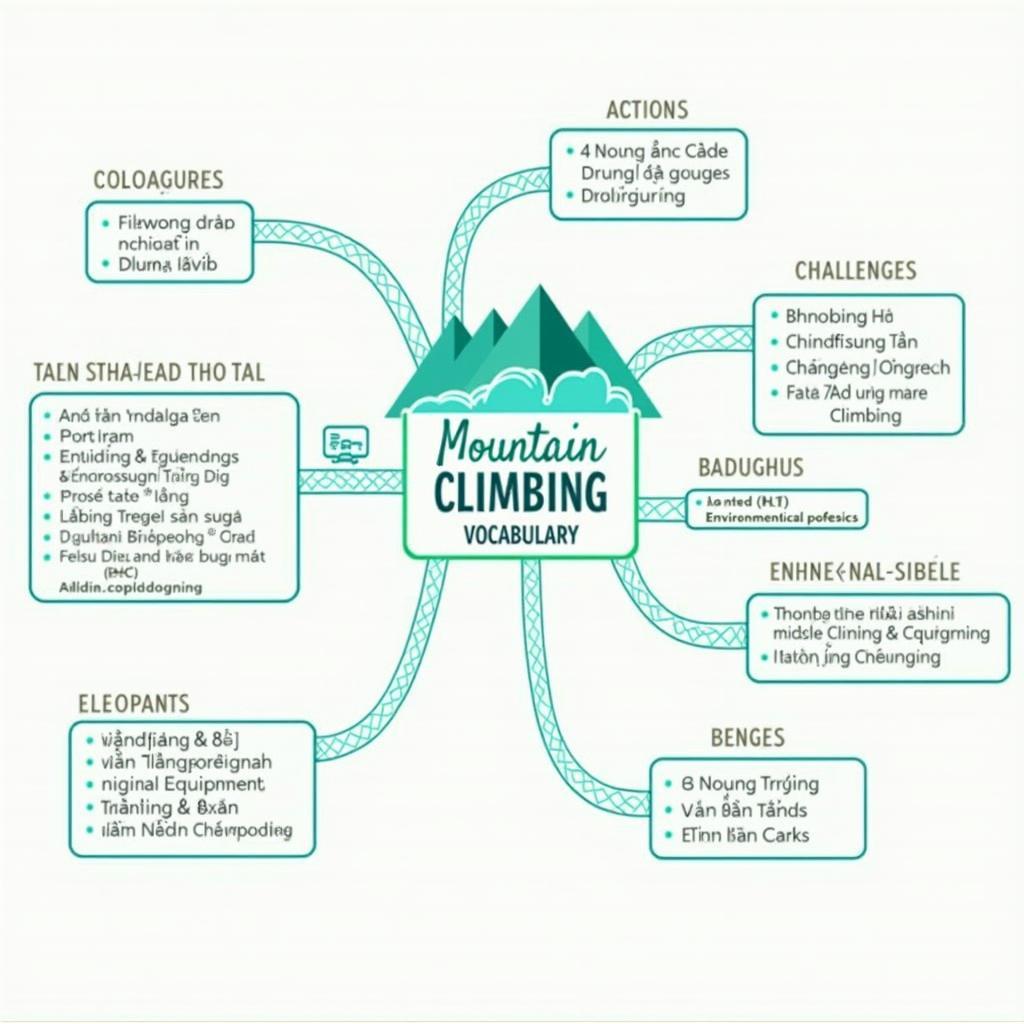 Sơ đồ tư duy từ vựng IELTS Speaking về chủ đề leo núi và thiên nhiên với các collocation quan trọng
Từ vựng và cụm từ quan trọng
Topic-Specific Vocabulary
| Từ vựng/Cụm từ | Loại từ | Phiên âm | Nghĩa tiếng Việt | Ví dụ | Collocation |
|---|---|---|---|---|---|
| summit | n | /ˈsʌmɪt/ | đỉnh núi | We reached the summit at dawn. | reach/make it to/conquer the summit |
| trek | v/n | /trek/ | đi bộ đường dài, hành trình leo núi | The trek to base camp took three days. | embark on a trek, challenging trek, mountain trek |
| altitude | n | /ˈæltɪtjuːd/ | độ cao | Altitude sickness affects many climbers above 3,000 meters. | high altitude, extreme altitude, altitude sickness |
| terrain | n | /təˈreɪn/ | địa hình | The terrain was rocky and difficult to navigate. | treacherous/challenging/rugged/steep terrain |
| acclimatization | n | /əˌklaɪmətaɪˈzeɪʃn/ | sự thích nghi với môi trường | Proper acclimatization is crucial to prevent altitude sickness. | altitude acclimatization, acclimatization period |
| ascent | n | /əˈsent/ | quá trình leo lên | The final ascent was the most challenging part. | steep/gradual/final ascent, make the ascent |
| descent | n | /dɪˈsent/ | quá trình đi xuống | The descent is often more dangerous than the climb up. | treacherous/careful descent, begin the descent |
| precipice | n | /ˈpresɪpɪs/ | vách đá dựng đứng | We stood at the edge of a sheer precipice. | sheer/steep precipice, edge of a precipice |
| panoramic view | phrase | /ˌpænəˈræmɪk vjuː/ | quang cảnh toàn cảnh | The summit offers breathtaking panoramic views. | breathtaking/spectacular/stunning panoramic view |
| conquer | v | /ˈkɒŋkə(r)/ | chinh phục | She conquered her first major peak last year. | conquer a mountain/peak/summit, conquer one’s fears |
| tackle | v | /ˈtækl/ | giải quyết, xử lý (thử thách) | We’re planning to tackle Mount Fuji next summer. | tackle a challenge/mountain, successfully tackle |
| navigate | v | /ˈnævɪɡeɪt/ | định hướng, điều hướng | We had to navigate through thick fog. | navigate through terrain/conditions, carefully navigate |
| treacherous | adj | /ˈtretʃərəs/ | nguy hiểm, không đáng tin cậy | The icy paths were treacherous. | treacherous terrain/conditions/path/weather |
| arduous | adj | /ˈɑːdʒuəs/ | gian khổ, vất vả | It was an arduous climb that tested our endurance. | arduous journey/climb/trek, arduous task |
| breathtaking | adj | /ˈbreθteɪkɪŋ/ | ngoạn mục, choáng ngợp | The views from the top were absolutely breathtaking. | breathtaking views/scenery/landscape/beauty |
| rejuvenating | adj | /rɪˈdʒuːvəneɪtɪŋ/ | làm trẻ lại, làm tươi mới | The mountain air was rejuvenating. | rejuvenating experience/effect/atmosphere |
| pristine | adj | /ˈprɪstiːn/ | nguyên sơ, hoang sơ | The area remains pristine and unspoiled. | pristine environment/nature/wilderness/condition |
| majestic | adj | /məˈdʒestɪk/ | hùng vĩ, uy nghi | Mount Fuji has a majestic presence. | majestic mountain/peak/scenery/beauty |
| serenity | n | /səˈrenəti/ | sự thanh bình | The mountain offered a sense of serenity. | sense of serenity, tranquil serenity, peaceful serenity |
| endurance | n | /ɪnˈdjʊərəns/ | sức bền, sức chịu đựng | Mountain climbing requires both physical and mental endurance. | physical/mental endurance, test one’s endurance, build endurance |
Idiomatic Expressions & Advanced Phrases
| Cụm từ | Nghĩa | Ví dụ sử dụng | Band điểm |
|---|---|---|---|
| at the crack of dawn | vào lúc rạng đông | We set off at the crack of dawn to reach the summit by sunrise. | 7.5-9 |
| push one’s limits | vượt qua giới hạn của bản thân | Mountain climbing really pushes your limits both physically and mentally. | 7-8 |
| off the beaten track | ngoài con đường mòn, vùng ít người biết | We prefer mountains that are off the beaten track, away from tourists. | 7.5-8.5 |
| take your breath away | làm ngạc nhiên, choáng ngợp | The view from the summit literally takes your breath away. | 7-8 |
| against all odds | bất chấp mọi khó khăn | They reached the summit against all odds despite terrible weather. | 8-9 |
| the tip of the iceberg | chỉ là phần nổi của tảng băng | The physical challenge is just the tip of the iceberg; mental strength matters more. | 7.5-8.5 |
| a stone’s throw away | rất gần | The next shelter was just a stone’s throw away from our position. | 7-8 |
| weather the storm | vượt qua khó khăn | We had to weather the storm before continuing our ascent. | 7.5-8.5 |
| on top of the world | cực kỳ hạnh phúc | Standing at the summit, I felt on top of the world. | 6.5-7.5 |
| hit rock bottom | rơi vào tình trạng tồi tệ nhất | During the climb, I hit rock bottom mentally but pushed through. | 7.5-8.5 |
| the pinnacle of | đỉnh cao của | Reaching Everest’s summit is considered the pinnacle of mountaineering. | 8-9 |
| tread carefully | đi cẩn thận, hành động thận trọng | We had to tread carefully on the icy slopes. | 7-8 |
Discourse Markers (Từ Nối Ý Trong Speaking)
Để bắt đầu câu trả lời:
- 📝 Well,… – Dùng khi cần thời gian suy nghĩ ngắn, tạo tính tự nhiên
- 📝 Actually,… – Khi muốn đưa ra góc nhìn hơi bất ngờ hoặc khác
- 📝 To be honest,… – Khi nói thật về suy nghĩ cá nhân
- 📝 I’d say that… – Khi đưa ra quan điểm có suy nghĩ
- 📝 From my perspective,… – Nhấn mạnh quan điểm cá nhân
- 📝 In my experience,… – Dựa trên trải nghiệm thực tế
Để bổ sung ý:
- 📝 On top of that,… – Thêm vào đó (informal)
- 📝 What’s more,… – Hơn nữa (slightly formal)
- 📝 Not to mention… – Chưa kể đến
- 📝 Furthermore,… – Hơn nữa (formal)
- 📝 Additionally,… – Thêm vào đó (formal)
- 📝 Beyond that,… – Vượt ra ngoài điều đó
Để đưa ra quan điểm cân bằng:
- 📝 On the one hand,… On the other hand,… – Một mặt… mặt khác…
- 📝 While it’s true that…, we also need to consider… – Mặc dù đúng là… nhưng ta cũng cần xem xét…
- 📝 That being said,… – Điều đó đã được nói, tuy nhiên…
- 📝 However,… – Tuy nhiên
- 📝 Conversely,… – Ngược lại
Để kết luận:
- 📝 All in all,… – Tóm lại, xét cho cùng
- 📝 At the end of the day,… – Cuối cùng thì
- 📝 In essence,… – Về bản chất
- 📝 Ultimately,… – Cuối cùng, về lâu dài
- 📝 To sum up,… – Tóm lại
Để giải thích hoặc paraphrase:
- 📝 In other words,… – Nói cách khác
- 📝 What I mean is,… – Ý tôi là
- 📝 To put it simply,… – Nói đơn giản thì
- 📝 Basically,… – Về cơ bản là
Grammatical Structures Ấn Tượng
1. Conditional Sentences (Câu điều kiện):
Mixed conditional:
- Formula: If + Past Perfect, Subject + would/could + base verb (hiện tại)
- Ví dụ: “If I had started training earlier, I would be much better prepared now for the climb.”
Inversion (đảo ngữ):
- Formula: Had + Subject + Past Participle, Subject + would have…
- Ví dụ: “Had the weather been better, we would have attempted the summit that day.”
2. Relative Clauses (Mệnh đề quan hệ):
Non-defining relative clauses:
- Formula: …, which + verb…
- Ví dụ: “Mount Kilimanjaro, which stands at nearly 6,000 meters, is Africa’s highest peak.”
Reduced relative clauses:
- Formula: Noun + V-ing/V-ed…
- Ví dụ: “Climbers attempting the summit must have proper equipment.” / “The trail leading to the peak is extremely steep.”
3. Passive Voice (Câu bị động):
Impersonal passive với reporting verbs:
- Formula: It is thought/believed/said/considered that…
- Ví dụ: “It is widely believed that mental strength is more important than physical fitness in mountaineering.”
Passive with modals:
- Formula: Modal + be + Past Participle
- Ví dụ: “Safety precautions should be taken seriously before any climb.”
4. Cleft Sentences (Câu chẻ):
What-cleft:
- Formula: What + Subject + Verb + is/was…
- Ví dụ: “What I find most challenging about mountain climbing is the mental endurance required.”
It-cleft:
- Formula: It + is/was + noun phrase + that/who…
- Ví dụ: “It was the sense of achievement that motivated me to continue climbing.”
5. Participle Clauses:
Present participle:
- Formula: V-ing…, Subject + Verb
- Ví dụ: “Standing at the summit, I realized how small human problems seem compared to nature’s grandeur.”
Past participle:
- Formula: V-ed…, Subject + Verb
- Ví dụ: “Exhausted from the climb, we decided to rest at the base camp for an extra day.”
6. Inversion for Emphasis:
Negative adverbials:
- Formula: Never/Rarely/Seldom + Auxiliary + Subject + Verb
- Ví dụ: “Never have I experienced such a profound sense of accomplishment as when I reached that summit.”
Only:
- Formula: Only when/if + Auxiliary + Subject + Verb
- Ví dụ: “Only when you face extreme conditions do you truly understand your capabilities.”
7. Subjunctive Mood:
Formula: It is essential/crucial/important that + Subject + base verb
- Ví dụ: “It is essential that every climber be properly equipped before attempting the ascent.”
8. Advanced Comparative Structures:
The more… the more:
- Ví dụ: “The higher you climb, the more challenging it becomes to breathe.”
Comparative + and + comparative:
- Ví dụ: “As we ascended, the air became thinner and thinner.”
Chiến lược và lời khuyên từ Examiner
Những Sai Lầm Thường Gặp Cần Tránh
1. Part 1 – Trả lời quá ngắn hoặc quá dài:
- ❌ Sai: “Yes, I like mountains.” (quá ngắn)
- ❌ Sai: Nói dài 1 phút về sở thích với núi trong Part 1 (quá dài)
- ✅ Đúng: “Yes, absolutely! I find mountains incredibly peaceful, and whenever I get the chance, I try to visit mountainous areas to disconnect from city life.” (2-3 câu, 15-20 giây)
2. Part 2 – Không sử dụng hết thời gian chuẩn bị:
- Nhiều học viên chỉ viết 2-3 từ trong 1 phút preparation time. Hãy ghi đủ keywords cho tất cả bullet points và ideas để expand.
- Tip: Ghi theo cấu trúc: Location (keywords) → How know (source) → Appearance (3-4 adjectives) → Why (3 reasons với keywords)
3. Part 2 – Nói dưới 1.5 phút:
- Band score sẽ bị ảnh hưởng nếu bạn chỉ nói 1 phút hoặc ít hơn
- Tip: Expand phần “explain why” – đây là nơi bạn có thể nói nhiều nhất. Đưa ra 2-3 reasons với examples và explanations.
4. Part 3 – Trả lời như Part 1:
- ❌ Sai: Trả lời ngắn gọn 1-2 câu với personal examples
- ✅ Đúng: Phân tích vấn đề từ nhiều góc độ, đưa ra societal examples, thảo luận causes/effects/solutions
5. Sử dụng template cứng nhắc:
- Examiner được training để nhận biết learned phrases
- ❌ Tránh: “There are three main reasons why…” (quá obvious)
- ✅ Tốt hơn: “Well, I think there are several factors contributing to this…” (natural hơn)
6. Vocabulary quá khó hoặc sử dụng sai:
- ❌ Sai: “The mountain’s perpendicularity was incontrovertible.” (quá academic, không tự nhiên)
- ✅ Đúng: “The mountain had incredibly steep slopes that were quite challenging to navigate.”
7. Không answer the question directly:
- Luôn trả lời trực tiếp câu hỏi trước khi elaborate
- Question: “Do you like mountains?”
- ❌ Sai: “Mountains are beautiful and many people visit them…” (không answer)
- ✅ Đúng: “Yes, I absolutely love mountains. They offer…” (clear answer first)
Cách Chuẩn Bị Hiệu Quả
4 tuần trước kỳ thi:
Tuần 1 – Vocabulary Building:
- Học 10-15 từ mỗi ngày về chủ đề mountains/nature/adventure
- Tạo sentences với mỗi từ mới
- Record lại pronunciation
- Practice collocations, không học từ isolated
Tuần 2 – Structure Practice:
- Luyện trả lời 5-7 câu Part 1 mỗi ngày
- Focus vào extending answers (2-3 sentences)
- Practice opening với different discourse markers
- Record và tự đánh giá
Tuần 3 – Part 2 Intensive:
- Practice 1 cue card mỗi ngày
- Time yourself: 1 phút preparation, 2 phút nói
- Record và listen back
- Identify weak areas (vocabulary, grammar, ideas)
- Practice different topics trong cùng category (places, experiences)
Tuần 4 – Part 3 & Mock Tests:
- Luyện Part 3 questions với analytical thinking
- Practice giving balanced views
- Do full mock tests (3 parts liền)
- Focus vào fluency và coherence
- Reduce hesitation
Mỗi ngày:
- 30 phút listening to English podcasts/videos về nature, adventure (để absorb natural expressions)
- 20 phút speaking practice (có thể nói một mình)
- 10 phút shadowing (lặp lại sau native speakers)
Tips Từ Góc Nhìn Examiner
Điều Examiner muốn thấy:
✅ Natural communication: Nói như conversation bình thường, không như đang recite
✅ Self-correction: Sửa lỗi nhỏ của mình (shows awareness)
✅ Pausing appropriately: Dừng để suy nghĩ (tự nhiên hơn là nói liên tục với nhiều errors)
✅ Engagement: Eye contact, responsive body language
✅ Range: Variety trong vocabulary và grammar, không lặp lại
Điều Examiner không thích:
❌ Memorized answers: Clearly learned phrases
❌ Irrelevant information: Nói lan man không liên quan câu hỏi
❌ Over-complicated language: Dùng từ quá phức tạp mà không hiểu nghĩa
❌ Long silence: Im lặng lâu hơn 3-4 giây
❌ Repeating the question: Lặp lại câu hỏi để gain time (làm 1 lần OK, nhiều lần = obvious strategy)
Myth-busting:
🔍 Myth: “Tôi cần nói nhanh để show fluency”
✅ Truth: Fluency là về smooth flow, không phải speed. Nói moderate speed với minimal hesitation tốt hơn nói nhanh với nhiều errors.
🔍 Myth: “Tôi phải đồng ý với examiner”
✅ Truth: Part 3 không có “đúng” hay “sai”. Bạn có thể disagree và present your view, miễn là có good reasoning.
🔍 Myth: “Accent Anh/Mỹ tốt hơn accent Việt”
✅ Truth: Pronunciation band chỉ đánh giá clarity và intelligibility. Accent không matter, miễn là examiner hiểu bạn nói gì.
🔍 Myth: “Tôi cần dùng nhiều idioms để được band cao”
✅ Truth: 2-3 idioms phù hợp context trong toàn bộ test là đủ. Dùng quá nhiều = unnatural và có thể sai context.
Ngày Thi – Những Điều Nên Làm
Trước khi vào phòng thi:
- Đến sớm 15-20 phút để calm down
- Không cố học vật vật mới vào last minute
- Take deep breaths để relax
- Nhớ rằng examiner muốn bạn làm tốt (không phải enemy)
Trong phòng thi:
- Smile và greeting tự nhiên
- Listen carefully to questions (đừng sợ yêu cầu repeat nếu không nghe rõ)
- Part 1: Warm up, đừng quá stress
- Part 2: Use full 1 minute preparation, speak for 2 minutes minimum
- Part 3: Think before speaking (1-2 giây silence để organize thoughts là OK)
- Maintain eye contact
- If you make a mistake, briefly correct và continue (đừng dwell on it)
Nếu gặp khó khăn:
- Không hiểu câu hỏi: “Sorry, could you please repeat that?” hoặc “I’m not sure I understand the question. Do you mean…?”
- Không biết từ vựng: Paraphrase! “I’m not sure of the exact word, but what I mean is…”
- Blank mind: “That’s an interesting question. Let me think…” (mua time 2-3 giây)
- Nói sai: “Sorry, what I meant to say is…” (quick correction rồi continue)
Đánh Giá Thực Tế Band Scores
Band 6.0-6.5:
- Communicate effectively nhưng có some errors
- Vocabulary adequate nhưng repetitive
- Some complex structures nhưng với errors
- Hesitations noticeable
- Để đạt: Focus vào accuracy và reducing errors hơn là dùng từ khó
Band 7.0-7.5:
- Speaks at length với minimal hesitation
- Good range of vocabulary với some less common items
- Variety of complex structures với good control
- Để đạt: Expand vocabulary range, practice complex grammar accurately, improve coherence
Band 8.0-8.5:
- Fluent with minimal repetition or self-correction
- Wide vocabulary range used naturally và flexibly
- Full range of structures used naturally
- Để đạt: Sound natural, không forced. Use idiomatic expressions appropriately. Show depth in Part 3.
Band 9.0:
- Fully operational command
- Completely natural, sophisticated use of language
- Rare mistakes
- Thực tế: Rất ít non-native speakers đạt band này. Đừng target 9.0, focus vào 7.5-8.5 range là realistic hơn.
Kết Luận
Chủ đề “describe a hill or mountain you would like to climb” là một topic thú vị và đa chiều trong IELTS Speaking, cho phép bạn showcase nhiều aspects của language ability. Từ mô tả địa điểm cụ thể trong Part 2 đến thảo luận về environmental issues và personal development trong Part 3, chủ đề này test cả descriptive và analytical skills của bạn.
Key takeaways:
🎯 Part 1: Keep it natural, 2-3 sentences, personal và relevant
🎯 Part 2: Use full preparation time, speak minimum 1.5-2 minutes, cover all bullet points với emphasis on “explain why”
🎯 Part 3: Think analytically, multiple perspectives, societal examples, balanced views
Để đạt band cao:
- ✅ Vocabulary range (topic-specific + academic + idiomatic)
- ✅ Grammar variety (complex structures used accurately)
- ✅ Fluency (smooth flow với minimal hesitation)
- ✅ Coherence (logical organization với appropriate linking)
- ✅ Pronunciation (clear và intelligible)
- ✅ Depth of ideas (especially Part 3)
Nhớ rằng: IELTS Speaking không phải test về knowledge của bạn về mountains hay bất kỳ topic nào. It’s a language test. Examiner đánh giá HOW you say it, không phải WHAT you say. Focus vào expressing your ideas clearly, coherently, và với appropriate language.
Practice consistently, record yourself, identify weaknesses, và improve gradually. Good luck với IELTS Speaking test của bạn!