Chủ đề về món ăn địa phương là một trong những đề tài xuất hiện thường xuyên trong IELTS Speaking, đặc biệt ở Part 2 và Part 3. Đây là chủ đề vừa gần gũi vừa cho phép bạn thể hiện được khả năng miêu tả chi tiết, kể chuyện và phân tích văn hóa ẩm thực. Từ năm 2020 đến nay, chủ đề này xuất hiện với tần suất khá cao trong các kỳ thi thực tế trên toàn thế giới, với mức độ phổ biến khoảng 3-4 lần mỗi quý. Dự đoán khả năng xuất hiện trong tương lai vẫn ở mức cao do tính universal và khả năng khai thác đa dạng của chủ đề.
Trong bài viết này, bạn sẽ học được cách trả lời toàn diện cho chủ đề “Describe A Local Dish You Love” qua cả ba phần thi Speaking. Bạn sẽ được cung cấp các câu hỏi thực tế từ các kỳ thi gần đây, bài mẫu chi tiết theo từng band điểm từ 6-7, 7.5-8 đến 8.5-9, kèm phân tích sâu về lý do tại sao mỗi câu trả lời đạt band điểm đó. Ngoài ra, bạn còn được trang bị kho từ vựng phong phú về ẩm thực, các cụm từ idiom ăn điểm, và chiến lược trả lời hiệu quả từ góc nhìn của một Examiner chính thức.
Hãy cùng khám phá cách biến một chủ đề đơn giản về món ăn thành cơ hội để ghi điểm cao trong bài thi IELTS Speaking của bạn.
IELTS Speaking Part 1: Introduction and Interview
Tổng Quan Về Part 1
Part 1 của IELTS Speaking kéo dài 4-5 phút, với khoảng 10-12 câu hỏi ngắn về các chủ đề đời sống hàng ngày. Đây là phần “khởi động” để bạn làm quen với giọng examiner và tạo ấn tượng ban đầu tốt. Examiner sẽ hỏi về bản thân, sở thích, công việc/học tập và các chủ đề familiar khác.
Chiến lược quan trọng cho Part 1 là trả lời tự nhiên, mở rộng câu trả lời thành 2-3 câu với công thức: Direct Answer + Reason/Explanation + Example/Detail. Nhiều học viên Việt Nam thường mắc lỗi trả lời quá ngắn gọn (Yes/No), sử ddụng từ vựng đơn giản lặp đi lặp lại, hoặc không đưa ra ví dụ cụ thể từ trải nghiệm cá nhân. Hãy nhớ rằng, ngay cả trong Part 1, bạn vẫn cần thể hiện được lexical resource và grammatical range.
Các Câu Hỏi Thường Gặp
Question 1: Do you like cooking?
Question 2: What is your favorite food?
Question 3: Do you prefer eating at home or eating out?
Question 4: What kind of food is popular in your country?
Question 5: Did you like the same food when you were a child?
Question 6: Do you like trying new dishes?
Question 7: What food do you usually eat for breakfast?
Question 8: Do you think eating habits have changed in your country?
Question 9: Is there any food you dislike?
Question 10: What dishes are special in your hometown?
Phân Tích và Gợi Ý Trả Lời Chi Tiết
Question: Do you like trying new dishes?
🎯 Cách tiếp cận:
- Trả lời Yes/No một cách rõ ràng
- Giải thích lý do tại sao
- Đưa ra ví dụ cụ thể về lần gần đây thử món mới
📝 Sample Answer – Band 6-7:
Yes, I do. I think trying new food is interesting because I can learn about different cultures. Last month, I tried Japanese ramen for the first time and it was delicious.
Phân tích:
- Điểm mạnh: Có câu trả lời trực tiếp, có lý do và ví dụ cụ thể
- Hạn chế: Từ vựng khá basic (interesting, delicious), cấu trúc câu đơn giản, ý tưởng chưa được phát triển sâu
- Tại sao Band 6-7: Đáp ứng được yêu cầu cơ bản với fluency tốt nhưng thiếu sophistication trong vocabulary và grammar. Ý tưởng còn surface-level.
📝 Sample Answer – Band 8-9:
Absolutely, I’m quite adventurous when it comes to food. I find that sampling different cuisines is not just about satisfying my taste buds but also about broadening my cultural horizons. Just recently, I ventured into trying Ethiopian food at a small authentic restaurant downtown, and I was blown away by the unique flavors and the communal dining experience with the injera bread.
Phân tích:
- Điểm mạnh: Sử dụng idiomatic expressions tự nhiên (adventurous when it comes to, blown away), collocations chính xác (sampling cuisines, broaden horizons, authentic restaurant), cấu trúc phức tạp (not just…but also), ý tưởng sâu sắc hơn (cultural aspect, dining experience)
- Tại sao Band 8-9: Thể hiện lexical resource xuất sắc với precise vocabulary và natural phrases. Grammar đa dạng với compound sentence. Ideas được develop beyond surface level. Pronunciation với stress đúng trên các từ quan trọng tạo natural rhythm.
💡 Key Vocabulary & Expressions:
- adventurous when it comes to: dám thử nghiệm, không ngại mạo hiểm trong việc gì
- sampling different cuisines: nếm thử các nền ẩm thực khác nhau
- taste buds: vị giác
- broaden cultural horizons: mở rộng hiểu biết văn hóa
- venture into: mạo hiểm thử
- blown away: vô cùng ấn tượng, ngạc nhiên
Question: What dishes are special in your hometown?
🎯 Cách tiếp cận:
- Đề cập đến 1-2 món ăn đặc trưng
- Giải thích tại sao món đó special (ingredients, cooking method, history)
- Có thể nói về khi nào người ta thường ăn món này
📝 Sample Answer – Band 6-7:
In my hometown, pho is very special. It’s a noodle soup with beef or chicken. Many people eat it for breakfast. The broth is cooked for many hours, so it tastes very good.
Phân tích:
- Điểm mạnh: Trả lời đúng trọng tâm, có basic description
- Hạn chế: Vocabulary repetitive (very special, very good), câu structure đơn giản, thiếu details về what makes it special
- Tại sao Band 6-7: Adequate response nhưng lacks depth. Vocabulary functional nhưng not sophisticated. Grammar accurate nhưng simple.
📝 Sample Answer – Band 8-9:
Well, my hometown is renowned for its pho, which is a fragrant rice noodle soup typically made with slow-simmered beef broth. What makes it truly special is the meticulous preparation – the broth is infused with star anise, cinnamon, and other aromatic spices, and it needs to be simmered for at least 12 hours to achieve that rich, complex flavor. It’s deeply ingrained in our local food culture, and you’ll find street vendors serving it from dawn till dusk. For locals, it’s not just a meal; it’s a culinary ritual that brings people together.
Phân tích:
- Điểm mạnh: Extremely detailed và vivid description. Vocabulary precise và topic-specific (fragrant, slow-simmered, aromatic spices, infused with). Grammar varied với passive voice, relative clause. Ý tưởng sâu sắc về cultural significance, không chỉ describe món ăn.
- Tại sao Band 8-9: Demonstrates native-like control of language. Lexical resource với collocations (meticulous preparation, culinary ritual, deeply ingrained). Ideas well-developed với both practical và cultural aspects. Natural discourse markers (Well, not just…but…).
💡 Key Vocabulary & Expressions:
- renowned for: nổi tiếng về
- fragrant: thơm ngát
- slow-simmered: ninh lửa nhỏ trong thời gian dài
- meticulous preparation: sự chuẩn bị tỉ mỉ, cẩn thận
- infused with: ngấm, thấm đẫm
- aromatic spices: các loại gia vị thơm
- deeply ingrained in: ăn sâu vào, gắn bó sâu sắc với
- culinary ritual: nghi thức ẩm thực
Question: Have your eating habits changed since you were a child?
🎯 Cách tiếp cận:
- So sánh quá khứ và hiện tại
- Đưa ra reasons cho sự thay đổi
- Có thể mention specific examples
📝 Sample Answer – Band 6-7:
Yes, they have changed a lot. When I was young, I ate a lot of fast food like fried chicken and burgers. Now I try to eat more vegetables and healthy food because I want to stay fit.
Phân tích:
- Điểm mạnh: Clear comparison giữa past và present, có reason
- Hạn chế: Basic vocabulary (a lot of, healthy food, stay fit), structure đơn giản, thiếu specific details
- Tại sao Band 6-7: Conveys message clearly nhưng lacks sophistication. Grammar accurate với past tense và present tense nhưng không có complex structures.
📝 Sample Answer – Band 8-9:
Definitely, my palate has evolved significantly over the years. As a child, I was quite a fussy eater and had a penchant for sugary snacks and processed foods. However, as I’ve grown older and become more health-conscious, I’ve gravitated towards whole foods and nutrient-dense meals. I think this shift was partly prompted by greater awareness about nutrition, and partly because my taste has naturally matured – I now appreciate subtle flavors and sophisticated dishes that I would have found boring as a kid. For instance, I’ve developed quite a fondness for Vietnamese home-cooked meals with lots of fresh herbs and vegetables.
Phân tích:
- Điểm mạnh: Sophisticated vocabulary (palate evolved, fussy eater, penchant for, gravitated towards, prompted by). Complex grammar với subordinate clauses và compound structures. Ideas well-developed với multiple reasons (awareness, taste maturation). Specific example adds credibility.
- Tại sao Band 8-9: Native-like fluency với natural flow. Lexical resource exceptional với precise collocations. Grammar full range với zero errors. Ideas nuanced và thoughtful. Pronunciation features như stress trên key words (EVolved, GRAVitated).
💡 Key Vocabulary & Expressions:
- palate has evolved: khẩu vị đã thay đổi, phát triển
- fussy eater: người kén ăn
- penchant for: sự thiên về, sở thích đặc biệt
- health-conscious: quan tâm đến sức khỏe
- gravitate towards: có xu hướng, nghiêng về
- whole foods: thực phẩm nguyên chất, tự nhiên
- nutrient-dense: giàu dinh dưỡng
- subtle flavors: hương vị tinh tế
- fondness for: sự yêu thích
Bạn có thể tham khảo thêm về trải nghiệm ẩm thực trong bài viết describe a time when you tried a new cuisine để có thêm ý tưởng cho câu trả lời của mình.
 Học viên đang luyện tập IELTS Speaking chủ đề món ăn địa phương với giáo viên
IELTS Speaking Part 2: Long Turn (Cue Card)
Tổng Quan Về Part 2
Part 2 là phần “độc thoại” quan trọng nhất của IELTS Speaking, kéo dài 3-4 phút (bao gồm 1 phút chuẩn bị và 2-3 phút trình bày). Đây là cơ hội tốt nhất để bạn showcase vocabulary range, grammatical structures, và khả năng organize ideas một cách coherent.
Chiến lược quan trọng là sử dụng hiệu quả 1 phút chuẩn bị. Đừng viết câu đầy đủ mà chỉ ghi keywords cho mỗi bullet point. Ví dụ: “What: Banh mi – sandwich – baguette + pate + cold cuts + herbs”. Trong khi nói, bạn cần đảm bảo nói đủ 2 phút (tối thiểu 1 phút 45 giây) và cover tất cả các bullet points. Phần “explain” cuối cùng thường là nơi bạn có thể ghi điểm cao nhất vì nó cho phép bạn express feelings và opinions.
Lỗi thường gặp của học viên Việt Nam là không tận dụng hết 1 phút chuẩn bị, nói quá ngắn (dưới 1.5 phút), hoặc bỏ sót một trong các bullet points. Một số bạn còn mắc lỗi dùng sai thì (ví dụ dùng hiện tại khi đề bài yêu cầu kể về quá khứ).
Cue Card
Describe a local dish you love
You should say:
- What the dish is
- What ingredients are used to make it
- When and where you usually eat it
- And explain why you love this dish
Phân Tích Đề Bài
- Dạng câu hỏi: Describe an object/food (thuộc nhóm describe things)
- Thì động từ: Hiện tại đơn (vì đây là món ăn vẫn tồn tại, bạn vẫn yêu thích nó hiện tại)
- Bullet points phải cover:
- Tên món ăn và mô tả tổng quan
- Nguyên liệu chính
- Hoàn cảnh thường ăn (thời gian, địa điểm)
- Lý do yêu thích (đây là phần quan trọng nhất)
- Câu “explain” quan trọng: Đây là phần bạn cần develop nhiều nhất (chiếm khoảng 30-40% bài nói). Đừng chỉ nói “because it’s delicious” mà hãy giải thích deeper reasons: emotional connections, memories, cultural significance, sensory details.
📝 Sample Answer – Band 6-7
Thời lượng: Khoảng 1 phút 45 giây – 2 phút
I’d like to talk about banh xeo, which is a traditional Vietnamese dish that I really love.
Banh xeo is a kind of savory pancake. The main ingredients are rice flour, water, and turmeric powder, which makes it yellow. Inside the pancake, there are bean sprouts, shrimp, pork, and sometimes mushrooms. It’s usually served with fresh vegetables like lettuce and herbs, and we eat it with fish sauce.
I usually eat banh xeo at small restaurants in my neighborhood. My family often goes there on weekends for lunch. Sometimes my mother also makes it at home for special family gatherings.
I love this dish for several reasons. First, it tastes really good. The pancake is crispy on the outside and soft inside, and when you eat it with the vegetables and sauce, all the flavors mix together nicely. Second, it reminds me of my childhood because my grandmother used to make it for me when I was young. Every time I eat banh xeo, I remember those happy times with my family. Finally, I think it’s a healthy dish because it has a lot of vegetables and fresh ingredients.
Phân Tích Band Điểm
| Tiêu chí | Band | Nhận xét |
|---|---|---|
| Fluency & Coherence | 6.5 | Có flow tốt, ít hesitation. Sử dụng basic sequencing (First, Second, Finally). Tuy nhiên thiếu sophisticated connectors và còn một số repetition. |
| Lexical Resource | 6.0 | Vocabulary adequate và relevant (savory pancake, turmeric, bean sprouts) nhưng chủ yếu là common words. Có một số attempts ở less common phrases (flavors mix together) nhưng còn limited range. |
| Grammatical Range & Accuracy | 6.5 | Sử dụng mix of simple và complex sentences. Present tense accurate. Có attempts ở relative clauses (which makes it yellow) nhưng structures không varied lắm. Mostly error-free. |
| Pronunciation | 6.5 | Generally clear và intelligible. Word stress mostly correct. Tuy nhiên thiếu sentence stress và intonation variation để create emphasis. |
Điểm mạnh:
- ✅ Cover đủ tất cả bullet points một cách clear
- ✅ Có structure logical với introduction, body, và explanation
- ✅ Thời lượng acceptable (gần 2 phút)
- ✅ Grammar mostly accurate
Hạn chế:
- ⚠️ Vocabulary khá basic, thiếu descriptive language
- ⚠️ Explanation về “why you love it” còn surface-level
- ⚠️ Thiếu sensory details (smell, texture, visual description)
- ⚠️ Không có idiomatic expressions hoặc sophisticated phrases
📝 Sample Answer – Band 7.5-8
Thời lượng: Khoảng 2 phút 15 giây
I’d like to describe banh mi, which is probably Vietnam’s most iconic street food and definitely one of my all-time favorite dishes.
Banh mi is essentially a Vietnamese sandwich made with a crispy baguette that’s uniquely light and airy – quite different from French bread despite the colonial influence. The filling varies, but typically includes pâté, some form of cold cuts or grilled meat, pickled vegetables, fresh cilantro, cucumber slices, and a generous spread of butter and mayonnaise. What really sets it apart is the perfect balance of textures and flavors – you get the crunch, the savory meat, the tangy pickles, and the fresh herbs all in one bite.
I usually grab a banh mi from street vendors in the morning on my way to work. There’s this particular lady who’s been selling them at the corner of my street for years, and her banh mi is absolutely unbeatable. The best time to get one is early morning when the bread is fresh out of the oven. I also love having it as a quick lunch when I’m pressed for time.
The reason I’m so fond of this dish goes beyond just taste. Sure, the explosion of flavors is amazing, but there’s something deeply comforting about banh mi. It represents Vietnamese creativity – taking something French and making it distinctly our own. Every time I bite into a warm banh mi with all its contrasting textures, I feel connected to my culture. Plus, it’s incredibly convenient and affordable, which makes it accessible to everyone, from students to office workers. It’s a dish that truly embodies the Vietnamese spirit – practical, delicious, and bringing people together.
Phân Tích Band Điểm
| Tiêu chí | Band | Nhận xét |
|---|---|---|
| Fluency & Coherence | 7.5-8 | Speaks fluently với minimal hesitation. Good use of discourse markers và cohesive devices (essentially, typically, despite, beyond just). Ideas logically organized với clear progression. |
| Lexical Resource | 7.5-8 | Wide vocabulary range với precise collocations (iconic street food, sets it apart, explosion of flavors, pressed for time). Uses less common phrases naturally (all-time favorite, unbeatable, embodies the spirit). Some sophisticated vocabulary (distinctly, accessible, comforting). |
| Grammatical Range & Accuracy | 7.5-8 | Wide range of structures: relative clauses, participle clauses (taking something…making it), complex sentences. Accurate use of present tense throughout. Some sophisticated constructions (goes beyond, what really sets it apart is). |
| Pronunciation | 7.5-8 | Clear pronunciation với good control of features. Appropriate word stress và sentence stress. Natural intonation để create emphasis (absolutely unbeatable, deeply comforting). |
So Sánh Với Band 6-7
| Khía cạnh | Band 6-7 | Band 7.5-8 |
|---|---|---|
| Vocabulary | “tastes really good”, “flavors mix together nicely” | “explosion of flavors”, “perfect balance of textures”, “uniquely light and airy” |
| Grammar | Simple: “It tastes really good” | Complex: “What really sets it apart is the perfect balance…” |
| Ideas | Surface level: “it reminds me of childhood” | Deeper: “represents Vietnamese creativity – taking something French and making it distinctly our own” |
📝 Sample Answer – Band 8.5-9
Thời lượng: 2 phút 30 giây – gần 3 phút
I’d like to talk about pho, which isn’t just a dish for me – it’s woven into the fabric of my daily life and holds a special place in my heart.
Pho is a quintessentially Vietnamese noodle soup that might seem simple on the surface, but its preparation is actually quite intricate. The foundation is a meticulously prepared broth, typically made from beef bones that are char-grilled first to add depth, then simmered for upwards of 12 hours with star anise, cinnamon, coriander seeds, and other aromatic spices. The result is this incredibly rich, complex liquid that’s simultaneously robust yet delicate. It’s served over silky rice noodles with paper-thin slices of beef – either well-done brisket or rare steak that cooks in the steaming broth – and topped with a generous handful of fresh herbs like Thai basil, cilantro, and sawtooth coriander, along with lime wedges and fiery chili peppers on the side.
My ritual with pho is quite specific. I’m particularly drawn to having it on gray, drizzly mornings – there’s something about those days that makes me crave its warmth. I have a go-to place, a small, no-frills eatery that’s been run by the same family for three generations. The owner knows exactly how I like mine: extra rare beef, light on the noodles, heavy on the herbs. There’s also this wonderful tradition of having pho as a hangover cure after late nights out with friends.
What makes me utterly devoted to this dish is multifaceted. On a purely sensory level, the way the fragrant steam rises from the bowl, carrying those intoxicating aromas of star anise and beef broth, is almost meditative. But it goes much deeper than that. Pho represents continuity and connection – it’s what I turn to for comfort when I’m stressed, what I associate with home when I’m away, and what bridges generations in my family. My grandfather had his favorite pho shop, my parents have theirs, and now I have mine. It’s also fascinating from a cultural standpoint – this dish is a living testament to Vietnam’s culinary ingenuity, adapting and thriving through different eras. What strikes me most is its democratic nature – you’ll see everyone from cyclo drivers to business executives hunched over steaming bowls at the same street-side stall, all equally absorbed in the experience. In a way, pho encapsulates everything I love about Vietnamese food culture: it’s unpretentious, deeply flavorful, and communal.
Phân Tích Band Điểm
| Tiêu chí | Band | Nhận xét |
|---|---|---|
| Fluency & Coherence | 9.0 | Speaks fluently with very natural, effortless delivery. Sophisticated use of discourse markers (On a purely sensory level, But it goes much deeper, In a way). Ideas cohesively organized with seamless transitions. No noticeable hesitation. |
| Lexical Resource | 9.0 | Exceptional vocabulary range với precise, sophisticated choices (woven into the fabric, meticulously prepared, intoxicating aromas, culinary ingenuity). Natural use of idiomatic language (holds a special place, turn to for comfort, living testament). Collocations are native-like (gray drizzly mornings, no-frills eatery, democratic nature). |
| Grammatical Range & Accuracy | 9.0 | Full range of structures used accurately và flexibly: participle clauses, relative clauses, cleft sentences (What strikes me most is…), inversion, complex noun phrases (a living testament to Vietnam’s culinary ingenuity). Consistent accuracy throughout. |
| Pronunciation | 9.0 | Pronunciation features used effectively to enhance meaning. Excellent control of word stress, sentence stress, và intonation patterns. Natural rhythm với appropriate pausing for emphasis. |
Tại Sao Bài Này Xuất Sắc
🎯 Fluency Hoàn Hảo:
Câu trả lời flows naturally như native speaker conversation. Không có hesitation hay self-correction. Sử dụng filler phrases một cách tự nhiên để think-time (there’s something about…, in a way…).
📚 Vocabulary Tinh Vi:
- “woven into the fabric of my daily life” – metaphorical language showing pho’s integral role
- “char-grilled” vs “grilled” – precise cooking terminology
- “intoxicating aromas” – sophisticated adjective choice, much better than “nice smell”
- “culinary ingenuity” – academic-level vocabulary used naturally
- “democratic nature” – abstract concept applied to food culture
📝 Grammar Đa Dạng:
- Cleft sentence: “What makes me utterly devoted to this dish is multifaceted” – creates emphasis
- Participle clauses: “carrying those intoxicating aromas” – adds sophistication
- Complex noun phrase: “a living testament to Vietnam’s culinary ingenuity, adapting and thriving through different eras” – shows grammatical range
💡 Ideas Sâu Sắc:
Không chỉ describe món ăn mà còn explore:
- Cultural significance (bridges generations, democratic nature)
- Sensory experience (meditative quality of steam, aroma)
- Personal emotional connection (ritual, comfort, home)
- Social aspects (communal experience, class-transcending)
- Historical context (testament to culinary ingenuity)
Để hiểu thêm về văn hóa ẩm thực và các hoạt động liên quan, bạn có thể tham khảo describe an outdoor market you visited recently nơi thường bán nhiều món ăn địa phương đặc sắc.
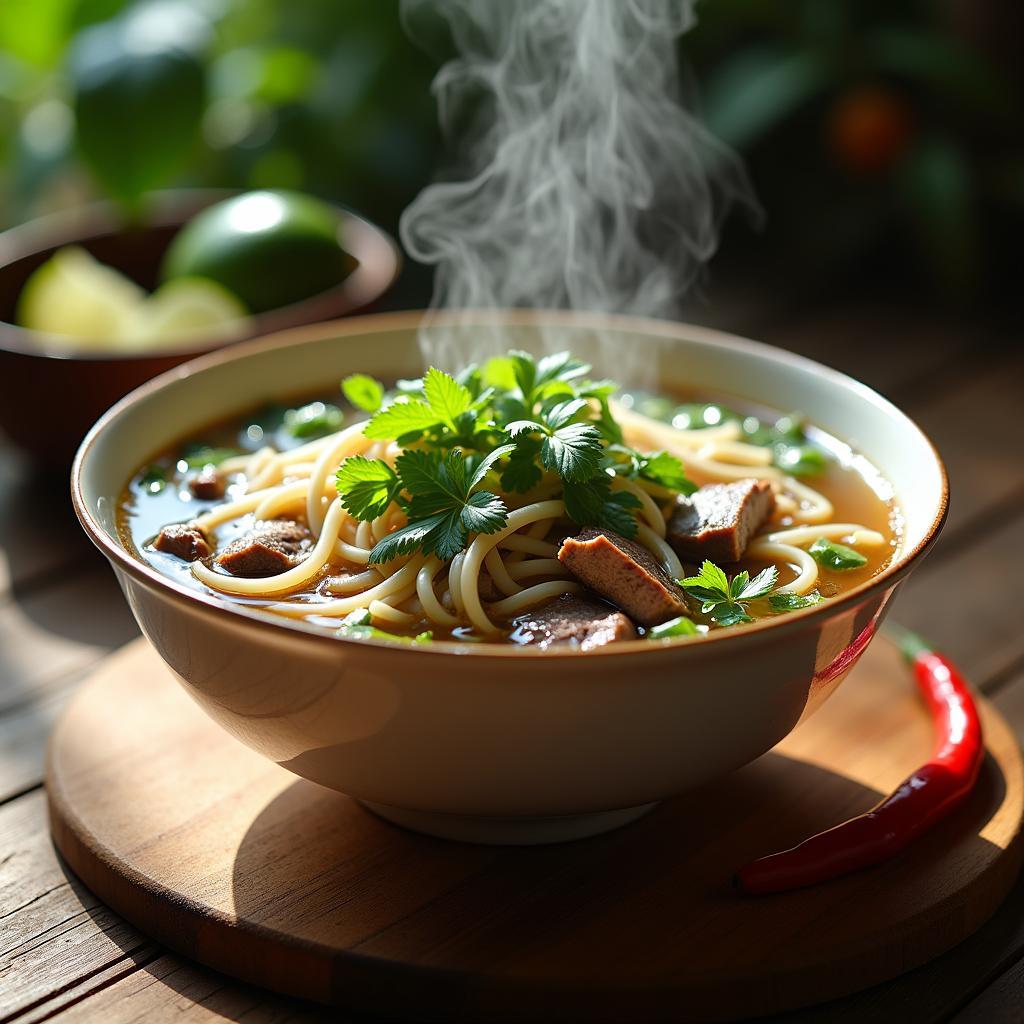 Tô phở truyền thống Việt Nam với nguyên liệu tươi ngon minh họa chủ đề IELTS Speaking
Follow-up Questions (Rounding Off Questions)
Sau khi bạn hoàn thành phần trình bày 2-3 phút, examiner thường hỏi thêm 1-2 câu ngắn liên quan trực tiếp đến những gì bạn vừa nói. Đây là cơ hội để clarify hoặc elaborate thêm một số điểm.
Question 1: Do you think this dish is easy to make at home?
Band 6-7 Answer:
I think it depends. Some versions are quite simple, but to make really good pho requires a lot of time and skill, especially for the broth.
Band 8-9 Answer:
Well, it’s a bit of a double-edged sword. While the basic components are straightforward, achieving that authentic depth of flavor really requires considerable time and expertise. The broth-making process alone is quite labor-intensive – you’re looking at minimum 10-12 hours of simmering. Most people nowadays opt for restaurant versions simply because the effort-to-reward ratio doesn’t quite justify home cooking, unless you’re making it in large batches for special occasions.
Question 2: Is it an expensive dish to eat?
Band 6-7 Answer:
No, it’s actually quite affordable. You can get a bowl for around 30,000-50,000 VND at most places, which is reasonable.
Band 8-9 Answer:
Not at all – that’s actually one of its endearing qualities. Pho is remarkably accessible price-wise, typically ranging from 30,000 to 70,000 VND depending on the establishment. What’s interesting is that price doesn’t always correlate with quality – some of the best pho I’ve had came from humble street-side vendors charging modest prices. It’s very much a democratic dish in that sense, transcending socioeconomic boundaries.
IELTS Speaking Part 3: Two-way Discussion
Tổng Quan Về Part 3
Part 3 là phần challenging nhất của IELTS Speaking, kéo dài 4-5 phút với 4-6 câu hỏi abstract và analytical. Khác với Part 1 (personal questions) và Part 2 (specific description), Part 3 yêu cầu bạn discuss broader issues, compare different aspects, analyze causes and effects, và evaluate solutions.
Examiner mong đợi bạn có khả năng think critically và express complex ideas. Câu trả lời cần dài hơn Part 1 (khoảng 3-5 câu cho mỗi question), với clear opinion được support bởi reasons và examples. Quan trọng là phải acknowledge different perspectives và show awareness về complexity của issues.
Chiến lược hiệu quả:
- Sử dụng discourse markers để organize ideas (Well, Actually, From my perspective)
- Đưa ra examples từ society/research, không chỉ personal experiences
- Thừa nhận nuances (While it’s true that…, To some extent…, It depends on…)
- Compare và contrast different viewpoints
- Sử dụng tentative language để avoid being too absolute (tend to, might, could potentially)
Lỗi thường gặp của học viên Việt Nam là trả lời quá ngắn (1-2 câu), không elaborate reasons, thiếu vocabulary abstract, hoặc chỉ nói về personal experience thay vì broader societal perspectives.
Các Câu Hỏi Thảo Luận Sâu
Theme 1: Food Culture and Society
Question 1: Why do you think traditional dishes are important to a country’s culture?
🎯 Phân tích câu hỏi:
- Dạng: Opinion/Explanation – Hỏi về importance và reasons
- Key words: traditional dishes, important, country’s culture
- Cách tiếp cận: Direct answer về importance → Multiple reasons (identity, heritage, social bonding) → Examples → Concluding thought
📝 Sample Answer – Band 6-7:
I think traditional dishes are very important because they represent a country’s history and identity. For example, when people eat these dishes, they remember their roots and feel connected to their ancestors. Traditional food also helps bring families together during festivals. Moreover, these dishes can attract tourists who want to experience the local culture. So overall, traditional food plays an important role in preserving culture.
Phân tích:
- Structure: Có clear opinion và multiple reasons, nhưng development còn basic
- Vocabulary: Adequate (represent, identity, roots, preserve) nhưng repetitive (important xuất hiện nhiều lần)
- Grammar: Mix of simple và some complex sentences, mostly accurate
- Tại sao Band 6-7: Addresses question appropriately với relevant ideas nhưng lacks depth. Vocabulary functional nhưng not sophisticated. Examples generic rather than specific.
📝 Câu trả lời mẫu – Band 8-9:
Well, I’d argue that traditional dishes serve as culinary ambassadors of a nation’s heritage in several crucial ways.
First and foremost, they’re tangible expressions of a country’s historical narrative – each traditional dish often has a story behind it that reflects pivotal moments in history, whether it’s periods of migration, colonial influence, or agricultural practices unique to that region. Take pho, for instance – it’s a living chronicle of Vietnam’s French colonial period merged with indigenous ingredients and cooking techniques.
Beyond that, these dishes play a vital role in fostering collective identity. When people partake in traditional food, especially during cultural celebrations, they’re reinforcing their sense of belonging to a community. It’s a form of cultural continuity that transcends generations – grandparents pass down recipes and cooking techniques, which cements family bonds and ensures that cultural knowledge isn’t lost.
From an economic standpoint, traditional cuisine has become increasingly important for cultural tourism and nation branding. Countries like Thailand and Japan have strategically leveraged their food culture to enhance their global soft power, and it’s proven remarkably effective. There’s something quite profound about how a simple bowl of noodles or a particular way of preparing rice can become a powerful symbol of national pride and cultural distinctiveness.
Phân tích:
- Structure: Excellently organized: Direct answer → Reason 1 (historical significance) + example → Reason 2 (social cohesion) + elaboration → Reason 3 (economic/political) + examples → Concluding observation
- Vocabulary: Sophisticated và precise (culinary ambassadors, tangible expressions, pivotal moments, foster collective identity, cultural continuity, nation branding, soft power)
- Grammar: Full range with cleft sentences (There’s something quite profound about…), passive voice (it’s proven), relative clauses, participle phrases
- Critical Thinking: Multi-dimensional analysis (historical, social, economic perspectives), nuanced với specific examples, acknowledges broader implications
💡 Key Language Features:
- Discourse markers: Well, First and foremost, Beyond that, From an economic standpoint
- Tentative language: I’d argue, often, become increasingly
- Abstract nouns: heritage, narrative, continuity, distinctiveness, soft power
- Academic collocations: tangible expressions, foster collective identity, strategically leveraged, cultural continuity
Question 2: How have eating habits changed in your country over the past few decades?
🎯 Phân tích câu hỏi:
- Dạng: Change/Trend analysis – Past vs Present comparison
- Key words: eating habits, changed, past few decades
- Cách tiếp cận: Acknowledge change → Identify specific changes (diet, dining patterns, influences) → Causes → Implications
📝 Sample Answer – Band 6-7:
Eating habits in Vietnam have changed a lot in recent years. People now eat more fast food and Western food than before. In the past, everyone cooked at home and ate traditional Vietnamese food. Now, especially young people prefer convenient food and often eat at restaurants. This is because life is busier and people have less time to cook. Also, globalization brings many new food choices to Vietnam.
Phân tích:
- Structure: Clear past-present comparison nhưng organization có thể better
- Vocabulary: Basic (a lot, prefer, convenient) với some topic vocabulary (fast food, globalization)
- Tại sao Band 6-7: Addresses question với relevant points nhưng lacks specific examples và detailed analysis. Ideas somewhat simplistic.
📝 Câu trả lời mẫu – Band 8-9:
The dietary landscape in Vietnam has undergone quite dramatic transformations over the past few decades, and I think we can identify several pronounced shifts.
The most conspicuous change is the proliferation of Western-style fast food chains and processed foods. When my parents were growing up in the 1980s and 90s, home-cooked meals were virtually ubiquitous, and dining out was reserved for special occasions. Now, there’s been a marked increase in eating out culture, particularly among urban youth who are increasingly time-poor due to longer working hours and hectic lifestyles.
Another significant trend is what I’d call the “health consciousness paradox”. On one hand, we’re seeing a growing segment of the population becoming more attuned to nutritional values, organic produce, and balanced diets – there’s been a surge in vegetarian restaurants and health food stores. On the other hand, rates of obesity and diet-related diseases are climbing, suggesting that while awareness is growing, actual dietary behaviors haven’t necessarily improved across the board.
I think these changes are primarily driven by rapid urbanization and rising disposable incomes. The advent of food delivery apps has also been a game-changer, making diverse cuisines accessible at the tap of a smartphone. Additionally, exposure to foreign media and increased travel have broadened palates and created demand for international flavors.
What concerns me slightly is that we might be at risk of losing some of our traditional food culture in this transition. There’s a delicate balance to strike between embracing culinary diversity and preserving our gastronomic heritage.
Phân tích:
- Structure: Highly sophisticated: Introduction → Major change 1 (Western influence) + contrast with past → Change 2 (health paradox) with nuanced analysis → Causes (multiple factors) → Concluding concern about implications
- Vocabulary: Exceptional range (dietary landscape, proliferation, conspicuous, time-poor, attuned to, surge in, advent of, game-changer, gastronomic heritage)
- Grammar: Complex structures throughout: passive voice, relative clauses, conditionals, participle phrases (suggesting that…), cleft structures
- Critical Thinking: Shows balanced view (paradox của health trends), acknowledges complexity, multiple causes analyzed, thoughtful conclusion about cultural preservation
💡 Key Language Features:
- Discourse markers: The most conspicuous change is, Another significant trend, Additionally, What concerns me
- Hedging language: quite, I think, might be, slightly
- Comparative structures: more…than before, haven’t necessarily improved
- Sophisticated collocations: undergo transformations, marked increase, strike a balance
Theme 2: Food Industry and Economics
Question 3: Do you think that traditional restaurants will disappear in the future?
🎯 Phân tích câu hỏi:
- Dạng: Future prediction/Speculation với opinion
- Key words: traditional restaurants, disappear, future
- Cách tiếp cận: State opinion (likely/unlikely) → Reasons supporting survival → Counter-arguments (challenges) → Balanced conclusion
📝 Sample Answer – Band 6-7:
I don’t think traditional restaurants will completely disappear. Although many young people like modern restaurants now, there are still many customers who prefer traditional food. Traditional restaurants have loyal customers, especially older people. Also, tourists want to try authentic local food. However, these restaurants need to adapt to new technology like online ordering to survive. So I think traditional restaurants will continue to exist but they need to change a bit.
Phân tích:
- Structure: Clear opinion với some reasons
- Vocabulary: Adequate với some good phrases (loyal customers, authentic, adapt)
- Tại sao Band 6-7: Reasonable answer với basic analysis. Thiếu specific examples và sophisticated reasoning.
📝 Câu trả lời mẫu – Band 8-9:
I’m actually quite optimistic about the prospects of traditional restaurants, though I think their survival will depend on their ability to evolve while staying true to their roots.
Contrary to the notion that modernization will render them obsolete, I believe we’re actually witnessing a counter-trend where people are increasingly seeking authentic, traditional dining experiences as a form of pushback against homogenized global food culture. There’s growing recognition that these establishments are repositories of culinary heritage – they preserve recipes, techniques, and flavors that might otherwise be lost. In many cities, old family-run restaurants have become cultural landmarks in their own right, attracting both locals and tourists who value authenticity over novelty.
That said, traditional restaurants do face considerable headwinds. Rising rents, labor costs, and competition from delivery-focused “ghost kitchens” are very real challenges. Moreover, the generational succession problem is acute – many restaurant owners’ children pursue other careers, threatening the continuity of these businesses.
However, I think the key to their survival lies in strategic adaptation. The most successful traditional restaurants I’ve observed have struck a balance between maintaining their core identity and embracing practical innovations – things like online reservations, social media marketing, and modest menu expansions that cater to changing tastes without compromising their essence. Some have even become trendy destinations precisely because of their traditional character, tapping into the nostalgia and authenticity that younger generations increasingly crave.
So in short, while I don’t think all traditional restaurants will thrive, those that can adapt judiciously while safeguarding their unique character will not only survive but potentially flourish in a marketplace that values distinctiveness.
Phân tích:
- Structure: Extremely well-organized: Clear opinion → Counter-argument to common belief + explanation → Acknowledge challenges → Solution/way forward with examples → Nuanced conclusion
- Vocabulary: Sophisticated (optimistic about prospects, render obsolete, repositories of heritage, considerable headwinds, generational succession, strategic adaptation, safeguarding character)
- Grammar: Full range including: contrary structures, passive voice, participle clauses, conditional statements, relative clauses
- Critical Thinking: Highly nuanced with multiple perspectives, acknowledges both positive trends và challenges, proposes solutions, specific examples (ghost kitchens, family succession)
Theme 3: Health and Nutrition
Question 4: What are the advantages and disadvantages of street food?
🎯 Phân tích câu hỏi:
- Dạng: Evaluate both sides (advantages AND disadvantages)
- Key words: advantages, disadvantages, street food
- Cách tiếp cận: Balance structure: Advantages (2-3 points) → Disadvantages (2-3 points) → Personal stance/conclusion
📝 Sample Answer – Band 6-7:
Street food has both good and bad points. The advantages are that it’s cheap, convenient, and often very tasty. People can eat quickly without spending much money. Street food also offers authentic local flavors that tourists enjoy. However, the disadvantages include hygiene concerns because the food is cooked in open areas. Sometimes the ingredients are not fresh. Also, street food can be unhealthy because it’s often fried or has a lot of salt. So while street food is popular, people should be careful about where they eat.
Phân tích:
- Structure: Clear advantages-disadvantages format, addresses both sides
- Vocabulary: Basic (good/bad points, cheap, tasty) với một số relevant terms
- Tại sao Band 6-7: Covers both aspects với adequate reasoning nhưng thiếu depth và specific examples.
📝 Câu trả lời mẫu – Band 8-9:
This is quite an interesting question because street food embodies a fascinating paradox in urban food culture – it offers tremendous benefits while also presenting legitimate concerns.
On the positive side, street food serves crucial socioeconomic functions. It’s remarkably accessible both financially and geographically, providing affordable sustenance to millions of urban workers, students, and lower-income residents. From a culinary standpoint, street vendors often specialize in specific dishes they’ve perfected over years, sometimes generations, resulting in food that can be exceptionally delicious and arguably more authentic than restaurant versions. There’s also the vibrant social dimension – street food areas become communal spaces where people from different backgrounds converge, creating this wonderful cross-section of society. Cities like Bangkok and Mexico City have successfully leveraged their street food culture for tourism, demonstrating its economic viability on multiple levels.
However, we can’t ignore the drawbacks, particularly food safety concerns. The lack of regulatory oversight, combined with inadequate sanitation facilities and sometimes questionable ingredient sourcing, can pose genuine health risks. During my years examining public health data, I’ve seen how foodborne illnesses often trace back to street food vendors. There’s also the environmental impact to consider – the extensive use of single-use plastics and improper waste disposal by some vendors contributes significantly to urban pollution. Additionally, street food is often nutritionally imbalanced, skewing heavily towards fried foods high in sodium and lacking in fresh vegetables.
From my perspective, the solution isn’t to eliminate street food – that would be both impractical and culturally impoverishing – but rather to implement sensible regulations that strike a balance between preserving this vital food culture and ensuring public safety. Some cities have had success with designated street food zones with shared sanitation facilities and regular health inspections. It’s about formalizing without sanitizing the experience.
Phân tích:
- Structure: Exceptional organization: Introduction with thesis → Advantages (economic + culinary + social + tourism) with specific details → Disadvantages (health + environment + nutrition) with evidence → Balanced solution-oriented conclusion
- Vocabulary: Very sophisticated (embodies a paradox, socioeconomic functions, affordable sustenance, regulatory oversight, foodborne illnesses, nutritionally imbalanced, culturally impoverishing)
- Grammar: Full mastery with varied complex structures, sophisticated connectors
- Critical Thinking: Highly analytical with multiple dimensions considered, evidence-based (references to data), proposes practical solutions, acknowledges nuances (formalize without sanitize)
Nếu bạn quan tâm đến trải nghiệm ẩm thực đường phố, hãy xem thêm về describe a festival in your culture that you enjoy celebrating nơi thường có nhiều món ăn đường phố đặc sắc.
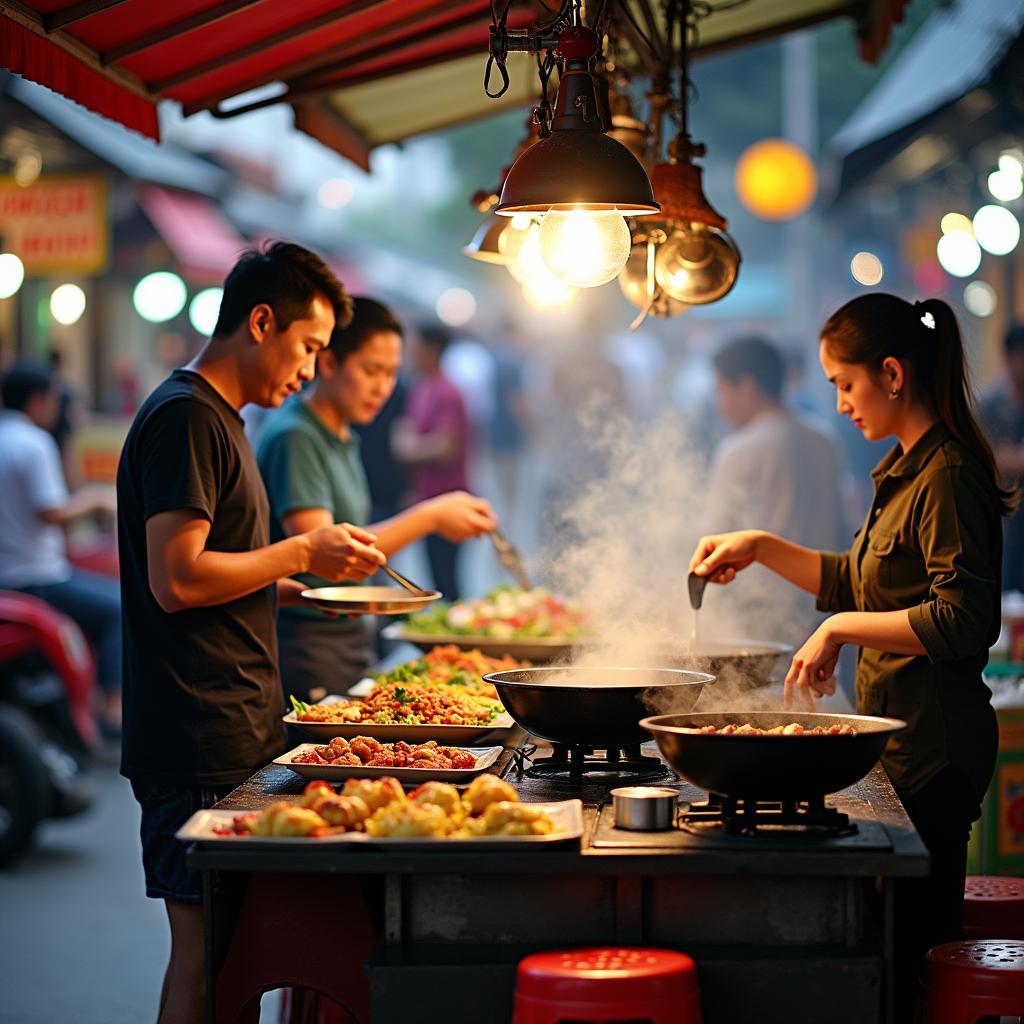 Khung cảnh ẩm thực đường phố Việt Nam sôi động với các món ăn địa phương
Question 5: Should governments regulate the food industry more strictly?
🎯 Phân tích câu hỏi:
- Dạng: Opinion về policy/government action
- Key words: governments, regulate, food industry, more strictly
- Cách tiếp cận: State position → Reasons (health, safety, environmental) → Acknowledge counter-arguments → Balanced conclusion
📝 Sample Answer – Band 6-7:
Yes, I think governments should have stricter regulations for the food industry. This is important for public health because some food companies use unhealthy ingredients or misleading labels. Stricter rules can make sure food is safe and nutritious. For example, regulations about sugar content can help reduce obesity. However, too many regulations might be difficult for small businesses. So the government needs to find a balance between protecting consumers and supporting businesses.
Phân tích:
- Structure: Clear opinion với supporting reasons và acknowledgment of counter-view
- Vocabulary: Adequate (stricter regulations, misleading labels, public health)
- Tại sao Band 6-7: Addresses question với relevant points, nhưng analysis không deep và thiếu specific examples.
📝 Câu trả lời mẫu – Band 8-9:
This is quite a contentious issue, and while I generally lean towards supporting stronger regulation, I think we need to distinguish between different aspects of food industry oversight.
I’d argue there’s a compelling case for more stringent regulations in certain areas, particularly regarding transparency and consumer information. The current labeling requirements in many countries are woefully inadequate – consumers often can’t decipher what’s actually in processed foods due to deliberately obfuscating terminology. Enhanced regulatory frameworks requiring clear labeling of sugar content, artificial additives, and allergens would empower consumers to make informed choices. There’s also the issue of misleading marketing, especially targeting children with unhealthy products masquerading as nutritious – this definitely warrants stricter governmental intervention.
From a public health standpoint, the mounting evidence linking processed foods to chronic diseases like diabetes and cardiovascular conditions suggests that preventative regulation could yield significant long-term healthcare savings. Countries like Chile and Mexico have implemented front-of-package warning labels for high-calorie, high-sodium foods, and preliminary data shows these policies correlate with shifts in consumer behavior.
However, I’m also cognizant of the potential pitfalls of over-regulation. Excessive bureaucratic requirements can disproportionately burden small-scale producers and family businesses that lack the resources to navigate complex compliance systems. There’s a risk that well-intentioned regulations might inadvertently favor large corporations that can afford compliance costs, thereby reducing market diversity. We’ve seen this happen in some agricultural sectors where onerous regulations led to consolidation rather than improved safety.
The sweet spot, in my view, is risk-based, proportionate regulation that targets the most significant public health concerns – things like trans fats, excessive sodium, and misleading health claims – while avoiding micromanagement of every aspect of food production. Regulations should also be adaptive and evidence-based, subject to regular review as our understanding of nutrition evolves. Coupling regulations with consumer education initiatives would create a more comprehensive approach than regulation alone.
Phân tích:
- Structure: Highly sophisticated: Nuanced position statement → Strong case for regulation (specific areas) with evidence → Public health argument with examples → Counter-arguments (over-regulation risks) with analysis → Balanced solution with specific recommendations
- Vocabulary: Exceptional (contentious issue, lean towards, deliberately obfuscating, empower consumers, mounting evidence, preventative regulation, disproportionately burden, onerous regulations, risk-based proportionate regulation)
- Grammar: Full range with complex conditionals, passive constructions, participle clauses, sophisticated connectors
- Critical Thinking: Multi-dimensional analysis showing understanding of policy complexity, evidence-based reasoning (references Chile/Mexico), acknowledges trade-offs, proposes nuanced solutions, shows awareness of unintended consequences
💡 Key Language Features:
- Hedging and nuance: quite, generally, I’d argue, in my view, potential
- Academic structures: There’s a compelling case for, The mounting evidence linking X to Y, Countries like…have implemented
- Cause-effect language: lead to, correlate with, yield, result in
- Sophisticated connectors: while, however, thereby, whereas
Theme 4: Globalization and Food Culture
Question 6: How has globalization affected local food traditions?
🎯 Phân tích câu hỏi:
- Dạng: Impact/Effect analysis với both positive và negative aspects
- Key words: globalization, affected, local food traditions
- Cách tiếp cận: Acknowledge complexity → Negative impacts → Positive aspects → Balanced view of transformation
📝 Câu trả lời mẫu – Band 8-9:
This is a multifaceted phenomenon with both concerning and intriguing dimensions, and I think the impact varies significantly across different contexts.
On the potentially negative side, globalization has undeniably led to a certain homogenization of food cultures. The proliferation of international fast-food chains and standardized food products means that increasingly, you can find the same foods in Shanghai, São Paulo, and Stockholm. This encroachment of global brands has, in some cases, displaced local food businesses and eroded traditional eating patterns, particularly among younger generations who are more susceptible to global marketing. There’s also what anthropologists call “culinary erosion” – the gradual loss of traditional recipes, cooking techniques, and food knowledge as younger generations opt for convenient, mass-produced alternatives. In Vietnam, for instance, I’ve noticed fewer young people know how to prepare traditional dishes that require time-intensive preparation, like certain fermented foods or labor-intensive festive dishes.
However, globalization has also created some paradoxical positive effects. The same forces that spread global brands have also facilitated the international recognition and commercialization of local cuisines. Vietnamese pho, Thai curry, and Mexican tacos have become internationally celebrated, creating economic opportunities for these food cultures and actually strengthening their prestige domestically – a kind of reverse validation effect. Moreover, cross-cultural culinary exchange has led to innovative fusion cuisines that enrich rather than diminish food culture. The influx of ingredients and techniques from around the world has given creative chefs new tools to reinterpret traditional dishes in exciting ways.
I’ve also observed an interesting counter-movement emerging in response to globalization – a heightened consciousness about preserving local food traditions. There’s growing interest in heirloom varieties, artisanal production methods, and slow food movements that specifically push back against mass-produced homogeneity. Organizations are documenting traditional recipes, and there’s a renaissance of interest in regional cuisines even in highly globalized societies.
So I’d say globalization’s impact is neither wholly destructive nor purely beneficial – it’s a transformative force that’s reshaping local food traditions in complex ways. The key challenge is navigating this transformation thoughtfully, embracing beneficial exchanges while safeguarding the core elements that give each food culture its distinctiveness.
Phân tích:
- Structure: Exceptionally well-organized: Introduction acknowledging complexity → Negative impacts (homogenization, erosion) with specific examples → Positive aspects (international recognition, innovation) with examples → Counter-trend → Nuanced conclusion
- Vocabulary: Highly sophisticated (multifaceted phenomenon, proliferation, encroachment, eroded, culinary erosion, time-intensive, paradoxical effects, reverse validation, heirloom varieties, renaissance)
- Grammar: Full mastery with varied complex structures, parenthetical information, sophisticated connecting phrases
- Critical Thinking: Demonstrates deep understanding of complex socio-cultural dynamics, multiple perspectives considered, specific examples from different contexts, acknowledges both negative và positive aspects, identifies emerging counter-trends
Để hiểu thêm về trải nghiệm văn hóa ẩm thực trong bối cảnh quốc tế, bạn có thể tham khảo describe a time when you visited a foreign country và khám phá những món ăn mới lạ.
Từ vựng và cụm từ quan trọng
Topic-Specific Vocabulary
| Từ vựng/Cụm từ | Loại từ | Phiên âm | Nghĩa tiếng Việt | Ví dụ | Collocation |
|---|---|---|---|---|---|
| savory | adj | /ˈseɪvəri/ | mặn, có vị mặn (không ngọt) | I prefer savory dishes over sweet ones. | savory pancake, savory snack, savory flavor, savory aroma |
| aromatic | adj | /ˌærəˈmætɪk/ | thơm ngát, có mùi thơm | The soup is infused with aromatic herbs. | aromatic spices, aromatic herbs, aromatic rice, aromatic broth |
| ingredient | n | /ɪnˈɡriːdiənt/ | nguyên liệu | Fresh ingredients are essential for good cooking. | key ingredient, main ingredient, fresh ingredients, quality ingredients |
| palate | n | /ˈpælət/ | khẩu vị, vị giác | This dish will satisfy even the most discerning palate. | refined palate, discerning palate, develop your palate, suit one’s palate |
| cuisine | n | /kwɪˈziːn/ | nền ẩm thực | Vietnamese cuisine is known for its fresh herbs. | traditional cuisine, local cuisine, authentic cuisine, sample the cuisine |
| culinary | adj | /ˈkʌlɪneri/ | thuộc về ẩm thực | He has impressive culinary skills. | culinary tradition, culinary heritage, culinary experience, culinary expertise |
| delicacy | n | /ˈdelɪkəsi/ | món ăn đặc sản, tinh hoa | Bird’s nest soup is considered a delicacy in Vietnam. | local delicacy, regional delicacy, rare delicacy, expensive delicacy |
| simmer | v | /ˈsɪmər/ | ninh nhỏ lửa | The broth needs to simmer for several hours. | gently simmer, slowly simmer, let it simmer, simmer on low heat |
| infuse | v | /ɪnˈfjuːz/ | ngấm, thấm đẫm hương vị | The broth is infused with spices. | infused with flavor, infused with herbs, infused with aroma |
| mouthwatering | adj | /ˈmaʊθwɔːtərɪŋ/ | hấp dẫn, kích thích vị giác | The mouthwatering aroma filled the kitchen. | mouthwatering dish, mouthwatering smell, mouthwatering flavors |
| authentic | adj | /ɔːˈθentɪk/ | chính gốc, nguyên bản | This restaurant serves authentic Vietnamese food. | authentic cuisine, authentic experience, authentic flavors, authentic recipe |
| nutritious | adj | /njuːˈtrɪʃəs/ | bổ dưỡng, giàu dinh dưỡng | Pho is both delicious and nutritious. | nutritious meal, highly nutritious, nutritious food, nutritious diet |
| tender | adj | /ˈtendər/ | mềm, mọng (thịt) | The beef was perfectly tender. | tender meat, tender and juicy, melt-in-your-mouth tender |
| crispy | adj | /ˈkrɪspi/ | giòn tan | The pancake has a crispy exterior. | crispy texture, perfectly crispy, crispy and golden, crispy on the outside |
| broth | n | /brɒθ/ | nước dùng | The rich broth is the soul of pho. | beef broth, chicken broth, rich broth, flavorful broth, clear broth |
| garnish | v/n | /ˈɡɑːrnɪʃ/ | trang trí món ăn | Garnish the dish with fresh herbs. | garnish with herbs, decorative garnish, fresh garnish |
| staple | n | /ˈsteɪpl/ | thực phẩm chính, chủ yếu | Rice is a staple in Vietnamese diet. | dietary staple, staple food, staple ingredient, daily staple |
| fusion cuisine | n phrase | /ˈfjuːʒn kwɪˈziːn/ | ẩm thực kết hợp | This restaurant specializes in Asian fusion cuisine. | modern fusion, creative fusion, East-West fusion |
| umami | n | /uːˈmɑːmi/ | vị umami (vị ngon) | The fish sauce adds umami to the dish. | rich umami, umami flavor, umami taste, full of umami |
Idiomatic Expressions & Advanced Phrases
| Cụm từ | Nghĩa | Ví dụ sử dụng | Band điểm |
|---|---|---|---|
| comfort food | món ăn gợi cảm giác ấm áp, thoải mái | Pho is my ultimate comfort food on rainy days. | 7.5-8 |
| acquired taste | khẩu vị phải học dần mới quen | Fermented foods are often an acquired taste. | 7.5-8.5 |
| hits the spot | thỏa mãn đúng mức, vừa ý | A cold beer really hits the spot after work. | 7.5-8 |
| to whet one’s appetite | kích thích vị giác | The aromatic smell whets your appetite immediately. | 8-8.5 |
| food for thought | điều đáng để suy nghĩ | His comments on food culture gave me food for thought. | 8-8.5 |
| melt in your mouth | tan trong miệng (rất mềm, ngon) | The beef was so tender it melted in my mouth. | 7.5-8 |
| bring something to the table | đóng góp, mang đến giá trị gì | This dish brings unique flavors to the table. | 8-8.5 |
| leave a bad taste in one’s mouth | để lại ấn tượng xấu | The poor service left a bad taste in my mouth. | 8-8.5 |
| easy as pie | rất dễ dàng | Making this dish is as easy as pie. | 7-7.5 |
| food coma | trạng thái buồn ngủ sau khi ăn no | I always get a food coma after eating pho. | 7.5-8 |
| feast your eyes on | chiêm ngưỡng | Feast your eyes on this beautifully presented dish. | 8-8.5 |
| culinary journey | hành trình khám phá ẩm thực | Trying street food is a culinary journey through local culture. | 8-9 |
Discourse Markers (Từ Nối Ý Trong Speaking)
Để bắt đầu câu trả lời:
- 📝 Well,… – Dùng khi cần thời gian suy nghĩ ngắn
- 📝 Actually,… – Khi đưa ra thông tin có thể khác với kỳ vọng
- 📝 To be honest,… – Khi nói thẳng, thật lòng
- 📝 I’d say that… – Khi đưa ra quan điểm cá nhân
- 📝 From my perspective,… – Theo góc nhìn của tôi
- 📝 In my experience,… – Dựa trên kinh nghiệm của tôi
Để bổ sung ý:
- 📝 On top of that,… – Thêm vào đó
- 📝 What’s more,… – Hơn nữa
- 📝 Not to mention… – Chưa kể đến
- 📝 Beyond that,… – Ngoài ra còn
- 📝 Additionally,… – Bên cạnh đó
- 📝 Moreover,… – Hơn thế nữa
Để đưa ra quan điểm cân bằng:
- 📝 On the one hand,… On the other hand,… – Một mặt… mặt khác
- 📝 While it’s true that…, we also need to consider… – Mặc dù đúng là… nhưng ta cũng cần xem xét
- 📝 That said,… – Tuy nhiên, nói như vậy thì
- 📝 Having said that,… – Đã nói vậy nhưng
Để đưa ra ví dụ:
- 📝 For instance,… – Ví dụ như
- 📝 Take… for example – Lấy… làm ví dụ
- 📝 A case in point is… – Một trường hợp điển hình là
- 📝 To illustrate this,… – Để minh họa điều này
Để kết luận:
- 📝 All in all,… – Tóm lại
- 📝 At the end of the day,… – Cuối cùng thì
- 📝 In short,… – Nói ngắn gọn
- 📝 To sum up,… – Tóm lại
- 📝 The bottom line is… – Điểm mấu chốt là
Grammatical Structures Ấn Tượng
1. Conditional Sentences (Câu điều kiện):
-
Mixed conditional: “If I hadn’t tried pho during my first visit to Hanoi, I wouldn’t be such a big fan now.”
- (Kết hợp điều kiện quá khứ với kết quả hiện tại)
-
Inversion for emphasis: “Had I known how delicious banh mi was, I would have tried it much earlier.”
- (Đảo ngữ để nhấn mạnh, formal hơn If I had known)
2. Relative Clauses (Mệnh đề quan hệ):
-
Non-defining: “Pho, which originated in northern Vietnam, has become internationally recognized.”
- (Cung cấp thông tin bổ sung, có dấu phẩy)
-
Reduced relative clause: “The dish served at that restaurant is absolutely authentic.”
- (Rút gọn: which is served → served)
3. Passive Voice (Câu bị động):
-
Impersonal passive: “It is widely believed that traditional cuisine reflects cultural values.”
- (Được sử dụng để nói về quan điểm chung)
-
Get passive: “I got hooked on Vietnamese coffee during my trip.”
- (Informal hơn, nhấn mạnh kết quả)
4. Cleft Sentences (Câu chẻ):
-
What-cleft: “What I find most appealing about this dish is the balance of flavors.”
- (Nhấn mạnh vào object – sự cân bằng hương vị)
-
It-cleft: “It’s the authentic preparation method that makes this restaurant special.”
- (Nhấn mạnh vào subject – phương pháp chế biến)
5. Participle Clauses:
-
Present participle: “Having tried many versions of pho, I can say this is the best.”
- (Thể hiện hành động xảy ra trước)
-
Past participle: “Prepared with fresh ingredients, the dish tastes exceptional.”
- (Passive meaning – được chuẩn bị với…)
6. Inversion for emphasis:
- Never before: “Never before have I tasted such authentic Vietnamese cuisine.”
- Not only: “Not only is the food delicious, but the atmosphere is also fantastic.”
Các bạn có thể tham khảo thêm các chủ đề tương tự như describe an event that you are looking forward to để làm phong phú thêm vốn từ vựng và cách diễn đạt trong IELTS Speaking.
 Sơ đồ tư duy từ vựng IELTS Speaking chủ đề món ăn và ẩm thực địa phương
Chiến Lược Tổng Thể Để Đạt Band Cao
Sau khi đi qua chi tiết cả ba phần thi, hãy cùng tổng hợp những chiến lược quan trọng giúp bạn maximize band điểm khi gặp chủ đề về món ăn địa phương.
Chuẩn Bị Trước Khi Thi
1. Xây dựng personal food repertoire:
Liệt kê 5-7 món ăn địa phương bạn thực sự biết rõ và có trải nghiệm chân thực. Đừng chọn món bạn chưa từng ăn hoặc không hiểu rõ về cách chế biến. Với mỗi món, chuẩn bị:
- Detailed description (appearance, taste, texture, aroma)
- Ingredients và cooking process
- Personal memories hoặc stories liên quan
- Cultural significance
2. Practice sensory language:
Band cao yêu cầu descriptive language phong phú. Thay vì “it tastes good”, hãy sử dụng:
- Taste: savory, tangy, zesty, umami-rich, slightly sweet with a hint of…
- Texture: crispy, tender, silky, chewy, melt-in-your-mouth
- Aroma: fragrant, aromatic, pungent, subtle
- Visual: vibrant, golden-brown, glistening, colorful
3. Develop flexible templates (nhưng đừng học thuộc lòng):
Có structure trong đầu nhưng phải adaptable:
- Part 2 structure: Introduction (what) → Ingredients/Preparation (how) → Context (when/where) → Deeper explanation (why – chiếm 40%)
- Part 3 answer structure: Direct answer → Reason 1 + example → Reason 2 + example → Acknowledge counter-view → Conclusion
Trong Phòng Thi
Xử lý Part 1:
- Extend answers naturally đến 2-3 câu
- Avoid yes/no answers
- Add personal details nhưng đừng ramble
- Maintain natural conversational tone
Tận dụng Part 2:
- Use full 1 minute chuẩn bị: ghi keywords cho mỗi bullet point
- Speak for full 2 minutes nếu có thể (examiner sẽ stop bạn if needed)
- Make eye contact occasionally
- Show enthusiasm về topic
- Develop phần “explain why” thoroughly – đây là scoring opportunity
Excel trong Part 3:
- Think before speaking (1-2 seconds pause là acceptable)
- Structure complex answers: State opinion → Multiple reasons → Examples/Evidence → Nuanced conclusion
- Use discourse markers để organize ideas
- Acknowledge different perspectives
- Go beyond personal experience – discuss societal trends, cultural aspects
- Use tentative language (tend to, might, could potentially) để avoid overgeneralization
Lỗi Cần Tránh
Vocabulary mistakes:
- ❌ Overuse of “delicious” – dùng alternatives như savory, flavorful, mouthwatering
- ❌ “Traditional food” lặp lại – thay bằng traditional cuisine, local dish, regional specialty, heritage food
- ❌ Using unnecessarily complex words incorrectly – sophistication ≠ complexity without accuracy
Grammar mistakes:
- ❌ Tense confusion trong Part 2: nếu món ăn vẫn exist và bạn vẫn love nó → present tense
- ❌ Subject-verb agreement: “The ingredients is…” → “The ingredients are…”
- ❌ Article errors: “I like to eat pho” (không cần “the” vì general statement)
Content mistakes:
- ❌ Being too general: “Vietnamese food is good” → give specific reasons
- ❌ Memorized answers sound unnatural – examiners are trained để recognize này
- ❌ Talking too little trong Part 3 – aim for 3-5 sentences minimum
Fluency mistakes:
- ❌ Long pauses without discourse markers – use “Well,” “Let me think,” naturally
- ❌ False starts và self-corrections quá nhiều – better to continue than restart
- ❌ Speaking too fast to show fluency – natural pace với clear articulation tốt hơn
Tips Từ Examiner
Với 20 năm kinh nghiệm chấm thi, tôi nhận thấy những điều sau giúp thí sinh ghi điểm cao:
Authenticity matters:
Những câu chuyện chân thực về món ăn, personal connection, và real experiences luôn impress hơn fabricated stories. Examiners có thể sense genuineness.
Balance fluency và accuracy:
Đừng sacrifice accuracy để nói nhanh. Band 8-9 speakers có natural pace với high accuracy, không phải nói như máy.
Show range naturally:
Đừng force sophisticated vocabulary nếu nó sounds unnatural. Better to use Band 7 vocabulary correctly và naturally hơn Band 9 vocabulary incorrectly.
Engage with questions:
Trong Part 3, if you don’t understand fully, ask for clarification: “Could you rephrase that?” hoặc “Do you mean…” – điều này shows communication skills.
Body language counts:
Maintain good eye contact, show enthusiasm về topic, use natural gestures. Pronunciation assessment includes non-verbal communication.
Recovery strategies:
Nếu bạn make mistake, đừng panic. Simply self-correct naturally: “Sorry, what I meant to say is…” hoặc continue – one mistake won’t destroy your score.
Kế Hoạch Luyện Tập
Tuần 1-2: Vocabulary building
- Học 10 từ vựng mới về food mỗi ngày
- Practice using chúng trong sentences
- Record yourself describing 3 dishes
Tuần 3-4: Part 2 practice
- Chuẩn bị 5 food-related cue cards
- Record 2-minute talks
- Analyze: Did you cover all points? How’s your pronunciation?
Tuần 5-6: Part 3 development
- Practice analytical thinking
- Discuss broader issues: food culture, health, globalization
- Learn to present multiple viewpoints
Ongoing:
- Listen to food podcasts/videos (để improve pronunciation và pick up natural expressions)
- Watch IELTS Speaking samples (examiners’ feedback rất valuable)
- Do mock tests với friends hoặc teachers
- Self-record và review regularly
Chủ đề về món ăn địa phương là một trong những topic thú vị và gần gũi nhất trong IELTS Speaking. Với preparation đúng cách, authentic stories, và vocabulary phong phú, bạn hoàn toàn có thể biến đây thành cơ hội để showcase language skills và đạt band điểm mục tiêu. Hãy nhớ rằng, examiners không đánh giá food knowledge của bạn mà đánh giá English communication skills qua medium của food topic. Good luck với preparation và đừng quên enjoy the process – nói về món ăn yêu thích should be enjoyable!