Chủ đề Describe A Memorable Concert Or Performance You Attended là một trong những đề bài kinh điển và xuất hiện thường xuyên trong IELTS Speaking Part 2. Với vai trò là giám khảo IELTS có hơn 20 năm kinh nghiệm chấm thi, tôi nhận thấy đây là chủ đề có tần suất xuất hiện cao trong các kỳ thi từ 2020 đến 2025, với mức độ phổ biến ước tính 15-20% trong tổng số đề thi Part 2. Dự đoán khả năng xuất hiện trong tương lai vẫn ở mức Cao do tính phổ biến của các hoạt động văn hóa – giải trí trong đời sống hiện đại.
Chủ đề này quan trọng vì nó cho phép bạn thể hiện khả năng kể chuyện, miêu tả trải nghiệm cá nhân và bày tỏ cảm xúc – những kỹ năng then chốt trong IELTS Speaking. Examiner thường đánh giá cao các câu trả lời có tính cá nhân, chân thực và giàu cảm xúc hơn là những câu trả lời mang tính khuôn mẫu.
Trong bài viết này, bạn sẽ học được:
- 10+ câu hỏi thực tế từ các kỳ thi IELTS cho cả 3 Part
- Bài mẫu chi tiết với phân tích theo từng band điểm 6-7, 7.5-8 và 8.5-9
- Hơn 50 từ vựng và cụm từ ăn điểm về chủ đề concert và performance
- Chiến lược trả lời hiệu quả từ góc nhìn Examiner
- Phân tích sâu về những điểm khác biệt giữa các band điểm
- Lời khuyên thực tế để tránh những lỗi thường gặp của học viên Việt Nam
IELTS Speaking Part 1: Introduction and Interview
Tổng Quan Về Part 1
Part 1 của IELTS Speaking thường kéo dài 4-5 phút với các câu hỏi ngắn về đời sống hàng ngày. Đặc điểm của phần này là câu hỏi thường liên quan đến kinh nghiệm, thói quen và sở thích cá nhân. Chiến lược hiệu quả là trả lời tự nhiên, mở rộng mỗi câu trả lời thành 2-3 câu với cấu trúc: trả lời trực tiếp, giải thích lý do và đưa ra ví dụ cụ thể.
Các lỗi thường gặp của học viên Việt Nam trong Part 1:
- Trả lời quá ngắn gọn chỉ với Yes/No hoặc một từ đơn
- Sử dụng từ vựng quá đơn giản và lặp lại
- Thiếu ví dụ cụ thể từ kinh nghiệm bản thân
- Ngần ngại, thiếu tự tin dẫn đến nhiều pauses không cần thiết
Các Câu Hỏi Thường Gặp
Question 1: Do you like going to concerts or live performances?
Question 2: What kind of music or performances do you enjoy most?
Question 3: When was the last time you attended a concert or performance?
Question 4: Do you prefer watching performances live or on TV/online?
Question 5: Have you ever been to a concert of your favorite artist?
Question 6: Are concerts popular in your country?
Question 7: What do you think makes a good live performance?
Question 8: Would you like to perform on stage yourself?
Phân Tích và Gợi Ý Trả Lời Chi Tiết
Question: Do you like going to concerts or live performances?
🎯 Cách tiếp cận:
- Trả lời trực tiếp có/không thích
- Đưa ra lý do cụ thể
- Thêm ví dụ hoặc tần suất tham gia
📝 Sample Answer – Band 6-7:
Yes, I really like going to concerts. The atmosphere is very exciting and the music sounds better than listening at home. I usually go to concerts with my friends when there are famous singers performing in my city.
Phân tích:
- Điểm mạnh: Câu trả lời rõ ràng, có lý do và đề cập đến tần suất
- Hạn chế: Từ vựng còn đơn giản (really like, very exciting), thiếu chi tiết cảm xúc
- Tại sao Band 6-7: Đủ các yếu tố cơ bản nhưng chưa có từ vựng nâng cao hoặc cấu trúc phức tạp
📝 Sample Answer – Band 8-9:
Absolutely! I’m quite passionate about attending live performances, especially indie rock concerts. There’s something incredibly exhilarating about the raw energy and atmosphere you can only experience in person – the way the bass reverberates through your body and how the crowd feeds off the artist’s energy. I try to catch a live show at least once every couple of months whenever my schedule permits.
Phân tích:
- Điểm mạnh: Sử dụng collocation tự nhiên (passionate about, raw energy, feeds off), miêu tả cảm giác cụ thể (bass reverberates), có tần suất rõ ràng
- Tại sao Band 8-9:
- Fluency: Câu trả lời trôi chảy, không hesitation
- Vocabulary: Từ vựng tinh tế và idiomatic (exhilarating, reverberates, feeds off)
- Grammar: Sử dụng cấu trúc phức tạp (there’s something… about, the way…)
- Ideas: Ý tưởng cụ thể về khác biệt giữa live và recorded music
💡 Key Vocabulary & Expressions:
- passionate about: say mê, đam mê về cái gì
- exhilarating: vô cùng phấn khích, hào hứng
- raw energy: năng lượng mãnh liệt, thuần khiết
- reverberates: vang vọng, rung động
- feeds off: hấp thụ, nhận năng lượng từ
Question: What kind of music or performances do you enjoy most?
🎯 Cách tiếp cận:
- Nêu rõ thể loại yêu thích
- Giải thích tại sao thích thể loại đó
- Có thể so sánh với các thể loại khác
📝 Sample Answer – Band 6-7:
I enjoy pop music concerts the most because the songs are catchy and easy to sing along. I also like the light effects and dancing at these shows. Sometimes I go to classical music concerts too, but they are more serious and quiet.
Phân tích:
- Điểm mạnh: Nêu được thể loại, có so sánh giữa hai loại nhạc
- Hạn chế: Từ vựng cơ bản (catchy, easy to sing along), thiếu depth trong giải thích
- Tại sao Band 6-7: Cấu trúc câu đơn giản, ý tưởng chưa được phát triển đầy đủ
📝 Sample Answer – Band 8-9:
I’m particularly drawn to acoustic performances and intimate gigs rather than massive stadium shows. What really resonates with me is the authenticity and vulnerability that artists display in smaller venues – you can pick up on every nuance in their voice and see the genuine emotion on their faces. Tương tự như describe a cultural performance you attended, những buổi biểu diễn có quy mô nhỏ hơn thường mang lại trải nghiệm gần gũi và chân thực hơn cho khán giả. That being said, I do occasionally enjoy high-energy rock concerts for the sheer adrenaline rush they provide.
Phân tích:
- Điểm mạnh: Vocabulary sophisticated (drawn to, resonates with, vulnerability, nuance), có contrast rõ ràng, thừa nhận nhiều preference
- Tại sao Band 8-9:
- Fluency: Sử dụng discourse markers tự nhiên (That being said)
- Vocabulary: Topic-specific và precise (acoustic, intimate gigs, nuance)
- Grammar: Complex sentences với relative clauses
- Ideas: Phân tích sâu về lý do thích (authenticity, vulnerability, emotion)
💡 Key Vocabulary & Expressions:
- drawn to: bị thu hút bởi
- intimate gigs: buổi biểu diễn thân mật, quy mô nhỏ
- resonates with: gây được tiếng vang, đồng điệu với
- pick up on: nhận ra, cảm nhận được
- nuance: sắc thái, chi tiết tinh tế
- adrenaline rush: cảm giác phấn khích mạnh
Question: When was the last time you attended a concert or performance?
🎯 Cách tiếp cận:
- Nêu thời gian cụ thể
- Mô tả ngắn gọn về sự kiện đó
- Chia sẻ cảm nhận tổng quan
📝 Sample Answer – Band 6-7:
The last concert I went to was about three months ago. It was a pop concert by a Vietnamese singer at the stadium. The concert was very crowded and exciting. I really enjoyed it and took many photos.
Phân tích:
- Điểm mạnh: Có timeframe rõ ràng, đề cập địa điểm và hành động
- Hạn chế: Thiếu detail về trải nghiệm, từ vựng lặp lại (very crowded, very exciting)
- Tại sao Band 6-7: Đáp ứng yêu cầu cơ bản nhưng chưa có chiều sâu
📝 Sample Answer – Band 8-9:
Just last month, I had the pleasure of attending a jazz fusion concert at the city’s performing arts center. It featured a renowned Vietnamese saxophonist who collaborated with an international ensemble. What made it particularly memorable was the improvisational nature of the performance – you could sense the musicians communicating through their instruments, responding to each other’s musical cues in real-time. Nếu bạn quan tâm đến describe a time when you attended a workshop, việc tham gia các buổi biểu diễn âm nhạc cũng mang lại những bài học và trải nghiệm tương tự về sự tương tác và học hỏi. It was absolutely mesmerizing.
Phân tích:
- Điểm mạnh: Chi tiết cụ thể (jazz fusion, performing arts center), miêu tả experience sâu sắc, từ vựng sophisticated
- Tại sao Band 8-9:
- Fluency: Câu trả lời coherent với các ideas liên kết mượt mà
- Vocabulary: Precise và topic-specific (improvisational, ensemble, musical cues)
- Grammar: Compound và complex structures
- Ideas: Focus vào unique aspect (improvisational nature, musicians communicating)
💡 Key Vocabulary & Expressions:
- performing arts center: trung tâm nghệ thuật biểu diễn
- renowned: nổi tiếng, có tiếng tăm
- ensemble: dàn nhạc, nhóm nhạc
- improvisational nature: tính chất ngẫu hứng
- musical cues: tín hiệu âm nhạc
- mesmerizing: mê hoặc, hấp dẫn không thể rời mắt
 Buổi biểu diễn jazz fusion tại trung tâm nghệ thuật biểu diễn với dàn nhạc chuyên nghiệp và ánh sáng sân khấu ấn tượng
IELTS Speaking Part 2: Long Turn (Cue Card)
Tổng Quan Về Part 2
Part 2 là phần độc thoại kéo dài 2-3 phút, trong đó bạn có 1 phút chuẩn bị. Đây là phần quan trọng nhất vì chiếm trọng số lớn trong tổng điểm Speaking. Đặc điểm của Part 2 là yêu cầu kể chi tiết về một chủ đề cụ thể, thường là trải nghiệm trong quá khứ.
Chiến lược hiệu quả:
- Sử dụng hết 1 phút chuẩn bị để ghi chú keywords, không viết câu hoàn chỉnh
- Nói đủ 2 phút, tối thiểu 1.5 phút để tránh bị trừ điểm
- Trả lời đầy đủ tất cả bullet points theo thứ tự
- Sử dụng thì quá khứ khi kể về sự kiện đã xảy ra
- Thêm chi tiết cụ thể về thời gian, địa điểm, con người, cảm xúc
Lỗi thường gặp của học viên Việt Nam:
- Không tận dụng hết 1 phút chuẩn bị hoặc viết quá nhiều
- Nói dưới 1.5 phút vì thiếu ý tưởng mở rộng
- Bỏ sót một hoặc nhiều bullet points
- Quá tập trung vào bullet đầu, vội vàng với các bullet sau
- Thiếu linking words giữa các ý
Cue Card
Describe a memorable concert or performance you attended
You should say:
- What concert or performance it was
- When and where you attended it
- Who performed and what they did
- And explain why it was memorable for you
Phân Tích Đề Bài
- Dạng câu hỏi: Describe an event/experience – kể về một trải nghiệm trong quá khứ
- Thì động từ: Chủ yếu là quá khứ đơn và quá khứ tiếp diễn để kể chuyện
- Bullet points phải cover:
- Loại concert/performance gì (thể loại, quy mô)
- Thời gian và địa điểm cụ thể
- Ai biểu diễn và họ làm gì trên sân khấu
- Giải thích tại sao đáng nhớ (đây là phần quan trọng nhất)
- Câu “explain” quan trọng: Đây là phần ghi điểm cao nhất vì yêu cầu bạn phân tích cảm xúc, đưa ra ý kiến và đánh giá. Cần dành ít nhất 30-40 giây cho phần này với vocabulary về emotions và personal reflection.
📝 Sample Answer – Band 6-7
Thời lượng: Khoảng 1.5-2 phút
I’d like to talk about a rock concert that I attended last year. It was a concert by a famous international band called Imagine Dragons, and it took place at the National Stadium in my city in August.
The stadium was really crowded with thousands of fans. The band had four members and they played many popular songs. The lead singer had a very powerful voice and he moved around the stage a lot. They also had amazing light effects and big screens showing the performance.
I went there with my two best friends who are also big fans of this band. We bought the tickets three months before because they sold out very quickly. We arrived early to get good positions near the stage. The concert started at 7 PM and lasted for about two hours.
What made it memorable for me was the atmosphere. Everyone was singing together and the energy was incredible. When they played my favorite song “Believer”, I felt very excited and emotional. The sound quality was excellent and much better than listening on my phone or computer. It was also special because it was my first time seeing an international band perform live. After the concert, my friends and I talked about it for weeks. I took many photos and videos to remember this experience. I hope I can attend another concert like this in the future.
Phân Tích Band Điểm
| Tiêu chí | Band | Nhận xét |
|---|---|---|
| Fluency & Coherence | 6-7 | Có sequencing rõ ràng, sử dụng basic linking words (also, when, because), một số repetition (very, really) |
| Lexical Resource | 6-7 | Từ vựng adequate (crowded, powerful voice, atmosphere, energy) nhưng chưa sophisticated, một số paraphrasing |
| Grammatical Range & Accuracy | 6-7 | Sử dụng mix của simple và complex sentences, past tenses chính xác, có một số errors nhỏ |
| Pronunciation | 6-7 | Rõ ràng và dễ hiểu, có thể có một số lỗi nhỏ về word stress |
Điểm mạnh:
- ✅ Trả lời đủ tất cả bullet points theo thứ tự logic
- ✅ Có cấu trúc rõ ràng: giới thiệu → miêu tả → giải thích
- ✅ Đủ độ dài (khoảng 1.5-2 phút)
- ✅ Sử dụng past tenses chính xác
Hạn chế:
- ⚠️ Từ vựng còn basic và lặp lại (very, really, amazing)
- ⚠️ Thiếu idiomatic expressions và collocations tự nhiên
- ⚠️ Phần giải thích “why memorable” chưa đủ sâu, chưa có personal insight
📝 Sample Answer – Band 7.5-8
Thời lượng: Khoảng 2-2.5 phút
I’d like to share my experience of attending an absolutely phenomenal concert that took place about eight months ago – it was a performance by the legendary British rock band Coldplay at the My Dinh National Stadium in Hanoi.
This was actually a highly anticipated event in Vietnam because it was the band’s first-ever concert in the country. I managed to secure tickets through the official website, though it was quite a competitive process as they sold out within hours. The concert was scheduled for a Saturday evening in January, and the stadium was packed with roughly 40,000 enthusiastic fans.
The performance itself was nothing short of spectacular. The band performed for nearly two and a half hours, delivering all their greatest hits from “Yellow” to “A Sky Full of Stars”. What really stood out was the production quality – they had this elaborate stage setup with enormous LED screens, pyrotechnics, and these special LED wristbands that all audience members wore. These wristbands synchronized with the music, creating this breathtaking sea of lights that changed colors throughout the concert. On top of that, Chris Martin, the lead vocalist, was incredibly engaging with the audience, even attempting to speak a few words in Vietnamese, which really resonated with the local crowd.
Điều này có điểm tương đồng với describe a time when you attended a sports event khi cảm giác hòa mình vào đám đông và chia sẻ những khoảnh khắc đặc biệt tạo nên trải nghiệm khó quên.
What made this concert truly memorable for me was the overwhelming sense of unity and joy I felt. There’s something profoundly moving about being surrounded by thousands of people all singing the same lyrics, all swept up in the same emotion. It was also personally significant because I’d been a fan of Coldplay since high school, so finally seeing them live felt like a dream come true. The combination of their incredible musicianship, the stunning visual effects, and that collective energy created an experience I’ll treasure forever. Even now, whenever I hear their songs, I’m instantly transported back to that magical evening.
Phân Tích Band Điểm
| Tiêu chí | Band | Nhận xét |
|---|---|---|
| Fluency & Coherence | 7.5-8 | Rất smooth với varied discourse markers (actually, on top of that, even now), progression logic, minimal hesitation |
| Lexical Resource | 7.5-8 | Wide range vocabulary (phenomenal, pyrotechnics, synchronized), good collocations (highly anticipated, stood out, dream come true), less common expressions |
| Grammatical Range & Accuracy | 7.5-8 | Consistently complex structures (relative clauses, participle clauses), accurate tenses, variety in sentence types |
| Pronunciation | 7.5-8 | Clear, natural stress và intonation, easy to understand throughout |
So Sánh Với Band 6-7
| Khía cạnh | Band 6-7 | Band 7.5-8 |
|---|---|---|
| Vocabulary | “amazing light effects”, “very excited” | “elaborate stage setup with pyrotechnics”, “overwhelming sense of unity” |
| Grammar | “The concert started at 7 PM and lasted for about two hours” | “The band performed for nearly two and a half hours, delivering all their greatest hits” (participle clause) |
| Ideas | “What made it memorable was the atmosphere” (general) | “What made this concert truly memorable was the overwhelming sense of unity and joy I felt… profoundly moving…” (specific emotions with analysis) |
📝 Sample Answer – Band 8.5-9
Thời lượng: 2.5-3 phút đầy đủ
I’d love to tell you about what I’d describe as a once-in-a-lifetime musical experience – a classical music performance I attended at the Opera House approximately a year ago. It was the Hanoi Philharmonic Orchestra performing Tchaikovsky’s Symphony No. 5, accompanied by a world-renowned Russian conductor who was making a guest appearance.
This particular concert was part of a limited-run series celebrating the 200th anniversary of Tchaikovsky’s birth, which made it all the more significant. Securing tickets had been quite the endeavor – I’d been keeping tabs on the Opera House’s schedule for months and jumped at the opportunity the moment they were released. The performance took place on a crisp autumn evening in November, and the venue itself, with its opulent French colonial architecture, lent an additional layer of grandeur to the occasion.
 Buổi biểu diễn giao hưởng tại Nhà hát Lớn Hà Nội với dàn nhạc Philharmonic và kiến trúc Pháp cổ điển
What set this performance apart was the sheer emotional intensity and technical precision the orchestra brought to Tchaikovsky’s masterpiece. The conductor’s interpretation was both faithful to the original composition yet imbued with his own unique artistic vision. I was particularly struck by the fourth movement – the way the strings built up the tension, then cascaded into that triumphant finale was absolutely spine-tingling. You could literally feel the music reverberating through the hall, and there was this palpable sense of collective awe among the audience. What’s more, the orchestra’s cohesion was impeccable – watching how the musicians communicated non-verbally, responding to the conductor’s subtle gestures, was fascinating in itself.
The reason this concert remains so indelibly etched in my memory is multifaceted. Firstly, on a personal level, it represented a significant departure from my usual musical preferences – I’d always been more into contemporary genres, so this was somewhat of a leap outside my comfort zone. Yet, it ended up being profoundly transformative. The experience made me realize how transcendent live classical music can be – there’s an ineffable quality to hearing these intricate compositions performed live that simply cannot be replicated through recordings, no matter how high-fidelity they are.
Beyond the musical aspect, what made it truly special was the almost meditative state it induced. Unlike modern concerts where there’s constant visual stimulation and audience participation, this required a different kind of engagement – one that was more introspective and contemplative. For those two hours, I was completely immersed, disconnected from the outside world, and absorbed in the sonic landscape the orchestra created. Đối với những ai quan tâm đến describe a sport you enjoy watching on television, việc theo dõi một buổi biểu diễn âm nhạc cũng đòi hỏi sự tập trung và đánh giá cao kỹ năng tương tự như khi thưởng thức thể thao.
Moreover, it was a shared cultural experience that fostered a sense of connection with fellow attendees – that collective hush during the performance, followed by the thunderous applause at the end, created an unspoken bond among complete strangers. To this day, whenever I hear Tchaikovsky’s Fifth, I’m instantly transported back to that magical evening, and I can vividly recall every sensation – the plush velvet seats, the warm ambient lighting, and most importantly, that overwhelming sense of beauty that seemed to permeate the entire hall. It’s an experience that not only broadened my musical horizons but also deepened my appreciation for the enduring power of live performance art.
Phân Tích Band Điểm
| Tiêu chí | Band | Nhận xét |
|---|---|---|
| Fluency & Coherence | 8.5-9 | Hoàn toàn fluent, sophisticated discourse markers (Moreover, Yet, Unlike), perfect coherence với detailed progression |
| Lexical Resource | 8.5-9 | Precise and sophisticated vocabulary (opulent, imbued with, indelibly etched, transcendent, ineffable), natural collocations, idiomatic language |
| Grammatical Range & Accuracy | 8.5-9 | Full range of structures used naturally and accurately, complex subordination, advanced features (inversion, cleft sentences) |
| Pronunciation | 8.5-9 | Fully native-like pronunciation features with appropriate intonation patterns |
Tại Sao Bài Này Xuất Sắc
🎯 Fluency Hoàn Hảo:
- Không có hesitation, các ý được kết nối mượt mà với sophisticated discourse markers
- Progression tự nhiên từ context → description → personal reflection
- Sử dụng timing phrases effectively (For those two hours, To this day)
📚 Vocabulary Tinh Vi:
- “indelibly etched in my memory” – Idiom nâng cao thể hiện trí nhớ sâu sắc, thay vì “I remember it very well”
- “profoundly transformative” – Collocation mạnh mẽ về sự thay đổi, không chỉ “life-changing”
- “ineffable quality” – Từ sophisticated chỉ điều không thể diễn tả bằng lời
- “spine-tingling” – Idiomatic expression miêu tả cảm giác mạnh mẽ
- “palpable sense of awe” – Collocation academic về cảm giác có thể cảm nhận được
📝 Grammar Đa Dạng:
- “What set this performance apart was…” – Cleft sentence nhấn mạnh
- “Unlike modern concerts where there’s…, this required…” – Complex comparison với relative clause
- “It’s an experience that not only broadened… but also deepened…” – Parallel structure với not only…but also
- “watching how the musicians communicated non-verbally, responding to…” – Participle clauses showing simultaneous actions
💡 Ideas Sâu Sắc:
- Không chỉ miêu tả sự kiện mà còn phân tích tác động cá nhân (departure from usual preferences)
- So sánh giữa classical và contemporary concerts về audience engagement
- Phản ánh về shared cultural experience và collective emotions
- Đề cập đến sensory details (plush velvet seats, ambient lighting) tạo vivid imagery
Follow-up Questions (Rounding Off Questions)
Examiner thường hỏi 1-2 câu ngắn sau Part 2 để transition sang Part 3:
Question 1: Do you often go to concerts?
Band 6-7 Answer:
Not very often, maybe once or twice a year when there are good concerts. It depends on my schedule and the ticket prices.
Band 8-9 Answer:
I wouldn’t say I’m a regular concertgoer, but I do try to catch performances whenever compelling acts come to town – probably about three or four times annually. It really hinges on both my availability and whether the artists align with my musical tastes.
Question 2: Would you recommend this type of performance to others?
Band 6-7 Answer:
Yes, definitely. I think everyone should experience a live concert at least once because it’s very different from listening to music at home. It’s more exciting and memorable.
Band 8-9 Answer:
Absolutely, without hesitation. I think there’s immense value in experiencing live performances, regardless of one’s musical preferences. There’s something inherently powerful about the communal aspect of concerts that simply can’t be replicated through digital platforms. It’s one of those experiences that transcends mere entertainment and becomes a genuine cultural touchstone.
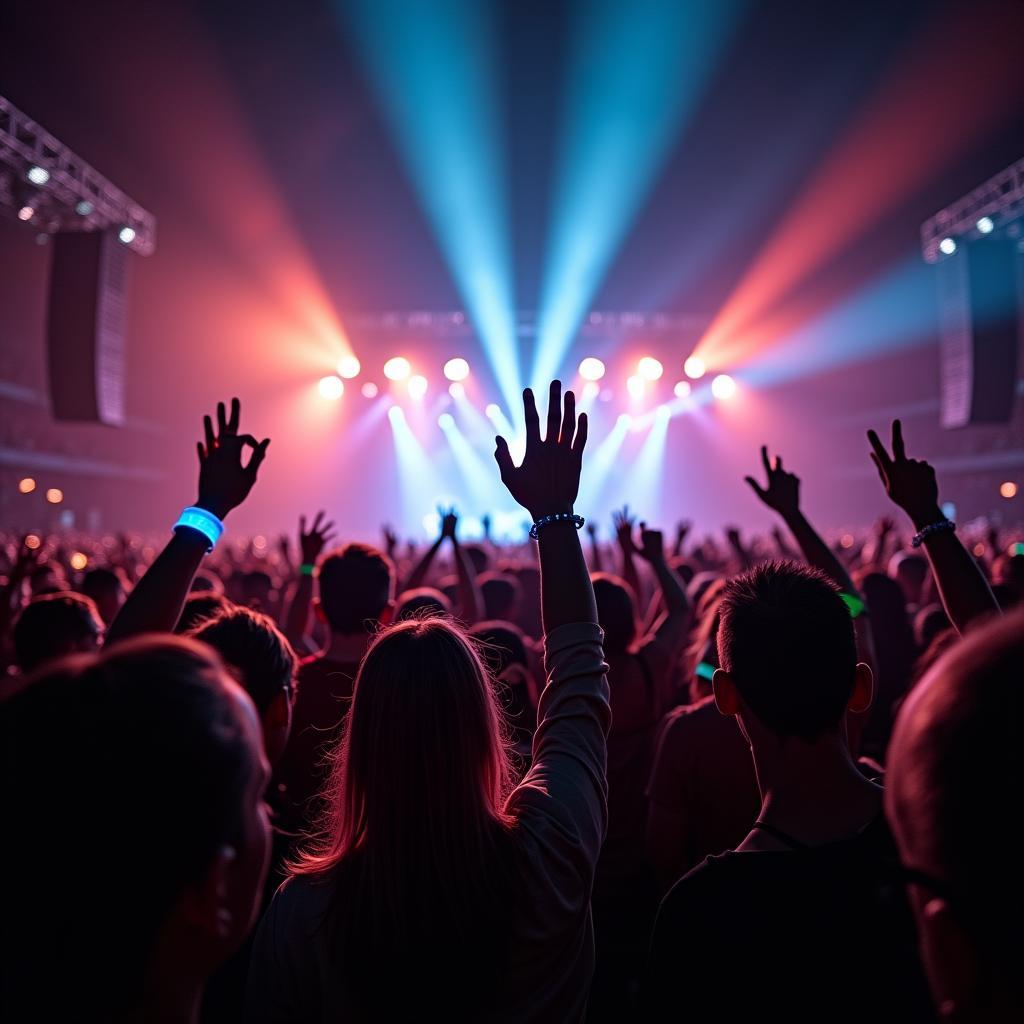 Khán giả cuồng nhiệt tại buổi hòa nhạc trực tiếp với đèn sân khấu rực rỡ và không khí sôi động
IELTS Speaking Part 3: Two-way Discussion
Tổng Quan Về Part 3
Part 3 kéo dài 4-5 phút với các câu hỏi thảo luận trừu tượng và sâu sắc hơn, mở rộng từ chủ đề Part 2. Đây là phần khó nhất vì yêu cầu bạn phải phân tích, đánh giá và đưa ra quan điểm có lý lẽ về các vấn đề xã hội, văn hóa.
Yêu cầu:
- Phân tích nhiều góc độ của vấn đề (advantages/disadvantages, causes/effects, past/present/future)
- Đưa ra quan điểm cá nhân có lý lẽ rõ ràng
- Xem xét complexity của vấn đề, không trả lời một chiều
- Sử dụng ví dụ từ xã hội, thế giới, không chỉ kinh nghiệm cá nhân
Chiến lược:
- Mở rộng câu trả lời 3-5 câu (30-45 giây)
- Sử dụng discourse markers để tổ chức ý (Well, Actually, On the one hand…)
- Đưa ra examples từ different contexts
- Thừa nhận complexity: “It depends on…”, “There are various factors…”
- Không sợ pause để suy nghĩ, nhưng signal: “That’s an interesting question…”, “Let me think…”
Lỗi thường gặp của học viên Việt Nam:
- Trả lời quá ngắn, chỉ 1-2 câu thiếu phân tích
- Không đưa ra lý lẽ rõ ràng, chỉ nêu ý kiến
- Thiếu từ vựng trừu tượng để discuss broader issues
- Chỉ nói về Vietnam, không có global perspective
- Sợ disagree hoặc thừa nhận không biết
Các Câu Hỏi Thảo Luận Sâu
Theme 1: Social and Cultural Impact of Live Performances
Question 1: Why do you think live concerts and performances are still popular despite the availability of recorded music online?
🎯 Phân tích câu hỏi:
- Dạng: Cause/Reason question – Tại sao vẫn phổ biến mặc dù có music online
- Key words: live concerts, popular, despite, recorded music online
- Cách tiếp cận: Direct answer (vẫn popular) → Reasons (2-3 lý do) → Examples/Elaboration → Conclude
📝 Sample Answer – Band 6-7:
I think live concerts are still popular because people want to see their favorite artists in person. Listening to music online is convenient, but it’s not the same as being at a real concert. At concerts, you can feel the atmosphere and energy from other fans. Also, people like to share this experience with friends and post photos on social media. Another reason is that concerts give artists a chance to interact with fans directly, which makes it more special.
Phân tích:
- Structure: Có reasons và examples nhưng còn basic
- Vocabulary: Adequate (in person, atmosphere, interact) nhưng chưa sophisticated
- Tại sao Band 6-7: Trả lời đầy đủ nhưng thiếu depth, chưa có analysis về social/psychological factors
📝 Câu trả lời mẫu – Band 8-9:
Well, I think there are several compelling reasons why live performances continue to thrive in the digital age. First and foremost, there’s the irreplaceable element of human connection and collective experience. When you’re at a concert, you’re not just passively consuming music – you’re part of a shared emotional journey with thousands of other people, which creates a sense of community and belonging that streaming services simply cannot replicate.
On top of that, there’s the authenticity factor. Live performances offer spontaneity and uniqueness – no two shows are exactly alike. Artists might improvise, interact with the audience, or perform songs differently than the recorded versions. This element of unpredictability makes each concert a one-of-a-kind experience, which actually adds to its value in an era where everything is readily accessible and reproducible.
Furthermore, I’d argue that attending concerts has become somewhat of a status symbol and a social currency, particularly among younger generations. The experience of “being there” serves as social proof and provides shareable content for social media, which enhances one’s social identity. From a psychological perspective, concerts also offer an escape from the screen-dominated lifestyle that many people are increasingly seeking.
Phân tích:
- Structure: Well-organized: Hook → Reason 1 (human connection) + elaboration → Reason 2 (authenticity) + explanation → Reason 3 (social value) + psychological aspect → Implicit conclusion
- Vocabulary: Precise, sophisticated (compelling reasons, thrive, irreplaceable element, collective experience, status symbol, social currency, social proof)
- Grammar: Complex structures: relative clauses (that many people are seeking), comparative (differently than), cleft sentences (The experience of “being there” serves as…)
- Critical Thinking: Multi-dimensional analysis – emotional, social, psychological perspectives; acknowledges modern context (digital age, social media)
💡 Key Language Features:
- Discourse markers: Well, First and foremost, On top of that, Furthermore, From a psychological perspective
- Tentative language: I think, I’d argue, somewhat of
- Abstract nouns: authenticity, spontaneity, unpredictability, social currency, social proof
- Academic phrases: thrive in the digital age, cannot replicate, element of unpredictability, adds to its value
Question 2: How have concerts and live performances changed over the past few decades?
🎯 Phân tích câu hỏi:
- Dạng: Compare/Contrast – Changes over time
- Key words: changed, past few decades
- Cách tiếp cận: Acknowledge changes → Specific aspects that changed (technology, scale, audience behavior) → Examples → Impact/Significance
📝 Sample Answer – Band 6-7:
Concerts have changed a lot in recent years. In the past, concerts were simpler with just basic lights and sound systems. Now, concerts use advanced technology like big LED screens, lasers, and special effects. Also, tickets are now sold online, so it’s easier to buy them. Another change is that people now use phones to record videos during concerts, which didn’t happen before. Concerts have also become more expensive because of all the technology and production costs.
Phân tích:
- Structure: List of changes but somewhat disorganized
- Vocabulary: Basic (a lot, simpler, advanced technology, expensive)
- Tại sao Band 6-7: Covers main ideas but lacks sophisticated analysis of implications
📝 Câu trả lời mẫu – Band 8-9:
That’s an interesting question. I’d say the evolution of live performances over the past few decades has been quite dramatic, particularly in three key areas.
Technologically speaking, concerts have become exponentially more sophisticated. We’ve moved from relatively modest stage setups to elaborate multimedia spectacles featuring state-of-the-art sound systems, immersive visual displays, pyrotechnics, and even holographic projections. Modern concerts are increasingly blurring the lines between traditional performances and full-blown theatrical productions. For instance, artists like Beyoncé or Taylor Swift now present what are essentially Broadway-caliber shows with intricate choreography, multiple costume changes, and seamless integration of video content.
From a business perspective, the concert industry has undergone significant commercialization. Ticket prices have skyrocketed, particularly for A-list performers, making live music increasingly less accessible to average fans. This has given rise to tiered ticketing systems and VIP experiences that cater to affluent audiences. Simultaneously, we’ve seen the emergence of massive music festivals that have become cultural phenomena in their own right – events like Coachella or Glastonbury are no longer just about the music but represent entire lifestyle experiences.
Perhaps most notably, audience behavior has fundamentally shifted. The smartphone era has transformed how people engage with live performances. On one hand, it’s created this somewhat paradoxical situation where people are physically present but mentally distanced, more focused on capturing content for social media than being in the moment. On the other hand, it’s also democratized the concert experience, allowing those who couldn’t attend to virtually participate through livestreams and fan-generated content.
Looking at the bigger picture, these changes reflect broader societal shifts – our relationship with technology, the commodification of experiences, and changing consumption patterns in the entertainment industry. While there’s certainly an argument to be made about whether these changes have been entirely positive, they’ve undeniably reshaped what it means to attend a live performance in the 21st century.
Phân tích:
- Structure: Sophisticated organization: Acknowledge complexity → Three dimensions (technology, business, audience) → Each with examples and implications → Broader significance
- Vocabulary: Precise and varied (exponentially, elaborate multimedia spectacles, skyrocketed, paradoxical situation, democratized, commodification)
- Grammar: Full range including: present perfect (have undergone, have become), passive constructions (have been reshaped), complex conditionals
- Critical Thinking: Balanced view showing both positive and negative aspects; connects micro changes to macro societal trends; uses specific examples (Beyoncé, Taylor Swift, Coachella)
Theme 2: Economic and Accessibility Issues
Question 3: Do you think concert tickets are becoming too expensive? Why or why not?
🎯 Phân tích câu hỏi:
- Dạng: Opinion with justification
- Key words: too expensive, why or why not
- Cách tiếp cận: Give nuanced opinion (yes and no) → Reasons for high prices → Impact → Alternative perspectives
📝 Sample Answer – Band 6-7:
Yes, I think concert tickets are too expensive nowadays. Some tickets for famous singers cost thousands of dollars, which most people cannot afford. This is unfair because music should be for everyone, not just rich people. The high prices are because of production costs and because artists want to make more money. However, some concerts still have reasonable prices, especially for local artists. I think ticket prices should be more affordable so more people can enjoy live music.
Phân tích:
- Structure: Clear opinion with basic reasoning
- Vocabulary: Adequate (afford, unfair, production costs, reasonable prices)
- Tại sao Band 6-7: Straightforward argument but lacks nuance and economic analysis
📝 Câu trả lời mẫu – Band 8-9:
Well, I’d say this is a rather nuanced issue that doesn’t have a simple yes or no answer. On the one hand, there’s certainly validity to the argument that concert pricing has become prohibitively expensive for the average consumer. We’re seeing astronomical prices for premium seats at major tours – some tickets fetching thousands of dollars, which effectively prices out a significant portion of the population. This raises serious concerns about equity and access to cultural experiences.
However, to be fair, we need to consider the economic realities facing artists and promoters. The music industry has been fundamentally disrupted by streaming services, which provide minimal revenue to most artists – we’re talking fractions of a cent per stream. Consequently, live performances have become the primary income source for many musicians, essentially subsidizing their recorded music. The costs of mounting modern productions – from logistics and crew wages to venue rentals and sophisticated equipment – are substantial.
What I find particularly concerning is the secondary market and scalping phenomenon. Concert tickets often resold at inflated prices by third-party sellers and automated bots, which artificially drives up costs without any additional value going to the artists or genuine fans. This represents a systemic problem that warrants regulatory intervention.
That said, I think the solution isn’t necessarily to make all concerts cheaper across the board, but rather to implement more tiered pricing models and greater transparency in ticket distribution. Some artists, like Bruce Springsteen, have experimented with dynamic pricing that adjusts to demand while preventing scalping. Additionally, subsidized tickets for students, community-focused venues, and livestream options can help maintain accessibility without undermining the financial viability of live music as an industry.
Một số giải pháp này cũng được áp dụng trong các sự kiện khác, chẳng hạn như describe a time when you had to manage a virtual event, nơi việc tổ chức sự kiện trực tuyến giúp tăng khả năng tiếp cận cho nhiều người hơn.
Phân tích:
- Structure: Highly sophisticated: Acknowledge complexity → Present concern → Counter-argument with economic context → Specific problem (scalping) → Proposed solutions with examples
- Vocabulary: Precise economic and social terminology (prohibitively expensive, equity, disrupted, scalping phenomenon, dynamic pricing, financial viability)
- Grammar: Advanced structures: passive voice (tickets resold, warrants regulatory intervention), conditionals (the solution isn’t… but rather to), participle clauses (adjusts to demand while preventing)
- Critical Thinking: Multi-stakeholder perspective (fans, artists, promoters); identifies root causes (streaming economics, scalping); proposes concrete solutions; uses real example (Bruce Springsteen)
💡 Key Language Features:
- Hedging/Tentative language: I’d say, rather, certainly, essentially
- Contrasting discourse markers: On the one hand, However, That said, Additionally
- Academic collocations: raises serious concerns, economic realities, systemic problem, regulatory intervention, financial viability
- Evaluative language: What I find particularly concerning, to be fair
Theme 3: Future Trends and Technology
Question 4: How do you think technology will change the way people experience concerts in the future?
🎯 Phân tích câu hỏi:
- Dạng: Prediction/Future speculation
- Key words: technology, change, future, experience concerts
- Cách tiếp cận: Current trends → Specific technologies → Potential impacts → Balanced view (opportunities + concerns)
📝 Sample Answer – Band 6-7:
I think technology will make big changes to concerts in the future. Virtual reality might allow people to watch concerts from home but feel like they are there. Also, hologram technology could bring back dead artists to perform on stage. Technology will make concerts more interactive, with apps that let audiences control lights or vote for songs. However, some people might prefer traditional concerts without too much technology. Overall, I believe technology will create new and exciting concert experiences.
Phân tích:
- Structure: Future predictions with examples
- Vocabulary: Basic tech terms (virtual reality, hologram, interactive, apps)
- Tại sao Band 6-7: Good ideas but surface-level analysis, lacks discussion of implications
📝 Câu trả lời mẫu – Band 8-9:
That’s a fascinating question to consider. I think we’re on the cusp of some quite revolutionary changes in how concerts are experienced, driven by several emerging technologies.
Most prominently, I believe virtual and augmented reality will become increasingly mainstream. We’re already seeing rudimentary versions with 360-degree concert streams, but I envision a future where people can don VR headsets and virtually attend concerts from anywhere in the world, with the ability to choose different vantage points – whether front row, backstage, or even on stage alongside performers. This could democratize access to concerts that would otherwise be geographically or financially out of reach. Companies like Meta are already investing heavily in metaverse concert experiences, which suggests this isn’t mere speculation but imminent reality.
Another intriguing development is AI-driven personalization. Imagine concerts where the setlist, lighting, and even audio mixing could be customized in real-time based on aggregate audience preferences collected through apps. Some artists are already experimenting with audience participation technologies that allow concertgoers to influence certain aspects of the performance through their smartphones.
Perhaps more controversially, we might see the proliferation of holographic performances – not just recreating deceased artists, which raises ethical questions, but also enabling artists to perform simultaneously in multiple venues worldwide. This could fundamentally alter the economics of touring while potentially diminishing the uniqueness of live experiences.
That being said, I think there will always be a substantial segment of audiences who crave the authentic, unmediated experience of traditional live music. The very imperfections – a missed note, an artist’s spontaneous interaction with the crowd – are what make concerts irreplaceable. What I suspect we’ll see is a bifurcation of the market: tech-enhanced spectacles for some, and intimate, stripped-down performances for others who seek authenticity.
The key challenge will be ensuring that technology enhances rather than supplants the human connection that makes live music so powerful. If implemented thoughtfully, technology could make concerts more accessible, immersive, and participatory while preserving the communal energy that defines them. The danger, however, lies in over-reliance on technology to the point where the essence of live performance – that unscripted, vulnerable, human moment – gets lost in the spectacle.
Phân tích:
- Structure: Exemplary organization: Acknowledge question → Technology 1 (VR/AR) with implications → Technology 2 (AI personalization) → Technology 3 (holograms) with ethical consideration → Counter-argument about traditional preferences → Balanced conclusion with challenges
- Vocabulary: Sophisticated and precise (on the cusp of, rudimentary versions, democratize access, proliferation of, bifurcation, supplants, unmediated)
- Grammar: Full range naturally employed: modal verbs for speculation (might, could), conditionals (If implemented thoughtfully), complex subordination, passive constructions
- Critical Thinking: Multi-dimensional analysis covering technology, economics, ethics, human psychology; identifies opportunities and risks; acknowledges uncertainty; provides concrete examples (Meta, metaverse); predicts market segmentation
💡 Key Language Features:
- Speculation language: I believe, I envision, I suspect, suggests this isn’t mere speculation, imagine
- Introducing examples: Companies like, already experimenting with, we’re already seeing
- Contrasting/Qualifying: That being said, However, The danger, The key challenge, Perhaps more controversially
- Abstract concepts: democratize access, communal energy, essence of live performance, human connection
Question 5: What role do concerts and live performances play in preserving cultural heritage?
🎯 Phân tích câu hỏi:
- Dạng: Analyze role/function in society
- Key words: role, preserving, cultural heritage
- Cách tiếp cận: Define cultural heritage in performance context → Specific roles/functions → Examples from different cultures → Challenges
📝 Câu trả lời mẫu – Band 8-9:
Well, I think live performances serve as vital conduits for transmitting and safeguarding cultural heritage, particularly in an increasingly globalized and homogenized world.
First and foremost, traditional performances – whether it’s Vietnamese water puppetry, Indian classical dance, or Irish folk music – function as living repositories of cultural knowledge and history. Unlike museum artifacts that are static and preserved behind glass, live performances are dynamic, evolving art forms that maintain their relevance across generations. When traditional musicians take the stage, they’re not just entertaining – they’re enacting rituals, telling ancestral stories, and demonstrating techniques that have been passed down for centuries, often through oral tradition rather than written documentation.
What’s particularly significant is the intergenerational transmission that occurs through performance. Young people exposed to traditional concerts often develop appreciation and interest in their cultural roots, which might otherwise be lost in the face of dominant pop culture. In Vietnam, for instance, traditional ca trù or quan họ performances serve this exact function, helping younger generations connect with their heritage in a way that feels immediate and emotionally resonant.
Moreover, live performances create spaces for cultural dialogue and cross-cultural understanding. When artists incorporate traditional elements into contemporary performances, or when international festivals showcase diverse musical traditions, they’re essentially building bridges between cultures while keeping traditions alive. This is evident in how world music festivals or cultural performance series expose audiences to traditions they might never otherwise encounter.
However, there are also challenges. The commercialization of traditional performances sometimes leads to oversimplification or modification to suit tourist expectations, which can dilute their authentic cultural significance. There’s a delicate balance between making traditions accessible and maintaining their integrity.
Ultimately, I believe concerts and live performances are indispensable for cultural preservation precisely because they’re participatory and experiential. Culture isn’t merely something to be documented and archived – it’s something that must be lived, felt, and continuously reinterpreted by each generation. Live performances provide the crucial platform for this ongoing cultural conversation to occur.
Phân tích:
- Structure: Clear thesis → Primary function (living repository) → Secondary function (intergenerational transmission) with example → Tertiary function (cultural dialogue) → Challenges → Strong conclusion
- Vocabulary: Sophisticated cultural/academic terminology (vital conduits, transmitting, safeguarding, living repositories, intergenerational transmission, cultural dialogue)
- Grammar: Complex structures throughout: relative clauses, participle phrases, conditionals, cleft sentences
- Critical Thinking: Defines terms implicitly; uses specific cultural examples (ca trù, quan họ, water puppetry); acknowledges complexity and challenges; distinguishes between static and dynamic preservation
 Biểu diễn ca trù truyền thống Việt Nam gìn giữ giá trị văn hóa với nghệ sĩ và nhạc cụ dân tộc
Từ vựng và cụm từ quan trọng
Topic-Specific Vocabulary
| Từ vựng/Cụm từ | Loại từ | Phiên âm | Nghĩa tiếng Việt | Ví dụ | Collocation |
|---|---|---|---|---|---|
| venue | n | /ˈvenjuː/ | địa điểm tổ chức | The venue was packed with enthusiastic fans. | concert venue, indoor venue, prestigious venue |
| spectacle | n | /ˈspektəkl/ | cảnh tượng hoành tráng | The concert was a visual spectacle with amazing lights. | multimedia spectacle, theatrical spectacle, elaborate spectacle |
| setlist | n | /ˈsetlɪst/ | danh sách bài hát biểu diễn | The band’s setlist included all their greatest hits. | varied setlist, predictable setlist, customize the setlist |
| encore | n | /ˈɒŋkɔː(r)/ | tiết mục thêm sau cùng | The crowd cheered for an encore after the final song. | demand an encore, perform an encore, multiple encores |
| pyrotechnics | n | /ˌpaɪrəʊˈteknɪks/ | pháo hoa, hiệu ứng lửa | The show featured impressive pyrotechnics during the finale. | elaborate pyrotechnics, stage pyrotechnics, synchronized pyrotechnics |
| acoustics | n | /əˈkuːstɪks/ | âm thanh, âm học | The hall has excellent acoustics for classical music. | perfect acoustics, poor acoustics, optimize the acoustics |
| resonate | v | /ˈrezəneɪt/ | gây tiếng vang, đồng cảm | Her performance really resonated with the audience. | resonate with, deeply resonate, emotionally resonate |
| captivating | adj | /ˈkæptɪveɪtɪŋ/ | quyến rũ, hấp dẫn | The singer’s voice was absolutely captivating. | captivating performance, visually captivating, utterly captivating |
| immersive | adj | /ɪˈmɜːsɪv/ | đắm chìm, hòa mình | The concert created an immersive audio-visual experience. | immersive experience, fully immersive, immersive environment |
| symphony | n | /ˈsɪmfəni/ | bản giao hưởng | Beethoven’s Fifth Symphony was performed brilliantly. | perform a symphony, compose a symphony, symphony orchestra |
| orchestra | n | /ˈɔːkɪstrə/ | dàn nhạc giao hưởng | The philharmonic orchestra gave an outstanding performance. | symphony orchestra, chamber orchestra, conduct an orchestra |
| choreography | n | /ˌkɒriˈɒɡrəfi/ | biên đạo múa | The choreography was perfectly synchronized with the music. | intricate choreography, stunning choreography, elaborate choreography |
| improvisation | n | /ˌɪmprəvaɪˈzeɪʃn/ | sự ngẫu hứng | The jazz musician’s improvisation was breathtaking. | musical improvisation, spontaneous improvisation, skillful improvisation |
| mesmerizing | adj | /ˈmezməraɪzɪŋ/ | mê hoặc, hạ gục | The light show was absolutely mesmerizing. | mesmerizing performance, visually mesmerizing, utterly mesmerizing |
| exhilarating | adj | /ɪɡˈzɪləreɪtɪŋ/ | phấn khích, hào hứng | Attending the rock concert was an exhilarating experience. | exhilarating atmosphere, utterly exhilarating, exhilarating moment |
| vibe | n | /vaɪb/ | không khí, cảm giác | The intimate venue had a great vibe. | positive vibe, electric vibe, create a vibe |
| lineup | n | /ˈlaɪnʌp/ | danh sách nghệ sĩ | The festival had an impressive lineup of international artists. | star-studded lineup, diverse lineup, announce the lineup |
| crescendo | n | /krəˈʃendəʊ/ | cao trào, điểm đỉnh | The song built to an emotional crescendo. | reach a crescendo, dramatic crescendo, build to a crescendo |
| rendition | n | /renˈdɪʃn/ | cách thể hiện, phiên bản | Her rendition of the classic song was stunning. | unique rendition, beautiful rendition, perform a rendition |
| genre | n | /ˈʒɒnrə/ | thể loại | He enjoys concerts across multiple musical genres. | musical genre, different genres, diverse genres |
Idiomatic Expressions & Advanced Phrases
| Cụm từ | Nghĩa | Ví dụ sử dụng | Band điểm |
|---|---|---|---|
| bring the house down | làm khán giả phấn khích tột độ | The band’s final song brought the house down. | 7.5-9 |
| steal the show | thu hút sự chú ý nhất | The opening act unexpectedly stole the show. | 7.5-9 |
| once-in-a-lifetime experience | trải nghiệm có một không hai | Seeing my favorite band live was a once-in-a-lifetime experience. | 7-8 |
| spine-tingling | gây cảm giác rùng mình (vì hứng thú) | The performance was absolutely spine-tingling. | 8-9 |
| blown away | vô cùng ấn tượng | I was completely blown away by the vocalist’s range. | 7-8 |
| feed off the energy | hấp thụ năng lượng từ | The performers really fed off the crowd’s energy. | 7.5-8.5 |
| electric atmosphere | không khí sôi động, phấn khích | There was an electric atmosphere in the stadium. | 7.5-8.5 |
| hit all the right notes | làm mọi thứ hoàn hảo | The concert hit all the right notes from start to finish. | 8-9 |
| packed to the rafters | chật ních, đông nghẹt | The venue was packed to the rafters with excited fans. | 7.5-8.5 |
| raw talent | tài năng thuần khiết, thật sự | The young artist displayed incredible raw talent. | 7-8 |
| tour de force | màn trình diễn xuất sắc | Her vocal performance was a tour de force. | 8.5-9 |
| standing ovation | vỗ tay đứng dậy (tán thưởng) | The orchestra received a five-minute standing ovation. | 7-8 |
Discourse Markers (Từ Nối Ý Trong Speaking)
Để bắt đầu câu trả lời:
- 📝 Well,… – Dùng khi cần suy nghĩ hoặc bắt đầu một câu trả lời dài
- 📝 Actually,… – Khi đưa ra góc nhìn khác hoặc thông tin bất ngờ
- 📝 To be honest,… – Khi nói thật về ý kiến cá nhân
- 📝 I’d say that… – Khi đưa ra quan điểm có phần dè dặt
- 📝 That’s an interesting question,… – Để có thời gian suy nghĩ và tỏ ra engaged
Để bổ sung ý:
- 📝 On top of that,… – Thêm vào đó, hơn nữa
- 📝 What’s more,… – Hơn thế nữa
- 📝 Not to mention… – Chưa kể đến
- 📝 Furthermore,… – Hơn nữa (formal hơn)
- 📝 Additionally,… – Thêm vào đó
Để đưa ra quan điểm cân bằng:
- 📝 On the one hand,… On the other hand,… – Một mặt… mặt khác
- 📝 While it’s true that…, we also need to consider… – Mặc dù đúng là… nhưng cũng cần xem xét
- 📝 That being said,… – Tuy nhiên, mặc dù vậy
- 📝 Having said that,… – Đã nói như vậy nhưng
Để kết luận:
- 📝 All in all,… – Tóm lại, xét cho cùng
- 📝 At the end of the day,… – Cuối cùng thì, kết cục
- 📝 Ultimately,… – Cuối cùng, về cơ bản
- 📝 Overall,… – Nhìn chung
Để nhấn mạnh điểm quan trọng:
- 📝 What I find particularly interesting/important is… – Điều tôi thấy đặc biệt thú vị/quan trọng là
- 📝 The key thing to remember is… – Điều then chốt cần nhớ là
- 📝 Perhaps most significantly,… – Có lẽ đáng chú ý nhất là
Grammatical Structures Ấn Tượng
1. Conditional Sentences (Câu điều kiện):
- Mixed conditional: “If I hadn’t bought those tickets months in advance, I wouldn’t be able to attend the sold-out concert now.” (Kết hợp quá khứ và hiện tại)
- Inversion (đảo ngữ): “Had I known the tickets would sell out so quickly, I would have bought them earlier.” (Đảo trợ động từ lên đầu câu – formal)
- Third conditional: “If the concert hadn’t been postponed, I would have missed seeing my favorite band.” (Giả định về quá khứ)
2. Relative Clauses (Mệnh đề quan hệ):
- Non-defining: “The lead singer, who has won multiple Grammy awards, performed with incredible passion.” (Thông tin thêm, có dấu phẩy)
- Reduced relative clause: “The concert held at the stadium was the biggest event of the year.” (Rút gọn: which was held)
3. Passive Voice (Câu bị động):
- Impersonal passive: “It is widely believed that live music offers a unique emotional experience.” (Câu bị động khách quan)
- Get passive: “I got invited to a backstage meet-and-greet after the show.” (Dùng get thay be – informal hơn)
4. Cleft Sentences (Câu chẻ – nhấn mạnh):
- What clause: “What I found most impressive was the way the orchestra synchronized perfectly.” (Nhấn mạnh vào việc gì)
- It clause: “It was the acoustic performance that really resonated with me, not the big production numbers.” (Nhấn mạnh vào thứ gì)
- The thing that…: “The thing that made this concert memorable was the intimate connection with the artist.” (Nhấn mạnh điểm cụ thể)
5. Inversion for Emphasis:
- Negative inversion: “Never have I experienced such an electrifying atmosphere at a concert.” (Đảo trợ động từ sau never/seldom/rarely)
- Only inversion: “Only when the lights dimmed did I realize how massive the production would be.” (Đảo sau only when)
6. Participle Clauses:
- Present participle: “Standing in the front row, I could see every detail of the performance.” (Thay thế while/when)
- Perfect participle: “Having attended numerous concerts, I can say this was among the best.” (Thể hiện hành động xảy ra trước)
7. Subjunctive Mood:
- It’s essential that…: “It’s essential that artists maintain authenticity in their performances.” (Should được lược bỏ)
- I suggest/recommend that…: “I’d suggest that anyone interested in live music attend at least one classical concert.” (Thể giả định)
Với bộ từ vựng phong phú này và hiểu rõ cách sử dụng các cấu trúc ngữ pháp nâng cao, bạn sẽ tự tin hơn khi trả lời chủ đề “describe a memorable concert or performance you attended” trong IELTS Speaking. Hãy nhớ rằng, điều quan trọng không chỉ là học thuộc mà là thực hành sử dụng chúng một cách tự nhiên trong ngữ cảnh phù hợp. Chúc bạn đạt band điểm cao trong kỳ thi sắp tới!