Mở bài
Chủ đề về công viên quốc gia và khu bảo tồn thiên nhiên là một trong những đề tài phổ biến và thú vị trong IELTS Speaking. Đây là chủ đề liên quan đến môi trường, du lịch và thiên nhiên – những khía cạnh mà giám khảo thường sử dụng để đánh giá khả năng miêu tả, kể chuyện và phân tích của thí sinh.
Từ kinh nghiệm chấm thi hơn 20 năm, tôi nhận thấy chủ đề này xuất hiện với tần suất khá cao trong các kỳ thi IELTS từ 2020 đến 2024, đặc biệt trong bối cảnh tăng cường nhận thức về bảo vệ môi trường. Mức độ phổ biến: Cao. Dự đoán khả năng xuất hiện trong tương lai: Cao, do xu hướng toàn cầu quan tâm đến du lịch sinh thái và bảo tồn thiên nhiên.
Trong bài viết này, bạn sẽ học được:
- Câu hỏi thường gặp trong cả 3 Part của bài thi Speaking về chủ đề này
- Bài mẫu chi tiết theo nhiều band điểm (6-7, 7.5-8, 8.5-9) với phân tích chuyên sâu
- Từ vựng và cụm từ ăn điểm được sử dụng tự nhiên
- Chiến lược trả lời hiệu quả từ góc nhìn của một giám khảo
- Những lỗi phổ biến mà học viên Việt Nam thường mắc phải và cách khắc phục
IELTS Speaking Part 1: Introduction and Interview
Tổng Quan Về Part 1
Part 1 kéo dài 4-5 phút với các câu hỏi ngắn về cuộc sống hàng ngày. Đối với chủ đề công viên quốc gia và thiên nhiên, giám khảo thường hỏi về sở thích, thói quen và trải nghiệm cá nhân của bạn.
Đặc điểm quan trọng:
- Câu hỏi ngắn, dễ hiểu, liên quan đến bản thân
- Thời gian trả lời mỗi câu: 20-30 giây (2-3 câu)
- Mục đích: Làm quen, đánh giá khả năng giao tiếp cơ bản
Chiến lược:
- Trả lời trực tiếp câu hỏi ngay
- Mở rộng với lý do hoặc ví dụ cụ thể
- Giữ câu trả lời tự nhiên, không quá dài
Lỗi thường gặp của học viên Việt Nam:
- Trả lời quá ngắn chỉ “Yes” hoặc “No”
- Dùng từ vựng quá đơn giản, lặp đi lặp lại
- Thiếu ví dụ cụ thể từ kinh nghiệm bản thân
- Nói quá nhanh hoặc quá chậm, thiếu tự nhiên
Các Câu Hỏi Thường Gặp
Question 1: Do you like visiting natural places?
Question 2: Have you ever been to a national park or nature reserve?
Question 3: What kind of natural scenery do you prefer?
Question 4: Do you think it’s important to protect wildlife?
Question 5: How often do you spend time in nature?
Question 6: Would you like to visit more national parks in the future?
Question 7: What activities do you enjoy doing in natural areas?
Question 8: Do you prefer mountains or beaches?
Phân Tích và Gợi Ý Trả Lời Chi Tiết
Question: Do you like visiting natural places?
🎯 Cách tiếp cận:
- Trả lời trực tiếp: Yes/No hoặc mức độ yêu thích
- Đưa ra lý do cụ thể
- Thêm ví dụ ngắn gọn từ kinh nghiệm
📝 Sample Answer – Band 6-7:
Yes, I like visiting natural places. I think nature is very beautiful and peaceful. When I go to natural places, I feel relaxed and can forget about my work stress. I usually go to parks near my house on weekends.
Phân tích:
- Điểm mạnh: Trả lời rõ ràng, có lý do cơ bản, đề cập đến thói quen cá nhân
- Hạn chế: Từ vựng đơn giản (beautiful, peaceful, relaxed), cấu trúc câu cơ bản, thiếu chi tiết cụ thể
- Tại sao Band 6-7: Đủ thông tin nhưng chưa impressive, vocabulary và grammar ở mức adequate
📝 Sample Answer – Band 8-9:
Absolutely! I’m quite drawn to natural environments because they offer a refreshing escape from the hustle and bustle of city life. There’s something incredibly rejuvenating about being surrounded by pristine landscapes – it really helps me recharge my batteries. Just last month, I visited a forest reserve and the sense of tranquility there was exactly what I needed after a hectic work period.
Phân tích:
- Điểm mạnh:
- Vocabulary phong phú và natural: “drawn to”, “refreshing escape”, “hustle and bustle”, “pristine landscapes”, “recharge my batteries”
- Cấu trúc đa dạng: There’s something…, it helps me…, the sense of…
- Ví dụ cụ thể với time reference (last month)
- Tone tự nhiên với “Absolutely!” và “quite”
- Tại sao Band 8-9:
- Fluency: Câu nối mạch lạc, không hesitation
- Vocabulary: Idiomatic expressions được dùng chính xác
- Grammar: Complex structures tự nhiên
- Content: Cụ thể, có depth
💡 Key Vocabulary & Expressions:
- drawn to (something): bị thu hút bởi cái gì đó
- refreshing escape: sự thoát ly sảng khoái
- hustle and bustle: sự hối hả, ồn ào
- rejuvenating: làm trẻ lại, làm tươi mới
- pristine landscapes: phong cảnh nguyên sơ, hoang sơ
- recharge one’s batteries: nạp lại năng lượng
- sense of tranquility: cảm giác bình yên
Question: Have you ever been to a national park or nature reserve?
🎯 Cách tiếp cận:
- Trả lời Yes/No
- Nêu tên địa điểm cụ thể (nếu có)
- Thêm ấn tượng ngắn gọn
📝 Sample Answer – Band 6-7:
Yes, I have been to Cuc Phuong National Park. It is located in the north of Vietnam. I went there two years ago with my family. The park was very big and had many trees and animals. I enjoyed the trip very much.
Phân tích:
- Điểm mạnh: Có địa điểm cụ thể, thời gian, người đi cùng, cảm nhận
- Hạn chế: Vocabulary cơ bản (big, many, very much), thiếu chi tiết về trải nghiệm, cấu trúc câu đơn giản
- Tại sao Band 6-7: Thông tin đầy đủ nhưng cách diễn đạt chưa sophisticated
📝 Sample Answer – Band 8-9:
Yes, actually I visited Cat Tien National Park a couple of years ago, and it was quite a memorable experience. It’s one of Vietnam’s most biodiverse protected areas, home to endangered species like the Javan rhinoceros. What struck me most was the sheer scale of the old-growth forest – you really get a sense of being immersed in wilderness. We did a guided night safari which was absolutely thrilling.
Phân tích:
- Điểm mạnh:
- Specific details: tên công viên, loài động vật, hoạt động cụ thể
- Topic-specific vocabulary: biodiverse, protected areas, endangered species, old-growth forest
- Descriptive phrases: sheer scale, immersed in wilderness
- Personal reaction: struck me most, thrilling
- Natural flow với “actually”, “quite”
- Tại sao Band 8-9:
- Fluency: Smooth transitions, natural discourse markers
- Lexical Resource: Precise, topic-appropriate vocabulary
- Grammar: Varied structures (complex noun phrases, relative clauses)
- Pronunciation: Clear stress on key words (memorable, biodiverse, thrilling)
💡 Key Vocabulary & Expressions:
- memorable experience: trải nghiệm đáng nhớ
- biodiverse protected areas: khu bảo tồn đa dạng sinh học
- endangered species: loài có nguy cơ tuyệt chủng
- struck me most: ấn tượng tôi nhất
- sheer scale: quy mô khổng lồ
- old-growth forest: rừng nguyên sinh
- immersed in wilderness: đắm chìm trong vùng hoang dã
- guided night safari: chuyến tham quan đêm có hướng dẫn viên
Question: What kind of natural scenery do you prefer?
🎯 Cách tiếp cận:
- Nêu rõ loại cảnh quan (núi, biển, rừng…)
- Giải thích tại sao thích
- So sánh nhẹ với các loại khác (nếu có thể)
📝 Sample Answer – Band 6-7:
I prefer mountain scenery. I like mountains because the air is fresh and the views are beautiful. Mountains are also quiet and peaceful. I don’t like crowded beaches very much because there are too many people.
Phân tích:
- Điểm mạnh: Preference rõ ràng, có lý do, có so sánh nhẹ
- Hạn chế: Từ vựng lặp (beautiful, quiet, peaceful đã dùng ở câu trước), lý do đơn giản
- Tại sao Band 6-7: Adequate communication nhưng lack sophistication
📝 Sample Answer – Band 8-9:
I’d say I’m more inclined towards mountainous regions. There’s something about the crisp mountain air and the panoramic vistas that I find incredibly captivating. I particularly appreciate how mountains offer diverse microclimates – you can experience different vegetation zones as you ascend. While I do enjoy coastal areas, I find mountains provide a more immersive natural experience with their rugged terrain and abundant wildlife.
Phân tích:
- Điểm mạnh:
- Sophisticated vocabulary: inclined towards, crisp, panoramic vistas, captivating, microclimates
- Technical terms: vegetation zones, ascend, rugged terrain
- Nuanced comparison: acknowledges beaches but explains preference
- Natural hedging: “I’d say”, “more inclined”
- Logical structure: preference → reasons → comparison
- Tại sao Band 8-9:
- Fluency: Coherent, well-connected ideas
- Vocabulary: Wide range, precise, natural collocations
- Grammar: Complex structures (relative clauses, comparative forms)
- Content: Detailed, thoughtful, shows personal insight
💡 Key Vocabulary & Expressions:
- inclined towards: thiên về, có xu hướng thích
- crisp mountain air: không khí trong lành vùng núi
- panoramic vistas: tầm nhìn toàn cảnh
- captivating: hấp dẫn, quyến rũ
- diverse microclimates: vi khí hậu đa dạng
- immersive natural experience: trải nghiệm thiên nhiên sâu sắc
- rugged terrain: địa hình hiểm trở
- abundant wildlife: động vật hoang dã phong phú
Nếu bạn quan tâm đến việc khám phá các chủ đề tương tự, hãy tìm hiểu thêm về describe a recent day trip you enjoyed để mở rộng vốn từ vựng và ý tưởng cho các câu trả lời của mình.
 Học viên luyện tập IELTS Speaking Part 1 về chủ đề công viên quốc gia và khu bảo tồn thiên nhiên
IELTS Speaking Part 2: Long Turn (Cue Card)
Tổng Quan Về Part 2
Part 2 là phần độc thoại kéo dài 2-3 phút, trong đó bạn có 1 phút chuẩn bị và ghi chú trước khi nói. Đây là phần quan trọng nhất để thể hiện khả năng kể chuyện có cấu trúc và sử dụng từ vựng phong phú.
Thời gian:
- Chuẩn bị: 1 phút (với giấy và bút)
- Nói: 2-3 phút (không bị ngắt)
Đặc điểm:
- Độc thoại dài về một topic cụ thể
- Phải cover tất cả bullet points trong cue card
- Giám khảo chỉ lắng nghe, không hỏi thêm
Chiến lược:
- Sử dụng hết 1 phút để ghi chú keywords (KHÔNG viết câu đầy đủ)
- Organize notes theo bullet points
- Aim cho 2-2.5 phút (tối thiểu 1.5 phút)
- Sử dụng past tense khi kể trải nghiệm
- Dành nhiều thời gian cho bullet point cuối (explain/feeling) vì đây là phần ghi điểm cao nhất
Lỗi thường gặp:
- Không sử dụng hết thời gian chuẩn bị hoặc viết câu hoàn chỉnh thay vì keywords
- Nói dưới 1.5 phút hoặc vượt quá 3 phút
- Bỏ sót một hoặc nhiều bullet points
- Quá focus vào describe mà quên explain feelings/reasons
- Dùng quá nhiều filler words (um, uh, like…)
Cue Card
Describe A National Park Or Wildlife Reserve You Visited
You should say:
- Where it is located
- When you visited it
- What you saw and did there
- And explain how you felt about this place
Phân Tích Đề Bài
Dạng câu hỏi: Describe a place you visited (past experience)
Thì động từ chính: Past Simple và Past Continuous (vì đây là trải nghiệm trong quá khứ)
Bullet points phải cover:
- Location: Tên và vị trí địa lý của công viên/khu bảo tồn
- When: Thời gian cụ thể (có thể là approximate: last year, two years ago…)
- What you saw and did: Activities và wildlife/scenery – đây là phần cần nhiều details nhất
- How you felt: Feelings và impressions – bullet point quan trọng nhất, cần explain thoroughly
Câu “explain” quan trọng: Đây là phần giám khảo chú ý nhất. Không chỉ nói “I felt happy” mà cần giải thích WHY và expand với specific reasons, comparisons, hoặc personal insights. Đây là cơ hội để show vocabulary range và critical thinking.
📝 Sample Answer – Band 6-7
Thời lượng: Khoảng 1.5-2 phút
I’d like to talk about Cuc Phuong National Park, which I visited about two years ago. It’s located in Ninh Binh province, in the northern part of Vietnam, approximately 100 kilometers from Hanoi.
I went there with my family during a long weekend in April. We drove there early in the morning, and it took us about two hours. The park is quite famous because it’s the oldest national park in Vietnam, established in 1962.
When we arrived, we first visited the Primate Rescue Center, where they take care of endangered monkeys and gibbons. It was very interesting to see these animals up close. After that, we went on a trekking route through the forest. The guide showed us many different types of plants and trees, including some ancient trees that are over 1,000 years old. We also saw some beautiful butterflies and heard many bird sounds. The forest was very green and peaceful.
In the afternoon, we visited a cave called Prehistoric Man Cave. Inside the cave, there were some old tools and bones that scientists discovered. It was quite dark inside, but our guide had a flashlight.
I really enjoyed this visit because it was my first time visiting such a big natural park. The fresh air and beautiful scenery made me feel very relaxed. It was different from the city where I live. I think places like this are important for protecting nature and wildlife. I would like to visit more national parks in the future because this experience made me appreciate nature more.
Phân Tích Band Điểm
| Tiêu chí | Band | Nhận xét |
|---|---|---|
| Fluency & Coherence | 6-7 | Mạch lạc, có structure rõ ràng theo chronological order. Có linking words cơ bản (after that, in the afternoon). Tuy nhiên thiếu discourse markers sophisticated hơn. Một số chỗ hơi mechanical. |
| Lexical Resource | 6-7 | Vocabulary adequate và relevant: oldest national park, trekking route, ancient trees, endangered. Tuy nhiên nhiều từ còn basic: very interesting, quite famous, very relaxed. Thiếu collocations và idiomatic expressions. |
| Grammatical Range & Accuracy | 6-7 | Sử dụng past tense chính xác. Có một số complex sentences (that scientists discovered, where they take care). Nhưng phần lớn là simple và compound sentences. Thiếu variety trong structures. |
| Pronunciation | 6-7 | Rõ ràng, dễ hiểu. Có thể có một số lỗi nhỏ về stress hoặc intonation nhưng không ảnh hưởng communication. |
Điểm mạnh:
- ✅ Cover đầy đủ tất cả bullet points
- ✅ Structure logic, dễ follow
- ✅ Có specific details: tên địa điểm, activities cụ thể, time reference
- ✅ Length phù hợp (khoảng 2 phút)
Hạn chế:
- ⚠️ Vocabulary còn đơn giản, lặp “very” nhiều lần
- ⚠️ Grammar structures chưa đa dạng, thiếu advanced constructions
- ⚠️ Phần “explain feelings” còn surface, chưa deep enough
- ⚠️ Thiếu personal insights hoặc comparisons để tạo depth
📝 Sample Answer – Band 7.5-8
Thời lượng: Khoảng 2-2.5 phút
I’d like to describe my visit to Phong Nha-Ke Bang National Park in Quang Binh province, which is renowned for its spectacular cave systems and pristine tropical forests. This UNESCO World Heritage Site is situated in central Vietnam, about 500 kilometers south of Hanoi.
I visited this remarkable place roughly a year and a half ago during the dry season, which I’d say was perfect timing as the weather was ideal for outdoor exploration. I went with a group of close friends who share my passion for adventure tourism.
The highlight of our trip was definitely exploring Paradise Cave – and it truly lived up to its name. As we descended into the cave, I was absolutely mesmerized by the magnificent stalactites and stalagmites that had formed over millions of years. The scale was just breathtaking – the main chamber stretches for about 31 kilometers, though tourists can only access the first kilometer. The lighting inside created this ethereal atmosphere that made you feel like you’d entered another world.
Beyond the caves, we also did a challenging trek through the dense jungle. Our guide pointed out various endemic species of plants and we were fortunate enough to spot some rare birds. What struck me most was the incredible biodiversity – apparently the park is home to over 300 cave systems and countless species, many of which are yet to be discovered.
What I found most impressive about this place was how it demonstrated nature’s power and beauty in its rawest form. Unlike manicured parks in urban areas, this was genuine wilderness. It really made me reflect on humanity’s role in conservation. The experience was both humbling and inspiring – humbling because you realize how small we are compared to these ancient natural formations, and inspiring because it reinforced my commitment to environmental protection. I left feeling incredibly grateful that such unspoiled natural wonders still exist and that authorities are working to preserve them for future generations.
Phân Tích Band Điểm
| Tiêu chí | Band | Nhận xét |
|---|---|---|
| Fluency & Coherence | 7.5-8 | Trôi chảy, tự nhiên, ít hesitation. Sử dụng discourse markers hiệu quả (I’d say, definitely, beyond, what struck me most). Ideas được organize logically và connect smoothly. |
| Lexical Resource | 7.5-8 | Vocabulary range rộng và precise: renowned for, pristine, mesmerized by, ethereal atmosphere, endemic species, biodiversity. Có collocations tự nhiên: adventure tourism, dense jungle, manicured parks. Paraphrasing tốt. |
| Grammatical Range & Accuracy | 7.5-8 | Diverse structures: relative clauses, participle clauses, passive voice. Complex sentences tự nhiên. Ít lỗi, không ảnh hưởng meaning. |
| Pronunciation | 7.5-8 | Clear, easy to understand. Good use of stress and intonation to convey meaning. Natural rhythm and pace. |
So Sánh Với Band 6-7
| Khía cạnh | Band 6-7 | Band 7.5-8 |
|---|---|---|
| Vocabulary | “very interesting”, “quite famous”, “very relaxed” | “mesmerized by”, “ethereal atmosphere”, “pristine tropical forests”, “unspoiled natural wonders” |
| Grammar | Mostly simple/compound sentences: “We went there… It took us…” | Complex structures: “As we descended…”, “What struck me most was…”, “Unlike manicured parks…” |
| Ideas | Descriptive, stating facts: “The park is quite famous” | Analytical, showing insight: “It made me reflect on humanity’s role in conservation” |
| Depth | Surface feelings: “I felt very relaxed” | Deep reflection: “humbling and inspiring – humbling because… inspiring because…” |
Đối với những bạn muốn tìm hiểu thêm về các trải nghiệm tương tự, describe a nature reserve you have visited là một chủ đề liên quan mà bạn có thể tham khảo thêm.
📝 Sample Answer – Band 8.5-9
Thời lượng: 2.5-3 phút đầy đủ
I’d like to share my experience visiting Cat Tien National Park, one of Vietnam’s most ecologically significant protected areas, nestled in the southeastern region, straddling the provinces of Dong Nai, Lam Dong, and Binh Phuoc. What makes this park particularly special is that it’s one of the few remaining lowland tropical forests in Southeast Asia – a type of ecosystem that’s become increasingly rare due to deforestation and habitat fragmentation.
I ventured there approximately two years ago, timing my visit during the transition between the dry and wet seasons. This strategic timing meant we could still navigate the trails comfortably while catching glimpses of wildlife emerging as the first rains began to replenish the water sources. I was accompanied by a couple of university friends who share my deep-rooted fascination with wildlife conservation and ecological sustainability.
The experience was nothing short of extraordinary. We embarked on a guided night safari, which proved to be the pinnacle of our trip. Armed with flashlights, we ventured deep into the forest after dusk, and I was absolutely captivated by the nocturnal ecosystem springing to life. We encountered several elusive species including the greater mouse-deer, which is notoriously difficult to spot, and heard the distinctive calls of various owl species reverberating through the canopy. Our guide, a seasoned naturalist, explained how this park serves as a crucial sanctuary for endangered species like the yellow-headed temple turtle and the Siamese crocodile, both of which are teetering on the brink of extinction.
During the daytime, we explored the extensive network of hiking trails, including a grueling six-hour trek to Crocodile Lake. The journey itself was as rewarding as the destination – we passed through different forest strata, from the undergrowth teeming with insects and reptiles to the towering dipterocarp trees that form the forest’s canopy. What particularly resonated with me was observing the intricate interdependencies within the ecosystem – how frugivorous animals disperse seeds, how certain tree species provide critical habitats for specific bird populations, and how the forest acts as a carbon sink while maintaining regional climate stability.
What made this visit truly transformative was how it challenged my preconceptions about conservation. I’d always intellectually understood the importance of biodiversity, but being immersed in such a rich ecosystem made it visceral and immediate. The stark contrast between the thriving wilderness of the protected area and the encroaching agricultural land at its borders was particularly sobering. It drove home the message that these protected areas aren’t just pleasant recreational spaces – they’re frontline defenses in the battle against biodiversity loss and climate change.
The experience left me with mixed emotions – profound awe at nature’s resilience and beauty, but also a sense of urgency about conservation. It crystallized my understanding that places like Cat Tien aren’t merely tourist attractions; they’re living laboratories that hold answers to many ecological questions and serve as genetic reservoirs for future generations. I left with a renewed commitment to supporting conservation efforts, not just through passive appreciation but through active engagement in environmental advocacy. This visit fundamentally shifted my perspective on our relationship with the natural world and reinforced my belief that sustainable coexistence between human development and nature preservation isn’t just possible – it’s imperative.
Phân Tích Band Điểm
| Tiêu chí | Band | Nhận xét |
|---|---|---|
| Fluency & Coherence | 8.5-9 | Exceptionally fluent, speaks at length without noticeable effort. Sophisticated discourse markers and cohesive devices. Ideas flow naturally with clear progression. |
| Lexical Resource | 8.5-9 | Wide range of precise, sophisticated vocabulary used naturally: ecologically significant, straddling, nocturnal ecosystem, teetering on the brink, intricate interdependencies, frugivorous. Natural collocations and less common idiomatic phrases. |
| Grammatical Range & Accuracy | 8.5-9 | Full range of structures used accurately and appropriately: participle phrases, cleft sentences, inversion, complex relative clauses, conditional forms. Errors extremely rare. |
| Pronunciation | 8.5-9 | Precise articulation, effective use of phonological features, sustains flexible use of features throughout, easy to understand. |
Tại Sao Bài Này Xuất Sắc
🎯 Fluency Hoàn Hảo:
Bài nói có độ dài lý tưởng (gần 3 phút), không có hesitation hay filler words không cần thiết. Transitions giữa các ý mượt mà và tự nhiên: “What makes this park particularly special…”, “The experience was nothing short of…”, “What particularly resonated with me…”. Demonstrating confident, sustained speech.
📚 Vocabulary Tinh Vi:
- “straddling the provinces” – thay vì “located in” đơn giản, từ này vừa precise vừa sophisticated
- “teetering on the brink of extinction” – idiom mạnh hơn nhiều so với “in danger”
- “nocturnal ecosystem springing to life” – vivid imagery, shows descriptive range
- “intricate interdependencies” – academic vocabulary được dùng naturally trong spoken context
- “drove home the message” – idiomatic expression làm câu nói authentic hơn
- “crystallized my understanding” – metaphorical use cho abstract concept
📝 Grammar Đa Dạng:
- Cleft sentence: “What makes this park particularly special is that…” – emphasizes information
- Participle phrases: “Armed with flashlights, we ventured…”, “nestled in the southeastern region” – adds sophistication
- Relative clauses: “…the greater mouse-deer, which is notoriously difficult to spot” – provides additional information smoothly
- Passive constructions: “I was captivated by…” – varies sentence patterns
- Complex conditionals & comparisons: “as rewarding as”, “not just… but…” – shows grammatical range
💡 Ideas Sâu Sắc:
Không chỉ describe mà còn analyze và reflect. Candidate thể hiện critical thinking qua:
- Understanding ecological concepts (forest strata, carbon sink, biodiversity)
- Making connections (conservation vs development, intellectual vs visceral understanding)
- Personal growth narrative (how the experience changed perspective)
- Broader implications (climate change, future generations)
- Balanced view (mixed emotions – awe but also urgency)
Điều này cho thấy không chỉ English proficiency mà còn intellectual maturity, một yếu tố quan trọng cho Band 9.
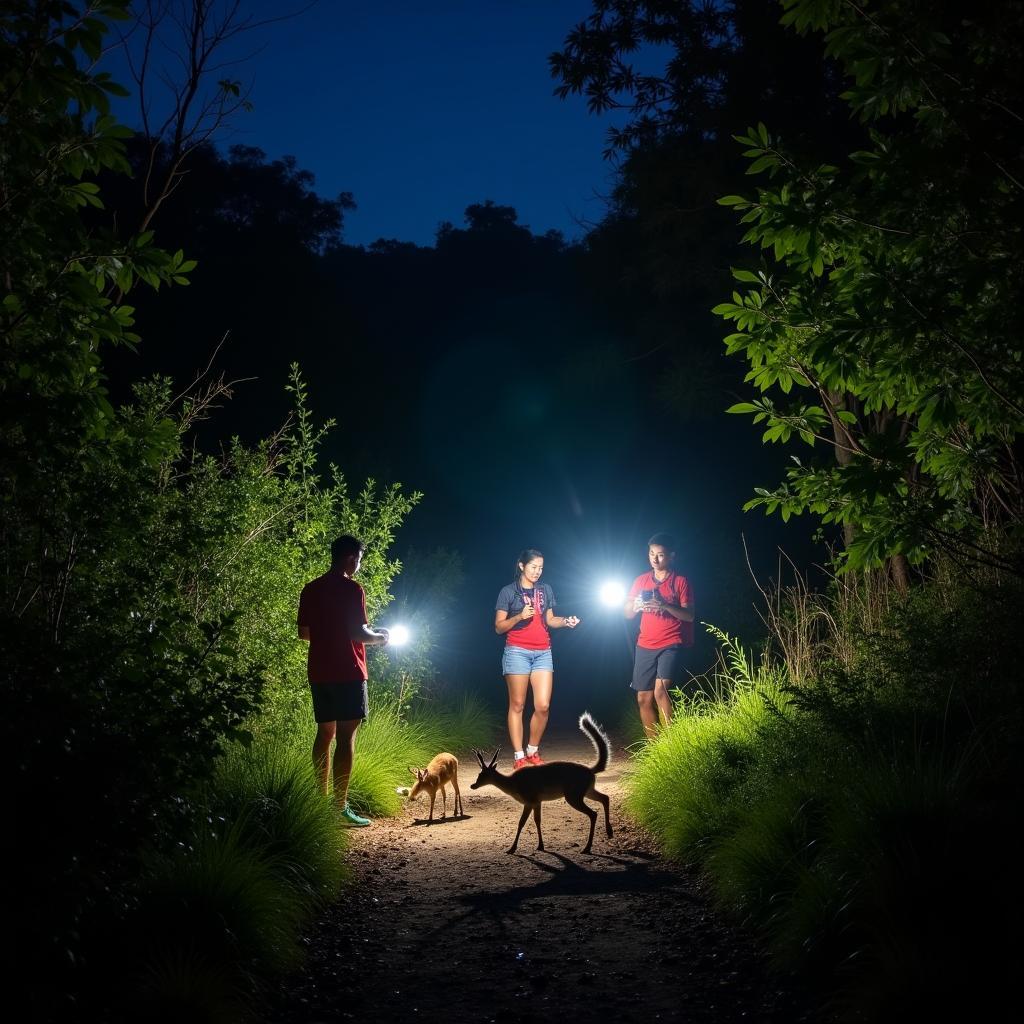 Trải nghiệm khám phá động vật hoang dã tại công viên quốc gia Việt Nam trong IELTS Speaking Part 2
Follow-up Questions (Rounding Off Questions)
Sau khi bạn kết thúc Part 2, giám khảo có thể hỏi thêm 1-2 câu ngắn để transition sang Part 3. Đây là câu hỏi đơn giản, trả lời ngắn gọn (2-3 câu) là đủ.
Question 1: Would you like to visit this place again?
Band 6-7 Answer:
Yes, definitely. I really enjoyed my visit and I think there are still many areas of the park I didn’t explore. Next time I would like to stay longer and see more wildlife.
Band 8-9 Answer:
Absolutely! In fact, I’m already planning a return trip. There’s so much I missed out on during my first visit – particularly some of the more remote trails and the bear rescue station. I’d love to experience the park during a different season to observe how the ecosystem transforms throughout the year.
Question 2: Did you take many photos there?
Band 6-7 Answer:
Yes, I took quite a lot of photos. The scenery was beautiful so I wanted to remember it. I also took some pictures of the animals and plants we saw.
Band 8-9 Answer:
I did take photos, though I tried to be mindful about not letting photography detract from the actual experience. I find there’s a delicate balance between documenting memories and being fully present in the moment. That said, I did capture some stunning shots of the landscape and wildlife that I now treasure as reminders of that incredible trip.
IELTS Speaking Part 3: Two-way Discussion
Tổng Quan Về Part 3
Part 3 là phần thảo luận trừu tượng và sâu sắc nhất, kéo dài 4-5 phút. Đây là nơi giám khảo đánh giá khả năng phân tích, so sánh và thảo luận các vấn đề xã hội rộng hơn liên quan đến chủ đề Part 2.
Thời gian: 4-5 phút
Đặc điểm:
- Câu hỏi trừu tượng, yêu cầu critical thinking
- Không hỏi về kinh nghiệm cá nhân mà về society, trends, opinions
- Two-way discussion: examiner có thể challenge hoặc probe deeper
Yêu cầu:
- Phân tích, so sánh, đánh giá các vấn đề
- Đưa ra quan điểm có lý lẽ rõ ràng
- Xem xét nhiều góc độ (advantages/disadvantages, past/present/future)
- Support opinions với examples từ society, không chỉ personal experience
Chiến lược:
- Mở rộng câu trả lời (3-5 câu minimum)
- Sử dụng discourse markers để organize ideas: Well, Actually, To be honest…
- Acknowledge complexity: “It’s a complex issue”, “There are different perspectives”
- Give balanced views: “On the one hand… On the other hand…”
- Use tentative language: “I would say”, “It seems to me”, “To some extent”
Lỗi thường gặp của học viên Việt Nam:
- Trả lời quá ngắn, thiếu elaboration
- Không đưa ra lý lẽ rõ ràng để support opinions
- Thiếu từ vựng trừu tượng để discuss broader issues
- Chỉ nói về personal experience thay vì societal trends
- Không acknowledge different perspectives
- Overgeneralize without nuance
Các Câu Hỏi Thảo Luận Sâu
Dưới đây là các câu hỏi Part 3 được phân loại theo themes liên quan đến chủ đề national parks và wildlife conservation.
Theme 1: Conservation và Environmental Protection
Question 1: Why do you think it’s important to protect national parks and wildlife reserves?
🎯 Phân tích câu hỏi:
- Dạng: Explaining importance/reasons
- Key words: important, protect, national parks, wildlife reserves
- Cách tiếp cận:
- Direct answer (state importance)
- Provide 2-3 clear reasons với elaboration
- Give examples từ real-world situations
- Có thể kết với broader implications
📝 Sample Answer – Band 6-7:
I think protecting national parks is very important for several reasons. First, these places are homes for many animals and plants, especially endangered species. If we don’t protect them, these animals might disappear. Second, national parks help keep the environment clean. Trees in forests clean the air and water. Also, many people can visit these places for education and relaxation. Young people can learn about nature when they visit national parks. So I believe we must protect these areas for future generations.
Phân tích:
- Structure: Có structure rõ: First, Second, Also – logic và easy to follow
- Vocabulary: Adequate: endangered species, environment, future generations. Nhưng còn basic: very important, clean the air, many people
- Grammar: Mix của simple và compound sentences. Có conditional: “If we don’t protect”. Nhưng thiếu complex structures
- Tại sao Band 6-7: Communicates ideas clearly với adequate vocabulary và reasonable structure. Tuy nhiên, vocabulary chưa sophisticated, arguments còn surface-level, thiếu depth và nuance
📝 Sample Answer – Band 8-9:
Well, I’d say the preservation of national parks and wildlife reserves is absolutely crucial for multiple reasons, both ecological and societal.
From an environmental standpoint, these protected areas serve as vital sanctuaries for biodiversity. They safeguard endangered species from habitat loss and human encroachment, acting as genetic reservoirs that maintain the delicate balance of our ecosystems. Without these protected zones, we’d witness accelerated extinction rates, which would have cascading effects throughout food chains and ecosystems.
Beyond biodiversity, national parks play an indispensable role in climate regulation. Forests, in particular, act as carbon sinks, sequestering massive amounts of CO2 that would otherwise exacerbate global warming. There’s also the aspect of ecosystem services – these areas regulate water cycles, prevent soil erosion, and maintain air quality, all of which directly benefit human populations.
From a socio-economic perspective, protected areas also contribute to sustainable tourism and provide livelihood opportunities for local communities through eco-tourism initiatives. They serve as living laboratories for scientific research and educational platforms where future generations can develop environmental awareness.
I think what’s often overlooked is the intrinsic value of these places – the idea that nature has worth beyond its utility to humans. Protecting these areas is fundamentally about recognizing our responsibility as stewards of the planet rather than its exploiters.
Phân tích:
- Structure: Exceptionally well-organized:
- Direct statement of importance
- Environmental reasons → detailed elaboration → specific examples
- Climate reasons → explanation → consequences
- Socio-economic dimension
- Philosophical consideration
- Vocabulary:
- Sophisticated academic terms: biodiversity, habitat encroachment, genetic reservoirs, cascading effects, sequestering, ecosystem services
- Precise collocations: vital sanctuaries, delicate balance, accelerated extinction rates, indispensable role, carbon sinks
- Abstract concepts: intrinsic value, stewards of the planet
- Grammar:
- Complex noun phrases: “the preservation of… is crucial”
- Participle clauses: “sequestering massive amounts”
- Relative clauses: “which would have cascading effects”
- Emphatic structures: “what’s often overlooked is…”
- Critical Thinking:
- Multiple dimensions: ecological, climatic, socio-economic, philosophical
- Cause-effect relationships clearly explained
- Acknowledges complexity: “both… and”, “beyond”
- Shows depth with “often overlooked” aspect
- Balanced, nuanced view
💡 Key Language Features:
- Discourse markers: “Well”, “From an… standpoint”, “Beyond”, “I think what’s often overlooked”
- Tentative language: “I’d say”, “I think”
- Academic vocabulary: biodiversity, encroachment, sequestering, stewards
- Abstract nouns: preservation, biodiversity, sustainability, awareness
- Hedging: “would witness”, “would otherwise”
Question 2: How can governments encourage people to visit and protect natural areas?
🎯 Phân tích câu hỏi:
- Dạng: Problem-solution / Suggesting methods
- Key words: governments, encourage, visit AND protect (2 objectives)
- Cách tiếp cận:
- Acknowledge the dual challenge
- Suggest 2-3 concrete methods với explanation
- Consider potential challenges
- Examples from successful cases
📝 Sample Answer – Band 6-7:
Governments can do many things to encourage people to visit natural areas. First, they should make these places easier to access by building better roads and public transport. This will help more people visit. They can also make entrance fees cheaper so that everyone can afford to go.
To encourage protection, governments should create educational programs about the environment in schools. When children learn about nature, they will want to protect it when they grow up. The government can also make strict laws against littering and hunting in these areas, and punish people who break these rules.
Another idea is to advertise these places more on TV and social media. Many people don’t know about national parks in their country, so marketing can help. If governments do these things, more people will visit and protect natural areas.
Phân tích:
- Structure: Clear organization: methods cho visiting, methods cho protection, conclusion
- Vocabulary: Adequate but basic: easier to access, make cheaper, strict laws, advertise
- Grammar: Mix of simple and complex sentences. Some conditional: “When children learn”, “If governments do”
- Tại sao Band 6-7: Ideas are relevant and organized. However, arguments lack sophistication and depth. Vocabulary is functional but not impressive. Missing nuanced discussion of challenges or trade-offs.
📝 Sample Answer – Band 8-9:
That’s quite a nuanced challenge actually, because there’s an inherent tension between encouraging visitation and ensuring protection – increased foot traffic can sometimes undermine conservation efforts if not managed properly.
From a promotional standpoint, governments could leverage digital marketing and social media campaigns to raise awareness about these natural treasures, perhaps partnering with influential environmental advocates to reach younger demographics. However, this needs to be balanced with sustainable tourism principles – it’s not about maximizing visitor numbers but rather about attracting the right kind of tourism that’s ecologically responsible.
Infrastructure development is crucial but must be thoughtfully executed. Governments should invest in eco-friendly facilities like low-impact trails, sustainable accommodation, and renewable energy-powered visitor centers. Singapore’s model with its nature reserves is quite instructive here – they’ve managed to make these areas accessible while implementing strict guidelines to minimize environmental disruption.
In terms of fostering a conservation ethic, I believe education is paramount. This could take multiple forms – integrating environmental curricula in schools, organizing guided eco-tours that emphasize conservation messages, and creating interpretive centers that help visitors understand the ecological significance of these areas. Costa Rica’s approach is particularly noteworthy – they’ve successfully cultivated a national identity around environmental stewardship through decades of education and policy.
Economic incentives shouldn’t be overlooked either. Governments might consider tax breaks for eco-tourism operators, funding for community-based conservation projects, or even payment for ecosystem services schemes that compensate local communities for protecting natural areas rather than exploiting them.
The key is recognizing that protection and visitation aren’t mutually exclusive – when done right, tourism can actually generate revenue that funds conservation efforts while building public support for protection. It requires what I’d call a holistic approach that considers environmental, economic, and social dimensions simultaneously.
Phân tích:
- Structure: Sophisticated organization:
- Acknowledges complexity upfront
- Multiple dimensions: promotion, infrastructure, education, economics
- Real-world examples (Singapore, Costa Rica)
- Synthesis at the end
- Vocabulary:
- Sophisticated phrases: nuanced challenge, inherent tension, undermine conservation efforts, sustainable tourism principles
- Technical terms: ecological footprint, ecosystem services, renewable energy-powered
- Precise verbs: leverage, foster, cultivate, compensate
- Academic collocations: thoughtfully executed, ecologically responsible, payment for ecosystem services
- Grammar:
- Conditional structures: “if not managed properly”, “when done right”
- Passive constructions: “must be thoughtfully executed”
- Participle phrases: “emphasizing conservation messages”
- Cleft sentences: “The key is recognizing that…”
- Critical Thinking:
- Identifies tension/challenge in the question
- Multiple perspectives covered
- Real examples to support arguments
- Acknowledges complexity: “not mutually exclusive”, “holistic approach”
- Shows sophisticated understanding of policy implications
💡 Key Language Features:
- Discourse markers: “actually”, “From a… standpoint”, “In terms of”, “The key is”
- Tentative language: “I believe”, “might consider”, “I’d call”
- Hedging and qualification: “can sometimes”, “quite instructive”, “particularly noteworthy”
- Referencing examples: “Singapore’s model”, “Costa Rica’s approach”
Để có thêm ý tưởng về các địa điểm du lịch thiên nhiên ấn tượng, bạn có thể tham khảo Describe a place you visited that exceeded your expectations cho những góc nhìn bổ ích.
Theme 2: Tourism và Economic Development
Question 3: Do you think eco-tourism can help protect the environment?
🎯 Phân tích câu hỏi:
- Dạng: Opinion with pros/cons evaluation
- Key words: eco-tourism, help, protect environment
- Cách tiếp cận:
- Give clear opinion (Yes but with conditions / It depends)
- Explain mechanisms of how it can help
- Acknowledge limitations or potential problems
- Provide examples
- Conclude with balanced view
📝 Sample Answer – Band 6-7:
Yes, I think eco-tourism can help protect the environment in many ways. When tourists visit natural places, they pay entrance fees and this money can be used to protect these areas. The government can use this money to hire more park rangers and buy equipment.
Also, eco-tourism creates jobs for local people. If local communities can earn money from tourism, they won’t need to cut down forests or hunt animals illegally. They will want to protect nature because it brings them income.
However, there are some problems. Sometimes too many tourists can damage the environment. They might leave trash or disturb animals. So it’s important to manage tourism carefully. If we control the number of visitors and educate them about protecting nature, then eco-tourism can be good for the environment.
Phân tích:
- Structure: Opinion → reasons → counterpoint → condition. Logical flow.
- Vocabulary: Functional: entrance fees, park rangers, creates jobs, damage the environment. Lacks sophistication.
- Grammar: Mostly simple and compound sentences. Some conditional: “If local communities can”, “If we control”
- Tại sao Band 6-7: Presents relevant ideas with basic support. Arguments are straightforward but lack depth. Vocabulary adequate but not impressive. Structure is clear but predictable.
📝 Sample Answer – Band 8.5-9:
I’d say eco-tourism has considerable potential to support environmental protection, but its effectiveness is highly contingent on how it’s implemented and regulated. It’s not an automatic win – there are both promising aspects and significant pitfalls to consider.
On the positive side, eco-tourism can create powerful economic incentives for conservation. When local communities derive tangible benefits from protecting their natural heritage – through employment, business opportunities, or revenue-sharing schemes – they become stakeholders in conservation rather than viewing wildlife and forests as mere resources to exploit. Kenya’s wildlife conservancies exemplify this model well; communities that once saw elephants as threats now recognize their value as tourist attractions, aligning economic interests with conservation goals.
Moreover, well-managed eco-tourism can raise environmental awareness among visitors, potentially creating conservation ambassadors who support environmental causes long after their trips end. The interpretive and educational components of eco-tourism can be quite impactful in this regard.
However, the term “eco-tourism” has become somewhat of a buzzword that’s often co-opted by businesses engaging in greenwashing – superficial environmental gestures that mask unsustainable practices. Without robust certification standards and enforcement mechanisms, so-called eco-tourism can actually inflict considerable environmental damage through habitat disturbance, pollution, and placing unsustainable pressure on fragile ecosystems. The overtourism issues plaguing places like Thailand’s Maya Bay or Nepal’s Everest region demonstrate how even nature-based tourism can become ecologically destructive.
The carrying capacity of ecosystems must be respected, which requires stringent visitor quotas, seasonal restrictions, and zoning regulations. There’s also the carbon footprint paradox – international eco-tourists typically generate substantial emissions through air travel, potentially offsetting the conservation benefits of their visits.
So I’d conclude that eco-tourism can indeed be a valuable tool for conservation, but only when it’s genuinely sustainable, properly regulated, and integrated into broader conservation strategies. It’s a means to an end, not a panacea for environmental challenges. The key is ensuring that economic benefits directly fund conservation activities and genuinely empower local communities, while stringent safeguards prevent environmental degradation. When these conditions are met, eco-tourism can create a virtuous cycle where economic development and environmental protection mutually reinforce each other rather than existing in tension.
Phân tích:
- Structure: Exceptionally sophisticated:
- Clear position with qualification
- Positive aspects with mechanisms and example
- Counterarguments with specific problems and examples
- Synthesis with conditions for success
- Nuanced conclusion
- Vocabulary:
- High-level academic: contingent on, tangible benefits, stakeholders, aligning interests, co-opted by, greenwashing, carrying capacity, panacea, virtuous cycle
- Precise collocations: considerable potential, powerful economic incentives, robust certification standards, stringent visitor quotas, carbon footprint paradox
- Technical environmental terms: habitat disturbance, ecosystem pressure, conservation ambassadors
- Grammar:
- Complex conditional structures: “When these conditions are met”
- Participle phrases: “viewing wildlife as”, “aligning economic interests”
- Passive voice for emphasis: “is highly contingent on”, “has become co-opted”
- Relative clauses: “communities that once saw”, “where economic development”
- Contrasting structures: “rather than”, “not… but”
- Critical Thinking:
- Acknowledges complexity and conditionality
- Multiple perspectives: economic, social, environmental
- Real examples (both positive and negative): Kenya, Thailand, Nepal
- Identifies paradoxes and tensions
- Distinguishes between theory and practice
- Provides criteria for success
- Shows sophisticated understanding of trade-offs
💡 Key Language Features:
- Discourse markers: “On the positive side”, “Moreover”, “However”, “So I’d conclude”
- Tentative language: “I’d say”, “has potential”, “can be”, “I’d conclude”
- Contrasting devices: “both… and”, “rather than”, “not… but”
- Abstract nouns: effectiveness, implementation, awareness, paradox
- Hedging: “considerably”, “potentially”, “typically”, “genuinely”
Question 4: How has tourism to natural areas changed over the past few decades?
🎯 Phân tích câu hỏi:
- Dạng: Describing changes/trends (past vs present)
- Key words: tourism, natural areas, changed, past few decades
- Cách tiếp cận:
- Identify main trends (increase in numbers, shift in motivations, changes in infrastructure)
- Compare past and present
- Analyze causes of changes
- Discuss implications
- Use time markers
📝 Sample Answer – Band 6-7:
Tourism to natural areas has changed a lot in recent decades. In the past, fewer people visited national parks because traveling was more expensive and difficult. There were also fewer roads and facilities. Now, more people visit natural areas because of better transportation and lower costs.
Another change is that people today are more interested in nature and the environment. Social media also plays a big role – people share photos of beautiful places and this encourages others to visit. Many young people want to take photos for Instagram.
Also, there are now more tour companies that organize trips to natural areas. These companies make it easier for people to visit places they couldn’t reach before. The facilities in national parks have also improved – there are better hotels, restaurants, and visitor centers now.
However, this increase in tourism has caused some problems like overcrowding and damage to the environment. So while tourism has grown a lot, we need to manage it better to protect these natural places.
Phân tích:
- Structure: Past → Present → Causes → Implications. Chronological and logical.
- Vocabulary: Adequate: fewer/more, better, improved, overcrowding. But repetitive and basic.
- Grammar: Mix of simple past and present. Basic comparatives: more/fewer, better. Some causal language: “because of”
- Tại sao Band 6-7: Addresses the question with relevant points. Clear comparison between past and present. However, analysis lacks depth, vocabulary is repetitive, and examples are general rather than specific.
📝 Sample Answer – Band 8.5-9:
The landscape of nature-based tourism has undergone dramatic transformation over the past few decades, driven by multiple intersecting factors ranging from technological advances to shifting cultural values.
Perhaps the most obvious change is the sheer scale of participation. What was once a relatively niche activity – predominantly the preserve of dedicated naturalists and adventure enthusiasts – has evolved into mainstream leisure. This democratization of nature tourism has been facilitated by several developments: budget air travel has made remote destinations accessible to middle-class travelers; digital technology and GPS systems have reduced the perceived barriers to wilderness exploration; and sophisticated online platforms now enable travelers to seamlessly book complex itineraries to previously hard-to-reach locations.
The motivations underlying nature tourism have also undergone a subtle evolution. Whereas earlier generations might have been driven primarily by adventure or scientific interest, contemporary tourists often seek nature experiences for psychological restoration and digital detox – a response to increasingly urbanized lifestyles and screen-saturated existence. There’s been a notable shift toward experiential travel over passive sightseeing, with visitors seeking immersive encounters and authentic connections with nature.
The advent of social media has introduced a particularly complex dynamic. While platforms like Instagram have undeniably amplified interest in natural destinations, creating unprecedented exposure for remote areas, this comes with significant downsides. Certain locations have been catapulted to fame through viral imagery, often resulting in unsustainable visitor surges that overwhelm local infrastructure and compromise the very qualities that made them attractive initially. Iceland’s tourism boom exemplifies this phenomenon – visitor numbers skyrocketed from around 500,000 annually in 2010 to over 2 million by 2018, straining resources and raising serious concerns about environmental degradation.
From an infrastructural perspective, there’s been substantial investment in visitor facilities, though this varies considerably by region. Developed nations have generally enhanced accessibility while implementing sophisticated management systems – timed entry reservations, shuttle services, and designated viewing areas to manage crowds and minimize impact. Developing countries with emerging eco-tourism sectors have faced the challenge of balancing development with conservation, sometimes successfully as in Costa Rica, sometimes less so.
There’s also been growing recognition of the conservation-tourism nexus. Many protected areas have shifted from viewing tourism as ancillary to conservation toward seeing it as an integral funding mechanism and public engagement tool. This has led to more professionalized visitor services and enhanced interpretive programming.
Looking forward, I’d say we’re seeing early signs of a potential paradigm shift toward regenerative tourism – the idea that tourism should actively improve rather than merely minimize harm to destinations. Whether this materializes into widespread practice or remains largely aspirational will likely define the next chapter in nature-based tourism.
Phân tích:
- Structure: Exceptionally comprehensive:
- Overview of transformation
- Scale changes with causes
- Motivation shifts
- Social media impact with example
- Infrastructure development
- Conservation approach evolution
- Future outlook
- Vocabulary:
- Sophisticated academic language: undergone dramatic transformation, intersecting factors, democratization, facilitated by, predominantly the preserve of
- Precise descriptive phrases: subtle evolution, psychological restoration, digital detox, screen-saturated existence, complex dynamic
- Technical tourism/conservation terms: nature-based tourism, experiential travel, regenerative tourism, conservation-tourism nexus
- Vivid verbs: catapulted, skyrocketed, straining, overwhelm, compromise
- Grammar:
- Complex noun phrases: “the democratization of nature tourism”, “the advent of social media”
- Participle clauses: “driven by”, “ranging from”, “resulting in”
- Passive constructions: “has been facilitated by”, “were driven by”, “has been enhanced”
- Comparative structures: “from… toward”, “While… this comes with”
- Conditional forms: “Whether this materializes”
- Relative clauses providing detailed information
- Critical Thinking:
- Multi-dimensional analysis: technological, social, psychological, infrastructural
- Identifies causes and effects
- Acknowledges complexity and variation
- Provides specific example with data (Iceland)
- Recognizes both positive and negative aspects
- Forward-looking perspective
- Distinguishes between aspiration and reality
💡 Key Language Features:
- Time markers: “over the past few decades”, “once”, “contemporary”, “Looking forward”
- Discourse markers: “Perhaps”, “Whereas”, “While”, “From an… perspective”, “Looking forward”
- Comparing past and present: “What was once… has evolved into”, “from… toward”
- Hedging: “might have been”, “often seek”, “likely define”, “I’d say”
- Emphasizing change: “dramatic transformation”, “undergone evolution”, “paradigm shift”
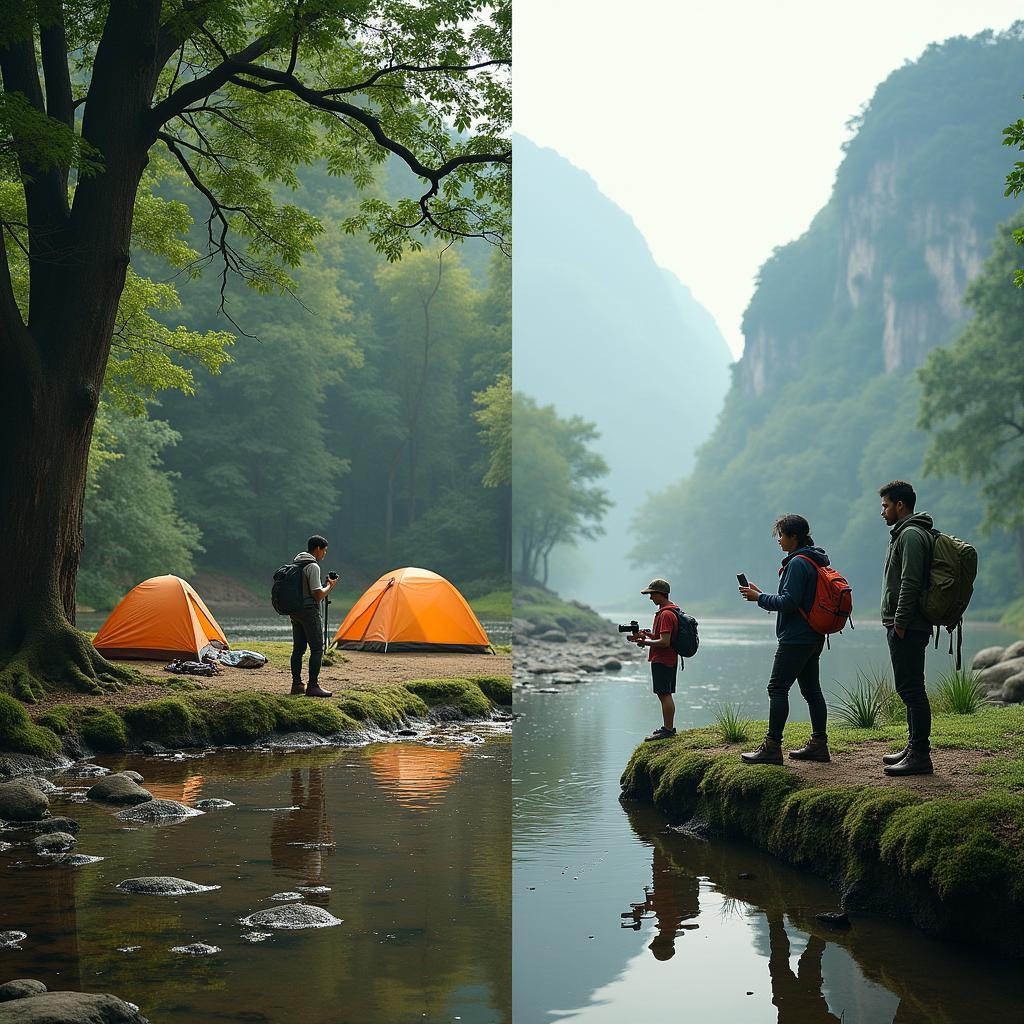 Sự phát triển du lịch sinh thái và tác động đến công viên quốc gia qua các thập kỷ
Theme 3: Wildlife và Biodiversity
Question 5: What are the main threats to wildlife in your country?
🎯 Phân tích câu hỏi:
- Dạng: Identifying and explaining problems
- Key words: main threats, wildlife, your country
- Cách tiếp cận:
- Identify 2-3 major threats
- Explain each threat with details
- Provide examples if possible
- Discuss causes and impacts
- May suggest solutions briefly
📝 Sample Answer – Band 6-7:
In Vietnam, there are several threats to wildlife. The biggest problem is habitat loss. Many forests are cut down to build houses, roads, and farms. When forests disappear, animals lose their homes and food sources.
Another threat is illegal hunting and trading of wild animals. Some people hunt rare animals to sell them for traditional medicine or as pets. This is a serious problem because it has caused some species to become endangered.
Pollution is also a threat. Rivers and forests are polluted by factories and garbage, which harms animals and plants. Climate change is another issue – it affects animal habitats and food supplies.
The government is trying to solve these problems by creating more protected areas and making stricter laws against hunting. However, more needs to be done to protect our wildlife effectively.
Phân tích:
- Structure: Lists threats clearly, each with brief explanation. Mentions government response.
- Vocabulary: Adequate: habitat loss, illegal hunting, endangered, protected areas. But fairly basic.
- Grammar: Simple and compound sentences. Some passive: “are cut down”, “are polluted”. Basic causal language: “because”, “when”
- Tại sao Band 6-7: Addresses all parts of the question. Ideas are relevant and organized. However, lacks depth in analysis, uses general rather than specific examples, and vocabulary is functional but not sophisticated.
📝 Sample Answer – Band 8.5-9:
Vietnam’s wildlife faces a confluence of threats, many of which are symptomatic of rapid economic development occurring alongside insufficient environmental safeguards.
I’d argue that habitat fragmentation and degradation constitute the most pervasive threat. Vietnam has experienced dramatic deforestation – we’ve lost approximately 50% of our forest cover since the 1940s. This isn’t just about outright clearance; it’s also about fragmentation, where remaining forest patches become isolated islands unable to support viable populations of species requiring large territories, like tigers or elephants. The expansion of agricultural land, particularly for cash crops like coffee and rubber, along with infrastructure development for hydropower dams and highways, has been instrumental in this habitat loss. The cumulative effect is that many species are being squeezed into increasingly smaller areas, elevating extinction risks.
Illegal wildlife trafficking represents another critical threat with far-reaching consequences. Vietnam unfortunately serves as both a source and transit hub for the illegal wildlife trade, which is estimated to be worth billions of dollars globally. The trade is fueled by demand for traditional medicine ingredients – products like rhino horn, bear bile, and pangolin scales – as well as the exotic pet market and bushmeat consumption. Species like the Javan rhinoceros have been driven to extinction in Vietnam partly due to poaching, and pangolins have become the world’s most trafficked mammals. Despite strengthened legislation, enforcement remains patchy, often undermined by corruption and insufficient resources for anti-poaching operations.
Pollution also exacts a significant toll, though its impacts are perhaps less immediately visible. Agricultural runoff containing pesticides and fertilizers contaminates waterways, affecting aquatic species. The Mekong Delta, one of the world’s most biodiverse regions, faces mounting pressure from upstream dam construction, pollution, and unsustainable fishing practices that threaten fish stocks and the ecological integrity of the delta.
There’s also the looming specter of climate change, which manifests in multiple ways: sea-level rise threatening coastal ecosystems like mangrove forests, altered precipitation patterns affecting forest composition, and coral bleaching in marine environments. These changes occur too rapidly for many species to adapt, particularly those with specialized habitat requirements.
What makes this situation particularly challenging is the interconnected nature of these threats. Poverty in rural areas, for instance, can drive both forest encroachment for agriculture and participation in wildlife trafficking. Addressing wildlife conservation in Vietnam therefore requires holistic approaches that consider socioeconomic factors alongside purely environmental ones. Recent initiatives like Vietnam’s Wildlife Conservation Strategy show promising directions, but sustained commitment and adequate resourcing will be crucial to reverse current declining trends in biodiversity.
Phân tích:
- Structure: Highly sophisticated:
- Introduction establishing complexity
- Four major threats, each thoroughly explained with causes, examples, and impacts
- Interconnections between threats acknowledged
- Contextualizes within socioeconomic factors
- Ends with current response and future needs
- Vocabulary:
- Academic and technical: confluence of threats, habitat fragmentation, viable populations, cumulative effect, far-reaching consequences, ecological integrity
- Precise environmental terms: forest cover, cash crops, microclimates, biodiverse regions, coral bleaching
- Sophisticated phrases: symptomatic of, instrumental in, squeezed into, exacts a toll, looming specter
- Domain-specific: anti-poaching operations, wildlife trafficking, endangered species
- Grammar:
- Complex noun phrases: “the expansion of agricultural land”, “the cumulative effect”, “the interconnected nature of these threats”
- Passive constructions: “has been driven”, “is fueled by”, “remain undermined”
- Participle phrases: “occurring alongside”, “threatening coastal ecosystems”
- Relative clauses: “which are symptomatic of”, “where remaining forest patches”
- Causal language: “due to”, “fueled by”, “resulting in”
- Critical Thinking:
- Comprehensive coverage of multiple threat categories
- Specific data and examples (50% forest loss, Javan rhino extinction, pangolins as most trafficked)
- Explains mechanisms and processes, not just lists problems
- Identifies interconnections between threats
- Contextualizes within broader socioeconomic framework
- Acknowledges complexity and challenges
- Balanced view: problems + efforts + what’s still needed
💡 Key Language Features:
- Discourse markers: “I’d argue that”, “What makes this particularly challenging”, “There’s also”
- Hedging: “I’d argue”, “perhaps”, “estimated to be”
- Emphasis: “most pervasive”, “critical threat”, “particularly challenging”
- Listing and contrasting: “not just… it’s also”, “both… and”
- Abstract nouns: confluence, fragmentation, degradation, integrity, commitment
Question 6: Do you think zoos play a positive role in wildlife conservation?
🎯 Phân tích câu hỏi:
- Dạng: Opinion with evaluation (controversial topic)
- Key words: zoos, positive role, wildlife conservation
- Cách tiếp cận:
- Give nuanced opinion (recognize both sides)
- Explain positive aspects with examples
- Acknowledge criticisms/limitations
- Provide balanced conclusion
- Consider different types of zoos (modern vs traditional)
📝 Sample Answer – Band 6-7:
This is a difficult question because zoos have both good and bad points. I think modern zoos can help conservation in some ways. They protect endangered species and help them breed. For example, some animals that are almost extinct in the wild are kept safely in zoos. Zoos also educate people, especially children, about wildlife and the importance of protecting nature.
However, there are problems with zoos. Some animals are kept in small cages and can’t behave naturally. This makes them unhappy and stressed. Also, I think the money spent on zoos could be used to protect animals in their natural habitats instead.
Overall, I believe zoos can be good for conservation if they focus on protecting endangered species and educating people. But they must provide good living conditions for animals. Old-fashioned zoos that just keep animals for entertainment should change or close.
Phân tích:
- Structure: Balanced approach: positive aspects → negative aspects → conditional conclusion
- Vocabulary: Adequate: endangered species, breed, educate, natural habitats, living conditions. Lacks sophistication
- Grammar: Mix of simple and complex sentences. Some conditional: “if they focus”
- Tại sao Band 6-7: Presents both sides fairly. Organized logically. However, arguments are quite general, lacks specific examples, and vocabulary is basic. Analysis lacks depth.
📝 Sample Answer – Band 8.5-9:
This is quite a contentious issue with passionate advocates on both sides, and I think the answer is far more nuanced than a simple yes or no. The role of zoos in conservation has evolved considerably, and we need to distinguish between modern, accredited conservation-focused facilities and traditional entertainment-oriented menageries.
Contemporary zoological institutions, particularly those accredited by organizations like the Association of Zoos and Aquariums, do make substantive contributions to conservation through several mechanisms. Ex situ conservation – maintaining populations outside their natural habitats – has proven instrumental in saving species from the brink of extinction. The Arabian oryx, for instance, was declared extinct in the wild in 1972 but was successfully reintroduced through captive breeding programs coordinated by zoos. Similarly, the California condor owes its survival to intensive zoo-based recovery efforts. These programs serve as genetic reservoirs and insurance populations against extinction in the wild.
Moreover, modern zoos channel significant resources into field conservation projects, often providing crucial funding for habitat protection and anti-poaching efforts in species’ native ranges. They also conduct valuable research on animal behavior, reproduction, and veterinary care that informs both captive management and wild conservation strategies.
The educational dimension shouldn’t be dismissed either. Zoos provide firsthand encounters with wildlife for millions of people who might otherwise have no connection to nature, potentially cultivating conservation awareness and fostering environmental stewardship. There’s evidence suggesting that well-designed zoo exhibits with comprehensive educational programming can meaningfully impact visitors’ environmental attitudes and behaviors.
However, these positive contributions must be weighed against legitimate concerns. Animal welfare remains a persistent issue – even in well-resourced zoos, replicating the complexity of natural habitats is challenging, and some species, particularly large, cognitively complex animals like elephants and cetaceans, may experience diminished wellbeing in captivity. There’s an ethical dimension regarding whether we have the right to confine sentient beings primarily for human benefit, even when framed as conservation.
Furthermore, I’d argue that zoos can create a misleading narrative suggesting that conservation can be achieved primarily through captive populations, potentially diverting attention and resources from the more fundamental challenge of habitat preservation. In-situ conservation – protecting species in their natural environments – should unquestionably take precedence, as it preserves not just individual species but entire ecosystems and ecological processes.
The efficacy of zoo-based conservation also varies enormously. While certain flagship programs have achieved remarkable success, many species in zoos contribute little to wild population recovery due to insurmountable reintroduction challenges or because they’re not genuinely threatened – their presence being more about visitor appeal than conservation necessity.
So, to synthesize, I’d say that thoughtfully managed, conservation-oriented zoos can serve as valuable adjuncts to broader conservation strategies, particularly for species facing imminent extinction or those requiring intensive intervention. However, they’re most appropriately viewed as last-resort measures rather than primary solutions. The conservation community’s focus and resources should predominantly support protecting wild habitats and addressing the root causes of biodiversity loss – habitat destruction, climate change, and unsustainable exploitation. Zoos can play a supporting role, but they’re neither necessary nor sufficient to stem the current biodiversity crisis – that requires fundamental changes in how human societies interact with the natural world.
Phân tích:
- Structure: Extraordinarily comprehensive and sophisticated:
- Acknowledges complexity and controversy
- Positive contributions with specific mechanisms and examples
- Counterarguments with ethical and practical concerns
- Critical analysis of limitations
- Nuanced synthesis that positions zoos within broader conservation context
- Vocabulary:
- Highly sophisticated academic language: contentious issue, substantive contributions, ex situ conservation, genetic reservoirs, fostering stewardship, cognitively complex
- Precise technical terms: accredited, menageries, reintroduction, anti-poaching, in-situ conservation, flagship programs
- Abstract concepts: ethical dimension, misleading narrative, ecological processes, biodiversity crisis
- Evaluative language: legitimate concerns, unquestionably, remarkably, appropriately viewed
- Grammar:
- Complex noun phrases: “the role of zoos in conservation”, “intensive zoo-based recovery efforts”
- Participle constructions: “framed as”, “suggesting that”, “diverting attention”
- Passive forms: “must be weighed”, “should take precedence”, “are viewed”
- Relative clauses: “that informs”, “who might otherwise”, “suggesting that”
- Conditional structures: “even when framed as”
- Comparative structures: “more… than”, “neither… nor”
- Critical Thinking:
- Exceptional depth and nuance
- Distinguishes between different types of zoos
- Provides specific, credible examples (Arabian oryx, California condor)
- Addresses multiple dimensions: scientific, educational, ethical, practical
- Acknowledges complexity and variation
- Considers trade-offs and opportunity costs
- Positions issue within broader conservation framework
- Offers synthesis rather than simplistic conclusion
- Shows sophisticated understanding of conservation science and ethics
💡 Key Language Features:
- Discourse markers: “Moreover”, “However”, “Furthermore”, “So, to synthesize”
- Hedging and nuancing: “I think”, “I’d argue”, “I’d say”, “potentially”, “may experience”
- Contrasting devices: “while”, “however”, “must be weighed against”, “rather than”
- Qualifying language: “far more nuanced”, “quite contentious”, “particularly”, “primarily”
- Emphatic structures: “What’s crucial is”, “unquestionably”, “extraordinarily”
Để khám phá thêm về các trải nghiệm ngoài trời thú vị, Describe a place where you would like to go hiking có thể cung cấp thêm nhiều ý tưởng và từ vựng bổ ích cho bạn.
Từ vựng và cụm từ quan trọng
Topic-Specific Vocabulary
| Từ vựng/Cụm từ | Loại từ | Phiên âm | Nghĩa tiếng Việt | Ví dụ | Collocation |
|---|---|---|---|---|---|
| biodiversity | n | /ˌbaɪ.əʊ.daɪˈvɜː.sə.ti/ | đa dạng sinh học | The national park is famous for its remarkable biodiversity. | rich biodiversity, protect biodiversity, biodiversity hotspot, biodiversity loss |
| pristine | adj | /ˈprɪs.tiːn/ | nguyên sơ, hoang sơ | We hiked through pristine forests untouched by development. | pristine wilderness, pristine landscape, pristine environment, pristine nature |
| endangered species | n phrase | /ɪnˈdeɪn.dʒəd ˈspiː.ʃiːz/ | loài có nguy cơ tuyệt chủng | The reserve protects several endangered species. | critically endangered, protect endangered species, endangered wildlife, endangered animals |
| habitat | n | /ˈhæb.ɪ.tæt/ | môi trường sống | Deforestation destroys the natural habitat of many animals. | natural habitat, wildlife habitat, habitat loss, habitat destruction, habitat conservation |
| conservation | n | /ˌkɒn.səˈveɪ.ʃən/ | sự bảo tồn | The park plays a vital role in wildlife conservation. | wildlife conservation, nature conservation, conservation efforts, conservation program, habitat conservation |
| ecosystem | n | /ˈiː.kəʊˌsɪs.təm/ | hệ sinh thái | The wetland ecosystem supports diverse bird populations. | fragile ecosystem, marine ecosystem, forest ecosystem, ecosystem services, ecosystem balance |
| flora and fauna | n phrase | /ˈflɔː.rə ənd ˈfɔː.nə/ | hệ thực vật và động vật | The reserve is home to diverse flora and fauna. | native flora and fauna, unique flora and fauna, abundant flora and fauna, protect flora and fauna |
| scenic | adj | /ˈsiː.nɪk/ | đẹp như tranh, có cảnh đẹp | We enjoyed the scenic views from the mountain trail. | scenic beauty, scenic landscape, scenic route, scenic spot, breathtakingly scenic |
| wilderness | n | /ˈwɪl.də.nəs/ | vùng hoang dã | The park preserves one of the last true wilderness areas. | untouched wilderness, pristine wilderness, vast wilderness, wilderness area, wilderness experience |
| trekking | n | /ˈtrek.ɪŋ/ | đi bộ đường dài | Trekking through the jungle was challenging but rewarding. | go trekking, trekking route, jungle trekking, mountain trekking, trekking experience |
| nocturnal | adj | /nɒkˈtɜː.nəl/ | hoạt động về đêm | We went on a night safari to observe nocturnal animals. | nocturnal creatures, nocturnal wildlife, nocturnal habits, nocturnal species, nocturnal activities |
| foliage | n | /ˈfəʊ.li.ɪdʒ/ | tán lá | The autumn foliage created a spectacular display of colors. | dense foliage, lush foliage, thick foliage, tropical foliage, colorful foliage |
| captivating | adj | /ˈkæp.tɪ.veɪ.tɪŋ/ | quyến rũ, hấp dẫn | The landscape was absolutely captivating. | captivating scenery, captivating beauty, captivating views, truly captivating, utterly captivating |
| unspoiled | adj | /ʌnˈspɔɪld/ | chưa bị hủy hoại, còn nguyên vẹn | The area remains largely unspoiled by tourism. | unspoiled nature, unspoiled wilderness, unspoiled beauty, relatively unspoiled, completely unspoiled |
| sanctuary | n | /ˈsæŋk.tʃu.er.i/ | khu bảo tồn, nơi ẩn náu | The park serves as a sanctuary for migratory birds. | wildlife sanctuary, bird sanctuary, nature sanctuary, elephant sanctuary, marine sanctuary |
| indigenous | adj | /ɪnˈdɪdʒ.ɪ.nəs/ | bản địa | The guide taught us about indigenous plant species. | indigenous species, indigenous wildlife, indigenous people, indigenous culture, indigenous plants |
| rejuvenating | adj | /rɪˈdʒuː.və.neɪ.tɪŋ/ | làm tươi mới, phục hồi sức lực | The experience in nature was truly rejuvenating. | rejuvenating experience, rejuvenating effect, rejuvenating atmosphere, deeply rejuvenating |
| tranquility | n | /træŋˈkwɪl.ə.ti/ | sự yên tĩnh, thanh bình | The tranquility of the forest was incredibly peaceful. | sense of tranquility, peace and tranquility, absolute tranquility, tranquility of nature |
| breathtaking | adj | /ˈbreθˌteɪ.kɪŋ/ | ngoạn mục, đẹp đến nghẹt thở | The views from the summit were absolutely breathtaking. | breathtaking scenery, breathtaking views, breathtaking beauty, breathtaking landscape |
| deforestation | n | /diːˌfɒr.ɪˈsteɪ.ʃən/ | sự phá rừng | Deforestation threatens wildlife habitats. | rapid deforestation, widespread deforestation, deforestation rates, prevent deforestation, combat deforestation |
Idiomatic Expressions & Advanced Phrases
| Cụm từ | Nghĩa | Ví dụ sử dụng | Band điểm |
|---|---|---|---|
| off the beaten track | xa trung tâm, vùng hẻo lánh | The national park is quite off the beaten track, which helps preserve its natural state. | 7.5-9 |
| a breath of fresh air | điều gì đó mới mẻ, sảng khoái | Visiting the park was a breath of fresh air after months of city living. | 7-8 |
| immerse oneself in nature | đắm mình trong thiên nhiên | I love to immerse myself in nature by visiting wilderness areas. | 7.5-8.5 |
| teeming with wildlife | đầy ắp động vật hoang dã | The reserve is teeming with wildlife, from birds to large mammals. | 7.5-9 |
| at the heart of | ở trung tâm của, là cốt lõi của | Biodiversity conservation is at the heart of the park’s mission. | 7-8 |
| strike a balance between | cân bằng giữa | We need to strike a balance between tourism and conservation. | 7.5-8.5 |
| on the brink of extinction | bên bờ vực tuyệt chủng | Several species in the park are on the brink of extinction. | 8-9 |
| shed light on | làm sáng tỏ | The guided tour shed light on the park’s conservation efforts. | 7-8 |
| take a toll on | gây ảnh hưởng tiêu cực | Climate change is taking a toll on fragile ecosystems. | 7.5-8.5 |
| in its prime | ở trạng thái hoàn hảo nhất | The forest was in its prime, with towering ancient trees. | 7-8 |
| recharge one’s batteries | nạp lại năng lượng | Spending time in nature really helps me recharge my batteries. | 7-7.5 |
| leave no stone unturned | không bỏ sót điều gì | Conservationists are leaving no stone unturned in protecting endangered species. | 7.5-8 |
Discourse Markers (Từ Nối Ý Trong Speaking)
Để bắt đầu câu trả lời:
- 📝 Well,… – Sử dụng khi cần thời gian suy nghĩ hoặc để transition tự nhiên
- 📝 Actually,… – Khi đưa ra góc nhìn khác hoặc thông tin unexpected
- 📝 To be honest,… – Khi muốn thể hiện honesty hoặc personal opinion
- 📝 I’d say that… – Cách tentative để đưa ra opinion
- 📝 From my perspective,… – Nhấn mạnh personal viewpoint
- 📝 In my experience,… – Khi dẫn dắt personal example
Để bổ sung ý:
- 📝 On top of that,… – Thêm điểm mới vào argument
- 📝 What’s more,… – Tương tự “moreover” nhưng conversational hơn
- 📝 Not to mention… – Emphasize additional point
- 📝 Beyond that,… – Mở rộng discussion
- 📝 Moreover,… – Formal way to add information
- 📝 In addition to this,… – Academic style addition
Để đưa ra quan điểm cân bằng:
- 📝 On the one hand,… On the other hand,… – Classic balanced structure
- 📝 While it’s true that…, we also need to consider… – Acknowledge + counter
- 📝 Having said that,… – Introduce contrasting point
- 📝 That being said,… – Similar to “however” but more natural
- 📝 Conversely,… – Formal contrast marker
- 📝 By contrast,… – Comparing opposite perspectives
Để đưa ra ví dụ:
- 📝 For instance,… – Formal example introduction
- 📝 Take… for example – Conversational example
- 📝 A case in point is… – Sophisticated way to give example
- 📝 To illustrate this,… – Academic style
- 📝 This is exemplified by… – High-level structure
Để kết luận hoặc tóm tắt:
- 📝 All in all,… – Informal summary
- 📝 At the end of the day,… – Idiomatic conclusion
- 📝 To sum up,… – Direct summary
- 📝 In conclusion,… – Formal ending (use sparingly in speaking)
- 📝 Ultimately,… – Emphasize final point
- 📝 The bottom line is… – Idiomatic way to state key point
Grammatical Structures Ấn Tượng
1. Conditional Sentences (Câu điều kiện):
-
Mixed conditional: “If governments had invested more in conservation earlier, we wouldn’t be facing such severe biodiversity loss now.”
- Dùng để: Express regret about past with present consequence
-
Inversion for emphasis: “Had I known how spectacular the park was, I would have visited sooner.”
- Dùng để: Create sophisticated, formal tone
2. Relative Clauses (Mệnh đề quan hệ):
-
Non-defining: “The park, which was established in 1962, has become a model for conservation.”
- Dùng để: Add extra information smoothly
-
Reduced relative clause: “Species facing extinction require immediate intervention.”
- Dùng để: Make speech more concise and sophisticated
3. Passive Voice (Câu bị động):
-
Impersonal structures: “It is widely believed that eco-tourism can benefit conservation.”
- Dùng để: Express general opinions academically
-
Causative passive: “The habitat has been severely degraded by human activities.”
- Dùng để: Focus on result rather than agent
4. Cleft Sentences (Câu chẻ):
-
What-cleft: “What struck me most about the park was its incredible biodiversity.”
- Dùng để: Emphasize the most important information
-
It-cleft: “It was the pristine nature of the reserve that impressed me.”
- Dùng để: Highlight specific element
5. Participle Phrases:
-
Present participle: “Observing wildlife in their natural habitat provides invaluable insights.”
- Dùng để: Create flowing, sophisticated sentences
-
Perfect participle: “Having visited several national parks, I can say this one stands out.”
- Dùng để: Show sequence of actions
6. Inversion for Emphasis:
-
“Not only does the park protect endangered species, but it also educates the public.”
- Dùng để: Create dramatic emphasis
-
“Rarely have I seen such unspoiled natural beauty.”
- Dùng để: Express strong opinion with sophistication
7. Subjunctive Mood:
-
“It’s essential that conservation efforts be sustained over the long term.”
- Dùng để: Express necessity or recommendation formally
-
“I suggest that authorities implement stricter regulations.”
- Dùng để: Make formal suggestions
Nếu bạn thích các hoạt động ngoài trời, Describe a time when you went camping cũng là một chủ đề thú vị có nhiều điểm liên quan với công viên quốc gia và thiên nhiên.
 Infographic về từ vựng và cấu trúc ngữ pháp quan trọng cho IELTS Speaking chủ đề công viên quốc gia
Chiến lược và lời khuyên từ góc nhìn Examiner
Những sai lầm phổ biến của thí sinh Việt Nam
1. Thiếu tự nhiên, nghe như đang đọc thuộc lòng
Nhiều học viên học thuộc template hoặc sample answer word-by-word. Điều này rất dễ nhận ra và sẽ bị giảm điểm nghiêm trọng.
Cách khắc phục:
- Học ý tưởng và từ vựng, không học cả câu
- Practice với nhiều variations của cùng một chủ đề
- Ghi âm và nghe lại để check tính tự nhiên
- Sử dụng fillers tự nhiên như “um”, “let me think” (nhưng không quá nhiều)
2. Trả lời quá ngắn, đặc biệt ở Part 1 và Part 3
Nhiều thí sinh chỉ trả lời 1 câu và dừng lại, buộc examiner phải hỏi tiếp.
Cách khắc phục:
- Part 1: Aim cho 2-3 câu (Direct answer + Reason/Example)
- Part 3: Aim cho 4-5 câu minimum (Opinion + Elaboration + Example + Conclusion)
- Sử dụng “extend and develop” technique: trả lời → giải thích → ví dụ
3. Lạm dụng từ “very”, “really”, “so”
“Very beautiful”, “really nice”, “so good” – những từ này quá basic và lặp lại nhiều.
Cách khắc phục:
- Replace với specific descriptors: stunning, magnificent, breathtaking, captivating
- Học synonyms và alternatives
- Sử dụng strong adjectives không cần intensifiers: “spectacular” thay vì “very beautiful”
4. Thiếu structure và coherence
Nhảy từ ý này sang ý khác không có linking, khiến examiner khó follow.
Cách khắc phục:
- Sử dụng discourse markers consistently
- Practice PREP method (Point – Reason – Example – Personal reflection)
- Signpost your ideas: “First”, “Additionally”, “On the other hand”
5. Ngữ pháp sai cơ bản ảnh hưởng nghiêm trọng
Subject-verb agreement, article usage, plural forms – những lỗi này repeated throughout sẽ pull down grammar score.
Cách khắc phục:
- Record và transcribe câu trả lời để identify recurring mistakes
- Focus on accuracy trong practice, gradually increase fluency
- Get feedback from teachers on persistent errors
6. Pronunciation issues
Word stress sai (e.g., “reCORD” vs “REcord”), intonation flat không có emotion.
Cách khắc phục:
- Shadow native speakers (repeat sau họ với same intonation)
- Học word stress khi học từ mới
- Practice với chunking (nhóm từ thành thought groups)
- Exaggerate intonation trong practice để develop habit
Tips từ Examiner để đạt Band 8+
1. Show range and flexibility
Band 8+ candidates demonstrate they can discuss topics với multiple approaches và varied language.
Practical advice:
- Paraphrase questions trong answer: “Why do you like nature?” → “I’m particularly drawn to natural environments because…”
- Use different structures cho similar ideas
- Incorporate less common vocabulary naturally
2. Develop ideas thoroughly
High-scoring candidates don’t just state opinions – they elaborate với depth and nuance.
Example of shallow vs deep response:
Shallow (Band 6): “I think national parks are important because they protect animals.”
Deep (Band 8+): “I’d argue that national parks serve as crucial sanctuaries, not just for individual species but for entire ecosystems. What’s particularly significant is their role as genetic reservoirs – maintaining biodiversity that we might need in the future as climate conditions change.”
3. Show critical thinking
Acknowledge complexity, different perspectives, and potential counterarguments.
Phrases that demonstrate this:
- “While it’s true that…, we should also consider…”
- “This is a complex issue because…”
- “There are different schools of thought on this…”
- “On the surface… but when you delve deeper…”
4. Use topic-specific vocabulary naturally
Band 8+ candidates use technical terms appropriately without forcing them.
Good example: “The park’s biodiversity is quite remarkable – we spotted several endemic species during our trek.”
Forced example: “The biodiversity was good and we saw many species with high endemism rates.” (sounds unnatural)
5. Maintain fluency with minimal hesitation
This doesn’t mean speaking fast – it means speaking at natural pace without long pauses or false starts.
Strategies:
- Use thinking time effectively: “Well, let me think…” (buys time while sounding natural)
- If you don’t know a word, paraphrase: “You know, those animals that only come out at night” (if you forgot “nocturnal”)
- Practice speaking for 2 minutes continuously on random topics
6. Show personality and genuine engagement
Examiners appreciate candidates who seem genuinely interested and engaged.
How to show this:
- Use personal anecdotes (but keep them relevant and brief)
- Show enthusiasm through intonation and pace variation
- Make eye contact and use natural gestures
- React to questions naturally: “Oh, that’s an interesting question…”
Lộ trình học tập đề xuất (4 tuần)
Tuần 1: Vocabulary & Ideas
- Day 1-2: Học 20 từ vựng chủ đề về nature/conservation mỗi ngày
- Day 3-4: Brainstorm ideas cho 10 common questions về topic này
- Day 5-6: Tạo mind maps cho Part 2 cue cards related to nature
- Day 7: Review và consolidate
Tuần 2: Structure & Fluency
- Day 1-2: Practice Part 1 questions (20 questions, 2-3 câu mỗi answer)
- Day 3-4: Practice Part 2 (5 cue cards khác nhau, speak 2 mins each)
- Day 5-6: Practice Part 3 questions (develop 4-5 sentence answers)
- Day 7: Record yourself và evaluate fluency
Tuần 3: Advanced Language
- Day 1-2: Learn và practice 15 idiomatic expressions
- Day 3-4: Master 5 advanced grammatical structures
- Day 5-6: Replace basic vocabulary trong previous recordings với sophisticated alternatives
- Day 7: Re-record same topics với improved language
Tuần 4: Mock Tests & Refinement
- Day 1-2: Complete mock test 1, get feedback
- Day 3-4: Address weaknesses identified, targeted practice
- Day 5: Complete mock test 2
- Day 6: Final polishing và confidence building
- Day 7: Rest và light review
Tâm lý và mindset
Overcoming nervousness:
- Remember: Examiner wants you to do well, they’re not adversaries
- Focus on communication, not perfection
- Small mistakes are okay and expected
- Take a breath if you need a moment to think
Building confidence:
- Celebrate small improvements trong practice
- Record progress để see how far you’ve come
- Practice với friends hoặc study groups
- Visualize success trước test day
On test day:
- Arrive early, familiarize yourself với environment
- Warm up your voice trước test (hum, speak to yourself)
- Think in English từ morning để get into the mindset
- Remember: One question không define entire performance – nếu một câu khó, don’t panic, move on smoothly
Kết luận
Chủ đề describe a national park or wildlife reserve you visited là một trong những đề tài thú vị và nhiều tiềm năng trong IELTS Speaking. Để đạt điểm cao, bạn cần:
✅ Vocabulary phong phú và chính xác: Sử dụng topic-specific words và idiomatic expressions tự nhiên
✅ Structure rõ ràng: Organize ideas logically với effective discourse markers
✅ Ideas sâu sắc: Go beyond surface descriptions, show critical thinking
✅ Grammar đa dạng: Mix simple và complex structures appropriately
✅ Fluency tự nhiên: Speak confidently với minimal hesitation
✅ Authentic engagement: Show genuine interest và personality
Hãy nhớ rằng IELTS Speaking không chỉ test English proficiency mà còn đánh giá communication skills. Practice regularly, get feedback, và gradually build confidence. Với preparation đúng cách và mindset tích cực, bạn hoàn toàn có thể đạt band điểm mục tiêu.
Good luck với IELTS preparation của bạn! Remember: Every great speaker was once a beginner who never gave up practicing.