
Chủ đề về kỹ năng mới học được là một trong những đề tài phổ biến và linh hoạt nhất trong IELTS Speaking. Theo thống kê từ các trung tâm luyện thi và diễn đàn IELTS uy tín, chủ đề này xuất hiện với tần suất cao trong các kỳ thi từ năm 2020 đến nay, đặc biệt là trong Part 2. Khả năng xuất hiện trong tương lai vẫn ở mức cao do tính thực tế và khả năng ứng dụng rộng rãi của chủ đề.
Điều đặc biệt của chủ đề này là bạn có thể linh hoạt lựa chọn nhiều loại kỹ năng khác nhau – từ kỹ năng công nghệ, nấu ăn, ngoại ngữ, đến kỹ năng mềm như giao tiếp hay quản lý thời gian. Điều này cho phép bạn chọn một chủ đề mà mình có kinh nghiệm và từ vựng phong phú để kể.
Trong bài viết này, bạn sẽ học được:
- 10+ câu hỏi thực tế xuất hiện trong cả 3 Part của IELTS Speaking về chủ đề skills
- Bài mẫu chi tiết cho mỗi band điểm từ 6.0 đến 9.0 với phân tích sâu về lý do đạt điểm
- 20+ từ vựng và cụm từ ăn điểm kèm cách sử dụng trong ngữ cảnh
- Chiến lược trả lời hiệu quả từ góc nhìn của Examiner với hơn 20 năm kinh nghiệm
- Những lỗi thường gặp của học viên Việt Nam và cách khắc phục
- Cấu trúc ngữ pháp nâng cao giúp tăng band điểm
Hãy cùng tìm hiểu cách trả lời chủ đề này một cách tự tin và ấn tượng nhất.
IELTS Speaking Part 1: Introduction and Interview
Tổng Quan Về Part 1
Part 1 của IELTS Speaking kéo dài 4-5 phút với những câu hỏi ngắn về cuộc sống hàng ngày, sở thích và kinh nghiệm của bạn. Đây là phần “khởi động” để bạn làm quen với examiner và môi trường thi.
Chiến lược quan trọng nhất cho Part 1 là trả lời tự nhiên nhưng phải mở rộng ý. Mỗi câu trả lời nên có 2-3 câu: câu đầu trả lời trực tiếp, câu sau giải thích hoặc đưa ra ví dụ. Nhiều học viên Việt Nam mắc lỗi trả lời quá ngắn gọn chỉ với “Yes” hoặc “No”, khiến examiner phải hỏi thêm nhiều câu và tạo ấn tượng không tốt.
Các lỗi thường gặp của học viên Việt Nam:
- Trả lời quá ngắn, chỉ một câu đơn giản
- Sử dụng từ vựng quá đơn giản và lặp lại
- Thiếu ví dụ cụ thể từ kinh nghiệm cá nhân
- Nói quá nhanh hoặc quá chậm do lo lắng
- Không duy trì eye contact tự nhiên
Các Câu Hỏi Thường Gặp
Question 1: What kind of skills do you think are important in daily life?
Question 2: Have you learned any new skills recently?
Question 3: Do you prefer learning skills from other people or teaching yourself?
Question 4: What skills would you like to learn in the future?
Question 5: Did you learn any special skills when you were a child?
Question 6: Is it easy for you to learn new skills?
Question 7: Do you think children should learn practical skills at school?
Question 8: What’s the difference between skills learned in the past and skills people learn nowadays?
Phân Tích và Gợi Ý Trả Lời Chi Tiết
Question: Have you learned any new skills recently?
🎯 Cách tiếp cận:
- Trả lời có/không một cách rõ ràng
- Nêu cụ thể kỹ năng gì
- Giải thích ngắn gọn tại sao học hoặc làm thế nào học
📝 Sample Answer – Band 6-7:
Yes, I have. I learned how to use Excel for my work. I took an online course last month because my manager said it’s important. Now I can make simple spreadsheets and charts for reports.
Phân tích:
- Điểm mạnh: Trả lời trực tiếp câu hỏi, có thông tin cụ thể về kỹ năng và cách học
- Hạn chế: Từ vựng còn đơn giản (important, simple), cấu trúc câu chưa đa dạng, thiếu cảm xúc cá nhân
- Tại sao Band 6-7: Câu trả lời rõ ràng và đủ thông tin nhưng chưa thể hiện được sự linh hoạt về ngôn ngữ. Grammar chính xác nhưng đơn giản.
📝 Sample Answer – Band 8-9:
Yes, absolutely! Just a couple of months ago, I picked up some basic coding skills in Python. I’d been wanting to get to grips with programming for ages, and I finally took the plunge by enrolling in an online bootcamp. What I find fascinating is that it’s opened up a whole new way of thinking for me – more logical and systematic in approaching problems.
Phân tích:
- Điểm mạnh: Sử dụng phrasal verbs tự nhiên (picked up, get to grips with, took the plunge), từ vựng đa dạng và chính xác (systematic, approaching problems), thể hiện cảm xúc cá nhân (fascinating), cấu trúc câu phức tạp với mệnh đề quan hệ
- Tại sao Band 8-9: Thể hiện Fluency cao với discourse markers tự nhiên (absolutely, just a couple of months ago), Vocabulary tinh tế với collocations chuẩn, Grammar đa dạng với past perfect và cấu trúc “What I find…is that”, Pronunciation tốt được thể hiện qua cách sử dụng connected speech
💡 Key Vocabulary & Expressions:
- pick up (a skill): học được một kỹ năng (cách nói tự nhiên hơn “learn”)
- get to grips with something: làm quen và hiểu rõ về điều gì đó
- take the plunge: quyết định làm điều gì đó sau khi cân nhắc lâu
- open up a whole new way of thinking: mở ra cách suy nghĩ hoàn toàn mới
- systematic: có hệ thống, có phương pháp
Question: Do you prefer learning skills from other people or teaching yourself?
🎯 Cách tiếp cận:
- Chọn một phương án hoặc kết hợp cả hai
- Đưa ra lý do cụ thể dựa trên kinh nghiệm
- Có thể đề cập đến điểm mạnh/yếu của mỗi cách
📝 Sample Answer – Band 6-7:
I think it depends on the skill. For some things like sports, I prefer learning from other people because they can show me the correct way. But for other things like using apps, I usually teach myself because it’s more convenient.
Phân tích:
- Điểm mạnh: Có sự phân tích, nhận ra sự khác biệt giữa các loại kỹ năng
- Hạn chế: Từ vựng cơ bản (correct way, convenient), thiếu ví dụ chi tiết, chưa thể hiện chiều sâu suy nghĩ
- Tại sao Band 6-7: Câu trả lời logic và có structure nhưng vocabulary và grammar chưa đủ sophisticated để đạt band cao hơn
📝 Sample Answer – Band 8-9:
Well, I’d say it’s horses for courses really. For hands-on skills like cooking or playing a musical instrument, I definitely benefit from having a mentor because they can spot mistakes I might not even be aware of and provide instant feedback. On the flip side, when it comes to self-paced learning like picking up a new language through apps, I actually thrive on the flexibility of going at my own speed. I guess I’m quite adaptable in that sense – I’ll go with whatever method suits the skill best.
Phân tích:
- Điểm mạnh: Sử dụng idiom tự nhiên (horses for courses, on the flip side), vocabulary chính xác và đa dạng (hands-on skills, mentor, spot mistakes, instant feedback, thrive on, self-paced learning), grammar phức tạp với câu điều kiện và mệnh đề quan hệ, thể hiện tư duy linh hoạt và balanced view
- Tại sao Band 8-9: Fluency xuất sắc với discourse markers tự nhiên, Lexical Resource phong phú với collocations chuẩn native, Grammar đa dạng và chính xác, Critical thinking thể hiện qua việc xem xét nhiều góc độ
💡 Key Vocabulary & Expressions:
- horses for courses: tùy thuộc vào từng trường hợp cụ thể (idiom)
- hands-on skills: kỹ năng thực hành
- benefit from having a mentor: được lợi từ việc có người hướng dẫn
- spot mistakes: phát hiện lỗi sai
- instant feedback: phản hồi tức thì
- self-paced learning: học theo tốc độ của bản thân
- thrive on: phát triển tốt nhờ vào điều gì
Question: What skills would you like to learn in the future?
🎯 Cách tiếp cận:
- Nêu cụ thể 1-2 kỹ năng
- Giải thích lý do tại sao muốn học (mục tiêu cá nhân/nghề nghiệp)
- Có thể đề cập đến kế hoạch học như thế nào
📝 Sample Answer – Band 6-7:
I would like to learn graphic design in the future. I think it’s a useful skill for making presentations and social media posts. Maybe I will take a course online or watch YouTube tutorials to learn it.
Phân tích:
- Điểm mạnh: Có kỹ năng cụ thể, có lý do và kế hoạch sơ bộ
- Hạn chế: Lý do chưa sâu sắc, từ vựng còn đơn giản (useful, making), thiếu sự nhiệt tình hoặc động lực cá nhân rõ ràng
- Tại sao Band 6-7: Đủ thông tin nhưng chưa impressive, thiếu personal touch và advanced vocabulary
📝 Sample Answer – Band 8-9:
I’ve been toying with the idea of learning digital photography for quite some time now. What draws me to it is not just the creative outlet it offers, but also the way it trains your eye to notice beauty in everyday moments. I’m particularly intrigued by landscape and street photography. My plan is to invest in a decent camera this year and perhaps enroll in a workshop to get the fundamentals down before experimenting on my own. I think it would be a refreshing counterbalance to my rather screen-heavy daily routine.
 Học viên đang thực hành kỹ năng nhiếp ảnh với máy ảnh chuyên nghiệp trong khóa học IELTS Speaking
Phân tích:
- Điểm mạnh: Vocabulary tinh vi và precise (toying with the idea, draws me to, creative outlet, trains your eye, intrigued by, refreshing counterbalance, screen-heavy), Grammar đa dạng với present perfect continuous, passive voice, infinitive phrases, ý tưởng sâu sắc về lợi ích cá nhân và cân bằng cuộc sống, kế hoạch cụ thể và realistic
- Tại sao Band 8-9: Fluency tuyệt vời với natural pacing, Lexical Resource sophisticated với nhiều collocations native-like, Grammar range rộng và accurate, Ideas thoughtful và personal, thể hiện personality rõ nét
💡 Key Vocabulary & Expressions:
- toy with the idea of: cân nhắc, suy nghĩ về việc làm gì đó
- draw someone to something: thu hút ai đó vào điều gì
- creative outlet: lối thoát sáng tạo, cách thể hiện sự sáng tạo
- train your eye: rèn luyện con mắt quan sát
- be intrigued by: bị hấp dẫn, tò mò về điều gì
- get the fundamentals down: nắm vững các kiến thức cơ bản
- refreshing counterbalance: sự cân bằng làm mới mẻ
- screen-heavy: nhiều màn hình, dành nhiều thời gian trước màn hình
IELTS Speaking Part 2: Long Turn (Cue Card)
Tổng Quan Về Part 2
Part 2 là phần độc thoại kéo dài 2-3 phút, trong đó bạn được 1 phút chuẩn bị và ghi chú. Đây là phần quan trọng nhất để thể hiện khả năng nói liên tục và tổ chức ý tưởng của bạn.
Chiến lược hiệu quả nhất:
- Sử dụng trọn 1 phút chuẩn bị để ghi keywords, không viết câu hoàn chỉnh
- Ghi từ khóa theo đúng thứ tự các bullet points
- Nói đủ 2 phút, tối thiểu 1 phút 45 giây
- Trả lời đầy đủ tất cả các yêu cầu trong đề
- Sử dụng thì động từ phù hợp (thường là quá khứ khi kể về kỹ năng đã học)
- Nói với tốc độ vừa phải, rõ ràng
Lỗi thường gặp của học viên Việt Nam:
- Không tận dụng hết 1 phút chuẩn bị, vội vàng bắt đầu nói
- Nói dưới 1.5 phút do thiếu ý tưởng mở rộng
- Bỏ quên một hoặc nhiều bullet points
- Nói quá nhanh do lo lắng, dẫn đến khó hiểu
- Dừng lại giữa chừng và xin lỗi examiner
- Lạc đề, nói về những thứ không liên quan
Cue Card
Describe A New Or Useful Skill You Learned Recently
You should say:
- What the skill is
- How and where you learned it
- How long it took you to learn this skill
- And explain why you decided to learn this skill and how useful it is for you
Phân Tích Đề Bài
Dạng câu hỏi: Describe an experience/event – Kể về một kỹ năng mới học
Thì động từ: Chủ yếu là quá khứ (past simple, past continuous) khi kể về quá trình học, có thể dùng hiện tại khi nói về lợi ích hiện tại
Bullet points phải cover:
- What: Kỹ năng gì (cần specific, không nói chung chung)
- How and where: Quá trình và địa điểm học (online/offline, tự học/có thầy)
- How long: Thời gian học (cụ thể: 2 tuần, 3 tháng, vẫn đang học…)
- Why and usefulness: Động lực học và ứng dụng thực tế (đây là phần quan trọng nhất để ghi điểm cao)
Câu “explain” quan trọng: Phần giải thích tại sao học và kỹ năng có ích ra sao chiếm khoảng 40-50% bài nói của bạn. Đây là nơi bạn thể hiện critical thinking và personal reflection – yếu tố quan trọng để đạt band 8+.
📝 Sample Answer – Band 6-7
Thời lượng: Khoảng 1.5-2 phút
I’d like to talk about a skill I learned recently, which is cooking Vietnamese food. I learned it about three months ago during the summer holiday.
I learned this skill from my mother at home. She is a very good cook and knows many traditional recipes. Every weekend, I helped her in the kitchen and watched how she prepared different dishes. She taught me step by step, from preparing ingredients to cooking and presenting the food. At first, it was quite difficult because I had never cooked before. I made many mistakes like adding too much salt or burning the food.
It took me about two months to learn the basic skills. Now I can cook some simple dishes like pho, spring rolls, and fried rice. I still need more practice to improve, but I’m getting better.
I decided to learn this skill because I will study abroad next year. I think it’s important to know how to cook, especially Vietnamese food, because I will miss home food when I’m away. Also, cooking at home is cheaper and healthier than eating out all the time. This skill is very useful for me. Now I can cook for myself and sometimes help my mother prepare meals for the family. My parents are very happy that I learned this skill. In the future, I can also cook Vietnamese food for my foreign friends and introduce them to our culture.
Phân Tích Band Điểm
| Tiêu chí | Band | Nhận xét |
|---|---|---|
| Fluency & Coherence | 6-7 | Có thể nói liên tục nhưng còn một số hesitation, sử dụng linking words cơ bản (at first, also, because), cấu trúc bài rõ ràng theo bullet points |
| Lexical Resource | 6-7 | Từ vựng đủ dùng và phù hợp (traditional recipes, step by step, preparing ingredients) nhưng chưa sophisticated, có một số repetition (cook/cooking xuất hiện nhiều lần) |
| Grammatical Range & Accuracy | 6-7 | Sử dụng mix của simple và complex sentences, có past simple, present simple, future với “will”, một số lỗi nhỏ không ảnh hưởng communication |
| Pronunciation | 6-7 | Rõ ràng và dễ hiểu, có thể có một số lỗi phát âm nhỏ không ảnh hưởng nghiêm trọng đến communication |
Điểm mạnh:
- ✅ Trả lời đủ tất cả các bullet points
- ✅ Có structure rõ ràng, dễ follow
- ✅ Đưa ra được lý do và usefulness cụ thể
- ✅ Có personal details (học từ mẹ, sắp đi du học)
Hạn chế:
- ⚠️ Từ vựng còn đơn giản, lặp lại nhiều (cook, food)
- ⚠️ Grammar chưa đa dạng, thiếu các cấu trúc nâng cao
- ⚠️ Ideas còn surface-level, chưa có depth
- ⚠️ Thiếu cảm xúc và reflection sâu sắc
📝 Sample Answer – Band 7.5-8
Thời lượng: Khoảng 2-2.5 phút
I’d like to share with you about a particularly rewarding skill I’ve picked up recently, which is basic video editing. This happened around four months ago, right at the beginning of the year.
The way I learned it was quite self-directed, actually. I enrolled in an online course on Udemy that specifically focused on Adobe Premiere Pro. The course was structured really well – it started with the absolute basics like navigating the interface and gradually built up to more complex techniques such as color grading and sound mixing. What I found especially helpful was that each lesson came with hands-on projects, so I could immediately apply what I’d learned. I also supplemented my learning by watching YouTube tutorials whenever I got stuck on something specific.
In terms of the time investment, I’d say it took me roughly three months to feel reasonably confident with the software. I dedicated about an hour each evening after work, and on weekends I’d spend a bit more time experimenting with different effects and transitions. The learning curve was quite steep at first, but once I got the hang of the basic tools, everything else started to fall into place.
As for why I decided to learn this skill, there were actually a couple of motivations. First and foremost, I’ve always been interested in content creation, and I wanted to be able to produce more polished videos for my personal YouTube channel. But beyond that, I recognized that video editing is becoming an increasingly valuable skill in today’s digital-first world. Many jobs now require at least some basic multimedia skills.
In terms of usefulness, I honestly can’t overstate how beneficial it’s been. Not only have I been able to create much more engaging content for my online presence, but it’s also opened doors professionally. My manager recently asked me to help put together a promotional video for our department, which was a great opportunity to showcase this new skill. On a personal level, it’s given me a new creative outlet and a real sense of accomplishment.
Phân Tích Band Điểm
| Tiêu chí | Band | Nhận xét |
|---|---|---|
| Fluency & Coherence | 7.5-8 | Speaks fluently với minimal hesitation, sử dụng cohesive devices đa dạng (actually, in terms of, as for, not only…but also), ý tưởng được develop logic và coherent |
| Lexical Resource | 7.5-8 | Vocabulary range rộng và precise (rewarding, self-directed, hands-on projects, learning curve, digital-first world), collocations natural (opened doors, creative outlet), paraphrasing tốt (picked up/learned, enrolled in) |
| Grammatical Range & Accuracy | 7.5-8 | Wide range of structures: past perfect, passive voice, relative clauses, có một số complex sentences, lỗi rất ít và không systematic |
| Pronunciation | 7.5-8 | Clear và easy to understand, stress và intonation tốt, có thể có một số minor issues không ảnh hưởng đến communication |
So Sánh Với Band 6-7
| Khía cạnh | Band 6-7 | Band 7.5-8 |
|---|---|---|
| Vocabulary | “learned a skill”, “very useful” | “picked up a skill”, “increasingly valuable”, “can’t overstate how beneficial” |
| Grammar | Simple: “I learned it from…” | Complex: “The way I learned it was quite self-directed” với relative clause |
| Ideas | Basic reasons: cheaper, healthier | Nuanced: career development + personal fulfillment + recognize broader trends |
| Development | Brief explanations | Extended with specific examples và personal reflection |
Tương tự như describe a time when you gave advice to a friend, việc thể hiện sự phát triển cá nhân và những bài học rút ra từ trải nghiệm giúp câu trả lời của bạn trở nên sâu sắc và ấn tượng hơn trong mắt giám khảo.
📝 Sample Answer – Band 8.5-9
Thời lượng: 2.5-3 phút đầy đủ
I’d be delighted to tell you about a skill that I’ve recently acquired and which has genuinely transformed aspects of my daily life – touch typing. Now, I know what you might be thinking – isn’t that something people learned decades ago? Well, surprisingly, I’d always been a hunt-and-peck typist, relying on looking at the keyboard, and it wasn’t until about six months ago that I decided to properly master this fundamental skill.
The learning process was quite systematic and deliberate. I discovered an excellent platform called TypingClub, which uses a gamified approach to teaching proper finger placement and keyboard familiarity. What I particularly appreciated about this method was its incremental difficulty progression – it started with just the home row keys and gradually introduced more complex combinations and punctuation marks. I complemented this with a rather unconventional technique – I actually put stickers over my keyboard keys to force myself to rely on muscle memory rather than visual cues. It was frustrating beyond belief initially, but that forced constraint actually accelerated my learning significantly.
In terms of the time investment, I’d say I committed roughly twenty to thirty minutes every single day for about two months before I reached a level of proficiency that felt natural. The tipping point came around week six, when I suddenly found I could type without consciously thinking about where each letter was. It’s that wonderful moment when a skill transitions from conscious competence to unconscious competence – when it becomes truly second nature.
Now, regarding my motivation for learning this, it was actually quite multifaceted. On a practical level, I’d noticed that my poor typing technique was creating a bottleneck in my productivity – I could think much faster than I could type, which was genuinely hampering my workflow. But there was also a psychological dimension to it. I’d always felt slightly embarrassed during video calls when colleagues could see me hunting for keys, and there was this nagging sense that I was missing out on a fundamental digital literacy skill that everyone else seemed to possess.
As for its usefulness, I genuinely believe this has been one of the highest-return investments in terms of skill acquisition I’ve ever made. The compound effect is remarkable – typing faster and more accurately might save only a few minutes per day, but when you extrapolate that over years, it translates to hundreds of hours reclaimed. More importantly, it’s removed a friction point between thought and expression. When I’m writing now, whether it’s emails or reports, my fingers can keep pace with my thoughts, which makes the whole creative process feel much more fluid and intuitive.
Beyond the practical benefits, there’s been an unexpected psychological boost as well. Mastering something that had always been a blind spot in my skill set has given me increased confidence to tackle other areas where I’ve been procrastinating on improvement. It’s reinforced the idea that with the right approach and consistency, even deeply ingrained habits can be reconfigured.
 Không gian làm việc hiện đại với bàn phím máy tính và học viên thực hành kỹ năng đánh máy cho IELTS Speaking
Phân Tích Band Điểm
| Tiêu chí | Band | Nhận xét |
|---|---|---|
| Fluency & Coherence | 8.5-9 | Speaks fluently with complete naturalness, no hesitation, sophisticated cohesive devices (Now regarding, As for, Beyond, More importantly), ideas fully developed và logically sequenced |
| Lexical Resource | 8.5-9 | Wide vocabulary range với precise và sophisticated choices, natural idiomatic language (hunt-and-peck typist, tipping point, second nature, nagging sense, blind spot), skillful paraphrasing, collocations native-like (compound effect, friction point, ingrained habits) |
| Grammatical Range & Accuracy | 8.5-9 | Full range of structures với flexibility, complex sentences với multiple clauses, perfect tense usage, passive structures, inversion for emphasis, virtually error-free |
| Pronunciation | 8.5-9 | Clear articulation, appropriate intonation patterns, word stress và sentence stress excellent, sustained throughout, fully comprehensible |
Tại Sao Bài Này Xuất Sắc
🎯 Fluency Hoàn Hảo:
Bài nói này demonstrate sustained speech không có pauses hay hesitation đáng kể. Các discourse markers được sử dụng naturally (I’d be delighted, Now I know what you might be thinking, In terms of, As for) tạo flow mượt mà. Speaker có khả năng self-correct elegantly và expand ý tưởng một cách tự nhiên.
📚 Vocabulary Tinh Vi:
- “hunt-and-peck typist” – idiom chuyên ngành về kiểu đánh máy không chuẩn, thể hiện topic-specific vocabulary
- “gamified approach” – thuật ngữ hiện đại về phương pháp học tập
- “muscle memory” – collocation y học/thể thao được apply chính xác
- “transitions from conscious competence to unconscious competence” – psychological terminology cho thấy vocabulary range rộng beyond everyday English
- “compound effect”, “extrapolate”, “reclaimed” – academic/sophisticated vocabulary sử dụng chính xác trong context
📝 Grammar Đa Dạng:
- Relative clauses: “a skill that I’ve recently acquired and which has genuinely transformed…”
- Passive voice: “it wasn’t until…that I decided” (cleft sentence với passive)
- Past perfect: “I’d always been a hunt-and-peck typist”
- Complex conditionals implied: “when you extrapolate that over years, it translates to…”
- Gerunds và infinitives mix: “hunting for keys”, “to tackle other areas”
- Inversion: “Not only… but also…” structure implicit trong flow
💡 Ideas Sâu Sắc:
Bài nói không chỉ describe skill một cách surface level mà còn analyze psychological dimensions (embarrassment, psychological boost), productivity implications (bottleneck, friction point), và long-term impact (compound effect, hundreds of hours). Speaker demonstrates metacognitive awareness khi nói về “transition from conscious to unconscious competence” và reflects on how learning one skill encourages tackling other challenges. Đây là level of analysis và self-reflection typically seen in Band 9 responses.
Follow-up Questions (Rounding Off Questions)
Examiner thường hỏi thêm 1-2 câu ngắn sau Part 2 để transition sang Part 3 hoặc để clarify một điểm nào đó.
Question 1: Do you think you’ll continue developing this skill?
Band 6-7 Answer:
Yes, definitely. I think there’s still a lot more to learn, and I want to get even better at it. I’ll keep practicing in my free time.
Band 8-9 Answer:
Absolutely, I see this as an ongoing journey rather than a destination. I’m particularly interested in pushing my speed while maintaining accuracy, and I’ve been toying with the idea of learning some keyboard shortcuts to further streamline my workflow. It’s one of those skills where there’s always room for refinement.
Question 2: Has learning this skill changed your perspective on learning other skills?
Band 6-7 Answer:
Yes, it has. Now I feel more confident about learning new things. I realized that if I practice regularly, I can learn almost anything.
Band 8-9 Answer:
It really has, quite profoundly actually. It’s reinforced my belief in the power of consistent, deliberate practice over natural talent. What struck me most was how a seemingly insurmountable challenge can be broken down into manageable increments. This experience has made me much more willing to embrace the discomfort of being a beginner again, which I think is crucial for lifelong learning.
IELTS Speaking Part 3: Two-way Discussion
Tổng Quan Về Part 3
Part 3 là phần thảo luận sâu kéo dài 4-5 phút, trong đó examiner sẽ hỏi những câu hỏi trừu tượng, mang tính phân tích hơn liên quan đến chủ đề Part 2. Đây là phần khó nhất nhưng cũng là cơ hội để thể hiện critical thinking và khả năng discuss complex issues.
Yêu cầu chính:
- Phân tích, so sánh, đánh giá các khía cạnh của vấn đề
- Đưa ra quan điểm cá nhân có lý lẽ rõ ràng
- Xem xét nhiều góc độ (advantages/disadvantages, past/present/future)
- Sử dụng examples từ society, không chỉ kinh nghiệm cá nhân
Chiến lược hiệu quả:
- Mở rộng câu trả lời 3-5 câu cho mỗi question
- Sử dụng discourse markers để structure câu trả lời (Well, Actually, From my perspective)
- Acknowledge complexity của vấn đề (It depends on, There are both advantages and disadvantages)
- Đưa ra examples cụ thể từ society hoặc research
- Sử dụng tentative language cho opinions (I would say, It seems to me, To some extent)
Lỗi thường gặp của học viên Việt Nam:
- Trả lời quá ngắn gọn như Part 1, thiếu elaboration
- Không đưa ra reasoning rõ ràng cho opinions
- Thiếu từ vựng abstract và academic
- Nói quá general, không có specific examples
- Không acknowledge other perspectives
- Sợ disagree với examiner
Các Câu Hỏi Thảo Luận Sâu
Theme 1: Education and Skill Development
Question 1: What types of skills should schools focus on teaching children nowadays?
🎯 Phân tích câu hỏi:
- Dạng: Opinion với element of comparison (traditional vs modern skills)
- Key words: types of skills, schools, children, nowadays (implies modern context)
- Cách tiếp cận: State main opinion → List 2-3 types of skills with reasons → Acknowledge balance với traditional subjects → Conclude
📝 Sample Answer – Band 6-7:
I think schools should teach practical skills like computer skills and financial management. These days, everyone needs to use computers for work, so it’s important to learn this early. Also, many young people don’t know how to manage money well, so schools should teach them about saving and budgeting. Of course, traditional subjects like math and science are still important, but practical skills will help students in their daily lives.
Phân tích:
- Structure: Có opinion clear và 2 examples nhưng development chưa deep
- Vocabulary: Basic (practical skills, important, manage money well)
- Tại sao Band 6-7: Adequate response with relevant ideas nhưng thiếu sophistication trong language và depth trong analysis
📝 Câu trả lời mẫu – Band 8-9:
Well, I’d argue that modern education needs to strike a balance between foundational academic knowledge and 21st-century competencies. First and foremost, schools should prioritize digital literacy – not just basic computer skills, but understanding things like online safety, critical evaluation of information, and even basic coding. In today’s increasingly digitized world, these aren’t optional extras anymore; they’re fundamental.
Equally important, I believe, are what we call soft skills – things like collaboration, communication, and adaptability. The reality is that the job market is evolving so rapidly that specific technical knowledge can become obsolete quite quickly, but these transferable skills remain valuable across different contexts. For instance, the ability to work effectively in diverse teams or to think critically and solve problems creatively are skills that will serve students well regardless of which career path they eventually pursue.
That said, I don’t think we should throw the baby out with the bathwater. Traditional subjects like mathematics and literature still provide essential frameworks for thinking and understanding the world. The key is integration – teaching these fundamentals in ways that also cultivate those broader competencies I mentioned.
Phân tích:
- Structure: Perfectly organized với clear signposting (First and foremost, Equally important, That said), direct answer → detailed reasons → balanced view → conclusion
- Vocabulary: Sophisticated và precise (strike a balance, 21st-century competencies, digital literacy, obsolete, transferable skills, throw the baby out with the bathwater [idiom])
- Grammar: Complex structures với relative clauses, passive voice (can become obsolete), present perfect (has evolved), conditionals implied
- Critical Thinking: Shows nuanced understanding với balanced perspective, acknowledges complexity, uses specific examples, references broader societal trends
💡 Key Language Features:
- Discourse markers: Well, First and foremost, Equally important, That said, For instance
- Tentative language: I’d argue, I believe, I don’t think we should
- Abstract nouns: competencies, literacy, adaptability, integration, frameworks
- Collocations: strike a balance, digital literacy, soft skills, transferable skills, cultivate competencies
Question 2: Do you think children learn skills faster than adults? Why or why not?
🎯 Phân tích câu hỏi:
- Dạng: Opinion với comparison (children vs adults)
- Key words: learn skills faster, children vs adults, why
- Cách tiếp cận: State position → Explain với scientific/psychological reasoning → Provide counterargument → Conclude with nuanced view
📝 Sample Answer – Band 6-7:
Yes, I think children usually learn faster than adults. This is because children’s brains are still developing, so they can absorb new information more easily. Also, children are not afraid to make mistakes, but adults often worry about looking silly. However, adults have more experience and discipline, so they can be good learners too if they try hard.
Phân tích:
- Structure: Clear position với 2 reasons và brief counterargument
- Vocabulary: Simple but adequate (developing, absorb information, make mistakes)
- Tại sao Band 6-7: Logical structure nhưng lacks depth in explanation và sophisticated language
📝 Câu trả lời mẫu – Band 8.5-9:
Well, this is a fascinating question, and I’d say the answer is more nuanced than a simple yes or no. There’s definitely truth to the idea that children have certain advantages when it comes to skill acquisition. From a neurological standpoint, young brains exhibit what scientists call neuroplasticity – essentially, their neural pathways are more malleable and can form new connections more readily. This is particularly evident in areas like language learning, where children can pick up accents and grammar patterns with an ease that most adults find remarkable.
However, I think it’s important to draw a distinction between different types of skills. While children might excel at implicit learning – absorbing skills through exposure and imitation without necessarily understanding the underlying principles – adults often have advantages in explicit learning that requires systematic study and metacognitive awareness. An adult learning a new language, for instance, can leverage their understanding of grammar from their native language, use mnemonic devices, and apply learning strategies that children haven’t yet developed.
Moreover, there’s a psychological dimension to consider. Adults often face what I’d call inhibition factors – fear of making mistakes, self-consciousness about appearing incompetent, and competing priorities that limit practice time. Children, conversely, tend to be more uninhibited and have more time to dedicate to repetitive practice, which is crucial for skill consolidation.
So, to synthesize these points, I’d say children have certain inherent neurological advantages, but adults can compensate through strategic approaches and life experience. The key difference might not be raw learning speed so much as the different pathways each group uses to acquire proficiency.
Phân tích:
- Structure: Extremely well-organized với thesis statement → scientific explanation → counterargument → psychological factors → synthesis conclusion. Shows ability to examine question from multiple angles
- Vocabulary: Highly sophisticated (nuanced, neuroplasticity, malleable, implicit vs explicit learning, metacognitive awareness, mnemonic devices, inhibition factors, consolidation, synthesize, compensate)
- Grammar: Full range including: passive voice (can be absorbed), relative clauses (that children haven’t yet developed), comparative structures (more…than), cleft sentences (what I’d call…)
- Critical Thinking: Demonstrates deep analysis với scientific knowledge, distinguishes between types of learning, acknowledges complexity, provides balanced synthesis rather than simplistic answer
Khi thảo luận về sự khác biệt trong cách học của các lứa tuổi, điều này có điểm tương đồng với describe a place where you would like to live in the future trong việc thể hiện khả năng phân tích các yếu tố phức tạp và đưa ra quan điểm cân bằng.
💡 Key Language Features:
- Hedging language: I’d say, There’s definitely truth to, I think it’s important to, might not be so much as
- Academic vocabulary: neurological standpoint, neuroplasticity, implicit/explicit learning, metacognitive awareness
- Discourse markers for contrast: However, Moreover, Conversely, So to synthesize
- Sophisticated expressions: more nuanced than, draw a distinction, leverage their understanding, inhibition factors, raw learning speed
Theme 2: Technology and Learning
Question 1: How has technology changed the way people learn new skills?
🎯 Phân tích câu hỏi:
- Dạng: Cause-Effect / Change over time
- Key words: technology, changed, way people learn
- Cách tiếp cận: Identify main changes → Explain with examples → Discuss positive and negative implications → Conclude
📝 Sample Answer – Band 6-7:
Technology has changed learning a lot. Now people can learn online from their homes using websites and apps. This is more convenient than going to traditional classes. Also, there are many free resources on the Internet like YouTube videos, so learning is cheaper now. However, some people think that online learning is not as effective as face-to-face learning because there is less interaction with teachers.
Phân tích:
- Structure: Identifies changes với examples và brief evaluation
- Vocabulary: Basic (convenient, free resources, effective, interaction)
- Tại sao Band 6-7: Adequate answer với relevant points nhưng lacks depth và sophisticated language
📝 Câu trả lời mẫu – Band 8.5-9:
Technology has absolutely revolutionized the landscape of learning, and I’d say the changes are both profound and multifaceted. Perhaps most significantly, it’s democratized access to knowledge in ways that were simply unimaginable a generation ago. Take online platforms like Coursera or Khan Academy – they’ve essentially dismantled geographical and economic barriers, allowing someone in a remote village to access the same quality instruction as someone attending an elite university. This leveling of the playing field represents a genuinely transformative shift.
Beyond accessibility, technology has fundamentally altered the pace and personalization of learning. Traditional classroom settings typically require everyone to move through material at the same speed, but digital learning platforms can adapt to individual learning curves. If you’re struggling with a concept, the system can provide additional practice; if you’ve mastered something quickly, you can accelerate forward. This kind of adaptive learning is remarkably more efficient than the one-size-fits-all approach.
There’s also been a paradigm shift toward self-directed and lifelong learning. The traditional model was that you completed your education in your youth and then applied those skills throughout your career. Now, with knowledge becoming obsolete so rapidly, people are constantly upskilling and reskilling. Technology makes this continuous learning feasible – you can take a course in the evenings, watch tutorials during your commute, or practice a language through an app for fifteen minutes a day.
However, I think we need to acknowledge some drawbacks. The abundance of information can be overwhelming, and not all online resources are reliable or well-structured. There’s also something lost in terms of the social dimension of learning – the spontaneous discussions, collaborative problem-solving, and mentorship relationships that emerge in physical learning environments are harder to replicate virtually.
On balance, though, I’d say technology has been an overwhelmingly positive force, expanding opportunities for skill development in ways that are both unprecedented and democratizing.
Phân tích:
- Structure: Comprehensive và logical: democratization → personalization → paradigm shift → drawbacks → balanced conclusion. Each point được develop fully với explanation và examples
- Vocabulary: Highly sophisticated (revolutionized, democratized, dismantled barriers, leveling the playing field, adaptive learning, paradigm shift, upskilling, reskilling, unprecedented, replicating virtually)
- Grammar: Full range: passive constructions (has been revolutionized, were unimaginable), conditionals (If you’re struggling…), relative clauses (that emerge…), perfect tenses (has altered, have mastered)
- Critical Thinking: Demonstrates comprehensive analysis từ multiple perspectives (access, personalization, social impacts), acknowledges both benefits và limitations, provides specific examples, shows awareness of broader societal trends
💡 Key Language Features:
- Emphatic language: absolutely revolutionized, genuinely transformative, remarkably more efficient, overwhelmingly positive
- Academic discourse markers: Perhaps most significantly, Beyond accessibility, There’s also been, However, On balance
- Abstract concepts: democratization, paradigm shift, adaptive learning, self-directed learning
- Sophisticated collocations: dismantled barriers, leveling the playing field, one-size-fits-all approach, upskilling and reskilling
Question 2: Do you think traditional classroom learning will disappear in the future?
🎯 Phân tích câu hỏi:
- Dạng: Future prediction với Opinion
- Key words: traditional classroom, disappear, future
- Cách tiếp cận: State position → Reasons why or why not → Discuss likely evolution → Conclude with prediction
📝 Sample Answer – Band 6-7:
I don’t think traditional classrooms will completely disappear. While online learning is becoming more popular, many people still prefer to learn in classrooms because they can interact with teachers and other students directly. Also, some subjects like science experiments need physical classrooms and equipment. In the future, I think there will be a mix of both online and traditional learning.
Phân tích:
- Structure: Clear position với reasons support it
- Vocabulary: Adequate (completely disappear, interact, directly, physical classrooms)
- Tại sao Band 6-7: Reasonable answer nhưng predictable và lacks sophistication
📝 Câu trả lời mẫu – Band 8.5-9:
I’d be highly skeptical of any prediction that traditional classrooms will entirely disappear, though I do believe they’ll undergo significant transformation. The reason I’m doubtful about their complete obsolescence is that physical learning environments serve functions that extend far beyond the mere transmission of information.
For one thing, classrooms provide crucial socialization experiences, particularly for younger learners. The informal learning that happens through peer interactions – things like negotiating group dynamics, reading social cues, and developing empathy – these are skills that are genuinely difficult to cultivate in virtual environments. Even with sophisticated video conferencing technology, there’s still something qualitatively different about face-to-face human interaction.
Moreover, physical learning spaces offer what I’d call structured accountability. Many people, myself included, find it considerably harder to maintain discipline and focus when learning remotely. The physical act of commuting to a learning space, the presence of peers also engaged in studying, the immediate availability of instructors for questions – these environmental factors provide a framework that facilitates learning in ways that require considerable self-regulation to replicate at home.
That said, I do think we’ll see a hybrid model become increasingly prevalent. The most forward-thinking educational institutions are already blending the best of both worlds – using online platforms for content delivery and self-paced learning, while reserving physical classroom time for discussion, collaboration, and hands-on activities. This flipped classroom approach actually makes more efficient use of that valuable face-to-face time.
Looking ahead, I envision classrooms will evolve to become more interactive and experiential rather than lecture-based. They might incorporate more technology – things like virtual reality for immersive learning experiences or AI tutors that complement human teachers. But the fundamental human element of education – that relationship between teacher and student, that sense of community among learners – I believe these will remain irreplaceable for the foreseeable future.
Phân tích:
- Structure: Exceptional organization với clear thesis → multiple well-developed arguments (socialization, accountability) → acknowledgment of hybrid future → forward-looking conclusion. Shows sophisticated ability to examine question from multiple timeframes and perspectives
- Vocabulary: Highly sophisticated (skeptical, obsolescence, transmission of information, socialization experiences, qualitatively different, structured accountability, self-regulation, hybrid model, flipped classroom, immersive experiences, irreplaceable)
- Grammar: Full range perfectly controlled: conditionals (I’d be skeptical if…), relative clauses (that happens through…), gerunds as subjects (The physical act of…), cleft sentences (what I’d call…), future forms (will evolve, will remain)
- Critical Thinking: Demonstrates nuanced thinking với refusal to give simplistic answer, examines multiple dimensions (social, psychological, practical), acknowledges evolution while maintaining core argument, provides specific examples of future models, shows awareness of educational theory (flipped classroom)
💡 Key Language Features:
- Tentative predictions: I’d be highly skeptical, I do believe, I envision, for the foreseeable future
- Sophisticated hedging: something qualitatively different, considerably harder, increasingly prevalent
- Academic register: obsolescence, transmission of information, structured accountability, facilitate learning, complement human teachers
- Future discussions: Looking ahead, will undergo transformation, will evolve to become, envision
Theme 3: Work and Career Skills
Question 1: What skills do you think will be most important for future careers?
🎯 Phân tích câu hỏi:
- Dạng: Future prediction with Opinion
- Key words: skills, most important, future careers
- Cách tiếp cận: Identify key skills → Explain why với reference to future trends → Provide examples → Conclude
📝 Sample Answer – Band 6-7:
I think computer skills and English will be very important for future careers. Most jobs now use computers and technology, so people need to know how to use them well. English is also important because many companies are international and need employees who can communicate with foreign clients. Also, I think creativity will be important because machines will do many simple tasks, so humans need to do more creative work.
Phân tích:
- Structure: Lists skills với brief explanations
- Vocabulary: Basic (computer skills, communicate, creative work)
- Tại sao Band 6-7: Relevant ideas nhưng development shallow và vocabulary simple
📝 Câu trả lời mẫu – Band 8.5-9:
This is a particularly thought-provoking question, especially given how rapidly the employment landscape is evolving. From my perspective, I’d identify several key competencies that I believe will become increasingly valuable, and they’re somewhat different from what previous generations prioritized.
First and foremost, I’d argue that adaptability might be the single most critical skill. We’re living in an era of unprecedented disruption – entire industries are being transformed or displaced by automation and AI. The days of learning one skill set and applying it throughout a forty-year career are essentially over. The ability to pivot, to learn new skills quickly, and to be comfortable with uncertainty – these meta-skills will be absolutely indispensable.
Closely related to this is what I’d call technological fluency – though I’d be careful to distinguish this from simply knowing how to use specific software. Rather, I mean a fundamental comfort with digital tools and an ability to quickly adapt to new platforms and technologies. It’s less about mastering one particular program and more about having that underlying digital literacy that allows you to navigate novel technological landscapes with confidence.
I’d also emphasize complex problem-solving and creative thinking. As routine tasks become increasingly automated, the work that remains for humans will be precisely the kind that defies algorithmic solutions – problems that require lateral thinking, synthesizing information from diverse sources, and developing innovative approaches. This is something that, at least for now, humans still do considerably better than machines.
Perhaps surprisingly, I think interpersonal skills will actually become more valuable, not less, in an increasingly digital world. The ability to empathize, to build genuine connections, to negotiate effectively, and to inspire and lead teams – these distinctly human capabilities become points of differentiation when so much other work is automated. There’s also growing recognition that emotional intelligence – understanding and managing your own emotions and those of others – is crucial for leadership and collaboration.
Finally, I’d mention critical thinking and information literacy. We’re drowning in information but often starved for wisdom. The ability to evaluate sources, identify bias, distinguish reliable information from misinformation, and synthesize complex ideas – these are skills that will be increasingly vital as we navigate information-saturated environments.
To sum up, I believe the skills that will matter most are those that are fundamentally human – our capacity for adaptation, creative problem-solving, genuine connection, and critical judgment. These are precisely the areas where we maintain an edge over machines, at least for the foreseeable future.
Để hiểu rõ hơn về describe a place that you visited that was unlike any other, bạn có thể thấy cách thể hiện sự độc đáo và khác biệt trong kinh nghiệm cá nhân cũng quan trọng như việc nhấn mạnh các kỹ năng độc đáo trong sự nghiệp.
Phân tích:
- Structure: Masterful organization với clear introduction of theme → systematic examination of 5 different skill areas (adaptability, technological fluency, problem-solving, interpersonal, critical thinking), each fully developed → synthesizing conclusion. Shows ability to organize complex ideas coherently
- Vocabulary: Exceptionally sophisticated (thought-provoking, unprecedented disruption, meta-skills, indispensable, technological fluency, algorithmic solutions, lateral thinking, synthesizing, points of differentiation, drowning in information but starved for wisdom [metaphor], information-saturated environments)
- Grammar: Full native-like range: cleft sentences (what I’d call…, These are precisely…), relative clauses multiple layers (problems that require…that defies…), present perfect continuous (we’re living, we’re drowning), comparative structures (more valuable not less), conditional implications (at least for now, for the foreseeable future)
- Critical Thinking: Demonstrates exceptional analytical ability với identification of underlying trends (automation, AI disruption), distinguishes between surface skills and deeper competencies (technological fluency vs knowing specific software), provides reasoning for each skill with reference to broader economic/social context, acknowledges complexity and uncertainty, synthesizes ideas in conclusion
💡 Key Language Features:
- Sophisticated signposting: First and foremost, Closely related to this, Perhaps surprisingly, Finally, To sum up
- Tentative academic language: From my perspective, I’d argue, I’d identify, at least for now
- Advanced vocabulary clusters: unprecedented disruption, meta-skills, technological fluency, algorithmic solutions, lateral thinking, emotional intelligence, information literacy
- Metaphorical language: drowning in information but starved for wisdom, navigate novel technological landscapes, maintain an edge over
Từ vựng và cụm từ quan trọng
Topic-Specific Vocabulary
| Từ vựng/Cụm từ | Loại từ | Phiên âm | Nghĩa tiếng Việt | Ví dụ | Collocation |
|---|---|---|---|---|---|
| pick up (a skill) | phrasal verb | /pɪk ʌp/ | học được một kỹ năng (cách nói tự nhiên) | I picked up some basic Spanish during my trip to Mexico. | pick up quickly, pick up a new language, pick up the basics |
| hands-on | adj | /hændz ɒn/ | thực hành, thực tế | The course offers hands-on experience with real equipment. | hands-on training, hands-on experience, hands-on approach |
| steep learning curve | noun phrase | /stiːp ˈlɜːnɪŋ kɜːv/ | đường cong học tập dốc (khó học ban đầu) | Programming has a steep learning curve for beginners. | face a steep learning curve, overcome the learning curve |
| get the hang of | idiom | /ɡet ðə hæŋ əv/ | nắm được bí quyết, làm quen với | It took me a while to get the hang of the new software. | finally get the hang of, quickly get the hang of |
| master | verb | /ˈmɑːstə(r)/ | thành thạo, làm chủ | She has mastered three foreign languages. | master a skill, fully master, master the art of |
| proficiency | noun | /prəˈfɪʃənsi/ | sự thành thạo, trình độ cao | You need a high level of proficiency in Excel for this job. | language proficiency, achieve proficiency, demonstrate proficiency |
| trial and error | noun phrase | /ˈtraɪəl ənd ˈerə(r)/ | thử và sai, học qua thực nghiệm | I learned cooking through trial and error. | through trial and error, process of trial and error |
| transferable skills | noun phrase | /trænsˈfɜːrəbl skɪlz/ | kỹ năng chuyển đổi được (dùng được nhiều lĩnh vực) | Communication is one of the most important transferable skills. | develop transferable skills, valuable transferable skills |
| upskill | verb | /ˌʌpˈskɪl/ | nâng cao kỹ năng | Employees need to upskill regularly to stay competitive. | upskill continuously, upskill the workforce |
| reskill | verb | /ˌriːˈskɪl/ | đào tạo lại kỹ năng mới | Many workers had to reskill after automation. | reskill for new roles, reskill the workforce |
| digital literacy | noun phrase | /ˈdɪdʒɪtl ˈlɪtərəsi/ | kiến thức kỹ thuật số, hiểu biết công nghệ | Digital literacy is essential in modern education. | improve digital literacy, basic digital literacy |
| soft skills | noun phrase | /sɒft skɪlz/ | kỹ năng mềm (giao tiếp, làm việc nhóm…) | Employers value soft skills as much as technical abilities. | develop soft skills, essential soft skills, soft skills training |
| self-directed learning | noun phrase | /self dɪˈrektɪd ˈlɜːnɪŋ/ | tự học, học tự định hướng | Online courses encourage self-directed learning. | promote self-directed learning, engage in self-directed learning |
| lifelong learning | noun phrase | /ˈlaɪflɒŋ ˈlɜːnɪŋ/ | học tập suốt đời | Lifelong learning is crucial in today’s fast-changing world. | commitment to lifelong learning, culture of lifelong learning |
| mentor | noun/verb | /ˈmentɔː(r)/ | người cố vấn, hướng dẫn / làm cố vấn | Having a good mentor can accelerate your learning. | find a mentor, mentor someone, experienced mentor |
| consolidate | verb | /kənˈsɒlɪdeɪt/ | củng cố, khắc sâu | Practice helps consolidate new skills in memory. | consolidate knowledge, consolidate learning, consolidate skills |
| competency | noun | /ˈkɒmpɪtənsi/ | năng lực, khả năng | Core competencies vary across different professions. | develop competency, demonstrate competency, key competencies |
| aptitude | noun | /ˈæptɪtjuːd/ | năng khiếu, khả năng bẩm sinh | She has a natural aptitude for languages. | natural aptitude, aptitude for, aptitude test |
| perseverance | noun | /ˌpɜːsɪˈvɪərəns/ | sự kiên trì, bền bỉ | Learning a musical instrument requires perseverance. | show perseverance, requires perseverance, through perseverance |
| cognitive | adj | /ˈkɒɡnətɪv/ | thuộc về nhận thức, tư duy | Cognitive skills include memory and problem-solving. | cognitive abilities, cognitive development, cognitive skills |
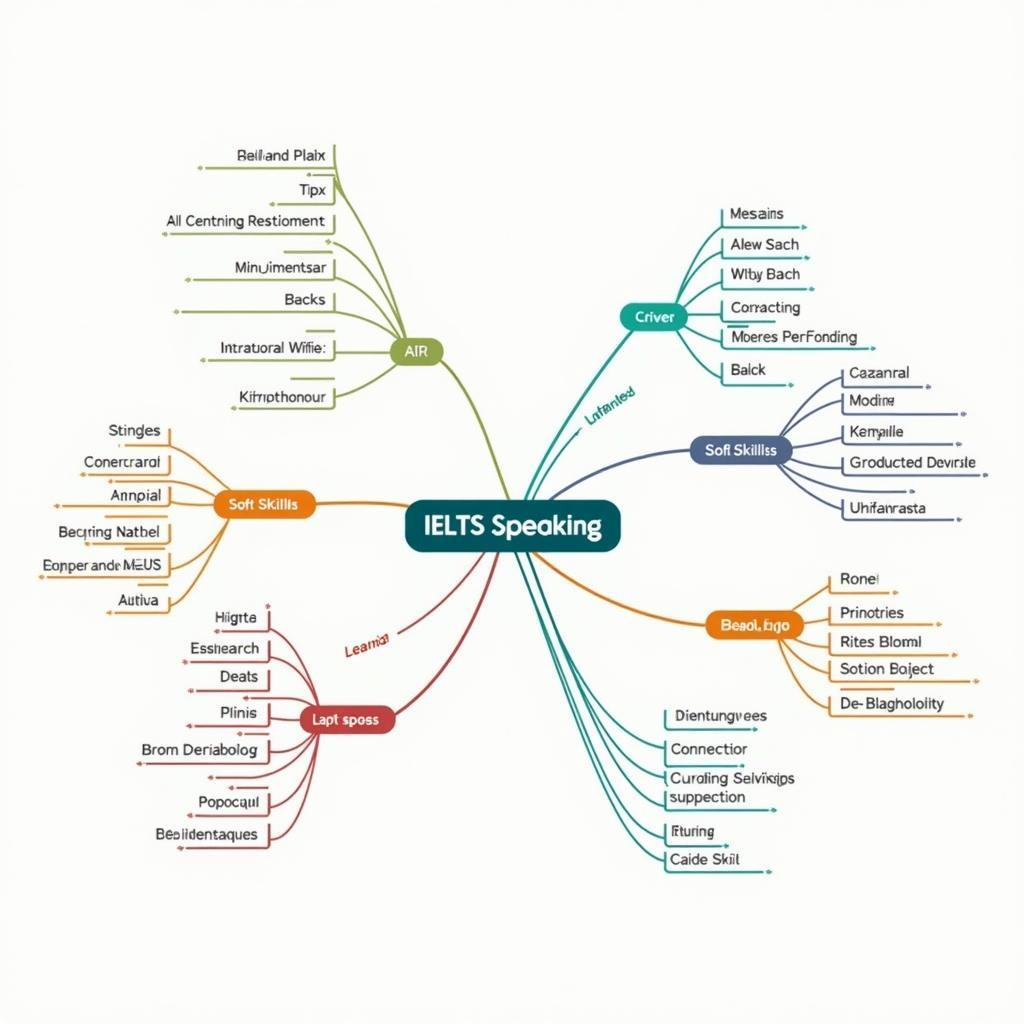 Sơ đồ tư duy về các nhóm từ vựng kỹ năng học tập quan trọng trong IELTS Speaking
Idiomatic Expressions & Advanced Phrases
| Cụm từ | Nghĩa | Ví dụ sử dụng | Band điểm |
|---|---|---|---|
| take the plunge | quyết định làm điều gì sau khi do dự lâu | After months of thinking about it, I finally took the plunge and enrolled in a cooking class. | 7.5-9 |
| get to grips with | làm quen và hiểu rõ về cái gì | It took me several weeks to get to grips with the new accounting software. | 7.5-8.5 |
| open up a whole new world | mở ra một thế giới hoàn toàn mới | Learning to code has opened up a whole new world of career possibilities for me. | 7-8.5 |
| be second nature | trở thành bản năng, tự nhiên như phản xạ | After months of practice, touch typing has become second nature to me. | 7.5-9 |
| put something into practice | áp dụng vào thực tế | The course taught us theory, but we need to put it into practice at work. | 7-8 |
| trial by fire | học qua trải nghiệm khó khăn | My first week as a manager was a real trial by fire. | 8-9 |
| learning by doing | học qua thực hành | I’m a firm believer in learning by doing rather than just reading about it. | 7-8 |
| hit the ground running | bắt đầu nhanh chóng và hiệu quả | The training program prepared us well so we could hit the ground running. | 7.5-8.5 |
| move up the learning curve | tiến bộ trong quá trình học | As you move up the learning curve, things that seemed difficult become easier. | 7.5-8.5 |
| at one’s own pace | theo tốc độ của bản thân | Online learning allows you to study at your own pace. | 6.5-7.5 |
| under someone’s wing | được ai đó bảo trợ, hướng dẫn | I was lucky to learn under an experienced programmer’s wing. | 7.5-8.5 |
| sink or swim | tự xoay sở (không có sự giúp đỡ) | When I started my first job, it was sink or swim – nobody held my hand. | 8-9 |
Tương tự như khi bạn trải nghiệm describe a meal you had in a restaurant recently, việc sử dụng từ vựng phong phú và các cụm từ idiom giúp bài nói của bạn trở nên sinh động và tự nhiên hơn.
Discourse Markers (Từ Nối Ý Trong Speaking)
Để bắt đầu câu trả lời:
- 📝 Well,… – Khi cần suy nghĩ một chút hoặc muốn bắt đầu một cách tự nhiên
- 📝 Actually,… – Khi đưa ra góc nhìn khác hoặc thông tin thú vị
- 📝 To be honest,… – Khi nói thật về quan điểm cá nhân
- 📝 I’d say that… – Khi đưa ra opinion một cách tentative
- 📝 From my perspective,… – Để thể hiện đây là quan điểm cá nhân
Để bổ sung ý:
- 📝 On top of that,… – Thêm vào đó (formal hơn “also”)
- 📝 What’s more,… – Hơn nữa, thêm nữa
- 📝 Not to mention… – Chưa kể đến (thường cho điều quan trọng)
- 📝 Besides that,… – Bên cạnh đó
- 📝 Equally important,… – Quan trọng ngang bằng
Để đưa ra quan điểm cân bằng:
- 📝 On the one hand,… On the other hand,… – Một mặt… mặt khác
- 📝 While it’s true that…, we also need to consider… – Tuy đúng là… nhưng cũng cần xem xét
- 📝 Having said that,… – Mặc dù đã nói vậy (để đưa ra contrast)
- 📝 That said,… – Điều đó đã nói (để chuyển sang contrast)
Để kết luận:
- 📝 All in all,… – Tóm lại, nhìn chung
- 📝 At the end of the day,… – Cuối cùng thì, về cơ bản
- 📝 To sum up,… – Tóm lại (formal)
- 📝 On balance,… – Khi cân nhắc mọi thứ
Để đưa ra ví dụ:
- 📝 For instance,… – Ví dụ (formal hơn “for example”)
- 📝 Take [something] for example,… – Lấy… làm ví dụ
- 📝 To illustrate this point,… – Để minh họa điểm này
Grammatical Structures Ấn Tượng
1. Conditional Sentences (Câu điều kiện):
Mixed conditional:
- Formula: If + past perfect, would/could + infinitive (hoặc ngược lại)
- Ví dụ: “If I hadn’t learned coding, I wouldn’t have the career opportunities I have now.”
- Khi nào dùng: Để nói về điều kiện trong quá khứ ảnh hưởng đến hiện tại
Inversion for emphasis:
- Formula: Had I known… / Were I to do it again…
- Ví dụ: “Had I known how useful this skill would be, I would have learned it much earlier.”
- Khi nào dùng: Để tạo formal tone và emphasize điều kiện
2. Relative Clauses (Mệnh đề quan hệ):
Non-defining (extra information):
- Formula: …, which/who/where + clause, …
- Ví dụ: “I learned photography from my uncle, who has been a professional photographer for 20 years.”
- Khi nào dùng: Để add thông tin không essential nhưng interesting
Reduced relative clauses:
- Formula: Skills (which are) learned in childhood…
- Ví dụ: “Skills learned in childhood tend to stay with us for life.”
- Khi nào dùng: Để make speech more concise và sophisticated
3. Passive Voice (Câu bị động):
Impersonal passive (formal opinions):
- Formula: It is thought/believed/said/considered that…
- Ví dụ: “It is widely believed that practical skills should be prioritized in modern education.”
- Khi nào dùng: Để express general opinions một cách formal, không attribute đến ai cụ thể
Passive with modal verbs:
- Formula: can be learned / should be taught / must be practiced
- Ví dụ: “Many essential life skills can be learned through experience rather than formal instruction.”
- Khi nào dùng: Để focus vào action thay vì doer
4. Cleft Sentences (Câu chẻ):
What-cleft for emphasis:
- Formula: What [subject] + verb + is/was…
- Ví dụ: “What I find most fascinating about this skill is how it’s changed my perspective on problem-solving.”
- Khi nào dùng: Để emphasize một aspect cụ thể của ý tưởng
It-cleft for focus:
- Formula: It is/was [focus] that/who…
- Ví dụ: “It was through consistent practice that I finally mastered the technique.”
- Khi nào dùng: Để highlight một element particular trong câu
5. Advanced Tenses:
Present Perfect Continuous (emphasize duration):
- Formula: have/has been + V-ing
- Ví dụ: “I’ve been learning Python for the past six months, and I’m still discovering new applications.”
- Khi nào dùng: Để show ongoing action với emphasis trên duration
Past Perfect for background:
- Formula: had + V3
- Ví dụ: “Before I took the course, I had never considered how important digital skills would become.”
- Khi nào dùng: Để establish sequence của events trong quá khứ
6. Gerunds and Infinitives:
Gerund as subject:
- Formula: V-ing + verb…
- Ví dụ: “Learning a new skill requires dedication and perseverance.”
- Khi nào dùng: Để make speech sound more sophisticated hơn “To learn…”
Complex infinitive structures:
- Formula: to have + V3
- Ví dụ: “I’m proud to have mastered this skill at my age.”
- Khi nào dùng: Để show completed action with connection đến present
Lời khuyên từ Examiner
Với hơn 20 năm kinh nghiệm chấm thi IELTS Speaking, tôi muốn chia sẻ một số insights quan trọng về chủ đề “describe a new or useful skill you learned recently”:
Những điều examiners thực sự đánh giá cao:
Authenticity (Tính chân thực): Đừng cố gắng tạo ra một câu chuyện quá impressive hoặc không realistic. Examiners được training để nhận ra khi candidates học thuộc template hay kể chuyện không thật. Một kỹ năng đơn giản như học nấu một món ăn mới, nếu được kể một cách chân thành với details cụ thể, sẽ impressive hơn nhiều so với claim học được một kỹ năng phức tạp nhưng không thể elaborate.
Personal reflection: Band 8-9 candidates luôn show được critical thinking thông qua việc reflect về learning process. Đừng chỉ describe WHAT bạn học, mà hãy analyze HOW you learned, WHY it was challenging, và WHAT insights bạn gained. Ví dụ: “What struck me during this learning process was…” hoặc “Looking back, I realize that…”
Natural language flow: Trong real conversation, chúng ta không nói theo structure perfect với first, second, third. Hãy sử dụng discourse markers tự nhiên như “Actually…”, “The thing is…”, “What I found interesting was…”. Điều này tạo impression bạn đang conversation thật sự, không phải đang present một bài đã prepare.
Những lỗi phổ biến cần tránh của học viên Việt Nam:
Over-preparation: Nhiều học viên Việt Nam prepare quá kỹ đến mức answer nghe như reading from a script. Hãy nhớ, đây là speaking test, không phải writing test được đọc to. Một số pauses, self-corrections, và rephrasing thực ra là natural và được accept.
Vocabulary showing off: Đừng force từ vựng academic không phù hợp vào context. Ví dụ, nói “facilitate my culinary competencies” thay vì “improve my cooking skills” nghe unnatural và pretentious. Examiners prefer natural, appropriate language hơn unnecessarily complex words.
Không trả lời đúng câu hỏi: Trong Part 3, nhiều candidates có xu hướng nói về general topic thay vì address câu hỏi specific. Ví dụ, nếu được hỏi “Do children learn faster than adults?”, đừng chỉ nói về “how children learn” mà phải compare and contrast với adults.
Thiếu structure trong Part 2: Khi có 1 phút prepare, hãy sử dụng thời gian đó để note down keywords cho MỖI bullet point. Nhiều học viên chỉ ghi một vài từ random và sau đó bị lost khi nói. Structure rõ ràng giúp bạn avoid rambling và ensure coverage của tất cả points.
Chiến lược học tập hiệu quả:
Record yourself: Đây là tool powerful nhất để improve. Record câu trả lời của bạn, sau đó listen lại với critical ear. Bạn sẽ notice những hesitations, repeated words, và grammatical mistakes mà bạn không aware when speaking.
Practice with variety: Đừng chỉ prepare một answer cho “skill you learned”. Hãy prepare 3-4 different skills (một practical skill, một creative skill, một technical skill, một soft skill) để bạn có flexibility và confidence với multiple scenarios.
Timing practice: Use timer khi practice Part 2. Aim cho 2-2.5 minutes, không shorter và không significantly longer. Nhiều candidates struggle với pacing – hoặc run out of things to say after 1 minute, hoặc ramble quá 3 minutes.
Lộ trình chuẩn bị chi tiết:
Week 1-2: Building foundation
- Học vocabulary và expressions từ bài viết này
- Practice pronouncing new words correctly
- Make personal examples với mỗi new phrase
Week 3-4: Structure practice
- Viết notes cho 3-4 different skills
- Practice Part 2 responses với timer
- Record và analyze fluency, vocabulary usage
Week 5-6: Advanced development
- Practice Part 3 questions về skills và education
- Work on expressing complex ideas clearly
- Focus on natural discourse markers
Week 7-8: Mock tests
- Full speaking tests với partner hoặc teacher
- Focus on overall performance, không chỉ vocabulary
- Work on confidence và natural delivery
Đối với những ai quan tâm đến describe a local dish you love, nội dung này cũng sẽ hữu ích trong việc phát triển kỹ năng miêu tả chi tiết và thể hiện cảm xúc cá nhân một cách tự nhiên trong IELTS Speaking.
Mindset quan trọng:
Hãy nhớ rằng IELTS Speaking không phải là test về knowledge của bạn về một chủ đề. Đó là test về English communication ability của bạn. Một câu trả lời với simple ideas nhưng expressed clearly, fluently, và với appropriate vocabulary sẽ score higher hơn complex ideas expressed poorly.
Examiners muốn hear bạn communicate như một proficient English speaker, không phải như một academic presenting a paper. Be yourself, be natural, và don’t try too hard to impress. Confidence và authenticity often shine through more than forced sophistication.
Cuối cùng, đừng quá stressed về achieving perfection. Ngay cả native speakers cũng make pauses, search for words, và restructure sentences mid-speech. What matters là overall communicative effectiveness và ability to express ideas clearly và coherently.
Good luck với IELTS Speaking preparation của bạn! Với practice đúng cách và mindset phù hợp, bạn hoàn toàn có thể achieve band điểm mục tiêu. Remember: every expert was once a beginner who decided to take the plunge and keep practicing.


