Chủ đề về công viên trong thành phố là một trong những đề tài phổ biến nhất trong IELTS Speaking, đặc biệt là ở Part 2. Từ năm 2020 đến nay, chủ đề này xuất hiện với tần suất cao trong các kỳ thi IELTS trên toàn thế giới, chiếm khoảng 15-20% tổng số đề thi liên quan đến địa điểm. Dự đoán khả năng xuất hiện trong tương lai vẫn ở mức cao do tính phổ biến và khả năng ứng dụng rộng rãi của chủ đề này.
Với tư cách là một IELTS Examiner với hơn 20 năm kinh nghiệm, tôi nhận thấy nhiều học viên Việt Nam gặp khó khăn khi mô tả địa điểm vì thiếu từ vựng miêu tả cảnh quan, không biết cách tổ chức ý tưởng theo không gian, và thường nói quá chung chung. Bài viết này sẽ giúp bạn:
- Nắm vững các câu hỏi thường gặp trong cả 3 Part của IELTS Speaking
- Học cách xây dựng câu trả lời từ Band 6-7 đến Band 8.5-9 với ví dụ cụ thể
- Tích lũy bộ từ vựng chuyên sâu về công viên, thiên nhiên và hoạt động giải trí
- Hiểu rõ tiêu chí chấm điểm và cách áp dụng vào bài nói của mình
- Tránh những lỗi điển hình mà học viên Việt Nam thường mắc phải
IELTS Speaking Part 1: Introduction and Interview
Tổng Quan Về Part 1
Part 1 của IELTS Speaking kéo dài 4-5 phút với các câu hỏi về cuộc sống hàng ngày, sở thích cá nhân và những điều quen thuộc. Đây là phần “warm-up” để giúp bạn cảm thấy thoải mái trước khi chuyển sang các phần khó hơn.
Đặc điểm quan trọng:
- Câu hỏi ngắn, trực tiếp về bản thân và cuộc sống
- Examiner mong đợi câu trả lời 2-3 câu cho mỗi câu hỏi
- Không cần trả lời quá dài hoặc phức tạp
- Tập trung vào sự tự nhiên và trôi chảy
Lỗi thường gặp của học viên Việt Nam:
- Trả lời quá ngắn gọn (chỉ Yes/No hoặc một câu đơn)
- Sử dụng từ vựng quá đơn giản, lặp đi lặp lại
- Thiếu ví dụ cụ thể từ trải nghiệm cá nhân
- Nói theo template, thiếu tính tự nhiên
- Không mở rộng ý một cách logic
Các Câu Hỏi Thường Gặp
Question 1: Do you often go to parks?
Question 2: What do you usually do when you visit a park?
Question 3: Are there many parks in your city?
Question 4: Did you go to parks when you were a child?
Question 5: What kinds of parks do you prefer?
Question 6: Do you think parks are important in cities?
Question 7: Would you like to have a park near your home?
Question 8: What improvements would you suggest for parks in your area?
Phân Tích và Gợi Ý Trả Lời Chi Tiết
Question: Do you often go to parks?
🎯 Cách tiếp cận:
- Trả lời trực tiếp có hay không
- Nói về tần suất cụ thể (nếu có)
- Giải thích lý do tại sao có hoặc không thường xuyên
- Có thể thêm ví dụ ngắn về lần gần nhất
📝 Sample Answer – Band 6-7:
“Yes, I go to parks quite regularly, maybe once or twice a week. I usually go there in the evening to relax after work. The fresh air and green space help me feel less stressed.”
Phân tích:
- Điểm mạnh: Trả lời trực tiếp câu hỏi, có đề cập tần suất và lý do cơ bản
- Hạn chế: Từ vựng còn đơn giản (relax, fresh air), thiếu chi tiết cụ thể về hoạt động, cấu trúc câu chưa đa dạng
- Tại sao Band 6-7: Câu trả lời đáp ứng yêu cầu nhưng chưa thể hiện được khả năng sử dụng ngôn ngữ phong phú. Ý tưởng rõ ràng nhưng còn chung chung.
📝 Sample Answer – Band 8-9:
“Actually, I’m a regular visitor to parks, especially on weekends. I find that spending time in green spaces is incredibly rejuvenating after a hectic week at the office. Just last Saturday, I went to the park near my apartment for a morning jog, and the tranquil atmosphere really helped me clear my head and prepare for the week ahead.”
Phân tích:
- Điểm mạnh:
- Từ vựng phong phú và chính xác: “regular visitor”, “rejuvenating”, “tranquil atmosphere”
- Cụm từ tự nhiên: “clear my head”, “hectic week”
- Có ví dụ cụ thể (last Saturday) làm câu trả lời sống động
- Cấu trúc câu đa dạng với mệnh đề quan hệ và gerund
- Tại sao Band 8-9:
- Fluency: Câu trả lời trôi chảy với discourse marker “Actually” để bắt đầu tự nhiên
- Vocabulary: Sử dụng từ vựng tinh tế và collocations tự nhiên
- Grammar: Cấu trúc phức tạp nhưng chính xác
- Ideas: Câu trả lời có chiều sâu với lý do và ví dụ cụ thể
💡 Key Vocabulary & Expressions:
- regular visitor: người thường xuyên đến (thay vì “often go”)
- green spaces: không gian xanh (thuật ngữ đô thị)
- rejuvenating: làm trẻ lại, phục hồi năng lượng
- tranquil atmosphere: bầu không khí yên tĩnh
- clear my head: làm đầu óc tỉnh táo, giải tỏa stress
- hectic week: tuần làm việc bận rộn, căng thẳng
Question: What do you usually do when you visit a park?
🎯 Cách tiếp cận:
- Liệt kê 2-3 hoạt động cụ thể
- Giải thích ngắn gọn tại sao làm những hoạt động đó
- Có thể đề cập đến người đồng hành (nếu có)
- Thêm cảm xúc hoặc lợi ích của hoạt động
📝 Sample Answer – Band 6-7:
“When I go to the park, I usually take a walk or do some exercise. Sometimes I bring a book to read on a bench. I also like to watch people and enjoy the peaceful environment there.”
Phân tích:
- Điểm mạnh: Đề cập được nhiều hoạt động khác nhau
- Hạn chế:
- Từ vựng cơ bản: “take a walk”, “do exercise”, “peaceful”
- Thiếu chi tiết về cách thức thực hiện
- Chưa giải thích rõ lợi ích hoặc cảm xúc
- Các câu độc lập, chưa có sự liên kết tốt
- Tại sao Band 6-7: Đáp ứng yêu cầu với nhiều ý tưởng nhưng cách diễn đạt còn đơn giản, thiếu depth.
📝 Sample Answer – Band 8-9:
“Well, it really depends on my mood and the time of day. In the mornings, I typically go for a brisk walk or light jog along the designated paths to get my blood flowing. If I’m there in the afternoon, I might find a shaded spot under a tree to unwind with a good book. Occasionally, I people-watch – there’s something quite fascinating about observing families having picnics or children playing. It’s a wonderful way to disconnect from technology and reconnect with nature.”
Phân tích:
- Điểm mạnh:
- Bắt đầu tự nhiên với “Well” và “it depends on”, thể hiện tư duy linh hoạt
- Từ vựng đa dạng: “brisk walk”, “designated paths”, “shaded spot”, “unwind”
- Cụm động từ phrasal verbs: “disconnect from”, “reconnect with”
- Có sự phân loại theo thời gian (morning vs afternoon)
- Thêm suy nghĩ cá nhân: “there’s something quite fascinating”
- Tại sao Band 8-9:
- Fluency: Câu trả lời mạch lạc với nhiều ý được nối kết tự nhiên
- Vocabulary: Precise và sophisticated với collocations tự nhiên
- Grammar: Đa dạng cấu trúc: conditional (if I’m there), gerund phrases, relative clauses
- Pronunciation: Các từ được nhấn âm đúng tạo sự tự nhiên
💡 Key Vocabulary & Expressions:
- depends on my mood: tùy thuộc vào tâm trạng
- brisk walk: đi bộ nhanh, khỏe
- designated paths: đường dạo được quy hoạch
- shaded spot: chỗ có bóng mát
- unwind with: thư giãn với…
- people-watch: quan sát người qua lại
- disconnect from technology: thoát khỏi công nghệ
- reconnect with nature: kết nối lại với thiên nhiên
 Người dân tập thể dục buổi sáng tại công viên thành phố với không gian xanh mát
Question: Did you go to parks when you were a child?
🎯 Cách tiếp cận:
- Sử dụng thì quá khứ đơn hoặc “used to”
- So sánh với hiện tại (nếu thích hợp)
- Kể về hoạt động cụ thể hoặc kỷ niệm
- Đề cập đến người đi cùng (bố mẹ, bạn bè)
📝 Sample Answer – Band 6-7:
“Yes, I did. When I was young, my parents often took me to the park on Sundays. I remember playing on the swings and slides with other children. It was very fun and I have good memories of those times.”
Phân tích:
- Điểm mạnh: Trả lời rõ ràng với ví dụ cụ thể về hoạt động
- Hạn chế:
- Từ vựng đơn giản: “very fun”, “good memories”
- Cấu trúc câu đơn điệu
- Thiếu chi tiết về cảm xúc hoặc ý nghĩa sâu hơn
- Tại sao Band 6-7: Câu trả lời đầy đủ thông tin cơ bản nhưng chưa impressive về mặt ngôn ngữ.
📝 Sample Answer – Band 8-9:
“Oh, absolutely! Parks were a staple of my childhood. My parents made it a point to take my siblings and me to the local park every weekend. I have vivid memories of clambering up the climbing frames and whizzing down the slides while my dad pushed me on the swings. Looking back, I think those outings were instrumental in developing my love for outdoor activities. It’s quite nostalgic to think about how carefree those days were compared to the hustle and bustle of adult life now.”
Phân tích:
- Điểm mạnh:
- Mở đầu nhiệt tình với “Oh, absolutely!” thể hiện sự tự nhiên
- Từ vựng phong phú: “staple”, “vivid memories”, “instrumental in”, “nostalgic”, “carefree”
- Cụm động từ sinh động: “clambering up”, “whizzing down”
- Có sự so sánh thời gian (past vs present)
- Thể hiện reflection về ý nghĩa của trải nghiệm
- Tại sao Band 8-9:
- Fluency: Câu chuyện được kể một cách tự nhiên và mạch lạc
- Vocabulary: Sử dụng từ vựng tinh tế và idiomatic expressions
- Grammar: Cấu trúc phức tạp với gerund phrases, relative clauses
- Ideas: Không chỉ trả lời mà còn phản ánh về ý nghĩa sâu xa
💡 Key Vocabulary & Expressions:
- staple: điều không thể thiếu, yếu tố quan trọng
- made it a point to: cố gắng làm điều gì đó một cách có ý thức
- vivid memories: ký ức sống động
- clamber up: trèo lên (cách nói sinh động hơn “climb”)
- whizz down: trượt xuống nhanh
- instrumental in: có vai trò quan trọng trong việc
- nostalgic: hoài niệm, nhớ về quá khứ
- carefree: vô tư, không lo nghĩ
- hustle and bustle: sự hối hả, bận rộn
IELTS Speaking Part 2: Long Turn (Cue Card)
Tổng Quan Về Part 2
Part 2 là phần thử thách nhất của IELTS Speaking vì bạn phải nói liên tục trong 2 phút mà không được ngắt quãng. Đây là cơ hội để thể hiện khả năng tổ chức ý tưởng, sử dụng từ vựng phong phú và duy trì sự trôi chảy.
Yêu cầu cụ thể:
- Thời gian chuẩn bị: 1 phút (bạn được cung cấp giấy và bút)
- Thời gian nói: 2-3 phút (tối thiểu 1.5 phút để không bị mất điểm)
- Examiner sẽ không ngắt lời cho đến khi hết thời gian hoặc bạn nói xong
Chiến lược quan trọng:
- Sử dụng tối đa 1 phút chuẩn bị: ghi keywords cho từng bullet point, KHÔNG viết câu hoàn chỉnh
- Lên kế hoạch trình tự: mở đầu → từng bullet point → kết luận
- Phân bổ thời gian: khoảng 30-40 giây cho mỗi bullet point
- Bullet point cuối (explain) thường quan trọng nhất – dành 40-50 giây
- Nói đủ 2 phút: nếu hết ý sớm, mở rộng phần “explain”
Lỗi thường gặp của học viên Việt Nam:
- Không sử dụng hết 1 phút chuẩn bị, vội vàng bắt đầu
- Ghi quá nhiều, viết câu hoàn chỉnh thay vì keywords
- Nói dưới 1.5 phút do thiếu ý tưởng mở rộng
- Bỏ sót bullet points hoặc trả lời không đủ
- Dùng thì động từ sai (quá khứ khi đề bài yêu cầu hiện tại)
- Thiếu liên kết giữa các ý, nói rời rạc
Cue Card
Describe A Park In Your City Where You Spend Time
You should say:
- Where this park is located
- How often you go there
- What you do there
- And explain why you like spending time in this park
Phân Tích Đề Bài
Dạng câu hỏi: Describe a place (địa điểm cụ thể)
Thì động từ chủ đạo: Hiện tại đơn và hiện tại hoàn thành (vì đề bài dùng “where you spend time” – hành động lặp lại hiện tại)
Bullet points phải cover:
- Where this park is located: Vị trí địa lý cụ thể, cách đến đó, khu vực xung quanh
- How often you go there: Tần suất cụ thể (mỗi tuần/tháng), thời điểm trong ngày, mùa nào
- What you do there: Các hoạt động cụ thể, với ai, khi nào
- Explain why you like it: Đây là phần QUAN TRỌNG NHẤT – cần có nhiều lý do với chi tiết
Câu “explain” quan trọng: Phần này quyết định điểm số cao. Bạn cần:
- Đưa ra ít nhất 2-3 lý do rõ ràng
- Mỗi lý do có giải thích hoặc ví dụ cụ thể
- Thể hiện cảm xúc cá nhân
- Có thể so sánh với các công viên khác hoặc với quá khứ
📝 Sample Answer – Band 6-7
Thời lượng: Khoảng 1.5-2 phút
“I’d like to talk about Tao Dan Park, which is located in District 1 of Ho Chi Minh City. It’s quite close to the city center and easy to get to by motorbike or bus.
I try to go there about twice a week, usually in the early morning around 6 AM before I go to work. Sometimes I also visit on Sunday afternoons when I have more free time.
When I’m there, I usually do some exercise like jogging or stretching. The park has nice paths for walking and running. I also enjoy sitting on the benches under the trees and watching other people. Sometimes I bring my earphones and listen to music while walking around. On weekends, I might meet friends there for a chat or to have some coffee from the nearby cafes.
I like spending time in this park for several reasons. First, it’s very green and peaceful, which is quite rare in the busy city center. The trees and plants make the air feel fresher and cooler. Second, it helps me stay healthy because I can exercise regularly. After visiting the park, I always feel more energetic and ready for the day. Finally, it’s a good place to relax and escape from the stress of work and city life. The atmosphere is calm and I can clear my mind there. So that’s why Tao Dan Park is my favorite place to spend time in the city.”
Phân Tích Band Điểm
| Tiêu chí | Band | Nhận xét |
|---|---|---|
| Fluency & Coherence | 6-7 | Câu trả lời mạch lạc với các linking words cơ bản (first, second, finally). Có một vài hesitation nhẹ nhưng không ảnh hưởng nhiều. Ý tưởng được trình bày rõ ràng theo thứ tự logic. |
| Lexical Resource | 6-7 | Từ vựng đủ để truyền đạt ý tưởng nhưng còn đơn giản: “nice paths”, “feel fresher”, “good place”. Có một số collocations đúng như “city center”, “free time”, “clear my mind”. |
| Grammatical Range & Accuracy | 6-7 | Sử dụng đúng các thì cơ bản. Có một số câu phức nhưng chủ yếu là câu đơn và câu ghép đơn giản. Độ chính xác tốt với ít lỗi. |
| Pronunciation | 6-7 | Phát âm rõ ràng, dễ hiểu. Có thể có một số lỗi nhỏ về trọng âm nhưng không gây hiểu lầm. |
Điểm mạnh:
- ✅ Trả lời đầy đủ tất cả các bullet points
- ✅ Có cấu trúc rõ ràng với introduction và conclusion
- ✅ Đưa ra nhiều lý do trong phần explain
- ✅ Thời lượng đủ yêu cầu (khoảng 1.5-2 phút)
Hạn chế:
- ⚠️ Từ vựng chưa đa dạng, nhiều từ lặp lại (park, time, place)
- ⚠️ Thiếu descriptive language để tạo hình ảnh sinh động
- ⚠️ Cấu trúc câu đơn điệu, chủ yếu là câu đơn
- ⚠️ Chưa có personal anecdotes chi tiết để làm bài nói thú vị hơn
📝 Sample Answer – Band 7.5-8
Thời lượng: Khoảng 2-2.5 phút
“I’d like to describe Tao Dan Park, which is nestled in the heart of District 1 in Ho Chi Minh City. It’s conveniently situated just a stone’s throw from downtown, making it easily accessible by various means of transport.
I’m quite a regular visitor there, typically making it there about three times a week. I make a point of going in the early hours, usually around 6 AM, when the park is at its most tranquil and the air is relatively crisp. Occasionally, I’ll also pop by on weekend afternoons if I’m in the area.
As for what I do there, my activities vary depending on my mood and the time of day. Most mornings, I’ll do a light jog along the winding pathways that meander through the park, which really helps me kick-start my day. Sometimes I’ll find a shaded bench and simply sit there, soaking up the atmosphere and people-watching. It’s quite fascinating to observe the diverse mix of people – from elderly folks practicing Tai Chi to young couples strolling hand in hand. On weekends, I might meet up with friends for a casual chat or grab a coffee from one of the nearby vendors and enjoy it while sitting on the grass.
What I particularly appreciate about this park are several factors. First and foremost, it serves as a green oasis in an otherwise concrete jungle. The lush vegetation and mature trees provide much-needed shade and serenity, creating a stark contrast to the hustle and bustle just outside its gates. Beyond that, it’s become integral to my fitness routine – those morning jogs have really helped me maintain my physical well-being. But perhaps most importantly, this park offers me a sanctuary where I can decompress from work pressures and recharge my batteries. There’s something deeply therapeutic about being surrounded by nature, even in the middle of a bustling metropolis. It’s this unique combination of accessibility, natural beauty, and peaceful atmosphere that makes Tao Dan Park my go-to spot for relaxation in the city.”
Phân Tích Band Điểm
| Tiêu chí | Band | Nhận xét |
|---|---|---|
| Fluency & Coherence | 7.5-8 | Nói trôi chảy với rất ít hesitation. Sử dụng linking devices tốt và đa dạng (First and foremost, Beyond that, But perhaps most importantly). Ý tưởng được phát triển logic và mạch lạc. |
| Lexical Resource | 7.5-8 | Từ vựng phong phú với nhiều less common words và collocations tự nhiên: “nestled in”, “stone’s throw”, “meander through”, “green oasis”, “concrete jungle”. Có paraphrasing tốt (go there → visit → pop by). |
| Grammatical Range & Accuracy | 7.5-8 | Sử dụng đa dạng cấu trúc câu phức với relative clauses, present participles, và conditional structures. Độ chính xác cao với lỗi rất ít. |
| Pronunciation | 7.5-8 | Phát âm rõ ràng với intonation tự nhiên. Stress và rhythm đúng. Dễ hiểu hoàn toàn. |
So Sánh Với Band 6-7
| Khía cạnh | Band 6-7 | Band 7.5-8 |
|---|---|---|
| Vocabulary | “located in District 1”, “nice paths”, “good place” | “nestled in the heart of”, “winding pathways that meander through”, “green oasis”, “sanctuary” |
| Grammar | “It’s quite close to the city center” (câu đơn giản) | “It’s conveniently situated just a stone’s throw from downtown, making it easily accessible” (câu phức với present participle) |
| Ideas | “it’s very green and peaceful” | “it serves as a green oasis in an otherwise concrete jungle… creating a stark contrast to the hustle and bustle” |
| Details | “I usually do some exercise” | “I’ll do a light jog along the winding pathways… from elderly folks practicing Tai Chi to young couples strolling hand in hand” |
Tương tự như describe a place in nature you often visit, việc tạo được hình ảnh sinh động về địa điểm và hoạt động là yếu tố quan trọng giúp nâng band điểm trong IELTS Speaking Part 2.
 Công viên Tao Đàn buổi sáng với người dân tập thể dục và không gian xanh mát
📝 Sample Answer – Band 8.5-9
Thời lượng: 2.5-3 phút đầy đủ
“I’d like to tell you about Tao Dan Park, a verdant haven that’s become something of a second home to me over the past few years. It’s strategically positioned in the epicenter of District 1 in Ho Chi Minh City, which might seem like an unlikely location for such a serene retreat, yet that’s precisely what makes it so remarkable. The park is tucked away behind the iconic Reunification Palace, just a brisk five-minute walk from the frenetic energy of Nguyen Hue Walking Street.
I’ve become quite the fixture there, visiting at least four times a week without fail. I’m particularly drawn to the golden hours of early morning – typically arriving around 5:45 AM when the park is bathed in soft, diffused light and there’s a certain ethereal quality to the atmosphere. The dew-kissed grass and the chorus of birdsong create an almost meditative ambiance. That said, I do occasionally venture there on weekend afternoons, though the vibe is distinctly different – more buzzing with activity and social energy.
My activities there are quite diverse and tend to evolve with the seasons and my varying states of mind. More often than not, I’ll embark on a moderate-paced jog along the park’s labyrinthine network of paths, which wind their way through centuries-old banyan trees whose gnarled roots create natural sculptures. What I find particularly invigorating is how the jogging route offers ever-changing scenery – one moment you’re enveloped by dense foliage, the next you’re passing open lawns where elderly residents engage in their synchronized Tai Chi routines. Beyond exercise, I’ve developed a ritual of finding my preferred spot – a weathered wooden bench beneath a sprawling rain tree – where I’ll spend 20 minutes or so simply immersing myself in the surroundings. I’m quite fascinated by the microcosm of city life that plays out before me: street vendors peddling their wares, children shrieking with delight as they chase pigeons, and couples of all ages engaged in intimate conversations. On weekends, I’ll occasionally rendezvous with fellow running enthusiasts, and we might cap off our exercise with Vietnamese coffee from the park’s makeshift cafés.
What truly sets this park apart for me, and why it’s become such an integral part of my routine, comes down to several intertwined factors. Foremost among them is the park’s uncanny ability to provide what I can only describe as a psychological sanctuary amidst the relentless urban sprawl. Ho Chi Minh City, as much as I’m fond of it, can be overwhelmingly intense with its cacophony of traffic and breakneck pace of life. This park represents a stark antithesis to that – it’s as though you’re stepping through a portal into a parallel dimension where time moves more slowly and nature reclaims its rightful place. The tapestry of greenery – from the towering canopy trees to the meticulously manicured flower beds – doesn’t just provide aesthetic pleasure; there’s tangible therapeutic value in that connection with nature.
Equally significant is the role this park plays in anchoring my physical and mental health regimen. I’ve noticed marked improvements in both my cardiovascular fitness and my stress management since making those morning visits non-negotiable. There’s compelling research suggesting that green spaces in urban environments have profound effects on our well-being, and I’m living proof of that. But beyond the quantifiable health benefits, there’s something inherently grounding about starting my day there – it sets the tone for everything that follows, giving me a sense of centeredness and perspective that’s invaluable in navigating the day’s challenges.
What I find particularly endearing about Tao Dan Park is its democratic nature – it’s a genuine melting pot where disparate segments of Saigon society converge. You’ll encounter well-heeled professionals like myself alongside working-class families, foreign expatriates mingling with local residents, the elderly sharing space with young children. This social tapestry reminds me that despite our outward differences, we all harbor this fundamental need for nature, for community, for places where we can simply be. It’s this confluence of natural beauty, personal wellness, and social cohesion that makes Tao Dan Park not just a place I enjoy, but somewhere I’ve come to regard as essential to my quality of life in this vibrant, if sometimes overwhelming, metropolis.”
Phân Tích Band Điểm
| Tiêu chí | Band | Nhận xét |
|---|---|---|
| Fluency & Coherence | 8.5-9 | Nói cực kỳ trôi chảy, tự nhiên như người bản ngữ. Không có hesitation. Sử dụng discourse markers tinh vi (Foremost among them, Equally significant, What I find particularly endearing). Ý tưởng phát triển logic với nhiều tầng sâu. |
| Lexical Resource | 8.5-9 | Từ vựng xuất sắc với numerous sophisticated và idiomatic expressions: “verdant haven”, “labyrinthine network”, “uncanny ability”, “stark antithesis”, “compelling research”. Paraphrasing tự nhiên và precise. Sử dụng metaphors và descriptive language một cách tinh tế. |
| Grammatical Range & Accuracy | 8.5-9 | Cấu trúc ngữ pháp rất phức tạp và đa dạng: inversion, cleft sentences, mixed conditionals, complex noun phrases. Gần như không có lỗi. Câu dài nhưng vẫn clear và coherent. |
| Pronunciation | 8.5-9 | Phát âm gần như hoàn hảo với stress, rhythm và intonation tự nhiên. Features của connected speech được sử dụng appropriately. |
Tại Sao Bài Này Xuất Sắc
🎯 Fluency Hoàn Hảo:
- Không có bất kỳ hesitation nào, câu chuyện được kể một cách tự nhiên và flowing
- Sử dụng discourse markers tinh vi để guide người nghe: “More often than not”, “What truly sets this park apart”, “Foremost among them”
- Có rhythm và pace tự nhiên, không rushed cũng không quá chậm
📚 Vocabulary Tinh Vi:
- Ví dụ: “verdant haven” thay vì “green park” – “verdant” là từ literary, sophisticated
- “labyrinthine network of paths” thay vì “many paths” – tạo imagery mạnh mẽ
- “uncanny ability” thay vì “special feature” – thể hiện nuanced meaning
- “stark antithesis” – sử dụng thuật ngữ academic một cách tự nhiên
- “democratic nature”, “melting pot”, “social tapestry” – metaphors sâu sắc
📝 Grammar Đa Dạng:
- Ví dụ: “It’s as though you’re stepping through a portal into a parallel dimension where time moves more slowly” – câu phức với as though clause và relative clause
- “What I find particularly endearing about Tao Dan Park is…” – cleft sentence để emphasize
- Sử dụng present perfect continuous: “I’ve become quite the fixture there”
- Mixed conditional implications: “This park represents a stark antithesis to that”
💡 Ideas Sâu Sắc:
- Không chỉ describe mà còn analyze: “There’s compelling research suggesting that green spaces… have profound effects”
- Có personal reflection sâu sắc: “it sets the tone for everything that follows”
- Xem xét social dimension: “genuine melting pot where disparate segments of society converge”
- Thể hiện understanding về broader context: urban planning, public health, social cohesion
🎨 Descriptive Power:
- “dew-kissed grass”, “chorus of birdsong”, “gnarled roots” – sensory details
- “bathed in soft, diffused light”, “ethereal quality” – poetic language
- “cacophony of traffic”, “breakneck pace of life” – vivid contrasts
Việc describe a decision you made that surprised others có thể liên quan đến quyết định dành thời gian thường xuyên tại công viên, đây là một cách tự nhiên để kết nối các chủ đề speaking và thể hiện sự nhất quán trong câu chuyện của bạn.
Follow-up Questions (Rounding Off Questions)
Examiner thường hỏi thêm 1-2 câu ngắn sau Part 2 để chuyển sang Part 3. Đây là câu hỏi “làm mát”, không quá khó.
Question 1: Are there many other parks like this in your city?
Band 6-7 Answer:
“Well, there are some other parks in Ho Chi Minh City, but I think Tao Dan Park is quite special because of its location and size. Most other parks are smaller and not as green.”
Band 8-9 Answer:
“There are indeed several parks scattered throughout the city, though I’d say none quite match the unique character of Tao Dan Park. While places like September 23rd Park or Gia Dinh Park offer their own distinct charms, they tend to be either more commercialized or less accessible. What sets Tao Dan apart is its perfect balance of natural serenity and urban convenience – it’s truly a rare gem in the metropolitan landscape.”
Question 2: Do you think you’ll continue visiting this park in the future?
Band 6-7 Answer:
“Yes, definitely. I plan to keep going there because it’s become part of my daily routine and it helps me stay healthy and relaxed.”
Band 8-9 Answer:
“Absolutely, I can’t envision my routine without it at this point. It’s become so deeply ingrained in my lifestyle that I’d say it’s non-negotiable. Even if I were to move to a different district, I’d likely make the trek back to Tao Dan Park regularly. It’s one of those places that truly anchors you to a city and gives it meaning beyond just being where you live.”
IELTS Speaking Part 3: Two-way Discussion
Tổng Quan Về Part 3
Part 3 là phần khó nhất và quan trọng nhất trong IELTS Speaking vì đây là nơi examiner đánh giá khả năng tư duy phản biện, phân tích vấn đề và thảo luận về các chủ đề trừu tượng của bạn. Nếu Part 2 là “kể chuyện”, thì Part 3 là “thảo luận học thuật”.
Đặc điểm quan trọng:
- Thời gian: 4-5 phút
- Câu hỏi: 4-6 câu, ngày càng khó và trừu tượng
- Yêu cầu: Phân tích, so sánh, đánh giá, dự đoán, đề xuất giải pháp
- Không còn về bản thân nữa mà về society, trends, issues
Yêu cầu cụ thể:
- Đưa ra quan điểm cá nhân có lý lẽ chặt chẽ
- Xem xét nhiều góc độ của vấn đề (balanced view)
- Sử dụng examples từ xã hội, không chỉ kinh nghiệm cá nhân
- Thừa nhận complexity của vấn đề (acknowledge different perspectives)
- Dùng từ vựng abstract và academic hơn
Chiến lược hiệu quả:
- Mở rộng câu trả lời: 3-5 câu minimum cho mỗi câu hỏi
- Structure rõ ràng: Direct answer → Reason/Explanation → Example → Conclusion/Caveat
- Sử dụng discourse markers: Well, Actually, I think, On the one hand
- Dùng tentative language: I would say, It seems to me, To some extent, Generally speaking
- Không ngại nói “It depends” hoặc “There are different views”
Lỗi thường gặp của học viên Việt Nam:
- Trả lời quá ngắn (1-2 câu), thiếu phân tích
- Chỉ đưa ra opinion mà không có supporting reasons
- Thiếu examples cụ thể từ xã hội
- Không thừa nhận complexity (chỉ nhìn một chiều)
- Thiếu từ vựng trừu tượng (abstract nouns, academic terms)
- Nói về bản thân thay vì về society nói chung
- Sợ dừng lại suy nghĩ, cố nói liên tục dẫn đến lủng củng
Các Câu Hỏi Thảo Luận Sâu
Theme 1: Urban Planning & Public Spaces
Question 1: How important are public parks in modern cities?
🎯 Phân tích câu hỏi:
- Dạng: Importance question (đánh giá tầm quan trọng)
- Key words: “public parks”, “modern cities”
- Cách tiếp cận:
- Direct answer về importance level
- Đưa ra 2-3 reasons với categories khác nhau (health, environment, social)
- Examples cụ thể từ cities hoặc research
- Có thể mention challenges hoặc alternatives
📝 Sample Answer – Band 6-7:
“I think public parks are very important in modern cities. First, they give people a place to exercise and stay healthy, which is important because city life can be stressful. Second, parks are good for the environment because they have trees and plants that clean the air. Also, parks are places where people can meet and spend time together. Many cities are building more parks now because they understand these benefits.”
Phân tích:
- Structure: Có opinion → reasons (3 points) → conclusion, nhưng chưa develop deeply
- Vocabulary: Basic và repetitive: “important”, “good for”, “place”
- Examples: Không có specific examples hoặc evidence
- Tại sao Band 6-7: Adequate response với clear points nhưng lacks depth, sophistication, và concrete examples
📝 Câu trả lời mẫu – Band 8.5-9:
“Well, I’d argue that public parks are absolutely pivotal to the fabric of modern urban life, and their importance really cannot be overstated. From a public health perspective, these green spaces serve as crucial venues for physical activity in environments where sedentary lifestyles are increasingly prevalent. There’s compelling evidence that access to parks correlates significantly with reduced rates of obesity, cardiovascular disease, and even mental health issues. For instance, research from cities like Singapore and Copenhagen has demonstrated that proximity to green spaces leads to measurably better health outcomes among residents.
Beyond the health dimension, parks play an indispensable role in environmental sustainability. In an era of escalating climate concerns, urban green spaces act as carbon sinks, help mitigate the urban heat island effect, and provide vital habitats for biodiversity even within metropolitan areas. Cities like Melbourne have actually pioneered the concept of ‘greening the urban landscape’ as a core strategy for climate adaptation.
Perhaps equally significant is the social cohesion aspect. Parks function as democratic spaces where people across socioeconomic strata can interact, which is increasingly rare in our stratified societies. They’re venues for community building, cultural events, and intergenerational exchange. That said, we must acknowledge that simply having parks isn’t enough – they need to be equitably distributed, well-maintained, and designed with community input to truly serve their multifaceted purpose.”
Phân tích:
- Structure: Extremely well-organized với clear signposting: “From a public health perspective”, “Beyond the health dimension”, “Perhaps equally significant”
- Vocabulary: Sophisticated và precise: “pivotal”, “fabric”, “indispensable”, “escalating”, “mitigate”, “stratified societies”
- Grammar: Complex structures: “cannot be overstated”, “There’s compelling evidence that…”, passive constructions
- Critical Thinking: Multi-dimensional analysis (health, environment, social), với specific examples (Singapore, Copenhagen, Melbourne), và nuanced ending (acknowledgment of limitations)
💡 Key Language Features:
- Discourse markers: “Well”, “From a X perspective”, “Beyond the X dimension”, “Perhaps equally significant”, “That said”
- Tentative language: “I’d argue that”, “increasingly”, “tends to”
- Abstract nouns: “sustainability”, “cohesion”, “proximity”, “prevalence”, “correlation”
- Academic collocations: “compelling evidence”, “measurably better outcomes”, “core strategy”, “climate adaptation”
Question 2: Do you think all cities have enough green spaces? Why or why not?
🎯 Phân tích câu hỏi:
- Dạng: Opinion + Explanation (Yes/No với justification)
- Key words: “enough green spaces”, scope là “all cities”
- Cách tiếp cận:
- Avoid simple yes/no – acknowledge variation between cities
- Compare different types of cities (developed vs developing, Asian vs Western)
- Reasons why some lack green spaces
- Consequences và potential solutions
📝 Sample Answer – Band 6-7:
“No, I don’t think all cities have enough green spaces. In developing countries, many cities are growing very fast and they focus more on building houses and offices than parks. Also, land is expensive in city centers, so it’s difficult to create new parks. This is a problem because people need green spaces for their health and happiness. Some cities are trying to solve this by building small parks or gardens on rooftops.”
Phân tích:
- Structure: Clear opinion với reasons và brief solution
- Vocabulary: Adequate nhưng basic: “growing very fast”, “expensive”, “difficult”
- Ideas: Touches on important points nhưng không develop thoroughly
- Tại sao Band 6-7: Addresses question adequately nhưng lacks sophistication và depth of analysis
📝 Câu trả lời mẫu – Band 8.5-9:
“This is definitely a nuanced issue that varies dramatically depending on the city in question. Generally speaking, I’d say the answer is decidedly no, though there are notable exceptions.
In rapidly urbanizing cities, particularly in the developing world – think of places like Jakarta, Lagos, or Dhaka – green spaces are often woefully inadequate. These cities are grappling with explosive population growth and face immense pressure to prioritize housing and infrastructure over parks. There’s often a tragic irony here: the cities that could benefit most from green spaces, due to high population density and pollution, are precisely the ones that can least afford to allocate valuable land for parks. The economic imperative to maximize land utilization for revenue-generating development typically trumps environmental considerations.
Conversely, many cities in developed nations – particularly in Europe and parts of North America – have been more successful in preserving or even expanding their green infrastructure. Cities like Vienna, Vancouver, and Stockholm have made urban greening a policy priority, often enshrining minimum green space requirements in their urban planning regulations. These cities have learned from the mistakes of earlier industrial urbanization and now deliberately incorporate nature into their urban design.
The consequences of insufficient green space are far-reaching: exacerbated mental health issues, diminished quality of life, heightened environmental degradation, and even socioeconomic disparities, as wealthier neighborhoods tend to have disproportionate access to whatever green spaces exist.
Encouragingly, some cities are getting creative with solutions – retrofitting buildings with green walls and roofs, converting abandoned industrial sites into parks, or creating linear parks along disused railway lines, like New York’s High Line. However, these piecemeal approaches, while commendable, can’t fully compensate for the fundamental shortage in cities where green space was never adequately prioritized during initial development phases.”
Phân tích:
- Structure: Sophisticated với comparison (developing vs developed cities), consequences, và solutions
- Vocabulary: Exceptional range: “woefully inadequate”, “grappling with”, “tragic irony”, “enshrining”, “disproportionate access”
- Grammar: Complex structures: inversion (“these cities are precisely the ones that…”), cleft sentences, conditional implications
- Critical Thinking: Multi-layered analysis với specific examples, acknowledges complexity, considers consequences và solutions
💡 Key Language Features:
- Discourse markers: “Generally speaking”, “Conversely”, “Encouragingly”
- Tentative/Hedging language: “I’d say”, “typically”, “tend to”, “often”
- Compare/Contrast: “while”, “conversely”, “in contrast”
- Cause-Effect: “due to”, “consequently”, “as a result”
Khi thảo luận về các quyết định quy hoạch đô thị, chủ đề này có điểm tương đồng với describe a decision you made that surprised others trong việc các thành phố đưa ra những lựa chọn táo bạo về phát triển không gian xanh bất chấp áp lực kinh tế.
 So sánh không gian xanh giữa thành phố phát triển và đang phát triển cho IELTS Speaking
Theme 2: Social Benefits & Community
Question 3: How do parks contribute to building community in cities?
🎯 Phân tích câu hỏi:
- Dạng: How question (mechanism/process explanation)
- Key words: “contribute”, “building community”
- Cách tiếp cận:
- Explain different ways/mechanisms
- Use examples of activities or scenarios
- Consider different demographics (children, elderly, families)
- Acknowledge potential limitations
📝 Sample Answer – Band 6-7:
“Parks help build community in several ways. First, they provide a place where neighbors can meet and talk to each other, which helps people become friends. Also, parks often have events like concerts or festivals where many people come together. Children can make friends when they play in the park, and their parents also get to know each other. For elderly people, parks are important social places where they can exercise together and chat. So parks create opportunities for different kinds of people to interact.”
Phân tích:
- Structure: Clear với several mechanisms listed
- Vocabulary: Functional nhưng simple: “meet”, “talk”, “become friends”
- Examples: Generic scenarios, không specific
- Tại sao Band 6-7: Addresses question with relevant points nhưng lacks depth và sophisticated vocabulary
📝 Câu trả lời mẫu – Band 8.5-9:
“Parks are absolutely instrumental in fostering community bonds, and they do so through several interlocking mechanisms. At the most fundamental level, they serve as shared spaces that transcend the boundaries of private property – they’re neutral territory where people from different backgrounds can converge without the barriers that often exist in commercial or residential settings.
One key aspect is what sociologists call ‘incidental encounters‘ – those spontaneous interactions that occur when people regularly inhabit the same space. When you see the same faces jogging each morning or the same families at the playground, there’s a natural progression from recognition to nodding acknowledgment to eventually striking up conversations. These seemingly trivial interactions actually form the bedrock of community cohesion. I’ve observed this firsthand – what started as brief exchanges about the weather with other park regulars has evolved into genuine friendships over time.
Beyond these organic interactions, parks often serve as venues for organized community activities – from tai chi groups and fitness classes to cultural festivals and concerts. These structured events provide frameworks for people who might otherwise never interact to come together around shared interests. For instance, many parks in Asian cities have designated spaces for intergenerational activities where elderly residents teach traditional arts or games to children, which is particularly valuable in an age where generational divides are widening.
Perhaps most significantly, parks function as equalizers – unlike shopping malls or private clubs, they’re accessible regardless of socioeconomic status. This democratic nature means you might find a CEO and a street vendor both enjoying the same bench, their children playing together at the playground. These cross-class interactions, however fleeting, help humanize the ‘other‘ and break down social stratification to some degree.
That said, we shouldn’t romanticize this too much. The efficacy of parks in building community depends heavily on design, maintenance, and programming. Poorly designed or neglected parks can become underutilized or even intimidating spaces that repel rather than attract community engagement. Additionally, in some contexts, parks can actually reflect and even reinforce social divisions rather than bridging them, if certain demographics dominate particular spaces at particular times.”
Phân tích:
- Structure: Exceptionally organized với multiple layers of explanation, progressing from fundamental concepts to specific examples to critical evaluation
- Vocabulary: Sophisticated và precise: “interlocking mechanisms”, “transcend”, “incidental encounters”, “bedrock”, “efficacy”
- Grammar: Complex với relative clauses, participle phrases, conditional implications
- Critical Thinking: Cites sociological concepts, personal observations, considers different demographics, và critically evaluates limitations
💡 Key Language Features:
- Academic vocabulary: “instrumental in”, “fostering”, “transcend boundaries”, “neutral territory”, “intergenerational”
- Discourse markers: “At the most fundamental level”, “One key aspect”, “Beyond these”, “Perhaps most significantly”, “That said”
- Hedging: “might”, “to some degree”, “can”, “often”
- Process language: “progression from X to Y”, “evolved into”, “serve as”
Theme 3: Future Trends & Changes
Question 4: In the future, do you think more or fewer people will use public parks? Why?
🎯 Phân tích câu hỏi:
- Dạng: Prediction với justification
- Key words: “future”, “more or fewer”
- Cách tiếp cận:
- Consider multiple factors affecting the trend
- Acknowledge uncertainty (không ai biết tương lai)
- Discuss opposing trends (technology vs wellness, urbanization vs environment awareness)
- Give conditional predictions (if X happens, then Y)
📝 Sample Answer – Band 6-7:
“I think more people will use parks in the future. One reason is that people are becoming more interested in health and fitness, so they will want to exercise in parks. Also, cities are becoming more crowded and polluted, so people will need parks to relax and breathe fresh air. However, technology might make some people prefer to stay at home and use their phones or computers. But overall, I believe parks will become more popular because of health awareness.”
Phán tích:
- Structure: Clear prediction với reasons supporting it
- Vocabulary: Adequate: “interested in”, “crowded”, “prefer”
- Ideas: Touches on relevant trends (health, urbanization, technology) nhưng chưa develop fully
- Tại sao Band 6-7: Reasonable prediction với supporting points nhưng lacks sophistication trong analysis và language
📝 Câu trả lời mẫu – Band 8.5-9:
“This is quite a fascinating question because there are competing trends that could push usage in either direction, making definitive predictions rather precarious. On balance, though, I’m cautiously optimistic that park usage will trend upward, albeit with significant caveats.
On the positive side, there are several converging factors that bode well for parks. First, there’s a burgeoning awareness of mental health issues, particularly in the wake of the pandemic, and growing recognition of nature’s therapeutic benefits. This has spawned concepts like ‘forest bathing‘ and ‘green prescriptions‘ – actual medical recommendations to spend time in nature. Second, as cities continue to densify and living spaces shrink, public parks become increasingly critical as de facto extensions of people’s living space – particularly for apartment dwellers lacking private gardens. Third, the wellness movement shows no signs of abating; if anything, it’s gaining momentum, and parks are integral to outdoor fitness culture.
However, there are countervailing forces we can’t ignore. Technological immersion is intensifying – virtual reality, gaming, and digital entertainment continue to lure people indoors, especially younger generations. The ‘indoor generation‘ phenomenon, where children spend alarmingly little time outdoors, is well-documented. Additionally, climate change itself presents a paradox: while it makes green spaces more necessary, it may also make them less hospitable during extreme weather events – scorching heat waves, air quality alerts, or severe storms could deter park visits.
The trajectory will likely also hinge on urban planning decisions. If cities proactively invest in creating more parks, improving existing ones, and integrating them into mixed-use developments, usage will naturally rise. Conversely, if parks are neglected or if cities prioritize other forms of development, they could become underutilized.
My best guess is that we’ll see divergent patterns: cities that successfully blend smart urban design with sustainability goals will see robust park usage, potentially even becoming destinations rather than just local amenities. Meanwhile, cities that fail to adapt may witness stagnation or even decline in park usage. It’s also possible we’ll see parks evolve in form and function – perhaps integrating more technology for augmented experiences or serving multiple purposes like urban farming and renewable energy generation. The parks of the future might look quite different from today’s, but I believe the fundamental human need for green space will ensure their enduring relevance.”
Phân tích:
- Structure: Extremely sophisticated với balanced analysis of opposing trends, conditional scenarios, và nuanced conclusion
- Vocabulary: Exceptional: “precarious”, “burgeoning awareness”, “countervailing forces”, “hospitable”, “augmented experiences”
- Grammar: Complex conditional structures, mixed conditionals, participle phrases
- Critical Thinking: Multi-faceted analysis considering psychology, sociology, urban planning, climate, technology; acknowledges uncertainty; provides conditional predictions; considers evolution rather than just increase/decrease
💡 Key Language Features:
- Hedging/Uncertainty: “rather precarious”, “on balance”, “cautiously optimistic”, “my best guess”
- Presenting alternatives: “On the positive side… However”, “Conversely”
- Conditional language: “If cities proactively invest… usage will naturally rise”
- Trend vocabulary: “trend upward”, “gaining momentum”, “shows no signs of abating”, “divergent patterns”
Việc dự đoán xu hướng tương lai tương tự như describe a time when you were alone, khi mọi người ngày càng tìm kiếm không gian riêng tư và yên tĩnh trong đó công viên đóng vai trò quan trọng.
Theme 4: Design & Environmental Considerations
Question 5: What features make a good urban park?
🎯 Phân tích câu hỏi:
- Dạng: Description/Criteria question
- Key words: “features”, “good”, “urban park”
- Cách tiếp cận:
- List và explain multiple features
- Categorize (physical, social, functional)
- Give examples from well-designed parks
- Consider different users’ needs
📝 Sample Answer – Band 6-7:
“A good urban park should have several important features. First, it needs to have enough trees and plants to provide shade and make the air fresh. It should also have paths for walking and jogging, and maybe some exercise equipment. Benches are important so people can sit and rest. The park should be clean and well-maintained with trash bins. Safety is also important – good lighting and security. Finally, it’s good if the park has some facilities like toilets and water fountains. If a park has all these things, it will be useful and popular.”
Phân tích:
- Structure: Clear list of features với brief explanations
- Vocabulary: Functional nhưng basic: “enough trees”, “good lighting”, “useful”
- Examples: No specific parks mentioned
- Tại sao Band 6-7: Comprehensive list nhưng lacks depth of analysis và sophisticated vocabulary
📝 Câu trả lời mẫu – Band 8.5-9:
“The anatomy of an exemplary urban park is quite multifaceted, and optimal design really hinges on balancing diverse, sometimes competing, objectives. Let me break this down into several key dimensions.
From an ecological standpoint, a well-designed park should prioritize biodiversity and environmental sustainability. This means incorporating native plant species that thrive in the local climate without excessive irrigation, creating habitat corridors for urban wildlife, and implementing permeable surfaces rather than impermeable concrete to allow natural water absorption. The shade canopy provided by mature trees is crucial, particularly in an era of intensifying heat. Parks like Singapore’s Bishan-Ang Mo Kio Park exemplify this approach – they’ve actually transformed a concrete canal into a naturalized river with biodiverse banks.
Functionally, a successful park needs to cater to diverse users and activities. This requires thoughtful spatial organization – perhaps designated zones for active recreation like sports fields and playgrounds, quieter areas for contemplation and reading, and multipurpose spaces for community events. Accessibility is paramount: this means not just wheelchair-friendly paths but also considerations like sensory gardens for visually impaired visitors, age-appropriate play equipment, and facilities that accommodate varying fitness levels.
The infrastructure layer is often underappreciated but vital. Beyond the obvious amenities like benches, restrooms, and water fountains, a contemporary urban park should integrate subtle technology – perhaps free WiFi, smart lighting that adjusts to activity levels, and even renewable energy sources like solar panels. Wayfinding should be intuitive, and the park should be seamlessly connected to public transportation networks and cycling infrastructure.
From a social perspective, good design fosters both social interaction and solitary respite. This means creating a spectrum of spaces – from open lawns that facilitate spontaneous gatherings to secluded nooks for privacy. Flexible spaces that can host farmers’ markets, outdoor cinema, or fitness classes enhance civic engagement. The permeability of the park – whether it has inviting entrances or forbidding fences – significantly impacts whether people feel welcome.
Aesthetically, while this is somewhat subjective, there should be visual interest throughout seasons – perhaps through strategic planting that ensures year-round color, water features that add sensory richness, and public art that sparks conversation. The park should celebrate local identity and culture rather than being generic.
Finally, and this is often overlooked, a truly great park requires ongoing community engagement in its design and management. Parks that involve local residents in decision-making tend to be better used and cared for. The most successful parks I’ve encountered aren’t just designed for the community but with it.
Of course, the ideal balance of these elements varies depending on context – a park in a densely populated neighborhood might prioritize social spaces, while one in a business district might focus more on providing respite from the corporate environment. The hallmark of truly excellent urban park design is flexibility and adaptability to evolving community needs over time.”
Phân tích:
- Structure: Exceptionally organized với clear categorization (ecological, functional, infrastructure, social, aesthetic) và conclusion về adaptability
- Vocabulary: Sophisticated và domain-specific: “multifaceted”, “biodiversity”, “permeable surfaces”, “wayfinding”, “permeability”
- Grammar: Complex với relative clauses, participial phrases, conditional structures
- Critical Thinking: Multi-dimensional analysis, specific examples (Singapore’s park), acknowledges trade-offs, considers different user groups, emphasizes community involvement
💡 Key Language Features:
- Categorization: “From an X standpoint”, “Functionally”, “The infrastructure layer”, “From a social perspective”
- Technical vocabulary: “habitat corridors”, “permeable surfaces”, “biodiverse banks”, “multipurpose spaces”
- Hedging: “quite multifaceted”, “somewhat subjective”, “tends to”
- Exemplification: “Parks like Singapore’s Bishan-Ang Mo Kio Park exemplify…”
Tương tự như describe a building you admire for its architecture, thiết kế công viên cũng đòi hỏi sự cân nhắc kỹ lưỡng về thẩm mỹ, chức năng và tác động đến cộng đồng.
Question 6: How can governments encourage people to use parks more?
🎯 Phân tích câu hỏi:
- Dạng: Problem-solution/Recommendation
- Key words: “governments”, “encourage”, “use parks more”
- Cách tiếp cận:
- Đưa ra multiple strategies
- Consider different types of interventions (infrastructure, programming, education, policy)
- Give examples from successful cities
- Acknowledge potential challenges or costs
📝 Sample Answer – Band 6-7:
“Governments can encourage people to use parks more in several ways. First, they should make sure parks are clean, safe, and well-maintained because people won’t go to dirty or dangerous parks. They can organize free events like concerts or sports activities to attract more visitors. Another idea is to build parks near residential areas so they are easy to reach. The government could also use advertising to promote the benefits of visiting parks. Additionally, they could improve facilities like adding more benches, toilets, and lighting. These actions would make parks more attractive to the public.”
Phân tích:
- Structure: Clear với multiple suggestions
- Vocabulary: Adequate: “well-maintained”, “attract”, “promote”
- Ideas: Relevant suggestions nhưng fairly predictable và surface-level
- Tại sao Band 6-7: Addresses question với reasonable suggestions nhưng lacks sophistication và depth
📝 Câu trả lời mẫu – Band 8.5-9:
“There’s actually a rich repertoire of strategies governments can deploy, ranging from hard infrastructure investments to softer behavioral interventions. The most effective approach would likely be multi-pronged, addressing different barriers that currently deter park usage.
At the foundational level, governments need to ensure that parks are genuinely accessible and welcoming. This goes beyond merely having parks – it means strategic location planning so parks are within a 10-minute walk of most residents, which urban planning researchers call the ‘park proximity principle‘. Seoul, for example, has committed to this benchmark, systematically filling gaps in their park network. Equally crucial is perceived safety – through adequate lighting, visible maintenance, and community policing. Parks that feel unsafe, particularly for women or at night, will inevitably be underutilized regardless of other features.
Programming is another powerful lever. Rather than treating parks as passive infrastructure, governments can activate them through diverse, inclusive programming – everything from outdoor fitness classes and yoga sessions to cultural festivals, farmers’ markets, and outdoor cinema. The key is diversifying offerings to appeal to different demographics. New York’s summer programming in parks, which includes free concerts and plays, has been remarkably successful in driving visitation. These programs essentially lower the barrier to entry for people who might be intimidated by or unfamiliar with simply going to a park.
Educational campaigns shouldn’t be overlooked. Many people, particularly in rapidly urbanizing societies, may not fully appreciate the multitude of benefits parks offer – from stress reduction to air quality improvement. Public health campaigns that frame park visits as preventive medicine could be surprisingly effective. Some cities have even partnered with healthcare providers to issue ‘park prescriptions’ as part of treatment for conditions like hypertension or depression.
Financial incentives could also play a role. While parks themselves should remain free, governments might subsidize complementary activities like discounted fitness class memberships held in parks, or provide vouchers for park-based recreational activities. Singapore’s ActiveSG program, which provides fitness credits including for outdoor activities, is an interesting model.
From a design and technology perspective, governments could enhance the park experience through strategic upgrades – free WiFi, interactive wayfinding apps, augmented reality features that educate about local ecology, or even gamification elements that reward frequent visitors. While this might seem gimmicky, it can be effective in engaging younger, tech-savvy demographics.
Policy levers shouldn’t be ignored either. Governments could mandate that large employers provide ‘park break‘ time, similar to how some promote fitness breaks. They might also integrate park visits into school curricula, establishing habits from childhood. Some cities have experimented with ‘car-free days‘ where roads adjacent to parks are closed, effectively expanding park space and signaling a priority shift toward public space over traffic.
Crucially, all these efforts should be informed by actual data on why people currently don’t use parks in their area. Is it lack of awareness? Perceived safety issues? Lack of relevant amenities? Different communities will face different barriers, and one-size-fits-all approaches are less effective than targeted interventions based on community consultation and usage data.
Finally, governments need to demonstrate commitment through sustained investment, not sporadic initiatives. People need to see that parks are genuinely valued and will be maintained over the long term. The quality and consistency of park management speaks volumes about whether visiting them is worthwhile. In essence, encouraging park use isn’t about a single silver bullet but rather a comprehensive ecosystem of supportive policies, infrastructure, programming, and cultural norm-shifting that collectively makes spending time in parks the natural, attractive choice for residents.”
Phân tích:
- Structure: Exceptionally comprehensive với systematic coverage of different intervention types, each với rationale và examples
- Vocabulary: Sophisticated: “rich repertoire”, “multi-pronged”, “passive infrastructure”, “preventive medicine”, “silver bullet”
- Grammar: Complex với passive constructions, conditional structures, relative clauses
- Critical Thinking: Multi-dimensional recommendations across infrastructure, programming, education, policy; specific examples from different cities; emphasizes data-driven approach; acknowledges need for sustained commitment
💡 Key Language Features:
- Categorization: “At the foundational level”, “From a design perspective”, “Policy levers”, “Crucially”
- Academic expressions: “deploy strategies”, “leverage”, “frame park visits as”, “informed by data”
- Cause-effect: “This goes beyond X – it means Y”, “leading to”, “resulting in”
- Hedging: “would likely be”, “could play a role”, “might seem”
- Emphasis: “genuinely”, “equally crucial”, “remarkably successful”
Điều này có điểm tương đồng với how can sports bring people together ielts trong việc chính phủ có thể tạo điều kiện cho các hoạt động tập thể trong công viên để tăng cường kết nối cộng đồng.
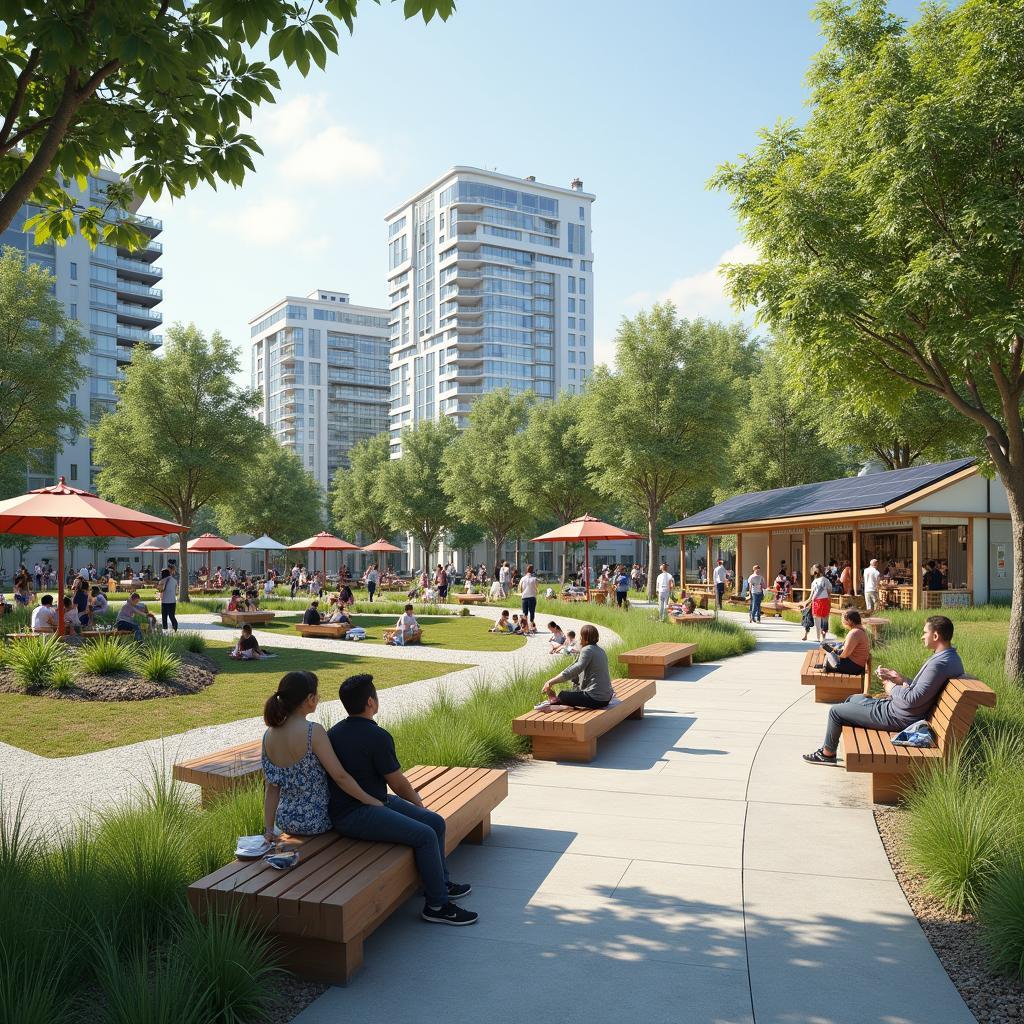 Các hoạt động cộng đồng đa dạng tại công viên thành phố hiện đại với công nghệ và tiện ích
Từ vựng và cụm từ quan trọng
Topic-Specific Vocabulary
| Từ vựng/Cụm từ | Loại từ | Phiên âm | Nghĩa tiếng Việt | Ví dụ | Collocation |
|---|---|---|---|---|---|
| verdant haven | noun phrase | /ˈvɜːdənt ˈheɪvn/ | nơi trú ẩn xanh tươi | The park serves as a verdant haven in the concrete jungle. | verdant landscape, verdant oasis, verdant greenery |
| lush vegetation | noun phrase | /lʌʃ ˌvedʒɪˈteɪʃn/ | thảm thực vật um tùm | The park boasts lush vegetation that provides excellent shade. | lush greenery, lush foliage, lush tropical plants |
| tranquil atmosphere | noun phrase | /ˈtræŋkwɪl ˈætməsfɪə(r)/ | bầu không khí yên tĩnh | I appreciate the tranquil atmosphere early in the morning. | tranquil setting, tranquil environment, tranquil surroundings |
| meander through | verb | /miˈændə(r) θruː/ | uốn khúc qua, đi lượn qua | The paths meander through ancient trees. | meander along, meander around, meandering river |
| designated paths | noun phrase | /ˈdezɪɡneɪtɪd pɑːðz/ | đường dạo được quy hoạch | Joggers should stick to the designated paths. | designated area, designated zone, designated space |
| shaded spot | noun phrase | /ˈʃeɪdɪd spɒt/ | chỗ có bóng mát | I found a shaded spot under a large oak tree. | shaded area, shaded bench, shaded corner |
| rejuvenating | adjective | /rɪˈdʒuːvəneɪtɪŋ/ | làm trẻ hóa, phục hồi | The morning walk was incredibly rejuvenating. | rejuvenating experience, rejuvenating effect, rejuvenating break |
| unwind | verb | /ʌnˈwaɪnd/ | thư giãn, xả stress | I go there to unwind after stressful days. | unwind with, unwind from, help someone unwind |
| green oasis | noun phrase | /ɡriːn əʊˈeɪsɪs/ | ốc đảo xanh | The park is a green oasis in the urban desert. | urban oasis, peaceful oasis, natural oasis |
| concrete jungle | noun phrase | /ˈkɒŋkriːt ˈdʒʌŋɡl/ | rừng bê tông (đô thị xám xịt) | Parks provide relief from the concrete jungle. | escape the concrete jungle, concrete urban landscape |
| hustle and bustle | noun phrase | /ˈhʌsl ənd ˈbʌsl/ | sự hối hả, nhộn nhịp | I need escape from the hustle and bustle. | hustle and bustle of city life, amid the hustle and bustle |
| sanctuary | noun | /ˈsæŋktʃuəri/ | nơi thánh thiện, nơi trú ẩn | The park serves as my sanctuary in the city. | peaceful sanctuary, natural sanctuary, urban sanctuary |
| biodiversity | noun | /ˌbaɪəʊdaɪˈvɜːsəti/ | đa dạng sinh học | The park promotes biodiversity in the city. | biodiversity conservation, rich biodiversity, maintain biodiversity |
| permeable surfaces | noun phrase | /ˈpɜːmiəbl ˈsɜːfɪsɪz/ | bề mặt thấm nước | Parks with permeable surfaces help water drainage. | permeable pavement, permeable materials |
| fixture | noun | /ˈfɪkstʃə(r)/ | vật cố định, người thường xuyên có mặt | I’ve become quite a fixture at the park. | regular fixture, permanent fixture, familiar fixture |
| integral to | adj phrase | /ˈɪntɪɡrəl tuː/ | thiết yếu cho, không thể thiếu | Parks are integral to urban well-being. | integral part of, integral component, integral role |
| therapeutic | adjective | /ˌθerəˈpjuːtɪk/ | có tính trị liệu, chữa lành | Being in nature has therapeutic benefits. | therapeutic effect, therapeutic value, therapeutic properties |
| foster | verb | /ˈfɒstə(r)/ | nuôi dưỡng, thúc đẩy | Parks foster community connections. | foster relationships, foster development, foster growth |
| cohesion | noun | /kəʊˈhiːʒn/ | sự gắn kết | Parks contribute to social cohesion. | social cohesion, community cohesion, promote cohesion |
| stratified | adjective | /ˈstrætɪfaɪd/ | phân tầng, có tầng lớp | Parks unite our stratified society. | stratified society, stratified system, highly stratified |
Idiomatic Expressions & Advanced Phrases
| Cụm từ | Nghĩa | Ví dụ sử dụng | Band điểm |
|---|---|---|---|
| a stone’s throw from | rất gần, chỉ một quãng ngắn | The park is just a stone’s throw from my apartment. | 7.5-8 |
| kick-start my day | bắt đầu ngày tràn đầy năng lượng | My morning jog really kick-starts my day. | 7-7.5 |
| clear my head | làm đầu óc tỉnh táo | I visit the park to clear my head. | 6.5-7 |
| soak up the atmosphere | đắm mình trong không khí | I love soaking up the peaceful atmosphere. | 7.5-8 |
| recharge my batteries | nạp lại năng lượng | Parks help me recharge my batteries. | 7-7.5 |
| make it a point to | cố gắng làm điều gì, ưu tiên | I make it a point to visit weekly. | 7.5-8 |
| pop by | ghé qua (informal nhưng natural) | I might pop by the park this afternoon. | 7-7.5 |
| stark contrast | sự tương phản mạnh mẽ | The quiet park is a stark contrast to busy streets. | 7.5-8 |
| bode well for | báo hiệu điều tốt cho | These investments bode well for park development. | 8-8.5 |
| trump | vượt trội hơn, quan trọng hơn | Economic concerns often trump environmental ones. | 7.5-8 |
| grapple with | vật lộn với, đối phó với | Cities grapple with balancing development and green space. | 8-8.5 |
| enshrine | ghi chép trang trọng, quy định chính thức | Some cities enshrine park requirements in law. | 8.5-9 |
| disproportionate access | tiếp cận không cân đối | Wealthy areas often have disproportionate access to parks. | 8-8.5 |
| piecemeal approach | cách tiếp cận rời rạc, từng phần | A piecemeal approach won’t solve the shortage. | 8-8.5 |
| at the end of the day | cuối cùng thì, xét cho cùng | At the end of the day, parks improve quality of life. | 6.5-7 |
| silver bullet | giải pháp thần kỳ, toàn diện | There’s no silver bullet for increasing park usage. | 7.5-8 |
Discourse Markers (Từ Nối Ý Trong Speaking)
Để bắt đầu câu trả lời:
- 📝 Well,… – Khi cần giây lát suy nghĩ hoặc bắt đầu một câu trả lời thoughtful
- 📝 Actually,… – Khi muốn đưa ra góc nhìn có thể unexpected hoặc correction
- 📝 To be honest,… – Khi muốn nói thẳng thắn, chân thành
- 📝 I’d say that… – Cách tự nhiên để đưa ra opinion
- 📝 Generally speaking,… – Khi đưa ra statement chung trước khi vào chi tiết
Để bổ sung ý:
- 📝 On top of that,… – Thêm điểm nữa (ít formal hơn Furthermore)
- 📝 What’s more,… – Hơn nữa, thêm vào đó
- 📝 Beyond that,… – Ngoài điều đó ra
- 📝 Not to mention… – Chưa kể đến (emphasize thêm điểm quan trọng)
- 📝 Equally important/significant… – Quan trọng tương đương
Để đưa ra quan điểm cân bằng:
- 📝 On the one hand,… On the other hand,… – Một mặt… mặt khác
- 📝 While it’s true that…, we also need to consider… – Tuy đúng là… nhưng cũng cần xem xét
- 📝 That said,… – Tuy nhiên, điều đó nói lên rằng (to introduce contrasting point)
- 📝 Having said that,… – Nói như vậy thì (transition to opposite view)
Để kết luận:
- 📝 All in all,… – Tóm lại, xét tất cả
- 📝 At the end of the day,… – Cuối cùng thì, xét cho cùng
- 📝 In essence,… – Về bản chất, điểm cốt lõi là
- 📝 Ultimately,… – Rốt cuộc, sau cùng
Để thể hiện uncertainty/tentative:
- 📝 I would say… – Tôi muốn nói rằng (softer than “I think”)
- 📝 It seems to me… – Theo tôi thấy thì
- 📝 To some extent… – Ở một mức độ nào đó
- 📝 By and large… – Nhìn chung, đại thể
Grammatical Structures Ấn Tượng
1. Conditional Sentences (Câu điều kiện):
-
Mixed conditional:
- Formula: If + past perfect, would + infinitive
- Ví dụ: “If cities had prioritized green spaces earlier, we wouldn’t be facing such shortages now.”
-
Inversion for emphasis:
- Formula: Should + subject + verb, subject + will
- Ví dụ: “Should governments invest more in parks, we’d see significant health improvements.”
2. Relative Clauses (Mệnh đề quan hệ):
-
Non-defining (providing extra information):
- Formula: Subject + , which/who + verb, + main verb
- Ví dụ: “Tao Dan Park, which is located in District 1, has become my sanctuary.”
-
Reduced relative clauses:
- Formula: Subject + participle phrase
- Ví dụ: “The paths winding through the park offer ever-changing scenery.”
3. Passive Voice (Câu bị động):
-
Impersonal passive (for opinions):
- Formula: It is thought/believed/said that…
- Ví dụ: “It’s widely believed that green spaces improve mental health.”
-
Passive with modals:
- Formula: Subject + modal + be + past participle
- Ví dụ: “Parks should be designed with community input.”
4. Cleft Sentences (Câu chẻ):
-
What-cleft (emphasizing object):
- Formula: What + subject + verb + is/was + noun phrase
- Ví dụ: “What I find most appealing about the park is its tranquil atmosphere.”
-
It-cleft (emphasizing specific element):
- Formula: It + is/was + emphasized element + that/who + rest of sentence
- Ví dụ: “It’s the mature trees that make this park so special.”
5. Participle Clauses (Mệnh đề phân từ):
-
Present participle (simultaneous actions):
- Formula: Subject + verb, + present participle phrase
- Ví dụ: “I walk through the park, soaking up the peaceful atmosphere.”
-
Past participle (passive meaning):
- Formula: Past participle phrase + , + subject + verb
- Ví dụ: “Nestled in the heart of the city, the park offers a green oasis.”
6. Inversion After Negative Adverbials:
- Formula: Negative adverbial + auxiliary + subject + main verb
- Ví dụ: “Never have I experienced such tranquility in an urban setting.”
- Ví dụ: “Rarely do we find such well-maintained parks in developing cities.”
7. Subjunctive Mood (Giả định):
- Formula: It’s important/essential/vital that + subject + base form
- Ví dụ: “It’s essential that governments prioritize green space development.”
Bài viết này đã cung cấp cho bạn một hướng dẫn toàn diện về cách trả lời chủ đề “describe a park in your city where you spend time” trong IELTS Speaking. Từ những câu hỏi cơ bản trong Part 1, đến bài nói dài trong Part 2, cho đến các câu hỏi thảo luận sâu trong Part 3, bạn đã có đầy đủ công cụ để tự tin đạt band điểm cao.
Hãy nhớ rằng, điều quan trọng nhất không phải là học thuộc các câu trả lời mẫu, mà là hiểu cách xây dựng câu trả lời logic, sử dụng từ vựng phong phú một cách tự nhiên, và thể hiện khả năng tư duy phản biện của bạn. Luyện tập thường xuyên với các chủ đề khác nhau, ghi âm để tự đánh giá, và không ngừng mở rộng vốn từ vựng – đó chính là con đường để chinh phục IELTS Speaking.
Chúc bạn thành công trong kỳ thi IELTS sắp tới!