
Mở bài
Chủ đề “Describe A Person Who Is Very Inspiring In Their Field” là một trong những đề bài phổ biến và quan trọng trong IELTS Speaking, đặc biệt ở Part 2. Đây là dạng câu hỏi yêu cầu bạn miêu tả một người có ảnh hưởng tích cực, truyền cảm hứng trong lĩnh vực của họ – có thể là một người nổi tiếng, chuyên gia, hoặc thậm chí là người thân trong gia đình.
Theo thống kê từ các trung tâm luyện thi IELTS và diễn đàn chia sẻ đề thi thực tế, chủ đề về “inspiring people” xuất hiện với tần suất cao trong các kỳ thi từ 2020 đến 2024, đặc biệt trong quý 1 và quý 3 hàng năm. Dự đoán khả năng xuất hiện trong tương lai vẫn ở mức cao vì đây là chủ đề gắn liền với trải nghiệm cá nhân và phù hợp với mọi đối tượng thí sinh.
Trong bài viết này, bạn sẽ học được:
- Các câu hỏi thường gặp trong cả 3 Part của bài thi Speaking
- Bài mẫu chi tiết theo nhiều band điểm từ 6-7, 7.5-8 đến 8.5-9
- Từ vựng và cụm từ ăn điểm giúp nâng band
- Chiến lược trả lời hiệu quả từ góc nhìn Examiner
- Phân tích sâu về tiêu chí chấm điểm và cách cải thiện
Đây không chỉ là bài hướng dẫn về describe a public figure you admire for their work mà còn giúp bạn nắm vững phương pháp áp dụng cho các chủ đề tương tự như miêu tả người có ảnh hưởng tích cực trong cuộc sống của bạn.
IELTS Speaking Part 1: Introduction and Interview
Tổng Quan Về Part 1
Part 1 của IELTS Speaking kéo dài 4-5 phút với các câu hỏi ngắn về cuộc sống hàng ngày, sở thích, công việc và học tập. Đặc điểm của phần này là câu hỏi đơn giản, thân thiện, giúp bạn làm quen với examiner và tạo không khí thoải mái.
Chiến lược quan trọng cho Part 1:
- Trả lời trực tiếp câu hỏi trong 1-2 câu đầu
- Mở rộng thêm 1-2 câu với lý do hoặc ví dụ cụ thể
- Giữ câu trả lời tự nhiên, không quá dài (20-30 giây)
- Sử dụng từ vựng đa dạng nhưng phù hợp với ngữ cảnh
Lỗi thường gặp của học viên Việt Nam:
- Trả lời quá ngắn kiểu “Yes, I do” hoặc “No, I don’t” mà không giải thích
- Học thuộc template và áp dụng cứng nhắc
- Dùng từ vựng quá academic không phù hợp với câu hỏi đời thường
- Thiếu tự tin, nói ngắt quãng hoặc quá nhanh
Các Câu Hỏi Thường Gặp
Question 1: Do you have any role models or people you look up to?
Question 2: Who inspires you the most in your family?
Question 3: Do you prefer to learn from successful people or from your own experiences?
Question 4: What qualities do you think make a person inspiring?
Question 5: Have you ever met someone famous who inspired you?
Question 6: Do young people in your country have good role models nowadays?
Question 7: How do you usually learn about inspiring people?
Question 8: Do you think it’s important to have role models in life?
Phân Tích và Gợi Ý Trả Lời Chi Tiết
Question: Do you have any role models or people you look up to?
🎯 Cách tiếp cận:
- Trả lời Yes/No trực tiếp
- Nói ai là role model của bạn
- Giải thích ngắn gọn tại sao
📝 Sample Answer – Band 6-7:
“Yes, I do. My role model is my high school teacher. She is very kind and always helps students. She inspired me to study hard and be a good person. I really admire her dedication to teaching.”
Phân tích:
- Điểm mạnh: Trả lời đúng trọng tâm, có nêu người cụ thể và lý do cơ bản
- Hạn chế: Từ vựng đơn giản (kind, good person, study hard), cấu trúc câu chưa đa dạng, thiếu chi tiết cụ thể
- Tại sao Band 6-7: Câu trả lời adequate và coherent nhưng chưa impressive. Vocabulary range còn hạn chế, chủ yếu dùng từ phổ thông. Grammar đúng nhưng đơn giản.
📝 Sample Answer – Band 8-9:
“Absolutely. I’ve always looked up to my former literature teacher, Mrs. Lan. What makes her truly inspiring is not just her profound knowledge of the subject, but her genuine passion for nurturing young minds. She had this remarkable ability to make complex concepts accessible and, more importantly, she instilled in me a love for reading that has stayed with me ever since.”
Phân tích:
-
Điểm mạnh:
- Từ vựng tinh tế: “profound knowledge”, “genuine passion”, “nurturing young minds”, “remarkable ability”, “instilled in me”
- Cấu trúc phức tạp: “What makes her truly inspiring is not just…, but…” (cleft sentence với not just…but also)
- Ý tưởng sâu sắc: Không chỉ nói về kiến thức mà còn về khả năng truyền cảm hứng lâu dài
-
Tại sao Band 8-9:
- Fluency: Câu trả lời trôi chảy, tự nhiên với discourse marker “Absolutely”
- Vocabulary: Wide range với collocations như “profound knowledge”, “genuine passion”, “instilled in me”
- Grammar: Complex structures (relative clauses, cleft sentences)
- Pronunciation: Natural stress trên các từ quan trọng “inspiring”, “remarkable”, “instilled”
💡 Key Vocabulary & Expressions:
- look up to someone: ngưỡng mộ, kính trọng ai đó
- profound knowledge: kiến thức sâu sắc
- genuine passion: đam mê thực sự
- nurture young minds: nuôi dưỡng tâm hồn trẻ thơ
- remarkable ability: khả năng đáng chú ý
- instill in someone: thấm nhuần, gieo vào ai đó (giá trị, thái độ)
Question: What qualities do you think make a person inspiring?
🎯 Cách tiếp cận:
- Liệt kê 2-3 phẩm chất quan trọng
- Giải thích ngắn gọn tại sao mỗi phẩm chất quan trọng
- Có thể thêm ví dụ nếu tự nhiên
📝 Sample Answer – Band 6-7:
“I think an inspiring person should be hardworking and successful. They need to have good achievements in their work. Also, they should be kind and willing to help other people. These qualities make people want to follow them.”
Phân tích:
- Điểm mạnh: Structure rõ ràng với 2 qualities chính (hardworking/successful và kind/helpful)
- Hạn chế: Từ vựng cơ bản (hardworking, successful, kind, help), ý tưởng chưa sâu, thiếu examples cụ thể
- Tại sao Band 6-7: Trả lời đầy đủ câu hỏi với ideas phù hợp nhưng vocabulary và grammar chưa sophisticated
📝 Sample Answer – Band 8-9:
“Well, I’d say there are several key attributes that make someone truly inspiring. First and foremost, resilience – the ability to overcome adversity and bounce back from failures. This shows others that setbacks are just stepping stones to success. Secondly, authenticity is crucial; inspiring people are true to their values rather than simply chasing fame or fortune. Finally, I think generosity of spirit – being willing to share knowledge and lift others up – really sets inspiring individuals apart from those who are merely successful.”
Phân tích:
-
Điểm mạnh:
- Vocabulary đa dạng và precise: “key attributes”, “resilience”, “overcome adversity”, “bounce back from”, “authenticity”, “true to their values”, “generosity of spirit”, “lift others up”
- Structure logic: First and foremost → Secondly → Finally
- Depth of ideas: Không chỉ nói về thành công mà còn về giá trị bên trong
- Sophisticated expressions: “setbacks are stepping stones”, “sets individuals apart from”
-
Tại sao Band 8-9:
- Fluency: Natural với discourse marker “Well, I’d say”
- Vocabulary: Wide range với abstract nouns và collocations
- Grammar: Complex sentences với relative clauses và gerunds
- Critical thinking: Phân biệt được inspiring people và merely successful people
💡 Key Vocabulary & Expressions:
- key attributes: phẩm chất then chốt
- resilience: khả năng phục hồi, kiên cường
- overcome adversity: vượt qua nghịch cảnh
- bounce back from failures: phục hồi sau thất bại
- authenticity: tính chân thực
- true to one’s values: trung thành với giá trị của mình
- generosity of spirit: lòng rộng lượng, hào phóng về tinh thần
- lift others up: nâng đỡ người khác
Question: Do young people in your country have good role models nowadays?
🎯 Cách tiếp cận:
- Đưa ra opinion (Yes/No/Mixed)
- Đưa ra examples cụ thể (người nổi tiếng, lĩnh vực nào)
- Có thể đề cập challenges nếu có
📝 Sample Answer – Band 6-7:
“I think it’s mixed. There are many good role models like successful business people and athletes. However, many young people follow social media influencers who are not really good examples. Some influencers only care about money and fame, not about doing meaningful things.”
Phân tích:
- Điểm mạnh: Balanced view (mixed opinion), có đề cập cả positive và negative examples
- Hạn chế: Vocabulary basic (good, successful, care about money), thiếu specific examples
- Tại sao Band 6-7: Coherent answer với adequate range nhưng chưa sophisticated
📝 Sample Answer – Band 8-9:
“It’s a bit of a mixed bag, to be honest. On the one hand, Vietnam has some outstanding figures in various fields – scientists like Professor Ngô Bảo Châu who won the Fields Medal, or entrepreneurs like those behind successful tech startups. These people demonstrate that hard work and innovation pay off. On the other hand, there’s a concerning trend where young people gravitate towards social media personalities whose main claim to fame is their appearance or lifestyle rather than any substantial achievements. I think the challenge is that the latter group gets far more visibility on platforms that young people frequent.”
Phân tích:
-
Điểm mạnh:
- Balanced argument với “On the one hand… On the other hand”
- Specific examples: Professor Ngô Bảo Châu, tech startups
- Sophisticated vocabulary: “mixed bag”, “outstanding figures”, “gravitate towards”, “substantial achievements”, “visibility”
- Critical analysis: Đề cập đến visibility issue trên social media
-
Tại sao Band 8-9:
- Fluency: Natural với “to be honest”, “It’s a bit of a mixed bag”
- Vocabulary: Topic-specific và precise
- Grammar: Complex structures với relative clauses
- Ideas: Thoughtful với real-world examples và analysis
💡 Key Vocabulary & Expressions:
- mixed bag: tình huống trái chiều, có cả tốt và xấu
- outstanding figures: những nhân vật xuất sắc
- Fields Medal: Huy chương Fields (giải Nobel của Toán học)
- innovation pays off: sự đổi mới mang lại kết quả
- gravitate towards: bị hấp dẫn, nghiêng về
- claim to fame: điều làm nên danh tiếng
- substantial achievements: thành tựu thực chất
- visibility: khả năng hiển thị, được chú ý
 Giám khảo IELTS đang đánh giá và chấm điểm thí sinh trong phần thi nói với bảng tiêu chí band descriptors
IELTS Speaking Part 2: Long Turn (Cue Card)
Tổng Quan Về Part 2
Part 2 là phần độc thoại quan trọng nhất của IELTS Speaking, kéo dài 3-4 phút bao gồm 1 phút chuẩn bị và 2-3 phút nói. Đây là phần thí sinh phải nói liên tục về một chủ đề cụ thể mà không bị gián đoạn.
Đặc điểm của Part 2:
- Thí sinh nhận cue card với chủ đề và 3-4 bullet points
- 1 phút chuẩn bị với giấy và bút ghi chú
- Nói 2-3 phút (tối thiểu 1.5 phút, tối đa 2 phút thường bị dừng lại)
- Examiner không ngắt lời cho đến khi hết thời gian
Chiến lược quan trọng:
- Sử dụng tốt 1 phút chuẩn bị: Ghi keywords cho mỗi bullet point, không viết câu hoàn chỉnh
- Structure rõ ràng: Giới thiệu → Body (trả lời từng bullet point) → Kết luận
- Timing: Luyện để nói đủ 2 phút, không quá ngắn cũng không bị cắt giữa chừng
- Personal touch: Thêm feelings, thoughts, details để câu chuyện sinh động
Lỗi thường gặp của học viên Việt Nam:
- Không tận dụng 1 phút chuẩn bị, nói ngay hoặc viết quá nhiều
- Nói dưới 1.5 phút vì thiếu ideas mở rộng
- Bỏ sót bullet points trong cue card
- Nói không có structure, nhảy lung tung giữa các ý
- Dùng thì sai (đặc biệt khi kể về quá khứ)
- Không explain đầy đủ phần cuối (thường là “explain why/how you feel”)
Cue Card
Describe a person who is very inspiring in their field
You should say:
- Who this person is
- What field they work in
- What they have achieved
- And explain why you find this person inspiring
Phân Tích Đề Bài
-
Dạng câu hỏi: Describe a person – yêu cầu miêu tả về một người cụ thể
-
Thì động từ chính: Hiện tại đơn (cho thông tin chung về người đó) + Hiện tại hoàn thành (cho achievements) + Quá khứ đơn (nếu kể câu chuyện cụ thể)
-
Bullet points phải cover:
- Who: Giới thiệu người đó là ai, mối quan hệ với bạn (nếu có)
- What field: Lĩnh vực họ làm việc (giáo dục, kinh doanh, khoa học, nghệ thuật…)
- Achievements: Thành tựu cụ thể họ đạt được
- Why inspiring: Lý do họ truyền cảm hứng cho bạn – ĐÂY LÀ PHẦN QUAN TRỌNG NHẤT
-
Câu “explain” quan trọng: Phần “explain why you find this person inspiring” là key để ghi điểm cao. Đây là nơi bạn thể hiện critical thinking, personal reflection và emotional depth. Không chỉ nói “họ thành công” mà phải giải thích TẠI SAO thành công đó có ý nghĩa với bạn, ẢNH HƯỞNG như thế nào đến suy nghĩ/hành động của bạn.
Tips chọn người để nói:
- Chọn người bạn thực sự biết hoặc quan tâm để nói tự nhiên
- Có thể là: giáo viên, ông bà, người trong gia đình, celebrity, doanh nhân, scientist, athlete, artist
- Tránh chọn quá nổi tiếng mà bạn không biết chi tiết (như Bill Gates, Elon Musk) nếu không có ý tưởng sâu
📝 Sample Answer – Band 6-7
Thời lượng: Khoảng 1.5-2 phút
“I’d like to talk about my uncle, who is a doctor. His name is Dr. Minh and he works at a hospital in Ho Chi Minh City. He has been working as a doctor for more than 15 years.
In his field, he has achieved many things. He became the head of the cardiology department when he was quite young, around 35 years old. He has also helped many patients with heart problems and saved many lives. He often works very long hours and sometimes doesn’t have time to rest properly.
What makes him inspiring to me is his dedication to his work. Even though he is very busy, he always tries his best to help his patients. He treats everyone equally, whether they are rich or poor. I remember one time when he missed a family dinner because he had to perform an emergency surgery. He never complains about his job even though it’s very stressful.
I find him inspiring because he shows me that helping other people is very important. He has a good job and earns good money, but he still cares more about saving lives than making money. He inspired me to think about what I really want to do in my life and to choose a career where I can help others too. Whenever I meet him, I feel motivated to work harder and be a better person.”
Phân Tích Band Điểm
| Tiêu chí | Band | Nhận xét |
|---|---|---|
| Fluency & Coherence | 6-7 | Nói khá trôi chảy với structure rõ ràng theo bullet points. Có sử dụng linking devices (Even though, because, also) nhưng còn đơn giản. Ý tưởng liên kết nhưng chưa sophisticated. |
| Lexical Resource | 6-7 | Vocabulary adequate với một số collocations tốt (dedication to work, emergency surgery, save lives). Tuy nhiên phần lớn là từ vựng phổ thông (very busy, good job, work harder). Có paraphrasing nhưng limited. |
| Grammatical Range & Accuracy | 6-7 | Sử dụng mix của simple và complex sentences. Có present perfect (has been working, has achieved), relative clauses (who is a doctor). Tuy nhiên chủ yếu vẫn là simple structures. Ít lỗi ngữ pháp. |
| Pronunciation | 6-7 | Giả định rõ ràng, dễ hiểu với một số mispronunciation nhỏ không ảnh hưởng communication. |
Điểm mạnh:
- ✅ Trả lời đầy đủ tất cả bullet points
- ✅ Structure logic và dễ follow
- ✅ Có ví dụ cụ thể (missed family dinner for surgery)
- ✅ Personal connection rõ ràng
Hạn chế:
- ⚠️ Vocabulary còn basic và repetitive (very, good, many)
- ⚠️ Thiếu sophisticated expressions và idioms
- ⚠️ Ideas về “why inspiring” chưa deep, còn surface level
- ⚠️ Câu văn chưa đa dạng, nhiều câu ngắn ghép với “and”
📝 Sample Answer – Band 7.5-8
Thời lượng: Khoảng 2-2.5 phút
“I’d like to talk about Dr. Nguyễn Thị Minh, a pioneering female surgeon who works at the Vietnam National Heart Institute. I first learned about her through a documentary about groundbreaking medical procedures in Vietnam, and her story has stuck with me ever since.
Dr. Minh specializes in pediatric cardiac surgery, which means she operates on children with heart conditions. What makes her work particularly challenging is that many of her patients come from underprivileged backgrounds in rural areas. She has dedicated over two decades to this field and has successfully performed more than 3,000 complex surgeries. Beyond her clinical work, she’s also spearheaded initiatives to provide free heart surgeries for children whose families cannot afford treatment.
Her achievements are truly remarkable. She was the first Vietnamese doctor to master a cutting-edge technique for repairing congenital heart defects in newborns, which has significantly reduced mortality rates. She’s also trained hundreds of younger surgeons, passing on her expertise to the next generation. Despite receiving offers from prestigious hospitals abroad with much higher salaries, she chose to stay in Vietnam because she believes her skills are needed most here.
What I find most inspiring about Dr. Minh is her unwavering commitment to her calling, not for fame or fortune, but for the genuine impact she can make. She embodies the principle that success isn’t just about personal achievement, but about lifting others up. Her story has profoundly influenced my perspective on what it means to have a meaningful career. It’s taught me that true inspiration comes from people who use their talents to make a tangible difference in others’ lives, especially for those who are most vulnerable.”
Phân Tích Band Điểm
| Tiêu chí | Band | Nhận xét |
|---|---|---|
| Fluency & Coherence | 7.5-8 | Speaks fluently với minimal hesitation. Structure rất rõ với introduction, body (achievements), và extended explanation. Sử dụng linking devices tự nhiên và đa dạng (Beyond, Despite, What I find most…). Ideas phát triển logic. |
| Lexical Resource | 7.5-8 | Wide vocabulary range với nhiều topic-specific words (pioneering, pediatric cardiac surgery, underprivileged backgrounds, spearheaded initiatives, cutting-edge technique, mortality rates). Collocations chính xác. Có paraphrasing tốt. |
| Grammatical Range & Accuracy | 7.5-8 | Variety of complex structures: relative clauses (which means…, whose families…), present perfect continuous (has dedicated), reduced relative clauses (trained hundreds of…). Mix of tenses accurate. Few errors. |
| Pronunciation | 7.5-8 | Clear pronunciation với good sentence stress và intonation. Vocabulary được phát âm chính xác. |
So Sánh Với Band 6-7
| Khía cạnh | Band 6-7 | Band 7.5-8 |
|---|---|---|
| Vocabulary | “dedication to work”, “save lives”, “help patients” | “unwavering commitment”, “make a tangible difference”, “most vulnerable”, “cutting-edge technique” |
| Grammar | Simple: “He has achieved many things” | Complex: “Despite receiving offers from prestigious hospitals abroad with much higher salaries, she chose to stay…” |
| Ideas | “He shows me helping others is important” | “It’s taught me that true inspiration comes from people who use their talents to make a tangible difference in others’ lives” |
📝 Sample Answer – Band 8.5-9
Thời lượng: 2.5-3 phút đầy đủ
“I’d like to tell you about Professor Trần Thanh Vân, a Vietnamese-French theoretical physicist who has been a towering figure in the field of particle physics for over half a century. I first encountered his work while researching Vietnamese scientists who had made significant contributions to their fields on a global scale, and what I discovered was nothing short of extraordinary.
Professor Vân is best known for founding the renowned Rencontres de Moriond conference series back in 1966, which has become one of the most prestigious gatherings in particle physics, attracting Nobel laureates and leading researchers from around the world. What’s particularly remarkable about his achievement is the context – he started this conference as a young Vietnamese scientist during the Vietnam War, at a time when such international scientific collaboration seemed almost impossible. He essentially built bridges between the Eastern and Western scientific communities during the Cold War, which was a monumental accomplishment in itself.
Beyond this flagship achievement, he’s also established the Rencontres du Vietnam conference series, which brings cutting-edge scientific discussions to Vietnam, helping to put the country on the map in the international scientific community. Through these initiatives, he’s mentored countless young physicists, many of whom have gone on to make their own notable discoveries. He’s in his late 80s now but remains remarkably active, still organizing conferences and advocating for scientific education in developing countries.
What makes Professor Vân truly inspiring to me goes far beyond his scientific achievements. It’s his unshakeable belief in the power of knowledge to transcend borders and his relentless dedication to creating opportunities for others. In an era where success is often measured purely in terms of personal gain, he stands as a testament to the idea that one’s legacy is built not just on what you achieve, but on what you enable others to achieve. His story resonates deeply with me because it challenges the notion that you need to be in the perfect circumstances to make an impact. He started with virtually nothing – no funding, no institutional support in the traditional sense – yet through sheer determination and vision, he created something that has outlasted generations.
Tương tự như describe a person who has a positive influence on your life, Professor Vân has fundamentally shaped my understanding of what it means to leave a meaningful mark on the world. His example has taught me that true inspiration lies not in the accolades you receive, but in the doors you open for those who come after you. It’s this philosophy that has profoundly influenced my own aspirations and my belief that success should always be intertwined with service to the broader community.”
Phân Tích Band Điểm
| Tiêu chí | Band | Nhận xét |
|---|---|---|
| Fluency & Coherence | 8.5-9 | Speaks fluently và coherently với sophisticated structure. Natural self-correction và elaboration. Seamless transitions giữa ideas. Progression logic từ introduction → achievements → deeper meaning. |
| Lexical Resource | 8.5-9 | Extensive vocabulary với precision và sophistication. Idiomatic expressions natural (nothing short of extraordinary, put on the map, stands as a testament to). Collocations chính xác (towering figure, monumental accomplishment, unshakeable belief). Skillful paraphrasing. |
| Grammatical Range & Accuracy | 8.5-9 | Wide range of complex structures used naturally: relative clauses, participle clauses, conditional structures, inversion. Variety of tenses used accurately. Virtually error-free với occasional slips không ảnh hưởng communication. |
| Pronunciation | 8.5-9 | Clear pronunciation với consistent appropriate stress, rhythm và intonation. Vocabulary phát âm chính xác, kể cả technical terms. |
Tại Sao Bài Này Xuất Sắc
🎯 Fluency Hoàn Hảo:
- Không có hesitation, speaks với confidence và natural rhythm
- Self-correction natural: “his achievement is the context” → elaborates smoothly
- Discourse markers sophisticated: “What’s particularly remarkable”, “Beyond this”, “What makes… goes far beyond”
📚 Vocabulary Tinh Vi:
- “nothing short of extraordinary” – idiomatic expression thể hiện surprise và admiration một cách tinh tế
- “essentially built bridges” – metaphor mạnh mẽ cho international collaboration
- “stands as a testament to” – formal phrase cho legacy
- “resonates deeply with me” – emotional connection được express eloquently
- “intertwined with” – sophisticated verb để nói về mối quan hệ gắn bó
📝 Grammar Đa Dạng:
- Reduced relative clause: “attracting Nobel laureates” (instead of “which attracts”)
- Participle clause: “helping to put the country on the map”
- Emphatic structure: “It’s his unshakeable belief… and his relentless dedication”
- Complex conditional: “In an era where success is often measured purely in terms of personal gain, he stands as…”
- Inversion for emphasis: “what I discovered was nothing short of extraordinary”
💡 Ideas Sâu Sắc:
- Không chỉ nói về achievements mà analyze context (during Vietnam War, Cold War)
- Critical thinking: Contrast giữa personal gain vs. enabling others
- Philosophical reflection: “legacy is built not just on what you achieve, but on what you enable others to achieve”
- Personal growth: Explain how this person changed speaker’s worldview
- Universal message: Success intertwined with service to community
 Thí sinh IELTS Speaking đang tự tin trình bày bài nói Part 2 với giám khảo trong phòng thi
Follow-up Questions (Rounding Off Questions)
Sau khi bạn hoàn thành phần nói 2 phút, examiner thường hỏi thêm 1-2 câu ngắn liên quan đến topic để transition sang Part 3. Đây là câu hỏi đơn giản, trả lời ngắn gọn 1-2 câu là đủ.
Question 1: Do you think you will meet this person again in the future?
Band 6-7 Answer:
“I hope so. I would really like to meet them again because they have influenced me a lot. Maybe I can attend one of their conferences someday.”
Band 8-9 Answer:
“I certainly hope so, though the likelihood is slim given their busy international schedule. However, I’m planning to attend the next Rencontres du Vietnam conference, so there’s a genuine possibility I might have the opportunity to hear them speak in person, which would be absolutely incredible.”
Question 2: Have you told other people about this person?
Band 6-7 Answer:
“Yes, I have. I often tell my friends about them when we discuss inspiring people. Many of my friends also find their story very interesting.”
Band 8-9 Answer:
“Absolutely. I’ve enthusiastically shared their story with anyone who’ll listen, particularly my younger cousins who are considering careers in science. I find that their example serves as a powerful counterpoint to the common belief that Vietnamese scientists can’t make it on the world stage. It’s a story that deserves to be more widely known.”
IELTS Speaking Part 3: Two-way Discussion
Tổng Quan Về Part 3
Part 3 là phần thảo luận hai chiều (two-way discussion) giữa bạn và examiner, kéo dài 4-5 phút. Đây là phần khó nhất trong IELTS Speaking vì yêu cầu bạn phân tích, đánh giá và thảo luận về các vấn đề trừu tượng, rộng hơn liên quan đến chủ đề Part 2.
Yêu cầu của Part 3:
- Phân tích sâu: Không chỉ nói “I think yes/no” mà phải explain why với reasoning
- Multiple perspectives: Xem xét nhiều góc độ của vấn đề
- Abstract thinking: Nói về xã hội, văn hóa, trends chứ không chỉ personal experience
- Comparison: So sánh past/present, different groups, countries
- Speculation: Dự đoán về tương lai với tentative language
Chiến lược:
- Extend your answers: Aim cho 3-5 câu (30-45 giây)
- Use discourse markers: Well, Actually, I think, To be honest, In my opinion
- Structure: Direct answer → Reason 1 + example → Reason 2 → Conclusion/balanced view
- Think before speaking: Dùng 2-3 giây để organize thoughts
- Show complexity: Acknowledge different viewpoints với “However”, “On the other hand”
Lỗi thường gặp của học viên Việt Nam:
- Trả lời quá ngắn (1-2 câu) không phát triển ý
- Chỉ nói về bản thân chứ không nói về society/general trends
- Thiếu examples hoặc examples không relevant
- Không có lý lẽ rõ ràng, nhảy từ ý này sang ý khác
- Thiếu từ vựng abstract (impact, influence, tendency, phenomenon)
- Không dare to disagree hoặc show different perspectives
- Speaking như đang viết essay (quá formal)
Các Câu Hỏi Thảo Luận Sâu
Trong Part 3, câu hỏi thường được phân loại theo các theme lớn liên quan đến chủ đề Part 2. Với topic về “inspiring people”, examiner sẽ mở rộng sang các góc độ như role models trong xã hội, ảnh hưởng của media, sự thay đổi qua thời gian, v.v.
Theme 1: Role Models and Society
Question 1: Why do you think some people become role models while others don’t?
🎯 Phân tích câu hỏi:
- Dạng: Reason/Cause – hỏi nguyên nhân
- Key words: “some people”, “become role models”, “others don’t” – cần compare và analyze factors
- Cách tiếp cận:
- Đưa ra main reason đầu tiên (có thể về achievements)
- Thêm factor thứ hai (về character/visibility)
- Acknowledge complexity (may depend on context)
📝 Sample Answer – Band 6-7:
“I think people become role models when they are successful in their work. If someone achieves great things, other people will admire them. Also, role models usually have good personalities. They are kind and help others. People who are selfish usually don’t become role models even if they are successful. Media attention is also important because if nobody knows about their achievements, they cannot inspire others.”
Phân tích:
- Structure: Có 3 points (success, personality, media) nhưng develop chưa sâu
- Vocabulary: Basic (successful, great things, good personalities, kind, help)
- Tại sao Band 6-7: Answer coherent với multiple points nhưng vocabulary và reasoning chưa sophisticated. Thiếu examples cụ thể.
📝 Sample Answer – Band 8-9:
“Well, I’d say it’s a combination of factors, really. First and foremost, there needs to be some tangible achievement or exceptional quality that sets them apart – whether that’s groundbreaking work in their field or extraordinary perseverance in the face of adversity. However, achievement alone isn’t enough. What really elevates someone to role model status is the narrative around their journey. People gravitate towards stories of individuals who’ve overcome significant obstacles or who’ve remained true to their principles despite temptation or pressure.
There’s also the element of visibility – in today’s world, you could be doing remarkable things, but if your story isn’t being told through media or social platforms, your potential to inspire is limited. That said, I think authenticity is crucial. The public has become quite savvy at detecting when someone is cultivating an image purely for personal gain versus when they genuinely embody the values they represent. Those who come across as genuine tend to have much more lasting influence as role models.”
Phân tích:
- Structure: Well-organized: Achievement → Narrative/story → Visibility → Authenticity (with natural flow)
- Vocabulary: Sophisticated (tangible achievement, groundbreaking work, elevate to status, gravitate towards, cultivate an image, genuinely embody)
- Grammar: Complex structures: “Whether that’s…”, “What really elevates someone is…”, “despite temptation”
- Critical Thinking: Acknowledge complexity (“achievement alone isn’t enough”), balanced view (success + character + visibility)
💡 Key Language Features:
- Discourse markers: “Well, I’d say”, “First and foremost”, “However”, “That said”
- Tentative language: “I think”, “tend to have”
- Abstract nouns: “narrative”, “visibility”, “authenticity”, “perseverance”
- Sophisticated verbs: “elevate”, “gravitate towards”, “embody”, “cultivate”
Question 2: Do you think famous people have a responsibility to be good role models?
🎯 Phân tích câu hỏi:
- Dạng: Opinion với moral/ethical dimension
- Key words: “responsibility”, “good role models” – về duty và ethics
- Cách tiếp cận: Take a stance (Yes/No/Depends) nhưng acknowledge both sides
📝 Sample Answer – Band 6-7:
“Yes, I think they do. Famous people have many fans, especially young people who look up to them. If celebrities behave badly, their fans might copy them. So famous people should be careful about their actions. However, I also think famous people are just normal people, so they can make mistakes too. But they should try to set a good example because they have influence on society.”
Phân tích:
- Structure: Clear stance (Yes) với reason, có acknowledge opposite view
- Vocabulary: Basic (behave badly, copy them, set a good example, have influence)
- Tại sao Band 6-7: Coherent với balanced view nhưng ideas chưa deeply developed, vocabulary còn simple
📝 Sample Answer – Band 8-9:
“This is quite a contentious issue, actually. On the one hand, I believe that with great visibility comes great responsibility, to paraphrase a famous quote. When someone occupies a position in the public eye, particularly if their audience includes impressionable young people, they inevitably become a de facto role model whether they want to or not. Their actions carry weight beyond their personal sphere, so there’s a moral imperative to consider the impact of their behavior.
On the other hand, I think we need to be careful about placing unrealistic expectations on public figures. They’re human beings who deserve the right to privacy and the freedom to make mistakes without having their entire careers destroyed. The problem arises when we put celebrities on pedestals and then feel betrayed when they turn out to be flawed.
I think the middle ground here is that while famous people should strive to be conscious of their influence, we as a society also need to be more discerning about who we elevate to role model status. Perhaps we should focus more on people’s concrete contributions to society rather than their lifestyle or persona. This way, tương tự như describe an interesting old person you have met, we can learn from people whose substantive achievements speak louder than their public image.”
Phân tích:
- Structure: Sophisticated: Acknowledge both sides thoroughly → Propose middle ground solution
- Vocabulary: Advanced (contentious issue, de facto role model, moral imperative, placing unrealistic expectations, putting on pedestals, concrete contributions, substantive achievements)
- Grammar: Complex: “whether they want to or not”, “without having their careers destroyed”, participle phrases
- Critical Thinking: Nuanced view showing maturity, acknowledges complexity, proposes solution
💡 Key Language Features:
- Introducing debate: “This is quite a contentious issue”
- Balanced structure: “On the one hand… On the other hand…”
- Hedging: “I think we need to be careful about…”, “Perhaps we should…”
- Metaphors: “putting on pedestals”, “turn out to be flawed”
Theme 2: Media and Inspiration
Question 3: How has the internet changed the way people find inspiration?
🎯 Phân tích câu hỏi:
- Dạng: Change/Comparison (past vs. present)
- Key words: “internet”, “changed”, “find inspiration”
- Cách tiếp cận: Explain how it was before → How it is now → Positive/negative impacts
📝 Sample Answer – Band 6-7:
“The internet has changed things a lot. In the past, people could only learn about inspiring people through TV, newspapers or books. Now, with the internet, we can easily find information about anyone. Social media allows us to follow successful people and see their daily lives. Young people today can find many role models online, from different countries and different fields. This is good because we have more choices, but sometimes it’s hard to know which information is true or false.”
Phân tích:
- Structure: Clear comparison (past vs. present) với mention of pros and cons
- Vocabulary: Adequate nhưng general (a lot, easily find, different countries, good)
- Tại sao Band 6-7: Answers the question với adequate development nhưng lacks sophistication và depth
📝 Sample Answer – Band 8-9:
“The internet has fundamentally transformed the landscape of inspiration in several profound ways. In the pre-internet era, our exposure to inspiring figures was largely mediated through traditional gatekeepers like publishers, TV networks, or educational institutions. This meant we were often limited to learning about nationally or internationally renowned figures who had already achieved widespread recognition.
Now, the internet has democratized access to inspiring stories in unprecedented ways. Through platforms like YouTube, TED Talks, or LinkedIn, we can discover unsung heroes – people doing remarkable work in niche fields who might never have gained traditional media attention. This diversification of role models is particularly significant because it allows people to find inspiration from individuals who share their specific interests, cultural background, or even struggles. For instance, khi tìm hiểu về describe a nature reserve you have visited, a young conservationist can now directly follow and learn from researchers working in remote locations through their blogs and social media.
However, this accessibility comes with a double-edged sword. The internet has also created what I’d call an inflation of inspiration – we’re bombarded with so many success stories and highlight reels of people’s lives that it can be overwhelming and sometimes counterproductive. There’s also the issue of authenticity – it’s become increasingly difficult to distinguish between genuine inspiring figures and those who are simply skilled at self-promotion. The algorithmic curation of content means we might end up in echo chambers, only seeing inspiration that confirms our existing beliefs rather than challenging us to grow.”
Phân tích:
- Structure: Sophisticated: Past situation → Present changes (positive) → Challenges (negative) with smooth transitions
- Vocabulary: Exceptional (fundamentally transformed, largely mediated, gatekeepers, democratized access, unsung heroes, diversification, double-edged sword, bombarded, algorithmic curation, echo chambers)
- Grammar: Advanced structures: “This meant we were…”, “who might never have gained…”, passive constructions
- Critical Thinking: Deep analysis với both positive và negative impacts, acknowledges complexity
💡 Key Language Features:
- Academic vocabulary: “mediated”, “unprecedented”, “diversification”, “counterproductive”
- Metaphors: “double-edged sword”, “inflation of inspiration”, “echo chambers”, “highlight reels”
- Comparison language: “In the pre-internet era… Now…”, “rather than challenging”
- Tentative language: “I’d call”, “might end up”
Theme 3: Success and Values
Question 4: Do you think people today define success differently than in the past?
🎯 Phân tích câu hỏi:
- Dạng: Change over time + Opinion
- Key words: “define success”, “differently”, “past”
- Cách tiếp cận: Explain past definition → Present definition → Reasons for change
📝 Sample Answer – Band 6-7:
“Yes, I think so. In the past, success usually meant having a good job, making a lot of money, and having a stable family. Material things were very important. Nowadays, young people think differently. They care more about being happy and having work-life balance. Many young people want to do work they enjoy rather than just earn a high salary. They also value experiences like traveling more than owning expensive things. I think this change happened because society is more developed now and people have more freedom to choose their lifestyle.”
Phân tích:
- Structure: Clear past/present comparison với explanation of change
- Vocabulary: Adequate (good job, work-life balance, experiences) nhưng còn basic
- Tại sao Band 6-7: Coherent answer với relevant ideas nhưng vocabulary và analysis chưa sophisticated
📝 Sample Answer – Band 8-9:
“Absolutely, and I think this shift is one of the most fascinating social phenomena of our time. Traditionally, success was quite narrowly defined in terms of material prosperity and social status – a stable corporate career, home ownership, a nuclear family. It was very much about tangible markers that you could point to and say, ‘I’ve made it.’ This definition was largely shaped by post-war economic priorities and the prevailing cultural values of that era.
Today, we’re witnessing a pronounced pivot towards more holistic and personalized definitions of success. There’s been a growing emphasis on psychological well-being, personal fulfillment, and alignment between one’s values and actions. Younger generations, in particular, are increasingly rejecting the traditional trajectory of sacrificing present happiness for future security. They’re asking themselves whether a high-paying job is worth it if it comes at the expense of their mental health or personal relationships.
Several factors have contributed to this evolution. Firstly, in many developed economies, we’ve moved beyond subsistence concerns – basic needs are generally met, which allows for higher-order considerations about meaning and purpose. Secondly, the rise of the gig economy and remote work has challenged the notion that success must look like a linear career progression. Finally, I think increased awareness of issues like burnout and mental health has made people question the sustainability of traditional success models.
That said, it’s worth noting that this shift is not uniformly distributed – it’s largely a privilege of those with economic security. For many people around the world, tương tự như những người trong describe a place you visited that exceeded your expectations, success still fundamentally means economic stability and the ability to provide for their families. So while the definition is changing, it’s changing unevenly across different socioeconomic strata.”
Phân tích:
- Structure: Exceptional: Traditional definition → Modern shift → Reasons for change → Acknowledgment of inequality
- Vocabulary: Sophisticated (fascinating social phenomena, tangible markers, pronounced pivot, holistic definitions, alignment, at the expense of, subsistence concerns, higher-order considerations, linear progression, uniformly distributed, socioeconomic strata)
- Grammar: Complex: “whether… is worth it if…”, “which allows for…”, participle phrases, passive structures
- Critical Thinking: Multi-dimensional analysis với historical context, reasons, và acknowledgment of inequality. Very nuanced.
💡 Key Language Features:
- Academic register: “fascinating social phenomena”, “prevailing cultural values”, “holistic definitions”
- Cause-effect language: “contributed to”, “shaped by”, “allows for”
- Hedging: “largely”, “increasingly”, “generally”
- Contrasting: “Traditionally… Today”, “That said”
Question 5: What role should parents play in choosing role models for their children?
🎯 Phân tích câu hỏi:
- Dạng: Opinion về parenting và values
- Key words: “role”, “parents”, “choosing role models”, “children”
- Cách tiếp cận: Discuss what parents should/shouldn’t do, balance guidance vs. autonomy
📝 Sample Answer – Band 6-7:
“I think parents should guide their children in choosing role models. Young children don’t have enough experience to judge if someone is a good role model or not. Parents should introduce their children to positive role models like teachers, scientists, or athletes who have good values. However, parents shouldn’t force their children to admire certain people. As children grow older, they should have freedom to choose their own role models based on their interests. Parents should talk with their children about why they admire certain people and help them understand what makes a good role model.”
Phân tích:
- Structure: Clear với guidance role → Limitations → Age consideration
- Vocabulary: Adequate (guide, judge, positive role models, force, freedom to choose)
- Tại sao Band 6-7: Coherent với balanced view nhưng lacks depth và sophisticated language
📝 Sample Answer – Band 8-9:
“This is a delicate balance that I think many parents struggle with, and understandably so. On one hand, parents have a crucial role in shaping their children’s values and helping them develop critical thinking skills to evaluate who’s worth emulating. Young children, in particular, are quite impressionable and may not have the cognitive maturity to distinguish between someone who’s famous and someone who’s genuinely admirable. In this sense, parents serve as filters and guides, introducing children to figures who exemplify qualities like integrity, perseverance, and compassion.
However, I think there’s a fine line between guidance and imposition. If parents are too prescriptive about who their children should admire, it can backfire – either the child rebels against these imposed role models, or worse, they never develop the capacity to make their own value judgments. Children need the space to gravitate towards people who resonate with their own emerging identities and interests.
I think the most effective approach is what I’d call facilitated exploration. Rather than saying ‘You should admire this person,’ parents can expose children to diverse role models across different fields, then engage in dialogue about what makes these people inspiring. Questions like ‘What do you think about how this person handled that challenge?’ or ‘Do you think their success came at a cost?’ help children develop analytical frameworks for evaluation.
It’s also crucial that parents recognize they themselves are the primary role models. Children absorb values far more through observing their parents’ behavior than through any explicit instruction. If parents preach about the importance of kindness but behave otherwise, that inconsistency will undermine any attempt to guide children toward positive role models.”
Phân tích:
- Structure: Outstanding: Role of parents → Dangers of overcontrol → Ideal approach → Self-awareness
- Vocabulary: Exceptional (delicate balance, struggle with, impressionable, cognitive maturity, genuinely admirable, exemplify, prescriptive, backfire, capacity, facilitated exploration, analytical frameworks, absorb values, inconsistency, undermine)
- Grammar: Sophisticated: conditional structures, “either… or worse…”, “If parents are too prescriptive, it can backfire”
- Critical Thinking: Nuanced analysis về balance, proposes concrete solution (“facilitated exploration”), emphasizes parents as role models themselves
💡 Key Language Features:
- Metaphorical language: “filters and guides”, “fine line”, “backfire”
- Academic vocabulary: “cognitive maturity”, “facilitated exploration”, “analytical frameworks”
- Balance markers: “On one hand… However”, “Rather than… parents can…”
- Emphasis structures: “It’s also crucial that…”, “far more through… than through”
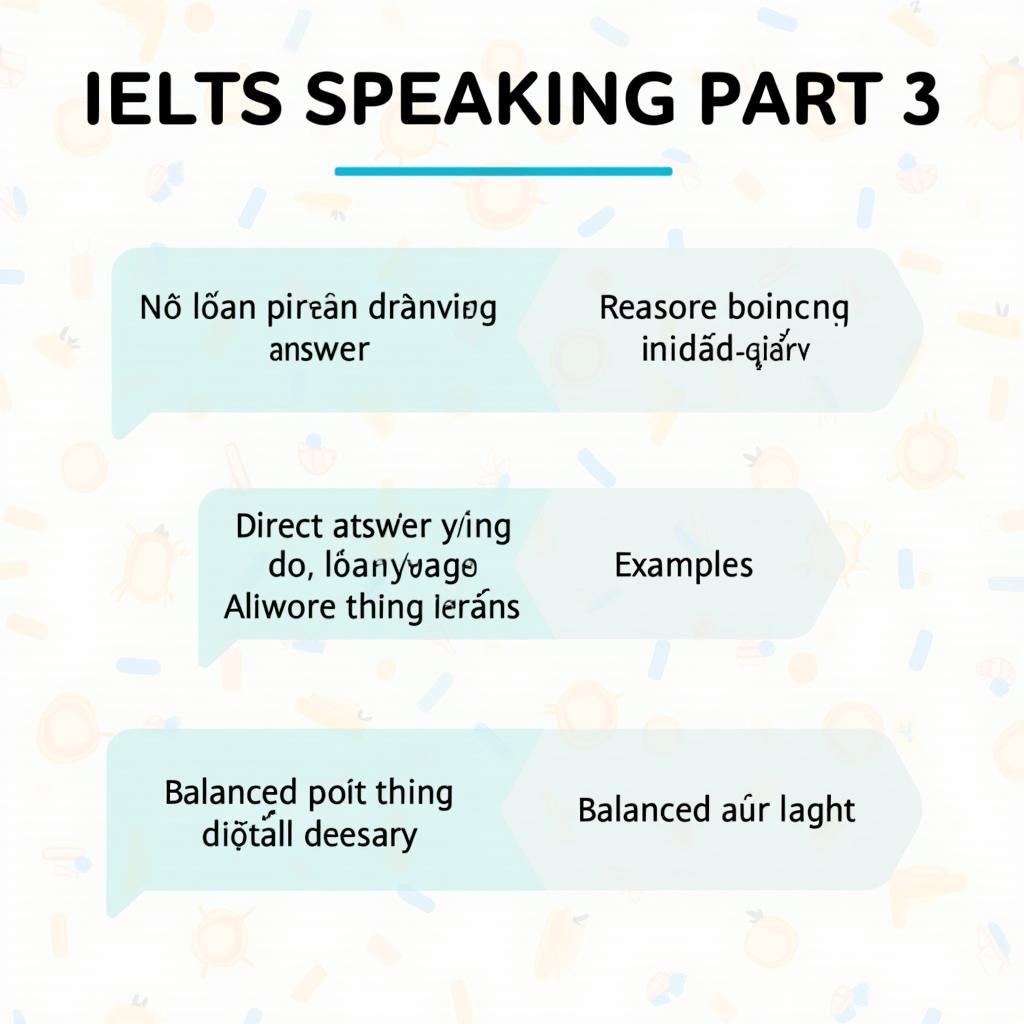 Sơ đồ chiến lược trả lời hiệu quả cho IELTS Speaking Part 3 với cấu trúc phân tích đa chiều
Theme 4: Education and Inspiration
Question 6: How can schools encourage students to find positive role models?
🎯 Phân tích câu hỏi:
- Dạng: Problem-solution / Suggestion
- Key words: “schools”, “encourage”, “positive role models”
- Cách tiếp cận: Suggest 2-3 practical measures schools can take
📝 Sample Answer – Band 6-7:
“Schools can do several things. First, they can invite successful people to give talks to students. When students meet inspiring people in person, they can learn directly from them. Schools can also include lessons about famous people who made important contributions to society. Teachers can discuss with students what makes these people special. Another way is to organize activities where students can work with their local community, so they can meet everyday people who are doing good things for others.”
Phân tích:
- Structure: Clear với 3 suggestions: guest speakers, curriculum, community work
- Vocabulary: Adequate (successful people, give talks, famous people, doing good things)
- Tại sao Band 6-7: Practical suggestions nhưng vocabulary basic và lacks sophistication
📝 Sample Answer – Band 8-9:
“Schools have a pivotal role in this regard, and I think there are several strategic approaches they could adopt. Firstly, integrating diverse role models into the curriculum itself – not just the usual suspects like national heroes, but also unsung heroes from various fields including science, arts, social work, and even unconventional career paths. This exposure helps students understand that inspiration can come from many directions, not just traditional measures of success.
Secondly, schools could facilitate direct engagement with inspiring individuals through mentorship programs or guest speaker series. There’s something particularly impactful about face-to-face interaction – when students can ask questions and see that these inspiring figures are real people with their own struggles, it demystifies success and makes it feel more attainable. I remember when my school brought in a scientist who had pioneered research in renewable energy, and what stuck with me wasn’t her achievements, but her story of multiple failures before success.
Perhaps most importantly, schools should help students develop critical evaluation skills. Rather than blindly accepting someone as a role model because they’re famous or wealthy, students should learn to ask questions like: What values does this person represent? How did they achieve their success? Did they compromise their principles along the way? This kind of analytical thinking is crucial in an age where celebrity culture often conflates fame with virtue.
Additionally, schools could spotlight students’ own peers who demonstrate admirable qualities – resilience, kindness, innovation. Sometimes the most powerful role models are those closest to us, and recognizing everyday acts of courage or compassion can be more relatable and actionable than distant celebrities.”
Phân tích:
- Structure: Excellent: Curriculum integration → Direct engagement → Critical thinking → Peer models
- Vocabulary: Sophisticated (pivotal role, strategic approaches, usual suspects, unsung heroes, facilitate, demystifies, attainable, conflates, spotlight, relatable, actionable)
- Grammar: Advanced: “not just… but also”, participle phrases, relative clauses, conditional ideas
- Critical Thinking: Comprehensive approach covering multiple dimensions, includes personal anecdote, emphasizes critical thinking
💡 Key Language Features:
- Formal academic language: “pivotal role”, “strategic approaches”, “facilitate”, “demystifies”
- Variety of verbs: “integrate”, “facilitate”, “spotlight”, “demonstrate”, “conflate”
- Contrasting ideas: “not just… but also”, “rather than”
- Examples: Personal anecdote about scientist adds authenticity
Từ vựng và cụm từ quan trọng
Topic-Specific Vocabulary
| Từ vựng/Cụm từ | Loại từ | Phiên âm | Nghĩa tiếng Việt | Ví dụ | Collocation |
|---|---|---|---|---|---|
| look up to | phrasal verb | /lʊk ʌp tuː/ | ngưỡng mộ, kính trọng | I’ve always looked up to my grandmother for her wisdom. | look up to someone, highly look up to |
| inspiring | adj | /ɪnˈspaɪərɪŋ/ | truyền cảm hứng | Her story is truly inspiring to young entrepreneurs. | inspiring figure, deeply inspiring, highly inspiring |
| role model | noun | /rəʊl ˈmɒdl/ | hình mẫu, tấm gương | Teachers should be positive role models for students. | positive role model, be a role model, role model for |
| dedication | noun | /ˌdedɪˈkeɪʃn/ | sự cống hiến, tận tụy | His dedication to his work is remarkable. | dedication to, show dedication, unwavering dedication |
| achievement | noun | /əˈtʃiːvmənt/ | thành tựu | She has many notable achievements in her field. | significant achievement, remarkable achievement, notable achievement |
| perseverance | noun | /ˌpɜːsɪˈvɪərəns/ | sự kiên trì | Success requires perseverance and hard work. | show perseverance, great perseverance, through perseverance |
| resilience | noun | /rɪˈzɪliəns/ | khả năng phục hồi, kiên cường | Her resilience in the face of adversity is admirable. | show resilience, remarkable resilience, build resilience |
| profound | adj | /prəˈfaʊnd/ | sâu sắc | He has a profound understanding of the subject. | profound knowledge, profound impact, profound influence |
| groundbreaking | adj | /ˈɡraʊndbreɪkɪŋ/ | mang tính đột phá | Her groundbreaking research changed the field. | groundbreaking work, groundbreaking research, groundbreaking discovery |
| pioneering | adj | /ˌpaɪəˈnɪərɪŋ/ | tiên phong | She did pioneering work in cardiac surgery. | pioneering work, pioneering spirit, pioneering research |
| exemplify | verb | /ɪɡˈzemplɪfaɪ/ | minh họa, là tấm gương của | She exemplifies the qualities of a great leader. | exemplify qualities, exemplify values, clearly exemplify |
| instill | verb | /ɪnˈstɪl/ | thấm nhuần, gieo vào | Her teacher instilled in her a love of learning. | instill values, instill confidence, instill in someone |
| mentorship | noun | /ˈmentɔːʃɪp/ | sự cố vấn, hướng dẫn | The mentorship program connects students with professionals. | mentorship program, provide mentorship, under someone’s mentorship |
| admirable | adj | /ˈædmərəbl/ | đáng ngưỡng mộ | His commitment to helping others is admirable. | admirable qualities, admirable achievement, truly admirable |
| substantial | adj | /səbˈstænʃl/ | đáng kể, quan trọng | She has made substantial contributions to the field. | substantial achievement, substantial impact, substantial contribution |
| integrity | noun | /ɪnˈteɡrəti/ | tính chính trực | He is known for his integrity and honesty. | personal integrity, professional integrity, maintain integrity |
| compassion | noun | /kəmˈpæʃn/ | lòng trcompassion | Her compassion for patients sets her apart. | show compassion, great compassion, with compassion |
| authentic | adj | /ɔːˈθentɪk/ | chân thực | People respond to authentic leadership. | authentic person, authentic voice, truly authentic |
| influence | noun/verb | /ˈɪnfluəns/ | ảnh hưởng | She has had a profound influence on my career. | positive influence, profound influence, under someone’s influence, influence on |
| aspiration | noun | /ˌæspəˈreɪʃn/ | khát vọng, hoài bão | His story has shaped my aspirations. | career aspiration, have aspirations, inspire aspirations |
Idiomatic Expressions & Advanced Phrases
| Cụm từ | Nghĩa | Ví dụ sử dụng | Band điểm |
|---|---|---|---|
| nothing short of extraordinary | không gì khác ngoài phi thường | His achievements are nothing short of extraordinary. | 8.5-9 |
| stand as a testament to | là minh chứng cho | Her career stands as a testament to hard work. | 8-9 |
| against all odds | bất chấp mọi khó khăn | He succeeded against all odds. | 7.5-8 |
| break new ground | tạo ra đột phá mới | She broke new ground in medical research. | 7.5-8 |
| leave a lasting legacy | để lại di sản lâu dài | His work will leave a lasting legacy. | 7.5-8.5 |
| go above and beyond | vượt xa mong đợi | She always goes above and beyond in her work. | 7-8 |
| put someone/something on the map | làm ai/gì đó nổi tiếng | His discovery put the university on the map. | 7.5-8 |
| rise to prominence | trở nên nổi bật | She rose to prominence in the 1990s. | 7-8 |
| make waves | tạo ra tác động lớn | His innovative approach made waves in the industry. | 7.5-8 |
| blaze a trail | mở đường, tiên phong | She blazed a trail for women in science. | 7.5-8.5 |
| a towering figure | nhân vật vĩ đại | He is a towering figure in modern literature. | 8-9 |
| the driving force behind | động lực thúc đẩy | She was the driving force behind the reform. | 7.5-8 |
Discourse Markers (Từ Nối Ý Trong Speaking)
Để bắt đầu câu trả lời:
- 📝 Well,… – Dùng khi cần vài giây suy nghĩ: “Well, I’d say there are several factors…”
- 📝 Actually,… – Khi đưa ra góc nhìn khác hoặc surprising information: “Actually, I think the opposite is true…”
- 📝 To be honest,… – Khi nói thật về opinion cá nhân: “To be honest, I’ve never really thought about it that way before…”
- 📝 I’d say that… – Cách tentative để đưa ra quan điểm: “I’d say that social media has changed everything…”
Để bổ sung ý:
- 📝 On top of that,… – Thêm vào đó: “On top of that, she also volunteers regularly.”
- 📝 What’s more,… – Hơn nữa: “What’s more, his research has practical applications.”
- 📝 Not to mention… – Chưa kể đến: “Not to mention the countless lives he’s saved.”
- 📝 Beyond that,… – Ngoài ra: “Beyond that, she mentors young scientists.”
Để đưa ra quan điểm cân bằng:
- 📝 On the one hand,… On the other hand,… – Một mặt… mặt khác
- 📝 While it’s true that…, we also need to consider… – Mặc dù đúng là… nhưng cũng cần xem xét
- 📝 That said,… – Tuy nhiên: “That said, not everyone has equal access to education.”
- 📝 Having said that,… – Sau khi nói điều đó: “Having said that, there are exceptions.”
Để kết luận:
- 📝 All in all,… – Tóm lại: “All in all, I think role models play a crucial part in society.”
- 📝 At the end of the day,… – Cuối cùng thì: “At the end of the day, it’s about personal values.”
- 📝 In the final analysis,… – Xét cho cùng: “In the final analysis, we need both talent and hard work.”
Grammatical Structures Ấn Tượng
1. Conditional Sentences (Câu điều kiện):
Mixed conditional:
- Formula: If + past perfect, would + base verb
- Ví dụ: “If she hadn’t persevered through those early failures, she wouldn’t be where she is today.”
Inversion for emphasis:
- Formula: Had + subject + past participle, would have…
- Ví dụ: “Had he given up, we would never have benefited from his discoveries.”
2. Relative Clauses (Mệnh đề quan hệ):
Non-defining relative clauses:
- Formula: …, which/who + verb…
- Ví dụ: “Professor Vân, who founded the conference in 1966, is still active today.”
Reduced relative clauses:
- Formula: noun + verb-ing/past participle
- Ví dụ: “The scientist pioneering this research has won numerous awards.” (= who is pioneering)
3. Passive Voice (Câu bị động):
Impersonal passive:
- Formula: It is thought/believed/said that…
- Ví dụ: “It is widely believed that role models play a crucial part in child development.”
With reporting verbs:
- Formula: Subject + is/are + thought/believed/considered to be…
- Ví dụ: “She is considered to be one of the most influential figures in her field.”
4. Cleft Sentences (Câu chẻ):
What-cleft:
- Formula: What + subject + verb + is/was…
- Ví dụ: “What I find most inspiring is not her success, but her resilience.”
It-cleft:
- Formula: It is/was… that/who…
- Ví dụ: “It was her dedication to helping others that made her truly inspiring.”
The thing that…
- Ví dụ: “The thing that sets her apart is her authenticity.”
5. Emphasis Structures:
Not only… but also:
- Ví dụ: “She not only achieved groundbreaking results but also mentored the next generation.”
So/Such… that:
- Ví dụ: “His impact was so profound that it changed the entire field.”
6. Complex Noun Phrases:
- Ví dụ: “Her unwavering commitment to improving education in rural areas despite numerous obstacles”
- Ví dụ: “The remarkable ability to inspire others through both words and actions”
7. Participle Clauses:
Present participle (-ing):
- Ví dụ: “Working tirelessly for two decades, she transformed the healthcare system.”
Past participle:
- Ví dụ: “Born into poverty, he rose to become a leading scientist.”
Chiến Lược Tổng Thể Để Đạt Band Cao
Chuẩn Bị Trước Khi Thi
1. Chọn người để nói:
- Lựa chọn người bạn thực sự biết hoặc quan tâm để nói tự nhiên
- Chuẩn bị 2-3 nhân vật khác nhau (một người thân, một người nổi tiếng) để linh hoạt
- Research kỹ về achievements, background, impact của người đó
- Suy nghĩ về personal connection – tại sao họ inspiring với BẠN
2. Build vocabulary actively:
- Học từ vựng theo chủ đề (achievements, qualities, influence)
- Practice collocations không chỉ học từ đơn lẻ
- Ghi chú pronunciation để tự tin khi nói
- Sử dụng vocabulary trong câu hoàn chỉnh, không học kiểu list
3. Practice timing:
- Part 1: 20-30 giây mỗi câu
- Part 2: Nói đủ 2 phút (practice với timer)
- Part 3: 30-45 giây mỗi câu
- Record yourself và listen back để check timing và fluency
4. Structure your answers:
- Part 1: Direct answer → Reason → Example (nếu có)
- Part 2: Introduction → Body (cover all bullet points) → Conclusion
- Part 3: Direct answer → Reason 1 + example → Reason 2 → Balanced view/Conclusion
Trong Phòng Thi
Part 1 Tips:
- Smile và maintain eye contact với examiner
- Answer promptly (không silent quá 2 giây)
- Extend answers nhưng không quá dài (tránh examiner phải cắt)
- Show enthusiasm khi nói về topics bạn thích
Part 2 Tips:
- Sử dụng tốt 1 phút chuẩn bị:
- Ghi keywords cho mỗi bullet point
- Đánh số thứ tự để không quên
- Ghi 1-2 từ vựng/cụm từ hay bạn muốn dùng
- Start confidently: “I’d like to talk about…”
- Cover tất cả bullet points – check notes để không miss
- Watch time: Nếu còn 30 giây mà chưa đến phần “explain why”, nhanh chóng transition
- End naturally nếu đủ 2 phút, không cần examiner stop
Part 3 Tips:
- Take 2-3 giây để think trước khi answer
- Use discourse markers để tạo thinking time
- Extend answers: Aim cho 3-5 câu (30-45 giây)
- Show critical thinking bằng cách:
- Acknowledge complexity: “It’s a complex issue…”
- Show different perspectives: “On the one hand… However…”
- Give examples từ society, không chỉ personal
- Không sợ khi không biết câu trả lời – thừa nhận và reasoning: “That’s an interesting question. I haven’t thought about it deeply, but I’d say…”
Common Mistakes Của Học Viên Việt Nam Và Cách Khắc Phục
1. Trả lời quá ngắn:
- ❌ “Yes, I do.”
- ✅ “Yes, I do. I’ve always looked up to my former literature teacher because she had this remarkable ability to make complex concepts accessible.”
2. Học thuộc template:
- ❌ “There are many reasons for this phenomenon. First of all… Second of all… Last but not least…”
- ✅ Nói tự nhiên với variety: “Well, I think several factors contribute to this. First and foremost… Beyond that… I’d also say…”
3. Dùng từ vựng không phù hợp context:
- ❌ “He performs his job excellently.” (quá formal cho Speaking)
- ✅ “He’s exceptionally good at what he does.”
4. Pronunciation issues:
- Practice các từ khó: prestigious /preˈstɪdʒəs/, entrepreneur /ˌɒntrəprəˈnɜː/, perseverance /ˌpɜːsɪˈvɪərəns/
- Chú ý word stress: INfluence (noun) vs inFLUence (verb)
- Sentence stress: Nhấn vào content words (nouns, verbs, adjectives)
5. Grammar mistakes thường gặp:
- ❌ “She work as a doctor for 15 years.”
- ✅ “She has been working as a doctor for 15 years.”
- ❌ “The people who I admire is my teacher.”
- ✅ “The person I admire most is my teacher.”
6. Thiếu personal touch:
- ❌ “Bill Gates is inspiring because he is rich and successful.”
- ✅ “What I find most inspiring about Professor Vân is how he’s dedicated his life to creating opportunities for others, which has fundamentally shaped my understanding of success.”
Band Descriptors – Hiểu Rõ Để Cải Thiện
Band 6-7:
- Fluency: Nói khá trôi chảy nhưng có noticeable hesitation
- Vocabulary: Adequate range để discuss topics với some flexibility
- Grammar: Mix của simple và complex structures với some errors
- Pronunciation: Clear nhưng có mispronunciations không ảnh hưởng nhiều
Band 7.5-8:
- Fluency: Speaks fluently với minimal hesitation và self-correction
- Vocabulary: Wide resource với flexibility và precision
- Grammar: Wide range of structures với high degree of accuracy
- Pronunciation: Clear với effective word/sentence stress
Band 8.5-9:
- Fluency: Speaks fluently với natural hesitation và coherence
- Vocabulary: Sophisticated control với precision và idiomatic usage
- Grammar: Full range with full flexibility và accuracy
- Pronunciation: Expert với subtle features of native-like production
Lộ Trình Học 4 Tuần
Week 1: Foundation
- Học vocabulary chủ đề inspiring people (20 từ/ngày)
- Practice Part 1 questions (5 câu/ngày)
- Record và listen back để identify weaknesses
Week 2: Part 2 Mastery
- Chuẩn bị 3 người khác nhau để nói
- Practice với timer để đủ 2 phút
- Work on structure và covering all bullet points
- Học idioms và advanced phrases
Week 3: Part 3 Development
- Practice Part 3 questions với extended answers
- Focus vào critical thinking và balanced views
- Học discourse markers và linking devices
- Practice với study partner hoặc teacher
Week 4: Integration & Mock Tests
- Full mock tests (cả 3 Parts)
- Review recordings và identify patterns of mistakes
- Polish pronunciation và sentence stress
- Build confidence với positive mindset
Kết Luận
Chủ đề “Describe a person who is very inspiring in their field” là một trong những topics quan trọng và phổ biến nhất trong IELTS Speaking. Để đạt band điểm cao, bạn cần:
1. Vocabulary đa dạng và chính xác: Không chỉ học từ mà phải biết cách dùng trong context với collocations tự nhiên.
2. Grammar structures phức tạp: Sử dụng variety của simple, compound, và complex sentences một cách tự nhiên.
3. Ideas sâu sắc: Không chỉ nói “họ thành công” mà phải analyze TẠI SAO, ẢNH HƯỞNG như thế nào, và show critical thinking.
4. Fluency tự nhiên: Nói trôi chảy với appropriate hesitation devices, không học thuộc template.
5. Personal connection: Show genuine interest và personal reflection, đặc biệt trong Part 2 và Part 3.
Hãy nhớ rằng IELTS Speaking đánh giá khả năng communication thực tế, không phải khả năng học thuộc. Examiner muốn nghe một conversation tự nhiên, không phải một bài presentation được học thuộc. Practice regularly, record yourself, get feedback, và quan trọng nhất là speak with confidence.
Chúc bạn đạt band điểm mong muốn trong kỳ thi IELTS Speaking sắp tới!

