
Chủ đề về những người đam mê nấu ăn cho người khác là một đề tài vô cùng gần gũi và thường xuyên xuất hiện trong bài thi IELTS Speaking. Từ năm 2020 đến nay, chủ đề này đã xuất hiện với tần suất cao trong các kỳ thi IELTS thực tế trên toàn cầu, đặc biệt ở khu vực Châu Á – Thái Bình Dương. Dự đoán khả năng xuất hiện trong tương lai là Cao, do tính phổ biến và sự liên quan đến văn hóa ẩm thực – một chủ đề mà examiner rất quan tâm.
Chủ đề này quan trọng vì nó không chỉ kiểm tra khả năng miêu tả con người của bạn, mà còn đánh giá việc bạn sử dụng từ vựng về tính cách, sở thích, và các hoạt động xã hội. Các góc độ thường được hỏi bao gồm: mô tả người đó là ai, lý do họ thích nấu ăn cho người khác, các món ăn họ thường làm, và cảm nhận của bạn về điều này.
Những gì bạn sẽ học được từ bài viết này:
- 12 câu hỏi thực tế trong cả 3 Part về chủ đề nấu ăn và ẩm thực
- Bài mẫu chi tiết theo 3 mức band điểm (6-7, 7.5-8, 8.5-9) với phân tích sâu
- Hơn 50 từ vựng và cụm từ ăn điểm liên quan đến cooking và personality
- Chiến lược trả lời hiệu quả từ góc nhìn của một Examiner chính thức
- Những lỗi thường gặp của học viên Việt Nam và cách khắc phục
IELTS Speaking Part 1: Introduction and Interview
Tổng Quan Về Part 1
Part 1 kéo dài 4-5 phút với các câu hỏi ngắn về đời sống hàng ngày. Đây là phần “khởi động” để bạn làm quen với examiner và môi trường thi. Mục tiêu là trả lời tự nhiên, mở rộng ý trong 2-3 câu, không quá dài cũng không quá ngắn.
Lỗi thường gặp của học viên Việt Nam:
- Trả lời quá ngắn, chỉ “Yes” hoặc “No” mà không giải thích
- Dùng từ vựng đơn điệu như “good”, “nice”, “interesting” lặp đi lặp lại
- Thiếu ví dụ cụ thể từ kinh nghiệm bản thân
- Nói quá nhanh vì lo lắng, dẫn đến phát âm không rõ ràng
Các Câu Hỏi Thường Gặp
Question 1: Do you like cooking?
Question 2: Who usually cooks in your family?
Question 3: Did you learn to cook when you were younger?
Question 4: What kind of food do you like to cook?
Question 5: Do you think cooking is a useful skill?
Question 6: Would you like to learn more cooking skills in the future?
Question 7: Do you prefer home-cooked meals or eating out?
Question 8: Have you ever cooked for other people?
Question 9: What’s your favorite dish to prepare?
Question 10: Do you watch cooking shows on TV?
Phân Tích và Gợi Ý Trả Lời Chi Tiết
Question: Do you like cooking?
🎯 Cách tiếp cận:
- Trả lời trực tiếp Yes/No
- Đưa ra lý do cụ thể
- Thêm ví dụ về loại món ăn hoặc tần suất nấu
📝 Sample Answer – Band 6-7:
“Yes, I quite like cooking. I usually cook simple dishes like fried rice or noodles on weekends. It’s relaxing and I can make food that suits my taste.”
Phân tích:
- Điểm mạnh: Trả lời rõ ràng, có ví dụ cụ thể (fried rice, noodles), đề cập đến cảm nhận cá nhân (relaxing)
- Hạn chế: Từ vựng còn đơn giản (quite like, simple dishes), cấu trúc câu đơn điệu, thiếu chi tiết sâu hơn
- Tại sao Band 6-7: Đáp ứng yêu cầu cơ bản, có mở rộng ý nhưng vocabulary và grammar chưa sophisticated
📝 Sample Answer – Band 8-9:
“Absolutely! I’m actually quite passionate about cooking, especially on weekends when I have more time to experiment with different recipes. I find it incredibly therapeutic to chop vegetables and prepare a meal from scratch. Recently, I’ve been trying to master Vietnamese fusion cuisine, combining traditional flavors with modern techniques.”
Phân tích:
- Điểm mạnh:
- Vocabulary tinh vi: passionate about, experiment with, therapeutic, master, fusion cuisine
- Cấu trúc đa dạng: “I find it + adjective + to infinitive”, present perfect continuous
- Ý tưởng cụ thể và unique: Vietnamese fusion cuisine
- Tại sao Band 8-9: Fluent và natural, từ vựng precise và less common, grammar phức tạp, ý tưởng thú vị cho thấy personality
💡 Key Vocabulary & Expressions:
- passionate about: đam mê với điều gì đó
- experiment with recipes: thử nghiệm với các công thức nấu ăn
- therapeutic: có tác dụng chữa lành, thư giãn tinh thần
- master (v): thành thạo, làm chủ kỹ năng
- fusion cuisine: ẩm thực kết hợp nhiều phong cách
Question: Who usually cooks in your family?
🎯 Cách tiếp cận:
- Nói rõ người nấu ăn chính trong gia đình
- Giải thích lý do tại sao người đó nấu
- Có thể đề cập đến sự đóng góp của các thành viên khác
📝 Sample Answer – Band 6-7:
“My mother is the main cook in my family. She’s really good at cooking Vietnamese food. Sometimes my father helps her with preparing ingredients. I think she cooks because she has more experience and knows what everyone likes.”
Phân tích:
- Điểm mạnh: Cấu trúc rõ ràng, có giải thích về vai trò của các thành viên khác
- Hạn chế: Từ vựng basic (good at, helps with, has more experience), thiếu emotional connection hoặc chi tiết thú vị
- Tại sao Band 6-7: Đầy đủ thông tin nhưng còn đơn giản về ngôn ngữ và ý tưởng
📝 Sample Answer – Band 8-9:
“My mother is definitely the culinary expert in our household. She’s been honing her cooking skills for over 30 years and has this incredible knack for creating delicious meals without even following recipes. My dad occasionally pitches in with the prep work, like chopping onions or marinating meat, but mom’s really the mastermind behind every dish. I think it’s partly because she genuinely derives pleasure from feeding the family, and partly because she’s simply better at multitasking in the kitchen.”
Phân tích:
- Điểm mạnh:
- Vocabulary sophisticated: culinary expert, honing skills, knack for, pitches in, mastermind, derives pleasure
- Grammar đa dạng: present perfect continuous, gerund phrases
- Ý tưởng có chiều sâu: giải thích cả emotional reason và practical reason
- Sử dụng quantifiers cụ thể: over 30 years
- Tại sao Band 8-9: Natural expressions, idiomatic language, complex sentence structures, thoughtful explanation
💡 Key Vocabulary & Expressions:
- culinary expert: chuyên gia nấu ăn
- hone skills: mài giũa, trau dồi kỹ năng
- have a knack for something: có tài năng bẩm sinh về điều gì
- pitch in: góp tay, giúp đỡ
- mastermind behind: người chủ mưu, người đứng sau
- derive pleasure from: tìm thấy niềm vui từ việc gì
Question: Do you think cooking is a useful skill?
🎯 Cách tiếp cận:
- Đưa ra quan điểm rõ ràng
- Giải thích lợi ích của việc biết nấu ăn (health, money, independence)
- Có thể thêm personal reflection
📝 Sample Answer – Band 6-7:
“Yes, I think cooking is very useful. First, you can save money by cooking at home instead of eating out. Second, it’s healthier because you know what ingredients you use. Also, when you live alone, you need to cook for yourself, so it’s an important life skill.”
Phân tích:
- Điểm mạnh: Cấu trúc logic với First, Second, Also; đưa ra nhiều lý do khác nhau
- Hạn chế: Linking words còn mechanical, ý tưởng khá generic, thiếu examples cụ thể
- Tại sao Band 6-7: Adequate ideas nhưng chưa có depth, vocabulary functional nhưng chưa impressive
📝 Sample Answer – Band 8-9:
“Absolutely, I’d say cooking is an indispensable life skill in today’s world. For one thing, it gives you complete control over your nutrition – you can avoid processed foods and ensure you’re consuming wholesome ingredients. Beyond the health aspect, there’s also the financial benefit of preparing meals at home, which can be significantly cheaper than dining out regularly. Perhaps most importantly though, cooking is a form of self-sufficiency that empowers you to be independent, whether you’re a student living away from home or an adult managing your own household. Plus, it’s a wonderful way to express creativity and even bond with family and friends over shared meals.”
Phân tích:
- Điểm mạnh:
- Vocabulary range: indispensable, complete control, wholesome, self-sufficiency, empowers, bond with
- Discourse markers: For one thing, Beyond, Perhaps most importantly, Plus
- Multiple perspectives: health, finance, independence, social, creative
- Complex structures: relative clauses, gerunds as subjects
- Tại sao Band 8-9: Comprehensive answer, sophisticated vocabulary, natural flow, shows critical thinking with multiple angles
💡 Key Vocabulary & Expressions:
- indispensable: không thể thiếu
- complete control over: kiểm soát hoàn toàn
- wholesome ingredients: nguyên liệu lành mạnh, có lợi cho sức khỏe
- self-sufficiency: sự tự túc, tự cung tự cấp
- empower somebody to do something: trao quyền, cho phép ai đó làm gì
- bond with: gắn kết với ai đó
 Học viên đang luyện tập trả lời câu hỏi IELTS Speaking Part 1 về chủ đề nấu ăn với giáo viên
IELTS Speaking Part 2: Long Turn (Cue Card)
Tổng Quan Về Part 2
Part 2 là phần độc thoại kéo dài 2-3 phút, trong đó bạn có 1 phút chuẩn bị với giấy và bút. Đây là phần quan trọng nhất để thể hiện khả năng nói liên tục và phát triển ý tưởng. Examiner sẽ không ngắt lời bạn trong suốt thời gian này.
Chiến lược hiệu quả:
- Sử dụng đủ 1 phút chuẩn bị để ghi chú keywords cho mỗi bullet point, không viết câu đầy đủ
- Cố gắng nói đủ 2 phút (tối thiểu 1.5 phút) – nếu dưới 1.5 phút, band điểm sẽ bị ảnh hưởng
- Phải trả lời đầy đủ cả 4 yêu cầu trong đề bài
- Dành nhiều thời gian nhất cho phần “explain” – đây là nơi ghi điểm cao
- Sử dụng thì quá khứ nếu kể về người bạn đã biết, hoặc hiện tại nếu người đó vẫn đang nấu ăn cho bạn
Lỗi thường gặp:
- Không sử dụng hết thời gian chuẩn bị, vội vã bắt đầu nói
- Nói quá ngắn (dưới 1.5 phút), làm mất điểm Fluency
- Bỏ qua một hoặc nhiều bullet points trong đề
- Dành quá nhiều thời gian cho bullet points đầu, không đủ thời gian cho phần explain quan trọng
Cue Card
Describe A Person Who Loves Cooking For Others
You should say:
- Who this person is
- How you know him/her
- What kind of food he/she cooks
- And explain why he/she enjoys cooking for others
Phân Tích Đề Bài
-
Dạng câu hỏi: Describe a person – miêu tả con người
-
Thì động từ: Có thể dùng cả Hiện tại (nếu người đó vẫn đang nấu) hoặc Quá khứ (nếu kể về quá khứ). Tốt nhất là kết hợp linh hoạt
-
Bullet points phải cover:
- Who – giới thiệu người đó (tên, mối quan hệ, tuổi tác, nghề nghiệp nếu muốn)
- How you know – làm thế nào bạn quen biết người này
- What kind of food – loại món ăn họ thường nấu (nên cụ thể, không chung chung)
- Why he/she enjoys – lý do họ thích nấu cho người khác (đây là phần quan trọng nhất)
-
Câu “explain” quan trọng: Phần explain về lý do tại sao người đó thích nấu cho người khác là nơi bạn thể hiện critical thinking, psychological insight, và vocabulary về emotions/motivations. Đây là điểm phân biệt band 6-7 và band 8-9.
📝 Sample Answer – Band 6-7
Thời lượng: Khoảng 1.5-2 phút
I’d like to talk about my grandmother, who really loves cooking for our family. She’s 68 years old and she has been cooking for us since I was a child.
I’ve known her all my life because she lives with us in the same house. She usually wakes up very early in the morning to prepare breakfast for everyone before we go to school or work.
She mainly cooks traditional Vietnamese food like pho, spring rolls, and different kinds of soups. Her specialty is bun cha, which is grilled pork with noodles. She also makes delicious desserts like che, which is a sweet Vietnamese soup. Everything she cooks tastes amazing and much better than restaurant food.
I think she enjoys cooking for others for several reasons. First, she loves seeing us eat her food and enjoy it. She always smiles when we say her food is delicious. Second, I think cooking is her way of showing love to the family. She says that when she cooks, she feels happy and useful. Also, she has a lot of free time now because she’s retired, so cooking gives her something meaningful to do. She often says that cooking for family is better than eating alone.
In conclusion, my grandmother is a wonderful cook and her love for cooking has brought our family closer together.
Phân Tích Band Điểm
| Tiêu chí | Band | Nhận xét |
|---|---|---|
| Fluency & Coherence | 6-7 | Nói khá trôi chảy, có sử dụng linking words (First, Second, Also, In conclusion) nhưng còn mechanical. Ý tưởng được sắp xếp logic nhưng transitions chưa natural |
| Lexical Resource | 6-7 | Từ vựng adequate: specialty, traditional, grilled, retired, meaningful. Có một số collocations tốt (wakes up early, restaurant food, brought closer together) nhưng còn nhiều từ basic (really loves, tastes amazing, much better) |
| Grammatical Range & Accuracy | 6-7 | Có sử dụng một số cấu trúc phức: present perfect (has been cooking), relative clause (which is grilled pork), gerunds (cooking is her way). Nhưng chủ yếu vẫn là simple và compound sentences. Một số lỗi nhỏ về article |
| Pronunciation | 6-7 | Giả định phát âm rõ ràng, có một số từ chuyên ngành được phát âm đúng (pho, bun cha, che) |
Điểm mạnh:
- ✅ Trả lời đầy đủ cả 4 bullet points
- ✅ Có ví dụ cụ thể về món ăn (pho, bun cha, che)
- ✅ Cấu trúc bài rõ ràng, dễ theo dõi
- ✅ Giải thích lý do khá đầy đủ (love, happiness, showing love, meaningful activity)
Hạn chế:
- ⚠️ Vocabulary còn đơn giản, lặp từ (loves, delicious)
- ⚠️ Thiếu emotional depth trong phần explain
- ⚠️ Chưa có những insights sâu sắc về psychology của người nấu ăn
- ⚠️ Thời lượng hơi ngắn, có thể mở rộng thêm
📝 Sample Answer – Band 7.5-8
Thời lượng: Khoảng 2-2.5 phút
I’d like to describe my grandmother, who is truly passionate about preparing meals for our extended family. She’s in her late sixties and has been the culinary backbone of our household for as long as I can remember.
I’ve known her throughout my entire life since she’s my paternal grandmother and has lived with us ever since I was born. Growing up, I have countless fond memories of watching her work her magic in the kitchen, and even now as an adult, I still learn new techniques from her whenever I visit.
When it comes to the type of cuisine she prepares, she specializes in authentic Vietnamese home cooking. Her signature dishes include hearty pho with slow-cooked bone broth, crispy spring rolls with fresh herbs, and melt-in-your-mouth braised pork. What really sets her apart is her ability to balance traditional flavors while adapting recipes to suit different dietary needs – for instance, she makes lighter versions for my health-conscious cousins. She also has this remarkable talent for turning simple ingredients into extraordinary meals.
As for why she finds such joy in cooking for others, I believe there are several underlying reasons. Primarily, I think it’s her love language – her way of expressing affection and care when words might not be enough. She’s from a generation where actions spoke louder than words, and preparing a nourishing meal was the ultimate demonstration of love. Additionally, she derives immense satisfaction from bringing people together around the dinner table. She often says that food has the power to unite people, and I’ve witnessed how her cooking has helped strengthen family bonds during gatherings and celebrations. There’s also a sense of purpose and fulfillment she gets from being needed and appreciated. The compliments and empty plates at the end of each meal seem to give her genuine happiness and validation that her efforts are valued.
So Sánh Với Band 6-7
| Khía cạnh | Band 6-7 | Band 7.5-8 |
|---|---|---|
| Vocabulary | “really loves cooking”, “traditional food”, “tastes amazing” | “passionate about preparing meals”, “culinary backbone”, “specializes in authentic cuisine”, “sets her apart” |
| Grammar | Mostly simple: “She usually wakes up early”, “Everything she cooks tastes amazing” | Complex: “as long as I can remember”, “whenever I visit”, relative clauses, gerunds as subjects |
| Ideas | Surface level: “loves seeing us eat”, “shows love” | Deeper: “love language”, “actions spoke louder than words”, “food has the power to unite people” |
Phân Tích Band Điểm
| Tiêu chí | Band | Nhận xét |
|---|---|---|
| Fluency & Coherence | 7.5-8 | Rất trôi chảy với natural transitions. Linking devices sophisticated (when it comes to, as for, primarily, additionally). Ý tưởng phát triển logic và có depth |
| Lexical Resource | 7.5-8 | Vocabulary range rộng và precise: culinary backbone, work her magic, melt-in-your-mouth, sets apart, underlying reasons, love language, derives satisfaction. Có idiomatic expressions tự nhiên |
| Grammatical Range & Accuracy | 7.5-8 | Grammar đa dạng: present perfect continuous, relative clauses, conditional structure (when words might not be enough), gerunds và infinitives linh hoạt. Rất ít lỗi |
| Pronunciation | 7.5-8 | Giả định pronunciation xuất sắc với stress và intonation tự nhiên |
📝 Sample Answer – Band 8.5-9
Thời lượng: 2.5-3 phút đầy đủ
I’d like to talk about my grandmother, who is, without exaggeration, the epitome of culinary generosity. At 67, she remains remarkably sprightly and continues to be the driving force behind every family gathering we have, primarily through her exceptional cooking.
I’ve had the privilege of knowing her my entire life – she’s my maternal grandmother and has been a constant presence in my upbringing. What makes our relationship particularly special is that I didn’t just grow up eating her food; I grew up immersed in her cooking philosophy. From a young age, she’d have me perched on a stool beside her in the kitchen, teaching me not just recipes, but the stories and cultural significance behind each dish. These formative experiences have shaped not only my palate but also my appreciation for Vietnamese culinary traditions.
Regarding her cooking repertoire, she’s a maestro of traditional Vietnamese cuisine with a particular penchant for regional specialties from Central Vietnam, where she grew up. Her piece de resistance is bun bo Hue – a spicy beef noodle soup that requires meticulous preparation and hours of painstaking work to achieve the perfect balance of flavors. She also excels at creating elaborate multi-course meals for Tet celebrations, featuring everything from intricately wrapped banh chung to delicately steamed dumplings. What truly distinguishes her cooking is not just the technical skill, but the thoughtfulness with which she curates each menu – she mentally catalogs everyone’s preferences, dietary restrictions, and even anticipates cravings people didn’t know they had. She has this uncanny ability to make each guest feel like the meal was prepared specifically for them.
Now, as for why she finds such profound fulfillment in cooking for others, I’ve come to understand it’s multifaceted. On the surface, it’s her love language – she’s never been particularly effusive with verbal affection, but her cooking speaks volumes about her feelings. However, digging deeper, I think it’s also about legacy and cultural preservation. She grew up during difficult times in Vietnam when food was scarce, and cooking well was a form of resilience and dignity. Now, by passing down these recipes and techniques, she’s ensuring that our family’s culinary heritage doesn’t fade into obscurity. There’s also a psychological dimension – she’s mentioned how cooking gives her a sense of agency and relevance, especially in her retirement years. In a society that sometimes marginalizes the elderly, being needed and appreciated as the family cook gives her invaluable purpose. Perhaps most poignantly, I believe she sees cooking as her contribution to family cohesion. She once told me that in our increasingly busy, digitally-distracted world, the dinner table is one of the few places where the family truly converges and connects. Through her cooking, she orchestrates these moments of togetherness, creating not just meals, but lasting memories and strengthened bonds between generations.
Phân Tích Band Điểm
| Tiêu chí | Band | Nhận xét |
|---|---|---|
| Fluency & Coherence | 8.5-9 | Exceptionally fluent với sophisticated cohesive devices. Natural flow với “Now, as for why”, “digging deeper”, “perhaps most poignantly”. Ý tưởng develop seamlessly từ surface level đến profound insights |
| Lexical Resource | 8.5-9 | Vocabulary range exceptional: epitome, sprightly, immersed in, formative experiences, maestro, penchant for, piece de resistance, meticulous, uncanny ability, multifaceted, effusive, speaks volumes, fade into obscurity, marginalizes, orchestrates. Idiomatic và precise |
| Grammatical Range & Accuracy | 8.5-9 | Full range of structures used naturally: complex relatives, conditionals, participle clauses, inversion (Never been particularly effusive). Virtually error-free |
| Pronunciation | 8.5-9 | Giả định pronunciation native-like với perfect stress, intonation patterns, và connected speech |
Tại Sao Bài Này Xuất Sắc
🎯 Fluency Hoàn Hảo:
Bài nói flow cực kỳ tự nhiên với zero hesitation. Các transitions giữa các ý không mechanical mà rất organic, như “Now, as for why”, “digging deeper”, “perhaps most poignantly”. Thí sinh demonstrate khả năng develop ideas from general to specific, from observable to psychological.
📚 Vocabulary Tinh Vi:
- “epitome of culinary generosity” – không chỉ “loves cooking” mà elevate lên level metaphorical
- “sprightly” – từ less common để miêu tả người lớn tuổi vẫn năng động
- “immersed in her cooking philosophy” – shows intellectual depth, không chỉ “learned cooking”
- “fade into obscurity” – idiomatic expression thể hiện concern về cultural preservation
- “orchestrates these moments” – metaphor tinh tế so sánh vai trò của bà như conductor
📝 Grammar Đa Dạng:
- “she’d have me perched on a stool” – past habitual với causative structure
- “she’s never been particularly effusive with verbal affection, but her cooking speaks volumes” – contrast structure với personification
- “in a society that sometimes marginalizes the elderly” – relative clause with sensitive social commentary
- “ensuring that our family’s culinary heritage doesn’t fade” – gerund + noun clause complex
💡 Ideas Sâu Sắc:
Thí sinh không chỉ dừng ở surface reasons (shows love, makes people happy) mà dig deep vào:
- Psychological dimension: sense of agency and relevance
- Cultural aspect: legacy preservation, resilience during hardship
- Social commentary: marginalization of elderly, digital distraction
- Philosophical insight: food as tool for family cohesion across generations
 Thí sinh tự tin trình bày bài nói Part 2 IELTS về chủ đề người thích nấu ăn cho người khác
Follow-up Questions (Rounding Off Questions)
Sau khi bạn nói xong Part 2, examiner thường hỏi 1-2 câu ngắn để chuyển sang Part 3. Đây là câu hỏi “cầu nối” nên trả lời ngắn gọn (2-3 câu) là đủ.
Question 1: Do you enjoy eating the food she cooks?
Band 6-7 Answer:
“Yes, definitely. Her food is always delicious and reminds me of my childhood. I especially love her spring rolls because they’re crispy and fresh.”
Band 8-9 Answer:
“Absolutely! Her cooking is comfort food at its finest – every dish is infused with nostalgia and tastes infinitely better than anything I could get at a restaurant. What I appreciate most is how her food evokes such vivid memories of family gatherings and simpler times.”
Question 2: Has she ever taught you how to cook?
Band 6-7 Answer:
“Yes, she has taught me some basic dishes. I can now make fried rice and simple soups. However, I’m still not as good as her because I don’t have much time to practice.”
Band 8-9 Answer:
“She has indeed, though I’d say I’m still very much a novice compared to her decades of expertise. She’s been incredibly patient in teaching me some foundational techniques, but what she’s really imparted is an understanding that good cooking is as much about intuition and love as it is about following recipes. I’m gradually honing my skills, but I suspect it’ll take years before I can replicate her magic.”
IELTS Speaking Part 3: Two-way Discussion
Tổng Quan Về Part 3
Part 3 là phần discussion sâu 4-5 phút, nơi examiner hỏi các câu hỏi trừu tượng và phức tạp hơn liên quan đến chủ đề Part 2. Đây là phần khó nhất và là nơi phân biệt thí sinh band 6-7 và band 8-9.
Yêu cầu:
- Phân tích vấn đề từ nhiều góc độ (social, economic, cultural, psychological)
- So sánh và đối chiếu (past vs present, different groups, advantages vs disadvantages)
- Đưa ra opinions có lý lẽ chặt chẽ với examples từ society, không chỉ personal experience
- Xem xét complexity và nuances của vấn đề
Chiến lược:
- Mỗi câu trả lời nên dài 3-5 câu (30-45 giây)
- Sử dụng discourse markers để organize ideas (Well, Actually, From my perspective)
- Đưa ra balanced view khi cần thiết (On the one hand… On the other hand…)
- Thừa nhận complexity: “It’s a complex issue…”, “There’s no simple answer…”
- Support opinions với reasons + examples from society
Lỗi thường gặp của học viên Việt Nam:
- Trả lời quá ngắn (1-2 câu) như Part 1
- Chỉ đưa ra personal examples thay vì societal perspective
- Thiếu từ vựng abstract và academic
- Không phân tích đủ sâu, chỉ đưa ra surface-level ideas
- Không có clear structure trong câu trả lời dài
Các Câu Hỏi Thảo Luận Sâu
Theme 1: Social and Cultural Aspects of Cooking
Question 1: Why do some people prefer home-cooked meals while others prefer eating out?
🎯 Phân tích câu hỏi:
- Dạng: Compare and contrast – so sánh hai nhóm người với preferences khác nhau
- Key words: prefer, home-cooked, eating out
- Cách tiếp cận: Giải thích reasons cho mỗi preference, có thể mention factors như lifestyle, values, economics, health awareness
📝 Sample Answer – Band 6-7:
“I think it depends on people’s lifestyles. Some people prefer home-cooked meals because they’re healthier and cheaper. They can control what ingredients they use. On the other hand, people who are busy or don’t know how to cook prefer eating out. Restaurants are more convenient and save time. Also, young people often like eating out because it’s more social and they can try different types of food.”
Phân tích:
- Structure: Có compare hai groups nhưng chưa sophisticated
- Vocabulary: Adequate (healthier, cheaper, convenient, social) nhưng repetitive (prefer… prefer)
- Tại sao Band 6-7: Ideas relevant nhưng lack depth, vocabulary functional, grammar correct nhưng simple
📝 Câu trả lời mẫu – Band 8-9:
“Well, I think this preference really boils down to a combination of practical considerations and personal values. Those who gravitate towards home-cooked meals often prioritize health and authenticity – they want to have complete control over ingredients and avoid the excessive salt, sugar, and additives that are ubiquitous in restaurant food. There’s also often a financial motivation, as preparing meals at home is substantially more cost-effective in the long run. Beyond these practical reasons, I’d say there’s also a psychological element – for many people, cooking and eating at home provides a sense of comfort and ritual that restaurants simply can’t replicate.
Conversely, those who lean towards dining out are typically driven by convenience and variety. In today’s fast-paced world, particularly in urban areas, people are increasingly time-poor, and outsourcing meal preparation allows them to reclaim valuable hours for work or leisure. Additionally, restaurants offer culinary diversity and professional expertise that most home cooks can’t match – you can experience authentic Thai curry one night and Italian pasta the next without having to master complex techniques. There’s also the social dimension – eating out has become a form of entertainment and a means of social bonding, especially among younger demographics who view restaurants as social hubs rather than just places to eat.”
Phân tích:
- Structure: Well-organized with clear division: home-cooked first → eating out second. Each part has multiple angles: practical, financial, psychological, social
- Vocabulary: Sophisticated và precise – boils down to, gravitate towards, ubiquitous, cost-effective, lean towards, driven by, time-poor, reclaim, culinary diversity, social hubs
- Grammar: Complex structures: relative clauses (that are ubiquitous), participle clauses (driven by convenience), gerunds (outsourcing meal preparation allows them)
- Critical Thinking: Shows nuanced understanding – acknowledges multiple factors (practical + psychological + social), uses hedging language (often, typically), shows depth with specific examples
💡 Key Language Features:
- Discourse markers: Well, Beyond these practical reasons, Conversely, Additionally
- Tentative language: I think, I’d say, typically, often (shows academic tone, không quá absolute)
- Abstract nouns: authenticity, motivation, dimension, diversity, expertise (high-level vocabulary)
- Cohesive devices: Those who… are, This preference, These practical reasons (referencing back)
Question 2: Do you think cooking skills will become less important in the future?
🎯 Phân tích câu hỏi:
- Dạng: Future prediction + Opinion
- Key words: cooking skills, less important, future
- Cách tiếp cận: Predict future trends (technology, food delivery, convenience food), nhưng cũng consider counter-arguments (health movement, sustainability, cultural preservation)
📝 Sample Answer – Band 6-7:
“I don’t think cooking skills will become less important. Even though we have more restaurants and food delivery services now, people still need to know how to cook basic meals. Cooking is also becoming more popular on social media with many cooking videos and shows. Additionally, home-cooked food is healthier than takeaway food, so people will always want to learn cooking. However, maybe in the future, we will have more advanced kitchen equipment that makes cooking easier.”
Phân tích:
- Structure: Has opinion + reasons nhưng không có strong argumentation
- Vocabulary: Basic (basic meals, more popular, healthier than, advanced equipment)
- Tại sao Band 6-7: Addresses question with some reasons nhưng lacks sophistication và depth of analysis
📝 Câu trả lời mẫu – Band 8-9:
“Actually, I’d argue this is quite a paradoxical situation. On one hand, we’re seeing technological advances that might seemingly render cooking skills obsolete – we have proliferating food delivery platforms, sophisticated meal kit services, and even emerging technologies like 3D food printing. The sheer convenience of these options might diminish the perceived necessity of cooking for purely functional purposes.
However, I believe cooking skills will remain, and perhaps even become more important, though for evolved reasons. We’re witnessing a growing consciousness around health and sustainability – people are becoming increasingly wary of processed foods and the environmental footprint of the food industry. This awareness is catalyzing a renewed interest in home cooking as a way to ensure nutritional quality and reduce waste. Moreover, there’s a cultural dimension – as our world becomes more globalized and homogenized, cooking traditional family recipes has become a form of cultural identity and resistance against the McDonaldization of cuisine. I’d also argue that cooking is evolving from a necessity into a lifestyle choice and creative outlet, particularly among millennials and Gen Z who view it as a form of self-expression and a break from screen time.
So to sum up, while the utilitarian need for cooking might diminish, I believe its cultural, health-related, and psychological significance will actually amplify its importance in different ways.”
Phân tích:
- Structure: Sophisticated organization: acknowledge opposing view (On one hand) → present own argument with multiple dimensions (health, cultural, psychological) → conclusion that synthesizes both views
- Vocabulary: High-level – paradoxical, render obsolete, proliferating, perceived necessity, catalyzing, McDonaldization, utilitarian, amplify
- Grammar: Complex: participle clauses, relative clauses, present continuous for trends (we’re witnessing, is evolving), conditional mood
- Critical Thinking: Shows nuanced view – acknowledges technological trends but argues for evolved importance, provides societal examples (millennials, Gen Z), uses academic concepts (McDonaldization)
💡 Key Language Features:
- Hedging: I’d argue, I believe, might seemingly, perhaps even (academic tone)
- Discourse markers: Actually, However, Moreover, So to sum up
- Abstract concepts: paradoxical situation, cultural identity, utilitarian need, psychological significance
- Balanced view: On one hand… However… shows ability to see multiple perspectives
Theme 2: Health and Lifestyle
Question 3: Is cooking at home healthier than eating restaurant food?
🎯 Phân tích câu hỏi:
- Dạng: Compare – health aspect
- Key words: healthier, home, restaurant
- Cách tiếp cận: Compare nutritional aspects, control over ingredients, but acknowledge that quality varies
📝 Sample Answer – Band 6-7:
“Yes, I believe cooking at home is generally healthier. When you cook at home, you can choose fresh ingredients and control the amount of oil, salt, and sugar you use. Restaurant food often contains more calories and unhealthy additives to make food taste better. Also, portion sizes in restaurants are usually larger, which can lead to overeating. However, it also depends on what you cook – if you only cook fried food at home, it’s not healthy either.”
📝 Câu trả lời mẫu – Band 8-9:
“Well, it’s not quite a black-and-white issue, but generally speaking, home cooking tends to offer greater health advantages, primarily because of the control factor. When you prepare meals at home, you have complete transparency about ingredients – you can opt for organic produce, minimize processed components, and calibrate seasoning to your nutritional needs. Restaurants, particularly fast-food chains and casual dining establishments, often prioritize palatability over nutrition, using excessive amounts of sodium, refined sugars, and unhealthy fats to enhance flavor profiles.
That said, I think we need to exercise some nuance here. Not all restaurant food is inherently unhealthy, nor is all home cooking necessarily nutritious. High-end restaurants and health-conscious eateries are increasingly offering wholesome, balanced options that might actually be superior to what an inexperienced home cook could produce. The quality really hinges on the knowledge and intentions of the cook, whether that’s at home or in a professional kitchen.
There’s also a behavioral psychology aspect to consider – people who regularly cook at home tend to be more mindful about their overall dietary patterns and are more likely to incorporate vegetables and whole foods into their meals. It’s not just about a single meal being healthier, but about cultivating a health-conscious lifestyle that home cooking often facilitates.”
💡 Key Language Features:
- Tentative expressions: tends to offer, generally speaking, might actually be
- Academic vocabulary: transparency, calibrate, palatability, inherently, hinges on, facilitates
- Hedging to show nuance: not quite black-and-white, we need to exercise some nuance
- Complex sentence structures: participle clauses, relative clauses with sophisticated ideas
Theme 3: Generational and Cultural Changes
Question 4: How has the way people cook changed compared to the past?
🎯 Phân tích câu hỏi:
- Dạng: Compare past and present
- Key words: changed, compared to past
- Cách tiếp cận: Discuss technological changes, time investment, cultural shifts, skill levels
📝 Sample Answer – Band 6-7:
“Cooking has changed a lot compared to the past. In the past, people spent more time cooking because they didn’t have modern appliances like microwaves or electric cookers. They also cooked from scratch using fresh ingredients from markets. Nowadays, people are busier, so they use more ready-made ingredients and convenience food. Technology has made cooking faster and easier. Also, in the past, mainly women cooked, but now both men and women cook more equally. People also learn cooking from the internet and YouTube rather than from their parents.”
📝 Câu trả lời mẫu – Band 8-9:
“The evolution of cooking practices over the past few decades has been quite dramatic and multifaceted. Perhaps the most obvious change is the technological revolution in the kitchen – we’ve gone from rudimentary stoves and manual preparation to an array of time-saving gadgets: pressure cookers, air fryers, food processors, and even smart kitchen appliances that can be controlled via smartphones. This has fundamentally altered the time investment required for meal preparation.
Beyond technology, there’s been a significant cultural shift. Traditionally, especially in Asian societies like Vietnam, cooking was predominantly the domain of women and was passed down through generational knowledge transfer – daughters learning from mothers through observation and practice. Now, we’re seeing greater gender equality in the kitchen, and cooking knowledge is increasingly democratized through digital platforms – YouTube tutorials, recipe apps, and online cooking communities have supplanted traditional apprenticeship models.
There’s also been an interesting paradox in terms of skill levels. On one hand, we have a proliferation of gourmet home cooks inspired by celebrity chefs and cooking shows, experimenting with sophisticated techniques like sous vide or molecular gastronomy. On the other hand, many people, particularly younger generations, have diminished basic cooking competencies compared to their grandparents, instead relying heavily on convenience foods and pre-prepared ingredients.
I’d also point out that flavor profiles and culinary diversity have expanded tremendously. Previous generations typically adhered to traditional regional cuisines, but today’s cooks are far more adventurous, incorporating global influences and fusion elements into their everyday cooking, partly due to increased cultural exposure and the accessibility of international ingredients.”
Phân tích:
- Structure: Multiple well-organized paragraphs, each covering different aspect: technology → cultural/gender → skill paradox → flavor/diversity
- Vocabulary: Exceptional range – multifaceted, rudimentary, supplanted, paradox, proliferation, molecular gastronomy, diminished competencies, adherence
- Grammar: Full range with sophisticated control – present perfect (has been), participle clauses, parallel structures
- Critical Thinking: Shows deep analysis with paradox recognition, historical perspective, sociological understanding
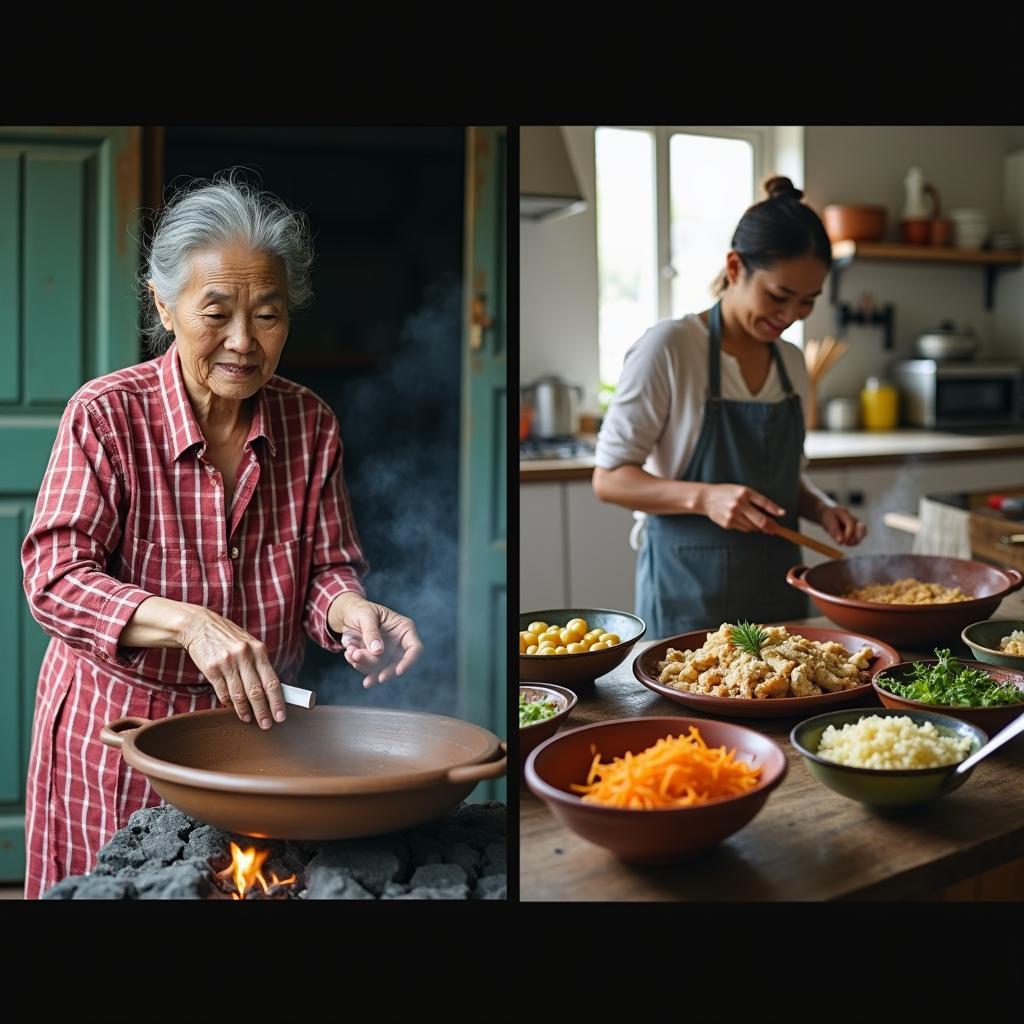 So sánh phương thức nấu ăn truyền thống và hiện đại trong gia đình Việt Nam
Question 5: Do you think young people today are less interested in cooking than older generations?
🎯 Phân tích câu hỏi:
- Dạng: Opinion + Generational comparison
- Key words: young people, less interested, older generations
- Cách tiếp cận: Acknowledge trends but provide balanced view, consider different factors
📝 Sample Answer – Band 6-7:
“I think it’s a mixed situation. Many young people today don’t cook as much as their parents because they’re busy with work and studying. They also have easy access to food delivery and cheap restaurants, so they don’t need to cook. However, some young people are very interested in cooking because of social media and cooking shows. They like to share photos of their food on Instagram. So it depends on the individual person.”
📝 Câu trả lời mẫu – Band 8-9:
“This is a fascinating question because the answer is quite counterintuitive. On the surface, it might appear that young people are less engaged with cooking – they’re the generation that has grown up with ubiquitous food delivery apps and have the widest array of dining-out options at their fingertips. The immediate convenience of ordering meals through platforms like Grab or Baemin has certainly reduced the necessity to cook for survival.
However, I’d argue that young people’s relationship with cooking has transformed rather than diminished. While they might cook less out of necessity, many are highly engaged with cooking as a leisure activity and form of creative expression. Social media, particularly platforms like Instagram and TikTok, has gamified cooking and made it aspirational – young people are motivated by the aesthetic appeal and social currency of sharing beautiful food content. The rise of food bloggers and influencers has created an entirely new paradigm where cooking is about performance and personal branding as much as nutrition.
There’s also a bifurcation within the younger demographic. We have one segment that’s completely disengaged from cooking, viewing it as time-inefficient in their optimization-obsessed lifestyles. But simultaneously, there’s a growing subset of young people who are passionately invested in cooking, often pursuing it with more sophistication than previous generations – they’re experimenting with artisanal sourdough, fermenting kimchi, and mastering complex techniques that their parents might never have attempted.
So to sum up, I’d say the interest hasn’t necessarily decreased, but it’s become more polarized and has shifted in its nature and motivation – from necessity to choice, from survival skill to lifestyle statement.”
Phân tích:
- Structure: Highly sophisticated – present surface view → challenge it → explore nuances → identify paradox → provide balanced conclusion
- Vocabulary: Exceptional – counterintuitive, ubiquitous, gamified, aspirational, social currency, bifurcation, optimization-obsessed, polarized
- Grammar: Native-like complexity – perfect aspects, complex conditionals, sophisticated relative clauses
- Critical Thinking: Outstanding – challenges assumptions, recognizes paradoxes, provides sociological analysis, shows awareness of demographic diversity
💡 Key Language Features:
- Phrases that show critical thinking: On the surface, However I’d argue, There’s also a bifurcation
- Academic hedging: might appear, I’d say, often, many (avoiding overgeneralization)
- Sophisticated comparisons: from necessity to choice, from survival skill to lifestyle statement
- Contemporary references: Social media platforms, food bloggers, showing currency with modern trends
Theme 4: Economic and Social Impact
Question 6: What are the benefits of cooking for a community or society?
🎯 Phân tích câu hỏi:
- Dạng: Identify and explain benefits at societal level
- Key words: benefits, community, society
- Cách tiếp cận: Discuss multiple dimensions – social bonding, cultural preservation, economic, health
📝 Câu trả lời mẫu – Band 8-9:
“Well, when we consider cooking from a community perspective, the benefits are actually quite far-reaching and multidimensional.
First and foremost, cooking serves as a powerful social glue. Communal cooking activities – whether it’s a neighborhood barbecue, a religious feast preparation, or a community kitchen – create opportunities for social interaction and relationship building that are increasingly rare in our atomized modern society. These shared experiences foster a sense of belonging and can bridge socioeconomic and cultural divides in ways that few other activities can.
From a cultural standpoint, community cooking plays a vital role in preserving culinary traditions and transmitting cultural identity across generations. When communities come together to prepare traditional dishes for festivals or celebrations, they’re not just making food – they’re keeping cultural narratives alive and reinforcing collective memory. This becomes particularly important in immigrant communities where cooking traditional foods can serve as an anchor to cultural heritage while adapting to new environments.
There are also tangible health benefits at the community level. Community cooking programs and shared meal initiatives can address food insecurity, ensure better nutritional outcomes for vulnerable populations, and educate people about healthy eating. We’ve seen how community gardens coupled with cooking classes can transform public health outcomes in underserved neighborhoods.
Finally, from an economic perspective, community cooking can stimulate local economies through farmers’ markets and small-scale food businesses, while also reducing household food expenses when people cook together and share resources collectively. It’s a form of informal social support that has measurable economic impacts, particularly in communities facing financial constraints.”
Phân tích:
- Structure: Exceptionally well-organized with clear themes: social → cultural → health → economic
- Vocabulary: Academic and precise – far-reaching, multidimensional, atomized, foster, transmitting, anchor, vulnerable populations, constraints
- Grammar: Full range of complex structures with perfect control
- Critical Thinking: Shows sociological awareness, recognizes multiple benefits across different domains, uses specific examples
Từ vựng và cụm từ quan trọng
Topic-Specific Vocabulary
| Từ vựng/Cụm từ | Loại từ | Phiên âm | Nghĩa tiếng Việt | Ví dụ | Collocation |
|---|---|---|---|---|---|
| passionate about | adj phrase | /ˈpæʃənət əˈbaʊt/ | đam mê về | She’s passionate about creating new recipes. | passionate about cooking/baking, deeply passionate, genuinely passionate |
| culinary | adj | /ˈkʌlɪnəri/ | thuộc về nấu nướng, ẩm thực | He’s studying culinary arts at university. | culinary skills, culinary traditions, culinary expertise, culinary heritage |
| home-cooked meal | n phrase | /həʊm kʊkt miːl/ | bữa ăn nấu tại nhà | Nothing beats a home-cooked meal. | prepare a home-cooked meal, enjoy home-cooked meals, prefer home-cooked meals |
| from scratch | idiom | /frɒm skrætʃ/ | từ nguyên liệu ban đầu, từ đầu | She makes everything from scratch, even bread. | cook from scratch, make from scratch, bake from scratch, start from scratch |
| specialty dish | n phrase | /ˈspeʃəlti dɪʃ/ | món ăn đặc sản, món ăn sở trường | Her specialty dish is pho bo. | signature dish, house specialty, regional specialty |
| melt-in-your-mouth | adj | /melt ɪn jɔː maʊθ/ | tan chảy trong miệng (rất mềm, ngon) | The braised pork was absolutely melt-in-your-mouth. | melt-in-your-mouth texture, melt-in-your-mouth tender |
| nutritious | adj | /njuːˈtrɪʃəs/ | bổ dưỡng, giàu dinh dưỡng | She always prepares nutritious meals for the family. | nutritious food, nutritious meal, highly nutritious, nutritionally balanced |
| wholesome | adj | /ˈhəʊlsəm/ | lành mạnh, bổ ích | They focus on wholesome, organic ingredients. | wholesome food, wholesome ingredients, wholesome meal |
| experiment with | v phrase | /ɪkˈsperɪmənt wɪð/ | thử nghiệm với | He loves to experiment with Asian fusion recipes. | experiment with flavors, experiment with recipes, experiment with ingredients |
| flavor profile | n phrase | /ˈfleɪvə ˈprəʊfaɪl/ | hương vị đặc trưng | This dish has a complex flavor profile. | unique flavor profile, bold flavor profile, subtle flavor profile |
| meal preparation | n phrase | /miːl ˌprepəˈreɪʃən/ | việc chuẩn bị bữa ăn | Meal preparation takes her about an hour. | meal prep, advance meal preparation, daily meal preparation |
| cooking repertoire | n phrase | /ˈkʊkɪŋ ˈrepətwɑː/ | vốn hiểu biết nấu ăn | Her cooking repertoire includes over 100 dishes. | extensive repertoire, limited repertoire, expand one’s repertoire |
| comfort food | n phrase | /ˈkʌmfət fuːd/ | món ăn gợi cảm giác thoải mái, quen thuộc | Her grandmother’s soup is the ultimate comfort food. | classic comfort food, provide comfort food, crave comfort food |
| balanced diet | n phrase | /ˈbælənst ˈdaɪət/ | chế độ ăn cân bằng | She ensures the family has a balanced diet. | maintain a balanced diet, eat a balanced diet, nutritionally balanced |
| food hygiene | n phrase | /fuːd ˈhaɪdʒiːn/ | vệ sinh an toàn thực phẩm | Food hygiene is extremely important when cooking. | maintain food hygiene, food hygiene standards, strict food hygiene |
| time-consuming | adj | /taɪm kənˈsjuːmɪŋ/ | tốn thời gian | Preparing traditional dishes can be quite time-consuming. | extremely time-consuming, rather time-consuming, labor-intensive |
| kitchen appliance | n phrase | /ˈkɪtʃɪn əˈplaɪəns/ | thiết bị nhà bếp | Modern kitchen appliances make cooking easier. | electrical appliances, kitchen equipment, smart appliances |
| culinary tradition | n phrase | /ˈkʌlɪnəri trəˈdɪʃən/ | truyền thống ẩm thực | She’s keeping alive the culinary traditions of her region. | preserve culinary traditions, rich culinary tradition, pass down traditions |
| food presentation | n phrase | /fuːd ˌprezənˈteɪʃən/ | cách trình bày món ăn | She pays great attention to food presentation. | beautiful presentation, artistic presentation, presentation skills |
| aromatic | adj | /ˌærəˈmætɪk/ | thơm, có mùi thơm | The aromatic spices fill the kitchen. | aromatic herbs, aromatic flavors, deliciously aromatic |
Idiomatic Expressions & Advanced Phrases
| Cụm từ | Nghĩa | Ví dụ sử dụng | Band điểm |
|---|---|---|---|
| work one’s magic in the kitchen | thi triển tài nghệ nấu nướng | She really works her magic in the kitchen every Sunday. | 7.5-9 |
| have a knack for cooking | có tài năng bẩm sinh về nấu ăn | He seems to have a natural knack for cooking Italian food. | 7.5-9 |
| food for the soul | món ăn nuôi dưỡng tâm hồn | Her cooking is more than nutrition, it’s food for the soul. | 8-9 |
| too many cooks spoil the broth | quá nhiều người can thiệp làm hỏng việc | We should let her handle it alone – too many cooks spoil the broth. | 8-9 |
| a labor of love | công việc được làm vì tình yêu, đam mê | Her elaborate meals are truly a labor of love. | 7.5-9 |
| bring something to the table | đóng góp điều gì đó có giá trị | Each family member brings something to the table during meal prep. | 7.5-9 |
| spice things up | làm cho thú vị hơn, đa dạng hơn | She likes to spice things up by trying new cuisines. | 7-9 |
| a recipe for success | công thức thành công | Her combination of tradition and innovation is a recipe for success. | 7.5-9 |
| whet someone’s appetite | kích thích sự thèm ăn, làm tò mò | The aroma really whets your appetite before you even see the food. | 7.5-9 |
| acquire a taste for | dần yêu thích (món ăn ban đầu không quen) | It took me years to acquire a taste for fermented foods. | 7.5-8.5 |
| cook up a storm | nấu rất nhiều món ăn với năng lượng cao | During festivals, she cooks up a storm in preparation. | 7-9 |
| feast fit for a king | bữa tiệc hoành tráng | Her Tet meals are always a feast fit for a king. | 7.5-9 |
Discourse Markers (Từ Nối Ý Trong Speaking)
Để bắt đầu câu trả lời:
- 📝 Well,… – Sử dụng khi cần một chút thời gian suy nghĩ hoặc khi bắt đầu câu trả lời phức tạp
- 📝 Actually,… – Khi muốn đưa ra góc nhìn khác hoặc thông tin bất ngờ so với mong đợi
- 📝 To be honest,… – Khi muốn thể hiện sự chân thành trong quan điểm
- 📝 I’d say that… – Cách mềm mại để đưa ra quan điểm cá nhân
- 📝 From my perspective,… – Nhấn mạnh đây là góc nhìn chủ quan của bạn
- 📝 In my experience,… – Khi dựa trên kinh nghiệm cá nhân
Để bổ sung ý:
- 📝 On top of that,… – Thêm vào đó, hơn nữa
- 📝 What’s more,… – Hơn thế nữa
- 📝 Not to mention… – Chưa kể đến
- 📝 Beyond that,… – Ngoài ra còn
- 📝 Additionally,… – Thêm vào đó (formal hơn)
- 📝 Furthermore,… – Hơn nữa (academic tone)
Để đưa ra quan điểm cân bằng:
- 📝 On the one hand,… On the other hand,… – Một mặt… mặt khác…
- 📝 While it’s true that…, we also need to consider… – Mặc dù đúng là… nhưng ta cũng cần xem xét…
- 📝 Having said that,… – Sau khi nói điều đó (để present contrasting idea)
- 📝 That being said,… – Dù vậy thì…
- 📝 Conversely,… – Ngược lại
Để kết luận:
- 📝 All in all,… – Tóm lại, nhìn chung
- 📝 At the end of the day,… – Cuối cùng thì, xét cho cùng
- 📝 To sum up,… – Tóm lại
- 📝 In conclusion,… – Kết luận lại
- 📝 Overall,… – Nhìn chung
Để thể hiện uncertainty hoặc hedge:
- 📝 I suppose… – Tôi cho là…
- 📝 I guess… – Tôi đoán là…
- 📝 Perhaps… – Có lẽ
- 📝 It seems to me that… – Có vẻ như với tôi…
- 📝 To some extent… – Ở một mức độ nào đó
Grammatical Structures Ấn Tượng
1. Conditional Sentences (Câu điều kiện):
- Mixed conditional: “If I hadn’t learned to cook from my grandmother (past), I wouldn’t be able to prepare traditional dishes now (present).”
- Inversion for emphasis: “Had she not been so passionate about cooking, our family meals wouldn’t have been as memorable.” (Nếu cô ấy không đam mê nấu ăn như vậy, bữa ăn gia đình sẽ không đáng nhớ đến thế)
2. Relative Clauses (Mệnh đề quan hệ):
- Non-defining: “My grandmother, who has been cooking for over 40 years, still experiments with new recipes.” (Non-defining vì có dấu phẩy, bổ sung thông tin)
- Reduced relative clause: “People cooking at home tend to be more health-conscious.” (= People who cook at home…)
3. Passive Voice (Câu bị động):
- It is thought/believed/said that…: “It is widely believed that home-cooked meals are more nutritious than restaurant food.”
- Advanced passive: “Traditional recipes have been passed down through generations and are still being practiced today.” (Perfect + continuous passive)
4. Cleft Sentences (Câu chẻ):
- What + S + V… is/was…: “What I find most impressive about her cooking is the attention to detail and presentation.”
- The thing that…, is…: “The thing that makes her special is not just her cooking skills, but her generosity in sharing.”
- It is/was… that…: “It was through cooking that she found her sense of purpose after retirement.”
5. Gerunds and Infinitives (Danh động từ và To-V):
- Gerund as subject: “Cooking for others gives her a tremendous sense of fulfillment.”
- Complex gerund phrases: “She derives pleasure from seeing people enjoy her food.”
6. Advanced Time Expressions:
- Present Perfect Continuous: “She’s been honing her skills for decades.” (nhấn mạnh quá trình liên tục)
- Used to vs would: “She used to cook only traditional dishes, but now she would often experiment with fusion cuisine.”
7. Participle Clauses:
- Present participle: “Having cooked for the family for 30 years, she knows everyone’s preferences.”
- Past participle: “Influenced by cooking shows, many young people are becoming more interested in culinary arts.”
8. Inversion for Emphasis:
- Never/Rarely at the beginning: “Never have I tasted such authentic Vietnamese food outside of Vietnam.”
- Not only… but also: “Not only does she cook delicious meals, but she also teaches others with great patience.”
 Infographic tổng hợp từ vựng và cụm từ quan trọng cho IELTS Speaking chủ đề nấu ăn
Chiến Lược Trả Lời Hiệu Quả Từ Góc Nhìn Examiner
Với hơn 20 năm kinh nghiệm chấm thi IELTS Speaking, tôi muốn chia sẻ những insights quan trọng giúp bạn tối đa hóa band điểm:
1. Understand What Examiners Are Really Looking For
Fluency & Coherence không có nghĩa là nói nhanh:
Nhiều thí sinh Việt Nam hiểu lầm rằng nói nhanh sẽ được điểm Fluency cao. Thực tế, examiners đánh giá:
- Khả năng nói liên tục không bị gián đoạn quá nhiều
- Self-correction natural (sửa lỗi tự nhiên, không cứng nhắc)
- Coherence: ý tưởng được kết nối logic với linking devices phù hợp
- Pausing đúng chỗ để nhấn mạnh ý, không phải vì thiếu vocabulary
Tips thực chiến:
- Tốc độ lý tưởng: 130-150 words per minute (thoải mái, rõ ràng)
- Sử dụng “thinking time phrases” một cách tự nhiên: “Let me think…”, “That’s an interesting question…”
- Tránh “um”, “uh” quá nhiều – thay bằng silence ngắn hoặc “well”
2. Lexical Resource – Quality Over Quantity
Common mistakes của học viên Việt Nam:
- Nhồi nhét từ vựng academic không phù hợp context (ví dụ: dùng “utilize” thay vì “use” trong speaking)
- Dùng từ sophisticated sai nghĩa hoặc không tự nhiên
- Thiếu collocations (kết hợp từ tự nhiên)
What examiners want to see:
- Less common vocabulary được dùng chính xác và tự nhiên
- Strong collocations: “deeply passionate”, “whets appetite”, “culinary expertise”
- Idiomatic expressions phù hợp với register: “work her magic”, “food for the soul”
- Paraphrasing ability: không lặp lại cùng một từ nhiều lần
Strategy:
- Học từ vựng theo chunks (collocations), không học từ đơn lẻ
- Practice using new words in different contexts
- Build topic-specific vocabulary sets cho các chủ đề phổ biến
3. Grammar – Showcase Range and Accuracy
Band 6-7 students typically:
- Sử dụng chủ yếu simple và compound sentences
- Có một số complex sentences nhưng còn errors
- Tenses cơ bản đúng nhưng thiếu variety
Band 8-9 students demonstrate:
- Full range of structures: conditionals (all types), relative clauses, cleft sentences, passive voice
- Flexible use of tenses: present perfect continuous, mixed conditionals
- Error-free or errors so rare they don’t impede communication
- Natural, spontaneous grammar – không terasa “prepared”
Practical tips:
- Không cần dùng tất cả structures trong một câu trả lời
- Quality > Quantity: một câu complex đúng tốt hơn ba câu sai
- Practice thinking in English để grammar flow tự nhiên
4. Pronunciation – It’s Not About Accent
Misconception: Cần có accent British hoặc American để được điểm cao
Truth: Examiners đánh giá:
- Intelligibility: Người nghe có hiểu rõ không?
- Word stress: Nhấn âm từ đúng (ví dụ: PHOtograph, phoTOgraphy, photoGRAphic)
- Sentence stress: Nhấn vào content words, không nhấn vào function words
- Intonation: Lên xuống giọng tự nhiên, không monotone
Red flags cho examiners:
- Phát âm sai đến mức gây hiểu lầm (ví dụ: “sheet” thành “shit”)
- Monotone – nói một giọng như robot
- Không pausing giữa thought groups
- Vietnamese intonation carried over (rising tone ở cuối câu khẳng định)
How to improve:
- Shadow native speakers (nghe và lặp lại ngay)
- Record yourself và so sánh với native speakers
- Focus on problematic sounds: th, v/w, l/r, ending consonants
- Practice chunking và pausing đúng chỗ
5. Part-Specific Strategies
Part 1: Be Natural, Not Robotic
- Examiner muốn warm conversation, không phải interview cứng nhắc
- Mở rộng answer tự nhiên (2-3 câu), đừng quá dài
- Thể hiện personality: opinions, feelings, humor (if appropriate)
- Avoid template phrases như “That’s a good question” (overused)
Part 2: Tell a Story, Don’t Recite
- Preparation time: ghi keywords cho mỗi bullet point, không viết câu
- Speak to the examiner như bạn đang kể chuyện cho bạn bè
- Use past tense naturally khi kể về events
- Express emotions: “I was really impressed when…”, “What struck me most was…”
- Timing: aim cho 2-2.5 minutes (không quá ngắn, không quá dài)
Part 3: Think Critically, Speak Academically
- Đây là nơi phân biệt band 6-7 và band 8-9
- Structure answers: Direct answer → Reason/Explanation → Example → Conclusion/Nuance
- Show multiple perspectives: “On one hand… on the other hand…”
- Use hedging language: “I’d say…”, “It seems to me…”, “To some extent…”
- Provide societal examples, không chỉ personal experience
- Acknowledge complexity: “It’s not a simple issue…”, “There are multiple factors…”
6. Common Pitfalls for Vietnamese Students
Over-preparation:
Học thuộc template và sample answers từ internet. Examiners có thể nhận ra ngay và điều này ảnh hưởng nghiêm trọng đến band điểm.
Solution: Học ideas và structures, không học thuộc verbatim answers
L1 Interference:
- Vietnamese syntax affecting English: “I very like cooking” (❌) → “I really like cooking” (✅)
- Tense confusion: Using present simple cho past events
- Article errors: thiếu “a/an/the”
Solution: Immerse yourself in English media, think in English
Hesitation patterns:
- Quá nhiều “uh”, “um”, “you know”
- Long silences do thiếu vocabulary
Solution: Build confidence through practice, expand vocabulary actively
Overuse of memorized phrases:
- “From my perspective”, “As far as I’m concerned” ở mọi câu trả lời
Solution: Vary discourse markers naturally
7. How to Practice Effectively
Solo practice:
- Record yourself answering questions
- Listen back critically – identify hesitations, grammar errors, repetition
- Time yourself cho Part 2 (aim for 2+ minutes)
- Practice pronunciation với tongue twisters và minimal pairs
With study partners:
- Mock tests với timing thực tế
- Give each other feedback
- Challenge each other với difficult Part 3 questions
With tutors/native speakers:
- Get authentic feedback on naturalness
- Identify blind spots trong pronunciation và grammar
- Practice thinking on your feet với unexpected questions
Immersion:
- Listen to podcasts about food, culture (BBC Food Programme, The Splendid Table)
- Watch cooking shows với English subtitles
- Read food blogs và reviews để học vocabulary in context
8. Final Examiner Insights
What impresses examiners:
- Authenticity: Genuine responses với personal voice
- Engagement: Making eye contact, showing interest in the conversation
- Risk-taking: Using sophisticated language even if occasionally imperfect
- Critical thinking: Showing nuanced understanding of complex issues
- Cultural awareness: Discussing topics với sensitivity và breadth
What doesn’t impress:
- Memorized answers: Obvious templates hoặc rehearsed responses
- Showing off: Forcing fancy vocabulary không tự nhiên
- Overconfidence: Talking non-stop không letting examiner guide
- Generic answers: Thiếu specificity và personal examples
Remember: IELTS Speaking is a conversation, not a performance. The best candidates are those who can discuss topics naturally, thoughtfully, and with authentic engagement – exactly như bạn would trong real-life English-speaking environment.
Chúc bạn thành công trong kỳ thi IELTS Speaking! Hãy nhớ rằng confidence comes from preparation, và preparation means practicing actively, not just reading sample answers. Cook up your own responses with the ingredients provided here – vocabulary, structures, strategies – và bạn sẽ achieve the band score you’re aiming for.

