Mở bài
Chủ đề “Describe A Person Who Taught You An Important Lesson” là một trong những đề tài phổ biến và có ý nghĩa sâu sắc trong IELTS Speaking Part 2. Đây là câu hỏi thuộc dạng “Describe a person” kết hợp với yếu tố “experience/influence”, yêu cầu bạn không chỉ miêu tả về một người mà còn phải giải thích rõ ràng về bài học quan trọng mà họ đã truyền đạt cho bạn.
Chủ đề này xuất hiện với tần suất cao trong các kỳ thi IELTS từ năm 2020 đến nay, đặc biệt là trong quý 1 và quý 3 hàng năm. Theo thống kê từ các đề thi thực tế được chia sẻ trên IELTS-Simon và ielts-blog.com, đề tài về “người có ảnh hưởng” hoặc “người dạy bạn điều gì đó” xuất hiện ở mức độ trung bình đến cao. Dự đoán khả năng xuất hiện trong tương lai vẫn ở mức cao do tính universal và khả năng đánh giá toàn diện các kỹ năng của thí sinh.
Trong bài viết này, bạn sẽ học được:
- 10+ câu hỏi thường gặp trong cả 3 Part liên quan đến chủ đề
- Bài mẫu chi tiết theo 3 band điểm khác nhau (6-7, 7.5-8, 8.5-9) với phân tích chuyên sâu
- 30+ từ vựng và cụm từ ăn điểm kèm cách sử dụng thực tế
- Chiến lược trả lời hiệu quả từ góc nhìn của examiner
- Các lỗi phổ biến của học viên Việt Nam và cách khắc phục
IELTS Speaking Part 1: Introduction and Interview
Tổng Quan Về Part 1
Part 1 của IELTS Speaking kéo dài 4-5 phút với các câu hỏi ngắn về đời sống hàng ngày. Đặc điểm của Part 1 là examiner sẽ hỏi các câu hỏi general về bản thân bạn, sở thích, công việc/học tập, và các chủ đề quen thuộc. Chiến lược quan trọng nhất là trả lời tự nhiên nhưng vẫn mở rộng câu trả lời thành 2-3 câu, không chỉ trả lời Yes/No đơn thuần.
Lỗi thường gặp của học viên Việt Nam trong Part 1:
- Trả lời quá ngắn, thiếu elaboration: “Yes, I do” rồi im lặng
- Dùng từ vựng quá đơn giản, lặp đi lặp lại: “I like”, “It’s good”, “very interesting”
- Thiếu ví dụ cụ thể từ kinh nghiệm bản thân
- Không tự nhiên, nghe giống đang đọc thuộc
Các Câu Hỏi Thường Gặp
Question 1: Do you think teachers play an important role in students’ lives?
Question 2: Who do you learn the most from in your family?
Question 3: Did you have a favorite teacher when you were at school?
Question 4: Do you prefer learning from experience or from other people?
Question 5: Have your parents taught you any important lessons?
Question 6: What kind of people do you like to learn from?
Question 7: Do you think young people today respect older people’s advice?
Question 8: Is it better to learn from success or failure?
Phân Tích và Gợi Ý Trả Lời Chi Tiết
Question: Do you think teachers play an important role in students’ lives?
🎯 Cách tiếp cận:
- Trả lời trực tiếp: Yes/No với qualifying word (definitely, absolutely)
- Đưa ra lý do cụ thể
- Thêm ví dụ từ kinh nghiệm cá nhân
📝 Sample Answer – Band 6-7:
“Yes, I think teachers are very important. They teach us knowledge and help us understand difficult subjects. My math teacher in high school helped me improve my grades a lot.”
Phân tích:
- Điểm mạnh: Trả lời trực tiếp câu hỏi, có ví dụ cụ thể
- Hạn chế: Từ vựng đơn giản (very important, a lot), cấu trúc câu cơ bản, thiếu chiều sâu
- Tại sao Band 6-7: Đáp ứng yêu cầu cơ bản, có coherence nhưng lexical resource và grammatical range còn hạn chế
📝 Sample Answer – Band 8-9:
“Absolutely, I’d say teachers play a pivotal role in shaping students’ academic and personal development. Beyond just imparting knowledge, they serve as mentors who inspire critical thinking and help us navigate challenges. For instance, my literature teacher in high school not only taught me analytical skills but also instilled in me a genuine passion for reading that has stayed with me ever since.”
Phân tích:
- Điểm mạnh: Từ vựng sophisticated (pivotal role, imparting knowledge, instilled in me), cấu trúc phức tạp (Beyond just…they serve as), ý tưởng sâu sắc (academic AND personal development), ví dụ chi tiết và meaningful
- Tại sao Band 8-9: Demonstrates excellent lexical resource with precise collocations, complex sentence structures, natural fluency, và depth of ideas. Pronunciation sẽ rõ ràng với appropriate stress trên “pivotal”, “inspire”, “instilled”
💡 Key Vocabulary & Expressions:
- play a pivotal role: đóng vai trò then chốt
- impart knowledge: truyền đạt kiến thức (formal, academic)
- instill in someone: thấm nhuần, khơi dậy trong ai đó
- inspire critical thinking: khuyến khích tư duy phản biện
- navigate challenges: vượt qua thách thức
Question: Have your parents taught you any important lessons?
🎯 Cách tiếp cận:
- Trả lời Yes với specific lesson
- Giải thích lesson đó là gì
- Nêu impact của lesson đó đến bạn
📝 Sample Answer – Band 6-7:
“Yes, my parents taught me many things. My father taught me to be honest and work hard. He always said that hard work is the key to success. This lesson helps me in my studies and work now.”
Phân tích:
- Điểm mạnh: Có lesson cụ thể (honesty, hard work), có mention về impact hiện tại
- Hạn chế: Clichéd expression (key to success), lack of specific example, từ vựng repetitive (taught, teach)
- Tại sao Band 6-7: Clear communication nhưng lacks sophistication và depth
📝 Sample Answer – Band 8-9:
“Definitely. One of the most valuable lessons my mother imparted to me was the importance of perseverance in the face of adversity. She would often say, ‘Success isn’t about never falling, it’s about getting back up every time.’ This mindset has been instrumental in helping me bounce back from setbacks, whether it was dealing with exam failures or navigating difficult projects at work. I’ve learned that resilience is often more important than raw talent.”
Phân tích:
- Điểm mạnh: Specific và meaningful lesson (perseverance), quote trực tiếp tạo authenticity, concrete examples (exam failures, work projects), sophisticated vocabulary (instrumental in, bounce back from setbacks, resilience), complex idea (resilience vs raw talent)
- Tại sao Band 8-9: Excellent coherence với clear progression of ideas, precise vocabulary với appropriate collocations, variety of grammatical structures (whether it was…, I’ve learned that…), natural và engaging delivery
💡 Key Vocabulary & Expressions:
- valuable lesson: bài học quý giá
- perseverance in the face of adversity: sự kiên trì trước nghịch cảnh
- instrumental in: đóng vai trò quan trọng trong
- bounce back from setbacks: phục hồi sau thất bại
- resilience: khả năng phục hồi, tính kiên cường
 Học viên IELTS thảo luận chủ đề Speaking về người dạy bài học quan trọng
Question: What kind of people do you like to learn from?
🎯 Cách tiếp cận:
- Identify qualities của người bạn muốn học hỏi
- Giải thích tại sao những qualities đó quan trọng
- Có thể thêm contrast (những người bạn KHÔNG muốn học từ)
📝 Sample Answer – Band 6-7:
“I like to learn from people who have a lot of experience and knowledge. Also, I prefer people who are patient and can explain things clearly. These people make learning easier and more interesting for me.”
Phân tích:
- Điểm mạnh: Identifies 2-3 qualities, có giải thích why
- Hạn chế: Generic qualities (experience, knowledge, patient), simple vocabulary và sentence structures
- Tại sao Band 6-7: Adequate response nhưng lacks specificity và sophistication
📝 Sample Answer – Band 8-9:
“I’m particularly drawn to individuals who demonstrate both expertise and humility. What I value most is someone who doesn’t just possess knowledge but can articulate complex ideas in an accessible way without being condescending. I also appreciate people who lead by example rather than just giving advice – those who practice what they preach. For instance, I’ve learned more from colleagues who roll up their sleeves and work alongside me rather than those who simply delegate tasks. Authenticity and genuine passion for what they do are qualities that make someone a truly effective teacher in my eyes.”
Phân tích:
- Điểm mạnh: Sophisticated qualities (expertise + humility combination), idiomatic expressions (lead by example, practice what they preach, roll up their sleeves), specific contrast (work alongside vs delegate), abstract nouns (authenticity, genuine passion), well-structured với logical flow
- Tại sao Band 8-9: Demonstrates wide range of vocabulary with precise usage, complex grammatical structures (relative clauses, rather than constructions), coherent progression from general to specific example, natural và fluent delivery với appropriate pausing
💡 Key Vocabulary & Expressions:
- demonstrate expertise and humility: thể hiện chuyên môn và khiêm tốn
- articulate complex ideas: diễn đạt ý tưởng phức tạp
- lead by example: nêu gương bằng hành động
- practice what they preach: làm theo những gì họ nói
- roll up their sleeves: xắn tay áo làm việc (idiom)
- authenticity: tính chân thực
IELTS Speaking Part 2: Long Turn (Cue Card)
Tổng Quan Về Part 2
Part 2 là phần độc thoại kéo dài 2-3 phút, trong đó bạn có 1 phút chuẩn bị và ghi chú. Đây là phần quan trọng nhất để demonstrate khả năng nói liền mạch và organize ý tưởng. Chiến lược hiệu quả:
- Sử dụng HẾT 1 phút chuẩn bị: Đừng vội bắt đầu nói sau 30 giây. Dùng thời gian để brainstorm và structure
- Ghi chú KEYWORDS chứ không phải câu hoàn chỉnh: Chỉ ghi 3-5 từ cho mỗi bullet point
- Nói tối thiểu 1.5-2 phút: Examiner sẽ không interrupt cho đến khi bạn nói đủ thời gian
- Cover TẤT CẢ bullet points: Đừng bỏ sót bất kỳ yêu cầu nào
- Chú ý thì động từ: Nếu đề bài dùng quá khứ (taught), toàn bộ câu chuyện phải ở thì quá khứ
Lỗi thường gặp:
- Không tận dụng hết 1 phút preparation time
- Nói dưới 1.5 phút vì nervous hoặc thiếu ý
- Bỏ sót bullet points, đặc biệt là câu “explain” ở cuối
- Lạc đề, nói về những thứ không liên quan
Tương tự như describe a time when you solved a problem using creativity, câu chuyện của bạn cần có cấu trúc rõ ràng với situation, action và result.
Cue Card
Describe a person who taught you an important lesson
You should say:
- Who this person is/was
- When and where you learned this lesson
- What the lesson was
- And explain why this lesson was important to you
Phân Tích Đề Bài
- Dạng câu hỏi: Describe a person (kết hợp với experience/influence)
- Thì động từ: Quá khứ (taught – đã dạy), nên toàn bộ story nên ở past tense. Tuy nhiên, khi explain impact hiện tại, có thể dùng present perfect hoặc present simple
- Bullet points phải cover:
- Who: Identity, relationship với bạn, brief background
- When/Where: Context cụ thể, setting rõ ràng
- What: The specific lesson – đây là trọng tâm, phải clear và detailed
- Explain: Impact, significance, how it changed you – đây là phần scoring cao nhất
- Câu “explain” quan trọng: Đây là nơi bạn demonstrate critical thinking và personal reflection. Đừng chỉ nói “it was important” mà phải giải thích cụ thể HOW và WHY nó quan trọng, với examples về impact
📝 Sample Answer – Band 6-7
Thời lượng: Khoảng 1.5-2 phút
I’d like to talk about my uncle who taught me an important lesson when I was in high school. His name is Nam and he is my father’s younger brother. He is a businessman and has his own small company.
The lesson happened about five years ago when I was preparing for my university entrance exam. I was very stressed because I failed my first mock test and felt really disappointed. I thought I wasn’t smart enough to pass the exam. At that time, my uncle came to visit our family and noticed that I looked sad.
He took me to a coffee shop and we had a long conversation. He told me about his own experience when he was young. He said that he also failed many times before he became successful in business. The important lesson he taught me was that failure is not the end, but it’s a chance to learn and improve. He said I should not give up easily and should learn from my mistakes.
This lesson was very important to me because it changed my mindset. After that talk, I studied harder and tried to understand my mistakes in the mock test. I learned how to deal with pressure better. Finally, I passed the entrance exam and got into a good university. Now, whenever I face difficulties, I always remember my uncle’s words and keep trying. His lesson helped me become more confident and persistent in achieving my goals.
Phân Tích Band Điểm
| Tiêu chí | Band | Nhận xét |
|---|---|---|
| Fluency & Coherence | 6-7 | Story có structure rõ ràng (who-when-what-explain), sử dụng basic linking words (at that time, after that, finally), flow tương đối smooth nhưng có một số hesitation points |
| Lexical Resource | 6-7 | Từ vựng adequate (stressed, disappointed, mindset, persistent) nhưng mostly common words, một số collocation đơn giản (deal with pressure, achieve goals), thiếu sophistication |
| Grammatical Range & Accuracy | 6-7 | Mix của simple và complex sentences, sử dụng past tense correctly, có reported speech, nhưng variety còn hạn chế, thiếu advanced structures |
| Pronunciation | 6-7 | Clear pronunciation, appropriate stress trên key words (failed, important, confident), natural intonation trong narrative |
Điểm mạnh:
- ✅ Cover đầy đủ tất cả bullet points trong cue card
- ✅ Story coherent với clear timeline và progression
- ✅ Có personal connection và emotional element (stressed, disappointed)
- ✅ Explain why lesson was important với concrete example (passed exam)
Hạn chế:
- ⚠️ Từ vựng chưa impressive, nhiều từ repetitive (important xuất hiện 3 lần)
- ⚠️ Thiếu vivid details để make story more engaging
- ⚠️ Grammatical structures khá basic, ít complex sentences
- ⚠️ Could expand more trên lasting impact của lesson
📝 Sample Answer – Band 7.5-8
Thời lượng: Khoảng 2-2.5 phút
I’d like to share with you about my former English teacher, Ms. Lan, who imparted a life-changing lesson to me during my final year of high school, around six years ago.
Ms. Lan was quite different from other teachers – she was incredibly passionate about not just teaching English but also nurturing students’ confidence. What made her stand out was her unwavering belief in every student’s potential, even those who struggled with the language.
The lesson I learned from her happened during a particularly challenging period in my life. I had just bombed a crucial English presentation in front of the entire class, and I was devastated. I remember feeling so humiliated that I wanted to drop the subject altogether. Ms. Lan called me to her office after class, and instead of criticizing my performance, she did something unexpected. She shared her own story of failure – how she had failed her first teaching certification exam twice and had seriously considered giving up her dream of becoming an educator.
The profound lesson she taught me that day was about embracing failure as a stepping stone to success. She said, “Every mistake is simply feedback, not a reflection of your worth.” She helped me understand that setbacks are inevitable, but what truly matters is how we respond to them. She encouraged me to view challenges through a different lens – as opportunities for growth rather than evidence of inadequacy.
This lesson has been tremendously influential in shaping who I am today. It completely transformed my approach to learning and life in general. Instead of shying away from difficult tasks, I now actively seek out challenges because I know they’ll help me grow. That presentation failure actually became a turning point – I practiced public speaking more diligently, and by graduation, I had won a school-wide English speech contest. Beyond academics, this mindset has helped me navigate various obstacles in university and my career, making me more resilient and adaptable in the face of adversity.
 Giáo viên IELTS đang truyền cảm hứng và dạy học sinh bài học cuộc sống quan trọng
Phân Tích Band Điểm
| Tiêu chí | Band | Nhận xét |
|---|---|---|
| Fluency & Coherence | 7.5-8 | Excellent flow với sophisticated linking devices (what made her stand out, instead of, beyond academics), clear progression từ context → event → lesson → impact, minimal hesitation |
| Lexical Resource | 7.5-8 | Wide range of vocabulary (unwavering belief, devastated, humiliated, stepping stone), good use of phrasal verbs (bombed, drop altogether, shying away from), some idiomatic language (turning point, through a different lens) |
| Grammatical Range & Accuracy | 7.5-8 | Variety of complex structures (relative clauses, participle clauses, reported speech), accurate use of past perfect (had failed, had won), conditional và comparative structures |
| Pronunciation | 7.5-8 | Clear pronunciation với appropriate word stress, good sentence stress highlighting key information, natural rhythm and intonation |
So Sánh Với Band 6-7
| Khía cạnh | Band 6-7 | Band 7.5-8 |
|---|---|---|
| Vocabulary | “very important”, “changed my mindset” | “life-changing lesson”, “transformed my approach”, “tremendously influential” |
| Grammar | “He told me about his experience” | “Instead of criticizing my performance, she did something unexpected” (complex inversion) |
| Ideas | Basic: failure → learn → success | Sophisticated: failure as feedback, viewing challenges through different lens, resilience beyond academics |
| Details | Generic: “had a long conversation” | Vivid: “called me to her office”, “wanted to drop the subject altogether” |
📝 Sample Answer – Band 8.5-9
Thời lượng: 2.5-3 phút đầy đủ
I’d like to tell you about my grandfather, who instilled in me what I consider to be one of the most profound and enduring lessons I’ve ever learned – a lesson that has fundamentally shaped my worldview and continues to guide my decisions to this day.
My grandfather was a remarkable man – a retired literature professor with an insatiable curiosity about life and an almost philosophical approach to everyday situations. What set him apart wasn’t just his vast knowledge but his extraordinary ability to distill complex life experiences into simple, actionable wisdom. He had this unique gift of making you feel like the most important person in the room whenever he spoke to you.
The lesson unfolded during what I can only describe as a pivotal summer when I was sixteen. I had just experienced a crushing disappointment – I’d been rejected from a prestigious summer program that I’d pinned all my hopes on. I was absolutely devastated, consumed by this overwhelming sense of failure and self-doubt. I remember retreating into myself, barely speaking to anyone for days, convinced that this rejection was somehow a referendum on my worth as a student and as a person.
One evening, my grandfather invited me to join him in his garden, where he was tending to his bonsai trees – a hobby he’d cultivated for decades. Rather than offering platitudes or trying to cheer me up, he simply showed me these miniature trees and began explaining his philosophy. He said, “These trees have been shaped by constraints, by being bent and pruned in ways that seem harsh, yet look at how beautiful and resilient they’ve become. Adversity doesn’t diminish us – it’s the very thing that gives us character and depth.”
He went on to explain that life’s most valuable lessons often come wrapped in disappointment, and that our ability to grow isn’t determined by the opportunities we’re given, but by how we respond to the ones we’re denied. He told me that setbacks are simply life’s way of redirecting us toward paths we might never have considered – paths that often turn out to be more fulfilling than our original plans.
This conversation was nothing short of transformative. It fundamentally reframed how I understood failure and success. The lesson he taught me – that resilience and adaptability matter far more than a perfect track record – has become a guiding principle in my life. Looking back, that summer program rejection turned out to be a blessing in disguise. I spent that summer volunteering at a local community center instead, which sparked my passion for social work – something I’m still deeply involved in today. More broadly, this mindset has made me far less risk-averse and more willing to venture outside my comfort zone, knowing that even if things don’t work out as planned, there’s always something valuable to be gained from the experience.
What makes this lesson so profoundly important is its universal applicability. Whether I’m facing academic challenges, navigating professional setbacks, or dealing with personal disappointments, I always return to my grandfather’s wisdom. It’s taught me to view life through a lens of curiosity rather than fear, to see obstacles not as dead ends but as invitations to adapt and evolve. In many ways, his lesson was less about that specific rejection and more about cultivating a resilient mindset that serves you throughout life’s inevitable ups and downs.
Phân Tích Band Điểm
| Tiêu chí | Band | Nhận xét |
|---|---|---|
| Fluency & Coherence | 8.5-9 | Exceptional fluency với sophisticated cohesive devices, seamless transitions between ideas (looking back, more broadly, what makes this lesson), complex rhetorical structures, natural và engaging storytelling |
| Lexical Resource | 8.5-9 | Sophisticated vocabulary used naturally (insatiable curiosity, philosophical approach, pivotal summer, referendum on my worth), wide range of idiomatic expressions (blessing in disguise, venture outside comfort zone), precise collocations (distill wisdom, cultivate mindset, spark passion) |
| Grammatical Range & Accuracy | 8.5-9 | Wide range of complex structures used accurately (relative clauses, participle phrases, cleft sentences, inversion), perfect control of tense shifts, sophisticated use of reported speech và indirect narration |
| Pronunciation | 8.5-9 | Clear và precise pronunciation, sophisticated stress patterns highlighting key concepts, natural rhythm and intonation creating engaging narrative flow |
Tại Sao Bài Này Xuất Sắc
🎯 Fluency Hoàn Hảo:
- Narrative flows naturally như một câu chuyện được kể, không có awkward pauses hay hesitation
- Sophisticated discourse markers (what set him apart, rather than, looking back) guide listener smoothly
- Maintains coherence across a longer response (2.5-3 phút) without losing focus
📚 Vocabulary Tinh Vi:
- “instilled in me” thay vì “taught me” – shows ownership của lesson
- “crushing disappointment” và “devastating” thay vì “very sad” – vivid emotional vocabulary
- “pinned all my hopes on” – idiomatic expression cho expectation
- “referendum on my worth” – metaphorical language showing depth
- “blessing in disguise” – natural idiom usage
- “cultivating a resilient mindset” – sophisticated collocation
📝 Grammar Đa Dạng:
- Complex relative clause: “a lesson that has fundamentally shaped my worldview and continues to guide my decisions”
- Participle phrase: “consumed by this overwhelming sense of failure”
- Cleft sentence: “What makes this lesson so profoundly important is…”
- Inversion: “Rather than offering platitudes, he simply showed me…”
- Perfect aspect: “had cultivated for decades”, “I’d pinned all my hopes on”
💡 Ideas Sâu Sắc:
- Không chỉ kể story mà còn reflect on deeper meaning (universal applicability)
- Metaphor của bonsai trees adds poetic element và demonstrates sophisticated thinking
- Shows long-term impact với specific example (community center → social work passion)
- Demonstrates growth mindset và philosophical understanding
- Connects personal experience to broader life principles
Follow-up Questions (Rounding Off Questions)
Examiner có thể hỏi thêm 1-2 câu ngắn sau Part 2 để clarify hoặc expand:
Question 1: Do you still keep in touch with this person?
Band 6-7 Answer:
“Yes, I do. I try to visit my grandfather regularly, maybe once or twice a month. We still have meaningful conversations and I always value his advice.”
Band 8-9 Answer:
“Absolutely. Despite my hectic schedule, I make it a point to visit him at least fortnightly. Those visits have become something of a ritual for me – not just to seek his counsel when I’m facing dilemmas, but also to simply bask in his presence and learn from his wealth of life experience. Our conversations continue to be intellectually stimulating and emotionally grounding.”
Question 2: Have you passed this lesson on to anyone else?
Band 6-7 Answer:
“Yes, I have. I often share this lesson with my younger sister and my friends when they face difficulties. I think it’s important to help others learn from our experiences.”
Band 8-9 Answer:
“I certainly try to. I’ve found myself unconsciously channeling my grandfather’s wisdom when mentoring younger students at university. Just last semester, I helped a freshman who was grappling with similar feelings of inadequacy after a poor exam result. I drew upon the bonsai metaphor and the idea of adversity as a shaping force, and I like to think it resonated with them the way it did with me. There’s something profoundly meaningful about perpetuating wisdom across generations.”
IELTS Speaking Part 3: Two-way Discussion
Tổng Quan Về Part 3
Part 3 là phần thảo luận trừu tượng và sâu sắc nhất, kéo dài 4-5 phút. Đây là phần để examiner đánh giá khả năng analyze, evaluate và discuss complex issues của bạn. Khác với Part 1 (personal) và Part 2 (narrative), Part 3 yêu cầu bạn nói về society, trends, comparisons và abstract concepts.
Yêu cầu của Part 3:
- Phân tích nhiều góc độ của vấn đề (không chỉ một chiều)
- So sánh và đối chiếu (past vs present, different groups, pros vs cons)
- Đưa ra quan điểm có lý lẽ support
- Sử dụng examples từ society, không chỉ personal experience
- Thừa nhận complexity của issues (It depends, There are various factors)
Chiến lược hiệu quả:
- Mở rộng câu trả lời thành 4-6 câu (không ngắn như Part 1)
- Sử dụng discourse markers để structure ideas (Well, Actually, On the one hand)
- Present balanced viewpoint trước khi state personal opinion
- Support ideas bằng examples hoặc explanations
- Acknowledge different perspectives
Lỗi thường gặp của học viên Việt Nam:
- Trả lời quá ngắn, giống Part 1 (chỉ 1-2 câu)
- Không đưa ra lý lẽ rõ ràng, chỉ state opinion
- Thiếu từ vựng abstract và academic
- Examples quá personal, không societal
- Không acknowledge complexity của issues
Điều này có điểm tương đồng với describe a challenging situation you faced while learning something new khi bạn cần demonstrate critical thinking và analytical skills.
Các Câu Hỏi Thảo Luận Sâu
Theme 1: Role of Teachers and Mentors in Society
Question 1: What qualities make someone a good teacher or mentor?
🎯 Phân tích câu hỏi:
- Dạng: Opinion + Analysis (phải list qualities và explain why)
- Key words: qualities, good teacher, mentor
- Cách tiếp cận: Identify 2-3 key qualities → Explain why each matters → Give examples or implications
📝 Sample Answer – Band 6-7:
“I think a good teacher needs to have patience and knowledge. They should be able to explain things clearly so students can understand. Also, they need to be friendly and approachable so students feel comfortable asking questions. Good communication skills are important too because teaching is about sharing information effectively.”
Phân tích:
- Structure: Lists qualities (patience, knowledge, friendliness) với basic explanation
- Vocabulary: Common words (patience, knowledge, friendly, comfortable)
- Tại sao Band 6-7: Adequate response với clear ideas nhưng lacks depth và sophistication. No examples, generic explanations.
📝 Câu trả lời mẫu – Band 8-9:
“Well, I’d say that effective mentorship requires a delicate balance of several crucial attributes. First and foremost, I believe genuine empathy is paramount – the ability to put yourself in someone else’s shoes and understand their struggles and aspirations. This creates psychological safety, which is essential for learning.
Secondly, what distinguishes exceptional teachers is their capacity to inspire curiosity rather than simply transfer information. The best mentors I’ve encountered don’t just provide answers; they cultivate critical thinking by asking thought-provoking questions that encourage independent exploration.
Beyond these, I’d argue that adaptability is increasingly vital in today’s context. Different students have varied learning styles and needs, so a truly effective teacher must be able to tailor their approach accordingly. For instance, some learners thrive with hands-on experience, while others prefer theoretical frameworks.
Lastly, and perhaps most importantly, authenticity and leading by example cannot be overstated. Students are remarkably perceptive – they can sense when someone genuinely practices what they preach versus when they’re merely performing a role. Teachers who embody the values they espouse, whether it’s perseverance, intellectual honesty, or continuous learning, tend to leave the most lasting impact.”
Phân tích:
- Structure: Well-organized với clear signposting (First and foremost, Secondly, Beyond these, Lastly), each quality explained with reasoning và implications
- Vocabulary: Sophisticated academic language (paramount, psychological safety, cultivate critical thinking, embody values, espouse), precise collocations (delicate balance, crucial attributes, tailor approach)
- Grammar: Complex structures (relative clauses, participle phrases, conditionals), variety of sentence patterns
- Critical Thinking: Không chỉ list qualities mà còn explain WHY và HOW they matter, acknowledges different contexts (different learning styles)
💡 Key Language Features:
- Discourse markers: Well, First and foremost, Secondly, Beyond these, Lastly (creates clear structure)
- Tentative language: I’d say that, I believe, I’d argue that (shows nuanced thinking, không absolute)
- Abstract nouns: empathy, mentorship, adaptability, authenticity, perseverance (academic vocabulary)
- Sophisticated expressions: put yourself in someone else’s shoes, psychological safety, thought-provoking questions, leading by example, practice what they preach
Question 2: Do you think traditional teaching methods are still effective in today’s digital age?
🎯 Phân tích câu hỏi:
- Dạng: Opinion + Compare (past vs present, traditional vs modern)
- Key words: traditional methods, effective, digital age
- Cách tiếp cận: Acknowledge both sides → Compare strengths and limitations → State balanced view with conditions
📝 Sample Answer – Band 6-7:
“I think traditional teaching methods still have some value, but they need to change with technology. Traditional methods like classroom lectures are good for direct interaction between teachers and students. However, digital tools like online learning platforms can make education more convenient and accessible. I believe we should combine both approaches to get the best results.”
Phân tích:
- Structure: Có attempt at balanced view (traditional có value + digital có benefits)
- Vocabulary: Basic (value, change, convenient, accessible, combine)
- Tại sao Band 6-7: Clear position nhưng lacks depth trong comparison, reasons quá general, no specific examples
📝 Câu trả lời mẫu – Band 8-9:
“This is quite a nuanced question, and I’d argue that the answer really depends on what we define as ‘traditional methods’ and the specific learning context. On the one hand, there’s undeniable value in certain time-tested approaches. For instance, face-to-face instruction offers something that digital platforms still struggle to replicate – the spontaneous dialogue, the ability to read body language, and the sense of community that develops in a physical classroom. These elements are particularly crucial for developing soft skills like communication and collaboration.
That being said, I don’t think we can afford to be nostalgic about methods that were designed for a fundamentally different era. Today’s digital natives have grown up with instant access to information and interactive multimedia, which means their cognitive patterns and attention spans differ significantly from previous generations. Purely lecture-based approaches, where students are passive recipients of information, seem increasingly out of touch with how young people actually learn and engage.
What I find most promising is not an either-or approach, but rather a thoughtful integration of both. For example, the ‘flipped classroom’ model – where students engage with digital content at their own pace before coming to class for active problem-solving and discussion – seems to harness the strengths of both paradigms. This approach maintains the human connection and mentorship that traditional methods offer while leveraging technology’s capacity for personalized learning and immediate feedback.
Ultimately, I believe effectiveness isn’t about traditional versus digital, but about pedagogical intentionality – using whatever tools and methods best serve the learning objectives while remaining responsive to students’ evolving needs.”
Phân tích:
- Structure: Sophisticated organization: acknowledges complexity → presents both sides with specific examples → proposes integrated solution → concluding with overarching principle
- Vocabulary: Academic and precise (nuanced question, time-tested approaches, spontaneous dialogue, cognitive patterns, pedagogical intentionality, responsive to needs)
- Grammar: Complex structures throughout (relative clauses: “that were designed for…”, participle phrases: “where students engage with…”, cleft sentences: “What I find most promising is…”)
- Critical Thinking: Demonstrates sophisticated thinking by questioning the premise (depends on definition), acknowledging generational differences, proposing synthesis rather than choosing sides, focusing on principles over specifics
💡 Key Language Features:
- Discourse markers: On the one hand, That being said, What I find most promising, Ultimately
- Tentative language: I’d argue that, seems to, I believe (avoids overgeneralization)
- Hedging: quite a nuanced question, really depends on, don’t think we can afford to (shows thoughtful consideration)
- Academic expressions: time-tested approaches, out of touch with, harness the strengths, pedagogical intentionality
 So sánh phương pháp giảng dạy truyền thống và hiện đại trong lớp học IELTS
Theme 2: Learning from Life Experiences
Question 3: Is it better to learn from your own experiences or from other people’s experiences?
🎯 Phân tích câu hỏi:
- Dạng: Compare + Opinion
- Key words: learn from, own experiences, other people’s experiences, better
- Cách tiếp cận: Discuss merits của both → Acknowledge trade-offs → State nuanced position
📝 Sample Answer – Band 6-7:
“Both ways of learning are important. Learning from your own experience helps you understand things deeply because you actually do it yourself. But learning from others’ experiences can save you time and help you avoid making the same mistakes. I think we need both types of learning in life.”
Phân tích:
- Structure: Simple comparison, mentions both sides
- Vocabulary: Basic (important, deeply, save time, avoid mistakes)
- Tại sao Band 6-7: Clear và logical nhưng lacks elaboration và sophistication
📝 Câu trả lời mẫu – Band 8-9:
“This is an interesting question that touches on fundamental aspects of human learning. In my view, both approaches have their distinct advantages, and the optimal strategy probably involves a judicious combination of the two.
Learning from personal experience has an unparalleled depth because it engages us emotionally and viscerally. When we make mistakes ourselves, the lessons tend to stick with us in a way that secondhand advice rarely does. There’s something about directly confronting consequences that embeds knowledge more permanently. For instance, you can read a hundred articles about time management, but it’s only when you miss a critical deadline and experience the fallout that you truly internalize the importance of planning.
However, relying exclusively on personal experience comes with significant limitations. For one, it’s incredibly time-intensive and potentially costly – some mistakes carry consequences too severe to learn from personally. Would you really want to learn about financial planning solely through bankruptcy, or about health primarily through illness? This is where vicarious learning – learning through others’ experiences – becomes invaluable. It allows us to compress decades of trial and error into shorter learning curves by standing on the shoulders of those who came before us.
That said, I’ve noticed that passive absorption of others’ lessons often lacks stickiness. The most effective approach, in my observation, is what I’d call informed experimentation – using others’ experiences as guideposts while still venturing out to test principles in your own context. This way, you benefit from accumulated wisdom without becoming overly risk-averse or losing the authentic understanding that comes from personal engagement.
Ultimately, I believe wisdom emerges from the interplay between these two modes of learning – integrating others’ insights with our own lived experiences to develop robust mental models that are both grounded in reality and informed by broader perspectives.”
Phân tích:
- Structure: Extremely well-organized: thesis statement → advantage 1 with explanation → advantage 2 with explanation → synthesis → philosophical conclusion
- Vocabulary: Sophisticated and precise (unparalleled depth, viscerally, embeds knowledge, vicarious learning, informed experimentation, robust mental models)
- Grammar: Wide range of complex structures, perfect control of tense và aspect
- Critical Thinking: Shows exceptional depth – not just comparing but proposing synthesis, uses concrete examples (missing deadline, bankruptcy), acknowledges complexity và trade-offs
💡 Key Language Features:
- Discourse markers: In my view, However, That said, Ultimately (sophisticated transitions)
- Tentative language: probably involves, in my observation, I believe (intellectual humility)
- Abstract nouns: depth, consequences, absorption, stickiness, wisdom, interplay (academic register)
- Metaphorical language: standing on the shoulders, guideposts, robust mental models (shows rhetorical sophistication)
Question 4: Why do you think some people refuse to learn from their mistakes?
🎯 Phân tích câu hỏi:
- Dạng: Cause-Effect / Problem Analysis
- Key words: refuse to learn, mistakes, why
- Cách tiếp cận: Identify multiple reasons (psychological, social, cultural) → Explain mechanisms → Perhaps mention consequences
📝 Sample Answer – Band 6-7:
“I think there are several reasons. First, some people have too much pride and don’t want to admit they are wrong. They feel embarrassed about making mistakes. Second, some people might not realize they made a mistake because they always think they are right. Also, some people are afraid of change, so they keep doing the same things even when they know it’s wrong.”
Phân tích:
- Structure: Lists 3 reasons với brief explanation mỗi cái
- Vocabulary: Common words (pride, embarrassed, realize, afraid of change)
- Tại sao Band 6-7: Clear reasons nhưng explanations superficial, lacks psychological depth
📝 Câu trả lời mẫu – Band 8-9:
“This is a fascinating question that delves into some quite complex psychological territory. From my perspective, there are several interrelated factors at play.
First and foremost, I think ego defensiveness plays a significant role. Admitting mistakes requires confronting the gap between how we see ourselves and reality, which can be psychologically threatening, especially for individuals whose self-worth is fragile. There’s a concept in psychology called cognitive dissonance – the discomfort we feel when holding contradictory beliefs. For some people, it’s actually less painful to rationalize their errors or externalize blame than to acknowledge fallibility.
Beyond individual psychology, there are sociocultural dimensions as well. In many societies, particularly those with strong collectivist values, making mistakes can be seen as bringing shame not just to oneself but to one’s family or community. This creates enormous pressure to maintain the appearance of competence, which paradoxically prevents genuine learning. I’ve observed this particularly in hierarchical work environments where admitting errors might be perceived as career-limiting.
Another crucial factor is what psychologists call a ‘fixed mindset’ versus a ‘growth mindset’. People with fixed mindsets believe abilities are static, so mistakes feel like evidence of inherent inadequacy rather than opportunities for development. Consequently, they tend to avoid confronting failures because doing so would challenge their self-concept.
Additionally, I’d argue that lack of psychological safety in one’s environment significantly impacts learning behavior. If you’re in a setting where mistakes are punished rather than treated as learning opportunities, it’s rational – though ultimately counterproductive – to deny or hide errors rather than examine them.
What’s particularly concerning is that this resistance to learning creates a vicious cycle – the less you learn from mistakes, the more likely you are to repeat them, which reinforces the belief that you’re somehow incapable of improvement, making you even more defensive about future errors.”
Phân tích:
- Structure: Exceptionally sophisticated: introduces complexity → explores psychological factors → adds sociocultural layer → discusses mindset theory → considers environmental factors → concludes with implications
- Vocabulary: Advanced academic vocabulary (delves into, cognitive dissonance, rationalize, externalize blame, hierarchical environments, psychological safety, vicious cycle)
- Grammar: Complex structures perfectly controlled (participle phrases, relative clauses, conditional structures, passive constructions)
- Critical Thinking: Demonstrates exceptional analytical depth – draws on psychology theories (cognitive dissonance, fixed/growth mindset), considers multiple levels (individual, social, cultural), identifies systemic patterns (vicious cycle)
💡 Key Language Features:
- Discourse markers: First and foremost, Beyond, Another crucial factor, Additionally, What’s particularly concerning
- Tentative language: From my perspective, I think, I’d argue that (avoids absolutism)
- Academic references: concept in psychology, psychologists call, fixed mindset versus growth mindset (shows breadth of knowledge)
- Causal language: requires, creates, prevents, impacts, reinforces (clear cause-effect reasoning)
Theme 3: Generational Learning
Question 5: Do you think younger generations can learn important lessons from older people?
🎯 Phân tích câu hỏi:
- Dạng: Opinion + Generational comparison
- Key words: younger generations, learn, older people, important lessons
- Cách tiếp cận: State position → Discuss what can be learned → Address potential counterarguments → Nuanced conclusion
📝 Sample Answer – Band 6-7:
“Yes, definitely. Older people have more life experience and wisdom, so young people can learn a lot from them. For example, older people can teach us about handling difficult situations because they have faced many challenges. However, sometimes there is a generation gap, and young people might find it hard to relate to older people’s advice because times have changed.”
Phân tích:
- Structure: States opinion → gives reason → mentions limitation
- Vocabulary: Adequate (life experience, wisdom, generation gap, relate to)
- Tại sao Band 6-7: Clear position với basic reasoning nhưng lacks depth và specific examples
📝 Câu trả lời mẫu – Band 8-9:
“Absolutely, though I’d say the nature of this intergenerational learning is more nuanced than people often assume. Older generations possess something invaluable that no amount of formal education or internet research can provide – lived wisdom, which is qualitatively different from theoretical knowledge.
What I find particularly valuable is older people’s perspective on patterns and cycles. Having weathered multiple economic downturns, social transformations, and personal upheavals, they can often discern patterns that younger people, lacking that temporal depth, might miss. For instance, my grandmother, who lived through significant political changes, has this remarkable ability to contextualize current events within longer historical arcs, which prevents me from catastrophizing temporary setbacks.
Moreover, older generations often embody values and practices that have been somewhat eroded in our hyper-connected, instant-gratification culture – things like patience, sustained attention, and the capacity to delay gratification. These aren’t outdated virtues; they’re increasingly crucial in an age where we’re constantly bombarded with distractions.
That said, I think it’s important to acknowledge that intergenerational learning shouldn’t be unidirectional. The world has changed dramatically – technologically, socially, environmentally. Older people’s frames of reference, while valuable, may not fully account for unprecedented challenges like climate change, digital disruption, or the gig economy. The most productive approach, therefore, is reciprocal learning – a genuine dialogue where both generations bring complementary insights rather than one simply dispensing wisdom to the other.
What concerns me is that modern society has become somewhat age-segregated, with young and old living in parallel universes. This represents a tremendous loss of potential learning on both sides. Creating intergenerational spaces where meaningful exchange can happen should be a societal priority.”
Để hiểu rõ hơn về cách phát triển kỹ năng giao tiếp xuyên thế hệ, bạn có thể tham khảo thêm describe a time when you used a foreign language to communicate, vì kỹ năng này tương tự như việc bridge generation gaps.
Phân tích:
- Structure: Exceptionally sophisticated: affirms với qualification → identifies specific value (patterns/cycles) → discusses values transfer → introduces counterpoint → proposes reciprocal model → raises societal concern
- Vocabulary: Advanced và precise (intergenerational learning, temporal depth, contextualize, catastrophizing, eroded, unidirectional, reciprocal learning, age-segregated, parallel universes)
- Grammar: Complex structures with perfect control, variety of subordinate clauses, sophisticated use of relative pronouns
- Critical Thinking: Demonstrates exceptional depth – references broader social trends, proposes bilateral rather than unilateral model, identifies systemic issues, suggests solutions
💡 Key Language Features:
- Discourse markers: Absolutely, What I find particularly valuable, Moreover, That said, What concerns me (sophisticated progression)
- Tentative language: I’d say, often, may not fully account for (shows nuanced thinking)
- Abstract nouns: perspective, wisdom, patterns, upheavals, gratification, disruption, dialogue (academic register)
- Sophisticated expressions: weathered multiple downturns, discern patterns, embody values, dispensing wisdom, complementary insights
Question 6: How has the way people learn changed over the past few decades?
🎯 Phân tích câu hỏi:
- Dạng: Compare (Past vs Present) + Analysis of change
- Key words: way people learn, changed, past few decades
- Cách tiếp cận: Identify key changes → Explain causes → Discuss implications → Perhaps evaluate (positive/negative aspects)
📝 Sample Answer – Band 6-7:
“Learning has changed a lot because of technology. In the past, people learned mainly from books and teachers in classrooms. Now, we can learn online anytime and anywhere. We have access to video tutorials, online courses, and educational apps. This makes learning more convenient and flexible. However, some people think too much screen time is not good for learning.”
Phân tích:
- Structure: Identifies main change (technology) → compares past and present → mentions benefit and concern
- Vocabulary: Common words (a lot, mainly, convenient, flexible, screen time)
- Tại sao Band 6-7: Clear comparison nhưng analysis superficial, lacks specific examples và depth
📝 Câu trả lời mẫu – Band 8-9:
“The transformation in learning paradigms over recent decades has been nothing short of revolutionary, driven primarily by technological advancement but also by shifting educational philosophies.
Perhaps the most obvious change is the democratization of access to information. Whereas previous generations were constrained by geographical and economic barriers – dependent on physical libraries, formal institutions, and gatekeepers of knowledge – today’s learners have unprecedented access to world-class resources at their fingertips. A student in a remote village can now access MIT lectures or learn coding through free platforms like Khan Academy. This represents a fundamental shift from knowledge scarcity to knowledge abundance.
However, I’d argue that a more profound but less visible change has occurred in the nature of learning itself. We’ve moved from what I’d call ‘just-in-case learning’ – acquiring broad knowledge you might need someday – to ‘just-in-time learning’ – rapidly acquiring specific skills as situations demand. This is largely driven by the accelerating pace of change in the workplace, where skills obsolescence happens faster than ever. People are increasingly becoming ‘perpetual learners’ out of necessity rather than choice.
Another significant shift relates to pedagogy. Traditional education was largely transmission-based – teachers as repositories of knowledge transferring information to passive students. Contemporary approaches increasingly emphasize active learning, collaborative problem-solving, and metacognition – learning how to learn. There’s greater recognition that memorizing facts matters less when information is instantly searchable, and that critical thinking, creativity, and adaptability are the truly valuable skills.
The social dimension of learning has also transformed dramatically. While we might assume online learning is more isolating, in many ways it’s created new forms of community-based learning – think of global study groups, peer-to-peer knowledge exchange on platforms like Stack Overflow, or massive open online courses where thousands learn together asynchronously. Learning has become more networked and collaborative in ways that transcend physical boundaries.
That being said, these changes bring significant challenges. The overwhelming abundance of information creates cognitive overload and makes discerning credible sources increasingly difficult. The fragmentation of attention caused by digital devices may undermine the deep, sustained concentration required for complex learning. And there’s an argument that we’re losing something valuable from traditional apprenticeship models – the tacit knowledge and embodied learning that happens through sustained proximity to skilled practitioners.
Ultimately, I believe we’re in a transitional period where we haven’t yet fully figured out how to optimize learning in this new landscape. The challenge moving forward is harnessing technology’s potential while preserving the irreplaceable elements of traditional learning – mentorship, depth, community, and wisdom that emerges from sustained engagement.”
Phân tích:
- Structure: Exceptional organization: introduces scope of change → discusses access democratization → analyzes deeper change in learning nature → examines pedagogical shift → explores social dimensions → acknowledges challenges → provides thoughtful conclusion
- Vocabulary: Sophisticated academic language (transformation in learning paradigms, democratization of access, knowledge scarcity to abundance, skills obsolescence, perpetual learners, metacognition, tacit knowledge, embodied learning, cognitive overload)
- Grammar: Wide range of complex structures perfectly controlled, sophisticated use of punctuation for clarity, variety in sentence length and structure
- Critical Thinking: Demonstrates exceptional analytical depth – distinguishes between obvious and subtle changes, identifies paradoxes (online learning as both isolating and connecting), acknowledges trade-offs, provides historical perspective, proposes forward-looking synthesis
💡 Key Language Features:
- Discourse markers: Perhaps the most obvious, However, Another significant shift, That being said, Ultimately (sophisticated transitions showing logical progression)
- Tentative language: I’d argue that, in many ways, there’s an argument that, I believe (intellectual humility)
- Contrasts: from…to constructions (knowledge scarcity to knowledge abundance, just-in-case to just-in-time, transmission-based to active learning)
- Academic expressions: nothing short of revolutionary, fundamental shift, profound but less visible change, transitional period, harnessing potential
Từ vựng và cụm từ quan trọng
Topic-Specific Vocabulary
| Từ vựng/Cụm từ | Loại từ | Phiên âm | Nghĩa tiếng Việt | Ví dụ | Collocation |
|---|---|---|---|---|---|
| impart knowledge | verb phrase | /ɪmˈpɑːt ˈnɒlɪdʒ/ | truyền đạt kiến thức | “Teachers impart knowledge through various teaching methods.” | impart wisdom, impart skills, impart values, impart lessons |
| instill values | verb phrase | /ɪnˈstɪl ˈvæljuːz/ | thấm nhuần giá trị | “My parents instilled strong moral values in me from a young age.” | instill confidence, instill discipline, instill respect, instill beliefs |
| pivotal role | noun phrase | /ˈpɪvətl rəʊl/ | vai trò then chốt | “Mentors play a pivotal role in shaping young professionals’ careers.” | play a pivotal role, crucial role, vital role, significant role |
| life-changing lesson | noun phrase | /laɪf ˈtʃeɪndʒɪŋ ˈlesn/ | bài học thay đổi cuộc đời | “That failure taught me a life-changing lesson about resilience.” | valuable lesson, profound lesson, important lesson, harsh lesson |
| perseverance | noun | /ˌpɜːsɪˈvɪərəns/ | sự kiên trì, bền bỉ | “Success requires perseverance in the face of obstacles.” | demonstrate perseverance, show perseverance, require perseverance, admire someone’s perseverance |
| resilience | noun | /rɪˈzɪliəns/ | khả năng phục hồi, tính kiên cường | “Building resilience helps you cope with life’s challenges.” | build resilience, develop resilience, demonstrate resilience, emotional resilience |
| adversity | noun | /ədˈvɜːsəti/ | nghịch cảnh, khó khăn | “He showed great strength in the face of adversity.” | face adversity, overcome adversity, in the face of adversity, triumph over adversity |
| mentor | noun/verb | /ˈmentɔː(r)/ | người cố vấn, hướng dẫn | “She mentored me throughout my university years.” | act as a mentor, seek a mentor, mentor someone, experienced mentor |
| embody values | verb phrase | /ɪmˈbɒdi ˈvæljuːz/ | thể hiện, hiện thân hóa giá trị | “Great teachers embody the values they teach.” | embody principles, embody ideals, embody qualities, embody spirit |
| cultivate mindset | verb phrase | /ˈkʌltɪveɪt ˈmaɪndset/ | rèn luyện, phát triển tư duy | “Reading widely helps cultivate a growth mindset.” | cultivate skills, cultivate habits, cultivate relationships, cultivate passion |
| profound impact | noun phrase | /prəˈfaʊnd ˈɪmpækt/ | ảnh hưởng sâu sắc | “His words had a profound impact on my career choices.” | have a profound impact, make a profound impact, lasting impact, significant impact |
| transformative experience | noun phrase | /trænsˈfɔːmətɪv ɪkˈspɪəriəns/ | trải nghiệm mang tính chuyển đổi | “Studying abroad was a transformative experience for me.” | life-changing experience, eye-opening experience, memorable experience, valuable experience |
| wisdom | noun | /ˈwɪzdəm/ | trí tuệ, sự khôn ngoan | “She shared her accumulated wisdom with younger colleagues.” | conventional wisdom, accumulated wisdom, infinite wisdom, words of wisdom |
| articulate ideas | verb phrase | /ɑːˈtɪkjuleɪt aɪˈdɪəz/ | diễn đạt ý tưởng | “Good teachers can articulate complex ideas simply.” | articulate thoughts, articulate feelings, articulate vision, clearly articulate |
| lead by example | verb phrase | /liːd baɪ ɪɡˈzɑːmpl/ | nêu gương bằng hành động | “The best leaders lead by example, not by command.” | set an example, follow someone’s example, good example, positive example |
| bounce back from setbacks | verb phrase | /baʊns bæk frɒm ˈsetbæks/ | phục hồi sau thất bại | “Resilient people can bounce back from setbacks quickly.” | recover from setbacks, overcome setbacks, face setbacks, experience setbacks |
| stepping stone | noun phrase | /ˈstepɪŋ stəʊn/ | bước đệm, nấc thang | “Each failure is just a stepping stone to success.” | serve as a stepping stone, use as a stepping stone, important stepping stone |
| turning point | noun phrase | /ˈtɜːnɪŋ pɔɪnt/ | bước ngoặt | “That conversation was a turning point in my life.” | major turning point, crucial turning point, mark a turning point, reach a turning point |
| navigate challenges | verb phrase | /ˈnævɪɡeɪt ˈtʃælɪndʒɪz/ | vượt qua thách thức | “Good mentors help you navigate professional challenges.” | navigate difficulties, navigate obstacles, successfully navigate, help navigate |
| cognitive dissonance | noun phrase | /ˈkɒɡnətɪv ˈdɪsənəns/ | sự bất hòa nhận thức | “Cognitive dissonance occurs when our beliefs conflict with reality.” | experience cognitive dissonance, reduce cognitive dissonance, cause cognitive dissonance |
Idiomatic Expressions & Advanced Phrases
| Cụm từ | Nghĩa | Ví dụ sử dụng | Band điểm |
|---|---|---|---|
| practice what you preach | làm theo những gì bạn nói (không nói suông) | “Great mentors practice what they preach – they live by the principles they teach.” | 7.5-9 |
| roll up one’s sleeves | xắn tay áo vào làm việc | “My supervisor doesn’t just delegate; she rolls up her sleeves and works alongside us.” | 7.5-9 |
| stand on the shoulders of giants | đứng trên vai người khổng lồ (học hỏi từ tiền nhân) | “We can achieve more by standing on the shoulders of those who came before us.” | 8-9 |
| blessing in disguise | điều tốt ngụy trang trong điều xấu | “Losing that job turned out to be a blessing in disguise – it led me to my dream career.” | 7.5-9 |
| put yourself in someone else’s shoes | đặt mình vào vị trí người khác | “Good teachers can put themselves in their students’ shoes and understand their struggles.” | 7-8 |
| a wake-up call | hồi chuông cảnh tỉnh | “That failure was a wake-up call that made me reevaluate my priorities.” | 7-8 |
| the tip of the iceberg | phần nổi của tảng băng (chỉ thấy bề nổi) | “What we see in class is just the tip of the iceberg; real learning happens through practice.” | 7.5-8.5 |
| trial and error | thử và sai | “Learning often involves trial and error – you discover what works by experimenting.” | 7-8 |
| learn the hard way | học qua những bài học đắng | “I learned the hard way that procrastination always catches up with you.” | 7-8 |
| food for thought | điều đáng suy ngẫm | “His advice about work-life balance really gave me food for thought.” | 7.5-8.5 |
| gain perspective | có cái nhìn toàn diện hơn | “Traveling helped me gain perspective on what truly matters in life.” | 7.5-8.5 |
| shift one’s mindset | thay đổi tư duy | “That experience completely shifted my mindset about failure and success.” | 7.5-8.5 |
Discourse Markers (Từ Nối Ý Trong Speaking)
Để bắt đầu câu trả lời:
- 📝 Well,… – Được dùng khi cần một chút thời gian suy nghĩ, tạo tính tự nhiên
- 📝 Actually,… – Khi đưa ra góc nhìn bất ngờ hoặc contrary to expectation
- 📝 To be honest,… – Khi muốn nói thẳng thắn, chân thành
- 📝 I’d say that… – Cách diplomatic để đưa ra quan điểm
- 📝 From my perspective,… – Thể hiện đây là personal viewpoint
- 📝 In my view,… – Tương tự “from my perspective” nhưng formal hơn
Để bổ sung ý:
- 📝 On top of that,… – Thêm vào đó (informal)
- 📝 What’s more,… – Hơn nữa (slightly formal)
- 📝 Not to mention… – Chưa kể đến (emphasizes additional point)
- 📝 Beyond that,… – Ngoài điều đó ra
- 📝 Furthermore,… – Hơn nữa (formal, academic)
- 📝 Additionally,… – Thêm vào đó (formal)
Để đưa ra quan điểm cân bằng:
- 📝 On the one hand,… On the other hand,… – Một mặt… mặt khác
- 📝 While it’s true that…, we also need to consider… – Mặc dù đúng là… nhưng ta cũng cần xem xét
- 📝 That being said,… – Dù vậy thì… (shows contrast after making a point)
- 📝 Having said that,… – Tương tự “that being said”
- 📝 That said,… – Version ngắn gọn của “that being said”
Để kết luận:
- 📝 All in all,… – Tóm lại, xét tất cả các yếu tố
- 📝 At the end of the day,… – Cuối cùng thì (focusing on what really matters)
- 📝 Ultimately,… – Cuối cùng, về căn bản (formal)
- 📝 In the final analysis,… – Phân tích cuối cùng (very formal)
- 📝 To sum up,… – Tóm lại (straightforward)
Để làm rõ hoặc elaborate:
- 📝 What I mean is… – Ý tôi là…
- 📝 In other words,… – Nói cách khác
- 📝 To put it another way,… – Diễn đạt theo cách khác
- 📝 What I’m trying to say is… – Điều tôi muốn nói là
Grammatical Structures Ấn Tượng
1. Conditional Sentences (Câu điều kiện):
Mixed conditional (kết hợp loại 2 và 3):
- Formula: If + past perfect, would + bare infinitive
- Ví dụ: “If my teacher hadn’t encouraged me back then, I wouldn’t be pursuing this career now.”
Inversion (đảo ngữ để nhấn mạnh):
- Formula: Had + subject + past participle
- Ví dụ: “Had I not learned that lesson from my mentor, I would have made serious mistakes in my career.”
2. Relative Clauses (Mệnh đề quan hệ):
Non-defining relative clauses (cung cấp thông tin bổ sung):
- Formula: , which/who + clause,
- Ví dụ: “My grandfather, who was a literature professor, taught me the value of critical thinking.”
Reduced relative clauses:
- Ví dụ: “The lesson taught by my teacher (which was taught by my teacher) changed my perspective completely.”
3. Passive Voice (Câu bị động):
Impersonal passive (thể hiện quan điểm chung):
- It is thought/believed/said that…
- Ví dụ: “It is widely believed that learning from experience is more effective than theoretical study.”
4. Cleft Sentences (Câu chẻ – để nhấn mạnh):
What-clefts:
- Formula: What + clause + is/was + noun phrase
- Ví dụ: “What I find most valuable about my mentor’s advice is its practical applicability.”
It-clefts:
- Formula: It + is/was + focused element + that/who + clause
- Ví dụ: “It was my grandmother who taught me the importance of perseverance.”
The thing that…
- Ví dụ: “The thing that makes her such an effective teacher is her genuine empathy for students.”
5. Inversion for emphasis:
Not only… but also:
- Ví dụ: “Not only did he teach me academic skills, but he also instilled important life values.”
Rarely/Seldom at the beginning:
- Ví dụ: “Rarely have I met someone who embodies wisdom and humility so perfectly.”
6. Participle Clauses (Mệnh đề phân từ):
Present participle (-ing):
- Ví dụ: “Having experienced failure myself, I can better understand my students’ struggles.”
Past participle (-ed):
- Ví dụ: “Shaped by my mentor’s guidance, my career has taken a direction I never anticipated.”
7. Nominalization (Danh từ hóa – academic style):
Thay vì: “He persevered and succeeded”
Dùng: “His perseverance led to success”
Thay vì: “She failed but became resilient”
Dùng: “Her failure contributed to her resilience”
Nếu bạn đang gặp khó khăn trong việc develop ideas cho các câu hỏi phức tạp, hãy xem thêm describe a situation when you had to deal with a problem để học cách structure câu trả lời logic và coherent.
Chiến lược và lời khuyên từ Examiner
Chiến lược tổng thể cho toàn bộ bài thi Speaking
Mindset quan trọng:
- Đây là cuộc TRÒ CHUYỆN, không phải kỳ thi tra hỏi: Hãy coi examiner như một người bạn mới gặp đang muốn hiểu về bạn
- Không cần perfect, cần NATURAL: Native speakers cũng có hesitation, self-correction, và imperfect grammar
- Focus vào COMMUNICATION, không phải reciting: Examiner nhận ra template và học thuộc ngay lập tức
- Personality matters: Cho examiner thấy con người thật của bạn, enthusiasm và genuine interest trong topic
Những điều CẦN LÀM:
✅ Mở rộng câu trả lời tự nhiên: Không chỉ trả lời câu hỏi mà hãy elaborate với examples, reasons, personal experiences
✅ Sử dụng signposting language: Giúp examiner follow ý tưởng của bạn (Firstly, Moreover, However, For instance)
✅ Demonstrate range: Không nhất thiết phải dùng toàn từ C2, nhưng cần show variety trong vocabulary và grammar
✅ Self-correct naturally: Nếu nói sai, tự sửa một cách tự nhiên cho thấy language awareness: “I mean…” “or rather…” “what I’m trying to say is…”
✅ Ask for clarification if needed: Nếu không hiểu câu hỏi, hãy hỏi lại: “Sorry, could you repeat that?” hoặc “Do you mean…?” – điều này shows confidence, không phải weakness
✅ Maintain good eye contact: Tạo connection với examiner, cho thấy confidence
✅ Show enthusiasm: Ngôn ngữ cơ thể tích cực, intonation varied, genuine interest trong topics
Những điều TRÁNH:
❌ Học thuộc template: Examiner được training để phát hiện memorized answers. Điều này sẽ bị penalty nghiêm trọng
❌ Dùng từ vựng quá academic không phù hợp context: “Utilize” thay vì “use” trong casual context nghe unnatural
❌ Trả lời quá ngắn: Part 1: tối thiểu 2-3 câu. Part 3: tối thiểu 4-5 câu
❌ Nói quá nhanh: Fast ≠ Fluent. Fluency là về smooth delivery với appropriate pausing
❌ Im lặng kéo dài: Nếu đang suy nghĩ, dùng fillers như “Well, let me think…” “That’s an interesting question…”
❌ Nói lạc đề: Đảm bảo luôn address câu hỏi được hỏi
❌ Negative body language: Nhìn xuống liên tục, fidgeting, crossed arms
Lỗi phổ biến của học viên Việt Nam
1. Pronunciation Issues:
Vấn đề: Confusion giữa /l/ và /r/, /th/ sounds, final consonants bị nuốt
Impact: Ảnh hưởng đến Pronunciation score và đôi khi Comprehensibility
Giải pháp:
- Practice minimal pairs: light/right, think/sink, bad/bat
- Record yourself và compare với native speakers
- Exaggerate final consonants khi practice
2. Overuse của “I think”:
Vấn đề: “I think” xuất hiện ở đầu mọi câu, làm giảm variety
Impact: Hạn chế Fluency & Coherence score
Giải pháp: Alternatives:
- “In my view…”
- “I’d say that…”
- “From my perspective…”
- “It seems to me that…”
- “I believe…”
- “I feel that…”
- Hoặc simply không dùng gì cả và state opinion trực tiếp
3. Literal translation từ tiếng Việt:
Ví dụ lỗi: “My teacher is very enthusiastic” (thay vì “My teacher is very passionate/energetic”)
Impact: Unnatural expressions, lower Lexical Resource score
Giải pháp:
- Think in English, không translate
- Learn collocations, không học từ riêng lẻ
- Read/listen extensively để absorb natural expressions
4. Thiếu specific examples:
Vấn đề: Đưa ra general statements không có supporting details
Ví dụ: “Teachers are important” (dừng lại)
Impact: Ideas không developed, ảnh hưởng tất cả scoring criteria
Giải pháp:
- Luôn hỏi bản thân “Why?” và “How?” sau mỗi statement
- Practice IDEA structure: Idea → Explain → Develop → Apply/Example
5. Grammar monotony:
Vấn đề: Chỉ dùng simple sentences hoặc lặp lại cùng một structure
Impact: Grammatical Range score bị giới hạn ở 6-6.5
Giải pháp:
- Consciously mix sentence types: simple, compound, complex
- Practice specific structures: relative clauses, conditionals, passives
- Record và analyze your own speaking để identify patterns
6. Ngại pausing:
Vấn đề: Sợ im lặng nên nói nhanh hoặc fill bằng “uh, um” liên tục
Impact: Reduce clarity, sound nervous, grammar errors increase
Giải pháp:
- Natural pausing là OK và expected
- Use thinking time phrases: “That’s a good question, let me think…”
- Practice strategic pausing for emphasis
Tips cho từng Part cụ thể
Part 1 Strategy:
🎯 Golden rules:
- Answer time: 20-30 seconds per question (3-4 câu)
- Structure: Direct answer → Reason/Explain → Example/Detail
- Tone: Friendly, conversational, natural
Example framework:
Q: “Do you enjoy reading?”
- Direct: “Yes, absolutely/Not particularly”
- Reason: “because it helps me relax/I find it hard to concentrate”
- Detail: “especially fiction/I prefer visual media like films”
- Example (if time): “For instance, I recently read…”
Part 2 Strategy:
🎯 Preparation time (1 minute):
- Jot down KEYWORDS only, không viết câu
- Map each bullet point với 2-3 keywords
- Think of a SPECIFIC story/example, không generic
- Plan opening và closing sentence
Speaking time (2-3 phút):
- Opening: Directly introduce what you’ll talk about (5-10 giây)
- Body: Cover each bullet point với details (1.5-2 phút)
- Closing: Brief conclusion về significance (10-15 giây)
- Time management: Glance at watch/clock sau 1 phút để check
Structure suggestion:
- Introduction: “I’d like to talk about…”
- Who: Name + relationship + brief background (20 giây)
- When/Where: Set context clearly (15 giây)
- What (lesson): THE CORE – detailed explanation (40-50 giây)
- Explain importance: Impact + why meaningful (30-40 giây)
- Conclusion: Brief wrap-up (10 giây)
Part 3 Strategy:
🎯 This is where high scores are made:
- Answer length: 40-60 giây minimum (5-7 câu)
- Complexity: Abstract thinking, analysis, evaluation
- Structure: Nuanced approach showing multiple perspectives
Powerful structures for Part 3:
For Opinion questions:
- State your position (but qualified: “To some extent, I believe…”)
- Reason 1 + explanation
- Reason 2 + explanation
- Acknowledge opposing view (“However, some people argue…”)
- Conclusion/Personal stance
For Compare questions (past vs present):
- Acknowledge both sides
- Discuss past situation với specific details
- Contrast với present situation
- Analyze reasons for change
- Comment on implications
For Problem/Solution questions:
- Identify the problem clearly
- Discuss causes/reasons
- Suggest solutions (2-3)
- Evaluate feasibility
- Conclude with broader implications
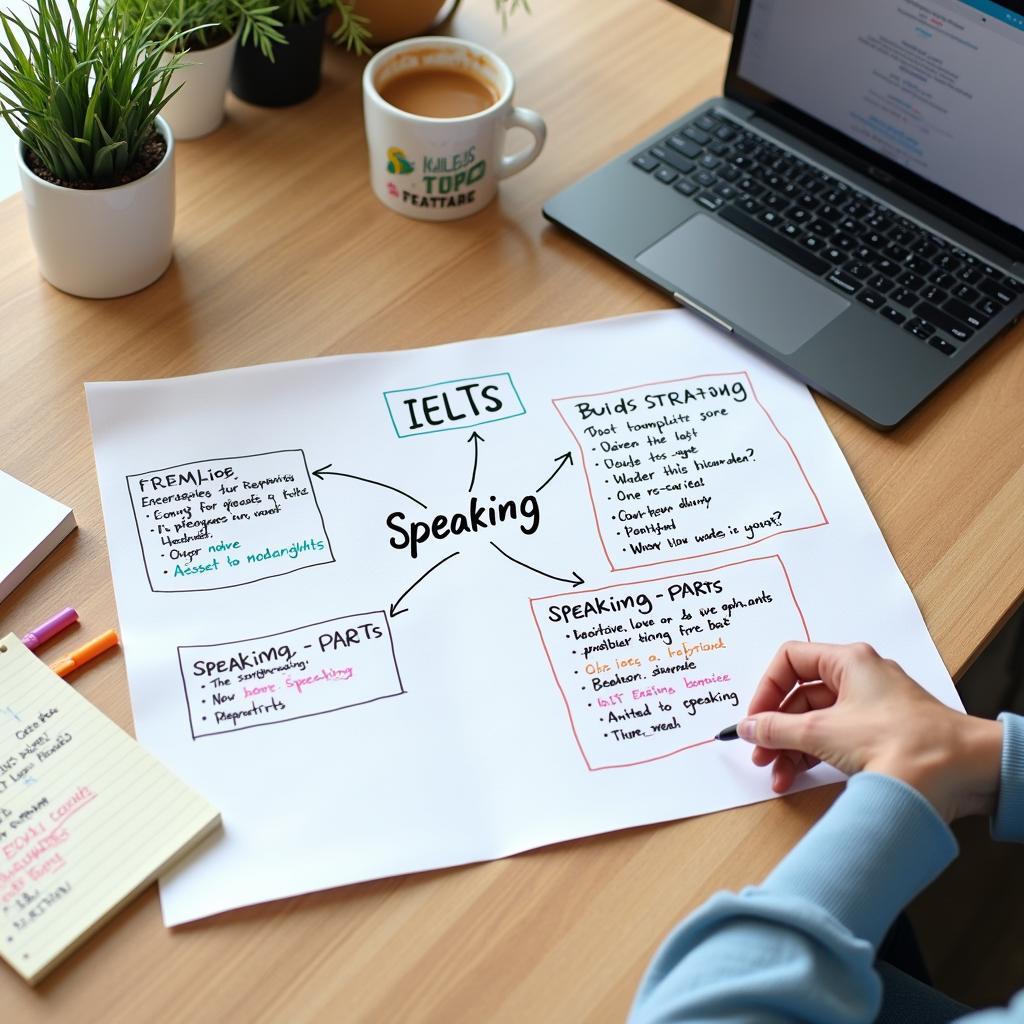 Chiến lược làm bài IELTS Speaking hiệu quả với sơ đồ tư duy và ghi chú
Cách chuẩn bị hiệu quả
4-6 tuần trước thi:
Week 1-2: Foundation
- Familiarize với test format và scoring criteria
- Record baseline speaking sample để identify weaknesses
- Build topic vocabulary (10-15 topics phổ biến)
- Practice pronunciation exercises daily
Week 3-4: Intensive Practice
- Practice 5-6 Part 2 cue cards mỗi ngày
- Develop idea bank cho common Part 3 questions
- Focus trên weak areas identified
- Start speaking với study partner hoặc teacher
Week 5-6: Refinement
- Full mock tests (3 parts) 2-3 lần/tuần
- Record và analyze để fine-tune
- Polish delivery: intonation, pausing, emphasis
- Review common topics và prepare flexible ideas
Daily practice routine (30-45 phút):
- Pronunciation drills: 5 phút
- Part 1 questions: 10 phút (5-6 câu hỏi)
- Part 2 practice: 15 phút (1-2 cue cards)
- Part 3 discussion: 10-15 phút
Resources to use:
- IELTS-Simon blog cho sample answers
- IELTS Liz cho strategies
- YouTube cho pronunciation practice
- Quizlet/Anki cho vocabulary
- Language exchange partners cho authentic practice
Ngày thi:
Trước giờ thi:
- Arrive 30 phút sớm để settle nerves
- Warm up voice bằng cách nói tiếng Anh (với bạn bè hoặc tự nói)
- Review key vocabulary nhưng KHÔNG học thuộc
- Breathe deeply, stay positive
Trong phòng thi:
- Smile, make eye contact, show confidence
- Listen carefully to questions
- Take a brief moment to think trước khi answer
- Speak clearly, không rush
- If you make mistake, self-correct naturally và move on
- Don’t panic nếu topic khó – use strategies to buy time và develop ideas
Khi bạn cần develop creativity trong speaking, hãy học cách approach tương tự như describe a new recipe you tried at home, nơi bạn cần miêu tả process và experience một cách sinh động.
Kết luận
Chủ đề “Describe a person who taught you an important lesson” không chỉ là một đề thi IELTS Speaking phổ biến mà còn là cơ hội tuyệt vời để bạn thể hiện khả năng storytelling, emotional depth và critical thinking – những yếu tố quan trọng để đạt band điểm cao.
Key takeaways từ bài viết này:
✅ Structure là foundation: Dù là Part 1, 2 hay 3, câu trả lời có cấu trúc rõ ràng luôn score tốt hơn
✅ Specificity matters: Generic answers chỉ đạt band 6-7. Để lên 8-9, bạn cần specific details, vivid descriptions và personal insights
✅ Vocabulary phải natural: Sophisticated không có nghĩa là overly complicated. Sử dụng collocations và idiomatic expressions appropriately
✅ Grammar variety shows control: Mix của simple, compound và complex sentences với different tenses demonstrates range
✅ Critical thinking distinguishes high scores: Part 3 là nơi band 8-9 được quyết định – show ability to analyze, evaluate và present nuanced views
✅ Authenticity is key: Examiner có thể phát hiện memorized answers. Hãy genuine, natural và show your personality
Lộ trình học tập đề xuất:
-
Phase 1 – Understanding (1 tuần):
- Học kỹ band descriptors
- Analyze sample answers ở các band khác nhau
- Identify personal strengths và weaknesses
-
Phase 2 – Building (2-3 tuần):
- Build topic vocabulary systematically
- Practice pronunciation và intonation
- Develop idea bank cho common topics
- Record và review your speaking regularly
-
Phase 3 – Refining (1-2 tuần):
- Full mock tests với feedback
- Focus trên weak areas
- Polish delivery và fluency
- Build confidence through repeated practice
Remember: IELTS Speaking không test English knowledge mà test communication ability. The goal không phải nói perfectly mà là nói effectively – conveying your ideas clearly, naturally và engagingly.
Với preparation đúng cách, mindset tích cực và practice đầy đủ, bạn hoàn toàn có thể đạt được band điểm mong muốn. Chúc bạn thành công trong kỳ thi IELTS Speaking của mình!
Final tip từ Examiner: The best speakers are those who forget they’re in a test and simply enjoy sharing their stories and ideas. Be that person!