
Chủ đề về đồ nội thất trong nhà là một trong những đề tài quen thuộc và xuất hiện thường xuyên trong bài thi IELTS Speaking. Đây là chủ đề thuộc nhóm “Objects” – miêu tả đồ vật, cho phép thí sinh thể hiện khả năng sử dụng từ vựng mô tả cụ thể, diễn đạt cảm xúc cá nhân, và giải thích ý nghĩa của vật dụng trong cuộc sống hàng ngày.
Tần suất xuất hiện: Chủ đề này xuất hiện với tần suất cao trong các kỳ thi IELTS thực tế từ năm 2020 đến 2024, đặc biệt phổ biến trong quý 1 và quý 3 hàng năm. Theo thống kê từ các nguồn đề thi thực tế như IELTS-Blog và các diễn đàn học viên, đề tài về đồ nội thất xuất hiện khoảng 15-20% trong tổng số đề thi Speaking Part 2. Dự đoán khả năng xuất hiện trong tương lai: Cao, vì đây là chủ đề gần gũi, dễ tiếp cận và cho phép đánh giá toàn diện năng lực ngôn ngữ của thí sinh.
Những gì bạn sẽ học được:
- Phân tích chi tiết cách trả lời câu hỏi về đồ nội thất trong cả 3 Part của IELTS Speaking
- Bài mẫu đầy đủ theo các band điểm 6-7, 7.5-8, và 8.5-9 với phân tích chuyên sâu
- Hơn 50 từ vựng và cụm từ chuyên biệt giúp bạn ghi điểm cao
- Chiến lược trả lời hiệu quả từ góc nhìn của một Examiner chính thức
- Các lỗi thường gặp của học viên Việt Nam và cách khắc phục
- Tips thực tế để tự tin hơn khi đối mặt với chủ đề này
IELTS Speaking Part 1: Introduction and Interview
Tổng Quan Về Part 1
Part 1 của IELTS Speaking kéo dài 4-5 phút với những câu hỏi ngắn gọn về cuộc sống hàng ngày, sở thích cá nhân và các chủ đề quen thuộc. Với chủ đề đồ nội thất, examiner sẽ không đi sâu vào chi tiết mà chỉ hỏi những câu hỏi chung về thói quen, sở thích liên quan đến việc trang trí nhà cửa hoặc các món đồ nội thất yêu thích.
Đặc điểm của Part 1:
- Câu hỏi trực tiếp, dễ hiểu
- Yêu cầu trả lời tự nhiên như trong cuộc trò chuyện thông thường
- Mỗi câu trả lời nên kéo dài 2-3 câu (10-15 giây)
- Cần mở rộng ý bằng cách thêm lý do, ví dụ hoặc chi tiết cá nhân
Chiến lược hiệu quả:
- Trả lời trực tiếp câu hỏi ngay trong câu đầu tiên
- Bổ sung thêm 1-2 câu giải thích hoặc ví dụ
- Sử dụng từ vựng đa dạng nhưng tự nhiên
- Tránh trả lời quá ngắn (Yes/No) hoặc quá dài (hơn 30 giây)
Lỗi thường gặp của học viên Việt Nam:
- Trả lời quá ngắn gọn, không mở rộng ý
- Sử dụng từ vựng quá đơn giản hoặc lặp lại
- Thiếu ví dụ cụ thể từ kinh nghiệm bản thân
- Nói quá nhanh hoặc quá chậm do lo lắng
- Dùng quá nhiều “I think” ở đầu mỗi câu
Các Câu Hỏi Thường Gặp
Question 1: What kind of furniture do you have in your home?
Question 2: Do you prefer modern or traditional furniture?
Question 3: Have you ever bought furniture online?
Question 4: What’s your favorite piece of furniture at home?
Question 5: Do you like rearranging furniture in your room?
Question 6: Who usually chooses furniture in your family?
Question 7: Is furniture expensive in your country?
Question 8: Would you like to change any furniture in your home?
Phân Tích và Gợi Ý Trả Lời Chi Tiết
Question: What kind of furniture do you have in your home?
🎯 Cách tiếp cận:
- Liệt kê 2-3 loại đồ nội thất chính
- Đưa ra mô tả ngắn gọn về chúng
- Có thể thêm comment về phong cách trang trí
📝 Sample Answer – Band 6-7:
Well, I have quite basic furniture in my home. There’s a wooden dining table in the living room where my family eats together. I also have a comfortable sofa and a bookshelf for my books. Everything is quite simple but functional.
Phân tích:
- Điểm mạnh: Trả lời đúng trọng tâm, liệt kê được các món đồ, có mở rộng ý với “simple but functional”
- Hạn chế: Từ vựng còn đơn giản (basic, quite, comfortable), thiếu chi tiết mô tả cụ thể hơn về chất liệu hoặc phong cách
- Tại sao Band 6-7: Câu trả lời đủ dài, có structure rõ ràng nhưng vocabulary chưa đa dạng, thiếu collocations tự nhiên
📝 Sample Answer – Band 8-9:
Well, we have a fairly eclectic mix of furniture at home. The centerpiece of our living room is a mid-century modern sofa in dark grey, which pairs really well with our minimalist aesthetic. We’ve also got a rustic wooden dining table that’s been in the family for years, and a few bespoke shelving units that my dad actually custom-made to fit our space perfectly.
Phân tích:
- Điểm mạnh: Sử dụng từ vựng tinh vi và chuyên biệt (eclectic mix, mid-century modern, minimalist aesthetic, bespoke, custom-made), mô tả chi tiết về màu sắc và phong cách, có sự liên kết giữa các món đồ, thêm thông tin cá nhân về nguồn gốc (been in the family, dad custom-made)
- Tại sao Band 8-9: Vocabulary rất đa dạng và precise, grammar structures phức tạp (relative clauses), câu trả lời tự nhiên như native speaker, có depth trong miêu tả, thể hiện personal connection với đồ vật
💡 Key Vocabulary & Expressions:
- eclectic mix: sự kết hợp đa dạng, pha trộn nhiều phong cách
- mid-century modern: phong cách hiện đại giữa thế kỷ 20
- minimalist aesthetic: thẩm mỹ tối giản
- rustic: mộc mạc, mang phong cách nông thôn
- bespoke: được thiết kế riêng, đặt làm theo yêu cầu
- custom-made: làm theo đơn đặt hàng, thiết kế riêng
Question: Do you prefer modern or traditional furniture?
🎯 Cách tiếp cận:
- Đưa ra lựa chọn rõ ràng
- Giải thích lý do cho preference
- Có thể acknowledge cả hai phong cách nhưng vẫn lean về một bên
📝 Sample Answer – Band 6-7:
I think I prefer modern furniture more. It looks cleaner and simpler, which I really like. Traditional furniture is nice but sometimes it can be too heavy and dark. Modern designs are more suitable for small apartments like mine.
Phân tích:
- Điểm mạnh: Có opinion rõ ràng, đưa ra 2-3 lý do (clean, simple, suitable for small space), có so sánh giữa hai phong cách
- Hạn chế: Từ vựng cơ bản (cleaner, simpler, nice, heavy, dark), cấu trúc câu đơn giản, thiếu examples cụ thể
- Tại sao Band 6-7: Câu trả lời logic và đủ dài, nhưng language range còn limited, không có sophisticated expressions
📝 Sample Answer – Band 8-9:
I’d say I’m more drawn to contemporary furniture, to be honest. There’s something about clean lines and functional design that really appeals to me. That said, I do appreciate certain vintage pieces for their craftsmanship and character. Ideally, I like striking a balance – having a modern foundation with a few statement traditional pieces that add warmth and personality to the space.
Phân tích:
- Điểm mạnh: Vocabulary sophisticated (drawn to, clean lines, functional design, craftsmanship, striking a balance, statement pieces), structure phức tạp với tentative language (I’d say, to be honest), thừa nhận complexity (That said, Ideally), balanced view thể hiện critical thinking, sử dụng relative clauses tự nhiên
- Tại sao Band 8-9: Fluent and coherent, lexical resource xuất sắc với topic-specific terms, grammatical range đa dạng, pronunciation elements như “I’d say” rất tự nhiên, ideas có depth và nuance
💡 Key Vocabulary & Expressions:
- be drawn to: bị thu hút bởi, có khuynh hướng thích
- clean lines: đường nét tinh giản, gọn gàng
- functional design: thiết kế tiện dụng, chú trọng công năng
- vintage pieces: đồ cổ điển, có tuổi đời
- craftsmanship: tay nghề thủ công, kỹ thuật chế tác
- strike a balance: tạo sự cân bằng
- statement pieces: món đồ điểm nhấn, thu hút sự chú ý
Question: Have you ever bought furniture online?
🎯 Cách tiếp cận:
- Yes/No answer rõ ràng
- Kể về trải nghiệm cụ thể (nếu có)
- Chia sẻ cảm nhận về việc mua đồ nội thất online
📝 Sample Answer – Band 6-7:
Yes, I have bought some furniture online before. Last year, I bought a desk for studying from an online shop. It was quite convenient because they delivered it to my house. However, I was a bit worried about the quality before it arrived, but fortunately it was good.
Phân tích:
- Điểm mạnh: Có ví dụ cụ thể (desk, last year), structure: experience + feeling + result, dùng được “however” và “fortunately” để tạo coherence
- Hạn chế: Vocabulary đơn giản (quite, good, a bit), grammar structures không phức tạp, thiếu details về process
- Tại sao Band 6-7: Câu trả lời complete với clear message nhưng language chưa sophisticated
📝 Sample Answer – Band 8-9:
Actually, yes. I took the plunge and ordered a computer desk online about six months ago. I was slightly apprehensive at first since you can’t gauge the quality in person, but the website had comprehensive reviews and detailed specifications, which really helped. The whole process was remarkably smooth – from ordering to delivery – and the desk exceeded my expectations. I’d definitely consider buying furniture online again, though I’d probably steer clear of bigger items like sofas where comfort is crucial.
Phân tích:
- Điểm mạnh: Idiomatic expressions xuất sắc (took the plunge, slightly apprehensive, exceeded expectations, steer clear of), vocabulary precise (gauge, comprehensive, specifications, remarkably), structure phức tạp với nhiều clauses, balanced view (positive experience nhưng có reservations), personal reflection ở cuối
- Tại sao Band 8-9: Highly fluent với natural pauses và discourse markers (Actually, at first, though), lexical resource exceptional, grammar sophisticated với embedded clauses, shows critical thinking
💡 Key Vocabulary & Expressions:
- take the plunge: quyết định làm điều gì đó dù có rủi ro
- apprehensive: lo lắng, e ngại
- gauge the quality: đánh giá chất lượng
- comprehensive reviews: đánh giá toàn diện, chi tiết
- exceeded my expectations: vượt quá mong đợi của tôi
- steer clear of: tránh xa, không làm điều gì đó
 Thí sinh tự tin trả lời câu hỏi IELTS Speaking Part 1 về đồ nội thất
IELTS Speaking Part 2: Long Turn (Cue Card)
Tổng Quan Về Part 2
Part 2 là phần độc thoại kéo dài 2-3 phút, được coi là phần thử thách nhất của IELTS Speaking. Bạn sẽ nhận được một Cue Card với chủ đề cụ thể và có đúng 1 phút để chuẩn bị. Đây là phần kiểm tra khả năng nói liền mạch, tổ chức ý tưởng logic và duy trì coherence trong thời gian dài.
Thời gian chuẩn bị: 1 phút chính xác
Thời gian nói: 2-3 phút (không bị ngắt – examiner sẽ dừng bạn khi hết thời gian)
Đặc điểm của Part 2:
- Phải cover đầy đủ tất cả bullet points trong cue card
- Nói liên tục mà không cần examiner hỏi thêm
- Yêu cầu khả năng tổ chức ý tưởng tốt
- Cần balance giữa các phần để không quá focus vào một bullet point
Chiến lược hiệu quả:
- Sử dụng đủ 1 phút để ghi chú keywords (không viết câu đầy đủ)
- Ghi từ khóa theo thứ tự của bullet points
- Note down một số từ vựng nâng cao muốn sử dụng
- Bắt đầu bằng câu giới thiệu tổng quát
- Dành 20-30 giây cho mỗi bullet point đầu
- Dành 40-50 giây cho phần “explain” (phần quan trọng nhất)
- Kết thúc bằng câu tổng kết ngắn gọn
- Giữ eye contact thường xuyên, không chỉ đọc notes
Lỗi thường gặp của học viên Việt Nam:
- Không sử dụng hết 1 phút chuẩn bị vì quá lo lắng
- Nói dưới 1.5 phút vì hết ý tưởng
- Bỏ sót một hoặc nhiều bullet points
- Focus quá nhiều vào bullet đầu, vội vàng với các bullet sau
- Không elaborate phần “explain” – phần ghi điểm cao nhất
- Đọc quá nhiều vào notes, thiếu eye contact
- Sử dụng thì động từ sai (quá khứ/hiện tại)
- Lặp lại từ vựng nhiều lần do thiếu paraphrase
Cue Card
Describe A Piece Of Furniture In Your Home
You should say:
- What it is
- Where it is located
- What it looks like
- And explain why it is important to you
Phân Tích Đề Bài
Dạng câu hỏi: Describe an object – Miêu tả một vật dụng cụ thể trong nhà bạn
Thì động từ chính: Hiện tại (present tense) – vì đồ vật vẫn đang tồn tại và sử dụng. Tuy nhiên, khi kể về nguồn gốc hoặc kỷ niệm liên quan, bạn sẽ chuyển sang quá khứ (past tense).
Bullet points phải cover:
-
What it is – Tên gọi và loại đồ nội thất (10-15 giây): Không chỉ nói “It’s a chair” mà cần specific hơn: “It’s a vintage rocking chair” hoặc “It’s an antique wooden bookshelf”
-
Where it is located – Vị trí trong nhà (10-15 giây): Mô tả chính xác vị trí, có thể thêm lý do tại sao đặt ở đó
-
What it looks like – Mô tả ngoại hình (25-30 giây): Đây là phần cần chi tiết nhất về mô tả – màu sắc, chất liệu, kích thước, design, đặc điểm nổi bật. Sử dụng nhiều adjectives và sensory details.
-
And explain why it is important to you – Giải thích ý nghĩa (50-60 giây): Đây là phần QUAN TRỌNG NHẤT để ghi điểm cao. Cần đi sâu vào:
- Giá trị tình cảm (sentimental value)
- Kỷ niệm gắn liền (memories)
- Công dụng đặc biệt (special function)
- Ảnh hưởng đến cuộc sống (impact on your life)
- So sánh với đồ vật khác
Lưu ý quan trọng: Phần “explain why it is important” là nơi phân biệt giữa Band 6-7 và Band 8-9. Học viên Band 6-7 thường chỉ nói “because I use it every day” hoặc “because it’s comfortable”. Học viên Band 8-9 sẽ đi sâu vào emotional connection, personal stories, và reflect về impact.
Chiến lược note-taking (1 phút chuẩn bị):
Furniture: Grandpa's bookshelf
Where: corner / study room / near window
Look: dark wood / carved / 6 shelves / antique
Why important:
- gift from grandpa (passed away)
- childhood memories
- inspired love of reading
- family heirloom
📝 Sample Answer – Band 6-7
Thời lượng: Khoảng 1.5-2 phút
I’d like to talk about a bookshelf in my home. It’s quite a special piece of furniture for me.
This bookshelf is located in my bedroom, right next to my study desk. It’s in the corner of the room near the window, so there’s good natural light there. I put it there because it’s convenient when I want to get books while I’m studying.
The bookshelf is made of dark brown wood and it’s quite tall, about 1.8 meters high. It has six shelves in total, and each shelf can hold many books. The wood looks old and has some scratches on it, but I think these make it look more interesting. The design is simple but sturdy, and it’s been very strong for many years.
This bookshelf is important to me for several reasons. First, it was a gift from my grandfather when I started university five years ago. He chose it carefully for me because he knew I loved reading. Sadly, my grandfather passed away two years ago, so this bookshelf reminds me of him every day. Second, I use it all the time for my studies. All my textbooks and favorite novels are organized on these shelves. It helps me keep my room tidy and my books in order. Finally, I have many good memories connected to this bookshelf. Sometimes when I look at it, I remember the times my grandfather and I talked about books together.
So yes, this bookshelf is not just furniture – it has a lot of meaning for me and I will keep it for a long time.
Phân Tích Band Điểm
| Tiêu chí | Band | Nhận xét |
|---|---|---|
| Fluency & Coherence | 6-7 | Nói tương đối trôi chảy, có structure rõ ràng theo bullet points. Sử dụng linking words cơ bản (First, Second, Finally, So). Có một vài pauses nhỏ nhưng không ảnh hưởng nhiều. Thiếu variety trong discourse markers. |
| Lexical Resource | 6-7 | Từ vựng adequate cho topic: convenient, sturdy, organized, tidy. Có một số collocations tốt (natural light, passed away, in order). Tuy nhiên còn lặp lại từ (bookshelf xuất hiện quá nhiều), thiếu paraphrase và synonyms. Chưa có idiomatic expressions. |
| Grammatical Range & Accuracy | 6-7 | Sử dụng mix của simple và complex sentences. Có relative clauses (when I started university, because he knew I loved reading). Thì động từ chính xác (hiện tại cho mô tả, quá khứ cho memories). Nhưng thiếu variety trong structures, chủ yếu dùng “It is/has”. |
| Pronunciation | 6-7 | Rõ ràng và dễ hiểu. Word stress cơ bản chính xác. Intonation còn flat ở một số chỗ. Có thể improve sentence stress để tăng natural flow. |
Điểm mạnh:
- ✅ Cover đầy đủ tất cả bullet points theo đúng thứ tự
- ✅ Structure logic và dễ follow
- ✅ Có personal connection (grandfather) tạo depth
- ✅ Length phù hợp (khoảng 1.5-2 phút)
- ✅ Grammar chính xác, ít lỗi
Hạn chế:
- ⚠️ Vocabulary còn basic, thiếu sophisticated expressions
- ⚠️ Lặp lại “bookshelf” quá nhiều lần (nên dùng “this piece of furniture”, “it”, “the shelf”)
- ⚠️ Phần “explain why” chưa đủ deep, còn surface-level
- ⚠️ Thiếu sensory details trong description (smell of wood, texture, etc.)
- ⚠️ Không có idioms hoặc less common vocabulary
📝 Sample Answer – Band 7.5-8
Thời lượng: Khoảng 2-2.5 phút
I’d like to describe a piece of furniture that holds a special place in my heart – it’s an antique wooden bookshelf that’s been a fixture in my family for generations.
This bookshelf takes pride of place in the corner of my study room, positioned right beside the window. I deliberately placed it there because the natural light streaming in makes it perfect for browsing books, and honestly, the warm glow that hits the wood in the afternoon creates such a cozy atmosphere for reading.
In terms of appearance, it’s an impressive piece. Standing about 1.8 meters tall, it’s crafted from dark mahogany wood that has developed a rich patina over the years. What I find particularly striking is the intricate carving on the sides – there are these delicate floral patterns that must have taken incredible skill to create. It has six spacious shelves, and while the wood shows its age with a few weathered marks and subtle scratches, these imperfections actually add character rather than detract from its beauty. The overall design is elegantly simple yet remarkably sturdy – it’s clearly built to last.
Now, why this bookshelf is so meaningful to me goes beyond its aesthetic appeal. First and foremost, it’s a treasured family heirloom – my late grandfather passed it down to me when I started university. He was an avid reader himself, and I can still remember him telling me that a person’s bookshelf reveals their journey through life. Sadly, he passed away two years ago, so every time I look at this bookshelf, I’m transported back to those precious moments we spent discussing literature together.
Moreover, this piece of furniture has genuinely shaped my daily life. It’s where I keep my ever-growing collection of books, and there’s something deeply satisfying about having all my knowledge literally within arm’s reach. It helps me maintain order in my study space, but more importantly, it serves as a constant reminder of the value of learning and the connections we forge through stories.
So this bookshelf isn’t merely functional – it’s a keeper of memories and a symbol of the legacy my grandfather left behind. I fully intend to pass it on to the next generation someday.
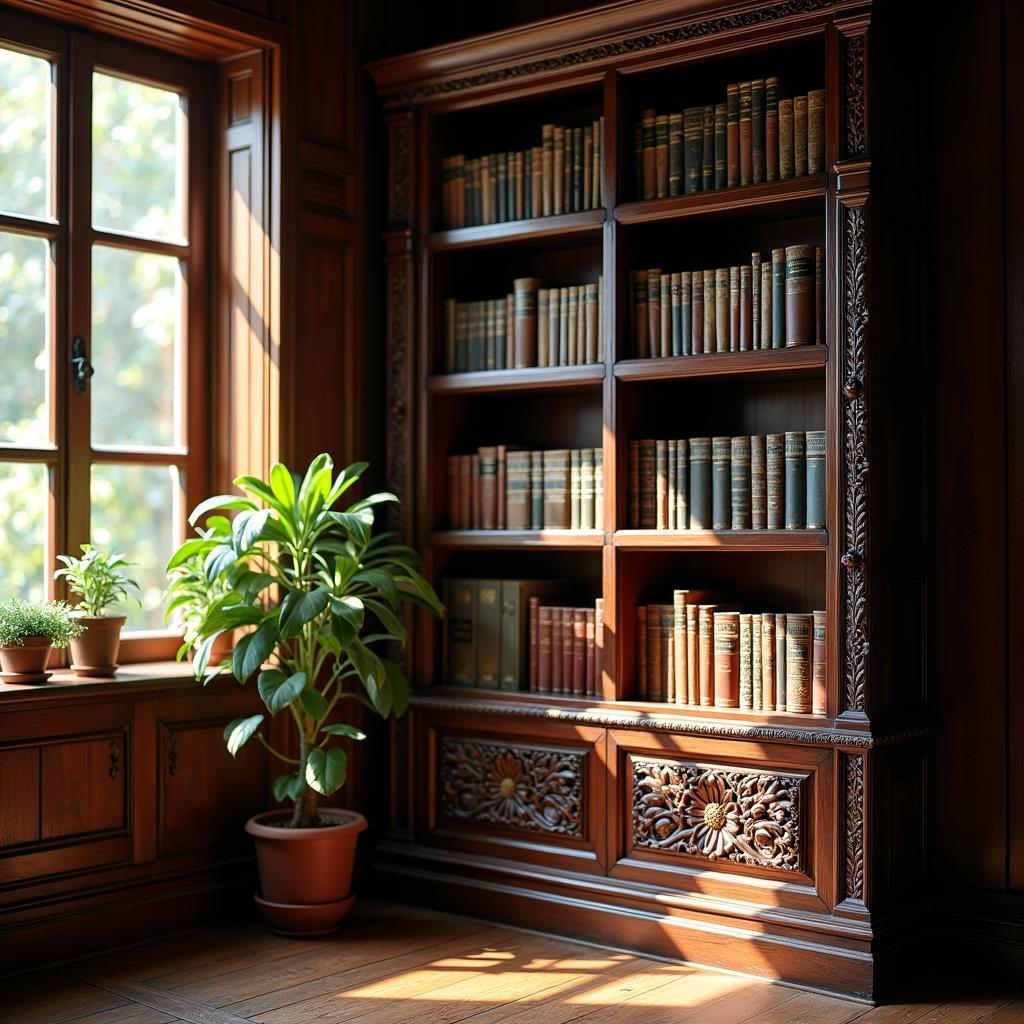 Gỗ sách gỗ cổ điển trong phòng học với ánh sáng tự nhiên minh họa bài thi IELTS Speaking
Phân Tích Band Điểm
| Tiêu chí | Band | Nhận xét |
|---|---|---|
| Fluency & Coherence | 7.5-8 | Rất trôi chảy với minimal hesitation. Progression tự nhiên giữa các ideas. Sử dụng range of cohesive devices sophisticated (First and foremost, Moreover, Now). Có clear paragraphing trong mind. Self-correction tự nhiên không awkward. |
| Lexical Resource | 7.5-8 | Wide range of vocabulary với precision cao: fixture, takes pride of place, patina, intricate carving, weathered marks. Nhiều collocations tự nhiên: streaming in, add character, built to last, within arm’s reach. Có một số idiomatic phrases: holds a special place in my heart, transported back. Good use of paraphrase: bookshelf → this piece → it. |
| Grammatical Range & Accuracy | 7.5-8 | Excellent variety: relative clauses (that holds, what I find), participle clauses (standing, positioned), inversion for emphasis (Sadly…). Complex structures: embedded clauses, conditionals implied. Tenses accurate và sophisticated (has developed, must have taken). Virtually error-free. |
| Pronunciation | 7.5-8 | Clear với good control of features. Word và sentence stress effective để create meaning. Intonation varied và natural. Individual sounds chính xác. Easy to understand with minimal L1 interference. |
So Sánh Với Band 6-7
| Khía cạnh | Band 6-7 | Band 7.5-8 |
|---|---|---|
| Vocabulary | “quite special”, “good natural light”, “look more interesting” | “holds a special place in my heart”, “natural light streaming in”, “add character” |
| Grammar | “It’s quite tall, about 1.8 meters high” | “Standing about 1.8 meters tall, it’s crafted from…” |
| Ideas | “It reminds me of him every day” | “I’m transported back to those precious moments we spent discussing literature together” |
| Depth | Surface explanation: “I use it all the time” | Deep reflection: “serves as a constant reminder of the value of learning” |
| Cohesion | Basic: First, Second, Finally | Sophisticated: First and foremost, Moreover, Now |
Improvements từ Band 6-7 lên 7.5-8:
- Vocabulary nhiều layers hơn: không chỉ “special” mà là “holds a special place in my heart”
- Grammar structures phức tạp: dùng participles để combine ideas smoothly
- Ideas có emotional depth: không chỉ nói “reminds me” mà elaborate the feeling
- Description chi tiết hơn với sensory details: warm glow, rich patina
- Better paraphrasing: không lặp “bookshelf” liên tục
📝 Sample Answer – Band 8.5-9
Thời lượng: 2.5-3 phút đầy đủ
I’d love to tell you about a piece of furniture that’s become absolutely integral to my daily life – an exquisite antique bookshelf that’s been lovingly preserved and handed down through my family for well over half a century.
This remarkable piece occupies a commanding position in the corner of my study, nestled right beside a large bay window. The placement is far from arbitrary – I specifically positioned it there to capitalize on the generous natural light that floods the area throughout the day. There’s something almost magical about how the afternoon sun bathes the wood in this ethereal golden glow, transforming my study into a sanctuary for reading and contemplation.
Appearance-wise, it’s nothing short of breathtaking. Standing at an imposing 1.8 meters, it’s meticulously crafted from rich mahogany that has gracefully aged, developing this deep, lustrous patina that you simply can’t replicate with modern finishes. What truly sets it apart is the extraordinarily intricate hand-carving adorning both sides – delicate floral motifs intertwined with vine patterns that speak to the extraordinary craftsmanship of a bygone era. The bookshelf comprises six generously proportioned shelves, each capable of bearing substantial weight. Now, I’d be remiss not to mention that it bears the marks of time – there are these faint scratches and subtle dents, but far from being flaws, I see them as testament to its journey through decades. They’re like the character lines on a beloved face, each telling its own silent story. The overall aesthetic strikes a perfect balance between elegant simplicity and robust functionality – it’s decidedly timeless.
But here’s what makes this bookshelf genuinely irreplaceable to me. On a sentimental level, it’s an invaluable family heirloom that my late grandfather entrusted to my care when I embarked on my university journey. He was a voracious reader who firmly believed that books were portals to infinite worlds, and he’d often say that you could gauge a person’s soul by examining their bookshelf. His passing two years ago cast a long shadow, but this piece helps keep his memory vibrantly alive. Every time my gaze falls upon it, I’m instantly transported back to those cherished afternoons we spent locked in animated discussions about everything from classic literature to contemporary philosophy.
On a more practical note, this bookshelf has fundamentally shaped how I interact with knowledge. My collection has expanded considerably over the years, and having all these resources readily at my fingertips creates this wonderful sense of intellectual abundance. But beyond mere utility, it instills a sense of order in both my physical space and, metaphorically, my mind. There’s something profoundly grounding about being surrounded by books – they serve as tangible reminders of lessons learned, perspectives gained, and the continuous journey of self-improvement I’m on.
I suppose what I’m trying to convey is that this bookshelf transcends its physical form. It’s simultaneously a keeper of stories, a bridge to my past, and a testament to the enduring value of learning and family bonds. As my grandfather hoped, it’s become a cornerstone of my life, and I sincerely look forward to the day when I can pass this legacy on to someone I love, perpetuating this beautiful tradition of valuing knowledge and honoring memory.
Phân Tích Band Điểm
| Tiêu chí | Band | Nhận xét |
|---|---|---|
| Fluency & Coherence | 8.5-9 | Exceptionally fluent speech với completely natural flow. Hesitation chỉ xuất hiện để create emphasis hoặc drama, không phải do lack of language. Sophisticated cohesive devices used effortlessly (On a sentimental level, On a more practical note, But here’s what, I suppose what I’m trying to convey). Ideas develop logically với excellent paragraphing. Self-correction minimal và natural. |
| Lexical Resource | 8.5-9 | Full flexibility và precision trong vocabulary use: integral, nestled, capitalize on, ethereal, sanctuary, meticulously crafted, lustrous patina, motifs intertwined with, bygone era, testament to, cast a long shadow, vibrantly alive, intellectual abundance, profoundly grounding. Idiomatic language used naturally: nothing short of breathtaking, I’d be remiss not to mention, gauge a person’s soul. Collocation impeccable: commanding position, generous natural light, extraordinarily intricate. Paraphrasing effortless và varied. |
| Grammatical Range & Accuracy | 8.5-9 | Full range của structures: inversion (Appearance-wise), cleft sentences (What truly sets it apart is, here’s what makes it), advanced participle constructions (nestled, standing, adorning), complex relative clauses, sophisticated conditionals implied. Perfect control của tenses including present perfect continuous (has become, has expanded), past perfect (had often say). Error-free throughout. Natural use of emphatic structures. |
| Pronunciation | 8.5-9 | Completely natural delivery với native-like features. Excellent sentence stress creating clear meaning và emotion. Intonation highly expressive và varied. Individual sounds precise. Connected speech features natural (gonna become, wanna tell). Easy to understand with zero effort from listener. |
Tại Sao Bài Này Xuất Sắc
🎯 Fluency Hoàn Hảo:
Bài nói không chỉ trôi chảy mà còn có dramatic pacing – học viên biết khi nào pause để create impact (“But here’s what makes this bookshelf genuinely irreplaceable to me”). Mỗi paragraph có clear topic sentence và development tự nhiên. Không có filler words (um, uh, like) hay awkward silences. Self-correction xuất hiện nhưng subtle và enhance clarity (“The bookshelf comprises… Now, I’d be remiss not to mention…”).
📚 Vocabulary Tinh Vi:
Abstract nouns showing sophistication:
- “a sanctuary for reading and contemplation” – không chỉ “a nice place”
- “intellectual abundance” – thay vì “many books”
- “the continuous journey of self-improvement” – thay vì “learning”
Idiomatic expressions used naturally:
- “holds a special place” → “become absolutely integral to my daily life” (higher register)
- “bears the marks of time” (poetic way to say “old”)
- “cast a long shadow” (metaphorical language for lasting impact)
- “keep his memory vibrantly alive” (emotional và vivid)
Precise collocations:
- “lovingly preserved” (not just “kept well”)
- “nestled right beside” (not just “next to”)
- “floods the area” (về light)
- “extraordinarily intricate hand-carving” (multiple adjectives building up)
📝 Grammar Đa Dạng:
Complex structures xuất hiện tự nhiên:
- Participle clauses: “Standing at an imposing 1.8 meters, it’s meticulously crafted…” (thay vì “It stands 1.8 meters tall. It is crafted…”)
- Relative clauses embedded: “patterns that speak to the extraordinary craftsmanship of a bygone era”
- Cleft sentences for emphasis: “What truly sets it apart is…” “What I’m trying to convey is…”
- Inversion: “Appearance-wise, it’s nothing short of breathtaking”
- Perfect infinitives: “I sincerely look forward to the day when I can pass this legacy on”
Tenses được sử dụng với sophistication:
- Present perfect continuous: “that’s become absolutely integral” (showing ongoing relevance)
- Past perfect: “he’d often say” (habitual action in past)
- Would for past habits: “We’d spend afternoons discussing”
💡 Ideas Sâu Sắc:
Không dừng ở surface level:
- Band 6-7 sẽ nói: “It reminds me of my grandfather”
- Band 8.5-9 nói: “Every time my gaze falls upon it, I’m instantly transported back to those cherished afternoons we spent locked in animated discussions… His passing cast a long shadow, but this piece helps keep his memory vibrantly alive”
Có layers of meaning:
- Physical description (what it looks like)
- Emotional connection (memories với grandfather)
- Philosophical reflection (books as portals, bookshelf reflects soul)
- Practical value (organization, accessibility)
- Future legacy (passing down)
Shows critical thinking:
- Acknowledges imperfections but reframes them positively: “far from being flaws, I see them as testament to its journey”
- Balances different values: sentimental + practical
- Uses metaphor sophisticatedly: “bridge to my past”, “cornerstone of my life”
Personal voice strong:
- “I suppose what I’m trying to convey is…” (reflective tone)
- “There’s something profoundly grounding about…” (personal philosophy)
- Emotional honesty: “His passing cast a long shadow”
Advanced discourse features:
- Signposting: “On a sentimental level… On a more practical note…”
- Summarizing: “I suppose what I’m trying to convey is that…”
- Forward reference: “But here’s what makes this bookshelf genuinely irreplaceable”
- Parenthetical comments: “Now, I’d be remiss not to mention…”
Follow-up Questions (Rounding Off Questions)
Sau khi bạn nói xong 2-3 phút, examiner thường hỏi thêm 1-2 câu ngắn để chuyển sang Part 3. Những câu hỏi này thường liên quan trực tiếp đến những gì bạn vừa nói.
Question 1: Do you think you’ll keep this bookshelf for a long time?
Band 6-7 Answer:
Yes, definitely. As I mentioned, it has a lot of sentimental value for me because it was my grandfather’s. I plan to keep it forever and maybe give it to my children in the future.
Band 8-9 Answer:
Absolutely. Given its profound sentimental significance and the fact that it’s a tangible link to my grandfather’s legacy, I can’t imagine parting with it. In fact, I fully intend to keep it as a cherished family heirloom and eventually pass it down to the next generation, perpetuating this beautiful tradition of valuing both knowledge and family history.
Phân tích: Band 8-9 answer sử dụng sophisticated phrases (profound sentimental significance, tangible link, perpetuating), shows forward thinking, và connects back to larger themes about family tradition. Band 6-7 answer đúng và clear nhưng thiếu depth và vocabulary range.
Question 2: Is it difficult to maintain antique furniture?
Band 6-7 Answer:
Well, it requires some care. You need to clean it regularly and protect it from moisture. I usually wipe it with a soft cloth and sometimes use special wood polish. It’s not too difficult if you’re careful.
Band 8-9 Answer:
That’s a great question. Antique furniture does demand a certain level of attention, I’d say. The key is being mindful of environmental factors – avoiding excessive moisture or direct prolonged sunlight that could cause the wood to warp or fade the finish. I make it a point to treat it with specialized wood conditioner every few months, and regular dusting with a microfiber cloth helps preserve that beautiful patina. But honestly, I see it less as a chore and more as a labor of love – each time I care for it, I’m honoring my grandfather’s memory and ensuring this piece endures for generations to come.
Phân tích: Band 8-9 answer demonstrates technical knowledge (wood conditioner, warp, patina), uses tentative language appropriately (I’d say, I make it a point to), và connects maintenance back to emotional meaning, showing depth of thinking. Vocabulary precise và collocations natural.
IELTS Speaking Part 3: Two-way Discussion
Tổng Quan Về Part 3
Part 3 kéo dài 4-5 phút và là phần abstract nhất, challenging nhất của IELTS Speaking. Đây không còn là nói về kinh nghiệm cá nhân như Part 2, mà là thảo luận về các vấn đề rộng hơn liên quan đến chủ đề, đòi hỏi khả năng phân tích, so sánh, đánh giá và đưa ra quan điểm có lý lẽ.
Đặc điểm của Part 3:
- Câu hỏi mang tính trừu tượng, thường về society, culture, trends, future
- Không có đáp án đúng/sai – quan trọng là cách bạn argue và support ideas
- Yêu cầu critical thinking và ability to see multiple perspectives
- Cần vocabulary cho abstract concepts
- Grammar cần sophisticated hơn để express complex ideas
Tương tự như khi bạn describe a person who has a very creative hobby, Part 3 sẽ mở rộng ra các câu hỏi về creativity trong xã hội, education, và workplace. Với chủ đề furniture, các câu hỏi sẽ xoay quanh home decoration, consumer behavior, cultural values, và environmental concerns.
Yêu cầu cụ thể:
- Analyze: Phân tích nguyên nhân, hậu quả, factors
- Compare: So sánh past/present, different groups, cultures
- Evaluate: Đánh giá advantages/disadvantages, positive/negative aspects
- Speculate: Dự đoán về future trends
- Give opinions: Quan điểm cá nhân có supporting reasons
Chiến lược hiệu quả:
- Mở rộng mỗi câu trả lời ít nhất 3-5 câu (30-45 giây)
- Structure: Direct answer → Reason/Explanation → Example → Additional point/Conclusion
- Sử dụng discourse markers để signpost ideas
- Acknowledge complexity: “It’s not straightforward”, “There are multiple factors”
- Show balanced view: “On the one hand… on the other hand…”
- Use tentative language: “I’d say”, “It seems to me”, “To some extent”
- Không afraid to admit không biết nhưng speculate: “I’m not entirely sure, but I’d imagine…”
Lỗi thường gặp của học viên Việt Nam:
- Trả lời quá ngắn (1-2 câu) như Part 1
- Chỉ đưa ra opinion mà không explain why
- Thiếu examples để support ideas
- Không xem xét multiple perspectives
- Vocabulary quá simple cho abstract topics
- Grammar structures lặp đi lặp lại
- Nervous và trả lời quá nhanh không suy nghĩ
- Over-generalize: “Everyone thinks”, “All people”
- Thiếu hedging language khi speculate
Các Câu Hỏi Thảo Luận Sâu
Các câu hỏi Part 3 thường được phân nhóm theo themes liên quan đến chủ đề Part 2. Với “furniture in your home”, examiner sẽ explore các góc độ: consumer behavior, cultural values, environmental impact, design trends, và economic factors.
Theme 1: Consumer Behavior and Shopping Habits
Question 1: What factors do people consider when buying furniture?
🎯 Phân tích câu hỏi:
- Dạng: Factors/Reasons – yêu cầu liệt kê và giải thích các yếu tố
- Key words: “factors”, “consider”, “buying furniture”
- Cách tiếp cận:
- Liệt kê 3-4 factors chính
- Giải thích tại sao mỗi factor quan trọng
- Có thể so sánh priorities của different groups
- Đưa examples cụ thể
📝 Sample Answer – Band 6-7:
Well, I think there are several factors people think about when buying furniture. First, price is very important because furniture can be expensive. People want to find good quality but at a reasonable price. Second, the size matters because it needs to fit in their home. If the furniture is too big, it won’t look good. Third, the design and color should match their home decoration style. Finally, quality is important because people want furniture that will last for many years. So these are the main things people consider.
Phân tích:
- Structure: Có structure rõ với First, Second, Third, Finally
- Vocabulary: Adequate nhưng basic (expensive, good quality, reasonable price, look good, last)
- Content: Cover được main points nhưng lack depth
- Tại sao Band 6-7: Ideas clear và organized, nhưng explanation superficial, thiếu examples cụ thể, vocabulary không sophisticated
📝 Sample Answer – Band 8-9:
That’s an interesting question, and I’d say the decision-making process is actually quite multifaceted.
First and foremost, budget constraints naturally play a pivotal role. Furniture represents a significant investment for most households, so people tend to carefully weigh the cost against the expected longevity and utility. However, I’ve noticed that priorities differ – while younger buyers might gravitate towards affordable, trendy pieces from places like IKEA, more established households often opt for higher-end furniture that they view as a long-term investment.
Beyond price, practical considerations are crucial. Dimensions are obviously vital – there’s nothing worse than falling in love with a sofa only to discover it simply won’t fit through your doorway. People also consider functionality, especially in space-constrained urban apartments where furniture increasingly needs to serve multiple purposes – think sofa beds or extendable dining tables.
On the aesthetic front, the piece needs to complement the existing décor and reflect the owner’s personal style. There’s been a noticeable shift towards minimalist, Scandinavian-inspired designs in recent years, though traditional styles still hold considerable appeal for certain demographics.
Lastly, I’d argue that sustainability is becoming increasingly prominent in people’s minds. More consumers are now asking questions about the environmental footprint of their purchases – whether the wood is ethically sourced, if the materials are eco-friendly, and even the carbon footprint of shipping. This represents quite a departure from the throwaway culture of previous decades.
Phân tích:
- Structure: Sophisticated với clear signposting (First and foremost, Beyond price, On the aesthetic front, Lastly)
- Vocabulary: Precise và varied: multifaceted, pivotal role, weigh against, gravitate towards, space-constrained, complement, environmental footprint, ethically sourced, departure from
- Grammar: Complex structures: relative clauses, participle phrases, passive voice, cleft sentences
- Critical Thinking: Shows nuance với different demographics, acknowledges changing trends, provides specific examples
- Tại sao Band 8-9: Demonstrates full control của language, ideas well-developed với supporting details, natural flow, shows ability to discuss abstract concepts with precision
💡 Key Language Features:
- Discourse markers: First and foremost, Beyond X, On the X front, Lastly, However, I’d argue that
- Tentative language: I’d say, tend to, I’ve noticed that, increasingly
- Hedging: quite, somewhat, to some extent
- Abstract nouns: constraints, investment, utility, demographics, sustainability, footprint
- Collocations: play a pivotal role, weigh against, opt for, serve multiple purposes, hold considerable appeal
Question 2: Has the way people shop for furniture changed compared to the past?
🎯 Phân tích câu hỏi:
- Dạng: Compare past vs present – cần so sánh changes over time
- Key words: “has changed”, “compared to the past”
- Cách tiếp cận:
- Identify main changes (shopping channels, decision process, types of furniture)
- Explain reasons for changes (technology, lifestyle)
- Evaluate impact (positive/negative)
- Có thể speculate về future
📝 Sample Answer – Band 6-7:
Yes, I think furniture shopping has changed a lot. In the past, people had to go to physical stores to see and buy furniture. They would visit many shops to compare prices. Now, many people shop online. They can see pictures and read reviews on websites. This is more convenient because they can shop from home. Also, delivery services are better now, so companies can bring furniture to your house. Another change is that furniture is cheaper now because of mass production. So overall, shopping for furniture is easier and more convenient than before.
Phân tích:
- Structure: Clear comparison (past vs present)
- Content: Identifies main changes (online vs physical, delivery, mass production)
- Vocabulary: Basic với some topic words (physical stores, compare prices, reviews, mass production)
- Tại sao Band 6-7: Addresses question adequately với relevant points, nhưng lacks depth, examples limited, explanation không elaborate
📝 Sample Answer – Band 8-9:
Absolutely, the transformation has been nothing short of remarkable.
If we cast our minds back to, say, two or three decades ago, furniture shopping was a decidedly hands-on experience. People would dedicate entire weekends to visiting showrooms, physically testing sofas for comfort, scrutinizing the quality of materials, and often negotiating face-to-face with salespeople. It was quite a laborious process, but there was a certain tangible quality to it – you could touch, sit on, and really get a feel for the piece before committing.
Fast forward to today, and the landscape has shifted dramatically. E-commerce has revolutionized the entire process. Platforms like Wayfair or even local online retailers allow customers to browse an overwhelming array of options from their couches, filtering by style, price, and dimensions with just a few clicks. What’s particularly interesting is how technology has addressed the traditional concern about buying furniture sight unseen – augmented reality apps now let you virtually place items in your room, and comprehensive customer reviews provide insights that go far beyond what a salesperson might share.
However, I’d argue we’re seeing an interesting hybrid model emerge. Many consumers now engage in what’s called “showrooming” – researching extensively online but visiting physical stores to verify their choices before purchasing, often still online to secure better prices. Similarly, some brands like IKEA have adapted by offering both experiences – extensive physical showrooms coupled with robust online platforms.
The drivers behind these changes are multifaceted – obviously, technological advancement, but also changing lifestyles. Modern consumers value convenience and time-efficiency more highly, and the sheer pace of urban life makes weekend showroom visits less appealing. Additionally, the democratization of design through social media means people are more informed and confident about their aesthetic choices.
That said, there’s a fascinating countertrend worth noting. Some high-end furniture retailers are actually doubling down on the in-store experience, offering personalized consultations and emphasizing the craftsmanship aspect that can’t be fully conveyed digitally. So while the mainstream has certainly moved online, there remains a market segment that values traditional shopping methods.
Phân tích:
- Structure: Exceptional organization: past situation → present changes → hybrid model → drivers of change → countertrend
- Vocabulary: Sophisticated: nothing short of remarkable, cast our minds back, laborious, tangible quality, revolutionized, overwhelming array, showrooming, democratization, doubling down on
- Grammar: Highly complex: conditionals, participle constructions, relative clauses, passive structures, cleft sentences
- Critical Thinking: Multi-layered analysis với multiple perspectives, acknowledges complexity (hybrid model, countertrend), identifies underlying causes
- Examples: Specific và relevant (Wayfair, IKEA, augmented reality apps, showrooming)
- Tại sao Band 8-9: Demonstrates exceptional language control, ideas deeply developed với nuance and sophistication, shows ability to discuss complex societal changes with precision and insight
💡 Key Language Features:
- Time references: Cast our minds back, Fast forward to today, two or three decades ago
- Contrast markers: However, That said, while, Similarly
- Emphasis structures: nothing short of remarkable, What’s particularly interesting is, worth noting
- Tentative language: I’d argue, tends to, seems to
- Academic style: the landscape has shifted, the drivers behind, a market segment that
Theme 2: Cultural Values and Home Life
Question 1: Why do you think homes are important to people?
🎯 Phân tích câu hỏi:
- Dạng: Opinion/Reasons – explain significance
- Key words: “why”, “important”, “homes”
- Cách tiếp cận:
- Identify multiple dimensions of importance (physical, emotional, social, psychological)
- Explain each với specific reasons
- Use examples to illustrate
- Consider cultural context
📝 Sample Answer – Band 6-7:
I think homes are very important to people for many reasons. First, home is where we feel safe and comfortable. After a long day at work, people want to return to their home to relax. Second, home is where families spend time together. We eat meals, watch TV, and talk with each other at home. It’s the center of family life. Third, our home shows our personality and taste. We decorate it in our own style. Finally, for many people, owning a home is a big achievement and makes them feel proud. So home has both practical and emotional importance.
Phân tích:
- Structure: Clear với multiple reasons (First, Second, Third, Finally)
- Content: Covers main points – safety, family, identity, achievement
- Vocabulary: Adequate nhưng simple (safe, comfortable, relax, personality, proud)
- Tại sao Band 6-7: Ideas relevant và organized, nhưng explanation lacks depth, limited use của abstract concepts
📝 Sample Answer – Band 8-9:
That’s a profoundly important question, actually, because our relationship with home goes to the very core of human psychology and culture.
On the most fundamental level, homes fulfill our innate need for security and shelter. But it extends far beyond merely physical protection from the elements. A home represents a personal sanctuary – a space where we can truly be ourselves without the social masks we often wear in public. There’s immense psychological comfort in having a refuge where we control the environment, the aesthetics, and who crosses the threshold. This is particularly crucial in our increasingly hectic, digitally-connected world where genuine privacy and solitude have become precious commodities.
From a social perspective, homes serve as the epicenter of family life and interpersonal relationships. They’re where formative memories are created – whether it’s family dinners, celebrations, or even those mundane daily rituals that actually constitute the fabric of family bonds. In many Asian cultures, including Vietnamese culture, the home holds even deeper significance as a multi-generational space that physically embodies family continuity and ancestral connections.
There’s also an identity dimension that shouldn’t be underestimated. Our homes are essentially three-dimensional expressions of who we are – our values, tastes, priorities, and even our aspirations. The way we choose to decorate, the objects we display, the spatial organization – all of these communicate something profound about our identity. Some psychologists argue that the impulse to create and control our living space is actually integral to developing a sense of self.
Economically speaking, homeownership has traditionally been viewed as a cornerstone of financial security and upward mobility in many societies. It represents tangible wealth, a foundation for retirement planning, and often something meaningful to pass down to future generations. Though this paradigm is being challenged in some places due to prohibitive housing costs, the aspiration remains deeply embedded in cultural consciousness.
Perhaps most poignantly, homes anchor us in a world that’s increasingly mobile and uncertain. They provide continuity and rootedness – a fixed point in our otherwise fluid lives. Even for those who move frequently, the concept of home – whether it’s a physical place or the people within it – serves as an emotional compass, helping us maintain a sense of belonging and purpose.
Như cách chúng ta describe a recent meal that you enjoyed, giá trị cảm xúc và văn hóa của không gian sống phản ánh sâu sắc về identity và social connections của con người.
Phân tích:
- Structure: Masterful organization theo multiple dimensions (psychological, social, identity, economic, emotional)
- Vocabulary: Exceptionally sophisticated: profoundly, innate, extends far beyond, sanctuary, threshold, epicenter, formative memories, mundane daily rituals, embodies, integral to, cornerstone, paradigm, prohibitive, poignantly, anchor, rootedness, compass
- Grammar: Highly complex với full range of structures: embedded clauses, emphatic structures (it’s where), participle phrases, relative clauses
- Critical Thinking: Multi-dimensional analysis, cultural sensitivity (references Asian/Vietnamese context), psychological depth, acknowledges changing paradigms
- Academic tone: Uses concepts from psychology và sociology naturally
- Tại sao Band 8-9: Demonstrates exceptional ability to discuss abstract concepts với sophistication, ideas deeply developed, shows wide knowledge và cultural awareness, language use is precise and nuanced
💡 Key Language Features:
- Academic phrases: goes to the very core of, extends far beyond, shouldn’t be underestimated, arguably, paradigm
- Emphasis: profoundly, immense, genuinely, even deeper, essentially, actually
- Abstract nouns: sanctuary, refuge, threshold, epicenter, continuity, rootedness, aspirations, paradigm
- Metaphorical language: epicenter, fabric of family bonds, emotional compass, anchor, fixed point
 Không gian sống hiện đại của gia đình Việt Nam thể hiện giá trị văn hóa và kết nối cảm xúc
Question 2: Do you think the design of homes reflects the culture of a country?
🎯 Phân tích câu hỏi:
- Dạng: Opinion + Explanation – discuss relationship giữa architecture và culture
- Key words: “design of homes”, “reflects”, “culture”
- Cách tiếp cận:
- Give clear opinion (Yes/No/To some extent)
- Explain how culture influences design
- Provide specific examples from different cultures
- Consider counterpoints (globalization)
📝 Sample Answer – Band 6-7:
Yes, I definitely think home design shows a country’s culture. For example, in Vietnam, traditional houses often have an altar for ancestors because we value family history. In Western countries, homes usually have large kitchens because they like cooking and eating together. In Japan, houses are smaller and simpler because they value minimalism. Also, the climate affects design – in hot countries, houses have big windows for air circulation. So we can learn about a culture by looking at how people design their homes. However, nowadays many modern buildings look similar everywhere because of globalization.
Phân tích:
- Structure: Clear với examples from different countries
- Content: Covers main point with relevant examples
- Vocabulary: Adequate (altar, ancestors, value, minimalism, air circulation, globalization)
- Tại sao Band 6-7: Ideas clear và supported by examples, addresses question well, nhưng analysis superficial, limited vocabulary range
📝 Sample Answer – Band 8-9:
Absolutely, and I’d go so far as to say that residential architecture is one of the most visible manifestations of cultural values and beliefs.
Let me illustrate with a few examples. Traditional Vietnamese tube houses – those narrow, deep structures you see throughout Hanoi’s Old Quarter – are far from arbitrary. They actually emerged from historical tax systems that charged based on street frontage, but they’ve persisted because they align with Vietnamese preferences for communal courtyard spaces and the interweaving of commercial and residential life. More fundamentally, the inclusion of ancestor altars in prominent positions reflects the Confucian emphasis on filial piety and maintaining connections with previous generations – a concept that’s largely foreign to Western domestic architecture.
Contrast this with typical American suburban homes, where you’ll notice expansive open-plan layouts connecting kitchen, dining, and living areas. This design philosophy reflects cultural values around casual socializing, informality, and the centralization of the kitchen as a family gathering point. The emphasis on individual bedrooms for children, meanwhile, speaks to Western notions of personal space and independence that might seem excessive in more collectivist cultures.
Take Japanese architecture as another fascinating case study. The traditional use of sliding shoji screens and flexible interior spaces reflects both practical adaptation to seismic vulnerability and deeper philosophical concepts about impermanence and harmony with nature. The relative absence of permanent internal walls embodies a fundamentally different relationship with space compared to Western architecture’s emphasis on fixed, defined rooms.
That said, globalization has certainly blurred these distinctions to some degree. Urban areas worldwide increasingly feature similar glass-and-steel apartment blocks, and IKEA catalogs look remarkably similar from Stockholm to Singapore. However, I’d argue that even within these homogenized structures, you’ll find subtle but significant adaptations – the way furniture is arranged, the ratio of communal to private space, the presence or absence of specific rooms like study areas or spaces for religious observance.
What’s particularly interesting is how diasporic communities often deliberately incorporate design elements from their heritage culture into homes in their adopted countries – creating these fascinating hybrid spaces that speak to the complex negotiations of identity in an increasingly globalized world. Vietnamese families in Australia, for instance, might have a Western kitchen layout but still dedicate space for a traditional altar, literally architecturally bridging two cultural worlds.
So yes, while globalization has introduced a degree of homogeneity, I believe residential design remains a rich text for reading cultural values – you just need to look beyond the superficial to see the underlying cultural DNA.
Phân tích:
- Structure: Exceptional với thesis → multiple specific examples (Vietnamese, American, Japanese) → acknowledge counterpoint (globalization) → nuanced conclusion
- Vocabulary: Sophisticated và precise: manifestations, arbitrary, emerged from, align with, interweaving, filial piety, expansive, collectivist cultures, seismic vulnerability, impermanence, blurred distinctions, homogenized, diasporic communities, hybrid spaces, homogeneity, underlying cultural DNA
- Grammar: Full range với complex embedding, participle constructions, relative clauses, passive structures
- Examples: Highly specific và well-explained (Vietnamese tube houses với historical context, American open-plan với cultural values, Japanese shoji screens với philosophy)
- Critical Thinking: Multi-layered analysis, acknowledges complexity, considers counterpoints, shows cultural sensitivity, introduces concept of hybrid spaces
- Tại sao Band 8-9: Demonstrates exceptional depth of knowledge và ability to discuss complex cultural concepts, language sophisticated và precise, ideas well-developed with excellent supporting details
💡 Key Language Features:
- Strong opinion language: I’d go so far as to say, Absolutely
- Introducing examples: Let me illustrate, Take X as another example, for instance
- Contrast markers: Contrast this with, That said, However
- Emphasis: far from arbitrary, More fundamentally, What’s particularly interesting
- Academic vocabulary: manifestations, emerged from, align with, vulnerability, homogeneity, diasporic
Theme 3: Environmental and Sustainability Issues
Question 1: What impact does furniture production have on the environment?
🎯 Phân tích câu hỏi:
- Dạng: Cause-Effect/Impact – explain environmental consequences
- Key words: “impact”, “furniture production”, “environment”
- Cách tiếp cận:
- Identify multiple impacts (deforestation, chemicals, waste, carbon footprint)
- Explain mechanisms và consequences
- Provide examples
- Suggest solutions hoặc alternatives
📝 Sample Answer – Band 6-7:
Furniture production has several negative impacts on the environment. First, many trees are cut down to make wooden furniture, which causes deforestation. This is bad for the environment because forests are important for clean air. Second, furniture factories use chemicals and produce pollution. These chemicals can harm water and air quality. Third, when people throw away old furniture, it creates waste in landfills. A lot of furniture isn’t recyclable. Finally, transporting furniture from factories to stores uses fuel and creates carbon emissions. So furniture production contributes to environmental problems, and we should try to buy more sustainable furniture.
Phân tích:
- Structure: Clear listing của impacts với First, Second, Third, Finally
- Content: Covers main environmental issues adequately
- Vocabulary: Basic environmental terms (deforestation, pollution, recyclable, carbon emissions, sustainable)
- Tại sao Band 6-7: Ideas relevant và organized, explanation straightforward, nhưng lacks depth và sophisticated vocabulary
📝 Sample Answer – Band 8-9:
This is actually quite a pressing concern that deserves more attention than it typically receives. The furniture industry has a surprisingly substantial environmental footprint across multiple dimensions.
Perhaps most visibly, there’s the issue of deforestation. The demand for wooden furniture, particularly exotic hardwoods like mahogany or teak, has contributed significantly to the degradation of tropical rainforests. While sustainable forestry practices exist, they’re far from universally adopted, and illegal logging remains rampant in many regions. What makes this particularly problematic is that these forests serve as crucial carbon sinks and biodiversity hotspots – their loss has ramifications that extend well beyond the furniture industry itself.
Beyond raw material extraction, the manufacturing process itself is highly resource-intensive. Traditional furniture production involves an array of chemicals – formaldehyde in adhesives, volatile organic compounds in finishes and stains, flame retardants in upholstery. These substances can leach into water systems during production and continue off-gassing in homes for years, affecting both environmental and human health. The energy consumption in factories, much of it still sourced from fossil fuels, adds another layer of carbon emissions.
Then there’s the waste issue, which is particularly pernicious in our current throwaway culture. Fast furniture – the industry’s equivalent of fast fashion – has normalized the practice of treating furniture as disposable rather than durable goods. Unlike clothing, furniture is notoriously difficult to recycle due to its composite nature – mixing wood, metal, foam, fabric, and plastics in ways that make separation and recycling economically unviable. Consequently, vast quantities end up in landfills where synthetic materials take decades or even centuries to decompose, potentially leaching harmful substances into soil and groundwater.
Transportation shouldn’t be overlooked either. Given that furniture production has largely migrated to countries with lower labor costs, particularly in Southeast Asia, products often travel thousands of miles before reaching consumers. This global supply chain generates substantial carbon emissions from shipping, trucking, and warehousing.
On a more optimistic note, there’s growing momentum towards sustainable alternatives. Companies are increasingly exploring reclaimed wood, bamboo – which is remarkably fast-growing and renewable – and even innovative materials like mycelium-based composites. The circular economy model, where furniture is designed for disassembly and eventual recycling or repurposing, is gaining traction, though it’s still far from mainstream adoption.
I suppose what I’m driving at is that while the environmental impact is significant, there’s cause for cautious optimism if consumers become more conscious and demand drives industry transformation toward more sustainable practices.
Phân tích:
- Structure: Comprehensive với multiple impacts systematically explained → optimistic note về solutions
- Vocabulary: Sophisticated environmental terminology: pressing concern, substantial footprint, degradation, carbon sinks, biodiversity hotspots, ramifications, resource-intensive, volatile organic compounds, off-gassing, pernicious, composite nature, mycelium-based composites, circular economy
- Grammar: Highly complex: embedded clauses, participle constructions, relative clauses, passive structures, conditionals
- Critical Thinking: Multi-dimensional analysis (deforestation, chemicals, waste, transportation), acknowledges complexity, provides balanced view với solutions
- Technical knowledge: Shows deep understanding của environmental science và industry practices
- Examples: Specific và technical (exotic hardwoods, formaldehyde, VOCs, mycelium composites)
- Tại sao Band 8-9: Exceptional depth of knowledge, sophisticated language use, well-developed ideas with excellent supporting details, shows ability to discuss complex environmental issues với precision
💡 Key Language Features:
- Academic hedging: surprisingly, perhaps, I suppose what I’m driving at
- Emphasis: particularly, highly, notoriously, vast quantities
- Cause-effect language: contributes to, has ramifications that extend, leads to, results in
- Environmental lexis: footprint, degradation, carbon sinks, resource-intensive, off-gassing, circular economy
- Formal connectors: Consequently, On a more optimistic note, Beyond X
Question 2: Should governments encourage people to buy locally-made furniture?
🎯 Phân tích câu hỏi:
- Dạng: Should question – evaluate policy suggestion
- Key words: “should”, “governments”, “encourage”, “locally-made”
- Cách tiếp cận:
- Give clear position (Yes/No/Depends)
- Discuss benefits của local furniture
- Consider drawbacks hoặc challenges
- Evaluate government’s role
- Balanced conclusion
📝 Sample Answer – Band 6-7:
Yes, I think governments should encourage people to buy locally-made furniture. This has several benefits. First, it’s better for the environment because local furniture doesn’t need to be transported long distances, so it reduces carbon emissions. Second, it supports local businesses and creates jobs in the community. Local craftsmen can make good quality furniture, and buying from them helps the local economy. Third, locally-made furniture might last longer because it’s made by skilled workers who care about quality.
However, there are some challenges. Local furniture is often more expensive than mass-produced furniture from other countries. Not everyone can afford to pay higher prices. Also, some people prefer the designs from international brands. So while I think encouraging local furniture is a good idea, governments need to make sure it’s affordable and attractive to consumers.
Phân tích:
- Structure: Clear với benefits → challenges → balanced conclusion
- Content: Covers environmental, economic, và quality aspects
- Vocabulary: Adequate (carbon emissions, supports local businesses, mass-produced, affordable)
- Tại sao Band 6-7: Balanced argument với clear position, addresses question fully, nhưng analysis lacks sophistication và depth
📝 Sample Answer – Band 8-9:
This is quite a nuanced question, and I’d say my answer would be a qualified yes – with some important caveats.
On the face of it, there are compelling arguments in favor of promoting domestic furniture production. From an environmental standpoint, locally-made furniture significantly reduces the carbon footprint associated with global supply chains. When you’re not shipping heavy items halfway across the world, you’re eliminating a substantial source of emissions. There’s also typically greater transparency regarding sourcing practices and labor conditions in local production – it’s considerably easier to verify that wood comes from sustainably managed forests and that workers receive fair wages when the factory is in your own country rather than on another continent.
Economically, supporting local artisans và manufacturers keeps money circulating within the community, bolsters employment, and helps preserve traditional craftsmanship skills that might otherwise fall by the wayside in the face of mass industrialization. There’s something to be said for maintaining these tangible cultural traditions and the knowledge they embody.
However – and this is where the nuance comes in – governments need to be careful about how they implement such encouragement. Heavy-handed protectionism through punitive tariffs or restrictive regulations could backfire by limiting consumer choice and artificially inflating prices, which would disproportionately impact lower-income households who rely on affordable imported furniture to furnish their homes. Not everyone can afford bespoke locally-crafted pieces, and furniture is a necessity, not a luxury.
A more effective approach might be incentive-based rather than restriction-based. Tax breaks for local manufacturers who meet sustainability standards, subsidies to make locally-produced furniture more price-competitive, or public awareness campaigns highlighting the environmental and social benefits of buying local could all nudge consumer behavior without being coercive. The Danish model is instructive here – they’ve successfully cultivated a thriving domestic furniture industry through design education, innovation support, and strong branding that makes “Danish design” synonymous with quality.
It’s also worth acknowledging that “local” doesn’t automatically mean “better” for the environment. A small local factory using outdated, inefficient processes and non-sustainable materials might actually have a worse environmental impact than a large, modern overseas facility with robust green credentials. So any government policy needs to focus on sustainability standards rather than geography alone.
In the final analysis, I believe governments have a legitimate role to play in encouraging local furniture production, but it needs to be part of a broader sustainability strategy that emphasizes responsible manufacturing practices, supports both local craftspeople and consumer affordability, and relies more on incentives và education than on restrictions. It’s about creating conditions where choosing local becomes appealing rather than obligatory.
Phân tích:
- Structure: Masterful với thesis (qualified yes) → benefits → important caveats → better approach → nuanced conclusion
- Vocabulary: Sophisticated policy language: compelling arguments, qualified yes, nuanced, caveats, heavy-handed protectionism, punitive tariffs, disproportionately impact, bespoke, incentive-based, nudge behavior, robust green credentials
- Grammar: Exceptional range: conditionals, relative clauses, participle constructions, emphatic structures, embedded clauses
- Critical Thinking: Highly sophisticated với multiple perspectives, acknowledges complexity, considers unintended consequences, proposes alternative approaches, uses specific example (Danish model)
- Balanced argument: Presents benefits thoroughly but immediately qualifies với important considerations
- Policy analysis: Shows understanding của economic và governance issues
- Tại sao Band 8-9: Demonstrates exceptional ability to discuss complex policy issues with nuance and sophistication, language highly precise và varied, ideas deeply developed với excellent supporting reasoning
💡 Key Language Features:
- Hedging/Nuance: quite nuanced, qualified yes, typically, might, could, I’d say
- Policy vocabulary: compelling arguments, protectionism, punitive tariffs, incentive-based, subsidies, nudge behavior
- Contrast và concession: However, On the face of it, It’s also worth acknowledging, In the final analysis
- Emphasis: considerably, substantial, disproportionately, successfully
- Examples: The Danish model is instructive here (specific policy reference)
Từ vựng và cụm từ quan trọng
Topic-Specific Vocabulary
| Từ vựng/Cụm từ | Loại từ | Phiên âm | Nghĩa tiếng Việt | Ví dụ | Collocation |
|---|---|---|---|---|---|
| antique | adj | /ænˈtiːk/ | cổ, xưa, có giá trị lịch sử | This antique bookshelf has been in my family for generations. | antique furniture, antique piece, antique dealer, antique value |
| heirloom | n | /ˈeəluːm/ | vật gia truyền, di sản gia đình | The wooden chair is a family heirloom passed down from my grandfather. | family heirloom, precious heirloom, treasured heirloom, pass down an heirloom |
| craftsmanship | n | /ˈkrɑːftsmənʃɪp/ | tay nghề thủ công, kỹ thuật chế tác | The intricate craftsmanship of this table is truly impressive. | fine craftsmanship, exquisite craftsmanship, traditional craftsmanship, showcase craftsmanship |
| bespoke | adj | /bɪˈspəʊk/ | được thiết kế riêng theo yêu cầu | We ordered a bespoke wardrobe to fit the unusual dimensions of our bedroom. | bespoke furniture, bespoke design, bespoke service, fully bespoke |
| minimalist | adj | /ˈmɪnɪməlɪst/ | tối giản | I prefer minimalist furniture with clean lines and simple designs. | minimalist aesthetic, minimalist design, minimalist approach, minimalist style |
| rustic | adj | /ˈrʌstɪk/ | mộc mạc, theo phong cách nông thôn | The rustic wooden dining table adds warmth to our modern apartment. | rustic charm, rustic style, rustic furniture, rustic appeal |
| ergonomic | adj | /ˌɜːɡəˈnɒmɪk/ | thiết kế theo công thái học, thoải mái cho cơ thể | An ergonomic office chair is essential for preventing back pain. | ergonomic design, ergonomic chair, ergonomic features, ergonomically designed |
| upholstery | n | /ʌpˈhəʊlstəri/ | vải bọc đồ nội thất, công việc bọc ghế | The sofa’s upholstery is made from durable, stain-resistant fabric. | leather upholstery, fabric upholstery, replace upholstery, upholstery fabric |
| patina | n | /ˈpætɪnə/ | lớp bóng tự nhiên trên gỗ cũ, dấu thời gian | The dark wood has developed a beautiful patina over the years. | develop a patina, rich patina, aged patina, natural patina |
| statement piece | n phrase | /ˈsteɪtmənt piːs/ | món đồ điểm nhấn, thu hút chú ý | The vintage armchair serves as a statement piece in our living room. | create a statement piece, bold statement piece, serve as a statement piece |
| multi-functional | adj | /ˌmʌltiˈfʌŋkʃənl/ | đa chức năng | This multi-functional sofa bed is perfect for small apartments. | multi-functional furniture, multi-functional design, multi-functional space |
| durable | adj | /ˈdjʊərəbl/ | bền, lâu dài | We chose durable furniture that can withstand daily use. | highly durable, durable materials, durable construction, built to be durable |
| mass-produced | adj | /mæs prəˈdjuːst/ | sản xuất hàng loạt | Mass-produced furniture is usually cheaper but less unique. | mass-produced items, mass-produced goods, cheaply mass-produced |
| showroom | n | /ˈʃəʊruːm/ | phòng trưng bày | We spent the weekend visiting furniture showrooms. | furniture showroom, visit a showroom, showroom display, showroom floor |
| assembly | n | /əˈsembli/ | việc lắp ráp | The desk requires assembly, which took us about an hour. | easy assembly, self-assembly, assembly instructions, require assembly |
| sustainable | adj | /səˈsteɪnəbl/ | bền vững, thân thiện môi trường | More consumers are choosing sustainable furniture made from reclaimed wood. | sustainable materials, sustainable practices, environmentally sustainable, sustainable production |
| reclaimed | adj | /rɪˈkleɪmd/ | tái chế, tận dụng lại | The table is made from reclaimed barn wood. | reclaimed wood, reclaimed materials, reclaimed timber, made from reclaimed |
| veneer | n | /vəˈnɪə(r)/ | lớp gỗ mỏng phủ bề mặt | The cabinet has a beautiful oak veneer over cheaper wood. | wood veneer, apply veneer, veneer finish, thin veneer |
| sturdy | adj | /ˈstɜːdi/ | chắc chắn, vững chãi | This sturdy bookshelf can hold a lot of weight. | sturdy construction, sturdy frame, built sturdy, remarkably sturdy |
| refurbish | v | /ˌriːˈfɜːbɪʃ/ | tân trang, sửa chữa lại | We decided to refurbish our old dining chairs rather than buy new ones. | refurbish furniture, newly refurbished, refurbish and restore, completely refurbish |
Idiomatic Expressions & Advanced Phrases
| Cụm từ | Nghĩa | Ví dụ sử dụng | Band điểm |
|---|---|---|---|
| hold a special place in my heart | có một vị trí đặc biệt trong trái tim tôi | This old rocking chair holds a special place in my heart because my grandmother used to read me stories while sitting in it. | 7.5-9 |
| stand the test of time | trường tồn với thời gian, vượt qua thử thách thời gian | Quality furniture is built to stand the test of time, unlike cheap mass-produced items. | 7.5-9 |
| a far cry from | rất khác xa so với | Modern minimalist furniture is a far cry from the ornate Victorian pieces our grandparents favored. | 7.5-9 |
| add character to | thêm nét đặc trưng, cá tính cho | Vintage furniture pieces add character to otherwise bland modern apartments. | 7.5-9 |
| within arm’s reach | trong tầm tay, dễ dàng tiếp cận | I love having my bookshelf within arm’s reach of my reading chair. | 7.5-8 |
| take pride of place | được đặt ở vị trí quan trọng nhất, nổi bật nhất | The antique piano takes pride of place in our living room. | 8-9 |
| nothing short of | chẳng gì khác ngoài, thực sự là | The craftsmanship on this handmade table is nothing short of remarkable. | 8-9 |
| go to great lengths | nỗ lực hết mình, cố gắng rất nhiều | Some collectors go to great lengths to find authentic mid-century modern furniture. | 7.5-8 |
| breathe new life into | mang lại sức sống mới, làm mới lại | Reupholstering old furniture can breathe new life into tired pieces. | 7.5-8 |
| strike a balance between | tạo sự cân bằng giữa | Good furniture design strikes a balance between aesthetics and functionality. | 7.5-9 |
| built to last | được chế tạo để bền lâu | Unlike disposable modern furniture, traditional pieces were built to last for generations. | 7-8 |
| the centerpiece of | trung tâm, điểm nhấn của | The dining table is the centerpiece of our home where the family gathers. | 7-8 |
Discourse Markers (Từ Nối Ý Trong Speaking)
Để bắt đầu câu trả lời:
- 📝 Well,… – Khi cần chút thời gian suy nghĩ
- 📝 Actually,… – Khi đưa ra góc nhìn khác hoặc thông tin bất ngờ
- 📝 To be honest,… – Khi muốn nói thẳng thắn
- 📝 I’d say that… – Khi đưa ra quan điểm có đo lường
- 📝 That’s an interesting question… – Để có thời gian suy nghĩ và show engagement
Để bổ sung ý:
- 📝 On top of that,… – Thêm vào đó, hơn nữa
- 📝 What’s more,… – Hơn thế nữa
- 📝 Not to mention… – Chưa kể đến
- 📝 Beyond that,… – Vượt ra ngoài điều đó
- 📝 Additionally,… – Thêm vào đó (formal hơn)
- 📝 Moreover,… – Hơn nữa (formal)
Để đưa ra quan điểm cân bằng:
- 📝 On the one hand,… On the other hand,… – Một mặt… mặt khác…
- 📝 While it’s true that…, we also need to consider… – Mặc dù đúng là… chúng ta cũng cần xem xét…
- 📝 That said,… – Tuy nhiên, dù vậy
- 📝 Having said that,… – Dù đã nói như vậy
- 📝 However,… – Tuy nhiên
Để đưa ra ví dụ:
- 📝 For instance,… – Ví dụ
- 📝 Take… for example – Lấy… làm ví dụ
- 📝 A good example of this would be… – Một ví dụ tốt cho điều này là…
- 📝 Let me illustrate… – Để tôi minh họa…
Để kết luận:
- 📝 All in all,… – Tóm lại, xét trên tổng thể
- 📝 At the end of the day,… – Cuối cùng thì, suy cho cùng
- 📝 In the final analysis,… – Xét cho cùng (formal)
- 📝 So to sum up,… – Tóm lại
Để thể hiện uncertainty (tentative language):
- 📝 I’m not entirely sure, but I’d imagine… – Tôi không hoàn toàn chắc chắn, nhưng tôi nghĩ rằng…
- 📝 It’s hard to say definitively, but… – Khó nói một cách chắc chắn, nhưng…
- 📝 To some extent,… – Ở một mức độ nào đó…
- 📝 I suppose… – Tôi cho là…
- 📝 Arguably,… – Có thể nói rằng…
Grammatical Structures Ấn Tượng
1. Conditional Sentences (Câu điều kiện):
Mixed conditional:
- Formula: If + past perfect, would + base verb (mixing time references)
- Ví dụ: “If my grandfather hadn’t passed this bookshelf down to me, I would probably have opted for cheaper, mass-produced furniture.” (Điều kiện trong quá khứ, kết quả ở hiện tại)
Inversion trong conditionals:
- Formula: Had/Were/Should + subject + verb
- Ví dụ:
- “Had I known how expensive custom furniture would be, I might have chosen differently.” (= If I had known…)
- “Were I to buy new furniture today, I’d definitely prioritize sustainability.” (= If I were to buy…)
2. Relative Clauses (Mệnh đề quan hệ):
Non-defining relative clauses (với commas):
- Formula: …, which/who/where + clause, …
- Ví dụ: “This vintage armchair, which has been reupholstered three times, remains the most comfortable seat in the house.”
Reduced relative clauses:
- Formula: Noun + participle phrase
- Ví dụ:
- “The bookshelf standing in the corner was handcrafted by my grandfather.” (= which stands)
- “Furniture made from reclaimed wood is becoming increasingly popular.” (= which is made)
3. Passive Voice (Câu bị động) – Để tạo formal tone:
Passive reporting structures:
- It is thought/believed/said that…
- Ví dụ: “It is widely believed that handmade furniture has better craftsmanship than mass-produced items.”
Passive with modal verbs:
- Formula: Modal + be + past participle
- Ví dụ: “Traditional furniture can be passed down through generations, whereas modern pieces need to be replaced more frequently.”
4. Cleft Sentences (Câu chẻ) – Để nhấn mạnh:
What-cleft:
- Formula: What + clause + be + noun/clause
- Ví dụ:
- “What I find most appealing about vintage furniture is its character and history.”
- “What really sets this bookshelf apart is the intricate hand-carving on the sides.”
It-cleft:
- Formula: It + be + emphasized part + that/who + clause
- Ví dụ: “It was my grandfather who taught me to appreciate quality craftsmanship in furniture.”
The thing that/The reason why:
- Ví dụ:
- “The thing that makes this piece special is its sentimental value.”
- “The reason why I prefer wooden furniture is its durability and timeless appeal.”
5. Advanced Participle Constructions:
Present participle (để show simultaneous actions):
- Ví dụ: “Standing at 1.8 meters tall, the bookshelf dominates the corner of the room.”
Perfect participle (để show earlier action):
- Ví dụ: “Having inherited this antique desk from my grandfather, I feel a strong obligation to preserve it.”
6. Inversion for emphasis:
Negative adverbials at the start:
- Formula: Negative word + auxiliary + subject + verb
- Ví dụ:
- “Never have I seen such exquisite craftsmanship in modern furniture.”
- “Rarely do you find such attention to detail in mass-produced items.”
- “Not only does this chair look beautiful, but it’s also incredibly comfortable.”
7. Subjunctive mood (formal suggestions/recommendations):
- Formula: It is essential/important/crucial that + subject + base verb
- Ví dụ: “It’s essential that consumers consider the environmental impact before purchasing new furniture.”
Chiến Lược Tổng Thể Để Đạt Band 8+
1. Fluency & Coherence
Làm gì để improve:
- Practice speaking continuously: Ghi âm bản thân nói 2 phút mỗi ngày về different topics
- Learn chunk phrases: Nhớ cả cụm từ thay vì từng từ riêng lẻ
- Use discourse markers naturally: Đừng overuse “Firstly, Secondly, Thirdly” – thay bằng variety như “To begin with”, “Another point worth mentioning”, “Beyond that”
- Develop ideas fully: Mỗi main point cần có reason + example/detail
- Self-correct naturally: Đừng sợ correct yourself – native speakers cũng làm thế: “I bought it… actually, my grandfather gave it to me”
Những gì cần tránh:
- Long pauses giữa câu
- Lặp lại từ quá nhiều lần
- Dùng filler words (um, uh, like) liên tục
- Nhảy topic không logic
- Trả lời quá ngắn gọn
2. Lexical Resource
Làm gì để improve:
- Learn collocations: “antique furniture” not “old furniture”, “hold sentimental value” not “have emotional meaning”
- Use topic-specific vocabulary: Không chỉ “bookshelf” mà “antique mahogany bookshelf with intricate carvings”
- Paraphrase effectively:
- furniture → piece, item, this particular bookshelf
- important → significant, valuable, meaningful, holds special place
- Incorporate idiomatic language: Nhưng phải natural, đừng force nếu không tự tin
- Use precise verbs: “the light floods the room” thay vì “there is a lot of light”
Những gì cần tránh:
- Lặp lại từ giống nhau nhiều lần
- Dùng từ quá informal hoặc quá formal không phù hợp context
- Sử dụng từ mà không hiểu rõ nghĩa
- Overuse của “very”, “really”, “a lot”
3. Grammatical Range & Accuracy
Làm gì để improve:
- Mix sentence structures: Simple + Complex + Compound
- Use variety of tenses: Present perfect cho experience, past simple cho specific event, present continuous cho trends
- Incorporate advanced structures:
- Relative clauses: “The bookshelf, which has been in my family for decades, …”
- Conditional sentences: “If I had to choose, I would say…”
- Passive voice: “The table was handcrafted by local artisans”
- Participle phrases: “Made from reclaimed wood, the desk is both beautiful and sustainable”
- Show control of complex grammar: Not just use it, but use it correctly and naturally
Những gì cần tránh:
- Chỉ dùng simple sentences
- Làm sai basic grammar (subject-verb agreement, tenses)
- Quá nhiều grammar mistakes ảnh hưởng communication
- Force complex grammar mà không tự nhiên
4. Pronunciation
Làm gì để improve:
- Work on word stress: “FURniture” not “furNIture”, “antiQUE” not “ANtique”
- Sentence stress và intonation: Nhấn mạnh content words, giảm nhẹ function words
- Connected speech: “a piece of furniture” → “a piece-uh furniture” (natural linking)
- Chunking: Pause ở đúng chỗ để tạo meaning units
- Pronunciation patterns: Không cần accent như native, nhưng cần clear và easy to understand
Những gì cần tránh:
- Nói quá nhanh khiến khó hiểu
- Nói quá chậm và monotone
- Stress sai vị trí trong từ
- Pronunciation khó hiểu ảnh hưởng communication
Lời Khuyên Từ Examiner Về Chủ Đề Furniture
1. Chọn món đồ thật sự có ý nghĩa:
Đừng chọn món đồ generic (như “my bed” hoặc “my desk”) nếu không có gì đặc biệt để nói. Tốt hơn là chọn món có story, có emotional connection, hoặc có unique features. Một chiếc ghế bành cũ của ông có nhiều điều để nói hơn một chiếc giường mới mua.
2. Prepare vocabulary nhưng đừng học thuộc script:
Examiner dễ dàng nhận ra khi thí sinh recite memorized answer. Thay vào đó, prepare ideas và vocabulary, nhưng practice expressing them naturally theo nhiều cách khác nhau.
3. Balance description và personal reflection:
Đừng chỉ describe physical appearance. Band cao cần emotional depth – tại sao món đồ này quan trọng? Nó ảnh hưởng cuộc sống bạn như thế nào? Có những memories gì gắn liền?
4. Sử dụng sensory details:
Thay vì chỉ nói “it’s beautiful”, hãy describe: màu sắc (rich mahogany), texture (smooth grain), smell (woody scent), sound (creaking when you open the drawer). Sensory details làm description sống động hơn.
5. Show critical thinking trong Part 3:
Part 3 không có right/wrong answers. Examiner muốn thấy bạn có thể analyze complex issues, see multiple perspectives, và support your views với reasons. Đừng sợ acknowledge là “it’s complicated” hoặc “there are multiple factors”.
6. Manage thời gian trong Part 2:
- 0-20 seconds: Giới thiệu món đồ
- 20-50 seconds: Mô tả chi tiết (what it looks like, where it is)
- 50-120 seconds: Giải thích tại sao important (phần này quan trọng nhất)
- Cuối: Summary ngắn gọn
7. Practice với real topics:
Thử describe different pieces trong nhà bạn – table, chair, lamp, mirror. Mỗi món sẽ yêu cầu slightly different vocabulary và approach. Variety trong practice giúp bạn flexible hơn trong exam.
8. Đừng lo lắng nếu không biết từ:
Nếu không nhớ từ specific (như “ottoman” hoặc “chest of drawers”), paraphrase: “a small padded seat you can rest your feet on” hoặc “a piece of furniture with multiple drawers for storing clothes”. Paraphrasing skill cũng được đánh giá cao.
9. Tone và attitude:
Nói với enthusiasm và genuine interest về topic. Examiner muốn conversation tự nhiên, không phải formal interview. Smile, maintain eye contact, và show you enjoy talking about the topic.
10. Learn from your mistakes:
Sau mỗi practice session, identify 2-3 điểm cần improve: vocabulary gap? grammar mistake? idea không develop đủ? Focus vào những điểm này trong lần practice tiếp theo.
Tổng Kết
Chủ đề “Describe a piece of furniture in your home” là một trong những đề bài vừa quen thuộc vừa challenging trong IELTS Speaking. Quen thuộc vì ai cũng có đồ nội thất ở nhà, nhưng challenging vì để đạt band cao, bạn cần vượt xa việc chỉ miêu tả vật lý mà phải show được emotional connection, critical thinking, và language sophistication.
Key takeaways:
✅ Preparation is crucial: Có vocabulary và ideas prepared, nhưng flexible trong cách express chúng
✅ Balance là quan trọng: Mix giữa description và personal reflection, giữa facts và feelings, giữa simple và complex grammar
✅ Depth over breadth: Better để nói ít ideas nhưng develop chúng deeply hơn là list nhiều points superficially
✅ Natural delivery wins: Fluent, confident, natural delivery quan trọng hơn perfect grammar
✅ Practice makes perfect: Record yourself, identify weaknesses, work on them systematically
Remember, IELTS Speaking đánh giá communication ability, không phải knowledge về furniture. Focus vào việc express your ideas clearly, coherently, và confidently. Với chiến lược đúng và practice đầy đủ, bạn hoàn toàn có thể đạt band điểm mong muốn.
Good luck với IELTS preparation của bạn!


[…] đến cách trả lời về các vật dụng trong gia đình, bạn có thể tham khảo thêm Describe a piece of furniture in your home để mở rộng vốn từ vựng về các đồ vật quen […]