Mở bài
Chủ đề mô tả một địa điểm có phong cảnh đẹp ở đất nước của bạn là một trong những đề tài phổ biến và thường xuyên xuất hiện trong kỳ thi IELTS Speaking, đặc biệt là ở Part 2. Theo thống kê từ các đề thi thực tế từ năm 2020 đến 2024, chủ đề này xuất hiện với tần suất khá cao – khoảng 15-20% các kỳ thi có ít nhất một câu hỏi liên quan đến địa điểm du lịch, phong cảnh thiên nhiên hoặc danh lam thắng cảnh. Dự đoán khả năng xuất hiện trong tương lai vẫn ở mức cao do đây là chủ đề phù hợp để đánh giá khả năng miêu tả chi tiết và diễn đạt cảm xúc của thí sinh.
Chủ đề “Describe A Place In Your Country Known For Its Beautiful Scenery” không chỉ kiểm tra khả năng sử dụng từ vựng về địa lý, thiên nhiên, mà còn đánh giá cách bạn kể chuyện, miêu tả trải nghiệm cá nhân và thể hiện cảm xúc. Đối với thí sinh Việt Nam, đây là một chủ đề thuận lợi vì chúng ta có rất nhiều địa điểm đẹp để nói về: Vịnh Hạ Long, Sa Pa, Phong Nha Kẻ Bàng, Đà Lạt, Phú Quốc…
Trong bài viết này, bạn sẽ học được:
- Các câu hỏi thường gặp trong cả 3 Part liên quan đến chủ đề phong cảnh và du lịch
- Bài mẫu chi tiết theo nhiều band điểm từ 6-7, 7.5-8 đến 8.5-9 với phân tích sâu
- Từ vựng và cụm từ ăn điểm về thiên nhiên, địa lý, cảm xúc
- Chiến lược trả lời hiệu quả từ góc nhìn của Examiner
- Những lỗi thường gặp của học viên Việt Nam và cách khắc phục
IELTS Speaking Part 1: Introduction and Interview
Tổng Quan Về Part 1
Part 1 của IELTS Speaking thường kéo dài từ 4-5 phút, với khoảng 10-12 câu hỏi ngắn về các chủ đề quen thuộc trong cuộc sống hàng ngày. Đối với chủ đề địa điểm và phong cảnh, Examiner thường hỏi về quê hương, nơi sinh sống, hoặc sở thích du lịch của bạn.
Đặc điểm quan trọng của Part 1:
- Câu hỏi ngắn gọn, dễ hiểu
- Yêu cầu trả lời tự nhiên như trong cuộc trò chuyện thông thường
- Mỗi câu trả lời nên kéo dài 2-3 câu (không quá dài)
- Tập trung vào thông tin cá nhân và kinh nghiệm của bạn
Lỗi thường gặp của học viên Việt Nam:
- Trả lời quá ngắn chỉ một câu kiểu “Yes, I do” hoặc “No, I don’t”
- Sử dụng từ vựng quá đơn giản như “beautiful”, “good”, “nice”
- Thiếu ví dụ cụ thể từ kinh nghiệm bản thân
- Không mở rộng ý, khiến Examiner phải hỏi thêm “Why?” hoặc “Can you tell me more?”
Các Câu Hỏi Thường Gặp
Question 1: Where do you live? Can you describe it?
Question 2: What do you like most about your hometown?
Question 3: Are there any beautiful natural places near where you live?
Question 4: Do you prefer living in places with natural scenery or modern cities?
Question 5: Have you visited any famous scenic spots in your country?
Question 6: Do you like taking photos of beautiful places?
Question 7: What kind of scenery do you find most attractive?
Question 8: Would you like to live near mountains or near the sea?
Question 9: Do you think it’s important to protect natural scenery?
Question 10: How often do you visit places with beautiful views?
Phân Tích và Gợi Ý Trả Lời Chi Tiết
Question: Where do you live? Can you describe it?
🎯 Cách tiếp cận:
- Nói rõ tên thành phố/vùng bạn đang sống
- Đưa ra 1-2 đặc điểm nổi bật về địa lý hoặc môi trường
- Thêm cảm nhận cá nhân ngắn gọn
📝 Sample Answer – Band 6-7:
I live in Hanoi, the capital city of Vietnam. It’s a big city with many people and buildings. There are some lakes and parks here, so it’s quite nice. I like living here because it’s convenient.
Phân tích:
- Điểm mạnh: Trả lời đúng trọng tâm, có thông tin cơ bản về địa điểm
- Hạn chế: Từ vựng đơn giản (big, many, nice, convenient), thiếu chi tiết cụ thể, câu ngắn và đơn điệu
- Tại sao Band 6-7: Fluency đạt yêu cầu nhưng vocabulary và grammar chưa phong phú, ý tưởng chưa được phát triển đầy đủ
📝 Sample Answer – Band 8-9:
I’m currently based in Hanoi, Vietnam’s bustling capital, which is quite a vibrant blend of ancient charm and modern development. The city is dotted with numerous serene lakes and tree-lined boulevards, which provide a refreshing contrast to the urban hustle and bustle. What I particularly appreciate is how the city has managed to preserve its cultural heritage while still embracing modernization.
Phân tích:
- Điểm mạnh: Sử dụng các cụm từ tinh tế như “bustling capital”, “vibrant blend”, “dotted with”, “tree-lined boulevards”. Grammar đa dạng với mệnh đề quan hệ (which provide…, which is…). Ý tưởng sâu sắc hơn khi đề cập đến sự kết hợp giữa truyền thống và hiện đại.
- Tại sao Band 8-9: Thể hiện Fluency tự nhiên, Vocabulary sophisticated và precise, Grammar structures phức tạp nhưng accurate, Ideas có chiều sâu và personal perspective rõ ràng
💡 Key Vocabulary & Expressions:
- bustling capital: thủ đô nhộn nhịp, sầm uất
- vibrant blend: sự kết hợp sống động
- dotted with: rải rác có nhiều (điều gì đó)
- tree-lined boulevards: những đại lộ rợp bóng cây
- urban hustle and bustle: sự nhộn nhịp, hối hả của thành phố
- preserve cultural heritage: bảo tồn di sản văn hóa
Question: Are there any beautiful natural places near where you live?
🎯 Cách tiếp cận:
- Trả lời Yes/No trước
- Nêu tên địa điểm cụ thể
- Mô tả ngắn gọn hoặc chia sẻ trải nghiệm
📝 Sample Answer – Band 6-7:
Yes, there are some nice places near my city. For example, there’s a mountain area about two hours away where many people go for weekend trips. The air is fresh and the views are beautiful. I went there last year with my family.
Phân tích:
- Điểm mạnh: Có ví dụ cụ thể, đề cập đến trải nghiệm cá nhân
- Hạn chế: Từ vựng lặp lại từ câu trả lời trước (nice, beautiful), thiếu descriptive details, cấu trúc câu đơn giản
- Tại sao Band 6-7: Adequate response nhưng lacks sophistication trong vocabulary và grammatical range
📝 Sample Answer – Band 8-9:
Absolutely! I’m quite fortunate to live within reasonable distance of several stunning natural attractions. Just about two hours north of Hanoi, there’s the mountainous region of Ba Vi, which offers breathtaking panoramic views and lush forested landscapes. The area is particularly renowned for its pristine natural environment and cool climate, making it a popular weekend getaway for city dwellers seeking to escape the urban heat.
Phân tích:
- Điểm mạnh: Opening với “Absolutely!” tạo sự tự nhiên. Vocabulary giàu và precise (stunning, breathtaking, panoramic, lush, pristine). Sử dụng passive voice (is renowned for) và complex structures. Giải thích lý do tại sao địa điểm phổ biến, showing deeper understanding.
- Tại sao Band 8-9: Demonstrates fluent delivery, wide range of vocabulary with precise meanings, complex grammatical structures used naturally, và ideas are well-developed with clear reasoning
💡 Key Vocabulary & Expressions:
- within reasonable distance: trong khoảng cách hợp lý, không quá xa
- stunning natural attractions: điểm tham quan thiên nhiên tuyệt đẹp
- breathtaking panoramic views: tầm nhìn toàn cảnh ngoạn mục
- lush forested landscapes: phong cảnh rừng rậm tươi tốt
- renowned for: nổi tiếng về
- pristine natural environment: môi trường thiên nhiên nguyên sơ
- weekend getaway: nơi nghỉ cuối tuần
Question: Do you prefer living in places with natural scenery or modern cities?
🎯 Cách tiếp cận:
- Đưa ra lựa chọn rõ ràng
- Giải thích lý do (2 reasons)
- Có thể acknowledge cả hai mặt
📝 Sample Answer – Band 6-7:
I prefer modern cities because they are more convenient. There are many shops, restaurants and entertainment places. Also, it’s easier to find jobs in cities. But I think natural places are good for holidays.
Phân tích:
- Điểm mạnh: Có position rõ ràng, đưa ra lý do
- Hạn chế: Vocabulary basic (convenient, good, many), ideas predictable, thiếu personal touch
- Tại sao Band 6-7: Communicates ideas clearly nhưng lacks depth and sophistication
📝 Sample Answer – Band 8-9:
That’s an interesting question. I’d say I’m more inclined towards modern cities, primarily because of the abundance of opportunities they offer in terms of career development and cultural experiences. However, I do recognize the immense value of natural scenery – it provides a much-needed respite from the fast-paced urban lifestyle. Ideally, I’d love to have the best of both worlds: living in a city that’s well-connected to nature, where I could enjoy modern amenities while still having easy access to green spaces and natural landscapes.
Phân tích:
- Điểm mạnh: Uses tentative language (“I’d say”, “I’m more inclined towards”) showing sophisticated speaking style. Presents balanced view (acknowledging both sides). Vocabulary is precise and varied (abundance, immense value, respite, fast-paced). Grammar includes conditionals (“I’d love to have”) và complex noun phrases.
- Tại sao Band 8-9: Shows ability to discuss abstract ideas, present nuanced opinions, use sophisticated language naturally, và demonstrate critical thinking
💡 Key Vocabulary & Expressions:
- more inclined towards: có xu hướng thiên về
- abundance of opportunities: dồi dào cơ hội
- cultural experiences: trải nghiệm văn hóa
- immense value: giá trị to lớn
- much-needed respite: sự nghỉ ngơi rất cần thiết
- fast-paced urban lifestyle: lối sống thành thị nhịp độ nhanh
- the best of both worlds: có được cả hai mặt tốt nhất
- easy access: dễ dàng tiếp cận
 Học viên luyện thi IELTS Speaking Part 1 với giáo viên về chủ đề phong cảnh đẹp ở Việt Nam
IELTS Speaking Part 2: Long Turn (Cue Card)
Tổng Quan Về Part 2
Part 2 là phần độc thoại kéo dài 2-3 phút, trong đó bạn có 1 phút chuẩn bị và ghi chú trước khi nói. Đây là phần quan trọng nhất để thể hiện khả năng nói liên tục, mạch lạc và sử dụng ngôn ngữ phong phú.
Thời gian chuẩn bị: 1 phút – sử dụng hiệu quả!
Thời gian nói: 2-3 phút (tối thiểu 1.5 phút để không bị trừ điểm)
Chiến lược quan trọng:
- Sử dụng hết 1 phút để ghi chú keywords, KHÔNG viết câu hoàn chỉnh
- Ghi theo cấu trúc bullet points của đề bài
- Nói đủ 2 phút – đừng dừng lại quá sớm
- Trả lời đầy đủ tất cả các bullet points
- Phần “explain” là quan trọng nhất để ghi điểm cao
- Sử dụng thì phù hợp (thường là quá khứ khi kể về trải nghiệm)
Lỗi thường gặp:
- Không sử dụng hết thời gian chuẩn bị, vội vàng bắt đầu nói
- Nói dưới 1.5 phút do thiếu ý tưởng
- Bỏ sót một hoặc nhiều bullet points
- Nói quá general, thiếu chi tiết cụ thể
- Không giải thích rõ cảm xúc/ý kiến ở phần cuối
Cue Card
Describe a place in your country that is known for its beautiful scenery
You should say:
- Where this place is
- How you know about this place
- What it looks like
- And explain why this place is famous for its beautiful scenery
Phân Tích Đề Bài
Dạng câu hỏi: Describe a place – Mô tả một địa điểm cụ thể
Thì động từ: Chủ yếu dùng thì hiện tại (Present Simple) khi mô tả địa điểm, nhưng có thể dùng quá khứ (Past Simple) khi kể về lần bạn biết đến hoặc đến thăm nơi đó.
Bullet points phải cover:
- Where this place is: Vị trí địa lý cụ thể (tỉnh nào, vùng nào, cách thành phố bao xa…)
- How you know about this place: Bạn biết đến qua kênh nào? (bạn bè, gia đình, internet, truyền hình, tự đi…)
- What it looks like: Mô tả chi tiết cảnh quan (núi, biển, rừng, động vật, thực vật, màu sắc, âm thanh…)
- Why it’s famous: Lý do khiến nơi này nổi tiếng về phong cảnh
Câu “explain” quan trọng: Đây là phần quyết định band điểm cao. Không chỉ nói “it’s beautiful” mà phải giải thích cụ thể: vì sao đẹp? Đẹp như thế nào? Có gì đặc biệt? Tác động đến du khách ra sao? Cảm giác của bạn thế nào?
📝 Sample Answer – Band 6-7
Thời lượng: Khoảng 1.5-2 phút
I’d like to talk about Ha Long Bay, which is a very famous place in Vietnam. It’s located in the north of Vietnam, in Quang Ninh province, about 3 hours from Hanoi by car.
I first knew about Ha Long Bay when I was in school because it’s in our textbooks. Also, many foreign tourists come to visit this place, so it’s very popular. Later, I visited there with my family when I was 15 years old.
Ha Long Bay is really beautiful. It has many islands and rocks in the sea. The rocks are very tall and have different shapes. Some look like animals or people. The water is green and calm. There are also some caves inside the rocks that tourists can visit. When you go there, you can take a boat to see all the islands.
This place is famous for its scenery because it’s very unique. You cannot see this kind of landscape in other places. The combination of rocks and sea water creates a magnificent view. That’s why UNESCO recognized it as a World Heritage Site. Many photographers come here to take pictures, especially at sunrise or sunset when the colors are amazing. The natural beauty makes people feel peaceful and relaxed.
Phân Tích Band Điểm
| Tiêu chí | Band | Nhận xét |
|---|---|---|
| Fluency & Coherence | 6-7 | Nói được liên tục, có structure rõ ràng theo bullet points. Sử dụng một số linking words cơ bản (also, later, that’s why). Vẫn còn một số hesitation nhẹ. |
| Lexical Resource | 6-7 | Từ vựng adequate và relevant (textbooks, islands, rocks, caves, magnificent, World Heritage Site). Tuy nhiên chủ yếu là từ thông dụng, thiếu collocations và paraphrasing. |
| Grammatical Range & Accuracy | 6-7 | Sử dụng đúng thì (hiện tại và quá khứ). Có một số cấu trúc phức (when I was in school, that tourists can visit). Nhưng chủ yếu là simple sentences. |
| Pronunciation | 6-7 | Giả định rõ ràng, dễ hiểu, có thể có một số lỗi nhỏ về trọng âm hoặc ngữ điệu. |
Điểm mạnh:
- ✅ Trả lời đầy đủ tất cả bullet points
- ✅ Có structure logic, dễ theo dõi
- ✅ Nói đủ thời gian (khoảng 1.5 phút)
- ✅ Có personal experience và feelings
Hạn chế:
- ⚠️ Từ vựng còn basic, thiếu sophisticated expressions
- ⚠️ Mô tả chưa đủ chi tiết và vivid
- ⚠️ Grammar structures chưa đa dạng, chủ yếu dùng simple sentences
- ⚠️ Thiếu sensory details (sounds, smells, feelings)
📝 Sample Answer – Band 7.5-8
Thời lượng: Khoảng 2-2.5 phút
I’d like to describe Ha Long Bay, which is undoubtedly one of Vietnam’s most iconic natural landmarks. It’s situated in the northeastern region of the country, specifically in Quang Ninh province, approximately 170 kilometers from Hanoi.
I was first introduced to Ha Long Bay through my geography lessons at school, where we learned about its geological significance. However, it wasn’t until I actually visited the bay three years ago during a family vacation that I truly appreciated its magnificence. The images in textbooks simply couldn’t do it justice.
What makes Ha Long Bay truly breathtaking is its extraordinary landscape of nearly 2,000 limestone karsts and islets rising dramatically from the emerald-green waters of the Gulf of Tonkin. These towering rock formations, which have been sculpted by wind and water over millions of years, create an almost surreal seascape. Many of the karsts are topped with thick jungle vegetation, adding layers of vibrant green to the scenery. The bay is also dotted with numerous caves and grottoes, some of which are illuminated to showcase their spectacular stalactites and stalagmites.
This place has earned its reputation for stunning scenery for several compelling reasons. First and foremost, the sheer scale and uniqueness of the landscape are unparalleled – it’s recognized as a UNESCO World Heritage Site, which speaks volumes about its natural significance. Moreover, the bay offers ever-changing vistas depending on the weather and time of day; the morning mist creates an ethereal atmosphere, while sunset bathes the entire area in golden hues. What I find particularly captivating is how the scenery evokes a sense of tranquility and timelessness – it makes you feel disconnected from the hustle and bustle of modern life and connected to nature in its most pristine form.
Phân Tích Band Điểm
| Tiêu chí | Band | Nhận xét |
|---|---|---|
| Fluency & Coherence | 7.5-8 | Nói trôi chảy, tự nhiên với minimal hesitation. Sử dụng discourse markers hiệu quả (First and foremost, Moreover, However). Ý tưởng được develop logically và coherently. |
| Lexical Resource | 7.5-8 | Wide range của từ vựng với nhiều collocations tự nhiên (geological significance, sculpted by, towering rock formations, emerald-green waters). Có paraphrasing (beautiful → breathtaking, stunning). Less common vocabulary được sử dụng đúng context. |
| Grammatical Range & Accuracy | 7.5-8 | Variety of complex structures: relative clauses (which have been sculpted…), passive voice (is situated, are illuminated), present perfect (has earned). Mix của tenses được sử dụng accurately. |
| Pronunciation | 7.5-8 | Giả định clear với good intonation và sentence stress. Pronunciation features enhance communication. |
So Sánh Với Band 6-7
| Khía cạnh | Band 6-7 | Band 7.5-8 |
|---|---|---|
| Vocabulary | “very famous place”, “really beautiful”, “many islands” | “iconic natural landmarks”, “breathtaking”, “limestone karsts and islets”, “emerald-green waters” |
| Grammar | “It has many islands and rocks” (simple) | “These towering rock formations, which have been sculpted by wind and water over millions of years, create an almost surreal seascape” (complex with relative clause và passive) |
| Ideas | “The water is green and calm” | “The bay offers ever-changing vistas depending on the weather and time of day; the morning mist creates an ethereal atmosphere” |
| Details | General description | Specific numbers (2,000 karsts), sensory details (emerald-green, golden hues, ethereal atmosphere) |
📝 Sample Answer – Band 8.5-9
Thời lượng: 2.5-3 phút đầy đủ
I’d like to talk about Ha Long Bay, which is arguably Vietnam’s most spectacular natural wonder and a place that has left an indelible mark on anyone fortunate enough to witness its beauty. This extraordinary seascape is located in the northeastern corner of Vietnam, in Quang Ninh province, roughly 165 kilometers from the capital, Hanoi.
My first encounter with Ha Long Bay was rather indirect – I’d seen countless images in glossy travel magazines and promotional materials, but these scarcely captured the true essence of the place. It wasn’t until I embarked on a three-day cruise there during my gap year that I fully grasped why this bay has captivated the imagination of travelers and poets alike for centuries. My parents had long been singing its praises, but I’d somewhat taken it for granted as just another tourist destination until I experienced it firsthand.
The landscape of Ha Long Bay is nothing short of mesmerizing. Picture this: an expansive body of water stretching as far as the eye can see, punctuated by approximately 1,600 limestone pillars and islands that rise majestically from the turquoise depths. These ancient karst formations, which have been painstakingly carved by geological forces over 500 million years, exhibit an astonishing diversity of shapes and sizes – some resemble mythical creatures, others appear as colossal sentinels guarding the bay. The interplay between the rugged rock surfaces and the gentle lapping of waves creates a dynamic visual symphony. What particularly struck me was the atmospheric quality of the place; early morning brings a mystical fog that envelops the karsts, creating an otherworldly tableau, while the late afternoon sun casts long shadows that accentuate the dramatic contours of the formations. Nestled within many of these limestone islands are hidden caves and grottoes, their interiors adorned with intricate stalactites and stalagmites that have been forming for millennia.
The fame of Ha Long Bay’s scenery is well-deserved and multifaceted. From a geological perspective, it represents one of the world’s most outstanding examples of marine-invaded tower karst landscapes, which accounts for its dual UNESCO World Heritage recognition – both as a natural heritage site and later as a geological heritage site. However, beyond the scientific accolades, what truly sets this place apart is its profound aesthetic appeal and the visceral emotional response it elicits from visitors. There’s something inherently humbling about standing before these timeless formations; they serve as a poignant reminder of nature’s supreme artistry and the insignificance of human timescales in comparison. The bay also possesses a remarkable ability to evoke different moods – it can appear serene and contemplative during calm weather, or dramatic and mysterious when shrouded in mist. Furthermore, the rich biodiversity of the area, including endemic species found nowhere else on Earth, adds another layer of significance to its natural beauty. For me personally, what makes Ha Long Bay truly exceptional is this perfect synthesis of grandeur and intimacy – while the overall vista is overwhelmingly majestic, you can also find countless small moments of beauty, whether it’s the way sunlight filters through a cave opening or the sight of traditional fishing villages nestled among the karsts, representing the harmonious coexistence between humans and nature.
Phân Tích Band Điểm
| Tiêu chí | Band | Nhận xét |
|---|---|---|
| Fluency & Coherence | 8.5-9 | Speaks fluently với hardly any hesitation. Sophisticated use của cohesive devices. Ideas flow naturally và logically với clear progression. Uses elaboration và exemplification expertly. |
| Lexical Resource | 8.5-9 | Wide range của sophisticated vocabulary với precise meanings. Natural use của idiomatic language (left an indelible mark, taken it for granted, as far as the eye can see). Skillful use của less common lexical items. Collocations are natural và precise. |
| Grammatical Range & Accuracy | 8.5-9 | Uses full range của structures naturally và appropriately. Complex sentences với multiple clauses. Variety of tenses used accurately. Sophisticated structures như cleft sentences, inversion. Error-free or rare minor slips. |
| Pronunciation | 8.5-9 | Uses features của pronunciation effectively. Intonation enhances meaning. Sustains clear pronunciation throughout. |
Tại Sao Bài Này Xuất Sắc
🎯 Fluency Hoàn Hảo:
Bài nói demonstrates natural, effortless delivery. Không có hesitation hoặc self-correction. Mỗi ý tưởng được develop fully trước khi chuyển sang ý tiếp theo. Sử dụng discourse markers tinh tế (From a geological perspective, However, Furthermore) để guide listener một cách tự nhiên.
📚 Vocabulary Tinh Vi:
- “left an indelible mark on” thay vì “impressed” – shows sophisticated expression
- “scarcely captured the true essence” thay vì “couldn’t show well” – demonstrates range
- “punctuated by”, “painstakingly carved”, “geological forces” – technical precision
- “mystical fog that envelops”, “otherworldly tableau” – vivid, sensory language
- “multifaceted”, “visceral emotional response”, “inherently humbling” – abstract concepts expressed fluently
📝 Grammar Đa Dạng:
- “It wasn’t until… that I fully grasped” – cleft sentence for emphasis
- “these ancient karst formations, which have been painstakingly carved…” – non-defining relative clause với present perfect passive
- “Picture this: an expansive body of water stretching…” – imperative với present participle
- “while the late afternoon sun casts long shadows that accentuate…” – complex sentence với relative clause
- Mix của present simple, past simple, present perfect, passive voice đều accurate
💡 Ideas Sâu Sắc:
Không chỉ describe surface-level beauty mà explore deeper meanings: geological significance, emotional impact, philosophical reflection về human timescales vs. nature, synthesis của grandeur và intimacy. Shows critical thinking và mature perspective.
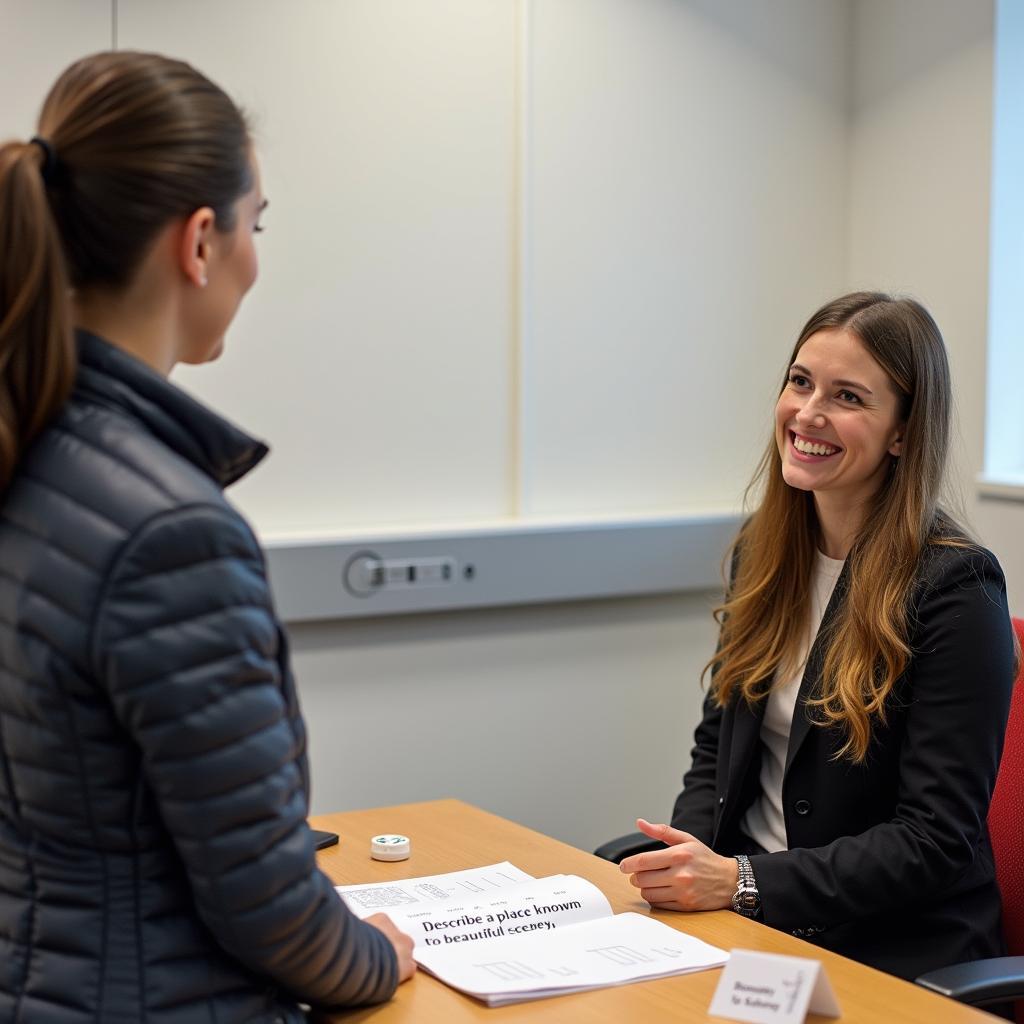 Thí sinh tự tin trình bày bài nói IELTS Speaking Part 2 về Vịnh Hạ Long với giám khảo
Follow-up Questions (Rounding Off Questions)
Examiner có thể hỏi thêm 1-2 câu ngắn sau khi bạn hoàn thành Part 2, trước khi chuyển sang Part 3. Đây là câu hỏi rounding-off để kết thúc natural Part 2.
Question 1: Have you been to Ha Long Bay more than once?
Band 6-7 Answer:
No, I’ve only been there once, but I really want to go back again because it was very memorable.
Band 8-9 Answer:
Actually, I’ve only had the opportunity to visit once so far, but it left such a lasting impression on me that I’m already planning a return trip, hopefully in the near future. I’d love to explore different areas of the bay that I didn’t get to see the first time.
Question 2: Would you recommend this place to foreign visitors?
Band 6-7 Answer:
Yes, definitely. I think foreign tourists would love it because the scenery is amazing and it’s different from what they have in their countries.
Band 8-9 Answer:
Absolutely, without hesitation. I think Ha Long Bay offers foreign visitors a quintessentially Vietnamese experience that beautifully showcases our country’s natural heritage. It’s one of those rare places that manages to exceed even the highest expectations, and it provides a perfect blend of natural splendor and cultural immersion, especially if they visit the floating villages.
IELTS Speaking Part 3: Two-way Discussion
Tổng Quan Về Part 3
Part 3 kéo dài 4-5 phút và là phần khó nhất của IELTS Speaking. Đây là phần thảo luận chuyên sâu, abstract hơn về chủ đề đã đề cập trong Part 2. Examiner sẽ hỏi những câu hỏi rộng hơn về xã hội, xu hướng, so sánh, cause-effect…
Yêu cầu:
- Phân tích, so sánh, đánh giá issues
- Đưa ra quan điểm cá nhân có lý lẽ rõ ràng
- Xem xét nhiều góc độ của vấn đề (not one-sided)
- Sử dụng examples từ society, not just personal experience
Chiến lược:
- Mỗi câu trả lời nên 3-5 câu (longer than Part 1)
- Sử dụng discourse markers để structure answer (Well, Actually, On the one hand…)
- Acknowledge complexity: “It depends…”, “There are various factors…”
- Đưa ra examples from broader context (society, country, world)
- Show critical thinking bằng cách present different perspectives
Lỗi thường gặp của học viên Việt Nam:
- Trả lời quá ngắn như Part 1, không elaborate
- Không đưa ra lý lẽ supporting opinion
- Thiếu từ vựng abstract và academic
- Không structure answer clearly
- Chỉ nói về personal experience thay vì broader issues
- Avoid hoặc too general khi không biết câu trả lời
Các Câu Hỏi Thảo Luận Sâu
Theme 1: Tourism and Natural Places
Question 1: Why do you think people like to visit places with beautiful scenery?
🎯 Phân tích câu hỏi:
- Dạng: Cause/Reason question (Why…)
- Key words: people (general, not just you), like to visit, beautiful scenery
- Cách tiếp cận: Give 2-3 reasons với explanation và examples. Consider different types of people và their motivations.
📝 Sample Answer – Band 6-7:
I think people like visiting beautiful places for several reasons. First, it helps them relax and forget about their work stress. Beautiful scenery makes people feel happy and peaceful. Also, many people want to take nice photos to share on social media. Finally, visiting natural places is good for health because of fresh air and outdoor activities.
Phân tích:
- Structure: Clear với “First”, “Also”, “Finally” – shows basic organization
- Vocabulary: Adequate but basic (relax, beautiful, happy, peaceful, nice photos, good for health)
- Tại sao Band 6-7: Answers the question với relevant reasons, nhưng lacks depth và sophisticated language. Ideas are somewhat predictable và not well-developed.
📝 Câu trả lời mẫu – Band 8-9:
Well, I believe there are multiple compelling reasons why scenic destinations hold such universal appeal. First and foremost, visiting places with beautiful scenery offers people a much-needed escape from the monotony and stress of daily life, particularly for those living in densely populated urban areas. There’s something inherently therapeutic about immersing oneself in nature – it provides a sense of perspective and helps people reconnect with what’s truly important.
Beyond the psychological benefits, I think people are also drawn to these places because of a fundamental human appreciation for beauty and natural wonders. We’re hardwired to find certain landscapes aesthetically pleasing, whether it’s the vastness of an ocean or the majesty of mountain ranges.
Additionally, in today’s Instagram-driven culture, there’s undeniably a social dimension to it as well – people want to capture and share these awe-inspiring moments, which adds another layer of satisfaction to the experience. However, I’d argue that even beyond social media, the desire to witness and experience beautiful scenery is deeply rooted in our innate curiosity about the world and our place in it.
Phân tích:
- Structure: Well-organized với clear progression: escape/psychological → aesthetic appreciation → social aspect → deeper philosophical reason. Uses discourse markers effectively (First and foremost, Beyond…, Additionally, However).
- Vocabulary: Sophisticated và precise (universal appeal, monotony, densely populated, inherently therapeutic, hardwired, awe-inspiring, innate curiosity). Collocations are natural (compelling reasons, fundamental appreciation, Instagram-driven culture).
- Grammar: Complex structures including: passive voice (are drawn to), relative clauses (which adds…), present participles (living in, immersing oneself), conditionals implied.
- Critical Thinking: Shows depth by considering multiple dimensions (psychological, aesthetic, social, philosophical). Acknowledges modern trends (social media) while maintaining that deeper motivations exist.
💡 Key Language Features:
- Discourse markers: “First and foremost” (emphasize main point), “Beyond the psychological benefits” (transition), “Additionally” (add point), “However” (contrast/nuance)
- Tentative language: “I believe”, “I think”, “I’d argue” – shows this is personal opinion, not absolute fact
- Abstract nouns: monotony, perspective, appreciation, dimension, satisfaction, curiosity – elevate language level
- Hedging devices: “undeniably”, “somewhat”, “to some extent” – show nuanced thinking
Question 2: How do you think tourism affects natural scenic areas?
🎯 Phân tích câu hỏi:
- Dạng: Effect/Impact question
- Key words: tourism, affects, natural scenic areas
- Cách tiếp cận: Balanced answer showing both positive và negative effects. Structure: Introduction → Positive impacts → Negative impacts → Conclusion/Personal view.
📝 Sample Answer – Band 6-7:
Tourism has both good and bad effects on natural areas. On the positive side, tourism brings money to local people and the government can use this money to protect the environment. But on the negative side, too many tourists can damage nature. For example, they may leave trash or disturb animals. So I think we need to control the number of tourists.
Phân tích:
- Structure: Basic balanced structure (positive and negative)
- Vocabulary: Simple và general (good and bad, money, protect, damage, trash)
- Tại sao Band 6-7: Addresses both sides but lacks specific examples, sophisticated vocabulary, và depth of analysis
📝 Câu trả lời mẫu – Band 8-9:
That’s a nuanced question because tourism’s impact on natural scenic areas is decidedly mixed, with both significant benefits and considerable drawbacks.
On the positive side, tourism can actually be a powerful force for conservation. When natural areas generate substantial revenue through tourism, there’s a strong economic incentive to preserve them. Take Vietnam’s national parks, for instance – the entrance fees and tourism-related income fund conservation efforts, anti-poaching patrols, and habitat restoration projects that might otherwise be impossible to finance. Tourism also raises awareness about environmental issues and fosters a sense of global responsibility for protecting these natural treasures.
However, the flip side is that poorly managed or excessive tourism can be profoundly detrimental. We’ve seen numerous examples of overtourism wreaking havoc on fragile ecosystems – from trail erosion and habitat disruption to pollution and wildlife disturbance. Some destinations have experienced such severe degradation that they’ve had to implement visitor caps or even temporary closures to allow ecosystems to recover. There’s also the issue of carbon footprints associated with travel, which somewhat ironically contributes to climate change that threatens the very landscapes people are traveling to see.
In my view, the key lies in sustainable tourism practices – finding that delicate balance between economic benefits and environmental protection. This means implementing carrying capacity limits, investing in infrastructure that minimizes environmental impact, and educating visitors about responsible tourism behavior.
Phân tích:
- Structure: Sophisticated organization: Intro (acknowledge complexity) → Positive impacts (with specific examples) → Negative impacts (with concrete examples) → Personal view/Solution. Clear signposting throughout.
- Vocabulary: Precise và topic-specific (nuanced, decidedly mixed, conservation, anti-poaching patrols, habitat restoration, overtourism, wreaking havoc on, trail erosion, carrying capacity limits). Demonstrates range.
- Grammar: Full range of structures: passive (can be seen), conditionals (might otherwise be impossible), present perfect (have experienced, have had to), relative clauses (that threatens…), participles (wreaking havoc).
- Critical Thinking: Shows ability to discuss complex issues from multiple angles, provide specific examples, acknowledge irony (carbon footprint issue), và propose balanced solutions.
💡 Key Language Features:
- Introducing complexity: “That’s a nuanced question”, “decidedly mixed”
- Balancing views: “On the positive side”, “However, the flip side is”
- Giving examples: “Take Vietnam’s national parks, for instance”, “We’ve seen numerous examples of”
- Showing irony/contrast: “somewhat ironically”
- Expressing opinion carefully: “In my view”, “the key lies in”
Theme 2: Environmental Protection
Question 3: Do you think governments should limit the number of tourists to protect natural areas?
🎯 Phân tích câu hỏi:
- Dạng: Opinion question với Yes/No + Why
- Key words: governments, should limit, number of tourists, protect
- Cách tiếp cận: State your position clearly → Provide 2-3 supporting reasons → Acknowledge potential counterarguments → Conclude with balanced view
📝 Sample Answer – Band 6-7:
Yes, I think the government should limit tourists in some places. If too many people visit, they will destroy the environment. For example, they throw garbage and damage plants. Limiting tourists can help keep the place clean and beautiful. But some people may disagree because tourism brings money. I think protection is more important than money.
Phân tích:
- Structure: Has clear position và some reasons
- Vocabulary: Basic (too many, destroy, throw garbage, damage, clean and beautiful)
- Tại sao Band 6-7: Clear communication but lacks sophistication, depth, và nuanced thinking
📝 Câu trả lời mẫu – Band 8-9:
I’m strongly in favor of governments implementing visitor quotas where necessary, though I’d say it needs to be done judiciously and on a case-by-case basis rather than as a blanket policy.
The primary justification for visitor restrictions is environmental protection. Certain ecosystems are simply too fragile to withstand the wear and tear of unlimited foot traffic. We’ve seen cautionary tales like Maya Bay in Thailand, which had to be closed indefinitely due to severe environmental degradation caused by mass tourism. In such cases, limiting numbers isn’t just advisable – it’s imperative if we want these places to exist for future generations. Scientific carrying capacity studies should inform these decisions, ensuring visitor numbers remain within sustainable thresholds.
That said, I recognize this is a contentious issue because tourism is often a vital economic lifeline for local communities. Simply imposing caps without considering the livelihoods of people who depend on tourism would be short-sighted and potentially unjust. This is why I believe the solution lies in smart regulation rather than outright prohibition – implementing timed entry systems, promoting off-peak visits, developing alternative attractions, and most importantly, channeling tourism revenue directly into both conservation and local community development.
Ultimately, I’d argue that preserving natural heritage is a long-term investment that transcends short-term economic considerations. After all, once these natural wonders are destroyed, no amount of money can restore them, and the very foundation of nature-based tourism collapses.
Phân tích:
- Structure: Excellent organization: Clear position → Main argument (environmental necessity with example) → Counterargument acknowledged → Proposed solution → Philosophical conclusion. Shows sophisticated thinking.
- Vocabulary: Highly sophisticated (judiciously, blanket policy, withstand, wear and tear, cautionary tales, imperative, contentious issue, vital economic lifeline, short-sighted, transcends). Precise legal/policy terms (visitor quotas, carrying capacity, timed entry systems).
- Grammar: Complex structures throughout: conditionals (if we want…), passive constructions (should be done, can be restored), relative clauses (that transcends…), gerunds (implementing, promoting, channeling), participles (caused by).
- Critical Thinking: Demonstrates ability to: present strong opinion while acknowledging complexity, provide specific real-world examples, consider stakeholder perspectives, propose nuanced solutions, và think long-term. Shows maturity in discussing policy issues.
 Thảo luận chuyên sâu Part 3 IELTS Speaking về du lịch bền vững và bảo vệ cảnh quan thiên nhiên
Theme 3: Changes and Future Trends
Question 4: How have people’s attitudes towards natural scenery changed over the years?
🎯 Phân tích câu hỏi:
- Dạng: Change over time question
- Key words: attitudes, natural scenery, changed, over the years
- Cách tiếp cận: Compare past và present attitudes → Explain reasons for change → Possibly mention future trend
📝 Sample Answer – Band 6-7:
I think people’s attitudes have changed a lot. In the past, people didn’t care much about nature because they were busy with work and survival. But now, more people appreciate natural scenery because they have more free time and money to travel. Also, social media makes people more interested in visiting beautiful places. Education about environment also makes people care more.
Phân tích:
- Structure: Basic past vs. present comparison
- Vocabulary: Adequate but simple (care much, appreciate, free time, interested in)
- Tại sao Band 6-7: Answers the question but lacks depth, specific examples, sophisticated language
📝 Câu trả lời mẫu – Band 8-9:
There’s been quite a remarkable shift in how people perceive and value natural scenery over the past few decades, and I think this evolution reflects broader societal changes.
Historically, particularly in agrarian societies, people’s relationship with nature was predominantly utilitarian – natural resources were valued primarily for their practical utility rather than their aesthetic or spiritual qualities. If we look back just a generation or two in Vietnam, for instance, people were more concerned with basic subsistence than recreational appreciation of landscapes. Mountains and forests were places of work, not leisure.
However, we’ve witnessed a profound transformation in recent decades. As societies have become more affluent and urbanized, there’s been a growing yearning for connection with nature. The environmental movement has also played a pivotal role in raising consciousness about the intrinsic value of natural ecosystems, not just as resources to be exploited but as treasures to be preserved. This ideological shift has been reinforced by mounting evidence of climate change and biodiversity loss, making people more aware that natural scenery isn’t just beautiful – it’s essential for human wellbeing and planetary health.
Another fascinating dimension is the democratization of travel through affordable transportation and digital media. Social media platforms have exponentially amplified people’s exposure to stunning landscapes worldwide, cultivating an aspirational culture around nature tourism. Whereas in the past, experiencing pristine natural scenery was largely the preserve of the wealthy elite, today it’s increasingly accessible to the masses.
Looking ahead, I suspect this appreciation will only deepen as people grapple with the psychological toll of increasingly digital, disconnected lifestyles and seek authentic experiences in nature.
Phân tích:
- Structure: Sophisticated chronological structure: Historical context → Recent changes with causes → Modern dimension (social media/democracy) → Future prediction. Shows ability to organize complex ideas temporally.
- Vocabulary: Highly academic và precise (utilitarian, agrarian societies, subsistence, profound transformation, intrinsic value, ideological shift, mounting evidence, democratization, exponentially amplified, cultivating, pristine, preserve of, grapple with). Demonstrates excellent range.
- Grammar: Full range expertly used: present perfect for changes over time (have witnessed, has been), past simple for historical context (were concerned), present continuous for ongoing trends (are becoming), conditionals và predictions. Complex sentences with multiple clauses.
- Critical Thinking: Demonstrates historical awareness, understanding of sociological factors, ability to connect multiple causes (affluence, urbanization, environmental movement, technology, media), và forward-thinking prediction. Shows depth of analysis.
💡 Key Language Features:
- Talking about change: “There’s been quite a remarkable shift”, “profound transformation”, “ideological shift”
- Historical comparison: “Historically”, “just a generation or two”, “Whereas in the past”
- Causal language: “reflects”, “played a pivotal role in”, “reinforced by”
- Future speculation: “Looking ahead”, “I suspect”, “will only deepen”
Question 5: What can individuals do to help protect beautiful natural places?
🎯 Phân tích câu hỏi:
- Dạng: Solution/Suggestion question
- Key words: individuals, do, help protect, natural places
- Cách tiếp cận: Give 3-4 concrete actions individuals can take → Explain how each helps → Possibly comment on collective impact
📝 Sample Answer – Band 6-7:
Individuals can do many things to protect natural places. First, they should not throw trash when visiting these places. They should also follow the rules and stay on the paths. People can also reduce pollution by using public transportation instead of private cars. Finally, they can tell other people about the importance of protecting nature.
Phân tích:
- Structure: List của actions (First, also, Finally)
- Vocabulary: Basic actions với simple vocabulary
- Tại sao Band 6-7: Relevant suggestions but lacks elaboration và sophistication
📝 Câu trả lời mẫu – Band 8-9:
While systemic change ultimately requires governmental action and corporate responsibility, I believe individuals can make meaningful contributions to protecting natural landscapes through both direct actions and broader behavioral changes.
Most immediately, when visiting natural areas, individuals need to practice responsible tourism. This goes beyond simply not littering – it includes staying on designated trails to prevent soil erosion, maintaining safe distances from wildlife to avoid disruption to their natural behaviors, and supporting local conservation efforts through entrance fees and donations. I’d also emphasize the importance of the “leave no trace” philosophy – the idea that we should leave natural places exactly as we found them, if not better.
On a broader level, individuals can make lifestyle choices that reduce their environmental footprint. This includes minimizing air travel when possible, choosing eco-certified accommodations, and supporting businesses that demonstrate genuine environmental stewardship rather than just greenwashing. The concept of “slow travel” – spending more time in fewer places – not only reduces carbon emissions but often leads to more meaningful experiences and greater appreciation for local environments.
Perhaps most importantly, individuals can leverage their voices and purchasing power. Advocating for stronger environmental protections, holding corporations accountable for environmental damage, and making conscious consumer choices that favor sustainable products all send powerful market signals. In today’s interconnected world, even small-scale grassroots movements can gain momentum and influence policy when enough individuals collectively push for change.
I’d also highlight the importance of environmental education – individuals who educate themselves about ecological issues and share this knowledge with others, particularly younger generations, are planting seeds for long-term cultural shifts toward greater environmental consciousness. After all, people protect what they love, and they love what they understand.
Phân tích:
- Structure: Highly sophisticated multi-level structure: Intro (acknowledge individual limits) → Immediate actions (responsible tourism) → Lifestyle choices → Advocacy/systemic action → Education/cultural change. Shows ability to think at multiple levels of intervention.
- Vocabulary: Excellent range with precise, topic-specific vocabulary (systemic change, corporate responsibility, designated trails, soil erosion, environmental footprint, eco-certified, greenwashing, environmental stewardship, leverage, purchasing power, grassroots movements, planting seeds). Natural collocations throughout.
- Grammar: Full range fluently used: conditionals, passive voice, gerunds, relative clauses, present perfect, complex noun phrases. Varied sentence structures maintain interest.
- Critical Thinking: Demonstrates sophisticated thinking by: acknowledging limitations of individual action while affirming its value, organizing actions from micro to macro levels, connecting individual behaviors to systemic change, considering both immediate và long-term strategies, showing understanding of how change happens in complex systems.
💡 Key Language Features:
- Acknowledging limitations: “While systemic change ultimately requires…”
- Organizing multiple points: “Most immediately”, “On a broader level”, “Perhaps most importantly”, “I’d also highlight”
- Emphasizing impact: “meaningful contributions”, “send powerful market signals”, “gain momentum”
- Idiomatic expressions: “leave no trace”, “planting seeds”, “people protect what they love”
Theme 4: Comparison and Personal Preferences
Question 6: Which do you think is more important for a country – protecting natural scenery or developing the economy?
🎯 Phân tích câu hỏi:
- Dạng: Compare/prioritize question (potentially controversial)
- Key words: more important, protecting natural scenery vs. developing economy
- Cách tiếp cận: Balanced approach showing understanding of both sides → Challenge the false dichotomy → Argue for integration rather than choosing one
📝 Sample Answer – Band 6-7:
This is a difficult question. Both are important for a country. Economic development is important because it creates jobs and improves people’s lives. But protecting nature is also important for future generations. I think the government should try to balance both. They can develop the economy in a sustainable way that doesn’t harm nature.
Phân tích:
- Structure: Acknowledges both sides và suggests balance
- Vocabulary: Basic và general
- Tại sao Band 6-7: Shows awareness của complexity but lacks depth, specific arguments, sophisticated expression
📝 Câu trả lời mẫu – Band 8-9:
I’d challenge the premise of this question somewhat because I think framing it as an either/or choice represents a false dichotomy that’s become increasingly outdated. The reality is that environmental protection and economic development are not mutually exclusive – in fact, they’re intrinsically linked in ways that make one impossible without the other in the long term.
If we examine the evidence, countries that have pursued economic development at the expense of environmental protection have invariably paid a heavy price. China’s experience is instructive here – decades of rapid industrialization with lax environmental regulations led to severe air pollution, water contamination, and ecological degradation that now costs the country hundreds of billions of dollars annually in healthcare costs, lost productivity, and environmental remediation. The economic costs of environmental neglect are staggering and often dwarf the short-term gains from unregulated development.
Conversely, protecting natural scenery isn’t merely an altruistic endeavor – it’s sound economic policy. Natural landscapes underpin viable tourism industries, which are often significant revenue generators. Costa Rica exemplifies this approach, having built its economy around eco-tourism and environmental conservation, which now accounts for a substantial portion of its GDP. Moreover, healthy ecosystems provide essential services – water filtration, carbon sequestration, flood prevention – that would cost enormous sums to replicate artificially, assuming it’s even possible.
The forward-thinking approach, which progressive governments are increasingly adopting, is to pursue what’s called “green growth” or “sustainable development” – an economic model that treats environmental protection not as an obstacle to prosperity but as its foundation. This means investing in renewable energy, sustainable agriculture, eco-tourism, and green technologies that generate economic opportunities while preserving natural capital.
In essence, I’d argue that the question shouldn’t be which is more important, but rather how we can ensure that economic development occurs in harmony with environmental protection – because ultimately, sacrificing one for the other is a losing proposition for everyone.
Phân tích:
- Structure: Sophisticated argumentative structure: Challenge premise → Negative example (environmental cost of development) → Positive example (economic value of protection) → Integrated solution (green growth) → Philosophical conclusion. Shows high-level critical thinking.
- Vocabulary: Extensive sophisticated vocabulary (false dichotomy, mutually exclusive, intrinsically linked, at the expense of, invariably, lax regulations, ecological degradation, dwarf, altruistic endeavor, underpin, exemplifies, carbon sequestration, progressive governments, natural capital, losing proposition). Academic register throughout.
- Grammar: Full range expertly deployed: conditionals (if we examine), relative clauses (which are often, that would cost), perfect forms, passive constructions, complex noun phrases, gerunds. Varied sentence lengths và structures maintain engagement.
- Critical Thinking: Demonstrates exceptional thinking by: challenging underlying assumptions of question, using specific country examples with data implications, understanding both short-term vs long-term perspectives, showing knowledge of economic concepts (GDP, healthcare costs), presenting integrated solution rather than binary choice, using evidence-based reasoning. Shows mature, sophisticated worldview.
💡 Key Language Features:
- Challenging assumptions: “I’d challenge the premise”, “framing it as an either/or choice represents a false dichotomy”
- Using evidence: “If we examine the evidence”, “China’s experience is instructive here”, “Costa Rica exemplifies”
- Contrast structures: “at the expense of”, “Conversely”, “not as… but as…”
- Academic hedging: “increasingly”, “often”, “substantial portion”, “assuming”
- Presenting integrated solutions: “in harmony with”, “The forward-thinking approach”
Từ vựng và cụm từ quan trọng
Topic-Specific Vocabulary
| Từ vựng/Cụm từ | Loại từ | Phiên âm | Nghĩa tiếng Việt | Ví dụ | Collocation |
|---|---|---|---|---|---|
| breathtaking | adj | /ˈbreθteɪkɪŋ/ | ngoạn mục, đẹp đến nghẹt thở | The view from the mountain peak was absolutely breathtaking. | breathtaking scenery/view/landscape/beauty |
| pristine | adj | /ˈprɪstiːn/ | nguyên sơ, hoang sơ, chưa bị tác động | The island has pristine beaches with crystal-clear water. | pristine nature/environment/condition/wilderness |
| limestone karst | n | /ˈlaɪmstəʊn kɑːst/ | địa hình đá vôi (đặc trưng của Vịnh Hạ Long) | Ha Long Bay is famous for its limestone karst formations. | limestone karst landscape/formation/terrain/topography |
| emerald-green | adj | /ˈemərəld ɡriːn/ | màu xanh ngọc lục bảo | The emerald-green waters reflect the surrounding cliffs. | emerald-green water/sea/ocean/lake |
| lush vegetation | n | /lʌʃ ˌvedʒəˈteɪʃn/ | thảm thực vật tươi tốt, sum suê | The national park is covered with lush vegetation. | lush vegetation/greenery/forest/landscape |
| picturesque | adj | /ˌpɪktʃəˈresk/ | đẹp như tranh vẽ | The village is nestled in a picturesque valley. | picturesque village/scenery/setting/landscape |
| majestic | adj | /məˈdʒestɪk/ | hùng vĩ, tráng lệ | The majestic mountains tower over the valley. | majestic mountains/peaks/scenery/landscape |
| panoramic view | n | /ˌpænəˈræmɪk vjuː/ | tầm nhìn toàn cảnh | From the top, you can enjoy a panoramic view of the entire bay. | panoramic view/vista/perspective |
| unspoiled | adj | /ˌʌnˈspɔɪld/ | chưa bị phá hủy, còn nguyên vẹn | The area remains largely unspoiled by mass tourism. | unspoiled nature/beauty/landscape/wilderness |
| scenic spot | n | /ˈsiːnɪk spɒt/ | điểm du lịch có cảnh đẹp | This is one of the most popular scenic spots in the region. | famous/popular/renowned scenic spot |
| biodiversity | n | /ˌbaɪəʊdaɪˈvɜːsəti/ | đa dạng sinh học | The national park is known for its rich biodiversity. | rich/preserve/protect biodiversity |
| conservation | n | /ˌkɒnsəˈveɪʃn/ | sự bảo tồn | Wildlife conservation is essential for protecting endangered species. | environmental/nature/wildlife conservation |
| overtourism | n | /ˌəʊvəˈtʊərɪzəm/ | tình trạng du lịch quá tải | Many popular destinations are suffering from overtourism. | combat/tackle/address overtourism |
| ecological footprint | n | /ˌiːkəˈlɒdʒɪkl ˈfʊtprɪnt/ | dấu chân sinh thái (tác động môi trường) | We should all try to reduce our ecological footprint when traveling. | reduce/minimize/carbon/ecological footprint |
| sustainable tourism | n | /səˈsteɪnəbl ˈtʊərɪzəm/ | du lịch bền vững | The country is promoting sustainable tourism to protect its natural heritage. | promote/develop/practice sustainable tourism |
| awe-inspiring | adj | /ˈɔː ɪnˌspaɪərɪŋ/ | gây kinh ngạc, choáng ngợp | The waterfalls create an awe-inspiring spectacle. | awe-inspiring sight/view/beauty/landscape |
| tranquil | adj | /ˈtræŋkwɪl/ | yên tĩnh, thanh bình | The lake provides a tranquil escape from city life. | tranquil atmosphere/setting/environment/surroundings |
| rugged terrain | n | /ˈrʌɡɪd təˈreɪn/ | địa hình hiểm trở | The mountain area has rugged terrain that’s challenging for hikers. | rugged terrain/landscape/coastline/mountains |
| seascape | n | /ˈsiːskeɪp/ | phong cảnh biển | The artist is famous for painting beautiful seascapes. | dramatic/stunning/coastal seascape |
| natural wonder | n | /ˈnætʃrəl ˈwʌndə/ | kỳ quan thiên nhiên | Ha Long Bay is considered one of Vietnam’s natural wonders. | natural wonder/marvel/treasure/heritage |
Idiomatic Expressions & Advanced Phrases
| Cụm từ | Nghĩa | Ví dụ sử dụng | Band điểm |
|---|---|---|---|
| take one’s breath away | làm ai đó kinh ngạc, choáng ngợp | The sunset over the bay absolutely took my breath away. | 7.5-9 |
| off the beaten track | xa xôi hẻo lánh, ít người biết đến | For those seeking adventure, this destination is well off the beaten track. | 7.5-9 |
| a sight to behold | một cảnh tượng đáng xem, ấn tượng | The rice terraces at harvest time are truly a sight to behold. | 7.5-9 |
| as far as the eye can see | xa tít tắp, đến tận chân trời | The golden sand dunes stretched as far as the eye could see. | 7-8.5 |
| a feast for the eyes | một bữa tiệc thị giác, cực kỳ đẹp mắt | The flower gardens in spring are a feast for the eyes. | 7.5-9 |
| nestled in/among | nằm ẩn mình trong, tọa lạc giữa | The village is nestled among verdant hills and valleys. | 7.5-8.5 |
| dotted with | rải rác có nhiều | The landscape was dotted with ancient temples and pagodas. | 7-8.5 |
| teeming with life | tràn đầy sự sống, sinh động | The coral reefs are teeming with colorful marine life. | 7.5-9 |
| in the lap of nature | trong lòng thiên nhiên | The eco-resort is located in the lap of nature, far from urban areas. | 7.5-8.5 |
| untouched by human hands | chưa bị con người tác động | These forests remain largely untouched by human hands. | 7.5-8.5 |
| the jewel in the crown | viên ngọc quý, điểm nhấn đẹp nhất | This national park is the jewel in the crown of Vietnam’s natural heritage. | 8-9 |
| leave no trace | không để lại dấu vết (nguyên tắc du lịch bền vững) | Responsible hikers follow the “leave no trace” principles. | 7.5-9 |
Discourse Markers (Từ Nối Ý Trong Speaking)
Để bắt đầu câu trả lời:
- 📝 Well,… – Khi cần thời gian suy nghĩ ngắn, tạo sự tự nhiên
- 📝 Actually,… – Khi đưa ra góc nhìn khác hoặc thông tin bất ngờ
- 📝 To be honest,… – Khi nói thật, thẳng thắn
- 📝 I’d say that… – Khi đưa ra quan điểm cá nhân
- 📝 From my perspective,… – Từ góc nhìn của tôi
- 📝 In my view/opinion,… – Theo quan điểm của tôi
Để bổ sung ý:
- 📝 On top of that,… – Thêm vào đó, hơn nữa
- 📝 What’s more,… – Hơn nữa, còn nữa
- 📝 Not to mention… – Chưa kể đến, chưa nói đến
- 📝 Additionally/Furthermore,… – Thêm vào đó (formal hơn)
- 📝 Beyond that,… – Ngoài ra còn
- 📝 Another aspect/dimension is… – Một khía cạnh khác là
Để đưa ra quan điểm cân bằng:
- 📝 On the one hand,… On the other hand,… – Một mặt… mặt khác
- 📝 While it’s true that…, we also need to consider… – Mặc dù đúng là… nhưng chúng ta cũng cần xem xét
- 📝 However/Nevertheless,… – Tuy nhiên
- 📝 That said/Having said that,… – Tuy đã nói vậy nhưng
- 📝 Conversely,… – Ngược lại
Để đưa ra ví dụ:
- 📝 For instance/For example,… – Ví dụ
- 📝 Take… for instance – Lấy… làm ví dụ
- 📝 A case in point is… – Một ví dụ điển hình là
- 📝 To illustrate this,… – Để minh họa điều này
Để kết luận:
- 📝 All in all,… – Tóm lại, nhìn chung
- 📝 At the end of the day,… – Cuối cùng thì, xét cho cùng
- 📝 In essence/Essentially,… – Về bản chất, về cơ bản
- 📝 Ultimately,… – Cuối cùng, rốt cuộc
Để thể hiện sự phức tạp:
- 📝 It depends on… – Điều đó phụ thuộc vào
- 📝 It’s a nuanced/complex question… – Đây là câu hỏi phức tạp
- 📝 There are various factors to consider… – Có nhiều yếu tố cần xem xét
- 📝 It’s not as simple as… – Nó không đơn giản như
Grammatical Structures Ấn Tượng
1. Conditional Sentences (Câu điều kiện):
Mixed conditional:
- Formula: If + Past Perfect, … would/could + bare infinitive
- Ví dụ: “If we had protected these natural areas earlier, we wouldn’t be facing such severe environmental degradation now.”
Inversion for emphasis:
- Formula: Had + subject + past participle, … would have…
- Ví dụ: “Had I known about the breathtaking scenery earlier, I would have visited years ago.”
2. Relative Clauses (Mệnh đề quan hệ):
Non-defining relative clauses:
- Formula: …, which/who + verb…
- Ví dụ: “Ha Long Bay, which was recognized as a UNESCO World Heritage Site, attracts millions of visitors annually.”
Reduced relative clauses:
- Formula: Noun + present/past participle…
- Ví dụ: “The mountains rising majestically in the distance create a stunning backdrop.”
3. Passive Voice (Câu bị động):
Impersonal passive structures:
- Formula: It is thought/believed/said that…
- Ví dụ: “It is widely believed that protecting natural scenery contributes significantly to national wellbeing.”
Passive with modal verbs:
- Formula: Modal + be + past participle
- Ví dụ: “Visitor numbers should be carefully monitored to prevent environmental damage.”
4. Cleft Sentences (Câu chẻ):
What-cleft for emphasis:
- Formula: What + subject + verb + is/was…
- Ví dụ: “What I find most impressive about this place is the perfect harmony between nature and local culture.”
It-cleft for focus:
- Formula: It + is/was + emphasized element + that/who…
- Ví dụ: “It was the pristine beauty of the landscape that convinced me to extend my stay.”
5. Inversion for Emphasis:
Negative adverbs at beginning:
- Formula: Never/Rarely/Seldom + auxiliary + subject + verb…
- Ví dụ: “Never have I seen such spectacular scenery in all my travels.”
Only/Not only at beginning:
- Formula: Not only + auxiliary + subject + verb… but also…
- Ví dụ: “Not only does the area boast stunning natural beauty, but it also offers rich cultural experiences.”
6. Advanced Gerund and Infinitive Structures:
Gerund as subject:
- Formula: Gerund + verb…
- Ví dụ: “Protecting natural landscapes requires sustained commitment from both governments and individuals.”
Perfect gerund for past actions:
- Formula: Subject + verb + having + past participle
- Ví dụ: “I regret not having visited this scenic spot earlier in my life.”
Với bài viết toàn diện này, bạn đã có trong tay một hướng dẫn chi tiết để chuẩn bị cho chủ đề “describe a place in your country known for its beautiful scenery” trong IELTS Speaking. Hãy nhớ rằng, điều quan trọng nhất không phải là học thuộc lòng các câu trả lời mẫu, mà là hiểu được cấu trúc, từ vựng và cách phát triển ý tưởng để bạn có thể tự tin thể hiện những trải nghiệm và suy nghĩ riêng của mình một cách tự nhiên và ấn tượng. Chúc bạn thành công trong kỳ thi IELTS Speaking!