Chủ đề về không khí trong lành và các địa điểm ngoài trời là một trong những đề tài phổ biến nhất trong IELTS Speaking, đặc biệt khi sự quan tâm về môi trường và sức khỏe ngày càng tăng cao. Từ năm 2020 đến nay, chủ đề này xuất hiện với tần suất cao trong các kỳ thi IELTS thực tế tại Việt Nam và trên toàn cầu, với dự đoán khả năng tiếp tục xuất hiện ở mức Cao trong tương lai gần.
Chủ đề “Describe A Place Where You Go To Enjoy The Fresh Air” thường xoay quanh các góc độ như: công viên, vườn quốc gia, bãi biển, vùng nông thôn, hoặc bất kỳ địa điểm nào giúp bạn thoát khỏi không khí ô nhiễm của thành phố. Đây là đề tài vừa gần gũi vừa đòi hỏi khả năng miêu tả chi tiết và diễn đạt cảm xúc tự nhiên.
Trong bài viết này, bạn sẽ học được:
- Các câu hỏi thường gặp trong cả 3 Part của IELTS Speaking về chủ đề này
- Bài mẫu chi tiết theo từng band điểm (6-7, 7.5-8, 8.5-9) với phân tích chuyên sâu
- Hơn 50 từ vựng và cụm từ ăn điểm liên quan đến môi trường và không gian ngoài trời
- Chiến lược trả lời hiệu quả từ góc nhìn của một IELTS Examiner
- Lời khuyên thực tế giúp bạn tránh những lỗi phổ biến của học viên Việt Nam
IELTS Speaking Part 1: Introduction and Interview
Tổng Quan Về Part 1
Part 1 kéo dài 4-5 phút với các câu hỏi ngắn về cuộc sống hàng ngày. Với chủ đề không khí trong lành, examiner thường hỏi về thói quen, sở thích và môi trường sống của bạn. Mục tiêu là trả lời tự nhiên, mở rộng mỗi câu trả lời thành 2-3 câu với lý do và ví dụ cụ thể.
Lỗi thường gặp của học viên Việt Nam:
- Trả lời quá ngắn chỉ “Yes” hoặc “No” mà không giải thích
- Dùng từ vựng đơn giản lặp đi lặp lại như “good”, “nice”, “beautiful”
- Thiếu ví dụ cá nhân để minh họa
- Nói quá nhanh hoặc quá chậm do lo lắng
Các Câu Hỏi Thường Gặp
Question 1: Do you prefer living in the city or the countryside?
Question 2: How often do you go to parks or green spaces?
Question 3: Is the air quality good in your city?
Question 4: What do you usually do when you want fresh air?
Question 5: Do you think it’s important to breathe fresh air?
Question 6: Are there many trees near where you live?
Question 7: Do you enjoy outdoor activities?
Question 8: Have you ever been to a place with very clean air?
Phân Tích và Gợi Ý Trả Lời Chi Tiết
Question: Do you prefer living in the city or the countryside?
🎯 Cách tiếp cận:
- Trả lời trực tiếp preference của bạn
- Đưa ra 1-2 lý do cụ thể
- Có thể thêm một câu về disadvantage của lựa chọn còn lại
📝 Sample Answer – Band 6-7:
“I prefer living in the city because it’s more convenient. There are many shops and restaurants near my house. However, the air quality is not very good compared to the countryside.”
Phân tích:
- Điểm mạnh: Trả lời rõ ràng, có comparison, đủ 3 câu
- Hạn chế: Từ vựng basic (convenient, good, many), cấu trúc câu đơn giản, ý tưởng surface-level
- Tại sao Band 6-7: Fluency ổn định nhưng thiếu sophistication trong vocabulary và grammar. Ý tưởng chưa được develop sâu.
📝 Sample Answer – Band 8-9:
“To be honest, I’m more of a city person, mainly because I’m drawn to the hustle and bustle of urban life. The convenience factor really appeals to me – everything from shopping malls to healthcare facilities is within easy reach. That said, I do acknowledge that city living comes at a cost, particularly when it comes to air quality, which is why I make it a point to escape to the countryside on weekends.”
Phân tích:
- Điểm mạnh:
- Vocabulary sophisticated: “hustle and bustle”, “within easy reach”, “comes at a cost”
- Cấu trúc đa dạng: “I’m more of a…”, “That said…”, “make it a point to…”
- Ý tưởng balanced: acknowledge cả pros và cons
- Tự nhiên với discourse markers: “To be honest”, “That said”
- Tại sao Band 8-9:
- Fluency: Smooth flow với appropriate linking
- Vocabulary: Idiomatic và precise
- Grammar: Complex structures (participle clauses, relative clauses)
- Ideas: Nuanced view thể hiện critical thinking
💡 Key Vocabulary & Expressions:
- hustle and bustle: (n) /ˈhʌsl ənd ˈbʌsl/ sự nhộn nhịp, hối hả
- within easy reach: (phrase) dễ dàng tiếp cận, gần
- comes at a cost: (idiom) đi kèm với cái giá phải trả
- make it a point to: (phrase) cố gắng đảm bảo làm điều gì đó
Question: How often do you go to parks or green spaces?
🎯 Cách tiếp cận:
- Nêu tần suất cụ thể (daily, weekly, monthly)
- Giải thích lý do cho frequency đó
- Có thể nói về specific park hoặc activity
📝 Sample Answer – Band 6-7:
“I go to the park near my house about twice a week. I usually go there in the early morning to exercise. It helps me feel relaxed and the air is fresh.”
Phân tích:
- Điểm mạnh: Specific frequency, có reason, đề cập benefit
- Hạn chế: Vocabulary repetitive (go, fresh), lack of detail về experience
- Tại sao Band 6-7: Clear communication nhưng thiếu variety trong language use
📝 Sample Answer – Band 8-9:
“I’d say I frequent a local park around three to four times a week, typically during the early morning hours when the air is crisp and clean. It’s become somewhat of a ritual for me – I find that starting my day with a brisk walk among the trees really clears my head and sets a positive tone for the rest of the day. Plus, it’s a great way to disconnect from the digital world and just be present in nature.”
Phân tích:
- Điểm mạnh:
- Vocabulary precise: “frequent” (verb), “crisp and clean”, “ritual”
- Collocations natural: “brisk walk”, “clears my head”, “sets a positive tone”
- Personal reflection: “It’s become somewhat of a ritual”
- Multi-layered answer: frequency + when + why + benefits
- Tại sao Band 8-9: Demonstrates full range of language với natural, idiomatic expressions. Shows personality và thoughtful reflection.
💡 Key Vocabulary & Expressions:
- frequent: (v) /frɪˈkwent/ thường xuyên đến (một nơi)
- crisp and clean: (adj phrase) trong lành, sạch sẽ (về không khí)
- brisk walk: (n) /brɪsk wɔːk/ đi bộ nhanh
- clears my head: (idiom) làm đầu óc tỉnh táo, giải tỏa stress
- disconnect from: (phrasal verb) ngắt kết nối, tách khỏi
Question: Is the air quality good in your city?
🎯 Cách tiếp cận:
- Đánh giá trung thực về air quality
- Nêu evidence hoặc comparison
- Có thể mention causes nếu air quality xấu
📝 Sample Answer – Band 6-7:
“Actually, the air quality in my city is quite poor, especially during rush hour. There are too many vehicles on the road and this causes air pollution. Sometimes I can see the smog in the morning.”
Phân tích:
- Điểm mạnh: Honest assessment, có cause-effect, visual evidence
- Hạn chế: Simple vocabulary (poor, too many, causes), basic grammar
- Tại sao Band 6-7: Communicates the main idea effectively nhưng lacks sophistication
📝 Sample Answer – Band 8-9:
“Unfortunately, I’d have to say the air quality in my city leaves much to be desired. We’re dealing with concerning levels of particulate matter, particularly during the dry season when pollution reaches its peak. The main culprits are vehicle emissions and industrial discharge, which create a visible haze that hangs over the city, especially during morning commutes. It’s actually become a pressing public health concern that local authorities are struggling to address.”
Phân tích:
- Điểm mạnh:
- Academic vocabulary: “particulate matter”, “emissions”, “industrial discharge”
- Sophisticated expressions: “leaves much to be desired”, “reaches its peak”
- Technical accuracy: specific pollutants và sources
- Social awareness: mention public health và government response
- Complex grammar: relative clauses, present perfect continuous
- Tại sao Band 8-9: Shows topic-specific knowledge, uses less common vocabulary naturally, demonstrates critical thinking về environmental issues.
💡 Key Vocabulary & Expressions:
- leaves much to be desired: (idiom) còn nhiều điều chưa đạt yêu cầu
- particulate matter: (n) /pɑːˈtɪkjələt ˈmætə/ bụi mịn, hạt vi mô
- culprits: (n) /ˈkʌlprɪts/ thủ phạm, nguyên nhân chính
- visible haze: (n) sương mù nhìn thấy được
- pressing public health concern: vấn đề sức khỏe cộng đồng cấp bách
 Công viên xanh trong thành phố nơi người học IELTS có thể đến để tận hưởng không khí trong lành
IELTS Speaking Part 2: Long Turn (Cue Card)
Tổng Quan Về Part 2
Part 2 là phần độc thoại kéo dài 2-3 phút, trong đó bạn có 1 phút chuẩn bị với giấy và bút. Đây là phần quan trọng nhất vì nó chiếm tỷ trọng lớn trong việc đánh giá khả năng nói liên tục của bạn.
Chiến lược hiệu quả:
- Sử dụng hết 1 phút chuẩn bị: Chỉ ghi keywords, không viết câu hoàn chỉnh (waste time)
- Nói đủ 2 phút: Examiners đánh giá cao sustained speech, tối thiểu 1.5 phút
- Cover tất cả bullet points: Mỗi bullet nên có ít nhất 3-4 câu
- Sử dụng thì phù hợp: Với “a place you go”, có thể dùng present simple/present perfect nếu là thói quen hiện tại
Lỗi thường gặp:
- Viết quá nhiều trong 1 phút chuẩn bị rồi không có thời gian suy nghĩ flow
- Nói quá ngắn (dưới 1.5 phút) khiến examiner phải hỏi thêm
- Bỏ sót bullet point cuối (thường là explain why/how you feel)
- Kể chuyện không có structure rõ ràng
Cue Card
Describe a place where you go to enjoy the fresh air
You should say:
- Where it is
- How often you go there
- What you do there
- And explain why you like to go there
Phân Tích Đề Bài
- Dạng câu hỏi: Describe a place (địa điểm cụ thể)
- Thì động từ: Present Simple/Present Perfect (vì là thói quen hiện tại: “where you go” không phải “where you went”)
- Bullet points phải cover:
- Where it is: Location cụ thể, có thể thêm how far, how to get there
- How often you go there: Frequency và circumstances (khi nào, với ai)
- What you do there: Activities chi tiết, experience
- Explain why you like: Reasons, feelings, benefits – phần này quan trọng nhất để show depth
- Câu “explain” quan trọng: Đây là nơi bạn express feelings và personal values, giúp phân biệt band 7 và band 8-9
📝 Sample Answer – Band 6-7
Thời lượng: Khoảng 1.5-2 phút
“I’d like to talk about a park near my house where I often go to enjoy fresh air. It’s called Thanh Xuan Park and it’s located about 10 minutes from my home by bicycle.
I try to go there at least twice a week, usually in the early morning around 6 AM or sometimes in the evening after work. The air is much fresher at these times compared to other hours of the day.
When I’m there, I usually do some exercise like jogging or cycling around the park. There’s a nice path that goes around the whole park. Sometimes I also do some stretching exercises under the trees. The park has many old trees and a small lake, so the environment is very peaceful and relaxing.
I really like going there because it helps me escape from the busy and polluted city center. The air quality there is much better because of all the trees. After spending time in the park, I feel more energetic and less stressed. It’s like a small piece of nature in the middle of the city. Also, I can meet other people who come there for exercise, and sometimes we chat a little bit. It’s become an important part of my daily routine and I always feel better after visiting this place.”
Phân Tích Band Điểm
| Tiêu chí | Band | Nhận xét |
|---|---|---|
| Fluency & Coherence | 6-7 | Flow ổn định, có sequencing rõ ràng với từng bullet point. Dùng basic linking words (usually, sometimes, also, because). Không có long pauses nhưng thiếu variety trong discourse markers. |
| Lexical Resource | 6-7 | Từ vựng adequate: “escape from”, “peaceful”, “energetic”. Có attempts để paraphrase (busy/polluted, fresh/better quality) nhưng còn repetitive. Thiếu less common vocabulary và collocations. |
| Grammatical Range & Accuracy | 6-7 | Mix simple và complex sentences. Có relative clauses đơn giản (“people who come there”). Dùng đúng present simple. Thiếu variety trong structures (conditional, perfect tenses). |
| Pronunciation | 6-7 | Rõ ràng và dễ hiểu, có một số errors về word stress nhưng không ảnh hưởng communication. |
Điểm mạnh:
- ✅ Cover đầy đủ 4 bullet points
- ✅ Nói đủ thời lượng (khoảng 1.5-2 phút)
- ✅ Ideas logical và organized
- ✅ Personal experience authentic
Hạn chế:
- ⚠️ Vocabulary còn basic (nice, very peaceful, much better)
- ⚠️ Thiếu descriptive details về the place
- ⚠️ Grammar structures không đa dạng
- ⚠️ Explain section chưa sâu về feelings và personal significance
📝 Sample Answer – Band 7.5-8
Thời lượng: Khoảng 2-2.5 phút
“I’d like to describe a place that’s become my go-to spot for fresh air – it’s a riverside park called West Lake Promenade, which is situated along the western shore of Hanoi’s largest lake, about a 15-minute drive from the city center.
I make it a point to visit this place at least three to four times a week, preferably during the early morning hours around 5:30 or 6 AM, when the air is at its freshest and the area isn’t too crowded yet. Occasionally, I also drop by in the late afternoon, especially on weekends when I need to clear my head after a hectic week.
What I typically do there varies depending on my mood and energy level. Most of the time, I go for a leisurely jog along the tree-lined pathway that stretches for about three kilometers. The path runs parallel to the lake, offering stunning views of the water, particularly at sunrise. On days when I’m feeling less energetic, I simply take a gentle stroll and soak in the atmosphere. There’s something incredibly therapeutic about watching the morning mist rise from the lake surface. I’ve also noticed that many elderly people practice tai chi there, and their graceful movements add to the tranquil ambiance.
The reason I’m so drawn to this place is multifaceted. First and foremost, the air quality is remarkably better than in the bustling downtown area where I live. The abundance of mature trees – mostly plane trees and willows – acts as a natural air filter, making each breath feel crisp and refreshing. Beyond the physical benefits, there’s also a profound psychological impact. Being surrounded by nature, even if it’s a man-made green space, helps me disconnect from work pressures and reconnect with myself. It’s become a form of moving meditation for me. Moreover, the sense of community there is wonderful – seeing familiar faces, exchanging smiles with fellow early risers, creates a feeling of belonging that’s quite rare in urban environments these days.”
Phân Tích Band Điểm
| Tiêu chí | Band | Nhận xét |
|---|---|---|
| Fluency & Coherence | 7.5-8 | Smooth và natural flow với appropriate hesitations. Excellent use of discourse markers (First and foremost, Beyond, Moreover). Clear progression of ideas với varied cohesive devices. |
| Lexical Resource | 7.5-8 | Wide range of vocabulary: “go-to spot”, “therapeutic”, “tranquil ambiance”, “profound psychological impact”. Good collocations: “tree-lined pathway”, “soak in the atmosphere”. Some less common items used effectively. |
| Grammatical Range & Accuracy | 7.5-8 | Variety of complex structures: relative clauses, participle clauses (-ing forms), conditionals implied. Mix of tenses appropriate. Few errors, mostly error-free. |
| Pronunciation | 7.5-8 | Clear pronunciation với appropriate word stress, sentence stress, và intonation patterns. Easy to understand throughout. |
So Sánh Với Band 6-7
| Khía cạnh | Band 6-7 | Band 7.5-8 |
|---|---|---|
| Vocabulary | “nice path”, “peaceful and relaxing” | “tree-lined pathway”, “tranquil ambiance”, “therapeutic” |
| Grammar | “There’s a nice path that goes around” | “The path runs parallel to the lake, offering stunning views” |
| Ideas | “helps me escape from busy city” | “profound psychological impact… helps me disconnect from work pressures and reconnect with myself” |
| Details | General descriptions | Specific sensory details (morning mist, graceful movements of tai chi practitioners) |
📝 Sample Answer – Band 8.5-9
Thời lượng: 2.5-3 phút đầy đủ
“I’d like to tell you about a place that’s become absolutely integral to my wellbeing – it’s a relatively secluded stretch of coastline about 45 minutes north of where I live, locally known as the Windy Cove, though it doesn’t appear on most tourist maps, which is precisely part of its charm.
I’ve been gravitating towards this spot with increasing regularity over the past year or so – I’d say I make the journey there at least once a week, sometimes twice if my schedule permits. I deliberately carve out time on Sunday mornings, leaving around dawn to catch that magical golden hour when the sea breeze is at its most invigorating. There’s something almost ritualistic about this weekly pilgrimage – it’s become far more than just a casual outing; it’s evolved into a non-negotiable commitment to myself.
What I do there has organically evolved over time. Initially, I’d simply perch myself on the rocky outcrop overlooking the ocean and lose myself in the rhythmic crash of waves against the shore. The salt-tinged air, carried by the persistent onshore breeze, has this remarkable capacity to instantaneously clear both my sinuses and my mind – quite literally sweeping away the mental cobwebs that accumulate during the week. Nowadays, I’ve incorporated a more structured routine: I start with about 30 minutes of mindful breathing exercises, really consciously inhaling that unpolluted ocean air, then I take a vigorous walk along the relatively untrodden beach. The coarse sand and occasional rock pools make it quite a workout for the legs. I’ve also taken to bringing a small journal to jot down reflections – there’s something about the expansiveness of the seascape that triggers creative thinking and helps crystallize thoughts that normally remain frustratingly nebulous.
The reasons I’m so profoundly attached to this place operate on multiple levels. On the most pragmatic level, the air quality is incomparably superior to what I breathe in the city – we’re talking about pollution levels that are practically negligible, with the constant sea breeze acting as nature’s own air purification system. But it goes far deeper than just the physical respiratory benefits. This place has become my sanctuary for psychological decompression. In our hyper-connected, perpetually stimulated modern existence, finding a space where you can achieve genuine mental stillness is increasingly rare. The sheer vastness of the ocean has a humbling effect – it puts my daily concerns into perspective and reminds me of something larger than the trivial stresses I often fixate on. There’s also an element of environmental consciousness that’s developed through these visits. Witnessing firsthand the pristine state of this relatively untouched ecosystem has made me acutely aware of how precious clean air and unspoiled nature truly are. It’s reinforced my commitment to sustainable living practices and environmental advocacy. Perhaps most significantly, this place represents a deliberate counterbalance to my otherwise predominantly indoor, screen-dominated lifestyle. It’s my way of maintaining equilibrium, of staying grounded in tangible, sensory experiences rather than getting entirely consumed by the virtual realm.”
Phân Tích Band Điểm
| Tiêu chí | Band | Nhận xét |
|---|---|---|
| Fluency & Coherence | 8.5-9 | Effortlessly fluent và coherent. Sophisticated use của discourse markers và cohesive devices. Ideas develop logically với clear progression. Speaks at length without noticeable effort or loss of coherence. |
| Lexical Resource | 8.5-9 | Wide vocabulary range used với full flexibility và precision. Uses idiomatic language naturally (“mental cobwebs”, “weekly pilgrimage”). Rare vocabulary items với sophisticated collocations: “hyper-connected existence”, “psychological decompression”, “environmental advocacy”. |
| Grammatical Range & Accuracy | 8.5-9 | Full range of structures với complete flexibility. Complex structures used accurately: participle clauses, cleft sentences, inversion, conditionals. Consistent grammatical control with only extremely rare errors. |
| Pronunciation | 8.5-9 | Pronunciation features used với full flexibility để convey meaning precisely. Uses features để enhance communication. Sustained appropriate intonation, stress và rhythm throughout. |
Tại Sao Bài Này Xuất Sắc
🎯 Fluency Hoàn Hảo:
- Không có hesitation, flow tự nhiên như native speaker
- Sử dụng sophisticated linkers: “precisely”, “far deeper than”, “perhaps most significantly”
- Ideas connect seamlessly từ description → activities → multi-layered explanation
📚 Vocabulary Tinh Vi:
- Ví dụ: “gravitating towards” thay vì “going to” – shows sophisticated verb choice
- “hyper-connected, perpetually stimulated modern existence” – abstract noun phrases
- “mental cobwebs” – metaphorical language used naturally
- “crystallize thoughts” – precise collocation showing depth of expression
📝 Grammar Đa Dạng:
- Ví dụ: “which is precisely part of its charm” – non-defining relative clause với adverb positioning
- “Witnessing firsthand the pristine state…” – participle clause as subject
- “It’s evolved into a non-negotiable commitment” – present perfect showing development
- Conditional implied: “if my schedule permits”
💡 Ideas Sâu Sắc:
- Không chỉ describe physical aspects mà explore psychological impact
- Demonstrates personal growth: “has developed through these visits”
- Shows social awareness: environmental consciousness
- Reflects on modern life: counterbalance to screen-dominated lifestyle
- Multi-dimensional explanation: physical → psychological → philosophical
 Bãi biển hoang sơ với không khí trong lành phù hợp cho đề tài IELTS Speaking về nơi tận hưởng thiên nhiên
Follow-up Questions (Rounding Off Questions)
Sau khi bạn nói xong Part 2, examiner thường hỏi 1-2 câu ngắn để transition sang Part 3:
Question 1: Do you think more people should spend time in places with fresh air?
Band 6-7 Answer:
“Yes, definitely. I think spending time in places with fresh air is good for health. It helps people relax and reduces stress from work.”
Band 8-9 Answer:
“Absolutely, I think it’s becoming increasingly crucial, especially given the rising pollution levels in urban areas. Not only does it offer tangible health benefits – both respiratory and cardiovascular – but there’s also growing evidence that regular exposure to nature significantly improves mental wellbeing and cognitive function. I’d say it should be viewed as a preventative health measure rather than just a leisure activity.”
Question 2: Have you noticed any changes in the air quality at this place over time?
Band 6-7 Answer:
“Not really, the air quality there is still quite good. Maybe because it’s far from the city center and there aren’t many factories nearby.”
Band 8-9 Answer:
“Fortunately, it’s remained relatively pristine, though I have noticed some subtle changes – there’s been a slight increase in plastic debris washing up on shore, which is indicative of broader oceanic pollution trends. It’s actually served as a stark reminder that even seemingly remote locations aren’t entirely immune to environmental degradation, which has only strengthened my resolve to be more environmentally conscious.”
IELTS Speaking Part 3: Two-way Discussion
Tổng Quan Về Part 3
Part 3 kéo dài 4-5 phút với các câu hỏi trừu tượng và phức tạp hơn Part 1 và 2. Examiner muốn thấy khả năng phân tích, so sánh, đưa ra quan điểm có lý lẽ và xem xét vấn đề từ nhiều góc độ.
Yêu cầu:
- Trả lời đủ dài (4-6 câu mỗi câu hỏi)
- Phân tích causes, effects, solutions
- Đưa ra examples từ society, không chỉ personal experience
- Acknowledge complexity của issues
- Use tentative language để show critical thinking (It seems that…, I would argue that…)
Chiến lược hiệu quả:
- Bắt đầu với discourse marker (Well, Actually, That’s an interesting question…)
- Structure: Direct answer → Reason 1 + example → Reason 2 + example → Conclusion/alternative view
- Use abstract vocabulary và complex grammar
- Show you can see different perspectives
Lỗi thường gặp của học viên Việt Nam:
- Trả lời quá ngắn (1-2 câu) cho câu hỏi phức tạp
- Chỉ nói về personal experience thay vì societal issues
- Thiếu từ vựng trừu tượng (development, trend, phenomenon, tendency)
- Không có critical thinking (chỉ nhìn một mặt của vấn đề)
- Over-generalize without evidence hoặc examples
Các Câu Hỏi Thảo Luận Sâu
Theme 1: Environmental Issues and Urban Planning
Question 1: Why do you think air pollution has become such a serious problem in many cities?
🎯 Phân tích câu hỏi:
- Dạng: Cause-Effect (Why question asking for reasons)
- Key words: air pollution, serious problem, many cities
- Cách tiếp cận: Identify multiple causes (industrialization, transportation, urban planning) → give examples → acknowledge complexity
📝 Sample Answer – Band 6-7:
“I think air pollution is serious because there are too many vehicles in cities nowadays. Cars and motorbikes produce a lot of exhaust fumes. Also, many factories are located near residential areas, and they release smoke and chemicals into the air. In developing countries, the problem is worse because environmental regulations are not strict enough.”
Phân tích:
- Structure: Multiple causes identified với basic explanation
- Vocabulary: Adequate nhưng basic (too many, a lot of, not strict enough)
- Tại sao Band 6-7: Ideas relevant và logically organized nhưng thiếu sophistication trong expression. Examples general chứ không specific.
📝 Sample Answer – Band 8-9:
“Well, I think it’s a multifaceted issue that stems from several interconnected factors. At the heart of it is rapid urbanization – we’ve seen unprecedented migration from rural to urban areas, particularly in developing nations, which has led to population density that our infrastructure simply wasn’t designed to accommodate. This, in turn, has precipitated a surge in vehicle ownership as public transportation systems struggle to keep pace with demand.
What’s more, there’s the legacy of industrial development – many cities prioritized economic growth over environmental considerations, resulting in lax emissions standards and inadequate enforcement mechanisms. We’re now dealing with the cumulative effects of decades of unchecked pollution.
I’d also argue that urban planning failures have exacerbated the situation. The lack of green corridors, insufficient investment in sustainable transportation infrastructure like cycling lanes and metro systems, and the absence of buffer zones between industrial and residential areas have all contributed to deteriorating air quality. It’s a systemic problem that requires coordinated policy interventions rather than piecemeal solutions.”
Phân tích:
- Structure: Well-organized: Main cause → supporting cause → urban planning aspect → conclusion about solutions
- Vocabulary: Sophisticated và precise: “multifaceted issue”, “unprecedented migration”, “lax emissions standards”, “cumulative effects”
- Grammar: Complex structures: relative clauses, participle phrases, passive constructions
- Critical Thinking: Shows understanding of cause-effect chains, acknowledges complexity với “interconnected factors”, suggests solutions
💡 Key Language Features:
- Discourse markers: “Well”, “At the heart of it”, “What’s more”, “I’d also argue that”
- Tentative language: “I think”, “I’d argue”, cho thấy thoughtful consideration
- Abstract nouns: “urbanization”, “infrastructure”, “enforcement mechanisms”, “buffer zones”
- Collocations: “rapid urbanization”, “population density”, “lax standards”, “coordinated policy interventions”
Question 2: Do you think governments should restrict the number of cars in city centers?
🎯 Phân tích câu hỏi:
- Dạng: Opinion (Do you think… should)
- Key words: governments, restrict, number of cars, city centers
- Cách tiếp cận: Give your position → explain reasons with pros/cons → acknowledge challenges → balanced conclusion
📝 Sample Answer – Band 6-7:
“Yes, I think governments should limit cars in city centers because it will reduce air pollution and traffic jams. If there are fewer cars, the air will be cleaner and people can breathe better. However, this might cause some problems for people who need to drive to work. So the government should also improve public transportation first.”
Phân tích:
- Structure: Position clear với basic supporting reason và acknowledgment of challenge
- Vocabulary: Simple (limit, reduce, cleaner, improve)
- Tại sao Band 6-7: Ideas present nhưng lack development. Simple conditional used. Short explanation.
📝 Sample Answer – Band 8-9:
“That’s a contentious issue, but I’m broadly in favor of such measures, provided they’re implemented thoughtfully. The compelling rationale is quite clear – congestion pricing and vehicle restrictions in cities like London and Singapore have demonstrably improved both air quality and traffic flow, with measurable health benefits for residents, particularly those vulnerable to respiratory conditions.
However, I think any such policy needs to be preceded by substantial investment in viable alternatives. Simply restricting access without offering adequate public transportation infrastructure would be counterproductive and disproportionately affect lower-income residents who might lack flexible work arrangements. We’d need comprehensive metro systems, reliable bus networks, safe cycling infrastructure, and perhaps even subsidized public transport fares to make it genuinely accessible.
There’s also the economic dimension to consider. Blanket restrictions could adversely impact businesses that rely on vehicle access for deliveries and services. A more nuanced approach might involve time-based restrictions, exemptions for certain vehicle categories, like electric vehicles or essential services, and phased implementation that allows businesses and residents to adapt gradually.
Ultimately, I’d say the principle is sound, but the devil’s in the details – it requires careful planning, stakeholder consultation, and a genuine commitment to creating equitable, sustainable urban mobility solutions.”
Phân tích:
- Structure: Clear position → Evidence from examples → Prerequisite conditions → Economic consideration → Nuanced conclusion
- Vocabulary: Sophisticated: “contentious issue”, “congestion pricing”, “disproportionately affect”, “blanket restrictions”, “stakeholder consultation”
- Grammar: Mixed conditionals, passive voice, participle clauses showing full grammatical range
- Critical Thinking: Balanced view (pros and cons), acknowledges complexity, suggests conditions for success, uses real-world examples
- Hedging language: “broadly in favor”, “provided they’re implemented”, “might lack”, “I’d say”
💡 Key Language Features:
- Discourse markers: “However”, “There’s also”, “Ultimately”
- Tentative language: “I’m broadly in favor”, “I think”, “I’d say”, “might involve”
- Abstract nouns: “rationale”, “implementation”, “infrastructure”, “dimension”, “principle”
- Academic style: “demonstrably improved”, “measurable benefits”, “nuanced approach”, “phased implementation”
Theme 2: Health and Lifestyle Changes
Question 3: How do you think people’s relationship with nature has changed in recent decades?
🎯 Phân tích câu hỏi:
- Dạng: Change over time (How… has changed)
- Key words: relationship with nature, changed, recent decades
- Cách tiếp cận: Describe past situation → present situation → reasons for change → consequences
📝 Sample Answer – Band 6-7:
“I think people nowadays spend less time in nature than before. In the past, many people lived in the countryside and worked with nature every day. But now, most people live in cities and work in offices. They use computers and phones all day, so they don’t have much contact with nature. This is not good for health because people need fresh air and green spaces.”
Phân tích:
- Structure: Simple comparison past vs present với basic cause and effect
- Vocabulary: Basic (spend time, work with, contact with)
- Tại sao Band 6-7: Communicates main idea nhưng lacks depth và sophisticated vocabulary
📝 Sample Answer – Band 8-9:
“I’d say there’s been a profound disconnect that’s developed, particularly over the last few decades. If we look back to previous generations, people had much more organic integration with natural environments – whether through agricultural livelihoods, outdoor recreation, or simply living in less densely urbanized settings. There was an intuitive understanding of natural cycles and seasonal rhythms that permeated daily life.
Fast forward to today, and we’re seeing what some researchers call “nature deficit disorder” – though not a clinical diagnosis, it captures this growing estrangement from the natural world. The culprits are manifold: urbanization, digitalization of entertainment and social interaction, increasingly indoor-centric lifestyles, and screen-based occupations that keep us tethered to desks and devices. Children, in particular, are spending dramatically less time in unstructured outdoor play compared to previous generations, which has documented implications for physical development, mental health, and environmental awareness.
What’s particularly concerning is the self-perpetuating cycle this creates. As people become more disconnected from nature, they’re less likely to value its preservation, which undermines support for conservation efforts and environmental policies. We lose our sense of stewardship over something we no longer feel connected to.
That said, there are some encouraging counter-trends – the rise of eco-tourism, urban rewilding initiatives, growing interest in biophilic design in architecture, and forest bathing practices borrowed from Japanese culture. These suggest a growing recognition that we need to actively rebuild that relationship rather than take it for granted.”
Phân tích:
- Structure: Past situation → Present situation with analysis → Consequences → Counter-trends (balanced view)
- Vocabulary: Advanced: “profound disconnect”, “organic integration”, “permeated”, “estrangement”, “self-perpetuating cycle”, “stewardship”
- Grammar: Complex: inversion (“If we look back”), participle clauses, relative clauses, mixed tenses
- Critical Thinking: Multi-dimensional analysis (historical, sociological, psychological), acknowledges complexity, mentions research, shows counter-trends
- Examples: Specific phenomena (nature deficit disorder, forest bathing, biophilic design)
💡 Key Language Features:
- Time expressions: “over the last few decades”, “If we look back”, “Fast forward to today”
- Academic language: “documented implications”, “self-perpetuating cycle”, “counter-trends”
- Hedging: “I’d say”, “some researchers call”, “suggest”
Question 4: What can individuals do to reduce their impact on air quality?
🎯 Phân tích câu hỏi:
- Dạng: Solutions (What can… do)
- Key words: individuals, reduce, impact, air quality
- Cách tiếp cận: Suggest multiple practical actions → explain impact → acknowledge limitations → conclude with broader view
📝 Sample Answer – Band 6-7:
“There are several things people can do. First, they can use public transportation instead of driving cars. They can also ride bicycles for short distances. Another thing is to save energy at home by turning off lights and air conditioning when not needed. People should also plant more trees because trees clean the air. If everyone does these things, air quality will improve.”
Phân tích:
- Structure: List of actions với basic explanations
- Vocabulary: Simple action verbs (use, ride, save, plant)
- Tại sao Band 6-7: Practical suggestions nhưng lack detail và sophisticated expression. Simple conditional at end.
📝 Sample Answer – Band 8-9:
“Well, while systemic change ultimately requires policy-level interventions, individuals do have meaningful agency in mitigating their environmental footprint, particularly regarding air quality.
On the most tangible level, transportation choices probably offer the greatest leverage. Opting for public transport, cycling, or walking whenever feasible, or even transitioning to electric vehicles if purchasing a car, can substantially reduce tailpipe emissions. Carpooling and consolidating errands to minimize trips are other practical strategies. I’d also mention advocating for better cycling infrastructure and public transit in your community – individual consumer choices combined with civic engagement can amplify impact.
Energy consumption at home is another significant factor. Improving home insulation, using energy-efficient appliances, mindfully regulating heating and cooling, and transitioning to renewable energy sources where possible all contribute to reducing the fossil fuel combustion that underlies much urban air pollution. Even seemingly minor habits like line-drying clothes instead of using electric dryers or batch-cooking to reduce oven use can cumulatively make a difference.
There’s also the indirect impact through consumption patterns. Choosing locally-sourced products reduces transportation-related emissions, minimizing single-use plastics addresses petrochemical pollution, and supporting businesses with sustainable practices sends market signals that can drive broader change.
However, I think it’s crucial to maintain perspective – individual actions, while important for building awareness and demonstrating commitment, can’t substitute for comprehensive regulatory frameworks and corporate accountability. We shouldn’t fall into the trap of overstating individual responsibility while letting major polluters off the hook. The most impactful individual action might actually be political engagement – voting for environmentally-conscious candidates, participating in advocacy organizations, and demanding that governments and corporations take meaningful action.”
Phân tích:
- Structure: Acknowledge complexity → Transport solutions → Energy solutions → Consumption patterns → Perspective on individual vs systemic change
- Vocabulary: Sophisticated: “meaningful agency”, “mitigating footprint”, “tailpipe emissions”, “amplify impact”, “petrochemical pollution”, “corporate accountability”
- Grammar: Full range: gerunds as subjects, participle clauses, conditionals, passive voice, nominalization
- Critical Thinking: Balanced view recognizing both individual agency và systemic constraints, avoids oversimplification, mentions political dimension
- Coherence: Excellent use of discourse markers và topic sentences for each paragraph
💡 Key Language Features:
- Discourse markers: “On the most tangible level”, “However”, “There’s also”
- Hedging: “probably”, “can”, “might actually be”
- Abstract nouns: “agency”, “leverage”, “engagement”, “accountability”, “frameworks”
- Emphasis structures: “The most impactful individual action might actually be…”
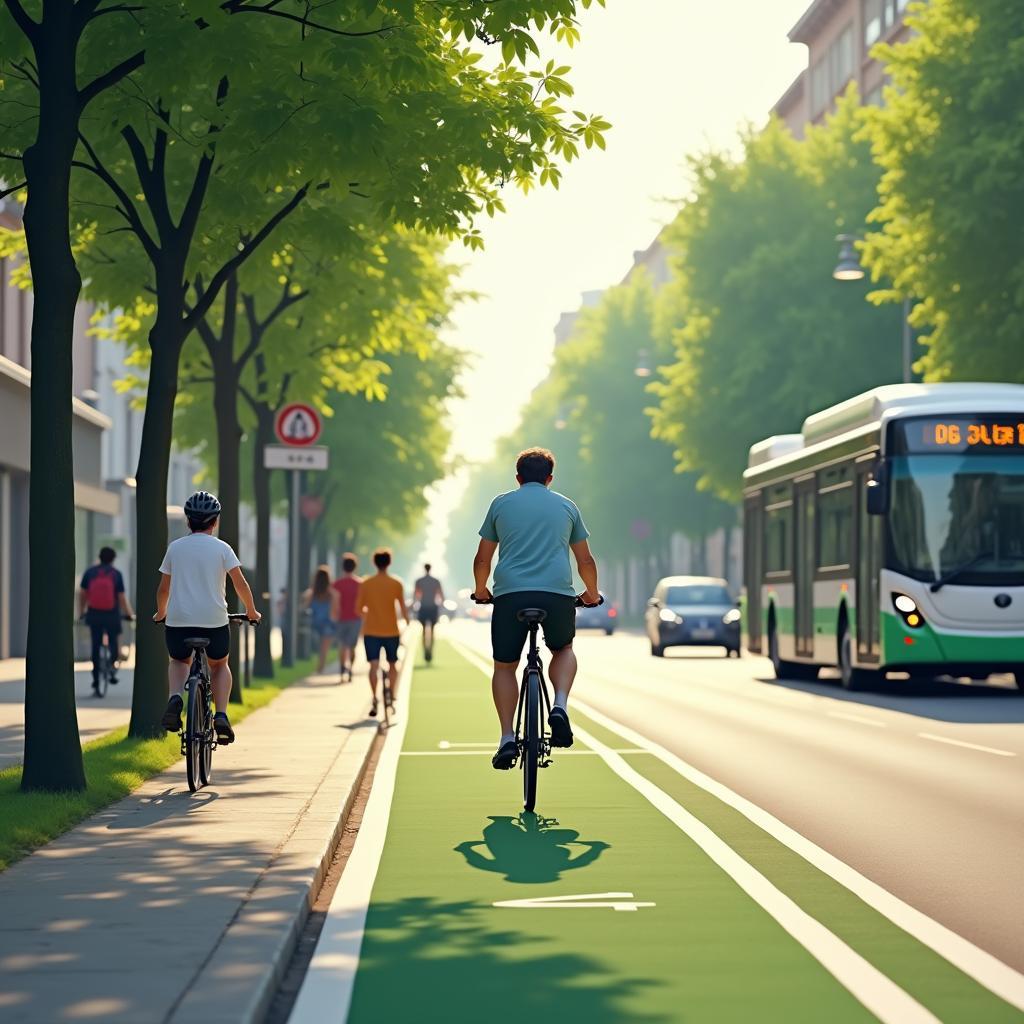 Người đạp xe trên đường phố xanh giúp giảm ô nhiễm không khí phù hợp với IELTS Speaking
Theme 3: Future Trends and Solutions
Question 5: Do you think technology can solve air pollution problems?
🎯 Phân tích câu hỏi:
- Dạng: Opinion about possibility (Do you think… can)
- Key words: technology, solve, air pollution
- Cách tiếp cận: Position → examples of technological solutions → limitations → balanced conclusion
📝 Sample Answer – Band 6-7:
“Yes, I think technology can help solve air pollution. For example, electric cars don’t produce exhaust fumes, so they are better for the environment. Scientists are also developing air purifiers that can clean the air in cities. In the future, we might have more advanced technology to reduce pollution. But technology alone is not enough – people also need to change their behavior.”
Phân tích:
- Structure: Clear position với examples và caveat
- Vocabulary: Basic (help solve, better for, clean, reduce)
- Tại sao Band 6-7: Relevant ideas nhưng lack sophistication và depth
📝 Sample Answer – Band 8-9:
“I’d say technology is certainly part of the solution, but I’m skeptical of viewing it as a silver bullet that can single-handedly resolve such a complex, multifaceted challenge.
On the positive side, we’re seeing some genuinely promising innovations. Electric vehicle technology is rapidly maturing, with improving battery efficiency and expanding charging infrastructure making it increasingly viable as a mainstream alternative to combustion engines. Renewable energy – solar, wind, geothermal – is becoming cost-competitive with fossil fuels, enabling a transition toward cleaner power generation. There are even emerging technologies like carbon capture and storage, air purification systems, and algae-based solutions that can actively remove pollutants rather than just reducing emissions.
However, there are several caveats. First, technology doesn’t exist in a vacuum – its deployment and adoption depend on economic incentives, political will, and social acceptance. The resistance from entrenched fossil fuel interests, inadequate government subsidies for clean technology, and consumer hesitancy due to upfront costs can all impede progress.
Moreover, some technological solutions create new problems. Electric vehicles, for instance, require batteries with rare earth minerals whose extraction processes are environmentally destructive. Solar panels eventually become hazardous waste requiring proper disposal infrastructure. We risk displacing problems rather than solving them if we’re not taking a holistic view.
Perhaps most fundamentally, technology addresses symptoms rather than root causes. Air pollution ultimately stems from unsustainable consumption patterns, economic systems that externalize environmental costs, and societal values that prioritize short-term convenience over long-term sustainability. Unless we confront these underlying issues, we’re essentially using technology as a band-aid on a systemic problem.
So my view is that technology is a necessary but insufficient condition for addressing air pollution. It needs to be coupled with regulatory frameworks, economic incentives that internalize environmental costs, shifts in cultural values, and fundamentally different approaches to urban planning and economic development. Technology enables solutions, but human choices – both individual and collective – ultimately determine whether we deploy it effectively.”
Phân tích:
- Structure: Qualified position → Technological innovations → Limitations and caveats → Deeper critique → Comprehensive conclusion
- Vocabulary: Sophisticated: “silver bullet”, “single-handedly”, “emerging technologies”, “entrenched interests”, “externalize costs”, “band-aid on a systemic problem”
- Grammar: Full range with perfect accuracy: conditional structures, relative clauses, participle phrases, nominalization
- Critical Thinking: Highly sophisticated analysis considering technological, economic, political, and philosophical dimensions. Acknowledges unintended consequences. Distinguishes symptoms from root causes.
- Balance: Recognizes both potential và limitations without being overly optimistic or pessimistic
💡 Key Language Features:
- Discourse markers: “On the positive side”, “However”, “Moreover”, “Perhaps most fundamentally”, “So”
- Hedging extensively: “I’d say”, “certainly part of”, “I’m skeptical of”, “my view is”
- Abstract vocabulary: “deployment”, “adoption”, “resistance”, “incentives”, “frameworks”
- Academic expressions: “doesn’t exist in a vacuum”, “necessary but insufficient condition”, “coupled with”
Question 6: How might cities change in the future to provide better air quality for residents?
🎯 Phân tích câu hỏi:
- Dạng: Prediction/Speculation (How might… in the future)
- Key words: cities, change, future, better air quality
- Cách tiếp cận: Use speculative language → Describe multiple possible changes → Examples of current trends → Consider challenges
📝 Sample Answer – Band 6-7:
“I think cities in the future will have more green spaces and parks. Maybe there will be more electric buses and trains instead of petrol vehicles. Cities might also ban old, polluting cars from entering the city center. Buildings could have more plants on roofs and walls to clean the air. I hope governments will also create stricter laws about factory emissions.”
Phân tích:
- Structure: List of predictions với basic modal verbs
- Vocabulary: Simple future forms (will have, might ban, could have)
- Tại sao Band 6-7: Relevant predictions nhưng lack detail và sophisticated speculation
📝 Sample Answer – Band 8.5-9:
“That’s fascinating to consider. I imagine we’ll see a convergence of several trends that are already gaining traction in forward-thinking cities worldwide.
Urban greening will likely become far more ambitious and systematic. We’re already seeing pioneering examples like Singapore’s ‘City in a Garden’ concept, where vertical forests, extensive green corridors, and integrated park systems aren’t just aesthetic additions but core infrastructure. I’d expect this to expand dramatically, with regulations mandating green roofs, living walls, and minimum vegetation coverage for all new developments. These serve dual purposes – sequestering carbon while creating natural cooling that reduces energy consumption for air conditioning.
Transportation infrastructure will likely undergo radical transformation. The prevailing model of car-centric urban design is increasingly recognized as fundamentally unsustainable. We might see vast expansions of pedestrianized zones, comprehensive metro networks extending to suburban peripheries, and dedicated cycling infrastructure that’s genuinely safe and convenient. Some cities are experimenting with car-free city centers entirely, with only public transport and service vehicles permitted. Autonomous electric vehicles operating as shared mobility services rather than private ownership could dramatically reduce both vehicle numbers and parking requirements, freeing up space for parks and pedestrian areas.
Architectural innovation will probably play a crucial role. We’re seeing early prototypes of buildings that actively clean air through photocatalytic surfaces, integrated air filtration systems, and bioreactor facades containing pollution-absorbing microorganisms. Building materials themselves might evolve to incorporate carbon-absorbing concrete and smog-eating tiles. The concept of ‘breathing buildings’ with natural ventilation systems that minimize mechanical cooling could become standard.
Industrial zoning might be fundamentally reconceived. Rather than having heavy industries in close proximity to residential areas – a legacy of poor planning in many cities – we’ll likely see stricter separation or relocation of polluting industries to designated zones with stringent emissions controls. There’s also potential for circular economy models where industrial processes are designed to generate minimal waste and reuse byproducts.
Monitoring and regulation will probably become increasingly sophisticated. Real-time air quality sensors throughout cities, integrated with AI systems, could dynamically adjust traffic flow, public transport frequency, and even industrial operations based on current pollution levels. Polluter-pays mechanisms, where emissions are continuously monitored and automatically penalized, could create powerful economic incentives for cleaner practices.
However, I should note that the pace and extent of these changes will vary enormously depending on economic resources, political commitment, and public support. Wealthier cities with progressive governance might lead the way, while others struggle with more basic challenges. There’s also the perennial tension between environmental ideals and economic pressures, private interests, and established behaviors that resist change.
Ultimately, I think the cities that thrive in the future will be those that recognize clean air not as a luxury but as fundamental infrastructure – as essential as water supply or electrical grids – and plan accordingly.”
Phân tích:
- Structure: Introduction → Urban greening → Transportation → Architecture → Industrial planning → Technology/monitoring → Caveats → Conclusion
- Vocabulary: Highly sophisticated: “convergence of trends”, “gaining traction”, “pioneering examples”, “photocatalytic surfaces”, “bioreactor facades”, “circular economy”, “perennial tension”
- Grammar: Full grammatical range perfectly controlled: future continuous, conditionals, participle clauses, complex nominalization
- Critical Thinking: Comprehensive analysis covering multiple dimensions. Uses real-world examples (Singapore). Acknowledges variability và challenges. Shows systems thinking (interconnected solutions).
- Speculation language: Appropriate use of “likely”, “probably”, “might”, “could”, “I imagine”, “I’d expect”
💡 Key Language Features:
- Speculation: “will likely”, “I imagine”, “might see”, “could dramatically reduce”, “probably become”
- Examples: “Singapore’s ‘City in a Garden'”, “photocatalytic surfaces”, “autonomous electric vehicles”
- Discourse markers: “However”, “Ultimately”, “Rather than”
- Technical vocabulary: Shows domain knowledge (photocatalytic, bioreactor, circular economy, polluter-pays)
- Balanced view: Acknowledges constraints and variations trong implementation
Từ Vựng và Cụm Từ Quan Trọng
Topic-Specific Vocabulary
| Từ vựng/Cụm từ | Loại từ | Phiên âm | Nghĩa tiếng Việt | Ví dụ | Collocation |
|---|---|---|---|---|---|
| pristine | adj | /ˈprɪstiːn/ | nguyên sơ, hoang sơ, trong lành | The air quality in the mountains is absolutely pristine. | pristine condition, pristine environment, pristine wilderness |
| invigorating | adj | /ɪnˈvɪɡəreɪtɪŋ/ | làm sảng khoái, tràn đầy sinh lực | The sea breeze was incredibly invigorating. | invigorating walk, invigorating experience, invigorating effect |
| therapeutic | adj | /ˌθerəˈpjuːtɪk/ | có tác dụng chữa bệnh, trị liệu | Being in nature has a therapeutic effect on mental health. | therapeutic benefits, therapeutic value, therapeutic properties |
| tranquil | adj | /ˈtræŋkwɪl/ | yên tĩnh, thanh bình | The park offers a tranquil escape from city noise. | tranquil environment, tranquil atmosphere, tranquil setting |
| ambiance/ambience | n | /ˈæmbiəns/ | bầu không khí, môi trường xung quanh | The natural ambiance of the forest is calming. | peaceful ambiance, natural ambiance, relaxing ambiance |
| sequester | v | /sɪˈkwestə/ | cô lập, hấp thụ (CO2) | Trees sequester carbon dioxide from the atmosphere. | sequester carbon, sequester pollutants |
| tailpipe emissions | n | /ˈteɪlpaɪp ɪˈmɪʃənz/ | khí thải từ ống xả xe | Electric vehicles produce zero tailpipe emissions. | reduce tailpipe emissions, eliminate tailpipe emissions |
| particulate matter | n | /pɑːˈtɪkjələt ˈmætə/ | bụi mịn, hạt vi mô gây ô nhiễm | High levels of particulate matter affect respiratory health. | fine particulate matter, airborne particulate matter |
| culprit | n | /ˈkʌlprɪt/ | thủ phạm, nguyên nhân chính | Vehicle emissions are the main culprit behind urban air pollution. | main culprit, primary culprit |
| urban sprawl | n | /ˈɜːbən sprɔːl/ | sự mở rộng đô thị không kiểm soát | Urban sprawl reduces green spaces and worsens air quality. | uncontrolled urban sprawl, rapid urban sprawl |
| green corridor | n | /ɡriːn ˈkɒrɪdɔː/ | hành lang xanh (dải cây xanh kết nối) | The city plans to create green corridors connecting major parks. | establish green corridors, connected green corridors |
| biophilic design | n | /ˌbaɪəʊˈfɪlɪk dɪˈzaɪn/ | thiết kế theo xu hướng gần gũi thiên nhiên | Biophilic design incorporates natural elements into buildings. | biophilic design principles, biophilic architecture |
| carbon footprint | n | /ˈkɑːbən ˈfʊtprɪnt/ | dấu chân carbon (lượng CO2 thải ra) | Walking to work reduces your carbon footprint. | reduce carbon footprint, minimize carbon footprint, measure carbon footprint |
| renewable energy | n | /rɪˈnjuːəbl ˈenədʒi/ | năng lượng tái tạo | Solar and wind are forms of renewable energy. | renewable energy sources, transition to renewable energy |
| congestion pricing | n | /kənˈdʒestʃən ˈpraɪsɪŋ/ | thu phí khi đường đông xe | Congestion pricing has reduced traffic in central London. | implement congestion pricing, effective congestion pricing |
| sustainable practices | n | /səˈsteɪnəbl ˈpræktɪsɪz/ | các hoạt động bền vững | Companies should adopt more sustainable practices. | environmentally sustainable practices, promote sustainable practices |
| ecosystem | n | /ˈiːkəʊsɪstəm/ | hệ sinh thái | This wetland ecosystem is home to diverse species. | fragile ecosystem, balanced ecosystem, preserve ecosystem |
| decompression | n | /ˌdiːkəmˈpreʃən/ | giải nén, giảm áp lực | The beach serves as my space for mental decompression. | psychological decompression, mental decompression |
| sanctuar | n | /ˈsæŋktʃuəri/ | nơi ẩn náu, thánh địa | The garden has become my sanctuary from daily stress. | peaceful sanctuary, natural sanctuary, create a sanctuary |
| perpetually | adv | /pəˈpetʃuəli/ | liên tục, mãi mãi | The city is perpetually covered in smog during winter. | perpetually busy, perpetually connected |
Idiomatic Expressions & Advanced Phrases
| Cụm từ | Nghĩa | Ví dụ sử dụng | Band điểm |
|---|---|---|---|
| a breath of fresh air | điều gì đó mới mẻ, sảng khoái | That park is literally and figuratively a breath of fresh air in this polluted city. | 7.5-8 |
| clear your head | làm đầu óc tỉnh táo, thư giãn | I go for a walk in the park to clear my head after work. | 7-8 |
| disconnect from the digital world | tách khỏi thế giới công nghệ | Spending time in nature helps me disconnect from the digital world. | 7.5-8 |
| escape the hustle and bustle | thoát khỏi sự hối hả, nhộn nhịp | I escape the hustle and bustle by visiting the countryside on weekends. | 7.5-8 |
| recharge your batteries | nạp lại năng lượng | A day at the beach really recharges my batteries. | 7-8 |
| get back to nature | trở lại với thiên nhiên | More people are trying to get back to nature in their free time. | 7-8 |
| a stone’s throw from | rất gần (khoảng cách ném đá) | The park is just a stone’s throw from my apartment. | 7.5-8 |
| at the crack of dawn | lúc bình minh, rất sớm | I visit the lake at the crack of dawn when the air is freshest. | 8-9 |
| off the beaten track | nơi ít người biết đến, hẻo lánh | I prefer places off the beaten track where the air is unpolluted. | 8-9 |
| within easy reach | dễ dàng tiếp cận | Fortunately, several parks are within easy reach of my home. | 7.5-8 |
| a world away from | hoàn toàn khác biệt với | This peaceful forest feels like a world away from city life. | 8-9 |
| comes at a cost | có cái giá phải trả | Living in the city comes at a cost to our respiratory health. | 8-9 |
| take its toll on | gây hại, ảnh hưởng xấu | Air pollution is taking its toll on public health. | 7.5-8 |
| leave much to be desired | còn nhiều điều chưa đạt yêu cầu | The air quality in my city leaves much to be desired. | 8-9 |
| the devil’s in the details | điều quan trọng là ở chi tiết | The policy sounds good, but the devil’s in the details of implementation. | 8.5-9 |
Discourse Markers (Từ Nối Ý Trong Speaking)
Để bắt đầu câu trả lời:
- 📝 Well,… – Khi cần một chút thời gian suy nghĩ
- 📝 Actually,… – Khi đưa ra thông tin có thể surprising
- 📝 To be honest,… / To be frank,… – Khi nói thật lòng
- 📝 I’d say that… – Khi đưa ra quan điểm cá nhân
- 📝 That’s an interesting question,… – Tạo thời gian suy nghĩ cho Part 3
- 📝 If I’m being honest,… – Khi thừa nhận điều gì đó
Để bổ sung ý:
- 📝 On top of that,… / What’s more,… – Thêm vào đó
- 📝 Not to mention… – Chưa kể đến
- 📝 Furthermore,… / Moreover,… – Hơn nữa (formal)
- 📝 Plus,… / And then there’s… – Ngoài ra còn có (informal)
- 📝 In addition to that,… – Thêm vào điều đó
Để đưa ra quan điểm cân bằng:
- 📝 On the one hand,… On the other hand,… – Một mặt… mặt khác
- 📝 While it’s true that…, we also need to consider… – Mặc dù đúng là… chúng ta cũng cần xem xét
- 📝 That said,… / Having said that,… – Nói như vậy nhưng…
- 📝 However,… / Nevertheless,… – Tuy nhiên
- 📝 Admittedly,… – Phải thừa nhận rằng
Để giải thích hoặc làm rõ:
- 📝 What I mean is… – Ý tôi là
- 📝 In other words,… – Nói cách khác
- 📝 To put it another way,… – Nói theo cách khác
- 📝 Basically,… – Về cơ bản
- 📝 Essentially,… – Về bản chất
Để đưa ra ví dụ:
- 📝 For instance,… / For example,… – Ví dụ
- 📝 Take… for example – Lấy… làm ví dụ
- 📝 A case in point is… – Một ví dụ điển hình là
- 📝 To illustrate this,… – Để minh họa điều này
Để kết luận:
- 📝 All in all,… / All things considered,… – Tóm lại
- 📝 At the end of the day,… – Cuối cùng thì
- 📝 Ultimately,… – Rốt cuộc
- 📝 So, to sum up,… – Vậy, tóm lại
- 📝 The bottom line is… – Điểm mấu chốt là
Để thể hiện uncertainty (quan trọng cho Part 3):
- 📝 I would say… / I’d argue that… – Tôi cho rằng
- 📝 It seems to me that… – Có vẻ như với tôi
- 📝 I suppose… / I guess… – Tôi cho là
- 📝 To some extent,… – Ở một mức độ nào đó
- 📝 In some ways,… – Theo một cách nào đó
Grammatical Structures Ấn Tượng
1. Conditional Sentences (Câu điều kiện):
Mixed conditional:
- Formula: If + past perfect, would + infinitive / If + past simple, would + have + past participle
- Ví dụ: “If I hadn’t discovered this park, I would still be struggling with stress” / “If the government regulated emissions more strictly, we wouldn’t have reached this crisis point”
Inversion for emphasis:
- Formula: Had/Were/Should + subject + verb
- Ví dụ: “Had I known about this place earlier, I would have started visiting years ago” / “Were cities to invest more in green spaces, air quality would improve significantly”
2. Relative Clauses (Mệnh đề quan hệ):
Non-defining relative clauses:
- Formula: …, which/who/where…
- Ví dụ: “The park, which is located near my house, has become my sanctuary” / “This place, where I go every weekend, offers the freshest air in the city”
Reduced relative clauses:
- Formula: Participle (-ing/-ed) replacing which is/was
- Ví dụ: “The path running along the lake is perfect for jogging” / “Trees planted along the roadside help filter pollutants”
3. Passive Voice (Câu bị động):
It is thought/believed/said that…
- Ví dụ: “It is widely believed that exposure to nature improves mental health” / “It has been demonstrated that green spaces reduce urban heat”
Advanced passive structures:
- Formula: Subject + is being + past participle / has been + past participle
- Ví dụ: “Air quality standards are being tightened in many cities” / “This forest has been protected for decades”
4. Cleft Sentences (Câu chẻ):
What… is/was…
- Formula: What + subject + verb + is/was + focus
- Ví dụ: “What I find most appealing about this place is the sense of tranquility” / “What really makes a difference is the abundance of trees”
The thing that… is…
- Formula: The thing that + clause + is/was + focus
- Ví dụ: “The thing that attracted me to this park is its pristine air quality”
It is/was… that…
- Formula: It + is/was + focus + that/who + clause
- Ví dụ: “It was the fresh air that drew me to this location” / “It is during early morning that the air quality is at its best”
5. Participle Clauses (Mệnh đề phân từ):
-ing clauses:
- Formula: -ing phrase + main clause / Main clause + -ing phrase
- Ví dụ: “Walking through the park, I feel my stress melting away” / “I visit this place regularly, seeking respite from urban pollution”
-ed clauses:
- Formula: Past participle phrase + main clause
- Ví dụ: “Surrounded by trees, I feel completely at peace” / “Located far from traffic, this area maintains excellent air quality”
6. Inversion for Emphasis:
Not only… but also…
- Formula: Not only + auxiliary + subject + verb, but + subject + also + verb
- Ví dụ: “Not only does this place offer fresh air, but it also provides a sense of community”
Rarely/Seldom/Never at the beginning:
- Formula: Rarely/Seldom/Never + auxiliary + subject + verb
- Ví dụ: “Rarely have I experienced such clean air in an urban setting” / “Never before has air quality been such a pressing concern”
7. Nominalization (Danh từ hóa):
Turning verbs/adjectives into nouns:
- Ví dụ:
- “pollute” → “pollution”: “The pollution levels here are concerning”
- “develop” → “development”: “Urban development has reduced green spaces”
- “aware” → “awareness”: “Environmental awareness is growing”
8. Emphasis Structures:
Do/Does/Did for emphasis:
- Formula: Subject + do/does/did + base verb
- Ví dụ: “I do believe that access to fresh air should be a basic right” / “This place does make a significant difference to my wellbeing”
 Thiết kế kiến trúc xanh và thành phố tương lai với không khí sạch cho IELTS Speaking
Chiến Lược Trả Lời Hiệu Quả Từ Examiner
Mindset và Preparation
Trước khi vào phòng thi:
- Hiểu rằng examiner không “test” bạn mà “assess” khả năng communication của bạn
- IELTS Speaking đánh giá khả năng nói tự nhiên, không phải recite memorized answers
- Thư giãn: nervousness ảnh hưởng đến fluency và pronunciation
Nguyên tắc vàng:
- Be yourself: Đừng cố gắng trở thành người khác. Authentic personality được đánh giá cao.
- Engage naturally: Treat it như một conversation, không phải interrogation
- Show interest: Enthusiasm về topic giúp bạn nói natural hơn
- Don’t panic with unfamiliar topics: Redirect về related experience bạn có
Lỗi Thường Gặp Của Học Viên Việt Nam
Part 1:
- ❌ Trả lời quá ngắn: “Yes, I do” và dừng lại
- ✅ Mở rộng: “Yes, I do. I usually go to the park near my house because…”
- ❌ Học thuộc template và recite mechanically
- ✅ Chuẩn bị ideas và vocabulary, nói tự nhiên
- ❌ Dùng từ vựng quá academic không phù hợp với speaking
- ✅ Mix formal và informal vocabulary naturally
Part 2:
- ❌ Viết full sentences trong 1 phút chuẩn bị
- ✅ Chỉ ghi keywords và brief notes
- ❌ Nói dưới 1.5 phút
- ✅ Aim cho 2-2.5 phút with good pacing
- ❌ Bỏ sót bullet point “explain why/how you feel”
- ✅ Spend most time trên explain section vì đó là nơi show depth
- ❌ Memorize và recite a script
- ✅ Prepare structure và key points, nói spontaneously
Part 3:
- ❌ Trả lời abstract questions với personal examples only
- ✅ Discuss broader societal issues với some personal reference
- ❌ Đưa ra absolute statements: “Everyone thinks…”
- ✅ Use hedging: “Many people tend to…”, “It seems that…”
- ❌ Chỉ nhìn một mặt của issue
- ✅ Acknowledge complexity: “On one hand… However…”
- ❌ Thiếu structure trong câu trả lời dài
- ✅ Use clear signposting: “There are several reasons… Firstly… Secondly…”
Tips Từ Examiner’s Perspective
Fluency & Coherence:
- Self-correction là OK và natural: “I mean…”, “or rather…”
- Brief pauses để suy nghĩ tốt hơn là filler sounds “um, er” liên tục
- Linking words quan trọng nhưng không overuse
- Maintain eye contact và natural body language
Lexical Resource:
- Paraphrase thay vì repeat từ trong câu hỏi
- Collocations impress hơn individual difficult words
- Show range: mix formal, informal, idiomatic language
- Topic-specific vocabulary demonstrates preparation
Grammatical Range & Accuracy:
- Attempt complex structures even với some errors tốt hơn là chỉ dùng simple correct sentences
- Mix tenses naturally theo context
- Error correction shows awareness: “I mean, I went there…”
Pronunciation:
- Clear articulation quan trọng hơn accent
- Word stress và sentence stress ảnh hưởng lớn
- Chunking (pause ở đúng chỗ) helps comprehension
- Intonation shows enthusiasm và engagement
Lộ Trình Học Tập Đề Xuất
4-6 tuần trước thi:
-
Tuần 1-2: Làm quen với format và band descriptors
- Nghiên cứu assessment criteria
- Record yourself và self-assess
- Identify weaknesses cụ thể
-
Tuần 3-4: Build vocabulary và structures
- Học 10-15 topic-specific words mỗi ngày
- Practice incorporating new vocabulary naturally
- Study grammatical structures với examples
-
Tuần 5-6: Intensive practice
- Mock tests với timing chính xác
- Focus trên weak areas identified
- Practice với partner hoặc tutor nếu có thể
Hàng ngày:
- Nói tiếng Anh 15-30 phút (tự nói về random topics)
- Listen to native speakers (podcasts, TED talks) để improve intonation
- Shadow native speakers để improve pronunciation
- Think in English về daily activities
Ngày thi:
- Arrive sớm để calm nerves
- Small talk với examiner naturally
- Remember: examiner wants you to do well
- Focus on communication, không phải perfection
Chủ đề “describe a place where you go to enjoy the fresh air” là một opportunity tuyệt vời để showcase vocabulary về environment, personal experiences, và ability để discuss abstract concepts trong Part 3. Với preparation đúng hướng và mindset tích cực, bạn hoàn toàn có thể đạt band điểm mong muốn. Remember, authenticity và clear communication luôn được đánh giá cao hơn mechanical perfection. Good luck với kỳ thi của bạn!