Chủ đề về những nơi yên tĩnh để thư giãn là một trong những đề tài phổ biến và gần gũi nhất trong kỳ thi IELTS Speaking. Đây không chỉ là câu hỏi đơn thuần về một địa điểm mà còn là cơ hội để bạn thể hiện khả năng mô tả cảm xúc, trải nghiệm cá nhân và suy nghĩ sâu sắc về cuộc sống hiện đại.
Từ góc nhìn của một examiner với hơn 20 năm kinh nghiệm, tôi nhận thấy chủ đề “Describe A Place Where You Like To Go For Peace And Quiet” xuất hiện với tần suất cao trong các kỳ thi IELTS từ 2020 đến nay, đặc biệt là sau đại dịch khi nhu cầu tìm kiếm sự yên bình trở nên cấp thiết hơn. Khả năng xuất hiện trong tương lai được dự đoán ở mức cao do tính universal và relevance của chủ đề.
Trong bài viết này, bạn sẽ học được:
- Hơn 20 câu hỏi thực tế từ các đề thi gần đây cho cả 3 Part
- Bài mẫu chi tiết với 3 mức band điểm khác nhau (6-7, 7.5-8, 8.5-9) có phân tích cụ thể
- Hơn 50 từ vựng và cụm từ ăn điểm với cách sử dụng trong ngữ cảnh
- Chiến lược trả lời hiệu quả từ góc nhìn examiner
- Những lỗi phổ biến mà học viên Việt Nam thường mắc phải và cách khắc phục
IELTS Speaking Part 1: Introduction and Interview
Tổng Quan Về Part 1
Part 1 của IELTS Speaking kéo dài 4-5 phút với các câu hỏi ngắn về cuộc sống hàng ngày của bạn. Đây là phần khởi động để examiner đánh giá khả năng giao tiếp cơ bản và tạo sự thoải mái cho thí sinh.
Chiến lược quan trọng:
- Trả lời trực tiếp câu hỏi trong câu đầu tiên
- Mở rộng với lý do hoặc ví dụ cụ thể (2-3 câu)
- Giữ câu trả lời tự nhiên, không quá dài dòng
Lỗi thường gặp của học viên Việt Nam:
- Trả lời quá ngắn gọn kiểu “Yes, I do” hoặc “No, I don’t” rồi im lặng
- Sử dụng từ vựng quá đơn giản ở cấp độ A2-B1
- Thiếu ví dụ cụ thể từ trải nghiệm bản thân
- Học thuộc template và trả lời máy móc
Các Câu Hỏi Thường Gặp
Question 1: Do you like quiet places?
Question 2: Where do you usually go when you want some peace and quiet?
Question 3: Is it easy to find quiet places in your city?
Question 4: Do you prefer quiet places or lively places?
Question 5: When do you need peace and quiet the most?
Question 6: Did you enjoy quiet places when you were a child?
Question 7: Why do you think some people prefer noisy environments?
Question 8: Are there any quiet places near your home?
Question 9: How often do you seek out peaceful environments?
Question 10: What do you usually do in quiet places?
Phân Tích và Gợi Ý Trả Lời Chi Tiết
Question: Do you like quiet places?
🎯 Cách tiếp cận:
- Trả lời trực tiếp Yes/No
- Giải thích lý do tại sao
- Thêm ví dụ hoặc thói quen cá nhân
📝 Sample Answer – Band 6-7:
“Yes, I do like quiet places. I think they help me relax after a busy day at work. For example, I often go to a small park near my house to sit and read books because it’s peaceful there.”
Phân tích:
- Điểm mạnh: Trả lời trực tiếp, có lý do và ví dụ cụ thể, câu văn rõ ràng
- Hạn chế: Từ vựng còn đơn giản (busy, peaceful, relax), cấu trúc câu chưa đa dạng, ý tưởng chưa sâu
- Tại sao Band 6-7: Đáp ứng đủ yêu cầu với fluency tương đối tốt, nhưng thiếu sophistication về mặt từ vựng và ngữ pháp
📝 Sample Answer – Band 8-9:
“Absolutely, I’m really drawn to quiet places. I find that in today’s fast-paced world, we’re constantly bombarded with noise and stimulation, so having access to tranquil environments is essential for my mental well-being. I particularly enjoy visiting a small secluded café in the old quarter where I can unwind with a good book and just tune out the chaos of daily life.”
Phân tích:
- Điểm mạnh: Từ vựng sophisticated (bombarded with, tranquil, secluded, unwind, tune out), cấu trúc phức tạp với mệnh đề quan hệ “where”, ý tưởng sâu sắc về mental well-being và modern life
- Tại sao Band 8-9:
- Fluency: Trả lời trôi chảy với discourse marker “Absolutely”
- Vocabulary: Sử dụng collocations chính xác (fast-paced world, mental well-being, secluded café)
- Grammar: Kết hợp nhiều mệnh đề phức tạp một cách tự nhiên
- Ideas: Thể hiện suy nghĩ về bối cảnh xã hội hiện đại
💡 Key Vocabulary & Expressions:
- be drawn to something: bị thu hút bởi điều gì đó
- fast-paced world: thế giới nhịp sống nhanh
- bombarded with: bị tấn công liên tục bởi
- tranquil environment: môi trường yên tĩnh
- mental well-being: sức khỏe tinh thần
- secluded: hẻo lánh, kín đáo
- unwind: thư giãn, xả stress
- tune out: tắt tiếng, không chú ý đến
Question: Where do you usually go when you want some peace and quiet?
🎯 Cách tiếp cận:
- Nêu địa điểm cụ thể
- Mô tả ngắn gọn về nơi đó
- Giải thích tại sao chọn nơi này
📝 Sample Answer – Band 6-7:
“I usually go to the public library near my house. It’s a nice place with many books and it’s always quiet. I can study or read there without any noise, which helps me focus better on my work.”
Phân tích:
- Điểm mạnh: Có địa điểm cụ thể, lý do rõ ràng
- Hạn chế: Từ vựng basic (nice place, quiet, focus), thiếu chi tiết về môi trường và cảm xúc cá nhân
- Tại sao Band 6-7: Adequate nhưng thiếu depth và sophistication
📝 Sample Answer – Band 8-9:
“My go-to place would be a small botanical garden about fifteen minutes from my apartment. It’s this hidden gem that not many people know about, featuring lush greenery and a serene pond where I can sit and collect my thoughts. What I love most is the gentle rustling of leaves and occasional bird songs, which create a naturally soothing atmosphere that you just can’t replicate indoors.”
Phân tích:
- Điểm mạnh:
- Từ vựng descriptive và vivid (botanical garden, hidden gem, lush greenery, serene pond)
- Sử dụng sensory details (gentle rustling, bird songs)
- Cấu trúc phức tạp với relative clause “which create…”
- Ý tưởng mang tính cá nhân và chi tiết
- Tại sao Band 8-9:
- Fluency: Discourse marker “My go-to place would be” tự nhiên
- Vocabulary: Precise và idiomatic (collect my thoughts, hidden gem)
- Grammar: Participle phrase “featuring…”, complex sentences
- Ideas: Chi tiết cụ thể về âm thanh và cảm giác
💡 Key Vocabulary & Expressions:
- go-to place: nơi mà bạn thường xuyên lui tới
- botanical garden: vườn thực vật
- hidden gem: viên ngọc ẩn (nơi tuyệt vời ít người biết)
- lush greenery: cây cối xanh tươi
- serene pond: ao yên tĩnh
- collect my thoughts: tập trung suy nghĩ
- gentle rustling: tiếng sột soạt nhẹ nhàng
- soothing atmosphere: bầu không khí êm dịu
Question: Is it easy to find quiet places in your city?
🎯 Cách tiếp cận:
- Trả lời Yes/No với qualification (phụ thuộc vào…)
- Giải thích tình hình thực tế
- Đưa ra ví dụ cụ thể
📝 Sample Answer – Band 6-7:
“Not really. My city is quite busy and crowded, so there’s a lot of noise everywhere. However, if you go to parks early in the morning, it can be quite peaceful. Most quiet places are far from the city center.”
Phân tích:
- Điểm mạnh: Có qualification “Not really” và “However”, đưa ra giải pháp thực tế
- Hạn chế: Từ vựng đơn giản (busy, crowded, peaceful), thiếu specific examples
- Tại sao Band 6-7: Communicative nhưng thiếu sophistication
📝 Sample Answer – Band 8-9:
“I’d say it’s becoming increasingly challenging, to be honest. Like many urban areas, my city is experiencing rapid urbanization, which means there’s constant construction noise and heavy traffic congestion throughout the day. That said, there are still some pockets of tranquility if you know where to look – certain temple grounds or riverside promenades can offer temporary respite from the hustle and bustle. But you definitely need to be more strategic about timing, like visiting during off-peak hours.”
Phân tích:
- Điểm mạnh:
- Tentative language “I’d say”, “to be honest” rất natural
- Từ vựng sophisticated và topic-specific (rapid urbanization, traffic congestion, pockets of tranquility)
- Balanced view: vấn đề + giải pháp
- Cụm từ idiomatic (hustle and bustle, temporary respite)
- Grammar phức tạp với relative clause và participle phrases
- Tại sao Band 8-9:
- Fluency: Natural discourse markers, smooth transitions
- Vocabulary: Precise collocations (rapid urbanization, heavy traffic congestion)
- Grammar: Complex sentences với “which means”, conditional thinking
- Ideas: Nuanced view về urban development
💡 Key Vocabulary & Expressions:
- increasingly challenging: ngày càng khó khăn
- urban areas: khu vực đô thị
- rapid urbanization: đô thị hóa nhanh chóng
- constant construction noise: tiếng ồn xây dựng liên tục
- heavy traffic congestion: ùn tắc giao thông nghiêm trọng
- pockets of tranquility: những góc yên tĩnh
- temple grounds: khuôn viên chùa
- riverside promenade: lối đi dạo ven sông
- temporary respite: sự nghỉ ngơi tạm thời
- hustle and bustle: sự hối hả và ồn ào
- off-peak hours: giờ thấp điểm
 Người trẻ đang ngồi thư giãn tại góc yên tĩnh trong vườn thực vật với sách và cây xanh minh họa chủ đề IELTS Speaking về nơi tìm kiếm sự bình yên
IELTS Speaking Part 2: Long Turn (Cue Card)
Tổng Quan Về Part 2
Part 2 là phần độc thoại kéo dài 2-3 phút, được coi là phần quan trọng nhất để đánh giá khả năng nói liên tục của thí sinh. Bạn có đúng 1 phút chuẩn bị và được phép ghi chú trên giấy nháp.
Chiến lược quan trọng:
- Sử dụng hết 60 giây chuẩn bị để note keywords, không viết câu hoàn chỉnh
- Đảm bảo trả lời đầy đủ tất cả bullet points trong cue card
- Nói tối thiểu 1.5 phút, lý tưởng là 2-2.5 phút
- Sử dụng thì quá khứ nếu mô tả trải nghiệm đã xảy ra, hiện tại nếu là thói quen thường xuyên
- Tập trung vào bullet point cuối cùng “explain why” vì đây là nơi thể hiện critical thinking
Lỗi thường gặp:
- Không tận dụng hết thời gian chuẩn bị hoặc viết quá nhiều
- Nói dưới 1.5 phút khiến examiner phải hỏi thêm
- Bỏ sót một hoặc nhiều bullet points
- Tập trung quá nhiều vào mô tả và quên phần “explain”
- Học thuộc bài mẫu và trả lời không tự nhiên
Cue Card
Describe a place where you like to go for peace and quiet
You should say:
- Where this place is
- How you found out about this place
- What you do there
- And explain why you like to go there for peace and quiet
Phân Tích Đề Bài
- Dạng câu hỏi: Describe a place (địa điểm cụ thể)
- Thì động từ: Có thể dùng hiện tại đơn nếu là thói quen thường xuyên, hoặc quá khứ nếu mô tả lần đầu đi
- Bullet points phải cover:
- Where: Vị trí địa lý cụ thể, môi trường xung quanh
- How you found out: Câu chuyện khám phá ra nơi này (by chance, recommendation, etc.)
- What you do: Các hoạt động cụ thể khi đến đó
- Explain why: Lý do sâu xa – đây là phần quan trọng nhất để ghi điểm cao
- Câu “explain” quan trọng: Phần explain chiếm khoảng 40% thời gian nói và cần thể hiện personal feelings, deeper meaning, hoặc life philosophy
📝 Sample Answer – Band 6-7
Thời lượng: Khoảng 1.5-2 phút
“I’d like to talk about a small café near my university where I often go when I need some peace and quiet.
This café is located in a quiet street about ten minutes from my school. It’s a small place with only about ten tables, and it has a nice decoration with plants and wooden furniture. The atmosphere is very calm and relaxing.
I found out about this place by accident last year. I was walking around the neighborhood looking for a place to study, and I saw this café. It looked interesting, so I decided to go inside, and I really liked it.
When I go there, I usually order a coffee and sit by the window. I bring my laptop or some books with me, and I study or read for a few hours. Sometimes I just sit and think about my life or watch people walking outside. The café plays soft music, which I find very relaxing.
I like going there because it’s very different from other places. Most cafés in my city are crowded and noisy, but this one is always quiet. The owner is very friendly and the coffee is good. When I’m there, I can focus on my work without any distractions. It helps me feel less stressed, especially during exam periods. I think everyone needs a place like this where they can escape from busy life and just relax.”
Phân Tích Band Điểm
| Tiêu chí | Band | Nhận xét |
|---|---|---|
| Fluency & Coherence | 6-7 | Trả lời mạch lạc với sequencing rõ ràng, có linking words cơ bản (and, but, because, when), nhưng thiếu variety trong discourse markers |
| Lexical Resource | 6-7 | Từ vựng adequate (calm, relaxing, distraction, escape) nhưng chưa sophisticated, một số collocations đơn giản (nice decoration, soft music, busy life) |
| Grammatical Range & Accuracy | 6-7 | Sử dụng các thì cơ bản chính xác, có một số câu phức (when I go there, which I find), nhưng thiếu variety trong structures |
| Pronunciation | 6-7 | Rõ ràng và dễ hiểu, phát âm chính xác hầu hết các từ |
Điểm mạnh:
- ✅ Trả lời đầy đủ tất cả bullet points trong đề bài
- ✅ Có cấu trúc rõ ràng, dễ follow
- ✅ Đưa ra ví dụ cụ thể về activities
- ✅ Có personal touch ở cuối bài
Hạn chế:
- ⚠️ Từ vựng còn đơn giản, thiếu precision (nice, good, quiet)
- ⚠️ Grammar structures chưa đa dạng, chủ yếu là simple và compound sentences
- ⚠️ Phần explain chưa đủ sâu về emotional và psychological aspects
📝 Sample Answer – Band 7.5-8
Thời lượng: Khoảng 2-2.5 phút
“I’d like to describe a small botanical garden on the outskirts of my city that has become my sanctuary whenever I need to escape the hustle and bustle of urban life.
This garden is tucked away in a relatively quiet neighborhood, about a 20-minute bus ride from the city center. It’s not a large space, but it’s beautifully landscaped with winding paths, well-maintained flower beds, and a picturesque pond at its center. What makes it special is that it’s relatively off the beaten track, so it never gets overcrowded, even on weekends.
I actually stumbled upon this place about two years ago quite by chance. I was taking a different bus route home one day and noticed the entrance from the window. Curiosity got the better of me, so I got off at the next stop and walked back to explore. From the moment I stepped inside, I was captivated by the serene atmosphere.
Whenever I visit, I usually spend around two hours just wandering around the pathways, taking in the lush greenery and the vibrant colors of seasonal flowers. There’s a particular bench by the pond where I like to sit with a book or my journal. Sometimes I don’t even read – I just sit and observe the ripples on the water or watch the birds. It’s also become my go-to spot for meditation and deep reflection.
What draws me to this place is the sense of tranquility it offers. In our fast-paced modern lives, we’re constantly bombarded with stimuli – social media notifications, work deadlines, traffic noise. This garden provides a much-needed respite from all that. The natural sounds – the rustling of leaves, bird songs, the gentle trickling of water – have an almost therapeutic effect on me. I always leave feeling mentally refreshed and emotionally recharged, ready to face whatever challenges await me in the outside world.”
Phân Tích Band Điểm
| Tiêu chí | Band | Nhận xét |
|---|---|---|
| Fluency & Coherence | 7.5-8 | Trôi chảy với cohesive devices đa dạng (What makes it special, From the moment, What draws me to), ideas được develop logically |
| Lexical Resource | 7.5-8 | Vocabulary precise và varied (sanctuary, tucked away, stumbled upon, captivated), collocations natural (off the beaten track, lush greenery) |
| Grammatical Range & Accuracy | 7.5-8 | Sử dụng mix của simple và complex structures, passive voice, relative clauses một cách tự nhiên |
| Pronunciation | 7.5-8 | Features như stress và intonation được sử dụng hiệu quả |
So Sánh Với Band 6-7
| Khía cạnh | Band 6-7 | Band 7.5-8 |
|---|---|---|
| Vocabulary | “nice decoration”, “soft music”, “calm” | “beautifully landscaped”, “serene atmosphere”, “therapeutic effect” |
| Grammar | “It looked interesting, so I decided to go inside” | “Curiosity got the better of me, so I got off at the next stop” |
| Ideas | “It helps me feel less stressed” | “Provides a much-needed respite… therapeutic effect… mentally refreshed and emotionally recharged” |
📝 Sample Answer – Band 8.5-9
Thời lượng: 2.5-3 phút đầy đủ
“I’d like to talk about a rather unconventional choice – a small, centuries-old temple nestled in the mountains about an hour’s drive from where I live. It’s become my refuge whenever I need to disconnect from the chaos of modern existence and reconnect with my inner self.
The temple itself is perched on a hillside, accessible only via a winding mountain path that takes roughly thirty minutes to climb. It’s a modest structure with traditional architecture, surrounded by towering pine trees and offering breathtaking panoramic views of the valley below. What I find particularly enchanting is how the place exudes an almost palpable sense of timelessness – you can almost feel the accumulated tranquility of centuries of meditation and prayer seeping into your consciousness.
My discovery of this place was quite serendipitous. About three years ago, I was going through a particularly turbulent period in my life, grappling with career decisions and personal relationships. A friend who knew I was struggling suggested this temple, describing it as a place where she’d found clarity during her own difficult times. Somewhat skeptical but desperate for perspective, I made the journey, and it turned out to be a transformative experience.
During my visits, which I try to make at least once a month, I engage in what I’d call contemplative solitude. The hike up itself serves as a form of moving meditation, allowing me to gradually shed the mental clutter I’ve accumulated. Once there, I usually find a spot on the temple’s veranda and simply sit in silence for hours, observing the interplay of light and shadow through the trees, or watching clouds drift across the valley. Occasionally, I bring a journal to process my thoughts, but more often than not, I just exist in the moment, absorbing the profound stillness that permeates the place.
What makes this place indispensable to me goes beyond mere quietness. In our hyper-connected digital age, where we’re constantly tethered to devices and inundated with information, finding genuine peace has become increasingly elusive. This temple offers something much more profound than simple quiet – it provides what I’d call restorative solitude. There’s a qualitative difference between simply being alone and experiencing true solitude in a space that’s been consecrated by centuries of spiritual practice.
The ambient sounds – the whisper of wind through pines, the distant chiming of temple bells, the occasional rustle of wildlife – create a natural symphony that’s infinitely more soothing than any artificial white noise. Moreover, the physical act of climbing to reach the temple adds a ritualistic dimension that makes the experience more meaningful. It’s as if the journey itself serves as a bridge between my everyday existence and this elevated state of being.
What I’ve come to realize is that this place has become essential to my psychological equilibrium. It’s where I gain perspective on my problems, where seemingly insurmountable challenges suddenly appear more manageable, and where I can recalibrate my priorities. In a way, it’s my antidote to the existential anxiety that comes with modern living.”
Phân Tích Band Điểm
| Tiêu chí | Band | Nhận xét |
|---|---|---|
| Fluency & Coherence | 8.5-9 | Hoàn toàn tự nhiên và coherent, sophisticated cohesion với abstract connections, develops ideas với depth exceptional |
| Lexical Resource | 8.5-9 | Vocabulary idiomatic và sophisticated (serendipitous, palpable, seeping into consciousness, consecrated), precise collocations (accumulated tranquility, contemplative solitude, hyper-connected digital age) |
| Grammatical Range & Accuracy | 8.5-9 | Full range của structures với complete flexibility, complex sentences tự nhiên (What I’ve come to realize is that…, It’s as if…) |
| Pronunciation | 8.5-9 | Native-like control của features |
Tại Sao Bài Này Xuất Sắc
🎯 Fluency Hoàn Hảo:
- Không có hesitation, ý được develop một cách tự nhiên và logic từ description đến deeper reflection
- Sử dụng discourse markers sophisticated (What I find particularly enchanting, What I’ve come to realize, In a way)
📚 Vocabulary Tinh Vi:
- Ví dụ: “palpable sense of timelessness” – không chỉ nói “old” hay “peaceful” mà dùng từ trừu tượng thể hiện cảm giác cụ thể
- “accumulated tranquility seeping into your consciousness” – metaphorical language thể hiện tầm sâu của trải nghiệm
- “hyper-connected digital age” – precise và contemporary, cho thấy awareness về social context
📝 Grammar Đa Dạng:
- Ví dụ: “Somewhat skeptical but desperate for perspective, I made the journey” – participle phrase opening cho thấy grammatical sophistication
- “It’s as if the journey itself serves as a bridge between…” – subjunctive mood với metaphorical expression
- “What makes this place indispensable to me goes beyond mere quietness” – cleft sentence nhấn mạnh ý
💡 Ideas Sâu Sắc:
- Không chỉ mô tả surface-level description mà đi sâu vào psychological và philosophical dimensions
- Contrast giữa “simple quiet” và “restorative solitude” cho thấy critical thinking
- Connection với broader themes như modern anxiety và need for meaning
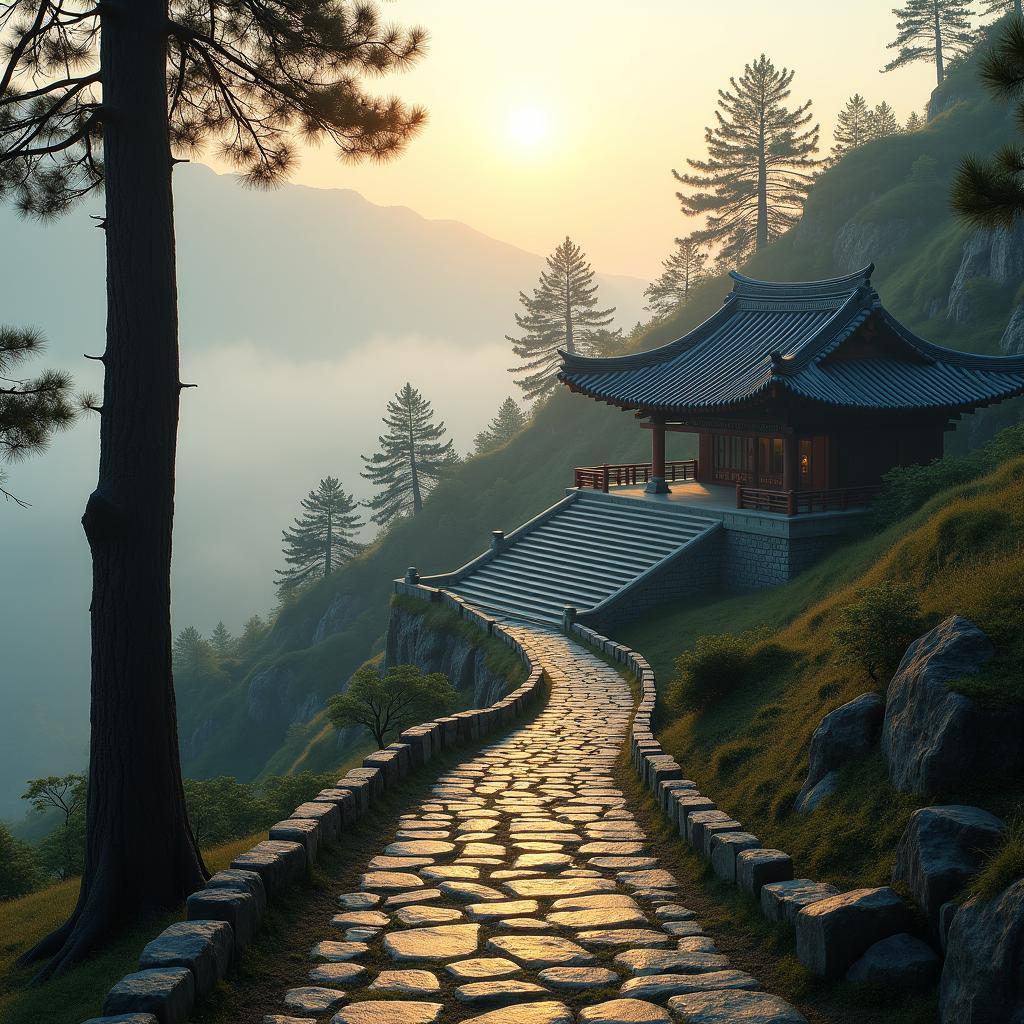 Ngôi đền cổ kính trên núi với không gian thiền định yên bình minh họa địa điểm lý tưởng để tìm kiếm sự thanh thản trong bài thi IELTS Speaking
Follow-up Questions (Rounding Off Questions)
Sau khi bạn kết thúc phần độc thoại Part 2, examiner thường hỏi 1-2 câu ngắn để transition sang Part 3. Những câu hỏi này thường liên quan trực tiếp đến những gì bạn vừa nói.
Question 1: How often do you visit this place?
Band 6-7 Answer:
“I try to go there about once or twice a month, usually on weekends when I’m free from work and have more time to relax.”
Band 8-9 Answer:
“I’d say I make the journey roughly once or twice a month, though the frequency tends to fluctuate depending on my workload and stress levels. During particularly demanding periods, I find myself craving that escape more frequently, sometimes even carving out time mid-week despite my busy schedule.”
💡 Key expressions: fluctuate depending on (thay đổi tùy thuộc vào), demanding periods (giai đoạn căng thẳng), craving that escape (khao khát sự trốn thoát đó), carving out time (dành riêng thời gian)
Question 2: Do you think everyone needs a place like this?
Band 6-7 Answer:
“Yes, I think so. Everyone experiences stress in their life, so having a quiet place to relax is important for mental health.”
Band 8-9 Answer:
“I believe it’s vital, actually. We’re living in an era of unprecedented connectivity and constant stimulation, which can be mentally exhausting. Having a personal sanctuary – whether it’s physical or metaphorical – allows us to maintain our psychological balance and prevent burnout. Though I should mention that what constitutes a peaceful place varies greatly from person to person – what works for me might not resonate with everyone.”
💡 Key expressions: unprecedented connectivity (sự kết nối chưa từng có), constant stimulation (sự kích thích liên tục), maintain psychological balance (duy trì cân bằng tâm lý), prevent burnout (ngăn ngừa kiệt sức), resonate with (gây được tiếng vang với)
IELTS Speaking Part 3: Two-way Discussion
Tổng Quan Về Part 3
Part 3 là phần thảo luận hai chiều kéo dài 4-5 phút, trong đó examiner sẽ hỏi những câu hỏi trừu tượng và sâu sắc hơn liên quan đến chủ đề Part 2. Đây là phần khó nhất và quan trọng nhất để phân biệt các band điểm cao.
Yêu cầu:
- Phân tích các vấn đề từ nhiều góc độ khác nhau
- So sánh, đánh giá và dự đoán xu hướng
- Đưa ra quan điểm có lý lẽ chặt chẽ với examples từ society
- Sử dụng abstract vocabulary và complex structures
Chiến lược:
- Mở rộng câu trả lời (minimum 4-5 câu, lý tưởng là 6-8 câu)
- Sử dụng discourse markers để structure answer (Well, Actually, From my perspective)
- Đưa ra examples từ xã hội, different countries, trends
- Thừa nhận complexity của issue (It depends on, There’s no simple answer)
- Avoid extreme positions, show balanced thinking
Lỗi thường gặp của học viên Việt Nam:
- Trả lời quá ngắn như Part 1, chỉ 2-3 câu
- Không phân tích sâu, chỉ nói ở surface level
- Thiếu examples cụ thể từ society hoặc real life situations
- Không có structure rõ ràng: opinion → reason 1 → example → reason 2 → conclusion
- Sử dụng từ vựng concrete thay vì abstract (nói “people are busy” thay vì “the pace of modern life”)
Các Câu Hỏi Thảo Luận Sâu
Theme 1: Modern Life and Stress
Question 1: Why do you think people need quiet places more nowadays than in the past?
🎯 Phân tích câu hỏi:
- Dạng: Compare (past vs present) + Cause analysis
- Key words: need more, nowadays, than in the past
- Cách tiếp cận: Direct answer → Explain changes in modern society → Contrast with past → Example → Conclude with implications
📝 Sample Answer – Band 6-7:
“I think people need quiet places more now because modern life is very busy and stressful. In the past, life was simpler and there wasn’t so much technology, so people could relax more easily. Now we have smartphones and social media, which make us always connected to work and other people. This creates more stress, so we need quiet places to escape. For example, my parents say that when they were young, they could relax at home, but now even at home we have many distractions.”
Phân tích:
- Structure: Có attempt để compare past và present, có example
- Vocabulary: Basic (busy, stressful, relax, distractions)
- Tại sao Band 6-7: Adequate communication nhưng thiếu sophistication và depth trong analysis
📝 Câu trả lời mẫu – Band 8-9:
“Well, I’d argue that the need has become more acute primarily due to the fundamental shift in how we experience daily life. If we look at contemporary society, we’re essentially living in a state of perpetual connectivity – our smartphones keep us tethered to work emails, social media platforms constantly bombard us with information, and there’s this implicit expectation to be available 24/7. This represents a stark contrast to previous generations, where there were much clearer boundaries between work and personal life, and people could genuinely disconnect when they left the office.
Moreover, the urbanization trend has meant that more people are living in densely populated cities characterized by noise pollution and overstimulation. Unlike our grandparents, who might have grown up in quieter rural environments with natural periods of solitude, today’s urban dwellers are constantly immersed in sensory input. This cumulative effect of chronic stress and information overload makes deliberate quiet spaces not just desirable, but actually essential for mental health preservation.
What’s particularly concerning is that this phenomenon seems to be intensifying rather than improving, especially with the advent of new technologies and the blurring of traditional work-life boundaries through remote work arrangements.”
Phân tích:
- Structure: Well-organized với clear progression: Direct answer → Modern factors → Contrast với past → Urban context → Future implications
- Vocabulary: Sophisticated và precise (acute need, perpetual connectivity, stark contrast, cumulative effect, chronic stress)
- Grammar: Full range – conditionals, relative clauses, participle phrases (“characterized by”, “Unlike our grandparents, who…”)
- Critical Thinking: Multi-dimensional analysis về technology, urbanization, và social expectations; shows awareness về complexity
💡 Key Language Features:
- Discourse markers: “Well, I’d argue that”, “Moreover”, “What’s particularly concerning”
- Tentative language: “I’d argue”, “seems to be”, “this represents”
- Abstract nouns: connectivity, urbanization, overstimulation, solitude, phenomenon
- Collocations: fundamental shift, perpetual connectivity, stark contrast, cumulative effect
Question 2: Do you think technology makes it harder to find peace and quiet?
🎯 Phân tích câu hỏi:
- Dạng: Opinion với focus on technology’s impact
- Key words: technology, harder, peace and quiet
- Cách tiếp cận: Balanced view – acknowledge both sides → Focus on dominant effect → Nuance about how we use technology
📝 Sample Answer – Band 6-7:
“Yes, I think technology makes it more difficult to find peace. Smartphones and computers are always with us, so we check them all the time. Even when we want to relax, we still look at our phones. However, technology can also help us find quiet, for example through meditation apps. So it depends on how we use technology.”
Phân tích:
- Structure: Yes → Reason → Counter-point → Conclusion
- Vocabulary: Simple (difficult, relax, depend on)
- Tại sao Band 6-7: Basic structure tốt với balanced view, nhưng thiếu development và examples cụ thể
📝 Câu trả lời mẫu – Band 8-9:
“This is quite a nuanced issue, actually. On the surface, technology certainly appears to be the culprit – after all, our devices are engineered to capture and retain our attention through notifications, updates, and addictive design patterns. The ubiquity of smartphones means we’re never truly unreachable, and there’s this compulsive tendency to check them even during moments that should be peaceful. Research suggests that even the mere presence of a smartphone, even when switched off, can diminish our capacity for deep focus and relaxation.
However, I’d argue that technology itself isn’t inherently problematic – rather, it’s our relationship with and usage patterns that determine its impact. The same technology that fragments our attention can also facilitate tranquility if used intentionally. For instance, apps for meditation, ambient sound generation, or even simple airplane mode demonstrate that technology can be harnessed to support peace rather than undermine it.
What’s really at play here is a broader cultural shift where we’ve normalized constant availability and instantaneous response. Technology has simply enabled and accelerated these expectations rather than solely creating them. The solution, therefore, lies not in rejecting technology but in cultivating digital literacy and establishing healthy boundaries around its use.”
Phân tích:
- Structure: Sophisticated – Acknowledge surface view → Present nuance → Provide counter-argument → Broader context → Solution-oriented conclusion
- Vocabulary: Highly sophisticated (culprit, ubiquity, compulsive tendency, inherently problematic, normalized, instantaneous)
- Grammar: Complex structures với variety (even when switched off, if used intentionally, rather than solely creating)
- Critical Thinking: Multi-layered analysis separating technology từ human behavior, avoids simplistic conclusions
💡 Key Language Features:
- Discourse markers: “This is quite a nuanced issue”, “On the surface”, “However”, “What’s really at play here”
- Tentative/Academic language: “appears to be”, “I’d argue”, “suggests that”
- Abstract concepts: relationship with technology, digital literacy, cultural shift
- Balanced view: Presents both negative và positive aspects before synthesizing
Theme 2: Urban Planning and Public Spaces
Question 3: Should governments invest more in creating peaceful public spaces in cities?
🎯 Phân tích câu hỏi:
- Dạng: Opinion on policy/government action
- Key words: should, governments, invest, peaceful public spaces
- Cách tiếp cận: Clear position → Multiple justifications với different angles (health, economic, social) → Acknowledge potential challenges → Conclude with balanced view
📝 Sample Answer – Band 6-7:
“Yes, I think governments should spend more money on peaceful public spaces. Many cities are very crowded and noisy, so people need places to relax. Parks and gardens are good for people’s health because they can exercise there and reduce stress. Also, these places are free, so everyone can use them, not just rich people. Of course, governments also need money for other things like hospitals and schools, but I think quiet spaces are also important for society.”
Phân tích:
- Structure: Clear position → Multiple reasons → Acknowledgment của other priorities
- Vocabulary: Functional nhưng basic (crowded, noisy, reduce stress, rich people)
- Tại sao Band 6-7: Communicative với multiple ideas, nhưng thiếu depth và sophisticated arguments
📝 Câu trả lời mẫu – Band 8.5-9:
“Absolutely, and I’d go so far as to say this should be considered a public health priority rather than merely an aesthetic consideration. There’s mounting evidence that access to tranquil public spaces has profound implications for both individual well-being and broader societal health outcomes.
From a public health perspective, green, peaceful spaces have been shown to reduce stress hormones, lower blood pressure, and mitigate the effects of mental health conditions like anxiety and depression. Given the escalating mental health crisis in many urban centers – which imposes substantial costs on healthcare systems – investing in peaceful spaces could be seen as preventative medicine. The return on investment here is actually quite compelling when you consider the downstream savings in healthcare expenditure.
Beyond health benefits, there are significant social equity considerations. In many cities, the only people with access to peace and quiet are those who can afford to live in affluent suburban areas or pay for private facilities. Public peaceful spaces serve as equalizers, ensuring that tranquility isn’t a luxury reserved for the wealthy. This is particularly crucial in socioeconomically disadvantaged neighborhoods, which are often disproportionately affected by noise pollution and lack green infrastructure.
That said, implementation requires thoughtful urban planning rather than simply allocating budget. These spaces need to be strategically distributed to maximize accessibility, and there must be ongoing maintenance and community engagement to ensure they serve their intended purpose. We’ve seen examples where well-intentioned public spaces become underutilized or even safety concerns due to poor design or inadequate management.
So while I strongly advocate for such investment, it needs to be part of a comprehensive urban strategy that considers spatial planning, community needs, and sustainable maintenance models.”
Phân tích:
- Structure: Highly sophisticated – Strong position → Public health argument với evidence → Social equity angle → Practical considerations and challenges → Nuanced conclusion
- Vocabulary: Academic và precise (mounting evidence, profound implications, mitigate, escalating crisis, return on investment, social equity, disproportionately affected)
- Grammar: Full flexibility với complex structures (Given the escalating crisis, which imposes…, ensuring that tranquility isn’t…)
- Critical Thinking: Multi-dimensional analysis (health, economic, social justice), acknowledgment của implementation challenges, evidence-based reasoning
💡 Key Language Features:
- Strong academic discourse: “I’d go so far as to say”, “There’s mounting evidence”, “From a public health perspective”
- Sophisticated cause-effect: “Given that X, Y could be seen as Z”, “when you consider the downstream savings”
- Hedging appropriately: “could be seen as”, “rather than simply”
- Topic-specific vocabulary: public health priority, return on investment, social equity, green infrastructure
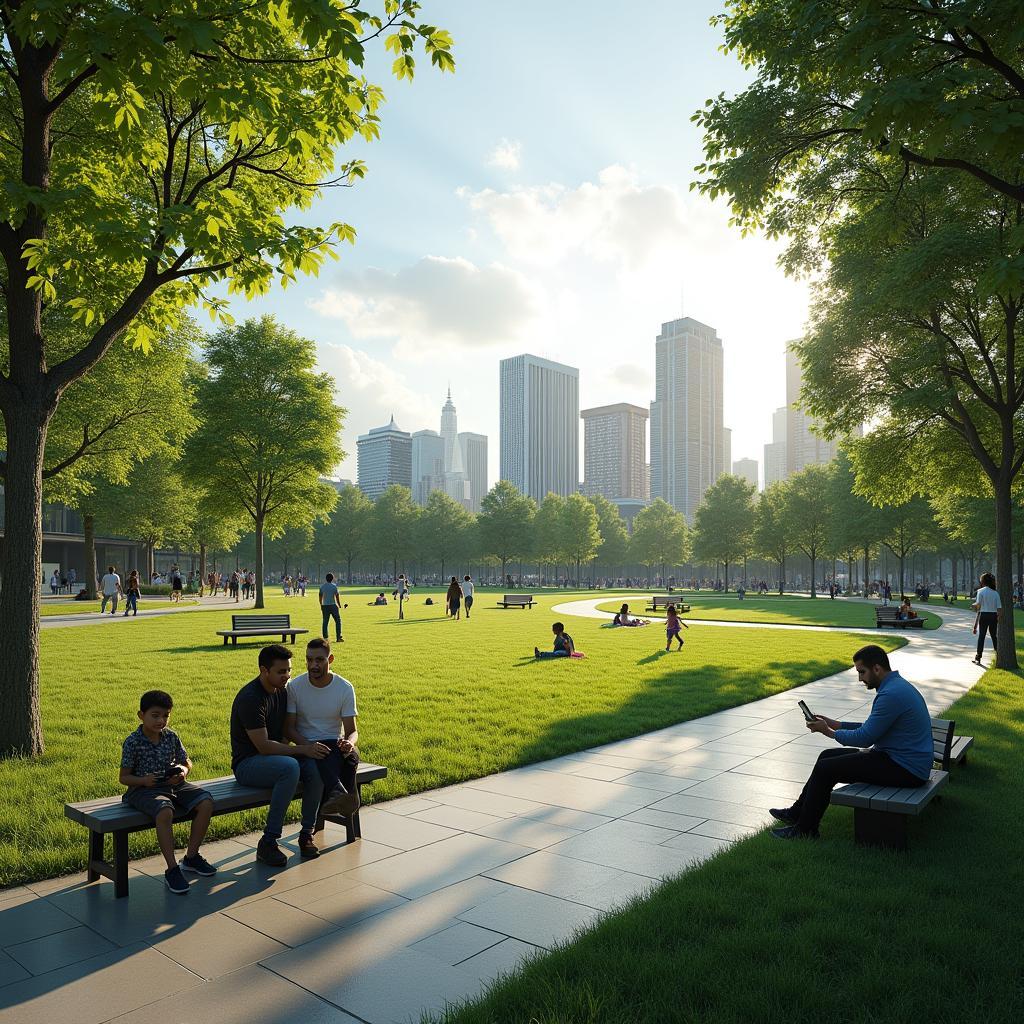 Công viên xanh yên bình giữa lòng đô thị với người dân thư giãn minh họa tầm quan trọng của không gian công cộng trong bài IELTS Speaking
Question 4: How can cities balance the need for development with creating peaceful environments?
🎯 Phân tích câu hỏi:
- Dạng: Problem-Solution với inherent tension between two goals
- Key words: balance, development, peaceful environments
- Cách tiếp cận: Acknowledge tension → Present multiple solutions/approaches → Give examples → Consider challenges
📝 Sample Answer – Band 6-7:
“This is difficult because cities need to grow and develop, but development often creates noise and takes away quiet spaces. I think city planners need to be careful when they design new buildings. They should keep some green spaces and parks even when they build new areas. For example, Singapore has many tall buildings but also has many parks. Cities can also make rules about noise levels in residential areas. So it’s possible to have both development and quiet places if there is good planning.”
Phân tích:
- Structure: Acknowledge challenge → General solution → Example → Conclusion
- Vocabulary: Basic (grow, careful, keep, rules)
- Tại sao Band 6-7: Has right idea nhưng lacks depth và specific terminology
📝 Câu trả lời mẫu – Band 8.5-9:
“This represents one of the central dilemmas of contemporary urban planning, and there’s certainly no one-size-fits-all solution. However, I believe there are several strategic approaches that forward-thinking cities are adopting with considerable success.
First, there’s the concept of integrated urban design where peaceful spaces aren’t afterthoughts but rather core components of development plans. Cities like Copenhagen and Singapore have pioneered this approach by mandating that new developments include proportional green space or contribute to green corridor networks. This ensures that economic growth doesn’t come at the expense of livability. The key is embedding tranquility into the urban fabric rather than treating it as incompatible with progress.
Vertical integration is another innovative solution – essentially incorporating green spaces into buildings themselves through rooftop gardens, green walls, and sky parks. This is particularly relevant for space-constrained cities where horizontal expansion is limited. Singapore’s pioneering projects like Marina Bay Sands demonstrate how high-density development can coexist with substantial green spaces.
Additionally, temporal zoning can play a role – designating certain hours or days where noise-generating activities are restricted in particular areas. Some European cities have successfully implemented “quiet hours” in residential districts, striking a balance between commercial vitality and residential tranquility.
Acoustical urban design is also gaining traction – using sound-absorbing materials, strategic placement of vegetation as natural sound barriers, and thoughtful building orientation to minimize noise propagation. Barcelona’s superblock concept, which restricts vehicular traffic in certain zones while maintaining access, has proven quite effective at creating pockets of calm within a bustling city.
However, all these approaches require political will, long-term vision, and stakeholder buy-in from developers, residents, and businesses. The challenge often isn’t technical feasibility but rather overcoming short-term economic pressures and shifting the paradigm from viewing peaceful spaces as obstacles to development to recognizing them as essential infrastructure for sustainable urban living.”
Phân tích:
- Structure: Exceptional – Frame dilemma → Present multiple sophisticated solutions with international examples → Discuss technical innovations → Acknowledge systemic challenges
- Vocabulary: Highly specialized (central dilemmas, integrated urban design, vertical integration, acoustical urban design, stakeholder buy-in, paradigm shift)
- Grammar: Full native-like flexibility với embedded clauses, nominalizations, complex modification
- Critical Thinking: Shows deep knowledge về urban planning, international examples, recognition that problems are often political rather than technical
💡 Key Language Features:
- Academic framing: “This represents one of the central dilemmas”, “there’s certainly no one-size-fits-all solution”
- Technical vocabulary: integrated urban design, vertical integration, temporal zoning, acoustical urban design, superblock concept
- International examples: Copenhagen, Singapore, Barcelona – shows global awareness
- Nuanced conclusion: Separates technical feasibility từ political challenges
Theme 3: Cultural Perspectives on Silence and Noise
Question 5: Do people from different cultures have different attitudes toward silence and noise?
🎯 Phân tích câu hỏi:
- Dạng: Cultural comparison + Analysis
- Key words: different cultures, attitudes, silence and noise
- Cách tiếp cận: Acknowledge cultural variation → Give specific examples → Explain underlying reasons → Avoid stereotyping
📝 Sample Answer – Band 6-7:
“Yes, I think different cultures view silence differently. In some Asian cultures, silence is seen as respectful, especially when talking to older people or in formal situations. But in Western cultures, people might think silence is uncomfortable and try to fill it with conversation. For example, in Japan, people are often quiet in public places like trains, but in some European countries, people talk more freely. These differences come from cultural values and social norms in each society.”
Phân tích:
- Structure: Yes → Examples từ different cultures → Reason
- Vocabulary: Adequate (respectful, uncomfortable, cultural values, social norms)
- Tại sao Band 6-7: Makes valid points với examples nhưng lacks nuance và sophistication
📝 Câu trả lời mẫu – Band 8.5-9:
“Absolutely, and these differences are quite fascinating when you examine them through a cultural lens. What constitutes appropriate levels of sound and silence is deeply embedded in cultural values, social norms, and even philosophical traditions.
Take, for instance, many East Asian cultures where silence often carries positive connotations – it’s associated with wisdom, contemplation, and respect for others. In Japanese culture, there’s even a concept called “ma” which refers to the meaningful silence or negative space that’s valued in conversation, art, and daily life. Similarly, in many Buddhist cultures, silence is seen as conducive to spiritual development. This reverence for quiet is reflected in social behaviors – you’ll notice how public spaces like trains in Japan are remarkably quiet, with people consciously minimizing their noise impact.
In contrast, many Mediterranean and Latin American cultures tend to have what researchers call higher tolerance for ambient noise and often associate vibrant soundscapes with social vitality and warmth. In these contexts, silence might actually be interpreted as awkward or even unfriendly. The animated conversations in cafés, the overlapping speech patterns, the exuberant street life – these are all manifestations of cultural values that prioritize communal connection and expressive communication.
Northern European cultures present an interesting middle ground – there’s a cultural appreciation for quiet and personal space, evident in concepts like the Swedish “lagom” (appropriate amount) or the Finnish comfort with silence, yet this coexists with a strong public sphere. The difference is that noise is compartmentalized – acceptable in designated social spaces but minimized in shared public transport or residential areas.
These variations aren’t merely superficial preferences but reflect deeper cultural philosophies about individualism versus collectivism, the role of verbal communication, and even historical factors like population density and living arrangements. Cultures that historically developed in densely populated areas often evolved stricter noise norms as a coping mechanism, while those with more space could afford to be more acoustically liberal.
It’s crucial to note, however, that we must avoid overgeneralizing or essentializing cultures. Within any culture, there’s tremendous individual variation, and globalization and urbanization are creating some convergence in attitudes, particularly among younger, urban populations worldwide.”
Phân tích:
- Structure: Outstanding – Affirmative answer → East Asian perspective với specific concepts → Mediterranean/Latin contrast → Northern European middle ground → Underlying reasons → Important caveat about generalization
- Vocabulary: Sophisticated và culturally specific (embedded in, philosophical traditions, reverence for quiet, vibrant soundscapes, manifestations of, acoustically liberal, essentializing)
- Grammar: Native-like complexity với variety of structures, embedding, nominalizations
- Critical Thinking: Demonstrates cultural awareness, uses specific cultural concepts (ma, lagom), explains underlying factors beyond surface differences, importantly acknowledges limitations của cultural generalizations
💡 Key Language Features:
- Cultural specificity: Uses actual cultural concepts (ma, lagom) rather than vague generalizations
- Academic hedging: “often”, “tend to have”, “might be interpreted”, “It’s crucial to note”
- Sophisticated comparison structures: “In contrast”, “present an interesting middle ground”, “coexists with”
- Nuanced conclusion: Warns against overgeneralization và acknowledges complexity
Question 6: Do you think the need for peace and quiet will increase or decrease in the future?
🎯 Phân tích câu hỏi:
- Dạng: Future prediction với justification
- Key words: future, increase or decrease, need for peace and quiet
- Cách tiếp cận: Make prediction → Justify với trends → Consider counterarguments → Conclude với balanced view
📝 Sample Answer – Band 6-7:
“I believe the need will increase in the future. As technology develops more, people will be even more connected to their devices and work, which will make them more stressed. Cities will also become more crowded as populations grow, so there will be more noise. Therefore, people will want to find quiet places even more than now. However, maybe new technology like noise-canceling headphones will help people create their own quiet spaces anywhere.”
Phân tích:
- Structure: Prediction → Reasons (technology, urbanization) → Brief counterpoint
- Vocabulary: Functional (develop, connected, stressed, crowded)
- Tại sao Band 6-7: Clear prediction với reasoning, nhưng lacks depth và nuance
📝 Câu trả lời mẫu – Band 8.5-9:
“I’d predict a significant escalation in this need, though I think the ways people seek and experience quiet will likely evolve in interesting ways.
Several converging trends point toward increased demand. First, the trajectory of technological development suggests we’re moving toward even more pervasive connectivity – with the proliferation of IoT devices, augmented reality, and ambient computing, the boundary between digital and physical space will become increasingly blurred. This omnipresent digital layer could make genuine quiet even more elusive and, consequently, more valued.
Demographic shifts also play a role. As global populations become increasingly concentrated in megacities – the UN projects that by 2050, nearly 70% of the world’s population will be urban – we’re looking at unprecedented levels of sensory density. This isn’t sustainable from a psychological perspective, and I think we’ll see mounting pressure for restorative environments.
Moreover, there’s growing awareness of the public health implications of chronic noise exposure and constant stimulation. As this becomes more well-documented in research, I anticipate it will drive policy changes and create market demand for quiet-conducive environments. We’re already seeing nascent trends like “digital detox retreats” and “silent tourism” gaining commercial traction.
However, I think the nature of quiet will be redefined. We might see technological solutions that create personal acoustic bubbles through advanced noise-cancellation, or virtual quiet through immersive soundscapes. There’s also the possibility that younger generations, who’ve grown up in noisier, more stimulated environments, might have adapted differently and have distinct thresholds for what they consider peaceful.
That said, I suspect there will be a bifurcation – on one hand, a growing wellness-conscious segment that actively seeks traditional forms of quiet as a form of luxury or self-care, and on the other, populations that become increasingly acclimated to constant stimulation and don’t perceive the same need.
So while I expect the overall need to increase, how it manifests and is addressed will likely be more complex and varied than our current understanding of peace and quiet.”
Phân tích:
- Structure: Exceptional – Clear prediction → Multiple supporting trends (technology, demographics, health awareness) → Evolution of the concept itself → Acknowledgment of generational differences → Nuanced conclusion about bifurcation
- Vocabulary: Highly sophisticated (converging trends, trajectory, proliferation, omnipresent, elusive, nascent trends, bifurcation, acclimated to)
- Grammar: Full range với future forms, conditionals, complex noun phrases
- Critical Thinking: Multi-dimensional future analysis, considers không chỉ increase/decrease mà còn transformation of the concept, acknowledges complexity và diverse futures
💡 Key Language Features:
- Future language variety: “I’d predict”, “will likely evolve”, “we’re moving toward”, “I anticipate”, “we might see”
- Trend language: “converging trends”, “trajectory”, “mounting pressure”, “nascent trends”, “gaining traction”
- Academic hedging: “I think”, “likely”, “could make”, “might have adapted”
- Sophisticated vocabulary: proliferation, omnipresent, elusive, bifurcation, acclimated to
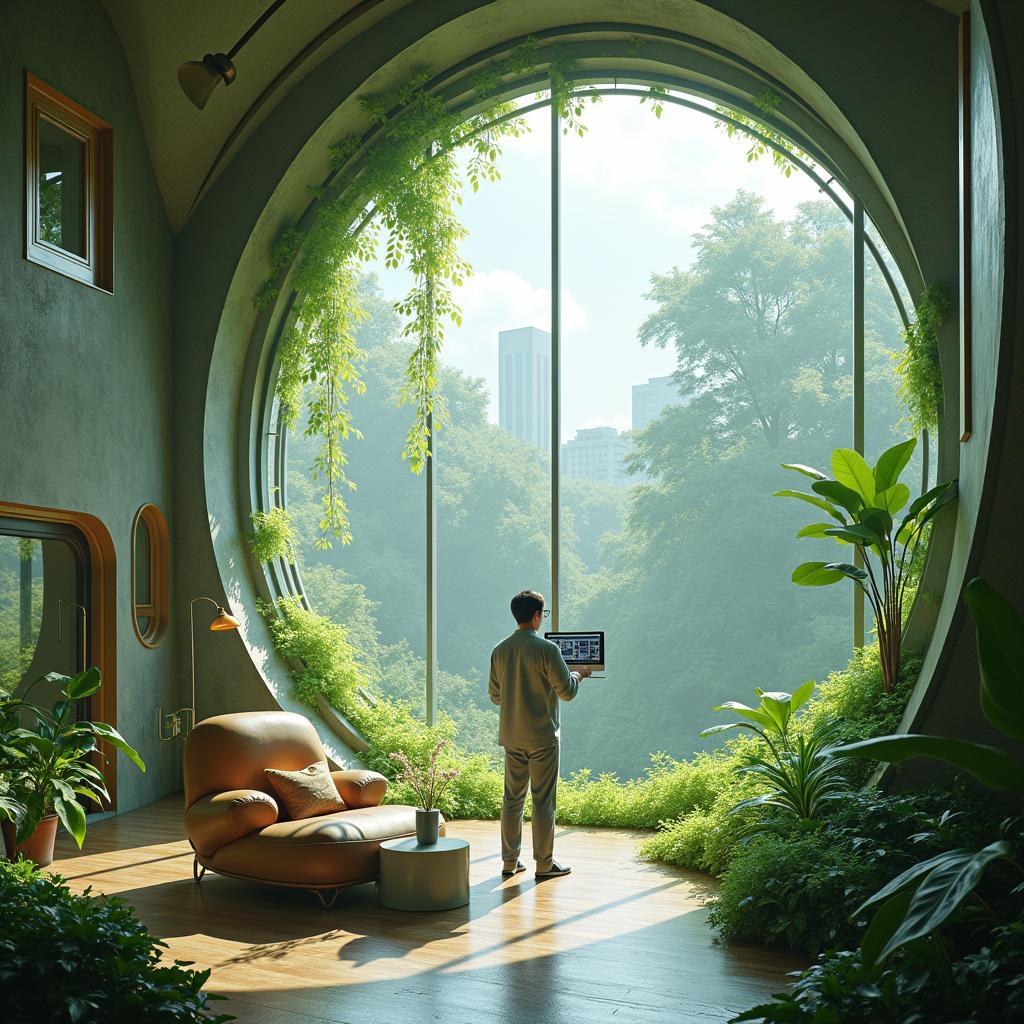 Không gian sống tương lai kết hợp công nghệ và thiên nhiên với thiết kế thông minh tạo vùng yên tĩnh giữa đô thị hiện đại
Từ vựng và cụm từ quan trọng
Topic-Specific Vocabulary
| Từ vựng/Cụm từ | Loại từ | Phiên âm | Nghĩa tiếng Việt | Ví dụ | Collocation |
|---|---|---|---|---|---|
| sanctuary | n | /ˈsæŋktʃueri/ | nơi ẩn náu, thánh địa | The library has become my sanctuary during exam season. | personal sanctuary, wildlife sanctuary, find sanctuary |
| tranquil | adj | /ˈtræŋkwɪl/ | yên tĩnh, thanh bình | The temple gardens offer a tranquil environment for meditation. | tranquil atmosphere, tranquil surroundings, remain tranquil |
| serene | adj | /səˈriːn/ | thanh thản, tĩnh lặng | The lake looked particularly serene at dawn. | serene beauty, serene expression, serene environment |
| secluded | adj | /sɪˈkluːdɪd/ | hẻo lánh, kín đáo | We found a secluded beach away from the tourists. | secluded spot, secluded area, secluded location |
| hustle and bustle | phrase | /ˈhʌsl ənd ˈbʌsl/ | sự hối hả và ồn ào | I needed to escape the hustle and bustle of city life. | escape the hustle and bustle, away from the hustle and bustle |
| unwind | v | /ʌnˈwaɪnd/ | thư giãn, xả stress | Reading helps me unwind after a stressful day. | unwind completely, help to unwind, need to unwind |
| solitude | n | /ˈsɒlɪtjuːd/ | sự cô đơn, một mình (mang tính tích cực) | She enjoys the solitude of her morning walks. | peaceful solitude, seek solitude, moment of solitude |
| respite | n | /ˈrespaɪt/ | sự tạm nghỉ, tạm thở | The garden offers a brief respite from the noise. | temporary respite, welcome respite, provide respite |
| refuge | n | /ˈrefjuːdʒ/ | nơi trú ẩn | The bookstore became my refuge during difficult times. | find refuge, seek refuge, place of refuge |
| ambient | adj | /ˈæmbiənt/ | xung quanh, môi trường | The ambient noise in cafés helps me concentrate. | ambient sound, ambient music, ambient lighting |
| contemplative | adj | /kənˈtemplətɪv/ | trầm tư, suy ngẫm | I prefer contemplative activities like reading. | contemplative mood, contemplative silence, contemplative practice |
| rejuvenate | v | /rɪˈdʒuːvəneɪt/ | làm trẻ lại, phục hồi | Time in nature helps rejuvenate my mind. | feel rejuvenated, rejuvenate completely, help to rejuvenate |
| mental well-being | phrase | /ˈmentl wel ˈbiːɪŋ/ | sức khỏe tinh thần | Quiet spaces are essential for mental well-being. | promote mental well-being, support mental well-being, affect mental well-being |
| sensory overload | phrase | /ˈsensəri ˈəʊvələʊd/ | quá tải giác quan | Cities can cause sensory overload. | experience sensory overload, avoid sensory overload, cope with sensory overload |
| acoustic | adj | /əˈkuːstɪk/ | liên quan đến âm thanh | The room has excellent acoustic properties. | acoustic environment, acoustic design, acoustic comfort |
| cacophony | n | /kəˈkɒfəni/ | âm thanh lộn xộn, ồn ào | The cacophony of traffic was overwhelming. | cacophony of sounds, constant cacophony, urban cacophony |
| tranquility | n | /træŋˈkwɪləti/ | sự yên tĩnh | I value the tranquility of early morning. | sense of tranquility, peace and tranquility, find tranquility |
| soothing | adj | /ˈsuːðɪŋ/ | làm dịu, êm dịu | The soothing sound of rain helps me sleep. | soothing effect, soothing atmosphere, soothing music |
| recharge | v | /ˌriːˈtʃɑːdʒ/ | nạp lại năng lượng | I need time alone to recharge my batteries. | recharge completely, need to recharge, help to recharge |
| meditative | adj | /ˈmedɪtətɪv/ | thiền định, trầm lặng | The walk had a meditative quality. | meditative practice, meditative state, meditative silence |
Idiomatic Expressions & Advanced Phrases
| Cụm từ | Nghĩa | Ví dụ sử dụng | Band điểm |
|---|---|---|---|
| escape the rat race | thoát khỏi cuộc sống cạnh tranh gay gắt | I visit the mountains to escape the rat race for a while. | 7.5-9 |
| tune out the noise | không chú ý đến tiếng ồn/sự phiền nhiễu | Sometimes you need to tune out the noise and focus on yourself. | 7.5-8 |
| a breath of fresh air | điều gì đó mới mẻ, sảng khoái | Finding that quiet café was like a breath of fresh air. | 7-8 |
| off the beaten track | nằm ngoài những nơi du khách thường đến | The temple is quite off the beaten track, which keeps it peaceful. | 7.5-8 |
| hidden gem | viên ngọc ẩn (nơi tuyệt vời ít người biết) | This botanical garden is a hidden gem in the city. | 7-8 |
| peace of mind | sự thanh thản trong tâm trí | Quiet places give me the peace of mind I need. | 7-8 |
| collect your thoughts | tập trung, sắp xếp suy nghĩ | I need somewhere quiet to collect my thoughts before the presentation. | 7.5-8 |
| shut out the world | cô lập khỏi thế giới bên ngoài | Sometimes I just need to shut out the world for a few hours. | 7.5-8 |
| mental clutter | sự lộn xộn trong tâm trí | Meditation helps clear away mental clutter. | 8-9 |
| sensory deprivation | sự thiếu kích thích giác quan | Some people seek sensory deprivation through float tanks. | 8-9 |
| digital detox | tạm ngừng sử dụng công nghệ | I do a digital detox every weekend at my countryside retreat. | 7.5-8 |
| psychological equilibrium | sự cân bằng tâm lý | Regular time in quiet spaces helps maintain psychological equilibrium. | 8.5-9 |
Discourse Markers (Từ Nối Ý Trong Speaking)
Để bắt đầu câu trả lời:
- 📝 Well,… – Khi cần suy nghĩ hoặc bắt đầu một ý kiến
- 📝 Actually,… – Khi đưa ra góc nhìn khác hoặc sự thật bất ngờ
- 📝 To be honest,… – Khi nói thật lòng, thẳng thắn
- 📝 I’d say that… – Khi đưa ra quan điểm cá nhân
- 📝 From my perspective,… – Theo quan điểm của tôi
- 📝 I tend to think that… – Tôi có xu hướng nghĩ rằng
Để bổ sung ý:
- 📝 On top of that,… – Thêm vào đó
- 📝 What’s more,… – Hơn nữa
- 📝 Not to mention… – Chưa kể đến
- 📝 Additionally,… – Thêm nữa
- 📝 Moreover,… – Hơn thế nữa (formal hơn)
- 📝 Beyond that,… – Ngoài ra
Để đưa ra quan điểm cân bằng:
- 📝 On the one hand,… On the other hand,… – Một mặt… mặt khác…
- 📝 While it’s true that…, we also need to consider… – Mặc dù đúng là… nhưng cũng cần xem xét…
- 📝 That said,… – Dù vậy…
- 📝 Having said that,… – Sau khi nói điều đó…
Để kết luận:
- 📝 All in all,… – Tóm lại
- 📝 At the end of the day,… – Cuối cùng thì
- 📝 In the final analysis,… – Phân tích cuối cùng
- 📝 All things considered,… – Xét mọi thứ
Để giải thích hoặc làm rõ:
- 📝 What I mean is… – Ý tôi là…
- 📝 In other words,… – Nói cách khác…
- 📝 To put it another way,… – Diễn đạt theo cách khác…
Grammatical Structures Ấn Tượng
1. Conditional Sentences (Câu điều kiện):
- Mixed conditional: “If more people had access to peaceful spaces (past), they would be less stressed now (present).”
- Inversion: “Had I not discovered this place, I would still be struggling with stress management.”
2. Relative Clauses (Mệnh đề quan hệ):
- Non-defining: “The botanical garden, which few tourists know about, offers complete tranquility.”
- Reduced relative clause: “The place (being) hidden from main roads makes it particularly peaceful.”
3. Passive Voice (Câu bị động):
- It is thought/believed/said that…: “It is widely believed that access to quiet spaces improves mental health.”
- Academic passive: “Research has shown that noise pollution is associated with increased stress levels.”
4. Cleft Sentences (Câu chẻ):
- What I find most…, is…: “What I find most appealing about this place is its complete isolation from urban noise.”
- The thing that…, is…: “The thing that makes this place special is the sense of timelessness it evokes.”
- It’s… that…: “It’s the combination of nature and silence that I find so restorative.”
5. Participle Phrases:
- Present participle: “Walking through the gardens, I feel all my stress melting away.”
- Perfect participle: “Having experienced the tranquility there, I can’t imagine going back to my old routine.”
6. Inversion for emphasis:
- “Not only does it offer peace, but it also provides stunning natural beauty.”
- “Rarely have I found a place that so perfectly combines accessibility with tranquility.”
7. Subjunctive mood:
- “It’s essential that quiet spaces be preserved in urban planning.”
- “I would suggest that everyone find their own sanctuary for peace and quiet.”
Qua bài viết toàn diện này, bạn đã được trang bị đầy đủ kiến thức và công cụ để tự tin trả lời chủ đề “describe a place where you like to go for peace and quiet” trong kỳ thi IELTS Speaking. Từ các câu hỏi thực tế trong Part 1, cue card và bài mẫu đa dạng band điểm trong Part 2, đến những câu hỏi thảo luận sâu trong Part 3 – tất cả đều được phân tích chi tiết từ góc nhìn của một examiner giàu kinh nghiệm.
Điểm quan trọng nhất là đừng học thuộc lòng các sample answers. Thay vào đó, hãy hiểu logic đằng sau mỗi câu trả lời: cách structure ý tưởng, cách sử dụng từ vựng trong context tự nhiên, và cách thể hiện critical thinking. Với nền tảng vững chắc này, bạn hoàn toàn có thể adapt và personalize để tạo ra những câu trả lời authentic và impressive của riêng mình.
Hãy nhớ rằng, IELTS Speaking không chỉ test English của bạn, mà còn test khả năng communicate ideas effectively. Sự tự tin, tự nhiên và genuine trong cách bạn chia sẻ suy nghĩ mới là yếu tố tạo nên sự khác biệt giữa một band điểm trung bình và xuất sắc.