Chủ đề về nơi ở tương lai là một trong những đề tài phổ biến và thực tế nhất trong kỳ thi IELTS Speaking. Với hơn 20 năm kinh nghiệm chấm thi, tôi nhận thấy chủ đề này xuất hiện với tần suất cao trong các kỳ thi từ 2020 đến nay, đặc biệt ở Part 2 và Part 3. Khả năng xuất hiện trong tương lai được đánh giá ở mức Cao do tính practical và universal của chủ đề.
Điều làm nên thách thức với chủ đề này là nhiều thí sinh Việt Nam thường mắc phải lỗi miêu tả quá chung chung, thiếu cụ thể về lý do lựa chọn, hoặc không thể hiện được tầm nhìn rõ ràng về cuộc sống tương lai. Examiner không chỉ muốn nghe bạn nói về một địa điểm đẹp, mà còn muốn thấy khả năng diễn đạt ước mơ, giá trị sống và khả năng lập luận logic.
Trong bài viết này, bạn sẽ học được:
- 10+ câu hỏi thực tế từ các kỳ thi gần đây cho cả 3 Part
- Bài mẫu chi tiết theo 3 band điểm (6-7, 7.5-8, 8.5-9) với phân tích sâu
- Hơn 50 từ vựng và cụm từ ăn điểm về địa điểm, môi trường sống
- Chiến lược trả lời từ góc nhìn Examiner để tránh các lỗi phổ biến
- Cách xử lý các câu hỏi khó trong Part 3 về xu hướng đô thị hóa, môi trường sống
IELTS Speaking Part 1: Introduction and Interview
Tổng Quan Về Part 1
Part 1 kéo dài 4-5 phút với các câu hỏi ngắn về đời sống hàng ngày. Đây là phần “warm-up” để bạn làm quen với examiner và tạo ấn tượng ban đầu. Chiến lược quan trọng nhất là trả lời tự nhiên, mở rộng mỗi câu trả lời thành 2-3 câu với cấu trúc: Direct answer → Reason/Example → Additional detail.
Lỗi thường gặp của học viên Việt Nam trong Part 1:
- Trả lời quá ngắn chỉ có “Yes” hoặc “No”
- Sử dụng từ vựng đơn giản như “good”, “nice”, “beautiful” mà không có từ cụ thể hơn
- Thiếu ví dụ từ kinh nghiệm cá nhân khiến câu trả lời nghe máy móc
- Không sử dụng discourse markers tự nhiên
Các Câu Hỏi Thường Gặp
Question 1: Where do you live now?
Question 2: Do you like living in your current area?
Question 3: What do you like most about where you live?
Question 4: Would you like to move to a different place in the future?
Question 5: What kind of place would you like to live in?
Question 6: Do you prefer living in a house or an apartment?
Question 7: What’s the most important thing when choosing where to live?
Question 8: Have you ever thought about living abroad?
Question 9: Do you think you will live in the same place in 10 years?
Question 10: What would make you want to move to a new place?
Phân Tích và Gợi Ý Trả Lời Chi Tiết
Question: Do you like living in your current area?
🎯 Cách tiếp cận:
- Trả lời trực tiếp có/không
- Đưa ra 1-2 lý do cụ thể
- Thêm ví dụ hoặc chi tiết để minh họa
📝 Sample Answer – Band 6-7:
“Yes, I quite like it. My area is convenient because there are many shops and restaurants nearby. The people are also friendly and I feel safe here.”
Phân tích:
- Điểm mạnh: Trả lời rõ ràng, có lý do cụ thể (convenient, shops, friendly people)
- Hạn chế: Từ vựng còn basic (quite like, many, friendly), cấu trúc câu đơn giản, thiếu chi tiết sâu hơn
- Tại sao Band 6-7: Đáp ứng yêu cầu cơ bản với fluency ổn định nhưng vocabulary và grammar chưa impressive
📝 Sample Answer – Band 8-9:
“Actually, I’m really fond of my current neighborhood. It strikes a perfect balance between urban convenience and residential tranquility. What I appreciate most is the well-established infrastructure – everything from supermarkets to healthcare facilities is within walking distance. Plus, there’s a real sense of community here, which is quite rare in big cities nowadays.”
Phân tích:
- Điểm mạnh: Sử dụng collocations tự nhiên (fond of, strikes a perfect balance, sense of community), cấu trúc phức tạp với what-clause, discourse marker “Actually” và “Plus” mạch lạc
- Tại sao Band 8-9: Vocabulary precise và topic-specific (well-established infrastructure, residential tranquility), grammar đa dạng, ý tưởng sâu sắc hơn về balance giữa tiện lợi và yên tĩnh
💡 Key Vocabulary & Expressions:
- be fond of: yêu thích (formal hơn “like”)
- strike a balance: cân bằng hoàn hảo
- well-established infrastructure: cơ sở hạ tầng hoàn thiện
- sense of community: tinh thần cộng đồng
Question: What kind of place would you like to live in the future?
🎯 Cách tiếp cận:
- Miêu tả loại địa điểm (city/countryside/coastal area)
- Giải thích lý do lựa chọn
- Nêu yếu tố quan trọng nhất
📝 Sample Answer – Band 6-7:
“I would like to live in a peaceful place, maybe near the beach. I think living by the sea would be very relaxing and good for my health. I also want a place with clean air and not too crowded.”
Phân tích:
- Điểm mạnh: Ý tưởng rõ ràng (beach, peaceful), có lý do (relaxing, healthy)
- Hạn chế: Từ vựng đơn giản (peaceful, good for health), thiếu cụ thể, cụm “not too crowded” hơi informal
- Tại sao Band 6-7: Communicates meaning nhưng thiếu sophistication trong vocabulary và grammar
📝 Sample Answer – Band 8-9:
“Ideally, I’d love to settle down in a coastal town somewhere with a temperate climate. I’ve always been drawn to places near the ocean because there’s something incredibly therapeutic about the sea breeze and the sound of waves. I also value a slower pace of life, so somewhere that’s not overly commercialized but still has essential amenities would be perfect. Environmental quality is another key factor – I’d prioritize clean air and access to nature.”
Phân tích:
- Điểm mạnh: Vocabulary tinh vi (settle down, temperate climate, therapeutic, overly commercialized), cấu trúc đa dạng với relative clause, ý tưởng sâu sắc về quality of life
- Tại sao Band 8-9: Natural discourse với “Ideally”, “I’ve always been”, paraphrasing hiệu quả (peaceful → slower pace of life), shows personal values rõ ràng
💡 Key Vocabulary & Expressions:
- settle down: định cư lâu dài
- coastal town: thị trấn ven biển
- temperate climate: khí hậu ôn hòa
- be drawn to: bị thu hút bởi
- therapeutic: có tác dụng chữa lành, thư giãn
- overly commercialized: thương mại hóa quá mức
Question: What’s the most important thing when choosing where to live?
🎯 Cách tiếp cận:
- Nêu yếu tố quan trọng nhất
- Giải thích tại sao
- So sánh với các yếu tố khác nếu có thể
📝 Sample Answer – Band 6-7:
“I think the most important thing is job opportunities. Because if you don’t have a good job, you can’t afford to live comfortably. Location is also important for me, it should be convenient to go to work.”
Phân tích:
- Điểm mạnh: Answer trực tiếp, lý do logic (job → afford living)
- Hạn chế: Grammar có lỗi nhỏ (“location is important for me” nên là “to me”), từ vựng basic (good job, convenient)
- Tại sao Band 6-7: Meaning clear nhưng accuracy và lexical resource chưa cao
📝 Sample Answer – Band 8-9:
“From my perspective, I’d say quality of life is paramount. While career opportunities are certainly important, there’s no point in earning a high salary if you’re living in a place that’s detrimental to your wellbeing. What I mean is that factors like air quality, access to green spaces, and a supportive community ultimately have a more profound impact on long-term happiness than purely financial considerations. That said, affordability can’t be ignored either – it’s all about finding that sweet spot.”
Phân tích:
- Điểm mạnh: Shows critical thinking với balanced view, vocabulary sophisticated (paramount, detrimental to wellbeing, supportive community), discourse markers tự nhiên (From my perspective, What I mean is, That said)
- Tại sao Band 8-9: Grammar phức tạp với conditional structure, cohesion hoàn hảo, acknowledges complexity của vấn đề
💡 Key Vocabulary & Expressions:
- paramount: quan trọng nhất, tối quan trọng
- detrimental to wellbeing: có hại cho sức khỏe và hạnh phúc
- access to green spaces: tiếp cận không gian xanh
- supportive community: cộng đồng hỗ trợ
- affordability: khả năng chi trả
- finding that sweet spot: tìm điểm cân bằng hoàn hảo
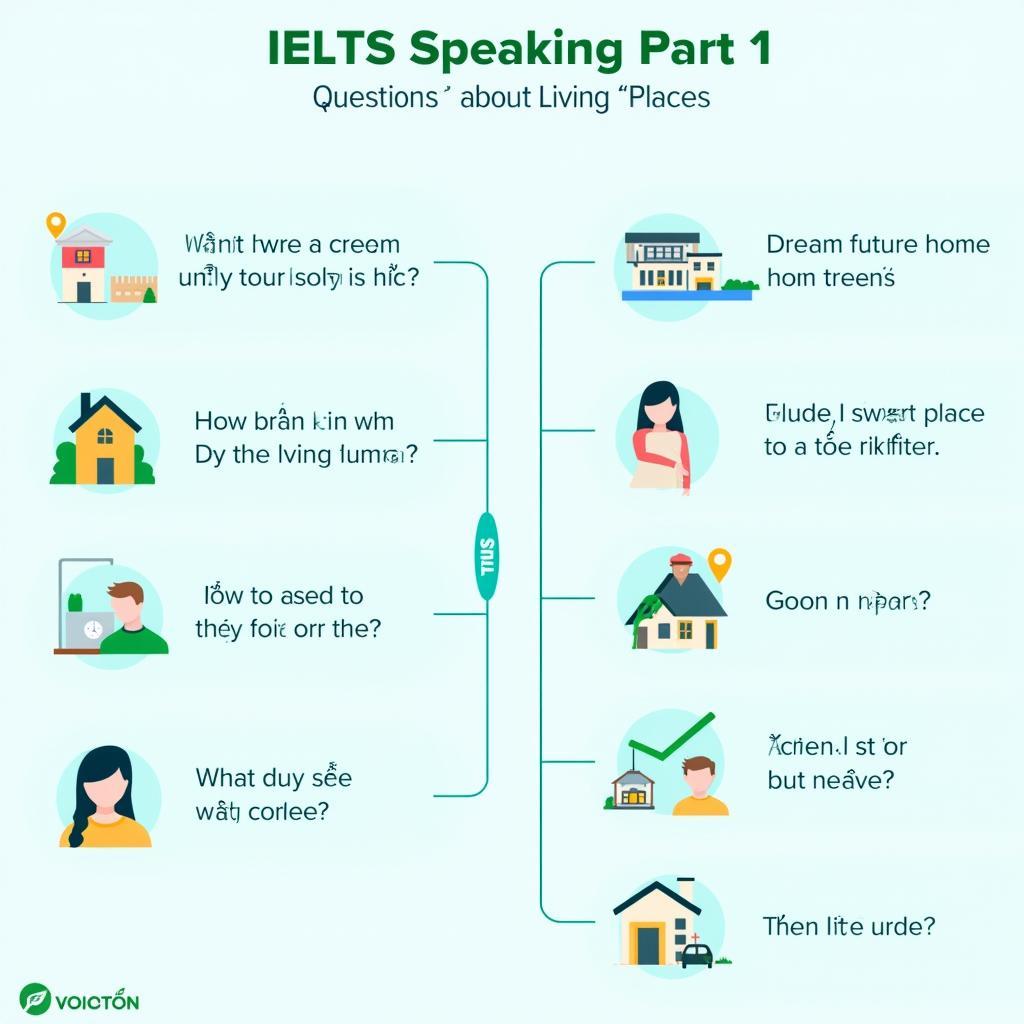 Các câu hỏi IELTS Speaking Part 1 về nơi ở hiện tại và tương lai với chiến lược trả lời
IELTS Speaking Part 2: Long Turn (Cue Card)
Tổng Quan Về Part 2
Part 2 là phần độc thoại kéo dài 2-3 phút, trong đó bạn có 1 phút chuẩn bị và ghi chú. Đây là phần quan trọng nhất để thể hiện khả năng nói liên tục và tổ chức ý tưởng. Examiner sẽ không ngắt lời bạn trong suốt thời gian này.
Chiến lược hiệu quả:
- Sử dụng đủ 1 phút để ghi chú keywords (KHÔNG viết câu hoàn chỉnh)
- Ghi theo thứ tự các bullet points
- Nói tối thiểu 1.5 phút, tốt nhất là 2-2.5 phút
- Trả lời đầy đủ tất cả bullet points, đặc biệt là câu “explain” cuối cùng
- Sử dụng thì tương lai khi nói về dự định
Lỗi thường gặp:
- Không tận dụng thời gian chuẩn bị, ghi chú lộn xộn
- Nói dưới 1.5 phút khiến examiner phải hỏi thêm
- Bỏ sót bullet points hoặc không giải thích đầy đủ phần “explain”
- Lạc đề, nói quá nhiều về chi tiết không liên quan
Cue Card
Describe A Place Where You Would Like To Live In The Future
You should say:
- Where this place would be
- What it would be like
- When you would like to live there
- And explain why you would like to live in this place
Phân Tích Đề Bài
-
Dạng câu hỏi: Describe a place (miêu tả địa điểm)
-
Thì động từ: Tương lai (would like, will) vì đây là dự định
-
Bullet points phải cover:
- Where: Vị trí địa lý cụ thể (thành phố, quốc gia, vùng)
- What it would be like: Miêu tả chi tiết về đặc điểm, môi trường, infrastructure
- When: Thời điểm mong muốn (sau khi nghỉ hưu, 5-10 năm nữa, khi có đủ tiền…)
- Why: Lý do sâu sắc nhất – đây là phần ghi điểm cao nhất
-
Câu “explain” quan trọng: Đây là phần thể hiện personal values, long-term vision và critical thinking. Đừng chỉ nói “because it’s beautiful” mà cần giải thích deeper reasons như lifestyle, personal growth, quality of life, family considerations.
📝 Sample Answer – Band 6-7
Thời lượng: Khoảng 1.5-2 phút
“The place I’d like to live in the future is Da Nang, a coastal city in central Vietnam. It’s located between Hanoi and Ho Chi Minh City, right next to the ocean.
Da Nang is a modern city with beautiful beaches. The most famous one is My Khe Beach, which has white sand and clear blue water. The city has many bridges and the infrastructure is quite developed. There are also mountains nearby, so you can enjoy both beach and mountain views. The weather is nice most of the year, not too hot or too cold.
I would like to move there in about five to ten years, after I have gained more work experience and saved enough money. Maybe when I’m around 35 years old, I’ll be ready to settle down there.
I want to live in Da Nang because it offers a good quality of life. The living cost is lower than in big cities like Hanoi or Saigon, but it still has all the modern facilities I need. I also love the sea, so living near the beach would make me happy and relaxed. The people there are friendly and the city is not too crowded. I think it would be a perfect place to raise a family in the future because it’s safe and has good schools. Overall, I believe Da Nang would give me a better work-life balance than living in a big, busy city.”
Phân Tích Band Điểm (H4)
| Tiêu chí | Band | Nhận xét |
|---|---|---|
| Fluency & Coherence | 6-7 | Nói trôi chảy, có sequencing rõ ràng theo bullet points. Sử dụng linking devices cơ bản (also, so, because, overall). Có một vài hesitation nhẹ nhưng không ảnh hưởng communication |
| Lexical Resource | 6-7 | Từ vựng adequate với collocations đơn giản (coastal city, living cost, work-life balance). Có paraphrasing cơ bản (modern facilities, infrastructure developed) nhưng còn repetition (good, nice) |
| Grammatical Range & Accuracy | 6-7 | Sử dụng mix của simple và complex sentences. Có conditional và future forms đúng. Một số lỗi nhỏ không ảnh hưởng meaning |
| Pronunciation | 6-7 | Rõ ràng, dễ hiểu với pronunciation chuẩn Vietnamese accent. Intonation khá tự nhiên |
Điểm mạnh:
- ✅ Trả lời đầy đủ tất cả bullet points theo đúng thứ tự
- ✅ Có specific location và details về địa điểm (My Khe Beach, bridges)
- ✅ Timeframe rõ ràng (5-10 years, around 35)
- ✅ Explanation có logic với nhiều reasons (cost, quality of life, family)
Hạn chế:
- ⚠️ Vocabulary còn basic ở nhiều chỗ (nice, good, happy, perfect)
- ⚠️ Thiếu idiomatic expressions và advanced phrases
- ⚠️ Ideas chưa đủ sâu, chưa thể hiện personal insight mạnh mẽ
📝 Sample Answer – Band 7.5-8
Thời lượng: Khoảng 2-2.5 phút
“The place I’ve been dreaming of living in is actually Wellington, the capital city of New Zealand. It’s situated on the southwestern tip of the North Island, nestled between a stunning harbor and rolling green hills.
What really appeals to me about Wellington is its unique character. It’s often described as having a vibrant cultural scene – there are countless cafes, art galleries, and indie theaters scattered throughout the city. The architecture is quite interesting too, with a mix of Victorian buildings and modern structures. What I find particularly attractive is the walkability of the city center; you don’t need a car to get around, which I think promotes a healthier lifestyle. The natural environment is breathtaking – you’ve got the harbor on one side and accessible hiking trails on the other, so outdoor enthusiasts like myself would be in their element.
Realistically, I’d aim to move there within the next decade, probably once I’ve established myself professionally and built up sufficient savings. I’d also need to secure a work visa, which requires having in-demand skills, so I’m currently working towards that goal. Ideally, I’d like to make the move before I turn 40, while I’m still adaptable enough to settle into a new culture.
The reason Wellington resonates with me so strongly is that it seems to embody the lifestyle I value. Unlike many capital cities, it’s not overwhelmingly busy or polluted – there’s a real emphasis on sustainability and work-life integration in New Zealand culture. I’ve read that Wellingtonians have a strong sense of community and environmental consciousness, which aligns perfectly with my personal values. Moreover, New Zealand’s education and healthcare systems are highly regarded, which would be important if I decide to start a family there. Ultimately, I’m drawn to the idea of living somewhere that prioritizes quality over quantity – where success isn’t just measured by career achievements but by overall wellbeing and life satisfaction.”
Phân Tích Band Điểm
| Tiêu chí | Band | Nhận xét |
|---|---|---|
| Fluency & Coherence | 7.5-8 | Nói liên tục không hesitation, logic progression rõ ràng. Discourse markers sophisticated (Actually, What I find particularly, Realistically, Ultimately). Cohesion tự nhiên |
| Lexical Resource | 7.5-8 | Vocabulary precise và varied (nestled between, vibrant cultural scene, outdoor enthusiasts, embody, work-life integration). Collocations natural (secure a visa, built up savings, environmental consciousness). Minimal repetition |
| Grammatical Range & Accuracy | 7.5-8 | Complex structures đa dạng (relative clauses, conditionals, passive voice). Virtually error-free. Flexible use of verb forms |
| Pronunciation | 7.5-8 | Clear với features of native-like speech, good stress và intonation patterns |
So Sánh Với Band 6-7
| Khía cạnh | Band 6-7 | Band 7.5-8 |
|---|---|---|
| Vocabulary | “modern city”, “beautiful beaches”, “good quality of life” | “vibrant cultural scene”, “breathtaking natural environment”, “work-life integration” |
| Grammar | Simple: “It’s located between…”, “The weather is nice” | Complex: “It’s situated on the southwestern tip…”, “What I find particularly attractive is…” |
| Ideas | General reasons (cheaper, nice weather, friendly people) | Specific values (sustainability, community, quality over quantity, personal alignment) |
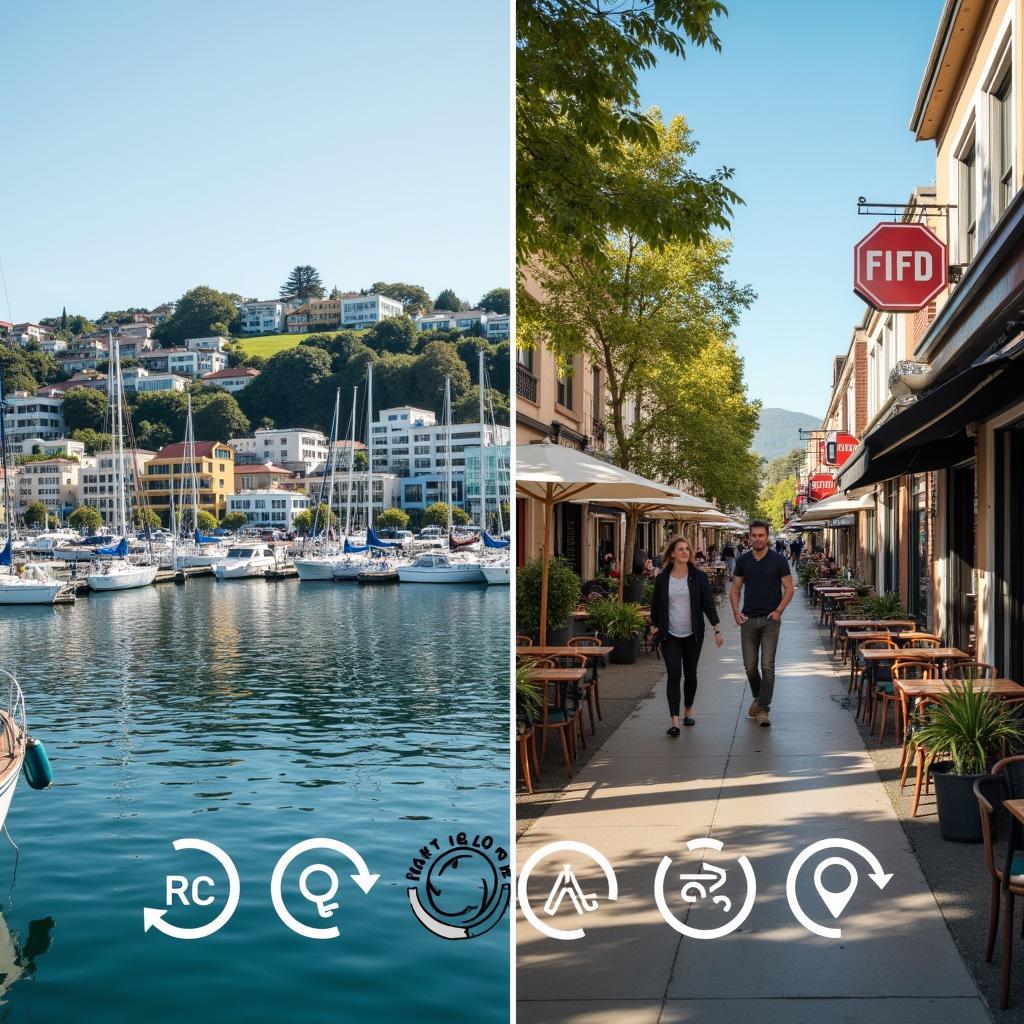 Cuộc sống tại Wellington New Zealand – địa điểm lý tưởng trong bài thi IELTS Speaking
📝 Sample Answer – Band 8.5-9
Thời lượng: 2.5-3 phút đầy đủ
“I’ve always been captivated by the idea of living in the Cotswolds region of England – it’s not a city per se, but rather a collection of picturesque villages scattered across the rolling countryside in south-central England. We’re talking about places like Bourton-on-the-Water or Chipping Campden, which are renowned for their quintessentially English character.
What makes this region so alluring is its timeless quality. The villages are characterized by honey-colored limestone cottages that date back centuries, narrow winding lanes, and an almost storybook-like atmosphere that feels worlds away from modern urban life. But it’s not just about aesthetics – what really strikes me is how the community has managed to preserve its heritage while still maintaining modern amenities. You’ll find excellent farm-to-table restaurants, artisan shops, and even robust internet connectivity, which means remote work is entirely feasible. The landscape itself is nothing short of spectacular – verdant hills, babbling brooks, and well-maintained footpaths that crisscross the countryside, making it a paradise for anyone who values outdoor pursuits and tranquility.
As for timing, I’m looking at a fairly ambitious timeline – potentially within 15 to 20 years, which would coincide with my semi-retirement phase. The plan is to build up a location-independent income stream, perhaps through consulting or creative work, that would enable me to afford the admittedly steep property prices in the area while maintaining financial security. I’m also factoring in visa requirements and the practicalities of international relocation, which at my stage of life would need careful planning.
The reason this speaks to me on such a profound level is quite personal. Throughout my career, I’ve been immersed in the relentless pace of city life, and while I’m grateful for the opportunities it’s provided, I’ve come to realize that my definition of success has evolved considerably. What I’m seeking now is what I’d call intentional living – a lifestyle where quality of relationships and mindful engagement with one’s surroundings take precedence over material accumulation and career ladder-climbing. The Cotswolds epitomizes this philosophy; it’s a place where people seem to have struck an enviable balance between productivity and presence. There’s also a thriving creative community there – lots of writers, artists, and craftspeople who’ve opted out of the urban rat race. I find that incredibly inspiring. Moreover, being in England would put me within easy reach of Europe, satisfying my wanderlust while having a peaceful home base to return to. Ultimately, I envision this move not as an escape, but as a conscious choice to align my physical environment with my core values – simplicity, connection to nature, and genuine community engagement. It’s about creating a life where every day feels purposeful rather than just productive.”
Phân Tích Band Điểm
| Tiêu chí | Band | Nhận xét |
|---|---|---|
| Fluency & Coherence | 8.5-9 | Completely fluent với sophisticated linking. Natural pauses for emphasis. Coherent argument development showing maturity of thought |
| Lexical Resource | 8.5-9 | Precise, sophisticated, idiomatic (captivated by, nothing short of spectacular, speaks to me on a profound level, opted out of the rat race). Wide range with skillful paraphrasing. Natural collocations throughout |
| Grammatical Range & Accuracy | 8.5-9 | Full range of structures used naturally and accurately. Complex sentences with multiple clauses handled effortlessly. No errors |
| Pronunciation | 8.5-9 | Fully operational command with features indistinguishable from educated native speakers |
Tại Sao Bài Này Xuất Sắc
🎯 Fluency Hoàn Hảo:
- Không có hesitation hay repetition không cần thiết. Speech flows naturally với variations trong pace để emphasize important points (ví dụ: dừng một chút trước “conscious choice” để create impact)
📚 Vocabulary Tinh Vi:
- Ví dụ: “nothing short of spectacular” – idiomatic expression thay vì simply “very beautiful”
- “strike an enviable balance” – sophisticated collocation thay vì “have good balance”
- “opted out of the rat race” – idiom showing cultural awareness
- “intentional living” – abstract noun phrase showing philosophical depth
📝 Grammar Đa Dạng:
- Ví dụ: “The plan is to build up a location-independent income stream, perhaps through consulting or creative work, that would enable me to afford the admittedly steep property prices…” – complex sentence với multiple clauses, parenthetical insertion, relative clause
- Mixed conditionals và subjunctive mood được dùng naturally
- Passive và active voice được alternate để tạo variety
💡 Ideas Sâu Sắc:
- Không chỉ miêu tả surface level (đẹp, yên tĩnh) mà explore deeper themes: evolving definition of success, intentional living, alignment between values và environment
- Shows self-awareness: “I’ve come to realize that my definition of success has evolved considerably”
- Acknowledges complexity: addresses practical concerns (visa, finances, property prices) cùng với emotional/philosophical motivations
- Personal narrative arc: từ busy city life → realization → future vision
Follow-up Questions (Rounding Off Questions)
Examiner có thể hỏi thêm 1-2 câu ngắn sau Part 2 để transition sang Part 3:
Question 1: Have you ever visited this place before?
Band 6-7 Answer:
“No, I haven’t been there yet, but I’ve seen many pictures and videos online. I’ve also read travel blogs about it, which made me more interested in living there.”
Band 8-9 Answer:
“Actually, no, which I realize might seem a bit idealistic. My fascination has been cultivated entirely through extensive research – documentaries, firsthand accounts from expats, and virtual tours. While I’m aware that reality might differ from my romanticized vision, I think the core appeal of the lifestyle there would still resonate with me. I’m planning a reconnaissance trip next year to test the waters before making any concrete decisions.”
Question 2: Do you think it’s difficult to move to a new place?
Band 6-7 Answer:
“Yes, I think it can be quite difficult. You need to find a job, make new friends, and get used to a different environment. It takes time to adapt.”
Band 8-9 Answer:
“It’s certainly challenging on multiple levels – there’s the logistical complexity of relocating, but more significantly, the emotional adjustment of leaving behind familiar networks and navigating a new social landscape. That said, I think difficulty is relative to how well you prepare and your capacity for adaptation. People who approach it with an open mindset and realistic expectations tend to weather the transition much better than those who expect instant belonging.”
 Cách ghi chú hiệu quả trong 1 phút chuẩn bị IELTS Speaking Part 2
IELTS Speaking Part 3: Two-way Discussion
Tổng Quan Về Part 3
Part 3 kéo dài 4-5 phút với các câu hỏi trừu tượng và sâu sắc hơn, liên quan đến chủ đề Part 2. Đây là phần khó nhất và là cơ hội để distinguish yourself ở band 8-9. Examiner muốn thấy khả năng phân tích, đánh giá, so sánh và đưa ra quan điểm có lý lẽ về các vấn đề xã hội.
Yêu cầu:
- Phân tích causes, effects, solutions của các vấn đề
- So sánh different perspectives hoặc time periods
- Đưa ra personal opinion với supporting arguments
- Xem xét multiple dimensions của vấn đề
Chiến lược:
- Mở rộng câu trả lời: 3-5 câu (không phải 1-2 câu như Part 1)
- Sử dụng discourse markers để structure ideas (Well, I think there are several factors…)
- Đưa ra examples từ society, không chỉ personal experience
- Acknowledge complexity: “It’s a complex issue…”, “There are pros and cons…”
- Show balanced thinking: “On the one hand… On the other hand…”
Lỗi thường gặp của học viên Việt Nam:
- Trả lời quá ngắn, thiếu elaboration và analysis
- Không đưa ra clear stance hoặc lý lẽ mâu thuẫn
- Thiếu vocabulary trừu tượng để discuss societal issues
- Không connect ideas với broader context
- Speak too personally thay vì from societal perspective
Các Câu Hỏi Thảo Luận Sâu
Theme 1: Urban vs Rural Living
Question 1: Why do many people prefer to live in cities rather than in the countryside?
🎯 Phân tích câu hỏi:
- Dạng: Cause/Reason – Giải thích xu hướng đô thị hóa
- Key words: prefer, cities, countryside (cần so sánh advantages)
- Cách tiếp cận: State the trend → Multiple reasons với examples → Nuance/exception
📝 Sample Answer – Band 6-7:
“I think there are several reasons for this trend. First, cities offer more job opportunities and higher salaries compared to rural areas. People can find better careers in cities. Second, cities have better infrastructure like hospitals, schools, and shopping centers. Everything is more convenient. Young people especially prefer city life because there are more entertainment options and social activities. However, some people still like the countryside because it’s peaceful and has fresh air.”
Phân tích:
- Structure: Có clear organization (First, Second, However) và multiple reasons
- Vocabulary: Adequate (job opportunities, infrastructure, entertainment options) nhưng chưa sophisticated
- Tại sao Band 6-7: Addresses question đầy đủ với relevant points nhưng analysis không deep, vocabulary còn basic, thiếu examples cụ thể từ society
📝 Sample Answer – Band 8-9:
“Well, I think this urban migration trend can be attributed to several interconnected factors. Predominantly, it’s about economic opportunities – cities serve as commercial hubs where industries are concentrated, which naturally translates to a wider array of career paths and typically higher earning potential. This is particularly pronounced in developing countries where the urban-rural income gap can be quite substantial.
Beyond economics, there’s also the infrastructure advantage. Cities offer superior healthcare facilities, educational institutions, and public services that are simply not viable in sparsely populated rural areas. For instance, if you need specialized medical treatment, you’ll almost certainly need to be in or near a major city.
But I think there’s also a sociological dimension that’s often overlooked. Cities provide anonymity and freedom from the tight-knit social structures of rural communities, which can be liberating, especially for young people seeking to forge their own identity. The cosmopolitan environment exposes you to diverse perspectives and cultures, which can be intellectually stimulating.
That said, we’re now seeing some counter-trends with remote work enabling people to have their cake and eat it too – earning city salaries while enjoying rural tranquility. So the picture is becoming more nuanced than it once was.”
Phân tích:
- Structure: Sophisticated organization: Economic → Infrastructure → Sociological → Counter-trend. Shows comprehensive thinking
- Vocabulary: Precise, academic (interconnected factors, pronounced, urban-rural income gap, forge their own identity, cosmopolitan environment, counter-trends)
- Grammar: Complex structures (relative clauses, conditional, passive) used naturally
- Critical Thinking: Goes beyond obvious reasons, considers psychological/social factors, acknowledges changing trends
💡 Key Language Features:
- Discourse markers: “Well”, “Predominantly”, “Beyond economics”, “But I think”, “That said” – creates natural flow
- Tentative language: “I think”, “can be attributed to”, “typically” – shows thoughtful, not dogmatic stance
- Abstract nouns: “anonymity”, “liberating”, “infrastructure advantage” – academic register
- Idiomatic expression: “have their cake and eat it too” – shows language flexibility
Question 2: Do you think more people will move to the countryside in the future?
🎯 Phân tích câu hỏi:
- Dạng: Future prediction + Opinion
- Key words: future, move to countryside (reversal of urbanization?)
- Cách tiếp cận: State your position → Factors supporting this trend → Factors against → Qualified conclusion
📝 Sample Answer – Band 6-7:
“I think it’s possible that some people will move to the countryside in the future. With technology, people can work from home now, so they don’t need to live in cities. The countryside is cheaper and less polluted, which is attractive. However, I don’t think it will be a big trend because cities still have better facilities and more job choices. Maybe only retired people or people who can work remotely will move to rural areas.”
Phân tích:
- Structure: Has opinion + some supporting points + counterpoint
- Vocabulary: Basic (work from home, cheaper, less polluted, better facilities)
- Tại sao Band 6-7: Addresses question với relevant ideas nhưng lacks depth, không có concrete examples, analysis superficial
📝 Sample Answer – Band 8.5-9:
“That’s an interesting question, and I’d say the answer is somewhat paradoxical. On one hand, we’re definitely seeing emerging trends that could facilitate this shift. The normalization of remote work post-pandemic has decoupled employment from physical location for many white-collar professions. Coupled with rising urban property prices and increasing awareness of quality-of-life issues like pollution and stress, there are compelling incentives for relocation.
However, I think we need to be realistic about the scale and demographics of this movement. It’s likely to be selective rather than widespread – predominantly affluent professionals who can leverage technology to maintain urban-level incomes while enjoying rural amenities. For the broader population, particularly those in service industries or manual labor, the economic gravitational pull of cities remains strong.
There’s also the infrastructure challenge. Rural areas would need substantial investment in digital connectivity, healthcare, and education to make them genuinely viable alternatives to urban living. Without this, we might see temporary migration or semi-rural settlement in satellite towns rather than a true back-to-the-land movement.
Ultimately, I’d predict a more nuanced pattern – not a mass exodus from cities, but rather a gradual diversification of living arrangements, with hybrid models becoming more common. Some people might split their time between urban and rural homes, while others might opt for smaller cities that offer a middle ground. The key factor will be whether governments implement policies that support sustainable rural development without sacrificing economic opportunity.”
Phân tích:
- Structure: Multi-layered argument: Trend acknowledgment → Realistic limitations → Infrastructure considerations → Nuanced prediction. Shows sophisticated thinking
- Vocabulary: Highly sophisticated (paradoxical, decoupled, gravitational pull, back-to-the-land movement, hybrid models, sustainable rural development)
- Grammar: Full range: complex conditionals, perfect aspects, noun phrases, passives
- Critical Thinking: Considers economics, technology, demographics, infrastructure, policy. Shows real-world understanding
- Balanced view: Acknowledges both possibilities and limitations, avoids simplistic yes/no
💡 Key Language Features:
- Hedging language: “somewhat”, “likely to be”, “I’d predict” – academic caution
- Transitional phrases: “On one hand”, “However”, “There’s also”, “Ultimately” – clear signposting
- Collocations: “emerging trends”, “compelling incentives”, “broader population”, “substantial investment”
Theme 2: Housing and Lifestyle Choices
Question 3: What are the advantages and disadvantages of living in an apartment compared to a house?
🎯 Phân tích câu hỏi:
- Dạng: Compare and contrast (advantages + disadvantages)
- Key words: apartment vs house (need balanced discussion)
- Cách tiếp cận: Structure clearly: Apartment advantages → disadvantages → House advantages → disadvantages → Personal view or context-dependent conclusion
📝 Sample Answer – Band 6-7:
“Living in an apartment has some good points and bad points. The advantages are that apartments are usually cheaper than houses and easier to maintain. You don’t need to worry about the garden or repairs because the building management takes care of it. Apartments are also more secure with guards and cameras. The disadvantages are that apartments are smaller and you have less privacy because neighbors are very close. You can’t make much noise or have pets easily.
Houses are better because you have more space and freedom. You can have a garden and park your car. But houses are expensive and you need to do all the maintenance yourself. I think it depends on your situation – apartments are good for young single people, but families need houses.”
Phân tích:
- Structure: Clear comparison với some advantages and disadvantages mentioned
- Vocabulary: Simple (cheaper, easier, more space, expensive)
- Tại sao Band 6-7: Addresses both sides nhưng points are general, thiếu specific examples và deeper analysis của lifestyle implications
📝 Sample Answer – Band 8.5-9:
“This really comes down to lifestyle priorities and life stage, as both options have distinct trade-offs.
Apartments offer several tangible benefits. Financially, they’re typically more affordable upfront and have lower maintenance overheads since communal expenses are shared among residents. There’s also a convenience factor – many modern apartment complexes are strategically located in urban centers with proximity to amenities, and the hands-off approach to property maintenance appeals to busy professionals who don’t want to spend weekends mowing lawns or fixing gutters. Security-wise, apartments with controlled access and surveillance systems can provide peace of mind, especially in high-crime areas.
However, the downsides are significant. There’s the obvious space constraint – you’re inherently limited in how you can use and modify your living environment. Noise pollution from neighbors can be a constant source of friction, and many apartment buildings have restrictive policies regarding pets, renovations, or even hosting gatherings. There’s also a lack of outdoor private space, which became particularly acute during pandemic lockdowns.
Houses, conversely, offer autonomy and flexibility. You have complete control over your property – you can renovate, landscape, and use the space as you see fit. The psychological benefits of having your own yard, direct access to outdoor space, and physical separation from neighbors shouldn’t be underestimated. It’s also generally better for families with children who need space to play safely.
The flip side is the financial and time burden. Houses demand substantial capital investment, ongoing maintenance costs, and considerable time for upkeep. You’re also typically further from city centers, which means longer commutes and potentially reduced access to services.
In my view, the optimal choice is highly contextual. A young professional prioritizing career advancement might find apartment living near their workplace strategically advantageous, while a family with children might find the trade-offs of house ownership worthwhile for the space and stability it provides. Ideally, one’s housing choice should align with their current life circumstances and evolving needs rather than being driven purely by societal expectations.”
Phân tích:
- Structure: Exceptional organization: Introduction (context-dependent) → Apartment pros → Apartment cons → House pros → House cons → Nuanced conclusion. Perfectly balanced
- Vocabulary: Sophisticated throughout (tangible benefits, hands-off approach, acute, inherently limited, flip side, contextual, strategically advantageous)
- Grammar: Complex sentences with multiple clauses, perfect use of noun phrases, sophisticated connectors
- Critical Thinking: Goes beyond surface level to consider psychological, financial, lifestyle dimensions. Avoids absolutism
Question 4: How have people’s preferences for where they live changed over the past few decades?
🎯 Phân tích câu hỏi:
- Dạng: Describe change over time (comparison: past vs present)
- Key words: changed, past few decades
- Cách tiếp cận: Past situation → Present situation → Reasons for change → Future speculation (optional)
📝 Sample Answer – Band 7-8:
“There have been some significant changes in housing preferences over the past few decades. In the past, most people wanted to own a house in the suburbs with a garden. It was seen as a sign of success and stability. People valued space and privacy more.
Nowadays, preferences have shifted quite a bit. Many young people prefer to live in city apartments that are close to their workplace and entertainment areas. They value convenience and accessibility over space. The rise of apartment living in city centers reflects this change.
I think several factors have driven this shift. First, property prices have increased dramatically, making house ownership less achievable for younger generations. Second, lifestyle changes – people work longer hours and value time saved on commuting. Third, there’s been a cultural shift where experiences and career are prioritized over property ownership.
We’re also seeing new trends like co-living spaces and tiny homes, which show that people are rethinking what ‘home’ means and adapting to economic and environmental realities.”
Phân tích:
- Structure: Clear temporal comparison with reasons for change
- Vocabulary: Good range (significant changes, shifted, accessibility, dramatically, cultural shift)
- Tại sao Band 7-8: Well-organized response với multiple factors, some specific examples (co-living, tiny homes), good analysis
📝 Sample Answer – Band 8.5-9:
“We’ve witnessed quite dramatic shifts in residential preferences, driven by a confluence of economic, social, and technological factors.
Historically – let’s say in the 1980s and 90s – the prevailing aspiration was suburban homeownership. The archetypal dream was a detached house with a garden, a two-car garage, and a white picket fence, if you will. This housing paradigm was underpinned by several factors: affordable mortgages, stable long-term employment, and cultural values that equated property ownership with success and stability. The suburbs represented escape from urban density while still maintaining reasonable proximity to employment centers.
Fast forward to today, and the landscape has been fundamentally transformed. We’re seeing pronounced generational differences. Millennials and Gen Z are demonstrably more inclined toward urban apartment living – prioritizing walkability, proximity to cultural amenities, and shorter commutes over sheer square footage. There’s been a philosophical shift from viewing homes as long-term investments to seeing them as lifestyle facilitators. The sharing economy mindset has also permeated housing, with co-living arrangements and flexible rental options becoming increasingly normalized.
Several macro-level forces have catalyzed this transition. Economically, the affordability crisis in many global cities has made traditional homeownership increasingly elusive for younger cohorts – skyrocketing property prices have outpaced wage growth by considerable margins. Technologically, remote work has decoupled residence from workplace, opening up previously non-viable locations. Socially, there’s been a recalibration of values – where previous generations measured success in property, newer generations often prioritize experiences, mobility, and flexibility.
We’re also seeing more diverse housing models emerging – micro-apartments in expensive cities, communal living spaces that blur the lines between roommates and intentional communities, and even nomadic lifestyles where people maintain no permanent residence at all.
Looking ahead, I think we’ll see continued fragmentation rather than a singular dominant model. Demographic diversity, economic stratification, and personal values will produce an increasingly varied landscape of housing choices. The one-size-fits-all suburb of the 20th century seems unlikely to return as the default aspiration.”
Phân tích:
- Structure: Sophisticated temporal framework: Historical context → Current situation → Driving forces → Future prediction. Comprehensive coverage
- Vocabulary: Exceptionally sophisticated (confluence, archetypal, underpinned by, fundamentally transformed, catalyzed, affordability crisis, decoupled, recalibration, fragmentation)
- Grammar: Full range with perfect control: complex nominalizations, passive constructions, metaphorical language
- Critical Thinking: Multi-dimensional analysis covering economics, sociology, technology, culture. Shows expert-level understanding
💡 Key Language Features:
- Historical framing: “Historically”, “Fast forward to”, “Looking ahead” – clear temporal signposting
- Academic register: “confluence of factors”, “underpinned by”, “demonstrably more inclined” – formal, precise language
- Metaphorical language: “landscape has been transformed”, “permeated housing”, “blur the lines” – adds sophistication
- Hedging: “seems unlikely”, “I think we’ll see” – appropriate academic caution
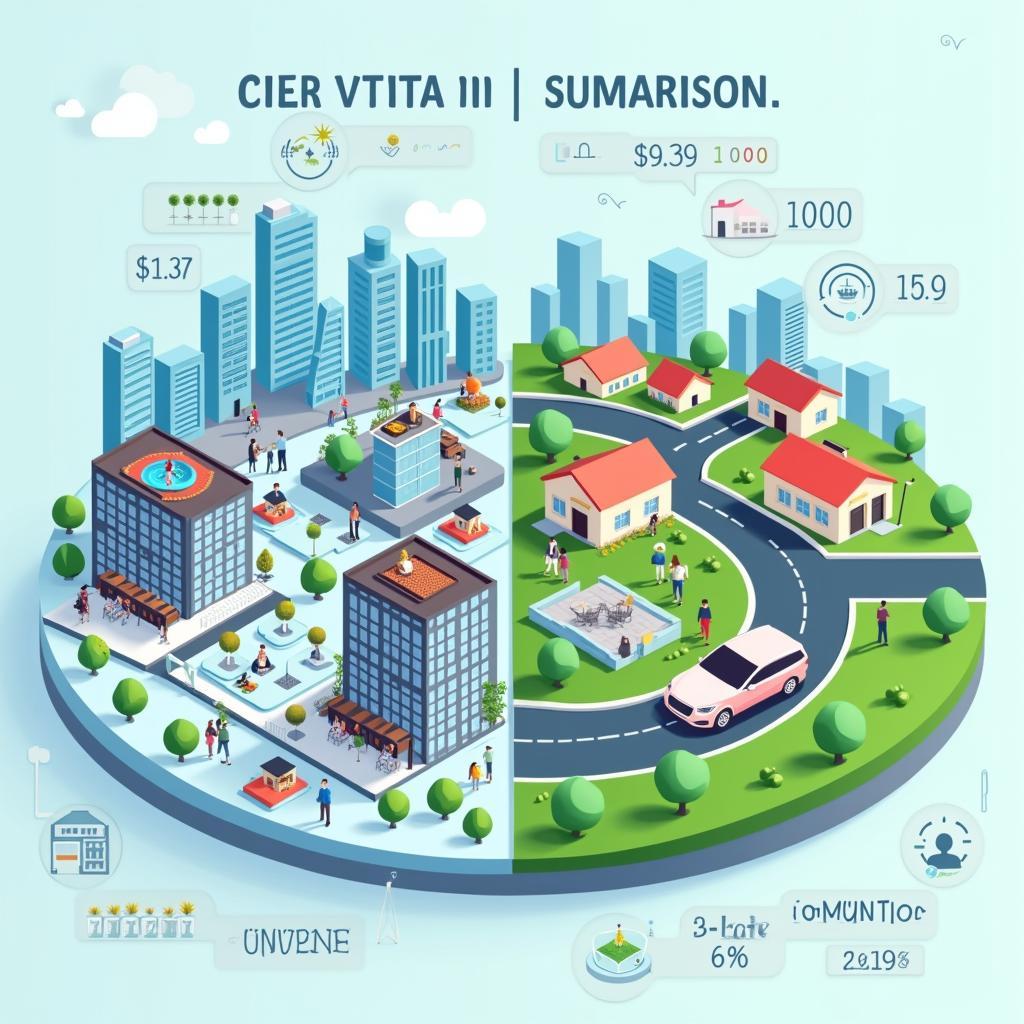 So sánh cuộc sống chung cư đô thị và nhà ở ngoại ô trong IELTS Speaking
Theme 3: Environment and Sustainability
Question 5: Do you think environmental factors will become more important in people’s decisions about where to live?
🎯 Phân tích câu hỏi:
- Dạng: Future prediction + Opinion về environmental consciousness
- Key words: environmental factors, more important, decisions
- Cách tiếp cận: Current situation → Trends suggesting change → Supporting evidence → Potential obstacles → Balanced conclusion
📝 Sample Answer – Band 7-8:
“Yes, I definitely think environmental factors will play a bigger role in housing decisions in the future. We’re already seeing this trend beginning.
Currently, more people are becoming aware of climate change and environmental issues. Natural disasters like floods and wildfires are making people think more carefully about where they live. For example, coastal areas are becoming riskier due to rising sea levels, and extremely hot cities might become less attractive.
Air quality is another growing concern. Many people in polluted cities are considering moving to places with cleaner air for health reasons. There’s also increasing interest in sustainable housing, like homes with solar panels and energy-efficient designs.
However, I think environmental concerns will mainly influence people who can afford to be selective. For many people, job opportunities and affordability will still be the primary factors. But overall, as environmental problems become more severe and people become more conscious, I believe it will definitely be a more significant factor than it is today.”
Phân tích:
- Structure: Clear progression: Current awareness → Specific examples → Limitations → Conclusion
- Vocabulary: Good range (climate change, natural disasters, sustainable housing, energy-efficient)
- Tại sao Band 7-8: Addresses question thoroughly với relevant examples, balanced view acknowledging practical limitations
📝 Sample Answer – Band 8.5-9:
“I’d argue this is not just likely but inevitable, though the manifestation of this trend will be more complex than simple environmental consciousness.
We’re already witnessing the early stages of what we might call climate-driven migration, though it’s not always explicitly framed that way. Extreme weather events – increasingly frequent heatwaves, wildfires, hurricanes, and flooding – are making certain areas demonstrably less habitable. This isn’t speculative – we have data showing depreciated property values in high-risk flood zones and wildfire-prone areas of California and Australia. Insurance companies are already factoring climate risk into premiums, which will inevitably influence affordability and therefore residential patterns.
Beyond disaster risk, there’s the quality-of-life dimension. Air quality has become a decisive factor for families with young children, particularly in rapidly industrializing nations. We’ve seen substantial internal migration in China, for instance, where affluent families relocate specifically to escape urban pollution. Access to green spaces and proximity to nature are increasingly valued amenities, especially post-pandemic when people realized the psychological toll of being confined in purely built environments.
The sustainability movement is also gaining traction. There’s growing interest in eco-communities, net-zero homes, and car-free neighborhoods – these were niche preferences a decade ago but are increasingly mainstream, particularly among younger homebuyers.
However, we need to acknowledge the socioeconomic divide here. Environmental considerations remain somewhat privileged concerns – if you’re struggling financially, you’re constrained by affordability rather than guided by environmental ideals. We might see a situation where environmental factors widen existing inequalities, with wealthy people able to insulate themselves from environmental degradation while lower-income populations are disproportionately exposed to climate impacts.
Ultimately, I think environmental factors will transition from being ‘nice-to-have’ considerations to ‘must-have’ criteria, but this transition will be uneven across socioeconomic strata and geographic regions. Governments could accelerate or mitigate this through policy interventions – investing in climate resilience in vulnerable areas, incentivizing sustainable development, and ensuring that environmental quality doesn’t become yet another axis of inequality.”
Phân tích:
- Structure: Exceptional depth: Inevitability argument → Evidence (disaster risk, quality of life, sustainability) → Socioeconomic limitations → Policy implications. Shows expert-level analysis
- Vocabulary: Highly sophisticated (manifestation, climate-driven migration, explicitly framed, depreciated property values, decisive factor, insulate themselves, disproportionately exposed, uneven across socioeconomic strata)
- Grammar: Full native-level range with perfect control of complex structures
- Critical Thinking: Multi-dimensional analysis covering environment, economics, social justice, policy. Acknowledges complexity and inequality. Shows real-world awareness
💡 Key Language Features:
- Strong argument structure: “I’d argue this is not just likely but inevitable” – confident academic stance
- Evidence-based reasoning: References data, insurance trends, migration patterns – credible argumentation
- Nuanced language: “somewhat privileged concerns”, “transition will be uneven” – sophisticated understanding of complexity
- Policy awareness: Discusses government role – shows broader societal thinking beyond individual level
Question 6: What can governments do to make cities more livable?
🎯 Phân tích câu hỏi:
- Dạng: Problem-solution (policy recommendations)
- Key words: governments, cities, more livable
- Cách tiếp cận: Identify key challenges → Specific solutions with examples → Potential challenges → Prioritization
📝 Sample Answer – Band 7-8:
“There are several important measures governments can take to improve urban livability.
First, they should invest heavily in public transportation. Good metro systems and bus networks reduce traffic congestion and pollution while making cities more accessible. Cities like Singapore and Tokyo are good examples of this.
Second, creating more green spaces is essential. Parks and urban forests improve air quality, provide recreational areas, and enhance mental health. Cities like Copenhagen have done this very successfully by integrating nature into urban planning.
Third, affordable housing needs to be a priority. Many cities are becoming unaffordable for average workers, which creates inequality and social problems. Governments could provide subsidies or regulate property markets to keep housing accessible.
They should also focus on sustainable development, encouraging buildings with better energy efficiency and promoting renewable energy sources.
Finally, making cities pedestrian and bicycle-friendly by creating safe walking paths and bike lanes would reduce car dependency and create healthier communities.
Implementation is challenging because it requires significant investment and long-term planning, but these measures would significantly improve quality of life in cities.”
Phán tích:
- Structure: Multiple solutions organized thematically with examples
- Vocabulary: Good range (invest heavily, traffic congestion, integrate, subsidies, pedestrian-friendly)
- Tại sao Band 7-8: Comprehensive response với multiple relevant solutions, specific city examples, acknowledgment of implementation challenges
📝 Sample Answer – Band 8.5-9:
“This is a multifaceted challenge that requires integrated policy approaches rather than isolated interventions.
Fundamentally, I think the starting point is comprehensive urban planning that prioritizes human wellbeing over purely economic metrics. This means moving away from the car-centric development model that’s dominated the 20th century. Cities like Copenhagen and Amsterdam have demonstrated that prioritizing cycling infrastructure, pedestrian zones, and efficient public transit not only reduces emissions but creates more vibrant, socially connected urban spaces. This requires bold political will to reclaim road space from vehicles, which often faces pushback from certain constituencies.
Green infrastructure should be systematically integrated rather than treated as an afterthought. We’re talking about mandating green roofs, creating urban forest corridors, and ensuring equitable distribution of parks so that all neighborhoods, not just affluent ones, have access to nature. The ecosystem services these provide – air purification, urban cooling, stormwater management – have tangible economic value beyond their aesthetic and recreational benefits.
The affordable housing crisis demands innovative solutions beyond traditional approaches. This might include inclusionary zoning policies, community land trusts, or Vienna’s model of high-quality social housing that destigmatizes public housing by making it attractive to mixed-income residents. The key is preventing complete market dominance that prices out essential workers, creating hollowed-out cities that lack socioeconomic diversity.
Regulatory frameworks around building standards need tightening – mandating energy efficiency, renewable energy integration, and climate-resilient design as default rather than optional. Retrofitting existing building stock is equally important; many cities’ environmental impact comes from aging infrastructure.
I’d also argue for participatory urban planning – actually involving residents in decision-making rather than top-down approaches. This fosters community ownership and ensures that improvements address actual resident needs rather than technocratic assumptions.
Critically, all of this requires substantial public investment, which means reprioritizing budgets and possibly implementing progressive taxation or land value capture mechanisms to fund urban improvements without disproportionately burdening lower-income residents.
The challenge, of course, is that vested interests – real estate developers, automotive industries, incumbent infrastructure – often resist such changes. Effective implementation requires political courage, long-term vision beyond electoral cycles, and public support built through education and demonstration projects that show tangible benefits.”
Phân tích:
- Structure: Exceptionally sophisticated: Foundational principle → Specific domains (transport, green space, housing, building standards, participation) → Funding mechanisms → Implementation challenges. Comprehensive policy analysis
- Vocabulary: Expert-level (multifaceted, integrated policy approaches, car-centric development model, ecosystem services, inclusionary zoning, destigmatizes, land value capture mechanisms, vested interests)
- Grammar: Native-level complexity throughout with perfect control
- Critical Thinking: Shows policy expertise – references specific models (Vienna, Copenhagen), understands political economy, considers stakeholder resistance, addresses funding and implementation challenges. Goes far beyond surface-level suggestions
💡 Key Language Features:
- Policy-specific language: “inclusionary zoning”, “land value capture”, “participatory urban planning” – shows specialized knowledge
- Cause-effect reasoning: “This requires X… which often faces Y” – sophisticated logical connections
- Comparative examples: References Vienna, Copenhagen, Amsterdam – evidence-based argumentation
- Acknowledgment of complexity: “The challenge, of course” – shows awareness that solutions aren’t simple
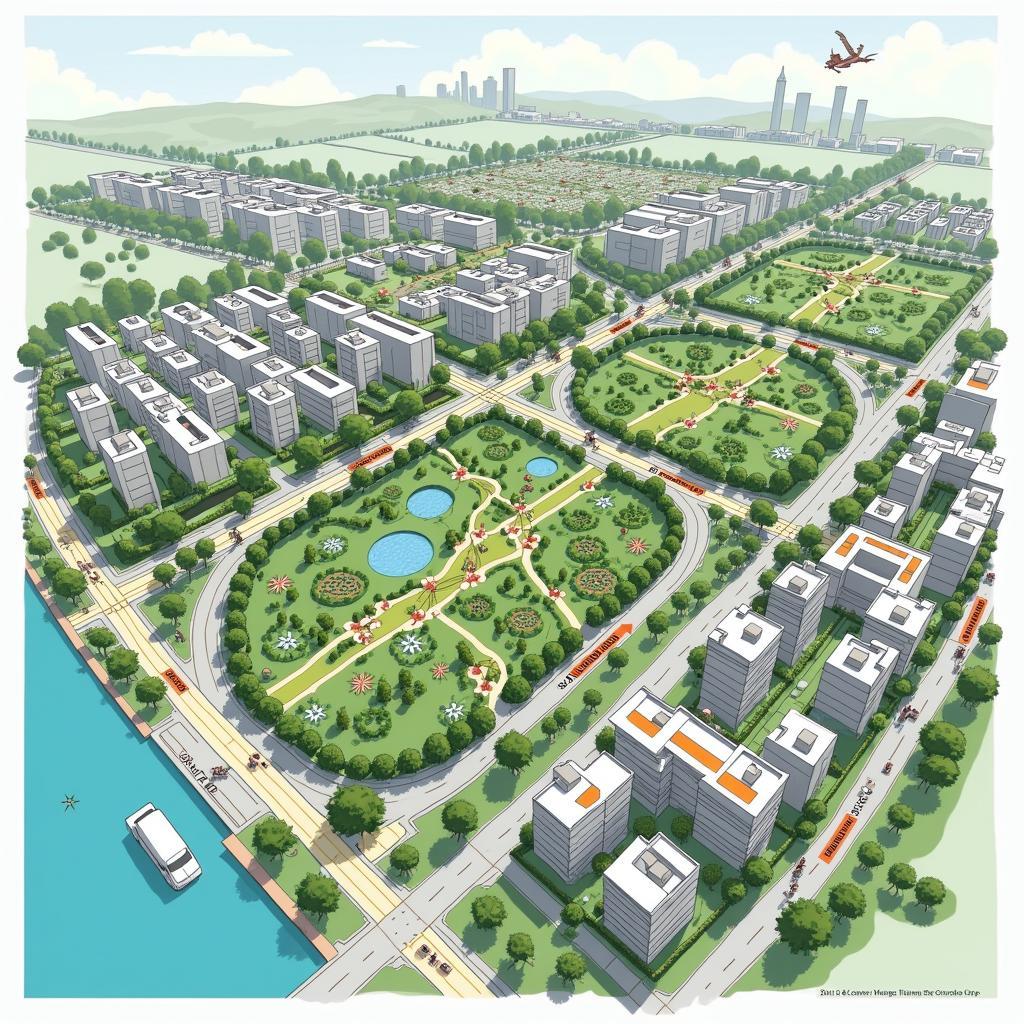 Quy hoạch đô thị bền vững và đáng sống cho chủ đề IELTS Speaking
Từ vựng và cụm từ quan trọng
Topic-Specific Vocabulary
| Từ vựng/Cụm từ | Loại từ | Phiên âm | Nghĩa tiếng Việt | Ví dụ | Collocation |
|---|---|---|---|---|---|
| settle down | phrasal verb | /ˈsetl daʊn/ | định cư, ổn định cuộc sống | I’d like to settle down in a coastal town after retirement. | settle down in/somewhere, settle down with someone |
| temperate climate | noun phrase | /ˈtempərət ˈklaɪmət/ | khí hậu ôn hòa | New Zealand has a temperate climate with mild winters. | enjoy/prefer/have a temperate climate |
| urban migration | noun phrase | /ˈɜːbən maɪˈɡreɪʃn/ | di cư từ nông thôn ra thành thị | Urban migration has accelerated in developing countries. | massive/rapid/continuing urban migration |
| infrastructure | noun | /ˈɪnfrəstrʌktʃə(r)/ | cơ sở hạ tầng | The city has well-developed infrastructure. | develop/improve/invest in infrastructure, robust/adequate infrastructure |
| cost of living | noun phrase | /kɒst əv ˈlɪvɪŋ/ | chi phí sinh hoạt | The cost of living in London is extremely high. | high/low/rising cost of living, afford the cost of living |
| sense of community | noun phrase | /sens əv kəˈmjuːnəti/ | tinh thần cộng đồng | Small towns often have a strong sense of community. | strong/real/genuine sense of community, foster/create a sense of community |
| quality of life | noun phrase | /ˈkwɒləti əv laɪf/ | chất lượng cuộc sống | Good healthcare improves quality of life. | high/improved/better quality of life, enhance/improve quality of life |
| work-life balance | noun phrase | /wɜːk laɪf ˈbæləns/ | cân bằng công việc và cuộc sống | The city offers excellent work-life balance. | achieve/maintain/improve work-life balance, good/healthy work-life balance |
| gentrification | noun | /ˌdʒentrif ɪˈkeɪʃn/ | sự quý tộc hóa khu vực (khu nghèo thành giàu) | Gentrification has pushed out long-time residents. | rapid/ongoing gentrification, gentrification of neighborhoods |
| sustainability | noun | /səˌsteɪnəˈbɪləti/ | tính bền vững | The government prioritizes environmental sustainability. | environmental/economic sustainability, promote/ensure sustainability |
| walkability | noun | /ˌwɔːkəˈbɪləti/ | khả năng đi bộ thuận tiện | The neighborhood’s walkability makes it very attractive. | excellent/poor walkability, improve/enhance walkability |
| affordable housing | noun phrase | /əˈfɔːdəbl ˈhaʊzɪŋ/ | nhà ở giá phải chăng | The city faces a crisis in affordable housing. | lack of/shortage of affordable housing, provide/build affordable housing |
| property prices | noun phrase | /ˈprɒpəti ˈpraɪsɪz/ | giá bất động sản | Property prices have skyrocketed in recent years. | soaring/rising/falling property prices, property prices increase/decline |
| public amenities | noun phrase | /ˈpʌblɪk əˈmiːnətiz/ | tiện ích công cộng | The area lacks basic public amenities. | access to/availability of public amenities, adequate/excellent public amenities |
| residential area | noun phrase | /ˌrezɪˈdenʃl ˈeəriə/ | khu dân cư | It’s a quiet residential area away from the city center. | peaceful/busy/upscale residential area, live in a residential area |
| metropolitan area | noun phrase | /ˌmetrəˈpɒlɪtən ˈeəriə/ | khu vực đô thị lớn | The metropolitan area has a population of 5 million. | greater metropolitan area, live/work in the metropolitan area |
| commute | noun/verb | /kəˈmjuːt/ | đi lại (từ nhà đến nơi làm) | My daily commute takes 45 minutes. | long/short/daily commute, commute to work, commute time |
| urban sprawl | noun phrase | /ˈɜːbən sprɔːl/ | sự phát triển tràn lan của đô thị | Urban sprawl has consumed farmland around the city. | unchecked/rampant urban sprawl, combat/prevent urban sprawl |
| overcrowding | noun | /ˌəʊvəˈkraʊdɪŋ/ | sự quá đông đúc | Overcrowding is a serious problem in many Asian cities. | severe/increasing overcrowding, reduce/alleviate overcrowding |
| green spaces | noun phrase | /ɡriːn ˈspeɪsɪz/ | không gian xanh | The city is investing in more green spaces. | access to/lack of green spaces, create/preserve green spaces |
Idiomatic Expressions & Advanced Phrases
| Cụm từ | Nghĩa | Ví dụ sử dụng | Band điểm |
|---|---|---|---|
| strike a balance | cân bằng hoàn hảo | The city strikes a balance between modernity and tradition. | 7.5-9 |
| have your cake and eat it too | có được cả hai thứ tốt cùng lúc | Remote work lets you have your cake and eat it too – city salary and rural peace. | 8-9 |
| be drawn to | bị thu hút bởi | I’ve always been drawn to places near the ocean. | 7.5-8 |
| settle into | làm quen, thích nghi với | It took me a while to settle into life in the countryside. | 7-8 |
| a stone’s throw from | rất gần (khoảng cách ngắn) | The apartment is just a stone’s throw from the beach. | 7.5-8 |
| off the beaten track | xa xôi, hẻo lánh, ít người biết đến | I prefer places that are off the beaten track. | 8-9 |
| the rat race | cuộc đua chuột (công việc căng thẳng, cạnh tranh) | I want to escape the rat race and live somewhere peaceful. | 8-9 |
| put down roots | định cư lâu dài, ổn định | After years of moving, I’m ready to put down roots. | 7.5-8 |
| a far cry from | rất khác biệt so với | Living in the countryside is a far cry from city life. | 8-9 |
| make ends meet | kiếm đủ sống | In expensive cities, it’s hard to make ends meet. | 7-8 |
| the middle of nowhere | vùng hẻo lánh, xa xôi | The house is beautiful but it’s in the middle of nowhere. | 7-8 |
| up and coming | đang phát triển, đầy tiềm năng | It’s an up and coming neighborhood with lots of new cafes. | 7.5-8 |
Discourse Markers (Từ Nối Ý Trong Speaking)
Để bắt đầu câu trả lời:
- 📝 Well,… – Sử dụng khi cần một chút thời gian suy nghĩ hoặc khi chuyển sang topic mới
- 📝 Actually,… – Khi đưa ra góc nhìn khác hoặc correct một assumption
- 📝 To be honest,… – Khi nói thật, đưa ra honest opinion
- 📝 I’d say that… – Cách scholarly để đưa ra quan điểm
- 📝 From my perspective,… – Nhấn mạnh đây là personal viewpoint
- 📝 Ideally,… – Khi nói về tình huống lý tưởng
Để bổ sung ý:
- 📝 On top of that,… – Thêm vào đó, bổ sung thêm point
- 📝 What’s more,… – Hơn nữa (formal hơn “also”)
- 📝 Not to mention… – Chưa kể đến (emphasize additional important point)
- 📝 Plus,… – Thêm nữa (informal nhưng natural)
- 📝 Beyond that,… – Ngoài ra còn
- 📝 Additionally,… – Thêm vào đó (formal)
Để đưa ra quan điểm cân bằng:
- 📝 On the one hand,… On the other hand,… – Một mặt… mặt khác…
- 📝 While it’s true that…, we also need to consider… – Mặc dù đúng là…, chúng ta cũng cần xem xét…
- 📝 That said,… – Tuy nhiên, dù vậy (để present contrasting view)
- 📝 Having said that,… – Sau khi nói điều đó (transition to different perspective)
Để kết luận:
- 📝 All in all,… – Tóm lại, nhìn chung
- 📝 At the end of the day,… – Cuối cùng thì (what matters most)
- 📝 Ultimately,… – Cuối cùng, về cơ bản
- 📝 In the long run,… – Về lâu dài
- 📝 All things considered,… – Xét tất cả mọi khía cạnh
Để clarify hoặc elaborate:
- 📝 What I mean is… – Ý tôi là…
- 📝 To put it another way,… – Nói cách khác
- 📝 In other words,… – Nói cách khác
- 📝 Let me elaborate on that… – Để tôi giải thích rõ hơn
Grammatical Structures Ấn Tượng
1. Conditional Sentences (Câu điều kiện):
-
Mixed conditional: Kết hợp past và present/future
- If I had moved to the countryside earlier, I would be much happier now.
- If cities were more affordable, more young people would be able to settle down there.
-
Inversion for emphasis: Đảo ngữ để nhấn mạnh (formal, impressive)
- Were I to relocate, I would choose somewhere with better air quality.
- Should property prices continue rising, many will be priced out of the market.
- Had I known about the noise pollution, I wouldn’t have moved here.
2. Relative Clauses (Mệnh đề quan hệ):
-
Non-defining relative clauses: Thêm thông tin không thiết yếu (dùng dấu phẩy)
- Wellington, which is the capital of New Zealand, has a vibrant cultural scene.
- The Cotswolds, where many artists live, offers a peaceful lifestyle.
-
Reduced relative clauses: Rút gọn mệnh đề quan hệ
- People living in cities often face higher stress levels. (thay vì “who live”)
- Factors affecting housing choices include affordability and location. (thay vì “that affect”)
3. Passive Voice (Câu bị động):
-
Impersonal passive for opinions: Diễn đạt quan điểm chung
- It is widely believed that urban living offers more opportunities.
- It is often said that money can’t buy happiness, but it can certainly buy a better location.
- Climate change is thought to be a major factor in future migration patterns.
-
Passive for describing processes:
- Green spaces should be integrated into urban planning.
- Affordable housing needs to be prioritized by governments.
4. Cleft Sentences (Câu chẻ):
-
What-clauses for emphasis: Nhấn mạnh điều quan trọng
- What I find most appealing about coastal living is the sense of tranquility.
- What really matters to me is quality of life rather than property size.
-
It-clauses:
- It’s the sense of community that I value most in my neighborhood.
- It was the affordable cost of living that initially attracted me to this city.
5. Nominalization (Danh từ hóa):
Chuyển động từ/tính từ thành danh từ để tăng tính academic:
- develop → development: “The development of public transport is crucial.”
- migrate → migration: “Urban migration has accelerated.”
- sustain → sustainability: “Sustainability should be a priority.”
- aware → awareness: “Environmental awareness is growing.”
6. Advanced Sentence Starters:
-
Given that… – Cho rằng, xét rằng
- Given that property prices keep rising, many young people can’t afford to buy homes.
-
Provided that… – Với điều kiện là
- I would consider moving abroad, provided that I could secure a good job.
-
Despite the fact that… – Mặc dù sự thật là
- Despite the fact that cities are crowded, many people still prefer urban living.
Chiến Lược Tổng Thể Để Đạt Band 8-9
Với hơn 20 năm kinh nghiệm chấm thi, tôi nhận thấy những yếu tố sau tạo nên sự khác biệt giữa Band 7 và Band 8-9:
1. Vocabulary Strategy
Tránh:
- Repetition: Nói “good” 5 lần trong một câu trả lời
- Generic words: nice, beautiful, interesting
- Vietnamese thinking patterns: “suitable for me” (nên dùng “suits my needs”)
Nên:
- Paraphrase liên tục: quality of life → living standards → wellbeing
- Topic-specific terms: không chỉ “pollution” mà “air quality index”, “environmental degradation”
- Natural collocations: không phải “make balance” mà “strike a balance”
2. Grammar Complexity
Đa dạng cấu trúc:
- Simple sentences để clarify points
- Complex sentences để show sophistication
- Mix active và passive
- Conditional sentences cho hypothetical situations
- Relative clauses để add detail
Tránh:
- Chỉ dùng simple sentences
- Grammar “show-off” không tự nhiên
- Template phrases cứng nhắc
3. Critical Thinking
Band 6-7 thinking:
- “Cities are good because they have jobs and shops.”
- Surface-level reasons
Band 8-9 thinking:
- “The urban-rural dichotomy is becoming increasingly nuanced with remote work challenging traditional assumptions about the relationship between residence and employment. While cities historically concentrated opportunities, we’re witnessing a potential paradigm shift…”
- Multi-dimensional analysis
- Acknowledges complexity
- Considers different stakeholders
4. Fluency Tips
Tránh silence:
- Sử dụng discourse markers khi suy nghĩ: “Well, that’s an interesting question…”
- Paraphrase câu hỏi để gain thinking time: “You’re asking about environmental factors… I’d say…”
Natural hesitation là OK:
- “Let me think about that for a moment…”
- “That’s quite a complex issue…”
- Native speakers cũng hesitate, điều quan trọng là cách bạn fill pauses
5. Common Mistakes của học viên Việt Nam
❌ “I think” quá nhiều lần
✅ Thay bằng: I’d say, From my perspective, In my view, I believe
❌ “Maybe” để bắt đầu mọi câu (thiếu confidence)
✅ Dùng: Perhaps, Potentially, It’s possible that (cân nhắc khi nào nên decisive vs tentative)
❌ Trả lời quá ngắn trong Part 3
✅ Aim for 4-6 câu mỗi answer trong Part 3
❌ Không có examples
✅ Luôn support ideas với “For instance…”, “Take… for example”
❌ Học thuộc template và áp dụng máy móc
✅ Hiểu structures và adapt linh hoạt theo context
6. Lộ Trình Chuẩn Bị
4-6 tuần trước thi:
Tuần 1-2: Foundation
- Học vocabulary theo themes (10-15 từ/ngày)
- Practice pronunciation với shadowing
- Record yourself và self-assess
Tuần 3-4: Practice
- Practice Part 2 với timer (1 phút prep, 2 phút nói)
- Làm quen với Part 3 abstract questions
- Practice với partner hoặc tutor
Tuần 5-6: Refinement
- Mock tests với real timing
- Phân tích recordings của mình
- Focus vào weak areas (vocabulary/grammar/fluency)
1 tuần cuối:
- Review vocabulary chính
- Practice các topics phổ biến
- Relax và maintain confidence
7. Trong Phòng Thi
Dos:
- ✅ Make eye contact với examiner
- ✅ Smile và relaxed body language
- ✅ Speak at natural pace (không quá nhanh)
- ✅ Self-correct nếu nhận ra lỗi: “Sorry, I meant to say…”
- ✅ Ask for clarification nếu không hiểu: “Could you please repeat the question?”
Don’ts:
- ❌ Memorized answers (examiners recognize này immediately)
- ❌ Quá formal/robotic
- ❌ Panic khi không biết từ (paraphrase instead)
- ❌ Give up mid-answer
- ❌ Argue với examiner
Kết Luận
Chủ đề “Describe a place where you would like to live in the future” là một trong những đề tài versatile và frequently tested trong IELTS Speaking. Thành công với chủ đề này phụ thuộc vào:
- Specificity: Đừng nói general “a beautiful place” – describe cụ thể location, features, lifestyle
- Personal connection: Explain WHY địa điểm này meaningful với bạn, không chỉ list features
- Realistic planning: Show bạn đã think through practical aspects (timing, finances, visa)
- Broader awareness: Trong Part 3, demonstrate understanding của housing trends, urbanization, environmental issues
Nhớ rằng IELTS Speaking không test knowledge của bạn về geography hay real estate – nó test communication ability. Ngay cả khi bạn chọn một địa điểm fictional hoặc somewhat unrealistic, miễn là bạn articulate ideas clearly, use appropriate vocabulary và grammar, và demonstrate critical thinking, bạn vẫn có thể achieve high band.
Final tip từ Examiner: The best answers sound like natural conversations, not rehearsed speeches. Be yourself, be genuine, và đừng ngại show personality của bạn. Good luck với kỳ thi IELTS Speaking của bạn!