
Mở bài
Chủ đề “Describe A Recent Day Trip You Enjoyed” là một trong những đề bài phổ biến và thực tế nhất trong IELTS Speaking Part 2. Đây là dạng câu hỏi yêu cầu thí sinh kể về một chuyến đi trong ngày (không qua đêm) mà bạn đã thích thú, từ đó đánh giá khả năng diễn đạt kinh nghiệm cá nhân, miêu tả địa điểm, cảm xúc và sử dụng thì quá khứ một cách tự nhiên.
Theo thống kê từ các đề thi thực tế, chủ đề về travel và day trips xuất hiện với tần suất cao trong các kỳ thi IELTS từ 2020 đến 2024, đặc biệt là trong giai đoạn sau đại dịch khi du lịch trở lại mạnh mẽ. Dự đoán khả năng xuất hiện trong tương lai vẫn ở mức Cao, vì đây là chủ đề gần gũi với đời sống thực tế và cho phép examiner đánh giá toàn diện các kỹ năng của thí sinh.
Trong bài viết này, bạn sẽ học được:
- Câu hỏi thường gặp trong cả 3 Part liên quan đến chuyến đi, du lịch và trải nghiệm
- Bài mẫu chi tiết theo nhiều band điểm từ 6-7, 7.5-8 đến 8.5-9 với phân tích cụ thể
- Từ vựng và cụm từ ăn điểm về travel, experiences và feelings
- Chiến lược trả lời hiệu quả từ góc nhìn của một IELTS Examiner
- Lời khuyên thực tế để tránh những lỗi phổ biến của học viên Việt Nam
IELTS Speaking Part 1: Introduction and Interview
Tổng Quan Về Part 1
Part 1 của IELTS Speaking kéo dài 4-5 phút với các câu hỏi ngắn về cuộc sống hàng ngày, sở thích, công việc/học tập và các chủ đề quen thuộc. Đây là phần “warm-up” để bạn làm quen với examiner và môi trường thi.
Chiến lược quan trọng:
- Trả lời trực tiếp câu hỏi ngay trong câu đầu tiên
- Mở rộng với 1-2 câu giải thích hoặc ví dụ cụ thể
- Tránh trả lời quá ngắn (Yes/No) hoặc quá dài (30 giây)
- Sử dụng từ vựng tự nhiên, không cần quá phức tạp
Lỗi thường gặp của học viên Việt Nam:
- Trả lời quá ngắn gọn, chỉ 1 câu đơn
- Dùng từ vựng cơ bản lặp đi lặp lại (good, nice, beautiful)
- Thiếu ví dụ cụ thể từ kinh nghiệm bản thân
- Ngại mở rộng ý vì sợ sai ngữ pháp
Các Câu Hỏi Thường Gặp
Question 1: Do you like going on day trips?
Question 2: What kind of places do you usually visit on day trips?
Question 3: Who do you usually go with on day trips?
Question 4: How often do you go on day trips?
Question 5: Do you prefer day trips or longer holidays?
Question 6: What do you usually bring with you on a day trip?
Question 7: Are day trips popular in your country?
Question 8: What was the last day trip you went on?
Phân Tích và Gợi Ý Trả Lời Chi Tiết
Question: Do you like going on day trips?
🎯 Cách tiếp cận:
- Trả lời Yes/No rõ ràng ngay câu đầu
- Đưa ra lý do tại sao thích hoặc không thích
- Thêm một ví dụ ngắn về loại day trip bạn thường đi
📝 Sample Answer – Band 6-7:
Yes, I really like going on day trips because they give me a break from my daily routine. I usually visit places near my city like beaches or mountains. It’s a nice way to relax without spending too much time or money.
Phân tích:
- Điểm mạnh: Trả lời trực tiếp câu hỏi, có lý do cơ bản, đưa ví dụ cụ thể về loại địa điểm
- Hạn chế: Từ vựng còn đơn giản (nice, really like), thiếu chi tiết về cảm xúc hoặc trải nghiệm
- Tại sao Band 6-7: Câu trả lời đủ độ dài và mạch lạc, nhưng vocabulary và grammar structure còn basic
📝 Sample Answer – Band 8-9:
Absolutely! I’m actually quite fond of day trips because they offer the perfect escape from the hustle and bustle of city life without requiring extensive planning. I particularly enjoy spontaneous excursions to nearby coastal areas or scenic mountain trails, where I can recharge my batteries and clear my head. What I appreciate most is the flexibility – I can leave early in the morning and be back home by evening, which means I don’t have to worry about accommodation or taking time off work.
Phân tích:
- Điểm mạnh:
- Vocabulary đa dạng và natural: “fond of”, “perfect escape”, “hustle and bustle”, “recharge my batteries”
- Cấu trúc câu phức tạp với relative clause (where I can…) và dash để thêm thông tin
- Giải thích chi tiết về lợi ích của day trips (flexibility, no accommodation needed)
- Thể hiện được personal preference rõ ràng
- Tại sao Band 8-9: Fluency tốt với nhiều ideas liên kết, lexical resource sophisticated, grammar structures đa dạng, pronunciation tự nhiên
💡 Key Vocabulary & Expressions:
- be fond of something: thích thú với điều gì đó (formal hơn “like”)
- perfect escape: sự thoát ly hoàn hảo
- hustle and bustle: sự hối hả, náo nhiệt
- spontaneous excursions: những chuyến đi tự phát
- recharge one’s batteries: nạp lại năng lượng
Question: What kind of places do you usually visit on day trips?
🎯 Cách tiếp cận:
- Nêu 1-2 loại địa điểm cụ thể
- Giải thích tại sao bạn chọn những địa điểm này
- Có thể so sánh các loại địa điểm khác nhau
📝 Sample Answer – Band 6-7:
I usually visit natural places like beaches or national parks. I prefer these places because they are peaceful and I can enjoy fresh air. Sometimes I also go to historical sites to learn about the culture and history of my country.
Phân tích:
- Điểm mạnh: Nêu rõ 2 loại địa điểm (natural places và historical sites), có lý do đơn giản
- Hạn chế: Từ vựng đơn giản (peaceful, fresh air), thiếu details về specific experiences
- Tại sao Band 6-7: Adequate vocabulary nhưng chưa sophisticated, ideas đủ nhưng chưa developed fully
📝 Sample Answer – Band 8-9:
I’m definitely drawn to nature-based destinations – places like coastal reserves, hiking trails in the mountains, or botanical gardens. There’s something incredibly therapeutic about being surrounded by greenery and natural landscapes. That said, I also have a soft spot for cultural sites, particularly ancient temples or heritage villages, where I can immerse myself in the local history and traditions. I find that these day trips not only provide physical refreshment but also mental stimulation, which is exactly what I need after a hectic week.
Phân tích:
- Điểm mạnh:
- Vocabulary range rộng: “drawn to”, “therapeutic”, “soft spot for”, “immerse myself in”
- Đưa ra nhiều loại địa điểm cụ thể (coastal reserves, hiking trails, botanical gardens)
- Giải thích sâu sắc về benefits (physical refreshment + mental stimulation)
- Sử dụng discourse marker “That said” để balance ideas
- Tại sao Band 8-9: Demonstrates flexibility in using language, sophisticated vocabulary, complex sentence structures với relative clauses và parallel structures
💡 Key Vocabulary & Expressions:
- be drawn to: bị thu hút bởi
- nature-based destinations: các điểm đến gắn liền với thiên nhiên
- therapeutic: có tác dụng chữa lành, thư giãn
- have a soft spot for: có cảm tình đặc biệt với
- immerse oneself in: đắm chìm, hòa mình vào
Question: Who do you usually go with on day trips?
🎯 Cách tiếp cận:
- Nêu rõ người đi cùng (friends/family/alone)
- Giải thích lý do chọn đi cùng người đó
- Có thể so sánh experiences khác nhau khi đi với người khác nhau
📝 Sample Answer – Band 6-7:
I usually go on day trips with my close friends because we have similar interests. We enjoy visiting the same places and taking photos together. Sometimes I go with my family on special occasions like holidays or birthdays.
Phân tích:
- Điểm mạnh: Trả lời rõ ràng (friends là main choice), có lý do (similar interests), mention family trong special cases
- Hạn chế: Vocabulary basic (close friends, enjoy, special occasions), thiếu examples cụ thể về activities
- Tại sao Band 6-7: Clear communication nhưng lacks detail và sophisticated language
📝 Sample Answer – Band 8-9:
It really depends on the type of trip, actually. For more adventurous outings like hiking or rock climbing, I tend to go with my close-knit group of friends who share my passion for outdoor activities. We have this unspoken understanding about pacing and what we find enjoyable. However, for more leisurely trips to gardens or cultural sites, I prefer going with my family – it’s a wonderful way to bond and create shared memories. Occasionally, I also enjoy solo trips when I need some me-time to reflect and disconnect from social obligations.
Phân tích:
- Điểm mạnh:
- Shows flexibility và nuance: “It depends on the type”
- Vocabulary sophisticated: “close-knit group”, “unspoken understanding”, “leisurely trips”, “bond”
- Đưa ra 3 scenarios khác nhau (friends/family/solo) với reasons cụ thể cho từng loại
- Grammar range: relative clauses, infinitive of purpose (to reflect, to disconnect)
- Tại sao Band 8-9: Demonstrates ability to discuss topic from multiple angles, precise vocabulary, natural flow
💡 Key Vocabulary & Expressions:
- adventurous outings: những chuyến đi mạo hiểm
- close-knit group: nhóm thân thiết, gắn bó
- unspoken understanding: sự hiểu biết ngầm, không cần nói ra
- leisurely trips: những chuyến đi nhàn nhã, không vội vã
- me-time: thời gian cho bản thân
Tương tự như describe a nature reserve you have visited, những chuyến đi trong ngày thường mang lại cảm giác thư giãn và kết nối với thiên nhiên.
IELTS Speaking Part 2: Long Turn (Cue Card)
Tổng Quan Về Part 2
Part 2 là phần quan trọng nhất của IELTS Speaking, kéo dài 3-4 phút bao gồm 1 phút chuẩn bị và 2-3 phút nói liên tục. Đây là lúc examiner đánh giá khả năng diễn đạt dài hơi, tổ chức ý tưởng và sử dụng ngôn ngữ đa dạng của bạn.
Chiến lược hiệu quả:
- Sử dụng hết 1 phút chuẩn bị: Ghi chú keywords cho mỗi bullet point, không viết câu hoàn chỉnh
- Nói đủ 2 phút: Đây là yêu cầu tối thiểu, nên cố gắng nói đến 2.5-3 phút nếu có thể
- Trả lời đầy đủ tất cả bullet points: Đừng bỏ sót bất kỳ yêu cầu nào trong đề bài
- Sử dụng thì quá khứ nhất quán: Vì đây là chuyến đi đã xảy ra
- Tập trung vào câu “explain”: Đây là phần quan trọng nhất để thể hiện feelings và opinions
Lỗi thường gặp:
- Không dùng hết 1 phút chuẩn bị, vội vàng bắt đầu nói
- Nói dưới 1.5 phút vì thiếu ý tưởng hoặc vocabulary
- Bỏ qua một bullet point nào đó
- Lạc đề, nói về vacation dài ngày thay vì day trip
- Không giải thích rõ why you enjoyed it
Cue Card
Describe a recent day trip you enjoyed
You should say:
- Where you went
- Who you went with
- What you did there
- And explain why you enjoyed this day trip
Phân Tích Đề Bài
Dạng câu hỏi: Describe an experience/event – kể về một trải nghiệm cụ thể trong quá khứ
Thì động từ: Quá khứ đơn và quá khứ tiếp diễn (past simple & past continuous)
Bullet points phải cover:
- Where you went: Nêu rõ địa điểm cụ thể (tên, vị trí, khoảng cách từ nhà bạn)
- Who you went with: Người đi cùng (friends/family/colleagues/alone)
- What you did there: Các hoạt động cụ thể theo trình tự thời gian
- Explain why you enjoyed it: Đây là phần QUAN TRỌNG NHẤT – cần giải thích feelings, reasons, impacts
Câu “explain” quan trọng:
Đây là phần ghi điểm cao nhất vì yêu cầu bạn phân tích, đánh giá và thể hiện cảm xúc. Đừng chỉ nói “it was fun” mà phải giải thích cụ thể: vì sao fun, cảm giác như thế nào, điều gì khiến chuyến đi memorable, impact gì đến bạn sau chuyến đi.
📝 Sample Answer – Band 6-7
Thời lượng: Khoảng 1.5-2 phút
I’d like to talk about a day trip I took to Da Lat last month. It’s a beautiful city in the Central Highlands of Vietnam, about 300 kilometers from where I live.
I went there with three of my close friends from university. We had been planning this trip for a while because all of us needed a break from our busy work schedules.
We left early in the morning, around 6 AM, and arrived at Da Lat around 11 AM. The first thing we did was visit the famous flower gardens. Da Lat is known as the city of flowers, so there were many colorful flowers everywhere. We took lots of photos there. After that, we had lunch at a local restaurant where we tried some special food like grilled rice paper and strawberries, which Da Lat is famous for.
In the afternoon, we visited Xuan Huong Lake and walked around it. The weather was very cool and pleasant, different from the hot weather in my city. We also went to some coffee shops and enjoyed the peaceful atmosphere. Before going home, we bought some fresh vegetables and flowers as souvenirs.
I really enjoyed this day trip for several reasons. First, the weather was perfect – not too hot and not too cold. Second, I had a great time with my friends. We talked a lot and laughed together. It was a nice break from our routine. The scenery was also very beautiful and relaxing. I felt refreshed after this trip and it helped me reduce my stress from work. I think I will definitely go back to Da Lat again in the future.
Phân Tích Band Điểm
| Tiêu chí | Band | Nhận xét |
|---|---|---|
| Fluency & Coherence | 6-7 | Có khả năng nói liên tục khoảng 2 phút, có sử dụng một số linking words (First, Second, After that) nhưng còn cơ bản. Ý tưởng được tổ chức theo sequence nhưng chưa thực sự smooth |
| Lexical Resource | 6-7 | Từ vựng adequate cho chủ đề (flower gardens, peaceful atmosphere, souvenirs) nhưng còn nhiều từ đơn giản (beautiful, nice, great). Có một số collocations nhưng không sophisticated |
| Grammatical Range & Accuracy | 6-7 | Sử dụng đúng thì quá khứ consistently, có một số câu phức (We had been planning, which Da Lat is famous for) nhưng chủ yếu là simple và compound sentences. Ít complex structures |
| Pronunciation | 6-7 | Assumed to be clear và intelligible với một số errors không ảnh hưởng communication |
Điểm mạnh:
- ✅ Trả lời đầy đủ tất cả bullet points trong đề bài
- ✅ Có sequence rõ ràng: morning → lunch → afternoon → evening
- ✅ Đưa ra reasons cụ thể tại sao enjoyed (weather, friends, scenery)
- ✅ Đủ độ dài yêu cầu (khoảng 2 phút)
Hạn chế:
- ⚠️ Vocabulary còn basic và repetitive (beautiful, nice, great)
- ⚠️ Thiếu details về feelings và personal experiences
- ⚠️ Grammar structures không đa dạng, chủ yếu là simple sentences
- ⚠️ Phần “explain” còn superficial, chưa thực sự deep
📝 Sample Answer – Band 7.5-8
Thời lượng: Khoảng 2-2.5 phút
I’d like to share with you a memorable day trip I took to Ba Vi National Park, which is located about 60 kilometers west of Hanoi. This happened just a few weeks ago, and it’s still fresh in my memory.
I went there with a group of five friends – people I’ve known since high school. We’re all nature enthusiasts, and we’d been meaning to explore this place for quite some time, so we finally decided to make it happen on a Sunday.
We set off quite early, around 5:30 AM, to beat the traffic and make the most of our day. The journey itself was quite enjoyable as we caught up with each other and shared stories along the way. When we arrived, we were greeted by the sight of lush green mountains and misty valleys – it was absolutely breathtaking.
Our main activity was trekking up to the summit, which took us about three hours. The trail was challenging in some parts, but the stunning scenery along the way made every step worthwhile. We passed through dense bamboo forests and spotted several interesting bird species. At the top, we were rewarded with a panoramic view of the surrounding countryside, which was simply spectacular.
After descending, we visited a nearby hot spring resort where we soaked our tired muscles in the therapeutic mineral water. It was incredibly rejuvenating. We also tried some local specialties for lunch, including grilled wild boar and fresh spring rolls.
What made this day trip particularly enjoyable was the perfect combination of physical activity and relaxation. The trek pushed me out of my comfort zone physically, but it also gave me a tremendous sense of achievement when we reached the summit. Moreover, spending quality time with my friends in such a serene environment allowed us to strengthen our bonds and create lasting memories. The whole experience was a welcome escape from the hustle and bustle of city life, and I felt completely recharged by the end of the day. It reminded me of how important it is to disconnect from technology and reconnect with nature regularly.
Phân Tích Band Điểm
| Tiêu chí | Band | Nhận xét |
|---|---|---|
| Fluency & Coherence | 7.5-8 | Nói trôi chảy với very few hesitations, linking devices đa dạng (Moreover, What made this…), ý tưởng được develop logically với clear progression |
| Lexical Resource | 7.5-8 | Vocabulary range wide và appropriate (breathtaking, therapeutic, rejuvenating, serene), có nhiều collocations tự nhiên (beat the traffic, catch up with, push out of comfort zone), paraphrasing tốt |
| Grammatical Range & Accuracy | 7.5-8 | Mix of simple và complex structures hiệu quả, sử dụng relative clauses, past perfect (had been meaning to), passive voice (were greeted by, were rewarded with), gerunds. Majority of sentences error-free |
| Pronunciation | 7.5-8 | Assumed to be clear với good control of phonological features, natural intonation |
So Sánh Với Band 6-7
| Khía cạnh | Band 6-7 | Band 7.5-8 |
|---|---|---|
| Vocabulary | “beautiful scenery”, “nice break”, “great time” | “breathtaking scenery”, “welcome escape”, “strengthen our bonds”, “recharged” |
| Grammar | “We left early in the morning” (simple past) | “We set off quite early to beat the traffic and make the most of our day” (infinitive of purpose, phrasal verbs) |
| Ideas | “The weather was perfect and I had a great time with friends” | “The perfect combination of physical activity and relaxation… pushed me out of my comfort zone… tremendous sense of achievement” |
| Details | General description of activities | Specific details (5:30 AM, 60km west, three hours trek, bamboo forests, bird species) |
Đối với những ai quan tâm đến describe a place you visited that exceeded your expectations, Ba Vi National Park chính là một ví dụ điển hình khi phong cảnh thực tế còn đẹp hơn cả những gì tôi tưởng tượng.
📝 Sample Answer – Band 8.5-9
Thời lượng: 2.5-3 phút đầy đủ
I’d like to tell you about a spontaneous day trip I took to Cuc Phuong National Park about a month ago, which turned out to be one of the most enriching experiences I’ve had in quite a while.
The backdrop to this trip was actually quite interesting. It was a spur-of-the-moment decision – I had been feeling rather overwhelmed by work pressures and the relentless pace of urban life, and when a friend suggested we escape to somewhere green for a day, I jumped at the opportunity. We managed to rope in three other friends who were equally eager for an adventure, so there were five of us in total.
The park is situated roughly 120 kilometers south of Hanoi, and what makes it particularly special is that it’s Vietnam’s first national park and houses an incredibly diverse ecosystem. We embarked on our journey at the crack of dawn – around 5 AM to be precise – because we wanted to immerse ourselves in the forest during the golden hours when wildlife is most active.
The experience itself was absolutely transformative. We opted for a guided trek through the ancient forest, which boasts trees that are over 1,000 years old. Our guide was remarkably knowledgeable and passionate about conservation, which really enhanced our appreciation of what we were witnessing. The sheer scale and grandeur of these ancient trees was awe-inspiring – it puts things into perspective when you’re standing next to a living organism that has witnessed centuries of history.
What really struck me was the biodiversity – we encountered several rare species, including the endangered Delacour’s langur, which is endemic to Vietnam. There was this profound moment when we were sitting quietly by a stream, and suddenly a whole family of these primates appeared in the canopy above us. The privileged feeling of witnessing such a rare sight in their natural habitat was truly indescribable.
Beyond the wildlife encounters, we also explored the park’s archaeological caves, which harbor evidence of prehistoric human habitation dating back 7,000 years. It was fascinating to see where ancient civilizations once lived, and it sparked some really interesting discussions among us about human evolution and our relationship with nature.
The reason this day trip resonated so deeply with me goes beyond just the scenic beauty and wildlife. First and foremost, it served as a poignant reminder of how insignificant our daily stresses are in the grand scheme of things. Standing beneath those millennium-old trees really humbled me and helped me recalibrate my priorities. Secondly, it rekindled my passion for environmental conservation – seeing such a fragile ecosystem that teeters on the edge of destruction due to human activity was both heartbreaking and motivating.
What also made it special was the quality of connection I experienced with my friends. In our normal city lives, we’re constantly distracted by phones and schedules, but out there in the forest, we had these uninterrupted conversations about life, dreams, and existential questions – the kind of deep dialogue that’s increasingly rare nowadays.
By the time we returned home that evening, I felt profoundly refreshed – not just physically, but mentally and spiritually as well. It’s made me committed to incorporating more of these nature-based excursions into my routine, perhaps monthly. The trip epitomized what I believe a meaningful day trip should be: challenging enough to push your boundaries, educational enough to broaden your perspective, and restorative enough to nourish your soul.
Phân Tích Band Điểm
| Tiêu chí | Band | Nhận xét |
|---|---|---|
| Fluency & Coherence | 8.5-9 | Speaks fluently với very rare hesitation, sophisticated use của cohesive devices và discourse markers (The backdrop to this trip, Beyond the wildlife encounters, First and foremost), ideas developed fully với excellent progression |
| Lexical Resource | 8.5-9 | Wide vocabulary range với precise và sophisticated lexical items (spur-of-the-moment, relentless pace, biodiversity, teeters on the edge, recalibrate priorities), natural use of idioms và collocations, skillful paraphrasing |
| Grammatical Range & Accuracy | 8.5-9 | Full range of structures used naturally và accurately (past perfect continuous, relative clauses, participle clauses, inversion, cleft sentences), rare errors that don’t impede communication |
| Pronunciation | 8.5-9 | Assumed to have full control of phonological features, natural stress patterns và intonation, easily understood |
Tại Sao Bài Này Xuất Sắc
🎯 Fluency Hoàn Hảo:
Bài nói có độ dài phù hợp (gần 3 phút), không có hesitation đáng kể. Sử dụng linking devices rất tự nhiên và sophisticated như “The backdrop to this trip”, “Beyond the wildlife encounters”, “First and foremost” thay vì các từ nối cơ bản. Ý tưởng được develop đầy đủ với clear beginning, middle, và end.
📚 Vocabulary Tinh Vi:
- “spur-of-the-moment decision” thay vì “sudden decision” – idiomatic và natural hơn
- “relentless pace” thay vì “fast speed” – abstract noun phrase sophisticated
- “teeters on the edge” thay vì “is in danger” – vivid imagery
- “recalibrate my priorities” thay vì “change my thinking” – precise collocation
- “epitomized” thay vì “showed” – academic verb used appropriately
📝 Grammar Đa Dạng:
- Past perfect: “I had been feeling rather overwhelmed” – shows prior action
- Relative clauses: “The park… which houses an incredibly diverse ecosystem” – adds information smoothly
- Participle clauses: “Standing beneath those millennium-old trees” – varies sentence structure
- Cleft sentences: “What really struck me was…” – emphasizes key points
💡 Ideas Sâu Sắc:
Không chỉ describe experience mà còn reflect deeply về impacts: environmental awareness, life perspective, human connection, spiritual nourishment. Shows critical thinking và ability to analyze experience from multiple angles. Discusses both immediate enjoyment và long-term significance of the trip.
Một trải nghiệm tương tự được chia sẻ trong describe a special day you spent with friends, khi những khoảnh khắc đơn giản bên bạn bè lại tạo nên những kỷ niệm sâu sắc nhất.
Follow-up Questions (Rounding Off Questions)
Sau khi bạn hoàn thành phần nói 2 phút, examiner có thể hỏi thêm 1-2 câu ngắn để kết thúc Part 2 trước khi chuyển sang Part 3. Đây là những câu hỏi đơn giản, không cần trả lời quá dài.
Question 1: Would you like to go back to this place again?
Band 6-7 Answer:
Yes, definitely. I really enjoyed my time there and I think there are still more places to explore. Maybe I will go there with different friends next time.
Band 8-9 Answer:
Absolutely, I’d jump at the chance to return. There’s still so much of the park I didn’t get to explore, particularly the botanical garden section, and I’d love to go during a different season to see how the landscape transforms. I’m also keen to take my family there to share this experience with them.
Question 2: How did you feel after the trip?
Band 6-7 Answer:
I felt very relaxed and happy after the trip. All the stress from work was gone and I had more energy to continue with my daily tasks.
Band 8-9 Answer:
I felt remarkably rejuvenated – both physically and mentally. It was as if the trip had pressed a reset button on my stress levels. I noticed I was more focused and productive at work the following week, and more importantly, I had this renewed sense of appreciation for the natural world that I’d taken for granted before.
 Người trẻ đang thư giãn bên suối trong rừng quốc gia với biểu cảm hạnh phúc và bình yên
IELTS Speaking Part 3: Two-way Discussion
Tổng Quan Về Part 3
Part 3 là phần khó nhất và quan trọng nhất trong IELTS Speaking, kéo dài 4-5 phút. Đây là phần examiner đánh giá khả năng thảo luận sâu, phân tích vấn đề và bày tỏ quan điểm về các topics trừu tượng liên quan đến chủ đề Part 2.
Yêu cầu:
- Phân tích, so sánh, đánh giá các vấn đề xã hội
- Đưa ra quan điểm cá nhân có lý lẽ chặt chẽ
- Xem xét nhiều góc độ của vấn đề (advantages/disadvantages, causes/effects)
- Đưa ra examples từ society, không chỉ personal experiences
Chiến lược hiệu quả:
- Mở rộng câu trả lời thành 4-6 câu với structure rõ ràng
- Sử dụng discourse markers để organize ideas (Well, Actually, On the one hand…)
- Thừa nhận complexity của vấn đề thay vì đưa ra black-and-white answers
- Balance giữa general statements và specific examples
- Show critical thinking bằng cách consider counterarguments
Lỗi thường gặp của học viên Việt Nam:
- Trả lời quá ngắn (1-2 câu), thiếu elaboration
- Không đưa ra reasons và examples để support opinions
- Thiếu từ vựng abstract và academic để discuss complex topics
- Không biết cách structure câu trả lời dài
- Sợ disagreeing hoặc showing nuanced views
Các Câu Hỏi Thảo Luận Sâu
Theme 1: Tourism and Travel Trends
Question 1: Why do you think day trips have become more popular in recent years?
🎯 Phân tích câu hỏi:
- Dạng: Cause/Reason question – yêu cầu phân tích nguyên nhân
- Key words: “day trips”, “more popular”, “recent years”
- Cách tiếp cận:
- Đưa ra 2-3 main reasons
- Support mỗi reason bằng explanation và example
- Consider societal changes (work culture, technology, economic factors)
📝 Sample Answer – Band 6-7:
I think day trips are more popular now because people are busier with work and don’t have much time for long vacations. Also, traveling is expensive, so day trips are a cheaper option. Another reason is that social media makes people want to visit new places and share photos. Young people especially like to post pictures of their trips on Instagram or Facebook.
Phân tích:
- Structure: Có 3 reasons (busy lifestyle, cost, social media) nhưng chưa develop deeply
- Vocabulary: Basic (busier, cheaper, want to visit) thiếu precision
- Tại sao Band 6-7: Ideas relevant và clear nhưng lacks depth of analysis, limited vocabulary range
📝 Sample Answer – Band 8-9:
Well, I’d say there are several converging factors that have contributed to this trend.
Firstly, I think our increasingly hectic lifestyles and demanding work culture have made it difficult for people to take extended time off. Day trips offer a practical compromise – you can escape the urban grind without having to navigate complicated leave requests or disrupt your work commitments. It’s essentially about maximizing limited leisure time.
Secondly, there’s the economic dimension. In an era of rising living costs and economic uncertainty, many people are more budget-conscious than ever before. Day trips are significantly more cost-effective than overnight stays since you eliminate accommodation expenses, which often constitute the lion’s share of travel budgets. This democratizes travel to some extent, making it accessible to a broader demographic.
What’s more, I believe the pervasive influence of social media has fundamentally altered our travel motivations. There’s this growing culture of experiential consumption – people want to accumulate diverse experiences rather than just possessions. Day trips cater perfectly to this desire, allowing people to visit Instagram-worthy locations and create shareable content without major investment.
Lastly, improvements in transportation infrastructure and the proliferation of ride-sharing services have made previously remote destinations more accessible for quick visits. What might have been a daunting journey twenty years ago is now just a couple of hours’ drive away.
Phân tích:
- Structure: Well-organized với clear signposting (Firstly, Secondly, What’s more, Lastly) và coherent flow of ideas
- Vocabulary: Sophisticated và precise (converging factors, hectic lifestyles, democratizes travel, pervasive influence, proliferation)
- Grammar: Complex structures including passive voice (have been made), relative clauses (which often constitute), participle phrases (allowing people to visit)
- Critical Thinking: Shows deep analysis từ multiple perspectives (lifestyle, economic, social, infrastructural), acknowledges complexity
💡 Key Language Features:
- Discourse markers: “Well, I’d say”, “Firstly”, “Secondly”, “What’s more”, “Lastly”
- Tentative language: “I think”, “I believe”, “to some extent”
- Abstract nouns: “economic uncertainty”, “experiential consumption”, “transportation infrastructure”
- Collocations: “practical compromise”, “lion’s share”, “cater perfectly to”
Question 2: Do you think day trips are better than longer holidays? Why or why not?
🎯 Phân tích câu hỏi:
- Dạng: Compare and evaluate – yêu cầu so sánh và đưa ra balanced view
- Key words: “better than”, comparison between day trips và longer holidays
- Cách tiếp cận:
- Avoid absolute answers (không nói một cái “better” tuyệt đối)
- Acknowledge merits của both options
- Discuss context where each is appropriate
- Personal preference nhưng justified
📝 Sample Answer – Band 6-7:
I don’t think one is better than the other because they serve different purposes. Day trips are good when you don’t have much time or money. You can relax for a short time and come back home the same day. Longer holidays are better if you want to really explore a place deeply and have more memorable experiences. For example, if you go to another country, you need more than one day to see everything. I personally like both types depending on my situation.
Phân tích:
- Structure: Có balanced view (không one-sided) và mention context
- Vocabulary: Adequate nhưng repetitive (good, better, memorable)
- Tại sao Band 6-7: Addresses question appropriately nhưng ideas underdeveloped, limited range of language
📝 Sample Answer – Band 8-9:
I’d argue that it’s not really a matter of one being objectively better than the other – rather, they serve distinctly different purposes and cater to different needs.
On the one hand, day trips have their unique merits. They’re ideal for people who need quick respites from daily routines but can’t afford extended time away. There’s also something to be said for their spontaneity – you don’t need months of planning or substantial financial outlays. Moreover, day trips can be frequent, so you might actually accumulate more diverse experiences throughout a year compared to one or two longer holidays.
On the other hand, longer holidays offer something fundamentally different – they allow for genuine immersion in a destination. When you stay somewhere for an extended period, you move beyond the superficial tourist experience and start to understand the local rhythm of life. There’s a profound psychological benefit to longer breaks as well – it takes a few days to truly decompress and disconnect from work stress. With day trips, you’re often back to your routine before you’ve fully unwound.
From my perspective, the optimal approach is actually to incorporate both into your lifestyle. Day trips can serve as regular mini-resets throughout the year – like pressure release valves for stress – while longer holidays offer those transformative experiences that day trips simply can’t provide. For instance, forging deep connections with locals or witnessing natural phenomena like sunrises in remote mountains often requires the luxury of time that day trips don’t afford.
Ultimately, I think we’re moving towards a more nuanced understanding of travel where it’s not about duration but about intentionality – making the most of whatever time you have available, whether that’s eight hours or eight days.
Phân tích:
- Structure: Sophisticated với clear organization: acknowledge both sides → deeper analysis → personal synthesis → thoughtful conclusion
- Vocabulary: Wide range và precise (respites, substantial financial outlays, genuine immersion, decompress, transformative experiences)
- Grammar: Complex structures including cleft sentences (it’s not really a matter of…), conditionals (when you stay somewhere), relative clauses
- Critical Thinking: Shows balanced, nuanced view; considers multiple dimensions (practical, psychological, experiential); synthesizes into coherent conclusion
💡 Key Language Features:
- Discourse markers: “On the one hand”, “On the other hand”, “From my perspective”, “Ultimately”
- Tentative language: “I’d argue”, “something to be said for”, “I think”
- Abstract concepts: “genuine immersion”, “psychological benefit”, “transformative experiences”, “intentionality”
Cũng giống như describe a time when you visited an exhibition, những chuyến tham quan ngắn ngày vẫn có thể mang lại giá trị văn hóa và giáo dục sâu sắc nếu được tận dụng hiệu quả.
Theme 2: Impact on Local Communities
Question 3: What impact do day-trippers have on local communities and environments?
🎯 Phân tích câu hỏi:
- Dạng: Effect/Impact question – yêu cầu phân tích both positive và negative impacts
- Key words: “impact”, “local communities”, “environments”
- Cách tiếp cận:
- Discuss both positive impacts (economic benefits) và negative impacts (overtourism)
- Give specific examples
- Consider sustainability issues
📝 Sample Answer – Band 6-7:
Day-trippers can have both positive and negative effects on local areas. On the positive side, they bring money to local businesses like restaurants and shops. This helps the local economy. However, too many tourists can cause problems like traffic jams and pollution. Popular destinations can become crowded, which affects the quality of life for local people. Also, tourists sometimes leave trash behind, which damages the environment.
Phân tích:
- Structure: Có mention both positive và negative impacts nhưng quite basic
- Vocabulary: Simple (bring money, cause problems, become crowded)
- Tại sao Band 6-7: Covers main points nhưng lacks detail và sophisticated analysis
📝 Sample Answer – Band 8.5-9:
This is actually quite a contentious issue with multifaceted implications.
From an economic standpoint, day-trippers can be a double-edged sword. On the positive side, they inject much-needed revenue into local economies, particularly in rural or economically depressed areas where tourism might be one of the few viable income sources. Local businesses – from restaurants to handicraft shops – stand to benefit from this influx of visitors. In Vietnam, for example, places like Ninh Binh have experienced economic revitalization largely due to day tourism.
However, there’s a crucial distinction to be made between day-trippers and overnight tourists – day-trippers typically contribute less per capita to the local economy since they’re not paying for accommodation, which is often the biggest ticket item in tourism spending. So while there might be high footfall, the actual financial injection may be more modest than it appears.
Environmentally, the impact can be quite problematic. Day-trippers tend to concentrate their visits in specific hotspots and time windows, leading to severe overcrowding during peak hours. This concentrated pressure can cause environmental degradation – everything from trail erosion to disruption of wildlife habitats. The trash issue you mentioned is particularly acute with day-trippers because there’s less sense of ownership or responsibility towards a place you’re only visiting briefly.
Socially, there are quality-of-life concerns for residents. Imagine living in a picturesque town that’s inundated with day-trippers every weekend – the constant noise, traffic congestion, and strain on local infrastructure can be exhausting. There’s a phenomenon called “tourism fatigue” that’s increasingly being documented in popular destinations.
That said, I believe the solution isn’t to discourage day tourism but rather to implement more sustainable management strategies – things like visitor caps, dispersal tactics to spread tourists across multiple sites, mandatory eco-fees to fund conservation, and robust education campaigns about responsible tourism. Some destinations are already pioneering such approaches with promising results.
Phân tích:
- Structure: Highly organized với clear thematic progression (economic → environmental → social → solutions)
- Vocabulary: Sophisticated và precise (contentious issue, multifaceted implications, economic revitalization, concentrated pressure, tourism fatigue)
- Grammar: Wide range including cleft sentences, passive constructions, participle clauses, relative clauses
- Critical Thinking: Shows deep analysis từ multiple perspectives, acknowledges complexity, proposes solutions, uses specific examples
💡 Key Language Features:
- Discourse markers: “From an economic standpoint”, “However”, “Environmentally”, “Socially”, “That said”
- Hedging language: “can be quite”, “may be more modest”, “tends to”, “increasingly being”
- Academic phrases: “crucial distinction”, “per capita”, “acute problem”, “robust education campaigns”
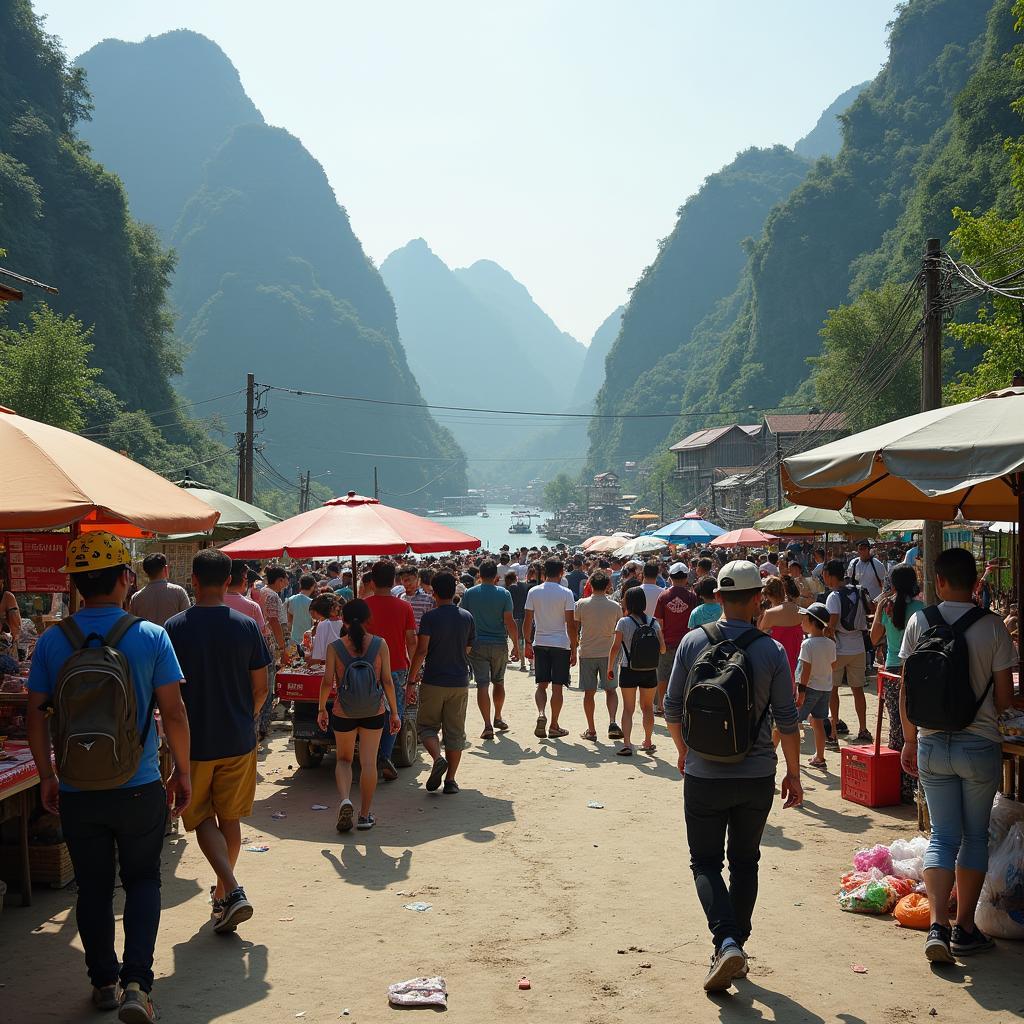 Cảnh đông đúc tại điểm du lịch nổi tiếng với nhiều khách du lịch và người dân địa phương
Theme 3: Future Trends and Technology
Question 4: How do you think technology has changed the way people plan and experience day trips?
🎯 Phân tích câu hỏi:
- Dạng: Change/Development question – yêu cầu phân tích how things have evolved
- Key words: “technology”, “changed”, “plan and experience”
- Cách tiếp cận:
- Discuss changes in planning stage (apps, reviews, booking)
- Discuss changes during experience (GPS, photography, sharing)
- Consider both positive và negative aspects
📝 Sample Answer – Band 6-7:
Technology has made planning day trips much easier. Now we can use apps and websites to find information about places to visit, check reviews from other travelers, and book tickets online. GPS helps us find directions easily. During trips, people use smartphones to take photos and share them on social media immediately. This is very different from the past when people had to ask locals for directions and wait until they got home to develop film photos.
Phân tích:
- Structure: Covers planning và experience aspects but quite superficially
- Vocabulary: Basic (much easier, find information, take photos)
- Tại sao Band 6-7: Addresses question adequately nhưng lacks depth và sophisticated language
📝 Sample Answer – Band 8.5-9:
Technology has fundamentally revolutionized both the planning and experiencing of day trips in ways that would have been inconceivable just a decade or two ago.
In terms of planning, we’ve witnessed a democratization of information. Previously, planning a trip required consulting travel guides, maps, or relying on word-of-mouth recommendations. Now, platforms like Google Maps, TripAdvisor, and local travel apps provide instantaneous access to comprehensive information – everything from opening hours and admission fees to real-time crowd levels and user-generated reviews. This abundance of information empowers travelers to make more informed decisions, though it has also created what some call “analysis paralysis” – being overwhelmed by too many options.
Booking and logistics have become remarkably streamlined. You can purchase tickets, reserve guided tours, or even book restaurant tables at your fingertips, often receiving digital confirmations instantly. Apps like Grab or local equivalents have made transportation incredibly convenient – you don’t need to negotiate with taxi drivers or worry about getting lost.
During the actual experience, technology plays an even more intrusive – or depending on your perspective, enriching – role. GPS navigation has essentially eliminated the possibility of getting lost, which removes some of the serendipitous discoveries that used to happen when people stumbled upon unexpected places. There’s also the omnipresent smartphone camera, which has transformed how people engage with destinations. Rather than simply immersing themselves in the moment, many visitors are preoccupied with capturing the perfect Instagram shot – a phenomenon sometimes called “living for the gram.”
On a more positive note, technology has made day trips more accessible for people with disabilities through apps that provide accessibility information, and has enhanced educational aspects through augmented reality guides and audio tours that can be downloaded on-demand.
However, I think there’s a growing countermovement of people who are deliberately disconnecting during day trips – turning off their phones to reclaim that authentic, unmediated experience of simply being present in nature or a new place. This suggests we’re entering a phase where people are becoming more conscious about striking a balance between leveraging technology’s benefits and not letting it detract from the essence of what makes travel meaningful.
So in summary, technology has made day trips more accessible, efficient, and information-rich, but it’s also introduced new challenges around authenticity, over-documentation, and digital distraction that we’re still learning to navigate.
Phân tích:
- Structure: Exceptionally well-organized với clear thematic progression (planning → booking → experience → accessibility → countermovement → summary)
- Vocabulary: Highly sophisticated (democratization, analysis paralysis, serendipitous discoveries, omnipresent, preoccupied, countermovement)
- Grammar: Full range of complex structures including conditionals, relative clauses, present perfect, gerunds, participles
- Critical Thinking: Shows nuanced understanding với balanced analysis, considers multiple perspectives, acknowledges both benefits và drawbacks, discusses emerging trends
💡 Key Language Features:
- Discourse markers: “In terms of”, “On a more positive note”, “However”, “So in summary”
- Tentative/Academic language: “some call”, “depending on your perspective”, “suggests we’re entering”
- Abstract nouns: “democratization of information”, “serendipitous discoveries”, “digital distraction”, “authenticity”
- Sophisticated collocations: “fundamentally revolutionized”, “striking a balance”, “detract from”
Đối với những người yêu thích describe a time when you traveled with friends, công nghệ đã giúp việc lên kế hoạch và phối hợp lịch trình nhóm trở nên dễ dàng hơn rất nhiều so với trước đây.
Question 5: Do you think day trips will become more or less popular in the future?
🎯 Phân tích câu hỏi:
- Dạng: Future prediction/speculation – yêu cầu dự đoán trends với justification
- Key words: “future”, “more or less popular”
- Cách tiếp cận:
- Make a clear prediction (more/less/different form)
- Support với logical reasoning
- Consider various factors (economic, social, environmental, technological)
📝 Sample Answer – Band 6-7:
I think day trips will become more popular in the future. People’s lives are getting busier and they have less free time, so short trips are more convenient. Also, with climate change concerns, people might prefer staying closer to home instead of flying to far places. Technology will also make it easier to find interesting places nearby that people didn’t know about before.
Phân tích:
- Structure: Clear prediction với some supporting reasons
- Vocabulary: Adequate (getting busier, more convenient, climate change)
- Tại sao Band 6-7: Makes reasonable points nhưng analysis lacks depth và sophistication
📝 Sample Answer – Band 8.5-9:
I’d venture to say that day trips will not only become more popular but will likely evolve in form and function over the coming decades, driven by several converging trends.
Economically, I believe we’re heading towards what some economists call a “experience economy” where people prioritize experiences over material possessions. However, with stagnating wages and rising costs of living in many countries, expensive long-haul travel may become increasingly unattainable for average families. Day trips represent a viable alternative that satisfies this craving for experiences without breaking the bank.
Environmentally, there’s growing awareness of travel’s carbon footprint, and we’re seeing the emergence of “flight shame” movements and conscious travel. Day trips to local or regional destinations obviously have a much smaller environmental impact than intercontinental flights, which aligns with this eco-conscious ethos. I think we’ll see more people embracing the concept of “slow travel” or rediscovering places in their own backyard rather than always seeking exotic destinations.
From a work-life perspective, the widespread adoption of remote and hybrid work models post-pandemic has given people more flexibility in how they structure their time. Someone working from home can potentially take a mid-week day trip without using annual leave, which was unthinkable in traditional office settings. This could dramatically expand the market for day trips beyond just weekends.
Technologically, I anticipate innovations that will make day trips even more appealing. We’re already seeing the development of high-speed rail networks in many countries, which will bring previously distant destinations within easy reach for day trips. Virtual reality might also play an interesting role – people could preview destinations virtually before committing to visit, making trip planning more informed and efficient.
However, I should note some countervailing forces. There’s a possibility that immersive virtual experiences could actually substitute for real travel to some extent, particularly if VR technology becomes truly compelling. Additionally, if we see significant economic upheaval or climate-related disruptions, even day trips might become less feasible for many people.
All things considered, though, I’m fairly optimistic that day trips will flourish, perhaps becoming the dominant form of leisure travel for many demographics. The key will be ensuring this growth is sustainable and doesn’t lead to the over-tourism problems we’re already seeing at many day-trip hotspots. We’ll need thoughtful regulation and infrastructure investment to make sure these destinations can accommodate increased visitor numbers without compromising their very attributes that make them worth visiting in the first place.
Phân tích:
- Structure: Exceptionally sophisticated với thematic organization (economic → environmental → work-life → technological → counterarguments → conclusion)
- Vocabulary: Highly advanced và precise (venture to say, converging trends, stagnating wages, flight shame, countervailing forces, immersive virtual experiences)
- Grammar: Full range of complex structures including conditionals, relative clauses, passive voice, future forms, participles
- Critical Thinking: Shows exceptional depth của analysis, considers multiple factors, acknowledges uncertainty, presents counterarguments, draws nuanced conclusion
💡 Key Language Features:
- Speculative language: “I’d venture to say”, “I anticipate”, “There’s a possibility”, “I’m fairly optimistic”
- Discourse markers: “Economically”, “Environmentally”, “From a work-life perspective”, “Technologically”, “However”, “All things considered”
- Abstract nouns: “experience economy”, “eco-conscious ethos”, “countervailing forces”, “economic upheaval”
- Academic collocations: “converging trends”, “viable alternative”, “widespread adoption”, “thoughtful regulation”
Từ vựng và cụm từ quan trọng
Topic-Specific Vocabulary
| Từ vựng/Cụm từ | Loại từ | Phiên âm | Nghĩa tiếng Việt | Ví dụ | Collocation |
|---|---|---|---|---|---|
| day trip | n | /deɪ trɪp/ | chuyến đi trong ngày | We went on a day trip to the countryside. | take/go on a day trip, organize a day trip, enjoy a day trip |
| excursion | n | /ɪkˈskɜːʃn/ | chuyến tham quan ngắn ngày | The school organized an excursion to the museum. | organize/plan an excursion, educational excursion, guided excursion |
| scenic | adj | /ˈsiːnɪk/ | có phong cảnh đẹp | We drove along a scenic route through the mountains. | scenic view/route/beauty, scenic destination/spot |
| breathtaking | adj | /ˈbreθteɪkɪŋ/ | ngoạn mục, đẹp đến nghẹt thở | The view from the top was absolutely breathtaking. | breathtaking view/scenery, breathtaking beauty, breathtaking landscape |
| rejuvenating | adj | /rɪˈdʒuːvəneɪtɪŋ/ | giúp trẻ hóa, làm tươi mới | The spa experience was truly rejuvenating. | rejuvenating experience, rejuvenating effect, rejuvenating break |
| immerse oneself in | v phrase | /ɪˈmɜːs wʌnˈself ɪn/ | đắm mình vào, hòa mình vào | We immersed ourselves in the local culture. | immerse in nature/culture, fully immerse, deeply immerse |
| bustling | adj | /ˈbʌslɪŋ/ | nhộn nhịp, tấp nập | The market was bustling with activity. | bustling city/market, bustling atmosphere, bustling with tourists |
| serene | adj | /səˈriːn/ | thanh bình, yên tĩnh | The lake offered a serene escape from city life. | serene environment/atmosphere, serene beauty, serene setting |
| picturesque | adj | /ˌpɪktʃəˈresk/ | đẹp như tranh | We visited a picturesque village in the mountains. | picturesque village/town, picturesque landscape, picturesque setting |
| trek | n/v | /trek/ | cuộc đi bộ đường dài, leo núi | We went on a challenging trek through the forest. | go on a trek, trekking expedition, mountain trek, challenging trek |
| summit | n | /ˈsʌmɪt/ | đỉnh núi | We reached the summit after three hours of climbing. | reach the summit, mountain summit, climb to the summit |
| panoramic view | n phrase | /ˌpænəˈræmɪk vjuː/ | tầm nhìn toàn cảnh | The tower offers panoramic views of the city. | enjoy/admire panoramic views, stunning panoramic view |
| tranquil | adj | /ˈtræŋkwɪl/ | yên bình, tĩnh lặng | The garden was a tranquil oasis in the busy city. | tranquil atmosphere/setting, tranquil retreat, tranquil environment |
| authentic | adj | /ɔːˈθentɪk/ | chân thực, đích thực | We wanted to experience authentic local cuisine. | authentic experience, authentic culture, authentic atmosphere |
| memorable | adj | /ˈmemərəbl/ | đáng nhớ | It was a truly memorable experience. | memorable experience/trip/day, highly memorable, most memorable |
| recharge one’s batteries | idiom | /ˌriːˈtʃɑːdʒ wʌnz ˈbætəriz/ | nạp lại năng lượng | I need a day trip to recharge my batteries. | recharge your batteries, need to recharge, helps recharge |
| off the beaten track | idiom | /ɒf ðə ˈbiːtn træk/ | nơi ít người biết đến | We prefer destinations off the beaten track. | go off the beaten track, places off the beaten track |
| escape | n/v | /ɪˈskeɪp/ | sự thoát ly, trốn thoát | The trip was a perfect escape from routine. | need an escape, perfect escape, escape from daily life |
| itinerary | n | /aɪˈtɪnərəri/ | lộ trình, hành trình | We planned a detailed itinerary for our day trip. | plan an itinerary, follow an itinerary, detailed itinerary |
| unwind | v | /ˌʌnˈwaɪnd/ | thư giãn, xả stress | I need time to unwind after a stressful week. | unwind and relax, help unwind, chance to unwind |
Idiomatic Expressions & Advanced Phrases
| Cụm từ | Nghĩa | Ví dụ sử dụng | Band điểm |
|---|---|---|---|
| jump at the chance/opportunity | nắm bắt cơ hội ngay lập tức | When my friend suggested a day trip, I jumped at the opportunity. | 7.5-9 |
| spur-of-the-moment decision | quyết định đột ngột, tức thì | The trip was a spur-of-the-moment decision on Saturday morning. | 7.5-9 |
| beat the crowds | tránh đám đông | We left early to beat the crowds at the popular attraction. | 7-8 |
| get away from it all | thoát khỏi mọi thứ, nghỉ ngơi hoàn toàn | Sometimes you just need to get away from it all for a day. | 7-8 |
| make the most of | tận dụng tối đa | We wanted to make the most of our limited time there. | 7-8 |
| worth every penny | xứng đáng từng đồng | The tour was expensive but worth every penny. | 7-8 |
| a breath of fresh air | làm tươi mới, khác biệt dễ chịu | The mountain trip was like a breath of fresh air. | 7.5-8 |
| put things into perspective | nhìn nhận lại mọi thứ đúng tỷ lệ | Being in nature really puts things into perspective. | 8-9 |
| at the crack of dawn | lúc rạng đông, rất sớm | We set off at the crack of dawn to maximize our time. | 7.5-8 |
| the hustle and bustle | sự hối hả, nhộn nhịp | I needed an escape from the hustle and bustle of city life. | 7.5-8 |
| teeter on the edge | đứng trên bờ vực (nguy hiểm) | The ecosystem teeters on the edge of destruction. | 8.5-9 |
| strike a balance | cân bằng, dung hòa | We need to strike a balance between tourism and conservation. | 8-9 |
Discourse Markers (Từ Nối Ý Trong Speaking)
Để bắt đầu câu trả lời:
- 📝 Well,… – Khi cần thời gian suy nghĩ ngắn (e.g., “Well, I’d say that…”)
- 📝 Actually,… – Khi đưa ra góc nhìn khác hoặc surprising information (e.g., “Actually, it was quite different from what I expected”)
- 📝 To be honest,… – Khi nói thật, thẳng thắn (e.g., “To be honest, I wasn’t expecting much”)
- 📝 I’d say that… – Khi đưa ra quan điểm cá nhân (e.g., “I’d say that day trips are becoming increasingly popular”)
- 📝 From my perspective,… – Từ góc nhìn của tôi (e.g., “From my perspective, the benefits outweigh the drawbacks”)
Để bổ sung ý:
- 📝 On top of that,… – Thêm vào đó (e.g., “On top of that, the weather was perfect”)
- 📝 What’s more,… – Hơn nữa (e.g., “What’s more, we discovered some hidden gems”)
- 📝 Not to mention… – Chưa kể đến (e.g., “Not to mention the amazing food we tried”)
- 📝 Additionally/Furthermore,… – Thêm vào đó (formal)
- 📝 Another thing worth mentioning is… – Một điều đáng nói nữa là
Để đưa ra quan điểm cân bằng:
- 📝 On the one hand,… On the other hand,… – Một mặt… Mặt khác…
- 📝 While it’s true that…, we also need to consider… – Mặc dù đúng là… nhưng ta cũng cần xem xét…
- 📝 That said,… – Tuy nhiên, dù vậy (để introduce contrasting point)
- 📝 Having said that,… – Nói như vậy, nhưng…
Để kết luận:
- 📝 All in all,… – Tóm lại, nhìn chung
- 📝 At the end of the day,… – Cuối cùng thì (when everything is considered)
- 📝 All things considered,… – Xét mọi mặt thì
- 📝 So in summary,… – Vậy tóm lại
- 📝 Ultimately,… – Cuối cùng, về cơ bản
Để đưa ra ví dụ:
- 📝 For instance/For example,… – Ví dụ như
- 📝 Take… for example,… – Lấy… làm ví dụ
- 📝 A case in point is… – Một ví dụ điển hình là
- 📝 Such as… – Chẳng hạn như
Grammatical Structures Ấn Tượng
1. Conditional Sentences (Câu điều kiện):
Mixed conditional:
- Formula: If + past perfect, would/could + infinitive (mixing time frames)
- Ví dụ: “If we hadn’t left so early, we would still be stuck in traffic now.”
- Ví dụ: “If I had known about this place earlier, I would visit it more often.”
Inversion trong conditional:
- Formula: Had + subject + past participle, subject + would…
- Ví dụ: “Had we known about the weather, we would have postponed the trip.”
- Ví dụ: “Should you decide to visit, I’d highly recommend going in spring.”
2. Relative Clauses (Mệnh đề quan hệ):
Non-defining relative clauses:
- Formula: …, which/who/where…,
- Ví dụ: “We visited Ba Vi National Park, which is known for its ancient forests.”
- Ví dụ: “My friend Sarah, who is an avid hiker, organized the entire trip.”
Reduced relative clauses:
- Formula: Bỏ who/which + be, giữ lại V-ing/V3
- Ví dụ: “The trail leading to the summit was quite challenging.” (which leads)
- Ví dụ: “People looking for authentic experiences prefer off-beaten destinations.” (who look)
3. Passive Voice (Câu bị động):
Impersonal passive với It:
- Formula: It is thought/believed/said/considered that…
- Ví dụ: “It is widely believed that day trips will become more popular.”
- Ví dụ: “It has been suggested that tourism authorities should implement stricter regulations.”
Passive with reporting verbs:
- Ví dụ: “The area is known to have exceptional biodiversity.”
- Ví dụ: “Day trips are considered to be more eco-friendly than long holidays.”
4. Cleft Sentences (Câu chẻ):
What-cleft:
- Formula: What + subject + verb + is/was…
- Ví dụ: “What I find most appealing about day trips is their spontaneity.”
- Ví dụ: “What struck me most was the serenity of the place.”
It-cleft:
- Formula: It + be + focus element + that/who…
- Ví dụ: “It was the breathtaking scenery that made the trip memorable.”
- Ví dụ: “It is the flexibility that makes day trips so attractive.”
5. Participle Clauses:
Present participle (-ing):
- Ví dụ: “Standing at the summit, I felt a tremendous sense of achievement.”
- Ví dụ: “Not wanting to waste time, we left very early in the morning.”
Past participle (-ed):
- Ví dụ: “Exhausted from the trek, we decided to rest by the lake.”
- Ví dụ: “Surrounded by ancient trees, I felt connected to nature.”
6. Inversion for Emphasis:
After negative adverbials:
- Formula: Never/Rarely/Seldom + auxiliary + subject + verb
- Ví dụ: “Never have I experienced such tranquility.”
- Ví dụ: “Rarely do I get the chance to completely disconnect from work.”
After Only:
- Formula: Only when/after… + auxiliary + subject + verb
- Ví dụ: “Only after visiting did I realize how special this place was.”
7. Wish/If only (for regrets or desires):
- Ví dụ: “I wish we had had more time to explore the area.”
- Ví dụ: “If only I had discovered this place earlier.”
Bài viết này đã cung cấp cho bạn một cái nhìn toàn diện về cách trả lời chủ đề “describe a recent day trip you enjoyed” trong IELTS Speaking. Từ việc phân tích chi tiết các câu hỏi Part 1, 2, 3 đến những bài mẫu theo từng band điểm, bạn đã có đủ công cụ và kiến thức để tự tin bước vào phòng thi.
Điều quan trọng nhất là hãy nhớ rằng IELTS Speaking không chỉ đánh giá khả năng ngôn ngữ mà còn đánh giá khả năng tư duy, phân tích và truyền đạt ý tưởng của bạn. Đừng cố gằng học thuộc template hay các câu trả lời mẫu – thay vào đó, hãy hiểu rõ cách xây dựng câu trả lời tự nhiên, sử dụng từ vựng đa dạng và thể hiện góc nhìn cá nhân độc đáo của riêng bạn.
Hãy thực hành thường xuyên, ghi âm lại câu trả lời của mình để tự đánh giá, và đừng ngại mắc lỗi – đó là cách tốt nhất để cải thiện. Chúc bạn đạt được band điểm như mong muốn trong kỳ thi IELTS Speaking sắp tới!


