Mở bài
Chủ đề “Describe A Situation That Made You Laugh” là một trong những đề bài phổ biến và thân thiện nhất trong IELTS Speaking Part 2. Đây là dạng câu hỏi yêu cầu thí sinh kể về một trải nghiệm cá nhân mang tính giải trí, cho phép bạn thể hiện khả năng kể chuyện một cách tự nhiên và sinh động.
Theo thống kê từ các trung tâm thi IELTS và diễn đàn học viên, chủ đề liên quan đến laughter, funny situations và humorous experiences xuất hiện với tần suất khá cao, khoảng 2-3 lần mỗi quý trong các kỳ thi từ năm 2020 đến nay. Đặc biệt, Cambridge IELTS 16 và 17 đều có đề bài tương tự trong phần Speaking Test. Khả năng xuất hiện trong tương lai được đánh giá ở mức cao do tính phổ biến và khả năng đánh giá toàn diện các kỹ năng của thí sinh.
Trong bài viết này, bạn sẽ học được:
- 10+ câu hỏi thường gặp trong cả 3 Part liên quan đến chủ đề cười và hài hước
- Bài mẫu chi tiết theo 3 mức band điểm (6-7, 7.5-8, 8.5-9) với phân tích sâu
- 50+ từ vựng và cụm từ ăn điểm về humor, laughter và emotions
- Chiến lược trả lời hiệu quả từ góc nhìn Examiner
- Lời khuyên cụ thể giúp tránh các lỗi phổ biến của học viên Việt Nam
Với tư cách là một examiner có hơn 20 năm kinh nghiệm, tôi nhận thấy đây là một trong những chủ đề mà thí sinh Việt Nam có thể tận dụng tốt để ghi điểm cao, vì nó cho phép thể hiện tính cách và khả năng sử dụng ngôn ngữ tự nhiên. Tuy nhiên, nhiều bạn vẫn mắc lỗi kể chuyện quá ngắn gọn, thiếu chi tiết sinh động, hoặc sử dụng từ vựng đơn điệu. Bài viết này sẽ giúp bạn khắc phục những vấn đề đó.
IELTS Speaking Part 1: Introduction and Interview
Tổng Quan Về Part 1
Part 1 của IELTS Speaking kéo dài 4-5 phút với các câu hỏi ngắn về đời sống hàng ngày. Đây là phần khởi động giúp bạn làm quen với examiner và tạo ấn tượng ban đầu.
Đặc điểm chính:
- Câu hỏi xoay quanh các chủ đề quen thuộc: work, study, hometown, hobbies
- Yêu cầu trả lời tự nhiên, không quá dài (2-4 câu mỗi câu hỏi)
- Cơ hội thể hiện fluency và pronunciation từ những giây đầu tiên
Chiến lược hiệu quả:
- Trả lời trực tiếp câu hỏi (không lạc đề)
- Mở rộng bằng lý do, ví dụ hoặc chi tiết cá nhân
- Sử dụng từ vựng đa dạng nhưng tự nhiên
- Giữ tốc độ nói vừa phải, rõ ràng
Lỗi thường gặp của học viên Việt Nam:
- Trả lời quá ngắn kiểu Yes/No mà không elaborate
- Dùng từ vựng quá basic (good, bad, like, don’t like)
- Thiếu ví dụ cụ thể từ kinh nghiệm bản thân
- Nói quá nhanh hoặc hesitate nhiều do lo lắng
- Học thuộc template khiến câu trả lời nghe không tự nhiên
Các Câu Hỏi Thường Gặp
Dưới đây là 10 câu hỏi thực tế thường xuất hiện trong Part 1 liên quan đến chủ đề laughter và humor:
Question 1: Do you like watching comedy shows or funny videos?
Question 2: What kinds of things make you laugh?
Question 3: Do you think laughter is important in daily life?
Question 4: Are you good at making other people laugh?
Question 5: Who makes you laugh the most in your family or among your friends?
Question 6: Do you prefer funny movies or serious ones?
Question 7: Have you ever laughed at an inappropriate time?
Question 8: Do you think sense of humor is important when choosing friends?
Question 9: What was the last thing that made you laugh out loud?
Question 10: Do you think people in your country have a good sense of humor?
Phân Tích và Gợi Ý Trả Lời Chi Tiết
Question: Do you like watching comedy shows or funny videos?
🎯 Cách tiếp cận:
- Trả lời trực tiếp Yes/No
- Giải thích lý do tại sao (để giải trí, thư giãn…)
- Đưa ra ví dụ cụ thể về loại comedy bạn thích
📝 Sample Answer – Band 6-7:
Yes, I do. I often watch funny videos on YouTube when I have free time. They help me relax after a long day of studying. I especially like videos about daily life situations because they are easy to understand and make me laugh.
Phân tích:
- Điểm mạnh: Trả lời rõ ràng, có lý do (relax) và ví dụ cụ thể (YouTube, daily life situations)
- Hạn chế: Từ vựng khá basic (funny, relax, like), cấu trúc câu đơn giản, chưa thể hiện vocabulary range
- Tại sao Band 6-7: Đủ fluent và coherent nhưng lexical resource và grammatical range còn ở mức adequate, chưa impressive
📝 Sample Answer – Band 8-9:
Absolutely! I’m actually quite a fan of comedy content, especially stand-up comedy and satirical shows. I find that watching something hilarious is the perfect stress-buster after a mentally draining day. What I particularly appreciate about comedy is its ability to offer a fresh perspective on everyday situations. For instance, I regularly watch British panel shows like “Would I Lie to You?” because the witty banter and clever wordplay never fail to crack me up.
Phân tích:
-
Điểm mạnh:
- Vocabulary tinh vi: “quite a fan of”, “stand-up comedy”, “satirical”, “stress-buster”, “mentally draining”, “witty banter”, “clever wordplay”, “crack me up”
- Cấu trúc đa dạng: “What I particularly appreciate…”, “never fail to…”
- Ví dụ cụ thể và authentic (British panel shows)
- Giải thích sâu hơn về lý do thích (fresh perspective)
-
Tại sao Band 8-9:
- Fluency: Trôi chảy, tự nhiên với discourse markers (Absolutely, especially, for instance)
- Vocabulary: Sophisticated và precise (satirical, witty banter)
- Grammar: Complex structures với relative clauses
- Pronunciation: Các từ được chọn thể hiện khả năng phát âm tốt các âm khó
💡 Key Vocabulary & Expressions:
- quite a fan of: rất thích, hâm mộ
- stand-up comedy: hài độc thoại
- satirical shows: chương trình châm biếm, mỉa mai
- stress-buster: thứ giúp giải tóa căng thẳng
- mentally draining: làm kiệt sức về tinh thần
- witty banter: cuộc đối thoại dí dỏm, hóm hỉnh
- crack someone up: làm ai đó cười rất nhiều
Question: What kinds of things make you laugh?
🎯 Cách tiếp cận:
- Liệt kê 2-3 loại tình huống/nội dung
- Giải thích tại sao chúng funny với bạn
- Có thể thêm ví dụ ngắn minh họa
📝 Sample Answer – Band 6-7:
Many things can make me laugh. I find it funny when people make silly mistakes, like forgetting their keys or saying the wrong words. Also, I laugh when watching comedy movies with my friends. Sometimes, my friends tell jokes and I find them very amusing.
Phân tích:
- Điểm mạnh: Đưa ra được nhiều ví dụ khác nhau (mistakes, movies, jokes)
- Hạn chế:
- Từ vựng lặp lại (funny, laugh)
- Thiếu specific details
- Chưa giải thích deeply tại sao những thứ này funny
- Tại sao Band 6-7: Đáp ứng yêu cầu cơ bản nhưng chưa demonstrate lexical flexibility
📝 Sample Answer – Band 8-9:
I’d say I have quite a broad sense of humor. What really tickles me is observational comedy – you know, when someone points out the absurdity of everyday situations that we normally take for granted. For example, I find it absolutely hilarious when comedians talk about the awkwardness of small talk in elevators. Additionally, I’m easily amused by wordplay and puns, even the cheesy ones. There’s something endearing about clever linguistic humor. Oh, and I must admit, slapstick comedy – people tripping over things or physical mishaps – can still get a laugh out of me, even though it’s quite juvenile.
Phân tích:
-
Điểm mạnh:
- Vocabulary range xuất sắc: “tickles me”, “observational comedy”, “absurdity”, “awkwardness”, “wordplay and puns”, “cheesy”, “endearing”, “slapstick comedy”, “mishaps”, “juvenile”
- Structure rõ ràng: observational comedy → wordplay → slapstick
- Discourse markers tự nhiên: “I’d say”, “you know”, “Additionally”, “Oh, and I must admit”
- Shows personality và self-awareness (“even though it’s quite juvenile”)
- Ví dụ cụ thể (small talk in elevators)
-
Tại sao Band 8-9:
- Fluency: Very natural flow với fillers appropriate (“you know”)
- Vocabulary: Precise và sophisticated với collocations (broad sense of humor, points out the absurdity)
- Grammar: Complex sentences với relative clauses, even though clauses
- Coherence: Well-organized với clear progression of ideas
💡 Key Vocabulary & Expressions:
- broad sense of humor: khiếu hài hước đa dạng
- tickle someone: làm ai đó cười, thích thú
- observational comedy: hài kịch quan sát (về đời sống hàng ngày)
- point out the absurdity: chỉ ra sự vô lý, phi lý
- wordplay/puns: chơi chữ
- cheesy: sến, cũ rích nhưng vẫn vui
- slapstick comedy: hài kịch hành động (té ngã, va chạm)
- get a laugh out of someone: làm ai đó cười
Question: Do you think laughter is important in daily life?
🎯 Cách tiếp cận:
- Đưa ra opinion rõ ràng (Yes/Definitely)
- Giải thích benefits của laughter (health, relationships, stress relief)
- Có thể thêm personal experience hoặc general observation
📝 Sample Answer – Band 6-7:
Yes, definitely. Laughter is very important because it makes us feel happy and reduces stress. When we laugh with friends or family, we feel closer to them. Also, I think people who laugh often are healthier and more positive in life.
Phân tích:
- Điểm mạnh:
- Opinion rõ ràng
- Đưa ra được 3 reasons (happiness, relationships, health)
- Logic flow tốt
- Hạn chế:
- Vocabulary basic (happy, reduces stress, healthier)
- Thiếu specific examples
- Ideas còn general, chưa develop deeply
- Tại sao Band 6-7: Adequate response nhưng chưa sophisticated trong cách diễn đạt
📝 Sample Answer – Band 8-9:
Absolutely, I’d go so far as to say it’s essential. Laughter serves as a natural stress reliever – there’s actually scientific evidence suggesting that it triggers the release of endorphins, our body’s feel-good chemicals. Beyond the physiological benefits, I believe laughter plays a crucial role in social bonding. When you share a laugh with someone, it creates an instant connection and breaks down barriers. In my own experience, the ability to find humor in difficult situations has helped me maintain perspective and cope with challenges more effectively. It’s like a free therapy session that’s available anytime.
Phân tích:
-
Điểm mạnh:
- Opening strong với “I’d go so far as to say” – shows conviction
- Scientific reference (endorphins) – demonstrates knowledge breadth
- Multiple dimensions: physical (endorphins) + social (bonding) + psychological (coping)
- Personal touch (“In my own experience”)
- Metaphor cuối (“free therapy session”) – creative và memorable
- Academic vocabulary nhưng vẫn natural: physiological, crucial role, maintain perspective
-
Tại sao Band 8-9:
- Fluency: Seamless với sophisticated linking (Beyond, In my own experience)
- Vocabulary: Precise collocations (natural stress reliever, breaks down barriers, maintain perspective)
- Grammar: Complex structures với suggesting that clause, it’s like comparison
- Ideas: Well-developed với multiple layers của argument
💡 Key Vocabulary & Expressions:
- essential: thiết yếu, cần thiết
- natural stress reliever: giải pháp xả stress tự nhiên
- trigger the release of: kích hoạt việc giải phóng
- endorphins: hormone hạnh phúc
- physiological benefits: lợi ích về mặt sinh lý
- social bonding: gắn kết xã hội
- break down barriers: phá vỡ rào cản
- maintain perspective: giữ được góc nhìn đúng đắn
- cope with challenges: đối phó với thử thách
 Thí sinh trả lời câu hỏi IELTS Speaking Part 1 về chủ đề tiếng cười và sự hài hước
IELTS Speaking Part 2: Long Turn (Cue Card)
Tổng Quan Về Part 2
Part 2 là phần thử thách nhất của IELTS Speaking, đòi hỏi bạn phải nói liên tục 2-3 phút về một chủ đề cụ thể mà không bị ngắt lời. Đây là cơ hội để bạn thể hiện khả năng tổ chức ý tưởng, kể chuyện mạch lạc và sử dụng ngôn ngữ đa dạng.
Thời gian và cấu trúc:
- 1 phút chuẩn bị: Ghi chú keywords trên giấy (không viết câu hoàn chỉnh)
- 2-3 phút nói: Độc thoại không bị gián đoạn (examiner sẽ chỉ cho dừng khi hết thời gian)
Chiến lược hiệu quả:
- Sử dụng trọn 1 phút chuẩn bị: Ghi từ khóa cho mỗi bullet point, note down names/places/times
- Nói đủ 2 phút: Aim for 2-2.5 phút là lý tưởng, tối thiểu 1.5 phút
- Cover tất cả bullet points: Đảm bảo trả lời đầy đủ các yêu cầu
- Structure rõ ràng: Intro ngắn → develop từng bullet point → conclude với “explain” part
- Use past tenses: Hầu hết câu chuyện funny đều ở quá khứ
- Be vivid: Describe details, feelings, reactions để câu chuyện sống động
Lỗi thường gặp của học viên Việt Nam:
- Không tận dụng hết 1 phút chuẩn bị (vội vã bắt đầu)
- Nói quá ngắn, kết thúc ở 1-1.5 phút
- Bỏ sót một hoặc nhiều bullet points
- Quên explain phần feelings/significance ở cuối
- Kể chuyện theo kiểu liệt kê sự kiện, thiếu details và emotions
- Sử dụng quá nhiều “and then… and then…”
- Nervous silence khi hết ý, thay vì paraphrase hoặc elaborate
Tương tự như describe a meal you had in a restaurant recently, đây là dạng câu hỏi yêu cầu kể về một trải nghiệm cá nhân cụ thể trong quá khứ, vì vậy việc sử dụng thành thạo các thì quá khứ và khả năng miêu tả chi tiết là rất quan trọng.
Cue Card
Describe a situation that made you laugh
You should say:
- When and where it happened
- Who was with you
- What happened
- And explain why it made you laugh so much
Phân Tích Đề Bài
Dạng câu hỏi: Describe an experience/event – đây là dạng yêu cầu kể về một sự kiện cụ thể đã xảy ra
Thì động từ chủ yếu: Past tenses (Simple Past, Past Continuous, Past Perfect) vì đây là sự việc đã xảy ra trong quá khứ
Bullet points phải cover:
-
When and where: Cần nêu rõ thời gian (có thể approximate: “about a month ago”, “last summer”) và địa điểm cụ thể (classroom, coffee shop, at home…)
-
Who was with you: Đề cập ai có mặt trong tình huống đó – bạn bè, gia đình, đồng nghiệp. Có thể giới thiệu ngắn về người này nếu cần.
-
What happened: Đây là phần chính – kể lại diễn biến sự việc một cách chi tiết, sinh động. Cần có beginning (bối cảnh), middle (sự việc chính), climax (khoảnh khắc funny nhất).
-
Explain why it made you laugh: Đây là phần QUAN TRỌNG NHẤT để ghi điểm cao. Không chỉ nói “it was funny” mà phải phân tích WHY – vì unexpected, vì timing, vì absurdity, vì relatable…
Câu “explain” quan trọng thế nào?
Phần explain là nơi bạn demonstrate critical thinking và depth of response. Examiner muốn thấy bạn có thể analyze feelings và reflect on experiences. Đây là điểm phân biệt giữa Band 6 và Band 8. Band cao không chỉ describe mà còn explain với insight.
Tips cho phần explain:
- Analyze the humor: Was it the timing? The unexpectedness? The absurdity?
- Describe the physical reaction: “I couldn’t stop laughing”, “tears were rolling down my face”
- Mention the aftermath: Did you laugh about it later? Do you still find it funny?
- Connect to broader idea: What it says about friendship/human nature/life
📝 Sample Answer – Band 6-7
Thời lượng: Khoảng 1.5-2 phút
I’d like to talk about a funny situation that happened about two months ago. It was at my friend’s house, and we were having a small birthday party for her.
There were four of us there – me, the birthday girl named Mai, and two other close friends from university. We were preparing the birthday cake in the kitchen. Mai’s mother had made a beautiful chocolate cake with cream and fruits on top.
What happened was quite funny. Mai was trying to light the candles on the cake, but she couldn’t find a lighter. She asked her younger brother to help, and he brought one from the living room. When Mai tried to light the first candle, her brother suddenly turned off all the lights in the house to create atmosphere. But it was completely dark, and Mai couldn’t see anything. She kept trying to light the candle but actually lit the wrong thing – it was a decorative paper flower next to the cake!
When we turned the lights back on, we saw the paper flower was burning, and Mai looked so shocked and confused. We all started laughing because the situation was so unexpected and silly. Mai’s face was really funny – she didn’t understand what happened at first. We quickly put out the fire, and luckily nothing serious happened. But we couldn’t stop laughing about it for the rest of the evening.
It made me laugh because it was so unexpected and clumsy. Mai is usually very careful, so seeing her make such a silly mistake was really amusing. Also, the timing was perfect – everything happened so fast and in a funny way. Even now, when we meet, we sometimes talk about this moment and laugh again.
Phân Tích Band Điểm
| Tiêu chí | Band | Nhận xét |
|---|---|---|
| Fluency & Coherence | 6-7 | Kể chuyện có logic, trôi chảy với sequencing rõ ràng (what happened was…, when we turned…). Sử dụng một số linking devices (but, when, so) nhưng chưa sophisticated. Có một vài repetition (funny, laughing) |
| Lexical Resource | 6-7 | Từ vựng adequate và appropriate (unexpected, silly, shocked, confused, clumsy, amusing). Có collocations cơ bản (close friends, decorative flower, serious happened). Tuy nhiên, chưa có nhiều less common vocabulary hoặc idioms |
| Grammatical Range & Accuracy | 6-7 | Mix of simple và complex sentences. Sử dụng đúng past tenses chủ yếu. Có relative clause (the birthday girl named Mai). Một số complex structure (When Mai tried…, we saw…) nhưng chưa variety cao |
| Pronunciation | 6-7 | Giả định clear và understandable với appropriate intonation khi kể chuyện |
Điểm mạnh:
- ✅ Cover đầy đủ tất cả bullet points
- ✅ Có structure rõ ràng: intro → context → main event → reaction → explanation
- ✅ Kể chuyện coherent, dễ follow
- ✅ Đủ length (khoảng 280 từ – tương đương 2 phút)
- ✅ Sử dụng past tenses correctly
Hạn chế:
- ⚠️ Vocabulary còn basic, lặp lại “funny” và “laugh” nhiều lần
- ⚠️ Thiếu vivid description của reactions và feelings
- ⚠️ Phần explain chưa deep enough, chưa analyze tại sao funny một cách sophisticated
- ⚠️ Chưa có idiomatic expressions hoặc advanced phrases
- ⚠️ Grammar structures chưa đủ đa dạng và complex
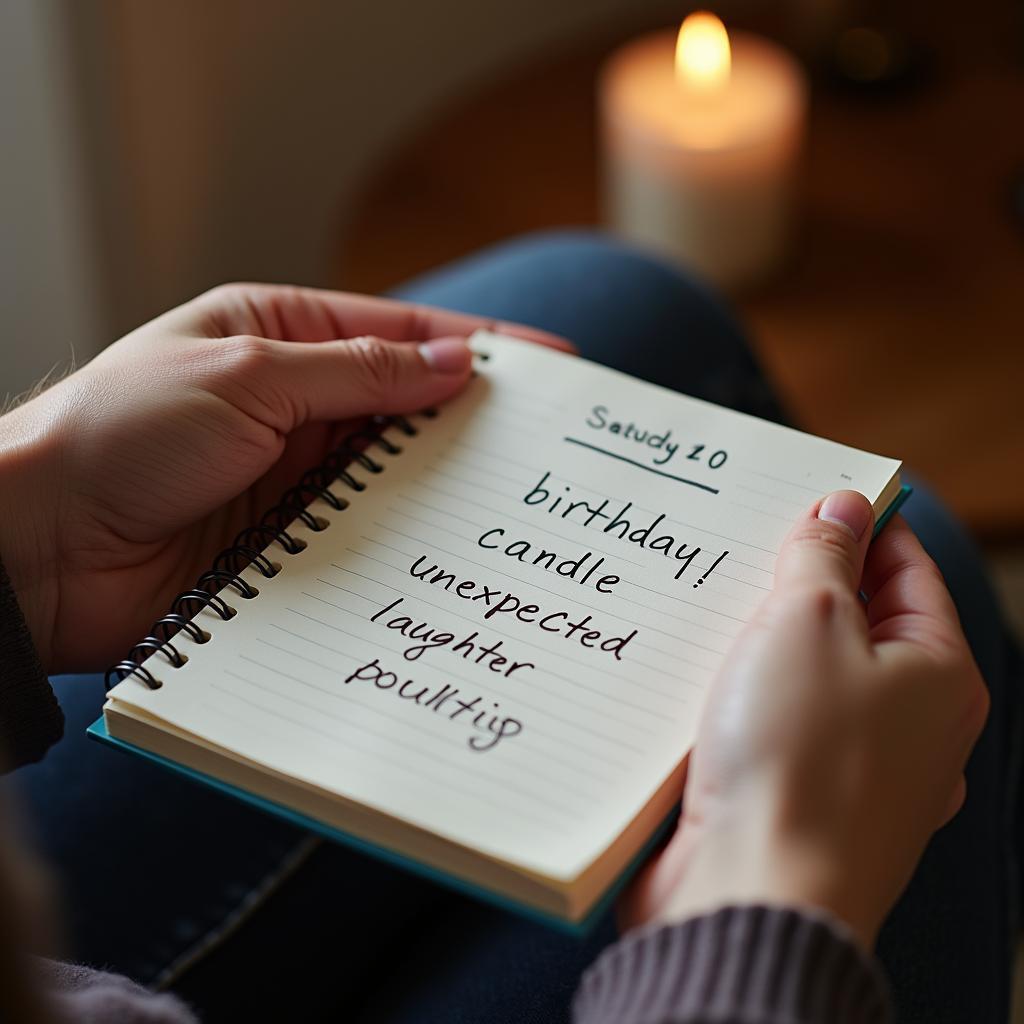 Học viên chuẩn bị bài nói IELTS Speaking Part 2 về tình huống gây cười
📝 Sample Answer – Band 7.5-8
Thời lượng: Khoảng 2-2.5 phút
I’d like to tell you about an absolutely hilarious incident that occurred roughly three months ago at my workplace. It’s one of those moments that still cracks me up whenever I think about it.
It happened during a regular Monday morning at our office. I was with my colleague, Minh, who’s known for being rather serious and professional – he’s the type who always wears formal suits and rarely shows emotion. We were both rushing to attend an important client meeting on the third floor.
So, what happened was this: We were running a bit late, and the elevator was taking forever. Minh suggested we take the stairs to save time. As we were hurrying up the stairs, Minh was frantically reviewing his presentation notes on his tablet. He was so engrossed in the documents that he wasn’t really paying attention to where he was going.
Suddenly, out of nowhere, he tripped over his own feet and stumbled forward. Now, here’s the funny part – instead of just catching himself normally, he did this elaborate theatrical tumble, with his arms flailing about dramatically, and his tablet went flying through the air. The tablet did a complete somersault before landing perfectly in his other hand – completely by accident! It was like watching a comedy sketch in slow motion.
The whole thing caught me completely off guard. What made it even funnier was Minh’s expression afterward – he looked absolutely mortified but also couldn’t help but laugh at himself. For someone so serious, seeing him in such a slapstick situation was pure comedy gold.
The reason it made me laugh so much was the sheer unexpectedness of it all. First, seeing someone as composed as Minh in such a comically awkward situation was too good to be true. Second, the way he accidentally caught the tablet was absolutely perfect timing – you couldn’t have choreographed it better if you tried. It was like something straight out of a Mr. Bean episode. The absurdity of the whole situation, combined with the impeccable timing and Minh’s reaction, created this perfect storm of humor. Even the client meeting went better afterward because we were in such good spirits from laughing about it.
Phân Tích Band Điểm
| Tiêu chí | Band | Nhận xét |
|---|---|---|
| Fluency & Coherence | 7.5-8 | Very fluent với natural flow. Excellent use của discourse markers (So, Suddenly, Now here’s the funny part). Câu chuyện được organize với clear progression và build-up đến climax. Minimal hesitation |
| Lexical Resource | 7.5-8 | Wide range của vocabulary (hilarious incident, engrossed in, flailing about, elaborate theatrical tumble, mortified, slapstick situation, comedy gold, sheer unexpectedness, impeccable timing). Good use của collocations và idiomatic language (cracks me up, caught me off guard, pure comedy gold) |
| Grammatical Range & Accuracy | 7.5-8 | Good variety của complex structures (instead of just catching…, It was like watching…, The reason it made me laugh was…). Consistent use của past tenses with past continuous for background. Relative clauses used appropriately (who’s known for, that occurred) |
| Pronunciation | 7.5-8 | Giả định sustained clear pronunciation với good intonation để convey humor |
So Sánh Với Band 6-7
| Khía cạnh | Band 6-7 | Band 7.5-8 |
|---|---|---|
| Vocabulary | “funny situation”, “turned off the lights”, “burning” | “absolutely hilarious incident”, “frantically reviewing”, “elaborate theatrical tumble”, “flailing about”, “sheer unexpectedness” |
| Grammar | “What happened was quite funny” (simple) | “What made it even funnier was…”, “you couldn’t have choreographed it better” (conditional perfect) |
| Ideas | Description of events + basic explanation | Vivid description với slow-motion effect + multi-layered explanation (unexpectedness + timing + character + absurdity) |
| Storytelling | Chronological, straightforward | Build-up tension, climax, aftermath với dramatic effect |
Điểm nổi bật của bài Band 7.5-8:
- Vivid imagery: “arms flailing about dramatically”, “tablet did a complete somersault”
- Character development: Minh được introduce rõ ràng (serious professional) tạo contrast với funny situation
- Sophisticated explanation: Không chỉ “it was funny” mà analyze multiple dimensions
- Natural spoken language: “out of nowhere”, “too good to be true”, “couldn’t have choreographed it”
- Cultural reference: “Mr. Bean episode” – shows broader knowledge
- Extended metaphor: “perfect storm of humor”
📝 Sample Answer – Band 8.5-9
Thời lượng: 2.5-3 phút đầy đủ
I’d love to share with you what I consider to be one of the most side-splittingly funny moments I’ve experienced in recent memory. This took place approximately six months ago, and honestly, just recounting it brings a grin to my face.
The setting was a weekend family gathering at my aunt’s countryside home – you know, one of those sprawling traditional Vietnamese houses with a large courtyard. The whole extended family was there – about fifteen of us – celebrating my grandmother’s 80th birthday. Among the guests was my cousin Duc, who’s notorious for his deadpan humor and impeccable comic timing.
Now, let me set the scene properly. My grandmother, bless her heart, is quite hard of hearing these days, but she adamantly refuses to wear hearing aids because she finds them uncomfortable. This has led to some genuinely amusing misunderstandings over the years, but nothing quite compared to what happened that day.
We were all gathered in the living room, and my uncle was giving an elaborate speech about my grandmother’s remarkable life journey – very formal, very touching, with everyone listening intently. At one point, he said something along the lines of “Grandmother has been a pillar of strength for our family through thick and thin.” My grandmother, who had been nodding politely throughout, suddenly piped up and said, quite loudly, “Oh yes, I do prefer thick spring rolls to thin ones – they’re much more filling!”
The room just erupted. There was this split second of stunned silence, and then everyone burst into laughter. But here’s where it gets even better – my cousin Duc, without missing a beat, stood up with the most serious expression and said, “Grandmother, Uncle was talking about strength, but I think you’ve just demonstrated the most important family value: always thinking about food.” This sent everyone into hysterics all over again. Even my uncle, who’d been trying so hard to maintain the solemnity of the moment, completely lost it.
What made the whole situation absolutely priceless was the layers of comedy involved. First, there was my grandmother’s genuine misunderstanding – the innocence of it was endearing and funny in equal measure. Then Duc’s response elevated the humor to another level because it was simultaneously respectful and irreverent. He managed to acknowledge the funny mistake while also celebrating my grandmother’s personality – she really does love food!
The reason it resonated with me so deeply was the universality of the moment. We’ve all experienced those instances where miscommunication creates unexpected comedy. But beyond that, what struck me most was how the laughter brought everyone together. It transformed what could have been an awkward moment into a cherished family memory. The spontaneity and authenticity of the humor – the fact that it was completely unrehearsed – made it even more delightful. It perfectly encapsulated what I love about family gatherings: those unscripted moments that become the stories we retell for years to come.
Even now, whenever our family gets together, someone inevitably brings up “the spring roll incident,” as we’ve come to call it. My grandmother, who eventually caught on to what happened, finds it just as amusing as we do. It’s become one of those legendary family anecdotes that gets better with each retelling – a testament to the power of laughter in strengthening family bonds.
Phân Tích Band Điểm
| Tiêu chí | Band | Nhận xét |
|---|---|---|
| Fluency & Coherence | 8.5-9 | Exceptionally fluent và coherent. Masterful use của discourse markers (Now let me set the scene, But here’s where it gets even better, Even now). Story structure xuất sắc với clear build-up, climax, và reflection. Natural pauses for emphasis rather than hesitation |
| Lexical Resource | 8.5-9 | Sophisticated vocabulary used naturally (side-splittingly funny, recounting, sprawling, notorious for, deadpan humor, adamantly refuses, piped up, erupted, without missing a beat, sent everyone into hysterics, priceless, elevated, simultaneously, resonated, encapsulated). Wide range của idioms and collocations (through thick and thin, lost it, in equal measure). Precise word choice throughout |
| Grammatical Range & Accuracy | 8.5-9 | Full range của structures used accurately and appropriately: reduced relative clauses (the whole thing, completely unrehearsed), perfect aspect (has led to), complex conditional meanings. Varied sentence structures for effect. No noticeable errors |
| Pronunciation | 8.5-9 | Giả định full control với sustained clarity, appropriate rhythm, stress và intonation for storytelling và emphasis |
Tại Sao Bài Này Xuất Sắc
🎯 Fluency Hoàn Hảo:
- Natural spoken style với conversational markers: “you know”, “honestly”, “bless her heart”
- Strategic pausing for dramatic effect: “There was this split second of stunned silence, and then…”
- Smooth transitions between narrative và explanation
- No hesitation, very comfortable và confident delivery
📚 Vocabulary Tinh Vi:
- Colloquial expressions used appropriately: “side-splittingly funny” (extremely funny), “brings a grin to my face” (makes me smile), “piped up” (spoke suddenly), “lost it” (couldn’t stop laughing)
- Academic/sophisticated vocabulary: “recounting”, “intently”, “resonated”, “encapsulated”, “testament to”
- Precise descriptors: “deadpan humor” (serious-faced comedy), “spontaneity”, “authenticity”, “universality”
- Topic-specific language: “misunderstanding”, “miscommunication”, “unrehearsed”, “unscripted moments”
Ví dụ xuất sắc: “simultaneously respectful and irreverent” – shows nuanced understanding of the humor’s complexity
📝 Grammar Đa Dạng:
- Complex sentence: “What made the whole situation absolutely priceless was the layers of comedy involved” – cleft sentence for emphasis
- Perfect structures: “has led to some genuinely amusing misunderstandings” – linking past to present
- Reduced relative clauses: “what I consider to be”, “one of those legendary family anecdotes that gets better with each retelling”
- Sophisticated conjunctions: “while also celebrating” – showing simultaneous actions with nuance
💡 Ideas Sâu Sắc:
- Multi-dimensional analysis: Không chỉ kể chuyện mà còn analyze “layers of comedy”
- Emotional intelligence: “the innocence of it was endearing and funny in equal measure”
- Social commentary: “the universality of the moment” – connecting personal experience to broader human experience
- Reflection on meaning: “testament to the power of laughter in strengthening family bonds”
- Metacognitive awareness: “stories we retell for years to come” – understanding về role của shared memories
🎭 Storytelling Excellence:
- Cinematic approach: “let me set the scene properly” – inviting listener into the story
- Character development: Grandmother (hard of hearing, adamant, food-loving), Uncle (formal, touched), Duc (deadpan, perfect timing)
- Build-up and payoff: Setting up serious speech → unexpected misunderstanding → cousin’s perfect response
- Sensory details: “sprawling traditional Vietnamese house”, “large courtyard”
- Dialogue inclusion: Makes story vivid and engaging
What sets this apart from Band 7.5-8:
| Aspect | Band 7.5-8 | Band 8.5-9 |
|---|---|---|
| Depth | Describes what happened và why funny | Analyzes layers of humor + universal appeal + lasting impact |
| Vocabulary precision | “absolutely perfect timing” | “impeccable comic timing”, “simultaneously respectful and irreverent” |
| Reflection | Explains immediate reaction | Explores deeper meaning + social bonding + memory formation |
| Storytelling | Clear narrative | Cinematic với setting, character development, dialogue |
Như khi describe a time when you were caught in bad weather, kỹ năng miêu tả chi tiết về bối cảnh, cảm xúc và suy nghĩ của bản thân là yếu tố quan trọng giúp bài nói đạt điểm cao.
Follow-up Questions (Rounding Off Questions)
Sau khi bạn hoàn thành phần độc thoại 2 phút, examiner thường hỏi thêm 1-2 câu ngắn liên quan trực tiếp đến câu chuyện bạn vừa kể. Đây là cầu nối sang Part 3 và cũng là cơ hội để bạn thêm chi tiết hoặc clarify.
Question 1: Do you still laugh about this incident when you think about it now?
Band 6-7 Answer:
Yes, I do. Whenever I remember that moment, I always smile or laugh a little bit. My friends and I sometimes talk about it when we meet.
Band 8-9 Answer:
Absolutely! In fact, it’s become one of those go-to stories that never gets old. Just the other day, I was telling a colleague about it and found myself chuckling all over again. What’s interesting is that the humor has actually aged well – if anything, the passage of time has made it even more amusing because we can appreciate the absurdity with fresh eyes.
Question 2: Did anyone take photos or videos of what happened?
Band 6-7 Answer:
Unfortunately, no. It all happened so quickly that nobody had time to take out their phones. But we don’t need photos because the memory is very clear in our minds.
Band 8-9 Answer:
Sadly, no – and that’s one of life’s great regrets! The whole thing unfolded so spontaneously that we were all too busy laughing to think about documentation. But honestly, in retrospect, I think the lack of recorded evidence actually makes it more special. It’s a shared memory that exists purely in our minds, and every time we recount it, we add our own embellishments and perspectives, which somehow keeps it alive in a way that a video never could.
IELTS Speaking Part 3: Two-way Discussion
Tổng Quan Về Part 3
Part 3 là phần abstract và intellectual nhất của IELTS Speaking, kéo dài 4-5 phút. Đây không còn là câu chuyện cá nhân như Part 2, mà là discussion về các vấn đề xã hội, văn hóa rộng lớn hơn liên quan đến chủ đề.
Đặc điểm quan trọng:
- Câu hỏi mang tính analytical và evaluative cao
- Yêu cầu compare, contrast, explain causes/effects, predict future trends
- Không còn là “I/my experience” mà là “people in general”, “society”, “in my country”
- Câu trả lời phải well-developed (4-6 câu) với clear argumentation
Yêu cầu cụ thể:
- Phân tích đa chiều: Xem xét vấn đề từ nhiều góc độ
- Lý lẽ rõ ràng: Mỗi opinion phải có reasoning và examples
- Balanced view: Thừa nhận complexity, không chỉ một chiều
- Abstract thinking: Sử dụng concepts và generalizations
- Formal register: Ngôn ngữ formal hơn Part 1 và 2
Chiến lược hiệu quả:
- Answer directly trước (Yes/No hoặc state position)
- Develop main point với reason/explanation
- Give example (general example, không phải personal story dài)
- Consider other perspective nếu có (However, On the other hand)
- Conclude hoặc summarize (So overall, Therefore)
Lỗi thường gặp của học viên Việt Nam:
- Trả lời quá ngắn (1-2 câu) không elaborate
- Không structure câu trả lời, nói lan man
- Thiếu từ vựng abstract và academic
- Chỉ đưa ra personal opinion không có analysis xã hội
- Không dùng discourse markers phù hợp (Well, Actually, I would say)
- Không demonstrate critical thinking
- Sợ disagree hoặc nói “it depends” rồi không explain properly
- Không có general examples để support ideas
Các Câu Hỏi Thảo Luận Sâu
Dưới đây là các câu hỏi Part 3 được phân nhóm theo theme, từ cơ bản đến phức tạp:
Theme 1: Social and Psychological Aspects of Humor
Question 1: Why do you think people enjoy laughing together?
🎯 Phân tích câu hỏi:
- Dạng: Explain reasons/causes – tại sao phenomena xã hội xảy ra
- Key words: “people enjoy”, “laughing together” – focus vào shared laughter, not individual
- Cách tiếp cận:
- Direct answer về main reason
- Explain psychological/social benefits
- Give examples của situations
- Possibly mention evolutionary/biological aspect
📝 Sample Answer – Band 6-7:
I think people enjoy laughing together because it makes them feel happy and connected. When we laugh with friends or family, we feel closer to each other and forget about our problems. Also, laughing together creates good memories that people can remember later. For example, when colleagues laugh together at work, they become better friends and work better as a team. So laughter is like a social activity that brings people together.
Phân tích:
- Structure: Clear với main point (feel happy and connected) → supporting ideas (forget problems, create memories, work better) → example
- Vocabulary: Basic level – happy, connected, problems, memories, better friends
- Tại sao Band 6-7:
- Đáp ứng câu hỏi adequately
- Ideas relevant nhưng chưa deep
- Thiếu sophisticated vocabulary và complex analysis
- Example generic, chưa specific
📝 Câu trả lời mẫu – Band 8-9:
Well, I’d say shared laughter serves multiple crucial functions in human social interaction. First and foremost, it acts as a powerful social bonding mechanism. When people laugh together, their brains release oxytocin, often called the bonding hormone, which creates feelings of trust and affection. This is why team-building activities often incorporate humor – it breaks down social barriers and facilitates connection.
Beyond the biochemical aspect, I think laughing together also serves a psychological safety function. It signals to group members that the environment is non-threatening and welcoming. In many cultures, including Vietnamese culture, the ability to laugh together often indicates that a relationship has reached a certain level of intimacy and comfort. It’s essentially a form of non-verbal communication saying “we’re on the same wavelength.”
Moreover, shared humor creates a sense of community through insider jokes and references. When a group of people finds the same things amusing, it establishes a shared identity and reinforces group cohesion. You can see this in everything from family dynamics to online communities where memes and humorous content serve as social glue. At its core, I believe humans are inherently social creatures, and laughter is simply one of the most accessible and enjoyable ways we affirm our connections with one another.
Phân tích:
-
Structure: Excellently organized
- Point 1: Biological/chemical explanation (oxytocin)
- Point 2: Psychological safety function
- Point 3: Social identity and community
- Conclusion: Synthesizes points
-
Vocabulary: Sophisticated and precise
- Academic terms: “bonding mechanism”, “facilitates connection”, “psychological safety function”
- Topic-specific: “oxytocin”, “bonding hormone”, “social barriers”, “group cohesion”
- Advanced phrases: “serves multiple crucial functions”, “breaks down”, “on the same wavelength”, “social glue”
-
Grammar: Complex and varied
- Relative clauses: “often called the bonding hormone, which creates…”
- Gerund phrases: “saying ‘we’re on the same wavelength'”
- Conditionals implied: “When people laugh together… it creates”
- Parallelism: “from family dynamics to online communities”
-
Critical Thinking: Multi-dimensional analysis
- Scientific perspective (oxytocin)
- Psychological perspective (safety, intimacy)
- Sociological perspective (community, identity)
- Cultural awareness (Vietnamese culture reference)
- Modern examples (online communities, memes)
💡 Key Language Features:
Discourse markers:
- “Well, I’d say” – softener, natural opening
- “First and foremost” – signaling primary point
- “Beyond the biochemical aspect” – transitioning to new dimension
- “Moreover” – adding additional point
- “At its core” – getting to fundamental truth
Tentative language:
- “I’d say” (không assertive quá mức)
- “I think” (personal opinion nhưng reasonable)
- “I believe” (conviction nhưng not absolute)
- “often” (acknowledging variation)
Abstract nouns:
- “mechanism”, “interaction”, “affection”, “intimacy”, “cohesion”, “dynamics”
Academic verb collocations:
- “serves functions”, “facilitates connection”, “signals to”, “indicates”, “establishes identity”, “reinforces cohesion”
Question 2: Do you think sense of humor differs between cultures?
🎯 Phân tích câu hỏi:
- Dạng: Opinion + Compare/Contrast cultures
- Key words: “sense of humor”, “differs”, “between cultures”
- Cách tiếp cận:
- State position (Yes, definitely/To some extent)
- Explain WHY it differs (language, values, social norms)
- Give specific examples from different cultures
- Acknowledge universal aspects too (balanced view)
📝 Sample Answer – Band 6-7:
Yes, I think humor is different in different cultures. Each country has its own style of jokes and comedy. For example, British humor is often more sarcastic, while American humor can be more direct and loud. In Vietnam, we often make jokes about family situations or daily life problems. Also, language plays a big role because some jokes don’t translate well to other languages. However, I think some things are funny everywhere, like slapstick comedy or children doing cute things.
Phân tích:
- Structure: Yes → examples of differences → language factor → acknowledge universals
- Vocabulary: Basic (different, sarcastic, direct, translate)
- Tại sao Band 6-7: Adequate response với relevant ideas nhưng lacks depth và sophisticated vocabulary. Examples general rather than specific.
📝 Câu trả lời mẫu – Band 8-9:
Absolutely, cultural differences in humor are quite pronounced, and I find this topic fascinating. The divergence stems from several interconnected factors – linguistic structures, cultural values, and social norms all play pivotal roles.
Take linguistic differences, for instance. Wordplay and puns, which are central to many comedic traditions, are inherently language-specific. What’s hilarious in Vietnamese might be completely incomprehensible in English because the humor relies on tonal variations or homophones unique to Vietnamese. Similarly, British humor is renowned for its heavy reliance on understatement, irony, and self-deprecating wit – characteristics that reflect the cultural value placed on modesty and restraint. In contrast, American comedy tends toward more explicit, high-energy humor, which mirrors the culture’s generally more expressive communication style.
Cultural taboos also significantly shape what’s considered funny. In many Asian cultures, including Vietnam, humor about sensitive topics like death, religion, or parental authority is generally frowned upon, whereas Western comedy often pushes boundaries in these areas. Vietnamese humor, I’ve noticed, gravitates toward observational comedy about everyday hassles – traffic, weather, family dynamics – precisely because these are shared experiences that don’t risk causing offense.
That said, I do believe there are universal elements of humor. Physical comedy transcends linguistic barriers – Charlie Chaplin’s films remain funny worldwide precisely because they’re predominantly visual. Likewise, humor derived from basic human experiences – parenting challenges, workplace frustrations, relationship mishaps – tends to resonate across cultures, though the specific manifestations may vary.
Ultimately, I’d argue that while the fundamental human impulse to laugh is universal, the triggers and expressions of humor are deeply culturally embedded. This is why cross-cultural comedy requires such sophisticated cultural intelligence – you’re not just translating words, you’re navigating entire worldviews.
Phân tích:
-
Structure: Multi-layered và sophisticated
- Direct answer với thesis (quite pronounced)
- Linguistic dimension với examples
- Cultural values dimension với compare/contrast
- Taboos và social norms dimension
- Acknowledge universal elements (balanced view)
- Synthesizing conclusion
-
Vocabulary: Advanced và precise
- Academic: “divergence stems from”, “interconnected factors”, “play pivotal roles”, “inherently”, “predominantly”
- Topic-specific: “wordplay”, “puns”, “self-deprecating wit”, “observational comedy”, “cross-cultural comedy”
- Sophisticated verbs: “mirrors”, “gravitates toward”, “transcends”, “resonate”, “navigating”
-
Grammar: Full range
- Passive constructions: “are renowned for”, “are frowned upon”
- Complex nominal phrases: “the fundamental human impulse to laugh”
- Relative clauses: “which mirrors…”, “that reflect…”
- Cause-effect: “precisely because”, “stems from”
-
Critical Thinking:
- Multi-dimensional analysis (linguistic, cultural, social)
- Specific examples (British vs American, Vietnamese, Charlie Chaplin)
- Balanced view (differences + universals)
- Metacognitive awareness (“navigating entire worldviews”)
What elevates to Band 9:
- Sophisticated discourse management (“Take linguistic differences, for instance”, “That said”, “Ultimately”)
- Precise qualifiers (“quite pronounced”, “generally”, “predominantly”)
- Evidence của wide knowledge (specific references to comedy styles, Chaplin)
- Nuanced thinking (“not just translating words, you’re navigating entire worldviews”)
Theme 2: Comedy in Media and Entertainment
Question 3: How has comedy changed with the rise of social media?
🎯 Phân tích câu hỏi:
- Dạng: Explain change/trend + Compare past and present
- Key words: “comedy”, “changed”, “rise of social media”
- Cách tiếp cận:
- Acknowledge the significant change
- Describe traditional comedy (past)
- Describe social media comedy (present)
- Analyze impacts (positive and negative)
- Optional: Future implications
📝 Câu trả lời mẫu – Band 8-9:
The transformation has been nothing short of revolutionary. Social media has fundamentally altered not just how comedy is consumed, but also who gets to create it and what forms it takes.
Traditionally, comedy was gatekept by traditional media – you needed to be on television, in films, or performing in established venues to reach a wide audience. Comedians spent years honing their craft in comedy clubs before potentially breaking through. Social media has democratized this entirely. A random person can create a humorous TikTok video in their bedroom and reach millions overnight. This lowered barrier to entry has resulted in an explosion of diverse comedic voices and styles that would never have found platforms in traditional media.
In terms of content, social media has bred new forms of comedy. Memes, for instance, represent a completely novel comedic format – they’re participatory, rapidly evolving, and highly referential. Unlike traditional jokes with clear setup and punchline, memes rely on shared cultural knowledge and operate on layers of irony. Then there are micro-formats like Vine’s six seconds or TikTok’s short videos, which have forced comedians to compress humor into incredibly brief formats, creating a new aesthetic of rapid-fire comedy.
However, this shift has trade-offs. On one hand, the sheer volume and accessibility of comedy content is unprecedented – you have infinite entertainment at your fingertips. On the other hand, some argue that attention spans have shortened, and the art of longer-form comedic storytelling – like a well-crafted stand-up hour – is somewhat devalued. There’s also the issue of algorithm-driven content, where what becomes popular isn’t necessarily what’s funniest, but what’s most shareable or polarizing.
Looking ahead, I suspect we’ll see further fragmentation of comedy into niche communities, each with their own in-jokes and humor styles. The challenge will be maintaining quality and thoughtful humor in an environment that rewards quick viral hits.
Phân tích:
- Multi-dimensional analysis (access, format, content, impacts)
- Specific examples (TikTok, memes, Vine)
- Balanced view (benefits và drawbacks)
- Future prediction
- Sophisticated vocabulary (gatekept, democratized, participatory, referential, unprecedented, algorithm-driven, fragmentation)
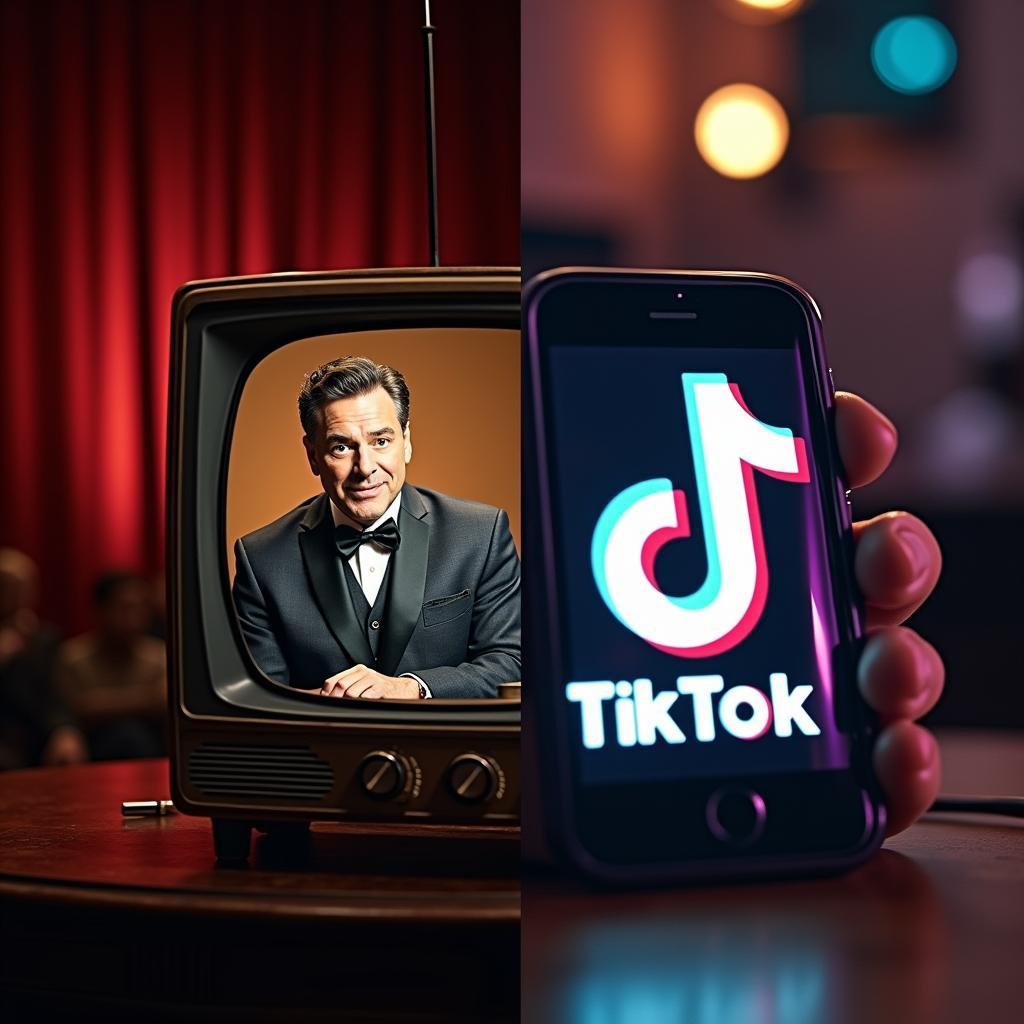 Minh họa sự thay đổi của hài kịch trong thời đại mạng xã hội
Question 4: Do you think comedians have a responsibility to be sensitive about their jokes?
🎯 Phân tích câu hỏi:
- Dạng: Opinion về ethical/social responsibility – controversial topic
- Key words: “responsibility”, “sensitive”, “jokes”
- Cách tiếp cận:
- Acknowledge complexity của issue
- Present different perspectives (freedom of expression vs social responsibility)
- State your balanced position
- Consider context and nuance
- Conclude với personal stance
📝 Câu trả lời mẫu – Band 8-9:
This is one of the most contentious debates in contemporary comedy, and honestly, I think the answer is nuanced rather than binary.
On one hand, comedy has historically served as a vehicle for social commentary and pushing boundaries. Some of the most impactful comedians – people like George Carlin or Hannah Gadsby – have tackled uncomfortable topics precisely to provoke thought and challenge social norms. There’s a legitimate argument that imposing too many restrictions on comedy stifles creativity and undermines one of its core functions: making us examine difficult truths through the lens of humor. The line between satire and offense is often deliberately blurred to create impact.
That said, I do believe context and intent matter enormously. There’s a distinction between humor that punches up – challenging power structures and societal injustices – versus humor that punches down, which mocks vulnerable groups or perpetuates harmful stereotypes. Personally, I think comedians bear some responsibility to be aware of the potential impact of their material, particularly when they have large platforms. As the saying goes, “with great reach comes great responsibility.”
What complicates this further is that humor is inherently subjective. What one person finds lighthearted and clever, another might experience as deeply offensive based on their lived experiences. Vietnamese comedy, for example, often includes self-deprecating humor about our own culture, which feels different when done within the community versus by outsiders.
My personal view is that the best comedy manages to be both daring and thoughtful. Comedians should have the freedom to tackle any topic, but that freedom comes with the responsibility to craft jokes carefully, understand their audience, and accept that some material will receive legitimate criticism. It’s not about censorship, but about conscious artistry – being funny while minimizing unnecessary harm. At the end of the day, if your comedy relies on punching down at marginalized groups, you might need to examine whether you’re being provocative or just lazy.
Phân tích:
- Sophisticated handling của controversial topic
- Balanced argument (both sides presented fairly)
- Specific concepts (punch up vs punch down)
- Cultural awareness (Vietnamese example)
- Nuanced conclusion (freedom with responsibility)
- Advanced vocabulary (contentious, stifles, undermines, perpetuates, inherently subjective, conscious artistry)
Khi thảo luận về các vấn đề phức tạp như trách nhiệm xã hội, việc thể hiện sự am hiểu về describe a public figure you respect có thể giúp bạn đưa ra những ví dụ cụ thể và thuyết phục hơn.
Theme 3: Psychology and Health Benefits
Question 5: What are the health benefits of laughter?
🎯 Phân tích câu hỏi:
- Dạng: Explain benefits/effects – scientific/factual
- Key words: “health benefits”, “laughter”
- Cách tiếp cận:
- Acknowledge multiple benefits
- Categorize (physical, mental, social)
- Explain mechanisms nếu biết
- Give examples or evidence
- Personal observation optional
📝 Câu trả lời mẫu – Band 8-9:
Laughter is, in many ways, nature’s medicine, with benefits that span physical, psychological, and social dimensions. The scientific evidence supporting this is actually quite compelling.
From a physiological standpoint, laughter triggers several beneficial responses in the body. It stimulates circulation, increases oxygen intake, and activates the release of endorphins – the body’s natural painkillers and mood elevators. There’s research suggesting that a good laugh can actually provide a mild workout for your cardiovascular system, somewhat comparable to light exercise. Interestingly, studies have shown that laughter can temporarily boost immune function by increasing the production of antibodies and activating immune cells. Some hospitals have even introduced laughter therapy programs for patients dealing with chronic conditions, precisely because of these measurable benefits.
Psychologically, the benefits are equally significant. Laughter acts as a powerful stress reducer, lowering cortisol levels and counteracting the harmful effects of chronic stress. It’s remarkably effective at providing perspective during difficult times – there’s something therapeutic about being able to find humor even in adversity. From a mental health perspective, regular laughter is associated with lower rates of depression and anxiety. It essentially serves as a release valve for emotional tension.
The social benefits shouldn’t be overlooked either. As I mentioned earlier, shared laughter strengthens bonds between people, which indirectly supports mental health through social connection. In Vietnamese culture, we have a saying that roughly translates to “a day without laughter is a wasted day,” which reflects the cultural wisdom recognizing laughter’s importance to wellbeing.
Of course, laughter isn’t a panacea – it won’t cure serious diseases – but as a complementary wellness practice, its benefits are well-documented and completely free. In our increasingly stressful modern world, actively seeking opportunities to laugh might be one of the simplest yet most effective wellness strategies available.
Phân tích:
- Scientific approach với evidence-based claims
- Organized categorically (physiological, psychological, social)
- Specific mechanisms explained (endorphins, cortisol, antibodies)
- Real-world application (hospital programs)
- Cultural reference (Vietnamese saying)
- Balanced conclusion (not a panacea)
- Advanced medical/scientific vocabulary (physiological, cardiovascular, antibodies, cortisol, panacea, complementary wellness)
Question 6: Why do some people laugh in stressful or serious situations?
🎯 Phân tích câu hỏi:
- Dạng: Explain psychological phenomenon
- Key words: “laugh”, “stressful or serious situations” – inappropriate laughter
- Cách tiếp cận:
- Acknowledge the phenomenon
- Explain psychological reasons (defense mechanism, nervous response)
- Discuss social/cultural aspects
- Give examples
- Note that it’s normal
📝 Câu trả lời mẫu – Band 8-9:
This is a fascinating psychological phenomenon that’s actually more common than people realize, and it stems from several interconnected psychological mechanisms.
Primarily, this type of laughter functions as a defense mechanism – a way for the brain to cope with overwhelming emotions or situations. When we encounter something too painful, frightening, or intense to process normally, inappropriate laughter can serve as a kind of psychological pressure valve, releasing tension that might otherwise become unbearable. Psychologists call this “nervous laughter” or “stress-induced laughter.” It’s the nervous system’s way of attempting to restore equilibrium when we’re emotionally flooded.
There’s also a neurological component. During highly stressful moments, the brain can essentially misfire, with the same neural pathways that process fear or anxiety accidentally triggering the laughter response. This is why some people laugh at funerals or during accidents – it’s not that they find the situation funny, but rather their brain is essentially short-circuiting under emotional overload.
Socially, this phenomenon can be quite problematic because laughter is universally recognized as a signal of amusement or joy. When someone laughs during a somber occasion, others might misinterpret it as disrespect or callousness, when in reality, it’s completely involuntary and often causes the person experiencing it considerable embarrassment afterward. In Vietnamese culture, where maintaining appropriate demeanor in serious situations is highly valued, this can be particularly mortifying.
Interestingly, there’s also the element of incongruity – sometimes laughter emerges when reality doesn’t match our expectations. For instance, if something absurd happens during a serious meeting, the disconnect between the formal context and the ridiculous occurrence can trigger laughter as our brains process this mismatch.
It’s worth emphasizing that this type of laughter is generally involuntary and shouldn’t be judged harshly. It’s a very human response to being overwhelmed, and understanding the psychology behind it can foster greater empathy for those who experience it.
Phân tích:
- Scientific and psychological depth
- Multiple explanations (defense mechanism, neurological, social, incongruity)
- Technical terminology (neural pathways, stress-induced, equilibrium)
- Cultural sensitivity (Vietnamese context)
- Empathetic conclusion
- Sophisticated explanatory language (stems from, serves as, functions as, triggers)
Tương tự như cách describe an interesting outdoor activity you tried yêu cầu phân tích cảm xúc và phản ứng tâm lý, việc hiểu sâu về các phản ứng cảm xúc phức tạp giúp bạn trả lời Part 3 một cách thuyết phục hơn.
Theme 4: Future of Comedy
Question 7: How do you think comedy will develop in the future?
🎯 Phân tích câu hỏi:
- Dạng: Prediction/speculation về future trends
- Key words: “comedy”, “develop”, “future”
- Cách tiếp cận:
- Acknowledge difficulty của prediction
- Identify current trends that might continue
- Consider technological influences
- Discuss possible changes in content/style
- Use tentative language (may, might, likely, probably)
📝 Câu trả lời mẫu – Band 8-9:
Predicting the future of comedy is challenging, but based on current trends, I can hazard some educated guesses about potential directions.
Technologically, I think we’ll see increasingly sophisticated integration of AI and VR in comedy. We’re already seeing AI-generated memes and comedic content, and while they’re rudimentary now, the technology will inevitably improve. Imagine virtual reality comedy clubs where you could watch a holographic comedian perform in your living room, or AI assistants that tailor jokes to your personal sense of humor based on your reaction history. This personalization could make comedy more accessible but might also create echo chambers where people only encounter humor that reinforces their existing preferences.
Content-wise, I anticipate two potentially divergent trends. On one hand, growing awareness of social issues might push comedy toward more thoughtful, inclusive humor that punches up rather than down. We’re seeing a new generation of comedians who skillfully blend social commentary with entertainment – addressing topics like mental health, diversity, and climate change in ways that are both funny and meaningful.
Conversely, there might be a countercurrent toward extremely edgy, deliberately offensive comedy as a reaction against what some perceive as excessive political correctness. This tension between these two directions will likely define comedic discourse for years to come.
In terms of format, the trend toward shorter, more digestible content will probably continue, driven by social media consumption patterns. However, I hope we’ll also see a renaissance of longer-form comedy – comedy albums, specials, podcasts – for audiences craving more depth and sophisticated storytelling. There’s something to be said for comedy that takes its time to build complex narratives rather than just delivering quick hits.
Culturally, I expect greater cross-pollination of comedic styles as the internet makes global comedy more accessible. Vietnamese comedy might incorporate elements of Western stand-up tradition, while Western audiences might embrace Asian comedic formats. This cultural exchange could result in genuinely innovative hybrid forms.
Ultimately, while technology and platforms will evolve, I believe the fundamental human need for laughter will ensure comedy’s continued vitality. The best comedy has always reflected its times while revealing timeless truths about human nature – and I don’t see that changing, regardless of how it’s delivered.
Phân tích:
- Comprehensive prediction covering multiple dimensions
- Balanced view (divergent trends, both/and thinking)
- Specific predictions with reasoning
- Appropriate tentative language (I think, probably, might, could, anticipate)
- Technological, content, format, and cultural dimensions
- Hope và concern balanced
- Sophisticated future-oriented vocabulary (hazard educated guesses, inevitably, divergent trends, renaissance, cross-pollination, hybrid forms)
Từ vựng và cụm từ quan trọng
Topic-Specific Vocabulary
| Từ vựng/Cụm từ | Loại từ | Phiên âm | Nghĩa tiếng Việt | Ví dụ | Collocation |
|---|---|---|---|---|---|
| hilarious | adj | /hɪˈleəriəs/ | cực kỳ hài hước, buồn cười | The comedian’s performance was absolutely hilarious. | absolutely hilarious, find something hilarious, hilarious moment |
| crack someone up | phrasal verb | /kræk ʌp/ | làm ai đó cười nhiều | His jokes always crack me up. | really crack up, crack up laughing, never fail to crack up |
| burst into laughter | phrase | /bɜːst ˈɪntuː ˈlɑːftə/ | bật cười, cười phá lên | Everyone burst into laughter at the unexpected joke. | suddenly burst into, burst into hysterical laughter |
| side-splitting | adj | /ˈsaɪd ˌsplɪtɪŋ/ | buồn cười đến mức đau bụng | It was a side-splitting comedy show. | side-splitting humor, side-splitting jokes |
| witty | adj | /ˈwɪti/ | dí dỏm, thông minh hài hước | She’s known for her witty comments. | witty remark, witty banter, witty response |
| slapstick comedy | noun | /ˈslæpstɪk ˈkɒmədi/ | hài kịch hành động (té ngã, đánh đập) | Charlie Chaplin was famous for slapstick comedy. | classic slapstick, slapstick humor |
| deadpan | adj | /ˈdedpæn/ | nghiêm túc khi nói điều hài hước | His deadpan delivery makes everything funnier. | deadpan expression, deadpan humor, deadpan style |
| sense of humor | phrase | /sens əv ˈhjuːmə/ | khiếu hài hước | Having a good sense of humor helps in difficult situations. | good sense of humor, dry sense of humor, quirky sense of humor |
| chuckle | verb/noun | /ˈtʃʌkl/ | cười khúc khích | I couldn’t help but chuckle at his story. | give a chuckle, chuckle to oneself |
| giggle | verb/noun | /ˈɡɪɡl/ | cười khúc khích (nhẹ nhàng hơn) | The children were giggling in the corner. | fit of giggles, giggle uncontrollably |
| roar with laughter | phrase | /rɔː wɪð ˈlɑːftə/ | cười lớn, cười như pháo | The audience roared with laughter at the punchline. | roar with laughter, make someone roar |
| in stitches | idiom | /ɪn ˈstɪtʃɪz/ | cười đau bụng | His impression had us all in stitches. | have someone in stitches, leave in stitches |
| comedic timing | phrase | /kəˈmiːdɪk ˈtaɪmɪŋ/ | thời điểm hài hước (trong diễn xuất) | Good comedic timing is essential for stand-up. | perfect comedic timing, impeccable timing |
| punchline | noun | /ˈpʌntʃlaɪn/ | câu kết của truyện cười | The punchline caught everyone by surprise. | deliver the punchline, wait for the punchline |
| satirical | adj | /səˈtɪrɪkl/ | mang tính châm biếm, mỉa mai | The show offers satirical commentary on politics. | satirical humor, satirical magazine |
| absurdity | noun | /əbˈsɜːdəti/ | sự vô lý, phi lý | The absurdity of the situation made it funny. | sheer absurdity, point out the absurdity |
| awkwardness | noun | /ˈɔːkwədnəs/ | sự ngượng ngùng, khó xử | The awkwardness of the moment was amusing. | social awkwardness, awkwardness of the situation |
| amusing | adj | /əˈmjuːzɪŋ/ | thú vị, gây cười | I found his story quite amusing. | highly amusing, mildly amusing, rather amusing |
| tickle someone | verb | /ˈtɪkl/ | làm ai đó cười, thích thú | That joke really tickled me. | tickle someone’s fancy, tickle the funny bone |
| comic relief | phrase | /ˈkɒmɪk rɪˈliːf/ | sự giải tỏa bằng hài hước | The character provided comic relief in a serious drama. | provide comic relief, much-needed comic relief |
Idiomatic Expressions & Advanced Phrases
| Cụm từ | Nghĩa | Ví dụ sử dụng | Band điểm |
|---|---|---|---|
| laugh your head off | cười vỡ bụng, cười không ngừng | We laughed our heads off at the comedy show last night. | 7.5-9 |
| die laughing | cười ngặt nghẽo | I nearly died laughing when he told that story. | 7-8 |
| can’t keep a straight face | không thể giữ được nét nghiêm túc | I couldn’t keep a straight face when she walked in wearing that costume. | 7.5-8.5 |
| have the last laugh | cười sau cùng (chiến thắng cuối cùng) | Everyone doubted her, but she had the last laugh when she succeeded. | 8-9 |
| no laughing matter | không phải chuyện đùa, nghiêm trọng | Climate change is no laughing matter; we need to act now. | 7.5-8.5 |
| milk it for laughs | lợi dụng tình huống để tạo tiếng cười | The comedian really knew how to milk the situation for laughs. | 8-9 |
| punch up | châm biếm kẻ mạnh, quyền lực | Good satire punches up at those in power. | 8.5-9 |
| punch down | chế giễu người yếu thế | Comedy that punches down at vulnerable groups is problematic. | 8.5-9 |
| comedy gold | tình huống cực kỳ hài hước | His reaction to the surprise was pure comedy gold. | 7.5-8.5 |
| a barrel of laughs | người/điều rất vui vẻ, hài hước | The party was a barrel of laughs from start to finish. | 7-8 |
| laugh something off | cười để giấu đi, làm nhẹ chuyện | She tried to laugh off the embarrassing mistake. | 7.5-8.5 |
| split your sides | cười đau cả bụng | The movie was so funny, I was splitting my sides. | 7.5-8.5 |
Discourse Markers (Từ Nối Ý Trong Speaking)
Để bắt đầu câu trả lời:
- 📝 Well,… – Dùng khi cần thời gian suy nghĩ ngắn
- “Well, I’d say that humor plays a crucial role…”
- 📝 Actually,… – Đưa ra thông tin có thể surprising hoặc correcting
- “Actually, Vietnamese comedy has changed significantly…”
- 📝 To be honest,… – Thể hiện sự thật thà, chân thực
- “To be honest, I find slapstick comedy a bit juvenile.”
- 📝 I’d say that… – Đưa ra opinion một cách soft
- “I’d say that laughter is essential for mental health.”
- 📝 From my perspective,… – Góc nhìn cá nhân
- “From my perspective, comedy reflects cultural values.”
Để bổ sung ý:
- 📝 On top of that,… – Thêm vào đó, hơn nữa
- “On top of that, laughter strengthens social bonds.”
- 📝 What’s more,… – Ngoài ra
- “What’s more, humor helps us cope with stress.”
- 📝 Not to mention… – Chưa kể đến
- “Not to mention the physical health benefits of laughing.”
- 📝 Beyond that,… – Ngoài điều đó ra
- “Beyond that, comedy serves as social commentary.”
- 📝 Additionally,… – Thêm vào đó (formal hơn)
- “Additionally, shared laughter creates memories.”
Để đưa ra quan điểm cân bằng:
- 📝 On the one hand,… On the other hand,…
- “On the one hand, edgy comedy pushes boundaries. On the other hand, it can be offensive.”
- 📝 While it’s true that…, we also need to consider…
- “While it’s true that humor differs culturally, some elements are universal.”
- 📝 That said,… – Tuy nhiên, dù vậy
- “That said, not everyone appreciates the same type of humor.”
- 📝 Having said that,… – Sau khi nói điều đó
- “Having said that, context matters enormously in comedy.”
Để kết luận:
- 📝 All in all,… – Tóm lại
- “All in all, laughter is essential for well-being.”
- 📝 At the end of the day,… – Cuối cùng thì
- “At the end of the day, comedy brings people together.”
- 📝 Ultimately,… – Sau cùng, rốt cuộc
- “Ultimately, a good sense of humor makes life better.”
- 📝 In the final analysis,… – Xét cho cùng (formal)
- “In the final analysis, laughter is universal.”
Để đưa ra ví dụ:
- 📝 For instance,… / For example,…
- “For instance, British humor relies heavily on irony.”
- 📝 Take… for example/instance
- “Take stand-up comedy, for instance – it requires great skill.”
- 📝 A case in point is… – Một ví dụ điển hình là (formal)
- “A case in point is Charlie Chaplin’s silent films.”
Grammatical Structures Ấn Tượng
1. Conditional Sentences (Câu điều kiện):
Mixed conditional (Type 2 + Type 3):
- Formula: If + past simple, would + base verb / If + past perfect, would + base verb now
- Ví dụ: “If I hadn’t watched that comedy show, I wouldn’t be laughing about it now.” (Nếu tôi không xem chương trình hài đó, bây giờ tôi đã không cười về nó)
Inversion trong conditional:
- Formula: Had + subject + past participle, subject + would have…
- Ví dụ: “Had the comedian delivered the punchline earlier, the joke wouldn’t have been as funny.” (Nếu diễn viên hài nói câu kết sớm hơn, câu chuyện đã không hài hước như vậy)
2. Relative Clauses (Mệnh đề quan hệ):
Non-defining relative clauses:
- Formula: …, which/who + verb…
- Ví dụ: “My friend, who has an amazing sense of humor, always makes everyone laugh.” (Bạn tôi, người có khiếu hài hước tuyệt vời, luôn làm mọi người cười)
Reduced relative clauses:
- Formula: Noun + V-ing/V-ed…
- Ví dụ: “The situation described in the story was absolutely hilarious.” (Tình huống được miêu tả trong câu chuyện cực kỳ hài hước)
3. Passive Voice (Câu bị động):
It is thought/believed/said that…
- Formula: It + is + past participle + that…
- Ví dụ: “It is widely believed that laughter is the best medicine.” (Người ta tin rằng cười là liều thuốc tốt nhất)
Passive with modal verbs:
- Formula: Subject + modal + be + past participle
- Ví dụ: “Humor can be used to cope with difficult situations.” (Sự hài hước có thể được dùng để đối phó với tình huống khó khăn)
4. Cleft Sentences (Câu chẻ):
What… is/was…
- Formula: What + subject + verb + is/was…
- Ví dụ: “What made the situation funny was the unexpected timing.” (Điều làm cho tình huống hài hước là thời điểm bất ngờ)
- Ví dụ: “What I find most amusing about comedy shows is the clever wordplay.” (Điều tôi thấy thú vị nhất về chương trình hài là cách chơi chữ thông minh)
The thing/reason that…
- Formula: The thing/reason that + subject + verb + is…
- Ví dụ: “The reason that I love comedy is that it helps me relax.” (Lý do tôi yêu thích hài kịch là vì nó giúp tôi thư giãn)
5. Emphasis Structures:
Not only… but also…
- Formula: Not only + auxiliary + subject + verb, but also…
- Ví dụ: “Not only does laughter reduce stress, but it also strengthens relationships.” (Cười không chỉ giảm căng thẳng mà còn củng cố mối quan hệ)
Such… that…
- Formula: Such + (a/an) + adjective + noun + that…
- Ví dụ: “It was such a hilarious moment that everyone burst into laughter.” (Đó là một khoảnh khắc hài hước đến mức mọi người đều bật cười)
6. Advanced Comparative Structures:
The more… the more…
- Formula: The + comparative + subject + verb, the + comparative + subject + verb
- Ví dụ: “The more you laugh, the better you feel.” (Càng cười nhiều, bạn càng cảm thấy tốt hơn)
As… as…
- Formula: As + adjective/adverb + as
- Ví dụ: “Sharing laughter is as important as sharing meals in building relationships.” (Chia sẻ tiếng cười cũng quan trọng như chia sẻ bữa ăn trong việc xây dựng mối quan hệ)
Bài viết này đã cung cấp cho bạn một hướng dẫn toàn diện về cách trả lời chủ đề “describe a situation that made you laugh” trong IELTS Speaking. Từ các câu hỏi Part 1 thân thiện, đến cue card Part 2 đòi hỏi khả năng kể chuyện, cho đến các câu hỏi thảo luận sâu Part 3, bạn đã được trang bị đầy đủ từ vựng, cấu trúc và chiến lược để tự tin đạt điểm cao.
Điều quan trọng nhất là hãy nhớ: authenticity (sự chân thật) là chìa khóa thành công trong IELTS Speaking. Examiner không mong đợi những câu trả lời hoàn hảo như sách giáo khoa, mà họ muốn nghe bạn giao tiếp một cách tự nhiên, thể hiện suy nghĩ và cảm xúc thật. Hãy chọn những câu chuyện thực sự từng xảy ra với bạn, sử dụng từ vựng phù hợp với level của mình (đừng cố nhồi nhét quá nhiều từ khó), và quan trọng nhất – hãy tận hưởng cuộc trò chuyện.
Laughter is universal, và đây là một trong những chủ đề dễ chịu nhất bạn có thể gặp trong IELTS Speaking. Hãy để tính cách của bạn tỏa sáng, chia sẻ những khoảnh khắc vui vẻ một cách chân thành, và bạn sẽ không chỉ ghi điểm cao mà còn để lại ấn tượng tích cực với examiner!
Chúc bạn ôn tập hiệu quả và đạt band điểm như mong muốn!