Trong kỳ thi IELTS Speaking, chủ đề về “thinking outside the box” – tư duy sáng tạo, tìm giải pháp độc đáo – là một topic phổ biến và đầy thách thức. Đây là dạng câu hỏi yêu cầu bạn kể về một tình huống thực tế khi bạn phải đối mặt với khó khăn và tìm ra cách giải quyết không theo lối mòn thông thường.
Tần suất xuất hiện: Chủ đề này xuất hiện với tần suất khá cao trong các kỳ thi IELTS từ 2022 đến 2025, đặc biệt trong Part 2. Theo thống kê từ các đề thi thực tế được chia sẻ trên IELTS-Blog và IELTSLiz, câu hỏi về “creative thinking”, “problem-solving”, hay “unconventional solutions” xuất hiện khoảng 3-4 lần mỗi quý. Dự đoán khả năng xuất hiện trong tương lai vẫn ở mức Cao vì nó đánh giá được khả năng tư duy phản biện và kể chuyện của thí sinh.
Những gì bạn sẽ học được trong bài viết này:
- 10+ câu hỏi thực tế về creative thinking xuất hiện trong cả 3 Part
- 3 bài mẫu chi tiết cho Part 2 theo band điểm 6-7, 7.5-8, và 8.5-9 với phân tích sâu
- 25+ từ vựng và cụm từ ăn điểm kèm phiên âm và ví dụ thực tế
- Chiến lược trả lời hiệu quả từ góc nhìn Examiner
- Phân tích chi tiết tại sao một câu trả lời đạt band cao
- Lỗi thường gặp của học viên Việt Nam và cách khắc phục
IELTS Speaking Part 1: Introduction and Interview
Tổng Quan Về Part 1
Part 1 của IELTS Speaking kéo dài 4-5 phút với các câu hỏi về cuộc sống hàng ngày, sở thích, công việc hay học tập. Mục tiêu là tạo bầu không khí thoải mái và đánh giá khả năng giao tiếp cơ bản của bạn.
Đặc điểm:
- Câu hỏi ngắn gọn, dễ hiểu
- Tập trung vào kinh nghiệm cá nhân
- Không yêu cầu phân tích sâu
Chiến lược hiệu quả:
- Trả lời trực tiếp câu hỏi (1 câu)
- Mở rộng với lý do hoặc chi tiết (1-2 câu)
- Thêm ví dụ cụ thể nếu phù hợp (1 câu)
Lỗi thường gặp của học viên Việt Nam:
- Trả lời quá ngắn chỉ “Yes” hoặc “No”
- Sử dụng từ vựng quá đơn giản, lặp đi lặp lại
- Thiếu ví dụ cụ thể từ kinh nghiệm bản thân
- Nói quá nhanh hoặc quá chậm, thiếu tự nhiên
- Không duy trì eye contact với giám khảo
Các Câu Hỏi Thường Gặp
Dưới đây là các câu hỏi thực tế liên quan đến creative thinking và problem-solving thường xuất hiện trong Part 1:
Question 1: Do you consider yourself a creative person?
Question 2: When was the last time you had to solve a difficult problem?
Question 3: Do you prefer following instructions or finding your own way?
Question 4: Have you ever had to think quickly to solve an unexpected problem?
Question 5: Do you think creativity is important in your daily life?
Question 6: Are you good at finding solutions when things go wrong?
Question 7: Do you usually ask others for help or try to solve problems yourself?
Question 8: Have you learned any creative skills recently?
Phân Tích và Gợi Ý Trả Lời Chi Tiết
Question: Do you consider yourself a creative person?
🎯 Cách tiếp cận:
- Trả lời trực tiếp Yes/No hoặc “to some extent”
- Đưa ra lý do hoặc ví dụ chứng minh
- Kết nối với tình huống thực tế trong cuộc sống
📝 Sample Answer – Band 6-7:
“Yes, I think I’m quite creative. I like to find new ways to do things at work. For example, last month I created a new filing system for my office that saved a lot of time. My colleagues thought it was very useful.”
Phân tích:
- Điểm mạnh: Trả lời trực tiếp, có ví dụ cụ thể, câu văn rõ ràng
- Hạn chế: Từ vựng đơn giản (new ways, saved time), cấu trúc câu cơ bản, thiếu depth
- Tại sao Band 6-7: Câu trả lời đáp ứng được yêu cầu nhưng chưa thể hiện được lexical range và grammatical complexity. Ý tưởng còn surface-level.
📝 Sample Answer – Band 8-9:
“I’d say I’m fairly creative, particularly when it comes to problem-solving. I tend to think outside the conventional framework when faced with challenges. For instance, when my team was struggling with time management last quarter, I devised a digital workflow system that streamlined our processes considerably. It’s something I take pride in – finding innovative solutions rather than just following the standard approach.”
Phân tích:
-
Điểm mạnh:
- Vocabulary sophisticated: “fairly creative”, “conventional framework”, “devised”, “streamlined”
- Grammar đa dạng: participle phrases, relative clauses
- Ý tưởng rõ ràng với specific example
- Natural discourse markers: “I’d say”, “particularly”
-
Tại sao Band 8-9:
- Fluency: Câu trả lời trôi chảy với appropriate hesitation (“I’d say”)
- Vocabulary: Precise và less common words (devised, streamlined)
- Grammar: Complex structures được sử dụng tự nhiên
- Pronunciation: Sentence stress được đặt đúng chỗ quan trọng
💡 Key Vocabulary & Expressions:
- fairly creative: khá sáng tạo (cách nói khiêm tốn, tự nhiên hơn “very creative”)
- think outside the conventional framework: tư duy ngoài khuôn khổ thông thường
- devised: nghĩ ra, thiết kế (formal hơn “created”)
- streamlined: tối ưu hóa, làm mượt mà hơn
- take pride in: tự hào về điều gì
Question: When was the last time you had to solve a difficult problem?
🎯 Cách tiếp cận:
- Xác định thời gian cụ thể (last week, a few months ago)
- Mô tả ngắn gọn vấn đề
- Nêu giải pháp và kết quả
📝 Sample Answer – Band 6-7:
“It was about two weeks ago. My computer stopped working before an important presentation. I was very worried but I borrowed my colleague’s laptop and transferred all my files using cloud storage. In the end, the presentation went well.”
Phân tích:
- Điểm mạnh: Timeline rõ ràng, có problem và solution, logical flow
- Hạn chế: Vocabulary repetitive (stopped working, went well), thiếu emotional language, ít complex grammar
- Tại sao Band 6-7: Đáp ứng yêu cầu cơ bản nhưng thiếu sophistication trong cách diễn đạt
📝 Sample Answer – Band 8-9:
“Just last week, actually. I was confronted with a technical glitch literally an hour before a crucial client presentation. My laptop crashed and wouldn’t boot up. Rather than panicking, I swiftly transferred all my materials to my colleague’s device via cloud backup – thankfully I’d been diligent about saving everything online. It was a close call, but the presentation went off without a hitch. The experience really reinforced the importance of having contingency plans.”
Phân tích:
-
Điểm mạnh:
- Time marker natural: “Just last week, actually”
- Precise vocabulary: confronted with, technical glitch, crashed
- Emotional language: panicking, close call
- Complex grammar: participle phrases, past perfect
- Shows reflection: “reinforced the importance”
-
Tại sao Band 8-9:
- Fluency: Natural storytelling với appropriate pace
- Vocabulary: Collocations như “boot up”, “went off without a hitch”
- Grammar: Mix of tenses showing sophisticated control
- Ideas: Shows problem, solution, outcome, và reflection
💡 Key Vocabulary & Expressions:
- confronted with: đối mặt với (formal hơn “faced”)
- technical glitch: sự cố kỹ thuật
- boot up: khởi động (máy tính)
- diligent about: cẩn thận, siêng năng trong việc gì
- close call: tình huống suýt nữa thì gặp rắc rối
- went off without a hitch: diễn ra suôn sẻ, không có trục trặc
- contingency plans: phương án dự phòng
Question: Do you prefer following instructions or finding your own way?
🎯 Cách tiếp cận:
- Có thể chọn một trong hai hoặc cân bằng
- Giải thích lý do preference
- Kết nối với personality hoặc experience
📝 Sample Answer – Band 6-7:
“I think it depends on the situation. When I’m doing something new, I prefer to follow instructions because it’s safer. But if I know the task well, I like to find my own way because it can be more efficient.”
Phân tích:
- Điểm mạnh: Balanced view, logical reasoning, clear structure
- Hạn chế: Basic vocabulary (safer, more efficient), simple conditionals
- Tại sao Band 6-7: Adequate response nhưng thiếu personal touch và sophisticated language
📝 Sample Answer – Band 8-9:
“That’s an interesting question – I’d say it’s contextual. When I’m venturing into unfamiliar territory, I tend to rely on established guidelines as a foundation. However, once I’ve grasped the fundamentals, I’m inclined to experiment and tailor my approach to suit the specific circumstances. I find this hybrid method strikes a balance between efficiency and innovation. For instance, in my work, I’ll follow the standard operating procedures initially, but then refine them based on what actually works in practice.”
Phân tích:
-
Điểm mạnh:
- Opening acknowledgement: “That’s an interesting question”
- Abstract vocabulary: contextual, foundation, fundamentals
- Balanced argument với nuance
- Specific terminology: hybrid method, standard operating procedures
- Personal example demonstrates understanding
-
Tại sao Band 8-9:
- Fluency: Sophisticated discourse structure
- Vocabulary: Less common phrases và idiomatic expressions
- Grammar: Complex conditionals và varied sentence structures
- Ideas: Shows critical thinking và mature perspective
💡 Key Vocabulary & Expressions:
- contextual: phụ thuộc vào ngữ cảnh
- venturing into unfamiliar territory: mạo hiểm vào lĩnh vực chưa quen
- rely on: dựa vào
- inclined to: có xu hướng, thiên về
- tailor my approach: điều chỉnh cách tiếp cận cho phù hợp
- hybrid method: phương pháp kết hợp
- refine: tinh chỉnh, hoàn thiện
 Học viên đang luyện tập IELTS Speaking Part 1 với giám khảo về chủ đề tư duy sáng tạo
IELTS Speaking Part 2: Long Turn (Cue Card)
Tổng Quan Về Part 2
Part 2 là phần độc thoại kéo dài 2-3 phút, trong đó bạn có 1 phút để chuẩn bị. Đây là phần challenging nhất vì bạn phải nói liên tục mà không được ngắt quãng.
Thời gian:
- Chuẩn bị: 1 phút (với giấy và bút ghi chú)
- Nói: 2-3 phút (tối thiểu 1.5 phút)
Đặc điểm:
- Kể chi tiết về một chủ đề cụ thể
- Phải cover đầy đủ tất cả bullet points
- Giám khảo không ngắt lời cho đến khi hết thời gian
Chiến lược thành công:
- Sử dụng hiệu quả 1 phút chuẩn bị: Ghi keywords, không viết câu hoàn chỉnh
- Organize notes theo bullet points: Mỗi bullet một dòng với 2-3 keywords
- Nói đủ thời gian: Aim for 2.5 phút, distribute time evenly cho các bullet points
- Sử dụng thì quá khứ: Khi kể về experience/event đã qua
- Kết thúc mạnh mẽ: Dành 20-30 giây cuối cho “explain” part vì đây là phần ghi điểm cao nhất
Lỗi thường gặp của học viên Việt Nam:
- Không tận dụng 1 phút chuẩn bị, bắt đầu nói ngay
- Nói dưới 1.5 phút rồi im lặng chờ giám khảo
- Bỏ sót bullet points hoặc nói không cân đối
- Kể chuyện thiếu chi tiết, quá chung chung
- Không nhấn mạnh phần “explain” quan trọng nhất
- Nói quá nhanh vì lo sợ hết ý tưởng
Cue Card
Describe A Situation Where You Were Forced To Think Outside The Box
You should say:
- What the situation was
- When and where it happened
- Why you had to think creatively
- And explain how you felt about this experience and what you learned from it
Phân Tích Đề Bài
Dạng câu hỏi: Describe an experience/event – kể về một trải nghiệm cụ thể trong quá khứ
Thì động từ: Chủ yếu Past Simple và Past Continuous cho narrative, Present Perfect cho reflection
Bullet points phải cover:
- What: Tình huống cụ thể là gì? (Problem/Challenge)
- When/Where: Thời gian và địa điểm (Context)
- Why creative thinking: Tại sao phải tư duy sáng tạo? Conventional methods không hiệu quả ra sao?
- Feelings + Learning: Cảm xúc và bài học – đây là phần QUAN TRỌNG NHẤT để đạt band cao
Câu “explain” quan trọng: Đây là phần ghi điểm cao nhất vì yêu cầu analysis và reflection, không chỉ description. Dành ít nhất 40-50 giây cho phần này.
Gợi ý situations phù hợp:
- Work/academic challenge
- Event organization problem
- Budget limitation situation
- Communication barrier
- Technical difficulty
- Time constraint situation
📝 Sample Answer – Band 6-7
Thời lượng: Khoảng 1.5-2 phút
“I’d like to talk about a situation that happened last year when I was organizing my company’s annual event. It took place in October at our office building.
The situation was quite challenging. We had to organize a team-building event for 50 employees, but our budget was suddenly cut by 40% just two weeks before the event. We had already booked an expensive venue and planned many activities that we could no longer afford.
I had to think creatively because the normal solution of just canceling expensive things would make the event very boring. Instead, I came up with a different idea. I contacted some partner companies and asked if they would sponsor our event in exchange for advertising opportunities. I also moved the event to a public park which was free, and I organized games using simple materials we already had in the office.
The most creative part was turning it into a ‘eco-friendly challenge’ theme, so the simple setting actually fit the concept perfectly. We even got local food vendors to provide lunch at a discount because we promoted their businesses to our employees.
I felt quite stressed at first because I wasn’t sure if my ideas would work. But when the event happened, it was actually more successful than our previous events. Everyone enjoyed the outdoor setting and the activities. I felt really proud and relieved.
From this experience, I learned that limitations can actually push you to be more creative. I also learned that asking for help and collaborating with others can lead to better solutions than trying to solve everything alone. Now I’m more confident when facing difficult situations at work.”
Phân Tích Band Điểm
| Tiêu chí | Band | Nhận xét |
|---|---|---|
| Fluency & Coherence | 6-7 | Nói liên tục được 1.5-2 phút, có sequencing rõ ràng (first, instead, the most creative part). Còn một số hesitation nhẹ. Linking words cơ bản. |
| Lexical Resource | 6-7 | Vocabulary adequate: “cut by 40%”, “came up with”, “in exchange for”. Có một số collocations tốt nhưng chưa nhiều. Paraphrasing đơn giản. |
| Grammatical Range & Accuracy | 6-7 | Mix of simple và complex sentences. Có relative clauses, conditionals cơ bản. Một số lỗi nhỏ có thể có nhưng không ảnh hưởng communication. |
| Pronunciation | 6-7 | Rõ ràng, dễ hiểu. Word stress và sentence stress cơ bản đúng. Intonation acceptable nhưng chưa sophisticated. |
Điểm mạnh:
- ✅ Cover đầy đủ tất cả bullet points
- ✅ Có structure rõ ràng: situation → problem → solution → feeling → learning
- ✅ Ví dụ cụ thể và realistic
- ✅ Nói đủ thời gian tối thiểu
Hạn chế:
- ⚠️ Vocabulary chưa impressive, còn nhiều từ basic (very boring, simple materials)
- ⚠️ Grammar structures còn đơn giản, ít complex sentences
- ⚠️ Thiếu depth trong phần reflection/learning
- ⚠️ Chưa có nhiều descriptive language cho feelings
📝 Sample Answer – Band 7.5-8
Thời lượng: Khoảng 2-2.5 phút
“I’d like to share an experience from about six months ago when I found myself in quite a predicament while organizing a university fundraising event.
The situation unfolded in March, right at our campus auditorium. I was leading a team of volunteers to organize a charity concert to raise funds for underprivileged students. Everything was meticulously planned – we’d secured sponsors, sold tickets, and lined up performers. However, three days before the event, our main venue unexpectedly flooded due to a burst pipe, rendering it completely unusable.
This is where I really had to think outside the conventional framework. Simply postponing wasn’t an option because we’d lose sponsors and disappoint ticket holders. Conventional wisdom would suggest finding an alternative indoor venue, but with such short notice, every suitable space was either booked or prohibitively expensive.
So I devised an unconventional solution – we’d take the event outdoors. I leveraged social media to create buzz around a ‘Concert Under the Stars’ concept, rebranding the crisis as a unique selling point. We collaborated with local businesses who provided tents and equipment at minimal cost in exchange for exposure. The performers were actually enthusiastic about the outdoor format, and we incorporated acoustic sets that suited the atmosphere perfectly.
Emotionally, it was quite a rollercoaster. Initially, I felt overwhelmed and questioned whether I was making a reckless decision. The night before, I barely slept, running through every possible scenario. But when I saw over 300 people gathered under fairy lights, enjoying the music and atmosphere, I felt an immense sense of relief and accomplishment.
This experience taught me several valuable lessons. Firstly, that constraints often breed creativity – having no easy options forced me to think differently. I also learned the importance of reframing problems as opportunities. Instead of seeing the flood as a disaster, pivoting to an outdoor concept actually created something more memorable. Most importantly, I discovered that taking calculated risks and trusting your instincts can lead to unexpected success. It’s fundamentally changed how I approach challenges now – I’m less afraid of unconventional solutions.”
Phân Tích Band Điểm
| Tiêu chí | Band | Nhận xét |
|---|---|---|
| Fluency & Coherence | 7.5-8 | Nói trôi chảy 2+ phút, minimal hesitation. Sophisticated sequencing (This is where…, Initially…, The night before…). Strong paragraphing. |
| Lexical Resource | 7.5-8 | Wide range: predicament, meticulously planned, prohibitively expensive. Good collocations: reframing problems, calculated risks. Appropriate paraphrasing. |
| Grammatical Range & Accuracy | 7.5-8 | Complex structures: past perfect, participle phrases, relative clauses. Mix of active/passive. Errors very rare. |
| Pronunciation | 7.5-8 | Clear pronunciation với good stress và intonation. Features of connected speech. Sustained effort throughout. |
So Sánh Với Band 6-7
| Khía cạnh | Band 6-7 | Band 7.5-8 |
|---|---|---|
| Vocabulary | “challenging”, “came up with”, “stressed” | “predicament”, “devised”, “rollercoaster”, “immense sense of relief” |
| Grammar | “We had to organize… but our budget was cut” | “we’d secured sponsors… However, three days before the event, our main venue unexpectedly flooded” |
| Ideas | “I learned that limitations can push you to be creative” | “constraints often breed creativity… reframing problems as opportunities… taking calculated risks and trusting your instincts” |
| Storytelling | Linear description | Rich narrative với emotional journey và vivid details |
Tại sao đạt Band 7.5-8:
- Vocabulary precise và sophisticated (predicament, prohibitively expensive)
- Grammar complex nhưng accurate (past perfect sequences, participle phrases)
- Ideas well-developed với depth trong reflection
- Storytelling engaging với sensory details và emotional arc
- Pronunciation features như sentence stress và chunking tốt
📝 Sample Answer – Band 8.5-9
Thời lượng: 2.5-3 phút đầy đủ
“I’d like to recount a particularly challenging predicament I encountered approximately eight months ago, which really pushed the boundaries of my conventional thinking.
The situation arose in the context of my role as a project coordinator at a tech startup. We were on the cusp of launching a mobile application that had been in development for over a year. The setting was our downtown office, and it was literally 48 hours before our high-stakes presentation to potential investors who could make or break our company’s future.
What happened was that our lead developer suddenly fell ill and was hospitalized, leaving us with a critical bug in the application that none of our other team members could crack. The conventional approach would have been to either postpone the investor meeting – which would have severely undermined our credibility – or present a flawed product, which was essentially professional suicide. We were essentially caught between a rock and a hard place.
This is where I truly had to think outside the box. Rather than viewing this as a purely technical problem, I reframed it as a communication and expectation management challenge. I orchestrated what I called a ‘transparent innovation approach.’ Instead of trying to hide the bug, we strategically incorporated it into our presentation narrative. I contacted the investors and positioned our pitch as an ‘interactive problem-solving session’ where we’d demonstrate not just our product, but our team’s real-time problem-solving capabilities.
During the actual presentation, we openly acknowledged the technical glitch, then livestreamed our remaining developers working on it while I led the investors through our business model, market analysis, and growth strategy. We turned what could have been a catastrophic flaw into a demonstration of transparency and agility. I even invited the investors to suggest solutions, which fostered an unprecedented level of engagement.
Emotionally, this was perhaps the most intense experience of my professional life. In the lead-up to the meeting, I grappled with severe self-doubt and imposter syndrome. I was essentially betting the company’s future on an untested approach that many would consider reckless. The night before, I experienced what I can only describe as existential anxiety – questioning whether my unconventional strategy was innovative or simply foolhardy.
However, when I saw the investors leaning forward, asking insightful questions, and genuinely invested in our problem-solving process, I felt a profound shift from trepidation to cautious optimism. By the end, when they not only agreed to invest but actually increased their initial offer, citing our ‘refreshing honesty’ and ‘adaptive capacity,’ I experienced an overwhelming sense of vindication.
The ramifications of this experience have been far-reaching. On a practical level, I learned that transparency can be a strategic asset rather than a vulnerability, especially in industries that value authenticity. More philosophically, it taught me that genuine innovation often involves challenging not just how we solve problems, but the very assumptions underlying what constitutes a ‘problem’ in the first place.
I also gained invaluable insight into the relationship between risk and creativity. Necessity, as they say, is the mother of invention – but I’d add that calculated risk-taking is its father. This experience has fundamentally altered my professional paradigm. I’m now far more receptive to unconventional solutions and less constrained by traditional frameworks. It’s essentially given me what I call ‘creative confidence‘ – the belief that sometimes the most counterintuitive approaches yield the most remarkable results.”
Phân Tích Band Điểm
| Tiêu chí | Band | Nhận xét |
|---|---|---|
| Fluency & Coherence | 8.5-9 | Speaks fluently với natural hesitation. Sophisticated cohesion (This is where…, In the lead-up…, More philosophically…). Perfect paragraphing và sequencing. |
| Lexical Resource | 8.5-9 | Idiomatic: “caught between a rock and a hard place”, “make or break”. Precise: vindication, ramifications, paradigm. Natural collocations throughout. Skilful paraphrasing. |
| Grammatical Range & Accuracy | 8.5-9 | Full range of structures: inversion, cleft sentences, complex conditionals. Consistent accuracy. Natural use of all tenses. |
| Pronunciation | 8.5-9 | Effortless pronunciation. Full control of features: stress, rhythm, intonation. Connected speech features naturally used. |
Tại Sao Bài Này Xuất Sắc
🎯 Fluency Hoàn Hảo:
- Nói đủ 2.5-3 phút một cách tự nhiên, không forced
- Hesitation devices sophisticated: “I can only describe as”, “what I call”
- Narrative flow xuất sắc với clear emotional arc
📚 Vocabulary Tinh Vi:
- Idiomatic expressions: “caught between a rock and a hard place”, “make or break” – sử dụng natural, không cứng nhắc
- Precise academic vocabulary: ramifications, paradigm, vindication, trepidation
- Strong collocations: unprecedented level of engagement, calculated risk-taking, profound shift
- Variety: Paraphrase “difficult situation” thành predicament, thành caught between a rock and a hard place
📝 Grammar Đa Dạng:
- Complex conditionals: “Instead of trying to hide the bug, we strategically incorporated it”
- Participle phrases: “citing our ‘refreshing honesty'”
- Cleft sentences: “It’s essentially given me what I call ‘creative confidence'”
- Inversion: “Rather than viewing this… I reframed it”
- Past perfect sequences: “application that had been in development”
💡 Ideas Sâu Sắc:
- Không chỉ describe mà còn analyze: “challenging not just how we solve problems, but the very assumptions”
- Philosophical reflection: “Necessity is the mother of invention – but I’d add that calculated risk-taking is its father”
- Shows maturity: acknowledges self-doubt, imposter syndrome
- Meta-cognitive awareness: “creative confidence”, “paradigm shift”
🎭 Storytelling Xuất Sắc:
- Dramatic tension: 48 hours before high-stakes presentation
- Emotional journey: anxiety → self-doubt → cautious optimism → vindication
- Sensory details: investors “leaning forward”, “livestreamed” developers working
- Satisfying resolution với unexpected positive outcome
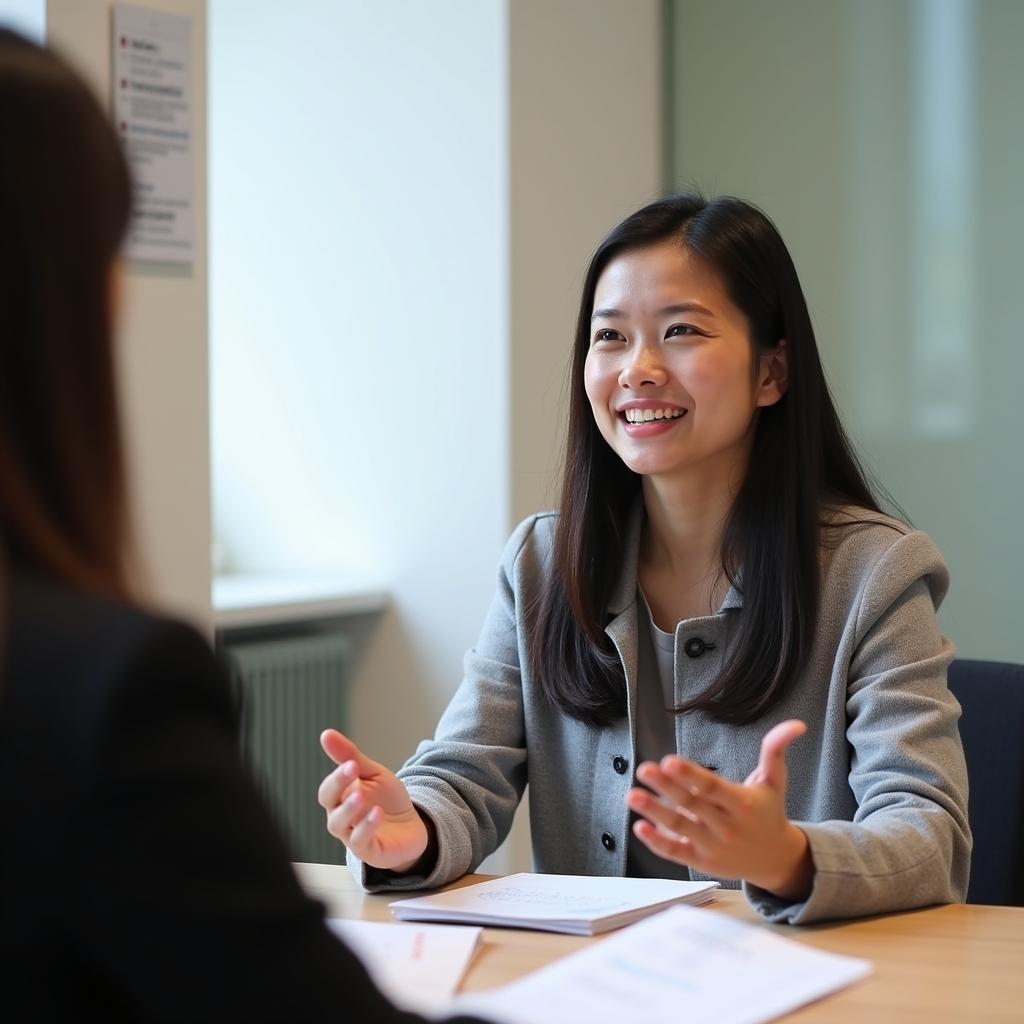 Thí sinh tự tin trình bày Part 2 IELTS Speaking về tình huống tư duy sáng tạo
Follow-up Questions (Rounding Off Questions)
Sau khi bạn hoàn thành phần nói 2-3 phút, giám khảo thường hỏi thêm 1-2 câu ngắn để transition sang Part 3. Những câu này không được chấm điểm nghiêm ngặt như Part 3 nhưng vẫn cần trả lời tốt.
Question 1: Did you face any other challenges during that time?
Band 6-7 Answer:
“Yes, besides the main problem, we also had some communication issues with team members. Some people disagreed with my approach initially.”
Band 8-9 Answer:
“Absolutely. Beyond the primary challenge, we also grappled with some internal resistance. A few team members were skeptical about such an unconventional strategy and worried it might backfire. Navigating those interpersonal dynamics while staying focused on the solution was quite demanding.”
💡 Giải thích:
- Band 8-9 answer sử dụng vocabulary precise hơn: grappled with (thay vì had), internal resistance (thay vì disagreed)
- Grammar phức tạp hơn với participle phrases: “Navigating those… while staying focused”
- Thêm depth: không chỉ nói có vấn đề mà còn nói về impact (demanding)
Question 2: Would you handle a similar situation differently now?
Band 6-7 Answer:
“I think I would be more confident now because I have more experience. But I would probably use the same approach because it worked well.”
Band 8-9 Answer:
“That’s an interesting question. While I’d retain the core philosophy of transparency and creative problem-solving, I think I’d implement it with more strategic planning. The experience has taught me to anticipate potential pushback and prepare stakeholders earlier. So essentially, the same approach but with more refinement and proactive communication.”
💡 Giải thích:
- Band 8-9 shows reflection và growth mindset
- Sử dụng tentative language sophisticated: “I think I’d”, “essentially”
- Balanced answer: giữ lại điểm mạnh nhưng acknowledge improvement areas
IELTS Speaking Part 3: Two-way Discussion
Tổng Quan Về Part 3
Part 3 là phần thảo luận sâu kéo dài 4-5 phút, nơi giám khảo đặt các câu hỏi trừu tượng và phức tạp hơn liên quan đến chủ đề Part 2. Đây là phần quan trọng nhất để phân biệt thí sinh band 7 và band 8+.
Đặc điểm:
- Câu hỏi abstract, theoretical
- Yêu cầu phân tích, so sánh, đánh giá
- Test critical thinking và ability to discuss complex ideas
- Không còn về personal experience mà về society, trends, issues
Yêu cầu:
- Analysis: Phân tích nguyên nhân, hệ quả
- Comparison: So sánh các khía cạnh khác nhau
- Evaluation: Đánh giá ưu nhược điểm
- Speculation: Dự đoán xu hướng tương lai
- Justification: Giải thích quan điểm với lý lẽ chặt chẽ
Chiến lược hiệu quả:
- Mở rộng câu trả lời 3-5 câu (30-45 giây)
- Structure rõ ràng: Direct answer → Reason 1 + example → Reason 2 + example → Conclusion/Balance
- Sử dụng discourse markers: Well, Actually, To be honest, From my perspective
- Acknowledge complexity: “It’s a complex issue”, “There are multiple factors”
- Provide examples from society, research, trends – không chỉ cá nhân
- Show balanced view: consider both sides khi appropriate
Lỗi thường gặp của học viên Việt Nam:
- Trả lời quá ngắn (1-2 câu) vì sợ sai
- Không có structure, nói lan man
- Chỉ nói về personal experience thay vì societal perspective
- Thiếu từ vựng abstract và academic
- Không thừa nhận complexity của issue
- Đưa ra opinion quá absolute, không nuanced
- Không biết cách “buy time” khi cần suy nghĩ
Các Câu Hỏi Thảo Luận Sâu
Dưới đây là các câu hỏi Part 3 authentic được phân loại theo themes, xuất hiện trong các kỳ thi thực tế:
Theme 1: Creativity in Society
Question 1: Why do you think creativity is important in the modern workplace?
🎯 Phân tích câu hỏi:
- Dạng: Why question – yêu cầu explain reasons và importance
- Key words: creativity, modern workplace (so sánh với past)
- Cách tiếp cận:
- Direct answer về importance
- Reason 1: Innovation/Competition + example
- Reason 2: Problem-solving/Adaptability + example
- Conclusion: Link to future trends
📝 Sample Answer – Band 6-7:
“I think creativity is very important in modern workplaces because businesses need to compete with each other. If companies don’t have new ideas, they will fall behind their competitors. Also, creative employees can solve problems better and find more efficient ways to work. For example, many successful companies like Apple became successful because of creative thinking. So creativity helps both the company and individual workers succeed.”
Phân tích:
- Structure: Có opinion → 2 reasons → example → conclusion nhưng còn basic
- Vocabulary: Adequate nhưng repetitive (creative/creativity xuất hiện nhiều lần), “very important”, “fall behind” còn common
- Grammar: Simple structures, ít complex sentences
- Tại sao Band 6-7: Đáp ứng yêu cầu cơ bản, có reasons và example, nhưng thiếu sophistication và depth. Ideas còn surface-level.
📝 Câu trả lời mẫu – Band 8-9:
“Well, I’d argue that creativity has become absolutely fundamental in today’s workplace, and there are several compelling reasons for this.
Firstly, we’re living in an era of unprecedented disruption where industries are being transformed at a breakneck pace. Companies that rely solely on traditional methods often find themselves rendered obsolete almost overnight. Take the taxi industry, for instance – it was completely upended by creative platforms like Uber and Grab, which reimagined the entire concept of transportation services.
Beyond that, the modern workplace increasingly grapples with complex, multifaceted challenges that don’t have straightforward solutions. Linear thinking simply doesn’t cut it anymore. We need employees who can connect disparate ideas, challenge assumptions, and devise novel approaches. This is particularly evident in fields like technology and marketing, where out-of-the-box thinking often determines whether a product resonates with consumers or falls flat.
Moreover, I think creativity fosters a more engaging and fulfilling work environment. When employees are encouraged to think creatively, they feel more invested in their work and less like mere cogs in a machine. This not only enhances productivity but also reduces turnover, which is economically significant for businesses.
That said, I’d acknowledge that creativity needs to be balanced with structure and feasibility – not every creative idea is practical or scalable. But overall, in an increasingly automated world, uniquely human creative capabilities are what give us our competitive edge.”
Phân tích:
Structure:
- Well-organized: Opening statement → Reason 1 (competition/disruption) với vivid example → Reason 2 (complex problems) với field examples → Reason 3 (employee engagement) với economic impact → Balanced conclusion với caveat
- Mỗi reason được develop fully với specific examples
- Conclusion nuanced, acknowledge limitations
Vocabulary:
- Sophisticated expressions: “unprecedented disruption”, “rendered obsolete”, “multifaceted challenges”, “connect disparate ideas”
- Strong collocations: “breakneck pace”, “completely upended”, “falls flat”, “cogs in a machine”
- Topic-specific: disruption, linear thinking, out-of-the-box thinking, scalable
- Precise verbs: grapple with, foster, enhance, determine, resonate with
Grammar:
- Complex structures:
- Relative clauses: “Companies that rely solely on traditional methods”
- Participle phrases: “When employees are encouraged to think creatively”
- Passive constructions: “was completely upended”
- Conditionals: “if companies don’t innovate”
- Variety: Mix of simple statements cho clarity và complex sentences cho sophistication
Critical Thinking:
- Multiple perspectives: Competition, problem-solving, employee satisfaction
- Specific examples: Uber/Grab disruption (relevant to Vietnamese context), technology/marketing fields
- Acknowledges complexity: Balanced view trong conclusion về needing structure
- Future-oriented: Links to automation và human competitive edge
💡 Key Language Features:
Discourse markers:
- Well: Buying time, showing thoughtfulness
- Firstly, Beyond that, Moreover: Organizing ideas clearly
- That said: Introducing caveat, showing balanced view
- Overall: Concluding, summarizing main point
Tentative language:
- I’d argue: Less aggressive than “I think”
- I think creativity fosters: Showing it’s opinion, not absolute fact
- I’d acknowledge: Modest, showing awareness of limitations
Abstract nouns:
- disruption, feasibility, turnover, productivity: Academic register
- Shows ability to discuss concepts, not just concrete things
Question 2: Do you think some people are naturally more creative than others?
🎯 Phân tích câu hỏi:
- Dạng: Opinion question (Do you think) – cần take a stance
- Key words: naturally, some people, more creative (nature vs nurture debate)
- Cách tiếp cận:
- Take a position (có thể balanced)
- Argument for nature/innate talent
- Argument for nurture/development
- Personal view với nuance
📝 Sample Answer – Band 6-7:
“Yes, I think some people are born more creative than others. We can see that some children are naturally good at art or music without much training. However, I also believe creativity can be developed through practice and education. So it’s probably a combination of both natural talent and learning. Some famous creative people like artists or inventors seem to have special abilities, but they also worked very hard to develop their skills.”
Phân tích:
- Structure: Clear position → reason for nature → reason for nurture → balanced conclusion
- Vocabulary: Basic (born more creative, naturally good at, worked very hard)
- Examples: Generic (children, famous artists) không specific
- Tại sao Band 6-7: Adequate response với balanced view nhưng thiếu depth và sophisticated language. Ideas không được explore deeply.
📝 Câu trả lời mẫu – Band 8-9:
“This is actually quite a contentious issue in psychology, and I’d say my view is relatively nuanced.
On one hand, there’s compelling evidence that certain cognitive predispositions might make some individuals more inclined toward creative thinking. Research suggests that people with certain personality traits – like openness to experience or tolerance for ambiguity – tend to demonstrate higher creative capacity. From a neurological standpoint, some studies indicate that creative individuals show different patterns of brain connectivity, particularly between regions responsible for divergent thinking.
However, I’d strongly argue that innate potential is just one piece of the puzzle. What we often perceive as ‘natural’ creativity is frequently the result of early exposure and sustained practice. Consider musicians – while some may have innate aptitude, even prodigies like Mozart underwent rigorous training from a very young age. Their environment cultivated what might have been a modest predisposition into exceptional ability.
More fundamentally, I think the nature versus nurture debate is somewhat of a false dichotomy. Modern research increasingly suggests that creativity emerges from the dynamic interaction between genetic factors and environmental influences. A person might have innate tendencies, but whether these manifest as actual creative output depends heavily on factors like education, cultural context, access to resources, and importantly, whether their environment encourages or stifles creative expression.
To put it in perspective, I’d compare it to athletic ability – yes, genetics play a role, but without training, proper nutrition, and opportunity, even the most naturally gifted athlete won’t reach their potential. Similarly, creativity can be nurtured, developed, and honed through deliberate practice, exposure to diverse ideas, and what psychologists call ‘creative constraints’ – challenges that push us to think differently.
So to answer directly, while I acknowledge that people may start with different baseline capacities, I believe that creativity is far more malleable than most people assume, and that with the right environmental conditions and mindset, virtually anyone can enhance their creative abilities significantly.”
Phân tích:
Structure:
- Sophisticated organization:
- Acknowledge complexity upfront (“contentious issue”, “nuanced”)
- Present nature argument với scientific evidence
- Present nurture argument với examples
- Synthesize both perspectives (false dichotomy)
- Use analogy (athletic ability) để clarify
- Direct answer với qualified statement
Vocabulary:
- Academic/Scientific: cognitive predispositions, neurological standpoint, brain connectivity, divergent thinking, innate aptitude
- Sophisticated phrases: compelling evidence, tolerance for ambiguity, rigorous training, dynamic interaction, false dichotomy
- Precise verbs: cultivated, manifest, stifles, nurtured, honed
Grammar:
- Complex conditionals: “whether these manifest as actual creative output depends…”
- Passive voice: “what we often perceive as”, “creativity can be nurtured”
- Relative clauses: “people with certain personality traits”, “challenges that push us”
- Participle phrases: “To put it in perspective”
- Reported speech structures: “Research suggests that”, “studies indicate”
Critical Thinking:
- Acknowledges debate: “contentious issue in psychology”
- Evidence-based: References research, studies, modern findings
- Multiple perspectives: Nature, nurture, interaction of both
- Nuanced position: Not absolute, shows complexity
- Effective analogy: Athletic ability comparison makes abstract concept concrete
- Qualified statements: “I’d say”, “I believe”, “tends to” rather than absolute claims
💡 Why This Is Band 8-9:
Intellectual depth:
- Engages with academic discourse (nature vs nurture debate)
- Shows awareness of research and theories
- Synthesizes different perspectives rather than just listing them
Sophisticated argumentation:
- Acknowledges opposing view before presenting own
- Uses evidence and examples to support claims
- Identifies flaws in common thinking (false dichotomy)
- Qualifies statements appropriately
Natural academic register:
- Sounds like educated speaker discussing complex topic
- Not overly formal or stiff
- Uses discourse markers naturally
- Maintains conversational tone while being sophisticated
Theme 2: Education and Creativity
Question 3: How can schools better encourage creative thinking in students?
🎯 Phân tích câu hỏi:
- Dạng: How/Solution question – cần đưa ra suggestions với justification
- Key words: schools, encourage, creative thinking (focus on educational context)
- Cách tiếp cận:
- Acknowledge current situation/problem
- Solution 1 với explanation và example
- Solution 2 với explanation và example
- Potential challenge/consideration
📝 Sample Answer – Band 6-7:
“I think schools can do several things to encourage creativity. First, they should have more art and music classes because these subjects help students be creative. Second, teachers should give students more freedom to express their ideas instead of just memorizing facts. For example, students could do more project work where they can choose their own topics. Also, schools shouldn’t focus too much on exams because this makes students only care about grades, not learning. If schools make these changes, students will become more creative thinkers.”
Phân tích:
- Structure: Clear suggestions với some reasoning
- Vocabulary: Basic (do several things, be creative, give freedom)
- Ideas: Relevant nhưng common và predictable
- Tại sao Band 6-7: Answers the question adequately với multiple suggestions nhưng lacks depth. Explanations surface-level, minimal critical analysis.
📝 Câu trả lời mẫu – Band 8-9:
“This is a crucial question, especially given that many education systems worldwide, including in Vietnam, tend to prioritize rote learning over creative exploration.
I’d say the most fundamental shift needed is moving away from what I’d call the ‘single correct answer’ paradigm. Currently, most classroom activities revolve around finding predetermined solutions to problems. Instead, schools should cultivate environments where ambiguity and multiple valid approaches are not just tolerated but actively encouraged. Practically speaking, this might involve more open-ended assignments – for instance, rather than asking students to solve a math problem using one specific method, teachers could challenge them to find three different approaches and evaluate which is most efficient in different contexts.
Another critical element is interdisciplinary learning. Creativity often emerges at the intersection of different fields. Schools could implement projects that bridge subjects – imagine a project that combines environmental science, art, and technology where students design sustainable solutions for urban challenges. This not only fosters creativity but also mirrors how problems are solved in the real world, where issues rarely fit neatly into single disciplines.
Beyond curriculum changes, I think there needs to be a fundamental rethinking of how we assess student work. The current heavy emphasis on standardized testing essentially penalizes creative thinking because it rewards conformity and quick, conventional responses. Schools could incorporate more portfolio-based assessment where students showcase their creative process, iterations, and reflections, not just final products. This would legitimize the trial-and-error process that’s inherent to creative work.
Interestingly, some progressive educational models like Finland’s system have demonstrated that reducing formal examination pressure actually correlates with better creative and critical thinking outcomes. Students who aren’t constantly anxious about grades tend to take more intellectual risks, which is essential for creative development.
That said, I’d acknowledge a practical challenge – implementing these changes requires significant teacher training and often contradicts parental expectations in cultures where academic achievement is traditionally measured through test scores. There’s a delicate balance between fostering creativity and ensuring students acquire foundational knowledge. The ideal approach probably involves integrating creative methodologies into existing structures rather than completely overhauling the system, which would be disruptive and impractical.
Ultimately, I believe schools should view themselves not as knowledge transmission centers but as environments that nurture curiosity, resilience, and adaptive thinking – all of which are fundamental components of creativity.”
Phân tích:
Structure:
- Sophisticated multi-layered response:
- Contextualize issue (current system problems)
- Solution 1: Pedagogy change (single answer paradigm) với practical example
- Solution 2: Interdisciplinary learning với specific project example
- Solution 3: Assessment reform với evidence from other systems
- Acknowledge challenges và balanced view
- Philosophical conclusion về broader educational purpose
Vocabulary:
- Educational terminology: rote learning, open-ended assignments, interdisciplinary learning, portfolio-based assessment, standardized testing
- Academic expressions: predetermined solutions, intersection of different fields, conformity, trial-and-error process, foundational knowledge
- Sophisticated collocations: cultivate environments, mirrors how problems are solved, correlates with, intellectual risks
Grammar:
- Complex structures:
- Relative clauses: “environments where ambiguity… is actively encouraged”
- Conditional forms: “if schools make these changes”
- Participle phrases: “Practically speaking”, “given that many systems”
- Comparative: “rather than asking… teachers could challenge”
- Academic constructions: “not just… but…”, “not as… but as…”
Critical Thinking:
- Identifies root cause: “single correct answer paradigm”
- Multiple dimensions: Pedagogy, curriculum, assessment
- Evidence-based: References Finland’s educational model
- Acknowledges complexity: Teacher training needs, cultural expectations, practical constraints
- Balanced view: Integration rather than complete overhaul
- Systems thinking: Sees education holistically, not just individual changes
Examples:
- Specific: Math problem with multiple approaches, interdisciplinary urban project
- Evidence: Finland’s educational outcomes
- Relevant: Mentions Vietnam context specifically
💡 What Makes This Band 8-9:
Depth and breadth:
- Addresses question from multiple angles (curriculum, assessment, culture)
- Goes beyond obvious answers to discuss systemic issues
- Shows understanding of educational theory and practice
Sophisticated argumentation:
- Clear thesis (move away from single-answer paradigm)
- Supporting evidence (Finland example)
- Anticipates counterarguments (practical challenges)
- Nuanced conclusion (integration not revolution)
Academic discourse:
- Uses appropriate educational terminology naturally
- References research/models from other systems
- Discusses abstract concepts (paradigm, conformity) with ease
- Maintains analytical tone while being accessible
 Lớp học sáng tạo khích lệ tư duy độc đáo cho học sinh IELTS Speaking
Theme 3: Innovation and Problem-Solving in Society
Question 4: What are the main barriers that prevent people from thinking creatively?
🎯 Phân tích câu hỏi:
- Dạng: What question about causes/factors – yêu cầu identify và explain barriers
- Key words: main barriers, prevent, thinking creatively (focus on obstacles)
- Cách tiếp cận:
- Identify 2-3 main barriers
- Explain each với psychological/social/practical dimensions
- Provide examples cho each
- Possible mention of how to overcome
📝 Sample Answer – Band 6-7:
“There are several barriers that stop people from being creative. First, people are afraid of failure. They worry that their ideas might be wrong or that others will criticize them. This fear makes them stick to safe, traditional solutions. Second, many workplaces and schools have too many rules and procedures. When people have to follow strict guidelines, they don’t have freedom to try new approaches. Third, time pressure is also a problem. When people are too busy or stressed, they don’t have time to think deeply about creative solutions. They just do things the quick and easy way. These barriers are common in many societies today.”
Phân tích:
- Structure: Clear identification of 3 barriers với brief explanations
- Vocabulary: Adequate (afraid of failure, stick to, time pressure) nhưng common
- Ideas: Relevant và logical nhưng surface-level explanations
- Tại sao Band 6-7: Answers question competently với multiple points nhưng lacks analytical depth. Each barrier explained briefly without sophisticated reasoning.
📝 Câu trả lời mẫu – Band 8-9:
“This is a multifaceted question, and I’d argue the barriers are both psychological and systemic.
Perhaps the most pervasive barrier is what psychologists call ‘fear of judgment’ or social conformity pressure. We’re essentially hardwired to seek social acceptance, and creative ideas, by their very nature, deviate from established norms. This creates a cognitive tension – people internalize the fear that their unconventional ideas might be ridiculed or dismissed, leading to self-censorship. This is particularly pronounced in cultures with high power distance, where challenging existing methods might be perceived as disrespectful. In Vietnamese workplace culture, for instance, hierarchy often discourages junior employees from proposing ideas that might contradict senior colleagues’ approaches.
A second significant barrier is what I’d call ‘cognitive fixation’ – our tendency to become trapped in established mental frameworks. Once we’ve learned a particular way of solving a problem, our brains naturally default to that approach, even when it’s suboptimal. This is exacerbated by experience paradoxically – the more expert someone becomes in their field, the more entrenched their thinking patterns can become. There’s fascinating research showing that sometimes novices come up with more innovative solutions precisely because they’re not constrained by existing paradigms.
Another crucial factor is the structural constraints within organizations and institutions. Many systems are optimized for efficiency and risk mitigation rather than innovation. Bureaucratic processes, rigid hierarchies, and short-term performance metrics all conspire against creative thinking. When employees are evaluated primarily on immediate deliverables rather than long-term value creation, they naturally prioritize safe, incremental improvements over bold, transformative ideas. The pressure to produce immediate results essentially stifles the experimental mindset that creativity requires.
Beyond these, I think there’s also an educational dimension. Most traditional education systems emphasize convergent thinking – finding the ‘correct’ answer – rather than divergent thinking, which involves generating multiple possibilities. Students spend years being rewarded for conformity and penalized for deviation, which fundamentally shapes how they approach problems throughout their lives. Breaking these deeply ingrained patterns is extremely challenging.
Interestingly, there’s also a resource dimension that’s often overlooked. Creative thinking requires what I’d call ‘cognitive slack‘ – mental space and time to explore ideas without immediate pressure. In today’s hyperconnected, productivity-obsessed culture, people are constantly bombarded with information and demands. This cognitive overload leaves little bandwidth for the kind of free-flowing thought that sparks creative insights. Research on creativity consistently shows that breakthrough ideas often emerge during unstructured time – in the shower, during walks, in those moments of mental wandering that we increasingly deny ourselves.
To address these barriers would require interventions at multiple levels – creating psychologically safe environments where people feel comfortable taking risks, restructuring organizational incentives to reward innovation, reforming educational approaches to cultivate divergent thinking, and perhaps most elusively, reshaping cultural attitudes toward failure and experimentation.”
Phân tích:
Structure:
- Comprehensive multi-dimensional analysis:
- Introduction establishing complexity (multifaceted, psychological + systemic)
- Barrier 1: Psychological (fear of judgment) với cultural specificity
- Barrier 2: Cognitive (fixation) với research reference
- Barrier 3: Structural/Organizational với specific examples
- Barrier 4: Educational với systemic analysis
- Barrier 5: Resource/Time với modern context
- Conclusion: Multi-level solutions needed
Vocabulary:
- Psychological terminology: cognitive tension, self-censorship, cognitive fixation, divergent thinking, cognitive overload
- Sophisticated academic language: multifaceted, pervasive, internalize, exacerbated, entrenched, conspire against
- Precise expressions: hardwired to, deviate from, default to, optimized for, bandwidth, cognitive slack
- Strong verbs: stifles, cultivate, spark, bombarded with, deny ourselves
Grammar:
- Complex structures:
- Relative clauses: “people internalize the fear that their ideas might be ridiculed”
- Participle phrases: “leading to self-censorship”, “showing that sometimes novices”
- Cleft sentences: “what psychologists call ‘fear of judgment'”
- Passive voice: “are evaluated”, “are optimized for”
- Academic constructions: “This is exacerbated by”, “Beyond these”, “Interestingly”
- **Conditional: “To address these barriers would require”
Critical Thinking:
- Multiple dimensions: Psychological, cognitive, structural, educational, resource-based
- Paradoxes identified: Experience can hinder creativity (novice advantage)
- Cultural awareness: Vietnamese workplace hierarchy example
- Research-informed: References psychological research, studies on creativity
- Systems thinking: Sees barriers as interconnected, requiring multi-level solutions
- Nuanced understanding: Acknowledges complexity (expertise paradox, cognitive slack)
Evidence and Examples:
- Specific: Vietnamese workplace hierarchy
- Research-based: Cognitive fixation studies, novice vs expert creativity
- Contemporary: Hyperconnected culture, productivity obsession
- Practical: Bureaucratic processes, performance metrics
💡 What Makes This Exceptional (Band 8-9):
Intellectual sophistication:
- Introduces psychological concepts naturally (cognitive fixation, convergent vs divergent thinking)
- Identifies non-obvious barriers (expertise paradox, cognitive slack)
- Shows understanding of research in the field
Analytical depth:
- Doesn’t just list barriers but explains mechanisms (why fear leads to self-censorship)
- Identifies paradoxes (experience as both asset and barrier)
- Connects individual, organizational, and societal levels
Cultural and contextual awareness:
- Specifically mentions Vietnamese workplace culture
- Discusses modern context (hyperconnected culture)
- Shows understanding of how education systems shape thinking
Comprehensive scope:
- Covers psychological, cognitive, structural, educational, and resource dimensions
- Each barrier is developed with explanation, examples, and implications
- Conclusion points to solutions, showing forward thinking
Natural academic discourse:
- Uses research references naturally (“fascinating research shows”)
- Introduces concepts appropriately (“what psychologists call”, “what I’d call”)
- Maintains conversational yet sophisticated tone
Question 5: Do you think modern technology helps or hinders creative thinking?
🎯 Phân tích câu hỏi:
- Dạng: Opinion question with two opposing views – requires balanced discussion
- Key words: modern technology, helps or hinders, creative thinking
- Cách tiếp cận:
- Acknowledge both sides (not simple answer)
- How it helps với specific examples
- How it hinders với specific examples
- Personal view với nuanced conclusion
📝 Sample Answer – Band 6-7:
“I think technology has both positive and negative effects on creativity. On the positive side, technology gives us access to a lot of information and tools. For example, designers can use software to create things that were impossible before. Social media also lets people share ideas easily. However, technology can also be negative for creativity. People spend too much time on their phones and don’t think deeply. They just copy what others do instead of creating original ideas. Also, AI can do many creative tasks now, so people might become lazy. Overall, I think it depends on how people use technology.”
Phân tích:
- Structure: Balanced view với both sides addressed
- Vocabulary: Basic (positive and negative effects, access to information, spend too much time)
- Examples: Generic (designers, social media, AI) lacking specificity
- Tại sao Band 6-7: Addresses both sides competently nhưng analysis shallow. Lacks sophisticated reasoning về mechanisms.
📝 Câu trả lời mẫu – Band 8-9:
“This is genuinely one of the most paradoxical aspects of our digital age, and I’d argue it’s not a simple dichotomy but rather a nuanced relationship that depends heavily on how technology is leveraged.
On the enabling side, technology has democratized creative tools in unprecedented ways. Consider that a teenager with a smartphone now has access to video editing software, music production tools, and design applications that would have required expensive studios and specialized equipment just two decades ago. This lowering of barriers to entry has unleashed a wave of creative expression – we see it in the explosion of content creators, independent musicians, and digital artists. Moreover, technology facilitates the cross-pollination of ideas across cultures and disciplines. A designer in Hanoi can instantaneously access design trends from Tokyo, collaborate with developers in Berlin, and draw inspiration from art movements anywhere in the world. This global connectivity can catalyze creative synthesis.
Furthermore, certain technologies actively augment human creative capacity. AI tools, contrary to the popular narrative that they’ll replace creativity, can actually serve as collaborative partners – generating variations, suggesting alternatives, or handling routine aspects of creative work, thereby freeing up humans to focus on higher-order conceptual thinking. I’ve seen graphic designers use AI to rapidly prototype dozens of design iterations, which they then refine with human judgment – it’s a symbiotic relationship rather than replacement.
However – and this is crucial – technology also introduces significant impediments to creative thinking. The most insidious is what researcher Linda Stone calls ‘continuous partial attention’ – our devices fragment our focus into countless micro-interactions. Creativity, particularly what psychologists call ‘insight-based creativity’, requires sustained concentration and what’s termed ‘deep work’. When we’re constantly interrupted by notifications, switching between apps, and skimming rather than deeply engaging, we undermine the cognitive conditions necessary for creative breakthroughs.
There’s also a homogenization effect. Algorithms curate what we see based on our previous preferences and behavior, creating ‘filter bubbles’ that paradoxically limit exposure to diverse perspectives – the very diversity that fuels creativity. When everyone consumes similar content mediated by the same platforms, there’s a risk of convergent thinking rather than divergent exploration. You see this in design trends – platforms like Instagram create aesthetic homogeneity where countless creators adopt similar visual styles because the algorithm rewards certain aesthetics.
Perhaps most concerningly, there’s an erosion of what I’d call ‘boredom time’ – those unstructured moments when the mind wanders freely. Neuroscience research indicates that the brain’s ‘default mode network’, which activates during rest and mind-wandering, plays a crucial role in creative ideation. But when every idle moment is filled with scrolling through social media or consuming content, we deny our brains these essential periods of incubation that often precede creative insights.
My personal view is that technology is essentially a powerful amplifier – it magnifies both our creative potential and our distractibility. The key lies in what tech philosophers call ‘intentional technology use’ – being deliberate about when and how we engage with digital tools. This might mean using technology to access diverse sources of inspiration and creative tools, while also cultivating ‘technology-free’ spaces for deep thinking. Practically, this could involve using apps that enhance focus (like distraction-blocking software) while also establishing boundaries around attention-fragmenting technologies like social media.
Ultimately, I believe the question isn’t whether technology helps or hinders creativity, but rather whether we can develop the discipline and systems to harness its empowering aspects while mitigating its detrimental effects. It’s less about the technology itself and more about the cultural practices and personal habits we build around it.”
Phân tích:
Structure:
- Exceptionally sophisticated organization:
- Opening: Establish complexity and nuanced approach
- Benefits section (3 detailed points):
- Democratization of tools với specific example
- Global connectivity and cross-pollination
- AI as collaborative partner với symbiotic relationship
- Drawbacks section (3 detailed points):
- Continuous partial attention affecting deep work
- Filter bubbles creating homogenization
- Erosion of boredom time and default mode network
- Personal view: Technology as amplifier
- Practical solutions: Intentional use
- Philosophical conclusion: Not about tech but practices
Vocabulary:
- Sophisticated concepts: paradoxical aspects, democratized, cross-pollination, catalyze, symbiotic relationship, insidious, continuous partial attention, homogenization, filter bubbles, default mode network, incubation
- Technical terminology: deep work, insight-based creativity, attention-fragmenting, distraction-blocking
- Academic expressions: contrary to popular narrative, erosion of, neuroscience research indicates, intentional technology use
- Precise collocations: lowering of barriers to entry, unleashed a wave, draw inspiration, handle routine aspects, sustained concentration
Grammar:
- Full range of complex structures:
- Cleft sentences: “It’s less about the technology itself and more about…”
- Relative clauses: “tools that would have required”, “diversity that fuels creativity”
- Participle phrases: “When everyone consumes similar content mediated by…”
- Conditionals and modals: “If we can develop”, “might mean using”
- Comparative: “rather than replacement”, “more about… than about…”
- Academic constructions:
- Nominalization: “This lowering of barriers”, “The erosion of”
- Passive voice: “are curated”, “is filled with”
- Abstract subjects: “The key lies in”, “The question isn’t whether”
Critical Thinking:
- Paradox identification: Technology both enables and constrains
- Multiple dimensions: Practical tools, cognitive effects, social patterns
- Research-informed: References Linda Stone, neuroscience research, tech philosophers
- Specific mechanisms: Explains HOW technology affects creativity (filter bubbles reduce diversity)
- Non-obvious insights: Boredom time necessity, AI as collaborator not replacement
- Systems thinking: Sees individual, social, and technological factors interacting
- Nuanced conclusion: Not binary answer but contextual and practice-dependent
Evidence and Examples:
- Contemporary: Teenager with smartphone, content creators explosion
- Geographic specificity: Designer in Hanoi, collaboration across cities
- Research-based: Linda Stone’s concept, default mode network research
- Observed phenomena: Instagram aesthetic homogeneity
- Practical: Distraction-blocking software, technology-free spaces
💡 Why This Is Outstanding (Band 9 Level):
Intellectual maturity:
- Rejects simple binary thinking
- Introduces sophisticated concepts from multiple fields (psychology, neuroscience, philosophy)
- Shows awareness of current research and thought leaders
- Identifies paradoxes and non-obvious relationships
Analytical excellence:
- Explains mechanisms, not just states effects
- Provides specific examples for abstract concepts
- Connects individual cognitive processes to broader social patterns
- Offers practical solutions grounded in analysis
Linguistic sophistication:
- Natural use of academic discourse
- Varied and precise vocabulary
- Complex grammatical structures used effortlessly
- Appropriate hedging and qualification
Breadth and depth:
- Covers multiple dimensions (tools, cognition, social effects)
- Each point developed thoroughly with examples and explanation
- Integrates research and personal observation
- Ends with actionable philosophical conclusion
Examiner perspective:
This response demonstrates exactly what we’re looking for at the highest bands – ability to discuss abstract concepts with sophistication, integrate knowledge from various domains, present nuanced arguments with appropriate evidence, and maintain natural fluency throughout complex discourse. The candidate sounds like an educated speaker engaging in intellectual discussion, not someone reciting prepared content.
 Công nghệ hỗ trợ và thách thức tư duy sáng tạo trong IELTS Speaking
Theme 4: Cultural Perspectives on Creativity
Question 6: How do cultural differences influence the way people approach creative problem-solving?
🎯 Phân tích câu hỏi:
- Dạng: How question – requires explanation of mechanisms and relationships
- Key words: cultural differences, influence, approach creative problem-solving
- Cách tiếp cận:
- Acknowledge cultural variation exists
- Discuss specific cultural dimensions (individualism vs collectivism, uncertainty avoidance, etc.)
- Provide examples from different cultures
- Nuanced view on implications
📝 Câu trả lời mẫu – Band 8-9:
“This is a fascinating area that’s been extensively researched in cross-cultural psychology, and the relationship is quite profound.
Fundamentally, culture shapes the very cognitive frameworks through which we perceive and approach problems. Research by scholars like Geert Hofstede has identified several cultural dimensions that significantly impact creative processes. Take individualism versus collectivism, for instance. In highly individualistic cultures like the United States, creative problem-solving tends to emphasize individual brainstorming, personal attribution, and what might be called ‘lone genius’ narratives. People are more likely to voice unconventional ideas publicly and challenge existing norms directly. By contrast, in more collectivist cultures – including many Asian societies like Vietnam – creative solutions often emerge through consensus-building and group harmony. The process might be more iterative and collaborative, with ideas being refined collectively rather than presented boldly by individuals.
Another significant dimension is what’s termed ‘uncertainty avoidance’ – how cultures deal with ambiguity and risk. Cultures with high uncertainty avoidance, like Japan or Germany, tend to favor structured approaches to problem-solving, with well-defined parameters and systematic methodologies. This can lead to highly refined and detailed creative solutions. Conversely, cultures more comfortable with ambiguity, like India or Brazil, might embrace more fluid, improvisational approaches where solutions evolve organically without rigid predetermined frameworks.
Power distance also plays a crucial role. In cultures with high power distance, where hierarchical structures are deeply embedded, junior members may be less likely to propose radical ideas that might contradict senior colleagues, potentially limiting the diversity of creative input. Whereas in cultures with low power distance, like Scandinavia, there’s more egalitarian participation where anyone, regardless of position, is expected to contribute ideas, potentially generating broader creative exploration.
Interestingly, communication styles also factor in. Cultures with direct communication norms tend to engage in more explicit debate and constructive conflict during creative processes, viewing disagreement as productive. In contrast, cultures valuing indirect communication might navigate creative differences more subtly, which can either foster careful consensus or potentially suppress dissenting perspectives depending on how it’s managed.
However, I think it’s crucial to avoid overgeneralization or stereotyping. These are broad tendencies, not deterministic rules. Within any culture, there’s tremendous variation, and increasingly, globalization and cross-cultural exchange are creating hybrid approaches. Moreover, research suggests that multicultural teams, when managed well, often demonstrate superior creative problem-solving precisely because they leverage diverse cognitive and cultural frameworks.
There’s also an interesting temporal dimension. Some cultures are more present-oriented or past-referencing, which might influence whether creative solutions draw heavily on traditional wisdom or prioritize cutting-edge innovation. Asian cultures, for example, often skillfully blend respect for tradition with modern innovation, creating what some call ‘evolutionary innovation’ rather than disruptive approaches.
From a practical standpoint, understanding these cultural influences is increasingly vital in our interconnected world. Global companies need to recognize that a one-size-fits-all approach to fostering creativity won’t work. What motivates and unleashes creative thinking in Silicon Valley might stifle it in Singapore or Stockholm. Effective creative problem-solving in diverse contexts requires cultural intelligence – the ability to adapt creative processes to different cultural environments while also creating ‘third culture’ spaces where diverse approaches can coexist and cross-fertilize.
Ultimately, I’d argue that cultural differences don’t make some cultures more or less creative, but rather they shape different modes and expressions of creativity. The optimal approach is probably cultivating what researchers call ‘creative ambidexterity’ – the ability to fluidly move between different cultural frameworks depending on context, drawing on the strengths of various approaches.”
Phân tích:
Structure:
- Comprehensive framework-based analysis:
- Introduction establishing importance and complexity
- Cultural dimension 1: Individualism vs Collectivism với detailed explanation và contrasts
- Cultural dimension 2: Uncertainty avoidance với specific examples
- Cultural dimension 3: Power distance với implications
- Cultural dimension 4: Communication styles
- Critical caveat: Avoiding stereotyping, acknowledging variation
- Additional dimension: Temporal orientation
- Practical implications for global context
- Sophisticated conclusion about creative ambidexterity
Vocabulary:
- Academic/Research terminology: cross-cultural psychology, cognitive frameworks, cultural dimensions, consensus-building, uncertainty avoidance, power distance, egalitarian, deterministic, cultural intelligence
- Sophisticated expressions: lone genius narratives, emerge through, iterative and collaborative, refined collectively, evolve organically, embedded hierarchical structures, cross-fertilize, creative ambidexterity
- Precise verbs: perceive, emphasize, embrace, navigate, leverage, foster, suppress, unleash, stifle, cultivate
Grammar:
- Full range showcased:
- Cleft sentences: “It’s crucial to avoid”, “What motivates… might stifle”
- Relative clauses: “cultures with high uncertainty avoidance”, “spaces where diverse approaches can coexist”
- Participle phrases: “viewing disagreement as productive”, “when managed well”
- Passive constructions: “been extensively researched”, “are deeply embedded”
- Conditional: “if cultures understand”, “when managed well”
- Complex comparatives: “not more or less creative, but rather different modes”
- Academic hedging: “tends to”, “might”, “can either foster or suppress”
Critical Thinking:
- Research-based framework: References Hofstede’s cultural dimensions (specific scholar)
- Multiple dimensions systematically explored: Individualism, uncertainty avoidance, power distance, communication styles, temporal orientation
- Comparative analysis: Contrasts specific cultures (US vs Asian, Japan vs India, Scandinavia)
- Acknowledges complexity: Warns against overgeneralization and stereotyping
- Identifies paradoxes: Multicultural teams showing superior creativity
- Forward-thinking: Discusses globalization effects and hybrid approaches
- Practical application: Links theory to real-world business implications
- Nuanced conclusion: Not about superiority but different modalities
Evidence and Examples:
- Scholar reference: Geert Hofstede’s research
- Specific cultures: US, Vietnam, Japan, Germany, India, Brazil, Scandinavia, Singapore, Stockholm
- Concrete comparisons: Individual brainstorming vs consensus-building
- Business context: Silicon Valley vs global companies
- Concepts: Evolutionary innovation vs disruptive innovation
Cultural Sensitivity:
- Discusses Vietnamese context specifically
- Avoids value judgments about “better” or “worse”
- Emphasizes within-culture variation
- Acknowledges strengths of different approaches
- Shows understanding of Asian cultural values while avoiding stereotypes
💡 Why This Exemplifies Band 9:
Scholarly sophistication:
- References specific academic frameworks (Hofstede)
- Uses appropriate terminology from cross-cultural psychology
- Shows deep understanding of research in the field
- Integrates multiple theoretical perspectives
Analytical excellence:
- Systematically explores multiple dimensions
- Explains mechanisms, not just describes differences
- Identifies both benefits and limitations of each approach
- Recognizes complexity and avoids oversimplification
Global perspective:
- References diverse cultures with specificity
- Understands globalization effects
- Shows cultural intelligence in discussing sensitive topics
- Practical implications for international contexts
Intellectual maturity:
- Warns against stereotyping (meta-cognitive awareness)
- Acknowledges within-culture variation
- Discusses temporal evolution (globalization creating hybrids)
- Sophisticated conclusion about ambidexterity rather than superiority
Natural academic discourse:
- Sounds like cross-cultural expert discussing their field
- Effortlessly integrates technical concepts
- Maintains conversational accessibility despite complexity
- Shows genuine engagement with ideas, not memorization
Examiner insight: This is precisely the level of discourse we look for at Band 9 – scholarly depth combined with natural delivery, sophisticated concepts handled with apparent ease, and genuine critical thinking that goes well beyond rehearsed responses. The candidate demonstrates they can engage in high-level academic discussion in English.
Từ vựng và cụm từ quan trọng
Topic-Specific Vocabulary
| Từ vựng/Cụm từ | Loại từ | Phiên âm | Nghĩa tiếng Việt | Ví dụ | Collocation |
|---|---|---|---|---|---|
| think outside the box | idiom | /θɪŋk ˌaʊtˈsaɪd ðə bɒks/ | tư duy sáng tạo, phá vỡ khuôn mẫu | We need to think outside the box to solve this crisis. | think creatively, unconventional thinking, innovative approach, break from tradition |
| predicament | noun | /prɪˈdɪkəmənt/ | tình thế khó khăn, tình huống khó xử | I found myself in quite a predicament when the venue flooded. | face a predicament, difficult predicament, find oneself in a predicament |
| devise | verb | /dɪˈvaɪz/ | nghĩ ra, đưa ra (phương án) | She devised an innovative solution to the problem. | devise a plan, devise a strategy, devise a solution, cleverly devised |
| unconventional | adjective | /ˌʌnkənˈvenʃənl/ | không theo lối mòn, độc đáo | His unconventional approach surprised everyone. | unconventional method, unconventional solution, highly unconventional, unconventional thinking |
| constraint | noun | /kənˈstreɪnt/ | hạn chế, rào cản | Budget constraints forced us to be creative. | financial constraints, time constraints, work within constraints, impose constraints |
| leverage | verb | /ˈlevərɪdʒ/ | tận dụng, khai thác | We leveraged social media to promote the event. | leverage resources, leverage technology, leverage expertise, effectively leverage |
| breakthrough | noun | /ˈbreɪkθruː/ | đột phá, bước tiến quan trọng | The team achieved a major breakthrough in research. | major breakthrough, scientific breakthrough, achieve a breakthrough, breakthrough innovation |
| innovative | adjective | /ˈɪnəveɪtɪv/ | đổi mới, sáng tạo | They developed an innovative approach to marketing. | innovative solution, innovative idea, highly innovative, innovative thinking |
| conventional wisdom | phrase | /kənˈvenʃənl ˈwɪzdəm/ | quan niệm thông thường, lối suy nghĩ truyền thống | Conventional wisdom suggested postponing, but we didn’t. | challenge conventional wisdom, go against conventional wisdom, according to conventional wisdom |
| pivot | verb | /ˈpɪvət/ | thay đổi hướng, điều chỉnh chiến lược | The company pivoted to an online business model. | pivot strategy, pivot to, quick pivot, successfully pivot |
| calculated risk | phrase | /ˈkælkjuleɪtɪd rɪsk/ | rủi ro có tính toán, mạo hiểm có cân nhắc | Taking a calculated risk led to unexpected success. | take a calculated risk, worth the calculated risk, carefully calculated risk |
| reframe | verb | /ˌriːˈfreɪm/ | đặt vấn đề theo cách khác, nhìn nhận lại | I tried to reframe the problem as an opportunity. | reframe the issue, reframe the question, reframe the situation, creatively reframe |
| paradigm | noun | /ˈpærədaɪm/ | mô hình tư duy, khuôn mẫu | We need to shift our paradigm about education. | paradigm shift, dominant paradigm, challenge the paradigm, existing paradigm |
| iterative | adjective | /ˈɪtəreɪtɪv/ | lặp đi lặp lại, dần dần cải thiện | Our design process is highly iterative. | iterative process, iterative approach, iterative development, iterative method |
| disruptive | adjective | /dɪsˈrʌptɪv/ | đột phá, làm thay đổi căn bản | Uber was a disruptive innovation in transportation. | disruptive innovation, disruptive technology, disruptive change, highly disruptive |
| agile | adjective | /ˈædʒaɪl/ | nhanh nhẹn, linh hoạt | The team demonstrated agile problem-solving abilities. | agile approach, agile mindset, agile methodology, remain agile |
| out-of-the-box | adjective | /aʊt əv ðə bɒks/ | sáng tạo, không theo khuôn mẫu | We need some out-of-the-box ideas for this campaign. | out-of-the-box thinking, out-of-the-box solution, out-of-the-box approach |
| catalyst | noun | /ˈkætəlɪst/ | chất xúc tác, yếu tố thúc đẩy | The crisis became a catalyst for innovation. | catalyst for change, act as a catalyst, powerful catalyst, catalyst for innovation |
| multifaceted | adjective | /ˌmʌltɪˈfæsɪtɪd/ | nhiều khía cạnh, đa chiều | Creativity is a multifaceted phenomenon. | multifaceted problem, multifaceted approach, multifaceted issue, highly multifaceted |
| ingenuity | noun | /ˌɪndʒəˈnjuːəti/ | sự khéo léo, tài xoay xở | The solution required considerable ingenuity. | human ingenuity, demonstrate ingenuity, creative ingenuity, technical ingenuity |
| brainstorm | verb | /ˈbreɪnstɔːm/ | động não, nghĩ ý tưởng tập thể | The team brainstormed possible solutions for hours. | brainstorm ideas, brainstorm solutions, brainstorming session, collectively brainstorm |
Idiomatic Expressions & Advanced Phrases
| Cụm từ | Nghĩa | Ví dụ sử dụng | Band điểm |
|---|---|---|---|
| caught between a rock and a hard place | ở trong tình thế tiến thoái lưỡng nan | We were caught between a rock and a hard place – cancel or present a flawed product. | 8.5-9 |
| back to the drawing board | phải bắt đầu lại từ đầu | When the first design failed, we had to go back to the drawing board. | 7.5-8 |
| push the envelope | vượt qua giới hạn, thử thách ranh giới | The startup is known for pushing the envelope in technology. | 8-9 |
| a stroke of genius | ý tưởng tuyệt vời, thiên tài | Using the flood as a marketing angle was a stroke of genius. | 7.5-8 |
| necessity is the mother of invention | cần nhập sinh mưu (cái khó ló cái khôn) | As they say, necessity is the mother of invention – we found solutions under pressure. | 8-9 |
| reinvent the wheel | làm lại điều đã có sẵn (lãng phí thời gian) | We don’t need to reinvent the wheel, just adapt existing solutions. | 7.5-8 |
| low-hanging fruit | mục tiêu dễ đạt được, cơ hội dễ nắm bắt | We focused on the low-hanging fruit before tackling complex problems. | 7.5-8 |
| game-changer | yếu tố làm thay đổi cuộc chơi hoàn toàn | This innovative approach was a real game-changer for our industry. | 8-9 |
| connect the dots | kết nối các mảnh ghép, nhận ra mối liên hệ | Creative thinking involves connecting the dots between seemingly unrelated ideas. | 7.5-8 |
| shift gears | thay đổi hướng, cách tiếp cận | When the original plan failed, we had to shift gears quickly. | 7-8 |
| outside one’s comfort zone | ngoài vùng an toàn, thử thách bản thân | Taking this approach pushed me outside my comfort zone. | 7-8 |
| trial and error | thử và sai, thử nghiệm để tìm giải pháp | Through trial and error, we eventually found what worked. | 7-8 |
| make or break | quyết định thành bại | This presentation could make or break our company’s future. | 8-9 |
| cut corners | làm tắt, giảm chất lượng để tiết kiệm | We were careful not to cut corners despite the budget constraints. | 7-8 |
| eureka moment | khoảnh khắc chợt hiểu ra, thời điểm sáng tỏ | I had a eureka moment when I realized we could combine both approaches. | 8-9 |
Discourse Markers (Từ Nối Ý Trong Speaking)
Để bắt đầu câu trả lời:
-
📝 Well,… – Mua thời gian suy nghĩ một cách tự nhiên
- “Well, I’d say creativity has become absolutely fundamental…”
-
📝 Actually,… – Đưa ra góc nhìn bất ngờ hoặc khác biệt
- “Actually, this is quite a contentious issue in psychology…”
-
📝 To be honest,… – Thể hiện sự chân thành, ý kiến cá nhân mạnh
- “To be honest, I was quite skeptical about the approach initially…”
-
📝 I’d say that… – Cách khẳng định ý kiến nhẹ nhàng hơn “I think”
- “I’d say that constraints often breed creativity…”
-
📝 From my perspective,… – Nhấn mạnh đây là quan điểm cá nhân
- “From my perspective, the issue is more complex than it appears…”
Để bổ sung ý:
-
📝 On top of that,… / Beyond that,… – Thêm ý mới quan trọng
- “Beyond that, the modern workplace increasingly grapples with complex challenges…”
-
📝 What’s more,… / Moreover,… – Thêm thông tin hỗ trợ
- “What’s more, creativity fosters a more engaging work environment…”
-
📝 Not to mention… – Nhấn mạnh điểm phụ quan trọng
- “Not to mention the positive impact on employee satisfaction…”
-
📝 In addition to that,… – Thêm chi tiết formal hơn
- “In addition to that, there are significant organizational barriers…”
-
📝 Another point worth mentioning is… – Giới thiệu điểm mới
- “Another point worth mentioning is the role of education…”
Để đưa ra quan điểm cân bằng:
-
📝 On the one hand,… On the other hand,… – So sánh hai mặt
- “On the one hand, technology democratizes creative tools. On the other hand, it fragments our attention…”
-
📝 While it’s true that…, we also need to consider… – Thừa nhận một mặt nhưng bổ sung mặt khác
- “While it’s true that some people have innate talents, we also need to consider environmental factors…”
-
📝 Having said that,… / That said,… – Đưa ra caveat sau khi trình bày argument
- “Having said that, I’d acknowledge there are practical challenges to implementing these changes…”
-
📝 It’s worth noting that… – Chỉ ra điểm cần chú ý
- “It’s worth noting that cultural differences play a significant role…”
Để kết luận:
-
📝 All in all,… / Overall,… – Tổng kết toàn bộ
- “All in all, I believe creativity can be nurtured with the right conditions…”
-
📝 At the end of the day,… – Kết luận theo cách thông tục
- “At the end of the day, it comes down to how we use technology…”
-
📝 Ultimately,… – Kết luận mang tính quyết định
- “Ultimately, I believe schools should view themselves as environments that nurture curiosity…”
-
📝 In essence,… – Nói một cách ngắn gọn, cốt lõi
- “In essence, creativity requires both freedom and structure…”
Để làm rõ hoặc diễn giải:
-
📝 In other words,… – Nói cách khác
- “In other words, we needed to reframe the problem entirely…”
-
📝 What I mean is… – Giải thích rõ hơn
- “What I mean is that creative thinking isn’t just about having ideas…”
-
📝 To put it another way,… – Diễn đạt theo cách khác
- “To put it another way, constraints can actually stimulate innovation…”
-
📝 Essentially,… / Basically,… – Về cơ bản
- “Essentially, the question isn’t whether technology helps or hinders…”
Để đưa ra ví dụ:
-
📝 For instance,… / For example,… – Ví dụ cụ thể
- “For instance, when my team was struggling with time management…”
-
📝 Take… for example – Lấy… làm ví dụ
- “Take the taxi industry, for example – it was completely upended by Uber…”
-
📝 A case in point is… – Một trường hợp điển hình là
- “A case in point is Finland’s education system, which demonstrates…”
-
📝 To illustrate this,… – Để minh họa điều này
- “To illustrate this, consider how designers now have access to tools…”
Grammatical Structures Ấn Tượng
1. Conditional Sentences (Câu điều kiện):
Mixed conditional (Kết hợp quá khứ và hiện tại):
- Formula: If + Past Perfect, … would/could + Verb (infinitive)
- Ví dụ: “If I hadn’t thought creatively, we would still be facing that problem today.”
- Khi dùng: Nói về hành động quá khứ với kết quả ở hiện tại
Inversion conditional (Đảo ngữ):
- Formula: Had/Were/Should + Subject + Verb, … would/could…
- Ví dụ: “Had we postponed the event, we would have lost all credibility.”
- Khi dùng: Formal, ấn tượng hơn if-clause thông thường
2. Relative Clauses (Mệnh đề quan hệ):
Non-defining relative clauses:
- Formula: …, which/who/where + clause, …
- Ví dụ: “The outdoor concept, which initially seemed risky, actually became our strongest selling point.”
- Lưu ý: Dùng dấu phẩy, bổ sung thông tin không thiết yếu
3. Passive Voice (Câu bị động) trong Academic Context:
Impersonal passive:
- It is thought/believed/said/considered that…
- Ví dụ: “It is widely believed that creativity cannot be taught, but research suggests otherwise.”
- Khi dùng: Trình bày ý kiến chung, quan điểm xã hội
4. Cleft Sentences (Câu chẻ) để nhấn mạnh:
What-cleft:
- Formula: What + Subject + Verb… is/was…
- Ví dụ: “What I found most challenging was managing the team’s anxiety during the crisis.”
- Khi dùng: Nhấn mạnh object hoặc action
The thing that-cleft:
- Formula: The thing that… is…
- Ví dụ: “The thing that makes creative thinking difficult is our fear of judgment.”
- Khi dùng: Nhấn mạnh nguyên nhân, đặc điểm
5. Participle Phrases (Cụm phân từ):
Present participle (-ing) cho simultaneous actions:
- Ví dụ: “Facing severe budget cuts, we had to devise unconventional solutions.”
- Khi dùng: Hành động xảy ra đồng thời, thay cho because/while
Past participle (-ed) cho passive meaning:
- Ví dụ: “Constrained by limited resources, I learned to think more creatively.”
- Khi dùng: Thể hiện bị động, thay cho “I was constrained by”
6. Inversion for Emphasis:
Negative inversion:
- Formula: Never/Rarely/Seldom/Not only + Auxiliary + Subject + Verb
- Ví dụ: “Never had I felt such intense pressure to perform.”
- Khi dùng: Nhấn mạnh trải nghiệm mạnh mẽ, dramatic effect
7. Nominalization (Danh từ hóa):
- Verb → Noun: develop → development, implement → implementation
- Ví dụ: “The implementation of these creative strategies led to significant improvement.”
- Khi dùng: Academic register, formal discussion
 Bảng từ vựng IELTS Speaking chủ đề tư duy sáng tạo với collocations
Chiến Lược Toàn Diện Để Đạt Band Cao
Mindset và Preparation Approach
1. Hiểu Rõ Examiner Perspective
Với tư cách là examiner, tôi muốn chia sẻ những gì chúng tôi thực sự đánh giá cao:
🎯 Authenticity over perfection:
- Chúng tôi nhận ra ngay khi thí sinh đang recite memorized answers
- Natural hesitation (“Well…”, “Let me think…”) thực sự tốt hơn là nói trôi chảy nhưng rõ ràng là đã học thuộc
- Personality và genuine engagement quan trọng hơn grammar hoàn hảo
🎯 Depth over breadth:
- Một ý tưởng được develop tốt với ví dụ cụ thể tốt hơn nhiều ý shallow
- Chúng tôi muốn thấy bạn thinking through ideas, không chỉ listing facts
🎯 Natural English over “impressive” words:
- Sử dụng từ vựng phức tạp sai context sẽ bị penalize
- Simple but accurate tốt hơn sophisticated but incorrect
- Collocations natural quan trọng hơn individual fancy words
2. Common Mistakes của học viên Việt Nam và Cách Khắc Phục
❌ Lỗi 1: Over-preparation và sounds robotic
- Vấn đề: Học thuộc toàn bộ câu trả lời, nói như đọc essay
- Khắc phục: Chỉ chuẩn bị ideas và keywords, practice speaking spontaneously
- Tip: Record yourself và nghe lại – nếu sounds unnatural cho chính bạn, examiner sẽ nhận ra ngay
❌ Lỗi 2: Trả lời quá ngắn trong Part 1 và 3
- Vấn đề: Yes/No answers hoặc 1-2 câu ngắn
- Khắc phục: Follow công thức: Direct answer → Reason → Example → Optional conclusion
- Tip: Aim for 3-4 câu mỗi Part 1 question, 4-6 câu mỗi Part 3 question
❌ Lỗi 3: Thiếu specific examples
- Vấn đề: Nói chung chung (people, society, nowadays) không có concrete details
- Khắc phục: Chuẩn bị personal examples có thể adapt cho nhiều topics
- Tip: Mỗi main idea cần ít nhất một specific example với details (time, place, people, actions, results)
❌ Lỗi 4: Pronunciation issues đặc trưng
- Vấn đề: Phát âm /θ/ thành /s/, /v/ thành /w/, word stress sai
- Khắc phục: Focus on word stress và sentence stress hơn là individual sounds
- Tip: Practice chunking – nói theo cụm ý nghĩa, không từng từ riêng lẻ
❌ Lỗi 5: Overuse linking words không tự nhiên
- Vấn đề: “Firstly, secondly, thirdly” trong mọi câu trả lời
- Khắc phục: Sử dụng varied discourse markers tự nhiên hơn
- Tip: Listen to podcasts/TED talks để học cách native speakers organize ideas
❌ Lỗi 6: Không manage được Part 2 timing
- Vấn đề: Nói hết trong 1 phút rồi im lặng, hoặc rambling không có structure
- Khắc phục: Practice với timer, distribute time evenly cho các bullet points
- Tip: Dành 15-20 giây cho each bullet point, 30-40 giây cho “explain” part
❌ Lỗi 7: Grammar errors vì nói quá nhanh
- Vấn đề: Subject-verb agreement, tense errors, article mistakes
- Khắc phục: Slow down slightly, focus on accuracy hơn speed
- Tip: It’s okay to pause briefly để organize your thought – self-correction shows language awareness
3. Practice Strategy by Band Level
Nếu bạn đang ở Band 5-6, muốn lên 6.5-7:
📚 Focus areas:
- Extend answers to 3-4 câu consistently
- Build basic range of topic vocabulary (50-100 words per topic)
- Master common collocations
- Practice telling personal stories với clear structure
- Work on fluency hơn là complexity
💪 Daily practice:
- 15 phút: Record yourself answering Part 1 questions
- 15 phút: Practice Part 2 cue cards với timer
- 10 phút: Learn và review 10 collocations mới
- 10 phút: Shadow native speakers (repeat after them) để improve pronunciation
Nếu bạn đang ở Band 6.5-7, muốn lên 7.5-8:
📚 Focus areas:
- Develop ideas với depth và examples
- Expand vocabulary range với less common words
- Use complex grammar naturally
- Improve discourse management (signposting ideas clearly)
- Add personal reflection và critical thinking trong Part 3
💪 Daily practice:
- 20 phút: Practice Part 3 questions với analytical thinking
- 15 phút: Paraphrase simple ideas using advanced vocabulary
- 15 phút: Record và analyze your answers – identify areas to improve
- 10 phút: Study idioms và advanced expressions in context
Nếu bạn đang ở Band 7-7.5, muốn lên 8-9:
📚 Focus areas:
- Demonstrate sophisticated vocabulary with precise usage
- Show flexibility và spontaneity trong responses
- Present nuanced, balanced arguments trong Part 3
- Master features of connected speech (linking, weak forms)
- Develop “examiner-like” discourse style
💪 Daily practice:
- 20 phút: Analyze sample Band 9 answers – note down expressions và structures
- 20 phút: Practice impromptu speaking on abstract topics
- 15 phút: Work on pronunciation features (stress, rhythm, intonation)
- 5 phút: Record speaking, focus on sounding natural and engaged
Chuẩn Bị Trong 1 Tháng Trước Thi
Week 1: Assessment và Foundation
- Ngày 1-2: Record yourself answering full test (Part 1, 2, 3) để assess current level
- Ngày 3-4: Identify weaknesses (vocabulary, grammar, fluency, pronunciation)
- Ngày 5-7: Build foundation vocabulary cho common topics (150-200 words)
Week 2: Part 2 Intensive
- Practice 2-3 cue cards mỗi ngày
- Focus on structuring answers với clear progression
- Build bank of personal stories có thể adapt
- Work on timing (aim for 2-2.5 phút consistently)
Week 3: Part 3 Depth
- Practice analytical thinking với abstract questions
- Learn discourse markers và tentative language
- Study how to present balanced arguments
- Practice giving specific examples for abstract ideas
Week 4: Integration và Fine-tuning
- Full mock tests mỗi 2 ngày
- Review và improve based on recordings
- Polish pronunciation và fluency
- Build confidence với varied question types
Tips Trong Ngày Thi
Before the test:
- ✅ Arrive 30 phút sớm để calm down
- ✅ Bring ID và confirmation
- ✅ Don’t cram vocabulary phút cuối – relax mind
- ✅ Do light warm-up: nói tiếng Anh với bản thân 5-10 phút
During Part 1:
- ✅ Smile và maintain eye contact – first impression matters
- ✅ Answer naturally, don’t rush
- ✅ Extend answers nhưng don’t over-talk
- ✅ If you don’t understand, politely ask: “Sorry, could you repeat that?”
During Part 2:
- ✅ Use full 1 minute preparation – don’t start early
- ✅ Jot down keywords, not full sentences
- ✅ Start confidently: “I’d like to talk about…”
- ✅ Keep talking until examiner stops you
- ✅ If you run out, don’t panic – add reflection/feelings
During Part 3:
- ✅ It’s okay to take 2-3 giây để think
- ✅ Use discourse markers: “That’s an interesting question…”, “Well, I’d say…”
- ✅ Structure answers clearly: opinion → reasons → examples → conclusion
- ✅ Show you’re thinking critically, not just listing facts
- ✅ If asked difficult question, acknowledge complexity: “That’s quite a complex issue…”
After each answer:
- ✅ Don’t worry nếu bạn made a mistake – don’t let it affect subsequent answers
- ✅ Self-correct briefly nếu catch error immediately, nhưng don’t dwell on it
- ✅ Maintain energy và engagement throughout – examiners notice enthusiasm
Những Điều Cần Tránh Tuyệt Đối
🚫 Không bao giờ:
- Học thuộc template và recite mechanically
- Nói quá nhanh để “impress” examiner
- Use vocabulary you’re not sure about
- Give memorized examples không liên quan
- Argue với examiner nếu they challenge your view (Part 3)
- Nói về chính trị, tôn giáo nhạy cảm
- Copy sample answers word-for-word từ internet
- Fake experiences – examiners can tell
- Panic khi không biết từ vựng – paraphrase thay thế
- Give up nếu Part 1 không tốt – mỗi Part độc lập
Tâm Lý Thi Cử
Hiểu rõ về Examiners:
- Chúng tôi muốn bạn succeed – không phải “tricky questions” để fail bạn
- Chúng tôi đã nghe hàng nghìn thí sinh – authenticity stands out
- Một vài grammar mistakes không matter nếu bạn communicate effectively
- Personality và engagement được value cao – don’t be robotic
Xây dựng confidence:
- Remember: IELTS Speaking tests communication ability, không phải perfection
- Native speakers cũng make mistakes và hesitate – it’s natural
- Examiner không judge ý kiến của bạn, chỉ judge English ability
- Practice enough để feel prepared, nhưng don’t over-practice đến mức lose spontaneity
Nếu gặp khó khăn trong test:
- Blank mind ở Part 2: Talk about feelings/reflections thay vì stick to story
- Không biết từ vựng: Paraphrase using simpler words
- Nervous và speak too fast: Take deep breath, intentionally slow down
- Made big mistake: Quick self-correction then move on – don’t apologize repeatedly
Lời Kết Từ Examiner
Sau hơn 20 năm chấm thi IELTS Speaking, tôi muốn chia sẻ những insight cuối cùng với các bạn:
1. Band điểm không phản ánh giá trị con người bạn
- IELTS Speaking chỉ đo một aspect của English proficiency trong một snapshot 15 phút
- Band 6.5 là competent user – đủ để succeed trong hầu hết academic và professional contexts
- Band 8-9 là exceptional, nhưng Band 7-7.5 là realistic target cho hầu hết learners
2. Improvement takes time
- Realistic expectation: 0.5-1 band improvement mỗi 3 tháng với consistent practice
- Không có “secret tricks” – chỉ có systematic preparation và genuine practice
- Plateaus are normal – keep practicing through them
3. English proficiency vs Test-taking skills
- Improve real English ability, không chỉ “luyện thi”
- Best preparation: Use English in real contexts (podcasts, conversations, reading)
- Test techniques help, nhưng genuine competence is what shines through
4. Vietnamese learners’ strengths và areas to leverage
- Vietnamese learners often have strong grammar knowledge – use it naturally
- Work ethic và dedication are advantages – channel them effectively
- Don’t let cultural modesty make you undersell your abilities – speak confidently
**Chủ đề “think outside the box” không chỉ là một IELTS topic – it’s a valuable life skill. Khi bạn prepare cho đề này, you’re actually developing creative problem-solving abilities that’ll serve you well beyond the test.
Remember: The examiner sitting across from you wants you to do well. We appreciate genuine communication, thoughtful ideas, and authentic engagement far more than perfectly rehearsed responses.
Good luck với IELTS Speaking test của bạn! Approach it as an opportunity to showcase your English ability và personality, not as an intimidating ordeal. With proper preparation và the right mindset, you can absolutely achieve your target band.
Hãy tự tin, be yourself, và remember – creativity, như bạn sẽ discuss trong test, often emerges from constraints. The 15-minute test format chính là constraint that can help you showcase your best English!
Tài liệu tham khảo và nguồn research:
- IELTS Official Band Descriptors (British Council, IDP, Cambridge Assessment)
- IELTS-Blog.com – Recent actual test questions database
- IELTSLiz.com – Speaking strategies and sample answers
- IELTS-Simon.com – Examiner perspective and high-band examples
- Cross-cultural psychology research (Hofstede, 2011; Nisbett, 2003)
- Creativity research (Amabile, 1996; Kaufman & Sternberg, 2010)
Lưu ý: Các câu hỏi và sample answers trong bài viết này được tổng hợp từ actual IELTS tests và được designed để reflect authentic test conditions. Practice với những materials này sẽ give you realistic preparation experience.