Chủ đề “Describe A Time When You Fixed Something” là một đề bài thực tế và phổ biến trong IELTS Speaking Part 2, thường xuyên xuất hiện trong các kỳ thi từ 2020 đến nay. Đây là dạng câu hỏi về trải nghiệm cá nhân, yêu cầu thí sinh kể về một lần họ sửa chữa một thứ gì đó, từ đồ vật nhỏ trong nhà đến các vấn đề phức tạp hơn.
Theo thống kê từ các nguồn đề thi thực tế, chủ đề này xuất hiện với tần suất trung bình cao trong cả ba năm gần đây, đặc biệt tại các trung tâm thi ở Việt Nam, Trung Quốc và các quốc gia Đông Nam Á. Khả năng xuất hiện trong các kỳ thi sắp tới vẫn ở mức cao do tính thực tiễn và khả năng đánh giá đa dạng năng lực của thí sinh.
Qua bài viết này, bạn sẽ học được:
- Các câu hỏi thường gặp trong cả 3 Part liên quan đến chủ đề sửa chữa, DIY và kỹ năng thực hành
- Bài mẫu chi tiết theo từng band điểm 6-7, 7.5-8, và 8.5-9 với phân tích cụ thể
- Kho từ vựng và cụm từ ăn điểm cho chủ đề này
- Chiến lược trả lời hiệu quả từ góc nhìn của một examiner chính thức
- Những lỗi thường gặp của học viên Việt Nam và cách khắc phục
IELTS Speaking Part 1: Introduction and Interview
Tổng Quan Về Part 1
Part 1 của IELTS Speaking kéo dài 4-5 phút với các câu hỏi ngắn về đời sống hàng ngày. Examiner muốn thấy bạn có khả năng trò chuyện tự nhiên và mở rộng câu trả lời một cách logic. Mỗi câu trả lời nên có 2-3 câu: trả lời trực tiếp, giải thích lý do, và đưa ra ví dụ cụ thể nếu phù hợp.
Những lỗi thường gặp của học viên Việt Nam trong Part 1:
- Trả lời quá ngắn gọn, chỉ “Yes” hoặc “No” mà không mở rộng
- Sử dụng từ vựng quá đơn giản, lặp đi lặp lại các từ cơ bản
- Thiếu ví dụ cụ thể từ kinh nghiệm bản thân
- Không sử dụng các cụm từ tự nhiên để bắt đầu câu trả lời
- Nói quá nhanh hoặc quá chậm, không tự nhiên
Các Câu Hỏi Thường Gặp
Question 1: Are you good at fixing things?
Question 2: Did you ever fix things when you were a child?
Question 3: What kinds of things do people usually need to fix in their homes?
Question 4: Do you think it’s important to know how to fix things?
Question 5: Have you ever asked someone to help you fix something?
Question 6: Do you prefer to fix things yourself or ask a professional?
Question 7: What do you usually do when something breaks?
Question 8: Is it easy to find repair services in your area?
Phân Tích và Gợi Ý Trả Lời Chi Tiết
Question: Are you good at fixing things?
🎯 Cách tiếp cận:
- Trả lời thẳng thắn về khả năng của bản thân (không cần phải “giỏi” mới nói được)
- Đưa ra ví dụ cụ thể về loại đồ vật bạn có thể hoặc không thể sửa
- Giải thích lý do tại sao bạn giỏi hoặc không giỏi
📝 Sample Answer – Band 6-7:
“Not really. I’m not very skilled at fixing things. I can do some simple tasks like changing a light bulb or fixing a loose screw, but anything more complicated is beyond my ability. I usually ask my dad or call a repair person when something breaks.”
Phân tích:
- Điểm mạnh: Trả lời trực tiếp câu hỏi, có ví dụ cụ thể (changing a light bulb, fixing a loose screw), đề cập đến giải pháp thay thế
- Hạn chế: Từ vựng còn đơn giản (not very skilled, beyond my ability), cấu trúc câu chưa đa dạng, thiếu chi tiết về lý do tại sao không giỏi
- Tại sao Band 6-7: Câu trả lời adequate và clear nhưng chưa impressive. Vocabulary functional nhưng chưa có collocations hay phrases nâng cao.
📝 Sample Answer – Band 8-9:
“Well, I’d say I’m reasonably handy with basic household repairs. I can tackle simple tasks like tightening loose fittings, replacing batteries, or even troubleshooting minor electrical issues. However, when it comes to more complex mechanical problems, I’m completely out of my depth. I think it’s because I’ve never really received any formal training, so I tend to rely on YouTube tutorials and trial and error.”
Phân tích:
- Điểm mạnh:
- Vocabulary phong phú: “reasonably handy”, “tackle simple tasks”, “troubleshooting”, “out of my depth”, “trial and error”
- Cấu trúc đa dạng: “I’d say…”, “when it comes to…”, “I think it’s because…”
- Có sự contrast rõ ràng giữa những gì làm được và không làm được
- Giải thích nguyên nhân cụ thể và đề cập đến cách học (YouTube tutorials)
- Tại sao Band 8-9:
- Fluency: Sử dụng discourse markers tự nhiên (Well, However)
- Vocabulary: Collocations chính xác (reasonably handy, tackle tasks, troubleshooting issues)
- Grammar: Cấu trúc phức tạp với mệnh đề phụ, gerund phrases
- Ideas: Thể hiện critical thinking bằng cách acknowledge limitations và explain learning methods
💡 Key Vocabulary & Expressions:
- reasonably handy: khá khéo tay, có khả năng làm được
- tackle simple tasks: giải quyết các công việc đơn giản
- tightening loose fittings: vặn chặt các chi tiết lỏng lẻo
- troubleshooting: tìm và khắc phục sự cố
- out of my depth: vượt quá khả năng của tôi
- trial and error: thử và sai, học qua kinh nghiệm
Question: Did you ever fix things when you were a child?
🎯 Cách tiếp cận:
- Sử dụng thì quá khứ đơn và “used to” để nói về quá khứ
- Kể về trải nghiệm cụ thể hoặc thói quen trong quá khứ
- Có thể so sánh với hiện tại nếu muốn mở rộng
📝 Sample Answer – Band 6-7:
“Yes, sometimes. When I was young, I used to fix my toys when they broke. I remember fixing my toy car by gluing the broken parts together. My father also taught me how to fix my bicycle when it had a flat tire.”
Phân tích:
- Điểm mạnh: Có ví dụ cụ thể (toy car, bicycle), sử dụng “used to” đúng ngữ pháp
- Hạn chế: Vocabulary đơn giản (broke, gluing, flat tire), thiếu chi tiết về cảm xúc hoặc ý nghĩa của việc sửa chữa
- Tại sao Band 6-7: Đáp ứng yêu cầu câu hỏi nhưng chưa impressive, thiếu depth trong ideas
📝 Sample Answer – Band 8-9:
“Absolutely! I was quite the little tinkerer as a kid. I was always taking apart broken toys to see if I could get them working again. I particularly remember spending hours trying to fix my remote-controlled car after I accidentally drove it into a wall. I didn’t always succeed, but the hands-on experience really sparked my curiosity about how things work. Looking back, those early attempts at fixing things taught me valuable problem-solving skills that I still use today.”
Phân tích:
- Điểm mạnh:
- Vocabulary sinh động: “little tinkerer”, “taking apart”, “get them working again”, “sparked my curiosity”
- Grammar đa dạng: past continuous (was taking), gerund phrases, relative clauses
- Có reflection về ý nghĩa của kinh nghiệm này
- Tạo narrative engaging với anecdote cụ thể
- Tại sao Band 8-9:
- Fluency: Flow tự nhiên với linking words (Absolutely, particularly, Looking back)
- Vocabulary: Idiomatic expressions (little tinkerer, sparked my curiosity)
- Grammar: Complex structures với perfect tenses và subordinate clauses
- Ideas: Depth trong suy nghĩ, connect past experience với present value
💡 Key Vocabulary & Expressions:
- little tinkerer: đứa trẻ thích mày mò sửa chữa
- taking apart: tháo rời ra
- get them working again: làm cho chúng hoạt động trở lại
- accidentally drove it into a wall: vô tình đâm vào tường
- hands-on experience: kinh nghiệm thực hành trực tiếp
- sparked my curiosity: khơi dậy sự tò mò
- problem-solving skills: kỹ năng giải quyết vấn đề
Question: Do you prefer to fix things yourself or ask a professional?
🎯 Cách tiếp cận:
- Đưa ra preference rõ ràng
- Giải thích lý do cho sự lựa chọn
- Có thể acknowledge cả hai options và khi nào dùng cái nào
📝 Sample Answer – Band 6-7:
“It depends on the situation. For simple problems, I prefer to fix things myself because it saves money and time. But for complicated issues like electrical problems or plumbing, I always call a professional because it’s safer and they have the right tools and experience.”
Phân tích:
- Điểm mạnh: Có balanced view, đưa ra examples cụ thể (electrical problems, plumbing)
- Hạn chế: Vocabulary predictable (saves money and time, safer, right tools)
- Tại sao Band 6-7: Adequate response với clear reasons nhưng thiếu sophistication
📝 Sample Answer – Band 8-9:
“Well, I’d say it really comes down to the complexity of the issue. For straightforward repairs like replacing a faucet washer or patching up a hole in the wall, I’m all for the DIY approach. Not only does it cut costs, but there’s also a genuine sense of accomplishment in fixing something with your own hands. However, when it comes to anything involving major electrical work or gas-related issues, I wouldn’t hesitate to call in an expert. The potential risks simply aren’t worth the savings, and professionals have the proper certification and specialized tools to get the job done safely and efficiently.”
Phân tích:
- Điểm mạnh:
- Discourse markers sophisticated: “it really comes down to”, “Not only… but also”, “when it comes to”
- Vocabulary precise: “straightforward repairs”, “cut costs”, “hesitate to call in”, “proper certification”
- Grammar complex: conditional structures, relative clauses, parallel structures
- Ideas well-developed: cân nhắc cả practical và safety aspects
- Tại sao Band 8-9:
- Fluency: Natural progression of ideas với appropriate hedging (I’d say, I wouldn’t hesitate)
- Vocabulary: Topic-specific lexis (faucet washer, patching up, certification)
- Grammar: Sophisticated structures (Not only… but also, anything involving)
- Ideas: Nuanced thinking với risk assessment và cost-benefit analysis
💡 Key Vocabulary & Expressions:
- it really comes down to: vấn đề là ở chỗ, phụ thuộc vào
- straightforward repairs: sửa chữa đơn giản, rõ ràng
- patching up a hole: vá lỗ thủng
- DIY approach: cách tiếp cận tự làm
- cut costs: cắt giảm chi phí
- sense of accomplishment: cảm giác hoàn thành, thành tựu
- hesitate to call in an expert: ngần ngại gọi chuyên gia
- aren’t worth the savings: không đáng để tiết kiệm
- proper certification: chứng chỉ phù hợp
- get the job done safely and efficiently: hoàn thành công việc an toàn và hiệu quả
Khi thảo luận về việc sửa chữa và kỹ năng thực hành, nội dung này có điểm tương đồng với describe a person who is very good at managing their time khi cả hai đều yêu cầu khả năng tổ chức và giải quyết vấn đề một cách có hệ thống.
 Thí sinh luyện tập IELTS Speaking Part 1 về chủ đề sửa chữa đồ vật
IELTS Speaking Part 2: Long Turn (Cue Card)
Tổng Quan Về Part 2
Part 2 là phần thi độc thoại kéo dài 3-4 phút bao gồm 1 phút chuẩn bị và 2-3 phút trình bày. Đây là phần quan trọng nhất để demonstrate vocabulary range và grammatical structures. Examiner sẽ đánh giá khả năng organize ideas và sustain speech của bạn.
Thời gian chuẩn bị 1 phút là vô cùng quý giá. Bạn nên:
- Ghi chú keywords cho từng bullet point (không viết câu đầy đủ)
- Plan structure: Introduction → Main story → Feelings/Conclusion
- Note down một vài từ vựng nâng cao bạn muốn sử dụng
Chiến lược quan trọng:
- Nói đủ 2 phút (tối thiểu 1.5 phút) – examiner sẽ stop bạn sau 2 phút nếu bạn còn đang nói
- Trả lời đầy đủ TẤT CẢ các bullet points
- Sử dụng past tenses khi kể chuyện đã xảy ra
- Thêm details cụ thể để make your story vivid và believable
- Phần “explain” cuối cùng là nơi bạn ghi điểm cao nhất về ideas
Lỗi thường gặp của học viên Việt Nam:
- Không sử dụng hết 1 phút chuẩn bị, vội vàng bắt đầu
- Nói dưới 1.5 phút rồi im lặng
- Bỏ sót một hoặc nhiều bullet points
- Quá focus vào memorized vocabulary mà quên develop ideas
- Không có conclusion, kết thúc đột ngột
Cue Card
Describe a time when you fixed something
You should say:
- What it was
- When and where you fixed it
- How you fixed it
- And explain how you felt about fixing it
Phân Tích Đề Bài
Dạng câu hỏi: Describe an experience – kể về một trải nghiệm cụ thể trong quá khứ
Thì động từ: Chủ yếu là Past Simple và Past Continuous để kể chuyện. Có thể dùng Past Perfect khi đề cập đến điều gì đó xảy ra trước thời điểm chính của câu chuyện.
Bullet points phải cover:
- What it was: Đồ vật/thiết bị gì bạn đã sửa – cần specific
- When and where: Thời gian và địa điểm cụ thể – tạo context
- How you fixed it: Quy trình sửa chữa – đây là phần quan trọng nhất, cần chi tiết
- Explain feelings: Cảm xúc và suy nghĩ của bạn – phần này demonstrate depth of thinking
Câu “explain” quan trọng: Đây là phần ghi điểm cao nhất. Đừng chỉ nói “I felt happy” mà hãy elaborate: tại sao bạn có cảm giác đó, nó ảnh hưởng như thế nào đến bạn, bạn học được gì từ kinh nghiệm này.
📝 Sample Answer – Band 6-7
Thời lượng: Khoảng 1.5-2 phút
I’d like to talk about a time when I fixed my bicycle. This happened about six months ago at my home.
One morning, I woke up and found that my bicycle had a flat tire. I needed to use it to go to work, so I had to fix it quickly. At first, I didn’t know what to do because I had never fixed a bicycle tire before.
I decided to watch some YouTube videos to learn how to do it. The videos showed me step by step what I needed to do. First, I had to remove the wheel from the bicycle. Then, I took out the inner tube and found the hole. I used a repair kit that I bought from a shop nearby. The kit had patches and glue. I put the glue on the patch and stuck it on the hole. After waiting for a few minutes, I put the tube back and pumped air into it.
The whole process took me about an hour because I was doing it for the first time. I had to be very careful not to make any mistakes. Finally, the tire was fixed and I could ride my bicycle again.
I felt really proud of myself for fixing it. Before this, I always asked someone else to fix my things, so this was a new experience for me. It made me realize that I can solve problems by myself if I try. Now I feel more confident about fixing simple things at home.
Phân Tích Band Điểm
| Tiêu chí | Band | Nhận xét |
|---|---|---|
| Fluency & Coherence | 6-7 | Có logic progression, sử dụng sequencers cơ bản (First, Then, After, Finally). Một số hesitation khi chuyển ý. Coherent nhưng chưa smooth. |
| Lexical Resource | 6-7 | Vocabulary adequate và appropriate (flat tire, inner tube, repair kit, patches). Có attempts sử dụng less common lexis nhưng chưa nhiều. Some repetition (fix, fixed, fixing). |
| Grammatical Range & Accuracy | 6-7 | Mix of simple và complex sentences. Sử dụng đúng past tenses. Có một số structures như “I had to”, “made me realize”. Mostly error-free nhưng structures không sophisticated. |
| Pronunciation | 6-7 | Generally clear và intelligible. Có thể có slight influence từ L1 nhưng không ảnh hưởng communication. Word stress generally accurate. |
Điểm mạnh:
- ✅ Cover đầy đủ tất cả bullet points
- ✅ Có structure rõ ràng: context → problem → process → result → feelings
- ✅ Đưa ra specific details (repair kit, patches, glue)
- ✅ Có personal reflection về learning experience
Hạn chế:
- ⚠️ Vocabulary còn basic, thiếu collocations và idiomatic expressions
- ⚠️ Grammar structures không đủ complex để demonstrate range
- ⚠️ Một số ideas còn surface-level, chưa develop sâu
- ⚠️ Thiếu vivid descriptions để make story more engaging
📝 Sample Answer – Band 7.5-8
Thời lượng: Khoảng 2-2.5 phút
I’d like to share an experience when I successfully repaired my laptop, which was quite a nerve-wracking but ultimately rewarding experience. This happened about eight months ago in my bedroom, late one evening.
So, what happened was that my laptop suddenly stopped charging. I noticed that the charging port seemed a bit loose, and the cable kept disconnecting even when it was plugged in properly. This was a serious problem because I needed my laptop for work the next day, and buying a new one or getting professional repair service would have been quite expensive and time-consuming.
Initially, I was quite hesitant about attempting the repair myself because I’d heard that laptop repairs can be tricky and delicate. However, after doing some research online, I found several detailed tutorials that gave me the confidence to give it a go. I carefully disassembled the laptop following a step-by-step guide, being extremely careful with all the tiny screws and delicate components. After taking off the back panel, I discovered that the charging port had become slightly dislodged from the motherboard.
Using a soldering iron that I borrowed from my neighbor, I re-attached the port by carefully melting the solder back into place. The whole process took me about two hours because I had to work very slowly and precisely. I also had to double-check everything before reassembling the laptop to make sure I hadn’t damaged any other components.
When I finally powered it on and saw that it was charging normally, I felt an incredible sense of achievement. What made it even more satisfying was that I’d not only saved a considerable amount of money but also gained confidence in my ability to troubleshoot technical problems. This experience taught me that with patience and the right resources, many seemingly complicated issues can actually be resolved without professional help.
Phân Tích Band Điểm
| Tiêu chí | Band | Nhận xét |
|---|---|---|
| Fluency & Coherence | 7.5-8 | Speaks fluently với minimal hesitation. Excellent use của discourse markers (Initially, However, After). Ideas logically organized và well-connected. Natural progression của story. |
| Lexical Resource | 7.5-8 | Wide range của vocabulary (nerve-wracking, dislodged, soldering iron, troubleshoot). Good use của collocations (professional repair service, delicate components, sense of achievement). Some less common lexical items used appropriately. |
| Grammatical Range & Accuracy | 7.5-8 | Wide range của structures: complex sentences, participle clauses (being extremely careful), relative clauses (that I borrowed). Accurate use của perfect tenses (I’d heard, had become). Variety of subordinate clauses. |
| Pronunciation | 7.5-8 | Clear pronunciation với good intonation patterns. Stress và rhythm enhance communication. Minimal influence từ L1. |
So Sánh Với Band 6-7
| Khía cạnh | Band 6-7 | Band 7.5-8 |
|---|---|---|
| Vocabulary | “flat tire”, “repair kit”, “patches” | “nerve-wracking”, “charging port became dislodged”, “soldering iron”, “troubleshoot technical problems” |
| Grammar | Simple: “I decided to watch videos” | Complex: “After taking off the back panel, I discovered that the charging port had become slightly dislodged” |
| Ideas | “I felt proud of myself” | “felt an incredible sense of achievement… not only saved money but also gained confidence in troubleshooting” |
Trong quá trình sửa chữa đòi hỏi sự kiên nhẫn và cẩn thận tương tự như describe a time when you had to manage a tight schedule, khi bạn cần phải tổ chức thời gian và các bước làm việc một cách logic để đạt được kết quả tốt nhất.
📝 Sample Answer – Band 8.5-9
Thời lượng: 2.5-3 phút đầy đủ
I’d like to recount what I consider to be one of my most memorable accomplishments – successfully restoring an old mechanical watch that had been languishing in my drawer for years. This took place about a year ago, and the entire process unfolded over several weekends in my home workshop.
The watch in question was a vintage timepiece that had belonged to my grandfather, passed down to me with considerable sentimental value attached. Unfortunately, it had stopped ticking several years prior, and I’d been reluctant to entrust it to a repair shop due to both the cost and my concerns about preserving its authenticity. So, it had been sitting idle, essentially serving as a nostalgic keepsake rather than a functional accessory.
The turning point came when I stumbled upon an online community of amateur horologists who shared detailed guides on watch restoration. This sparked my determination to tackle the project myself. I began by meticulously researching the specific model and sourcing specialized tools – precision screwdrivers, tweezers, and a jeweler’s loupe for magnification. The actual repair process was remarkably intricate. After carefully prying open the case back, I discovered that the mainspring had lost its tension and several gear wheels were clogged with dried lubricant.
Working under magnification, I painstakingly cleaned each component using special cleaning solution, which was absolutely nerve-racking given how infinitesimally small some of the parts were. One false move could have rendered the watch irreparably damaged. I then carefully replaced the mainspring and re-lubricated the movement with synthetic watch oil. The most challenging aspect was reassembling everything in the correct sequence – there must have been over fifty separate components, each no bigger than a grain of rice.
When I finally wound the crown and heard that distinctive mechanical ticking sound, I was genuinely overwhelmed with emotion. It wasn’t merely the technical triumph that moved me, but rather the profound connection I felt with my grandfather’s legacy. What this experience fundamentally taught me was that patience and meticulous attention to detail can yield results that far exceed mere functional restoration. I’d not only brought the watch back to life but had also gained invaluable insights into craftsmanship and the satisfaction that comes from creating something with your own hands. This experience has since inspired me to pursue other hands-on restoration projects, and I’ve developed a deep appreciation for the artistry and precision that goes into mechanical devices.
Phân Tích Band Điểm
| Tiêu chí | Band | Nhận xét |
|---|---|---|
| Fluency & Coherence | 8.5-9 | Speaks fluently và coherently với no noticeable effort. Sophisticated use của cohesive devices (This sparked, The turning point came, Given how). Fully developed ideas với excellent progression. Natural và effortless delivery. |
| Lexical Resource | 8.5-9 | Extensive vocabulary with precision (languishing, entrust, horologists, painstakingly, infinitesimally). Skillful use của uncommon và idiomatic items (passed down with sentimental value, sitting idle, irreparably damaged). Precise collocations (mechanical ticking sound, profound connection, meticulous attention to detail). |
| Grammatical Range & Accuracy | 8.5-9 | Full range của structures used accurately và appropriately. Complex sentences với multiple clauses. Perfect control của tenses (had been languishing, had stopped ticking). Advanced structures (It wasn’t merely… but rather, What this experience taught me was that). Consistent grammatical control. |
| Pronunciation | 8.5-9 | Pronunciation features used to enhance communication. Excellent intonation và stress patterns. Sustained control throughout. Natural rhythm và connected speech. |
Tại Sao Bài Này Xuất Sắc
🎯 Fluency Hoàn Hảo:
- Không có hesitation, delivery rất natural như người bản ngữ
- Sử dụng sophisticated discourse markers để transition giữa ideas
- Maintain momentum throughout với varied sentence lengths
📚 Vocabulary Tinh Vi:
- “languishing in my drawer” – idiomatic expression thay vì simple “staying in my drawer”
- “amateur horologists” – precise terminology thay vì “people who fix watches”
- “infinitesimally small” – sophisticated adjective thay vì “very tiny”
- “yielded results” – academic collocation thay vì “gave results”
📝 Grammar Đa Dạng:
- “The watch in question was a vintage timepiece that had belonged to my grandfather, passed down to me with considerable sentimental value attached” – complex sentence với relative clause và reduced passive clause
- “What this experience fundamentally taught me was that…” – cleft sentence structure để emphasize learning
- Perfect control của past perfect để establish timeline of events
💡 Ideas Sâu Sắc:
- Không chỉ describe physical process mà còn explore emotional và philosophical dimensions
- Connect personal experience với broader themes (craftsmanship, legacy, satisfaction from manual work)
- Reflect on long-term impact của experience (inspired future projects, developed appreciation)
- Show nuanced understanding về why the experience was meaningful beyond just technical success
Follow-up Questions (Rounding Off Questions)
Examiner có thể hỏi thêm 1-2 câu ngắn sau Part 2 để naturally transition sang Part 3:
Question 1: Would you fix something like that again in the future?
Band 6-7 Answer:
“Yes, definitely. Now that I know how to do it, I would try to fix similar things again. It was a good learning experience and I saved money too.”
Band 8-9 Answer:
“Absolutely. That experience really ignited a passion for restoration work that I didn’t know I had. I’ve actually been on the lookout for other vintage items that might benefit from some tender loving care. There’s something deeply satisfying about breathing new life into objects that others might consider beyond repair.”
Question 2: Do you think everyone should learn basic repair skills?
Band 6-7 Answer:
“Yes, I think so. It’s useful to know how to fix simple things because you can save money and don’t always need to call someone for help.”
Band 8-9 Answer:
“I’d say it’s increasingly valuable in today’s world. While we’ve become somewhat of a throwaway society, having basic repair skills not only promotes self-sufficiency but also contributes to sustainability. That said, I wouldn’t go so far as to say it’s essential for everyone – different people have different aptitudes, and there’s certainly merit in specialization. However, at the very least, understanding the fundamentals of how things work can help you make more informed decisions about when to attempt repairs and when to seek professional assistance.”
 Quy trình sửa chữa đồng hồ cơ với các dụng cụ chuyên dụng cho IELTS Speaking
IELTS Speaking Part 3: Two-way Discussion
Tổng Quan Về Part 3
Part 3 kéo dài 4-5 phút và là phần khó nhất trong IELTS Speaking. Examiner sẽ hỏi các câu hỏi trừu tượng, mang tính phân tích cao liên quan đến chủ đề Part 2. Đây là nơi bạn demonstrate critical thinking và ability to discuss abstract concepts.
Yêu cầu của Part 3:
- Phân tích vấn đề từ nhiều góc độ khác nhau
- So sánh, đối chiếu các khía cạnh
- Đưa ra opinions có lý lẽ chặt chẽ
- Speculate về future trends hoặc causes/effects
- Đánh giá advantages/disadvantages
Chiến lược hiệu quả:
- Mở rộng câu trả lời với 4-6 câu (không phải 2-3 câu như Part 1)
- Sử dụng discourse markers để organize ideas (Firstly, In addition, However, Overall)
- Acknowledge complexity của issue (It depends on, There are multiple factors)
- Đưa ra examples từ society, không chỉ personal experience
- Sử dụng tentative language để show sophisticated thinking (tends to, might, could potentially)
Lỗi thường gặp của học viên Việt Nam:
- Trả lời quá ngắn như Part 1, không develop ideas đủ
- Không structure câu trả lời rõ ràng
- Thiếu abstract vocabulary và academic expressions
- Chỉ nói về personal opinions mà không analyze broader social context
- Không demonstrate balanced/nuanced view của vấn đề
Các Câu Hỏi Thảo Luận Sâu
Theme 1: Skills and Self-Sufficiency
Question 1: Why do you think fewer young people today know how to fix things compared to previous generations?
🎯 Phân tích câu hỏi:
- Dạng: Cause-Effect analysis – giải thích nguyên nhân của xu hướng xã hội
- Key words: “fewer young people”, “compared to previous generations” – cần compare và explain changes
- Cách tiếp cận:
- Acknowledge the trend
- Provide 2-3 main reasons
- Give examples/evidence
- Brief conclusion/implication
📝 Sample Answer – Band 6-7:
“I think there are several reasons for this. First, technology has changed a lot. Modern devices are more complex than before, so they are harder to fix. Also, young people today are busy with work and study, so they don’t have much time to learn repair skills. Another reason is that it’s now easy to buy new things because they are cheaper than before. So when something breaks, people prefer to buy a new one instead of fixing the old one. In the past, things were more expensive, so people had to fix them.”
Phân tích:
- Structure: Có attempt organize ideas (First, Also, Another reason, In the past) nhưng còn simple
- Vocabulary: Adequate nhưng repetitive (fix, people, things) và thiếu precise terms
- Tại sao Band 6-7: Ideas relevant và coherent nhưng lacking depth. Grammar mostly simple sentences. Vocabulary functional nhưng không sophisticated.
📝 Câu trả lời mẫu – Band 8-5-9:
“Well, I think this shift can be attributed to several interconnected factors. Firstly, there’s been a fundamental change in the nature of consumer products. Modern devices are deliberately designed to be difficult to repair – a practice known as “planned obsolescence”. Manufacturers often use proprietary parts and specialized tools, making DIY repairs virtually impossible for the average person. Added to this is the fact that the cost-benefit analysis has shifted dramatically. With mass production driving prices down, it’s often more economically rational to replace rather than repair items.
Beyond the practical considerations, there’s also a cultural dimension to this trend. Previous generations grew up in an era where self-sufficiency was valued and resources were relatively scarce, so fixing things was both a necessity and a source of pride. Today’s young people, by contrast, have been raised in what we might call a “convenience culture” where instant solutions are readily available. Furthermore, the proliferation of specialized services means that professional help is just an app away, which diminishes the incentive to develop these skills independently.
That said, I think we’re beginning to see a counter-movement emerging, with “right-to-repair” initiatives and maker spaces gaining popularity. This suggests that while the trend has been toward declining repair skills, there’s a growing recognition of their value, particularly in terms of environmental sustainability and personal empowerment.”
Phân tích:
- Structure: Exceptionally well-organized: technological factors → economic factors → cultural factors → counter-trend. Sophisticated use của discourse markers.
- Vocabulary:
- Technical terms: “planned obsolescence”, “proprietary parts”, “cost-benefit analysis”, “mass production”
- Academic phrases: “attributed to interconnected factors”, “cultural dimension”, “relatively scarce”
- Idiomatic expressions: “just an app away”, “counter-movement”
- Grammar:
- Complex structures: “With mass production driving prices down” (with + noun + participle)
- Relative clauses: “an era where self-sufficiency was valued”
- Nominalization: “the proliferation of specialized services”
- Critical Thinking:
- Multi-faceted analysis (technical, economic, cultural)
- Shows nuance bằng cách mention counter-trend
- Uses specific examples (planned obsolescence, right-to-repair initiatives)
- Balanced view without being simplistic
💡 Key Language Features:
- Discourse markers: Well, Firstly, Added to this, Beyond, Furthermore, That said
- Tentative language: I think, suggests that, might call
- Abstract nouns: obsolescence, proliferation, dimension, sustainability, empowerment
- Academic collocations: attributed to factors, fundamental change, economic rational, declining skills
Khi thảo luận về kỹ năng và tính tự lập, những phẩm chất này cũng được thể hiện rõ trong describe a person who is very determined to succeed, bởi vì sự quyết tâm thường đi kèm với khả năng tự giải quyết vấn đề và không phụ thuộc vào người khác.
Question 2: What are the benefits of being able to fix things yourself?
🎯 Phân tích câu hỏi:
- Dạng: Advantages – liệt kê và giải thích benefits
- Key words: “benefits”, “fix things yourself” – focus vào DIY repairs
- Cách tiếp cận:
- Introduce topic
- Present 2-3 main benefits với elaboration
- Prioritize hoặc summarize
📝 Sample Answer – Band 6-7:
“There are many benefits of fixing things yourself. First, you can save money because you don’t need to pay for repair services. This is especially important if you are a student or have a limited budget. Second, you can learn new skills which might be useful in the future. When you fix something, you understand how it works better. Also, it gives you confidence because you solved the problem by yourself. Finally, it’s better for the environment because you don’t throw things away and create less waste.”
Phân tích:
- Structure: Clear organization với First, Second, Also, Finally
- Vocabulary: Basic advantages vocabulary (save money, learn skills, confidence, environment)
- Tại sao Band 6-7: Covers multiple benefits adequately nhưng lacks depth trong explanation. Examples generic rather than specific.
📝 Câu trả lời mẫu – Band 8.5-9:
“I’d argue that the advantages extend far beyond the obvious financial savings, though that’s certainly not to be dismissed. On a practical level, being handy with repairs can translate into significant cost reductions over time, particularly with high-ticket items like appliances or vehicles. But perhaps more importantly, there’s an intrinsic satisfaction that comes from successfully troubleshooting and resolving problems with your own hands – a sense of accomplishment and self-reliance that’s increasingly rare in our service-dependent society.
From a cognitive perspective, repair work is actually remarkably beneficial for developing problem-solving skills. It requires you to think systematically, diagnose issues, and often improvise solutions when the standard approach doesn’t work. These are transferable skills that prove valuable in countless other contexts, both professional and personal. What’s more, there’s a meditative quality to working with your hands that many people find stress-relieving – a welcome counterbalance to our increasingly screen-dominated lives.
On a broader scale, cultivating repair skills contributes to environmental sustainability. In an age where electronic waste is a mounting global crisis, extending the lifespan of products through repair rather than reflexively replacing them represents a meaningful way to reduce one’s ecological footprint. It also challenges the throwaway mentality that has become so ingrained in consumer culture. So really, the benefits are multidimensional – economic, psychological, intellectual, and environmental.”
Phân tích:
- Structure: Sophisticated organization: practical benefits → psychological benefits → cognitive benefits → environmental benefits → synthesis
- Vocabulary:
- Precise expressions: “intrinsic satisfaction”, “service-dependent society”, “cognitive perspective”
- Academic phrases: “translate into significant cost reductions”, “transferable skills”, “mounting global crisis”
- Idiomatic language: “not to be dismissed”, “prove valuable”, “screen-dominated lives”
- Grammar:
- Advanced structures: “a sense of accomplishment that’s increasingly rare” (relative clause với reduced form)
- Gerund phrases: “being handy”, “developing problem-solving skills”, “cultivating repair skills”
- Emphatic structures: “It’s… that”, “What’s more”
- Critical Thinking:
- Goes beyond obvious answers để explore deeper implications
- Connects individual benefits với broader social/environmental issues
- Uses academic discourse (cognitive perspective, multidimensional benefits)
- Provides sophisticated analysis rather than simple listing
💡 Key Language Features:
- Discourse markers: though, But perhaps more importantly, From a cognitive perspective, What’s more, On a broader scale, So really
- Hedging language: I’d argue, certainly, often, many people find
- Abstract vocabulary: intrinsic, cognitive, systematic, reflexively, ecological footprint, ingrained
- Complex collocations: high-ticket items, mounting global crisis, throwaway mentality, multidimensional benefits
Theme 2: Consumer Culture and Sustainability
Question 3: Do you think the “throwaway culture” is a problem in modern society?
🎯 Phân tích câu hỏi:
- Dạng: Opinion + Evaluation – đưa ra quan điểm và assess severity của issue
- Key words: “throwaway culture”, “problem”, “modern society”
- Cách tiếp cận:
- State clear position
- Define/explain the concept
- Provide evidence của problem
- Discuss implications/consequences
- Potentially suggest solutions hoặc balanced view
📝 Sample Answer – Band 6-7:
“Yes, I think it’s a big problem. Many people today buy things and throw them away very quickly when they don’t need them anymore or when something new comes out. This creates a lot of waste which is bad for the environment. For example, people buy new phones every year even though their old ones still work fine. This waste ends up in landfills and pollutes the environment. I think companies are also responsible because they make products that don’t last long so people have to buy new ones. We should try to use things longer and recycle more.”
Phân tích:
- Structure: Has opinion → reason → example → blame → solution, nhưng còn basic
- Vocabulary: Functional words (big problem, waste, pollutes, recycle) nhưng lacks precision
- Tại sao Band 6-7: Clear position và relevant ideas nhưng analysis superficial. Lacks sophisticated vocabulary và nuanced thinking.
📝 Câu trả lời mẫu – Band 8.5-9:
“I’d say it’s one of the defining challenges of our time, though the issue is more nuanced than it might initially appear. The “throwaway culture” or “culture of disposability” represents a fundamental shift in how we relate to material objects. Where previous generations viewed possessions as long-term investments to be maintained and cherished, we’ve transitioned to a model where products are seen as essentially transient – designed to be used briefly and then discarded.
The environmental ramifications are staggering. We’re generating unprecedented volumes of waste, much of it non-biodegradable, which places enormous strain on our ecosystems. E-waste alone has become a critical global issue, with millions of tons of electronic devices ending up in landfills annually, leaching toxic substances into soil and water. But the problem extends beyond just physical waste – there’s also the embedded carbon footprint of constantly manufacturing new products, the depletion of finite resources, and the energy consumption involved in extraction, production, and transportation.
However, I think it’s important to recognize that this isn’t simply a matter of individual moral failing. The throwaway culture has been systematically engineered through planned obsolescence, aggressive marketing, and economic structures that make repair prohibitively expensive relative to replacement. Compounding this is the fact that for many people, particularly those with limited financial resources, buying cheap, disposable goods may be the only economically viable option in the short term, even if it’s ultimately more costly both financially and environmentally.
That said, I’m cautiously optimistic that we’re reaching a tipping point. There’s growing consumer awareness about sustainability, grassroots movements promoting repair and reuse, and regulatory pressure on manufacturers to design for longevity and recyclability. The circular economy model is gaining traction as a more sustainable alternative to our current linear “take-make-dispose” system. So while the throwaway culture is undoubtedly problematic, I believe we’re beginning to see the contours of a shift toward more sustainable practices.”
Phân tích:
- Structure: Exceptionally sophisticated: define problem → environmental impact → systemic causes → socioeconomic factors → emerging solutions. Multiple layers của analysis.
- Vocabulary:
- Academic register: “defining challenges”, “nuanced”, “environmental ramifications”, “staggering”, “embedded carbon footprint”
- Technical terms: “non-biodegradable”, “e-waste”, “leaching toxic substances”, “circular economy”
- Sophisticated expressions: “one of the defining challenges of our time”, “systematically engineered”, “tipping point”
- Grammar:
- Complex sentences với multiple clauses: “Where previous generations viewed… we’ve transitioned to…”
- Nominalization: “the depletion of finite resources”, “the energy consumption involved”
- Advanced structures: “Compounding this is the fact that…” (inverted structure)
- Critical Thinking:
- Demonstrates nuanced understanding bằng cách acknowledge complexity
- Distinguishes between symptoms và systemic causes
- Considers socioeconomic dimensions (people with limited resources)
- Balances criticism với recognition của emerging positive trends
- Uses sophisticated hedging (cautiously optimistic, undoubtedly problematic)
💡 Key Language Features:
- Discourse markers: though, Where… (contrastive), However, Compounding this, That said, So while
- Tentative language: I’d say, might initially appear, I think, I believe, I’m cautiously optimistic
- Academic collocations: defining challenges, fundamental shift, unprecedented volumes, critical global issue, systemic causes, economically viable option, circular economy model
- Complex noun phrases: the culture of disposability, the embedded carbon footprint of manufacturing, the contours of a shift
 Văn hóa sử dụng và bỏ đi với tác động môi trường trong IELTS Speaking
Question 4: How can governments encourage people to repair rather than replace items?
🎯 Phân tích câu hỏi:
- Dạng: Problem-Solution – đề xuất biện pháp policy/practical solutions
- Key words: “governments”, “encourage”, “repair rather than replace”
- Cách tiếp cận:
- Acknowledge importance của issue
- Suggest 2-3 specific policy measures
- Explain mechanism và expected outcomes
- Consider potential challenges/limitations
📝 Sample Answer – Band 6-7:
“Governments can do several things to encourage repairs. First, they can give tax benefits to people who repair things instead of buying new ones. This will make repairs cheaper and more attractive. Second, they can make laws that require companies to provide spare parts for their products for a certain number of years. This way, people can fix things more easily. Also, governments can organize workshops to teach people basic repair skills. They can also make repair shops easier to find by creating special areas or websites that list all the repair services available. Finally, they can increase taxes on new products to make them more expensive, so people will think more before throwing things away.”
Phân tích:
- Structure: Clear suggestions với linking (First, Second, Also, Finally)
- Vocabulary: Basic policy vocabulary (tax benefits, laws, workshops, taxes)
- Tại sao Band 6-7: Relevant suggestions nhưng lacks sophistication trong explanation. Ideas somewhat superficial without deep analysis của implementation hoặc potential impact.
📝 Câu trả lời mẫu – Band 8.5-9:
“I think governments have a pivotal role to play in shifting consumer behavior toward repair, and there are several policy levers they could pull. Perhaps most directly, they could implement “right-to-repair” legislation that mandates manufacturers to make spare parts, repair manuals, and diagnostic tools available to independent repair shops and consumers. This would break down the monopolies that manufacturers currently hold over repairs and drive down costs through competition. We’ve seen promising precedents in places like France, which has introduced a “repairability index” requiring manufacturers to score products on how easy they are to repair – this empowers consumers to make more informed purchasing decisions.
On the fiscal front, governments could implement a differentiated VAT system where repair services are taxed at a significantly lower rate than new products, tipping the economic calculus in favor of repair. Sweden has done something similar by reducing VAT on repairs to just 12%, compared to 25% on new goods. Coupled with this, they could offer tax incentives for businesses that specialize in repair and refurbishment, thereby fostering a robust repair economy.
Beyond economic instruments, there’s also a role for public education and infrastructure. Governments could subsidize community repair cafés and maker spaces where people can access tools and expertise, while simultaneously running public awareness campaigns about the environmental and economic benefits of repair. In schools, they could integrate practical repair skills into the curriculum, reversing the trend where such knowledge has been gradually phased out of education.
That being said, these measures need to be carefully calibrated. Overly aggressive regulations could inadvertently stifle innovation or burden small businesses. The key is to strike a balance between incentivizing repair while still allowing for technological advancement. It’s also worth noting that government action alone won’t be sufficient – we need coordinated efforts involving manufacturers, consumers, and civil society to fundamentally reshape our relationship with material goods.”
Phân tích:
- Structure: Highly sophisticated: legislative measures → fiscal policies → education/infrastructure → caveats/balanced view. Each suggestion thoroughly explained với examples.
- Vocabulary:
- Policy-specific terms: “policy levers”, “right-to-repair legislation”, “mandates manufacturers”, “differentiated VAT system”, “fiscal incentives”
- Academic language: “pivotal role”, “shift consumer behavior”, “break down monopolies”, “empowers consumers”, “tipping the economic calculus”
- Precise verbs: “implement”, “foster”, “subsidize”, “calibrate”, “stifle”, “burden”
- Grammar:
- Complex conditional structures: “could implement… that mandates…”
- Reduced relative clauses: “a system where repair services are taxed…”
- Gerund subjects: “reversing the trend”, “incentivizing repair”
- Advanced passive structures: “knowledge has been gradually phased out”
- Critical Thinking:
- Provides specific, detailed policy proposals
- Uses real-world examples (France’s repairability index, Sweden’s VAT policy)
- Explains mechanisms (how policies would work) và expected outcomes
- Shows sophistication bằng cách acknowledge limitations và need for balance
- Considers multiple stakeholders (governments, manufacturers, consumers, civil society)
💡 Key Language Features:
- Discourse markers: Perhaps most directly, On the fiscal front, Coupled with this, Beyond, That being said
- Tentative/Academic language: I think, could implement, there’s a role for, It’s worth noting
- Complex noun phrases: the economic calculus in favor of repair, a robust repair economy, coordinated efforts involving multiple stakeholders
- Sophisticated collocations: pivotal role to play, policy levers, promising precedents, carefully calibrated, strike a balance
Theme 3: Technology and Accessibility
Question 5: Why are modern electronic devices often harder to repair than older ones?
🎯 Phân tích câu hỏi:
- Dạng: Cause-Effect analysis + Comparison – so sánh và giải thích reasons
- Key words: “modern electronic devices”, “harder to repair”, “older ones”
- Cách tiếp cận:
- Acknowledge the trend/comparison
- Explain technical reasons
- Discuss business/economic factors
- Provide specific examples
- Consider implications
📝 Sample Answer – Band 6-7:
“Modern devices are more complicated than old ones, so they are harder to fix. Companies make them with special parts that normal people can’t buy or replace. Also, everything is very small and put together in a way that makes it difficult to open. Old devices were simpler and had bigger parts that you could easily see and change. Another reason is that companies want people to buy new products, so they design them to be hard to repair. For example, they use special screws that need special tools to open. Also, modern devices use a lot of glue instead of screws, which makes them almost impossible to take apart without breaking them.”
Phân tích:
- Structure: Has comparison và multiple reasons (complicated, special parts, size, business strategy)
- Vocabulary: Basic technical terms (special parts, screws, glue) và descriptive words (complicated, difficult)
- Tại sao Band 6-7: Covers main ideas adequately với some examples, nhưng lacks technical precision và depth trong analysis.
📝 Câu trả lời mẫu – Band 8.5-9:
“This is really a multi-faceted issue that stems from both technological evolution and deliberate design choices. From a purely technical standpoint, modern electronics have undergone dramatic miniaturization and integration. Where older devices used discrete, modular components that could be individually replaced – think of replaceable batteries or swappable RAM modules – contemporary devices increasingly employ system-on-chip architecture where multiple functions are consolidated into single, integrated circuits. When a single component fails in such a system, you often need to replace the entire board rather than just the faulty element, which dramatically escalates repair costs.
Compounding the technical complexity is what’s often called “hostile design” – manufacturers intentionally creating barriers to repair. This manifests in various ways: using proprietary screws and specialized tools that aren’t available to the general public, soldering components directly to motherboards rather than using replaceable sockets, and increasingly, employing adhesive instead of mechanical fasteners, which makes non-destructive disassembly virtually impossible. Apple, for instance, has been particularly notorious for this, with their devices featuring heavily glued assemblies and components paired to specific serial numbers, so even if you source replacement parts, the device may refuse to function with them.
There’s also the software dimension. Modern devices often include firmware restrictions and digital locks that prevent repairs or modifications. This means that even if you have the technical skill and replacement parts, you might be legally or technically barred from completing the repair due to encryption or authentication protocols. This has become particularly contentious with agricultural equipment, where farmers who technically own expensive machinery can’t perform basic repairs without authorized technicians due to software lockouts.
The underlying motivation, of course, is largely economic. Planned obsolescence and restricted repairability drive consumers toward more frequent replacement cycles, which is obviously more profitable for manufacturers. However, this comes at significant environmental and social costs, contributing to e-waste and perpetuating inequality – those with limited means who might otherwise extend device longevity through repairs are instead forced into an expensive upgrade cycle. So really, the difficulty in repairing modern devices isn’t just a technical inevitability but often a conscious business strategy that prioritizes profit maximization over sustainability and consumer autonomy.”
Phân tích:
- Structure: Exceptionally comprehensive: technical factors → deliberate design barriers → software restrictions → underlying economic motivations → broader implications. Each point thoroughly developed.
- Vocabulary:
- Technical precision: “dramatic miniaturization”, “system-on-chip architecture”, “discrete modular components”, “firmware restrictions”
- Business terminology: “hostile design”, “planned obsolescence”, “upgrade cycle”, “profit maximization”
- Academic expressions: “multi-faceted issue”, “technological evolution”, “compounding the complexity”, “underlying motivation”
- Specific examples: “swappable RAM modules”, “proprietary screws”, “digital locks”, “authentication protocols”
- Grammar:
- Advanced structures: “Where older devices used… contemporary devices employ…” (comparative structure)
- Complex noun phrases: “the difficulty in repairing modern devices”, “a conscious business strategy that prioritizes…”
- Nominalization: “dramatic miniaturization”, “integration”, “consolidation”
- Sophisticated subordination: “so even if you source replacement parts, the device may refuse…”
- Critical Thinking:
- Multi-layered analysis (technical, design, software, economic, social)
- Specific brand example (Apple) để illustrate points
- Unexpected example (agricultural equipment) showing breadth of issue
- Connects individual frustrations với broader systemic problems
- Distinguishes between technical necessity và deliberate choice
- Considers social equity implications
💡 Key Language Features:
- Discourse markers: From a purely technical standpoint, Compounding the technical complexity, There’s also, of course, However, So really
- Hedging and precision: often, increasingly, virtually, largely, obviously, isn’t just… but often
- Academic collocations: multi-faceted issue, technological evolution, deliberate design choices, underlying motivation, conscious business strategy
- Technical collocations: system-on-chip architecture, firmware restrictions, authentication protocols, software lockouts
Khi xem xét những thách thức phức tạp trong việc sửa chữa thiết bị hiện đại, điều này đòi hỏi sự kiên nhẫn và kỹ năng quản lý thời gian tương tự như những gì được thể hiện trong describe a time when you had to wait for something important, bởi quá trình tìm hiểu và thực hiện sửa chữa thường mất nhiều thời gian và đòi hỏi sự kiên nhẫn.
Question 6: Should schools teach students practical skills like repairing things?
🎯 Phân tích câu hỏi:
- Dạng: Opinion + Evaluation – về education policy
- Key words: “schools”, “teach”, “practical skills”, “repairing things”
- Cách tiếp cận:
- State position clearly
- Provide rationale (educational, practical, developmental benefits)
- Address potential counter-arguments
- Discuss implementation considerations
- Balanced conclusion
📝 Sample Answer – Band 6-7:
“Yes, I think schools should teach these skills. Students spend a lot of time learning academic subjects but they don’t learn practical things that are useful in daily life. If they learn how to fix basic things, they can be more independent and save money in the future. Also, some students might not be good at academic subjects but they could be good with their hands, so this could help them find their strengths. However, schools already have a lot to teach, so it might be difficult to add more subjects. Maybe they could have optional classes after school for students who are interested.”
Phân tích:
- Structure: Has position → reasons → counter-argument → solution
- Vocabulary: Straightforward educational vocabulary (academic subjects, practical things, optional classes)
- Tại sao Band 6-7: Clear position với relevant reasons, acknowledges limitations, suggests solution. Nhưng analysis lacks depth và sophistication.
📝 Câu trả lời mẫu – Band 8.5-9:
“I’d strongly advocate for this, though I think it needs to be thoughtfully integrated rather than just added as an additional burden on an already overstretched curriculum. The case for including practical repair skills in education is compelling on multiple fronts. Firstly, there’s the pragmatic argument – these are genuinely life-relevant skills that students will use long after they’ve forgotten most of what they memorized for standardized tests. Being able to perform basic household repairs, understand how mechanical and electronic systems work, and approach problems methodically are universally applicable competencies.
But beyond the utilitarian benefits, there’s a pedagogical value that’s often overlooked. Hands-on practical work engages different cognitive pathways than traditional academic learning. It’s particularly valuable for students who are kinesthetic learners – those who understand concepts better through physical manipulation and tangible outcomes. What’s more, repair work inherently teaches problem-solving, persistence, attention to detail, and the capacity to tolerate failure and learn from mistakes – these are exactly the kinds of soft skills that educators and employers consistently identify as crucial but which are inadequately addressed in conventional curricula.
There’s also an equity dimension to consider. Students from financially privileged backgrounds might have access to informal learning opportunities – parents or relatives who can teach them these skills, or resources to hire help when needed. For students from less advantaged circumstances, school might represent the only opportunity to develop these capabilities. Failing to provide this essentially perpetuates inequality.
Now, I recognize the practical constraints. Curricula are indeed already densely packed, and there are legitimate concerns about teacher training, equipment costs, and safety considerations. But I think the solution isn’t to dismiss the idea but to reimagine how we deliver education. Rather than creating a standalone “repair class”, these skills could be woven into existing subjects – physics students could learn about circuits by building and troubleshooting simple electronic devices, mathematics could incorporate measurement and geometry through carpentry projects, and so forth. Additionally, schools could partner with local businesses and vocational programs to provide expertise and resources they might lack internally.
Ultimately, education should prepare young people not just for university or white-collar careers, but for autonomous, capable adult lives. Integrating practical repair skills serves that broader educational mission while also addressing pressing concerns about sustainability and self-sufficiency. So yes, I believe schools absolutely should teach these skills, but implementation matters – it needs to be done thoughtfully and strategically rather than as a token gesture.”
Phân tích:
- Structure: Highly sophisticated multi-layered argument: practical benefits → pedagogical value → equity considerations → address objections → propose implementation strategies → philosophical conclusion. Exceptional coherence và progression.
- Vocabulary:
- Educational terminology: “overstretched curriculum”, “kinesthetic learners”, “pedagogical value”, “cognitive pathways”, “soft skills”
- Academic precision: “compelling on multiple fronts”, “utilitarian benefits”, “equity dimension”, “legitimate concerns”
- Sophisticated expressions: “I’d strongly advocate for”, “thoughtfully integrated”, “universally applicable competencies”, “reimagine how we deliver education”
- Grammar:
- Complex conditional structures: “Rather than creating… these skills could be woven…”
- Advanced nominalization: “the capacity to tolerate failure”, “implementation matters”
- Sophisticated subordination: “those who understand concepts better through physical manipulation”
- Emphatic structures: “these are exactly the kinds of skills that…”
- Critical Thinking:
- Multi-dimensional analysis (practical, pedagogical, social equity)
- Anticipates và addresses counter-arguments effectively
- Provides specific, actionable implementation suggestions
- Distinguishes between principle (should teach) và practice (how to teach)
- Uses sophisticated hedging (I recognize, I think, might represent)
- Connects immediate issue với broader educational philosophy
- Demonstrates awareness of real-world constraints while maintaining position
💡 Key Language Features:
- Discourse markers: though, Firstly, But beyond, What’s more, Now, Additionally, Ultimately, So yes
- Tentative/Academic language: I’d strongly advocate, I think, might have, could learn, should prepare
- Abstract vocabulary: pragmatic argument, pedagogical value, kinesthetic learners, equity dimension, legitimate concerns, educational mission
- Complex collocations: thoughtfully integrated, overstretched curriculum, universally applicable competencies, informal learning opportunities, perpetuates inequality, densely packed, broader educational mission
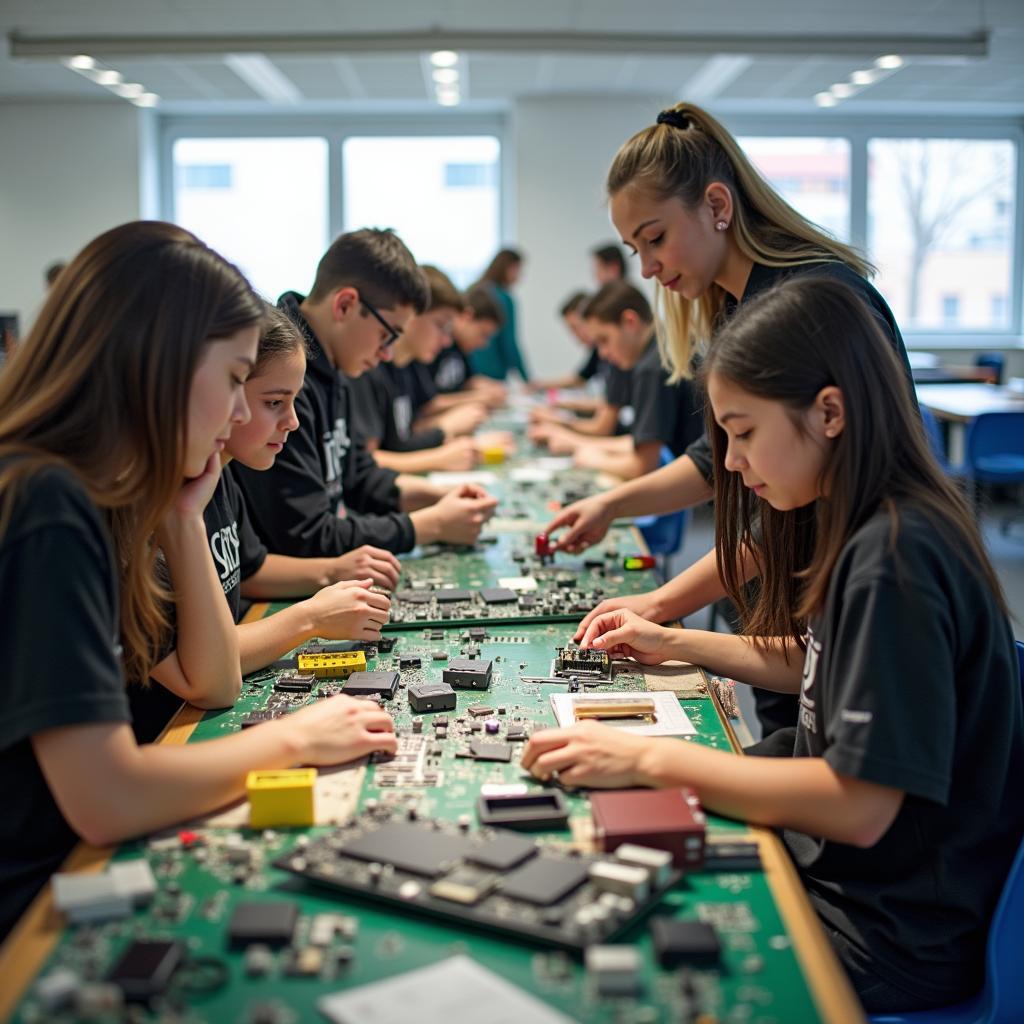 Dạy kỹ năng thực hành sửa chữa trong trường học cho IELTS Speaking topic
Từ vựng và cụm từ quan trọng
Topic-Specific Vocabulary
| Từ vựng/Cụm từ | Loại từ | Phiên âm | Nghĩa tiếng Việt | Ví dụ | Collocation |
|---|---|---|---|---|---|
| troubleshoot | v | /ˈtrʌbl.ʃuːt/ | tìm và khắc phục sự cố | I spent hours troubleshooting the computer issue. | troubleshoot problems/issues, troubleshoot technical difficulties |
| DIY (Do-It-Yourself) | adj/n | /ˌdiː.aɪˈwaɪ/ | tự làm, tự sửa | The DIY approach saved me a lot of money. | DIY repairs, DIY enthusiast, DIY project, DIY culture |
| handy | adj | /ˈhæn.di/ | khéo tay, tiện dụng | My father is very handy with tools. | reasonably handy, handy with repairs, come in handy |
| tinkering | n | /ˈtɪŋ.kər.ɪŋ/ | việc mày mò sửa chữa | I enjoy tinkering with old electronics. | tinkering with gadgets, enjoy tinkering, amateur tinkering |
| spare parts | n | /speər pɑːts/ | phụ tùng thay thế | I ordered spare parts online for the repair. | replacement spare parts, genuine spare parts, source spare parts |
| planned obsolescence | n | /plænd ˌɒb.səˈles.əns/ | sự lỗi thời có kế hoạch | Many manufacturers practice planned obsolescence. | practice planned obsolescence, strategy of planned obsolescence |
| throwaway culture | n | /ˈθrəʊ.ə.weɪ ˈkʌl.tʃər/ | văn hóa vứt bỏ | Throwaway culture is damaging the environment. | combat throwaway culture, embrace throwaway culture |
| self-sufficiency | n | /ˌself.səˈfɪʃ.ən.si/ | sự tự túc, tự cung tự cấp | Repair skills promote self-sufficiency. | promote self-sufficiency, achieve self-sufficiency, value self-sufficiency |
| proprietary | adj | /prəˈpraɪ.ə.tər.i/ | độc quyền, chuyên dụng | The device uses proprietary screws. | proprietary technology, proprietary parts, proprietary software |
| hands-on experience | n | /hændz ɒn ɪkˈspɪə.ri.əns/ | kinh nghiệm thực hành | I gained hands-on experience by fixing my bike. | gain hands-on experience, provide hands-on experience, valuable hands-on experience |
| soldering iron | n | /ˈsɒl.dər.ɪŋ ˈaɪ.ən/ | mỏ hàn | I used a soldering iron to fix the circuit board. | use a soldering iron, heat up the soldering iron |
| disassemble | v | /ˌdɪs.əˈsem.bəl/ | tháo rời | I carefully disassembled the device. | disassemble carefully, completely disassemble, disassemble for repair |
| component | n | /kəmˈpəʊ.nənt/ | thành phần, bộ phận | The device has many small components. | electronic component, faulty component, replace components, delicate components |
| circular economy | n | /ˈsɜː.kjə.lər iˈkɒn.ə.mi/ | nền kinh tế tuần hoàn | The circular economy promotes repair over replacement. | embrace circular economy, transition to circular economy, circular economy model |
| right-to-repair | n | /raɪt tuː rɪˈpeər/ | quyền sửa chữa | Right-to-repair legislation is gaining support. | right-to-repair movement, support right-to-repair, right-to-repair laws |
| e-waste | n | /ˈiː.weɪst/ | rác thải điện tử | E-waste is a growing environmental problem. | reduce e-waste, e-waste crisis, dispose of e-waste, mounting e-waste |
| restore | v | /rɪˈstɔːr/ | phục hồi, khôi phục | I restored an old watch to working condition. | restore to working order, fully restore, carefully restore, restore functionality |
| malfunction | n/v | /ˌmæl.fʌŋkˈʃən/ | trục trặc, hoạt động sai | The device malfunctioned after a few months. | experience a malfunction, cause a malfunction, malfunction occurred |
| warranty | n | /ˈwɒr.ən.ti/ | bảo hành | The repair was covered by warranty. | under warranty, warranty period, extended warranty, void the warranty |
| patch up | phr v | /pætʃ ʌp/ | vá, sửa tạm | I patched up the hole in the wall. | patch up temporarily, patch something up, quickly patch up |
Idiomatic Expressions & Advanced Phrases
| Cụm từ | Nghĩa | Ví dụ sử dụng | Band điểm |
|---|---|---|---|
| trial and error | thử và sai, học qua kinh nghiệm | I fixed it through trial and error. | 7-8 |
| get something working again | làm cho cái gì đó hoạt động trở lại | I managed to get the printer working again. | 6.5-7 |
| out of my depth | vượt quá khả năng | Complex repairs are out of my depth. | 7.5-8 |
| spark curiosity | khơi dậy sự tò mò | Fixing things sparked my curiosity about mechanics. | 7.5-8 |
| sense of accomplishment | cảm giác thành tựu | Completing the repair gave me a sense of accomplishment. | 7-8 |
| cut costs | cắt giảm chi phí | DIY repairs help cut costs significantly. | 7-7.5 |
| it comes down to | vấn đề là ở chỗ, phụ thuộc vào | It comes down to whether you have the right tools. | 7.5-8 |
| breathe new life into | thổi hồn mới vào, làm sống lại | I breathed new life into the old device. | 8-8.5 |
| tender loving care (TLC) | sự chăm sóc tận tình | The vintage watch needed some TLC. | 7.5-8 |
| on the lookout for | đang tìm kiếm | I’m on the lookout for repair opportunities. | 7-8 |
| throw in the towel | đầu hàng, bỏ cuộc | I almost threw in the towel but persisted. | 7.5-8 |
| back to square one | trở về điểm xuất phát | When it didn’t work, I was back to square one. | 7-8 |
| get the hang of it | nắm được cách làm | After a while, I got the hang of it. | 7-7.5 |
| tipping point | điểm chuyển biến | We’re reaching a tipping point in consumer attitudes. | 8-8.5 |
| at the end of the day | cuối cùng thì | At the end of the day, repair skills are valuable. | 7-7.5 |
Discourse Markers (Từ Nối Ý Trong Speaking)
Để bắt đầu câu trả lời:
- 📝 Well,… – Dùng khi cần thời gian suy nghĩ ngắn
- “Well, I think repair skills are increasingly important…”
- 📝 Actually,… – Khi đưa ra thông tin có thể surprising hoặc corrective
- “Actually, I’m not very good at fixing things…”
- 📝 To be honest,… – Khi muốn nói thật, thẳng thắn
- “To be honest, I find modern devices too complex to repair…”
- 📝 I’d say that… – Cách formal để express opinion
- “I’d say that repair skills should be taught in schools…”
Để bổ sung ý:
- 📝 On top of that,… – Thêm vào đó, thêm một ý nữa
- “On top of that, repairing things is environmentally friendly…”
- 📝 What’s more,… – Hơn nữa (formal hơn “Also”)
- “What’s more, it builds confidence and problem-solving skills…”
- 📝 Not to mention… – Chưa kể đến
- “Not to mention the satisfaction you get from fixing something…”
- 📝 Added to this… – Thêm vào điều này
- “Added to this is the financial benefit of not having to buy new items…”
Để đưa ra quan điểm cân bằng:
- 📝 On the one hand,… On the other hand,… – Một mặt… mặt khác…
- “On the one hand, professional repairs guarantee quality. On the other hand, DIY saves money…”
- 📝 While it’s true that…, we also need to consider… – Dù đúng là… nhưng ta cũng cần xem xét…
- “While it’s true that modern devices are complex, we also need to consider that many repairs are still feasible…”
- 📝 Having said that,… – Sau khi đã nói điều đó…
- “Having said that, not everyone has the time to learn repair skills…”
Để kết luận:
- 📝 All in all,… – Tóm lại, xét tất cả
- “All in all, repair skills are valuable life competencies…”
- 📝 At the end of the day,… – Cuối cùng thì
- “At the end of the day, being able to fix things makes you more self-reliant…”
- 📝 Ultimately,… – Cuối cùng, về cơ bản
- “Ultimately, repair culture benefits both individuals and society…”
Grammatical Structures Ấn Tượng
1. Conditional Sentences (Câu điều kiện):
Mixed conditional (mixing time frames):
- Formula: If + Past Perfect, would/could + present
- Ví dụ: “If I had learned repair skills earlier, I would be more confident now.”
Inversion for emphasis:
- Formula: Had I known…, I would have…
- Ví dụ: “Had I known how simple it was, I would have tried it years ago.”
2. Relative Clauses (Mệnh đề quan hệ):
Non-defining (extra information với commas):
- Formula: …, which/who…
- Ví dụ: “The watch, which had belonged to my grandfather, required delicate handling.”
Reduced relative clause:
- Formula: Remove relative pronoun + be verb
- Ví dụ: “The tools needed for basic repairs are affordable.” (tools that are needed)
3. Passive Voice (Câu bị động):
Impersonal passive for academic tone:
- It is thought/believed/said that…
- “It is widely believed that repair skills are becoming obsolete.”
- There is thought to be…
- “There is thought to be a growing interest in DIY repairs.”
4. Cleft Sentences (Câu chẻ):
What-cleft for emphasis:
- What I find most…, is…
- “What I find most satisfying is the sense of accomplishment after completing a repair.”
- The thing that…, is…
- “The thing that surprised me was how straightforward the process was.”
It-cleft:
- It is… that…
- “It’s the practical experience that really develops your skills.”
5. Nominalization (Danh từ hóa):
- Verb → Noun để sound more academic
- “repair” → “the repair of devices”
- “solve problems” → “problem-solving”
- “consume” → “consumption patterns”
- “produce” → “production processes”
Ví dụ: “The restoration of vintage items requires patience.” (thay vì “Restoring vintage items requires patience”)
Chiến Lược Tổng Thể Cho Chủ Đề “Fixing Things”
Lời Khuyên Từ Examiner
Chuẩn Bị Vocabulary:
- Học từ vựng theo nhóm semantic: tools, processes, problems, solutions
- Practice collocations thường dùng với “repair”, “fix”, “broken”
- Không cố gắng nhồi nhét quá nhiều từ khó – natural delivery quan trọng hơn
- Chuẩn bị synonyms để avoid repetition: repair/fix/mend/restore
Structure Your Answers:
- Part 1: 2-3 câu với direct answer + reason/example
- Part 2: Follow chronological order cho stories, use clear paragraphing
- Part 3: Use discourse markers để organize complex ideas
Personal Stories Work Best:
- Authentic experiences luôn sound more convincing
- Details make stories memorable và believable
- Không cần spectacular achievements – simple, relatable stories are fine
Common Mistakes To Avoid:
- ❌ Sử dụng “thing” quá nhiều – specify: device, appliance, item, object
- ❌ Over-using “very” – learn stronger adjectives: extremely, remarkably, incredibly
- ❌ Speaking too fast to show fluency – natural pace với appropriate pausing tốt hơn
- ❌ Memorizing và reciting – examiners can easily detect this
Time Management:
- Part 1: Không elaborate quá nhiều, 20-30 giây mỗi câu trả lời
- Part 2: Use FULL 1 minute prep time, speak for at least 1.5-2 minutes
- Part 3: Develop ideas fully, 30-60 giây mỗi câu trả lời
Practice Plan
Week 1-2: Vocabulary Building
- Learn 10 new words/phrases daily related to repairs and DIY
- Create personal example sentences
- Record yourself using new vocabulary
Week 3-4: Part 2 Story Development
- Brainstorm 3-4 different repair experiences
- Write bullet-point notes for each
- Practice telling story với timing (2 minutes)
- Record và self-assess
Week 5-6: Part 3 Abstract Thinking
- Research current issues: sustainability, consumer culture, right-to-repair
- Practice forming opinions với supporting reasons
- Develop ability to see multiple perspectives
Daily Practice:
- 15 minutes: Record yourself answering random questions
- Listen back và identify:
- Hesitations và filler words
- Grammatical errors
- Repetitive vocabulary
- Areas to improve
Final Tips
✅ Practice với real recording conditions – phone recording, 2-minute timer
✅ Develop genuine opinions about repair culture, sustainability, technology – authenticity shows
✅ Learn from high-scoring samples but adapt to your own style
✅ Focus on communication over perfection – fluency và clarity matter most
✅ Stay current với real issues like e-waste, right-to-repair movements
✅ Build confidence through regular practice – nervousness affects delivery
Chủ đề “describe a time when you fixed something” là excellent opportunity để demonstrate range of vocabulary, narrative skills, và ability to discuss abstract concepts. Key to success là having authentic stories, relevant vocabulary, và clear structure trong cả ba parts. Remember, examiner đánh giá communication ability, không phải technical knowledge về repairs. Focus on expressing ideas clearly, using appropriate language, và maintaining natural fluency throughout the test.
Việc chuẩn bị kỹ lưỡng và có hệ thống tương tự như cách describe a time when you participated in a debate đòi hỏi bạn phải nghiên cứu, tổ chức ý tưởng và trình bày một cách logic và thuyết phục.
Chúc bạn thành công trong kỳ thi IELTS Speaking!