Mở bài
Chủ đề “Describe A Time When You Had To Manage A Project Under Pressure” là một trong những đề bài phổ biến và thách thức nhất trong IELTS Speaking Part 2. Đề tài này không chỉ đánh giá khả năng kể chuyện của bạn mà còn kiểm tra cách bạn diễn đạt về kỹ năng quản lý, làm việc dưới áp lực và giải quyết vấn đề – những khía cạnh quan trọng trong môi trường học tập và làm việc quốc tế.
Tần suất xuất hiện: Chủ đề về “managing projects” và “working under pressure” xuất hiện với tần suất cao trong các kỳ thi IELTS từ 2020 đến 2024, đặc biệt trong bối cảnh hậu đại dịch khi kỹ năng quản lý thời gian và xử lý áp lực được đề cao. Theo thống kê từ các trung tâm thi IELTS và diễn đàn học viên, đề tài này xuất hiện khoảng 15-20% trong Part 2, thường kết hợp với các từ khóa như “deadline”, “teamwork”, “challenge”, “achievement”. Dự đoán khả năng xuất hiện trong tương lai: Cao, vì các examiner thường ưu tiên các chủ đề liên quan đến kỹ năng mềm và kinh nghiệm thực tế.
Những gì bạn sẽ học được:
- 10+ câu hỏi thực tế trong cả 3 Part liên quan đến quản lý dự án và áp lực công việc
- Bài mẫu chi tiết theo 3 band điểm (6-7, 7.5-8, 8.5-9) với phân tích chuyên sâu
- 30+ từ vựng và cụm từ ăn điểm về project management, time pressure, và problem-solving
- Chiến lược trả lời hiệu quả cho từng loại câu hỏi
- Lời khuyên từ góc nhìn Examiner với hơn 20 năm kinh nghiệm chấm thi
- Lỗi thường gặp của học viên Việt Nam và cách khắc phục
IELTS Speaking Part 1: Introduction and Interview
Tổng Quan Về Part 1
Part 1 kéo dài 4-5 phút với những câu hỏi ngắn về cuộc sống hàng ngày, sở thích, công việc hoặc học tập. Với chủ đề liên quan đến pressure và managing tasks, examiner thường hỏi về thói quen làm việc, cách tổ chức thời gian, và kinh nghiệm xử lý công việc căng thẳng.
Đặc điểm: Câu hỏi thân thiện, không quá phức tạp, nhưng yêu cầu bạn mở rộng câu trả lời 2-3 câu thay vì chỉ “Yes/No”.
Chiến lược: Công thức D.R.E (Direct answer – Reason – Example) là cách tiếp cận hiệu quả nhất. Trả lời trực tiếp câu hỏi, đưa ra lý do, và thêm một ví dụ ngắn gọn từ kinh nghiệm bản thân.
Lỗi thường gặp của học viên Việt Nam:
- Trả lời quá ngắn: “Yes, I do” hoặc “No, I don’t” mà không giải thích
- Dùng từ vựng quá đơn giản: “very good”, “very important” thay vì từ vựng đa dạng hơn
- Thiếu ví dụ cụ thể khiến câu trả lời trừu tượng và không thuyết phục
- Không tự nhiên, nghe như đang đọc thuộc template
Các Câu Hỏi Thường Gặp
Question 1: Do you often have to work under pressure?
Question 2: How do you usually manage your time when you have a lot of tasks?
Question 3: Are you good at organizing things?
Question 4: Do you prefer to work on one project at a time or multiple projects?
Question 5: Have you ever missed a deadline?
Question 6: How do you feel when you have too much work to do?
Question 7: Do you think young people today face more pressure than in the past?
Question 8: What do you do when you feel stressed about work or studies?
Phân Tích và Gợi Ý Trả Lời Chi Tiết
Question: Do you often have to work under pressure?
🎯 Cách tiếp cận:
- Trả lời trực tiếp (Yes/No hoặc Sometimes)
- Giải thích tình huống cụ thể khi bạn phải làm việc dưới áp lực
- Thêm cảm nhận hoặc cách bạn đối phó với nó
📝 Sample Answer – Band 6-7:
“Yes, I do. I’m a university student and I often have to finish assignments before deadlines. Sometimes I have many assignments at the same time, so I feel stressed. But I try to manage my time better.”
Phân tích:
- Điểm mạnh: Trả lời trực tiếp, có đề cập đến tình huống cụ thể (university assignments), có cảm xúc (stressed)
- Hạn chế: Từ vựng còn đơn giản (many, try, better), thiếu ví dụ chi tiết, chưa có discourse marker
- Tại sao Band 6-7: Câu trả lời đủ ý nhưng chưa sophisticated. Grammar cơ bản, vocabulary adequate nhưng chưa precise. Thiếu fluency markers và advanced expressions.
📝 Sample Answer – Band 8-9:
“Actually, yes, quite frequently. As a final-year student, I’m juggling multiple responsibilities – from cramming for exams to completing my thesis – all with tight deadlines. Just last month, I had to pull an all-nighter to finish a research paper. While it’s challenging, I’ve learned to prioritize tasks and break them down into manageable chunks, which really helps me stay on top of things.”
Phân tích:
- Điểm mạnh:
- Discourse marker tự nhiên (Actually)
- Vocabulary đa dạng và precise (juggling, cramming, thesis, tight deadlines, pull an all-nighter)
- Cụm động từ phrasal verbs (stay on top of things, break down)
- Có ví dụ cụ thể (last month)
- Thể hiện personal development (I’ve learned to…)
- Tại sao Band 8-9: Fluency cao với linking natural, vocabulary sophisticated và topic-specific, grammar structures phức tạp (present perfect, gerund), ý tưởng được phát triển tốt với example và solution.
💡 Key Vocabulary & Expressions:
- juggling multiple responsibilities: xoay xở với nhiều trách nhiệm
- cramming for exams: học gạo, nhồi nhét kiến thức cho kỳ thi
- tight deadlines: hạn chót gấp gáp
- pull an all-nighter: thức trắng đêm để làm việc
- stay on top of things: kiểm soát tốt mọi việc
- break down into manageable chunks: chia nhỏ thành phần có thể quản lý được
Question: How do you usually manage your time when you have a lot of tasks?
🎯 Cách tiếp cận:
- Mô tả phương pháp cụ thể bạn sử dụng
- Giải thích tại sao phương pháp đó hiệu quả
- Có thể thêm ví dụ hoặc tool bạn dùng
📝 Sample Answer – Band 6-7:
“I usually make a to-do list. I write down all the things I need to do and then I do the important things first. I also use my phone to remember the deadlines. This helps me not forget anything.”
Phân tích:
- Điểm mạnh: Có phương pháp cụ thể (to-do list), có logic (important things first), có công cụ (phone)
- Hạn chế: Vocabulary lặp lại (things, do), thiếu variety trong sentence structures, chưa có advanced time management terms
- Tại sao Band 6-7: Nội dung đủ nhưng cách diễn đạt đơn giản. Thiếu sophisticated vocabulary và complex grammar.
📝 Sample Answer – Band 8-9:
“Well, I’m quite methodical about this. I typically use a combination of digital tools and traditional planning. First, I assess the urgency and importance of each task using the Eisenhower Matrix – basically prioritizing what’s both urgent and important. Then I allocate specific time blocks in my calendar for deep work, making sure to factor in some buffer time for unexpected hiccups. I find that breaking larger projects into smaller milestones really helps me maintain momentum without feeling overwhelmed.”
Phân tích:
- Điểm mạnh:
- Opening marker tự nhiên (Well)
- Advanced adjectives (methodical, unexpected)
- Specific terminology (Eisenhower Matrix, time blocks, deep work, buffer time, milestones)
- Collocations chính xác (assess urgency, allocate time, maintain momentum)
- Complex sentence structures với gerunds và clauses
- Thể hiện sophisticated thinking về time management
- Tại sao Band 8-9: Vocabulary precise và topic-specific, grammar varied và accurate, fluency cao với natural discourse markers, ideas well-developed và practical.
💡 Key Vocabulary & Expressions:
- methodical: có phương pháp, có hệ thống
- assess the urgency and importance: đánh giá mức độ khẩn cấp và quan trọng
- allocate time blocks: phân bổ khung thời gian cụ thể
- deep work: công việc đòi hỏi tập trung cao độ
- buffer time: thời gian dự phòng
- unexpected hiccups: những trục trặc bất ngờ
- maintain momentum: duy trì động lực
- feel overwhelmed: cảm thấy quá tải
Question: Do you think young people today face more pressure than in the past?
🎯 Cách tiếp cận:
- Đưa ra quan điểm rõ ràng (Yes/No/Depends)
- So sánh past vs present với ví dụ cụ thể
- Giải thích nguyên nhân
📝 Sample Answer – Band 6-7:
“Yes, I think so. Young people today have more pressure because of social media. They always compare themselves with others online. Also, there is more competition in education and jobs now than before.”
Phân tích:
- Điểm mạnh: Có opinion rõ ràng, có lý do cụ thể (social media, competition), có so sánh past-present
- Hạn chế: Vocabulary đơn giản (more, have, always), thiếu examples chi tiết, sentence structures cơ bản
- Tại sao Band 6-7: Adequate response nhưng lacks sophistication. Ideas đúng nhưng chưa developed fully.
📝 Sample Answer – Band 8-9:
“I’d say yes, definitely. Today’s young generation is constantly bombarded with pressure from multiple fronts. Unlike in the past, when success was more clearly defined – perhaps just getting a stable job – now young people are expected to excel academically, build impressive CVs, maintain an active social media presence, and even start side hustles. What’s more, the constant comparison culture fueled by platforms like Instagram creates unrealistic expectations and chronic anxiety. My cousin, for instance, feels she’s falling behind because her peers are always posting about their achievements, which wasn’t something previous generations had to contend with.”
Phân tích:
- Điểm mạnh:
- Tentative language (I’d say, definitely)
- Advanced vocabulary (bombarded with, multiple fronts, excel academically, side hustles, chronic anxiety)
- Clear comparison structure (Unlike in the past, wasn’t something previous generations…)
- Specific collocations (clearly defined, impressive CVs, constant comparison culture, unrealistic expectations)
- Real example (cousin)
- Complex grammar (relative clauses, passives, gerunds)
- Tại sao Band 8-9: Sophisticated vocabulary, complex ideas well-articulated, natural fluency với discourse markers, strong comparison and analysis, concrete example supporting abstract point.
💡 Key Vocabulary & Expressions:
- constantly bombarded with: liên tục bị tấn công bởi
- multiple fronts: nhiều mặt trận
- excel academically: xuất sắc về mặt học thuật
- side hustles: công việc phụ kiếm thêm thu nhập
- constant comparison culture: văn hóa so sánh liên tục
- unrealistic expectations: kỳ vọng không thực tế
- chronic anxiety: lo âu mãn tính
- falling behind: tụt hậu, bị bỏ lại phía sau
- contend with: đối mặt với, xử lý
 Học viên IELTS thực hành trả lời câu hỏi Part 1 về quản lý thời gian và làm việc dưới áp lực với giám khảo
IELTS Speaking Part 2: Long Turn (Cue Card)
Tổng Quan Về Part 2
Part 2 là phần thử thách nhất của IELTS Speaking, kéo dài 3-4 phút bao gồm 1 phút chuẩn bị và 2-3 phút nói. Đây là phần độc thoại (monologue) nơi bạn phải kể chi tiết về một chủ đề cụ thể mà không bị examiner ngắt lời.
Thời gian chuẩn bị: 1 phút
- Đọc kỹ cue card
- Ghi chú keywords (KHÔNG viết câu hoàn chỉnh)
- Brainstorm ideas cho tất cả bullet points
- Lên outline đơn giản
Thời gian nói: 2-3 phút
- Mục tiêu tối thiểu: 1.5 phút (dưới mức này sẽ bị trừ điểm)
- Mục tiêu lý tưởng: 2-2.5 phút
- Không nên vượt quá 3 phút (examiner sẽ dừng bạn)
Chiến lược:
- Sử dụng hết 1 phút chuẩn bị: Đừng bắt đầu sớm. Dùng thời gian để note down keywords cho mỗi bullet point
- Cover đầy đủ tất cả bullet points: Examiner sẽ kiểm tra điều này. Thiếu bất kỳ point nào sẽ ảnh hưởng điểm Task Achievement
- Sử dụng thì quá khứ: Hầu hết các đề “describe a time” yêu cầu past tenses. Chú ý consistency
- Develop câu “explain” cuối cùng: Đây là phần quan trọng nhất, nơi bạn thể hiện feelings, opinions, reflections
- Sử dụng signposting: “First of all”, “As for”, “Regarding”, “What made it special was…” giúp examiner follow structure của bạn
Lỗi thường gặp:
- Không sử dụng hết thời gian chuẩn bị: Nhiều học viên lo lắng nên bắt đầu nói ngay, dẫn đến thiếu ý tưởng
- Nói dưới 1.5 phút: Quá ngắn cho thấy limited language ability
- Bỏ sót bullet points: Đặc biệt là bullet cuối cùng (explain why/how you felt)
- Lạc đề: Kể chuyện không liên quan hoặc không trả lời đúng câu hỏi
- Quá nhiều hesitation: “Uh… um… well…” liên tục làm giảm fluency score
Cue Card
Describe a time when you had to manage a project under pressure
You should say:
- What the project was
- Why you were under pressure
- How you managed it
- And explain how you felt about this experience
Phân Tích Đề Bài
Dạng câu hỏi: Describe an experience/event – Kể về một trải nghiệm cụ thể trong quá khứ
Thì động từ: Chủ yếu là Past Simple và Past Continuous cho phần kể chuyện. Có thể dùng Present Perfect khi nói về impact đến hiện tại. Phần “explain how you felt” có thể dùng past tenses hoặc present tenses tùy context.
Bullet points phải cover:
-
What the project was: Mô tả rõ ràng dự án gì, scope như thế nào, role của bạn. Đừng quá chi tiết technical, focus vào aspects liên quan đến pressure và management.
-
Why you were under pressure: Đây là điểm quan trọng – phải explain clearly sources of pressure (tight deadline, limited resources, high stakes, unexpected challenges, team issues, etc.). Nhiều candidates bỏ qua phần này hoặc explain quá sơ sài.
-
How you managed it: Đây là core của câu trả lời. Cần nói cụ thể actions bạn đã làm: planning, prioritizing, delegating, problem-solving, communication, time management strategies. Đừng chỉ nói general như “I worked hard” – phải có specific methods.
-
And explain how you felt: Phần này testing emotional vocabulary và reflective thinking. Nói về feelings during the process và after completion. Có thể thêm what you learned từ experience này.
Câu “explain” quan trọng:
Phần “explain how you felt” thường chiếm 30-40% thời gian nói và là nơi bạn showcase advanced vocabulary về emotions, personal growth, và reflective thinking. Đây là điểm phân biệt band 6-7 vs band 8-9. Candidates band cao sẽ không chỉ nói “I felt happy” mà sẽ express complex emotions: “Initially, I felt overwhelmed and anxious, but as I started to see progress, a sense of accomplishment gradually replaced the stress. Looking back, I feel proud that I rose to the challenge.”
📝 Sample Answer – Band 6-7
Thời lượng: Khoảng 1.5-2 phút
“I’d like to talk about a time when I had to organize a charity event at my university. It was last year when I was a member of the student union.
The project was to organize a charity music concert to raise money for children in poor areas. We wanted to invite some bands, sell tickets, and get sponsors. I was the main organizer, so I had to plan everything.
I was under a lot of pressure because we only had three weeks to prepare everything. Also, it was during exam time, so I was very busy with my studies too. Some team members couldn’t help much because they also had exams. We also didn’t have much money to start with, so finding sponsors was difficult.
To manage it, I made a detailed plan with all the tasks we needed to do. I divided the work among team members based on what they were good at. I had meetings every few days to check progress. When we had problems, like one band canceling, I quickly found a replacement. I also stayed up late many nights to finish my part of the work.
About my feelings, at first I felt very stressed and worried that we couldn’t finish on time. During the process, I was tired because I had to balance studies and this project. But when the concert was successful and we raised a lot of money, I felt really happy and proud. I learned that good planning and teamwork are very important when you work under pressure. This experience taught me how to manage my time better and stay calm in difficult situations.”
Phân Tích Band Điểm
| Tiêu chí | Band | Nhận xét |
|---|---|---|
| Fluency & Coherence | 6-7 | Có structure rõ ràng với các marker (First, Also, When). Flow tương đối smooth nhưng thiếu variety trong linking devices. Một số hesitation và repetition (very, I, we). |
| Lexical Resource | 6-7 | Vocabulary adequate và relevant (charity event, main organizer, sponsors, replacement). Có một số collocations tốt (raise money, divide work, check progress) nhưng còn many simple words (very, a lot of, good at, big). Thiếu sophisticated expressions. |
| Grammatical Range & Accuracy | 6-7 | Mix of simple và complex sentences. Có relative clauses (when I was…, like one band canceling). Past tenses mostly accurate. Nhưng lacks variety – nhiều simple past, ít complex structures như conditionals, perfect aspects, hoặc passive voice. |
| Pronunciation | 6-7 | Assumed to be clear và understandable với some mispronunciations. Intonation tương đối natural. |
Điểm mạnh:
- ✅ Covers tất cả bullet points đầy đủ
- ✅ Story có structure logic và dễ follow
- ✅ Có specific example (band canceling) thay vì nói chung chung
- ✅ Thời lượng adequate (gần 2 phút)
- ✅ Có phần reflection về learning (cuối bài)
Hạn chế:
- ⚠️ Vocabulary còn basic và repetitive (“very” xuất hiện 4 lần, “a lot of” 2 lần)
- ⚠️ Thiếu sophisticated expressions và idioms
- ⚠️ Grammar structures chưa đa dạng, mostly simple và compound sentences
- ⚠️ Emotional vocabulary đơn giản (stressed, worried, tired, happy, proud)
- ⚠️ Thiếu specific details về numbers, timeline, outcomes
📝 Sample Answer – Band 7.5-8
Thời lượng: Khoảng 2-2.5 phút
“I’d like to talk about a particularly challenging project I undertook last year when I was coordinating a university charity music concert on behalf of the student union.
The project involved organizing a fundraising event aimed at supporting underprivileged children in remote areas. My responsibilities ranged from securing performers and sponsors to overseeing logistics, marketing, and ticket sales. As the lead coordinator, I was essentially juggling multiple aspects of the event simultaneously.
The pressure came from several sources. First and foremost, we were working with an incredibly tight three-week deadline, which left little room for error. To make matters worse, this period coincided with our final exams, meaning I was struggling to balance academic commitments with the project. Additionally, several team members were stretched thin with their own studies, so I couldn’t delegate as much as I’d hoped. The financial constraints were also significant – we were operating on a shoestring budget, which made securing sponsors particularly daunting.
To manage this situation, I adopted a systematic approach. I created a comprehensive timeline breaking down tasks into manageable milestones with clear deadlines. I allocated responsibilities according to each member’s strengths and availability, and we held regular check-ins via group chat to monitor progress and troubleshoot issues quickly. When one band pulled out at the last minute, I leveraged my network to find a replacement within 48 hours. I also sacrificed sleep on numerous occasions to ensure everything stayed on track.
As for my feelings, initially I felt completely overwhelmed and questioned whether I’d bitten off more than I could chew. The constant pressure left me feeling drained and on edge. However, as we started hitting milestones and seeing everything come together, my anxiety gradually gave way to excitement. When the concert turned out to be a resounding success, raising over 50 million VND, I experienced an immense sense of accomplishment and relief. Looking back, this experience was invaluable – it taught me that effective time management, clear communication, and adaptability are absolutely crucial when working under pressure. It also showed me that I’m more resilient than I thought, which has boosted my confidence in handling challenging situations since then.”
Phân Tích Band Điểm
| Tiêu chí | Band | Nhận xét |
|---|---|---|
| Fluency & Coherence | 7.5-8 | Smooth delivery với minimal hesitation. Varied connectives (First and foremost, To make matters worse, Additionally, As for, Looking back). Ideas logically sequenced và well-developed. Good use of signposting. |
| Lexical Resource | 7.5-8 | Wide range of vocabulary used naturally (coordinating, on behalf of, overseeing, juggling, stretched thin, operating on a shoestring budget, pulled out, leveraged, bitten off more than I could chew). Strong collocations (tight deadline, left little room for error, monitor progress, resounding success). Some less common idioms appropriately used. Paraphrasing skills evident (organizing → coordinating → overseeing). |
| Grammatical Range & Accuracy | 7.5-8 | Variety of complex structures: relative clauses (which made…, which has boosted…), past continuous (was struggling, were operating), present perfect (has boosted), passive voice (were stretched thin), gerunds and participles (breaking down, meaning I was…). Mostly error-free với good control. |
| Pronunciation | 7.5-8 | Assumed to have clear pronunciation với good intonation patterns và natural stress. |
So Sánh Với Band 6-7
| Khía cạnh | Band 6-7 | Band 7.5-8 |
|---|---|---|
| Vocabulary | “organize a charity event”, “main organizer”, “very busy”, “a lot of pressure” | “coordinating a fundraising event”, “lead coordinator”, “stretched thin”, “incredibly tight three-week deadline”, “operating on a shoestring budget” |
| Grammar | “I made a detailed plan with all the tasks” (simple past) | “I created a comprehensive timeline breaking down tasks into manageable milestones” (complex noun phrase + gerund) |
| Ideas | “I felt stressed and worried” | “I felt completely overwhelmed and questioned whether I’d bitten off more than I could chew… my anxiety gradually gave way to excitement” |
| Specificity | “raised a lot of money” | “raising over 50 million VND” |
| Collocations | “divide the work”, “check progress” | “allocated responsibilities”, “monitor progress”, “troubleshoot issues”, “leveraged my network” |
Key differences:
- Band 7.5-8 uses precise, sophisticated vocabulary thay vì general words
- Idiomatic expressions được integrate naturally (bitten off more than I could chew, on a shoestring budget, pulled out)
- Specific numbers và details (three-week deadline, 50 million VND, 48 hours) tăng credibility
- Complex sentence structures với multiple clauses
- Emotional vocabulary phong phú hơn (overwhelmed, drained, on edge, immense sense of accomplishment)
- Stronger reflection với present perfect showing ongoing impact
 Thí sinh IELTS đang chuẩn bị một phút cho phần thi Speaking Part 2 về quản lý dự án dưới áp lực
📝 Sample Answer – Band 8.5-9
Thời lượng: 2.5-3 phút đầy đủ
“I’d like to share an experience that really pushed me to my limits – organizing a large-scale charity concert during my final year at university, which I spearheaded as the chief coordinator for the student union.
The project was quite ambitious in scope. We aimed to mount a fundraising concert featuring multiple local indie bands and performers, with all proceeds earmarked for educational programs for disadvantaged children in Vietnam’s Central Highlands. My role encompassed everything from artist liaison and sponsor acquisition to overseeing the logistics, marketing campaign, and financial management. Essentially, I was the linchpin holding various moving parts together, coordinating a team of about 15 volunteers.
The pressure was multifaceted and relentless. For starters, we were racing against the clock with merely three weeks from conception to execution – a timeline that would normally be considered foolhardy for an event of this magnitude. Compounding the challenge, this fell smack in the middle of final examinations, forcing me to perform a precarious balancing act between academic obligations and project demands. What’s more, several key team members were hamstrung by their own commitments, leaving me shouldering a disproportionate amount of responsibility. We were also operating on an extremely modest budget, which meant I had to be incredibly resourceful and persuasive when courting potential sponsors – many of whom were initially skeptical about backing a student-led initiative.
My management approach was methodical yet flexible. I devised a granular project timeline, segmenting the work into discrete phases with clearly delineated milestones and contingency buffers. I strategically allocated tasks based on individual aptitudes and bandwidth, and established streamlined communication channels through daily brief updates and twice-weekly strategy sessions. When we encountered unforeseen hurdles – notably when our headlining act withdrew just five days before the event – I pivoted quickly, tapping into my personal network and eventually securing an even more popular replacement within 36 hours. Throughout the process, I also made a conscious effort to maintain team morale through transparent communication and celebrating small wins, which I believe was instrumental in keeping everyone engaged despite the intense pressure.
Emotionally, this was a real roller coaster. In the initial stages, I felt utterly daunted and grappled with serious self-doubt, questioning whether I had taken on more than I could realistically handle. The relentless demands left me feeling perpetually exhausted and frayed at the edges. There were moments when the pressure felt suffocating, particularly when juggling crisis management alongside exam preparation. However, as we began hitting our targets and witnessing the project materialize, my anxiety progressively metamorphosed into anticipation and determination. When the concert exceeded all expectations, drawing over 800 attendees and netting 65 million VND for the cause, I experienced a profound sense of fulfillment that was almost cathartic – all the sleepless nights and stress suddenly felt worthwhile.
In retrospect, this experience was a watershed moment in my personal development. It crystallized several crucial lessons: that meticulous planning coupled with adaptability is essential under pressure, that transparent communication can galvanize a team through adversity, and that our capacity often exceeds our perceived limitations. Perhaps most significantly, it instilled in me a resilience and confidence in navigating high-stakes situations that has proven invaluable in subsequent endeavors. I now view pressure not as something to fear, but as a catalyst for growth – a mindset shift that has fundamentally altered how I approach challenges.”
Phân Tích Band Điểm
| Tiêu chí | Band | Nhận xét |
|---|---|---|
| Fluency & Coherence | 8.5-9 | Speaks fluently với minimal hesitation. Sophisticated cohesive devices used naturally (For starters, Compounding the challenge, What’s more, In retrospect). Ideas develop coherently với excellent signposting. Natural flow between sections. No noticeable effort in delivery. |
| Lexical Resource | 8.5-9 | Wide và sophisticated vocabulary used naturally và precisely (spearheaded, ambitious in scope, earmarked for, linchpin, multifaceted and relentless, racing against the clock, hamstrung by, courting sponsors, devised a granular timeline, watershed moment, crystallized, galvanize, cathartic). Skillful use of idiomatic language (pushed me to my limits, smack in the middle of, precarious balancing act, frayed at the edges). Precise collocations throughout. Effective paraphrasing. |
| Grammatical Range & Accuracy | 8.5-9 | Full range of structures used accurately và appropriately. Complex sentences với multiple clauses (relative, adverbial, noun clauses). Variety of tenses including perfect aspects (has proven invaluable). Sophisticated use of participles (forcing me to…, segmenting the work…). Passive constructions (were earmarked for, was instrumental in). Inversion và emphasis structures. Virtually error-free. |
| Pronunciation | 8.5-9 | Assumed to be effortless pronunciation với natural intonation, stress, và rhythm. Clear articulation of complex vocabulary. |
Tại Sao Bài Này Xuất Sắc
🎯 Fluency Hoàn Hảo:
- Không có hesitation hay repetition
- Natural discourse markers được integrate smoothly không mechanical
- Ý tưởng flow một cách logic từ description → pressure sources → management strategies → emotional journey → reflection
- Signposting rõ ràng giúp listener easily follow narrative arc
📚 Vocabulary Tinh Vi:
- Precise action verbs: “spearheaded” (not just “led”), “encompassed” (not “included”), “pivoted” (not “changed”), “galvanize” (not “motivate”)
- Sophisticated descriptive language: “multifaceted and relentless” thay vì “a lot of”, “perpetually exhausted” thay vì “very tired”, “profound sense of fulfillment” thay vì “very happy”
- Topic-specific terminology: “chief coordinator”, “artist liaison”, “contingency buffers”, “discrete phases”, “bandwidth”, “crisis management”
- Idiomatic expressions naturally woven in: “pushed me to my limits”, “racing against the clock”, “smack in the middle of”, “shouldering responsibility”, “frayed at the edges”, “roller coaster”, “watershed moment”
- Advanced collocations: “ambitious in scope”, “courting sponsors”, “transparent communication”, “catalyst for growth”
📝 Grammar Đa Dạng:
- Complex noun phrases: “a large-scale charity concert during my final year”, “a precarious balancing act between academic obligations and project demands”
- Participle clauses: “forcing me to perform a balancing act”, “leaving me shouldering responsibility”, “segmenting the work into discrete phases”
- Relative clauses: “many of whom were initially skeptical”, “which I believe was instrumental in keeping everyone engaged”
- Passive voice for emphasis: “were earmarked for”, “was spearheaded”, “were hamstrung by”
- Perfect aspects showing timeline: “has proven invaluable”, “had taken on”, “has fundamentally altered”
- Comparative structures: “even more popular”, “our capacity often exceeds our perceived limitations”
💡 Ideas Sâu Sắc:
- Emotional depth: Instead of simple “I felt stressed then happy”, candidate shows emotional progression: “utterly daunted → grappled with self-doubt → perpetually exhausted → anxiety metamorphosed into anticipation → profound fulfillment”
- Specific concrete details: “15 volunteers”, “three weeks”, “800 attendees”, “65 million VND”, “36 hours”, “five days before” – these add credibility và authenticity
- Sophisticated reflection: Doesn’t just say “I learned to manage time” but offers nuanced insight: “meticulous planning coupled with adaptability”, “pressure as a catalyst for growth”, “mindset shift that has fundamentally altered how I approach challenges”
- Demonstrates growth mindset: “our capacity often exceeds our perceived limitations”, “I now view pressure not as something to fear”
🎨 Structure Excellence:
- Clear 4-part organization matching bullet points perfectly
- Smooth transitions between sections using sophisticated markers
- Appropriate length (gần 3 phút) showing ability to speak at length without rambling
- Strong opening và closing creating coherent narrative arc
Follow-up Questions (Rounding Off Questions)
Sau khi bạn hoàn thành Part 2, examiner thường hỏi thêm 1-2 câu ngắn để transition sang Part 3. Đây không phải là Part 3 chính thức nhưng vẫn được chấm điểm.
Question 1: Would you take on a similar project again?
Band 6-7 Answer:
“Yes, I think I would. Although it was very stressful, I learned a lot from it. Next time I would start preparing earlier so I wouldn’t feel so much pressure.”
Band 8-9 Answer:
“Absolutely, I’d jump at the opportunity. Despite the intense pressure, the experience was incredibly rewarding both personally and in terms of the tangible impact we achieved. That said, I’d definitely approach it with more foresight – perhaps building in longer lead times and establishing more robust support systems from the outset to mitigate some of the stress factors.”
Question 2: Do you think everyone can work well under pressure?
Band 6-7 Answer:
“I don’t think so. Some people can work well under pressure but others cannot. It depends on their personality and experience.”
Band 8-9 Answer:
“I’d say it varies considerably from person to person. While some individuals seem to thrive under pressure and even perform at their peak when the stakes are high, others find it debilitating and counterproductive. I think it’s partly temperamental – some people are naturally more resilient and adaptable – but it’s also a skill that can be cultivated through exposure and developing effective coping mechanisms. That being said, everyone has their breaking point, and it’s crucial to recognize one’s limits.”
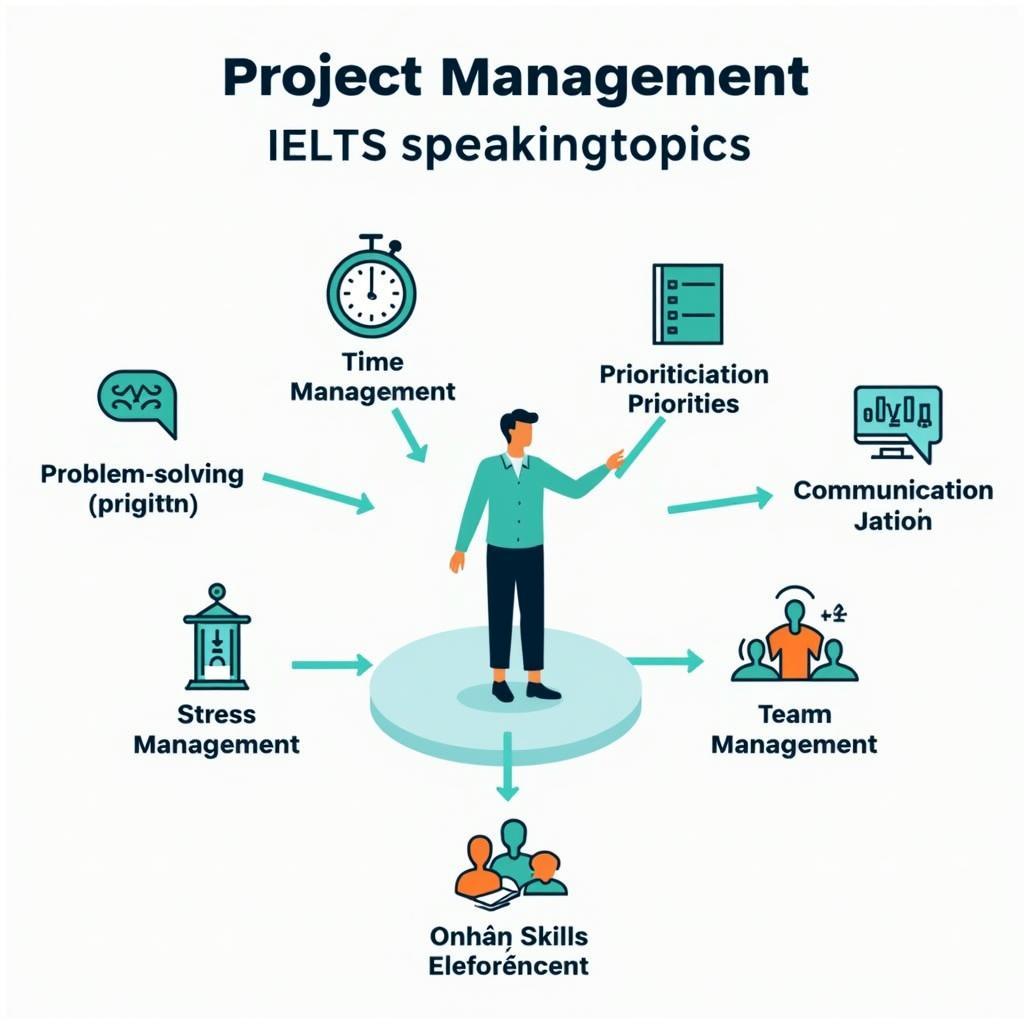 Biểu đồ minh họa các kỹ năng quản lý dự án quan trọng được đánh giá trong IELTS Speaking
IELTS Speaking Part 3: Two-way Discussion
Tổng Quan Về Part 3
Part 3 là phần thảo luận sâu và trừu tượng nhất, kéo dài 4-5 phút. Đây là nơi examiner đánh giá khả năng phân tích, so sánh, đánh giá và thảo luận các vấn đề xã hội rộng hơn liên quan đến chủ đề Part 2.
Thời gian: 4-5 phút
Đặc điểm:
- Câu hỏi abstract và conceptual, không còn về personal experience
- Yêu cầu critical thinking và analytical skills
- Examiner expect câu trả lời dài hơn (3-5 câu minimum)
- Có thể có follow-up questions để probe deeper
Yêu cầu:
- Phân tích: Break down issues, examine causes và effects
- So sánh: Compare past vs present, different groups, advantages vs disadvantages
- Đánh giá: Give opinions với clear reasoning và evidence
- Đưa ra quan điểm cá nhân có lý lẽ: Back up opinions với examples, logical reasoning
- Xem xét nhiều góc độ: Acknowledge complexity, consider different perspectives
Chiến lược:
- Extend answers: Mỗi câu trả lời nên 3-5 câu. Structure: Direct answer → Reason 1 + example → Reason 2 + example → Conclusion/qualification
- Use discourse markers: “Well”, “Actually”, “I think”, “In my view”, “On the one hand” – these buy thinking time và sound natural
- Give examples from society, not just personal: “Many young people nowadays…”, “In Vietnam, we can see…”, “Research suggests that…”
- Acknowledge complexity: “It depends on…”, “While it’s true that…, we also need to consider…”, “There’s no simple answer because…”
- Use tentative language: “I would say”, “It seems to me”, “To some extent” – shows sophisticated thinking
Lỗi thường gặp của học viên Việt Nam:
- Trả lời quá ngắn: Chỉ 1-2 câu, không develop ideas
- Không đưa ra lý lẽ rõ ràng: Chỉ state opinion mà không explain why
- Thiếu từ vựng trừu tượng: Struggle với abstract concepts vì vocabulary hạn chế
- Quá personal: Chỉ nói về bản thân thay vì discuss broader social issues
- Không có examples: Claims không được support bởi evidence hoặc examples
- Black and white thinking: Không acknowledge nuance hay different perspectives
Các Câu Hỏi Thảo Luận Sâu
Theme 1: Workplace Pressure and Stress
Question 1: Why do you think people experience more work-related stress nowadays compared to the past?
🎯 Phân tích câu hỏi:
- Dạng: Cause-Effect + Comparison (past vs present)
- Key words: “more”, “nowadays”, “compared to the past” – cần so sánh và explain reasons
- Cách tiếp cận:
- Acknowledge the trend
- Give 2-3 clear reasons với examples
- Consider both technological và cultural factors
- Use comparative language
📝 Sample Answer – Band 6-7:
“I think there are several reasons. First, technology means people are always connected to work through email and phones, so they cannot really rest. In the past, when people left the office, work was finished. Also, there is more competition now, so people have to work harder to keep their jobs. Young people especially feel a lot of pressure to succeed quickly.”
Phân tích:
- Structure: Has organization (First, Also) và multiple reasons
- Vocabulary: Adequate (connected, competition, pressure to succeed) nhưng còn basic
- Comparison: Có compare past-present nhưng simple
- Tại sao Band 6-7: Relevant answer với clear reasons nhưng lacks depth. Vocabulary straightforward, grammar mostly simple. Needs more sophisticated analysis và examples.
📝 Sample Answer – Band 8-9:
“I’d argue there are several interconnected factors driving this trend. First and foremost, the advent of digital technology has fundamentally blurred the boundaries between work and personal life. Unlike previous generations who could truly disconnect once they left the office, today’s workers are perpetually tethered to their jobs through smartphones and laptops, creating an always-on culture where the pressure to respond immediately is relentless. Secondly, we’re living in an increasingly competitive and globalized economy where job security is far more precarious than it was decades ago. This breeds anxiety as people feel they must constantly prove their worth and go the extra mile to retain their positions. Moreover, there’s been a shift in workplace expectations – the modern workplace often glorifies busyness and conflates long hours with productivity, creating a culture where taking breaks or setting boundaries is sometimes viewed as lacking commitment. Add to that the rising cost of living, particularly in urban areas, which forces many to take on additional work or side hustles, and you have a perfect storm of stress factors that previous generations simply weren’t contending with to the same degree.”
Phân tích:
- Structure: Well-organized với clear signposting (First and foremost, Secondly, Moreover, Add to that), logical flow of ideas
- Vocabulary: Sophisticated và precise (interconnected factors, advent of, perpetually tethered, always-on culture, breeds anxiety, glorifies busyness, conflates X with Y, perfect storm, contending with)
- Grammar: Complex structures (unlike previous generations who…, where the pressure…, which forces many to…), relative clauses, passive voice
- Critical Thinking: Multi-dimensional analysis covering technology, economy, culture, và cost of living. Acknowledges complexity với “interconnected factors”
- Comparison: Effective past-present comparison woven throughout (Unlike previous generations, far more precarious than decades ago, weren’t contending with to the same degree)
💡 Key Language Features:
- Discourse markers: I’d argue, First and foremost, Secondly, Moreover, Add to that
- Cause-effect language: driving this trend, breeds anxiety, creating a culture
- Abstract nouns: advent, boundaries, anxiety, productivity, commitment
- Sophisticated collocations: blurred the boundaries between, perpetually tethered to, always-on culture, job security, prove their worth, go the extra mile, perfect storm
Question 2: What can companies do to help employees manage work pressure better?
🎯 Phân tích câu hỏi:
- Dạng: Problem-Solution (suggesting measures)
- Key words: “companies”, “help”, “manage” – focus on organizational responsibility
- Cách tiếp cận:
- Give concrete, practical solutions
- Organize ideas (policy changes, cultural shifts, support systems)
- Provide examples of effective measures
- Consider both prevention và intervention
📝 Sample Answer – Band 6-7:
“Companies can do many things. They should give employees reasonable deadlines and not expect them to work overtime too much. They can also provide training on time management and stress reduction. Having employee support programs where workers can talk about their problems would help too. Some companies let employees work from home sometimes, which gives them more flexibility and less stress from commuting.”
Phân tích:
- Structure: Lists several solutions với some organization
- Vocabulary: Adequate (reasonable deadlines, overtime, time management, flexibility) nhưng general
- Ideas: Relevant suggestions nhưng lack detail và sophistication
- Tại sao Band 6-7: Answers the question với appropriate suggestions nhưng analysis is superficial. Lacks specific examples, sophisticated vocabulary, và depth of thinking about implementation.
📝 Sample Answer – Band 8-9:
“I think companies need to take a multi-pronged approach to this issue. On a practical level, they should implement realistic workload management systems that prevent employees from being stretched too thin. This might involve better project planning, adequate staffing levels, and genuinely respecting boundaries around working hours – for instance, instituting policies that discourage after-hours emails or establishing no-meeting days to give people uninterrupted time for deep work.
Beyond policy changes, there’s a critical need to shift workplace culture away from the toxic hustle mentality that equates long hours with dedication. Forward-thinking organizations are now championing work-life integration rather than just paying lip service to work-life balance. Companies like Microsoft Japan, for example, experimented with a four-day work week and saw productivity actually surge, debunking the myth that more hours equal more output.
Furthermore, providing robust mental health support is essential. This could include subsidized counseling services, stress management workshops, or even mindfulness programs. Some progressive companies have also introduced mandatory vacation policies because they recognize that burnt-out employees are neither happy nor productive. Crucially, leadership must model these behaviors – if executives are sending emails at midnight, employees will feel pressured to do the same regardless of official policies. Ultimately, it’s about fostering a culture where seeking help or setting boundaries isn’t stigmatized but rather celebrated as responsible self-management.”
Phân tích:
- Structure: Sophisticated organization into three main areas (practical policies, cultural change, mental health support) với examples và qualification
- Vocabulary: Advanced và precise (multi-pronged approach, stretched too thin, toxic hustle mentality, equates X with Y, paying lip service to, debunking the myth, burnt-out employees, model these behaviors, fostering a culture)
- Grammar: Complex sentences với multiple clauses, conditionals (if executives are…, employees will feel…), relative clauses (that equates…, where seeking help…)
- Critical Thinking: Nuanced analysis acknowledging that solutions require both policy và culture change. Specific example (Microsoft Japan) adds credibility. Recognizes implementation challenges (leadership must model behaviors)
- Cohesion: Excellent use of discourse markers (On a practical level, Beyond policy changes, Furthermore, Crucially, Ultimately)
💡 Key Language Features:
- Discourse markers for organizing: On a practical level, Beyond policy changes, Furthermore, Crucially, Ultimately
- Tentative/diplomatic language: I think, might involve, could include
- Emphasizing importance: critical need, essential, Crucially
- Cause-effect: prevent employees from, saw productivity surge, fostering a culture where
- Advanced collocations: multi-pronged approach, stretched too thin, forward-thinking organizations, robust mental health support, progressive companies
Theme 2: Project Management Skills
Question 3: Do you think project management skills are important for everyone, or only for certain professions?
🎯 Phân tích câu hỏi:
- Dạng: Opinion + Evaluate scope (everyone vs certain professions)
- Key words: “everyone”, “only for certain professions” – need to take a position and justify
- Cách tiếp cận:
- State your position clearly
- Define what project management skills entail
- Explain applicability across contexts
- Consider counterarguments
- Give concrete examples
📝 Sample Answer – Band 6-7:
“I think project management skills are important for everyone, not just certain jobs. Even in daily life, we need to plan things and manage our time. For example, students need to organize their study schedule and complete assignments on time. People planning a wedding or moving house also need these skills. However, some professions like construction managers or event organizers need more advanced project management skills than others.”
Phân tích:
- Structure: Clear position với some justification
- Vocabulary: Basic (plan things, manage time, organize, on time)
- Examples: Relevant (students, wedding planning) nhưng not deeply analyzed
- Tại sao Band 6-7: Adequate response với clear opinion và examples, nhưng analysis is shallow. Lacks sophisticated vocabulary và nuanced exploration of the topic.
📝 Sample Answer – Band 8-9:
“I’m firmly of the opinion that project management skills are universally valuable, though the degree of sophistication required certainly varies across contexts. At their core, these skills encompass fundamental competencies like planning, prioritizing, problem-solving, and coordinating resources – abilities that are inherently useful in virtually any sphere of life, not just professional settings.
Take everyday scenarios, for instance. Planning a family vacation essentially constitutes a small project: you’re juggling multiple variables – budget, schedules, preferences – and navigating constraints like time off work. Similarly, students orchestrating their academic commitments are effectively managing competing deadlines and priorities. Even something as routine as organizing household chores benefits from basic project management principles like task breakdown and time allocation.
That said, I’d concede that certain professions – construction managers, event coordinators, IT project managers – require highly specialized and formalized PM methodologies like Agile or PRINCE2, which go well beyond the intuitive planning most people employ. These roles demand expertise in risk assessment, stakeholder management, and complex resource allocation that the average person wouldn’t need to master.
However, here’s the thing: even if people don’t need to become certified project managers, cultivating these skills enhances their effectiveness across domains. In our increasingly complex world, where we’re constantly balancing multiple responsibilities, the ability to break down goals, create realistic timelines, and adapt to changing circumstances is invaluable. In essence, while the complexity and formality of application varies, the underlying principles are remarkably transferable, making them relevant to virtually everyone.”
Phân tích:
- Structure: Sophisticated structure: thesis statement → universal applicability với examples → acknowledge exceptions → nuanced conclusion showing balance
- Vocabulary: Precise và sophisticated (universally valuable, degree of sophistication, fundamental competencies, inherently useful, orchestrating commitments, intuitive planning, cultivating skills, remarkably transferable)
- Grammar: Complex structures (though the degree…, not just…, even if people don’t need to…), relative clauses, gerunds, conditionals
- Critical Thinking: Nuanced view acknowledging both universal value AND professional specialization. Defines terms clearly (at their core, these skills encompass…). Considers counterargument (That said, I’d concede that…) before reinforcing main thesis
- Examples: Range from everyday (family vacation, household chores) to professional (construction, IT), showing breadth of thinking
💡 Key Language Features:
- Stating opinion strongly: I’m firmly of the opinion that
- Qualifying statements: certainly varies, That said, However
- Conceding points: I’d concede that
- Emphasizing: At their core, In essence, here’s the thing
- Abstract nouns: sophistication, competencies, constraints, methodologies, domains
- Advanced verbs: encompasses, constitutes, orchestrating, cultivating, enhances
Theme 3: Education and Training
Question 4: Should schools teach students how to manage stress and work under pressure?
🎯 Phân tích câu hỏi:
- Dạng: Opinion về educational policy (should schools…)
- Key words: “schools”, “teach”, “manage stress”, “work under pressure”
- Cách tiếp cận:
- Clear opinion (yes/no/to some extent)
- Explain rationale (why it’s important/not important)
- Consider practical implementation
- Address potential challenges
- Connect to broader educational goals
📝 Sample Answer – Band 6-7:
“Yes, I think schools should teach this because young people face a lot of pressure nowadays from exams and their future careers. If students learn how to manage stress when they are young, they will be better prepared for adult life. Schools could have special classes or workshops about stress management techniques like time management or relaxation exercises. This would help students not only with their studies but also in their future jobs.”
Phân tích:
- Structure: Clear opinion với reasoning
- Vocabulary: Adequate (face pressure, manage stress, prepared for, techniques)
- Ideas: Relevant points về benefits nhưng lacks depth
- Tại sao Band 6-7: Direct answer với some justification và suggestions. However, analysis is superficial, vocabulary basic, và doesn’t explore complexities or counterarguments.
📝 Sample Answer – Band 8-9:
“Absolutely, and I’d go so far as to say it’s becoming increasingly imperative in today’s educational landscape. The reality is that young people are facing unprecedented levels of academic and social pressure, yet traditional curricula largely overlook the essential life skills needed to navigate these challenges. By explicitly teaching stress management and resilience-building techniques, schools would be equipping students with tools that have lifelong relevance.
What makes this particularly important is the well-documented mental health crisis among young people. Statistics show alarming rates of anxiety and depression in students, much of which stems from an inability to cope effectively with pressure. If schools proactively address this through dedicated programs – whether through standalone courses on emotional intelligence and stress management, or by integrating these concepts across the curriculum – they could make a significant dent in these concerning trends.
Practically speaking, this might involve teaching concrete techniques: mindfulness practices, cognitive reframing strategies, time management skills, and healthy coping mechanisms. Schools could also normalize conversations around mental health, breaking down the stigma that often prevents students from seeking help when overwhelmed. Some pioneering institutions are already doing this – for example, some UK schools have introduced mandatory well-being classes, and early results suggest students are demonstrating greater resilience and improved academic performance.
Of course, there are legitimate concerns about already overburdened curricula and whether teachers have adequate training to deliver these programs effectively. However, I’d contend that this is too important to relegate to the “nice to have” category. Given that students spend a formative portion of their lives in educational institutions, schools are uniquely positioned to instill these crucial competencies. Ultimately, education shouldn’t solely focus on academic knowledge but should encompass preparing students holistically for life’s challenges – and managing pressure is undeniably a fundamental component of that preparation.”
Phân tích:
- Structure: Exceptionally well-organized: strong thesis → explain importance với evidence → practical implementation → address counterarguments → powerful conclusion
- Vocabulary: Sophisticated và precise (increasingly imperative, unprecedented levels of, largely overlook, resilience-building, well-documented, alarming rates of, pioneering institutions, overburdened curricula, uniquely positioned, holistically)
- Grammar: Full range of complex structures including conditionals (If schools proactively address…, they could make…), passive voice (are facing, is becoming), relative clauses, gerunds
- Critical Thinking: Multi-layered argument covering necessity, evidence (mental health crisis), practical implementation, real examples (UK schools), và acknowledgment of challenges before defending position. Shows sophisticated understanding of educational policy complexities
- Evidence: References statistics, real-world examples (UK schools), và research (well-documented, early results suggest)
💡 Key Language Features:
- Strong opinion markers: Absolutely, I’d go so far as to say, Undeniably
- Presenting evidence: The reality is, Statistics show, early results suggest
- Emphasizing importance: increasingly imperative, particularly important, crucial competencies
- Conceding points: Of course, there are legitimate concerns
- Counter-arguing: However, I’d contend that, Given that
- Discourse markers: Practically speaking, Ultimately
- Advanced collocations: unprecedented levels of, well-documented crisis, alarming rates of, pioneering institutions, overburdened curricula, uniquely positioned
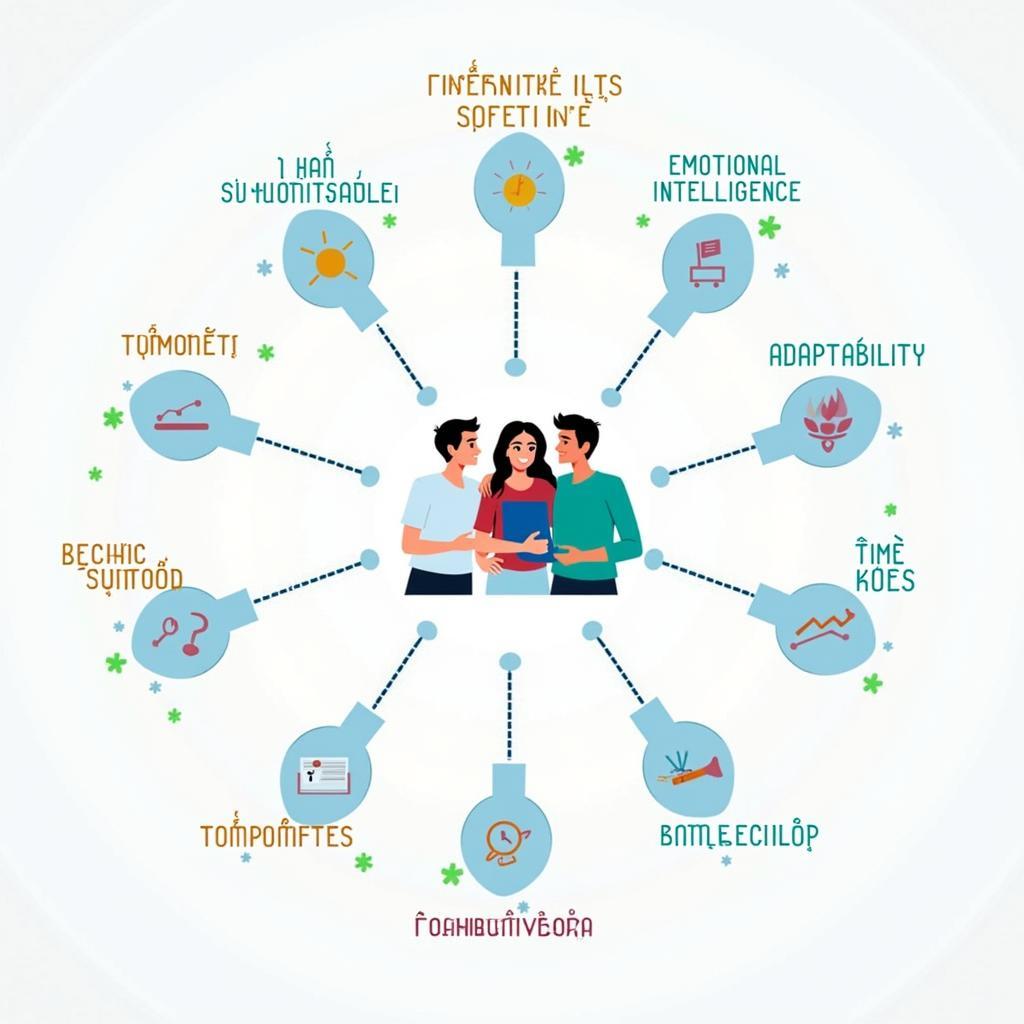 Infographic về các kỹ năng mềm quan trọng được đề cập trong IELTS Speaking Part 3
Question 5: How has technology changed the way people manage projects?
🎯 Phân tích câu hỏi:
- Dạng: Describe change (How has… changed…)
- Key words: “technology”, “changed”, “manage projects” – need to compare past vs present và specify technologies
- Cách tiếp cận:
- Identify specific technologies
- Explain concrete changes in processes
- Discuss both positive impacts và potential drawbacks
- Use comparative language (used to vs now, in the past vs nowadays)
📝 Sample Answer – Band 6-7:
“Technology has changed project management a lot. In the past, people had to have face-to-face meetings and use paper documents, but now they can use software and apps to manage projects online. Tools like Trello or Microsoft Teams help teams communicate and track progress easily. People can work remotely and still collaborate on projects. Also, with cloud storage, everyone can access files anytime, anywhere. This makes project management faster and more convenient than before.”
Phân tích:
- Structure: Clear comparison (past vs present) với examples
- Vocabulary: Adequate (software, apps, track progress, work remotely, cloud storage) with some technical terms
- Examples: Specific tools mentioned (Trello, Microsoft Teams) which is good
- Tại sao Band 6-7: Answers question với relevant points và examples. However, analysis lacks depth về how these tools specifically changed processes. Vocabulary and grammar could be more sophisticated.
📝 Sample Answer – Band 8-9:
“Technology has fundamentally transformed project management in profound and multifaceted ways. Perhaps most significantly, it’s enabled unprecedented levels of collaboration and coordination, particularly for distributed teams. Where project managers once relied heavily on in-person meetings, physical documents, and cumbersome manual tracking systems, today’s digital ecosystem offers sophisticated platforms like Asana, Slack, and Jira that facilitate real-time communication, centralize information, and provide instant visibility into project status. This shift has essentially democratized project oversight – team members can autonomously access updates, identify bottlenecks, and adjust their workflows without constant top-down intervention.
Moreover, technology has revolutionized data management and analytics. Project management software can now automatically generate progress reports, flag potential delays, and even leverage AI to predict risks based on historical patterns. This data-driven approach enables more informed decision-making and proactive problem-solving rather than reactive crisis management. Tools like Microsoft Project or Monday.com can create sophisticated Gantt charts and resource allocation models in minutes – tasks that would have taken hours or days using traditional methods.
Cloud computing has been another game-changer, enabling seamless file sharing and version control. Gone are the days when team members would email documents back and forth, inevitably creating confusion about which version was current. Now, platforms like Google Workspace or SharePoint ensure everyone is working off the same page – quite literally – with simultaneous editing capabilities and comprehensive audit trails.
That said, this technological transformation isn’t without its drawbacks. There’s a risk of over-reliance on tools at the expense of human judgment and communication. Some teams find themselves drowning in notifications and updates, suffering from what I’d call “collaboration overload.” Additionally, the proliferation of project management tools can paradoxically create complexity – organizations sometimes juggle multiple platforms, leading to fragmentation rather than integration.
Nevertheless, on balance, I’d argue technology has been overwhelmingly positive for project management, making it more efficient, transparent, and adaptable to our increasingly globalized and fast-paced work environment.”
Phân tích:
- Structure: Excellently organized: major transformation 1 (collaboration) → transformation 2 (data/analytics) → transformation 3 (cloud) → counterargument (drawbacks) → balanced conclusion
- Vocabulary: Sophisticated và precise (fundamentally transformed, profound and multifaceted, unprecedented levels of, cumbersome, facilitate, centralize, democratized, autonomously access, top-down intervention, leverage AI, data-driven approach, proactive problem-solving, game-changer, seamless, audit trails, drowning in, collaboration overload, proliferation of, paradoxically)
- Grammar: Full range including relative clauses (Where project managers once relied…, tasks that would have taken…), participles (inevitably creating, leading to), passives (can be generated, have been transformed)
- Critical Thinking: Multi-dimensional analysis covering collaboration, data analytics, cloud computing. Acknowledges drawbacks (isn’t without drawbacks, risk of over-reliance) before defending overall positive impact. Shows nuanced understanding
- Specific Examples: Names specific tools (Asana, Slack, Jira, Microsoft Project, Monday.com, Google Workspace, SharePoint) adding credibility
- Comparison: Effective past-present comparison woven throughout (once relied heavily on vs today’s ecosystem, Gone are the days when vs Now platforms ensure)
💡 Key Language Features:
- Emphasizing transformation: fundamentally transformed, revolutionized, game-changer
- Degree markers: Perhaps most significantly, Moreover, Another
- Contrast language: Where… once, Gone are the days when, unlike
- Conceding points: That said, isn’t without drawbacks
- Balancing: Nevertheless, on balance
- Cause-effect language: enabling, facilitate, leading to, create
- Advanced collocations: unprecedented levels of, facilitate real-time communication, data-driven approach, proactive problem-solving, seamless file sharing, drowning in notifications, collaboration overload
Theme 4: Future Trends
Question 6: What challenges do you think future generations will face in terms of managing work pressure?
🎯 Phân tích câu hỏi:
- Dạng: Prediction about future + Problem identification
- Key words: “future generations”, “challenges”, “work pressure”
- Cách tiếp cận:
- Identify emerging trends (AI, remote work, gig economy, etc.)
- Predict specific challenges stemming from these trends
- Use future tenses và tentative language (will likely, may face, could become)
- Consider both technological và social factors
- Back up predictions với current evidence
📝 Sample Answer – Band 6-7:
“I think future generations will face new challenges with work pressure. First, automation and AI might take some jobs, so people will worry about job security. Also, the line between work and personal life will become more unclear because of remote work. People might work from home but feel they should always be available. Another challenge is that jobs will change quickly, so workers will need to keep learning new skills, which can be stressful.”
Phân tích:
- Structure: Identifies multiple challenges với some organization
- Vocabulary: Adequate (automation, AI, job security, remote work, keep learning)
- Future language: Uses “will” appropriately
- Tại sao Band 6-7: Relevant predictions với clear challenges identified. However, analysis lacks depth and sophistication. Vocabulary could be more precise, và predictions need more supporting reasoning.
📝 Sample Answer – Band 8-9:
“I anticipate future generations will grapple with a unique constellation of pressures that are qualitatively different from what we face today. For one thing, the accelerating pace of technological disruption will likely intensify job insecurity anxiety. As AI and automation increasingly encroach on roles previously thought immune to technological replacement – including cognitive and creative work – workers will face mounting pressure to continuously upskill and pivot to remain relevant. This perpetual state of adaptation could prove psychologically taxing, creating what some experts call “chronic career uncertainty.”
Compounding this, the trajectory toward increasingly flexible work arrangements – while offering advantages – may paradoxically amplify pressure. The erosion of clear work-life boundaries means employees might find themselves perpetually “on call,” unable to truly disconnect. Imagine a scenario where the traditional 9-to-5 has been completely replaced by project-based gig work with no guaranteed income or benefits – workers would face constant pressure to hustle for the next opportunity, with little safety net or downtime for recovery.
Additionally, I’d expect heightened pressure around environmental and ethical considerations in work. Future workers will likely face mounting scrutiny regarding the ecological footprint and social impact of their projects, adding an additional layer of complexity and responsibility to their roles. Take project managers, for example – they may need to balance traditional metrics like cost and timeline with carbon neutrality goals and social equity concerns, exponentially increasing the number of competing priorities they’re juggling.
Furthermore, the hyper-connected nature of future work environments could exacerbate issues of information overload and attention fragmentation. With ever-proliferating communication channels and collaboration tools, workers might struggle to maintain deep focus, constantly bombarded by notifications and requests, leading to “decision fatigue” and burnout.
However, it’s not all doom and gloom. Future generations may also have better frameworks for addressing these challenges – perhaps more robust mental health support, more enlightened workplace cultures that genuinely prioritize well-being, or even technological solutions like AI assistants that shoulder some of the cognitive burden. The key will be whether societies proactively develop these support systems or reactively address problems after they’ve reached crisis proportions.”
Phân tích:
- Structure: Exceptionally well-organized: main challenge 1 (job insecurity from AI) → challenge 2 (work-life boundaries) → challenge 3 (environmental/ethical pressure) → challenge 4 (information overload) → balanced consideration of potential positives
- Vocabulary: Highly sophisticated (I anticipate, grapple with, unique constellation of, qualitatively different, accelerating pace of, encroach on, mounting pressure, perpetual state of, psychologically taxing, trajectory, erosion of, heightened pressure, ecological footprint, exponentially increasing, ever-proliferating, attention fragmentation, decision fatigue, doom and gloom, shoulder some of, crisis proportions)
- Grammar: Full range including conditionals, future forms (will likely face, may need to, could prove), participles (accelerating, mounting, competing), complex noun phrases (perpetual state of adaptation, trajectory toward flexible arrangements)
- Critical Thinking: Multi-dimensional analysis covering technology, work arrangements, environmental factors, và information overload. Acknowledges complexity (paradoxically, Compounding this). Considers both challenges AND potential solutions. Uses expert terminology (chronic career uncertainty, decision fatigue)
- Tentative Language: I anticipate, will likely, may face, could prove, I’d expect – appropriate for predictions
- Evidence/Examples: References expert terms, concrete scenarios (9-to-5 replaced by gig work), specific roles (project managers)
💡 Key Language Features:
- Prediction language: I anticipate, will likely, may face, could prove, I’d expect
- Emphasizing complexity: unique constellation of, qualitatively different, exponentially increasing
- Cause-effect: leading to, resulting in, creating
- Contrasting: paradoxically, However, it’s not all doom and gloom
- Abstract nouns: trajectory, erosion, scrutiny, fragmentation, burnout
- Advanced verbs: grapple with, encroach on, amplify, exacerbate, prioritize
- Sophisticated collocations: accelerating pace of, perpetual state of, mounting pressure, ecological footprint, attention fragmentation, decision fatigue
Từ vựng và cụm từ quan trọng
Topic-Specific Vocabulary
| Từ vựng/Cụm từ | Loại từ | Phiên âm | Nghĩa tiếng Việt | Ví dụ | Collocation |
|---|---|---|---|---|---|
| under pressure | phrase | /ˈʌndə(r) ˈpreʃə(r)/ | dưới áp lực | I work best under pressure. | work/perform/thrive under pressure; put someone under pressure |
| tight deadline | n | /taɪt ˈdedlaɪn/ | hạn chót gấp gáp | We’re working with a very tight deadline. | meet/miss a tight deadline; face/have a tight deadline |
| juggle (multiple tasks) | v | /ˈdʒʌɡl/ | xoay xở với nhiều việc | I’m juggling work and family commitments. | juggle responsibilities/priorities/tasks/commitments |
| prioritize | v | /praɪˈɒrətaɪz/ | ưu tiên | You need to prioritize urgent tasks first. | prioritize tasks/work/responsibilities; learn to prioritize |
| delegate | v | /ˈdelɪɡeɪt/ | phân công, ủy quyền | Good managers know how to delegate effectively. | delegate tasks/responsibilities/authority; delegate to team members |
| overwhelming | adj | /ˌəʊvəˈwelmɪŋ/ | quá tải, áp đảo | The workload was overwhelming. | feel overwhelming; overwhelming pressure/workload/stress |
| milestone | n | /ˈmaɪlstəʊn/ | mốc quan trọng | We achieved an important milestone today. | reach/hit/achieve a milestone; significant/key milestone |
| on track | phrase | /ɒn træk/ | đúng tiến độ | The project is still on track for completion. | stay/keep/get on track; be on track to do something |
| pull an all-nighter | idiom | /pʊl ən ˌɔːl ˈnaɪtə(r)/ | thức trắng đêm | I had to pull an all-nighter to finish the report. | pull an all-nighter to finish/complete something |
| behind schedule | phrase | /bɪˈhaɪnd ˈʃedjuːl/ | chậm tiến độ | We’re two weeks behind schedule. | fall/run behind schedule; get back on schedule |
| time management | n | /taɪm ˈmænɪdʒmənt/ | quản lý thời gian | Good time management is essential. | improve/develop time management; time management skills/techniques |
| workload | n | /ˈwɜːkləʊd/ | khối lượng công việc | My workload has increased significantly. | heavy/manageable/overwhelming workload; reduce/manage workload |
| multitask | v | /ˌmʌltiˈtɑːsk/ | làm nhiều việc cùng lúc | She’s excellent at multitasking. | ability to multitask; multitask effectively |
| crisis management | n | /ˈkraɪsɪs ˈmænɪdʒmənt/ | quản lý khủng hoảng | The team showed excellent crisis management. | crisis management skills; handle crisis management |
| stakeholder | n | /ˈsteɪkhəʊldə(r)/ | bên liên quan | We need to keep all stakeholders informed. | key/important stakeholders; stakeholder engagement/management |
| contingency plan | n | /kənˈtɪndʒənsi plæn/ | kế hoạch dự phòng | Always have a contingency plan ready. | develop/prepare/implement a contingency plan |
| resource allocation | n | /rɪˈsɔːs ˌæləˈkeɪʃn/ | phân bổ nguồn lực | Efficient resource allocation is crucial. | optimal resource allocation; resource allocation strategy |
| stretched thin | idiom | /stretʃt θɪn/ | bị căng thẳng quá mức | The team is stretched thin with current projects. | be stretched thin; feel stretched thin |
| stay on top of (things) | phrase | /steɪ ɒn tɒp əv/ | kiểm soát tốt mọi việc | It’s hard to stay on top of everything. | stay on top of work/deadlines/tasks |
| burnout | n | /ˈbɜːnaʊt/ | kiệt sức | Many workers suffer from burnout. | experience/suffer from/prevent burnout; burnout symptoms |
Idiomatic Expressions & Advanced Phrases
| Cụm từ | Nghĩa | Ví dụ sử dụng | Band điểm |
|---|---|---|---|
| push someone to their limits | đẩy ai đó đến giới hạn | This project really pushed me to my limits. | 8-9 |
| bite off more than one can chew | tham vọng quá sức | I think I bit off more than I could chew with this project. | 8-9 |
| a race against time | cuộc đua với thời gian | Finishing the project was a race against time. | 7.5-8 |
| spread oneself too thin | dàn trải quá nhiều | Don’t spread yourself too thin by taking on too many projects. | 7.5-8 |
| the ball is in someone’s court | quyền quyết định thuộc về ai | I’ve done my part; now the ball is in their court. | 7-8 |
| get the ball rolling | bắt đầu công việc | Let’s get the ball rolling on this project. | 7-8 |
| on the same page | thống nhất, có cùng quan điểm | We need to make sure everyone is on the same page. | 7-8 |
| drop the ball | làm hỏng việc, sai sót | I dropped the ball on that deadline. | 7-8 |
| go the extra mile | nỗ lực hết mình | She always goes the extra mile for her clients. | 7.5-8 |
| rise to the challenge | vươn lên đương đầu thử thách | The team really rose to the challenge. | 7.5-8 |
| in the nick of time | vào phút chót, kịp lúc | We finished the project in the nick of time. | 7-8 |
| keep one’s head above water | cố gắng duy trì, không bị chìm | I’m just trying to keep my head above water with all this work. | 8-9 |
| a perfect storm (of factors) | sự kết hợp của nhiều yếu tố tiêu cực | It was a perfect storm of tight deadlines and limited resources. | 8.5-9 |
| frayed at the edges | kiệt sức, sắp đạt giới hạn | By the end of the project, I was feeling frayed at the edges. | 8.5-9 |
| hit the ground running | bắt đầu ngay với năng lượng cao | We need to hit the ground running next Monday. | 7.5-8 |
| wear many hats | đảm nhận nhiều vai trò | As a startup founder, you have to wear many hats. | 7.5-8 |
Discourse Markers (Từ Nối Ý Trong Speaking)
Để bắt đầu câu trả lời:
- 📝 Well,… – Dùng khi cần thời gian suy nghĩ ngắn. “Well, that’s an interesting question…”
- 📝 Actually,… – Khi đưa ra góc nhìn khác hoặc thông tin bất ngờ. “Actually, I think the opposite is true…”
- 📝 To be honest,… – Khi nói thật, thẳng thắn. “To be honest, I found it quite challenging.”
- 📝 I’d say that… – Khi đưa ra quan điểm. “I’d say that time management is crucial.”
- 📝 From my perspective,… – Góc nhìn cá nhân. “From my perspective, teamwork made all the difference.”
Để bổ sung ý:
- 📝 On top of that,… – Thêm vào đó. “On top of that, we had budget constraints.”
- 📝 What’s more,… – Hơn nữa. “What’s more, the deadline was moved up.”
- 📝 Not to mention… – Chưa kể đến. “Not to mention the technical difficulties we faced.”
- 📝 Additionally,… / Furthermore,… – Formal hơn, dùng Part 3
- 📝 Moreover,… – Ngoài ra (formal)
Để đưa ra quan điểm cân bằng:
- 📝 On the one hand,… On the other hand,… – Một mặt… mặt khác
- 📝 While it’s true that…, we also need to consider… – Tuy đúng là… nhưng cũng cần xem xét
- 📝 That said,… – Tuy nhiên, dù vậy. “That said, there were some benefits.”
- 📝 Having said that,… – Sau khi đã nói điều đó
Để giải thích hoặc làm rõ:
- 📝 What I mean is… – Ý tôi là…
- 📝 In other words,… – Nói cách khác
- 📝 To put it another way,… – Nói theo cách khác
- 📝 Essentially,… – Về cơ bản
Để đưa ra ví dụ:
- 📝 For instance,… / For example,… – Ví dụ
- 📝 Take… for example – Lấy… làm ví dụ. “Take my recent project for example…”
- 📝 Such as… – Như là…
- 📝 Like… – Giống như (informal, natural)
Để kết luận:
- 📝 All in all,… – Tóm lại, nói chung
- 📝 At the end of the day,… – Cuối cùng thì
- 📝 In conclusion,… – Kết luận (formal, chủ yếu Part 3)
- 📝 Looking back,… – Nhìn lại
- 📝 Ultimately,… – Cuối cùng, rốt cuộc
Để thừa nhận phức tạp (Part 3):
- 📝 It depends on… – Tùy thuộc vào
- 📝 There’s no simple answer because… – Không có câu trả lời đơn giản vì
- 📝 It’s a complex issue… – Đó là vấn đề phức tạp
Grammatical Structures Ấn Tượng
1. Conditional Sentences (Câu điều kiện):
Mixed conditional:
- Formula: If + past perfect, would + bare infinitive
- Ví dụ: “If I had started planning earlier, I wouldn’t be so stressed now.”
- Dùng khi: Nói về hành động trong quá khứ ảnh hưởng đến hiện tại
Inversion (Đảo ngữ):
- Formula: Had I known… / Were I to do it again…
- Ví dụ: “Had I known about the deadline change, I would have prioritized differently.”
- Dùng khi: Muốn sound formal và sophisticated, đặc biệt Part 3
2. Relative Clauses (Mệnh đề quan hệ):
Non-defining relative clauses:
- Formula: …, which/who + clause, …
- Ví dụ: “The project, which took three weeks to complete, was a great success.”
- Dùng khi: Thêm thông tin bổ sung, tăng fluency
Reduced relative clauses:
- Formula: The person coordinating… / The project involving…
- Ví dụ: “The tasks requiring immediate attention were handled first.”
- Dùng khi: Muốn compact và sophisticated hơn
3. Passive Voice (Câu bị động):
Impersonal passive (It + passive verb):
- Formula: It is thought/believed/said that…
- Ví dụ: “It’s widely believed that stress levels are increasing among young people.”
- Dùng khi: Nói về general opinion, research, không muốn specify subject
Get passive (informal):
- Formula: get + past participle
- Ví dụ: “I got assigned to lead the project” / “We got delayed by unexpected issues.”
- Dùng khi: Speaking tự nhiên hơn “be + past participle”
4. Cleft Sentences (Câu chẻ):
What-cleft:
- Formula: What I find most…, is… / What made it challenging was…
- Ví dụ: “What I found most stressful was the uncertainty about whether we’d finish on time.”
- Dùng khi: Muốn emphasize một phần của câu
It-cleft:
- Formula: It was… that… / It wasn’t until… that…
- Ví dụ: “It was the support from my team that made the difference.”
- Dùng khi: Focus vào một element cụ thể
5. Participle Clauses (Mệnh đề phân từ):
Present participle:
- Formula: -ing clause at beginning or end of sentence
- Ví dụ: “Having managed several projects before, I felt confident taking this on.”
- Dùng khi: Show cause, time relationship, reduce repetition
Perfect participle:
- Formula: Having + past participle
- Ví dụ: “Having completed the planning phase, we moved on to implementation.”
- Dùng khi: Show one action completed before another
6. Inversion for Emphasis:
Negative inversion:
- Formula: Never have I… / Rarely do we… / Not only did…, but also…
- Ví dụ: “Never have I experienced such intense pressure.” / “Not only did we meet the deadline, but we also exceeded expectations.”
- Dùng khi: Strong emphasis, dramatic effect (use sparingly!)
7. Subjunctive Mood:
Formal suggestions/requirements:
- Formula: It’s essential/crucial/important that + subject + base form
- Ví dụ: “It’s essential that every team member be informed of changes.”
- Dùng khi: Formal recommendations, Part 3 discussions about policy
Chiến lược trả lời và lời khuyên từ Examiner
Strategies for Part 1: Be Natural and Extend
Do’s:
- ✅ Trả lời ngắn gọn nhưng complete (2-3 câu)
- ✅ Sound natural, như đang chat với bạn
- ✅ Thêm ví dụ ngắn từ experience của bạn
- ✅ Vary vocabulary thay vì repeat câu hỏi
- ✅ Smile và maintain eye contact
Don’ts:
- ❌ Nói quá dài (1 câu quá ngắn, 5+ câu quá dài)
- ❌ Học thuộc template và recite mechanically
- ❌ Dùng từ quá formal không phù hợp (utilize, commence thay vì use, start)
- ❌ Trả lời Yes/No rồi im lặng
- ❌ Overthink – Part 1 là warm-up!
Common mistakes từ học viên Việt Nam:
- Quá ngắn gọn: “Yes, I do” → Extend với reason!
- Repeat question: “Do you work under pressure? Yes, I work under pressure” → Paraphrase!
- Quá nhiều “very”: very good, very important → Use stronger adjectives: excellent, crucial
- Thiếu tự nhiên: Nghe như đang đọc thuộc → Practice speaking naturally!
Strategies for Part 2: Structure and Develop
Preparation (1 minute):
- Read carefully – Highlight key words trong đề
- Plan structure – Quick outline for each bullet point
- Note keywords – KHÔNG viết câu, chỉ keywords
- Think of examples – Specific details, numbers, names
- Plan conclusion – Reflection về feelings/learning
Speaking (2-3 minutes):
- Strong opening – “I’d like to talk about…”
- Signpost clearly – “As for…”, “Regarding…”, “What made it special…”
- Develop each point – Don’t rush, give details
- Use past tenses – Mostly simple past và past continuous for stories
- Strong ending – Reflect on feelings, impact, learning
Timing:
- Aim for 2-2.5 phút (not 1 minute, not 3.5 minutes)
- If you finish at 1.5 phút → You didn’t develop enough
- If examiner stops you → Totally fine, doesn’t affect score
- Use timer when practice để có sense of timing
Common mistakes từ học viên Việt Nam:
- Không dùng hết 1 phút chuẩn bị → Thiếu ý tưởng khi nói
- Bỏ sót bullet points → Mất điểm Task Achievement
- Nói quá ngắn (dưới 1.5 phút) → Shows limited ability
- Quá general, thiếu specific details → Unconvincing
- Đột ngột dừng lại không có conclusion → Incomplete
Strategies for Part 3: Analyze and Balance
Approach:
- Take your time – It’s OK to pause và say “That’s an interesting question…”
- Structure your answer:
- Direct response to question
- Reason 1 + example/explanation
- Reason 2 + example/explanation
- Counterargument or qualification (if appropriate)
- Brief conclusion
- Think broadly – Not just personal experience, discuss society, trends, different groups
- Show critical thinking – Acknowledge complexity: “It depends on…”, “While X is true, we also need to consider Y…”
- Use sophisticated language – Abstract nouns, tentative language, advanced discourse markers
When you don’t understand:
- “Could you rephrase that?” – Polite và acceptable
- “Do you mean…?” – Clarify để avoid answering wrong question
- “I’m not entirely sure I understand, but…” – Honest, then answer what you think
When you don’t know:
- “That’s a difficult question…” – Buys time
- “I haven’t thought about this before, but…” – Honest then speculate
- “I’m not an expert on this, but I’d say…” – Hedge then give opinion
- NEVER say “I don’t know” và stop
Common mistakes từ học viên Việt Nam:
- Trả lời quá ngắn như Part 1 → Part 3 needs analysis!
- Quá personal → Talk about society, not just yourself
- Đồng ý/phủ định absolute → Show nuanced thinking: “To some extent…”, “It depends…”
- Thiếu examples → Abstract ideas need concrete illustration
- Sợ silence → Natural pausing OK, better than “um… er…” constantly
Band Score Breakdown – What Examiners Look For
Band 6-7:
- Fluency: Some hesitation, self-correction OK but shouldn’t be constant
- Vocabulary: Adequate range, some topic vocabulary, occasional imprecision
- Grammar: Mix of simple và complex, some errors don’t impede communication
- Pronunciation: Generally clear với some L1 influence
Band 7.5-8:
- Fluency: Speaks at length without noticeable effort, natural self-correction
- Vocabulary: Wide range used flexibly, some sophisticated items, good collocations
- Grammar: Wide range of complex structures, mostly accurate
- Pronunciation: Easy to understand, effective intonation patterns
Band 8.5-9:
- Fluency: Fluent với minimal hesitation, coherent và cohesive throughout
- Vocabulary: Sophisticated range used naturally, precise meanings, idiomatic
- Grammar: Full range used accurately và appropriately, very rare errors
- Pronunciation: Effortless to understand, natural prosody và features
Final Tips từ 20 Years Experience
1. Practice authentically:
- Record yourself và listen back
- Practice với topics you don’t prepare
- Time yourself
- Get feedback từ teacher hoặc experienced speaker
2. Build vocabulary organically:
- Learn words in chunks (collocations) not isolation
- Note phrases từ podcasts, TV shows
- Practice using new words in sentences
- Review regularly
3. Develop ideas:
- Read opinions trên controversial topics
- Practice explaining “why” – reasoning is key
- Think about both sides of issues
- Watch TED talks for examples of developed ideas
4. Manage test day:
- Arrive early để settle nerves
- Warm up voice trước khi vào (practice speaking)
- Treat examiner như conversation partner, not interrogator
- If nervous, take deep breath và speak slowly – better slow and accurate than fast and messy
5. Mindset:
- Don’t memorize answers – examiners can tell
- It’s OK to not know something – speculate intelligently
- Your ideas don’t need to be brilliant, just clearly expressed
- Accent doesn’t matter – clarity does
Remember: IELTS Speaking tests your ability to communicate effectively in English, not your knowledge about topics or intelligence. Focus on expressing yourself clearly, developing ideas, và using language flexibly. Good luck!
Kết luận:
Chủ đề “Describe a time when you had to manage a project under pressure” là một đề tài phổ biến và thực tế trong IELTS Speaking. Để đạt band điểm cao, bạn cần:
- Kể chuyện chi tiết với specific examples, numbers, và timeline
- Sử dụng từ vựng đa dạng về project management, stress, và emotions
- Demonstrate reflection về what you learned và how you grew
- Cân bằng giữa fluency và accuracy – don’t sacrifice clarity for speed
- Practice regularly với variety of topics để build confidence
Hãy nhớ rằng examiner không chỉ đánh giá English của bạn mà còn cách bạn organize ideas, develop arguments, và communicate effectively. Với preparation đúng cách và practice thường xuyên, bạn hoàn toàn có thể đạt band điểm mong muốn. Chúc bạn thành công!