Chủ đề về việc giúp đỡ đồng nghiệp trong công việc là một trong những đề tài phổ biến và thiết thực nhất trong kỳ thi IELTS Speaking. Theo thống kê từ các trung tâm thi IELTS chính thức, chủ đề này xuất hiện với tần suất khá cao từ năm 2020 đến nay, đặc biệt trong Part 2 và Part 3. Dự đoán khả năng xuất hiện trong tương lai vẫn ở mức cao do tính ứng dụng thực tế của chủ đề trong môi trường làm việc hiện đại.
Chủ đề “helping a colleague” không chỉ kiểm tra khả năng kể chuyện của bạn mà còn đánh giá cách bạn diễn đạt về kỹ năng làm việc nhóm, tinh thần hợp tác và khả năng giải quyết vấn đề. Đây là những phẩm chất được đánh giá cao trong văn hóa làm việc quốc tế, vì vậy examiner thường quan tâm đến cách bạn trình bày câu chuyện một cách tự nhiên và thuyết phục.
Trong bài viết này, bạn sẽ học được cách trả lời hiệu quả cho tất cả 3 phần thi với chủ đề này, bao gồm 15+ câu hỏi thường gặp kèm bài mẫu chi tiết từ Band 6 đến Band 9. Bạn cũng sẽ được trang bị hơn 50 từ vựng và cụm từ ăn điểm, các chiến lược trả lời từ góc nhìn examiner, cùng những lưu ý quan trọng để tránh những lỗi phổ biến mà học viên Việt Nam thường mắc phải.
IELTS Speaking Part 1: Introduction and Interview
Tổng Quan Về Part 1
Part 1 của IELTS Speaking thường kéo dài 4-5 phút với các câu hỏi ngắn về đời sống hàng ngày. Examiner sẽ hỏi về công việc, đồng nghiệp và môi trường làm việc của bạn một cách tự nhiên. Mục tiêu của phần này là tạo không khí thoải mái và đánh giá khả năng giao tiếp cơ bản của bạn.
Chiến lược quan trọng nhất cho Part 1 là trả lời trực tiếp câu hỏi, sau đó mở rộng thêm 1-2 câu với lý do hoặc ví dụ cụ thể. Tránh trả lời quá dài vì examiner cần kiểm soát thời gian để hỏi đủ số câu hỏi theo quy định.
Lỗi thường gặp của học viên Việt Nam trong Part 1 bao gồm: trả lời chỉ một từ hoặc quá ngắn gọn như “Yes” hoặc “No”, sử dụng từ vựng quá đơn giản lặp đi lặp lại, không đưa ra ví dụ cụ thể từ kinh nghiệm bản thân, và có xu hướng nói theo template cứng nhắc thay vì tự nhiên.
Các Câu Hỏi Thường Gặp
Question 1: Do you work or are you a student?
Question 2: Do you often help your colleagues at work?
Question 3: What kind of help do colleagues usually ask you for?
Question 4: Is it important to help colleagues in the workplace?
Question 5: Have you ever refused to help a colleague? Why?
Question 6: Do you prefer to work independently or in a team?
Question 7: What makes a good colleague?
Question 8: How do you feel when someone asks for your help at work?
Phân Tích và Gợi Ý Trả Lời Chi Tiết
Question: Do you often help your colleagues at work?
🎯 Cách tiếp cận:
- Trả lời trực tiếp có hay không
- Giải thích tần suất và loại giúp đỡ
- Đưa ra lý do tại sao bạn làm điều đó
📝 Sample Answer – Band 6-7:
Yes, I help my colleagues quite regularly. Usually, they ask me about technical problems with computers or software because I’m good at IT. I think it’s normal to help each other in the office.
Phân tích:
- Điểm mạnh: Trả lời rõ ràng, có ví dụ cụ thể về loại giúp đỡ, có lý do đơn giản
- Hạn chế: Từ vựng còn basic (good at, quite regularly, normal), cấu trúc câu đơn giản, thiếu chi tiết cảm xúc
- Tại sao Band 6-7: Đáp ứng yêu cầu câu hỏi nhưng chưa thể hiện được khả năng sử dụng ngôn ngữ linh hoạt và phong phú
📝 Sample Answer – Band 8-9:
Absolutely, I’d say I’m quite proactive when it comes to offering assistance to my colleagues. More often than not, people approach me for help with technical troubleshooting or when they need someone to brainstorm ideas for projects. I find it really fulfilling because not only does it strengthen our team dynamics, but it also helps me stay sharp with my own skills.
Phân tích:
- Điểm mạnh: Từ vựng sophisticated (proactive, offering assistance, troubleshooting, brainstorm, fulfilling), cấu trúc phức tạp (when it comes to, more often than not, not only…but also), thể hiện tư duy sâu sắc về lợi ích hai chiều
- Tại sao Band 8-9: Fluency tự nhiên, vocabulary precise và topic-specific, grammar đa dạng với inversion và complex sentences, pronunciation rõ ràng với word stress phù hợp, ideas developed với personal insight
💡 Key Vocabulary & Expressions:
- proactive: chủ động, tích cực
- offering assistance: đề nghị giúp đỡ (formal hơn “help”)
- technical troubleshooting: khắc phục sự cố kỹ thuật
- brainstorm ideas: động não, suy nghĩ ý tưởng cùng nhau
- fulfilling: mang lại cảm giác thỏa mãn, có ý nghĩa
- strengthen team dynamics: củng cố sự gắn kết trong nhóm
- stay sharp: duy trì sự nhạy bén, tinh thông
Question: What kind of help do colleagues usually ask you for?
🎯 Cách tiếp cận:
- Nêu cụ thể 2-3 loại giúp đỡ phổ biến
- Giải thích tại sao họ lại nhờ bạn những việc đó
- Có thể thêm cảm nhận của bạn
📝 Sample Answer – Band 6-7:
My colleagues usually ask me to help them with Excel spreadsheets and data analysis. Sometimes they also need help with presentations. I think they ask me because I have experience with these things and I’m patient when explaining.
Phân tích:
- Điểm mạnh: Trả lời đúng trọng tâm, có ví dụ cụ thể, đưa ra lý do
- Hạn chế: Vocabulary basic, thiếu variety trong sentence structure, chưa thể hiện depth of thinking
- Tại sao Band 6-7: Adequate response nhưng chưa impressive về mặt ngôn ngữ
📝 Sample Answer – Band 8-9:
Well, I tend to get requests for help in a couple of different areas. First and foremost, people often come to me for guidance with data visualization and advanced Excel functions, particularly when they’re dealing with complex spreadsheets. Additionally, I’m frequently asked to proofread important documents or help refine presentations before client meetings. I suppose it’s because I have a keen eye for detail and I genuinely enjoy walking people through the process rather than just doing it for them.
Phân tích:
- Điểm mạnh: Structure rõ ràng với First and foremost, Additionally; vocabulary sophisticated (come to me for guidance, data visualization, complex spreadsheets, proofread, refine, keen eye for detail); grammar phức tạp với relative clauses và gerunds; critical thinking thể hiện qua việc phân tích lý do một cách sâu sắc
- Tại sao Band 8-9: Demonstrates excellent control of language với precise vocabulary, complex structures được sử dụng naturally, và ideas được developed fully với personal reflection
💡 Key Vocabulary & Expressions:
- come to someone for guidance: nhờ ai đó hướng dẫn
- data visualization: trực quan hóa dữ liệu
- complex spreadsheets: bảng tính phức tạp
- proofread documents: đọc và sửa lỗi tài liệu
- refine presentations: chỉnh sửa, hoàn thiện bài thuyết trình
- keen eye for detail: con mắt tinh tường, chú ý đến chi tiết
- walk people through: hướng dẫn ai đó từng bước
Question: Is it important to help colleagues in the workplace?
🎯 Cách tiếp cận:
- Đưa ra quan điểm rõ ràng (yes/no)
- Giải thích 2-3 lý do cụ thể
- Có thể đưa ra example hoặc consequence
📝 Sample Answer – Band 6-7:
Yes, I think it’s very important to help colleagues. When we help each other, the work gets done faster and the atmosphere in the office is better. Also, if you help others, they will help you when you need it.
Phân tích:
- Điểm mạnh: Có opinion rõ ràng, đưa ra được 2 lý do logic
- Hạn chế: Ideas còn surface-level, vocabulary repetitive (help xuất hiện 4 lần), grammar đơn giản với mostly simple sentences
- Tại sao Band 6-7: Communicates ideas clearly nhưng lacks sophistication và depth
📝 Sample Answer – Band 8-9:
Absolutely, I’d argue it’s essential for workplace productivity and employee morale. When colleagues support one another, it fosters a collaborative environment where people feel valued and psychologically safe to ask questions or admit mistakes. This ultimately leads to better problem-solving because you’re leveraging diverse perspectives and skill sets. Beyond that, it builds trust and rapport within teams, which I believe is the foundation of any high-performing organization. From my experience, workplaces where people operate in silos tend to have much higher turnover rates and lower job satisfaction.
Phân tích:
- Điểm mạnh: Strong opinion với I’d argue; sophisticated vocabulary (essential, foster, psychologically safe, leveraging, operate in silos, turnover rates); complex grammar với when-clauses, relative clauses; critical thinking thể hiện qua việc phân tích both immediate benefits và long-term consequences; personal experience được integrate naturally
- Tại sao Band 8-9: Language control xuất sắc với precise expressions, ideas được developed với depth và nuance, demonstrates awareness of broader implications
💡 Key Vocabulary & Expressions:
- essential: thiết yếu, cần thiết
- workplace productivity: năng suất làm việc
- employee morale: tinh thần nhân viên
- foster a collaborative environment: thúc đẩy môi trường hợp tác
- psychologically safe: an toàn về mặt tâm lý
- leverage diverse perspectives: tận dụng các góc nhìn đa dạng
- build trust and rapport: xây dựng lòng tin và mối quan hệ
- operate in silos: làm việc độc lập, không liên kết
- turnover rates: tỷ lệ nghỉ việc
 Đồng nghiệp hỗ trợ nhau trong văn phòng làm việc thể hiện tinh thần teamwork IELTS Speaking
IELTS Speaking Part 2: Long Turn (Cue Card)
Tổng Quan Về Part 2
Part 2 là phần độc thoại kéo dài 3-4 phút, trong đó bạn có 1 phút chuẩn bị và phải nói liên tục 2-3 phút về một chủ đề cụ thể. Đây là phần quan trọng nhất để thể hiện khả năng sử dụng ngôn ngữ một cách độc lập và mạch lạc.
Chiến lược hiệu quả nhất là sử dụng đầy đủ 1 phút chuẩn bị để ghi chú các từ khóa chính, không viết câu đầy đủ. Bạn nên note down theo từng bullet point của đề bài, thêm một vài từ vựng hay bạn muốn sử dụng. Trong khi nói, hãy đảm bảo trả lời đầy đủ tất cả các yêu cầu, sử dụng thì động từ phù hợp (thường là quá khứ khi kể câu chuyện), và nói đủ 2 phút.
Lỗi thường gặp của học viên Việt Nam bao gồm không tận dụng hết thời gian chuẩn bị, nói quá ngắn dưới 1.5 phút, bỏ sót một hoặc nhiều bullet points, sử dụng sai thì động từ, và có xu hướng nói theo template học thuộc thay vì tự nhiên kể câu chuyện của mình.
Cue Card
Describe A Time When You Helped A Colleague
You should say:
- When this happened
- Who the colleague was
- What kind of help you provided
- And explain how you felt about helping this person
Phân Tích Đề Bài
Dạng câu hỏi: Describe an experience – kể về một trải nghiệm cụ thể trong quá khứ
Thì động từ: Quá khứ đơn và quá khứ tiếp diễn chủ yếu, có thể dùng quá khứ hoàn thành để nói về sự việc xảy ra trước
Bullet points phải cover:
- When: Xác định thời gian cụ thể (tháng, năm, hoặc mốc thời gian tương đối)
- Who: Giới thiệu đồng nghiệp đó là ai, mối quan hệ công việc
- What help: Mô tả chi tiết loại giúp đỡ, bối cảnh, quá trình
- How you felt: Đây là phần quan trọng nhất để ghi điểm cao – cần phân tích cảm xúc và suy nghĩ
Câu “explain” quan trọng: Phần explain feelings thường chiếm 30-40% thời gian nói và là nơi bạn thể hiện depth of thinking. Đừng chỉ nói “I felt happy” mà hãy phân tích tại sao bạn cảm thấy như vậy, điều gì có ý nghĩa với bạn, và tác động lâu dài của trải nghiệm này.
Để dễ dàng chuẩn bị cho các tình huống tương tự, bạn có thể tham khảo thêm describe a time when you helped a friend with an important decision để học cách triển khai ý về việc hỗ trợ người khác trong các bối cảnh khác nhau.
📝 Sample Answer – Band 6-7
Thời lượng: Khoảng 1.5-2 phút
I’d like to talk about a time when I helped my colleague named Linda about six months ago. She was a new member in our marketing team and was still learning about our company’s systems.
At that time, Linda was working on an important presentation for a client meeting, but she had problems with the design software we use. She looked really stressed because the deadline was the next day. I noticed she was struggling, so I offered to help her.
I spent about two hours that evening showing her how to use the software. I explained the basic functions and helped her create some slides for her presentation. We also practiced together so she would feel more confident. I stayed late at the office to make sure she finished everything on time.
When we completed the presentation, Linda was very happy and thanked me many times. She said I saved her from a difficult situation. The next day, her presentation went well and the client was satisfied.
I felt really good about helping Linda because I remembered when I was new, other people also helped me. It’s important to support new colleagues because everyone needs help sometimes. I also think it made our working relationship stronger. After that, Linda and I became good friends at work, and now we often help each other with different tasks.
This experience taught me that helping others doesn’t take too much time but can make a big difference. I believe a friendly and supportive workplace is better for everyone.
Phân Tích Band Điểm
| Tiêu chí | Band | Nhận xét |
|---|---|---|
| Fluency & Coherence | 6-7 | Có logical sequencing với các linking words cơ bản (at that time, after that), ít hesitation, nhưng còn mechanical, thiếu flexibility trong cách diễn đạt |
| Lexical Resource | 6-7 | Vocabulary adequate (struggled, confident, satisfied) nhưng còn basic, có một số collocations (working relationship, difficult situation) nhưng không sophisticated |
| Grammatical Range & Accuracy | 6-7 | Mix của simple và complex sentences, sử dụng đúng thì quá khứ, có một số cấu trúc phức (when-clauses, so…that) nhưng không đa dạng |
| Pronunciation | 6-7 | Rõ ràng và dễ hiểu, có một số lỗi nhỏ về word stress nhưng không ảnh hưởng communication |
Điểm mạnh:
- ✅ Trả lời đầy đủ tất cả bullet points
- ✅ Có structure rõ ràng với introduction, body, conclusion
- ✅ Sử dụng đúng thì quá khứ xuyên suốt
- ✅ Có personal reflection ở cuối
Hạn chế:
- ⚠️ Vocabulary còn repetitive (helped xuất hiện 6 lần, good/well 3 lần)
- ⚠️ Ideas về feelings còn surface-level, thiếu depth
- ⚠️ Grammar structures chưa sophisticated, mostly simple sentences
📝 Sample Answer – Band 7.5-8
Thời lượng: Khoảng 2-2.5 phút
I’d like to share an experience from about eight months ago when I assisted a colleague named David, who had just joined our finance department.
The situation arose during our fiscal year-end closing, which is typically our most hectic period. David, being relatively new to the company, was overwhelmed by the complexity of our reporting system. He was responsible for consolidating data from multiple departments, but he was struggling to navigate the software and kept running into technical errors.
I noticed he was working late every evening and looking increasingly stressed out, so I approached him to see if I could lend a hand. Initially, he was hesitant to accept help, probably because he didn’t want to appear incompetent, but I reassured him that everyone faces challenges with new systems.
I spent several evenings walking him through the process step by step. We tackled the technical issues together, and I shared some shortcuts and best practices I’d learned over the years. I also created a simple reference guide he could use in the future. By the deadline, we managed to complete all the reports successfully, and they were error-free.
Looking back, I felt genuinely fulfilled by this experience. There was a real sense of satisfaction in passing on knowledge and seeing someone gain confidence in their abilities. It reminded me of my early days at the company when senior colleagues took me under their wing. Beyond just completing a task, it strengthened our professional bond, and David has since become one of my closest collaborators.
This experience reinforced my belief that fostering a supportive work culture benefits everyone. When people feel comfortable seeking assistance, it ultimately enhances team performance and creates a more positive work environment.
Phân Tích Band Điểm
| Tiêu chí | Band | Nhận xét |
|---|---|---|
| Fluency & Coherence | 7.5-8 | Speaks fluently với minimal hesitation, excellent use of cohesive devices (Initially, Looking back, Beyond just), logical progression of ideas |
| Lexical Resource | 7.5-8 | Wide range của vocabulary (overwhelmed, consolidating, navigate, tackled, fulfilled), good use of collocations (fiscal year-end, lend a hand, took me under their wing), less common lexical items |
| Grammatical Range & Accuracy | 7.5-8 | Wide range của structures (relative clauses, participle clauses, conditionals implied), majority of sentences error-free, sophisticated use of tenses |
| Pronunciation | 7.5-8 | Clear pronunciation, appropriate intonation, effective use of stress và rhythm |
So Sánh Với Band 6-7
| Khía cạnh | Band 6-7 | Band 7.5-8 |
|---|---|---|
| Vocabulary | “helped”, “problems”, “stressed” | “assisted”, “overwhelmed”, “complexity”, “struggling to navigate” |
| Grammar | “I spent about two hours that evening showing her” (simple) | “I spent several evenings walking him through the process step by step” (more complex với gerund phrase) |
| Ideas | “I felt really good because I remembered when I was new” | “There was a real sense of satisfaction in passing on knowledge and seeing someone gain confidence” (deeper emotional analysis) |
📝 Sample Answer – Band 8.5-9
Thời lượng: 2.5-3 phút đầy đủ
I’d like to recount a particularly memorable experience from roughly a year ago when I came to the aid of a colleague named Sarah, who was grappling with what seemed like an insurmountable challenge at work.
The context was quite critical – our company was in the midst of pitching for a high-stakes contract with a major international client. Sarah, who’s exceptionally talented in client relations but admittedly less tech-savvy, had been tasked with creating an interactive data dashboard for the presentation. The problem was that she had virtually no experience with the business intelligence software required, and with just three days until the pitch, she was visibly overwhelmed and on the verge of a breakdown.
When I stumbled upon her late one evening, frantically trying to troubleshoot issues with her dashboard, I could see she was caught between asking for help and wanting to prove herself capable of handling the task independently. I took the initiative to sit down with her, and we devised a collaborative approach – rather than simply doing it for her, which would have been quicker but less empowering, I guided her through each stage of the process.
We spent those three evenings working side by side, and I adopted what I’d call a coaching methodology. I’d demonstrate a technique, watch her replicate it, and then gradually step back as her confidence grew. We also brainstormed creative ways to visualize the data that would resonate with the client’s priorities. By the final evening, Sarah was independently navigating the software and even implementing features I hadn’t thought to suggest.
The pitch itself was a resounding success, and Sarah’s dashboard was singled out by the client as a decisive factor in their decision to award us the contract. But what struck me most was witnessing Sarah’s transformation from someone paralyzed by self-doubt to someone radiating confidence in her expanded skill set.
On a personal level, this experience was profoundly rewarding in ways that transcended the immediate outcome. There’s something intrinsically meaningful about facilitating someone’s professional growth – it taps into a deeper sense of purpose beyond individual achievement. It also challenged me to articulate knowledge I’d internalized to the point where I no longer consciously thought about it, which actually refined my own understanding.
Moreover, this experience catalyzed a shift in how I perceive my role within the team. I realized that true value isn’t just about individual technical prowess but about elevating the collective capability of the group. Sarah and I have since developed a reciprocal mentoring relationship where we each leverage our respective strengths, and I’ve noticed this collaborative spirit has permeated our broader team culture.
In retrospect, what could have been a high-pressure crisis became a defining moment that reinforced the importance of fostering a culture where vulnerability is not seen as weakness but as an opportunity for collective growth.
Phân Tích Band Điểm
| Tiêu chí | Band | Nhận xét |
|---|---|---|
| Fluency & Coherence | 8.5-9 | Speaks fluently với full coherence, sophisticated use of discourse markers, seamless development of ideas với exceptional logical flow |
| Lexical Resource | 8.5-9 | Wide range với precise và sophisticated vocabulary (insurmountable, grappling with, stumbled upon, coaching methodology, catalyzed, reciprocal mentoring), skillful use of idiomatic language (on the verge of, side by side, resounding success), natural collocations |
| Grammatical Range & Accuracy | 8.5-9 | Full range of structures used naturally và accurately, sophisticated use of complex sentences, perfect control of tenses including narrative tenses, conditional structures, relative clauses |
| Pronunciation | 8.5-9 | Precise pronunciation, natural intonation patterns, effective use of features to enhance meaning |
Tại Sao Bài Này Xuất Sắc
🎯 Fluency Hoàn Hảo:
Bài nói demonstrates exceptional fluency với no noticeable hesitation. Ý tưởng được develop một cách tự nhiên và mạch lạc, sử dụng sophisticated discourse markers như “The context was quite critical”, “What struck me most”, “On a personal level”, “In retrospect” để guide listener through different aspects của story.
📚 Vocabulary Tinh Vi:
- “grappling with an insurmountable challenge” – thay vì “having big problems”, thể hiện precise vocabulary choice
- “on the verge of a breakdown” – idiomatic expression natural và powerful
- “catalyzed a shift” – sophisticated academic vocabulary được sử dụng naturally
- “reciprocal mentoring relationship” – precise collocation thể hiện deep understanding
- “permeated our broader team culture” – advanced verb với abstract concept
📝 Grammar Đa Dạng:
- “Rather than simply doing it for her, which would have been quicker but less empowering” – complex sentence với relative clause và conditional meaning
- “Witnessing Sarah’s transformation from someone paralyzed by self-doubt to someone radiating confidence” – gerund phrase với complex structure
- “There’s something intrinsically meaningful about facilitating someone’s professional growth” – cleft sentence với gerund object
- Perfect control của narrative tenses: past simple, past continuous, past perfect được weave together naturally
💡 Ideas Sâu Sắc:
Bài nói không chỉ kể story mà còn reflect deeply về meaning và implications. Candidate phân tích transformation của both parties, discusses concepts như empowerment vs. just helping, explores idea của reciprocal learning, và connects individual experience với broader team culture. Level of reflection này demonstrates mature thinking và ability to see beyond surface level.
Follow-up Questions (Rounding Off Questions)
Examiner có thể hỏi thêm 1-2 câu ngắn sau Part 2:
Question 1: Do you still work with this colleague?
Band 6-7 Answer:
Yes, we still work together in the same department. We have a good working relationship now and sometimes help each other with different projects.
Band 8-9 Answer:
Absolutely, we’re still part of the same team, and I’d say our professional relationship has evolved considerably since that experience. We’ve developed what I’d call a mutual support system where we regularly bounce ideas off each other, and she’s actually taken the lead on several high-profile projects since then, which has been really gratifying to witness.
Question 2: Would you help this person again in the future?
Band 6-7 Answer:
Yes, definitely. I would help her again if she needs it because she also helps me sometimes. I think it’s important to support each other at work.
Band 8-9 Answer:
Without hesitation. That being said, what I find most rewarding now is that the dynamic has shifted – she’s become equally capable of offering guidance to others, and I’ve actually sought her expertise on matters within her domain of strength. It’s become much more of a collaborative partnership rather than a one-way mentoring relationship, which I think is the ideal outcome of any professional development support.
 Ghi chú chuẩn bị bài IELTS Speaking Part 2 về giúp đỡ đồng nghiệp hiệu quả
IELTS Speaking Part 3: Two-way Discussion
Tổng Quan Về Part 3
Part 3 kéo dài 4-5 phút với các câu hỏi trừu tượng và sâu sắc hơn, liên quan đến chủ đề rộng lớn hơn từ Part 2. Đây là phần khó nhất nhưng cũng là nơi bạn có thể thể hiện tư duy phản biện và khả năng phân tích vấn đề ở nhiều góc độ.
Yêu cầu chính của Part 3 là ability to discuss abstract ideas, compare and contrast different perspectives, analyze causes and effects, và present well-reasoned arguments. Examiner không mong đợi bạn có specialized knowledge mà muốn thấy cách bạn develop ideas logically.
Chiến lược hiệu quả là extend your answers với 3-5 câu, sử dụng discourse markers để structure your response (Well, I think…, On the one hand…, For instance…), provide examples từ society chứ không chỉ personal experience, acknowledge complexity của issues (It depends on, There are various factors…), và demonstrate critical thinking bằng cách xem xét multiple perspectives.
Lỗi thường gặp của học viên Việt Nam bao gồm: trả lời quá ngắn gọn như Part 1, thiếu structure rõ ràng trong câu trả lời, không đưa ra reasons và examples cụ thể, sử dụng personal pronouns quá nhiều (I, my) thay vì abstract language (people, society, individuals), thiếu vocabulary để discuss abstract concepts, và không demonstrate ability to analyze issues deeply.
Các Câu Hỏi Thảo Luận Sâu
Theme 1: Workplace Cooperation and Team Dynamics
Question 1: Why do you think some people are more willing to help others at work than others?
🎯 Phân tích câu hỏi:
- Dạng: Cause analysis – tìm reasons cho behavior differences
- Key words: “why”, “some people”, “more willing”, “than others”
- Cách tiếp cận: State general observation → Analyze 2-3 main factors → Provide examples → Acknowledge other factors
📝 Sample Answer – Band 6-7:
I think there are several reasons for this. First, some people have a more friendly personality and they naturally like helping others. Also, people who are confident in their skills feel more comfortable offering help because they know they can do it well. Another reason might be their past experience – if they received help before, they want to help others too. On the other hand, some people are too busy with their own work or they worry that helping others will affect their own performance.
Phân tích:
- Structure: Has basic organization với First, Also, Another reason
- Vocabulary: Adequate nhưng simple (friendly, comfortable, busy)
- Tại sao Band 6-7: Communicates main ideas clearly nhưng lacks sophistication và depth of analysis
📝 Câu trả lời mẫu – Band 8-9:
Well, I believe this really boils down to a combination of personality traits and workplace culture. From a psychological standpoint, individuals with high emotional intelligence tend to be more attuned to their colleagues’ needs and derive satisfaction from collaborative success rather than purely individual achievement. They’re often described as having a prosocial orientation, meaning they genuinely find fulfillment in contributing to others’ growth.
Beyond personality, however, the organizational environment plays a crucial role. In workplaces where cooperation is recognized and rewarded, people are naturally more inclined to offer assistance because there’s positive reinforcement. Conversely, in hyper-competitive cultures where success is measured purely by individual metrics, employees may view helping others as detrimental to their own advancement.
There’s also the matter of workload and capacity. Even well-intentioned individuals might be reluctant to extend support if they’re already stretched thin with their own responsibilities. It’s worth noting that some people may also lack confidence in their ability to help effectively, which can manifest as unwillingness when it’s actually rooted in insecurity rather than selfishness.
Phân tích:
- Structure: Well-organized: Direct answer with two main factors → Detailed explanation of each → Acknowledgment of additional complexity → Nuanced observation
- Vocabulary: Precise và sophisticated (boils down to, prosocial orientation, hyper-competitive cultures, stretched thin, manifest as, rooted in)
- Grammar: Complex structures naturally used (individuals with high emotional intelligence, where cooperation is recognized, it’s worth noting that)
- Critical Thinking: Shows balanced view với multiple perspectives, distinguishes between personality và environment, acknowledges complexity
💡 Key Language Features:
- Discourse markers: Well, I believe…, From a psychological standpoint…, Beyond personality…, Conversely…, There’s also the matter of…, It’s worth noting that…
- Tentative language: I believe, tend to be, may view, might be, can manifest as
- Abstract nouns: emotional intelligence, prosocial orientation, organizational environment, positive reinforcement, individual metrics
Question 2: Do you think companies should encourage employees to help each other? Why?
🎯 Phân tích câu hỏi:
- Dạng: Opinion with justification
- Key words: “should”, “encourage”, “why”
- Cách tiếp cận: Direct answer (Yes/No) → Main reason 1 với example → Main reason 2 với example → Address potential counterargument
📝 Sample Answer – Band 6-7:
Yes, I definitely think companies should encourage this. When employees help each other, the company becomes more productive because problems are solved faster. Also, it creates a better atmosphere in the office, which makes people happier and more motivated. Some companies give awards or recognition to employees who help others, which I think is a good idea. However, companies need to make sure it’s balanced and people don’t spend too much time helping others instead of doing their own work.
Phân tích:
- Structure: Clear opinion → Two reasons → Example → Counterpoint
- Vocabulary: Adequate (productive, atmosphere, motivated, recognition)
- Tại sao Band 6-7: Communicates clearly với logical structure nhưng ideas không được developed deeply
📝 Câu trả lời mẫu – Band 8-9:
Absolutely, I’d argue it’s not just beneficial but essential for companies to actively foster a culture of mutual support. The reasoning behind this is multifaceted.
Firstly, from a purely pragmatic standpoint, organizations that promote knowledge-sharing experience accelerated problem-solving and reduced bottlenecks. When employees feel psychologically safe asking for help, issues are addressed proactively rather than escalating into crises. For instance, in tech companies that implement peer-programming practices, the collective expertise of the team leads to more robust solutions and faster debugging than isolated work ever could.
Secondly, there’s the retention and engagement dimension. Research consistently shows that employees who feel supported by their colleagues report significantly higher job satisfaction and are far less likely to leave the organization. This translates directly into reduced turnover costs and preserved institutional knowledge, which are substantial concerns for any business.
That said, it’s important to acknowledge that this needs to be implemented thoughtfully. Companies should establish clear boundaries to ensure that helping others doesn’t become exploitative of certain individuals’ time, or create unhealthy dependencies. The goal should be empowerment rather than creating a culture where people can’t function independently.
Phân tích:
- Structure: Strong direct answer → Signposting với Firstly/Secondly → Each point deeply developed với reasoning + example → Sophisticated counterargument showing critical thinking
- Vocabulary: Highly sophisticated (multifaceted, pragmatic standpoint, psychological safety, bottlenecks, retention dimension, institutional knowledge, exploitative, unhealthy dependencies)
- Grammar: Full range của advanced structures (organizations that promote, employees who feel supported, it’s important to acknowledge that, to ensure that)
- Critical Thinking: Demonstrates nuanced understanding với both benefits và potential pitfalls, references research, provides specific industry examples
💡 Key Language Features:
- Discourse markers: Absolutely, I’d argue…, The reasoning behind this is…, Firstly…, For instance…, Secondly…, That said…
- Hedging/Certainty: I’d argue it’s essential, Research consistently shows, significantly higher
- Abstract nouns: pragmatic standpoint, knowledge-sharing, psychological safety, retention dimension, institutional knowledge, empowerment
Theme 2: Generational Differences in the Workplace
Question 3: How do you think attitudes toward helping colleagues differ between younger and older workers?
🎯 Phân tích câu hỏi:
- Dạng: Compare and contrast with cause analysis
- Key words: “differ”, “younger and older workers”, “attitudes”
- Cách tiếp cận: Acknowledge the question → Describe younger workers’ tendencies → Describe older workers’ tendencies → Explain underlying reasons → Avoid overgeneralization
📝 Sample Answer – Band 6-7:
I think there are some differences. Younger workers are usually more open to sharing information because they grew up with technology and are used to collaboration. They often use online tools to help each other quickly. Older workers have more experience, so they can provide deeper knowledge and wisdom. However, sometimes older workers might be more traditional and prefer to work alone. But this is not always true because it depends on the individual person, not just their age.
Phân tích:
- Structure: Comparison structure present với younger vs older
- Vocabulary: Basic (open, sharing, traditional, alone)
- Tại sao Band 6-7: Makes valid comparisons nhưng analysis lacks depth và sophistication
📝 Câu trả lời mẫu – Band 8-9:
This is quite a nuanced topic because while there are observable patterns, we need to be careful about overgeneralizing. That being said, I have noticed some interesting distinctions in professional environments.
Younger generations, particularly Millennials and Gen Z, tend to have been socialized in more collaborative educational environments where group projects and peer learning were emphasized. They’re often very comfortable with the idea of crowdsourcing solutions and leveraging digital platforms for real-time collaboration. There’s less of a sense that asking for help signals weakness – instead, it’s seen as efficient resource utilization.
Older workers, on the other hand, often bring a different but equally valuable perspective. Having accumulated substantial expertise over decades, they may be more selective about when and how they offer assistance, typically providing more strategic guidance rather than just tactical solutions. They’ve often learned that sometimes the most valuable help is allowing people to struggle productively rather than immediately jumping in to solve problems.
However, I think the most significant factor isn’t actually age but rather organizational culture and individual personality. I’ve worked with exceptionally collaborative senior professionals and quite territorial younger colleagues. The generational narrative can be somewhat overplayed – what matters more is whether the workplace itself cultivates a helping mentality across all age demographics.
What’s particularly promising is when organizations facilitate intergenerational mentoring, where younger employees might help older colleagues with technological adaptation while receiving strategic career guidance in return. This reciprocal dynamic tends to break down stereotypes and leverage the complementary strengths of different age groups.
Phân tích:
- Structure: Sophisticated introduction acknowledging complexity → Detailed analysis of younger generation → Contrasting analysis of older generation → Critical pushback against oversimplification → Constructive synthesis
- Vocabulary: Highly sophisticated (nuanced topic, socialized in, crowdsourcing solutions, tactical vs strategic, territorial, age demographics, reciprocal dynamic, complementary strengths)
- Grammar: Complex sentences expertly managed (Having accumulated, it’s seen as, what matters more is whether, where younger employees might help)
- Critical Thinking: Exceptional – challenges the premise of the question, acknowledges observable patterns while cautioning against stereotyping, proposes a more sophisticated framework, offers constructive solution
💡 Key Language Features:
- Hedging language: This is quite nuanced, tend to have been, may be more selective, can be somewhat overplayed
- Comparison structures: while there are, on the other hand, rather than, different but equally valuable
- Abstract concepts: observable patterns, generational narrative, intergenerational mentoring, reciprocal dynamic
Theme 3: Technology and Workplace Collaboration
Question 4: Has technology made it easier or more difficult for colleagues to help each other?
🎯 Phân tích câu hỏi:
- Dạng: Evaluate impact (positive/negative/both)
- Key words: “technology”, “easier or more difficult”
- Cách tiếp cận: Acknowledge both sides → Discuss positive impacts with examples → Discuss negative impacts with examples → Provide balanced conclusion
📝 Sample Answer – Band 6-7:
I think technology has mostly made it easier. Now we can use email, messaging apps, and video calls to help colleagues even when we’re not in the same office. We can share documents quickly and work together online. However, sometimes technology can be a problem because people might send too many messages or it’s harder to understand someone’s tone in a text message. Face-to-face communication is sometimes still better for explaining complex things.
Phân tích:
- Structure: Clear stance → Supporting points for both sides
- Vocabulary: Basic (email, messaging apps, share, complex)
- Tại sao Band 6-7: Addresses both sides adequately nhưng lacks depth và sophisticated vocabulary
📝 Câu trả lời mẫu – Band 8-9:
This is a fascinating question because technology has been a double-edged sword in this regard, simultaneously enabling new forms of collaboration while also introducing new barriers.
On the positive side, technology has dramatically lowered the logistical barriers to helping colleagues. Instant messaging platforms like Slack or Microsoft Teams allow for quick troubleshooting without requiring formal meeting schedules. Screen-sharing capabilities mean you can walk someone through a process remotely with remarkable efficiency. Cloud-based collaboration tools enable asynchronous assistance – I can review and comment on a colleague’s document at midnight if that’s when I have time, and they can incorporate my feedback the next morning. For geographically dispersed teams, this has been absolutely transformative.
However, there are some significant downsides that often get overlooked. The ease of digital communication can lead to what I’d call “help request fatigue” – when it’s so simple to ping someone, people may do so excessively, disrupting their colleagues’ deep work. There’s also the loss of contextual cues that come with in-person interaction. When you’re sitting next to someone, you can pick up on visual cues that they’re struggling; in a remote environment, people may suffer in silence rather than explicitly asking for help.
Moreover, technology can create an expectation of immediate availability that’s quite unhealthy. The boundaries between offering help and being on-call 24/7 become blurred, which can lead to burnout.
On balance, I’d argue that technology is net positive provided it’s implemented with thoughtful guardrails. Organizations need to establish norms around digital communication – things like respecting focus time, using appropriate channels for different types of requests, and maintaining some synchronous connection to preserve the relational aspects of helping colleagues. When done right, technology amplifies our ability to support one another; when done poorly, it can make us simultaneously more connected and more isolated.
Phân tích:
- Structure: Introduction acknowledging complexity với metaphor → Comprehensive discussion of positives với specific examples → Equally thorough discussion of negatives → Sophisticated conclusion với conditional framework
- Vocabulary: Advanced và precise (double-edged sword, logistical barriers, asynchronous assistance, contextual cues, guardrails, net positive, amplifies)
- Grammar: Full range expertly deployed (simultaneously enabling while introducing, when it’s so simple to, provided it’s implemented with)
- Critical Thinking: Exceptional depth – moves beyond simple pros/cons to analyze second-order effects, proposes nuanced solutions, uses metaphors effectively
💡 Key Language Features:
- Balanced language: On the positive side…, However…, Moreover…, On balance…
- Cause-effect structures: can lead to, which can lead to, when done right/poorly
- Conditional thinking: provided it’s implemented, if that’s when I have time
Nếu bạn quan tâm đến việc phát triển kỹ năng chuyên môn trong môi trường làm việc, describe a person who is an expert in a particular field sẽ giúp bạn học cách miêu tả người có chuyên môn cao và cách họ hỗ trợ đồng nghiệp.
Theme 4: Cultural and Professional Boundaries
Question 5: In some cultures, people are more reluctant to ask colleagues for help. Why do you think this is?
🎯 Phân tích câu hỏi:
- Dạng: Cultural analysis with cause exploration
- Key words: “some cultures”, “reluctant to ask”, “why”
- Cách tiếp cận: Acknowledge cultural variation → Identify 2-3 cultural factors → Explain how these manifest in workplace → Discuss implications
📝 Sample Answer – Band 6-7:
In some cultures, especially Asian cultures, people don’t like to ask for help because they think it shows weakness. They worry about losing face in front of their colleagues or managers. Also, in these cultures, people value independence and solving problems by themselves. They don’t want to be a burden to others. This can be a problem because it means people struggle alone when they could work together more efficiently.
Phân tích:
- Structure: Identifies key factors (face, independence, burden)
- Vocabulary: Adequate (losing face, independence, burden, efficiently)
- Tại sao Band 6-7: Addresses the question với valid cultural observations nhưng lacks sophistication và deeper analysis
📝 Câu trả lời mẫu – Band 8-9:
This touches on some really fundamental cultural dimensions that shape workplace behavior in profound ways.
In many collectivist cultures, particularly in East Asian contexts, there’s a strong emphasis on what’s called “face” or social harmony. Asking for help can be perceived as an admission that you’re not competent enough to fulfill your role, which brings shame not just to yourself but potentially to your team or even your family. There’s this deeply ingrained notion that you should avoid burdening others with your difficulties. This is compounded by power distance – in hierarchical cultures, approaching someone senior for assistance can feel like overstepping boundaries or questioning the established order.
Another factor is the concept of “ganbaru” in Japanese culture or similar ideas in other Asian cultures – the virtue of persevering through hardship independently. Struggling is seen as character-building, and premature help-seeking might be viewed as taking the easy way out. This can be admirable in some respects, fostering resilience and self-reliance, but it can also lead to unnecessary suffering and missed opportunities for collaborative problem-solving.
Interestingly, Western cultures aren’t immune to this either, though it manifests differently. In highly individualistic cultures like the United States, there can be reluctance to ask for help because it’s seen as undermining your personal brand or competitive advantage. If you’re constantly seeking assistance, you might be perceived as less capable in promotion decisions.
The implications of this are quite significant for global organizations. Leaders need to be culturally intelligent about these dynamics and proactively create psychologically safe environments where asking for help is normalized and even celebrated rather than stigmatized. This might involve anonymous help channels, peer mentoring programs, or leadership modeling where managers openly discuss times they sought assistance. It’s about reframing help-seeking from a sign of weakness to a sign of strategic self-awareness and commitment to excellence.
Phân tích:
- Structure: Introduction framing the cultural significance → Deep analysis of collectivist cultures với specific concepts → Comparison với Western contexts → Practical implications for organizations
- Vocabulary: Sophisticated và culturally informed (fundamental cultural dimensions, perceived as, deeply ingrained, compounded by, power distance, ganbaru, immune to, culturally intelligent)
- Grammar: Complex structures seamlessly integrated (This touches on, which brings shame, This might involve, It’s about reframing)
- Critical Thinking: Exceptional – references specific cultural concepts, avoids Western-centric bias, acknowledges nuance, proposes practical solutions
💡 Key Language Features:
- Cultural terminology: collectivist cultures, face, power distance, ganbaru, individualistic cultures
- Tentative academic language: can be perceived as, might be viewed as, can be admirable
- Contrast markers: Another factor is, Interestingly, though it manifests differently
Question 6: Should helping colleagues be part of performance evaluations? Why or why not?
🎯 Phân tích câu hỏi:
- Dạng: Opinion on policy with evaluation of pros/cons
- Key words: “should”, “performance evaluations”, “why or why not”
- Cách tiếp cận: State opinion → Discuss benefits of including it → Discuss potential problems → Provide nuanced conclusion with conditions
📝 Sample Answer – Band 6-7:
Yes, I think it should be included because it would encourage people to help more. If helping colleagues affects your evaluation positively, more people will do it. However, it might be difficult to measure accurately because some types of help are visible but other types are not. Also, some people might help others just to get good evaluation scores, not because they really want to. So companies need to be careful about how they measure and evaluate this.
Phân tích:
- Structure: Clear opinion → Supporting reason → Counterarguments → Cautionary note
- Vocabulary: Basic (encourage, measure, visible, evaluation scores)
- Tại sao Band 6-7: Logical structure với valid points nhưng lacks depth và sophisticated analysis
📝 Câu trả lời mẫu – Band 8-9:
This is a contentious issue with compelling arguments on both sides, and I think the answer hinges on how it’s implemented rather than whether it should be done at all.
In principle, incorporating collaborative behaviors into performance metrics makes strategic sense. What gets measured gets done, as the saying goes. If organizations genuinely value teamwork and knowledge-sharing but exclusively reward individual achievements in evaluations, they’re sending contradictory signals. Including helping behaviors aligns incentives with stated values and can shift organizational culture in positive directions. It also gives recognition to the often invisible labor of mentoring and supporting colleagues – work that disproportionately falls on certain individuals, often women and minorities, who then paradoxically suffer in advancement because this work isn’t “counted.”
However, the implementation is fraught with challenges. How do you objectively quantify helping? There’s a real risk of rewarding performative assistance – people helping in highly visible ways while genuine behind-the-scenes support goes unnoticed. You could also inadvertently create a toxic dynamic where people help only strategically – those who can advance their career – while ignoring others. There’s also the measurement burden: who assesses helping behaviors, and how do you ensure fairness when different roles have vastly different opportunities to help?
My considered view is that helping should be part of evaluations, but through carefully designed mechanisms. This might include 360-degree feedback where peers can anonymously recognize colleagues who’ve assisted them, narrative components where managers describe collaborative contributions rather than reducing it to numbers, and ensuring this is weighted appropriately – perhaps 15-20% of overall evaluation rather than becoming disproportionately emphasized.
Most importantly, there needs to be clear definition of what constitutes helpful behavior to prevent gaming the system, and organizations should monitor for unintended consequences like people over-committing to helping at the expense of their core responsibilities.
Phân tích:
- Structure: Sophisticated introduction acknowledging complexity → Case for inclusion với strategic reasoning → Detailed analysis of implementation challenges → Nuanced conclusion với specific recommendations
- Vocabulary: Advanced (contentious issue, hinges on, incorporating, fraught with challenges, performative assistance, inadvertently create, considered view, gaming the system)
- Grammar: Full range expertly deployed (What gets measured gets done, who assesses, ensuring this is weighted, monitor for consequences)
- Critical Thinking: Exceptional – considers strategic implications, identifies second-order effects, proposes specific solutions with parameters, acknowledges need for monitoring
💡 Key Language Features:
- Academic hedging: I think the answer hinges on, This might include, perhaps 15-20%
- Logical connectors: In principle, However, Most importantly
- Problem-solution structure: Identifies challenges then proposes specific remedies
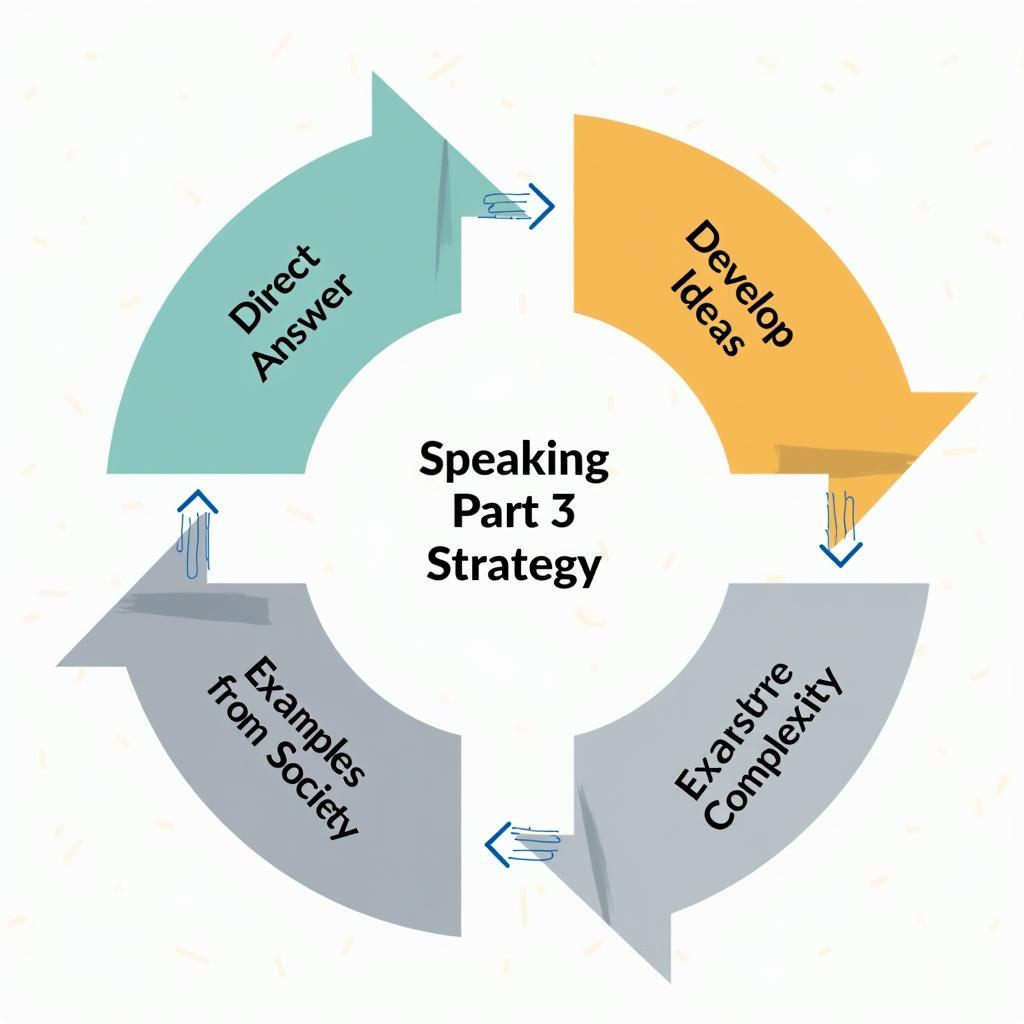 Chiến lược trả lời IELTS Speaking Part 3 với cấu trúc rõ ràng và từ vựng nâng cao
Từ vựng và cụm từ quan trọng
Topic-Specific Vocabulary
| Từ vựng/Cụm từ | Loại từ | Phiên âm | Nghĩa tiếng Việt | Ví dụ | Collocation |
|---|---|---|---|---|---|
| assist | v | /əˈsɪst/ | hỗ trợ, giúp đỡ (formal) | I assisted my colleague with the presentation | assist with/in something, assist someone in doing something |
| collaborative | adj | /kəˈlæbərətɪv/ | mang tính hợp tác | We work in a collaborative environment | collaborative effort, collaborative approach, collaborative culture |
| troubleshoot | v | /ˈtrʌblʃuːt/ | khắc phục sự cố, tìm và sửa lỗi | He helped me troubleshoot the software issues | troubleshoot problems/issues, troubleshoot technical difficulties |
| overwhelmed | adj | /ˌəʊvəˈwelmd/ | quá tải, choáng ngợp | She felt overwhelmed by the workload | feel/be overwhelmed by, overwhelmed with work |
| consolidate | v | /kənˈsɒlɪdeɪt/ | hợp nhất, tổng hợp | We need to consolidate data from different sources | consolidate data/information, consolidate efforts |
| navigate | v | /ˈnævɪɡeɪt/ | điều hướng, tìm đường trong hệ thống | New employees struggle to navigate the complex system | navigate through something, navigate challenges |
| proactive | adj | /prəʊˈæktɪv/ | chủ động, tích cực | She’s very proactive about offering help | proactive approach, proactive measures |
| fulfilling | adj | /fʊlˈfɪlɪŋ/ | mang lại sự thỏa mãn, có ý nghĩa | Helping others is a fulfilling experience | fulfilling work, fulfilling experience |
| expertise | n | /ˌekspɜːˈtiːz/ | chuyên môn, kiến thức chuyên sâu | He shared his technical expertise with the team | technical expertise, share expertise, leverage expertise |
| mentor | v/n | /ˈmentɔː(r)/ | cố vấn, người hướng dẫn / hướng dẫn | Senior staff should mentor junior colleagues | mentor someone, act as a mentor, mentoring relationship |
| reciprocal | adj | /rɪˈsɪprəkl/ | có tính đối ứng, qua lại | We have a reciprocal mentoring relationship | reciprocal arrangement, reciprocal relationship |
| competent | adj | /ˈkɒmpɪtənt/ | có năng lực, đủ khả năng | She’s very competent in her field | highly competent, competent at/in something |
| leverage | v | /ˈliːvərɪdʒ/ | tận dụng, khai thác | We should leverage each other’s strengths | leverage expertise, leverage resources, leverage opportunities |
| foster | v | /ˈfɒstə(r)/ | thúc đẩy, nuôi dưỡng | The company fosters a culture of cooperation | foster collaboration, foster relationships, foster innovation |
| empower | v | /ɪmˈpaʊə(r)/ | trao quyền, tạo điều kiện phát triển | Good mentors empower their mentees | empower employees, empower people to do something |
| bottleneck | n | /ˈbɒtlnek/ | nút thắt, điểm nghẽn | Helping each other reduces bottlenecks in workflow | create/cause a bottleneck, eliminate bottlenecks |
| turnover | n | /ˈtɜːnəʊvə(r)/ | tỷ lệ nghỉ việc, luân chuyển nhân sự | High turnover rates indicate poor work environment | high/low turnover, staff turnover, reduce turnover |
| rapport | n | /ræˈpɔː(r)/ | mối quan hệ tốt đẹp, sự hòa hợp | We built a strong rapport through collaboration | build/establish rapport, develop rapport with someone |
| delegate | v | /ˈdelɪɡeɪt/ | ủy quyền, giao việc | Good leaders know how to delegate effectively | delegate tasks/responsibilities, delegate to someone |
| retain | v | /rɪˈteɪn/ | giữ lại (nhân viên), duy trì | Companies want to retain talented employees | retain staff/employees, retain knowledge |
Idiomatic Expressions & Advanced Phrases
| Cụm từ | Nghĩa | Ví dụ sử dụng | Band điểm |
|---|---|---|---|
| lend a hand | giúp đỡ (thân mật hơn “help”) | I’m always happy to lend a hand when colleagues are struggling | 7.0-8.0 |
| take someone under your wing | nhận ai đó làm học trò, bảo trợ | Senior employees should take newcomers under their wing | 7.5-8.5 |
| go the extra mile | nỗ lực thêm, làm nhiều hơn yêu cầu | She always goes the extra mile to help her teammates | 7.0-8.0 |
| pick someone’s brain | xin ý kiến, học hỏi từ ai đó | Can I pick your brain about this marketing strategy? | 7.5-8.5 |
| be on the same page | có cùng quan điểm, hiểu nhau | After the discussion, we were all on the same page | 7.0-7.5 |
| a helping hand | sự giúp đỡ | Sometimes we all need a helping hand | 6.5-7.5 |
| walk someone through | hướng dẫn ai đó từng bước | I walked her through the entire process | 7.5-8.5 |
| team player | người biết làm việc nhóm | Being a team player is essential in our company | 7.0-7.5 |
| carry the load | gánh vác công việc nặng nhọc | Some people end up carrying the load for the entire team | 7.5-8.0 |
| pull one’s weight | làm phần việc của mình đầy đủ | Everyone needs to pull their weight in this project | 7.5-8.0 |
| burning the midnight oil | làm việc đến khuya | We were burning the midnight oil to meet the deadline | 7.5-8.5 |
| break down barriers | phá bỏ rào cản | Collaboration helps break down barriers between departments | 7.5-8.5 |
Discourse Markers (Từ Nối Ý Trong Speaking)
Để bắt đầu câu trả lời:
- 📝 Well,… – Dùng khi cần thời gian suy nghĩ ngắn, tự nhiên
- 📝 Actually,… – Khi đưa ra góc nhìn khác hoặc điều chỉnh câu trả lời
- 📝 To be honest,… – Khi muốn nói thẳng thắn, chân thực
- 📝 I’d say that… – Khi đưa ra quan điểm cá nhân một cách diplomatic
- 📝 From my perspective,… – Nhấn mạnh đây là quan điểm riêng
Để bổ sung ý:
- 📝 On top of that,… – Thêm vào đó, hơn nữa
- 📝 What’s more,… – Hơn thế nữa
- 📝 Not to mention… – Chưa kể đến
- 📝 Additionally,… – Thêm vào đó (formal)
- 📝 Beyond that,… – Ngoài ra còn
Để đưa ra quan điểm cân bằng:
- 📝 On the one hand,… On the other hand,… – Một mặt… mặt khác
- 📝 While it’s true that…, we also need to consider… – Trong khi đúng là… chúng ta cũng cần xem xét
- 📝 That being said,… – Tuy nhiên, dù vậy
- 📝 Having said that,… – Đã nói như vậy nhưng
Để đưa ra ví dụ:
- 📝 For instance,… – Ví dụ như (formal)
- 📝 Take… for example – Lấy… làm ví dụ
- 📝 A good example would be… – Một ví dụ tốt sẽ là
- 📝 To illustrate this,… – Để minh họa điều này
Để kết luận:
- 📝 All in all,… – Tóm lại, xét tất cả mọi mặt
- 📝 At the end of the day,… – Cuối cùng thì, xét cho cùng
- 📝 In retrospect,… – Nhìn lại
- 📝 On balance,… – Xét trên tổng thể
Grammatical Structures Ấn Tượng
1. Conditional Sentences (Câu điều kiện):
-
Mixed conditional: “If I hadn’t helped her that day, she might still be struggling with the system now.” (Kết hợp quá khứ và hiện tại)
-
Inversion for emphasis: “Had I known how challenging it would be, I might have approached it differently.” (Đảo ngữ để nhấn mạnh)
-
Third conditional with modal: “If he had asked for help earlier, he could have avoided the crisis.” (Diễn tả hối tiếc về quá khứ)
2. Relative Clauses (Mệnh đề quan hệ):
-
Non-defining: “My colleague Sarah, who had recently joined the team, was struggling with the new software.” (Cung cấp thông tin bổ sung)
-
Reduced relative clause: “Employees working in collaborative environments report higher satisfaction.” (Rút gọn mệnh đề quan hệ)
3. Passive Voice (Câu bị động):
-
It is thought/believed/said that… “It is widely believed that workplace cooperation enhances productivity.”
-
Be supposed to: “We’re supposed to support each other, not compete internally.”
-
Get passive: “She got promoted partly because of her collaborative nature.”
4. Cleft Sentences (Câu chẻ):
-
What I find most rewarding is… “What I find most rewarding about helping colleagues is seeing their confidence grow.”
-
The thing that matters most is… “The thing that matters most isn’t the outcome but the learning process.”
-
It was… that… “It was this experience that changed my perspective on teamwork.”
5. Gerunds and Infinitives:
-
There’s no point in… “There’s no point in pretending you know everything when you could just ask.”
-
I can’t help thinking that… “I can’t help thinking that modern workplaces need more cooperation.”
-
To be honest,… to see… “To be honest, it was amazing to see how quickly she picked up the skills.”
6. Subjunctive and Tentative Language:
-
I’d argue that… “I’d argue that helping colleagues is essential for organizational success.”
-
It’s essential that… “It’s essential that companies create environments where people feel comfortable asking for help.”
-
Were it not for… “Were it not for my colleague’s assistance, I wouldn’t have completed the project on time.”
Để mở rộng vốn từ vựng về các tình huống đòi hỏi kỹ năng xử lý cao, bạn có thể xem thêm describe a time when you had to handle a critical situation để học cách diễn đạt về các tình huống căng thẳng trong công việc.
Chiến lược trả lời từ góc nhìn Examiner
Những điều Examiner muốn thấy
Với hơn hai thập kỷ kinh nghiệm chấm thi IELTS Speaking, tôi có thể khẳng định rằng những gì làm nên sự khác biệt giữa Band 7 và Band 8+ không phải là việc sử dụng từ vựng “khó” mà là khả năng giao tiếp tự nhiên, mạch lạc và thể hiện depth of thinking.
Tính tự nhiên quan trọng hơn độ phức tạp: Nhiều thí sinh mắc lỗi cố gắng nhồi nhét vocabulary cao cấp vào câu trả lời một cách gượng ép. Examiner nhận ra ngay điều này và sẽ không đánh giá cao. Thay vào đó, hãy sử dụng từ vựng sophisticated một cách tự nhiên, trong context phù hợp. Câu “She was overwhelmed by the complexity of the task” tự nhiên hơn nhiều so với “She was experiencing an overwhelming magnitude of complicated circumstances.”
Mạch lạc và liên kết ý: Một trong những tiêu chí quan trọng nhất là Fluency and Coherence. Điều này không chỉ về speaking without hesitation mà còn về logical flow của ideas. Sử dụng discourse markers một cách appropriate giúp examiner follow your train of thought dễ dàng. Tuy nhiên, tránh lạm dụng linking words một cách mechanical như “Firstly, secondly, thirdly, finally” trong mọi câu trả lời.
Develop ideas với examples cụ thể: Band 8-9 candidates không chỉ state opinions mà còn develop them thoroughly với specific examples, reasons, và consequences. Khi nói “Helping colleagues is important,” hãy explain why, give real-world examples, và discuss implications. Surface-level answers chỉ đạt Band 6-7.
Demonstrate critical thinking: Trong Part 3 đặc biệt, examiner đánh giá cao khả năng analyze issues từ multiple perspectives, acknowledge complexity, và avoid oversimplification. Phrases như “It depends on,” “While it’s true that…, we also need to consider,” “This is a nuanced issue” cho thấy sophisticated thinking.
Lỗi phổ biến của học viên Việt Nam
Over-preparation và memorization: Đây là vấn đề lớn nhất. Nhiều học viên học thuộc templates hoặc sample answers và recite chúng trong phòng thi. Examiners được training để detect memorized responses và sẽ interrupt để test spontaneous speaking ability. Nếu bạn suddenly fluent với perfect grammar ở Part 2 nhưng struggle ở Part 3, đó là red flag rõ ràng.
Sử dụng vocabulary “sách vở” không tự nhiên: Học viên Việt Nam thường có xu hướng sử dụng academic vocabulary quá mức trong speaking, khiến câu trả lời nghe unnatural. IELTS Speaking là conversational English, không phải academic essay. “I utilize assistance from my colleague” nghe formal và awkward hơn “I ask my colleague for help.”
Thiếu personal touch và authenticity: Nhiều thí sinh đưa ra generic answers không có personal connection. “Many people think…” hoặc “It is commonly believed…” không impressive bằng “From my own experience…” hay “I’ve noticed in my workplace…” Personal examples khiến câu trả lời convincing và memorable hơn.
Quá ngắn gọn hoặc quá dài dòng: Học viên thường rơi vào hai cực: trả lời quá ngắn (1-2 câu) hoặc nói dài dòng lạc đề. Part 1 nên 2-3 câu, Part 2 đủ 2 phút, Part 3 khoảng 3-5 câu. Practice timing để develop intuition về appropriate length.
Pronunciation issues: Nhiều học viên Việt Nam có vấn đề với word stress và sentence stress. “PREsent” (danh từ) vs “preSENT” (động từ), “CONtent” (nội dung) vs “conTENT” (hài lòng). Sai word stress có thể khiến examiner khó hiểu, ảnh hưởng đến Pronunciation band.
Không trả lời trực tiếp câu hỏi: Một số thí sinh nói xung quanh vấn đề mà không address the question directly. Luôn bắt đầu với direct answer, sau đó mới develop. Ví dụ: “Do you think companies should encourage teamwork?” – Start với “Absolutely, I believe it’s essential” hoặc “To some extent, yes, but with caveats.”
Cách luyện tập hiệu quả
Record and self-assess: Ghi âm câu trả lời của bạn và nghe lại critically. Pay attention to hesitations, repetitions, grammar errors, và natural flow. Compare với sample answers không phải để copy mà để understand the difference in quality.
Practice with authentic questions: Sử dụng câu hỏi từ actual IELTS tests, không phải generic topics. Websites như IELTS-Simon, IELTSLiz, và recent actual test compilations là reliable sources.
Develop idea banks, not memorized answers: Thay vì học thuộc answers, hãy develop idea banks cho common topics. For “helping colleagues,” brainstorm các situations, feelings, impacts, challenges. Trong thi, bạn sẽ draw from này một cách tự nhiên.
Focus on natural English: Immerse yourself in authentic English qua podcasts, TED talks, interviews. Pay attention to how native speakers structure responses, use fillers naturally, và transition between ideas. Mimic natural speech patterns, không phải textbook English.
Practice Part 3 abstract thinking: Part 3 là challenging nhất. Practice analyzing why, how, what if questions. Develop ability to discuss causes, effects, solutions, và implications. Think aloud về social issues để build this skill.
Get feedback from qualified sources: Self-study có limits. Tìm qualified IELTS instructor hoặc native speaker experienced in IELTS to give detailed feedback về cả content và delivery. Họ sẽ identify issues bạn không tự nhận ra.
Simulate real test conditions: Practice với timing constraints, without notes (except 1 minute in Part 2), và speaking continuously. Pressure trong real test khác với practice ở nhà, nên simulate conditions để build confidence.
Nếu bạn cần luyện thêm về các chủ đề liên quan đến học hỏi và phát triển kỹ năng, describe a time when you attended a workshop cung cấp vocabulary và ideas hữu ích về môi trường học tập và chia sẻ kiến thức.
Những câu hỏi nâng cao khác có thể gặp
Câu hỏi về Dynamic công việc hiện đại
How has remote work changed the way colleagues help each other?
Remote work đã fundamentally transformed workplace collaboration. The shift to digital platforms has created both opportunities và challenges. On one hand, async communication tools allow for more flexible helping – I can review a colleague’s document at any time without requiring their presence. On the other hand, the spontaneous hallway conversations where natural knowledge-sharing occurred have largely disappeared. There’s also the challenge of remote workers feeling isolated và less likely to reach out for help. Companies now need to be more intentional about creating virtual spaces for collaboration và fostering connections that previously happened organically.
Do you think artificial intelligence will reduce the need for colleagues to help each other?
This is nuanced. AI will certainly handle many routine queries – imagine a chatbot that can instantly answer procedural questions rather than asking a colleague. However, I believe this will actually elevate the nature of human collaboration rather than eliminate it. The help colleagues provide each other will shift toward more complex problem-solving, creative brainstorming, emotional support, và strategic thinking – areas where AI still falls short. What might change is that we’ll spend less time on basic information exchange và more on higher-value collaboration. The human element of mentorship, the understanding of organizational culture và politics, và the ability to provide contextualized advice will remain irreplaceable.
In your opinion, what role do social activities play in building a helpful workplace culture?
Social activities are surprisingly critical, though often undervalued. When colleagues interact outside formal work contexts – whether through team lunches, company events, or casual coffee breaks – they build what sociologists call “social capital.” These informal bonds create psychological safety, making people more comfortable asking for help later. There’s research showing that teams with stronger social connections collaborate more effectively và share knowledge more freely. However, it’s important that these activities are inclusive và genuinely optional. Forced fun can backfire, creating resentment rather than rapport. The goal should be facilitating authentic connections, not checking boxes on team-building exercises.
Câu hỏi về Ethics và Boundaries
Where should someone draw the line between being helpful and doing someone else’s work?
This is one of the most challenging boundaries in workplace dynamics. The key distinction lies in empowerment versus enablement. Helpful assistance teaches skills, provides guidance, và gradually releases responsibility – essentially teaching someone to fish rather than just giving them fish. Conversely, doing someone’s work creates dependency và ultimately hurts both parties. Red flags include repeatedly doing the same tasks for someone, helping at the expense of your own core responsibilities, or the person showing no effort to learn. A helpful framework is asking yourself: “Will this person be more capable after I help them?” If the answer is no, you’re probably crossing the line. It’s also important to communicate boundaries clearly but kindly when requests become excessive.
Should there be formal policies about helping colleagues, or should it remain informal?
I believe there’s value in a hybrid approach. Too much formalization can make helping feel transactional và bureaucratic – if every instance of assistance requires documentation hoặc approval, people simply won’t do it. The beauty of spontaneous help is its organic nature. However, completely informal systems can lead to inequitable distribution of this labor, with certain individuals becoming overburdened while others contribute little. A balanced approach might include recognizing collaborative behaviors in performance reviews without rigid quantification, establishing cultural norms through leadership modeling, và creating formal mentorship programs alongside informal help. The goal is providing structure that encourages helping without strangling its spontaneous spirit.
Is it ever appropriate to refuse to help a colleague? Under what circumstances?
Absolutely, và knowing when to say no is as important as knowing when to help. Appropriate circumstances for refusing include when you genuinely lack the expertise và directing them to someone more qualified would serve them better, when helping would compromise your own critical deadlines và ultimately hurt the team more, when the request is inappropriate or unethical, or when the person has shown no effort to solve the problem themselves. However, the manner of refusal matters enormously. Rather than a flat “no,” try “I can’t right now but could we schedule time tomorrow?” or “I’m not the best person for this, but have you tried asking Sarah who specializes in this?” The goal is maintaining the relationship while respecting your own boundaries. Chronic inability to refuse often leads to burnout, which ultimately makes you less helpful to everyone.
Nếu bạn quan tâm đến việc phát triển quan điểm về các chính sách và quy định tại nơi làm việc, describe a law you think should be introduced sẽ giúp bạn học cách diễn đạt ý kiến về luật lệ và quy định một cách academic.
 Phương pháp luyện tập IELTS Speaking hiệu quả với ghi âm và tự đánh giá
Tổng kết và lời khuyên cuối cùng
Chủ đề “describe a time when you helped a colleague” là một trong những topics thực tế và valuable nhất trong IELTS Speaking. Nó không chỉ test khả năng kể chuyện của bạn mà còn reveal cách bạn think about workplace relationships, professional development, và collaborative problem-solving.
Key takeaways cho success:
Đầu tiên, authenticity beats perfection. Examiners có thể detect memorized answers ngay lập tức. Thay vì học thuộc templates, hãy develop genuine stories từ experience của bạn và practice telling them naturally với different wordings mỗi lần. Your unique perspective và personal insights sẽ impressive hơn một bài “perfect” nhưng generic.
Thứ hai, balance structure với spontaneity. Có mental framework giúp organize thoughts (who, what, when, why, how), nhưng đừng sound robotic. Natural hesitations, self-corrections, và conversational fillers là acceptable và actually contribute to natural fluency.
Thứ ba, vocabulary sophistication không means obscure words. Nó means precise word choice, appropriate collocations, và idiomatic expressions được sử dụng naturally. “She was grappling with the challenge” sounds more natural và sophisticated hơn “She was experiencing considerable difficulty.”
Thứ tư, trong Part 3, demonstrate critical thinking bằng cách acknowledge complexity, consider multiple perspectives, và avoid oversimplification. Câu trả lời showing nuanced understanding sẽ score higher than absolute statements.
Thứ năm, pronunciation và delivery matter just as much as content. Practice word stress, sentence rhythm, và intonation. Recording yourself và comparing với native speakers hoặc high-scoring samples helps identify areas for improvement.
Your action plan:
- Build your story bank với real experiences của helping colleagues trong different contexts
- Practice các stories với variations, không phải memorization
- Expand vocabulary bank với topic-specific terms và idiomatic expressions
- Record yourself regularly và self-assess critically
- Practice Part 3 abstract discussions với why, how, what if questions
- Seek feedback từ qualified instructors hoặc experienced speakers
- Simulate test conditions để build confidence under pressure
Remember: IELTS Speaking is ultimately a test of communication ability. Your goal không phải impress examiner với fancy words mà demonstrate that you can communicate complex ideas clearly, naturally, và coherently in English. Focus on meaningful communication rather than performance, và your authenticity sẽ shine through.
Với preparation đúng hướng, consistent practice, và mindset tích cực, bạn hoàn toàn có thể achieve band score mong muốn. The skills bạn develop qua quá trình chuẩn bị – critical thinking, structured communication, confidence trong expressing ideas – sẽ valuable không chỉ cho kỳ thi mà cho entire professional life của bạn.
Chúc bạn thành công trong kỳ thi IELTS Speaking và nhớ rằng mỗi lần practice là một bước tiến gần hơn đến mục tiêu của mình!