Chủ đề hoạt động nhóm là một trong những đề tài phổ biến và thực tế nhất trong kỳ thi IELTS Speaking. Với hơn 20 năm kinh nghiệm chấm thi, tôi nhận thấy đây là chủ đề xuất hiện với tần suất cao trong các kỳ thi từ 2020 đến nay, đặc biệt tăng đột biến sau đại dịch khi các kỹ năng làm việc nhóm trở nên quan trọng hơn bao giờ hết. Dự đoán khả năng xuất hiện trong tương lai: Rất cao.
Qua bài viết này, bạn sẽ được trang bị đầy đủ công cụ để tự tin đối mặt với chủ đề này, bao gồm:
- Hơn 20 câu hỏi thực tế đã xuất hiện trong các kỳ thi IELTS gần đây
- Bài mẫu chi tiết cho cả 3 band điểm 6-7, 7.5-8, và 8.5-9
- Phân tích sâu về tiêu chí chấm điểm từ góc nhìn examiner
- Hơn 50 từ vựng và cụm từ ăn điểm kèm cách sử dụng
- Chiến lược trả lời hiệu quả giúp tối đa hóa điểm số
- Những lỗi thường gặp của học viên Việt Nam và cách khắc phục
IELTS Speaking Part 1: Introduction and Interview
Tổng Quan Về Part 1
Part 1 kéo dài 4-5 phút với các câu hỏi ngắn về đời sống hàng ngày. Đặc điểm quan trọng nhất là tính tự nhiên – examiner muốn thấy bạn có thể trò chuyện một cách thoải mái về những chủ đề quen thuộc. Chiến lược hiệu quả là trả lời trực tiếp câu hỏi, sau đó mở rộng bằng lý do hoặc ví dụ cụ thể trong 2-3 câu.
Lỗi thường gặp của học viên Việt Nam mà tôi quan sát được:
- Trả lời quá ngắn gọn kiểu “Yes, I do” hoặc “No, I don’t” mà không giải thích
- Sử dụng từ vựng đơn giản lặp đi lặp lại như “good”, “nice”, “interesting”
- Thiếu ví dụ cụ thể từ kinh nghiệm bản thân
- Nói theo template học thuộc, nghe không tự nhiên
Các Câu Hỏi Thường Gặp
Question 1: Do you prefer working in a group or working alone?
Question 2: What kind of group activities did you participate in at school?
Question 3: Do you think teamwork is important in the workplace?
Question 4: Have you ever been a leader in a group project?
Question 5: What difficulties can people face when working in groups?
Question 6: Do you enjoy team sports or group exercises?
Question 7: How often do you participate in group activities?
Question 8: What makes a group activity successful?
Phân Tích và Gợi Ý Trả Lời Chi Tiết
Question: Do you prefer working in a group or working alone?
🎯 Cách tiếp cận:
- Nêu rõ sở thích của bạn ngay từ đầu
- Giải thích lý do tại sao bạn thích cách làm việc đó
- Có thể thêm một câu về tình huống ngoại lệ để câu trả lời cân bằng hơn
📝 Sample Answer – Band 6-7:
“I prefer working in a group because I can learn from other people. When I work alone, sometimes I don’t have enough ideas, but in a group, everyone can share their thoughts. However, if the task is simple, I can work alone.”
Phân tích:
- Điểm mạnh: Trả lời trực tiếp câu hỏi, có lý do cơ bản, đề cập đến cả hai khía cạnh
- Hạn chế: Từ vựng đơn giản (learn, ideas, thoughts), cấu trúc câu chưa đa dạng, thiếu ví dụ cụ thể
- Tại sao Band 6-7: Fluency ổn nhưng chưa flexible, vocabulary adequate nhưng chưa sophisticated, grammar đơn giản nhưng accurate
📝 Sample Answer – Band 8-9:
“Well, it really depends on the nature of the task, to be honest. I generally gravitate towards collaborative work because I find that bouncing ideas off others really sparks creativity and helps me see things from different perspectives. For instance, when I was working on a marketing campaign last month, the synergy within our team led to some brilliant solutions I never would have thought of independently. That said, when it comes to tasks requiring deep concentration, like writing reports, I definitely prefer working autonomously.”
Phân tích:
- Điểm mạnh:
- Sử dụng discourse marker “Well” và “to be honest” để nghe tự nhiên
- Từ vựng tinh vi: gravitate towards, bouncing ideas off, sparks creativity, synergy, autonomously
- Cấu trúc đa dạng: “it depends on…”, “when it comes to…”
- Ví dụ cụ thể từ kinh nghiệm bản thân
- Thể hiện sự cân bằng trong quan điểm
- Tại sao Band 8-9:
- Fluency: Trôi chảy, không hesitation, sử dụng fillers tự nhiên
- Vocabulary: Precise collocation (sparks creativity, deep concentration), less common phrases (gravitate towards)
- Grammar: Complex structures với relative clause và conditional
- Coherence: Logic rõ ràng với “that said” để chuyển ý
💡 Key Vocabulary & Expressions:
- gravitate towards: có xu hướng thiên về, yêu thích
- bounce ideas off someone: trao đổi ý tưởng với ai đó
- spark creativity: kích thích sự sáng tạo
- synergy: sự phối hợp hiệu quả, hiệu ứng cộng hưởng
- work autonomously: làm việc độc lập
Question: What kind of group activities did you participate in at school?
🎯 Cách tiếp cận:
- Nêu cụ thể loại hoạt động nào
- Mô tả ngắn gọn về hoạt động đó
- Có thể thêm cảm xúc hoặc kết quả của việc tham gia
📝 Sample Answer – Band 6-7:
“When I was at school, I joined many group activities like sports day and class presentations. I remember we had to work together to prepare for the school festival. It was fun and I made many friends.”
Phân tích:
- Điểm mạnh: Đưa ra ví dụ cụ thể, có cảm xúc cá nhân
- Hạn chế: Vocabulary basic (fun, many friends), thiếu chi tiết về hoạt động, grammar structures đơn giản
- Tại sao Band 6-7: Adequate response nhưng lacks development và sophisticated language
📝 Sample Answer – Band 8-9:
“Oh, I was quite actively involved in various extracurricular activities back in school. The one that stands out most vividly was our school drama club, where we collaborated on staging a Vietnamese adaptation of Shakespeare’s plays. We also had regular group projects in science class, which really honed my teamwork skills. What I particularly enjoyed was the debate team, where we’d work collectively to research topics and formulate arguments. These experiences really laid the foundation for my ability to function effectively in team settings today.”
Phân tích:
- Điểm mạnh:
- Vocabulary sophisticated: actively involved in, stands out vividly, honed my teamwork skills, laid the foundation for
- Nhiều ví dụ cụ thể và đa dạng
- Cấu trúc câu phức: relative clause (where we collaborated…), which clause
- Kết nối với hiện tại, cho thấy depth of thinking
- Tại sao Band 8-9:
- Fluency: Natural discourse với “Oh” để bắt đầu, smooth transitions
- Vocabulary: Topic-specific (extracurricular activities, staging, formulate arguments) và idiomatic (stands out vividly)
- Grammar: Variety of complex structures
- Coherence: Well-organized với clear examples và conclusion
💡 Key Vocabulary & Expressions:
- actively involved in: tham gia tích cực vào
- stand out vividly: nổi bật rõ ràng trong trí nhớ
- collaborate on staging: hợp tác dàn dựng
- hone teamwork skills: mài dũa kỹ năng làm việc nhóm
- lay the foundation for: đặt nền móng cho
Question: Do you think teamwork is important in the workplace?
🎯 Cách tiếp cận:
- Đưa ra quan điểm rõ ràng (Yes/No/It depends)
- Giải thích tại sao với 1-2 lý do
- Có thể thêm ví dụ từ quan sát hoặc kinh nghiệm
📝 Sample Answer – Band 6-7:
“Yes, I think teamwork is very important at work. Because if people work together, they can finish tasks faster. Also, different people have different skills, so they can help each other. In my opinion, companies need good teamwork to be successful.”
Phân tích:
- Điểm mạnh: Opinion rõ ràng, có reasons, structure logic
- Hạn chế: Vocabulary repetitive (work, people), ideas khá obvious và không deep, grammar basic
- Tại sao Band 6-7: Communicates effectively nhưng lacks sophistication
📝 Sample Answer – Band 8-9:
“Absolutely, I’d say teamwork is fundamental to modern workplaces. In today’s increasingly complex business environment, most challenges are simply too multifaceted for one person to tackle alone. Effective collaboration enables companies to leverage diverse skill sets and tap into collective intelligence. For example, in the tech industry, you typically see cross-functional teams where designers, developers, and marketers pool their expertise to create products. Moreover, strong team dynamics often foster innovation because people challenge each other’s assumptions and push boundaries collectively. Without solid teamwork, organizations would struggle to remain competitive in today’s fast-paced market.”
Phân tích:
- Điểm mạnh:
- Opening với “Absolutely” thể hiện strong opinion
- Vocabulary precise và sophisticated: fundamental to, multifaceted, leverage, tap into collective intelligence
- Multiple reasons với clear structure
- Specific example từ tech industry
- Kết luận mạnh mẽ về importance
- Tại sao Band 8-9:
- Fluency: Fully coherent với excellent discourse markers
- Vocabulary: Wide range, precise, less common phrases (cross-functional teams, push boundaries collectively)
- Grammar: Complex sentences với clauses, perfect verb forms
- Ideas: Sophisticated với nuanced understanding of the topic
💡 Key Vocabulary & Expressions:
- fundamental to: cơ bản, thiết yếu cho
- multifaceted: nhiều khía cạnh, phức tạp
- leverage diverse skill sets: tận dụng các kỹ năng đa dạng
- tap into collective intelligence: khai thác trí tuệ tập thể
- foster innovation: thúc đẩy sự đổi mới
 Học sinh tham gia hoạt động nhóm trong lớp học IELTS Speaking để luyện tập kỹ năng giao tiếp và teamwork
IELTS Speaking Part 2: Long Turn (Cue Card)
Tổng Quan Về Part 2
Part 2 là phần quan trọng nhất trong bài thi Speaking, kéo dài 3-4 phút bao gồm 1 phút chuẩn bị và 2-3 phút thuyết trình. Đây là lúc bạn hoàn toàn “sở hữu sân khấu” – examiner sẽ không ngắt lời bạn.
Chiến lược hiệu quả:
- Sử dụng trọn vẹn 1 phút chuẩn bị để ghi chú keywords (KHÔNG viết câu hoàn chỉnh)
- Ghi chú theo từng bullet point của đề bài
- Nói tối thiểu 1.5 phút, lý tưởng là 2-2.5 phút
- Sử dụng thì quá khứ nhất quán khi kể về sự việc đã xảy ra
- Dành nhiều thời gian nhất cho bullet point cuối (explain why/how you felt)
Lỗi thường gặp:
- Không tận dụng hết 1 phút chuẩn bị hoặc viết quá chi tiết
- Nói dưới 1.5 phút vì thiếu ý tưởng mở rộng
- Bỏ sót một hoặc nhiều bullet points
- Không cân bằng thời gian – nói quá nhiều về bullet đầu, vội vã với bullet cuối
- Lạc đề, nói về những thứ không liên quan
Cue Card
Describe A Time When You Participated In A Group Activity
You should say:
- What the activity was
- When and where you did it
- Who you did it with
- And explain how you felt about this experience
Phân Tích Đề Bài
- Dạng câu hỏi: Describe an experience/event – yêu cầu kể về một trải nghiệm cụ thể trong quá khứ
- Thì động từ: Quá khứ đơn và quá khứ tiếp diễn chủ yếu
- Bullet points phải cover:
- What: Hoạt động gì? (sports, project, volunteer, performance, etc.)
- When/Where: Thời gian và địa điểm cụ thể
- Who: Những người tham gia cùng bạn, vai trò của họ
- Explain: Cảm xúc và suy nghĩ về trải nghiệm này
- Câu “explain” quan trọng: Đây là phần ghi điểm cao nhất vì thể hiện khả năng express feelings, reflect on experience và demonstrate vocabulary range. Nên dành 30-40% thời gian cho phần này.
📝 Sample Answer – Band 6-7
Thời lượng: Khoảng 1.5-2 phút
“I’d like to talk about a group activity I participated in last year. The activity was organizing a charity event for children in rural areas.
We did this in December, just before Christmas. The event took place at my university campus. We set up stalls and games to raise money for the children.
I did this activity with my classmates from the volunteer club. There were about 15 people in our group. Some people were responsible for setting up decorations, some prepared food, and I was in charge of managing the games section.
We worked together for about two weeks to prepare everything. On the event day, many students came and joined our activities. We managed to raise quite a lot of money, which made us very happy.
I felt really satisfied about this experience. It was the first time I organized such a big event. Although we had some problems during the preparation, like disagreeing about the budget, we solved them by discussing together. This experience taught me that teamwork is very important. When people work together and help each other, they can achieve great things. I also made some good friends through this activity, and we still keep in touch now.”
Phân Tích Band Điểm
| Tiêu chí | Band | Nhận xét |
|---|---|---|
| Fluency & Coherence | 6-7 | Trả lời khá mạch lạc với clear structure, có basic discourse markers (although, when), nhưng có occasional hesitation và repetition |
| Lexical Resource | 6-7 | Vocabulary adequate cho topic (charity event, responsible for, in charge of), có attempts at less common words nhưng còn basic overall |
| Grammatical Range & Accuracy | 6-7 | Mix of simple và complex sentences, sử dụng đúng past tenses, có relative clause nhưng structures không đa dạng lắm |
| Pronunciation | 6-7 | Generally clear và intelligible, có appropriate intonation patterns |
Điểm mạnh:
- ✅ Trả lời đầy đủ tất cả bullet points
- ✅ Có structure rõ ràng, dễ follow
- ✅ Examples cụ thể về activities và roles
- ✅ Grammar accuracy tốt, ít lỗi
Hạn chế:
- ⚠️ Vocabulary khá basic và repetitive (very happy, very important, good friends)
- ⚠️ Thiếu descriptive language về feelings và atmosphere
- ⚠️ Complex sentences chưa đa dạng
- ⚠️ Chưa có idiomatic expressions hoặc sophisticated phrases
📝 Sample Answer – Band 7.5-8
Thời lượng: Khoảng 2-2.5 phút
“I’d like to share my experience of participating in a community clean-up project that took place about six months ago, which turned out to be quite memorable.
The activity involved cleaning up a local beach in my hometown, Nha Trang. It was organized by an environmental NGO, and the event was held on a Saturday morning in early April, right at the beginning of the tourist season. The idea was to restore the beach to its pristine condition before the influx of summer visitors.
I joined this activity with about 40 volunteers, ranging from high school students to retired professionals. We were divided into several teams, each assigned to different sections of the beach. I was part of a team of eight people, and we were tasked with collecting plastic waste along a two-kilometer stretch. Our team consisted of people from various backgrounds, including a marine biology student who provided insights into how plastic pollution affects marine life.
What made this experience particularly rewarding was the sense of collective achievement. Initially, I’ll admit I was a bit skeptical about whether our efforts would make much of a difference, but as the morning progressed and we witnessed the transformation of the beach, my perspective changed completely. By the end of the session, we had collected over 300 kilograms of trash, which was far beyond our expectations.
I felt genuinely fulfilled by this experience. Not only did it allow me to contribute to environmental protection, but it also gave me the opportunity to connect with like-minded individuals who share the same passion for conservation. The experience reinforced my belief that when people come together with a common purpose, they can create meaningful impact. It was also eye-opening to see the sheer amount of waste that accumulates on beaches, which motivated me to be more conscious about my own plastic consumption.”
Phân Tích Band Điểm
| Tiêu chí | Band | Nhận xét |
|---|---|---|
| Fluency & Coherence | 7.5-8 | Speaks fluently với minimal hesitation, excellent use of cohesive devices (initially, not only…but also), well-organized với clear progression |
| Lexical Resource | 7.5-8 | Good range of vocabulary (pristine condition, influx, insights into, collective achievement), some less common items, appropriate collocations |
| Grammatical Range & Accuracy | 7.5-8 | Wide range of structures (passive voice, relative clauses, inversion), mostly error-free, good control of complex grammar |
| Pronunciation | 7.5-8 | Clear pronunciation với appropriate stress và intonation, easy to understand |
So Sánh Với Band 6-7
| Khía cạnh | Band 6-7 | Band 7.5-8 |
|---|---|---|
| Vocabulary | “very happy”, “good friends” | “genuinely fulfilled”, “like-minded individuals” |
| Grammar | “We worked together for about two weeks” | “By the end of the session, we had collected over 300 kilograms” |
| Ideas | “teamwork is very important” | “reinforced my belief that when people come together with a common purpose, they can create meaningful impact” |
Giống như cách mà các thí sinh thường describe a recent cultural experience, bài mẫu Band 7.5-8 này thể hiện khả năng kết nối trải nghiệm cá nhân với những suy ngẫm sâu sắc hơn về ý nghĩa xã hội.
📝 Sample Answer – Band 8.5-9
Thời lượng: 2.5-3 phút đầy đủ
“I’d like to recount my experience of taking part in a collaborative theatre production, which I would say was one of the most enriching group activities I’ve ever been involved in.
This undertaking was a student-directed adaptation of a contemporary Vietnamese play, and it unfolded over the course of three months last year, from September through November. We held our rehearsals in a small community theatre in the heart of Ho Chi Minh City, a somewhat cramped but atmospheric venue that lent itself perfectly to the intimate nature of the production. The actual performances took place over two weekends in late November, and we managed to draw quite respectable audiences despite being relatively unknown actors.
The ensemble consisted of about twenty individuals, including actors, stage crew, and production assistants. I was cast in a supporting role and also doubled as the assistant director for certain scenes. What made our group particularly interesting was the diversity of perspectives we brought to the table – we had theatre veterans who’d been honing their craft for years alongside complete novices who’d never set foot on a stage before. There was a palpable sense of mentorship within the group, with more experienced members generously sharing their expertise and helping the rest of us navigate the intricacies of stage performance.
What struck me most profoundly about this experience was how it exemplified the essence of collaborative creativity. Unlike many group projects where you can somewhat coast on others’ contributions, theatre demands absolute commitment and synchronization from every single participant. A single missed cue or lapse in concentration can derail an entire scene, so there was this inherent pressure to pull your weight and remain fully present throughout.
Looking back, I’d say this experience was transformative on multiple levels. On a practical level, it sharpened my ability to work under pressure and enhanced my adaptability – in theatre, you need to think on your feet when things inevitably go wrong during live performances. On a deeper level, it fostered a profound appreciation for the magic that happens when individuals subordinate their egos and channel their energies toward a shared vision. There were certainly moments of friction – creative differences, scheduling conflicts, the usual interpersonal dynamics that emerge in any group setting – but navigating these challenges actually strengthened our bonds and taught us invaluable lessons about compromise and mutual respect.
Perhaps most importantly, this experience reaffirmed my conviction that truly meaningful work rarely happens in isolation. The synergy that emerged from our collective efforts far exceeded what any one of us could have accomplished independently. It was a visceral reminder that while individual talent matters, it’s the alchemy of collaboration that brings ideas to life in their most powerful form.”
Phân Tích Band Điểm
| Tiêu chí | Band | Nhận xét |
|---|---|---|
| Fluency & Coherence | 8.5-9 | Speaks fluently và coherently với natural flow, sophisticated discourse markers, develops topics fully, seamless organization |
| Lexical Resource | 8.5-9 | Wide vocabulary range với precision, idiomatic language (think on your feet, pull your weight), sophisticated collocations, natural và flexible use |
| Grammatical Range & Accuracy | 8.5-9 | Full range of structures với full flexibility và accuracy, rare errors, complex sentences used naturally |
| Pronunciation | 8.5-9 | Pronunciation features used effectively, minimal L1 influence, natural intonation và stress patterns |
Tại Sao Bài Này Xuất Sắc
🎯 Fluency Hoàn Hảo:
Bài nói trôi chảy tự nhiên như native speaker, không có hesitation hay repetition. Sử dụng discourse markers sophisticated như “Looking back”, “On a deeper level”, “Perhaps most importantly” để structure ideas một cách elegant.
📚 Vocabulary Tinh Vi:
- “honing their craft” – không chỉ nói “improving their skills” mà dùng phrase idiomatic thể hiện sự dedication
- “palpable sense of mentorship” – “palpable” là adjective rất sophisticated, thể hiện cái gì đó có thể cảm nhận rõ ràng
- “subordinate their egos” – phrase này shows deep understanding về group dynamics
- “visceral reminder” – “visceral” là less common word nghĩa là deeply felt, instinctive
📝 Grammar Đa Dạng:
- Complex sentences: “Unlike many group projects where you can somewhat coast on others’ contributions, theatre demands absolute commitment…”
- Perfect aspects: “who’d been honing their craft”, “who’d never set foot on”
- Inversion for emphasis: “rarely happens in isolation”
- Participle phrases: “navigating these challenges actually strengthened our bonds”
💡 Ideas Sâu Sắc:
Không chỉ describe surface-level facts mà còn reflect sâu sắc về significance của experience, from practical skills (adaptability, working under pressure) đến deeper philosophical insights (collective creativity surpassing individual efforts).
Follow-up Questions (Rounding Off Questions)
Examiner có thể hỏi thêm 1-2 câu ngắn sau Part 2:
Question 1: Would you participate in similar activities in the future?
Band 6-7 Answer:
“Yes, definitely. I enjoyed this experience a lot, so I would like to join more group activities in the future, especially volunteer work.”
Band 8-9 Answer:
“Absolutely. This experience whetted my appetite for collaborative projects, and I’m actually actively seeking out similar opportunities. I find that these activities enrich my life in ways that solo pursuits simply can’t match, so I’d jump at the chance to get involved in comparable initiatives.”
Question 2: What did you learn from working with others?
Band 6-7 Answer:
“I learned that communication is very important when working in a group. Also, I learned to be patient with others and listen to different opinions.”
Band 8-9 Answer:
“The key takeaway for me was understanding that effective collaboration hinges on balancing individual contributions with collective goals. I also came to appreciate how diverse perspectives can elevate the quality of outcomes when there’s mutual respect and open dialogue. Perhaps most significantly, I learned that the best teams aren’t necessarily composed of the most talented individuals, but rather those who can harmonize their strengths and complement each other’s weaknesses.”
 Nhóm sinh viên đang thực hiện dự án tình nguyện cộng đồng với tinh thần làm việc nhóm tích cực trong IELTS Speaking
IELTS Speaking Part 3: Two-way Discussion
Tổng Quan Về Part 3
Part 3 kéo dài 4-5 phút và là phần challenging nhất vì yêu cầu bạn discuss abstract ideas một cách sâu sắc. Đây không còn là chuyện kể về bản thân nữa mà là analyze, evaluate, và express opinions về broader social issues liên quan đến chủ đề Part 2.
Yêu cầu:
- Phân tích causes, effects, advantages, disadvantages
- So sánh different perspectives hoặc time periods
- Đưa ra predictions về future trends
- Acknowledge complexity của issues (không nên quá black-and-white)
Chiến lược:
- Mở rộng câu trả lời đến 3-5 câu với structure: Direct answer → Reason/Explanation → Example → Acknowledge other view/Conclusion
- Sử dụng discourse markers để organize ideas (Well, Actually, On the one hand…)
- Đưa ra examples từ society, không chỉ personal experience
- Show balanced thinking bằng cách acknowledge both sides
- Sử dụng tentative language (I would say, It seems to me, To some extent) để sound thoughtful
Lỗi thường gặp của học viên Việt Nam:
- Trả lời quá ngắn (1-2 câu) thiếu development
- Không có clear structure trong câu trả lời
- Thiếu abstract vocabulary và formal expressions
- Chỉ nói về personal opinion mà không contextualize trong broader society
- Afraid to admit không biết câu trả lời
Các Câu Hỏi Thảo Luận Sâu
Theme 1: Benefits and Challenges of Group Work
Question 1: What are the main advantages of working in a group compared to working individually?
🎯 Phân tích câu hỏi:
- Dạng: Compare & Contrast – cần so sánh hai ways of working
- Key words: main advantages, compared to
- Cách tiếp cận: State 2-3 main advantages, explain each với reasoning hoặc example, có thể acknowledge potential disadvantages để show balanced view
📝 Sample Answer – Band 6-7:
“I think there are several advantages of group work. First, people can share ideas and learn from each other. When working alone, you only have your own ideas, but in a group, you can get different perspectives. Second, group work can be faster because people can divide the tasks. For example, in a project, one person can do research while another person prepares the presentation. However, sometimes group work can be difficult if people don’t agree with each other.”
Phân tích:
- Structure: Clear với First, Second
- Vocabulary: Basic (share ideas, different perspectives, divide the tasks)
- Tại sao Band 6-7: Answers the question adequately nhưng lacks sophistication trong vocabulary và depth trong analysis
📝 Câu trả lời mẫu – Band 8-9:
“Well, the primary advantage, I’d say, lies in the pooling of diverse expertise and perspectives. When individuals collaborate effectively, they can leverage each other’s strengths and compensate for individual weaknesses, which typically results in more robust outcomes than solo efforts might produce. On top of that, group work often fosters innovation because the cross-pollination of ideas can spark creative solutions that wouldn’t emerge in isolation. For instance, in the tech industry, breakthrough innovations rarely come from lone geniuses anymore – they’re almost always the product of interdisciplinary teams where engineers, designers, and marketers bring their unique insights to the table.
Another significant benefit is the distribution of workload, which can accelerate project completion and reduce individual stress. That said, I should mention that these advantages only materialize when the group has clear communication channels and well-defined roles – without these foundations, group work can actually be counterproductive.”
Phân tích:
- Structure: Well-organized: Main advantage → Supporting reason → Specific example → Second advantage → Caveat to show balanced thinking
- Vocabulary: Sophisticated (pooling of diverse expertise, cross-pollination of ideas, breakthrough innovations, interdisciplinary teams, materialize when, counterproductive)
- Grammar: Wide range (passive voice, conditional, relative clauses)
- Critical Thinking: Shows nuanced understanding bằng cách acknowledge cả advantages và conditions cần thiết
💡 Key Language Features:
- Discourse markers: “Well”, “On top of that”, “That said” – tạo natural flow
- Tentative language: “I’d say”, “typically” – shows thoughtful consideration
- Abstract nouns: “expertise”, “innovation”, “distribution” – academic style phù hợp Part 3
Question 2: What challenges might people face when working in groups?
🎯 Phân tích câu hỏi:
- Dạng: Problem identification
- Key words: challenges, might face
- Cách tiếp cận: Identify 2-3 main challenges, explain why they occur, có thể suggest solutions hoặc real-world implications
📝 Sample Answer – Band 6-7:
“People can face many challenges when working in groups. One problem is that some members don’t do their work, so other people have to do more. This is not fair. Another challenge is when people have different opinions and they argue. This can waste time and make the atmosphere bad. Also, it’s sometimes difficult to find time when everyone is free to meet.”
Phân tích:
- Structure: Lists problems clearly
- Vocabulary: Simple (don’t do their work, argue, waste time, bad atmosphere)
- Tại sao Band 6-7: Adequate response với relevant points nhưng lacks sophisticated expression và depth
📝 Câu trả lời mẫu – Band 8-9:
“One of the most pervasive challenges is what psychologists call ‘social loafing’ – the tendency for some individuals to reduce their effort when working collectively, banking on others to pick up the slack. This phenomenon stems from a diffusion of responsibility and can seriously undermine team morale and productivity. I’ve observed this firsthand in university projects where unequal contribution often breeds resentment among more conscientious members.
Beyond that, conflicting working styles and communication breakdowns frequently pose significant hurdles. Some people are highly structured and deadline-driven, while others prefer a more flexible, spontaneous approach. When these styles clash without proper mediation, it can lead to friction and impede progress. Compounding these issues is the challenge of coordinating schedules, particularly in our increasingly busy society where people juggle multiple commitments.
What’s particularly tricky is that these challenges can create a vicious cycle – poor initial experiences with group work can make people more cynical and less willing to invest effort in future collaborative endeavors, which then perpetuates the problem. The key to mitigating these challenges, in my view, lies in establishing clear expectations and accountability mechanisms from the outset.”
Phân tích:
- Structure: Challenge 1 + explanation + personal observation → Challenge 2 with multiple aspects → Meta-analysis about cycle → Solution-oriented conclusion
- Vocabulary: Sophisticated (pervasive, social loafing, banking on, pick up the slack, breeds resentment, conflicting working styles, mediation, compounding, vicious cycle, perpetuates)
- Grammar: Complex structures (relative clauses, present participles, conditionals)
- Critical Thinking: Shows deep understanding bằng cách reference psychology concept, identify patterns, và suggest underlying mechanisms
💡 Key Language Features:
- Academic terminology: “social loafing”, “diffusion of responsibility” – shows informed perspective
- Phrasal verbs: “banking on”, “pick up the slack” – makes language natural despite sophistication
- Cause-effect language: “stems from”, “lead to”, “perpetuates” – clear logical connections
Tương tự như khi describe a time when you experienced something new, việc đối mặt với những thách thức trong teamwork cũng đòi hỏi sự linh hoạt và khả năng thích ứng cao.
Theme 2: Group Dynamics and Leadership
Question 3: Do you think every group needs a leader? Why or why not?
🎯 Phân tích câu hỏi:
- Dạng: Opinion với justification
- Key words: every group, needs, leader
- Cách tiếp cận: Take a position (có thể nuanced: depends on situation), provide reasoning, acknowledge counter-argument để show balanced thinking
📝 Sample Answer – Band 6-7:
“Yes, I think most groups need a leader. A leader can make decisions when people don’t agree and organize the work. Without a leader, the group might waste time discussing and not finish the task. The leader can also motivate team members and solve problems. However, the leader should listen to everyone’s ideas, not just make decisions alone.”
Phân tích:
- Structure: Clear position → Reasons → Caveat
- Vocabulary: Functional but basic (make decisions, organize, waste time, motivate)
- Tại sao Band 6-7: Answers adequately với relevant points nhưng lacks nuance và sophisticated language
📝 Câu trả lời mẫu – Band 8-9:
“I’d argue that it depends largely on the nature of the group and the task at hand, though broadly speaking, some form of leadership is typically beneficial. In structured, goal-oriented contexts – say, a corporate project with tight deadlines and clear deliverables – having a designated leader is often essential for maintaining focus and ensuring accountability. The leader serves as a focal point for decision-making and can cut through the potential paralysis that sometimes afflicts consensus-based approaches.
That being said, I don’t think leadership necessarily needs to be hierarchical or centralized. In more creative or collaborative settings – like a research team or an artistic collective – what often works better is distributed leadership, where different members step into leadership roles based on their particular expertise or the specific demands of the moment. This approach can foster greater ownership and tap into diverse talents more effectively.
The caveat here is that even in supposedly ‘leaderless’ groups, informal hierarchies tend to emerge organically based on personality, expertise, or social dynamics. So perhaps the more pertinent question isn’t whether groups need leaders, but rather what kind of leadership model best serves their purposes. In an ideal scenario, you’d have someone who can provide direction when needed while also empowering others to contribute their strengths – essentially a facilitator rather than a dictator.”
Phân tích:
- Structure: Nuanced position (depends) → Situation 1 with reasoning → Contrasting situation 2 → Meta-observation about leadership dynamics → Sophisticated conclusion
- Vocabulary: Highly sophisticated (afflicts consensus-based approaches, distributed leadership, foster greater ownership, emerge organically, facilitator rather than dictator)
- Grammar: Full range including conditionals, relative clauses, inversion (The caveat here is…)
- Critical Thinking: Demonstrates deep analysis bằng cách consider multiple scenarios, acknowledge complexity, và synthesize insights
💡 Key Language Features:
- Hedging language: “I’d argue”, “typically”, “often”, “tend to” – shows measured thinking
- Contrasting structures: “That being said”, “The caveat here” – introduces different perspectives
- Abstract concepts: “distributed leadership”, “informal hierarchies” – academic discourse
Theme 3: Cultural and Social Aspects
Question 4: How have attitudes towards teamwork changed in recent years?
🎯 Phân tích câu hỏi:
- Dạng: Describe change over time – Past vs Present comparison
- Key words: attitudes, changed, recent years
- Cách tiếp cận: Describe past attitudes → Present attitudes → Explain reasons for change → Potential implications
📝 Sample Answer – Band 6-7:
“I think attitudes towards teamwork have changed a lot. In the past, people preferred working alone more, but now teamwork is considered very important. This is because modern work requires many different skills, so people need to work together. Also, companies now value teamwork skills when hiring employees. Schools also teach students to work in groups more than before.”
Phân tích:
- Structure: States change → Gives reasons
- Vocabulary: Basic (preferred, considered, requires, value, teach)
- Tại sao Band 6-7: Addresses the question với relevant points nhưng lacks specific examples và sophisticated analysis
📝 Câu trả lời mẫu – Band 8-9:
“There’s been a quite marked shift, I’d say, particularly over the past two decades. Traditionally, especially in more individualistic cultures, there was a strong emphasis on personal achievement and individual merit – the idea of the ‘self-made person’ who succeeds through solitary brilliance. However, contemporary perspectives have increasingly come to recognize that most complex challenges require collective intelligence and diverse skill sets.
Several factors have driven this evolution. Firstly, the nature of work itself has changed – we’ve moved from manufacturing-based economies where tasks were often highly compartmentalized to knowledge-based economies where problems are inherently interdisciplinary. The rise of technology has also played a role; paradoxically, while digital tools allow for more remote, independent work, they’ve also facilitated unprecedented collaboration across geographical and disciplinary boundaries.
What’s interesting is that this valorization of teamwork has permeated educational systems as well. Whereas previous generations might have been taught primarily through individual assignments and competitive grading, today’s students are routinely exposed to group projects and collaborative learning models. This shift reflects a broader recognition that in our interconnected global economy, the ability to work effectively across differences – whether cultural, professional, or ideological – has become a critical competency.
That said, I think we need to be mindful of not swinging too far in the other direction. While collaboration is crucial, there’s still tremendous value in solitary, focused work and individual accountability. The ideal, in my estimation, is striking a balance between collaborative and independent work, recognizing that different contexts call for different approaches.”
Phân tích:
- Structure: Sophisticated với clear progression: Past attitudes → Present shift → Reasons (multiple) → Educational implications → Balanced conclusion with caveat
- Vocabulary: Exceptional range (marked shift, self-made person, solitary brilliance, inherently interdisciplinary, valorization, permeated, critical competency, striking a balance)
- Grammar: Complex structures throughout (whereas clauses, while clauses, participle phrases)
- Critical Thinking: Shows excellent analysis skills với multiple perspectives, historical context, và balanced view
💡 Key Language Features:
- Time markers: “Traditionally”, “over the past two decades”, “Contemporary perspectives” – clear temporal organization
- Cause-effect language: “driven this evolution”, “facilitated”, “reflects” – logical connections
- Evaluative language: “What’s interesting”, “paradoxically” – shows analytical thinking
Khi nhìn vào những thay đổi trong thái độ về teamwork, chúng ta có thể thấy điều này liên quan chặt chẽ đến cách mọi người describe a competition you want to participate in, vì ngày càng nhiều cuộc thi và hoạt động yêu cầu sự hợp tác thay vì cạnh tranh đơn thuần.
Question 5: Are there differences in how people from different cultures approach group work?
🎯 Phân tích câu hỏi:
- Dạng: Compare across cultures
- Key words: differences, different cultures, approach
- Cách tiếp cận: Identify key cultural dimensions, give specific examples, explain underlying values, avoid stereotyping
📝 Sample Answer – Band 6-7:
“Yes, I think there are differences. In some Asian cultures, people are taught to respect hierarchy and follow the leader’s decisions. But in Western cultures, everyone can share their opinions more freely. Asian people also focus more on group harmony, while Western people value individual contribution. These differences can sometimes cause problems when people from different cultures work together.”
Phân tích:
- Structure: Yes → Contrasts → Potential problem
- Vocabulary: Simple comparisons (respect, follow, share, focus, value)
- Tại sao Band 6-7: Makes valid points nhưng somewhat simplistic và potentially stereotypical, lacks nuance
📝 Câu trả lời mẫu – Band 8-9:
“Absolutely, and these differences often stem from deeply ingrained cultural values around hierarchy, communication, and individual versus collective identity. To take a broad example – though I should caveat that we’re talking about general tendencies rather than absolute rules – cultures with high power distance, such as many Asian and Latin American societies, tend to have more hierarchical team structures where authority is concentrated in leadership roles and decision-making flows top-down. In contrast, cultures with lower power distance, like those in Scandinavia or Australia, often favor more egalitarian approaches where input is actively solicited from all team members regardless of their position.
Communication styles also vary significantly. Collectivist cultures often prioritize harmony and consensus, which can mean indirect communication and a preference for addressing conflicts privately rather than in group settings. Individualist cultures, on the other hand, may place higher value on directness and efficiency, viewing open debate as healthy and productive rather than potentially face-threatening.
These cultural differences manifest in practical ways – for instance, in multicultural teams, you might notice that members from hierarchical backgrounds wait to be called upon rather than volunteering opinions, while those from egalitarian cultures might inadvertently come across as disrespectful by challenging senior members too directly. What’s crucial is developing cultural intelligence – the ability to recognize these patterns, adapt your approach, and create inclusive environments where diverse working styles can coexist productively.
In my view, the most successful international teams are those that explicitly acknowledge these differences early on and establish ground rules that draw on strengths from various cultural approaches. It’s about leveraging diversity rather than trying to homogenize everyone into one style.”
Phân tích:
- Structure: Affirm differences → Dimension 1 (hierarchy) with examples → Dimension 2 (communication) → Practical implications → Solution-oriented conclusion
- Vocabulary: Sophisticated (ingrained cultural values, power distance, egalitarian, solicited, face-threatening, inadvertently come across as, cultural intelligence, homogenize)
- Grammar: Complex sentences với multiple clauses, relative pronouns, participles
- Critical Thinking: Shows nuanced understanding bằng cách caveat about stereotypes, provide specific dimensions, acknowledge complexity, và suggest practical solutions
💡 Key Language Features:
- Academic concepts: “power distance”, “collectivist/individualist”, “cultural intelligence” – demonstrates informed perspective
- Qualifying language: “general tendencies rather than absolute rules”, “often”, “tend to” – avoids overgeneralization
- Contrastive structures: “In contrast”, “on the other hand” – clear comparison
 Nhóm đa văn hóa làm việc cùng nhau trong dự án quốc tế thể hiện sự khác biệt trong cách tiếp cận teamwork
Theme 4: Education and Development
Question 6: Should schools place more emphasis on group projects or individual assignments?
🎯 Phân tích câu hỏi:
- Dạng: Opinion with recommendation
- Key words: should, more emphasis, group projects vs individual assignments
- Cách tiếp cận: Consider benefits of both, suggest balanced approach, support with reasoning
📝 Sample Answer – Band 6-7:
“I think schools should use both group projects and individual assignments. Group projects are good because students can learn teamwork skills, which are important for their future jobs. However, individual assignments are also necessary because they help students develop independent thinking and responsibility. If schools only focus on group work, some students might not develop their individual skills. So a balance between both is best.”
Phân tích:
- Structure: Balanced view → Reason for each → Conclusion
- Vocabulary: Functional (learn, develop, focus, balance)
- Tại sao Band 6-7: Reasonable answer với balance nhưng lacks depth và sophisticated expression
📝 Câu trả lời mẫu – Band 8-9:
“I’d argue for a carefully calibrated mix rather than prioritizing one over the other, as both serve distinct pedagogical purposes. Group projects are invaluable for developing what we might call ‘soft skills’ – negotiation, conflict resolution, communication – skills that are increasingly recognized as critical for professional success yet often undersupplied in traditional education. Through collaborative work, students learn to navigate diverse perspectives, manage interpersonal dynamics, and synthesize different viewpoints – all competencies that are difficult to cultivate through solo work.
However, individual assignments play an equally vital role in fostering deep, autonomous thinking and personal accountability. There’s something to be said for the intellectual independence that comes from grappling with complex problems on your own, without the potential crutch of relying on teammates. Moreover, individual work provides clearer assessment of each student’s understanding and capabilities, which is pedagogically important for identifying learning gaps.
The optimal approach, in my view, is sequential integration – using individual work to ensure foundational competence before transitioning to collaborative applications. For instance, students might first develop research skills through personal projects, then apply those skills in group settings where they contribute their individual expertise to a collective endeavor. This model capitalizes on the strengths of both approaches while mitigating their respective limitations.
What concerns me about the current trend toward excessive group work is that it may inadvertently penalize introverted learners who process information differently or students who shoulder disproportionate workloads in dysfunctional groups. Educational systems need to be thoughtful about designing group work that’s genuinely collaborative rather than just slapping students together and hoping for the best.”
Phân tích:
- Structure: Sophisticated position (balanced) → Benefits of group work → Benefits of individual work → Proposed solution with rationale → Critical reflection on current trends
- Vocabulary: Exceptional (calibrated mix, pedagogical purposes, undersupplied, grappling with, capitalize on, inadvertently penalize, shoulder disproportionate workloads)
- Grammar: Wide range including inversion, participles, complex conditionals
- Critical Thinking: Shows excellent analytical thinking với nuanced position, recognition of trade-offs, practical solution, và critical evaluation
💡 Key Language Features:
- Academic register: “pedagogical purposes”, “competencies”, “sequential integration” – appropriate formality
- Evaluative phrases: “There’s something to be said for”, “What concerns me” – shows personal engagement with topic
- Solution-oriented language: “optimal approach”, “capitalizes on”, “mitigating” – constructive thinking
Từ vựng và cụm từ quan trọng
Topic-Specific Vocabulary
| Từ vựng/Cụm từ | Loại từ | Phiên âm | Nghĩa tiếng Việt | Ví dụ | Collocation |
|---|---|---|---|---|---|
| collaborate | v | /kəˈlæbəreɪt/ | hợp tác, cộng tác | We collaborated on the research project. | collaborate with, collaborate on, collaborative effort, close collaboration |
| teamwork | n | /ˈtiːmwɜːrk/ | làm việc nhóm, tinh thần đồng đội | Good teamwork is essential for success. | effective teamwork, promote teamwork, teamwork skills, foster teamwork |
| synergy | n | /ˈsɪnərdʒi/ | sự cộng hưởng, hiệu ứng tổng hợp | The synergy between team members was impressive. | create synergy, team synergy, synergistic effect, harness synergy |
| collective | adj | /kəˈlektɪv/ | tập thể, chung | We made a collective decision. | collective effort, collective intelligence, collective responsibility, collective achievement |
| participate | v | /pɑːrˈtɪsɪpeɪt/ | tham gia | I participated in various group activities. | participate in, active participation, full participation, willing to participate |
| contribution | n | /ˌkɒntrɪˈbjuːʃn/ | sự đóng góp | Everyone made valuable contributions. | make a contribution, significant contribution, individual contribution, equal contribution |
| coordinate | v | /koʊˈɔːrdɪneɪt/ | điều phối, phối hợp | She coordinated the team activities. | coordinate with, coordinate efforts, well-coordinated, coordinate schedules |
| delegate | v | /ˈdelɪɡeɪt/ | phân công, ủy quyền | The leader delegated tasks effectively. | delegate tasks, delegate responsibility, delegate authority, delegate to |
| consensus | n | /kənˈsensəs/ | sự đồng thuận | We reached a consensus after discussion. | reach consensus, build consensus, general consensus, consensus-based |
| facilitated | v | /fəˈsɪlɪteɪt/ | tạo điều kiện thuận lợi | Technology facilitated our collaboration. | facilitate communication, facilitate cooperation, facilitate the process |
| cohesion | n | /koʊˈhiːʒn/ | sự gắn kết | Team cohesion improved over time. | group cohesion, social cohesion, strengthen cohesion, lack of cohesion |
| interpersonal | adj | /ˌɪntərˈpɜːrsənl/ | giữa các cá nhân | She has excellent interpersonal skills. | interpersonal skills, interpersonal relationships, interpersonal communication, interpersonal dynamics |
| leverage | v | /ˈlevərɪdʒ/ | tận dụng, khai thác | We leveraged each other’s strengths. | leverage resources, leverage expertise, leverage technology, leverage opportunities |
| accountability | n | /əˌkaʊntəˈbɪləti/ | trách nhiệm giải trình | Clear accountability is important in teams. | personal accountability, ensure accountability, lack of accountability, accountability mechanisms |
| dynamics | n | /daɪˈnæmɪks/ | động lực, sự tương tác | Understanding group dynamics is crucial. | group dynamics, team dynamics, power dynamics, social dynamics |
Tương tự như trong describe a recent family gathering that was enjoyable, việc sử dụng từ vựng phong phú về tương tác xã hội và cảm xúc tập thể rất quan trọng để đạt band điểm cao.
Idiomatic Expressions & Advanced Phrases
| Cụm từ | Nghĩa | Ví dụ sử dụng | Band điểm |
|---|---|---|---|
| pull your weight | làm phần việc của mình, đóng góp công bằng | Everyone needs to pull their weight in a team project. | 7.5-9 |
| be on the same page | có cùng quan điểm, hiểu nhau | It’s important that all team members are on the same page. | 7-8 |
| think on your feet | suy nghĩ nhanh, ứng biến linh hoạt | Group activities teach you to think on your feet. | 7.5-8 |
| bounce ideas off someone | trao đổi ý tưởng với ai đó | I like bouncing ideas off my teammates. | 7-8 |
| pick up the slack | làm phần việc của người khác, bù đắp khuyết điểm | Some members had to pick up the slack when others didn’t contribute. | 7.5-9 |
| get the ball rolling | bắt đầu, khởi xướng | The team leader got the ball rolling with some initial ideas. | 7-8 |
| a meeting of minds | sự thống nhất quan điểm | The successful project was the result of a meeting of minds. | 8-9 |
| work in tandem | làm việc phối hợp chặt chẽ | The two departments worked in tandem to achieve the goal. | 7.5-8 |
| pool resources | gộp chung nguồn lực | By pooling our resources, we accomplished much more. | 7-8 |
| at cross purposes | không cùng mục tiêu, hiểu lầm nhau | Initially, we were working at cross purposes, but we sorted it out. | 8-9 |
| divide and conquer | chia để trị, phân công hợp lý | We used a divide and conquer strategy for the project. | 7-8 |
| foster a sense of | nuôi dưỡng ý thức về | Group activities foster a sense of belonging. | 7.5-8 |
Discourse Markers (Từ Nối Ý Trong Speaking)
Để bắt đầu câu trả lời:
- 📝 Well,… – Dùng khi cần một chút thời gian suy nghĩ: “Well, I think teamwork has become increasingly important…”
- 📝 Actually,… – Khi đưa ra góc nhìn có thể bất ngờ: “Actually, I find that working alone can sometimes be more productive…”
- 📝 To be honest,… – Khi muốn nói thật về suy nghĩ: “To be honest, I used to prefer working independently…”
- 📝 I’d say that… – Khi đưa ra quan điểm: “I’d say that effective collaboration requires clear communication…”
- 📝 In my view/opinion,… – Khi express personal opinion: “In my view, leadership style matters more than having a leader…”
Để bổ sung ý:
- 📝 On top of that,… – Thêm một điểm mới: “On top of that, group work helps develop social skills…”
- 📝 What’s more,… – Hơn nữa: “What’s more, collaborative projects often yield better results…”
- 📝 Not to mention… – Chưa kể đến: “Not to mention the networking opportunities it provides…”
- 📝 Beyond that,… – Ngoài ra: “Beyond that, teamwork fosters a sense of shared responsibility…”
- 📝 Another point is… – Một điểm khác: “Another point is that diverse perspectives enhance creativity…”
Để đưa ra quan điểm cân bằng:
- 📝 On the one hand,… On the other hand,… – Một mặt… mặt khác: “On the one hand, group work promotes collaboration. On the other hand, it can slow down decision-making.”
- 📝 While it’s true that…, we also need to consider… – Mặc dù đúng là… nhưng ta cũng cần xem xét: “While it’s true that teamwork is important, we also need to consider individual accountability.”
- 📝 That being said,… – Tuy nhiên, nói như vậy thì: “That being said, not all tasks benefit from group work.”
- 📝 Having said that,… – Sau khi nói điều đó: “Having said that, individual contribution still matters.”
Để kết luận:
- 📝 All in all,… – Tóm lại: “All in all, I believe balanced approach works best.”
- 📝 At the end of the day,… – Cuối cùng thì: “At the end of the day, success depends on team commitment.”
- 📝 To sum up,… – Tóm lại: “To sum up, group activities offer valuable learning experiences.”
- 📝 In the final analysis,… – Cuối cùng phân tích thì: “In the final analysis, both individual and group work have their place.”
Grammatical Structures Ấn Tượng
1. Conditional Sentences (Câu điều kiện):
-
Mixed conditional: Kết hợp past và present để nói về giả định quá khứ ảnh hưởng đến hiện tại
- Formula: If + past perfect, … would/could + verb
- Ví dụ: “If I hadn’t participated in that group project, I wouldn’t have developed such strong communication skills today.”
-
Inversion: Đảo ngữ để tạo emphasis
- Formula: Had + subject + past participle, …
- Ví dụ: “Had we not worked collaboratively, the project would have failed.”
2. Relative Clauses (Mệnh đề quan hệ):
-
Non-defining relative clauses: Thêm thông tin bổ sung
- Formula: …, which/who + verb, …
- Ví dụ: “Group activities, which are increasingly common in workplaces, help develop essential soft skills.”
-
Reduced relative clauses:
- Ví dụ: “The team working on this project consists of experts from various fields.”
3. Passive Voice (Câu bị động):
-
Formal expressions: Thể hiện objectivity
- It is thought/believed/said that…
- Ví dụ: “It is widely believed that teamwork enhances productivity.”
-
Present perfect passive:
- Ví dụ: “These skills have been honed through years of collaborative work.”
4. Cleft Sentences (Câu chẻ):
-
What-cleft: Nhấn mạnh điểm quan trọng
- Formula: What + subject + verb + is/was…
- Ví dụ: “What I find most valuable about group work is the opportunity to learn from others’ perspectives.”
-
It-cleft: Focus vào một element cụ thể
- Formula: It + is/was + [emphasized element] + that/who…
- Ví dụ: “It was the diversity of our team that made the project so successful.”
5. Participle Clauses:
-
Present participle (-ing): Show simultaneous actions
- Ví dụ: “Working in diverse teams, I’ve learned to appreciate different cultural perspectives.”
-
Perfect participle (having + past participle): Show sequence
- Ví dụ: “Having participated in numerous group activities, I now feel confident in collaborative settings.”
6. Advanced Verb Patterns:
-
Complex causatives:
- Ví dụ: “The experience enabled us to develop skills that are essential in professional environments.”
-
Subjunctive mood:
- Ví dụ: “It’s crucial that every member contribute equally to the group’s success.”
Những cấu trúc ngữ pháp này khi được sử dụng tự nhiên và chính xác sẽ giúp bạn đạt band điểm cao trong tiêu chí Grammatical Range and Accuracy. Tuy nhiên, điều quan trọng là không lạm dụng – chỉ sử dụng khi phù hợp với context và nghe tự nhiên trong speaking.
Khi mà bạn how to describe a time you were very proud of yourself in IELTS Speaking, việc tham gia hoạt động nhóm thành công chính là một trong những trải nghiệm đáng tự hào nhất, và bạn có thể áp dụng nhiều từ vựng và cấu trúc tương tự để mô tả cảm xúc và thành tựu của mình.
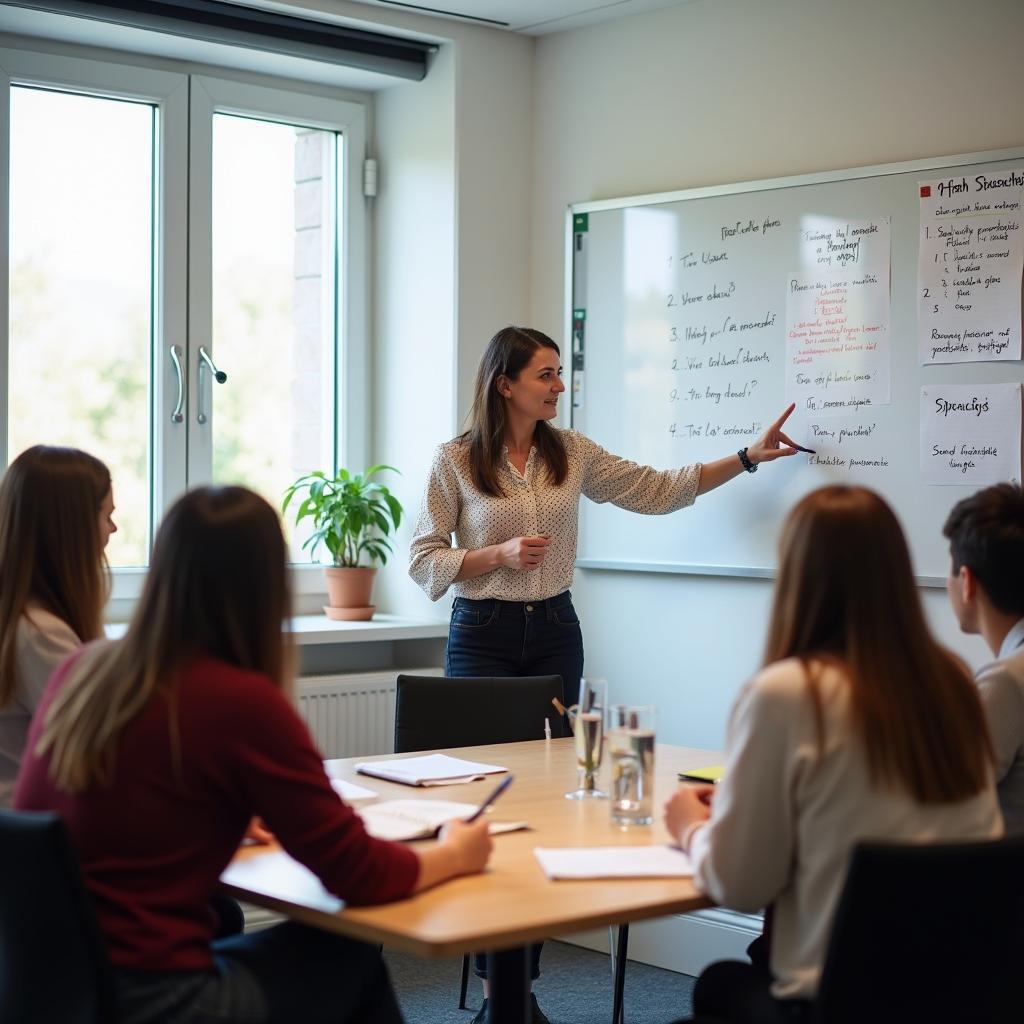 Giảng viên IELTS đang hướng dẫn kỹ năng Speaking về chủ đề hoạt động nhóm cho học viên
Qua bài viết này, bạn đã được trang bị đầy đủ công cụ để tự tin đối mặt với chủ đề “Describe a time when you participated in a group activity” trong kỳ thi IELTS Speaking. Hãy nhớ rằng, thành công không đến từ việc học thuộc template mà từ việc hiểu sâu sắc về tiêu chí chấm điểm và luyện tập đều đặn với authentic materials.
Những điểm quan trọng cần ghi nhớ:
- Part 1: Trả lời tự nhiên, mở rộng 2-3 câu, đưa ra ví dụ cụ thể
- Part 2: Chuẩn bị kỹ trong 1 phút, nói đủ 2 phút, trả lời đầy đủ tất cả bullet points
- Part 3: Phân tích sâu, đưa ra nhiều góc nhìn, sử dụng discourse markers hiệu quả
Hãy tập trung phát triển cả 4 tiêu chí: Fluency & Coherence, Lexical Resource, Grammatical Range & Accuracy, và Pronunciation. Đừng chỉ học từ vựng mà hãy học cách sử dụng chúng trong context tự nhiên. Thực hành thường xuyên với đề tài thực tế và ghi âm để tự đánh giá.
Chúc bạn đạt được band điểm mong muốn trong kỳ thi IELTS Speaking!