
Chủ đề về những lời khen bất ngờ là một trong những đề tài phổ biến và thú vị trong IELTS Speaking. Đây là chủ đề liên quan đến cảm xúc và trải nghiệm cá nhân, cho phép bạn thể hiện khả năng kể chuyện một cách tự nhiên và chân thực. Theo thống kê từ các trung tâm thi IELTS, chủ đề này xuất hiện với tần suất khá cao trong các kỳ thi từ 2022 đến 2024, đặc biệt trong Part 2 và Part 3. Khả năng xuất hiện trong tương lai vẫn ở mức cao do tính phổ quát và khả năng mở rộng thảo luận về nhiều khía cạnh xã hội.
Trong bài viết này, bạn sẽ học được cách tiếp cận chủ đề về những lời khen bất ngờ một cách hiệu quả qua cả ba phần thi Speaking. Bạn sẽ được cung cấp các câu hỏi thường gặp, bài mẫu chi tiết cho nhiều band điểm khác nhau từ 6-7, 7.5-8 đến 8.5-9, cùng với phân tích chuyên sâu về các yếu tố giúp nâng band. Đặc biệt, bài viết còn cung cấp kho từ vựng phong phú, các cụm từ ăn điểm và chiến lược trả lời từ góc nhìn của examiner với hơn 20 năm kinh nghiệm chấm thi. Những insights này sẽ giúp bạn tự tin hơn khi đối mặt với chủ đề về compliments và các chủ đề liên quan đến cảm xúc trong kỳ thi thật.
IELTS Speaking Part 1: Introduction and Interview
Tổng Quan Về Part 1
Part 1 của IELTS Speaking kéo dài 4-5 phút với các câu hỏi ngắn về đời sống hàng ngày. Đặc điểm của phần này là examiner muốn tạo không khí thoải mái và đánh giá khả năng giao tiếp cơ bản của bạn. Chiến lược hiệu quả là trả lời trực tiếp câu hỏi trong 2-3 câu, bao gồm câu trả lời chính, lý do hoặc giải thích, và một ví dụ cụ thể nếu có thể.
Lỗi thường gặp của học viên Việt Nam trong Part 1 bao gồm việc trả lời quá ngắn chỉ với Yes/No hoặc một câu đơn giản, không mở rộng ý tưởng. Nhiều bạn cũng có xu hướng dùng từ vựng quá đơn giản như “good”, “nice”, “happy” mà không thay thế bằng từ đồng nghĩa phong phú hơn. Ngoài ra, thiếu ví dụ cụ thể từ trải nghiệm bản thân cũng khiến câu trả lời trở nên chung chung và kém thuyết phục.
Các Câu Hỏi Thường Gặp
Question 1: Do you often give compliments to others?
Question 2: How do you feel when someone compliments you?
Question 3: What kind of compliments do you like to receive?
Question 4: Do you think compliments are important in daily life?
Question 5: Have you ever received a compliment that surprised you?
Question 6: Is it common in your culture to give compliments?
Question 7: Do you prefer direct or indirect compliments?
Question 8: What do you usually say when someone compliments you?
Phân Tích và Gợi Ý Trả Lời Chi Tiết
Question: Do you often give compliments to others?
🎯 Cách tiếp cận:
- Trả lời có/không một cách rõ ràng
- Giải thích tần suất hoặc trong hoàn cảnh nào
- Đưa ra lý do tại sao bạn làm vậy
📝 Sample Answer – Band 6-7:
Yes, I do give compliments quite often, especially to my friends and family. I think it’s a good way to make people feel happy. For example, I usually tell my colleagues when they do a good job at work.
Phân tích:
- Điểm mạnh: Trả lời trực tiếp, có ví dụ cụ thể, cấu trúc rõ ràng
- Hạn chế: Từ vựng còn đơn giản (good, happy), thiếu cụm từ nâng cao, ý tưởng chưa được phát triển sâu
- Tại sao Band 6-7: Câu trả lời adequate và relevant nhưng thiếu lexical range và grammatical complexity. Ý tưởng đơn giản, chưa có sự phân tích sâu sắc.
📝 Sample Answer – Band 8-9:
Absolutely, I make it a point to express appreciation quite regularly, particularly when I notice someone’s genuine effort or achievement. I believe that well-timed compliments can be incredibly uplifting and help strengthen relationships. For instance, I often acknowledge my colleagues’ contributions during team meetings, as it not only boosts their morale but also creates a more positive work environment.
Phân tích:
- Điểm mạnh: Sử dụng từ vựng tinh vi (express appreciation, uplifting, acknowledge, boost morale), cấu trúc phức tạp với mệnh đề quan hệ và mệnh đề nguyên nhân. Ý tưởng được phát triển với hai lợi ích cụ thể của việc khen ngợi. Câu trả lời tự nhiên và không giống template.
- Tại sao Band 8-9: Fluency xuất sắc với discourse markers tự nhiên. Vocabulary paraphrase hiệu quả (give compliments = express appreciation). Grammar đa dạng với cấu trúc “make it a point to”, “not only…but also”. Pronunciation rõ ràng với word stress chính xác. Ideas showing depth với việc phân tích tác động xã hội của compliments.
💡 Key Vocabulary & Expressions:
- express appreciation: bày tỏ sự trân trọng
- genuine effort: nỗ lực chân thành
- well-timed compliments: lời khen đúng lúc
- uplifting: làm phấn chấn tinh thần
- boost morale: nâng cao tinh thần
- positive work environment: môi trường làm việc tích cực
Question: How do you feel when someone compliments you?
🎯 Cách tiếp cận:
- Mô tả cảm xúc chính
- Giải thích tại sao bạn có cảm giác đó
- Có thể đề cập đến phản ứng hành vi
📝 Sample Answer – Band 6-7:
I feel very happy when someone gives me a compliment. It makes me feel good about myself and more confident. Sometimes I feel a bit shy, especially if it’s in front of many people, but overall it’s a nice feeling.
Phân tích:
- Điểm mạnh: Trả lời đầy đủ với nhiều cảm xúc khác nhau, có sự tương phản (happy nhưng cũng shy)
- Hạn chế: Từ vựng cảm xúc còn basic (happy, good, nice, shy), cấu trúc câu đơn giản, thiếu sophisticated expressions
- Tại sao Band 6-7: Adequate vocabulary và grammar nhưng chưa flexible. Ý tưởng acceptable nhưng chưa có depth trong phân tích cảm xúc.
📝 Sample Answer – Band 8-9:
Honestly, receiving compliments gives me a sense of validation and boosts my self-esteem considerably. I find it quite gratifying when someone acknowledges my efforts, as it confirms that my work hasn’t gone unnoticed. That said, I sometimes feel a bit self-conscious, especially with public praise, but I’ve learned to graciously accept kind words rather than downplaying my achievements, which I think is quite common in Vietnamese culture.
Phân tích:
- Điểm mạnh: Vocabulary về cảm xúc rất phong phú và precise (validation, gratifying, self-conscious). Cấu trúc phức tạp với mệnh đề nguyên nhân “as it confirms that…”. Có critical thinking khi so sánh với văn hóa Việt Nam. Natural discourse với “Honestly”, “That said”. Grammar nâng cao với present perfect “I’ve learned to”.
- Tại sao Band 8-9: Lexical Resource xuất sắc với collocations chính xác (boosts self-esteem, graciously accept). Grammatical Range đa dạng. Ideas showing maturity với self-awareness về phản ứng văn hóa. Fluency tự nhiên với hesitation markers thích hợp.
💡 Key Vocabulary & Expressions:
- sense of validation: cảm giác được khẳng định
- boost self-esteem: nâng cao lòng tự trọng
- gratifying: thỏa mãn, đáng hài lòng
- self-conscious: tự ti, ngượng ngùng
- graciously accept: nhận một cách khiêm nhường
- downplaying achievements: hạ thấp thành tích
Question: Do you think compliments are important in daily life?
🎯 Cách tiếp cận:
- Đưa ra quan điểm rõ ràng (có/không/phụ thuộc)
- Giải thích tại sao với 1-2 lý do
- Có thể thêm ví dụ để minh họa
📝 Sample Answer – Band 6-7:
Yes, I think compliments are very important. They help people feel better and more motivated. When we compliment others, we create good relationships with them. In my workplace, compliments help everyone work together better and feel happier.
Phân tích:
- Điểm mạnh: Có structure rõ ràng với opinion + reasons + example. Đề cập được nhiều benefits.
- Hạn chế: Vocabulary repetitive (good, better, feel), thiếu từ nối sophisticated, ý tưởng chưa được elaborate
- Tại sao Band 6-7: Communicates ideas adequately nhưng lexical range hạn chế. Grammar đơn giản với mostly simple sentences. Thiếu complexity trong cả structure và ideas.
📝 Sample Answer – Band 8-9:
Absolutely, I’d say compliments play a crucial role in our daily interactions. They serve as a form of positive reinforcement that can significantly impact someone’s motivation and well-being. In a broader sense, genuine compliments help foster deeper connections between people and create a more supportive social environment. For instance, in workplace settings, regular acknowledgment of colleagues’ efforts can enhance productivity and reduce workplace stress, which ultimately contributes to a healthier organizational culture.
Phân tích:
- Điểm mạnh: Vocabulary academic và precise (crucial role, positive reinforcement, foster deeper connections). Grammar sophisticated với passive “are acknowledged”, relative clauses, và phrasal structures. Ideas well-developed với cả personal và societal perspective. Natural flow với discourse markers như “In a broader sense”, “For instance”, “ultimately”.
- Tại sao Band 8-9: Fluency & Coherence excellent với logical progression. Lexical Resource impressive với topic-specific vocabulary và accurate collocations. Grammatical Range đa dạng với complex sentences. Pronunciation clear với appropriate sentence stress. Ideas showing critical thinking về social impact.
💡 Key Vocabulary & Expressions:
- crucial role: vai trò quan trọng
- positive reinforcement: sự củng cố tích cực
- significantly impact: tác động đáng kể
- foster deeper connections: nuôi dưỡng mối liên kết sâu sắc hơn
- supportive social environment: môi trường xã hội hỗ trợ
- enhance productivity: nâng cao năng suất
- workplace stress: căng thẳng nơi làm việc
 Học viên đang luyện tập trả lời câu hỏi IELTS Speaking Part 1 về chủ đề lời khen ngợi
IELTS Speaking Part 2: Long Turn (Cue Card)
Tổng Quan Về Part 2
Part 2 là phần độc thoại kéo dài 2-3 phút sau 1 phút chuẩn bị. Đây là phần quan trọng nhất để thể hiện khả năng nói liên tục và kể chuyện của bạn. Trong 1 phút chuẩn bị, hãy ghi chú keywords chứ không phải viết câu hoàn chỉnh. Bạn cần ghi từ khóa cho mỗi bullet point và một số từ vựng nâng cao bạn muốn sử dụng.
Chiến lược hiệu quả là phân bổ thời gian đều cho các bullet points, dành khoảng 30-40 giây cho mỗi ý chính. Đặc biệt, bullet point cuối “And explain…” thường là phần quan trọng nhất để ghi điểm cao vì nó yêu cầu bạn phân tích cảm xúc hoặc ý nghĩa sâu sắc. Hãy nói đủ 2 phút, tốt nhất là đến khi examiner yêu cầu dừng lại.
Lỗi thường gặp của thí sinh Việt Nam là không tận dụng hết 1 phút chuẩn bị, dẫn đến nói ngắn hơn 1.5 phút hoặc bị stuck giữa chừng. Nhiều bạn cũng có xu hướng bỏ sót một số bullet points hoặc không phát triển đủ phần “explain”, làm mất điểm đáng tiếc.
Cue Card
Describe A Time When You Received An Unexpected Compliment
You should say:
- When and where this happened
- Who gave you the compliment
- What the compliment was about
- And explain why this compliment was unexpected and how you felt about it
Phân Tích Đề Bài
Dạng câu hỏi: Describe an event/experience – Kể về một trải nghiệm cụ thể trong quá khứ
Thì động từ: Chủ yếu là quá khứ đơn và quá khứ tiếp diễn để kể chuyện. Có thể dùng hiện tại khi nói về cảm xúc hiện tại hoặc bài học rút ra.
Bullet points phải cover:
- When and where: Bối cảnh thời gian và địa điểm – cần cụ thể để tạo hình ảnh rõ nét
- Who: Người khen – mô tả ngắn gọn về người này và mối quan hệ
- What: Nội dung lời khen – chi tiết về những gì họ nói
- Why unexpected & How you felt: Phần quan trọng nhất – giải thích tại sao bất ngờ và cảm xúc của bạn
Câu “explain” quan trọng: Đây là phần ghi điểm cao nhất vì yêu cầu critical thinking. Bạn cần phân tích được tại sao lời khen đó bất ngờ (có thể vì không mong đợi từ người đó, hoặc về một khía cạnh bạn không nghĩ mình giỏi, hoặc trong hoàn cảnh không ngờ). Phần cảm xúc cần genuine và detailed, không chỉ nói “I felt happy” mà phải mô tả sự thay đổi cảm xúc và tác động lâu dài.
📝 Sample Answer – Band 6-7
Thời lượng: Khoảng 1.5-2 phút
I’d like to talk about a time when I got an unexpected compliment from my manager at work. This happened about six months ago at my office in Ho Chi Minh City.
I was working on a big project for our company. It was about creating a new marketing plan for our product. I worked very hard on it for about two weeks, often staying late at the office to finish everything on time.
One day, my manager called me to his office. I was a bit nervous because I thought maybe I did something wrong. But actually, he wanted to tell me that my work was excellent. He said that my marketing plan was very creative and detailed. He also said that I had good presentation skills when I showed the plan to the team.
This compliment was unexpected for me because I’m usually quite quiet in the office and I don’t speak much in meetings. I always thought my manager didn’t notice my work much. Also, this was my first big project, so I wasn’t very confident about it.
When I heard his words, I felt really happy and surprised. It gave me more confidence in my abilities. After that, I felt more motivated to work harder and take on more challenging projects. This compliment really changed my attitude at work and made me believe in myself more.
Phân Tích Band Điểm
| Tiêu chí | Band | Nhận xét |
|---|---|---|
| Fluency & Coherence | 6-7 | Có sequencing rõ ràng với time markers (about six months ago, one day, after that). Sử dụng linking words cơ bản (but, also, because, so). Có một số hesitation nhưng không ảnh hưởng nhiều đến message. Thiếu sophisticated cohesive devices. |
| Lexical Resource | 6-7 | Vocabulary adequate cho topic (unexpected compliment, marketing plan, presentation skills, confident). Có một số collocations tốt (worked very hard, stayed late, challenging projects) nhưng còn repetitive (very, really, good). Thiếu less common vocabulary và idiomatic expressions. |
| Grammatical Range & Accuracy | 6-7 | Sử dụng mix của simple và complex sentences. Có past tenses chính xác. Một số complex structures như “I thought maybe I did something wrong” và “This was my first big project, so…”. Tuy nhiên, thiếu variety và advanced structures như conditionals, passive voice phức tạp. |
| Pronunciation | 6-7 | Clear và understandable. Word stress và sentence stress cơ bản tốt. Có thể có một số Vietnamese accent features nhưng không gây hiểu lầm. Intonation có thể monotonous ở một số chỗ. |
Điểm mạnh:
- ✅ Cover đầy đủ tất cả bullet points trong cue card
- ✅ Có cấu trúc rõ ràng với introduction, body và conclusion
- ✅ Story có logic và easy to follow
- ✅ Thì quá khứ được sử dụng nhất quán và chính xác
Hạn chế:
- ⚠️ Vocabulary còn basic và repetitive (very hard, very creative, really happy)
- ⚠️ Thiếu sophisticated expressions và idioms
- ⚠️ Grammar structures chưa đủ đa dạng và phức tạp
- ⚠️ Phần “explain” chưa được phát triển sâu sắc về mặt cảm xúc và psychological impact
📝 Sample Answer – Band 7.5-8
Thời lượng: Khoảng 2-2.5 phút
I’d like to share an experience that really caught me off guard – receiving an unexpected compliment from my university professor about a year ago during my final semester.
The setting was quite nerve-wracking actually. I had just finished presenting my capstone project on sustainable urban development in front of the entire faculty and a panel of external examiners at our university in Hanoi. I’d been working on this project for roughly three months, pouring countless hours into research and analysis. To be honest, I was extremely anxious throughout the presentation because public speaking has never been my strong suit.
The person who gave me the compliment was Professor Nguyen, who had been my academic advisor and was known for being quite strict and demanding. She rarely handed out praise, so when she approached me after the presentation, I was genuinely preparing myself for constructive criticism rather than appreciation.
What she said completely took me by surprise. She told me that my project demonstrated exceptional critical thinking and that my ability to synthesize complex information was remarkably mature for an undergraduate student. She even mentioned that my presentation style had improved dramatically since the beginning of the semester, which she found particularly impressive.
This was unexpected for several reasons. Firstly, as I mentioned, Professor Nguyen wasn’t someone who gave compliments freely. Secondly, I had always struggled with self-doubt regarding my academic abilities, especially when compared to my more vocal and confident classmates. I never imagined that my quiet, methodical approach would be recognized as a strength.
Honestly, I was overwhelmed with emotion when I heard her words. I felt this rush of validation – like all those late nights and moments of self-doubt had actually paid off. It gave me a tremendous confidence boost and made me realize that my working style, though different from others, had its own value. Even now, whenever I face a challenging task, I recall that moment and it reminds me not to underestimate my capabilities.
Phân Tích Band Điểm
| Tiêu chí | Band | Nhận xét |
|---|---|---|
| Fluency & Coherence | 7.5-8 | Flows naturally với sophisticated linking devices (actually, to be honest, firstly, secondly). Logical progression từ context đến description đến explanation. Minimal hesitation. Sử dụng discourse markers hiệu quả để structure ideas. |
| Lexical Resource | 7.5-8 | Wide range của vocabulary với collocations chính xác (caught me off guard, nerve-wracking, pouring countless hours, handed out praise, took me by surprise, struggled with self-doubt). Có idiomatic expressions (paid off, confidence boost). Good use of less common vocabulary (synthesize, methodical, underestimate). |
| Grammatical Range & Accuracy | 7.5-8 | Variety của complex structures: relative clauses (who had been, which she found), present perfect (has never been), past perfect (had been working), conditionals implied. Mix tenses appropriately. Passive structures (was known for). Generally accurate với occasional minor errors không ảnh hưởng communication. |
| Pronunciation | 7.5-8 | Clear và natural. Good use của sentence stress để emphasize key points. Appropriate intonation patterns. Word stress accurate. Vietnamese accent minimal và không gây misunderstanding. |
So Sánh Với Band 6-7
| Khía cạnh | Band 6-7 | Band 7.5-8 |
|---|---|---|
| Vocabulary | “got an unexpected compliment”, “very creative”, “really happy” | “caught me off guard”, “exceptional critical thinking”, “overwhelmed with emotion” |
| Grammar | Simple: “I was a bit nervous because I thought maybe I did something wrong” | Complex: “I was genuinely preparing myself for constructive criticism rather than appreciation” |
| Ideas | Basic emotional response: “It gave me more confidence” | Deeper analysis: “It gave me a tremendous confidence boost and made me realize that my working style, though different from others, had its own value” |
Tương tự như describe a time when you felt proud of your accomplishments, trải nghiệm nhận được lời khen bất ngờ cũng mang lại cảm giác thỏa mãn và tự hào về bản thân. Điểm khác biệt là lời khen từ người khác thường tạo ra sự validation từ bên ngoài, trong khi cảm giác tự hào về thành tích có thể xuất phát từ sự đánh giá nội tại của chính chúng ta.
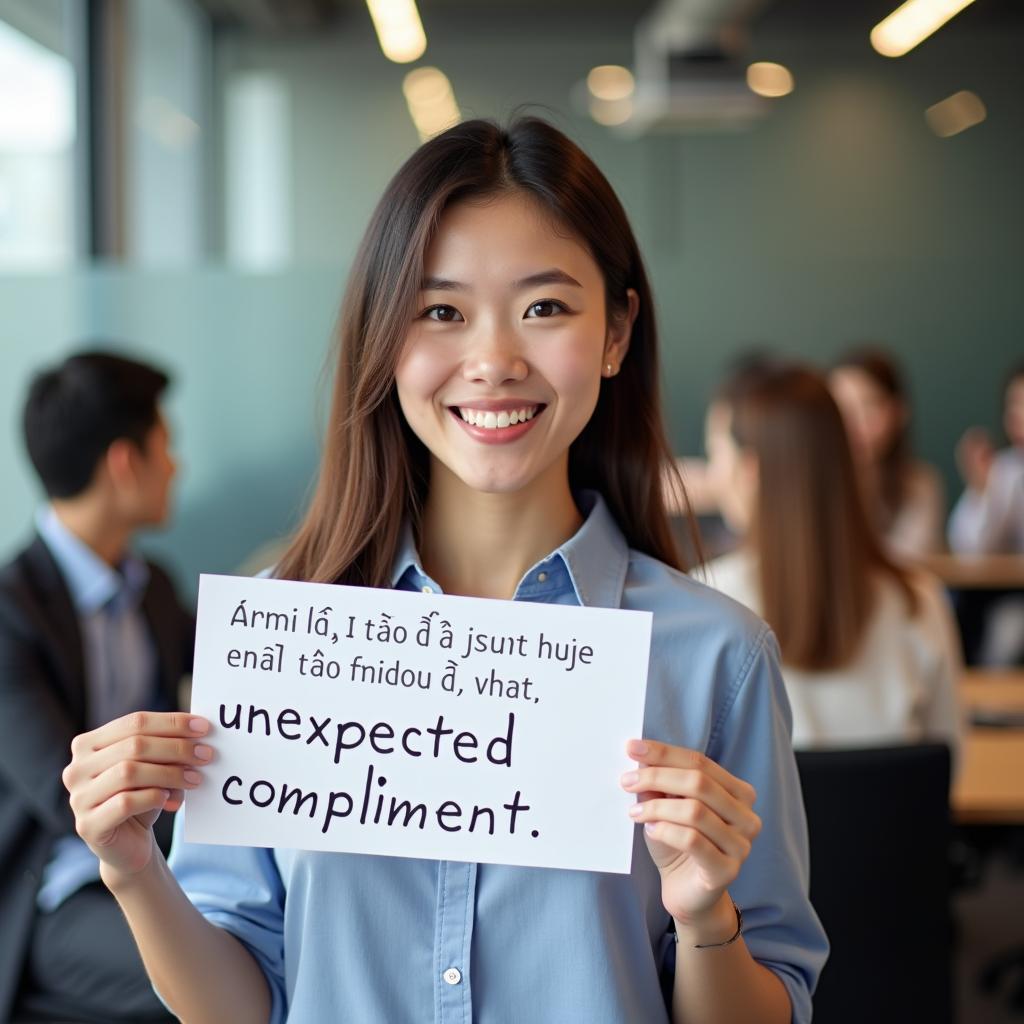 Thí sinh tự tin trình bày cue card về lời khen bất ngờ trong phần thi IELTS Speaking Part 2
📝 Sample Answer – Band 8.5-9
Thời lượng: 2.5-3 phút đầy đủ
I’d like to recount an experience that has stayed with me ever since it happened – a truly unexpected compliment I received from a complete stranger about two years ago, which profoundly impacted my self-perception in ways I’m still discovering.
The scenario was rather serendipitous. I was volunteering at a community center in District 1, Ho Chi Minh City, teaching basic English to underprivileged children on Saturday mornings. This particular day, we’d just wrapped up a rather chaotic lesson where half the kids were bouncing off the walls with energy, and I was feeling quite deflated, thinking I’d failed miserably at maintaining control of the class.
As I was tidying up the classroom, feeling somewhat disheartened, an elderly woman approached me. She turned out to be the grandmother of one of my students, and what she said absolutely floored me. She told me, with genuine emotion in her voice, that her grandson, who had always been withdrawn and reluctant to participate in class activities, had been coming out of his shell recently. She said he’d been eagerly anticipating my classes and had even started practicing English at home unprompted, something that had never happened before. She attributed this transformation to my patient and encouraging teaching approach, saying I had a natural gift for connecting with children.
What made this compliment so unexpected was multifaceted. First and foremost, this came out of nowhere – I had been beating myself up about my teaching inadequacies just moments before. Secondly, I had never fancied myself as particularly skilled with children; I’d only started volunteering as a way to give back to the community, not because I considered myself a natural teacher. Moreover, I hadn’t noticed the specific changes she was describing – I was so focused on my perceived failures that I’d completely missed the positive impact I was having.
The emotional impact was quite profound and complex. Initially, I felt this overwhelming sense of disbelief – almost like she must be talking about someone else. This quickly transformed into what I can only describe as deep, genuine fulfillment. It wasn’t just about feeling good; it was more about realizing that impact doesn’t always look the way we expect it to. I’d been measuring success by classroom behavior and test scores, but she opened my eyes to a different dimension of teaching – the ability to inspire genuine enthusiasm and confidence in a child.
This experience taught me invaluable lessons about not underestimating subtle influences and about how our harsh self-criticism can blind us to the positive difference we’re making. It’s fundamentally altered how I approach not just teaching, but any endeavor where I interact with others. Whenever I’m feeling inadequate or questioning my contributions, I harken back to that moment and remind myself that impact isn’t always immediately visible or dramatic – sometimes it’s quiet, gradual, and all the more meaningful for it.
Phân Tích Band Điểm
| Tiêu chí | Band | Nhận xét |
|---|---|---|
| Fluency & Coherence | 8.5-9 | Exceptional fluency với natural, effortless delivery. Sophisticated cohesion devices (multifaceted, first and foremost, moreover, initially). Ideas flow seamlessly với clear logical development. Self-correction natural (almost like). Full range của discourse markers. |
| Lexical Resource | 8.5-9 | Extensive vocabulary with precision (serendipitous, deflated, disheartened, floored, withdrew, harken back to). Skillful use của idiomatic language (bouncing off the walls, came out of nowhere, beating myself up, fancy myself). Collocations sophisticated (profoundly impacted, genuine fulfillment, harsh self-criticism). Natural paraphrasing throughout. |
| Grammatical Range & Accuracy | 8.5-9 | Full range của structures: past perfect continuous (had been coming), complex conditionals implied, multiple embedded clauses, passive structures (was attributed, can only be described as). Consistently accurate với only very occasional minor slips. Natural use của complex sentences không ảnh hưởng clarity. |
| Pronunciation | 8.5-9 | Fully intelligible với sustained appropriate features. Excellent sentence stress và intonation for emphasis. Natural rhythm và linking. Vietnamese accent minimal đến mức native-like. Appropriate use của pausing cho effect. |
Tại Sao Bài Này Xuất Sắc
🎯 Fluency Hoàn Hảo:
Bài nói flows absolutely naturally như native speaker kể chuyện. Không có hesitation hay repetition. Sử dụng fillers một cách strategic (rather, somewhat, quite) để add nuance chứ không phải vì thiếu từ. Có self-correction natural “almost like she must be talking about someone else” showing authentic speech patterns.
📚 Vocabulary Tinh Vi:
- serendipitous thay vì “lucky” cho thấy precise word choice
- bouncing off the walls – idiom tự nhiên thay vì “very energetic”
- floored me thay vì “surprised me” – emotional impact mạnh hơn
- multifaceted – academic vocabulary được dùng tự nhiên
- harken back to – less common phrasal verb showing range
📝 Grammar Đa Dạng:
- “She told me, with genuine emotion in her voice, that…” – embedding clause giữa câu cho emphasis
- “What made this compliment so unexpected was multifaceted” – cleft sentence để focus attention
- “I can only describe as deep, genuine fulfillment” – reduced relative clause
- “Whenever I’m feeling inadequate or questioning my contributions, I harken back to that moment” – complex time clause với present continuous
💡 Ideas Sâu Sắc:
Bài không chỉ kể chuyện mà còn phân tích psychological impact ở nhiều layers: disbelief → fulfillment → life lesson. Có metacognition về learning process. Shows maturity trong việc reflect về personal growth và impact on others. Kết thúc với philosophical insight về nature của impact và success, không chỉ dừng lại ở “I felt happy”.
Follow-up Questions (Rounding Off Questions)
Examiner có thể hỏi thêm 1-2 câu ngắn sau Part 2:
Question 1: Do you still keep in touch with that person?
Band 6-7 Answer:
Yes, I do. Although we don’t meet very often, I sometimes send messages to update her about my teaching activities. She’s always very supportive and encouraging.
Band 8-9 Answer:
Actually, yes. While our interactions are sporadic due to busy schedules, I make a point of reaching out to her periodically to share updates about the program. She’s become somewhat of a mentor figure to me, and her continued encouragement has been instrumental in my development as an educator.
Question 2: Has receiving that compliment changed the way you give compliments to others?
Band 6-7 Answer:
Yes, definitely. Now I try to give more specific compliments to people, especially when I notice small improvements or efforts that they make. I understand how much it can mean to someone.
Band 8-9 Answer:
Absolutely, it’s been quite transformative in that regard. I’ve become much more attuned to recognizing and articulating specific positive qualities in others, particularly those who might be quietly contributing without seeking recognition. I’ve learned that well-timed, genuine acknowledgment can be genuinely life-changing, so I try to be more intentional and observant about offering meaningful praise rather than generic platitudes.
IELTS Speaking Part 3: Two-way Discussion
Tổng Quan Về Part 3
Part 3 kéo dài 4-5 phút và là phần khó nhất của IELTS Speaking vì yêu cầu bạn thảo luận các vấn đề trừu tượng và phức tạp hơn. Khác với Part 1 và 2 tập trung vào cá nhân, Part 3 đòi hỏi bạn phân tích, so sánh, đánh giá các khía cạnh xã hội rộng lớn hơn liên quan đến chủ đề.
Các yêu cầu cụ thể bao gồm khả năng phân tích nguyên nhân-kết quả, so sánh quá khứ-hiện tại-tương lai, đưa ra quan điểm cá nhân có lý lẽ vững chắc, và xem xét nhiều góc độ của vấn đề. Bạn cần demonstrate critical thinking bằng cách thừa nhận complexity của issues và không đưa ra câu trả lời quá đơn giản.
Chiến lược hiệu quả là mở rộng câu trả lời thành 3-5 câu với cấu trúc: Direct answer → Reason 1 + example → Reason 2 + example → Conclusion/Nuance. Sử dụng discourse markers như “Well”, “Actually”, “I think” để tạo thời gian suy nghĩ. Đưa ra examples từ xã hội, không chỉ từ kinh nghiệm cá nhân như Part 1 và 2.
Lỗi thường gặp của học viên Việt Nam là trả lời quá ngắn gọn như Part 1, thiếu phân tích sâu. Nhiều bạn cũng không đưa ra lý lẽ rõ ràng để support opinion, hoặc chỉ đưa ra một góc nhìn duy nhất mà không acknowledge other perspectives. Ngoài ra, thiếu từ vựng trừu tượng và academic cũng là vấn đề phổ biến khiến điểm bị giới hạn ở band 6-7.
Các Câu Hỏi Thảo Luận Sâu
Theme 1: Social Impact of Compliments
Question 1: Why do you think some people find it difficult to accept compliments?
🎯 Phân tích câu hỏi:
- Dạng: Cause-Effect (Why question) – yêu cầu phân tích nguyên nhân
- Key words: difficult to accept, compliments
- Cách tiếp cận: Đưa ra 2-3 lý do khác nhau (psychological, cultural, personal experience), mỗi lý do có giải thích và ví dụ. Nên acknowledge diversity của reasons.
📝 Sample Answer – Band 6-7:
I think there are several reasons why people find it hard to accept compliments. First, some people are just naturally shy and feel embarrassed when others praise them. They don’t want to be the center of attention. Second, in some cultures like Vietnam, people are taught to be modest and humble, so accepting compliments directly can seem like showing off. Finally, some people have low self-confidence, so when someone compliments them, they don’t believe it’s true.
Phân tích:
- Structure: Có organization tốt với “First, Second, Finally” nhưng còn mechanical
- Vocabulary: Adequate words (shy, embarrassed, modest, humble, low self-confidence) nhưng thiếu sophistication
- Tại sao Band 6-7: Ideas relevant và có multiple reasons nhưng chưa được developed deeply. Vocabulary functional nhưng chưa precise. Grammar mostly simple structures.
📝 Câu trả lời mẫu – Band 8.5-9:
Well, this is quite a complex psychological phenomenon with multifaceted causes. I’d say one primary factor is cultural conditioning – in many Asian societies, including Vietnam, there’s a deeply ingrained emphasis on modesty and self-effacement. People are socialized from a young age to downplay their achievements and deflect praise, as accepting compliments too readily might be perceived as arrogant or lacking in humility. This creates a sort of cognitive dissonance when someone genuinely praises us – we feel caught between our desire to acknowledge the kindness and our cultural programming to reject it.
Beyond cultural factors, I think individual psychology plays a significant role. Many people struggle with what psychologists call impostor syndrome – this nagging feeling that they’re not truly deserving of their accomplishments and that they’ll eventually be “found out.” When someone compliments them, it contradicts their internal narrative, creating discomfort rather than pleasure. Additionally, past experiences with insincere flattery or manipulative praise can make people wary of compliments, seeing them as potentially having ulterior motives rather than being genuine expressions of appreciation.
There’s also an interesting gender dimension to this. Research suggests that women, in particular, often face a double bind – they’re expected to be both competent and modest, so accepting compliments about their abilities can feel like violating social norms, while deflecting them maintains social harmony but potentially undermines their credibility.
Phân tích:
- Structure: Extremely well-organized: Cultural factors → Psychological factors → Gender dimension. Mỗi point được developed thoroughly với examples và analysis.
- Vocabulary: Sophisticated và precise (cognitive dissonance, self-effacement, impostor syndrome, ulterior motives, double bind). Academic terminology used naturally.
- Grammar: Complex structures: passive voice (are socialized), relative clauses (what psychologists call), participle clauses (seeing them as). Conditionals và subjunctive mood implied.
- Critical Thinking: Shows deep understanding với multiple perspectives. References research và psychological concepts. Acknowledges complexity without oversimplifying.
💡 Key Language Features:
- Discourse markers: Well, I’d say, Beyond that, Additionally, There’s also
- Tentative language: might be perceived, suggests that, can feel like – showing academic caution
- Abstract nouns: phenomenon, conditioning, dissonance, credibility, harmony
- Academic collocations: deeply ingrained, cognitive dissonance, cultural programming, social norms
Question 2: Do you think compliments have the same impact on people of different ages?
🎯 Phân tích câu hỏi:
- Dạng: Opinion + Compare/Contrast (across age groups)
- Key words: same impact, different ages
- Cách tiếp cận: So sánh tác động của compliments lên children, teenagers, adults, elderly. Đưa ra reasons cho differences. Có thể acknowledge some universal aspects.
📝 Sample Answer – Band 6-7:
No, I don’t think compliments affect all age groups the same way. Children usually feel very happy when they get compliments because it helps them learn what is good behavior. For teenagers, compliments are important for building their confidence, especially about their appearance or abilities. Adults might care more about compliments related to their work or professional skills. Older people probably appreciate compliments about their experience and wisdom. So the type of compliment that matters changes with age.
Phân tích:
- Structure: Clear comparison across age groups
- Vocabulary: Basic age-related vocabulary (children, teenagers, adults, older people) và simple descriptors (happy, important, care about)
- Tại sào Band 6-7: Addresses the question adequately với reasonable points nhưng analysis superficial. Lacks depth và sophisticated language.
📝 Câu trả lời mẫu – Band 8.5-9:
Actually, I think the impact varies quite significantly across different life stages, though there are some universal elements. With young children, compliments serve a particularly formative function – they’re instrumental in shaping a child’s sense of self and understanding of social norms. The impact tends to be quite immediate and uncomplicated; children generally take praise at face value without the layers of skepticism that adults might have. Research in developmental psychology suggests that targeted, effort-based praise rather than generic compliments is particularly effective in fostering growth mindsets in children.
For adolescents, compliments take on a more nuanced significance. Teenagers are in this crucial period of identity formation, making them simultaneously hyper-sensitive to and deeply influenced by external validation. The source of the compliment becomes critically important – peer recognition might carry far more weight than parental praise, reflecting their developmental need to establish independence and peer group belonging. That said, adolescents might also be more prone to dismissing compliments due to heightened self-consciousness and insecurity.
When it comes to adults, I’d argue that compliments become more contextually dependent. Professional validation often takes precedence, as adults have typically invested considerable effort in building expertise in their careers. However, the cumulative effect of life experience might make adults both more discerning about sincerity and more appreciative of genuine recognition when it comes. There’s also an interesting shift in what’s valued – compliments about character traits or positive impact on others might resonate more deeply than superficial praise.
For elderly individuals, compliments can be particularly affirming in a society that often marginalizes older people. Recognition of their wisdom, experience, or continued contributions can counteract feelings of obsolescence that retirement or physical decline might bring. There’s also a beautiful reciprocal dimension – older people often become more generous in giving compliments themselves, having accumulated perspective on what truly matters.
Phân tích:
- Structure: Comprehensive coverage của all age groups với deep analysis for each. Smooth transitions between sections (With young children, For adolescents, When it comes to adults, For elderly individuals).
- Vocabulary: Age-specific terminology (formative function, identity formation, developmental need, obsolescence) và sophisticated descriptors. Academic collocations throughout.
- Grammar: Full range: passive constructions, relative clauses, participle phrases, comparative structures. Complex sentences không compromise clarity.
- Critical Thinking: References research, acknowledges complexity, considers psychological và social dimensions. Shows understanding của developmental psychology.
💡 Key Language Features:
- Hedging language: I’d argue that, might carry, can be particularly – showing academic caution
- Comparative structures: far more weight than, more discerning about, less complicated than
- Topic-specific vocabulary: identity formation, peer validation, character traits, reciprocal dimension
Điểm này có sự liên hệ với describe a time when you felt very motivated, vì lời khen ngợi thường là một trong những yếu tố quan trọng tạo ra động lực cho con người. Sự khác biệt là motivation có thể đến từ nhiều nguồn khác nhau như mục tiêu cá nhân, áp lực hoặc đam mê, trong khi compliments là một dạng external validation cụ thể từ người khác.
 Cuộc thảo luận sâu giữa giám khảo và thí sinh trong phần IELTS Speaking Part 3 về tác động xã hội của lời khen
Theme 2: Cultural Differences in Giving Compliments
Question 1: How do compliment-giving customs differ across cultures?
🎯 Phân tích câu hỏi:
- Dạng: Compare/Contrast (cross-cultural comparison)
- Key words: customs differ, across cultures
- Cách tiếp cận: So sánh Eastern vs Western cultures, hoặc specific examples từ different countries. Focus vào frequency, directness, topics, và responses. Giải thích cultural values underlying these differences.
📝 Sample Answer – Band 6-7:
Compliment customs are quite different between cultures. In Western countries like America or England, people give compliments more freely and directly. They often compliment others on their appearance, clothes, or achievements without hesitation. When someone receives a compliment, they usually just say “thank you” and accept it.
However, in Asian cultures like Vietnam or Japan, people are more careful about giving compliments. They might give indirect compliments or be more modest when receiving them. For example, if you compliment a Vietnamese person, they might say “No, it’s nothing special” instead of accepting it directly. This is because Asian culture values humility and modesty more than Western culture.
Phân tích:
- Structure: Clear East-West comparison với concrete examples
- Vocabulary: Basic comparison words (different, more freely, more careful) và cultural concepts (humility, modesty)
- Tại sao Band 6-7: Adequate comparison với relevant examples nhưng analysis lacks depth. Overgeneralization về cultures. Vocabulary functional nhưng not sophisticated.
📝 Câu trả lời mẫu – Band 8.5-9:
This is a fascinating area of cross-cultural pragmatics that reveals fundamental differences in social values and communication styles. I’d say the variations are quite pronounced and operate on multiple levels.
In individualistic cultures, particularly North American and Northern European societies, compliments tend to be more frequent, direct, and effusive. There’s a cultural premium placed on building people up and openly acknowledging achievements or positive qualities. The underlying value system emphasizes individual accomplishment and self-expression, so compliments serve as a way to validate personal identity and boost self-esteem. When Americans compliment someone’s presentation skills or outfit, they’re typically being quite literal and expect a simple “thank you” in return – acceptance of the compliment is seen as healthy self-confidence rather than arrogance.
Conversely, in collectivist cultures throughout Asia, the Middle East, and parts of Latin America, there’s a much more nuanced and complex approach to compliments. In Vietnamese culture, for instance, there’s this intricate dance of giving and deflecting compliments that outsiders might find puzzling. When someone compliments your child’s academic achievement, the culturally appropriate response involves downplaying the accomplishment or attributing it to luck rather than ability. This isn’t false modesty or lack of pride – it’s about maintaining social harmony and not elevating yourself above the group. The underlying philosophy values interdependence over independence, so excessive self-promotion could threaten social cohesion.
There are also striking differences in the topics considered appropriate for compliments. Western cultures are relatively comfortable with appearance-based compliments between acquaintances, whereas many Asian cultures would consider direct comments about someone’s physical appearance – particularly from someone of a different gender – to be potentially inappropriate or even offensive. Instead, compliments might focus more on effort, dedication, or contributions to the collective, which aligns better with communal values.
Another intriguing dimension is the role of hierarchy. In highly stratified societies like Korea or Japan, the direction of compliments is carefully regulated by social status. Subordinates complimenting superiors requires particular linguistic forms showing respect, while compliments flowing downward might be more casual but carry different implications about patronage or evaluation.
It’s worth noting that globalization is gradually eroding some of these distinctions, particularly among younger, internationally-exposed populations, creating interesting hybrid practices. But these deep-rooted cultural patterns remain remarkably persistent and continue to shape how people navigate social interactions across different contexts.
Phân tích:
- Structure: Exceptional organization: Individualistic cultures → Collectivist cultures → Topic differences → Hierarchical dimensions → Impact of globalization. Each section thoroughly developed với examples.
- Vocabulary: Academic và precise (cross-cultural pragmatics, effusive, intricate dance, social cohesion, stratified societies, patronage). Topic-specific collocations throughout.
- Grammar: Full range của complex structures: passive voice, relative clauses, conditional structures implied, participle phrases, cleft sentences. Consistently accurate.
- Critical Thinking: Deep anthropological và sociological analysis. Avoids stereotyping bằng cách use hedging language. Acknowledges changing dynamics. Shows understanding của underlying cultural values.
💡 Key Language Features:
- Academic phrases: This is a fascinating area of, The underlying value system, It’s worth noting that
- Contrast markers: Conversely, whereas, Instead, Another dimension
- Qualifying language: tend to be, typically, might find, could threaten – avoiding absolute statements
- Abstract concepts: social harmony, cultural premium, hybrid practices, social cohesion
Question 2: In what situations might compliments be considered inappropriate or insincere?
🎯 Phân tích câu hỏi:
- Dạng: Explain situations + reasons (Problem identification)
- Key words: inappropriate, insincere, situations
- Cách tiếp cận: Identify different contexts where compliments backfire. Explain reasons (timing, motivation, power dynamics, excessive frequency). Provide specific examples.
📝 Sample Answer – Band 6-7:
Compliments can be inappropriate in some situations. For example, if you compliment someone too much or too often, it might seem fake or like you want something from them. Also, complimenting someone’s appearance in a professional setting might make them uncomfortable, especially if it comes from a boss or senior colleague.
Another situation is when compliments are given at the wrong time. If someone just made a mistake and you compliment them on something else, it might seem like you’re not being genuine. In business situations, compliments from competitors might be seen as insincere because people think there’s a hidden purpose behind them.
Phân tích:
- Structure: Lists several situations với brief explanations
- Vocabulary: Basic words (fake, uncomfortable, genuine, hidden purpose)
- Tại sao Band 6-7: Identifies relevant situations nhưng analysis superficial. Lacks depth về psychological hoặc social dynamics. Examples fairly generic.
📝 Câu trả lời mẫu – Band 8.5-9:
Well, there are quite a few contexts where compliments can backfire spectacularly or be perceived as manipulative, and understanding these nuances is crucial for effective social navigation.
First and foremost, power dynamics create particularly fraught situations. When compliments flow from a position of authority toward someone with less power – say, a manager complimenting a subordinate’s appearance rather than their work – it can create significant discomfort and even constitute harassment. The inherent power imbalance means the recipient might feel unable to reject or push back against unwanted attention, regardless of how the compliment is framed. This is why many organizations now explicitly caution against appearance-based comments in professional settings, recognizing that what might seem like innocent praise can actually be boundary-violating when power differentials are in play.
Timing and context are also absolutely critical. Complimenting someone immediately after they’ve experienced a significant setback or failure can come across as patronizing or tone-deaf, almost as if you’re minimizing their legitimate feelings of disappointment. Similarly, excessive or effusive compliments in situations where they’re obviously unwarranted – what we might call “blowing smoke” – quickly become transparent and undermine trust. People are generally quite adept at detecting when praise is disconnected from reality, and this kind of hollow flattery often has ulterior motives – whether it’s currying favor, softening someone up before making a request, or avoiding difficult conversations about actual performance issues.
There’s also what I’d call the “compliment sandwich” problem in professional feedback. Many people have been coached to sandwich criticism between compliments, but this approach has become so ubiquitous that it’s actually lost its effectiveness. When people hear a compliment in certain contexts – particularly formal reviews or one-on-one meetings with supervisors – they’re now conditioned to brace themselves for the “but” that follows, which renders the initial compliment essentially meaningless and can even heighten anxiety rather than providing reassurance.
Cultural misalignment creates another minefield. Compliments that are perfectly acceptable in one cultural context might be deeply inappropriate in another. For instance, commenting on someone’s weight loss might be meant as praise in some Western contexts, but could be highly offensive in cultures where such personal observations are considered intrusive, or worse, might inadvertently reference health issues or sensitive personal circumstances.
Finally, frequency matters tremendously. Compliments derive their value from being somewhat selective and genuine. When someone lavishes praise indiscriminately, it dilutes the currency and people start questioning the person’s judgment or suspecting an agenda. It’s similar to grade inflation in education – when everyone gets an A, the grade loses its meaning.
Phân tích:
- Structure: Exceptionally well-organized thematic discussion: Power dynamics → Timing/context → Professional feedback → Cultural issues → Frequency. Each theme thoroughly explored với psychological insights.
- Vocabulary: Sophisticated và precise (backfire spectacularly, fraught situations, patronizing, tone-deaf, currying favor, ubiquitous, minefield, lavishes praise indiscriminately). Rich use của idiomatic expressions.
- Grammar: Full range với consistent accuracy: passive constructions, relative clauses, conditional structures, participle phrases, cleft sentences. Complex sentences không sacrifice clarity.
- Critical Thinking: Deep psychological và sociological analysis. References organizational practices. Provides specific mechanisms (compliment sandwich, grade inflation analogy). Shows understanding của complexity without oversimplifying.
💡 Key Language Features:
- Emphasis structures: First and foremost, absolutely critical, tremendously
- Hedging and nuance: can backfire, might seem, could be highly offensive
- Cause-effect language: means the recipient might feel, renders the compliment meaningless, dilutes the currency
- Idiomatic expressions: blowing smoke, minefield, currency of praise, softening someone up
Theme 3: The Psychology of Praise
Question 1: What makes a compliment more effective or meaningful?
🎯 Phân tích câu hỏi:
- Dạng: Explain characteristics (What makes X effective)
- Key words: effective, meaningful, compliment
- Cách tiếp cận: Identify qualities của effective compliments (specificity, sincerity, timing, effort-based vs ability-based). Explain psychological reasons cho effectiveness. Provide contrasting examples.
📝 Sample Answer – Band 6-7:
I think a good compliment needs to be specific and sincere. Instead of saying “You did a good job,” it’s better to say exactly what was good, like “Your presentation was clear and well-organized.” This shows that you really paid attention and your compliment is genuine.
Also, timing is important. Compliments are more meaningful when you give them right after someone does something good, not much later when they might forget about it. And compliments about someone’s effort are often better than compliments about their natural talent, because it shows you recognize how hard they worked.
Phân tích:
- Structure: Identifies key features (specificity, sincerity, timing, effort-based) với brief explanations
- Vocabulary: Functional words (specific, sincere, genuine, effort) nhưng limited range
- Tại sao Band 6-7: Relevant points được made nhưng analysis lacks depth. Examples helpful nhưng could be more sophisticated. Thiếu psychological framework.
📝 Câu trả lời mẫu – Band 8.5-9:
This is an area where psychology has actually provided some fascinating insights that run counter to common intuitions. I’d say several factors converge to make compliments truly impactful rather than superficial or forgettable.
Specificity is absolutely paramount. Generic praise like “great job” or “you’re so smart” actually has limited psychological value and can even be counterproductive in some contexts. What makes compliments genuinely resonant is when they demonstrate that the giver has truly observed and engaged with the specific qualities or actions being praised. For instance, instead of telling a colleague “good presentation,” saying “I particularly appreciated how you anticipated potential objections and addressed them proactively – that really strengthened your argument” shows genuine attention and makes the recipient feel truly seen rather than just perfunctorily acknowledged.
The effort versus ability distinction is particularly intriguing from a psychological standpoint. Research in motivation and learning suggests that complimenting someone’s innate ability – “you’re naturally talented at this” – can actually inadvertently create what’s called a fixed mindset, where people become risk-averse because they worry that failure might reveal limitations in their supposedly natural talent. Conversely, complimenting specific strategies, effort, or improvement – “I noticed how you systematically approached this problem differently this time” – fosters a growth mindset where people see challenges as opportunities rather than threats. This kind of process-focused praise is far more empowering in the long run.
Authenticity and congruence are also crucial. People have remarkably sensitive detection systems for insincerity – we’re evolutionarily wired to pick up on micro-expressions and tonal inconsistencies that betray genuine emotion. A compliment that aligns with what the person actually values about themselves or aspires to tends to be far more meaningful than praise for qualities they consider peripheral or unimportant. For example, if someone prides themselves on their analytical thinking, complimenting their fashion sense might be pleasant but won’t resonate as deeply as acknowledging their intellectual rigor.
Unexpectedness also amplifies impact. When compliments come from unexpected sources or about aspects of ourselves we didn’t think others noticed, they carry disproportionate weight. This might be because they challenge our self-concept in productive ways or provide information we couldn’t have generated ourselves. The compliment I mentioned in Part 2 was powerful precisely because it came from a demanding authority figure and addressed qualities I hadn’t recognized in myself.
Finally, personalization matters tremendously. Compliments that reference shared history or demonstrate knowledge of someone’s particular journey feel more meaningful than one-size-fits-all praise. Acknowledging someone’s progress relative to their starting point rather than measuring them against others shows genuine investment in their individual trajectory.
Phân tích:
- Structure: Exceptional thematic organization: Specificity → Effort vs ability → Authenticity → Unexpectedness → Personalization. Each principle explained với psychological rationale và concrete examples.
- Vocabulary: Academic và precise terminology (converge, paramount, counterproductive, innate ability, evolutionarily wired, disproportionate weight). Psychology-specific vocabulary (fixed mindset, growth mindset, self-concept).
- Grammar: Full range consistently accurate: passive voice, relative clauses, complex conditionals, participle phrases, gerunds. Sophisticated sentence embedding không compromise clarity.
- Critical Thinking: Deep psychological analysis supporting each point. References research framework (mindset theory, evolutionary psychology). Provides mechanistic explanations for why certain types work better. Connects back to personal experience từ Part 2 showing coherence.
💡 Key Language Features:
- Academic framing: Research suggests that, from a psychological standpoint, This is an area where
- Contrast structures: rather than, conversely, instead of
- Cause-effect markers: can inadvertently create, fosters, tends to be, amplifies
- Qualifying expressions: particularly, absolutely, tremendously, far more
Trong bối cảnh rộng hơn, describe a time when you experienced an act of kindness có nhiều điểm tương đồng với việc nhận được lời khen bất ngờ. Cả hai đều là những hành động tích cực từ người khác mang lại cảm xúc ấm áp và có tác động đến cảm nhận của chúng ta về bản thân và thế giới xung quanh. Tuy nhiên, lời khen thường tập trung vào việc công nhận phẩm chất hoặc thành tích cụ thể, trong khi acts of kindness có thể bao gồm nhiều dạng hỗ trợ và quan tâm khác nhau.
Question 2: How might the increased use of social media change how people give and receive compliments?
🎯 Phân tích câu hỏi:
- Dạng: Predict/Speculate about change (How might X change Y)
- Key words: social media, change, give and receive compliments
- Cách tiếp cận: Discuss current trends và potential future changes. Consider both positive và negative impacts. Include aspects như frequency, sincerity, public vs private, validation-seeking behavior.
📝 Sample Answer – Band 6-7:
Social media has definitely changed how we compliment each other. Now people give compliments more publicly by commenting on posts or liking photos. This can feel good because you get compliments from many people at once, not just one person.
However, social media compliments might be less sincere than face-to-face ones. Sometimes people just write “nice pic” or use emojis without really thinking about it. Also, people might post things mainly to get compliments and likes, which can make compliments feel less meaningful. Young people especially might become too dependent on getting likes and comments for their self-esteem, which could be problematic.
Phân tích:
- Structure: Discusses both positive và negative aspects
- Vocabulary: Adequate (publicly, sincere, face-to-face, dependent on) nhưng limited range
- Tại sao Band 6-7: Addresses question với relevant points nhưng analysis fairly superficial. Lacks depth về psychological hoặc sociological implications. Examples generic.
📝 Câu trả lời mẫu – Band 8.5-9:
This is an absolutely critical question that speaks to profound shifts in how we construct and validate identity in the digital age. I think social media has already fundamentally altered the compliment landscape, and these changes are likely to intensify rather than abate.
One of the most significant transformations is the shift toward performative complimenting. On platforms like Instagram or Facebook, compliments become semi-public performances rather than private exchanges, which fundamentally changes their nature. When you comment “You look amazing!” on someone’s photo, you’re not just communicating with that person – you’re also broadcasting your own social grace and relationship status to everyone who views that post. This performative dimension can make compliments feel less authentic, even when genuinely meant, because there’s always this underlying awareness of the audience. It’s compliment as social capital rather than pure appreciation.
The validation economy that social media has created is also quite troubling from a psychological perspective. Platforms are deliberately engineered to create feedback loops where quantifiable validation – likes, hearts, fire emojis – becomes addictive. This gamification of approval can lead to what researchers call “approval-seeking behavior,” where people curate their lives specifically to elicit compliments rather than sharing authentic experiences. The danger here is that self-worth becomes increasingly externalized and contingent on these digital affirmations, which are inherently unstable and subject to algorithmic whims.
There’s also an interesting inflation problem. Because social media compliments are so easy to dispense – just a quick tap or generic comment – they’ve become dramatically devalued. We’re awash in superficial praise, which actually makes genuine, specific compliments stand out more but also makes it harder to distinguish authentic appreciation from obligatory engagement. It’s creating what you might call “compliment fatigue” where the sheer volume actually diminishes impact.
That said, there are potentially positive dimensions worth acknowledging. Social media has democratized compliment-giving in interesting ways – people can now receive encouragement from a much wider network, including supportive online communities that might not have been accessible before. For individuals who are marginalized or isolated in their physical environments, online validation can be genuinely sustaining and help them develop confidence that translates offline.
Looking forward, I suspect we’ll see growing bifurcation between public social media praise and more intimate, direct forms of complimenting. There might be a counter-movement toward valuing private messages or handwritten notes as more meaningful alternatives to public posts. Some platforms are already experimenting with hiding like counts, recognizing the psychological toll of this quantified approval system. Whether these nascent corrections can counterbalance the deeply ingrained behaviors that have developed remains an open question.
Phân tích:
- Structure: Exceptional organization: Performative nature → Validation economy → Inflation problem → Positive aspects → Future predictions. Balanced perspective showing multiple dimensions.
- Vocabulary: Sophisticated terminology (performative, validation economy, gamification, curated lives, externalized self-worth, democratized, nascent corrections, bifurcation). Media studies và psychology vocabulary naturally integrated.
- Grammar: Full sophisticated range: passive constructions, relative clauses, conditionals, participle phrases, gerunds, nominalization. Consistently accurate với complex structures.
- Critical Thinking: Deep sociological và psychological analysis. References research concepts. Acknowledges complexity without simplifying. Balanced view showing both concerns và positive aspects. Forward-looking predictions grounded in current trends.
💡 Key Language Features:
- Academic hedging: likely to, I suspect, might be, potentially, remains an open question
- Cause-effect language: leads to, fundamentally changes, can make, creates, has already altered
- Emphasis structures: absolutely critical, dramatically devalued, fundamentally altered
- Technical terminology: feedback loops, algorithmic whims, quantifiable validation, approval-seeking behavior
 Minh họa về ảnh hưởng của mạng xã hội đến văn hóa khen ngợi và tương tác trực tuyến
Từ vựng và cụm từ quan trọng
Topic-Specific Vocabulary
| Từ vựng/Cụm từ | Loại từ | Phiên âm | Nghĩa tiếng Việt | Ví dụ | Collocation |
|---|---|---|---|---|---|
| unexpected compliment | noun phrase | /ˌʌnɪkˈspektɪd ˈkɒmplɪmənt/ | lời khen bất ngờ | I received an unexpected compliment from my professor yesterday. | receive/get an unexpected compliment, give an unexpected compliment |
| genuine appreciation | noun phrase | /ˈdʒenjuɪn əˌpriːʃiˈeɪʃən/ | sự trân trọng chân thành | Her words showed genuine appreciation for my efforts. | express genuine appreciation, show genuine appreciation, demonstrate genuine appreciation |
| boost morale | verb phrase | /buːst məˈrɑːl/ | nâng cao tinh thần | Positive feedback can significantly boost morale in the workplace. | boost team morale, boost employee morale, help boost morale |
| validation | noun | /ˌvælɪˈdeɪʃən/ | sự khẳng định, xác nhận | Many people seek validation through social media likes. | seek validation, provide validation, external validation, social validation |
| self-esteem | noun | /ˌself ɪˈstiːm/ | lòng tự trọng | Positive compliments can boost someone’s self-esteem. | boost self-esteem, low self-esteem, high self-esteem, damage self-esteem |
| acknowledgment | noun | /əkˈnɒlɪdʒmənt/ | sự công nhận | Public acknowledgment of achievements motivates employees. | receive acknowledgment, give acknowledgment, formal acknowledgment, public acknowledgment |
| gratifying | adjective | /ˈɡrætɪfaɪɪŋ/ | thỏa mãn, đáng hài lòng | It’s gratifying when your hard work is recognized. | find something gratifying, deeply gratifying, particularly gratifying |
| self-conscious | adjective | /ˌself ˈkɒnʃəs/ | tự ti, ngượng ngùng | She felt self-conscious when receiving compliments in public. | feel self-conscious, become self-conscious, make someone self-conscious |
| downplay | verb | /ˌdaʊnˈpleɪ/ | hạ thấp, làm giảm tầm quan trọng | In Vietnamese culture, people often downplay their achievements. | downplay achievements, downplay success, tend to downplay |
| foster connections | verb phrase | /ˈfɒstə(r) kəˈnekʃənz/ | nuôi dưỡng mối liên kết | Sincere compliments help foster deeper connections between people. | foster deeper connections, foster meaningful connections, help foster connections |
| positive reinforcement | noun phrase | /ˈpɒzətɪv ˌriːɪnˈfɔːsmənt/ | sự củng cố tích cực | Compliments serve as positive reinforcement for good behavior. | provide positive reinforcement, use positive reinforcement, form of positive reinforcement |
| humble | adjective | /ˈhʌmbl/ | khiêm tốn | She remained humble despite receiving numerous compliments. | stay humble, remain humble, humble response, humble attitude |
| insincere | adjective | /ˌɪnsɪnˈsɪə(r)/ | không chân thành, giả tạo | Excessive compliments can seem insincere and manipulative. | sound insincere, seem insincere, insincere flattery, insincere praise |
| deflect praise | verb phrase | /dɪˈflekt preɪz/ | từ chối, khước từ lời khen | Many Asians are taught to deflect praise politely. | deflect praise, deflect compliments, tend to deflect praise |
| uplift | verb | /ˌʌpˈlɪft/ | làm phấn chấn tinh thần | Kind words can uplift someone who’s feeling down. | uplift spirits, uplift mood, uplift someone, deeply uplift |
| affirming | adjective | /əˈfɜːmɪŋ/ | khẳng định, động viên | Receiving recognition can be particularly affirming for elderly people. | particularly affirming, deeply affirming, affirming experience |
| perfunctory | adjective | /pəˈfʌŋktəri/ | chiếu lệ, qua loa | His compliments seemed perfunctory rather than genuine. | perfunctory praise, perfunctory compliment, seem perfunctory |
| cultivate | verb | /ˈkʌltɪveɪt/ | trau dồi, nuôi dưỡng | We should cultivate the habit of giving meaningful compliments. | cultivate relationships, cultivate habits, cultivate confidence |
Idiomatic Expressions & Advanced Phrases
| Cụm từ | Nghĩa | Ví dụ sử dụng | Band điểm |
|---|---|---|---|
| catch someone off guard | làm ai đó bất ngờ, không chuẩn bị | The unexpected compliment from my manager really caught me off guard. | 7.5-9 |
| take something at face value | tin vào điều gì đó mà không nghi ngờ | Children tend to take compliments at face value without skepticism. | 7.5-8 |
| blow smoke | nói lời nịnh hót, tâng bốc quá đáng | I can tell when someone is just blowing smoke versus giving genuine praise. | 8-9 |
| come out of nowhere | xuất hiện/xảy ra bất ngờ | The compliment came out of nowhere, just when I was doubting myself. | 7-8 |
| beat yourself up | tự trách mình, tự hành hạ bản thân | Stop beating yourself up; you did better than you think. | 7.5-8 |
| pour your heart into something | dốc hết tâm huyết vào việc gì | I’d been pouring my heart into this project for months. | 7.5-8 |
| paid off | được đền đáp, có kết quả | All my hard work finally paid off when the professor praised my research. | 7-8 |
| take someone by surprise | làm ai đó bất ngờ | His sincere words of appreciation really took me by surprise. | 7-8 |
| opened my eyes to | mở mắt cho ai thấy, giúp nhận ra | Her compliment opened my eyes to strengths I didn’t know I had. | 7.5-8 |
| harken back to | nhớ lại, hồi tưởng | I often harken back to that moment when I need encouragement. | 8-9 |
| stay with someone | ở lại trong tâm trí, không quên được | That unexpected compliment has stayed with me ever since. | 7.5-8 |
| strike a chord | chạm đến cảm xúc, gây xúc động | Her words really struck a chord because they addressed my insecurities. | 8-9 |
| make someone’s day | làm ai đó vui cả ngày | That small compliment completely made my day. | 7-7.5 |
| go a long way | có tác động lớn/lâu dài | A simple word of encouragement can go a long way in building confidence. | 7-8 |
Discourse Markers (Từ Nối Ý Trong Speaking)
Để bắt đầu câu trả lời:
- 📝 Well,… – Sử dụng khi cần thời gian suy nghĩ ngắn hoặc chuyển sang ý mới
- 📝 Actually,… – Khi đưa ra góc nhìn khác hoặc thông tin bất ngờ
- 📝 To be honest,… – Khi nói thật về cảm giác hoặc quan điểm cá nhân
- 📝 I’d say that… – Cách mềm mại để đưa ra quan điểm
- 📝 Honestly speaking,… – Nhấn mạnh tính chân thực của câu trả lời
Để bổ sung ý:
- 📝 On top of that,… – Thêm điểm quan trọng nữa
- 📝 What’s more,… – Thêm thông tin hỗ trợ
- 📝 Not to mention… – Đề cập đến điều quan trọng khác
- 📝 Beyond that,… – Vượt ra ngoài điểm vừa nói
- 📝 Additionally,… – Cách formal để thêm ý
Để đưa ra quan điểm cân bằng:
- 📝 On the one hand,… On the other hand,… – Thể hiện hai mặt của vấn đề
- 📝 While it’s true that…, we also need to consider… – Công nhận một điểm nhưng đưa ra góc nhìn khác
- 📝 That said,… – Tuy nhiên, mặc dù vậy
- 📝 Having said that,… – Sau khi nói điều đó thì…
- 📝 Conversely,… – Ngược lại
Để kết luận:
- 📝 All in all,… – Tóm lại, xét tất cả
- 📝 At the end of the day,… – Cuối cùng thì (informal)
- 📝 Ultimately,… – Cuối cùng, về cơ bản
- 📝 In the final analysis,… – Khi phân tích cuối cùng (formal)
Grammatical Structures Ấn Tượng
1. Conditional Sentences (Câu điều kiện):
Mixed conditional:
- Formula: If + past perfect, would + base verb (now)
- Ví dụ: If I hadn’t received that unexpected compliment, I would still be doubting my abilities today.
Inversion:
- Formula: Had + subject + past participle, would have…
- Ví dụ: Had my professor not praised my work, I might have given up on academic research.
2. Relative Clauses (Mệnh đề quan hệ):
Non-defining:
- Formula: …, which/who + verb, …
- Ví dụ: My manager, who rarely gave compliments, surprised everyone by praising my presentation.
3. Passive Voice (Câu bị động):
It is thought/believed/said that…:
- Ví dụ: It is widely believed that sincere compliments have a lasting positive impact on mental health.
- Ví dụ: It has been suggested that the way we respond to compliments reflects our cultural background.
4. Cleft Sentences (Câu chẻ):
What I find most…, is…:
- Ví dụ: What I find most meaningful about compliments is when they acknowledge specific efforts rather than generic qualities.
The thing that…, is…:
- Ví dụ: The thing that made this compliment so unexpected was that it came from someone I thought didn’t notice my work.
5. Advanced Participle Phrases:
Present participle:
- Ví dụ: Receiving unexpected praise, I felt a surge of confidence that lasted for weeks.
Past participle:
- Ví dụ: Caught off guard by the compliment, I didn’t know how to respond appropriately.
6. Subjunctive Mood:
It’s crucial/essential/important that:
- Ví dụ: It’s essential that compliments be specific and sincere to have genuine impact.
7. Inversion for Emphasis:
Not only… but also:
- Ví dụ: Not only did the compliment boost my confidence, but it also changed my entire approach to work.
Rarely/Seldom at the beginning:
- Ví dụ: Rarely have I received such thoughtful and specific praise for my work.
Đối với những ai quan tâm đến việc phát triển khả năng thể hiện cảm xúc trong IELTS Speaking, chủ đề describe a time when you felt truly happy cũng rất có ích. Việc nhận được lời khen bất ngờ thường dẫn đến cảm giác hạnh phúc thật sự, nhưng happy moments có thể đến từ nhiều nguồn khác nhau như thành công, reunions, hoặc simple pleasures trong cuộc sống.
Với bài viết chi tiết này về cách trả lời chủ đề “describe a time when you received an unexpected compliment”, bạn đã có trong tay một guide toàn diện từ band 6 đến 9 cho cả ba phần thi Speaking. Hãy nhớ rằng thành công trong IELTS Speaking không chỉ đến từ việc học thuộc vocabulary hay template, mà từ khả năng sử dụng ngôn ngữ một cách tự nhiên và linh hoạt để diễn đạt ý tưởng của chính bạn. Practice regularly, record yourself, và đừng ngại thử nghiệm với các cấu trúc và từ vựng mới trong conversations thực tế. Chúc bạn đạt band điểm cao trong kỳ thi sắp tới.



[…] tự như việc chia sẻ kinh nghiệm trong các tình huống khác nhau, như describe a time when you received an unexpected compliment, việc kể về trải nghiệm troubleshooting cũng đòi hỏi bạn phải structure câu […]