Chủ đề “Describe A Time When You Stayed Up All Night To Complete A Task” là một trong những đề tài phổ biến và thực tế nhất trong IELTS Speaking Part 2. Theo thống kê từ các kỳ thi thực tế, chủ đề liên quan đến việc thức khuya hoặc làm việc cật lực để hoàn thành công việc xuất hiện với tần suất khá cao trong các đề thi từ năm 2020 đến 2024, đặc biệt trong quý 1 và quý 3 hàng năm. Dự đoán khả năng xuất hiện trong tương lai: Cao.
Đề tài này đòi hỏi thí sinh kể về một trải nghiệm cá nhân cụ thể, thể hiện khả năng sử dụng thì quá khứ chính xác, mô tả cảm xúc và giải thích lý do một cách thuyết phục. Đây là cơ hội tuyệt vời để bạn thể hiện vốn từ vựng liên quan đến công việc, học tập, quản lý thời gian và những thử thách trong cuộc sống.
Trong bài viết này, bạn sẽ học được:
- 12 câu hỏi thường gặp trong cả 3 Part liên quan đến chủ đề thức khuya và làm việc
- Bài mẫu chi tiết theo 3 band điểm khác nhau (6-7, 7.5-8, 8.5-9) với phân tích sâu
- Hơn 50 từ vựng và cụm từ ăn điểm được phân tích chi tiết
- Chiến lược trả lời hiệu quả từ góc nhìn của một examiner có 20 năm kinh nghiệm
- Những lỗi phổ biến của học viên Việt Nam và cách khắc phục
IELTS Speaking Part 1: Introduction and Interview
Tổng Quan Về Part 1
Part 1 kéo dài 4-5 phút với những câu hỏi ngắn về cuộc sống hàng ngày. Examiner muốn đánh giá khả năng giao tiếp tự nhiên của bạn trong các tình huống thông thường. Chiến lược quan trọng nhất là trả lời trực tiếp rồi mở rộng ý với 2-3 câu, kèm theo ví dụ hoặc lý do cụ thể.
Lỗi thường gặp của học viên Việt Nam trong Part 1:
- Trả lời quá ngắn gọn, chỉ “Yes” hoặc “No” mà không giải thích
- Dùng từ vựng đơn giản cấp THPT (good, bad, like, don’t like)
- Thiếu ví dụ cụ thể từ kinh nghiệm bản thân
- Không tự nhiên, nghe như đang đọc thuộc lòng
Các Câu Hỏi Thường Gặp
Question 1: Do you often stay up late?
Question 2: What do you usually do when you stay up late?
Question 3: How do you feel the next day after staying up late?
Question 4: Did you stay up late when you were a child?
Question 5: Do you think staying up late is good for health?
Question 6: What time do you usually go to bed?
Question 7: Have you ever worked or studied overnight?
Question 8: How do you manage your time when you have a lot of work?
Phân Tích và Gợi Ý Trả Lời Chi Tiết
Question: Do you often stay up late?
🎯 Cách tiếp cận:
- Trả lời trực tiếp Yes/No với tần suất cụ thể
- Đưa ra lý do hoặc hoàn cảnh
- Thêm ví dụ về việc bạn thường làm gì khi thức kêu
📝 Sample Answer – Band 6-7:
Not really, I usually try to go to bed before 11 PM. But sometimes I stay up late when I have important deadlines at work. When that happens, I might stay awake until 1 or 2 AM to finish my tasks.
Phân tích:
- Điểm mạnh: Trả lời trực tiếp, có đưa ra tần suất và hoàn cảnh cụ thể, sử dụng thì hiện tại đơn chính xác
- Hạn chế: Từ vựng còn đơn giản (go to bed, stay awake, finish tasks), thiếu collocation tự nhiên, câu trúc đơn giản
- Tại sao Band 6-7: Đủ thông tin nhưng chưa thể hiện được range của vocabulary và grammar phức tạp
📝 Sample Answer – Band 8-9:
Well, I wouldn’t say I’m a night owl by nature. I generally try to stick to a regular sleep schedule and turn in around 11 PM. However, there are occasions when I have to burn the midnight oil, particularly during peak season at work or when I’m racing against the clock to meet project deadlines. In those instances, I might find myself working well into the early hours, sometimes until 2 or 3 AM.
Phân tích:
- Điểm mạnh:
- Bắt đầu tự nhiên với “Well” để tạo thời gian suy nghĩ
- Từ vựng đa dạng và idiomatic (night owl, burn the midnight oil, racing against the clock)
- Cụm từ collocation tự nhiên (stick to a schedule, turn in, well into the early hours)
- Cấu trúc câu phức với linking devices (However, particularly, In those instances)
- Tại sao Band 8-9:
- Fluency: Trôi chảy với discourse markers tự nhiên
- Vocabulary: Wide range với idiomatic expressions được sử dụng chính xác
- Grammar: Mix được nhiều cấu trúc (present simple, present continuous trong context phù hợp)
- Pronunciation: Các cụm từ như “burn the midnight oil” thể hiện sự quen thuộc với English expressions
💡 Key Vocabulary & Expressions:
- night owl: người thích thức khuya, làm việc vào ban đêm
- stick to a regular sleep schedule: giữ thời gian ngủ đều đặn
- burn the midnight oil: thức khuya làm việc chăm chỉ
- racing against the clock: chạy đua với thời gian
- well into the early hours: đến tận những giờ sáng sớm
Question: How do you feel the next day after staying up late?
🎯 Cách tiếp cận:
- Mô tả cảm giác về mặt thể chất và tinh thần
- Đưa ra các tác động cụ thể đến công việc/học tập
- Có thể so sánh với trạng thái bình thường
📝 Sample Answer – Band 6-7:
I feel really tired and sleepy. My eyes feel heavy and I can’t concentrate well on my work. Sometimes I drink a lot of coffee to stay awake, but I still feel exhausted. I usually need to take a nap in the afternoon.
Phân tích:
- Điểm mạnh: Mô tả được các cảm giác cơ bản, có đưa ra cách giải quyết (uống cà phê, ngủ trưa)
- Hạn chế: Từ vựng về cảm xúc và trạng thái còn đơn giản (tired, sleepy, heavy), thiếu collocations tự nhiên
- Tại sao Band 6-7: Adequate nhưng chưa sophisticated trong cách diễn đạt
📝 Sample Answer – Band 8-9:
Honestly, I feel completely drained the next day. I typically experience a mental fog that makes it incredibly difficult to focus on complex tasks. My productivity takes a nosedive, and I find myself relying heavily on caffeine just to get through the day. Physically, I feel sluggish and irritable, and even simple activities require much more effort than usual. It usually takes me a good day or two to fully recover and get back to my normal energy levels.
Phân tích:
- Điểm mạnh:
- Bắt đầu với “Honestly” để tạo tính chân thực
- Từ vựng về trạng thái tinh thần và thể chất rất precise (drained, mental fog, sluggish, irritable)
- Collocations tự nhiên (productivity takes a nosedive, get through the day, fully recover)
- Cấu trúc câu đa dạng với “find myself + V-ing” và comparison
- Thể hiện consequences và recovery process
- Tại sao Band 8-9:
- Fluency: Mạch lạc, linking ideas rõ ràng (Physically, even, usually)
- Vocabulary: Sophisticated và precise trong việc mô tả feelings và states
- Grammar: Complex structures với relative clauses và comparative forms
- Ideas: Detailed và comprehensive, covering multiple aspects
💡 Key Vocabulary & Expressions:
- completely drained: kiệt sức hoàn toàn
- mental fog: trạng thái mơ màng, không tỉnh táo
- productivity takes a nosedive: năng suất giảm mạnh
- get through the day: vượt qua ngày hôm đó
- sluggish: uể oải, chậm chạp
- irritable: dễ cáu, khó chịu
Question: Have you ever worked or studied overnight?
🎯 Cách tiếp cận:
- Trả lời Yes/No rõ ràng
- Kể ngắn gọn về lần đó (when, what, why)
- Thêm cảm nhận hoặc kết quả
📝 Sample Answer – Band 6-7:
Yes, I have done it a few times. I remember one time during my university years, I had to stay up all night to finish my final project. It was due the next morning and I hadn’t managed my time well. It was very difficult but I managed to submit it on time.
Phân tích:
- Điểm mạnh: Trả lời trực tiếp, có context cụ thể (university, final project), sử dụng past tense chính xác
- Hạn chế: Vocabulary basic (stay up all night, finish project, managed time), thiếu chi tiết và descriptive language
- Tại sao Band 6-7: Đáp ứng yêu cầu cơ bản nhưng chưa impressive
📝 Sample Answer – Band 8-9:
Absolutely, and it’s not an experience I’d like to repeat! The most memorable occasion was during my final year at university when I had to pull an all-nighter to complete my graduation thesis. I’d fallen behind schedule due to some unexpected personal issues, and with the submission deadline looming, I had no choice but to power through the entire night. I survived on copious amounts of coffee and sheer determination. While I did manage to submit it on time, the sleep deprivation really took its toll, and I vowed never to let myself get into that situation again.
Phân tích:
- Điểm mạnh:
- Opening mạnh với “Absolutely” và personal comment
- Storytelling có structure rõ ràng: situation → action → consequence → reflection
- Idiomatic expressions (pull an all-nighter, looming, took its toll)
- Advanced vocabulary (copious, sheer determination, sleep deprivation, vowed)
- Cấu trúc câu phức tạp với past perfect, relative clause
- Thể hiện personal reflection và lesson learned
- Tại sao Band 8-9:
- Fluency: Natural flow với cohesive devices
- Vocabulary: Rich và contextually appropriate
- Grammar: Variety của tenses và structures
- Ideas: Well-developed story với clear progression
💡 Key Vocabulary & Expressions:
- pull an all-nighter: thức suốt đêm để làm việc/học
- fallen behind schedule: bị chậm tiến độ
- looming: (deadline) đang đến gần, cận kề một cách đe dọa
- power through: cố gắng vượt qua dù khó khăn
- copious amounts of: một lượng lớn
- took its toll: gây ảnh hưởng tiêu cực
- vowed: thề, quyết tâm
 Sinh viên Việt Nam thức khuya hoàn thành bài tập deadline gần kề với tách cà phê và máy tính
IELTS Speaking Part 2: Long Turn (Cue Card)
Tổng Quan Về Part 2
Part 2 là phần độc thoại kéo dài 2-3 phút – phần quan trọng nhất để thể hiện khả năng nói liên tục của bạn. Bạn có 1 phút chuẩn bị với giấy nháp và bút, sau đó phải nói không bị ngắt quãng trong 2 phút.
Chiến lược hiệu quả:
- Sử dụng hết 1 phút chuẩn bị: Ghi keywords, không viết câu đầy đủ (Examiner sẽ nhìn và đánh giá thấp nếu bạn đọc)
- Note-taking structure: Who/What/When/Where → Actions/Events → Feelings/Results
- Nói đủ 2 phút: Minimum 1.5 phút để tránh bị hỏi thêm, ideal là 2-2.5 phút
- Cover tất cả bullet points: Mỗi bullet point nên có 3-4 câu
- Sử dụng thì quá khứ: Hầu hết các “describe a time” đều yêu cầu past tense
Lỗi thường gặp của học viên Việt Nam:
- Viết quá nhiều trong 1 phút chuẩn bị rồi đọc nguyên xi (nghe rất unnatural)
- Nói dưới 1.5 phút vì quá ngắn gọn, không expand ideas
- Bỏ sót bullet points, đặc biệt là câu “explain” cuối
- Sử dụng sai thì động từ (lẫn lộn giữa past và present)
- Nói quá nhanh để “hết 2 phút” nhưng thiếu coherence
Cue Card
Describe a time when you stayed up all night to complete a task
You should say:
- When this happened
- What task you needed to complete
- Why you had to stay up all night
- And explain how you felt about this experience
Phân Tích Đề Bài
-
Dạng câu hỏi: Describe a time – event trong quá khứ
-
Thì động từ: Past tenses (past simple, past continuous, past perfect)
-
Bullet points phải cover:
- When: Time frame cụ thể (năm, tháng, dịp nào)
- What task: Mô tả rõ công việc/nhiệm vụ là gì
- Why had to: Lý do buộc phải thức suốt đêm (deadline, tình huống bất ngờ)
- How felt: Cảm xúc trong và sau sự việc – đây là phần quan trọng nhất để ghi điểm cao
-
Câu “explain” quan trọng: Part cuối cùng “how you felt about this experience” là nơi bạn thể hiện vocabulary về emotions, reflections và lessons learned. Đây là phần examiner chú ý nhất để đánh giá lexical resource và ideas depth.
📝 Sample Answer – Band 6-7
Thời lượng: Khoảng 1.5-2 phút
I’d like to talk about a time when I stayed up all night to finish an important work project. This happened about two years ago when I was working for a marketing company in Ho Chi Minh City.
The task I needed to complete was a presentation for a big client. It was a proposal for their new product launch campaign, and it included market research, creative ideas, and budget planning. The presentation had to be ready for a meeting at 9 AM the next morning.
The reason I had to stay up all night was because of poor time management on my part. I had been given this project two weeks earlier, but I kept postponing it because I thought I had plenty of time. Then, suddenly, the deadline was the next day and I had barely started. I realized I had no choice but to work through the night to get it done.
It was a really difficult experience. I felt very stressed and tired. My eyes hurt from staring at the computer screen for so long. I drank a lot of coffee to stay awake, but by 5 AM, I was completely exhausted. However, I managed to finish the presentation just in time. When I finally submitted it, I felt relieved but also very tired. The presentation went well at the meeting, but I learned an important lesson about not leaving things until the last minute. After that experience, I became much better at managing my time and never wanted to go through that again.
Phân Tích Band Điểm
| Tiêu chí | Band | Nhận xét |
|---|---|---|
| Fluency & Coherence | 6-7 | Có structure rõ ràng theo bullet points, sử dụng sequencing (then, when, after that) nhưng còn basic. Một số hesitation nhẹ. Linking devices đơn giản. |
| Lexical Resource | 6-7 | Vocabulary adequate cho topic (presentation, deadline, time management, postponing). Có một số collocations (poor time management, product launch) nhưng chủ yếu là từ vựng common. Thiếu idiomatic expressions. |
| Grammatical Range & Accuracy | 6-7 | Sử dụng past tenses chính xác. Có mix một số cấu trúc (I had been given, I realized I had no choice) nhưng phần lớn là simple/compound sentences. Thiếu complex structures đa dạng. |
| Pronunciation | 6-7 | Clear và dễ hiểu, stress patterns cơ bản đúng nhưng có thể thiếu intonation tự nhiên trong connected speech. |
Điểm mạnh:
- ✅ Cover đầy đủ tất cả bullet points theo đúng thứ tự
- ✅ Có context rõ ràng (2 years ago, marketing company, HCMC)
- ✅ Sử dụng past tenses chính xác, không lẫn thì
- ✅ Có lesson learned ở cuối thể hiện reflection
Hạn chế:
- ⚠️ Vocabulary còn safe và predictable (very stressed, very tired, really difficult)
- ⚠️ Thiếu descriptive language và sensory details
- ⚠️ Cấu trúc câu đơn giản, ít variety
- ⚠️ Không có idiomatic expressions hay advanced collocations
- ⚠️ Phần “how you felt” còn surface-level, chưa thể hiện depth of feelings
📝 Sample Answer – Band 7.5-8
Thời lượng: Khoảng 2-2.5 phút
I’d like to share an experience from my university days that really stands out in my memory – it was when I had to pull an all-nighter to complete my final year dissertation.
This happened during my last semester at university, specifically in April 2021. The task at hand was my graduation thesis on digital marketing strategies for small businesses in Vietnam. It was a substantial piece of work, requiring around 80 pages of research, analysis, and recommendations, complete with data visualizations and case studies.
Looking back, I realize the situation was largely self-inflicted. I’d had three months to work on it, but I’d been juggling multiple commitments – part-time work, other assignments, and honestly, a fair bit of procrastination. Before I knew it, the submission deadline was breathing down my neck, and I still had three entire chapters to write. I kicked myself for not starting earlier, but there was no point dwelling on it – I had to buckle down and get it done.
So that night, I armed myself with several thermoses of strong coffee, snacks, and sheer determination. I started at around 8 PM and worked straight through until 7 AM the next morning. The experience was quite surreal, actually. The first few hours were productive – I was in the zone, typing away furiously. But around 3 AM, I hit what I call the mental wall. My concentration wavered, and I found myself reading the same paragraph multiple times without comprehending it.
What kept me going was the looming deadline and the thought of disappointing my supervisor, who’d invested so much time in guiding me. By sunrise, I’d somehow managed to complete all the remaining sections. I felt an overwhelming mix of relief and exhaustion – relief that I’d actually finished it, but also frustrated with myself for putting myself through such unnecessary stress.
The silver lining, if there was one, was the valuable lesson I learned. That experience was a wake-up call about the importance of time management and the dangers of procrastination. It reinforced for me that while I could pull it off under pressure, it wasn’t sustainable or healthy. Since then, I’ve been much more disciplined about planning ahead and breaking large tasks into manageable chunks. It’s definitely an experience I’d rather not repeat!
Phân Tích Band Điểm
| Tiêu chí | Band | Nhận xét |
|---|---|---|
| Fluency & Coherence | 7.5-8 | Trôi chảy với minimal hesitation. Sử dụng discourse markers tự nhiên (Looking back, honestly, actually). Progression rõ ràng với time markers. Linking sophisticated (Before I knew it, So that night, What kept me going). |
| Lexical Resource | 7.5-8 | Wide range với nhiều idiomatic expressions (pull an all-nighter, breathing down my neck, in the zone, mental wall). Collocations tự nhiên (self-inflicted, juggling commitments, looming deadline). Paraphrasing tốt (stayed up all night = pull an all-nighter). |
| Grammatical Range & Accuracy | 7.5-8 | Variety tốt: past perfect (I’d had, who’d invested), present perfect (I’ve been), conditionals implied. Mix sentence lengths hiệu quả. Relative clauses (that really stands out, who’d invested). Participle clauses (requiring around 80 pages). |
| Pronunciation | 7.5-8 | Expected to be clear với good stress và intonation patterns, especially trong idiomatic phrases. Connected speech natural. |
So Sánh Với Band 6-7
| Khía cạnh | Band 6-7 | Band 7.5-8 |
|---|---|---|
| Vocabulary | “very stressed and tired” | “overwhelming mix of relief and exhaustion” |
| Grammar | “I had to work through the night” | “I had to pull an all-nighter” + “Before I knew it, the deadline was breathing down my neck” |
| Ideas | “I felt relieved but also very tired” | “I felt an overwhelming mix of relief and exhaustion – relief that I’d actually finished it, but also frustrated with myself for putting myself through such unnecessary stress” |
| Storytelling | Chronological và straightforward | Reflective với personal insights và vivid descriptions |
📝 Sample Answer – Band 8.5-9
Thời lượng: 2.5-3 phút đầy đủ
I’d like to recount what I consider to be one of the most challenging yet formative experiences of my professional life – an occasion when I literally didn’t sleep a wink while working on a critical project that could make or break my team’s reputation.
This took place roughly eighteen months ago when I was working as a project coordinator for an international consulting firm. We’d been commissioned by a major e-commerce client to develop a comprehensive digital transformation strategy, and the final presentation was scheduled for 9 AM on what turned out to be an incredibly tight deadline.
The circumstances leading up to this marathon work session were, in hindsight, a perfect storm of unfortunate events. Our team had been working diligently on the project for weeks, but just three days before the presentation, we received some last-minute feedback from the client requesting substantial revisions. To make matters worse, one of our key team members fell seriously ill, and another had a family emergency, leaving just myself and one colleague to shoulder the entire workload. We found ourselves backed into a corner – there was simply no way to meet the deadline without an all-night effort.
I vividly remember the experience unfolding in distinct phases. We started around 7 PM, fueled by determination and probably an unhealthy amount of coffee. The first few hours were surprisingly productive – there’s something about a do-or-die situation that really sharpens your focus. We were firing on all cylinders, revising slides, crunching numbers, and refining our recommendations.
However, as midnight approached and then passed, I began experiencing what I can only describe as hitting the wall. Around 3 AM, exhaustion started to cloud my judgment, and even simple tasks seemed to require Herculean effort. I distinctly remember staring at a graph for what felt like an eternity, completely unable to process the information. My colleague and I took turns taking brief power naps – just 15-minute breaks to recharge our batteries – but these only provided fleeting relief.
What I found most striking was the emotional rollercoaster throughout that night. Initially, I felt a strange adrenaline-fueled confidence – almost like we were warriors going into battle. As the hours wore on, this transformed into a kind of grim determination mixed with growing anxiety about whether we’d actually pull it off. When dawn finally broke and we’d completed the presentation, I experienced this profound mixture of emotions – immense relief, certainly, but also a bone-deep exhaustion that went beyond mere physical tiredness.
The presentation itself went remarkably well, and the client was thoroughly impressed, which provided some vindication for our efforts. However, the aftermath was quite brutal – I essentially spent the next two days in a fog, and it took nearly a week for my cognitive functions to fully return to normal.
In retrospect, while I’m proud we delivered under such adverse conditions, this experience served as a stark reminder of several important lessons. Firstly, it reinforced the critical importance of having backup plans and not becoming overly dependent on individual team members. Secondly, it made me realize that while pulling through in a crisis is admirable, regularly operating in such a manner is utterly unsustainable and potentially detrimental to both health and work quality.
More broadly, it’s made me a staunch advocate for better project planning and more realistic timeline setting. I now actively push back against unreasonable deadlines and ensure we have adequate contingency buffers. While I’d never want to repeat that experience, I can honestly say it shaped my approach to project management and gave me a deeper appreciation for the importance of work-life balance. It’s definitely one of those experiences that, while grueling at the time, ultimately contributed to my professional growth.
Phân Tích Band Điểm
| Tiêu chí | Band | Nhận xét |
|---|---|---|
| Fluency & Coherence | 8.5-9 | Hoàn toàn trôi chảy, không hesitation. Discourse markers sophisticated và varied (In hindsight, To make matters worse, In retrospect, More broadly). Progression logic với clear phases. Cohesive devices natural (However, Firstly, Secondly, While). |
| Lexical Resource | 8.5-9 | Exceptional range với precise và sophisticated expressions (formative experience, perfect storm, backed into a corner, Herculean effort, emotional rollercoaster, bone-deep exhaustion). Idiomatic language natural (didn’t sleep a wink, firing on all cylinders, hitting the wall). Collocations exact (adverse conditions, stark reminder, contingency buffers). |
| Grammatical Range & Accuracy | 8.5-9 | Full range của structures: past perfect continuous (had been working), conditionals (there was no way to…without), participle clauses (leaving just myself), relative clauses. Complex sentences với multiple clauses. Inversion (never would I want). Tenses chính xác hoàn toàn. |
| Pronunciation | 8.5-9 | Expected to be native-like với sophisticated intonation, appropriate stress on idiomatic phrases, clear connected speech patterns. |
Tại Sao Bài Này Xuất Sắc
🎯 Fluency Hoàn Hảo:
- Không có pausing hay hesitation
- Discourse markers đa dạng và tự nhiên (In hindsight, To make matters worse, In retrospect)
- Narrative flow mượt mà với clear phases và logical progression
📚 Vocabulary Tinh Vi:
- “perfect storm of unfortunate events” – metaphor tinh tế cho sự trùng hợp các yếu tố xấu
- “bone-deep exhaustion” – descriptive và evocative thay vì “very tired”
- “cognitive functions fully return to normal” – technical và precise
- “grueling at the time” – adjective mạnh thể hiện intensity
- “staunch advocate” – sophisticated collocation
📝 Grammar Đa Dạng:
- Past perfect continuous: “We’d been commissioned” / “had been working diligently”
- Participle clauses: “leaving just myself and one colleague” / “fueled by determination”
- Relative clauses: “an occasion when I literally didn’t sleep” / “what I can only describe as”
- Conditional structures implied: “there was simply no way to meet the deadline without…”
- Inversion for emphasis: “never would I want to repeat”
💡 Ideas Sâu Sắc:
- Không chỉ kể story mà có deep reflection và analysis
- Thể hiện emotional intelligence (emotional rollercoaster, profound mixture of emotions)
- Đưa ra lessons learned với practical implications
- Critical thinking về work culture và sustainability
- Personal growth và professional development được highlight rõ ràng
🎭 Storytelling Excellence:
- Vivid descriptions tạo imagery (staring at a graph for an eternity)
- Emotional journey được chart rõ ràng
- Sensory details (coffee, dawn breaking, fog)
- Metaphors hiệu quả (warriors going into battle, emotional rollercoaster)
 Nhân viên làm việc xuyên đêm tại văn phòng với ánh đèn mờ và tài liệu công việc đầy bàn
Follow-up Questions (Rounding Off Questions)
Examiner thường hỏi thêm 1-2 câu ngắn sau Part 2 để transition sang Part 3:
Question 1: Do you think you would do the same thing again if you faced a similar situation?
Band 6-7 Answer:
Probably not. I learned that it’s better to manage time properly. I would try to plan ahead and not leave things until the last minute.
Band 8-9 Answer:
Honestly, I’d hope not to find myself in that position again! But realistically, if circumstances were truly beyond my control and the stakes were high enough, I suppose I would. However, I’d now be much more proactive about implementing safeguards – like building in buffer time and ensuring better team redundancy – to minimize the chances of such crisis situations arising in the first place.
Question 2: How did your colleagues react to what happened?
Band 6-7 Answer:
They were impressed that we managed to finish everything. Some of them said they couldn’t have done it. My manager also thanked us for our hard work.
Band 8-9 Answer:
Interestingly, the reaction was quite mixed. Some colleagues expressed genuine admiration for our perseverance, while others – quite rightly, in my view – questioned whether such heroics should have been necessary. My manager was appreciative but also reflective, and it actually sparked a broader team discussion about workload management and the need for more realistic project timelines. In a way, that near-disaster became a catalyst for some positive organizational changes.
IELTS Speaking Part 3: Two-way Discussion
Tổng Quan Về Part 3
Part 3 là phần thảo luận sâu kéo dài 4-5 phút, được coi là phần khó nhất và quan trọng nhất để phân biệt thí sinh band 7+ với band 8+. Examiner sẽ hỏi các câu hỏi trừu tượng, yêu cầu phân tích, so sánh, đánh giá về các vấn đề rộng hơn liên quan đến chủ đề Part 2.
Yêu cầu:
- Phân tích nhiều góc độ: Không chỉ ý kiến cá nhân mà xem xét various perspectives
- Đưa ra lý lẽ logic: Support opinions với reasons, examples từ society
- Thừa nhận complexity: Thể hiện critical thinking bằng cách acknowledge cả advantages và disadvantages
- Sử dụng academic language: Formal hơn Part 1-2 nhưng vẫn natural
Chiến lược thành công:
- Mở rộng câu trả lời (3-5 câu minimum): Direct answer → Reason 1 + example → Reason 2 + example → Conclusion/nuance
- Sử dụng discourse markers: Well, Actually, I think, To some extent, On the one hand
- Đưa ra examples từ xã hội: Not just personal experience (In many countries, Research shows, In modern society)
- Show balanced view: Acknowledge different perspectives (While some people think…, others argue…)
Lỗi thường gặp của học viên Việt Nam:
- Trả lời quá ngắn (1-2 câu) như Part 1
- Không đưa ra supporting reasons và examples
- Thiếu từ vựng abstract và academic
- Chỉ nói về personal experience thay vì societal issues
- Không thể hiện được critical thinking và complexity
Các Câu Hỏi Thảo Luận Sâu
Theme 1: Work Culture and Productivity
Question 1: Why do you think some people tend to leave work until the last minute?
🎯 Phân tích câu hỏi:
- Dạng: Cause-Effect / Reasons
- Key words: “some people”, “tend to leave”, “last minute”
- Cách tiếp cận: Analyze multiple reasons (psychological, practical, cultural factors). Don’t just say “procrastination” – explain WHY people procrastinate.
📝 Sample Answer – Band 6-7:
I think there are several reasons for this. First, some people are not good at time management. They don’t plan their work properly and then realize they don’t have enough time. Second, many people work better under pressure. They feel more motivated when the deadline is close. Also, sometimes people are just lazy or don’t want to do difficult tasks, so they keep postponing them until they have no choice.
Phân tích:
- Structure: Có list reasons (First, Second, Also) nhưng còn basic
- Vocabulary: Adequate (time management, under pressure, motivated) nhưng chưa sophisticated
- Tại sao Band 6-7: Đáp ứng yêu cầu nhưng lack depth of analysis và advanced vocabulary
📝 Câu trả lời mẫu – Band 8-9:
Well, I think this phenomenon can be attributed to several interrelated factors. Firstly, there’s what psychologists call “temporal discounting” – essentially, humans have a cognitive bias toward prioritizing immediate gratification over future benefits. When a deadline seems distant, the perceived urgency is low, so people naturally gravitate toward more immediately rewarding activities.
Beyond that, I’d argue that our modern work environment actually exacerbates this tendency. We’re constantly bombarded with competing demands and distractions, making it incredibly challenging to maintain focus on long-term projects. The paradox is that while people know they should start early, the mental bandwidth required to begin a complex task when there’s no immediate pressure often feels prohibitively high.
Additionally, there’s a certain perverse psychology at play – some individuals actually thrive under pressure and find that time constraints help them narrow their focus and make decisions more quickly. They’ve conditioned themselves to work this way, even if it’s objectively suboptimal from a stress and quality perspective.
To some extent, I also think there’s a cultural dimension to this. In many fast-paced work cultures, there’s an unspoken premium placed on being busy and firefighting, which can inadvertently reward last-minute heroics rather than steady, proactive work habits.
Phân tích:
- Structure: Sophisticated organization với clear progression: cognitive factors → environmental factors → psychological factors → cultural factors
- Vocabulary:
- Abstract nouns: phenomenon, temporal discounting, cognitive bias, paradox, mental bandwidth
- Academic verbs: attributed to, exacerbates, gravitate toward, thrive under
- Sophisticated adjectives: interrelated, prohibitively high, perverse psychology, objectively suboptimal
- Grammar:
- Relative clauses: “what psychologists call”, “making it incredibly challenging”
- Participle clauses: “making it challenging to maintain”
- Complex conditionals implied: “when there’s no immediate pressure”
- Critical Thinking:
- Multi-dimensional analysis (psychological + environmental + cultural)
- Acknowledges paradox và complexity
- Uses academic references (psychologists call)
- Shows understanding of human behavior patterns
💡 Key Language Features:
- Discourse markers: Well (starter), Firstly, Beyond that, Additionally, To some extent
- Tentative language: I think, I’d argue, there’s a certain, To some extent
- Abstract nouns: phenomenon, cognitive bias, temporal discounting, paradox, mental bandwidth, cultural dimension
- Academic phrases: can be attributed to, cognitive bias toward, inadvertently reward
Question 2: Do you think working long hours is always productive?
🎯 Phân tích câu hỏi:
- Dạng: Opinion với “always” → Cần nuanced answer, không simply yes/no
- Key words: “always”, “productive”
- Cách tiếp cận: Challenge the absolute (“always”), acknowledge both sides, provide conditions when it might/might not be productive
📝 Sample Answer – Band 6-7:
No, I don’t think so. Working too many hours can make people tired and less productive. When people are exhausted, they make more mistakes and can’t think clearly. Quality is more important than quantity. However, sometimes it’s necessary to work long hours to meet important deadlines. So it depends on the situation.
Phân tích:
- Structure: Direct answer → reason → counterpoint, nhưng còn underdeveloped
- Vocabulary: Basic (tired, exhausted, mistakes, think clearly)
- Tại sao Band 6-7: Clear opinion nhưng lack sophisticated analysis và examples
📝 Câu trả lời mẫu – Band 8-9:
Absolutely not – in fact, I’d argue that the assumption underlying this question is fundamentally flawed. Research has consistently shown that there’s a point of diminishing returns when it comes to work hours. Beyond a certain threshold, typically around 50-55 hours per week, productivity actually takes a nosedive rather than increasing proportionally.
The crux of the matter is that human cognitive resources are finite. When we’re chronically overworked, several detrimental effects kick in. Our decision-making capacity deteriorates, we become more prone to errors, and our creative problem-solving abilities significantly diminish. What’s more, the cumulative effect of sleep deprivation and stress means that each additional hour worked yields progressively less output – you might physically be present, but you’re operating at a fraction of your capacity.
From a broader perspective, there’s also compelling evidence about what researchers call “presenteeism” – where employees are physically at work but mentally disengaged due to exhaustion. This can actually be more detrimental to organizational productivity than absenteeism because it creates an illusion of productivity while actually impeding progress.
That being said, I should acknowledge that there are exceptional circumstances where intensive work periods might be unavoidable – say, during a genuine crisis or a make-or-break deadline. But even then, this should be the exception rather than the rule. Organizations that routinely expect long hours are essentially trading short-term gains for long-term sustainability, which is a fundamentally flawed strategy.
Ultimately, I believe we need to shift our focus from hours worked to outcomes achieved. Some of the most successful companies globally have actually embraced more flexible, results-oriented work cultures, and they’re seeing better productivity, higher employee satisfaction, and improved staff retention as a result.
Phân tích:
- Structure: Strong opening challenge → Scientific backing → Multiple consequences → Broader context (presenteeism) → Acknowledge exceptions → Conclusion with solution
- Vocabulary:
- Academic: underlying assumption, point of diminishing returns, cognitive resources, presenteeism, absenteeism
- Sophisticated collocations: chronically overworked, creative problem-solving abilities, cumulative effect, mentally disengaged
- Precise verbs: deteriorates, diminish, impeding, embrace
- Grammar:
- Complex conditionals: “where employees are physically at work but mentally disengaged”
- Participle clauses: “Research has consistently shown that…”
- Comparative structures: “more detrimental than absenteeism”
- Critical Thinking:
- Challenges premise of question
- Cites research và evidence-based reasoning
- Distinguishes between exceptions and norms
- Provides solution-oriented conclusion
- Shows understanding of organizational psychology
💡 Key Language Features:
- Strong stance markers: Absolutely not, I’d argue that, I believe
- Academic hedging: typically around, progressively, generally speaking
- Evidence markers: Research has shown, compelling evidence, studies indicate
- Contrast markers: That being said, However, While
- Emphasis structures: What’s more, The crux of the matter, Ultimately
Theme 2: Sleep and Health
Question 3: How important is sleep for people’s health and well-being?
🎯 Phân tích câu hỏi:
- Dạng: Importance / Significance
- Key words: “how important”, “health”, “well-being”
- Cách tiếp cận: Establish high importance → Explain multiple dimensions (physical, mental, cognitive) → Consequences of lack of sleep → Societal implications
📝 Sample Answer – Band 6-7:
Sleep is very important for our health. When we don’t get enough sleep, we feel tired and can’t work well. It affects our immune system, so we get sick more easily. Sleep is also important for our brain – it helps us remember things and concentrate. Many people today don’t sleep enough because they’re too busy, which is bad for their health.
Phân tích:
- Structure: General statement → consequences → brief mention of modern issue
- Vocabulary: Basic (tired, work well, remember things, concentrate)
- Tại sào Band 6-7: Covers main points nhưng lacks depth và sophisticated language
📝 Câu trả lời mẫu – Band 8.5-9:
I’d say sleep is absolutely fundamental – it’s not just important, it’s essential for virtually every aspect of human functioning. To put it in perspective, sleep isn’t merely a passive state of rest; it’s an active, restorative process during which critical biological functions take place.
From a physiological standpoint, sleep plays a pivotal role in cellular repair, immune system regulation, and hormonal balance. During deep sleep, our bodies undergo what’s essentially a maintenance and repair cycle – damaged tissues are regenerated, toxins are cleared from the brain, and our immune cells are replenished. Chronic sleep deprivation has been conclusively linked to a host of serious health conditions, including cardiovascular disease, diabetes, and even certain cancers.
Equally crucial is sleep’s impact on cognitive function and mental health. Sleep is when memory consolidation occurs – the brain essentially processes and files away the information we’ve absorbed during the day. Insufficient sleep dramatically impairs our decision-making abilities, emotional regulation, and capacity for creative thinking. Research has shown that prolonged sleep deprivation can trigger or exacerbate mental health issues like depression and anxiety.
What’s particularly concerning from a societal perspective is that we’re experiencing what some researchers call a “sleep crisis” in modern society. The proliferation of digital devices, always-on work cultures, and artificial lighting have fundamentally disrupted our natural circadian rhythms. This has far-reaching implications not just for individual health, but for public safety – consider how sleep deprivation contributes to workplace accidents and traffic incidents.
I’d go so far as to say that adequate sleep should be viewed as a public health priority on par with nutrition and exercise. Unfortunately, there’s still this pervasive cultural attitude that treats sleep as a luxury or even a sign of weakness, when in reality, prioritizing sleep is one of the most health-promoting behaviors we can adopt.
Phân tích:
- Structure: Establish fundamental importance → Physical health dimension → Cognitive/mental health dimension → Societal implications → Call to action/conclusion
- Vocabulary:
- Medical/scientific: physiological standpoint, cellular repair, immune system regulation, memory consolidation, circadian rhythms
- Abstract nouns: restorative process, hormonal balance, cognitive function, emotional regulation, proliferation
- Sophisticated adjectives: pivotal role, conclusively linked, far-reaching implications, pervasive cultural attitude
- Precise verbs: undergo, regenerated, replenished, impairs, exacerbate, disrupted
- Grammar:
- Passive voice for scientific facts: “has been conclusively linked”, “toxins are cleared”
- Participle clauses: “During deep sleep, our bodies undergo…”
- Relative clauses: “what some researchers call”, “what’s essentially a maintenance cycle”
- Comparative structures: “on par with nutrition”
- Critical Thinking:
- Multi-dimensional analysis (physiological + cognitive + societal)
- Evidence-based reasoning (research has shown)
- Challenges cultural attitudes
- Contextualizes individual health in broader social framework
- Strong concluding statement with call to action
💡 Key Language Features:
- Emphasis structures: absolutely fundamental, not just important, it’s essential, I’d go so far as to say
- Academic phrases: From a physiological standpoint, To put it in perspective, from a societal perspective
- Cause-effect language: contributes to, has been linked to, triggers or exacerbate
- Contrasting ideas: when in reality, Unfortunately
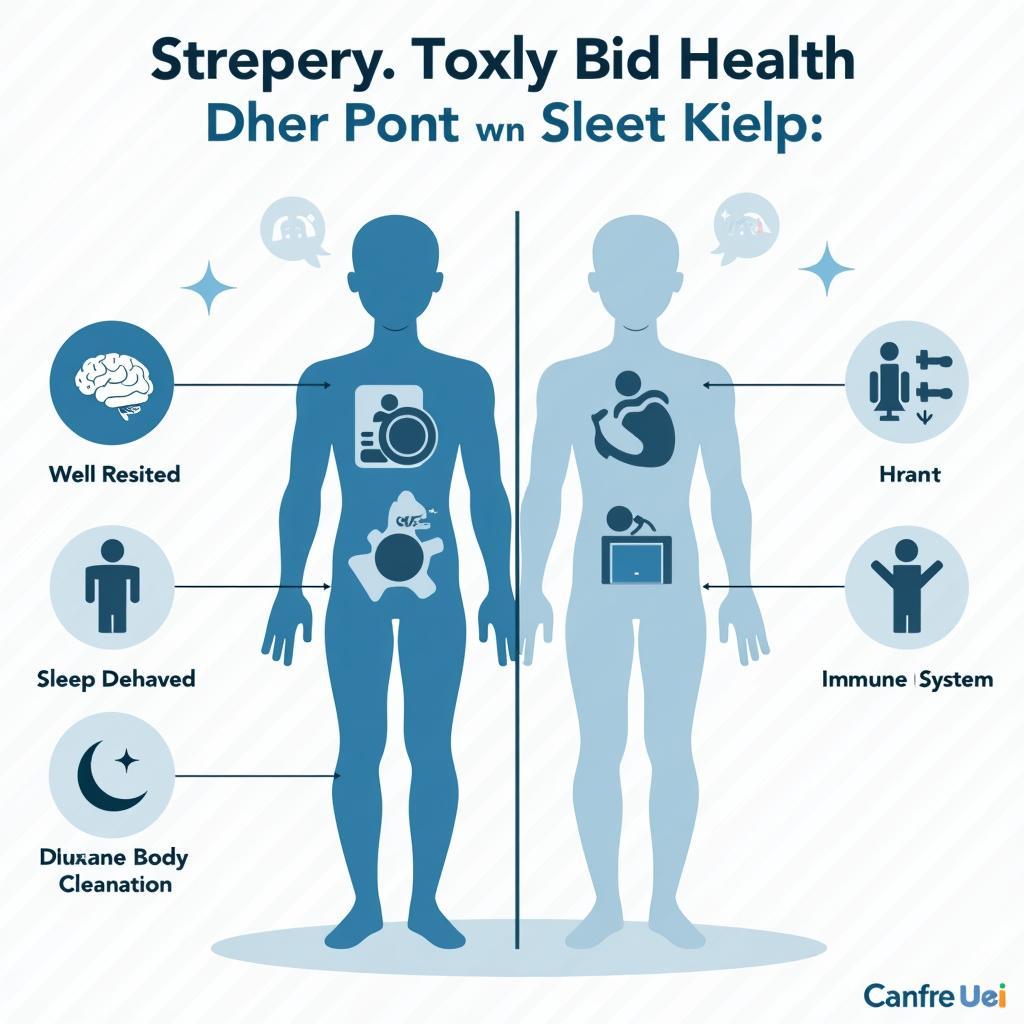 Infographic minh họa tác động tiêu cực của thiếu ngủ đến sức khỏe con người
Theme 3: Work-Life Balance
Question 4: What can companies do to help employees maintain a better work-life balance?
🎯 Phân tích câu hỏi:
- Dạng: Problem-Solution / Suggestions
- Key words: “companies”, “help”, “work-life balance”
- Cách tiếp cận: Suggest multiple concrete measures → Explain benefits → Address potential challenges → Give examples
📝 Sample Answer – Band 6-7:
Companies can do several things. First, they should not expect employees to work overtime too often. They could also offer flexible working hours so people can manage their time better. Some companies allow working from home, which helps people save commuting time. Employers should also respect employees’ personal time and not contact them after working hours. These changes would make employees happier and more productive.
Phân tích:
- Structure: List solutions với “First”, “also”, “should”
- Vocabulary: Basic workplace terms (overtime, flexible hours, working from home, personal time)
- Tại sao Band 6-7: Clear suggestions nhưng lacks sophistication và depth of analysis
📝 Câu trả lời mẫu – Band 8.5-9:
I think there’s a multifaceted approach that progressive companies can adopt to foster better work-life integration – and I deliberately say “integration” rather than “balance” because the rigid separation between work and personal life is increasingly unrealistic in our interconnected world.
First and foremost, organizations need to move away from the outdated paradigm of measuring productivity by hours logged and instead adopt a results-oriented performance framework. This fundamental shift in mindset would empower employees to structure their work in ways that align with their personal circumstances, whether that means compressed workweeks, flexible scheduling, or asynchronous work arrangements.
Equally important is the need for companies to implement and enforce clear policies around digital boundaries. This means explicitly discouraging after-hours emails, ensuring employees can genuinely disconnect during vacations, and modeling these behaviors at the leadership level – because cultural change must come from the top down. There’s compelling research showing that constant connectivity leads to burnout and diminished productivity over time.
Beyond policy changes, forward-thinking companies should also invest in comprehensive wellness programs that go beyond token gestures like gym memberships. This could include mental health support, stress management workshops, and even sabbatical opportunities for long-term employees. Companies like Microsoft Japan have experimented with four-day workweeks and seen productivity actually increase, which underscores the fact that well-rested, fulfilled employees are simply more effective.
Another crucial element is creating a workplace culture that destigmatizes taking time off and prioritizing personal needs. Too often, employees feel pressure to demonstrate commitment by sacrificing personal time, and this toxic dynamic needs to be actively challenged. Performance metrics should explicitly account for sustainable work practices rather than rewarding unsustainable overwork.
That said, I should acknowledge that implementing these changes requires genuine organizational commitment rather than superficial lip service. Many companies tout their commitment to work-life balance while maintaining expectations that contradict these stated values. For meaningful change to occur, there needs to be accountability mechanisms and transparent monitoring of whether policies are actually being implemented equitably across the organization.
Ultimately, I believe companies that genuinely prioritize employee well-being will see tangible benefits in terms of talent retention, productivity, and organizational resilience. In today’s competitive labor market, work-life balance isn’t just a nice-to-have – it’s increasingly a strategic imperative.
Phân tích:
- Structure: Framework overview → Core solution 1 (results-oriented) → Core solution 2 (digital boundaries) → Core solution 3 (wellness programs) → Cultural change → Acknowledge challenges → Conclusion with business case
- Vocabulary:
- Business/organizational: multifaceted approach, results-oriented framework, asynchronous work arrangements, performance metrics, strategic imperative
- Abstract concepts: outdated paradigm, cultural change, toxic dynamic, organizational resilience
- Sophisticated collocations: foster better integration, empowers employees, destigmatizes taking time off, tangible benefits
- Academic verbs: adopt, implement, enforce, underscores, contradict
- Grammar:
- Participle clauses: “whether that means compressed workweeks”
- Relative clauses: “which underscores the fact that”
- Passive constructions: “should be implemented”, “needs to be challenged”
- Conditionals: “For meaningful change to occur”
- Critical Thinking:
- Reframes question (integration vs balance)
- Multiple specific solutions với practical examples
- Acknowledges implementation challenges
- Cites real examples (Microsoft Japan)
- Connects employee wellbeing to business outcomes
- Shows understanding of organizational psychology
💡 Key Language Features:
- Structuring phrases: First and foremost, Equally important, Beyond policy changes, Another crucial element, That said, Ultimately
- Emphasis: deliberately say, explicitly discourage, genuinely prioritize, simply more effective
- Contrast: rather than, while maintaining, instead of
- Causation: leads to, results in, seeing productivity increase
Question 5: Do you think attitudes toward work have changed in recent years?
🎯 Phân tích câu hỏi:
- Dạng: Change/Trend Analysis + Opinion
- Key words: “attitudes”, “changed”, “recent years”
- Cách tiếp cận: Acknowledge changes → Analyze drivers of change → Compare past vs present attitudes → Consider future implications
📝 Sample Answer – Band 6-7:
Yes, I think work attitudes have changed a lot, especially because of COVID-19. More people now want to work from home and have flexible schedules. Young people especially want better work-life balance and don’t want to work long hours like older generations did. Companies are also starting to understand that happy employees work better. Technology has also changed how we work, allowing us to work remotely.
Phân tích:
- Structure: Agreement → reasons (COVID, young people, technology)
- Vocabulary: Common workplace terms (work from home, flexible schedules, work-life balance)
- Tại sao Band 6-7: Covers main trends nhưng lacks nuanced analysis và sophisticated language
📝 Câu trả lời mẫu – Band 8.5-9:
Absolutely – we’re witnessing what I’d characterize as a fundamental paradigm shift in how people conceptualize their relationship with work, and this transformation has been dramatically accelerated by recent global events, particularly the COVID-19 pandemic.
Historically, work was predominantly viewed through a transactional lens – you exchange time and labor for compensation, and there was an implicit expectation of loyalty and long-term commitment to a single employer. This was the era of the “company man” who might spend their entire career with one organization. However, we’re now seeing a marked departure from this model, particularly among younger generations.
What’s emerging is a more holistic perspective where work is increasingly seen as just one component of a multifaceted life rather than the defining element of one’s identity. There’s growing recognition of what economists call “non-monetary compensation” – factors like flexibility, autonomy, meaningful work, and alignment with personal values are often weighing more heavily in career decisions than traditional markers like salary and title alone.
The pandemic served as a catalyst, forcing a mass experiment in remote work that shattered many long-held assumptions about productivity and presence. Many workers experienced firsthand that they could be highly effective without commuting daily to an office, which has emboldened them to push back against outdated workplace norms. This has tilted the power dynamic somewhat in favor of employees, at least in certain sectors.
There’s also what some sociologists call the “Great Resignation” or “Great Reflection” – a phenomenon where workers are reassessing their priorities and exhibiting greater willingness to change jobs or even careers in pursuit of better alignment with their values. The traditional “career ladder” metaphor is increasingly being replaced by concepts like “career lattice” or “portfolio careers”, where people navigate more fluidly between roles and even industries.
That said, I should acknowledge that these shifts are not uniformly distributed. They’re most pronounced in knowledge-based sectors and among workers with transferable skills who have greater mobility. Workers in essential services, manual labor, or those with fewer options may not have the luxury of being as selective. There’s a risk of widening disparity between those who can leverage these new attitudes and those who cannot.
Looking forward, I suspect we’ll see continued evolution toward what some call “conscious capitalism” – where there’s greater emphasis on sustainable work practices, employee well-being, and corporate social responsibility. However, there will likely be ongoing tension between these progressive attitudes and traditional business pressures around productivity and profitability. The trajectory isn’t entirely clear, but the genie is out of the bottle – workers have tasted greater autonomy and flexibility, and many won’t willingly revert to old models.
Phân tích:
- Structure: Strong opening → Historical context → Current shift → Pandemic impact → Societal trends → Acknowledge limitations → Future outlook
- Vocabulary:
- Sociological/economic: paradigm shift, transactional lens, non-monetary compensation, Great Resignation, conscious capitalism, portfolio careers
- Abstract concepts: implicit expectation, holistic perspective, power dynamic, widening disparity
- Sophisticated collocations: marked departure, shattered assumptions, tilted the power dynamic, ongoing tension
- Metaphorical language: career ladder vs career lattice, genie is out of the bottle
- Grammar:
- Past vs present comparison structures
- Participle clauses: “forcing a mass experiment”, “where people navigate”
- Relative clauses: “what economists call”, “what some sociologists call”
- Complex conditionals: “Workers who have greater mobility”
- Future forms: “we’ll see continued evolution”, “will likely be”
- Critical Thinking:
- Historical perspective provides context
- Identifies multiple drivers of change (generational, technological, pandemic)
- Acknowledges inequality in access to these benefits
- Balanced view of tensions and tradeoffs
- Speculates thoughtfully about future trends
- Uses academic references (economists, sociologists)
💡 Key Language Features:
- Trend language: fundamental shift, dramatic acceleration, marked departure, continued evolution
- Hedging: I’d characterize, I suspect, likely be, There’s a risk
- Contrasting: Historically vs However, That said
- Metaphors: career ladder vs lattice, genie is out of the bottle, tilted the power dynamic
- Academic markers: what economists call, sociologists call, research indicates
 Không gian làm việc linh hoạt hiện đại với nhân viên làm việc từ xa
Từ vựng và cụm từ quan trọng
Topic-Specific Vocabulary
| Từ vựng/Cụm từ | Loại từ | Phiên âm | Nghĩa tiếng Việt | Ví dụ | Collocation |
|---|---|---|---|---|---|
| pull an all-nighter | idiom | /pʊl ən ɔːl ˈnaɪtər/ | thức suốt đêm để làm việc/học | I had to pull an all-nighter to finish my dissertation. | pull/do an all-nighter, survive an all-nighter |
| burn the midnight oil | idiom | /bɜːn ðə ˈmɪdnaɪt ɔɪl/ | thức khuya làm việc chăm chỉ | She’s been burning the midnight oil preparing for exams. | burn/burning the midnight oil, have to burn |
| deadline looming | phrase | /ˈdedlaɪn ˈluːmɪŋ/ | deadline đang đến gần đe dọa | With the deadline looming, I felt increasing pressure. | deadline looming/approaching, looming deadline |
| race against the clock | idiom | /reɪs əˈɡenst ðə klɒk/ | chạy đua với thời gian | We were racing against the clock to complete the project. | race/racing against the clock, in a race against |
| sleep deprivation | noun | /sliːp ˌdeprɪˈveɪʃən/ | thiếu ngủ, mất ngủ | Sleep deprivation can seriously affect cognitive function. | suffer from sleep deprivation, chronic sleep deprivation |
| mental fog | noun phrase | /ˈmentl fɒɡ/ | trạng thái mơ màng, không tỉnh táo | After staying up all night, I experienced severe mental fog. | mental fog/haze, clear the mental fog |
| completely drained | adj phrase | /kəmˈpliːtli dreɪnd/ | kiệt sức hoàn toàn | By morning, I felt completely drained of energy. | completely/totally drained, emotionally drained |
| power through | phrasal verb | /ˈpaʊər θruː/ | cố gắng vượt qua dù khó khăn | I had to power through despite feeling exhausted. | power through something, manage to power through |
| hit the wall | idiom | /hɪt ðə wɔːl/ | đạt đến giới hạn khả năng chịu đựng | Around 3 AM, I really hit the wall. | hit/hitting the wall, before you hit the wall |
| in the zone | idiom | /ɪn ðə zəʊn/ | trong trạng thái tập trung cao độ | During the first few hours, I was completely in the zone. | be/get in the zone, stay in the zone |
| productivity takes a nosedive | phrase | /ˌprɒdʌkˈtɪvəti teɪks ə ˈnəʊzdaɪv/ | năng suất giảm mạnh | After 50 hours a week, productivity takes a nosedive. | productivity takes/took a nosedive, nosedive in productivity |
| time management | noun | /taɪm ˈmænɪdʒmənt/ | quản lý thời gian | Poor time management led to my all-nighter. | good/poor time management, time management skills |
| juggling commitments | phrase | /ˈdʒʌɡlɪŋ kəˈmɪtmənts/ | xoay xở nhiều công việc cùng lúc | I was juggling multiple commitments that semester. | juggle/juggling commitments, struggle with juggling |
| self-inflicted | adj | /ˌself ɪnˈflɪktɪd/ | tự gây ra cho bản thân | The situation was largely self-inflicted due to procrastination. | self-inflicted problem/wound/stress |
| procrastination | noun | /prəˌkræstɪˈneɪʃən/ | sự trì hoãn, lần lữa | Procrastination is my biggest weakness. | chronic procrastination, tendency toward procrastination |
| cognitive function | noun phrase | /ˈkɒɡnətɪv ˈfʌŋkʃən/ | chức năng nhận thức | Lack of sleep impairs cognitive function. | cognitive function/abilities, impaired cognitive function |
| peak season | noun | /piːk ˈsiːzən/ | mùa cao điểm | We work longer hours during peak season. | peak season/period, during peak season |
| grim determination | noun phrase | /ɡrɪm dɪˌtɜːmɪˈneɪʃən/ | quyết tâm mãnh liệt dù khó khăn | I continued with grim determination. | with grim determination, sense of grim determination |
| emotional rollercoaster | idiom | /ɪˈməʊʃənl ˈrəʊləkəʊstər/ | cảm xúc lên xuống thất thường | The experience was an emotional rollercoaster. | emotional rollercoaster, on an emotional rollercoaster |
| work-life balance | noun | /wɜːk laɪf ˈbæləns/ | cân bằng công việc và cuộc sống | Maintaining work-life balance is crucial. | good/poor work-life balance, achieve work-life balance |
Idiomatic Expressions & Advanced Phrases
| Cụm từ | Nghĩa | Ví dụ sử dụng | Band điểm |
|---|---|---|---|
| didn’t sleep a wink | không ngủ được chút nào | I didn’t sleep a wink that entire night. | 8-9 |
| burning the candle at both ends | làm việc quá sức, nghỉ ngơi không đủ | She’s been burning the candle at both ends for weeks. | 7.5-8 |
| the straw that broke the camel’s back | giọt nước tràn ly, sự việc cuối cùng | The last-minute request was the straw that broke the camel’s back. | 8-9 |
| a wake-up call | hồi chuông cảnh tỉnh | That experience was a real wake-up call about time management. | 7-8 |
| make or break | quyết định thành bại | This was a make-or-break moment for my career. | 7.5-8 |
| backed into a corner | bị dồn vào đường cùng | We were backed into a corner with no other options. | 7.5-8 |
| a perfect storm | sự kết hợp của nhiều yếu tố xấu | It was a perfect storm of unfortunate circumstances. | 8-9 |
| firing on all cylinders | hoạt động hết công suất | For the first few hours, I was firing on all cylinders. | 8-9 |
| run on fumes | hoạt động với năng lượng cuối cùng | By dawn, I was running on fumes and caffeine. | 8-9 |
| the elephant in the room | vấn đề rõ ràng nhưng không ai nhắc tới | The elephant in the room was our poor project planning. | 7.5-8 |
| the silver lining | mặt tích cực của điều xấu | The silver lining was the valuable lesson I learned. | 7-8 |
| bite off more than you can chew | nhận việc quá khả năng | I’d bitten off more than I could chew with that project. | 7-8 |
Discourse Markers (Từ Nối Ý Trong Speaking)
Để bắt đầu câu trả lời:
- 📝 Well,… – Dùng khi cần thời gian suy nghĩ ngắn, tạo tính tự nhiên
- 📝 Actually,… – Khi đưa ra góc nhìn khác hoặc thông tin bất ngờ
- 📝 To be honest,… – Khi nói thật, thể hiện tính chân thực
- 📝 I’d say that… – Khi đưa ra quan điểm với độ chắc chắn vừa phải
- 📝 From my perspective,… – Nhấn mạnh đây là góc nhìn cá nhân
Để bổ sung ý:
- 📝 On top of that,… – Thêm vào đó, ngoài ra
- 📝 What’s more,… – Hơn nữa, không chỉ vậy
- 📝 Not to mention… – Chưa kể đến
- 📝 Beyond that,… – Xa hơn nữa
- 📝 Additionally,… – Thêm vào đó (formal hơn)
Để đưa ra quan điểm cân bằng:
- 📝 On the one hand,… On the other hand,… – Một mặt… mặt khác
- 📝 While it’s true that…, we also need to consider… – Mặc dù đúng là… nhưng ta cũng cần xem xét…
- 📝 That being said,… – Tuy nhiên, tuy vậy thì
- 📝 Having said that,… – Sau khi nói điều đó
- 📝 To some extent,… – Ở một mức độ nào đó
Để kết luận:
- 📝 All in all,… – Tóm lại, xét chung lại
- 📝 At the end of the day,… – Cuối cùng thì, xét về căn bản
- 📝 Ultimately,… – Về căn bản, cuối cùng
- 📝 In retrospect,… – Nhìn lại, khi xem xét lại
- 📝 Looking back,… – Khi nhìn lại
Để thể hiện sự không chắc chắn (tentative language):
- 📝 I think/believe/feel that… – Tôi nghĩ/tin/cảm thấy rằng
- 📝 It seems to me that… – Có vẻ như với tôi
- 📝 I’d argue that… – Tôi muốn lập luận rằng
- 📝 To a certain extent,… – Ở một mức độ nhất định
- 📝 Generally speaking,… – Nói chung thì
Grammatical Structures Ấn Tượng
1. Conditional Sentences (Câu điều kiện):
-
Mixed conditional: “If I had managed my time better (past), I wouldn’t be so exhausted now (present).”
- Dùng khi kết hợp điều kiện quá khứ với kết quả hiện tại
-
Inversion for emphasis: “Had I known how difficult it would be, I would have started earlier.”
- Bỏ “if” và đảo trợ động từ lên đầu để nhấn mạnh
-
Third conditional: “If I had started the project earlier, I wouldn’t have needed to pull an all-nighter.”
- Dùng cho tình huống giả định trong quá khứ
2. Relative Clauses (Mệnh đề quan hệ):
-
Non-defining with “which”: “I stayed up until 5 AM, which left me completely exhausted the next day.”
- Thêm thông tin cho cả câu trước đó
-
“What” as relative pronoun: “What surprised me most was how quickly the time passed.”
- Dùng “what” thay cho “the thing that”
3. Passive Voice (Câu bị động):
-
Impersonal passive: “It is thought/believed/said that sleep deprivation seriously affects productivity.”
- Dùng để trình bày ý kiến chung, research findings
-
Passive with modal verbs: “The deadline could not be extended, so we had to work overnight.”
- Kết hợp passive với can/could/should/must
4. Cleft Sentences (Câu chẻ):
-
“What” cleft: “What I find most challenging is maintaining focus after midnight.”
- Nhấn mạnh object của câu
-
“It” cleft: “It was the tight deadline that forced us to work all night.”
- Nhấn mạnh subject hoặc reason
-
“The thing that” structure: “The thing that kept me going was my determination to succeed.”
- Tương tự “what” cleft nhưng informal hơn
5. Advanced Participle Clauses:
-
Present participle: “Feeling exhausted but determined, I continued working through the night.”
- Thay thế cho “Although I felt exhausted…”
-
Perfect participle: “Having stayed up all night, I struggled to concentrate the next day.”
- Nhấn mạnh action trước xảy ra trước action sau
6. Inversion Structures:
-
“Not only… but also” inversion: “Not only did I finish the project, but I also learned valuable lessons.”
- Nhấn mạnh cả hai điểm
-
“Rarely/Seldom” inversion: “Rarely have I felt so exhausted as I did that morning.”
- Nhấn mạnh tính hiếm có
Chủ đề “describe a time when you stayed up all night to complete a task” là một excellent opportunity để thể hiện storytelling skills, emotional range, và khả năng reflection sâu sắc. Những điểm quan trọng cần nhớ:
Cho Part 2:
- Structure rõ ràng: Context → Actions → Feelings → Lessons
- Sử dụng past tenses chính xác và đa dạng
- Descriptive language cho emotions và situations
- Personal reflection thể hiện maturity
Cho Part 3:
- Think beyond personal experience – analyze societal trends
- Use evidence-based reasoning và academic vocabulary
- Show balanced perspective với multiple viewpoints
- Connect ideas logically với sophisticated discourse markers
Vocabulary Strategy:
- Memorize idiomatic expressions trong context, không học riêng lẻ
- Practice collocations tự nhiên (mental fog, looming deadline)
- Use tentative language để sound more native-like
- Vary expressions cho cùng một concept
Common Mistakes để tránh:
- Không nói quá nhanh – pace yourself naturally
- Không học thuộc template – examiners nhận ra ngay
- Không dùng từ vựng quá academic cho personal story trong Part 2
- Không quên cover tất cả bullet points trong cue card
Hãy nhớ rằng IELTS Speaking đánh giá khả năng communication tự nhiên của bạn, không phải là bài kiểm tra vocabulary hay grammar riêng lẻ. Sự tự tin, fluency và khả năng express ideas một cách clear và coherent quan trọng hơn việc nhồi nhét quá nhiều từ khó. Practice regularly, record yourself, và học từ feedback để improve steadily. Good luck với IELTS Speaking test của bạn!