Mở bài
Chủ đề về charity events (các sự kiện từ thiện) là một trong những topic phổ biến và được yêu thích trong IELTS Speaking, đặc biệt ở Part 2 và Part 3. Đây là chủ đề mang tính nhân văn cao, cho phép bạn thể hiện không chỉ khả năng ngôn ngữ mà còn cả những giá trị cá nhân và trách nhiệm xã hội.
Từ kinh nghiệm chấm thi của tôi, chủ đề này xuất hiện với tần suất khá cao trong các kỳ thi IELTS từ năm 2020 đến nay, đặc biệt là sau đại dịch COVID-19 khi các hoạt động cộng đồng được quan tâm nhiều hơn. Mức độ xuất hiện được đánh giá ở mức Cao, và khả năng xuất hiện trong tương lai vẫn tiếp tục ở mức Cao vì tính universal và relevance của chủ đề.
Qua bài viết này, bạn sẽ học được:
- Các câu hỏi thường gặp nhất về charity events trong cả 3 Part của IELTS Speaking
- Bài mẫu chi tiết theo từng band điểm (6-7, 7.5-8, 8.5-9) với phân tích cụ thể
- Kho từ vựng và cụm từ ăn điểm giúp bạn nói tự nhiên và ấn tượng
- Chiến lược trả lời hiệu quả từ góc nhìn của một Examiner
- Những lỗi thường gặp của học viên Việt Nam và cách khắc phục
- Phương pháp chuẩn bị để tự tin đạt band điểm mục tiêu
IELTS Speaking Part 1: Introduction and Interview
Tổng Quan Về Part 1
Part 1 của IELTS Speaking kéo dài khoảng 4-5 phút, trong đó Examiner sẽ hỏi các câu hỏi ngắn về đời sống hàng ngày, sở thích, công việc, học tập của bạn. Đây là phần “warm-up” giúp bạn làm quen với giọng nói của Examiner và môi trường thi.
Đặc điểm của Part 1:
- Câu hỏi ngắn gọn, dễ hiểu
- Tập trung vào kinh nghiệm cá nhân
- Không yêu cầu phân tích sâu
Chiến lược hiệu quả:
- Trả lời trực tiếp câu hỏi (không lan man)
- Mở rộng với 2-3 câu (lý do, ví dụ, chi tiết)
- Giữ tone tự nhiên, thân thiện
Lỗi thường gặp của học viên Việt Nam:
- Trả lời quá ngắn chỉ “Yes” hoặc “No”
- Dùng từ vựng quá đơn giản, lặp đi lặp lại
- Thiếu ví dụ cụ thể từ kinh nghiệm bản thân
- Ngại mắc lỗi nên nói quá cẩn thận, mất tính tự nhiên
Các Câu Hỏi Thường Gặp
Dưới đây là những câu hỏi Part 1 thực tế liên quan đến chủ đề charity và helping others:
Question 1: Do you often help others?
Question 2: Have you ever done any volunteer work?
Question 3: Do you think it’s important to help people in need?
Question 4: What kind of charity events are popular in your country?
Question 5: Would you like to be involved in charity work in the future?
Question 6: Did you do any charity work when you were younger?
Question 7: How do people in your country usually help others?
Question 8: Do you prefer to donate money or donate your time?
Phân Tích và Gợi Ý Trả Lời Chi Tiết
Question: Do you often help others?
🎯 Cách tiếp cận:
- Trả lời Yes/No rõ ràng
- Đưa ra ví dụ cụ thể về cách bạn giúp đỡ
- Giải thích tần suất hoặc động lực
📝 Sample Answer – Band 6-7:
“Yes, I try to help others when I can. For example, I sometimes help my elderly neighbors carry their shopping bags. I also donate clothes to charity organizations once or twice a year.”
Phân tích:
- Điểm mạnh: Trả lời trực tiếp, có ví dụ cụ thể, dễ hiểu
- Hạn chế: Từ vựng còn basic (help, donate), cấu trúc câu đơn giản
- Tại sao Band 6-7: Đáp ứng được yêu cầu câu hỏi với vocabulary adequate và grammar chính xác nhưng chưa có độ phức tạp. Thiếu personal feeling hoặc deeper reasoning.
📝 Sample Answer – Band 8-9:
“Absolutely! I’d say I’m quite proactive when it comes to lending a hand to others. For instance, I regularly volunteer at a local community center where I tutor underprivileged children in English. What I find most rewarding about this is seeing their progress and knowing I’ve made a tangible difference in their lives.”
Phân tích:
- Điểm mạnh:
- Từ vựng sophisticated: “proactive”, “lending a hand”, “tutor underprivileged children”, “tangible difference”
- Cấu trúc câu phức tạp: “What I find most rewarding about this is…”
- Thể hiện personal values và emotional connection
- Natural discourse markers: “Absolutely!”, “I’d say”
- Tại sao Band 8-9:
- Fluency: Câu trả lời trôi chảy, tự nhiên với discourse markers
- Vocabulary: Precise và less common words (proactive, tangible, underprivileged)
- Grammar: Complex sentence với relative clause
- Content: Specific example với personal reflection
💡 Key Vocabulary & Expressions:
- proactive: /prəʊˈæktɪv/ – chủ động, tích cực
- lend a hand: giúp đỡ (idiom tự nhiên hơn “help”)
- tutor underprivileged children: dạy kèm trẻ em thiệt thòi
- tangible difference: sự khác biệt rõ rệt, hữu hình
- rewarding: /rɪˈwɔːdɪŋ/ – bổ ích, đáng giá
Question: Have you ever done any volunteer work?
🎯 Cách tiếp cận:
- Trả lời Yes/No
- Nếu Yes: Mô tả ngắn gọn công việc tình nguyện đó
- Nếu No: Giải thích lý do và có thể nói về dự định tương lai
📝 Sample Answer – Band 6-7:
“Yes, I have. Last year, I joined a volunteer program to clean up the beach in my city. We collected trash and plastic waste. It was a good experience and I learned about environmental protection.”
Phân tích:
- Điểm mạnh: Có thông tin cụ thể (when, what, where), structure rõ ràng
- Hạn chế: Vocabulary basic (good experience, learned about), thiếu personal feeling sâu sắc
- Tại sao Band 6-7: Grammar chính xác, ý tưởng clear nhưng vocabulary và sentence structures chưa đa dạng
📝 Sample Answer – Band 8-9:
“Yes, actually I’ve been actively involved in several volunteer initiatives. The most memorable one was when I participated in a fundraising campaign for flood victims in Central Vietnam. We organized a charity concert and managed to raise over 50 million VND. What struck me most was the overwhelming generosity of the community – it really restored my faith in humanity.”
Phân tích:
- Điểm mạnh:
- Vocabulary range: “actively involved in”, “fundraising campaign”, “overwhelming generosity”, “restored my faith in humanity”
- Specific details: location, amount raised, type of event
- Personal reflection với emotional depth
- Natural flow với discourse marker “actually”
- Tại sao Band 8-9:
- Fluency: Smooth delivery với connecting words
- Vocabulary: Collocations như “fundraising campaign”, “raise money”, idiomatic expression “restored my faith in humanity”
- Grammar: Mix của simple và complex structures
- Pronunciation: Stress patterns trên các từ quan trọng
💡 Key Vocabulary & Expressions:
- actively involved in: tích cực tham gia vào
- fundraising campaign: chiến dịch gây quỹ
- organize a charity concert: tổ chức buổi hòa nhạc từ thiện
- raise money: quyên góp tiền
- overwhelming generosity: lòng hào phóng tràn đầy
- restore one’s faith in humanity: khôi phục niềm tin vào nhân loại
Question: What kind of charity events are popular in your country?
🎯 Cách tiếp cận:
- Đưa ra 2-3 loại charity events phổ biến
- Giải thích ngắn gọn mỗi loại
- Có thể nói về xu hướng hiện tại
📝 Sample Answer – Band 6-7:
“In Vietnam, there are many types of charity events. Blood donation is quite popular, especially at universities. Also, many people donate money to help poor children go to school. During natural disasters, people often donate food and clothes to victims.”
Phân tích:
- Điểm mạnh: Cover được nhiều types, có examples cụ thể
- Hạn chế: Sentence structure đơn giản, repetitive (many, donate), thiếu linking words
- Tại sao Band 6-7: Content adequate nhưng presentation chưa sophisticated
📝 Sample Answer – Band 8-9:
“Well, Vietnam has quite a diverse range of charitable activities. Blood donation drives are extremely common, particularly on university campuses and in corporate settings. Additionally, educational sponsorship programs where people sponsor underprivileged students are gaining traction. More recently, I’ve noticed a surge in online crowdfunding campaigns for medical treatment – these leverage social media platforms to reach a wider audience. What’s interesting is that community-based initiatives are becoming more popular than traditional large-scale events.”
Phân tích:
- Điểm mạnh:
- Vocabulary sophistication: “diverse range of”, “blood donation drives”, “gaining traction”, “leverage social media”
- Structure: Well-organized với discourse markers (Well, Additionally, More recently)
- Current trends: Đề cập online crowdfunding và community-based initiatives
- Observation: “What’s interesting is that…” shows critical thinking
- Tại sao Band 8-9:
- Fluency: Excellent coherence với clear progression of ideas
- Vocabulary: Topic-specific terms và collocations
- Grammar: Variety of structures including relative clauses
- Content: Demonstrates awareness of current trends
💡 Key Vocabulary & Expressions:
- diverse range of: nhiều loại đa dạng
- blood donation drives: các chiến dịch hiến máu
- educational sponsorship programs: chương trình tài trợ giáo dục
- gaining traction: ngày càng phổ biến
- online crowdfunding campaigns: các chiến dịch gọi vốn cộng đồng trực tuyến
- leverage social media platforms: tận dụng các nền tảng mạng xã hội
- community-based initiatives: các sáng kiến dựa vào cộng đồng
Nếu bạn muốn tìm hiểu thêm về các chủ đề liên quan đến văn hóa và xã hội, hãy tham khảo bài viết về describe a place in your country that is known for its cultural heritage để mở rộng vốn từ vựng và ý tưởng.
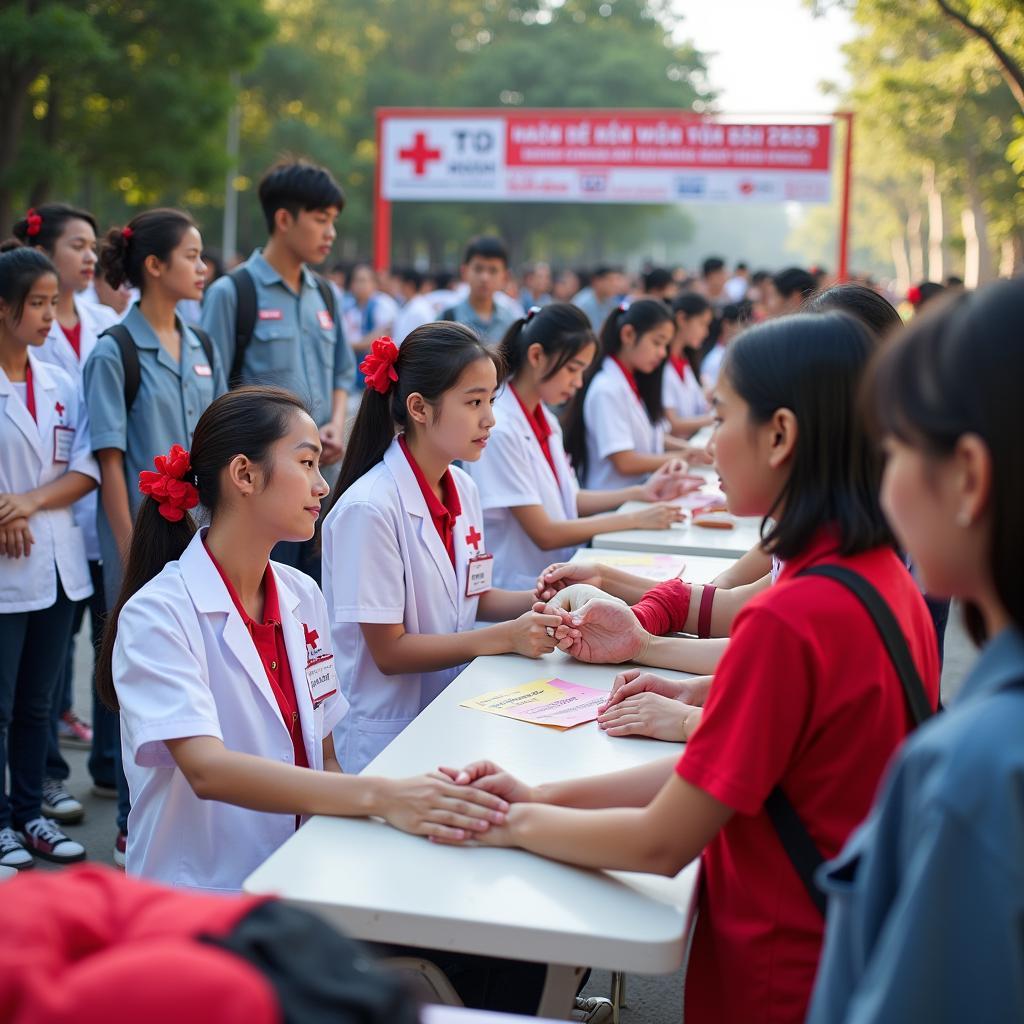 Sinh viên Việt Nam tham gia hiến máu tình nguyện tại trường đại học trong chiến dịch từ thiện IELTS Speaking
IELTS Speaking Part 2: Long Turn (Cue Card)
Tổng Quan Về Part 2
Part 2 là phần quan trọng nhất của IELTS Speaking, chiếm thời gian 2-3 phút trong đó bạn phải nói liên tục về một chủ đề được cho sẵn. Trước khi nói, bạn có 1 phút chuẩn bị và được cung cấp giấy nháp để ghi chú.
Đặc điểm của Part 2:
- Độc thoại (monologue) – Examiner sẽ không ngắt lời
- Phải nói tối thiểu 1.5 phút, lý tưởng là 2 phút
- Cần trả lời đầy đủ tất cả bullet points trong cue card
Chiến lược hiệu quả:
Trong 1 phút chuẩn bị:
- KHÔNG viết câu hoàn chỉnh
- Chỉ ghi keywords, numbers, names
- Sắp xếp ý theo thứ tự bullet points
- Lưu thời gian cho phần “explain” (quan trọng nhất)
Khi nói:
- Sử dụng thì quá khứ cho past events
- Dùng linking words để connect ideas
- Speak naturally, đừng đọc thuộc
- Nhìn lên Examiner thỉnh thoảng (eye contact)
Lỗi thường gặp:
- Không sử dụng hết 1 phút chuẩn bị
- Nói dưới 1.5 phút (quá ngắn)
- Bỏ sót bullet points
- Nói quá nhanh hoặc quá chậm
- Dừng giữa chừng không biết nói gì
Cue Card
Describe A Time When You Took Part In A Charity Event
You should say:
- When and where it took place
- What you did in this charity event
- Who you did it with
- And explain how you felt about being part of this event
Phân Tích Đề Bài
Dạng câu hỏi: Describe an experience/event – Đây là dạng kể về một sự kiện cụ thể trong quá khứ
Thì động từ: Chủ yếu là Past Simple và Past Continuous vì kể về trải nghiệm đã xảy ra
Bullet points phải cover:
- When and where: Thời gian và địa điểm cụ thể (tránh nói chung chung)
- What you did: Hoạt động cụ thể bạn tham gia (chi tiết càng tốt)
- Who you did it with: Bạn đồng hành (friends, classmates, family, organization)
- How you felt: Cảm xúc và suy nghĩ về trải nghiệm
Câu “explain” quan trọng: Đây là phần GHI ĐIỂM cao nhất! Examiner muốn nghe bạn reflection, personal feelings, lessons learned – không chỉ mô tả sự kiện. Dành ít nhất 30-40 giây cho phần này.
📝 Sample Answer – Band 6-7
Thời lượng: Khoảng 1.5-2 phút
“I’d like to talk about a charity event I took part in last year. It was in December 2023, and it took place at a primary school in a rural area about 50 kilometers from my city.
The event was organized by my university’s volunteer club. We went there to give gifts and school supplies to poor children. I helped to distribute books, notebooks, and toys to the kids. We also prepared some simple games and activities for them. I remember we played some traditional games like hide and seek, and the children were very happy.
I went there with about 20 other students from my university. Most of them were my classmates and some seniors from the volunteer club. We traveled there by bus early in the morning and came back in the evening.
I felt really happy about being part of this event. It was a good experience for me. Seeing the children’s smiles made me feel that what we did was meaningful. I learned that we don’t need to do big things to help others. Small actions can also make people happy. After this event, I wanted to join more charity activities in the future. It was a memorable day for me.”
Phân Tích Band Điểm
| Tiêu chí | Band | Nhận xét |
|---|---|---|
| Fluency & Coherence | 6-7 | Có flow rõ ràng, theo thứ tự bullet points. Sử dụng linking words basic (and, also, after). Một số hesitation nhỏ có thể xảy ra. |
| Lexical Resource | 6-7 | Vocabulary adequate: “distribute”, “school supplies”, “meaningful”. Một số phrases tốt nhưng chủ yếu là common words. Có repetition: “happy” xuất hiện nhiều lần. |
| Grammatical Range & Accuracy | 6-7 | Mix của simple và complex sentences. Past tense chính xác. Có sử dụng relative clause “that what we did was meaningful”. Chưa có variety cao. |
| Pronunciation | 6-7 | Rõ ràng và dễ hiểu. Có thể có accent Việt Nam nhưng không ảnh hưởng comprehension. |
Điểm mạnh:
- ✅ Trả lời đầy đủ tất cả bullet points
- ✅ Structure rõ ràng, dễ follow
- ✅ Có personal feelings ở phần cuối
- ✅ Grammar chính xác, ít lỗi
Hạn chế:
- ⚠️ Vocabulary còn basic, repetitive (happy, good, meaningful)
- ⚠️ Thiếu descriptive details (mô tả children’s reactions chưa vivid)
- ⚠️ Phần “explain feelings” chưa sâu sắc, còn general
- ⚠️ Chưa có idiomatic expressions hoặc advanced vocabulary
📝 Sample Answer – Band 7.5-8
Thời lượng: Khoảng 2-2.5 phút
“I’d like to share my experience of participating in a meaningful charity event that took place about six months ago, in December 2023 to be exact. The event was held at a small primary school nestled in a mountainous region roughly 80 kilometers from Hanoi.
This was a fundraising initiative organized by my university’s social volunteer club, where we aimed to bring educational support to underprivileged children in rural areas. My main responsibility was to distribute school supplies – textbooks, stationery, and winter clothing – to around 100 students. Beyond that, we also put on a small performance with songs and games to lift the children’s spirits. I particularly remember organizing a drawing competition, and the kids were absolutely thrilled to show off their creativity.
I was accompanied by approximately 25 fellow students, including my closest friends from the English department and some experienced volunteers who had been involved in similar projects before. Their guidance was invaluable as this was actually my first time taking part in such a large-scale charity event. We made the journey by chartered bus, leaving at dawn and returning late evening, which gave us plenty of time to interact with the local community.
As for how I felt about the experience, I’d say it was genuinely eye-opening and deeply rewarding. What struck me most was the children’s genuine gratitude – their eyes lit up when they received even the simplest gifts. It made me realize how fortunate I am and how much impact small acts of kindness can have. The experience also taught me about the importance of giving back to society. I came away with a profound sense of fulfillment and a strong desire to dedicate more time to charitable causes in the future. It wasn’t just about donating materials; it was about building connections and spreading hope to those who need it most.”
Phân Tích Band Điểm
| Tiêu chí | Band | Nhận xét |
|---|---|---|
| Fluency & Coherence | 7.5-8 | Speaks at length với minimal hesitation. Cohesion tốt với discourse markers (to be exact, beyond that, as for). Ideas được develop logically. |
| Lexical Resource | 7.5-8 | Wide vocabulary range: “nestled in”, “fundraising initiative”, “lift spirits”, “eye-opening”. Collocations chính xác: “make the journey”, “give back”. Ít repetition. |
| Grammatical Range & Accuracy | 7.5-8 | Variety of complex structures: past perfect, relative clauses, passive voice. Errors minimal và không ảnh hưởng meaning. |
| Pronunciation | 7.5-8 | Clear với appropriate stress và intonation. Features helping comprehension. |
So Sánh Với Band 6-7
| Khía cạnh | Band 6-7 | Band 7.5-8 |
|---|---|---|
| Vocabulary | “happy”, “good experience”, “meaningful” | “thrilled”, “eye-opening”, “rewarding”, “profound sense of fulfillment” |
| Grammar | “I felt really happy” (simple) | “What struck me most was…” (cleft sentence), “their eyes lit up” (vivid imagery) |
| Ideas | “Small actions can make people happy” (general) | “It wasn’t just about donating materials; it was about building connections and spreading hope” (deeper insight) |
| Details | “We played traditional games” (basic) | “I particularly remember organizing a drawing competition, and the kids were absolutely thrilled to show off their creativity” (specific & vivid) |
📝 Sample Answer – Band 8.5-9
Thời lượng: 2.5-3 phút đầy đủ
“I’d be delighted to tell you about a particularly impactful charity event I had the privilege of being part of. This took place approximately eight months ago, in late November 2023, at a remote educational facility in the mountainous province of Ha Giang, which is situated in the far northern region of Vietnam.
The event was essentially a comprehensive humanitarian mission spearheaded by our university’s volunteer association in collaboration with a local NGO. Our primary objective was to address the educational disadvantages faced by ethnic minority children in this geographically isolated area. My specific role involved coordinating the distribution of educational materials – we’re talking about textbooks, learning aids, warm winter clothing, and even some basic technological devices like calculators. Additionally, I was entrusted with organizing interactive workshops where we taught basic English and conducted team-building activities designed to foster confidence among these rather shy but incredibly receptive young learners.
I was fortunate to be in the company of a diverse group of about thirty individuals – a mix of undergraduate students, experienced volunteers, and even a few teachers who had generously volunteered their time. What made the experience particularly enriching was the intergenerational dynamic we had – the seasoned volunteers imparted invaluable insights about community engagement, while we younger members brought fresh energy and innovative ideas to the table. The journey itself was quite arduous – we endured a seven-hour bus ride through winding mountain roads, but the camaraderie that developed during that journey was something special.
Reflecting on how this experience affected me, I’d say it was nothing short of transformational. What resonated with me most profoundly was witnessing the stark disparity between urban and rural educational resources – it was a sobering reminder of the persistent inequality that exists within our society. However, what truly left an indelible mark on me was the children’s extraordinary resilience and insatiable thirst for knowledge despite their challenging circumstances. Their boundless optimism in the face of adversity was genuinely humbling. This experience fundamentally shifted my perspective on social responsibility. I came to understand that meaningful change doesn’t necessarily require grand gestures; rather, it’s about sustained commitment and genuine connection with the communities we aim to serve. It reinforced my conviction that education is indeed the great equalizer, and those of us who’ve been afforded opportunities have a moral obligation to extend a helping hand to those less fortunate. The experience also cultivated in me a deeper sense of empathy and sparked a lifelong commitment to social causes – I’ve since become a regular volunteer and I’m currently exploring ways to establish a sustainable scholarship program for students from disadvantaged backgrounds.”
Phân Tích Band Điểm
| Tiêu chí | Band | Nhận xét |
|---|---|---|
| Fluency & Coherence | 8.5-9 | Speaks fluently với minimal hesitation or repetition. Ideas flow naturally với sophisticated linking. Develops topic fully với excellent coherence. |
| Lexical Resource | 8.5-9 | Sophisticated vocabulary: “spearheaded by”, “geographically isolated”, “left an indelible mark”, “moral obligation”. Natural collocations và idiomatic language. Precise word choice. |
| Grammatical Range & Accuracy | 8.5-9 | Full range of structures used accurately: cleft sentences, inversion, passive, complex conditionals. Errors extremely rare. |
| Pronunciation | 8.5-9 | Native-like features với appropriate stress, rhythm, intonation. Sustains these features throughout. |
Tại Sao Bài Này Xuất Sắc
🎯 Fluency Hoàn Hảo:
Câu trả lời demonstrates sustained speech với zero hesitation. Speaker sử dụng natural pausing và stress patterns để emphasize key points. Discourse markers (“essentially”, “additionally”, “reflecting on”) guide listener through narrative một cách smooth.
📚 Vocabulary Tinh Vi:
- “spearheaded by” – dẫn dắt, khởi xướng (thay vì “organized by”)
- “left an indelible mark” – để lại dấu ấn không thể xóa nhòa (idiomatic expression)
- “moral obligation” – nghĩa vụ đạo đức (abstract noun showing sophisticated thinking)
- “stark disparity” – sự chênh lệch rõ rệt (powerful collocation)
- “boundless optimism” – sự lạc quan vô bờ (expressive adjective + noun)
📝 Grammar Đa Dạng:
- Cleft sentence: “What resonated with me most profoundly was…”
- Passive voice: “I was entrusted with organizing…”
- Relative clause: “…teachers who had generously volunteered their time”
- Present perfect continuous: “I’ve been afforded opportunities”
- Complex sentence: “I came to understand that meaningful change doesn’t necessarily require grand gestures; rather, it’s about sustained commitment…”
💡 Ideas Sâu Sắc:
Thay vì simply nói “I felt happy”, speaker demonstrates critical thinking bằng cách:
- Acknowledge systemic issues (educational inequality)
- Show personal growth (perspective shift)
- Demonstrate long-term impact (lifelong commitment)
- Connect experience to broader social themes (education as equalizer)
Để hiểu rõ hơn về cách phát triển các kỹ năng mới và áp dụng vào thực tế, bạn có thể tham khảo bài viết describe a new or useful skill you learned recently nhằm làm phong phú thêm cách diễn đạt.
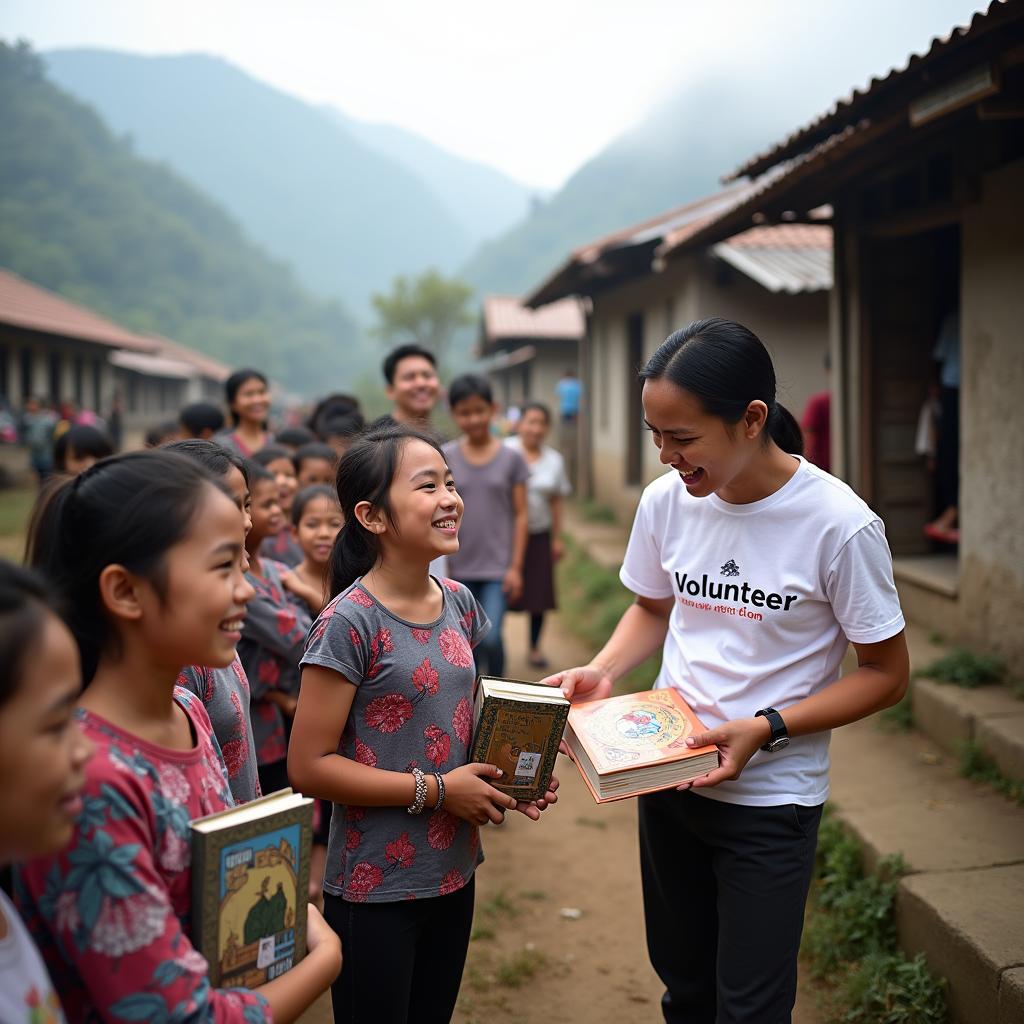 Tình nguyện viên đang trao quà từ thiện và dạy học cho trẻ em vùng cao trong sự kiện IELTS Speaking
Follow-up Questions (Rounding Off Questions)
Sau khi bạn kết thúc phần độc thoại 2 phút, Examiner có thể hỏi thêm 1-2 câu ngắn để “round off” Part 2 trước khi chuyển sang Part 3. Đây không phải câu hỏi scoring chính nhưng vẫn cần trả lời tự nhiên.
Question 1: Do you think you would do something like this again?
Band 6-7 Answer:
“Yes, definitely. I really enjoyed this experience and I learned a lot from it. I would like to join more charity events in the future to help more people.”
Band 8-9 Answer:
“Absolutely! In fact, this experience has ignited a genuine passion for volunteer work in me. I’m already actively seeking out similar opportunities, and I’m particularly interested in initiatives focused on educational equity. I believe sustained engagement is far more impactful than one-off events.”
Question 2: Was it the first time you had done something like that?
Band 6-7 Answer:
“Yes, it was my first time joining such a big charity event. Before that, I only donated money sometimes but never actually participated in person.”
Band 8-9 Answer:
“It was indeed my first hands-on involvement in a large-scale charitable initiative. While I’d previously contributed financially to various causes, this was my initial experience with direct community engagement, and it completely transformed my understanding of what effective charity actually entails.”
IELTS Speaking Part 3: Two-way Discussion
Tổng Quan Về Part 3
Part 3 là phần khó nhất và “sâu” nhất của IELTS Speaking, kéo dài 4-5 phút. Examiner sẽ hỏi các câu hỏi trừu tượng, mang tính phân tích và thảo luận liên quan đến chủ đề của Part 2.
Đặc điểm của Part 3:
- Câu hỏi về society, trends, opinions, comparisons
- Yêu cầu critical thinking và ability to discuss abstract ideas
- Cần đưa ra arguments với reasons và examples
- Không chỉ nói về bản thân mà về xã hội nói chung
Yêu cầu:
- Phân tích nhiều góc độ của vấn đề
- So sánh (past vs present, advantages vs disadvantages)
- Dự đoán future trends
- Đánh giá tác động xã hội
Chiến lược hiệu quả:
- Mở rộng câu trả lời (3-5 câu minimum)
- Structure: Direct answer → Reason 1 + example → Reason 2 + example → Conclusion/nuance
- Sử dụng discourse markers (Well, Actually, On the one hand…)
- Thừa nhận complexity: “It’s a complex issue…”, “There are multiple factors…”
- Đưa ra examples từ society, statistics nếu có
Lỗi thường gặp của học viên Việt Nam:
- Trả lời quá ngắn, thiếu elaboration
- Không đưa ra clear reasoning
- Thiếu từ vựng abstract và academic
- Nói về personal experience thay vì societal issues
- Không acknowledge different perspectives
Các Câu Hỏi Thảo Luận Sâu
Theme 1: Social Impact of Charity
Question 1: Why do you think charity events are important in society?
🎯 Phân tích câu hỏi:
- Dạng: Opinion/Reason – Tại sao quan trọng?
- Key words: charity events, important, society
- Cách tiếp cận: Đưa ra 2-3 lý do với examples cụ thể cho mỗi lý do. Nên nói về social benefits, không chỉ individual.
📝 Sample Answer – Band 6-7:
“I think charity events are very important for society. First, they help poor people and people in difficult situations get support they need. For example, after natural disasters, charity events can provide food and shelter quickly. Second, these events can raise awareness about social problems. When people participate, they learn more about issues in their community. Finally, charity events bring people together and create a sense of community.”
Phân tích:
- Structure: Clear với three reasons (First, Second, Finally)
- Vocabulary: Adequate nhưng basic (help, support, raise awareness, bring together)
- Tại sao Band 6-7: Có structure tốt và covers nhiều points nhưng vocabulary chưa sophisticated, thiếu depth trong examples
📝 Câu trả lời mẫu – Band 8-9:
“Well, I’d argue that charity events play an absolutely crucial role in maintaining social cohesion and addressing systemic inequalities. First and foremost, they serve as a vital safety net for vulnerable populations who fall through the cracks of formal welfare systems. Take, for instance, grassroots fundraising initiatives during the COVID-19 pandemic – these provided immediate relief to daily wage workers who suddenly found themselves without income.
Beyond the direct material support, what I find equally significant is their role in fostering empathy and breaking down social barriers. When people from privileged backgrounds engage directly with disadvantaged communities, it humanizes abstract statistics and challenges preconceived notions. This experiential learning is far more impactful than any theoretical discussion about inequality.
Moreover, charity events can catalyze broader social change by bringing visibility to issues that might otherwise remain invisible. A case in point would be the numerous environmental charity campaigns that have successfully raised public consciousness about sustainability. That said, we must acknowledge that while charity is important, it shouldn’t be seen as a substitute for systematic policy reforms and government responsibility.”
Phân tích:
- Structure: Well-organized với discourse markers (First and foremost, Beyond, Moreover, That said) và clear progression
- Vocabulary:
- Sophisticated phrases: “fall through the cracks”, “grassroots initiatives”, “catalyze broader social change”
- Abstract nouns: “social cohesion”, “systemic inequalities”, “experiential learning”
- Academic collocations: “raise public consciousness”, “substitute for”
- Grammar: Complex structures including relative clauses, participle phrases, conditionals
- Critical Thinking:
- Multiple perspectives (direct support + empathy building + social change)
- Specific example (COVID-19)
- Nuanced conclusion acknowledging limitations
- Shows awareness that charity ≠ permanent solution
💡 Key Language Features:
- Discourse markers: “Well”, “First and foremost”, “Beyond”, “Moreover”, “That said”
- Tentative language: “I’d argue that”, “what I find equally significant”
- Abstract nouns: “social cohesion”, “systemic inequalities”, “empathy”, “preconceived notions”
- Emphatic expressions: “absolutely crucial”, “far more impactful”
Question 2: Do you think wealthy people have a responsibility to help those less fortunate?
🎯 Phân tích câu hỏi:
- Dạng: Opinion về moral responsibility
- Key words: wealthy people, responsibility, help, less fortunate
- Cách tiếp cận: Đưa ra stance rõ ràng nhưng acknowledge different viewpoints. Có thể discuss obligations vs voluntary giving.
📝 Sample Answer – Band 6-7:
“Yes, I believe rich people should help poor people. They have more money than they need, so they can share with others. Many wealthy people do charity work and donate money to help society. This is good because it reduces the gap between rich and poor. However, I think this should be voluntary, not forced by the government.”
Phân tích:
- Structure: Clear opinion với basic reasoning
- Vocabulary: Simple (rich/poor, help, donate, gap)
- Tại sao Band 6-7: Opinion được stated nhưng reasoning chưa sophisticated, thiếu exploration of complexity
📝 Câu trả lời mẫu – Band 8-9:
“This is quite a contentious issue, and honestly, I think it warrants a nuanced perspective. On one hand, I firmly believe that extreme wealth concentration in a society where many struggle to meet basic needs does create a moral imperative for the affluent to contribute. After all, they’ve often benefited from social infrastructure – education systems, stable governance, consumer markets – that were built collectively. There’s an argument to be made that they have a debt to society.
That being said, the question of whether this should be a legal obligation versus a moral choice is where it gets complicated. I personally lean towards incentivizing philanthropy rather than mandating it. Progressive taxation systems can ensure the wealthy contribute to public goods, while leaving space for voluntary charitable giving that might be more innovative and responsive than government programs.
What concerns me, though, is when charity becomes a PR exercise rather than genuine commitment to social change. We’ve seen numerous examples of performative philanthropy where wealthy individuals donate publicly but simultaneously lobby for policies that perpetuate inequality. Ideally, there should be both systemic mechanisms – like fair taxation and labor laws – and a culture of giving among those who have the means. At the end of the day, sustainable social welfare requires structural solutions, not just the goodwill of the wealthy.”
Phân tích:
- Structure:
- Opens acknowledging complexity
- Presents main argument (moral imperative)
- Explores nuance (legal vs moral)
- Raises critical point (performative charity)
- Balanced conclusion
- Vocabulary:
- Academic: “contentious issue”, “moral imperative”, “extreme wealth concentration”
- Sophisticated verbs: “warrants”, “incentivizing”, “perpetuate”
- Collocations: “debt to society”, “progressive taxation”, “performative philanthropy”
- Grammar: Variety including conditionals, passives, relative clauses
- Critical Thinking:
- Acknowledges multiple perspectives
- Distinguishes between legal obligation vs moral choice
- Critiques superficial charity
- Proposes balanced solution
💡 Key Language Features:
- Hedging language: “I think”, “I personally lean towards”, “Ideally”
- Contrasting: “On one hand… That being said…”, “rather than”
- Emphasis: “What concerns me”, “At the end of the day”
Theme 2: Effectiveness and Challenges
Question 3: What are some challenges that charity organizations face?
🎯 Phân tích câu hỏi:
- Dạng: Problem identification
- Key words: challenges, charity organizations
- Cách tiếp cận: List 2-3 major challenges với explanations. Có thể categorize (financial, operational, trust issues).
📝 Sample Answer – Band 6-7:
“Charity organizations face several challenges. The main problem is lack of money. Many organizations depend on donations, but sometimes people don’t donate enough. Another challenge is finding volunteers. Many people are busy with work and don’t have time to volunteer. Also, some organizations have problems with management and don’t use the money efficiently. This makes people lose trust in charity organizations.”
Phân tích:
- Structure: Lists challenges clearly
- Vocabulary: Basic terminology (lack of money, donations, volunteers)
- Tại sao Band 6-7: Covers relevant points nhưng lacks depth và sophisticated vocabulary
📝 Câu trả lời mẫu – Band 8-9:
“Charity organizations grapple with quite a few significant obstacles. Perhaps the most pressing is funding sustainability – many charities operate on shoestring budgets and face constant uncertainty about their financial future. Unlike businesses that generate revenue, they’re entirely reliant on the generosity of donors, which can be incredibly volatile, especially during economic downturns. Just look at how many charitable initiatives struggled when the pandemic hit and individual donors tightened their belts.
Another substantial challenge is what I’d call the transparency and accountability issue. There have been high-profile cases of misappropriation of funds and administrative bloat, which has unfortunately eroded public trust. This creates a vicious cycle – scandals lead to decreased donations, which puts pressure on organizations, sometimes leading to corner-cutting that can spawn further issues.
On top of that, there’s the operational challenge of measuring impact effectively. How do you quantify the success of, say, a literacy program or a mental health initiative? Without clear metrics, it’s difficult to demonstrate value to potential donors and secure continued funding. Many smaller organizations lack the capacity to conduct rigorous impact assessments.
Lastly, I’d mention volunteer retention and burnout. Charity work is often emotionally demanding, and many organizations struggle to maintain a stable volunteer base. The irony is that those most committed to the cause are sometimes the most susceptible to burnout because they invest so heavily emotionally.”
Phân tích:
- Structure: Four distinct challenges, each with explanation and sometimes example
- Vocabulary:
- Vivid expressions: “shoestring budgets”, “tightened their belts”, “corner-cutting”
- Academic terms: “funding sustainability”, “misappropriation of funds”, “administrative bloat”
- Precise verbs: “grapple with”, “eroded”, “quantify”, “spawn”
- Grammar: Complex sentences, relative clauses, rhetorical questions
- Critical Thinking:
- Real-world examples (pandemic impact)
- Cause-effect relationships (vicious cycle)
- Nuanced understanding (measuring impact difficulty)
Theme 3: Future Trends and Technology
Question 4: How has technology changed the way people donate to charity?
🎯 Phân tích câu hỏi:
- Dạng: Compare/Change over time
- Key words: technology, changed, donate
- Cách tiếp cận: Compare traditional methods vs modern methods. Discuss advantages và potential drawbacks.
📝 Sample Answer – Band 6-7:
“Technology has changed charity donations a lot. In the past, people had to donate money in person or send money by post. Now, they can donate online very easily through websites or apps. Social media also helps charities reach more people. For example, people can share charity campaigns on Facebook, and many people will see it. This makes donating more convenient and faster than before.”
Phân tích:
- Structure: Simple before-after comparison
- Vocabulary: Basic tech terms (online, websites, apps, social media)
- Tại sao Band 6-7: Answers question với relevant points nhưng lacks analytical depth
📝 Câu trả lời mẫu – Band 8-9:
“Technology has absolutely revolutionized the charitable giving landscape in several profound ways. Most notably, it’s democratized philanthropy by lowering the barriers to entry. Gone are the days when you needed to attend fundraising galas or write checks – now you can contribute to causes with just a few clicks on your smartphone. Mobile payment platforms and crowdfunding websites like GoFundMe have made micro-donations accessible to virtually anyone.
What’s particularly interesting is how technology has enabled unprecedented transparency. Many modern charity platforms now use blockchain technology or real-time tracking systems that allow donors to see exactly how their contributions are being utilized. This addresses the trust deficit I mentioned earlier and can incentivize more giving.
Social media’s role cannot be overstated either. Viral campaigns – remember the Ice Bucket Challenge for ALS? – can generate astronomical amounts of funding and awareness in incredibly short timeframes. The network effect of social sharing means a compelling story can reach millions globally, transcending geographical boundaries that once limited charity’s reach.
However, there’s a flip side. The ease of online giving has also led to what some call “slacktivism” – people feeling they’ve done their part by clicking ‘donate’ without any sustained engagement. Additionally, the proliferation of online fundraisers can lead to donor fatigue, where people feel overwhelmed by constant appeals.
Looking ahead, I think we’ll see AI-driven personalization of donation requests, matching donors with causes they care about, and possibly even cryptocurrency-based charitable systems that operate across borders with minimal transaction costs. The key challenge will be maintaining the human connection and emotional resonance that drives meaningful giving, even as the mechanisms become increasingly digital.”
Phân tích:
- Structure:
- Current changes (democratization, transparency, social media)
- Critical perspective (drawbacks)
- Future predictions
- Vocabulary:
- Precise terminology: “democratized philanthropy”, “blockchain technology”, “donor fatigue”, “slacktivism”
- Vivid expressions: “Gone are the days”, “astronomical amounts”, “network effect”
- Technical terms: “micro-donations”, “real-time tracking”, “AI-driven personalization”
- Grammar: Full range including past perfect, conditionals, passive, future forms
- Critical Thinking:
- Multiple dimensions (access, transparency, reach)
- Acknowledges limitations (slacktivism, donor fatigue)
- Forward-thinking (AI, cryptocurrency)
- Balances benefits with concerns
💡 Key Language Features:
- Discourse markers: “Most notably”, “What’s particularly interesting”, “However”, “Additionally”, “Looking ahead”
- Emphatic language: “absolutely revolutionized”, “cannot be overstated”, “unprecedented”
- Rhetorical devices: “remember the Ice Bucket Challenge?” (engaging listener)
Nếu bạn quan tâm đến việc thể hiện lòng tốt trong các tình huống khác nhau, hãy xem thêm bài viết describe a time when you showed kindness to a stranger để có thêm ý tưởng và từ vựng phong phú.
 Thanh niên Việt Nam sử dụng ứng dụng di động để quyên góp từ thiện trực tuyến trong xu hướng công nghệ IELTS Speaking
Question 5: Do you think the younger generation is more or less willing to help others compared to older generations?
🎯 Phân tích câu hỏi:
- Dạng: Compare generations + Opinion
- Key words: younger generation, more/less willing, help, compared to older
- Cách tiếp cận: Present balanced view. Có thể argue both ways với evidence. Avoid stereotyping.
📝 Sample Answer – Band 6-7:
“I think young people today are willing to help others, but in different ways compared to older people. Young people use technology more, so they often donate online or share charity information on social media. Older people might prefer traditional methods like volunteering at community centers. Both generations help others, just in different ways. However, some young people might be too busy with work and study to participate in charity activities regularly.”
Phân tích:
- Structure: Comparison với acknowledgment of differences
- Vocabulary: Basic comparison language (different ways, prefer, compared to)
- Tại sao Band 6-7: Balanced perspective nhưng analysis chưa deep, thiếu specific examples
📝 Câu trả lời mẫu – Band 8-9:
“This is an interesting question that often sparks debate, and honestly, I don’t think it’s a straightforward either/or proposition. What I’d say is that different generations demonstrate their altruism in distinct ways that reflect their contextual realities.
On the surface, one might argue that younger people are less engaged in traditional forms of charity – you see fewer millennials and Gen Z at bake sales or church fundraisers, for instance. However, I think this reflects an evolution in methodology rather than a decline in compassion. Young people today are incredibly socially conscious – look at their spearheading of movements around climate activism, racial justice, and mental health awareness. They’re not just writing checks; they’re demanding systemic change.
Moreover, digital natives have leveraged technology to make helping others more integrated into daily life. A young person might set up a recurring donation while waiting for their coffee, share a fundraiser that reaches thousands, or participate in online activism that influences policy. The cumulative impact of these seemingly small actions can be substantial.
That said, older generations bring something equally valuable – sustained commitment. Many older volunteers dedicate hours each week to local organizations, providing stability and institutional memory. They’ve built the infrastructure of civil society that younger people now utilize.
I’d also point out that economic factors play a role. Young people today face unprecedented financial pressures – student debt, housing costs, precarious employment – which might limit their capacity for financial giving even as their desire to help remains strong. Older generations might have more disposable income but perhaps less familiarity with emerging social issues.
Ultimately, I think both generations are willing to help; they just navigate their altruism through different lenses shaped by their generational experiences. Rather than comparing, we should be looking at how to harness the strengths of both – the energy and innovation of youth combined with the wisdom and persistence of older generations.”
Phân tích:
- Structure:
- Rejects binary thinking (not either/or)
- Examines surface perceptions vs reality
- Discusses young generation’s approach
- Acknowledges older generation’s contributions
- Considers socioeconomic factors
- Synthesizes with balanced conclusion
- Vocabulary:
- Nuanced expressions: “contextual realities”, “evolution in methodology”, “cumulative impact”
- Academic terms: “digital natives”, “institutional memory”, “systemic change”
- Sophisticated verbs: “sparks debate”, “leveraged”, “harness”, “navigate”
- Grammar: Full range with complex conditionals, relative clauses, contrasts
- Critical Thinking:
- Rejects oversimplification
- Considers multiple factors (methodology, economics, technology)
- Provides specific examples (bake sales vs online activism)
- Proposes integrative solution
- Shows awareness of complexity
💡 Key Language Features:
- Opening hedging: “I don’t think it’s a straightforward either/or”, “What I’d say is”
- Contrasting: “On the surface… However”, “That said”
- Qualifying: “Rather than comparing”, “Ultimately”
Theme 4: Cultural and Global Perspectives
Question 6: Are there differences in how people from different cultures approach charity?
🎯 Phân tích câu hỏi:
- Dạng: Cultural comparison
- Key words: differences, different cultures, approach charity
- Cách tiếp cận: Discuss cultural factors influencing charity. Examples from different regions. Avoid stereotypes but acknowledge genuine cultural patterns.
📝 Sample Answer – Band 6-7:
“Yes, I think there are differences in charity across cultures. In some Asian countries, charity is often related to religious beliefs. For example, Buddhist people might donate to temples or help monks. In Western countries, charity organizations are more formal and systematic. They have big foundations and professional staff. In Vietnam, we often help family members and close community first, while in Western countries, people might donate to strangers or international causes more easily.”
Phân tích:
- Structure: Provides examples from different cultures
- Vocabulary: Basic cultural terms (religious beliefs, formal, systematic)
- Tại sao Band 6-7: Addresses question với relevant observations nhưng lacks sophistication và depth of analysis
📝 Câu trả lời mẫu – Band 8-9:
“Absolutely, and I find this cross-cultural variation quite fascinating as it illuminates different underlying values and social structures. Cultural context profoundly shapes both the motivations for giving and the mechanisms through which charity operates.
In collectivist societies, particularly in Asia, charity often operates through concentric circles of obligation – you first support your extended family, then your local community, and only then consider broader societal needs. This isn’t selfishness; it’s rooted in Confucian principles of filial piety and communal responsibility. There’s an implicit understanding that strong family and community networks create a natural safety net. Religious practices also play a role – merit-making in Buddhist countries, zakat in Islamic societies, and dana traditions all prescribe charitable giving as a spiritual duty.
In contrast, Western, particularly Protestant-influenced societies often emphasize institutionalized philanthropy. There’s a deeply ingrained tradition of establishing foundations, endowments, and formal charitable organizations that operate independently of family structures. The Carnegie and Rockefeller foundations are classic examples. This approach has its roots in the Protestant work ethic and the idea of stewardship – that wealth should be used for public good. Interestingly, there’s often more anonymity in Western giving; the concept of anonymous donors is celebrated, whereas in many Asian contexts, public recognition of donors is more common and considered appropriate.
Another dimension is attitudes toward redistribution. Scandinavian countries, for instance, have robust welfare states, so individual charity plays a less prominent role because systematic social safety nets address many needs. People there channel their altruism primarily through taxation and political engagement. In contrast, in countries with weaker state infrastructure, like many developing nations, grassroots charity becomes absolutely essential.
That being said, globalization is blurring these boundaries. We’re seeing hybrid models emerge – Chinese philanthropists establishing Western-style foundations, Western charities adopting more community-centered approaches, and international NGOs learning to navigate cultural nuances. The key insight is that there’s no universal ‘right’ way to do charity; effectiveness depends on cultural context, and the most impactful approaches are those that respect and work within local value systems.”
Phân tích:
- Structure:
- Collectivist societies approach
- Western institutional approach
- Welfare state perspective
- Globalization and convergence
- Vocabulary:
- Sophisticated cultural terminology: “concentric circles of obligation”, “merit-making”, “filial piety”
- Academic language: “cross-cultural variation”, “illuminates”, “prescribe”, “stewardship”
- Nuanced expressions: “implicit understanding”, “deeply ingrained”, “blurring boundaries”
- Grammar: Complex structures including passive voice, relative clauses, conditionals
- Critical Thinking:
- Explores underlying cultural values (not just surface behaviors)
- Provides specific examples from multiple cultures
- Acknowledges economic and political factors
- Recognizes trend toward hybridization
- Avoids ethnocentrism
💡 Key Language Features:
- Academic discourse: “Cultural context profoundly shapes”, “This illuminates”
- Cultural sensitivity: “This isn’t selfishness; it’s rooted in…”, “no universal ‘right’ way”
- Hedging appropriately: “often”, “generally”, “tend to”
Để mở rộng hiểu biết về các giá trị văn hóa và di sản, bạn có thể tham khảo thêm bài viết describe a historical site you wish to visit nhằm làm phong phú vốn từ vựng về chủ đề văn hóa và lịch sử.
Từ vựng và cụm từ quan trọng
Topic-Specific Vocabulary
| Từ vựng/Cụm từ | Loại từ | Phiên âm | Nghĩa tiếng Việt | Ví dụ | Collocation |
|---|---|---|---|---|---|
| charity event | n | /ˈtʃærəti ɪˈvent/ | sự kiện từ thiện | We organized a charity event to raise funds for orphans. | organize/host/attend a charity event |
| fundraising | n | /ˈfʌndreɪzɪŋ/ | gây quỹ, quyên góp | The fundraising campaign exceeded our expectations. | fundraising campaign/initiative/drive/event |
| donate | v | /dəʊˈneɪt/ | quyên góp, tặng | Many people donated money to support the cause. | donate money/blood/clothes/time |
| volunteer | n/v | /ˌvɒlənˈtɪə(r)/ | tình nguyện viên / làm tình nguyện | I volunteer at a local shelter every weekend. | volunteer work/program/organization |
| underprivileged | adj | /ˌʌndəˈprɪvəlɪdʒd/ | thiệt thòi, kém may mắn | The program helps underprivileged children access education. | underprivileged children/communities/groups |
| humanitarian | adj | /hjuːˌmænɪˈteəriən/ | nhân đạo | They launched a humanitarian mission to provide aid. | humanitarian crisis/aid/mission/work |
| benevolent | adj | /bəˈnevələnt/ | nhân từ, nhân ái | She’s known for her benevolent nature. | benevolent person/organization/act |
| philanthropist | n | /fɪˈlænθrəpɪst/ | nhà từ thiện | Bill Gates is a well-known philanthropist. | prominent/renowned philanthropist |
| contribution | n | /ˌkɒntrɪˈbjuːʃn/ | sự đóng góp | Every contribution, no matter how small, makes a difference. | make a contribution/financial contribution |
| altruism | n | /ˈæltruɪzəm/ | lòng vị tha, chủ nghĩa vị tha | Her altruism inspired many to help others. | demonstrate/show altruism |
| give back | phrasal v | /ɡɪv bæk/ | trả lại cho xã hội, đền đáp | Successful people should give back to their communities. | give back to society/community |
| lend a hand | idiom | /lend ə hænd/ | giúp đỡ | Volunteers lent a hand during the relief operations. | lend a helping hand |
| make a difference | idiom | /meɪk ə ˈdɪfrəns/ | tạo ra sự khác biệt | Small actions can make a big difference. | make a real/tangible/significant difference |
| raise awareness | phrase | /reɪz əˈweənəs/ | nâng cao nhận thức | The campaign aims to raise awareness about poverty. | raise awareness about/of |
| social responsibility | n | /ˈsəʊʃl rɪˌspɒnsəˈbɪləti/ | trách nhiệm xã hội | Companies should take their social responsibility seriously. | corporate/social responsibility |
| grassroots | adj | /ˈɡrɑːsruːts/ | cơ sở, phong trào quần chúng | Grassroots movements often create lasting change. | grassroots organization/movement/level |
| marginalized | adj | /ˈmɑːdʒɪnəlaɪzd/ | bị gạt ra ngoài lề, thiệt thòi | The organization supports marginalized communities. | marginalized groups/communities/populations |
| empower | v | /ɪmˈpaʊə(r)/ | trao quyền, giúp tự tin | Education empowers people to improve their lives. | empower people/women/communities |
| sustainable | adj | /səˈsteɪnəbl/ | bền vững | We need sustainable solutions to social problems. | sustainable development/solution/approach |
| tangible impact | phrase | /ˈtændʒəbl ˈɪmpækt/ | tác động rõ rệt | The project has had a tangible impact on literacy rates. | have/make a tangible impact |
Idiomatic Expressions & Advanced Phrases
| Cụm từ | Nghĩa | Ví dụ sử dụng | Band điểm |
|---|---|---|---|
| strike a chord | chạm đến cảm xúc, gây ấn tượng | The charity’s message struck a chord with many donors. | 8-9 |
| fall through the cracks | bị bỏ sót, không được chú ý | Vulnerable people often fall through the cracks of the system. | 8-9 |
| turn the tide | thay đổi tình thế | Community efforts are helping to turn the tide on poverty. | 7.5-8 |
| at the grassroots level | ở cấp cơ sở | Change is most effective when it starts at the grassroots level. | 7.5-8 |
| bridge the gap | thu hẹp khoảng cách | Education programs help bridge the gap between rich and poor. | 7.5-8 |
| make ends meet | kiếm đủ sống | Many families struggle to make ends meet. | 7-8 |
| lift someone’s spirits | làm ai đó vui lên | The volunteers’ visit really lifted the children’s spirits. | 7-8 |
| extend a helping hand | đưa tay giúp đỡ | We should extend a helping hand to those in need. | 7-8 |
| put something on the map | làm nổi bật, đưa vào tầm nhìn | The campaign really put the issue on the map. | 7.5-8 |
| catalyze change | thúc đẩy thay đổi | Youth activism can catalyze meaningful social change. | 8-9 |
| level the playing field | tạo điều kiện công bằng | Scholarships help level the playing field for poor students. | 7.5-8 |
| restore faith in humanity | khôi phục niềm tin vào nhân loại | Acts of kindness restore our faith in humanity. | 8-9 |
Discourse Markers (Từ Nối Ý Trong Speaking)
Để bắt đầu câu trả lời:
- 📝 Well,… – Dùng khi cần thời gian suy nghĩ ngắn hoặc đưa ra câu trả lời thoughtful
- 📝 Actually,… – Khi đưa ra thông tin có thể surprising hoặc correct một assumption
- 📝 To be honest,… / Honestly,… – Khi chia sẻ opinion thật
- 📝 I’d say that… / I’d argue that… – Khi present opinion mạnh mẽ nhưng vẫn polite
- 📝 From my perspective,… – Khi nhấn mạnh đây là personal viewpoint
Để bổ sung ý:
- 📝 On top of that,… / Additionally,… – Thêm điểm mới
- 📝 What’s more,… / Furthermore,… – Bổ sung ý quan trọng
- 📝 Not to mention… – Thêm point thường bị overlooked
- 📝 Beyond that,… – Mở rộng ra ngoài điểm đã nói
- 📝 Another thing worth mentioning is… – Introduce thêm relevant point
Để đưa ra quan điểm cân bằng:
- 📝 On the one hand,… On the other hand,… – Present hai sides
- 📝 While it’s true that…, we also need to consider… – Acknowledge một point nhưng balance nó
- 📝 That being said,… / That said,… – Transition sang contrasting point
- 📝 Having said that,… – Sau khi present một side, pivot to another view
Để kết luận:
- 📝 All in all,… / All things considered,… – Tổng kết overall
- 📝 At the end of the day,… – Về cơ bản, điều quan trọng nhất là
- 📝 Ultimately,… – Kết luận cuối cùng
- 📝 In a nutshell,… – Tóm tắt ngắn gọn
Để clarify hoặc elaborate:
- 📝 What I mean is… – Giải thích rõ hơn
- 📝 To put it another way,… – Diễn đạt lại theo cách khác
- 📝 In other words,… – Nói cách khác
- 📝 Let me elaborate on that… – Mở rộng chi tiết hơn
Grammatical Structures Ấn Tượng
1. Conditional Sentences (Câu điều kiện):
Mixed conditional:
- Formula: If + past perfect, would/could + bare infinitive
- Ví dụ: “If I hadn’t participated in that charity event, I wouldn’t be so passionate about volunteering today.”
Inversion (đảo ngữ để nhấn mạnh):
- Formula: Had + S + past participle, S + would have…
- Ví dụ: “Had I known about the impact of charity work earlier, I would have started volunteering sooner.”
2. Relative Clauses (Mệnh đề quan hệ):
Non-defining relative clauses:
- Formula: …, which/who + clause, …
- Ví dụ: “The charity event, which took place last December, raised over 100 million VND for flood victims.”
Reduced relative clauses:
- Ví dụ: “Volunteers working at the event were incredibly dedicated.” (= who were working)
3. Passive Voice (Câu bị động):
Impersonal passive (formal, academic):
- It is thought/believed/said that…
- Ví dụ: “It is widely believed that charity work benefits not only recipients but also donors themselves.”
Passive with reporting verbs:
- Ví dụ: “The event was reported to have raised more than expected.”
4. Cleft Sentences (Câu chẻ – để nhấn mạnh):
What-cleft:
- What I find most… is…
- Ví dụ: “What I found most rewarding about the experience was seeing the genuine gratitude in the children’s eyes.”
It-cleft:
- The thing that… is…
- Ví dụ: “The thing that struck me most was the overwhelming generosity of strangers.”
5. Inversion for Emphasis:
Negative adverbials:
- Never before have I… / Rarely do we see…
- Ví dụ: “Never before have I felt such a strong sense of purpose as when I was volunteering.”
6. Advanced Tense Usage:
Present Perfect Continuous (cho continuity):
- Ví dụ: “I’ve been volunteering at the community center for the past two years.”
Past Perfect (cho sequence trong storytelling):
- Ví dụ: “By the time we arrived, the other volunteers had already set up all the donation booths.”
7. Participle Clauses:
Present participle:
- Ví dụ: “Seeing the children’s happiness, I realized how meaningful volunteer work could be.”
Perfect participle:
- Ví dụ: “Having participated in several charity events, I now understand the challenges these organizations face.”
Chiến Lược Chuẩn Bị và Luyện Tập
Cách Chuẩn Bị Hiệu Quả
1. Brainstorming Real Experiences (2-3 giờ):
- Liệt kê tất cả charity events/volunteer work bạn đã tham gia
- Nếu chưa có experience thực, nghĩ về:
- Helping neighbors/relatives
- School/university community service
- Donating clothes/books
- Environmental clean-up activities
- Chọn 1-2 experiences có nhiều details để develop
2. Developing Your Story (3-4 giờ):
Với mỗi experience, note down:
- When: Exact time (month/year), duration
- Where: Specific location với descriptive details
- Who: Names/relationships của people involved
- What: Step-by-step của activities
- Challenges: Difficulties encountered
- Feelings: Evolution của emotions throughout
- Impact: Immediate và long-term effects
3. Vocabulary Building (Ongoing):
- Học vocabulary theo themes (fundraising, volunteering, social issues)
- Tạo flashcards với collocations, không học từ riêng lẻ
- Practice pronunciation với Cambridge Dictionary hoặc Forvo
- Integrate từ mới vào câu của bạn, không học thuộc definitions
4. Recording and Self-Assessment:
- Record yourself answering cue card (set timer 2 minutes)
- Listen back và note:
- Hesitations/fillers (um, uh)
- Repetitive vocabulary
- Grammar errors
- Areas where you ran out of ideas
- Re-record sau khi improve
5. Mock Practice with Partners:
- Find study partner hoặc join speaking clubs
- Practice với realistic conditions (1 minute prep, 2 minute speak)
- Give each other feedback based on band descriptors
- Rotate examiner roles
Những Lỗi Cần Tránh
Lỗi Content:
- ❌ Fabricate unrealistic stories (claiming to build schools in Africa khi chưa từng đi)
- ❌ Choose boring/common experiences không có details
- ❌ Miss bullet points trong cue card
- ❌ Speak dưới 1.5 phút
Lỗi Language:
- ❌ Overuse linking words (every sentence starts với “Moreover”, “Furthermore”)
- ❌ Use vocabulary không naturally (cố nhồi nhét từ khó)
- ❌ Memorize templates và sound robotic
- ❌ Speak quá nhanh để “impress” examiner
Lỗi Delivery:
- ❌ No eye contact với examiner
- ❌ Monotone voice (no intonation variation)
- ❌ Reading từ notes (trong Part 2)
- ❌ Panic khi examiner không smile hoặc react
Tips Từ Examiner
Những gì Examiner muốn thấy:
✅ Natural communication – Speak like you’re telling a friend, not reciting
✅ Genuine emotion – Show real feelings về experience
✅ Specific details – Numbers, names, vivid descriptions
✅ Coherent organization – Clear beginning, middle, end
✅ Vocabulary range – Mix của common và less common words
✅ Grammar variety – Mix của simple và complex structures
✅ Pronunciation clarity – Understandable, không cần perfect accent
✅ Appropriate response length – Not too short, not rambling
Red flags cho Examiner:
🚩 Over-prepared answers – Sounds memorized
🚩 Irrelevant content – Not answering the question
🚩 Obvious lies – Unrealistic stories
🚩 Excessive hesitation – Long pauses, lots of fillers
🚩 Limited vocabulary – Repeating same words
🚩 Basic grammar only – Only simple sentences
Lộ Trình 4 Tuần Chuẩn Bị
Week 1: Foundation
- Học topic vocabulary (30-40 từ quan trọng)
- Brainstorm personal experiences
- Practice Part 1 questions (10-15 questions)
- Record baseline speaking sample
Week 2: Development
- Develop full Part 2 answer với notes
- Practice speaking 2 minutes liên tục
- Learn advanced grammar structures
- Study Band 8-9 sample answers (analyze, không copy)
Week 3: Refinement
- Practice Part 3 abstract questions
- Work on pronunciation và intonation
- Time yourself strictly (1 min prep, 2 min speak)
- Get feedback từ teacher/partner
Week 4: Simulation
- Full mock tests (Part 1+2+3)
- Review recordings và identify patterns
- Polish weak areas
- Build confidence, reduce anxiety
Để nâng cao khả năng thể hiện các trải nghiệm văn hóa và nghệ thuật, bạn có thể tham khảo bài viết describe an art exhibit that impressed you nhằm học cách miêu tả chi tiết và cảm xúc.
 Học viên IELTS đang ghi chú chuẩn bị bài nói về sự kiện từ thiện với flashcard và tài liệu học tập
Kết Luận
Chủ đề “Describe a time when you took part in a charity event” là một topic tuyệt vời để showcase cả language skills và personal values của bạn. Qua bài viết này, bạn đã được trang bị:
✅ Comprehensive question bank cho cả 3 Parts
✅ Sample answers từ Band 6 đến Band 9 với detailed analysis
✅ Rich vocabulary và expressions ăn điểm
✅ Strategic approaches từ góc nhìn Examiner
✅ Practical preparation roadmap
Key Takeaways:
- Authenticity matters: Chọn real experience bạn có thể speak passionately about, không fabricate elaborate stories
- Details bring life: Specific information (dates, places, names, numbers) make your answer memorable
- Show depth: Particularly trong Part 3, demonstrate critical thinking và multiple perspectives
- Balance is key: Sophisticated vocabulary + natural delivery; complex grammar + accuracy
- Practice strategically: Record yourself, get feedback, iterate
Điều quan trọng nhất: IELTS Speaking không phải về việc impress examiner bằng fancy words. It’s about effective communication – conveying your ideas clearly, coherently, and confidently. Charity là universal topic mà examiner cũng có personal connection, nên speak from the heart với solid language foundation sẽ natural bring out your best performance.
Chúc bạn tự tin và thành công trong kỳ thi IELTS Speaking! Remember, mỗi lần practice là một bước tiến gần hơn đến band điểm mục tiêu của bạn.