
Mở bài
Chủ đề “Describe A Time When You Visited An Exhibition” là một trong những đề bài phổ biến và thú vị trong IELTS Speaking Part 2. Đây là dạng câu hỏi yêu cầu thí sinh kể về trải nghiệm thực tế của mình khi tham quan một triển lãm – có thể là triển lãm nghệ thuật, bảo tàng, triển lãm công nghệ, hoặc bất kỳ loại hình exhibition nào khác.
Theo thống kê từ các trung tâm luyện thi IELTS và website chuyên đề như IELTS-Simon.com, chủ đề liên quan đến art, culture và exhibitions xuất hiện với tần suất khá cao trong các kỳ thi từ 2020 đến 2024, đặc biệt trong quý 1 và quý 3 hàng năm. Dự đoán khả năng xuất hiện trong tương lai vẫn ở mức Cao do tính phổ biến và khả năng mở rộng đa dạng của chủ đề này.
Bài viết này sẽ cung cấp cho bạn:
- Các câu hỏi thường gặp trong cả 3 Part của IELTS Speaking
- Bài mẫu chi tiết theo nhiều band điểm từ 6-7, 7.5-8 đến 8.5-9
- Phân tích chuyên sâu về từ vựng và cấu trúc giúp bạn ghi điểm
- Chiến lược trả lời hiệu quả từ góc nhìn của một Examiner
- Những lỗi thường gặp của học viên Việt Nam và cách khắc phục
IELTS Speaking Part 1: Introduction and Interview
Tổng Quan Về Part 1
Part 1 của IELTS Speaking kéo dài khoảng 4-5 phút, trong đó Examiner sẽ hỏi các câu hỏi ngắn về cuộc sống hàng ngày của bạn. Đây là phần warm-up giúp bạn cảm thấy thoải mái trước khi bước vào các phần khó hơn.
Chiến lược quan trọng:
- Trả lời trực tiếp câu hỏi trong câu đầu tiên
- Mở rộng với lý do hoặc ví dụ cụ thể (2-3 câu là đủ)
- Sử dụng thì động từ chính xác
- Không nói quá dài (tránh vượt quá 30 giây mỗi câu trả lời)
Lỗi thường gặp của học viên Việt Nam:
- Trả lời quá ngắn chỉ Yes/No hoặc một từ
- Dùng từ vựng quá đơn giản (good, bad, beautiful…)
- Không đưa ra ví dụ cụ thể từ kinh nghiệm bản thân
- Học thuộc template nghe rất cứng nhắc
Các Câu Hỏi Thường Gặp
Question 1: Do you like visiting museums or art galleries?
Question 2: How often do you visit exhibitions?
Question 3: Did you go to exhibitions when you were a child?
Question 4: What kind of exhibitions are popular in your country?
Question 5: Do you prefer going to exhibitions alone or with friends?
Question 6: What was the last exhibition you visited?
Question 7: Are there any good museums or galleries near where you live?
Question 8: Do you think exhibitions are important for education?
Phân Tích và Gợi Ý Trả Lời Chi Tiết
Question: Do you like visiting museums or art galleries?
🎯 Cách tiếp cận:
- Trả lời trực tiếp có thích hay không
- Đưa ra lý do cụ thể (tại sao thích hoặc không thích)
- Thêm ví dụ ngắn về lần gần nhất hoặc loại triển lãm bạn thích
📝 Sample Answer – Band 6-7:
“Yes, I do. I like visiting art galleries because they are very interesting. I can see many beautiful paintings there. Last month, I went to an art gallery in Ho Chi Minh City and I enjoyed it.”
Phân tích:
- Điểm mạnh: Trả lời rõ ràng, có ví dụ cụ thể (art gallery ở TP.HCM)
- Hạn chế: Từ vựng đơn giản (interesting, beautiful), thiếu chi tiết về cảm xúc hoặc experience cụ thể
- Tại sao Band 6-7: Đáp ứng được yêu cầu cơ bản, có structure nhưng vocabulary và grammar chưa sophisticated
📝 Sample Answer – Band 8-9:
“Absolutely! I’m quite drawn to art galleries, particularly contemporary art exhibitions. There’s something intellectually stimulating about observing different artistic interpretations and trying to understand the underlying messages. Just recently, I visited a thought-provoking exhibition featuring local Vietnamese artists, and it really opened my eyes to how art can reflect social issues.”
Phân tích:
- Điểm mạnh:
- Vocabulary nâng cao: “drawn to”, “intellectually stimulating”, “underlying messages”
- Cấu trúc phức tạp: “There’s something…about”, participle phrase
- Ý tưởng sâu sắc: Không chỉ nói đẹp mà còn phân tích về intellectual aspect
- Chi tiết cụ thể: Vietnamese artists, social issues
- Tại sao Band 8-9:
- Fluency: Natural flow với linking phrases
- Vocabulary: Precise và sophisticated (thought-provoking, artistic interpretations)
- Grammar: Complex structures được sử dụng chính xác
- Content: Insightful, không chỉ surface-level
💡 Key Vocabulary & Expressions:
- be drawn to something: bị thu hút bởi điều gì đó
- intellectually stimulating: kích thích trí tuệ
- artistic interpretations: cách diễn giải nghệ thuật
- underlying messages: thông điệp ẩn sâu bên trong
- thought-provoking: kích thích tư duy, gợi nhiều suy nghĩ
- open someone’s eyes to: mở mang tầm mắt về điều gì
Question: How often do you visit exhibitions?
🎯 Cách tiếp cận:
- Nói rõ tần suất (how often)
- Giải thích lý do cho tần suất đó
- Có thể thêm điều kiện hoặc circumstances ảnh hưởng
📝 Sample Answer – Band 6-7:
“I don’t visit exhibitions very often, maybe once or twice a year. I’m quite busy with my work, so I don’t have much free time. But when I have time, I like to go to see new exhibitions.”
Phân tích:
- Điểm mạnh: Có tần suất cụ thể (once or twice a year), có lý do (busy with work)
- Hạn chế: Cấu trúc câu đơn giản, lặp từ “exhibitions”, thiếu detail về loại exhibition nào
- Tại sao Band 6-7: Adequate response nhưng thiếu depth và variety trong language
📝 Sample Answer – Band 8-9:
“Well, I’d say I’m a fairly regular visitor to exhibitions – probably every couple of months or so. It really depends on what’s on at the time. I tend to keep an eye out for exhibitions that align with my interests, particularly photography and modern art. That said, during busy periods at work, I might go for months without visiting one, but I always try to make up for it when things calm down.”
Phân tích:
- Điểm mạnh:
- Natural discourse markers: “Well, I’d say…”, “That said…”
- Vocabulary chính xác: “a fairly regular visitor”, “align with my interests”
- Acknowledges complexity: phụ thuộc vào thời gian và công việc
- Authentic response: không claim quá perfect, rất truthful
- Tại sao Band 8-9:
- Fluency: Smooth transitions với “That said”, “but”
- Vocabulary: Idiomatic expressions (keep an eye out, make up for it)
- Grammar: Mixed tenses, phrasal verbs được dùng tự nhiên
- Pronunciation factors: Natural rhythm với các phrases như “every couple of months”
💡 Key Vocabulary & Expressions:
- a fairly regular visitor: người thường xuyên ghé thăm (nhưng không quá nhiều)
- at the time: vào thời điểm đó
- keep an eye out for: để ý tìm kiếm
- align with my interests: phù hợp với sở thích của tôi
- go for months without: trải qua nhiều tháng mà không làm gì
- make up for it: bù đắp lại
Question: Did you go to exhibitions when you were a child?
🎯 Cách tiếp cận:
- Sử dụng past tense (đây là câu hỏi về quá khứ)
- Trả lời có/không và giải thích why/why not
- Thêm memory cụ thể nếu có
📝 Sample Answer – Band 6-7:
“Yes, I did. My parents sometimes took me to museums when I was young. I remember going to a science museum when I was about 10 years old. It was very fun and I learned many things there.”
Phân tích:
- Điểm mạnh: Đúng thì (past tense), có ví dụ cụ thể (science museum, age 10)
- Hạn chế: “Very fun” hơi informal, “many things” quá general, thiếu vivid details
- Tại sao Band 6-7: Clear và coherent nhưng vocabulary không sophisticated
📝 Sample Answer – Band 8-9:
“Not particularly, to be honest. My family wasn’t really into that sort of thing when I was growing up. Most of our family outings were more nature-oriented – we’d go hiking or to the beach rather than visiting galleries. However, I do have vague memories of a school trip to a history museum when I was around eight, which I found absolutely mind-numbing at the time! It’s funny how my appreciation for exhibitions has evolved significantly since then.”
Phân tích:
- Điểm mạnh:
- Honest và authentic: “Not particularly”, “wasn’t really into”
- Rich vocabulary: “family outings”, “nature-oriented”, “mind-numbing”
- Personal reflection: so sánh past vs present attitude
- Humor tự nhiên: “absolutely mind-numbing at the time!”
- Shows development: “evolved significantly”
- Tại sao Band 8-9:
- Fluency: Natural conversational style với “to be honest”, “It’s funny how…”
- Vocabulary: Precise expressions (vague memories, appreciation for)
- Grammar: Past perfect (wasn’t into), present perfect (has evolved)
- Content: Thoughtful reflection showing maturity
💡 Key Vocabulary & Expressions:
- not particularly: không đặc biệt lắm (cách nói mềm mại hơn “no”)
- wasn’t really into: không thực sự thích/quan tâm
- family outings: các chuyến đi chơi gia đình
- nature-oriented: hướng về thiên nhiên
- have vague memories: có ký ức mơ hồ
- mind-numbing: cực kỳ nhàm chán (informal nhưng expressive)
- appreciation for: sự trân trọng đối với
- evolve significantly: thay đổi/phát triển đáng kể
 Học viên luyện tập IELTS Speaking Part 1 với giảng viên về chủ đề triển lãm nghệ thuật
IELTS Speaking Part 2: Long Turn (Cue Card)
Tổng Quan Về Part 2
Part 2 là phần độc thoại quan trọng nhất của IELTS Speaking, kéo dài 3-4 phút tổng cộng:
- 1 phút chuẩn bị: Bạn được cho giấy và bút để ghi chú
- 2-3 phút nói: Bạn nói không bị ngắt (Examiner sẽ dừng bạn khi hết thời gian)
Chiến lược quan trọng:
- Sử dụng đủ 1 phút chuẩn bị: Đừng bắt đầu sớm! Ghi chú keywords, không viết câu hoàn chỉnh
- Cấu trúc ghi chú theo bullet points: Mỗi bullet point một vài từ khóa
- Nói đủ 2 phút: Đây là yêu cầu tối thiểu để đạt band cao
- Trả lời đầy đủ tất cả bullet points: Đừng bỏ sót bất kỳ yêu cầu nào
- Sử dụng đúng thì: Đối với chủ đề này, chủ yếu là past tense vì kể về trải nghiệm đã qua
Lỗi thường gặp của học viên Việt Nam:
- Không dùng hết 1 phút chuẩn bị, vội vàng bắt đầu
- Nói dưới 1.5 phút vì thiếu ideas hoặc vocabulary
- Bỏ sót bullet point cuối (usually là phần explain feeling/opinion)
- Học thuộc template và áp dụng máy móc
- Nói quá general, thiếu specific details
Cue Card
Describe a time when you visited an exhibition
You should say:
- When and where it was
- What kind of exhibition it was
- What you saw there
- And explain how you felt about this exhibition
Phân Tích Đề Bài
-
Dạng câu hỏi: Describe an experience/event (kể về một trải nghiệm trong quá khứ)
-
Thì động từ: Chủ yếu Past Simple và Past Continuous (vì là sự kiện đã xảy ra)
-
Bullet points phải cover:
- When and where: Thời gian cụ thể + địa điểm cụ thể (tên triển lãm, thành phố)
- What kind: Loại triển lãm (art/technology/history/photography/science…)
- What you saw: Mô tả chi tiết những gì bạn đã thấy – đây là phần chiếm nhiều thời gian nhất
- How you felt: Cảm xúc và impression – QUAN TRỌNG vì đây là phần scoring cao
-
Câu “explain” quan trọng: Phần explain feeling thường là nơi bạn có thể showcase vocabulary về emotions, opinions và reasoning. Đây là cơ hội để bạn đạt điểm cao về Lexical Resource và Fluency.
Tips về nội dung:
- Chọn một exhibition có đủ details để nói (tránh chọn cái quá đơn giản)
- Có thể sáng tạo một phần nếu cần, miễn là realistic và consistent
- Nên chọn exhibition mà bạn có vocabulary phù hợp
📝 Sample Answer – Band 6-7
Thời lượng: Khoảng 1.5-2 phút
“I’d like to talk about an art exhibition I visited last year. It was in August 2023, and it took place at the Fine Arts Museum in Ho Chi Minh City.
It was a contemporary art exhibition that featured works from many Vietnamese artists. The exhibition was called ‘Modern Vietnam‘ and it showed different paintings, sculptures, and photographs about life in Vietnam today.
When I walked into the exhibition, I saw many colorful paintings on the walls. Some paintings showed busy streets in Saigon with many motorbikes. Other paintings showed traditional Vietnamese villages and rice fields. There were also some interesting sculptures made from recycled materials like plastic bottles and old metal. I was quite impressed by how creative the artists were. One painting that I remember clearly showed a young woman wearing both traditional ao dai and modern accessories like sunglasses, which represented the mix of traditional and modern in Vietnam today.
The exhibition also had a photography section with black and white photos of old Hanoi. These photos were very beautiful and made me feel nostalgic about the past.
I really enjoyed this exhibition because it was very interesting and educational. I learned a lot about Vietnamese culture and how artists see our country. It made me feel proud of Vietnamese art. I also liked that the exhibition was free to enter, so many people could come and see it. After visiting, I felt more interested in art and I want to visit more exhibitions in the future.”
Phân Tích Band Điểm
| Tiêu chí | Band | Nhận xét |
|---|---|---|
| Fluency & Coherence | 6-7 | Có structure rõ ràng theo bullet points. Sử dụng một số linking words cơ bản (when, also, after). Tuy nhiên thiếu variety trong discourse markers và có một vài hesitations do vocabulary limitations. |
| Lexical Resource | 6-7 | Vocabulary adequate và appropriate: contemporary art, sculptures, recycled materials, nostalgic. Tuy nhiên nhiều từ repeated (paintings, interesting, beautiful) và thiếu less common vocabulary hoặc idioms. Paraphrasing hạn chế. |
| Grammatical Range & Accuracy | 6-7 | Mix of simple và complex sentences. Đúng thì (past simple predominantly). Có một số complex structures (which represented…, made from…) nhưng chưa đa dạng. Errors minimal nhưng structures không sophisticated. |
| Pronunciation | 6-7 | Clear và understandable. Word stress và sentence stress cơ bản đúng. Tuy nhiên thiếu intonation variety và connected speech features. |
Điểm mạnh:
- ✅ Trả lời đầy đủ tất cả bullet points
- ✅ Có ví dụ cụ thể (painting với ao dai và sunglasses)
- ✅ Structure logic: introduction → type → what saw → feelings
- ✅ Length phù hợp (khoảng 2 phút)
Hạn chế:
- ⚠️ Vocabulary repetitive (interesting x2, paintings nhiều lần)
- ⚠️ Lacks sophisticated expressions và idioms
- ⚠️ Grammatical structures chưa đa dạng (mostly simple past + some relative clauses)
- ⚠️ Feeling section hơi shallow (enjoyed, proud) – thiếu depth trong emotional description
📝 Sample Answer – Band 7.5-8
Thời lượng: Khoảng 2-2.5 phút
“I’d like to share my experience of visiting a particularly memorable exhibition that took place about six months ago. It was a digital art exhibition called ‘The Infinite Canvas‘ that was held at the Museum of Contemporary Art in Hanoi, and I went there on a rather gloomy Saturday afternoon in October.
What made this exhibition stand out was that it was entirely focused on immersive digital art. Unlike traditional exhibitions with paintings on walls, this one transformed the entire museum space into an interactive digital environment. The exhibition showcased the works of both established and emerging Vietnamese digital artists who were exploring themes like urbanization, technology’s impact on society, and cultural identity in the modern age.
The moment I stepped into the first gallery, I was absolutely mesmerized. The walls, floors, and even the ceiling were covered with projected animations that responded to visitors’ movements. In one room, there was this breathtaking installation where animated lotus flowers would bloom as you walked past them, creating a sort of digital garden that beautifully blended traditional Vietnamese imagery with cutting-edge technology. Another highlight was a virtual reality section where you could put on a headset and experience flying over a futuristic version of Hanoi, which was both thrilling and slightly surreal.
What truly struck me was how the exhibition challenged my perception of what art could be. I’ve always been more drawn to traditional art forms, but this experience really opened my mind to the possibilities of digital media. The exhibition also sparked conversations among visitors – I noticed people of all ages, from children to elderly visitors, equally engaged and fascinated.
Looking back, I felt a real sense of excitement and inspiration. It was refreshing to see Vietnamese artists pushing boundaries and using technology so creatively. The exhibition also made me reflect on how rapidly our world is changing and how art continues to evolve alongside technology. I left feeling both intellectually stimulated and culturally enriched, and it definitely rekindled my interest in visiting more contemporary art spaces.”
Phân Tích Band Điểm
| Tiêu chí | Band | Nhận xét |
|---|---|---|
| Fluency & Coherence | 7.5-8 | Speaks fluently với minimal hesitation. Good use of discourse markers (Unlike, The moment, Looking back). Ideas well-organized và coherent. Natural development of ideas với clear progression. |
| Lexical Resource | 7.5-8 | Wide range của vocabulary: immersive, mesmerized, breathtaking, surreal, sparked conversations. Good collocations: stand out, blend traditional with cutting-edge, pushing boundaries. Some less common items và idioms (opened my mind, rekindled my interest). Paraphrasing effective. |
| Grammatical Range & Accuracy | 7.5-8 | Wide range of structures: past perfect (I’d always been drawn…), passive voice, relative clauses, participle phrases (creating a sort of…). Complex sentences handled well. Errors rare và don’t impede communication. |
| Pronunciation | 7.5-8 | Clear với good range of pronunciation features. Word và sentence stress appropriate. Intonation natural. Some connected speech features present. |
So Sánh Với Band 6-7
| Khía cạnh | Band 6-7 | Band 7.5-8 |
|---|---|---|
| Vocabulary | interesting, beautiful, colorful | mesmerized, breathtaking, surreal, immersive |
| Grammar | “I saw many colorful paintings” | “The walls, floors, and even the ceiling were covered with projected animations that responded to visitors’ movements” |
| Ideas | Described what saw (paintings, sculptures) | Analyzed impact và meaning (challenged perception, blended traditional with cutting-edge) |
| Feelings | enjoyed, proud, interested | intellectually stimulated, culturally enriched, sense of excitement và inspiration |
| Specificity | “a painting showed…” | “animated lotus flowers would bloom as you walked past them, creating a digital garden” |
Tại sao tốt hơn Band 6-7:
- ✅ Vocabulary range rộng hơn nhiều với less common lexis
- ✅ Collocations natural: stand out, pushed boundaries, sparked conversations
- ✅ Ideas có depth: không chỉ describe mà còn analyze impact
- ✅ Grammar complex và accurate: mix nhiều structures
- ✅ Details vivid và specific: lotus flowers blooming, VR flying over Hanoi
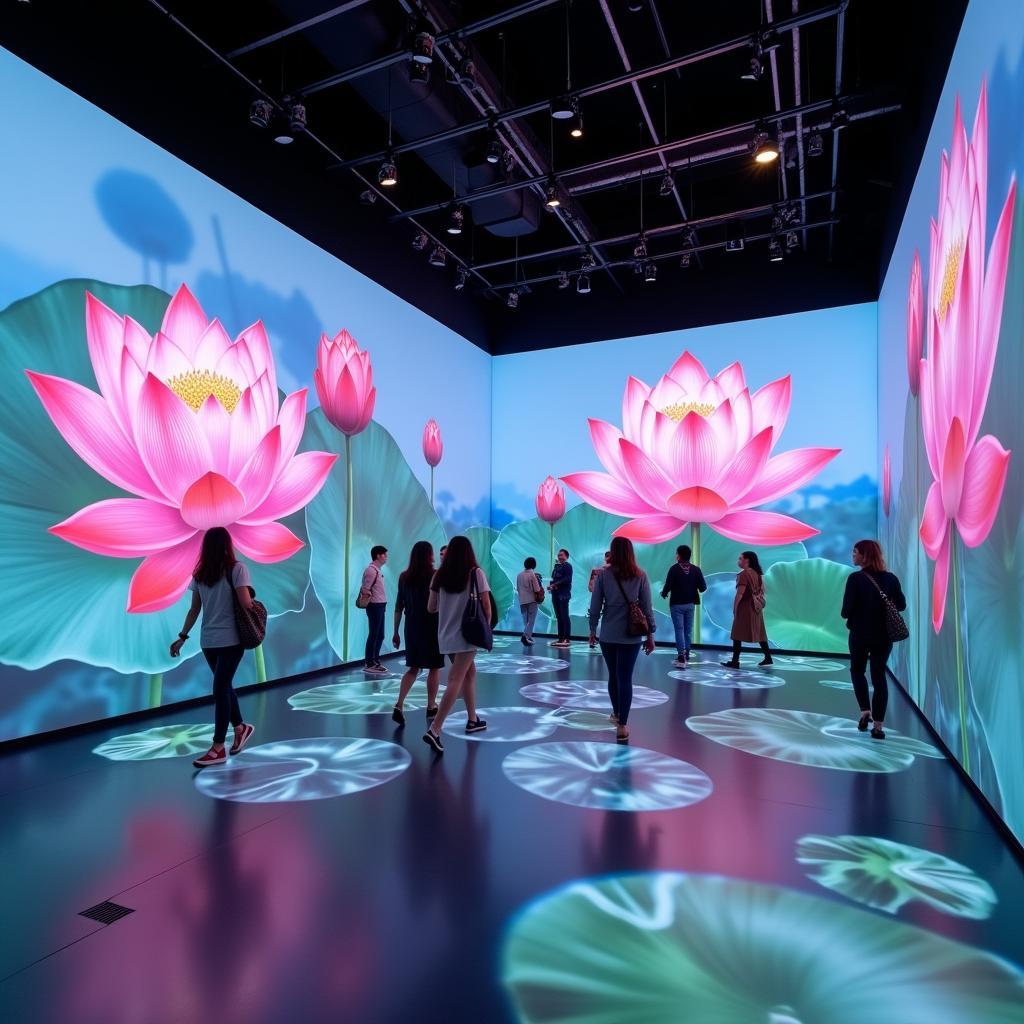 Triển lãm nghệ thuật số tương tác hiện đại tại Việt Nam với hình ảnh hoa sen kỹ thuật số
📝 Sample Answer – Band 8.5-9
Thời lượng: 2.5-3 phút đầy đủ
“I’d like to tell you about an exhibition that left a profound impression on me – it was a retrospective photography exhibition by a renowned Vietnamese photojournalist, and it took place at the Vietnam National Museum of Fine Arts in Hanoi. This was roughly a year ago, during the height of the summer, if I recall correctly, around late July or early August.
The exhibition was entitled ‘Four Decades Through the Lens‘, and it was essentially a comprehensive chronicle of Vietnam’s transformation from the post-war period right through to the present day. What made it particularly noteworthy was that it wasn’t just a display of photographs – it was more of a meticulously curated journey through Vietnam’s recent history, capturing everything from the hardships of the 1980s to the rapid economic development we’ve witnessed in recent decades.
As I made my way through the exhibition, I was immediately struck by the sheer emotional weight of the images. The early sections featured stark black-and-white photographs depicting the aftermath of the war – images of war-torn landscapes gradually being reclaimed by nature, portraits of families reuniting after years of separation, and scenes of people rebuilding their lives from scratch. What really resonated with me was the photographer’s ability to capture the resilience of the human spirit even in the most dire circumstances.
The exhibition then transitioned into more contemporary subjects – the Doi Moi period, the influx of foreign investment, and Vietnam’s gradual integration into the global economy. There were these particularly poignant images of street vendors in Hanoi’s Old Quarter whose faces told stories of decades of perseverance, juxtaposed with photographs of gleaming skyscrapers and tech startups representing the new Vietnam. The photographer had this remarkable talent for finding beauty in the mundane – whether it was an elderly woman selling flowers at dawn or a young programmer working late into the night.
What truly set this exhibition apart, in my view, was its unflinching honesty. It didn’t romanticize the past nor did it oversimplify the present. Instead, it presented a nuanced narrative that acknowledged both the progress we’ve made and the challenges that remain. There was one series, for instance, that focused on rural-to-urban migration, showing both the opportunities it created and the social costs it entailed – families separated, traditional ways of life disrupted, yet also new possibilities emerging.
On a personal level, this exhibition stirred up a complex mix of emotions. I felt a deep sense of respect and admiration for the generation that had endured so much hardship. At the same time, I experienced a kind of bittersweet nostalgia for aspects of Vietnamese life that are rapidly disappearing. But perhaps most significantly, it instilled in me a profound sense of responsibility toward preserving and documenting our own era for future generations.
The exhibition also prompted me to reflect on the power of visual storytelling. In an age where we’re constantly bombarded with images on social media, seeing these carefully selected and contextualized photographs reminded me that photography, at its best, is not just about capturing moments but about bearing witness to history and prompting viewers to think critically about the world around them.
I left the exhibition feeling intellectually enriched and emotionally moved. It reinforced my conviction that art, and photography in particular, has this unique capacity to bridge temporal and generational divides, allowing us to connect with experiences far removed from our own. It’s the kind of exhibition that stays with you long after you’ve left – I still find myself thinking about certain images and the stories they told, and it’s definitely influenced how I perceive both my country’s history and its trajectory moving forward.”
Phân Tích Band Điểm
| Tiêu chí | Band | Nhận xét |
|---|---|---|
| Fluency & Coherence | 8.5-9 | Speaks fluently với natural, effortless delivery. Sophisticated use of discourse markers (If I recall correctly, What really resonated with me, On a personal level). Ideas developed fully với logical sequencing. No noticeable effort to search for words. |
| Lexical Resource | 8.5-9 | Wide và sophisticated range: profound impression, meticulously curated, sheer emotional weight, resilience of human spirit, unflinching honesty, bittersweet nostalgia. Idiomatic language natural (left a profound impression, stays with you, bearing witness). Precise collocations throughout. Sophisticated paraphrasing. |
| Grammatical Range & Accuracy | 8.5-9 | Full range of structures với natural và accurate use: complex conditionals, participle clauses, cleft sentences, passive constructions. Error-free performance. Sentences vary in length và complexity naturally. |
| Pronunciation | 8.5-9 | Full range of pronunciation features. Sustained use of features throughout. Easy to understand despite any accent. Natural rhythm, stress, và intonation patterns. |
Tại Sao Bài Này Xuất Sắc
🎯 Fluency Hoàn Hảo:
- Speech flows naturally không có hesitations hay self-corrections
- Discourse markers sophisticated: “If I recall correctly”, “On a personal level”, “What truly set this apart”
- Transitions seamless giữa các ideas và sections
- Sounds like a natural, educated speaker rather than rehearsed
📚 Vocabulary Tinh Vi:
- Less common lexis: “meticulously curated”, “unflinching honesty”, “bittersweet nostalgia”, “bearing witness to history”
- Precise collocations: “profound impression”, “sheer emotional weight”, “resilience of human spirit”, “romanticize the past”
- Idiomatic expressions: “left a profound impression”, “stays with you”, “from scratch”, “late into the night”
- Sophisticated paraphrasing: không lặp lại từ “exhibition” quá nhiều – thay bằng “retrospective”, “display”, “journey”, “show”
📝 Grammar Đa Dạng:
- Complex participle phrases: “depicting the aftermath”, “capturing everything from…”
- Cleft sentences: “What made it particularly noteworthy was…”, “What truly set this exhibition apart…”
- Mixed conditionals và hypotheticals: showing range
- Relative clauses: “whose faces told stories”, “that acknowledged both…”
- Passive constructions: “It was entitled”, “we’re constantly bombarded”
- Advanced tenses: Past perfect “had endured”, present perfect “we’ve witnessed”
💡 Ideas Sâu Sắc:
- Không chỉ describe mà analyze và reflect critically
- Multiple layers of meaning: personal emotional response + broader social commentary
- Shows intellectual depth: discusses power of visual storytelling, art’s capacity to bridge divides
- Nuanced perspective: acknowledges complexity (not romanticizing, not oversimplifying)
- Personal growth evident: how exhibition changed perspective và influenced thinking
🎨 Structure Xuất Sắc:
- Introduction engaging: Sets context clearly
- Logical progression: Chronological tour through exhibition mirrors content structure
- Emotional arc: Builds from observation → analysis → personal reflection
- Conclusion thoughtful: Ties back to broader themes về art’s role
🗣️ Natural Speaking Features:
- Hedging appropriate: “if I recall correctly”, “in my view”, “kind of”
- Personal voice: “On a personal level”, “I still find myself thinking”
- Evaluative language: “particularly noteworthy”, “truly set apart”, “most significantly”
- Shows engagement: “What really resonated with me”, “I was immediately struck by”
Follow-up Questions (Rounding Off Questions)
Sau khi bạn nói xong Part 2, Examiner có thể hỏi 1-2 câu ngắn để transition sang Part 3. Đây là câu hỏi đơn giản, trả lời ngắn gọn là đủ.
Question 1: Would you visit another exhibition by the same artist?
Band 6-7 Answer:
“Yes, definitely. I really enjoyed this exhibition, so I would like to see more work by this photographer in the future.”
Band 8-9 Answer:
“Absolutely, without hesitation. This exhibition really whetted my appetite for his work, and I’d be keen to explore how his perspective and style have evolved over the years. I’d particularly love to see any unpublished material or behind-the-scenes insights into his creative process.”
💡 Key expressions: whetted my appetite (làm tăng sự thèm muốn), keen to explore (háo hức khám phá), unpublished material (tài liệu chưa công bố)
Question 2: Did you buy anything from the exhibition?
Band 6-7 Answer:
“No, I didn’t buy anything. The items were quite expensive and I didn’t have enough money at that time.”
Band 8-9 Answer:
“I didn’t, actually, though I was sorely tempted by the exhibition catalogue. It was quite reasonably priced, but I was traveling light that day and didn’t want to lug it around. In retrospect, I rather regret not getting it – it would have been a wonderful keepsake and would have allowed me to revisit those powerful images.”
💡 Key expressions: sorely tempted (rất bị cám dỗ), lug it around (vác nó đi khắp nơi – informal), in retrospect (nhìn lại), keepsake (vật lưu niệm), revisit (xem lại, trở lại với)
IELTS Speaking Part 3: Two-way Discussion
Tổng Quan Về Part 3
Part 3 là phần thảo luận trừu tượng và sâu sắc nhất của IELTS Speaking, kéo dài 4-5 phút. Đây là nơi Examiner đánh giá khả năng phân tích, so sánh, và thảo luận về các vấn đề xã hội rộng lớn hơn liên quan đến chủ đề Part 2.
Đặc điểm:
- Câu hỏi abstract, philosophical, về society và trends
- Yêu cầu critical thinking và ability to discuss complex issues
- Không chỉ nói về bản thân mà về people in general, society, your country
Yêu cầu:
- Phân tích causes và effects
- So sánh past vs present, different perspectives
- Đưa ra quan điểm có arguments và supporting reasons
- Acknowledge complexity của issues (not everything is black and white)
Chiến lược:
- Mở rộng answer: Mỗi câu trả lời nên 3-5 câu (around 30-45 giây)
- Structure rõ ràng: Direct answer → Reason 1 (+example) → Reason 2 (+example) → Conclusion/Nuance
- Use discourse markers: Well, Actually, I think, On the one hand, However…
- Give examples from society: không chỉ personal experience
- Show balanced view: Acknowledge different perspectives, complexity
Lỗi thường gặp của học viên Việt Nam:
- Trả lời quá ngắn (1-2 câu), không elaborate
- Không đưa ra lý lẽ cụ thể, chỉ nói general statements
- Thiếu từ vựng trừu tượng (abstract nouns, academic vocabulary)
- Không acknowledge complexity – chỉ nhìn một chiều
- Dùng quá nhiều “I think” mà không có supporting reasons
Các Câu Hỏi Thảo Luận Sâu
Các câu hỏi Part 3 thường được nhóm theo themes liên quan đến chủ đề Part 2.
Theme 1: The Role and Value of Exhibitions
Question 1: Why do you think governments invest money in museums and exhibitions?
🎯 Phân tích câu hỏi:
- Dạng: Cause/Reason question (Why…)
- Key words: governments, invest, museums and exhibitions
- Cách tiếp cận:
- Direct answer (state main reasons)
- Elaborate on each reason with explanation
- Provide examples if possible
- Can acknowledge different purposes
📝 Sample Answer – Band 6-7:
“I think governments invest in museums because they are important for education and culture. Museums help people learn about history and art. Also, museums can attract tourists to the country, which is good for the economy. For example, many tourists visit the Louvre Museum in Paris. So museums are good for both education and tourism.”
Phân tích:
- Structure: Basic – có reasons nhưng chưa detailed
- Vocabulary: Simple – important, good for, help, attract
- Tại sao Band 6-7: Đáp ứng câu hỏi nhưng thiếu depth, vocabulary không sophisticated, ideas còn surface-level
📝 Câu trả lời mẫu – Band 8-9:
“Well, I’d say there are several compelling reasons behind government investment in cultural institutions. First and foremost, museums and exhibitions serve as vital educational resources that help preserve and transmit a nation’s cultural heritage to future generations. They provide tangible connections to the past that you simply can’t replicate through textbooks alone – seeing authentic artifacts or original artworks creates a much more visceral and memorable learning experience.
Beyond education, there’s also a significant economic dimension to consider. Cultural institutions can be powerful drivers of tourism and contribute substantially to the local economy. Take Vietnam’s Imperial City in Hue, for instance – it draws hundreds of thousands of international visitors annually, generating revenue not just for the site itself but for hotels, restaurants, and local businesses throughout the region.
Moreover, I think there’s a broader societal value that’s perhaps less tangible but equally important. Museums and exhibitions foster social cohesion by providing shared cultural experiences and spaces for public discourse. They can also enhance a nation’s soft power on the international stage – countries with world-class cultural institutions often command greater respect and cultural influence globally.
That said, it’s worth noting that government priorities vary, and some administrations place more emphasis on cultural investment than others, depending on their broader policy objectives and budgetary constraints.”
Phân tích:
- Structure: Well-organized: Educational reasons → Economic benefits → Social/Political value → Nuanced conclusion
- Vocabulary: Sophisticated: compelling reasons, tangible connections, visceral experience, foster social cohesion, soft power, command respect
- Grammar: Complex structures throughout: participle phrases, relative clauses, conditional implications
- Critical Thinking: Multi-dimensional analysis, acknowledges complexity, provides specific example, shows balanced view
💡 Key Language Features:
- Discourse markers: Well, First and foremost, Beyond, Moreover, That said
- Tentative language: I’d say, I think, perhaps, it’s worth noting
- Abstract nouns: cultural heritage, social cohesion, soft power, policy objectives, budgetary constraints
- Advanced vocabulary: compelling, transmit, replicate, visceral, tangible, foster
- Collocations: preserve and transmit, powerful drivers, contribute substantially, foster social cohesion, enhance soft power
Question 2: Do you think exhibitions are becoming more or less popular nowadays?
🎯 Phân tích câu hỏi:
- Dạng: Opinion + Trend analysis (comparing present with past)
- Key words: becoming, more or less popular, nowadays
- Cách tiếp cận:
- State your view (more popular or less popular, or mixed)
- Provide reasons and evidence
- Can compare different types of exhibitions
- Acknowledge factors influencing the trend
📝 Sample Answer – Band 6-7:
“I think exhibitions are becoming more popular now. Many people like to visit exhibitions because they can take photos and post on social media. Also, there are more types of exhibitions now, like technology exhibitions and interactive exhibitions, which are more interesting than traditional museums. Young people especially like these modern exhibitions.”
Phân tích:
- Structure: Clear opinion + some reasons
- Vocabulary: Basic level – interesting, like, post on social media
- Ideas: Valid points but not deeply explored
- Tại sao Band 6-7: Adequate response nhưng lacks sophistication và depth of analysis
📝 Câu trả lời mẫu – Band 8.5-9:
“That’s a fascinating question, and I think the answer is somewhat nuanced. On one hand, traditional museums have been facing challenges in terms of attendance – many people, particularly younger generations, find them somewhat staid and old-fashioned. There’s a perception that they’re dusty repositories of artifacts that don’t really resonate with contemporary life.
However, I’d argue that exhibitions as a broader category are actually experiencing a renaissance, particularly those that have adapted to changing audience expectations. We’re seeing the emergence of highly immersive, interactive exhibitions that leverage technology in innovative ways – think augmented reality tours, interactive installations, and multimedia experiences that are Instagram-worthy and designed to be shared on social media. These experiential exhibitions have struck a chord with younger audiences who are looking for experiences rather than just passive observation.
The popularity also varies significantly by type. Pop-up exhibitions, photography showcases, and exhibitions focusing on contemporary issues like climate change or social justice tend to generate considerable buzz and draw substantial crowds. Meanwhile, more traditional exhibitions might struggle to maintain relevance unless they actively innovate in their presentation and engagement strategies.
I think what’s really changed is the nature of what makes an exhibition successful. It’s no longer enough to simply display objects in glass cases – successful exhibitions now need to tell compelling stories, create emotional connections, and provide shareable moments that extend their reach beyond the physical space. In this sense, exhibitions that have embraced this evolution are thriving, while those that resist change are gradually becoming less relevant.”
Phân tích:
- Structure: Sophisticated – presents complexity first, then breaks down different aspects, concludes with analysis of underlying factors
- Vocabulary: High-level: nuanced, staid, dusty repositories, renaissance, leverage, struck a chord, generate buzz, maintain relevance
- Grammar: Complex structures: cleft sentences (What’s really changed is…), relative clauses, participle phrases
- Critical Thinking:
- Acknowledges complexity (“somewhat nuanced”)
- Distinguishes between traditional museums vs modern exhibitions
- Analyzes underlying reasons for trends
- Provides specific examples (AR tours, pop-up exhibitions)
- Shows understanding of generational differences
- Concludes with analysis of success factors
💡 Key Language Features:
- Opening phrases: “That’s a fascinating question”, “I think the answer is somewhat nuanced”
- Contrasting: “On one hand… However”, “Meanwhile”
- Hedging: “I’d argue that”, “tend to”, “might struggle”
- Academic vocabulary: broader category, contemporary life, leverage technology, engagement strategies
- Idiomatic expressions: “struck a chord”, “generate buzz”, “embrace evolution”, “resist change”
- Sophisticated collocations: experiencing a renaissance, vary significantly, draw substantial crowds, maintain relevance
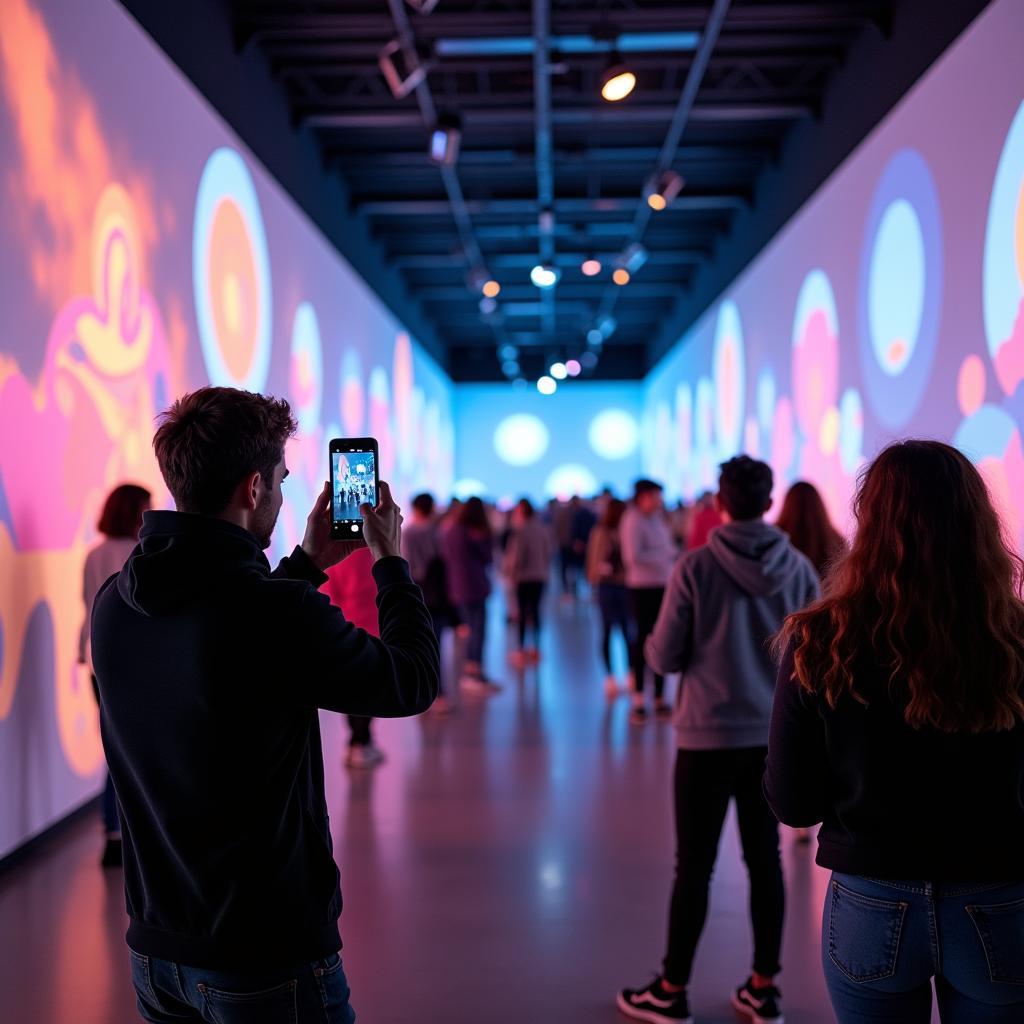 Triển lãm nghệ thuật tương tác hiện đại thu hút đông đảo giới trẻ chụp ảnh và chia sẻ
Theme 2: Art Education and Cultural Access
Question 1: Should art education be compulsory in schools?
🎯 Phân tích câu hỏi:
- Dạng: Opinion question với modal verb “should” – yêu cầu argumentation
- Key words: art education, compulsory, schools
- Cách tiếp cận:
- State your position clearly
- Provide multiple supporting arguments
- Acknowledge counter-arguments if possible
- Give examples to illustrate points
📝 Sample Answer – Band 6-7:
“Yes, I think art education should be compulsory in schools. Art is important for children’s development. It helps them be more creative and express their feelings. Also, art classes can help students relax after studying difficult subjects like math and science. Some students might not be good at academic subjects but they can be good at art, so art classes give them a chance to succeed.”
Phân tích:
- Structure: Clear opinion + several reasons
- Vocabulary: Basic – important, creative, express, relax, good at
- Ideas: Valid points about creativity, emotional expression, alternative success path
- Tại sao Band 6-7: Responds to question adequately nhưng vocabulary simple, arguments chưa fully developed, lacks examples
📝 Câu trả lời mẫu – Band 8.5-9:
“I’m firmly in favor of making art education compulsory, though I think it’s crucial that we understand what we mean by ‘compulsory’ in this context. It shouldn’t be about forcing every student to become an artist, but rather about ensuring universal access to artistic exposure and creative development.
There are several compelling reasons for this position. First and foremost, art education cultivates critical skills that are increasingly valuable in the modern economy – creativity, visual literacy, lateral thinking, and the ability to approach problems from multiple angles. These aren’t just nice-to-have soft skills; they’re becoming fundamental competencies in an age where automation is replacing routine tasks and creative problem-solving becomes ever more valuable.
Beyond the utilitarian argument, art education plays a crucial role in social and emotional development. It provides students with outlets for self-expression, helps them process complex emotions, and builds confidence through creative achievement. For students who struggle with traditional academic subjects, art classes can be a lifeline – a space where they can excel and find their voice. I’ve seen this firsthand with friends who were dismissed as poor students in academic subjects but flourished in art and eventually built successful careers in creative industries.
Moreover, from a societal perspective, universal art education helps to democratize access to culture. Without school-based art programs, children from less affluent backgrounds might never have the opportunity to engage with visual arts, music, or drama – experiences that children from privileged families often take for granted. This perpetuates cultural inequality and deprives society of potential talent.
That said, I think the key is how art education is delivered. It shouldn’t be overly rigid or focused on technical proficiency at the expense of creativity. The emphasis should be on exploration, experimentation, and developing an appreciation for artistic expression in its many forms. If done right, compulsory art education can enrich students’ lives while also equipping them with valuable skills for the future.”
Phân tích:
- Structure: Clear position → Economic argument → Social/emotional argument → Equity argument → Nuanced conclusion about implementation
- Vocabulary: Sophisticated: firmly in favor of, universal access, utilitarian argument, lateral thinking, democratize access, perpetuates inequality
- Grammar: Full range: conditionals, relative clauses, participle phrases, cleft sentences (What’s crucial is…)
- Critical Thinking:
- Multiple dimensions: economic, social, emotional, equity
- Acknowledges nuance (not about forcing everyone to be artists)
- Personal example adds authenticity
- Shows awareness of implementation challenges
- Balanced conclusion
💡 Key Language Features:
- Strong position markers: “I’m firmly in favor of”, “There are several compelling reasons”
- Sequencing: “First and foremost”, “Beyond”, “Moreover”, “That said”
- Academic vocabulary: cultivates critical skills, utilitarian argument, fundamental competencies, democratize access, perpetuates inequality
- Hedging for nuance: “I think it’s crucial that…”, “shouldn’t be about…”, “If done right”
- Sophisticated expressions: “nice-to-have soft skills”, “serves as a lifeline”, “flourished in art”, “take for granted”
Question 2: What are the differences between visiting an exhibition online and in person?
🎯 Phân tích câu hỏi:
- Dạng: Compare and contrast
- Key words: differences, online vs in person
- Cách tiếp cận:
- Identify multiple key differences across different dimensions
- Discuss advantages and disadvantages of each
- Use comparison structures
- Can include personal preference or observations
📝 Sample Answer – Band 6-7:
“There are many differences between online and in-person exhibitions. When you visit in person, you can see the real artwork and it feels more special. You can also see the size and details better. Online exhibitions are more convenient because you can view them from home and you don’t need to travel. But the experience is not the same because you are just looking at a screen. I think in-person is better for serious art, but online is okay for a quick look.”
Phân tích:
- Structure: Lists differences with some comparison
- Vocabulary: Basic comparison language – more special, better, more convenient
- Ideas: Valid points about sensory experience và convenience
- Tại sao Band 6-7: Addresses question but lacks sophistication, comparison chưa detailed, thiếu variety trong language
📝 Câu trả lời mẫu – Band 8.5-9:
“The differences are quite profound and span multiple dimensions of the experience. Most fundamentally, there’s the sensory dimension. Viewing art in person allows you to appreciate aspects that are simply impossible to replicate digitally – the physical scale of a work, the texture of brushstrokes, the way natural light interacts with a sculpture, even the ambient atmosphere of the exhibition space itself. There’s also something about being in the physical presence of an artwork, particularly historically significant pieces, that creates an almost reverential feeling that you can’t get through a screen.
On the practical front, the contrasts are equally stark. In-person visits require considerable time and effort – you need to travel, navigate crowds, potentially queue for entry, and work within opening hours. Virtual exhibitions, by contrast, offer unparalleled accessibility – you can explore at your own pace, revisit specific pieces multiple times, and access collections from around the world without leaving your home. For people with mobility limitations or those living in remote areas, digital access can be truly transformative.
Interestingly, each format also offers distinct pedagogical advantages. Physical exhibitions often feature curated pathways and spatial arrangements that guide the narrative in specific ways, creating a journey through the collection. Virtual exhibitions, meanwhile, can incorporate multimedia elements – artist interviews, animated explainers, zoomable high-resolution images – that enhance understanding in ways that aren’t possible in physical spaces. Some digital platforms even use 3D modeling to let you manipulate and examine objects from all angles, which can actually offer perspectives not available in a traditional museum display.
However, what’s really lost in digital experiences is the social dimension. Visiting an exhibition is often a shared cultural activity – you exchange reactions with companions, observe other visitors’ engagement, and participate in a collective experience of discovery. There’s also the serendipity factor – in a physical space, you might stumble upon an unexpected work that captivates you, whereas digital exhibitions often funnel you toward curated highlights.
Ultimately, I don’t think it’s about one being inherently superior to the other. They serve complementary purposes – virtual exhibitions can democratize access and serve as valuable educational resources, while in-person visits offer depth of experience and emotional resonance that technology can’t yet fully replicate. The ideal approach, perhaps, is to use digital platforms as a way to explore and identify exhibitions you’d like to experience in person.”
Phân tích:
- Structure: Masterful organization – sensory → practical → pedagogical → social → balanced conclusion
- Vocabulary: Exceptional range: profound, span multiple dimensions, reverential feeling, unparalleled accessibility, pedagogical advantages, serendipity factor, emotional resonance
- Grammar: Full range of complex structures naturally deployed
- Critical Thinking:
- Multi-dimensional analysis (sensory, practical, educational, social)
- Acknowledges strengths of both formats
- Considers accessibility and equity issues
- Recognizes complementary rather than competitive relationship
- Nuanced conclusion avoiding simplistic judgments
💡 Key Language Features:
- Sophisticated comparison structures: “are quite profound”, “the contrasts are equally stark”, “distinct pedagogical advantages”, “inherently superior”
- Abstract nouns: sensory dimension, ambient atmosphere, pedagogical advantages, serendipity factor, emotional resonance
- Academic vocabulary: replicate, reverential, unparalleled, transformative, pedagogical, complementary
- Precise verbs: span, navigate, curate, funnel, captivate, democratize
- Idiomatic expressions: “stumble upon”, “lost in digital experiences”, “funnel you toward”
Theme 3: Future Trends and Technology
Question 1: How do you think technology will change exhibitions in the future?
🎯 Phân tích câu hỏi:
- Dạng: Future prediction/speculation
- Key words: technology, change, exhibitions, future
- Cách tiếp cận:
- Use future forms and speculative language
- Discuss multiple possible developments
- Provide reasoning for predictions
- Can reference current trends that might develop further
📝 Sample Answer – Band 6-7:
“I think technology will change exhibitions a lot in the future. Maybe we will have more virtual reality exhibitions where people can walk around in a virtual museum. Also, exhibitions might use more interactive screens and digital displays instead of just paintings on walls. Technology will make exhibitions more interesting and attractive to young people. Perhaps we can also use our phones to get more information about the artworks when we visit.”
Phân tích:
- Structure: Lists several predictions
- Vocabulary: Basic future forms – will have, might use, can use
- Ideas: Valid predictions but not deeply explored
- Tại sao Band 6-7: Addresses question but predictions lack detail, reasoning underdeveloped, vocabulary limited
📝 Câu trả lời mẫu – Band 8.5-9:
“I think we’re standing on the cusp of some truly transformative changes in how exhibitions are conceived and experienced. Several converging technological trends suggest quite radical shifts on the horizon.
Most immediately, I anticipate we’ll see widespread adoption of immersive technologies – particularly augmented reality and mixed reality. Imagine visiting a historical exhibition where AR overlays can reconstruct ancient sites around you, or viewing a sculpture that comes alive through your device, showing you the artist’s creative process or the object’s historical context. This technology is already emerging in pilot programs at major museums, and as it becomes more affordable and user-friendly, I expect it to become ubiquitous.
We’re also likely to see artificial intelligence playing a greater role in curation and personalization. AI could analyze visitor behavior and preferences to create dynamically tailored tours, suggesting artworks based on what resonates with individual visitors. This could address one of the major challenges of traditional exhibitions – the fact that a single curatorial narrative can’t possibly engage everyone equally. Smart systems might also serve as sophisticated guides, offering different levels of information based on visitors’ existing knowledge and areas of interest.
On a more speculative note, I think we might witness the emergence of entirely new formats that blur the boundaries between physical and digital spaces. We could have hybrid exhibitions that exist simultaneously in multiple locations, with visitors in different countries sharing a connected experience. Holographic technology might allow museums to display works from other institutions without physical transport, reducing conservation risks while expanding access.
However, I think there will also be a counter-movement – a growing appreciation for technology-free, contemplative spaces where visitors can engage with art without digital mediation. We might see a bifurcation where some exhibitions embrace cutting-edge technology while others deliberately offer analog experiences as a form of refuge from our hyper-connected world.
What’s critical, in my view, is that technology should enhance rather than overshadow the art itself. The most successful future exhibitions will likely be those that thoughtfully integrate technology to deepen engagement while still preserving the essential human connection to art and culture. Technology should be a tool for democratization and deeper understanding, not just spectacle for its own sake.”
Phân tích:
- Structure: Opening prediction → Immediate trends (AR/MR) → AI developments → Speculative future → Counter-trend → Thoughtful conclusion
- Vocabulary: Exceptional: standing on the cusp, converging trends, ubiquitous, dynamically tailored, blur boundaries, bifurcation, spectacle for its own sake
- Grammar: Sophisticated future forms: will see, are likely to, might witness, could have
- Critical Thinking:
- Multiple timeframes (immediate, near-future, speculative)
- Considers different technological dimensions
- Recognizes counter-trends
- Addresses potential concerns
- Balanced conclusion about role of technology
💡 Key Language Features:
- Speculative language: “I anticipate”, “I expect”, “We’re likely to see”, “might witness”, “could have”
- Future forms variety: will see, are going to, might, could, may
- Sophisticated predictions: “standing on the cusp”, “converging technological trends”, “on the horizon”
- Academic vocabulary: ubiquitous, curation, personalization, bifurcation, mediation, democratization
- Balanced expressions: “enhance rather than overshadow”, “not just spectacle for its own sake”
Question 2: Do you think commercial galleries are different from public museums?
🎯 Phân tích câu hỏi:
- Dạng: Opinion + Comparison
- Key words: commercial galleries vs public museums, different
- Cách tiếp cận:
- Identify key differences across multiple dimensions
- Discuss underlying purposes and objectives
- Can include advantages/disadvantages of each model
- Show understanding of art ecosystem
📝 Sample Answer – Band 6-7:
“Yes, they are quite different. Commercial galleries are businesses that sell art to make money, while public museums are for education and preserving culture. Commercial galleries show contemporary art by living artists, but museums often have historical collections. Museums usually charge lower entrance fees or are free, but galleries are free because they make money from selling art. I think both are important in different ways.”
Phân tích:
- Structure: Clear comparison with some key differences identified
- Vocabulary: Basic – make money, sell art, charge fees, free
- Ideas: Identifies main differences but lacks depth
- Tại sao Band 6-7: Addresses question adequately but analysis superficial, vocabulary simple, lacks sophisticated comparison
📝 Câu trả lời mẫu – Band 8.5-9:
“Absolutely, and the differences run quite deep, reflecting fundamentally different missions and economic models. Understanding these distinctions is actually crucial to grasping how the broader art ecosystem functions.
At the most basic level, commercial galleries are profit-driven enterprises that operate in the primary art market – they represent artists, facilitate sales, and take commission on transactions. Their overarching objective is to build and sustain the careers of their artists while generating revenue. Public museums, conversely, are typically non-profit institutions with an educational and preservational mandate – they’re charged with safeguarding cultural heritage, providing public access to art, and advancing scholarship.
These contrasting purposes shape everything from exhibition practices to acquisition strategies. Commercial galleries tend to focus on living artists and contemporary work – they need to maintain a regular turnover of exhibitions to generate sales and keep collectors engaged. Their shows are often carefully calibrated to appeal to potential buyers, with commercial viability being a key consideration. Museums, meanwhile, can take longer-term views – they might mount scholarly exhibitions that wouldn’t be commercially viable, showcase underappreciated historical periods, or present challenging work that pushes boundaries but might not attract buyers.
The curation philosophy also differs markedly. Galleries typically present work in ways that highlight its aesthetic appeal and market value – pristine presentation, generous spacing, gallery-white walls. Museums often provide extensive contextual information, educational materials, and attempt to situate works within broader historical and cultural narratives. Where a gallery might display a painting with minimal wall text, a museum would likely provide detailed provenance, historical context, and interpretive analysis.
From a visitor perspective, the experiences are distinct in important ways. Museums serve the general public and typically aim for broad accessibility – modest entrance fees, family programming, multilingual materials. Galleries can feel more exclusive and sometimes intimidating to those unfamiliar with the art world – they’re primarily geared toward collectors and serious buyers, though most welcome browsers. There’s also often an unspoken etiquette in commercial galleries that can make casual visitors feel uncomfortable.
That said, these distinctions are increasingly blurring. Some cutting-edge contemporary museums operate almost like commercial galleries in terms of promoting living artists, while certain high-end galleries offer museum-quality scholarship and preservation standards. There’s also growing collaboration between the sectors – galleries lend works to museum exhibitions, and museums’ stamp of approval can significantly boost an artist’s commercial value.
The art ecosystem needs both. Commercial galleries provide crucial support infrastructure for emerging and mid-career artists, while museums offer institutional validation, long-term preservation, and public engagement on a scale that commercial entities couldn’t sustain. They function symbiotically – galleries feed the market that eventually enriches museum collections, while museum exhibitions often drive interest that benefits gallery artists.”
Phân tích:
- Structure: Masterful – progresses from basic differences → purposes → practices → curation → visitor experience → blurring boundaries → ecosystem view
- Vocabulary: Exceptional sophistication: profit-driven enterprises, primary art market, preservational mandate, commercial viability, pristine presentation, provenance, symbiotically
- Grammar: Full range of complex structures used with precision and naturalness
- Critical Thinking:
- Multi-dimensional comparison (economic, curatorial, visitor experience)
- Acknowledges evolving relationship and blurring boundaries
- Understands ecosystem perspective rather than simple opposition
- Shows insider knowledge of art world dynamics
- Balanced conclusion about complementary roles
💡 Key Language Features:
- Sophisticated comparison language: “run quite deep”, “contrasting purposes”, “differs markedly”, “distinct in important ways”
- Academic register: overarching objective, acquisition strategies, curation philosophy, institutional validation, symbiotically
- Precise vocabulary: primary art market, commission, mandate, charged with, calibrated, provenance, unspoken etiquette
- Nuanced expressions: “increasingly blurring”, “function symbiotically”, “feed the market”, “stamp of approval”
- Discourse organization: “At the most basic level”, “From a visitor perspective”, “That said”, “The art ecosystem needs both”
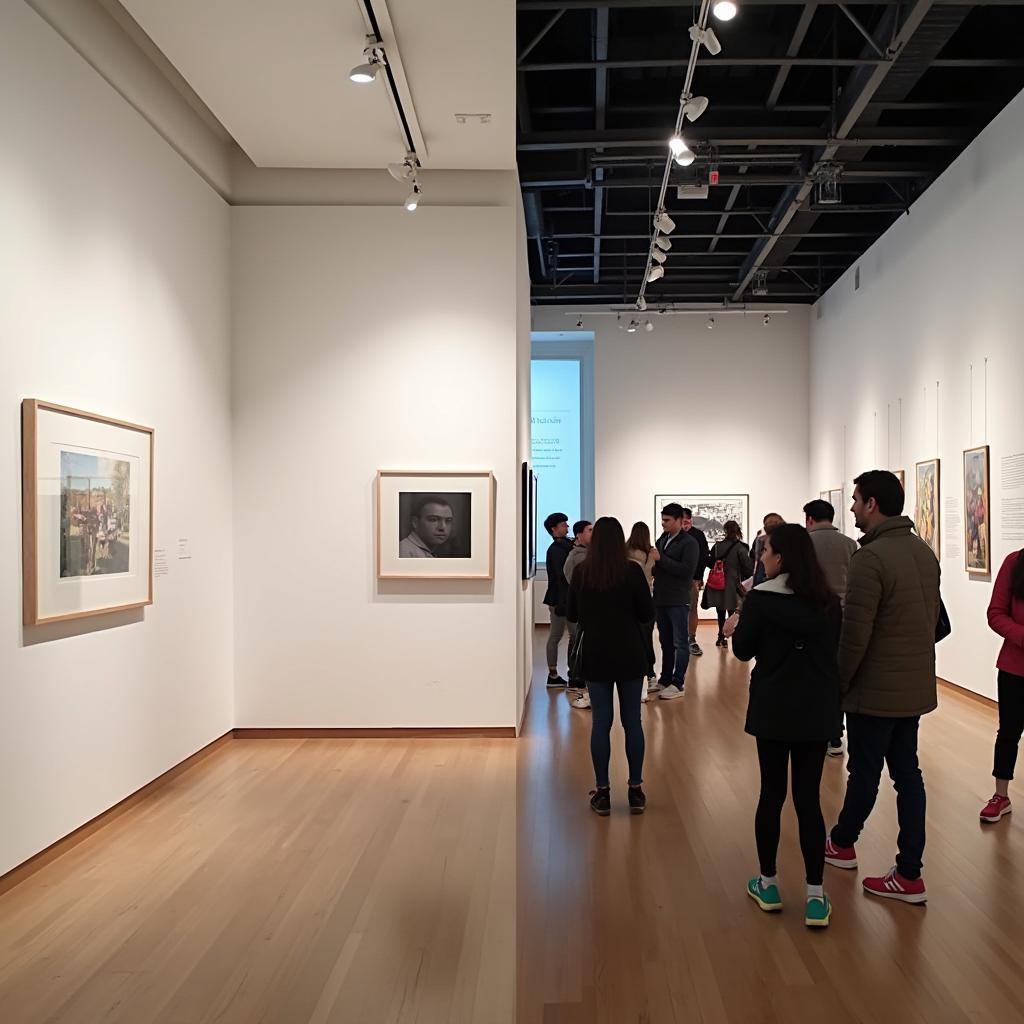 Sự khác biệt giữa phòng triển lãm nghệ thuật thương mại và bảo tàng công cộng về thiết kế và không gian
Từ vựng và cụm từ quan trọng
Topic-Specific Vocabulary
| Từ vựng/Cụm từ | Loại từ | Phiên âm | Nghĩa tiếng Việt | Ví dụ | Collocation |
|---|---|---|---|---|---|
| exhibition | n | /ˌeksɪˈbɪʃn/ | triển lãm | The exhibition featured works by contemporary Vietnamese artists. | art exhibition, photography exhibition, traveling exhibition, host/mount an exhibition |
| retrospective | n/adj | /ˌretrəˈspektɪv/ | (triển lãm) hồi cố, tổng kết sự nghiệp | The museum held a retrospective of the artist’s 40-year career. | career retrospective, major retrospective, comprehensive retrospective |
| curator | n | /kjʊˈreɪtər/ | người quản lý/tổ chức triển lãm | The curator carefully selected pieces that told a coherent story. | museum curator, exhibition curator, chief curator |
| contemporary art | n phrase | /kənˈtempərəri ɑːrt/ | nghệ thuật đương đại | Contemporary art often challenges traditional aesthetics. | contemporary art exhibition, contemporary art museum, contemporary art scene |
| immersive | adj | /ɪˈmɜːrsɪv/ | đắm chìm, tương tác toàn diện | The immersive installation surrounded visitors with sound and light. | immersive experience, immersive environment, immersive technology |
| artifact | n | /ˈɑːrtɪfækt/ | hiện vật, di vật | The museum displayed ancient artifacts from the Bronze Age. | historical artifact, cultural artifact, ancient artifact, precious artifact |
| provenance | n | /ˈprɒvənəns/ | nguồn gốc xuất xứ (của tác phẩm nghệ thuật) | The painting’s provenance was carefully documented. | establish provenance, verify provenance, questionable provenance |
| installation | n | /ˌɪnstəˈleɪʃn/ | tác phẩm sắp đặt (loại hình nghệ thuật) | The installation used recycled materials to comment on consumption. | art installation, interactive installation, site-specific installation |
| thought-provoking | adj | /ˈθɔːt prəˌvoʊkɪŋ/ | kích thích tư duy, gợi suy nghĩ | The exhibition raised thought-provoking questions about identity. | thought-provoking exhibition, thought-provoking work, thought-provoking themes |
| captivating | adj | /ˈkæptɪveɪtɪŋ/ | quyến rũ, hấp dẫn mạnh mẽ | The captivating photographs held visitors’ attention. | captivating display, captivating performance, captivating artwork |
| aesthetic | n/adj | /esˈθetɪk/ | thẩm mỹ | The exhibition explored the aesthetic of minimalism. | aesthetic appeal, aesthetic value, aesthetic experience, visual aesthetic |
| showcase | v/n | /ˈʃoʊkeɪs/ | trưng bày, giới thiệu nổi bật | The gallery showcased emerging local talent. | showcase work, showcase talent, showcase exhibition |
| unveil | v | /ʌnˈveɪl/ | công bố, tiết lộ (tác phẩm mới) | The museum unveiled a newly acquired masterpiece. | unveil a collection, unveil an exhibition, unveil artwork |
| mesmerizing | adj | /ˈmezməraɪzɪŋ/ | mê hoặc, thôi miên | The mesmerizing light display created an otherworldly atmosphere. | mesmerizing display, mesmerizing performance, mesmerizing effect |
| juxtaposition | n | /ˌdʒʌkstəpəˈzɪʃn/ | sự đặt cạnh nhau (để tạo tương phản) | The juxtaposition of old and new created striking contrasts. | interesting juxtaposition, deliberate juxtaposition, juxtaposition of styles |
| conservation | n | /ˌkɒnsərˈveɪʃn/ | bảo tồn, bảo quản | The painting required extensive conservation work. | art conservation, conservation efforts, conservation standards |
| patronage | n | /ˈpætrənɪdʒ/ | sự bảo trợ nghệ thuật | The arts rely heavily on private patronage. | art patronage, cultural patronage, receive patronage |
| vernissage | n | /ˌvɜːrnɪˈsɑːʒ/ | lễ khai mạc triển lãm (private viewing) | The vernissage attracted collectors and art critics. | attend a vernissage, vernissage event, invitation-only vernissage |
Idiomatic Expressions & Advanced Phrases
| Cụm từ | Nghĩa | Ví dụ sử dụng | Band điểm |
|---|---|---|---|
| leave a lasting impression | để lại ấn tượng sâu sắc | The exhibition left a lasting impression on all who visited. | 7.5-9 |
| whet someone’s appetite | làm tăng sự thèm muốn, khơi dậy hứng thú | The preview really whetted my appetite for the full exhibition. | 7.5-9 |
| feast for the eyes | cảnh tượng đẹp mắt, thỏa mãn thị giác | The colorful paintings were a real feast for the eyes. | 7-8 |
| strike a chord with | gây được tiếng vang, chạm đến cảm xúc | The artist’s work struck a chord with younger audiences. | 7.5-9 |
| draw crowds | thu hút đông đảo người đến | The new installation has been drawing crowds since opening day. | 7-8 |
| be drawn to | bị thu hút bởi | I’ve always been drawn to abstract expressionism. | 7.5-8.5 |
| push boundaries | phá vỡ ranh giới, đột phá | Contemporary artists often push boundaries of what’s considered art. | 8-9 |
| stand the test of time | tồn tại qua thời gian, không bị lỗi thời | Only truly great artworks stand the test of time. | 7.5-9 |
| a sight to behold | cảnh tượng đáng chiêm ngưỡng | The sculpture garden was truly a sight to behold. | 7-8 |
| catch someone’s eye | thu hút sự chú ý của ai | One particular painting immediately caught my eye. | 6.5-7.5 |
| make a splash | gây ấn tượng mạnh, tạo tiếng vang | The young artist made quite a splash with her debut exhibition. | 7.5-8.5 |
| come alive | trở nên sinh động | The historical artifacts really came alive through the curator’s storytelling. | 7-8 |
Discourse Markers (Từ Nối Ý Trong Speaking)
Để bắt đầu câu trả lời:
- 📝 Well,… – Dùng khi bạn cần một chút thời gian suy nghĩ hoặc muốn nói một cách tự nhiên
- 📝 Actually,… – Dùng khi đưa ra thông tin có thể bất ngờ hoặc trái với expectation
- 📝 To be honest,… / Honestly,… – Dùng khi muốn nói thẳng thắn, chân thành
- 📝 I’d say that… – Cách mềm mại để đưa ra quan điểm
- 📝 From my perspective,… / In my view,… – Nhấn mạnh đây là quan điểm cá nhân
Để bổ sung ý:
- 📝 On top of that,… – Thêm vào đó (informal nhưng natural)
- 📝 What’s more,… / Moreover,… – Hơn nữa (formal hơn)
- 📝 Not to mention… – Chưa kể đến (để thêm point quan trọng)
- 📝 Beyond that,… / Beyond this,… – Ngoài điều đó ra
- 📝 In addition to that,… – Thêm vào đó (formal)
Để đưa ra quan điểm cân bằng:
- 📝 On the one hand,… On the other hand,… – Một mặt… mặt khác
- 📝 While it’s true that…, we also need to consider… – Trong khi đúng là… chúng ta cũng cần xem xét
- 📝 That said,… / Having said that,… – Nói như vậy thì… (để present contrasting view)
- 📝 To some extent,… but… – Ở một mức độ nào đó… nhưng
Để kết luận:
- 📝 All in all,… – Tóm lại, nhìn chung
- 📝 At the end of the day,… – Cuối cùng thì (informal)
- 📝 Ultimately,… – Cuối cùng, về cơ bản (formal)
- 📝 Looking at the bigger picture,… – Nhìn vào bức tranh tổng thể
Để làm rõ hoặc elaborate:
- 📝 What I mean is… – Ý tôi là
- 📝 To put it another way,… – Nói cách khác
- 📝 In other words,… – Nói cách khác (formal)
- 📝 Let me explain,… – Để tôi giải thích
Grammatical Structures Ấn Tượng
1. Conditional Sentences (Câu điều kiện):
Mixed conditional:
- Formula: If + past perfect, would + base verb (hoặc ngược lại)
- Ví dụ: “If I hadn’t visited that exhibition, I wouldn’t have developed such a strong interest in contemporary art.” (Nếu tôi không đến triển lãm đó, tôi đã không phát triển sự quan tâm mạnh mẽ đến nghệ thuật đương đại như vậy)
Inversion (Đảo ngữ với conditional):
- Formula: Should/Were/Had + subject + verb…
- Ví dụ: “Had I known about the exhibition earlier, I would have brought my camera.” (Nếu tôi biết về triển lãm sớm hơn, tôi đã mang máy ảnh theo)
2. Relative Clauses (Mệnh đề quan hệ):
Non-defining relative clauses:
- Formula: , which/who/where + clause,
- Ví dụ: “The exhibition, which featured works from over 50 artists, was absolutely stunning.” (Triển lãm, với tác phẩm của hơn 50 nghệ sĩ, thật sự tuyệt đẹp)
Reduced relative clauses:
- Formula: noun + V-ing/V-ed phrase
- Ví dụ: “The paintings displayed in the main gallery were from the 19th century.” (Những bức tranh được trưng bày ở phòng chính là từ thế kỷ 19)
3. Passive Voice (Câu bị động):
Impersonal passive:
- Formula: It is thought/believed/said/considered that…
- Ví dụ: “It is widely believed that this exhibition will attract record-breaking numbers of visitors.” (Người ta tin rộng rãi rằng triển lãm này sẽ thu hút số lượng khách kỷ lục)
Passive with modal verbs:
- Formula: Modal + be + past participle
- Ví dụ: “The exhibition should be seen by anyone interested in modern art.” (Triển lãm nên được xem bởi bất kỳ ai quan tâm đến nghệ thuật hiện đại)
4. Cleft Sentences (Câu chẻ):
What-cleft:
- Formula: What + clause + is/was…
- Ví dụ: “What impressed me most was the curator’s attention to detail in arranging the pieces.” (Điều gây ấn tượng nhất với tôi là sự chú ý đến chi tiết của người tổ chức trong việc sắp xếp các tác phẩm)
It-cleft:
- Formula: It + is/was + noun/phrase + that/who…
- Ví dụ: “It was the interactive installations that really engaged younger visitors.” (Chính là những sắp đặt tương tác đã thực sự thu hút khách trẻ tuổi)
5. Advanced Participle Phrases:
Present participle phrases:
- Ví dụ: “Walking through the gallery, I noticed how carefully each piece had been positioned.” (Đi qua phòng trưng bày, tôi nhận thấy mỗi tác phẩm đã được đặt vị trí cẩn thận như thế nào)
Perfect participle phrases:
- Ví dụ: “Having visited similar exhibitions before, I could appreciate the unique curation approach.” (Đã từng tham quan các triển lãm tương tự trước đó, tôi có thể đánh giá cao cách tiếp cận độc đáo trong việc tổ chức)
6. Inversion for Emphasis:
Negative adverbials at beginning:
- Formula: Never/Rarely/Seldom + auxiliary + subject + verb
- Ví dụ: “Rarely have I seen such a well-organized exhibition.” (Hiếm khi tôi thấy một triển lãm được tổ chức tốt như vậy)
Only after/when at beginning:
- Ví dụ: “Only after visiting the exhibition did I fully appreciate the artist’s genius.” (Chỉ sau khi tham quan triển lãm, tôi mới thực sự đánh giá cao tài năng của nghệ sĩ)
Kết luận và Lời khuyên
Chủ đề “Describe a time when you visited an exhibition” là một trong những đề bài cho phép bạn thể hiện nhiều khía cạnh của khả năng Speaking – từ việc kể chuyện sinh động trong Part 2 đến phân tích sâu sắc về văn hóa và xã hội trong Part 3.
Để thành công với chủ đề này, bạn không cần phải ghi nhớ từng từ trong các bài mẫu. Thay vào đó, hãy:
📌 Focus vào việc phát triển ideas của riêng mình:
- Chọn một exhibition mà bạn thực sự có ấn tượng (hoặc có thể tưởng tượng chi tiết)
- Suy nghĩ về why it was meaningful to you
- Chuẩn bị các góc nhìn khác nhau về art và culture
📌 Xây dựng vocabulary bank cá nhân:
- Học các collocations tự nhiên, không học từ đơn lẻ
- Practice sử dụng từ vựng trong context, không học thuộc definition
- Ghi âm bản thân và nghe lại để check pronunciation
📌 Luyện tập structure và coherence:
- Part 2: Practice nói đủ 2 phút về different exhibitions
- Part 3: Luyện tập elaborate ideas – không chỉ đưa ra opinion mà còn explain why
- Sử dụng discourse markers tự nhiên để connect ideas
📌 Những điều cần tránh:
- ❌ Học thuộc template và áp dụng máy móc
- ❌ Sử dụng vocabulary quá phức tạp mà không hiểu nghĩa
- ❌ Nói quá nhanh hoặc quá chậm – aim for natural pace
- ❌ Lo lắng quá về grammar mistakes – fluency và communication quan trọng hơn
📌 Mẹo từ Examiner:
- Thể hiện enthusiasm khi nói về chủ đề – examiners appreciate genuine interest
- Đừng ngại paraphrase câu hỏi nếu cần time to think
- Use personal examples để make your answer more authentic
- Trong Part 3, acknowledge complexity của issues – không có absolute right/wrong answers
Nếu bạn quan tâm đến các chủ đề nghệ thuật tương tự, bạn có thể tham khảo describe an art exhibit that impressed you để có thêm góc nhìn về cách mô tả triển lãm nghệ thuật một cách ấn tượng. Đối với những ai muốn khám phá thêm về văn hóa và di sản, bài viết về describe a place in your country that is known for its cultural heritage sẽ giúp bạn mở rộng vocabulary về cultural topics.
Khi chuẩn bị cho IELTS Speaking, việc tìm nguồn cảm hứng cũng rất quan trọng. Bạn có thể tìm hiểu về describe a place where you go to feel inspired để hiểu cách diễn đạt về những địa điểm mang lại cảm hứng, điều này có thể áp dụng khi nói về exhibitions. Ngoài ra, nếu bạn muốn nói về museums nói chung, describe a museum you wish to visit cung cấp nhiều ý tưởng và structures hữu ích.
Cuối cùng, khi thảo luận về exhibitions, việc hiểu về nghệ sĩ cũng quan trọng. Bạn có thể tham khảo describe a famous artist or musician you admire để học cách nói về creative individuals và tác phẩm của họ một cách sinh động và ấn tượng.
Chúc bạn luyện tập hiệu quả và đạt band điểm cao trong IELTS Speaking!
Remember: Confidence comes from preparation, và preparation không có nghĩa là học thuộc – it means understanding the topic, building your vocabulary, và practicing until you can speak naturally và fluently về bất kỳ góc độ nào của chủ đề.


