
Chủ đề nghệ thuật luôn là một trong những đề tài quen thuộc trong kỳ thi IELTS Speaking, đặc biệt là câu hỏi “Describe An Art Exhibit That Impressed You”. Đây là dạng câu hỏi yêu cầu thí sinh kể về một trải nghiệm văn hóa cụ thể, vừa kiểm tra khả năng miêu tả, vừa đánh giá khả năng diễn đạt cảm xúc và quan điểm cá nhân về nghệ thuật.
Chủ đề này xuất hiện với tần suất khá cao trong các kỳ thi IELTS từ năm 2020 đến nay, đặc biệt tại các quốc gia châu Á. Theo thống kê từ các nguồn đề thi thực tế trên IELTS-Blog và diễn đàn thí sinh, câu hỏi về art exhibitions, museums và cultural events xuất hiện khoảng 15-20% trong tổng số đề thi Part 2. Khả năng xuất hiện trong tương lai vẫn ở mức cao do tính phổ biến và khả năng mở rộng của chủ đề.
Trong bài viết này, bạn sẽ học được:
- Các câu hỏi thường gặp về nghệ thuật trong cả 3 Part của IELTS Speaking
- Bài mẫu chi tiết theo từng band điểm 6-7, 7.5-8 và 8.5-9
- Hơn 50 từ vựng và cụm từ chuyên ngành về nghệ thuật
- Chiến lược trả lời hiệu quả từ góc nhìn của Examiner
- Phân tích sâu về tiêu chí chấm điểm và cách cải thiện band score
- Lỗi thường gặp của học viên Việt Nam và cách khắc phục
IELTS Speaking Part 1: Introduction and Interview
Tổng Quan Về Part 1
Part 1 của IELTS Speaking kéo dài 4-5 phút với các câu hỏi ngắn về đời sống hàng ngày. Đây là phần “khởi động” giúp bạn làm quen với examiner và môi trường thi. Chiến lược quan trọng nhất là trả lời tự nhiên, mở rộng mỗi câu trả lời thành 2-3 câu với cấu trúc: trả lời trực tiếp → lý do → ví dụ cụ thể.
Lỗi thường gặp của học viên Việt Nam trong Part 1:
- Trả lời quá ngắn, chỉ Yes/No hoặc một câu đơn
- Sử dụng từ vựng quá đơn giản như “good”, “nice”, “interesting”
- Thiếu ví dụ cụ thể từ kinh nghiệm bản thân
- Nói theo template, thiếu tự nhiên
- Không duy trì eye contact do lo lắng
Các Câu Hỏi Thường Gặp
Question 1: Do you like art?
Question 2: Did you learn art at school?
Question 3: Have you ever visited an art gallery or museum?
Question 4: What kind of art do you enjoy looking at?
Question 5: Do you think art is important in life?
Question 6: Would you like to be an artist?
Question 7: Do you have any artwork in your home?
Question 8: What form of art interests you most?
Question 9: Do you prefer traditional or modern art?
Question 10: Have you ever tried creating art yourself?
Phân Tích và Gợi Ý Trả Lời Chi Tiết
Question: Do you like art?
🎯 Cách tiếp cận:
- Trả lời trực tiếp có hay không (nhưng nên trả lời có để mở rộng được)
- Đưa ra lý do tại sao thích hoặc loại nghệ thuật nào
- Thêm ví dụ cụ thể từ kinh nghiệm bản thân
📝 Sample Answer – Band 6-7:
Yes, I like art quite a lot. I find it interesting to look at different paintings and sculptures. When I visit museums, I usually spend time looking at the artworks and thinking about what the artists wanted to express.
Phân tích:
- Điểm mạnh: Trả lời rõ ràng, có mở rộng về hành động cụ thể (visit museums), sử dụng từ vựng phù hợp như “express”
- Hạn chế: Từ vựng còn basic (quite a lot, interesting), thiếu cụm từ collocation mạnh, chưa có ví dụ personal rõ ràng
- Tại sao Band 6-7: Đủ fluency cơ bản, grammar đơn giản nhưng chính xác, vocabulary adequate nhưng chưa impressive
📝 Sample Answer – Band 8-9:
Yes, I’m quite drawn to art, particularly contemporary visual art. I find it fascinating how artists can convey complex emotions through colors and forms. Just last month, I visited a local gallery featuring abstract expressionism, and I was captivated by how the bold brushstrokes could evoke such strong feelings without depicting anything concrete.
Phân tích:
- Điểm mạnh: Sử dụng collocations mạnh (drawn to, captivated by, convey emotions), từ vựng chuyên ngành (contemporary visual art, abstract expressionism), có ví dụ cụ thể và gần đây (last month), cấu trúc câu phức (how… can…, without depicting)
- Tại sao Band 8-9: Fluency tự nhiên, vocabulary sophisticated và precise, grammar đa dạng với mệnh đề quan hệ và cấu trúc gerund, ideas cụ thể và personal
💡 Key Vocabulary & Expressions:
- be drawn to something: bị thu hút bởi cái gì đó
- contemporary visual art: nghệ thuật thị giác đương đại
- convey complex emotions: truyền tải cảm xúc phức tạp
- abstract expressionism: trường phái biểu hiện trừu tượng
- captivated by: bị mê hoặc bởi
- evoke strong feelings: gợi lên cảm xúc mạnh mẽ
Question: Have you ever visited an art gallery or museum?
🎯 Cách tiếp cận:
- Trả lời có/không và khi nào
- Mô tả ngắn gọn trải nghiệm
- Chia sẻ cảm nhận hoặc ấn tượng
📝 Sample Answer – Band 6-7:
Yes, I have visited several art museums in my city. The last time was about six months ago when I went to the Fine Arts Museum with my friends. We saw many traditional paintings from Vietnamese artists. It was a nice experience and I learned a lot about our country’s art history.
Phân tích:
- Điểm mạnh: Có thông tin cụ thể về thời gian và địa điểm, structure rõ ràng
- Hạn chế: Từ “nice” quá generic, thiếu chi tiết về cảm xúc cá nhân, vocabulary chưa nổi bật
- Tại sao Band 6-7: Đủ information nhưng lacks depth và sophistication trong cách diễn đạt
📝 Sample Answer – Band 8-9:
Absolutely! I’m actually a regular visitor to art galleries. The most memorable one was when I attended an exhibition showcasing Vietnamese lacquer paintings at the Fine Arts Museum about six months ago. What really struck me was the intricate craftsmanship and the way artists incorporated traditional motifs into contemporary themes. It gave me a deeper appreciation for our cultural heritage.
Phân tích:
- Điểm mạnh: Vocabulary chuyên ngành (lacquer paintings, intricate craftsmanship, traditional motifs), collocations mạnh (regular visitor, struck me, deeper appreciation), cấu trúc What really… was… tạo emphasis, kết nối với personal insight về cultural heritage
- Tại sao Band 8-9: Natural fluency với discourse marker “Absolutely”, precise vocabulary, complex ideas về sự kết hợp tradition và contemporary, shows personal engagement với subject
💡 Key Vocabulary & Expressions:
- a regular visitor: người thường xuyên ghé thăm
- exhibition showcasing: triển lãm trưng bày
- lacquer paintings: tranh sơn mài
- struck me: gây ấn tượng mạnh với tôi
- intricate craftsmanship: tay nghề thủ công tinh xảo
- incorporate traditional motifs: kết hợp các họa tiết truyền thống
- gave me a deeper appreciation: giúp tôi trân trọng sâu sắc hơn
Question: What kind of art do you enjoy looking at?
🎯 Cách tiếp cận:
- Nêu loại nghệ thuật cụ thể
- Giải thích lý do thích
- Có thể so sánh với các loại khác
📝 Sample Answer – Band 6-7:
I enjoy looking at landscape paintings the most. I like them because they show beautiful natural scenes like mountains, rivers and forests. These paintings make me feel relaxed and peaceful. I prefer them to abstract art because I can understand them more easily.
Phân tích:
- Điểm mạnh: Structure clear với preference → reason → comparison
- Hạn chế: Adjectives basic (beautiful, relaxed, peaceful), lý do chưa profound, comparison đơn giản
- Tại sao Band 6-7: Adequate communication nhưng lacks sophistication và depth of thought
📝 Sample Answer – Band 8-9:
I’m particularly fond of impressionist paintings, especially works by artists like Monet and Van Gogh. What appeals to me most is their masterful use of light and color to capture fleeting moments. Unlike photorealistic art, impressionism leaves room for interpretation, allowing viewers to engage emotionally with the artwork. The soft brushstrokes and vibrant palettes create a dreamlike quality that I find absolutely mesmerizing.
Phân tích:
- Điểm mạnh: Specific art movement (impressionism) với artist names, technical vocabulary (use of light and color, soft brushstrokes, vibrant palettes), sophisticated comparison với photorealistic art, shows deep understanding về artistic techniques, emotional engagement rõ ràng
- Tại sao Band 8-9: Demonstrates specialist knowledge, uses advanced collocations naturally, complex sentence structures với unlike…, allowing…, creates…, shows critical thinking về interpretation
💡 Key Vocabulary & Expressions:
- be fond of: yêu thích
- appeals to me most: thu hút tôi nhất
- masterful use of light and color: cách sử dụng ánh sáng và màu sắc điêu luyện
- capture fleeting moments: bắt giữ những khoảnh khắc thoáng qua
- leaves room for interpretation: để lại không gian cho sự diễn giải
- engage emotionally: gắn kết về mặt cảm xúc
- vibrant palettes: bảng màu sống động
- dreamlike quality: chất lượng như mơ
- mesmerizing: mê hoặc, quyến rũ
 Học viên đang luyện tập IELTS Speaking về chủ đề nghệ thuật với giáo viên
IELTS Speaking Part 2: Long Turn (Cue Card)
Tổng Quan Về Part 2
Part 2 là phần độc thoại kéo dài 2-3 phút sau 1 phút chuẩn bị. Đây là phần quan trọng nhất trong bài thi Speaking vì examiner sẽ đánh giá đầy đủ cả 4 tiêu chí mà không bị gián đoạn. Chiến lược hiệu quả:
- Sử dụng hết 1 phút chuẩn bị để ghi chú keywords, không viết câu hoàn chỉnh
- Nói đủ 2 phút, tốt nhất là 2-2.5 phút để thể hiện fluency
- Trả lời đầy đủ tất cả bullet points theo thứ tự
- Sử dụng thì quá khứ đơn và quá khứ tiếp diễn khi kể chuyện
- Dành thời gian nhiều nhất cho bullet point cuối (explain why/how you felt)
Lỗi thường gặp của học viên Việt Nam:
- Không tận dụng 1 phút chuẩn bị, bắt đầu nói ngay
- Nói dưới 1.5 phút do thiếu ý tưởng mở rộng
- Bỏ sót bullet points, đặc biệt là phần “explain”
- Dùng quá nhiều filler words (uhm, well, you know) do thiếu chuẩn bị
- Nói theo template cứng nhắc thay vì tự nhiên
Cue Card
Describe an art exhibit that impressed you
You should say:
- Where and when you saw this exhibit
- What kind of artworks were displayed
- What made the exhibit special or different
- And explain why it impressed you and how you felt about it
Phân Tích Đề Bài
- Dạng câu hỏi: Describe an event/experience – kể về một trải nghiệm văn hóa trong quá khứ
- Thì động từ: Chủ yếu là quá khứ đơn (saw, was, made) và quá khứ tiếp diễn (were displaying)
- Bullet points phải cover:
- Địa điểm và thời gian cụ thể (where/when)
- Loại tác phẩm nghệ thuật (paintings/sculptures/installations…)
- Điểm đặc biệt của triển lãm (concept/artist/presentation style)
- Cảm xúc và lý do ấn tượng (phần quan trọng nhất, nên dành 40% thời gian)
- Câu “explain” quan trọng: Đây là phần ghi điểm cao nhất vì thể hiện khả năng phân tích cảm xúc, suy nghĩ sâu sắc và sử dụng vocabulary mô tả feelings. Không chỉ nói “I felt happy” mà cần giải thích why và how cụ thể.
Tương tự như describe a museum you wish to visit, đề bài này yêu cầu bạn có kiến thức về văn hóa nghệ thuật và khả năng diễn đạt cảm xúc tinh tế.
📝 Sample Answer – Band 6-7
Thời lượng: Khoảng 1.5-2 phút
I’d like to talk about an art exhibition I visited last year at the Vietnam Fine Arts Museum in Hanoi. It was in September, during the Mid-Autumn Festival holiday.
The exhibition displayed modern Vietnamese paintings by young artists. There were about fifty artworks, including oil paintings, watercolors, and some digital art pieces. Most of them showed scenes of daily life in Vietnam, like street vendors, old houses, and people doing their daily activities.
What made this exhibit special was that all the artists were under 30 years old. The museum wanted to show that young Vietnamese people are still interested in traditional art forms. Another interesting thing was that visitors could talk to some of the artists who were there. They explained their ideas and techniques, which helped me understand the paintings better.
I was impressed by this exhibition for several reasons. First, the artworks were very colorful and creative. The artists mixed traditional Vietnamese themes with modern painting styles, which I found interesting. Second, it made me feel proud of Vietnamese art and culture. I realized that our young generation is keeping these traditions alive while also bringing new ideas. The experience made me want to visit more art exhibitions in the future. Overall, it was a memorable day and I learned a lot about contemporary Vietnamese art.
Phân Tích Band Điểm
| Tiêu chí | Band | Nhận xét |
|---|---|---|
| Fluency & Coherence | 6-7 | Có structure rõ ràng theo bullet points, sử dụng linkers cơ bản (First, Second, Another), có một số hesitation nhỏ nhưng không ảnh hưởng communication |
| Lexical Resource | 6-7 | Vocabulary adequate với art topic (exhibition, display, oil paintings, watercolors), nhưng còn dùng nhiều từ generic (colorful, interesting, memorable) thay vì precise expressions |
| Grammatical Range & Accuracy | 6-7 | Mix của simple và complex sentences, sử dụng đúng quá khứ đơn, có relative clauses (who were there, which helped me), nhưng structures chưa đa dạng |
| Pronunciation | 6-7 | Clear và understandable, có thể có một số lỗi nhỏ về word stress nhưng không gây khó hiểu |
Điểm mạnh:
- ✅ Trả lời đầy đủ tất cả bullet points theo thứ tự logic
- ✅ Có thông tin cụ thể về thời gian, địa điểm, số lượng artworks
- ✅ Structure rõ ràng với introduction, body, và conclusion
- ✅ Có personal feelings và reasons tại sao impressed
Hạn chế:
- ⚠️ Vocabulary chưa sophisticated, thiếu collocations mạnh
- ⚠️ Adjectives quá đơn giản (colorful, interesting, memorable)
- ⚠️ Chưa có figurative language hoặc idiomatic expressions
- ⚠️ Phần explain feelings chưa profound, thiếu emotional depth
📝 Sample Answer – Band 7.5-8
Thời lượng: Khoảng 2-2.5 phút
I’d like to tell you about a truly captivating art exhibition I attended last September at the Vietnam Fine Arts Museum in Hanoi. I went there during the Mid-Autumn Festival holiday with a close friend who’s also passionate about contemporary art.
The exhibition showcased works by emerging Vietnamese artists, all under thirty. What immediately caught my eye was the diverse range of mediums on display – there were striking oil paintings, delicate watercolors, and even some thought-provoking digital installations. The recurring theme throughout the collection was the juxtaposition of traditional Vietnamese life and modern urban culture. Artists depicted everything from street vendors in Old Quarter alleyways to the bustling tech startup scene in Saigon.
What really set this exhibition apart was its interactive nature. Several of the artists were actually present, which created a wonderful opportunity for meaningful dialogue about their creative processes and artistic vision. I remember having a fascinating conversation with one painter who explained how she used traditional lacquer techniques but applied them to contemporary subjects. Additionally, the museum had incorporated QR codes next to each artwork, allowing visitors to access audio explanations and artist interviews through their phones.
This exhibition left a profound impression on me for multiple reasons. Firstly, I was genuinely amazed by how these young artists skillfully blended traditional Vietnamese aesthetics with modern artistic expressions. The way they paid homage to our cultural heritage while pushing creative boundaries was truly inspiring. Secondly, it gave me renewed hope about the future of Vietnamese art. Seeing so much raw talent and innovative thinking from the younger generation made me feel incredibly proud of our artistic community. The experience sparked my interest in contemporary Southeast Asian art, and I’ve since become a regular attendee at gallery openings. It was more than just an exhibition – it was a transformative experience that deepened my appreciation for both traditional and modern Vietnamese artistry.
Phân Tích Band Điểm
| Tiêu chí | Band | Nhận xét |
|---|---|---|
| Fluency & Coherence | 7.5-8 | Speaks fluently với minimal hesitation, coherence devices đa dạng (Firstly, Secondly, Additionally), clear progression của ideas, maintains focus throughout |
| Lexical Resource | 7.5-8 | Wide range của vocabulary với collocations mạnh (set apart, profound impression, raw talent), less common expressions (juxtaposition, pay homage to), some paraphrasing (showcase/display/exhibit) |
| Grammatical Range & Accuracy | 7.5-8 | Flexibly uses complex structures (relative clauses, conditionals implied, gerunds, passive voice), occasional minor errors không ảnh hưởng communication |
| Pronunciation | 7.5-8 | Clear pronunciation với appropriate intonation và word stress, sustained intelligibility |
So Sánh Với Band 6-7
| Khía cạnh | Band 6-7 | Band 7.5-8 |
|---|---|---|
| Vocabulary | “colorful and creative”, “interesting” | “striking oil paintings”, “thought-provoking installations”, “skillfully blended” |
| Grammar | “which I found interesting” (simple relative clause) | “allowing visitors to access…” (complex gerund), “it was more than just an exhibition – it was…” (cleft sentence) |
| Ideas | “made me feel proud” | “gave me renewed hope about the future”, “transformative experience that deepened my appreciation” |
📝 Sample Answer – Band 8.5-9
Thời lượng: 2.5-3 phút đầy đủ
I’d like to share with you what was undoubtedly one of the most intellectually stimulating and emotionally resonant cultural experiences I’ve had – an extraordinary exhibition I attended last September at the Vietnam Fine Arts Museum in Hanoi. My friend, who’s an avid art enthusiast, had been raving about this particular showcase for weeks, so we decided to visit during the Mid-Autumn Festival weekend.
The exhibition was a curated collection of works by Vietnam’s most promising emerging artists, all under thirty, and it represented what I can only describe as a bold reimagining of Vietnamese artistic identity. What immediately struck me was the remarkable diversity not just in mediums – ranging from hauntingly beautiful lacquer paintings to cutting-edge digital installations – but in the conceptual depth each piece possessed. The overarching narrative explored the complex interplay between tradition and modernity, heritage and innovation. Artists had masterfully captured this tension through works depicting everything from the vanishing street vendors of Hanoi’s Old Quarter to the rapidly evolving tech startup culture of modern Saigon.
What truly elevated this exhibition above typical gallery experiences was its profoundly interactive dimension. The presence of several artists created invaluable opportunities for substantive dialogues about their artistic philosophies and creative journeys. I was particularly enthralled by a conversation with one painter who had ingeniously adapted centuries-old lacquer techniques to contemporary political commentary – a testament to how traditional craftsmanship can remain relevant in addressing modern issues. Moreover, the museum’s thoughtful integration of technology, through QR-linked audio guides and artist interviews, seamlessly enhanced the viewing experience without detracting from the artworks themselves.
This exhibition left an indelible mark on me, and I find myself reflecting on it even months later. On one level, I was utterly captivated by the sheer artistic prowess these young creators demonstrated – their ability to deftly navigate between honoring cultural traditions and forging new aesthetic territories was nothing short of remarkable. The exhibition challenged my preconceptions about what Vietnamese art could be and expanded my aesthetic horizons considerably. On a deeper level, it instilled in me a profound sense of optimism about our artistic future. Witnessing such unbridled creativity and courageous experimentation from the next generation was genuinely heartening. What’s more, the experience catalyzed a sustained interest in contemporary Southeast Asian art movements – I’ve since become a devoted regular at gallery openings and have even started a modest collection of prints by emerging artists. In retrospect, this wasn’t merely an exhibition; it was a watershed moment that fundamentally transformed my relationship with Vietnamese art, helping me appreciate not only its rich heritage but also its dynamic, evolving nature in our rapidly changing world. The whole experience reaffirmed my belief that art remains one of the most powerful mediums for cultural dialogue and self-expression, particularly in times of rapid social transformation.
Phân Tích Band Điểm
| Tiêu chí | Band | Nhận xét |
|---|---|---|
| Fluency & Coherence | 8.5-9 | Speaks fluently với virtually no hesitation, sophisticated coherence devices (On one level…, On a deeper level…, What’s more…, In retrospect…), ideas develop naturally với logical progression, effective use của parenthetical expressions |
| Lexical Resource | 8.5-9 | Sophisticated vocabulary with precise usage (indelible mark, deftly navigate, watershed moment), skillful use of idiomatic language (raving about, nothing short of remarkable), effective collocations (unbridled creativity, sustained interest), natural paraphrasing throughout |
| Grammatical Range & Accuracy | 8.5-9 | Full range của structures used naturally (cleft sentences, complex relatives, inversion implied, multiple clause combinations), rare minor errors, sophisticated use của gerunds và participles, complex conditionals embedded |
| Pronunciation | 8.5-9 | Precise articulation, fully appropriate intonation patterns, effective use của stress and rhythm để convey meaning, sustained clarity |
Tại Sao Bài Này Xuất Sắc
🎯 Fluency Hoàn Hảo:
- Không có hesitation, discourse flows naturally như native speaker
- Sophisticated signposting: “On one level…, On a deeper level…, What’s more…, In retrospect…”
- Parenthetical asides add depth: “– a testament to…”, “– ranging from…”
📚 Vocabulary Tinh Vi:
- “intellectually stimulating and emotionally resonant” – phrasal pair cho strong impact thay vì “interesting and impressive”
- “a curated collection” – technical term trong art world
- “hauntingly beautiful” – adverb + adjective combination creates imagery
- “indelible mark” – metaphorical language thay vì “big impression”
- “catalyzed a sustained interest” – precise verb choice showing cause-effect
- “watershed moment” – idiom cho pivotal experience
📝 Grammar Đa Dạng:
- “What immediately struck me was…” – cleft sentence for emphasis
- “ranging from… to…” – participle phrase as modifier
- “I find myself reflecting on it even months later” – reflexive verb + gerund
- “Witnessing such unbridled creativity… was genuinely heartening” – gerund as subject
- “not only its rich heritage but also its dynamic, evolving nature” – parallel structure với double adjectives
💡 Ideas Sâu Sắc:
- Multi-layered analysis: aesthetic appreciation → personal growth → social impact
- Critical thinking: “challenged my preconceptions”, “expanded my aesthetic horizons”
- Long-term impact: “catalyzed a sustained interest”, “fundamentally transformed”
- Philosophical depth: art as medium for “cultural dialogue” in times of “social transformation”
- Personal evolution: từ visitor → enthusiast → collector
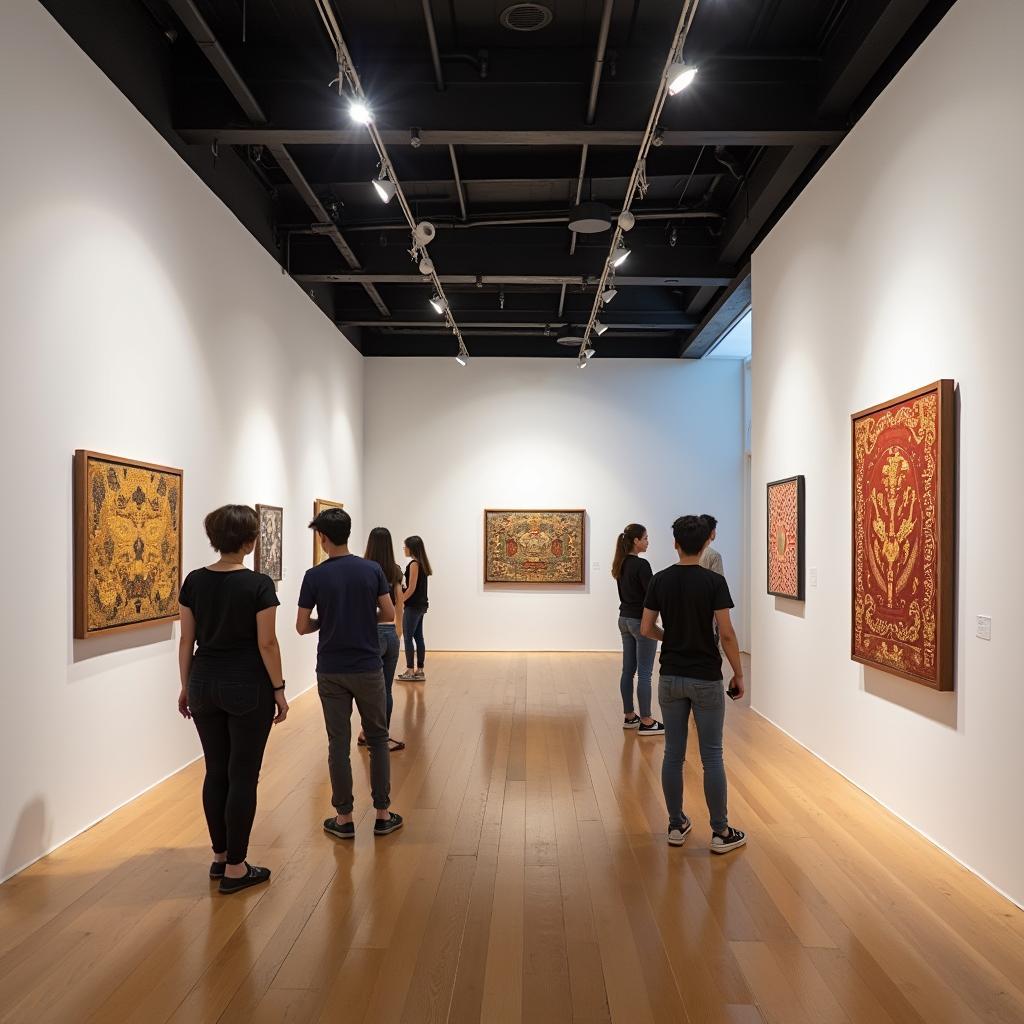 Triển lãm nghệ thuật hiện đại Việt Nam với tác phẩm sơn mài độc đáo và du khách đang chiêm ngưỡng
Follow-up Questions (Rounding Off Questions)
Examiner có thể hỏi thêm 1-2 câu ngắn sau Part 2 để transition sang Part 3:
Question 1: Would you recommend this exhibition to others?
Band 6-7 Answer:
Yes, definitely. I think it’s a great exhibition for people who are interested in Vietnamese art. It shows how young artists are creating new and interesting works while keeping traditional styles alive.
Band 8-9 Answer:
Absolutely, I’d wholeheartedly recommend it, particularly to anyone interested in contemporary Asian art movements. The exhibition offers invaluable insights into how the younger generation is reinterpreting cultural heritage through a modern lens. It’s a must-see for both art enthusiasts and those simply curious about Vietnam’s evolving artistic landscape.
Question 2: Do you think you’ll attend more art exhibitions in the future?
Band 6-7 Answer:
Yes, I will. After this experience, I became more interested in art. I plan to visit exhibitions more often when I have free time because I enjoy learning about different artists and their work.
Band 8-9 Answer:
Without a doubt. This experience has genuinely ignited a passion for contemporary art that I didn’t know I had. I’ve actually made it a point to attend at least one exhibition monthly, and I’ve even started following several Southeast Asian galleries on social media to stay abreast of upcoming showcases. It’s become an integral part of my cultural life.
IELTS Speaking Part 3: Two-way Discussion
Tổng Quan Về Part 3
Part 3 kéo dài 4-5 phút với các câu hỏi trừu tượng và sâu sắc hơn, mở rộng từ chủ đề Part 2. Đây là phần khó nhất vì yêu cầu:
- Phân tích vấn đề ở cấp độ xã hội, không chỉ cá nhân
- So sánh, đánh giá, dự đoán xu hướng
- Đưa ra quan điểm có lý lẽ chặt chẽ và examples từ thực tế
- Xem xét nhiều góc độ của vấn đề (pros and cons, different perspectives)
Chiến lược hiệu quả:
- Mở rộng mỗi câu trả lời thành 3-5 câu với structure: Direct answer → Reason 1 + example → Reason 2 + example → Conclusion/nuance
- Sử dụng discourse markers tự nhiên (Well, Actually, I think, From my perspective)
- Acknowledge complexity: “It depends on…”, “While it’s true that…, we also need to consider…”
- Đưa ra examples từ xã hội Việt Nam hoặc global trends
- Thừa nhận nếu không chắc chắn: “I’m not entirely sure, but I would say…”
Lỗi thường gặp của học viên Việt Nam:
- Trả lời quá ngắn (1-2 câu), thiếu phân tích sâu
- Không đưa ra lý lẽ rõ ràng để support opinion
- Thiếu từ vựng trừu tượng (benefit, drawback, impact, influence, trend)
- Chỉ nói về personal experience thay vì societal level
- Không consider multiple perspectives
- Sợ pause để suy nghĩ, cố gắng nói ngay
Các Câu Hỏi Thảo Luận Sâu
Theme 1: Social Impact of Art
Question 1: Why do you think art is important in society?
🎯 Phân tích câu hỏi:
- Dạng: Opinion + Justification – yêu cầu explain importance và give reasons
- Key words: “important” (cần define importance như thế nào), “society” (phải nói ở societal level, không chỉ cá nhân)
- Cách tiếp cận: State importance → Give 2-3 functions của art trong society → Provide examples → Conclude với broader impact
📝 Sample Answer – Band 6-7:
I think art is very important in society for several reasons. First, art helps people express their feelings and ideas. Artists can show social problems through their work, which makes people think about these issues. Second, art is also important for culture. It keeps traditional values and customs alive for the next generation. For example, in Vietnam, traditional paintings show our history and way of life. Finally, art can bring people together. When people visit museums or galleries, they can share their opinions and learn from each other. So I believe art plays an important role in making society better.
Phân tích:
- Structure: Có clear organization với First, Second, Finally
- Vocabulary: Adequate với basic art terms nhưng chưa sophisticated (express feelings, social problems, traditional values)
- Tại sao Band 6-7: Ideas relevant và clear, grammar mostly accurate, nhưng lacks depth of analysis và advanced vocabulary. Chưa có abstract nouns mạnh, thiếu precise collocations
📝 Câu trả lời mẫu – Band 8-9:
Well, I’d say art plays an absolutely vital role in society, functioning on multiple levels. From a cultural standpoint, art serves as a repository of collective memory and shared identity. It preserves and transmits cultural values across generations, helping societies maintain a sense of continuity in rapidly changing times. Take Vietnamese lacquer painting, for instance – it’s not just an art form but a tangible link to centuries of craftsmanship and aesthetic philosophy.
Beyond cultural preservation, art also functions as a powerful catalyst for social change. Throughout history, artists have used their work to challenge prevailing norms, raise awareness about social injustices, and provoke critical thinking. We’ve seen this repeatedly, from protest art during political upheavals to contemporary installations addressing climate change or inequality. Art has this unique ability to communicate complex ideas in ways that resonate emotionally, often reaching people that traditional discourse cannot.
Moreover, on a more individual level, exposure to art contributes to personal development and cognitive flexibility. Research suggests that engagement with artistic experiences enhances creativity, empathy, and critical thinking skills. In our increasingly automated world, these distinctly human capacities become even more valuable. So, all things considered, art isn’t merely decorative – it’s fundamental to how societies evolve, reflect on themselves, and maintain their humanity.
Phân tích:
- Structure: Sophisticated với Well… → From a cultural standpoint… → Beyond… → Moreover… → all things considered – shows ability to develop ideas systematically
- Vocabulary: Precise academic language (repository of collective memory, catalyst for social change, cognitive flexibility, distinctly human capacities), strong collocations (prevailing norms, resonate emotionally, tangible link)
- Grammar: Complex structures: “helping societies maintain…” (gerund phrase), “We’ve seen this repeatedly, from… to…” (parallel structure), “Research suggests that…” (noun clause)
- Critical Thinking: Multi-dimensional analysis (cultural, social, individual levels), acknowledges nuance (“in rapidly changing times”), references research, considers future implications (“in our increasingly automated world”)
💡 Key Language Features:
- Discourse markers: Well, From a cultural standpoint, Beyond cultural preservation, Moreover, all things considered
- Tentative language: I’d say, suggests that, often
- Abstract nouns: repository, continuity, catalyst, discourse, upheavals, inequality, engagement, capacities
- Collocations: vital role, collective memory, shared identity, tangible link, prevailing norms, raise awareness about, provoke critical thinking, resonate emotionally, cognitive flexibility
Question 2: Do you think governments should support artists financially?
🎯 Phân tích câu hỏi:
- Dạng: Opinion + Evaluation – yes/no question nhưng nên present balanced view
- Key words: “governments”, “support financially” (not just any support, specifically về money)
- Cách tiếp cận: State opinion → Present benefits → Acknowledge drawbacks/challenges → Conclude với balanced view hoặc conditions
📝 Sample Answer – Band 6-7:
Yes, I think governments should support artists with money. Artists need financial help because making art doesn’t always give them enough income to live. If the government gives them money, they can focus on creating good art without worrying about earning money. This is especially important for traditional art forms that are not very popular commercially. However, the government should be careful about how they spend money. They should make sure the money goes to real artists who create quality work. In general, I believe government support is necessary to keep art alive in society.
Phân tích:
- Structure: Clear position → reasoning → caveat → conclusion
- Vocabulary: Basic financial terms (financial help, income, spend money) chưa precise
- Ideas: Relevant nhưng lacks depth, chưa explore broader implications
- Tại sao Band 6-7: Communicates main ideas clearly nhưng analysis superficial, vocabulary adequate but not impressive
📝 Câu trả lời mẫu – Band 8-9:
This is actually a rather contentious issue, and I think the answer is more nuanced than a simple yes or no. On the one hand, there’s a compelling case for government funding of the arts. Many art forms, particularly traditional or experimental ones, aren’t commercially viable but are nonetheless culturally invaluable. Without public subsidy, these could fall into decline, leading to an impoverishment of our cultural landscape. Countries like France and South Korea have demonstrated how strategic public investment in the arts can foster vibrant cultural sectors that eventually become economically self-sustaining.
That said, government funding also raises some legitimate concerns. There’s always the question of allocation criteria – who decides what constitutes “worthy” art? There’s a risk that funding might favor conventional work over genuinely innovative pieces, or that it could lead to a certain homogenization of artistic expression. We’ve seen cases where state patronage has inadvertently stifled creative freedom, with artists self-censoring to secure funding.
In my view, the key lies in striking the right balance. Governments should definitely provide financial support, but through transparent, merit-based systems that respect artistic autonomy. Funding should prioritize preserving endangered art forms, supporting early-career artists, and making art accessible to disadvantaged communities, rather than simply propping up established institutions. Additionally, governments might incentivize private sector involvement through tax breaks for corporate sponsorship of the arts. Done right, public funding can catalyze a thriving artistic ecosystem without compromising creative independence.
Phân tích:
- Structure: Acknowledges complexity → presents pro arguments → presents counter arguments → offers nuanced conclusion with conditions – demonstrates sophisticated thinking
- Vocabulary: Precise terminology (contentious issue, commercially viable, public subsidy, allocation criteria, state patronage, merit-based systems, artistic autonomy), abstract concepts (impoverishment, homogenization, self-censoring)
- Grammar: Complex conditionals (Without public subsidy, these could…), multiple relative clauses (who decides, what constitutes, where state patronage has…), sophisticated use of passive (be provided, be prioritized)
- Critical Thinking: Examines issue from multiple angles (economic, cultural, political), acknowledges complexity (“more nuanced than…”), considers real-world examples (France, South Korea), proposes solutions with conditions (“Done right…”)
💡 Key Language Features:
- Discourse markers: On the one hand, That said, In my view, Additionally, Done right
- Tentative language: I think, there’s a risk, might incentivize, could catalyze
- Abstract nouns: impoverishment, homogenization, patronage, autonomy, ecosystem, sponsorship
- Hedging: rather contentious, legitimate concerns, inadvertently, to some extent
- Academic collocations: compelling case for, commercially viable, culturally invaluable, fall into decline, strategic public investment, allocation criteria, merit-based systems, artistic autonomy, private sector involvement
Theme 2: Art Education
Question 3: Should art be a compulsory subject in schools?
🎯 Phân tích câu hỏi:
- Dạng: Opinion + Justification về education policy
- Key words: “compulsory” (mandatory vs optional), “schools” (primary, secondary?)
- Cách tiếp cận: State position → Benefits của art education → Potential challenges → Balanced conclusion
📝 Sample Answer – Band 6-7:
I think art should be a required subject in schools because it’s important for children’s development. Art classes help students become more creative and learn to think in different ways. Many students also find art relaxing compared to academic subjects like math or science. Art can help them reduce stress and express themselves better. However, some people might argue that art takes time away from more important subjects. Schools have limited hours, so they need to focus on core subjects that students need for their future careers. But I still believe art should be taught because it develops important skills that students can use in many areas of life.
Phân tích:
- Structure: Clear position with supporting points và counter-argument
- Vocabulary: Basic education terms (required subject, development, academic subjects, core subjects)
- Ideas: Relevant benefits mentioned nhưng chưa elaborate deeply
- Tại sao Band 6-7: Adequate communication với basic reasoning, nhưng lacks sophisticated analysis và precise terminology
📝 Câu trả lời mẫu – Band 8-9:
I’m inclined to say yes, but with some important caveats. There’s mounting evidence that art education contributes significantly to holistic development in ways that extend far beyond simply learning to paint or draw. Art classes cultivate what educators call “21st-century skills” – creativity, critical thinking, problem-solving, and visual literacy – which are increasingly vital in our image-saturated digital age. When students engage with artistic processes, they’re learning to think divergently, take risks, and embrace ambiguity, all of which are transferable skills applicable across disciplines.
From a neurological perspective, research shows that artistic activities stimulate areas of the brain associated with emotional intelligence and spatial reasoning. There’s also compelling evidence that students who regularly participate in arts education often demonstrate improved performance in other academic areas. This makes intuitive sense – the cognitive flexibility developed through artistic practice enhances overall learning capacity.
However, the key word here is “compulsory.” I think we need to be thoughtful about implementation. Rather than imposing a one-size-fits-all approach, schools should offer diverse artistic pathways – visual arts, music, drama, digital media – allowing students some agency in choosing their creative outlet. Equally important is ensuring that art education doesn’t become overly prescriptive or assessment-driven, which could undermine its intrinsic value. The goal should be fostering genuine creative expression and aesthetic appreciation, not just ticking boxes on a curriculum.
Moreover, practical considerations matter. Implementing quality art education requires adequate resources – trained teachers, materials, facilities – which many schools, particularly in underserved areas, currently lack. So while I strongly support making art a core component of education, it needs to be accompanied by sufficient investment and pedagogical flexibility to be truly effective.
Tương tự như cách describe a person who is a great leader đòi hỏi khả năng phân tích nhiều khía cạnh của lãnh đạo, việc thảo luận về giáo dục nghệ thuật cũng cần xem xét đa chiều từ góc độ giáo dục, tâm lý học và chính sách công.
Phân tích:
- Structure: Highly sophisticated với position → evidence-based arguments → neurological research → implementation considerations → practical concerns – demonstrates ability to build complex, multi-layered argument
- Vocabulary: Academic register (mounting evidence, holistic development, visual literacy, cognitive flexibility, pedagogical flexibility), precise collocations (contribute significantly to, extend far beyond, embrace ambiguity, transferable skills)
- Grammar: Advanced structures: “I’m inclined to say” (tentative opinion), “Rather than imposing…” (comparative construction), “which could undermine…” (result clause), “So while I strongly support…” (concessive clause)
- Critical Thinking: Multi-dimensional analysis (educational, neurological, practical), cites research evidence, considers implementation challenges, proposes nuanced solution with conditions, acknowledges resource constraints
💡 Key Language Features:
- Discourse markers: From a neurological perspective, However, Rather than, Equally important, Moreover, So while
- Tentative language: I’m inclined to say, with some important caveats, I think we need to be thoughtful about
- Abstract nouns: holistic development, visual literacy, ambiguity, spatial reasoning, emotional intelligence, cognitive flexibility, implementation, intrinsic value, aesthetic appreciation
- Academic collocations: mounting evidence, contribute significantly to, extend far beyond, 21st-century skills, image-saturated digital age, engage with, think divergently, take risks, transferable skills, compelling evidence, demonstrate improved performance, one-size-fits-all approach, creative outlet, overly prescriptive, assessment-driven, undermine its value, fostering creative expression, ticking boxes, adequate resources, underserved areas, core component, sufficient investment
Theme 3: Art and Technology
Question 4: How has technology changed the way people create and experience art?
🎯 Phân tích câu hỏi:
- Dạng: Describe changes – yêu cầu comparison between past and present
- Key words: “technology”, “create” (artist perspective), “experience” (audience perspective)
- Cách tiếp cận: Acknowledge transformation → Changes in creation → Changes in experience → Overall evaluation
📝 Sample Answer – Band 6-7:
Technology has changed art in many ways. For artists, they now have digital tools like computers and tablets to create artwork. This makes the process faster and they can fix mistakes easily. Artists can also use software to try different styles and effects. For people who enjoy art, technology makes it easier to see artworks. You can visit virtual museums online and see famous paintings without traveling. Social media also helps artists share their work with more people around the world. However, some people worry that digital art is not as valuable as traditional art. But I think both types have their own benefits and technology has made art more accessible to everyone.
Phân tích:
- Structure: Clear organization separating artist vs audience perspective
- Vocabulary: Basic tech terms (digital tools, computers, software, virtual museums, social media) chưa precise
- Ideas: Covers main points nhưng analysis superficial, thiếu specific examples
- Tại sao Band 6-7: Communicates main changes clearly nhưng lacks depth, vocabulary adequate but generic, chưa explore implications deeply
📝 Câu trả lời mẫu – Band 8-9:
Technology has fundamentally revolutionized both the creation and consumption of art in ways that would have been unimaginable just a few decades ago. On the creative side, digital tools have dramatically expanded the artist’s palette, so to speak. Artists now work with sophisticated software that allows for unprecedented precision and experimentation. Take digital illustration, for example – artists can create infinitely layerable compositions, instantly undo mistakes, and manipulate images in ways that would be prohibitively time-consuming with traditional media. We’re also seeing entirely new art forms emerge, like generative art created through algorithms and AI-assisted creation, which blur the boundaries between human creativity and machine capability.
Perhaps even more transformative is how technology has democratized both art creation and access. Aspiring artists who might not have been able to afford traditional art supplies can now create digital art with just a tablet. Distribution channels have been completely disrupted – artists can bypass traditional gatekeepers like galleries and directly reach global audiences through platforms like Instagram or Behance. This has given rise to a much more diverse artistic landscape where previously marginalized voices can gain visibility.
From the audience perspective, technology has made art incredibly accessible. Virtual museum tours, high-resolution digital archives, and augmented reality exhibitions mean that someone in rural Vietnam can explore the Louvre or MoMA from their smartphone. During the pandemic, we saw how technology enabled digital exhibitions and live-streamed gallery openings, maintaining cultural engagement when physical spaces were closed. There’s also this fascinating shift toward interactive, immersive experiences – installation art using projection mapping, VR art experiences, things that fundamentally alter the viewer-artwork relationship.
That said, this technological transformation isn’t without complications. There are ongoing debates about the authenticity and value of digital art – questions about provenance, ownership in the age of infinite reproducibility, and whether NFTs actually solve these issues or create new problems. Some critics argue that our screen-mediated art experiences lack the visceral impact of standing before an actual painting. There’s something to that – the texture, scale, and physical presence of art can’t always be fully captured digitally.
On balance, though, I’d say technology has been overwhelmingly positive for the art world. It’s made art more democratic, more experimental, and more accessible, while still allowing traditional practices to continue and even thrive alongside digital innovations. The richness of our current artistic landscape – where someone can appreciate a centuries-old watercolor technique on Instagram one moment and experience a cutting-edge VR installation the next – is something truly remarkable about our technological age.
Phân tích:
- Structure: Exceptionally well-organized với creation → democratization → audience perspective → complications → balanced conclusion – shows ability to develop extended, coherent discourse
- Vocabulary: Specialized terminology (generative art, algorithms, AI-assisted, gatekeepers, augmented reality, projection mapping, provenance, infinite reproducibility, NFTs, screen-mediated), precise collocations (fundamentally revolutionize, unprecedented precision, entirely new art forms, blur the boundaries, democratized access, distribution channels, marginalized voices, visceral impact)
- Grammar: Full range: “which would have been unimaginable” (mixed conditional), “allowing traditional practices to continue and even thrive” (parallel infinitives), “someone in rural Vietnam can explore” (illustrative example in present simple), “There’s something to that” (idiomatic concession)
- Critical Thinking: Comprehensive analysis covering multiple stakeholders (artists, audiences, critics), acknowledges both benefits và complications, uses specific examples (Louvre, MoMA, pandemic impact, NFTs), considers philosophical questions (authenticity, provenance), provides balanced evaluation
💡 Key Language Features:
- Discourse markers: On the creative side, Perhaps even more transformative, From the audience perspective, That said, On balance, though
- Tentative language: so to speak, I’d say, There’s something to that
- Abstract nouns: creation, consumption, precision, experimentation, democratization, visibility, authenticity, provenance, reproducibility, richness
- Advanced collocations: fundamentally revolutionize, dramatically expand, unprecedented precision, prohibitively time-consuming, entirely new art forms, blur the boundaries, democratized access, completely disrupted, bypass gatekeepers, gain visibility, incredibly accessible, fascinating shift, fundamentally alter, ongoing debates, infinite reproducibility, visceral impact, physical presence, overwhelmingly positive, thrive alongside
Question 5: Do you think traditional art forms will disappear in the digital age?
🎯 Phân tích câu hỏi:
- Dạng: Prediction + Opinion về future trends
- Key words: “traditional art forms”, “disappear”, “digital age”
- Cách tiếp cận: State prediction → Reasons why traditional art persists → Acknowledge challenges → Conclude with nuanced view
📝 Sample Answer – Band 6-7:
I don’t think traditional art will completely disappear. Many people still appreciate traditional paintings, sculptures, and crafts. These art forms have been around for hundreds of years and they are part of our cultural heritage. Young people are still learning traditional techniques from older artists. Also, traditional art has a special quality that digital art cannot replace. When you see a real painting in a museum, the experience is different from looking at it on a screen. However, traditional artists might need to adapt to the digital age. They could use social media to promote their work or combine traditional and modern techniques. So I believe traditional art will continue to exist, but it might change in some ways.
Phân tích:
- Structure: Clear position with supporting reasons và adaptation suggestion
- Vocabulary: Basic terminology (traditional paintings, cultural heritage, traditional techniques) adequate but not sophisticated
- Ideas: Relevant points about cultural value và experiential difference, but lacks depth
- Tại sao Band 6-7: Communicates position clearly với basic reasoning, but analysis lacks sophistication và specific examples
📝 Câu trả lời mẫu – Band 8-9:
I’m quite optimistic that traditional art forms will not only survive but actually experience a renaissance in the digital age, though perhaps in evolved forms. History has shown that new technologies rarely completely supplant older ones; rather, they coexist and often mutually enrich each other. When photography emerged in the 19th century, many predicted the death of painting, yet painting evolved and flourished, with movements like Impressionism and Cubism exploring dimensions that photography couldn’t capture.
Several factors suggest traditional arts will remain relevant. Firstly, there’s an intrinsic human appreciation for craftsmanship and tangible objects. The tactile quality of a hand-painted canvas, the weight of a bronze sculpture, the texture of handmade paper – these physical attributes create an aesthetic experience that digital reproductions simply cannot replicate. As our lives become increasingly screen-based, there’s actually growing nostalgia for and valuation of the handmade and analog. We’re seeing this in the resurgence of vinyl records, film photography, and artisanal crafts – all of which were supposedly rendered obsolete by digital alternatives.
Moreover, traditional art forms often carry deep cultural significance and serve as repositories of heritage. In Vietnam, for instance, silk painting and lacquerware aren’t merely art forms; they’re embodiments of centuries of accumulated knowledge and cultural identity. There’s substantial interest among younger generations in preserving and reinterpreting these traditions. I’ve noticed many contemporary Vietnamese artists skillfully integrating traditional techniques with modern themes, which keeps the art forms alive while making them relevant to current times.
That being said, traditional arts do face legitimate challenges. The economics can be difficult – traditional methods are often labor-intensive and time-consuming, making it hard for artists to earn a sustainable living in a market that often undervalues handcraft. There’s also the question of relevance – how do ancient art forms speak to digital-native generations whose primary mode of engagement is screen-based?
The key, I believe, lies in adaptation without abandonment. Traditional artists who embrace elements of digital culture – using social media for outreach, incorporating technology into their practice, or creating hybrid works – seem to be thriving. Japanese woodblock printing artists, for example, now sell limited edition prints internationally via Instagram, while maintaining the centuries-old techniques. Similarly, calligraphers are finding new audiences through videos showing their process, which actually enhances appreciation for the skill involved.
In essence, I don’t see traditional and digital as opposing forces but rather as complementary aspects of our artistic ecosystem. The digital age, paradoxically, may actually heighten our appreciation for the physical and handmade, ensuring that traditional art forms continue to hold a cherished place in our cultural landscape, albeit perhaps transformed by their coexistence with digital technologies.
Khi nói về sự bền bỉ của các giá trị truyền thống, điều này có điểm tương đồng với describe a person you know who enjoys adventure sports trong việc duy trì đam mê cá nhân giữa thế giới hiện đại – cả hai đều thể hiện sự kiên trì với những giá trị cốt lõi bất chấp sự thay đổi của công nghệ.
Phân tích:
- Structure: Exceptionally sophisticated với prediction → historical precedent → supporting factors (intrinsic value, cultural significance) → challenges → solution → philosophical conclusion – demonstrates ability to construct extended, nuanced argument
- Vocabulary: Highly precise academic register (renaissance, supplant, coexist, mutually enrich, intrinsic appreciation, tactile quality, repositories of heritage, embodiments of, accumulated knowledge, labor-intensive, undervalues, hybrid works, complementary aspects, paradoxically)
- Grammar: Full grammatical range: “which were supposedly rendered obsolete” (passive in relative clause), “how do ancient art forms speak to digital-native generations” (embedded question), “using social media for outreach… incorporating technology… creating hybrid works” (parallel gerund phrases), “The digital age, paradoxically, may…” (parenthetical adverb)
- Critical Thinking: Exceptional depth with historical analysis (photography/painting parallel), economic considerations, cultural dimensions, generational perspectives, specific examples (vinyl records, Vietnamese silk painting, Japanese woodblock), proposes nuanced solution (adaptation without abandonment), philosophical insight about paradox
💡 Key Language Features:
- Discourse markers: History has shown, Several factors suggest, Moreover, That being said, The key, I believe, In essence
- Tentative language: I’m quite optimistic, perhaps, I believe, may actually
- Abstract nouns: renaissance, craftsmanship, nostalgia, valuation, resurgence, repositories, embodiments, significance, relevance, outreach, appreciation, coexistence
- Sophisticated collocations: experience a renaissance, completely supplant, mutually enrich, predicted the death of, remain relevant, intrinsic appreciation for, tangible objects, tactile quality, aesthetic experience, screen-based, growing nostalgia for, rendered obsolete, repositories of heritage, embodiments of, accumulated knowledge, substantial interest, skillfully integrating, legitimate challenges, earn a sustainable living, primary mode of engagement, adaptation without abandonment, embrace elements of, finding new audiences, enhances appreciation, opposing forces, complementary aspects, heighten our appreciation for, hold a cherished place
 Nghệ sĩ trẻ Việt Nam đang kết hợp kỹ thuật sơn mài truyền thống với công nghệ số hiện đại
Từ vựng và cụm từ quan trọng
Topic-Specific Vocabulary
| Từ vựng/Cụm từ | Loại từ | Phiên âm | Nghĩa tiếng Việt | Ví dụ | Collocation |
|---|---|---|---|---|---|
| art exhibit/exhibition | n | /ɑːrt ɪɡˈzɪbɪʃən/ | triển lãm nghệ thuật | I attended a fascinating art exhibition last month. | contemporary exhibition, solo exhibition, touring exhibition, showcase an exhibition |
| captivating | adj | /ˈkæptɪveɪtɪŋ/ | quyến rũ, hấp dẫn | The exhibition was absolutely captivating from start to finish. | captivating performance, captivating artwork, utterly captivating |
| showcase | v | /ˈʃəʊkeɪs/ | trưng bày, giới thiệu | The gallery showcases works by emerging artists. | showcase talent, showcase collection, showcase contemporary art |
| striking | adj | /ˈstraɪkɪŋ/ | nổi bật, ấn tượng mạnh | The striking use of color caught everyone’s attention. | striking contrast, striking visual, striking composition |
| thought-provoking | adj | /ˈθɔːt prəˌvəʊkɪŋ/ | kích thích tư duy, gợi suy nghĩ | The installation was deeply thought-provoking. | thought-provoking question, thought-provoking artwork, thought-provoking theme |
| juxtaposition | n | /ˌdʒʌkstəpəˈzɪʃən/ | sự đặt cạnh nhau để tương phản | The juxtaposition of traditional and modern styles was fascinating. | juxtaposition of ideas, stark juxtaposition, interesting juxtaposition |
| intricate craftsmanship | n | /ˈɪntrɪkət ˈkrɑːftsmənʃɪp/ | tay nghề thủ công tinh xảo | The lacquer painting demonstrated intricate craftsmanship. | display craftsmanship, exquisite craftsmanship, traditional craftsmanship |
| incorporate | v | /ɪnˈkɔːpəreɪt/ | kết hợp, tích hợp | The artist incorporated traditional motifs into modern designs. | incorporate elements, incorporate ideas, incorporate techniques |
| profound impression | n | /prəˈfaʊnd ɪmˈpreʃən/ | ấn tượng sâu sắc | The exhibition left a profound impression on all visitors. | make a profound impression, leave a profound impression, lasting impression |
| raw talent | n | /rɔː ˈtælənt/ | tài năng tiềm ẩn chưa được mài giũa | The young artists displayed remarkable raw talent. | demonstrate raw talent, possess raw talent, nurture raw talent |
| masterful use | n | /ˈmɑːstəfʊl juːs/ | cách sử dụng điêu luyện | His masterful use of light created dramatic effects. | masterful use of color, masterful use of technique, masterful use of space |
| evoke emotions | v | /ɪˈvəʊk ɪˈməʊʃənz/ | gợi lên cảm xúc | The painting evoked strong emotions in viewers. | evoke feelings, evoke memories, evoke responses |
| visual impact | n | /ˈvɪʒuəl ˈɪmpækt/ | tác động thị giác | The installation had tremendous visual impact. | create visual impact, powerful visual impact, immediate visual impact |
| aesthetic appeal | n | /esˈθetɪk əˈpiːl/ | sức hấp dẫn về mặt thẩm mỹ | The minimalist design had strong aesthetic appeal. | have aesthetic appeal, enhance aesthetic appeal, aesthetic value |
| cultural heritage | n | /ˈkʌltʃərəl ˈherɪtɪdʒ/ | di sản văn hóa | The artworks represent our rich cultural heritage. | preserve cultural heritage, cultural heritage site, protect cultural heritage |
| contemporary art | n | /kənˈtempərəri ɑːrt/ | nghệ thuật đương đại | Contemporary art often challenges traditional boundaries. | contemporary art museum, contemporary art scene, contemporary art movement |
| abstract expressionism | n | /ˈæbstrækt ɪkˈspreʃənɪzəm/ | trường phái biểu hiện trừu tượng | The gallery featured works from the abstract expressionism movement. | abstract art, abstract painting, abstract style |
| installation art | n | /ˌɪnstəˈleɪʃən ɑːrt/ | nghệ thuật sắp đặt | The installation art used multimedia elements. | interactive installation, large-scale installation, site-specific installation |
| curated collection | n | /ˈkjʊəreɪtɪd kəˈlekʃən/ | bộ sưu tập được tuyển chọn | The museum presented a carefully curated collection. | curated exhibition, specially curated, expertly curated |
| artistic vision | n | /ɑːˈtɪstɪk ˈvɪʒən/ | tầm nhìn nghệ thuật | The curator’s artistic vision was evident throughout. | creative vision, artistic vision and skill, share artistic vision |
Idiomatic Expressions & Advanced Phrases
| Cụm từ | Nghĩa | Ví dụ sử dụng | Band điểm |
|---|---|---|---|
| caught my eye | thu hút sự chú ý của tôi | The vibrant colors immediately caught my eye when I entered the gallery. | 7.5-8 |
| struck me | gây ấn tượng mạnh với tôi | What really struck me was the artist’s innovative use of recycled materials. | 7.5-8 |
| nothing short of remarkable | thực sự đáng chú ý | The craftsmanship displayed was nothing short of remarkable. | 8-9 |
| left an indelible mark | để lại dấu ấn không thể xóa nhòa | The exhibition left an indelible mark on my appreciation of modern art. | 8-9 |
| feast for the eyes | trải nghiệm thị giác tuyệt vời | The colorful installation was truly a feast for the eyes. | 7-8 |
| push creative boundaries | vượt qua ranh giới sáng tạo | Contemporary artists constantly push creative boundaries. | 7.5-8.5 |
| pay homage to | tỏ lòng kính trọng với | The exhibition paid homage to traditional Vietnamese art forms. | 8-9 |
| spoke volumes about | nói lên nhiều điều về | The artist’s choice of materials spoke volumes about environmental concerns. | 7.5-8.5 |
| bring to life | làm sống động | The sculptor brought abstract concepts to life through his work. | 7-8 |
| a watershed moment | khoảnh khắc quan trọng, bước ngoặt | Seeing that exhibition was a watershed moment in my artistic journey. | 8.5-9 |
| catalyzed my interest | kích thích, thúc đẩy sự quan tâm của tôi | The experience catalyzed my interest in contemporary Southeast Asian art. | 8-9 |
| sparked a passion for | khơi dậy niềm đam mê với | The exhibition sparked a passion for abstract art that I didn’t know I had. | 7.5-8.5 |
Discourse Markers (Từ Nối Ý Trong Speaking)
Để bắt đầu câu trả lời:
- 📝 Well,… – Khi cần một chút thời gian suy nghĩ, tạo tính tự nhiên (Well, I’d say art plays a vital role…)
- 📝 Actually,… – Khi đưa ra góc nhìn khác hoặc thông tin bất ngờ (Actually, I’ve been to quite a few exhibitions…)
- 📝 To be honest,… – Khi nói thật về cảm nhận cá nhân (To be honest, I wasn’t initially interested in abstract art…)
- 📝 I’d say that… – Khi đưa ra quan điểm (I’d say that art education is essential…)
- 📝 From my perspective,… – Khi nhấn mạnh quan điểm cá nhân (From my perspective, traditional art will always have value…)
Để bổ sung ý:
- 📝 On top of that,… – Thêm vào đó (On top of that, the exhibition offered interactive elements…)
- 📝 What’s more,… – Hơn nữa, còn nữa (What’s more, the curator provided excellent context…)
- 📝 Not to mention… – Chưa kể đến (The artwork was stunning, not to mention the venue itself…)
- 📝 Additionally,… – Thêm vào đó (Additionally, the artists were available for Q&A…)
- 📝 Moreover,… – Hơn nữa (Moreover, art education enhances cognitive development…)
Để đưa ra quan điểm cân bằng:
- 📝 On the one hand,… On the other hand,… – Một mặt… mặt khác (On the one hand, digital art is accessible; on the other hand, traditional art has unique value…)
- 📝 While it’s true that…, we also need to consider… – Mặc dù đúng là… nhưng ta cũng cần xem xét (While it’s true that museums charge fees, we also need to consider maintenance costs…)
- 📝 That said,… – Tuy nhiên, dù vậy (Government funding is important. That said, there are concerns about allocation…)
- 📝 Having said that,… – Sau khi nói điều đó (Traditional art is valuable. Having said that, we shouldn’t dismiss digital innovations…)
Để kết luận:
- 📝 All in all,… – Tóm lại, nhìn chung (All in all, the exhibition was a transformative experience…)
- 📝 At the end of the day,… – Cuối cùng thì (At the end of the day, art is about personal connection…)
- 📝 In essence,… – Về bản chất (In essence, art enriches our lives in countless ways…)
- 📝 On balance,… – Cân nhắc tất cả các yếu tố (On balance, I believe art should be funded publicly…)
Grammatical Structures Ấn Tượng
1. Conditional Sentences (Câu điều kiện):
-
Mixed conditional: If I hadn’t visited that exhibition, I wouldn’t be as passionate about art as I am today.
- Formula: If + past perfect, would + infinitive (present result of past condition)
- Ví dụ: If traditional artists had embraced technology earlier, they would have wider audiences now.
-
Third conditional with inversion: Had I known about the exhibition earlier, I would have invited more friends.
- Formula: Had + subject + past participle, would have + past participle
- Ví dụ: Had the government provided more funding, many traditional art forms would have been better preserved.
2. Relative Clauses (Mệnh đề quan hệ):
-
Non-defining relative clause: The exhibition, which featured over 50 artworks, attracted thousands of visitors.
- Formula: …, which/who + verb, …
- Ví dụ: Vietnamese lacquer painting, which requires immense patience, is experiencing renewed interest.
-
Reduced relative clause: The paintings displayed in the main hall were particularly impressive.
- Formula: noun + past participle phrase
- Ví dụ: Artists working with traditional mediums often struggle financially.
3. Cleft Sentences (Câu chẻ – để nhấn mạnh):
-
What-cleft: What impressed me most was the artist’s innovative use of recycled materials.
- Formula: What + subject + verb + is/was…
- Ví dụ: What makes this exhibition special is its focus on emerging artists.
-
It-cleft: It was the emotional depth of the artworks that moved me.
- Formula: It + is/was + emphasized element + that/who…
- Ví dụ: It’s through art that we can truly understand different cultures.
4. Inversion for Emphasis:
- Not only… but also: Not only did the exhibition showcase contemporary art, but it also included interactive installations.
- Formula: Not only + auxiliary + subject + verb, but also…
- Ví dụ: Not only does art enhance creativity, but it also improves emotional intelligence.
5. Passive Voice (Câu bị động academic):
- It is thought/believed/said that…
- It is widely believed that exposure to art enhances cognitive development.
- It has been shown that art education improves academic performance.
- It is often argued that traditional art forms will disappear.
6. Gerunds and Infinitives:
-
Gerund as subject: Visiting art exhibitions regularly has deepened my appreciation for creativity.
- Experiencing art firsthand differs significantly from viewing it online.
-
Complex gerund phrases: The artist’s way of incorporating traditional motifs into modern themes was groundbreaking.
- Their method of combining digital tools with handcrafted elements created unique effects.
Đối với những ai quan tâm đến describe a product you purchased that you are satisfied with, việc áp dụng các cấu trúc ngữ pháp phức tạp tương tự sẽ giúp nâng cao band điểm đáng kể trong phần Speaking.
 Bảng từ vựng chuyên ngành nghệ thuật cho IELTS Speaking với các collocation quan trọng
Chiến lược trả lời hiệu quả từ góc nhìn Examiner
Những điều Examiner tìm kiếm trong câu trả lời tốt
Sau hơn 20 năm chấm thi IELTS Speaking, tôi nhận thấy những thí sinh đạt Band 8+ thường có những đặc điểm chung sau:
1. Tự nhiên và Authenticity:
- Không nói theo template cứng nhắc
- Sử dụng filler words tự nhiên (Well, You know, I mean) một cách có chọn lọc
- Có personality trong cách diễn đạt
- Thể hiện genuine interest trong topic
2. Extended Responses với Structure:
- Part 1: 2-3 câu (Direct answer → Reason/Detail → Example)
- Part 2: 2+ phút với clear progression
- Part 3: 4-5 câu (Direct answer → Reason 1 → Example → Reason 2 → Conclusion)
3. Vocabulary Range và Precision:
- Sử dụng topic-specific vocabulary accurately
- Collocations tự nhiên (profound impression, raw talent, visual impact)
- Paraphrasing để avoid repetition
- Idiomatic expressions được dùng đúng context
4. Grammatical Flexibility:
- Mix của simple và complex sentences
- Variety trong sentence starters
- Tenses được sử dụng chính xác
- Conditional sentences, relative clauses, passive voice
5. Critical Thinking và Depth:
- Analyze rather than just describe
- Consider multiple perspectives
- Provide specific examples và evidence
- Show personal reflection và insight
Lỗi thường gặp của học viên Việt Nam
Lỗi Fluency:
- ❌ Dừng quá lâu giữa các câu do translate từ tiếng Việt
- ✅ Cải thiện: Practice thinking in English, sử dụng discourse markers để buy time tự nhiên
Lỗi Vocabulary:
- ❌ Lặp đi lặp lại “interesting”, “beautiful”, “good”
- ✅ Cải thiện: Learn synonyms và collocations: captivating, striking, thought-provoking, aesthetically pleasing
Lỗi Grammar:
- ❌ Nhầm lẫn thì: “Yesterday I go to the museum” thay vì “went”
- ✅ Cải thiện: Review past tenses kỹ cho Part 2, practice với timeline
Lỗi Pronunciation:
- ❌ Word stress sai: EXhibition thay vì exhiBItion
- ✅ Cải thiện: Learn IPA, practice với audio resources, record và compare
Lỗi về Content:
- ❌ Trả lời quá ngắn trong Part 3, thiếu analysis
- ✅ Cải thiện: Practice với “Why?” framework – always explain WHY và give examples
Lộ trình chuẩn bị hiệu quả
Tuần 1-2: Foundation Building
- Learn 50-70 topic-specific vocabulary với collocations
- Practice Part 1 questions daily (5-7 questions/day)
- Record yourself và identify weaknesses
- Focus on pronunciation của key terms
Tuần 3-4: Part 2 Mastery
- Practice 3-4 cue cards/week
- Time yourself strictly (1 min prep, 2 min speaking)
- Develop note-taking strategy
- Build bank của experiences có thể adapt cho different topics
Tuần 5-6: Part 3 Critical Thinking
- Practice abstract questions với structured answers
- Learn discourse markers và tentative language
- Read opinion articles để expand ideas
- Practice considering multiple perspectives
Tuần 7-8: Integration và Mock Tests
- Full mock tests với realistic timing
- Get feedback từ teacher hoặc study partner
- Fine-tune pronunciation và intonation
- Build confidence through repeated practice
Tips từ Examiner góc nhìn
Trong phòng thi:
-
First Impression Matters:
- Greet examiner warmly với eye contact
- Sit comfortably, maintain good posture
- Smile naturally – it helps fluency!
-
During Part 1:
- Answer promptly, avoid long pauses
- Extend answers naturally, don’t just answer yes/no
- Show enthusiasm for topics you like
-
During Part 2:
- Use full 1 minute preparation – ghi keywords, không viết câu
- Look at examiner occasionally, not just at notes
- Speak for full 2 minutes if possible
- If you finish early, add a concluding thought
-
During Part 3:
- It’s OK to pause briefly để organize thoughts
- Use discourse markers: “That’s an interesting question. I think…”
- If unsure, admit it professionally: “I’m not entirely certain, but I would say…”
- Show you can discuss ideas at an abstract level
-
Throughout:
- Maintain natural pace – không rush
- Self-correct naturally nếu sai (như native speakers)
- Don’t panic về minor mistakes – keep going
- Show personality và genuine thoughts
Những gì KHÔNG nên làm:
- ❌ Học thuộc lòng template và recite mechanically
- ❌ Use từ vựng quá phức tạp mà không hiểu nghĩa
- ❌ Speak too fast để cố gắng impressive
- ❌ Give up sau một vài mistakes
- ❌ Provide memorized answers không liên quan đến câu hỏi
Kết luận
Chủ đề “describe an art exhibit that impressed you” là một đề tài phong phú cho phép bạn thể hiện không chỉ khả năng ngôn ngữ mà còn sự hiểu biết văn hóa và khả năng tư duy phản biện. Để đạt band điểm cao:
Những điểm then chốt:
-
Vocabulary là chìa khóa: Master ít nhất 50 từ vựng chuyên ngành về nghệ thuật với collocations chính xác. Đừng chỉ học từ đơn lẻ mà học cả cụm từ tự nhiên như “profound impression”, “raw talent”, “captivating artwork”.
-
Structure rõ ràng: Đặc biệt quan trọng trong Part 2 và Part 3. Sử dụng discourse markers để guide examiner through your ideas. Think of it như telling a story với beginning, middle, end.
-
Authenticity over perfection: Examiner đánh giá cao câu trả lời tự nhiên, personal hơn là perfect nhưng sounds scripted. Share your genuine thoughts và feelings về art.
-
Critical thinking in Part 3: Đây là nơi phân biệt Band 7 và Band 8+. Analyze issues từ nhiều góc độ, consider implications, provide balanced views với specific examples.
-
Practice consistently: Speaking skill cải thiện through regular practice. Record yourself, get feedback, identify patterns trong mistakes, và work systematically để overcome them.
Một bài viết chi tiết về describe a place in your country known for its beautiful scenery cũng áp dụng những chiến lược tương tự trong việc miêu tả và diễn đạt cảm xúc cá nhân.
Remember: IELTS Speaking không phải là test về art knowledge mà là test về English communication skills. You don’t need to be an art expert – you just need to communicate your ideas clearly, fluently, và với appropriate vocabulary. Even nếu bạn không có nhiều kinh nghiệm với art exhibitions, với preparation strategies trong bài viết này, you can confidently tackle bất kỳ art-related question nào trong IELTS Speaking test.
Chúc bạn học tập hiệu quả và đạt được band điểm mong muốn! Keep practicing, stay confident, và most importantly, enjoy the process của improving your English communication skills.


[…] Xem thêm: IELTS Speaking: Cách Trả Lời “Describe An Art Exhibit That Impressed You” – Bài Mẫu Ba… […]