Chủ đề “Describe An Event That Made You Laugh A Lot” là một trong những đề tài phổ biến và thú vị trong IELTS Speaking Part 2. Đây là dạng câu hỏi yêu cầu thí sinh kể về một trải nghiệm cá nhân mang tính giải trí, đồng thời thể hiện khả năng miêu tả sự kiện, cảm xúc và tương tác xã hội bằng tiếng Anh.
Tần suất xuất hiện: Chủ đề này xuất hiện với tần suất trung bình đến cao trong các kỳ thi IELTS từ năm 2020 đến nay, đặc biệt trong các quý 2 và 4. Dự đoán khả năng xuất hiện trong tương lai: Cao, vì đây là chủ đề liên quan đến trải nghiệm cá nhân, dễ khai thác và phù hợp với nhiều độ tuổi thí sinh.
Những gì bạn sẽ học được trong bài viết này:
- Phân tích chi tiết cách tiếp cận chủ đề về sự kiện hài hước
- Câu hỏi thường gặp trong cả 3 Part của IELTS Speaking
- Bài mẫu chi tiết theo 3 band điểm (6-7, 7.5-8, 8.5-9) với phân tích cụ thể
- Hơn 50 từ vựng và cụm từ ăn điểm về humor, emotions và storytelling
- Chiến lược trả lời hiệu quả từ góc nhìn examiner
- Lỗi thường gặp của thí sinh Việt Nam và cách khắc phục
IELTS Speaking Part 1: Introduction and Interview
Tổng Quan Về Part 1
Part 1 của IELTS Speaking kéo dài 4-5 phút với các câu hỏi ngắn về cuộc sống hàng ngày và sở thích cá nhân. Đối với chủ đề liên quan đến laughter và humor, examiner thường hỏi về thói quen giải trí, sense of humor và các hoạt động mang lại niềm vui.
Đặc điểm của Part 1:
- Câu hỏi đơn giản, quen thuộc
- Thời gian trả lời mỗi câu: 20-30 giây (2-3 câu)
- Không cần câu trả lời quá phức tạp
- Thể hiện tính tự nhiên và fluency
Lỗi thường gặp của học viên Việt Nam:
- Trả lời quá ngắn gọn (chỉ Yes/No)
- Không extend ideas với examples cụ thể
- Dùng từ vựng đơn điệu (happy, good, nice)
- Thiếu intonation tự nhiên khi nói
Các Câu Hỏi Thường Gặp
Question 1: Do you like watching comedy shows or funny videos?
Question 2: What kinds of things make you laugh?
Question 3: Do you think laughter is important in daily life?
Question 4: When was the last time you laughed really hard?
Question 5: Do you prefer humor in movies or in real-life situations?
Question 6: Are you good at telling jokes?
Question 7: Do you think sense of humor is important in friendships?
Question 8: Has your sense of humor changed as you’ve grown older?
Phân Tích và Gợi Ý Trả Lời Chi Tiết
Question: What kinds of things make you laugh?
🎯 Cách tiếp cận:
- Đưa ra 2-3 loại humor cụ thể
- Giải thích ngắn gọn tại sao chúng funny
- Có thể thêm ví dụ từ kinh nghiệm bản thân
📝 Sample Answer – Band 6-7:
“I usually laugh at funny videos on social media, especially animal videos. I also find it funny when my friends tell jokes or when something unexpected happens in daily life. Comedy shows on TV sometimes make me laugh too.”
Phân tích:
- Điểm mạnh: Trả lời đủ 3 câu, có examples cụ thể (animal videos, friends’ jokes)
- Hạn chế: Từ vựng đơn giản (funny xuất hiện 3 lần), thiếu depth trong explanation
- Tại sao Band 6-7: Fluency tốt nhưng vocabulary range hạn chế, chưa có sophisticated expressions
📝 Sample Answer – Band 8-9:
“I’m quite easily amused, actually. Witty banter between friends really cracks me up, especially when it’s spontaneous and unexpected. I’m also a big fan of situational comedy – you know, those awkward moments in everyday life that are so absurd they become hilarious. And I have to admit, animal bloopers on social media never fail to brighten my day, particularly when cats do something completely out of character.”
Phân tích:
- Điểm mạnh:
- Vocabulary đa dạng và precise: witty banter, cracks me up, situational comedy, absurd, bloopers, brighten my day
- Có personal touch: “I’m quite easily amused”, “I have to admit”
- Structure rõ ràng với linking (actually, especially, And)
- Tại sao Band 8-9:
- Fluency: Tự nhiên, không hesitation
- Vocabulary: Idiomatic (cracks me up, never fail to), topic-specific (witty banter, situational comedy)
- Grammar: Complex structures (those awkward moments that are so absurd…)
- Pronunciation: Natural rhythm với filler phrases (you know, actually)
💡 Key Vocabulary & Expressions:
- witty banter: cuộc trao đổi hài hước thông minh
- cracks me up: khiến tôi cười ngặt nghẽo
- situational comedy: hài kịch tình huống
- absurd: phi lý, vô lý đến mức buồn cười
- animal bloopers: những tình huống động vật làm điều ngớ ngẩn
- out of character: trái với tính cách thường ngày
Question: Do you think laughter is important in daily life?
🎯 Cách tiếp cận:
- Đưa ra opinion rõ ràng (Yes/Definitely/Absolutely)
- Nêu 2 reasons với brief explanation
- Có thể thêm personal observation hoặc example
📝 Sample Answer – Band 6-7:
“Yes, I think laughter is very important. It helps people feel happy and reduces stress. When I laugh with my friends, I feel more relaxed and forget about my problems. Laughter also makes relationships stronger.”
Phân tích:
- Điểm mạnh: Structure rõ ràng (opinion → reasons → personal example), có logic
- Hạn chế: Generic vocabulary (happy, relaxed, problems), thiếu sophistication
- Tại sao Band 6-7: Adequate response nhưng chưa impressive về từ vựng và depth of ideas
📝 Sample Answer – Band 8-9:
“Absolutely, I’d say laughter is essential for overall well-being. From a psychological perspective, it’s a natural stress-reliever that releases endorphins and helps us cope with life’s pressures. But beyond the health benefits, I think laughter strengthens social bonds – shared humor creates a sense of connection and camaraderie that’s hard to achieve through other means. In Vietnamese culture, we even have a saying: ‘cười để mọi chuyện qua đi‘ – laugh and let things go.”
Phân tích:
- Điểm mạnh:
- Academic vocabulary: psychological perspective, overall well-being, releases endorphins
- Sophisticated ideas: phân tích từ nhiều góc độ (health + social)
- Cultural reference: thêm yếu tố văn hóa Việt Nam
- Advanced structures: From a… perspective, beyond…, that’s hard to achieve
- Tại sao Band 8-9:
- Vocabulary: Precise and sophisticated (essential, cope with, camaraderie)
- Grammar: Complex sentences với relative clauses và discourse markers
- Ideas: Multi-dimensional (health, social, cultural)
- Coherence: Well-organized với clear progression
💡 Key Vocabulary & Expressions:
- overall well-being: sức khỏe tổng thể (thể chất và tinh thần)
- stress-reliever: giải tỏa căng thẳng
- releases endorphins: giải phóng endorphin (hormone hạnh phúc)
- cope with: đối phó với, vượt qua
- strengthens social bonds: củng cố mối quan hệ xã hội
- camaraderie: tình đồng chí, tình bạn thân thiết
Question: Are you good at telling jokes?
🎯 Cách tiếp cận:
- Trả lời honest (có thể nói không giỏi, đây không phải câu trả lời sai)
- Giải thích tại sao (personality, experience, cultural factors)
- Có thể so sánh với việc appreciate humor
📝 Sample Answer – Band 6-7:
“Not really. I’m not very good at remembering jokes and sometimes my timing is off. But I enjoy listening to others tell jokes and I can laugh at funny situations easily.”
Phân tích:
- Điểm mạnh: Honest answer, có explanation (remembering, timing)
- Hạn chế: Khá ngắn, có thể expand thêm
- Tại sao Band 6-7: Clear và coherent nhưng thiếu elaboration
📝 Sample Answer – Band 8-9:
“To be honest, I’m more of a humor appreciator than a joke-teller. I tend to fumble the punchline or mess up the timing, which is crucial for comedy. I think it’s partly because humor is so culturally nuanced – what’s hilarious in Vietnamese might fall flat in English and vice versa. That said, I’m quite good at picking up on witty remarks and laughing at the right moments, which I think is equally important in social situations. As they say, being a good audience is an art in itself.”
Để hiểu rõ hơn về describe a person who motivates you to exercise, có thể áp dụng cách miêu tả tính cách và ảnh hưởng tương tự vào các câu chuyện cá nhân.
Phân tích:
- Điểm mạnh:
- Self-awareness và honesty: thừa nhận điểm yếu một cách tự tin
- Cultural insight: nhắc đến cultural nuances trong humor
- Balanced view: không giỏi kể joke nhưng giỏi appreciate
- Idiomatic expressions: fumble the punchline, fall flat, picking up on
- Ending quote tạo ấn tượng
- Tại sao Band 8-9:
- Fluency: Natural với filler phrases (To be honest, That said)
- Vocabulary: Sophisticated (appreciator, nuanced, crucial, witty remarks)
- Grammar: Complex structures với which clauses
- Ideas: Thoughtful analysis về cross-cultural humor
💡 Key Vocabulary & Expressions:
- humor appreciator: người biết thưởng thức sự hài hước
- fumble the punchline: nói hỏng câu chốt của truyện cười
- mess up the timing: làm hỏng thời điểm kể
- culturally nuanced: mang tính văn hóa tinh tế
- fall flat: không gây được hiệu ứng, thất bại (về joke)
- picking up on witty remarks: hiểu được những lời nói dí dỏm
 Thí sinh IELTS tự tin trả lời câu hỏi về chủ đề cười trong phần thi speaking
IELTS Speaking Part 2: Long Turn (Cue Card)
Tổng Quan Về Part 2
Part 2 là phần quan trọng nhất của IELTS Speaking, chiếm thời gian 3-4 phút (bao gồm 1 phút chuẩn bị và 2-3 phút nói). Đây là lúc bạn thể hiện khả năng độc thoại về một chủ đề cụ thể một cách mạch lạc và chi tiết.
Đặc điểm của Part 2:
- Độc thoại không bị ngắt quãng
- Phải cover tất cả bullet points
- Cần nói đủ 2 phút (tối thiểu 1 phút 45 giây)
- Storytelling skills rất quan trọng
Chiến lược chuẩn bị 1 phút:
- KHÔNG viết câu hoàn chỉnh, chỉ ghi keywords
- Lập outline theo 4 bullet points
- Note 2-3 từ vựng advanced dự định dùng
- Nghĩ về introduction và conclusion
- Luyện tập transition phrases
Lỗi thường gặp:
- Nói không đủ thời gian (dưới 1.5 phút)
- Bỏ sót bullet points
- Kể chuyện thiếu details cụ thể
- Sử dụng thì động từ không nhất quán
- Thiếu emotion khi miêu tả sự kiện vui
Cue Card
Describe an event that made you laugh a lot
You should say:
- What the event was
- When and where it happened
- Who was with you
- And explain why it made you laugh so much
Phân Tích Đề Bài
Dạng câu hỏi: Describe an event (kể về một sự kiện cụ thể)
Thì động từ: Chủ yếu là Past Simple và Past Continuous (vì kể về sự kiện đã xảy ra)
Bullet points phải cover:
- What the event was – Miêu tả ngắn gọn sự kiện gì (family gathering, school incident, watching comedy show…)
- When and where it happened – Thời gian và địa điểm cụ thể
- Who was with you – Những người có mặt (friends, family, colleagues…)
- Why it made you laugh so much – Đây là phần QUAN TRỌNG NHẤT, cần giải thích chi tiết
Lưu ý về câu “explain”:
Câu “explain why” là phần ghi điểm cao nhất vì yêu cầu bạn phân tích, không chỉ miêu tả. Cần:
- Giải thích elements gây cười (unexpected twist, physical comedy, wordplay…)
- Miêu tả feelings và reactions cụ thể
- Có thể nhắc đến context tạo nên sự hài hước
- Reflection về tại sao memory đó đáng nhớ
📝 Sample Answer – Band 6-7
Thời lượng: Khoảng 1 phút 45 giây – 2 phút
“I’d like to talk about a really funny event that happened last year during my cousin’s wedding. It took place in a restaurant in Ho Chi Minh City in December, and many family members were there.
The funny part happened during the wedding games. In Vietnamese weddings, we have traditional games where the groom has to complete challenges to ‘win’ the bride. One of the challenges was that he had to eat a lemon while keeping a straight face. My cousin tried really hard not to make any expression, but his face became so funny that everyone started laughing.
But the funniest moment was when he accidentally dropped the lemon and it rolled under the bride’s dress. He had to crawl under the table to get it, and he bumped his head when he stood up. Everyone laughed so hard, including the bride. Even the photographer was laughing and couldn’t take proper photos.
I laughed a lot because the situation was so unexpected and embarrassing for him. Also, my cousin is usually very serious and formal, so seeing him in this funny situation was unusual. The whole family still talks about this moment and we laugh every time we remember it. It was one of the most memorable and entertaining moments I’ve experienced at a wedding.”
Phân Tích Band Điểm
| Tiêu chí | Band | Nhận xét |
|---|---|---|
| Fluency & Coherence | 6-7 | Nói mạch lạc, có structure rõ ràng với sequencing (first, then, but). Tuy nhiên còn một số pauses khi tìm từ. Linking words cơ bản (also, because, so). |
| Lexical Resource | 6-7 | Từ vựng adequate với một số collocations tốt (complete challenges, bumped his head, memorable moments). Nhưng còn lặp từ (funny xuất hiện 4 lần) và thiếu idiomatic expressions. |
| Grammatical Range & Accuracy | 6-7 | Mix của simple và complex sentences. Sử dụng đúng past tenses. Có relative clauses đơn giản. Chưa có nhiều advanced structures. |
| Pronunciation | 6-7 | Rõ ràng và dễ hiểu. Có một số Vietnamese accent features nhưng không ảnh hưởng communication. |
Điểm mạnh:
- ✅ Cover đầy đủ 4 bullet points
- ✅ Story có beginning, middle, end rõ ràng
- ✅ Có specific details (lemon challenge, bumped head)
- ✅ Thời lượng đủ 2 phút
Hạn chế:
- ⚠️ Vocabulary range hạn chế, lặp từ “funny” và “laughed”
- ⚠️ Thiếu sophisticated expressions về humor
- ⚠️ Chưa miêu tả đầy đủ emotions và atmosphere
- ⚠️ Grammar structures chưa đa dạng
📝 Sample Answer – Band 7.5-8
Thời lượng: Khoảng 2 phút 15 giây
“I’d like to share a hilarious incident that still cracks me up whenever I think about it. This happened about six months ago during a family gathering at my aunt’s house in Da Lat, a beautiful city in the Central Highlands of Vietnam.
It was a Sunday afternoon, and we were celebrating my grandmother’s 80th birthday. Around twenty relatives were there, including my parents, cousins, and some distant relatives I hadn’t seen in years. The atmosphere was really festive and lively.
The comedy gold moment occurred when we were taking a family photo. My uncle, who’s usually quite dignified and serious, volunteered to use the timer function on his phone to take a group picture. He set up the phone on a stack of books, pressed the timer, and then rushed back to join us. However, in his hurry, he tripped over the carpet and went flying across the room, landing face-first into the birthday cake that was on the coffee table.
For a split second, everyone was stunned into silence. Then, when he lifted his head with frosting all over his face and glasses, the entire room erupted in laughter. Even my grandmother, who’s usually quite reserved, was laughing so hard she had tears streaming down her face. My uncle, to his credit, took it really well and started making jokes about becoming one with the cake.
What made it so side-splittingly funny wasn’t just the physical comedy of him diving into the cake – it was the perfect storm of circumstances. First, my uncle is typically so composed and proper, so seeing him in such an undignified position was completely out of character. Second, the timing was impeccable – the phone actually captured the whole sequence, including his spectacular fall and the priceless expression on everyone’s faces. And finally, his good-natured reaction transformed what could have been an embarrassing moment into an unforgettable comedic highlight.
That incident really brought the family closer together. We still watch the video regularly, and it never fails to make us laugh. It’s become legendary in our family, and it reminded me that sometimes the best moments in life are the unplanned, spontaneous ones.”
Phân Tích Band Điểm
| Tiêu chí | Band | Nhận xét |
|---|---|---|
| Fluency & Coherence | 7.5-8 | Rất fluent với minimal hesitation. Sử dụng variety của linking devices (However, First, Second, And finally). Clear progression từ setup → incident → explanation → reflection. |
| Lexical Resource | 7.5-8 | Wide range với nhiều less common vocabulary (hilarious, dignified, stunned into silence, side-splittingly funny, impeccable). Có idiomatic language (cracks me up, comedy gold, perfect storm). Some collocation errors có thể xuất hiện nhưng ít. |
| Grammatical Range & Accuracy | 7.5-8 | Consistently uses complex structures (relative clauses, participle clauses, conditionals). Good control of past tenses including past perfect. Mix của active và passive voice. |
| Pronunciation | 7.5-8 | Clear và natural. Good sentence stress và intonation. Có thể có slight accent nhưng không ảnh hưởng intelligibility. |
So Sánh Với Band 6-7
| Khía cạnh | Band 6-7 | Band 7.5-8 |
|---|---|---|
| Vocabulary | “funny”, “laughed a lot”, “unexpected” | “hilarious”, “side-splittingly funny”, “erupted in laughter”, “impeccable timing” |
| Grammar | “Everyone laughed so hard” | “The entire room erupted in laughter”, “laughing so hard she had tears streaming down her face” |
| Ideas | Miêu tả sự kiện cơ bản | Phân tích tại sao funny (timing, character, circumstances) với deeper reflection |
| Story structure | Linear narration | Setup → Build-up → Climax → Analysis → Reflection |
📝 Sample Answer – Band 8.5-9
Thời lượng: 2 phút 30 giây – 3 phút
“I’d like to recount an absolutely hysterical incident that occurred roughly eight months ago, which has since become somewhat of an inside joke in my social circle. This took place during what was supposed to be a dignified farewell dinner for our English teacher at a rather upscale restaurant in District 1, Ho Chi Minh City.
The setting was quite formal – about fifteen of my former classmates and I had gathered to bid farewell to Mr. Nam, our beloved English teacher who was relocating to Australia. The restaurant had an air of sophistication with its dim lighting, classical music, and impeccably dressed waitstaff. We were all on our best behavior, trying to maintain a level of decorum befitting the occasion.
The comedy of errors began innocently enough. One of my friends, Minh, who fancies himself quite the linguist, decided to deliver an impromptu speech in English to impress our teacher. He stood up ceremoniously, cleared his throat, and launched into what he clearly intended to be an eloquent tribute. However, in his nervousness, he mixed up several English idioms catastrophically. He said things like ‘you’ve been a pain in our necks‘ instead of ‘a teacher of great depth,’ and ‘we’ll remember you until the cows go home‘ instead of ‘until the cows come home.’
What made it exponentially funnier was that Mr. Nam, being the consummate professional he is, was trying desperately to keep a straight face, but you could see his shoulders shaking with suppressed laughter. The more Minh spoke, the worse it got. He culminated his speech by saying ‘you’ve taught us to break a leg,’ which in his mind meant to succeed, but everyone interpreted as him wishing our teacher would injure himself.
The dam finally broke when Mr. Nam couldn’t contain himself any longer and burst into uncontrollable laughter, doubled over in his chair. This gave everyone else permission to laugh, and the restaurant erupted in what can only be described as absolute pandemonium. Even Minh, once he realized his linguistic blunders, joined in. I was laughing so hard my sides hurt, and I actually had to excuse myself to the restroom to compose myself.
What made this incident particularly memorable and side-splitting was the convergence of multiple comedic elements. Foremost, there was the delicious irony of someone trying to demonstrate their English proficiency to an English teacher and spectacularly failing. Moreover, Minh’s earnest delivery and complete obliviousness to his mistakes created a kind of cringe comedy that was simultaneously painful and hilarious. The formal setting also amplified the absurdity – had this happened in a casual environment, it wouldn’t have been nearly as funny. But the juxtaposition of Minh’s mangled English against the sophisticated backdrop created a perfect comedic storm.
In retrospect, what I cherish most about this memory isn’t just the laughter itself, but how it encapsulates a beautiful truth about human connection. The incident transformed what could have been a somber, formal goodbye into an unforgettable celebration of our shared journey. Mr. Nam later told us it was the send-off he wouldn’t have traded for anything. The memory has become a touchstone for our group – whenever we’re together, someone inevitably brings it up, and we relive that moment of pure, unadulterated joy.”
 Cách kể chuyện hài hước trong IELTS Speaking Part 2 đạt band điểm cao
Phân Tích Band Điểm
| Tiêu chí | Band | Nhận xét |
|---|---|---|
| Fluency & Coherence | 8.5-9 | Exceptionally fluent với coherent and cohesive discourse. Sophisticated use của discourse markers (Foremost, Moreover, In retrospect). Natural rhythm và pacing. Zero hesitation. |
| Lexical Resource | 8.5-9 | Sophisticated và precise vocabulary với natural idiomatic usage (comedy of errors, fancies himself, catastrophically, consummate professional). Skillful use của less common lexical items (pandemonium, juxtaposition, encapsulates). Perfect collocations throughout. |
| Grammatical Range & Accuracy | 8.5-9 | Full range của structures used naturally và accurately. Complex sentences với multiple clauses. Perfect control của tenses. Advanced features: inversion, cleft sentences, participle clauses, subjunctive mood. |
| Pronunciation | 8.5-9 | Native-like pronunciation features. Appropriate word stress, sentence stress, intonation patterns. Uses pronunciation features để enhance meaning (emphasis, tone variation). |
Tại Sao Bài Này Xuất Sắc
🎯 Fluency Hoàn Hảo:
Bài nói có natural flow với zero hesitation. Sử dụng discourse markers sophisticated (Foremost, Moreover, In retrospect) tạo structure rõ ràng. Pacing được control tốt với build-up tension trước comedic climax.
📚 Vocabulary Tinh Vi:
- “comedy of errors” – thành ngữ chỉ chuỗi sai lầm dẫn đến tình huống hài hước (Shakespearean reference)
- “fancies himself” – tự cho mình là (slightly ironic)
- “catastrophically mixed up” – trộn lẫn một cách thảm họa (dramatic intensifier)
- “consummate professional” – chuyên nghiệp hoàn hảo
- “the dam finally broke” – metaphor cho moment everyone releases suppressed laughter
- “delicious irony” – irony đầy thú vị
- “cringe comedy” – comedy genre terminology
- “juxtaposition” – sự đặt cạnh nhau tạo contrast
📝 Grammar Đa Dạng:
- Complex relative clauses: “which has since become somewhat of an inside joke”
- Participle clauses: “being the consummate professional he is”
- Inversion: “Had this happened in a casual environment”
- Cleft sentence: “What made it particularly memorable was…”
- Past perfect continuous: “trying to maintain a level of decorum”
💡 Ideas Sâu Sắc:
Không chỉ kể story, mà còn:
- Phân tích comedic elements (irony, setting, character)
- Reflection về deeper meaning (human connection, shared joy)
- Multi-layered explanation (multiple reasons why funny)
- Cultural and linguistic awareness (English idioms misused)
Cấu trúc storytelling xuất sắc:
- Atmospheric setup – Tạo bối cảnh formal và sophisticated
- Character introduction – Establish Minh’s personality và intention
- Rising action – Build-up với mistakes accumulating
- Climax – Teacher’s laughter triggers everyone
- Physical comedy details – “doubled over”, “sides hurt”
- Multi-faceted analysis – Explain why funny từ nhiều angles
- Philosophical reflection – Deeper meaning về human connection
Follow-up Questions (Rounding Off Questions)
Examiner thường hỏi 1-2 câu ngắn sau khi bạn kết thúc Part 2 để transition sang Part 3. Đây là câu hỏi đơn giản, không cần trả lời dài.
Question 1: Do you often laugh that hard?
Band 6-7 Answer:
“Not really. That was a special moment. Usually I just laugh normally at funny things, but that day was really exceptional.”
Band 8-9 Answer:
“Not frequently, no. That was quite an anomaly, actually. I’d say truly belly-laugh moments like that are relatively rare occurrences – maybe once every few months. Genuine, uncontrollable laughter requires the perfect combination of circumstances, people, and timing.”
Question 2: Do you still keep in touch with those people?
Band 6-7 Answer:
“Yes, I do. We have a group chat and sometimes meet up. We often talk about that funny evening.”
Band 8-9 Answer:
“Absolutely. That incident actually solidified our bond significantly. We have an active group chat where someone inevitably references that evening at least once a week. It’s become a touchstone moment for our friendship – one of those shared experiences that keeps a group connected over time.”
IELTS Speaking Part 3: Two-way Discussion
Tổng Quan Về Part 3
Part 3 là phần thảo luận sâu nhất của IELTS Speaking, kéo dài 4-5 phút. Examiner sẽ hỏi các câu hỏi trừu tượng, yêu cầu bạn phân tích, đánh giá và đưa ra quan điểm về các vấn đề xã hội liên quan đến chủ đề Part 2.
Đặc điểm của Part 3:
- Câu hỏi trừu tượng, academic hơn Part 1 và 2
- Yêu cầu critical thinking và analytical skills
- Cần đưa ra arguments có lý lẽ rõ ràng
- Mỗi câu trả lời nên dài 3-5 câu (30-45 giây)
Yêu cầu quan trọng:
- Extend answers: Không trả lời Yes/No đơn giản
- Multiple perspectives: Xem xét nhiều góc độ
- Examples: Đưa ra examples từ society, không chỉ personal
- Speculate: Dùng tentative language khi không chắc chắn
- Compare: So sánh past/present, different situations
Chiến lược trả lời:
- Direct answer – Trả lời thẳng vào câu hỏi
- Explanation/Reason – Giải thích tại sao
- Example – Đưa ra ví dụ cụ thể
- Contrasting view (optional) – Góc nhìn khác
- Conclusion (optional) – Tổng kết
Lỗi thường gặp của học viên Việt Nam:
- Trả lời quá ngắn, thiếu elaboration
- Chỉ nói về personal experience, không generalize
- Thiếu linking words và discourse markers
- Không acknowledge complexity của issues
- Vocabulary không đủ abstract/academic
Các Câu Hỏi Thảo Luận Sâu
Các câu hỏi Part 3 về chủ đề laughter và humor thường xoay quanh: psychological benefits, social functions, cultural differences, humor in media, và changes over time.
Theme 1: Psychological and Social Benefits of Laughter
Question 1: Why do you think laughter is important for people’s health?
🎯 Phân tích câu hỏi:
- Dạng: Explanation question (Why)
- Key words: laughter, important, health
- Cách tiếp cận:
- Direct answer về importance
- Explain physical + mental health benefits
- Support với scientific evidence hoặc examples
- Có thể add personal observation
📝 Sample Answer – Band 6-7:
“I think laughter is important for health because it makes people feel good and reduces stress. When we laugh, our body releases happy hormones which help us relax. Also, laughing with others can make our relationships better and this affects mental health. I read somewhere that laughing can even help the immune system, so it’s good for physical health too.”
Phân tích:
- Structure: Có clear answer → reasons (stress, relationships, immune system)
- Vocabulary: Basic (feel good, happy hormones, mental health)
- Tại sao Band 6-7: Adequate response với ideas relevant nhưng lack của sophisticated vocabulary và deeper analysis. Vague reference (“I read somewhere”) shows limited precision.
📝 Câu trả lời mẫu – Band 8-9:
“Well, laughter plays a crucial role in both physical and psychological well-being, and there’s actually substantial scientific evidence to support this. From a physiological perspective, laughter triggers the release of endorphins – the body’s natural feel-good chemicals – which can temporarily alleviate pain and promote an overall sense of well-being. It also reduces the level of stress hormones like cortisol and adrenaline, effectively serving as a natural stress-management mechanism.
But I think the psychological benefits are equally, if not more, significant. Laughter can act as a coping mechanism during difficult times, helping people maintain perspective and resilience in the face of adversity. Moreover, shared laughter strengthens social bonds and fosters a sense of belonging, which are fundamental to mental health. In Vietnamese culture, we often say ‘cười là thuốc hay nhất’ – laughter is the best medicine – and modern research has essentially validated this age-old wisdom.”
Phân tích:
- Structure: Well-organized: scientific evidence → physical benefits → psychological benefits → cultural validation
- Vocabulary: Sophisticated (physiological perspective, endorphins, alleviate, resilience, validated)
- Grammar: Complex structures (which clauses, participle phrases, inversion: “equally, if not more”)
- Critical Thinking: Multi-dimensional analysis (physical + psychological), references scientific evidence + cultural wisdom
💡 Key Language Features:
- Discourse markers: Well, From a… perspective, But, Moreover
- Tentative language: I think, can act as, essentially
- Abstract nouns: well-being, resilience, adversity, perspective
- Academic vocabulary: substantial evidence, physiological, validated
Question 2: How does humor help people deal with difficult situations?
🎯 Phân tích câu hỏi:
- Dạng: How question (mechanism/process)
- Key words: humor, help, difficult situations
- Cách tiếp cận:
- Explain psychological mechanisms
- Give specific examples của difficult situations
- Có thể mention limitations (không phải always appropriate)
📝 Sample Answer – Band 6-7:
“Humor helps people in difficult times because it makes them feel less stressed. When something bad happens, if people can laugh about it, they can feel better and not think about the problem so much. For example, when students are stressed about exams, they often share funny memes to relax. However, some situations are too serious for humor.”
Phân tích:
- Structure: Basic explanation + example + caveat
- Vocabulary: Simple (feel better, not think about, too serious)
- Tại sao Band 6-7: Clear và coherent nhưng lacks depth và sophisticated expression
📝 Câu trả lời mẫu – Band 8-9:
“Humor serves as a powerful psychological defense mechanism that helps people reframe difficult situations and gain emotional distance from their problems. Essentially, when we can laugh at a challenging circumstance, we’re exercising a degree of control over it – we’re choosing our response rather than being overwhelmed by negative emotions.
On a cognitive level, humor allows people to step back and view their problems from a different angle, often revealing that things aren’t as catastrophic as they initially seemed. This shift in perspective can be incredibly liberating. For instance, during the COVID-19 pandemic, we saw an explosion of humorous memes and jokes about lockdown life. While the situation was genuinely serious, this collective humor helped people process their anxiety and feel less isolated in their experience.
That said, I should qualify this by noting that humor isn’t a panacea – there are certainly situations where it might be inappropriate or even insensitive. The key is timing and context. Used judiciously, though, humor can be an invaluable tool for maintaining mental equilibrium during tough times.”
Tương tự như describe a time when you were caught in bad weather, việc miêu tả cảm xúc và phản ứng trong tình huống khó khăn rất quan trọng.
Phân tích:
- Structure: Mechanism explanation → cognitive analysis → concrete example → qualification/caveat
- Vocabulary: Advanced (defense mechanism, reframe, cognitive level, panacea, judiciously)
- Grammar: Complex sentences với relative clauses, participle phrases, conditionals
- Critical Thinking: Acknowledges complexity (humor isn’t always appropriate), provides balanced view
💡 Key Language Features:
- Discourse markers: Essentially, On a cognitive level, For instance, That said
- Tentative/Hedging language: I should qualify, can be, might be
- Abstract concepts: emotional distance, shift in perspective, mental equilibrium
- Sophisticated vocabulary: overwhelmed, catastrophic, liberating, invaluable
Theme 2: Cultural Differences in Humor
Question 3: Do you think humor is the same in different cultures?
🎯 Phân tích câu hỏi:
- Dạng: Opinion + Comparison
- Key words: humor, same, different cultures
- Cách tiếp cận:
- Clear opinion (same/different/both)
- Explain universal elements và cultural-specific elements
- Give concrete examples từ different cultures
- Consider implications
📝 Sample Answer – Band 6-7:
“No, I don’t think humor is the same everywhere. Different cultures have different types of jokes and things they find funny. For example, British people like sarcasm but Vietnamese people might not understand it well. Also, some jokes need knowledge about the culture to be funny, so foreigners won’t get them. But some physical comedy like Mr. Bean is funny everywhere because everyone can understand it without words.”
Phân tích:
- Structure: Clear opinion → reasons → examples (British vs Vietnamese, physical comedy)
- Vocabulary: Basic (types of jokes, find funny, get them)
- Tại sao Band 6-7: Addresses question adequately với relevant examples nhưng lacks sophistication và deeper cultural analysis
📝 Câu trả lời mẫu – Band 8-9:
“This is actually a fascinating question that touches on both universal and culturally-specific aspects of humor. I’d argue that humor exists on a spectrum, with certain elements being relatively universal while others are deeply rooted in particular cultural contexts.
On the universal end, we have things like physical comedy and slapstick humor – think Charlie Chaplin or Mr. Bean – which can transcend language barriers and resonate across cultures. These work because they tap into shared human experiences and basic incongruity that doesn’t require cultural knowledge to appreciate.
However, a significant portion of humor is culturally embedded. Wordplay, for instance, rarely translates well because it relies on the nuances and ambiguities of a specific language. Vietnamese humor often involves puns and tonal wordplay that would be completely lost on non-Vietnamese speakers. Similarly, satirical humor requires understanding of social norms and current events in that culture – what’s hilariously funny in one society might be completely baffling or even offensive in another.
There’s also the dimension of what’s considered appropriate to joke about. Some cultures have quite rigid taboos around certain topics, while others are more permissive. For example, humor about family or elders might be perfectly acceptable in Western contexts but could be seen as disrespectful in more collectivist Asian cultures.
I’d say the key challenge in our increasingly globalized world is navigating these cultural differences in humor, especially in multicultural settings. Being attuned to these variations is actually an important aspect of cultural intelligence.”
Phân tích:
- Structure: Nuanced opinion (spectrum) → universal elements → cultural-specific elements → appropriateness dimension → conclusion about implications
- Vocabulary: Sophisticated (spectrum, embedded, nuances, taboos, permissive, attuned to)
- Grammar: Complex structures throughout (relative clauses, participle phrases, cleft sentences)
- Critical Thinking: Multi-dimensional analysis (universal vs. specific, language vs. social norms, appropriateness), acknowledges complexity, considers practical implications
💡 Key Language Features:
- Discourse markers: Actually, On the universal end, However, Similarly, I’d say
- Tentative language: I’d argue, relatively, might be
- Abstract nouns: spectrum, incongruity, nuances, dimension, taboos
- Advanced expressions: deeply rooted in, tap into, lost on, attuned to
Question 4: How has comedy in media changed over the years in your country?
🎯 Phân tích câu hỏi:
- Dạng: Change over time (compare past and present)
- Key words: comedy, media, changed, over the years
- Cách tiếp cận:
- Describe past state
- Describe current state
- Explain reasons for changes
- Evaluate changes (positive/negative/mixed)
📝 Sample Answer – Band 6-7:
“Comedy in Vietnam has changed a lot. In the past, we mainly watched comedy shows on TV during Tet holiday, like Táo Quân. The humor was quite simple and family-friendly. Now, young people watch comedy on YouTube and social media. The style is different – more modern and sometimes more direct. Some comedians talk about social issues now, which was rare before. I think this change is because of the internet and young people wanting different types of entertainment.”
Phân tích:
- Structure: Past → Present → Reasons for change
- Vocabulary: Basic (a lot, quite simple, different types)
- Tại sao Band 6-7: Addresses all parts of question với relevant information about Vietnamese context nhưng lacks analytical depth và sophisticated language
📝 Câu trả lời mẫu – Band 8-9:
“The landscape of comedy in Vietnam has undergone a remarkable transformation, particularly over the past decade, largely driven by the digital revolution and shifting societal attitudes.
Traditionally, comedy in Vietnam was predominantly found on state television, especially during major holidays like Tet, with shows like Táo Quân – a satirical year-end program – being a cultural institution. The humor tended to be relatively gentle, focusing on lighthearted observations about daily life and mild satire of social issues, all delivered in a family-friendly package. The format was also quite formulaic – sketch comedy or variety shows hosted by established comedians.
Fast forward to today, and the comedy scene has been completely revolutionized by digital platforms. YouTube, TikTok, and Facebook have democratized comedy, allowing independent comedians to bypass traditional gatekeepers and reach audiences directly. This has led to an explosion of diversity in comedic styles and content. We’re seeing everything from observational comedy about millennial life struggles to more edgy, boundary-pushing humor that tackles topics previously considered taboo – like relationships, mental health, and even subtle social commentary on contemporary issues.
What’s particularly interesting is the emergence of stand-up comedy as a format, which was practically non-existent in Vietnam a decade ago. Comedians like various artists performing in Saigon and Hanoi are pioneering this genre, and their shows often sell out, indicating a genuine appetite for this more Western-style comedy format.
However, this evolution isn’t without its tensions. There’s an ongoing negotiation between creative freedom and cultural sensitivity, with the boundaries of what’s acceptable constantly being tested and redefined. Some traditionalists argue that modern comedy has become too crude or disrespectful, while younger audiences appreciate the authenticity and relatability of this new wave.
Overall, I’d characterize this as a largely positive evolution that reflects Vietnam’s broader social and technological development. The diversification of comedy means there’s something for everyone, and it’s given voice to previously underrepresented perspectives, particularly those of young people.”
 Thảo luận về sự khác biệt văn hóa trong hài hước cho IELTS Speaking Part 3
Phân tích:
- Structure: Highly organized: Traditional state → Current state → New formats → Tensions → Evaluation
- Vocabulary: Very sophisticated (landscape, undergone transformation, democratized, gatekeepers, pioneering, negotiation)
- Grammar: Full range of complex structures, perfect tense control
- Critical Thinking: Deep analysis với multiple dimensions (technology, formats, content, social implications), balanced view acknowledging tensions
💡 Key Language Features:
- Time markers: Traditionally, Fast forward to today, a decade ago, currently
- Comparison language: whereas, in contrast to, unlike
- Evaluative language: particularly interesting, largely positive, remarkable
- Abstract concepts: democratization, negotiation, evolution, diversification
Theme 3: Future Trends and Individual Differences
Question 5: Do you think artificial intelligence could ever create truly funny content?
🎯 Phân tích câu hỏi:
- Dạng: Future speculation + Opinion
- Key words: AI, create, funny content
- Cách tiếp cận:
- State opinion với qualifications
- Explain what AI can/cannot do
- Consider what makes humor “truly funny” (human element)
- Speculate about future possibilities
📝 Sample Answer – Band 6-7:
“I think AI can create some funny things but maybe not truly funny content. AI can learn patterns from existing jokes and make similar ones, and some might be funny. But real humor often comes from human experiences and emotions, which AI doesn’t have. Also, humor needs good timing and understanding of context, which is difficult for AI. Maybe in the future AI will get better, but I think human comedians will always be funnier because they understand people better.”
Phân tích:
- Structure: Opinion → reasons (patterns, human element, timing) → future speculation
- Vocabulary: Adequate (patterns, experiences, emotions, timing)
- Tại sao Band 6-7: Relevant answer với logical reasoning nhưng lacks sophistication và deeper philosophical analysis
📝 Câu trả lời mẫu – Band 8-9:
“This is a genuinely intriguing question that really gets at the heart of what makes something funny. I’d say AI could certainly create content that elicits laughter, but whether it could create truly funny content in the authentic, human sense is more debatable.
On one hand, we’re already seeing AI systems that can generate jokes and humorous text by analyzing patterns in existing comedy and mimicking those structures. Some of these outputs can be superficially amusing. GPT models, for instance, can create wordplay and puns that work on a technical level because they understand linguistic patterns and semantic relationships.
However, what AI fundamentally lacks is genuine lived experience and emotional depth. The most resonant and memorable comedy comes from authentic human experiences – pain, embarrassment, social awkwardness, cultural observations – filtered through a unique personal lens. Comedy is often about finding humor in suffering or pointing out absurdities in the human condition, and I’d argue you need to actually live through these things to capture their essence authentically.
Moreover, truly great comedy requires what I’d call emotional intelligence – the ability to read the room, understand social dynamics, gauge timing, and adapt on the fly. These are inherently human skills that go beyond pattern recognition. A human comedian can sense when a joke isn’t landing and pivot, or can tailor their delivery based on subtle audience cues that AI would likely miss.
That said, I wouldn’t completely rule out the possibility that as AI becomes more sophisticated, particularly with advances in artificial general intelligence, it might develop something approximating a sense of humor. But I suspect there’ll always be a quality to human comedy – that ineffable spark of genuine connection and shared humanity – that AI will struggle to replicate.
In practical terms, I think the most likely scenario is a collaborative future where AI serves as a tool that comedians use to generate ideas or refine material, rather than replacing human comedy entirely. It’s similar to how photography didn’t replace painting – it just created a new medium and new possibilities.”
Phân tích:
- Structure: Exceptionally well-organized: nuanced thesis → AI capabilities → fundamental limitations → emotional intelligence aspect → future speculation → practical implications với analogy
- Vocabulary: Highly sophisticated (intriguing, elicits, mimicking, resonant, ineffable, replicate)
- Grammar: Full range của complex structures (relative clauses, participle phrases, subjunctive, conditionals)
- Critical Thinking: Multi-layered analysis examining technical capabilities, philosophical questions about consciousness/experience, practical future scenarios. Acknowledges uncertainty appropriate.
💡 Key Language Features:
- Discourse markers: On one hand, However, Moreover, That said, In practical terms
- Tentative/Speculative language: I’d say, I’d argue, I suspect, I wouldn’t completely rule out, most likely scenario
- Abstract nouns: essence, dynamics, intelligence, spark, humanity
- Sophisticated expressions: gets at the heart of, finding humor in suffering, read the room, pivot, tailor delivery
Question 6: Why do some people have a better sense of humor than others?
🎯 Phân tích câu hỏi:
- Dạng: Explanation of individual differences
- Key words: some people, better, sense of humor
- Cách tiếp cận:
- Define “better sense of humor”
- Explore multiple factors (nature vs nurture)
- Consider personality, upbringing, intelligence
- Avoid being too deterministic
📝 Sample Answer – Band 6-7:
“I think some people are naturally funnier than others. It might be partly about personality – some people are more relaxed and creative. Also, upbringing matters because if you grow up in a family that jokes a lot, you learn to be funny. Intelligence probably helps too because making jokes requires quick thinking. Some people are also better at reading social situations and knowing when to make jokes. But I think anyone can improve their sense of humor if they practice and watch good comedians.”
Phân tích:
- Structure: Multiple factors identified (personality, upbringing, intelligence, social skills) + growth mindset conclusion
- Vocabulary: Basic (naturally funnier, quick thinking, reading social situations)
- Tại sao Band 6-7: Covers multiple angles competently nhưng explanations lack depth và sophisticated vocabulary
📝 Câu trả lời mẫu – Band 8-9:
“This is a multifaceted question that touches on nature versus nurture, personality psychology, and even cognitive science. I’d argue that what we call a ‘good sense of humor’ is actually a constellation of different abilities, and the variation we see among people stems from multiple sources.
From a neurological standpoint, there’s evidence that humor appreciation and creation involve specific cognitive processes – including pattern recognition, incongruity detection, and creative thinking. Some people may be naturally predisposed toward these cognitive styles due to inherent brain wiring or what psychologists call openness to experience – a personality trait associated with curiosity, imagination, and appreciation for novelty.
However, I’d say environmental factors are equally, if not more, influential. People who grow up in households where humor is valued and actively cultivated – where wordplay is encouraged, where family members engage in good-natured banter – essentially get thousands of hours of practice in both creating and appreciating humor. It’s similar to how children who grow up in musical families often become more musical; the environment shapes the ability.
There’s also a social intelligence component that’s often overlooked. People with a keen sense of humor tend to be adept at reading social cues, understanding group dynamics, and timing their remarks appropriately. This is partly innate temperament but largely learned through countless social interactions and, sometimes, through making mistakes and calibrating their approach.
Interestingly, I think life experience plays a significant but paradoxical role. Some research suggests that people who’ve faced adversity sometimes develop a more robust sense of humor as a coping mechanism. There’s truth to the stereotype of the ‘sad clown’ – using humor to process pain. This suggests humor isn’t always about natural talent but sometimes about survival and adaptation.
Finally, I should mention that ‘better’ is somewhat subjective. Different types of humor appeal to different people – intellectual wordplay, observational comedy, slapstick, dark humor – and someone might be brilliant at one type while falling flat at another. Cultural context also shapes what’s considered ‘good’ humor.
In essence, I’d characterize it as an interplay of genetic predisposition, environmental influence, personality traits, social learning, and life experiences – with probably more weight on the nurture side than we typically assume, which is encouraging because it suggests humor is a skill that can be developed rather than a fixed trait.”
Để hiểu rõ hơn về describe a traditional dish in your culture, việc phân tích các yếu tố văn hóa và lịch sử tương tự cũng áp dụng cho humor.
Phân tích:
- Structure: Extremely sophisticated multi-layered analysis: cognitive factors → environmental factors → social intelligence → life experience → subjectivity → synthesis
- Vocabulary: Academic và precise (multifaceted, constellation, predisposed, calibrating, paradoxical, interplay)
- Grammar: Full range của advanced structures, perfect control of complex syntax
- Critical Thinking: Exceptional depth examining psychological, neurological, social, và cultural dimensions. Acknowledges complexity và subjectivity. Ends với encouraging implication.
💡 Key Language Features:
- Academic discourse markers: From a… standpoint, However, Interestingly, Finally, In essence
- Hedging language: I’d argue, tends to be, probably, suggests
- Abstract concepts: constellation of abilities, cognitive styles, genetic predisposition, interplay
- Sophisticated expressions: stems from, valued and actively cultivated, overlook, falls flat, fixed trait
Từ vựng và cụm từ quan trọng
Topic-Specific Vocabulary
| Từ vựng/Cụm từ | Loại từ | Phiên âm | Nghĩa tiếng Việt | Ví dụ | Collocation |
|---|---|---|---|---|---|
| hilarious | adj | /hɪˈleə.ri.əs/ | Cực kỳ hài hước, buồn cười | “The movie was absolutely hilarious – I couldn’t stop laughing.” | absolutely/totally hilarious, find something hilarious |
| crack someone up | phrasal verb | /kræk ʌp/ | Làm ai đó cười ngặt nghẽo | “My friend’s jokes always crack me up.” | really/always crack up, crack up laughing |
| burst out laughing | phrase | /bɜːst aʊt ˈlɑː.fɪŋ/ | Bật cười ồ lên, cười phá lên | “Everyone burst out laughing when he tripped.” | suddenly burst out, burst out laughing at |
| side-splitting | adj | /ˈsaɪd.splɪ.tɪŋ/ | Buồn cười đến mức đau bụng | “It was a side-splitting comedy performance.” | side-splitting comedy/humor/laughter |
| witty | adj | /ˈwɪt.i/ | Dí dỏm, sắc sảo (về lời nói) | “She’s known for her witty remarks in conversations.” | witty remark/comment/response, witty humor |
| banter | n | /ˈbæn.tər/ | Cuộc trao đổi hài hước, trêu đùa | “The friendly banter between them made everyone comfortable.” | friendly/playful banter, engage in banter |
| punchline | n | /ˈpʌntʃ.laɪn/ | Câu chốt của truyện cười | “He delivered the punchline perfectly and everyone laughed.” | deliver/ruin the punchline, get the punchline |
| comic relief | n | /ˈkɒm.ɪk rɪˈliːf/ | Yếu tố hài hước giảm căng thẳng | “The character provided comic relief in an otherwise serious movie.” | provide comic relief, need comic relief |
| dry humor | n | /draɪ ˈhjuː.mər/ | Hài hước khô khan, châm biếm tinh tế | “British comedy is famous for its dry humor.” | appreciate dry humor, have a dry sense of humor |
| slapstick | n | /ˈslæp.stɪk/ | Hài kịch vật lý, hài té ngã | “The movie relies heavily on slapstick comedy.” | slapstick comedy/humor, classic slapstick |
| amusing | adj | /əˈmjuː.zɪŋ/ | Buồn cười, thú vị | “I found his story quite amusing.” | find something amusing, mildly/highly amusing |
| chuckle | v/n | /ˈtʃʌk.əl/ | Cười khúc khích | “He chuckled at the memory of that event.” | chuckle at/about something, give a chuckle |
| giggle | v/n | /ˈɡɪɡ.əl/ | Cười khúc khích (thường là phụ nữ/trẻ em) | “The girls giggled at the silly joke.” | giggle at something, fit of giggles |
| roar with laughter | phrase | /rɔːr wɪð ˈlɑː.ftər/ | Cười ồ lên, cười rộ | “The audience roared with laughter at his performance.” | roar with laughter at |
| lighthearted | adj | /ˌlaɪtˈhɑː.tɪd/ | Vui vẻ, không nghiêm túc | “The conversation was lighthearted and fun.” | lighthearted tone/mood/approach |
| comical | adj | /ˈkɒm.ɪ.kəl/ | Hài hước, buồn cười | “His comical expressions made everyone laugh.” | comical situation/scene/character |
| in stitches | idiom | /ɪn ˈstɪtʃ.ɪz/ | Cười đến đau bụng | “The comedian had everyone in stitches.” | have someone in stitches, be in stitches |
| rib-tickling | adj | /ˈrɪb.tɪk.lɪŋ/ | Rất buồn cười | “It was a rib-tickling performance.” | rib-tickling comedy/joke/humor |
Idiomatic Expressions & Advanced Phrases
| Cụm từ | Nghĩa | Ví dụ sử dụng | Band điểm |
|---|---|---|---|
| laugh your head off | Cười sái quai hàm | “We laughed our heads off watching that sitcom.” | 7.5-9 |
| comedy gold | Điều cực kỳ hài hước, đáng giá | “His accidental mistake was comedy gold.” | 7.5-9 |
| fall about laughing | Cười ngã nghiêng | “Everyone fell about laughing when the chair collapsed.” | 7.5-9 |
| tickle someone’s funny bone | Làm ai đó thấy buồn cười | “That kind of humor really tickles my funny bone.” | 7.5-9 |
| the joke fell flat | Câu chuyện cười không gây được hiệu ứng | “He tried to be funny but the joke fell flat.” | 7.5-9 |
| have the last laugh | Cười sau cùng (thắng cuộc) | “Everyone doubted her, but she had the last laugh.” | 7.5-9 |
| no laughing matter | Không phải chuyện đùa, nghiêm trọng | “Climate change is no laughing matter.” | 7.5-9 |
| a barrel of laughs | Người/sự vật rất vui vẻ | “The party was a barrel of laughs from start to finish.” | 7.5-9 |
| laugh something off | Cười để xoa dịu tình huống xấu hổ | “She laughed off the embarrassing moment gracefully.” | 7.5-9 |
| split your sides laughing | Cười đến đau sườn | “The comedy show had us splitting our sides.” | 7.5-9 |
Discourse Markers (Từ Nối Ý Trong Speaking)
Để bắt đầu câu trả lời:
- 📝 Well,… – Dùng khi cần thời gian suy nghĩ ngắn: “Well, I think humor plays a crucial role…”
- 📝 Actually,… – Khi đưa ra góc nhìn bất ngờ: “Actually, I find that Vietnamese humor is quite unique…”
- 📝 To be honest,… – Khi muốn nói thật: “To be honest, I’m not particularly good at telling jokes…”
- 📝 I’d say that… – Khi đưa ra opinion: “I’d say that laughter is essential for well-being…”
Để bổ sung ý:
- 📝 On top of that,… – Thêm vào đó: “On top of that, laughter strengthens social bonds…”
- 📝 What’s more,… – Hơn nữa: “What’s more, humor can help people cope with stress…”
- 📝 Not to mention… – Chưa kể đến: “Not to mention the physical health benefits of laughing…”
- 📝 Moreover,… – Hơn nữa (formal hơn): “Moreover, shared laughter creates stronger connections…”
Để đưa ra quan điểm cân bằng:
- 📝 On the one hand,… On the other hand,… – Một mặt… mặt khác: “On the one hand, AI can generate jokes. On the other hand, it lacks emotional depth…”
- 📝 While it’s true that…, we also need to consider… – Mặc dù đúng là… nhưng ta cũng cần xem xét: “While it’s true that humor varies across cultures, some elements are universal…”
- 📝 That said,… – Tuy nhiên, nói như vậy: “Humor is important. That said, timing and context matter significantly…”
Để kết luận:
- 📝 All in all,… – Tóm lại: “All in all, laughter is an indispensable part of human life…”
- 📝 At the end of the day,… – Cuối cùng thì: “At the end of the day, humor is what makes us human…”
- 📝 In essence,… – Về bản chất: “In essence, a good sense of humor is both innate and developed…”
Grammatical Structures Ấn Tượng
1. Conditional Sentences (Câu điều kiện):
Mixed conditional:
- Formula: If + Past Perfect, would + base verb
- Ví dụ: “If I hadn’t witnessed that hilarious moment, I wouldn’t appreciate how unpredictable life can be.”
Inversion for emphasis:
- Formula: Had + subject + past participle
- Ví dụ: “Had the situation not been so absurd, it wouldn’t have been nearly as funny.”
2. Relative Clauses (Mệnh đề quan hệ):
Non-defining relative clause:
- Formula: , which/who + verb
- Ví dụ: “My uncle, who is usually very serious, suddenly became the source of everyone’s laughter.”
Reduced relative clause:
- Ví dụ: “The event happening at my cousin’s wedding became legendary in our family.”
3. Passive Voice (Câu bị động):
It is thought/believed/said that…
- Ví dụ: “It is widely believed that laughter is the best medicine for both physical and mental health.”
4. Cleft Sentences (Câu chẻ):
What + clause + is/was:
- Ví dụ: “What made it so funny was the perfect combination of timing, context, and his serious personality.”
The thing that + clause + is:
- Ví dụ: “The thing that I remember most vividly is how everyone’s laughter echoed through the restaurant.”
It was… that:
- Ví dụ: “It was his completely unexpected reaction that triggered everyone’s laughter.”
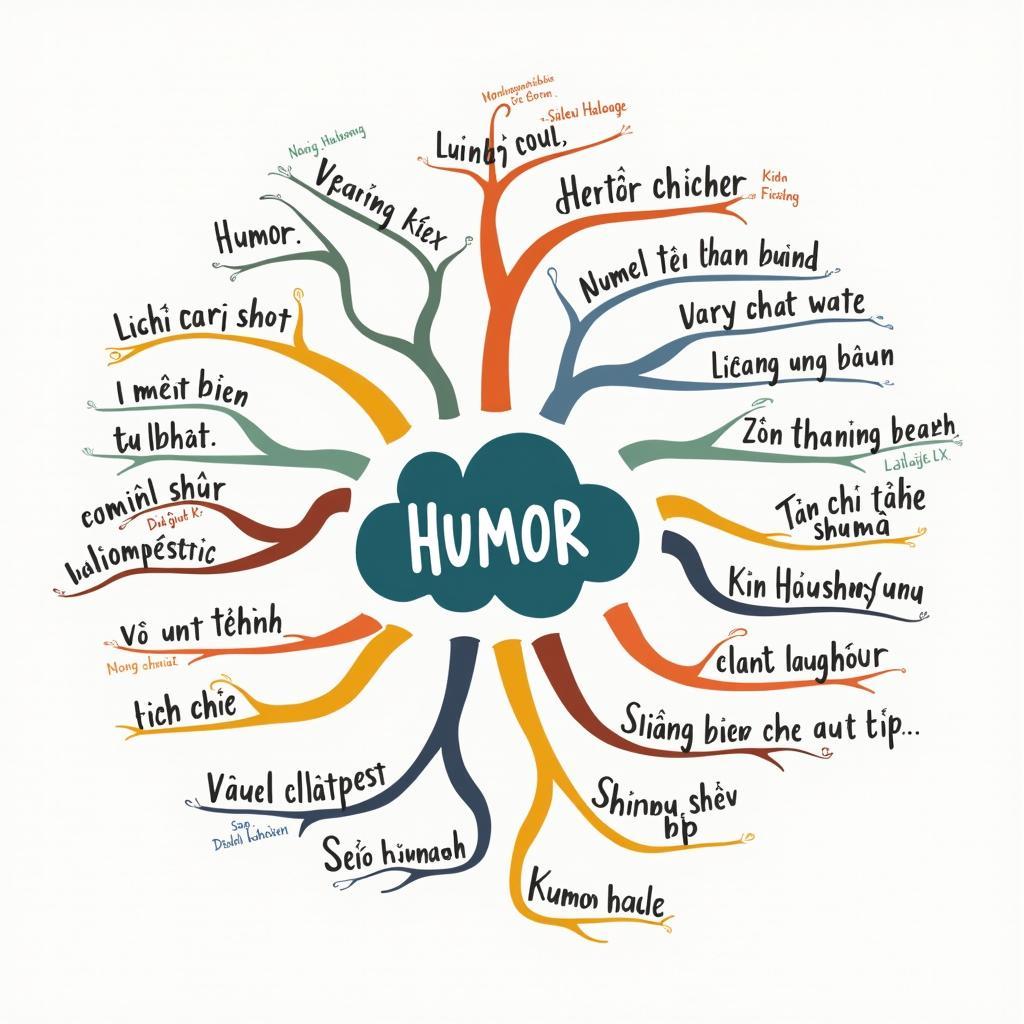 Sơ đồ tư duy từ vựng về chủ đề hài hước và cười trong IELTS Speaking
Chiến Lược Trả Lời Tối Ưu Cho Band 8+
Cấu Trúc PREP Framework
Đây là framework hiệu quả giúp bạn organize ideas nhanh chóng trong 1 phút chuẩn bị:
P – Point: Trả lời trực tiếp câu hỏi
R – Reason: Đưa ra lý do
E – Example: Ví dụ cụ thể
P – Personal touch: Liên hệ bản thân hoặc kết luận
Ví dụ áp dụng:
- Question: “Do you think laughter is important?”
- Point: “Absolutely, laughter is essential for well-being.”
- Reason: “It reduces stress and strengthens relationships.”
- Example: “Research shows it releases endorphins…”
- Personal: “In my experience, shared laughter has deepened my friendships significantly.”
Kỹ Thuật Mở Rộng Câu Trả Lời
1. Add reasons/explanations:
- Because/Since/As/Due to the fact that…
- This is primarily because…
- The main reason is that…
2. Add examples:
- For instance/For example
- Take [X] as an example
- A case in point is…
3. Add contrasts:
- However/Nevertheless/On the other hand
- In contrast to…
- Whereas/While…
4. Add qualifications:
- To some extent
- Generally speaking
- In most cases
Xử Lý Tình Huống Khó
Khi không hiểu câu hỏi:
- “I’m sorry, could you rephrase that question?”
- “Do you mean…?” (paraphrase lại)
- “Just to clarify, are you asking about…?”
Khi cần thời gian suy nghĩ:
- “That’s an interesting question. Let me think…”
- “Well, I’ve never really thought about it before, but…”
- “That’s quite a complex issue…”
Khi không có ý tưởng:
- Relate to something similar: “I haven’t experienced exactly that, but something similar…”
- Be honest: “To be honest, I don’t have strong opinions on this, but I suppose…”
- Generalize: “I think most people would agree that…”
Khi mắc lỗi:
- Self-correct naturally: “I mean… / What I meant to say was…”
- Don’t apologize repeatedly
- Continue confidently
Tips Từ Examiner
Những điều examiner muốn thấy:
- Natural communication – Không giống đang đọc script
- Spontaneity – Phản ứng tự nhiên, không quá rehearsed
- Personality – Để bản thân thể hiện qua cách nói
- Genuine engagement – Thực sự suy nghĩ về câu hỏi
- Appropriate responses – Trả lời đúng trọng tâm
Những điều khiến điểm bị giảm:
- ❌ Memorized answers – Nghe như đang thuộc bài
- ❌ Off-topic responses – Nói không đúng câu hỏi
- ❌ Overly short answers – Quá ngắn, không elaborate
- ❌ Repetitive vocabulary – Lặp từ liên tục
- ❌ Long pauses – Im lặng quá lâu giữa câu
Body language quan trọng:
- Maintain eye contact (nhìn vào examiner tự nhiên)
- Smile when appropriate (đặc biệt khi nói về funny topics)
- Sit comfortably, không quá stiff
- Use hand gestures naturally (không quá nhiều)
- Show enthusiasm through facial expressions
Lỗi Phổ Biến Của Thí Sinh Việt Nam
1. Phát âm:
- Confusion: /l/ và /n/ (laugh/lanh)
- Ending sounds: không phát âm âm cuối (laugh/lau)
- Word stress: humor (HU-mor không phải hu-MOR)
2. Ngữ pháp:
- Quên “-s” thứ ba số ít: “He laugh” → “He laughs”
- Lẫn thì: Kể story quá khứ nhưng dùng hiện tại
- Articles: “The laughter” vs. “Laughter” (uncountable)
3. Từ vựng:
- Overuse “very”: very funny → hilarious/side-splitting
- Literal translation: “mất hình tượng” → “lose image” (nên dùng: embarrassing/undignified)
- Wrong collocation: “make laugh” → “make someone laugh” (cần object)
4. Cấu trúc câu:
- Câu quá đơn giản: “It was funny. Everyone laughed.” → “It was so hilarious that everyone burst out laughing.”
- Thiếu linking: Nhảy từ ý này sang ý khác không có transition
Lộ Trình Luyện Tập Hiệu Quả
Tuần 1-2: Foundation Building
Mục tiêu: Làm quen với format và xây dựng vocabulary base
Ngày 1-3:
- Học 10 từ vựng mới mỗi ngày từ topic vocabulary list
- Record bản thân đọc pronunciation và check lại
- Viết 5 câu ví dụ cho mỗi từ
Ngày 4-7:
- Luyện trả lời 3 câu Part 1 mỗi ngày
- Record và tự nghe lại
- Identify các lỗi phát âm và grammar
- Practice với 1 cue card, note ideas trong 1 phút
Ngày 8-14:
- Nói Part 2 hoàn chỉnh 2-3 phút mỗi ngày
- Luyện 2 câu Part 3 với extended answers
- Bắt đầu track các collocations và idioms
Tuần 3-4: Skills Development
Mục tiêu: Improve fluency và sophisticated language use
Practice activities:
- Shadowing native speakers trên YouTube (mimic rhythm và intonation)
- Record 1 complete speaking test mỗi tuần
- Exchange recordings với study partners để feedback
- Practice thinking in English (not translate from Vietnamese)
Specific exercises:
- Paraphrase practice: Nói lại cùng ý bằng 3 cách khác nhau
- Extension drill: Từ 1 câu trả lời, extend thành 3-4 câu
- Replacement exercise: Thay basic words bằng advanced alternatives
Tuần 5-6: Refinement and Mock Tests
Mục tiêu: Fine-tune performance và build confidence
Activities:
- 2-3 mock tests với timing chính xác
- Focus on transition smoothness giữa các parts
- Practice handling unexpected questions
- Work on eliminating long pauses
Self-evaluation checklist:
- ✅ Có trả lời đủ thời gian không? (Part 2 ít nhất 1:45)
- ✅ Có dùng được sophisticated vocabulary không?
- ✅ Grammar có chính xác không?
- ✅ Có sounds natural không hay quá rehearsed?
- ✅ Pronunciation có clear không?
Một ví dụ về describe a place where you go to de-stress cho thấy cách áp dụng từ vựng cảm xúc và miêu tả địa điểm hiệu quả.
Resources Hữu Ích
YouTube Channels chất lượng:
- IELTS Liz – Chi tiết về scoring criteria
- E2 IELTS – Method và strategies
- IELTS Advantage – Band 9 sample answers
Podcasts để cải thiện listening và pronunciation:
- BBC Radio Comedy
- The Moth (storytelling)
- TED Talks Daily
Apps hữu ích:
- ELSA Speak – Practice pronunciation
- HelloTalk – Practice với native speakers
- Anki – Flashcards cho vocabulary
Practice partners:
- Tìm study groups trên Facebook IELTS Vietnam
- iTalki – Book sessions với tutors
- Language exchange meetups
Kết Luận
Chủ đề “Describe an event that made you laugh a lot” là một trong những đề tài thú vị và accessible trong IELTS Speaking, nhưng để đạt band điểm cao, bạn cần:
Về content:
- Chọn story có genuine emotional impact
- Include vivid details khiến story come alive
- Explain why funny từ multiple angles
- Show personality qua cách kể chuyện
Về language:
- Sử dụng topic-specific vocabulary chính xác
- Incorporate idiomatic expressions naturally
- Demonstrate grammatical range với complex structures
- Maintain fluency với appropriate discourse markers
Về delivery:
- Speak với natural rhythm và intonation
- Show enthusiasm phù hợp với joyful topic
- Make eye contact và engage với examiner
- Control timing – đủ dài nhưng không rambling
Hãy nhớ rằng IELTS Speaking không chỉ test English proficiency mà còn communication ability. Examiner muốn thấy bạn có thể express ideas clearly, engage in meaningful discussion, và demonstrate personality through language. Chủ đề về laughter là perfect opportunity để show these qualities.
Với preparation đúng cách theo hướng dẫn trong bài viết này, kết hợp với regular practice và genuine effort để improve, bạn hoàn toàn có thể đạt được band điểm mục tiêu. Chúc bạn thành công trong kỳ thi IELTS Speaking sắp tới!