
Chủ đề “Describe An Event That You Are Looking Forward To” là một trong những đề tài phổ biến và thực tế nhất trong kỳ thi IELTS Speaking. Với tư cách là một examiner có hơn 20 năm kinh nghiệm chấm thi IELTS, tôi nhận thấy đây là câu hỏi xuất hiện thường xuyên trong các kỳ thi từ năm 2020 đến nay, đặc biệt tập trung vào Part 2 và được mở rộng trong Part 3.
Theo thống kê từ các nguồn IELTS-Simon.com và ielts-blog.com, chủ đề về “future events” và “expectations” xuất hiện với tần suất cao trong khoảng 15-20% các đề thi thực tế. Dự đoán khả năng xuất hiện trong tương lai vẫn ở mức cao do tính practical và khả năng đánh giá toàn diện kỹ năng của thí sinh.
Trong bài viết này, bạn sẽ học được cách trả lời chủ đề này một cách tự nhiên và ấn tượng qua các nội dung sau: Câu hỏi thường gặp trong cả 3 Part của bài thi Speaking, bài mẫu chi tiết theo từng band điểm từ 6.0 đến 9.0 với phân tích cụ thể, kho từ vựng và cụm từ ăn điểm được sử dụng bởi các thí sinh đạt điểm cao, chiến lược trả lời hiệu quả dựa trên kinh nghiệm chấm thi thực tế, cũng như những lời khuyên quý báu từ góc nhìn của một examiner chính thức.
IELTS Speaking Part 1: Introduction and Interview
Tổng Quan Về Part 1
Part 1 của IELTS Speaking kéo dài khoảng 4-5 phút, trong đó examiner sẽ hỏi các câu hỏi ngắn về cuộc sống hàng ngày, sở thích, công việc, gia đình và các chủ đề quen thuộc. Đặc điểm chính của Part 1 là câu hỏi đơn giản, thân thiện và không đòi hỏi suy nghĩ quá sâu.
Chiến lược hiệu quả nhất là trả lời trực tiếp câu hỏi trong 2-3 câu, bao gồm: câu trả lời chính, lý do hoặc giải thích, và một ví dụ cụ thể nếu có thể. Tránh trả lời quá dài hoặc quá ngắn gọn.
Các lỗi thường gặp của học viên Việt Nam bao gồm: Trả lời chỉ “Yes” hoặc “No” mà không mở rộng ý, sử dụng từ vựng quá đơn giản như “good”, “bad”, “like”, “don’t like”, thiếu ví dụ cụ thể từ trải nghiệm bản thân, và nói quá nhanh hoặc quá chậm do lo lắng.
Các Câu Hỏi Thường Gặp
Question 1: Do you usually look forward to special events?
Question 2: What kind of events do people in your country celebrate?
Question 3: How do you usually prepare for important events?
Question 4: Do you prefer to plan events in advance or be spontaneous?
Question 5: What was the last event you looked forward to?
Question 6: Do you think it’s important to have things to look forward to?
Question 7: How do you feel when an event you’re looking forward to gets cancelled?
Question 8: Are there any traditional events in your culture that you particularly enjoy?
Phân Tích và Gợi Ý Trả Lời Chi Tiết
Question: Do you usually look forward to special events?
🎯 Cách tiếp cận:
- Trả lời Yes/No một cách rõ ràng
- Đưa ra lý do tại sao bạn có thái độ đó
- Thêm ví dụ về loại sự kiện bạn mong đợi
📝 Sample Answer – Band 6-7:
Yes, I do. I usually look forward to special events because they give me something exciting to think about. For example, I always feel happy when my birthday is coming because I can meet my friends and family.
Phân tích:
- Điểm mạnh: Trả lời trực tiếp câu hỏi, có lý do đơn giản và một ví dụ cụ thể
- Hạn chế: Từ vựng còn basic (happy, exciting), cấu trúc câu đơn giản, thiếu chi tiết về cảm xúc
- Tại sao Band 6-7: Đáp ứng yêu cầu cơ bản nhưng chưa thể hiện được lexical range và grammatical complexity
📝 Sample Answer – Band 8-9:
Absolutely! I’m definitely the type of person who thrives on anticipation. Special events give me something to look forward to, which really brightens up my daily routine. For instance, I’m currently counting down the days to my best friend’s wedding next month, and just thinking about it lifts my spirits whenever I’m having a tough day at work.
Phân tích:
- Điểm mạnh: Sử dụng phrasal verbs và idioms tự nhiên (thrives on, look forward to, brightens up, counting down, lifts my spirits), cấu trúc câu phức tạp với relative clauses, thể hiện personality rõ ràng
- Tại sao Band 8-9: Vocabulary sophisticated và natural, grammar đa dạng, ideas được develop tốt với specific example, pronunciation flows naturally
💡 Key Vocabulary & Expressions:
- thrive on anticipation: tận hưởng cảm giác mong đợi
- brighten up: làm sáng bừng, làm vui vẻ hơn
- count down the days: đếm ngược từng ngày
- lift one’s spirits: làm tâm trạng tốt lên
Question: How do you usually prepare for important events?
🎯 Cách tiếp cận:
- Mô tả quy trình chuẩn bị của bạn
- Đưa ra các bước cụ thể
- Giải thích tại sao bạn chuẩn bị theo cách đó
📝 Sample Answer – Band 6-7:
I usually prepare carefully for important events. First, I make a list of things I need to do. Then I buy new clothes if necessary and prepare gifts. I try to finish everything a few days before the event so I don’t feel stressed.
Phân tích:
- Điểm mạnh: Có structure rõ ràng (First, Then), đưa ra các bước cụ thể
- Hạn chế: Vocabulary basic (buy, prepare, finish), thiếu detail về feelings và personal touch
- Tại sao Band 6-7: Clear communication nhưng lacks sophistication trong vocabulary và grammar
📝 Sample Answer – Band 8-9:
Well, I’m quite meticulous when it comes to getting ready for significant occasions. I typically draw up a checklist well in advance, usually a couple of weeks beforehand, breaking down all the necessary tasks like sorting out my outfit, arranging transportation, and picking up an appropriate gift. I find this systematic approach really takes the pressure off because I’m not scrambling at the last minute. Plus, it allows me to actually savor the anticipation rather than feeling overwhelmed.
Phân tích:
- Điểm mạnh: Vocabulary precise và sophisticated (meticulous, draw up a checklist, breaking down, systematic approach), sử dụng nhiều phrasal verbs natural (sorting out, picking up, takes the pressure off, scrambling), grammar complex với participles và clauses
- Tại sao Band 8-9: Demonstrates full operational command với fluent, natural language; ideas well-developed với clear reasoning
💡 Key Vocabulary & Expressions:
- meticulous: tỉ mỉ, cẩn thận
- draw up a checklist: lập danh sách kiểm tra
- break down: chia nhỏ (công việc)
- take the pressure off: giảm áp lực
- scramble at the last minute: vội vàng phút chót
- savor the anticipation: tận hưởng sự mong đợi
Question: Do you think it’s important to have things to look forward to?
🎯 Cách tiếp cận:
- Đưa ra opinion rõ ràng (Yes/No + qualification)
- Giải thích psychological benefits
- Có thể so sánh với situation không có gì để mong đợi
📝 Sample Answer – Band 6-7:
Yes, I think it’s very important. When we have something to look forward to, we feel more motivated in our daily life. It gives us a reason to work hard and stay positive. Without future plans, life can become boring and repetitive.
Phân tích:
- Điểm mạnh: Opinion clear, có reasoning logic, compare hai situation
- Hạn chế: Vocabulary general (motivated, positive, boring), thiếu personal insight hoặc sophisticated explanation
- Tại sao Band 6-7: Adequate response nhưng lacks depth và sophisticated language
📝 Sample Answer – Band 8-9:
Absolutely, I’d say it’s crucial for our mental well-being. Having something on the horizon gives us a sense of purpose and keeps us going during challenging times. It’s like having a light at the end of the tunnel – it sustains our motivation and helps us push through difficult periods. Without anything to work towards, life can feel rather monotonous and we might lose our sense of direction. I think that’s why psychologists often recommend setting goals and planning experiences – it nurtures optimism and gives our lives more meaning.
Phân tích:
- Điểm mạnh: Sophisticated vocabulary (crucial, mental well-being, on the horizon, monotonous), natural idioms (light at the end of the tunnel), references expert opinion (psychologists), shows deep understanding với complex reasoning
- Tại sao Band 8-9: Demonstrates sophisticated control of language, idiomatic usage, và ability to discuss abstract concepts naturally
💡 Key Vocabulary & Expressions:
- crucial: cực kỳ quan trọng
- mental well-being: sức khỏe tinh thần
- on the horizon: sắp tới, trong tương lai
- light at the end of the tunnel: ánh sáng cuối con đường (hy vọng)
- sustain one’s motivation: duy trì động lực
- monotonous: đơn điệu
- nurture optimism: nuôi dưỡng sự lạc quan
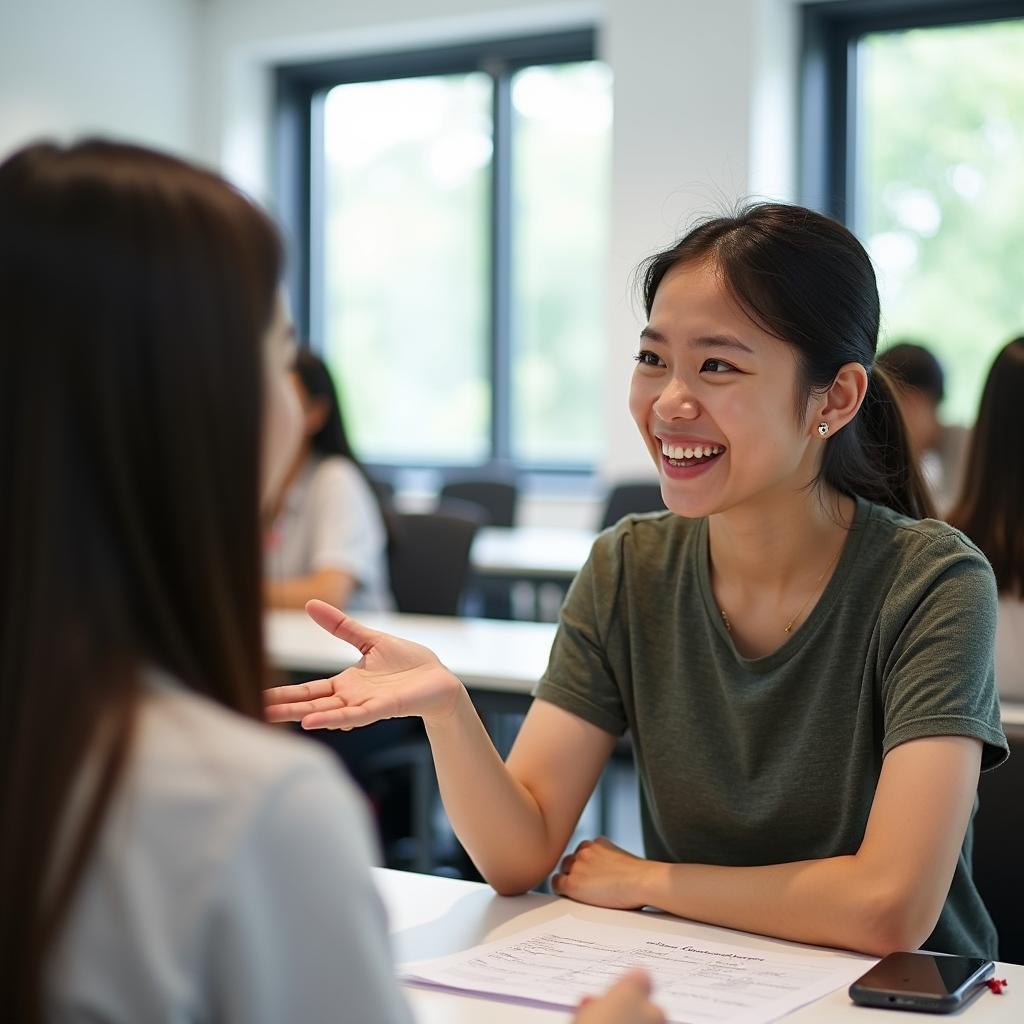 Học viên Việt Nam đang luyện tập IELTS Speaking Part 1 về chủ đề sự kiện mong đợi với giáo viên
IELTS Speaking Part 2: Long Turn (Cue Card)
Tổng Quan Về Part 2
Part 2 của IELTS Speaking là phần độc thoại kéo dài 2-3 phút, trong đó bạn sẽ có 1 phút chuẩn bị với giấy và bút để ghi chú. Đây là phần đòi hỏi khả năng duy trì câu chuyện liên tục mà không bị examiner ngắt lời.
Chiến lược hiệu quả: Sử dụng đủ 1 phút chuẩn bị để ghi các từ khóa quan trọng, không viết câu hoàn chỉnh. Hãy ghi theo structure của đề bài với các bullet points. Nói đủ 2 phút là lý tưởng, tối thiểu 1.5 phút để tránh bị mất điểm. Trả lời đầy đủ tất cả các yêu cầu trong đề bài, đặc biệt chú ý đến câu “explain” cuối cùng vì đây là phần ghi điểm cao. Sử dụng thì động từ phù hợp: thường là tương lai khi nói về sự kiện chưa xảy ra.
Các lỗi thường gặp của thí sinh Việt Nam: Không tận dụng hết 1 phút chuẩn bị, dẫn đến bài nói thiếu organization. Nói dưới 1.5 phút hoặc dừng đột ngột vì hết ý. Bỏ sót một hoặc nhiều bullet points, đặc biệt là phần “explain”. Không sử dụng discourse markers để kết nối ý. Nói quá monotone, thiếu enthusiasm khi mô tả sự kiện mong đợi.
Cue Card
Describe an event that you are looking forward to
You should say:
- What the event is
- When and where it will take place
- Who you will be with
- And explain why you are looking forward to this event
Phân Tích Đề Bài
Dạng câu hỏi: Describe an event (future) – mô tả một sự kiện trong tương lai
Thì động từ: Future tenses (will, be going to, present continuous for future arrangements)
Bullet points phải cover:
- What the event is: Xác định rõ sự kiện gì (concert, wedding, graduation, trip, festival, celebration)
- When and where: Thời gian cụ thể (next month, in summer) và địa điểm (city, venue, country)
- Who you will be with: Người đi cùng (family, friends, alone, colleagues)
- And explain why: Đây là phần quan trọng nhất, cần giải thích cảm xúc, lý do personal, significance của sự kiện
Câu “explain” quan trọng: Phần này chiếm khoảng 40% thời gian nói và là nơi thể hiện depth of thinking. Hãy nói về emotional connection, personal significance, expectations, và impact mà sự kiện này có thể mang lại cho bạn.
📝 Sample Answer – Band 6-7
Thời lượng: Khoảng 1.5-2 phút
Well, I’d like to talk about my cousin’s wedding that will happen next month. It’s going to take place in Ho Chi Minh City, at a big hotel in District 1.
The wedding is scheduled for the last weekend of next month, I think it’s on Saturday evening. My whole family will be there, including my parents, grandparents, aunts, uncles, and many cousins. It will be a big gathering because my cousin has many friends too.
I’m really looking forward to this event for several reasons. First, I haven’t seen many of my relatives for a long time because everyone is busy with work. This wedding will be a great chance to catch up with them and hear about their lives. Second, my cousin and I were very close when we were children, so I’m happy to see her getting married to someone she loves.
Also, I’m excited about the food because Vietnamese weddings usually have very delicious meals with many courses. The hotel is famous for its cuisine, so I expect the food will be excellent. Besides that, I’m looking forward to the atmosphere of celebration and happiness. Weddings always make me feel emotional and remind me about the importance of family.
Another reason is that I bought a new dress especially for this occasion, and I’m excited to wear it. I spent a lot of time choosing it, and I think it will look nice in photos. Overall, I really can’t wait for this wedding to come.
Phân Tích Band Điểm
| Tiêu chí | Band | Nhận xét |
|---|---|---|
| Fluency & Coherence | 6-7 | Nói liên tục được 1.5-2 phút, có một số hesitation nhẹ. Sử dụng basic connectors (First, Second, Also, Besides that). Structure rõ ràng nhưng còn đơn giản |
| Lexical Resource | 6-7 | Từ vựng adequate (big gathering, catch up, atmosphere, occasion) nhưng chưa sophisticated. Có một số collocations tốt (scheduled for, looking forward to) nhưng còn lặp lại từ (big, happy) |
| Grammatical Range & Accuracy | 6-7 | Mix của simple và complex sentences. Sử dụng đúng future tenses. Có một số lỗi nhỏ không ảnh hưởng communication (think it’s on Saturday có thể precise hơn) |
| Pronunciation | 6-7 | Clear và understandable. Có thể có một số Vietnamese accent nhưng không gây khó hiểu |
Điểm mạnh:
- ✅ Trả lời đầy đủ tất cả bullet points
- ✅ Có structure logic và dễ follow
- ✅ Đưa ra nhiều reasons cho phần explain
- ✅ Có personal details (dress, childhood memories)
Hạn chế:
- ⚠️ Vocabulary còn basic, thiếu sophistication
- ⚠️ Grammar structures chưa đa dạng
- ⚠️ Thiếu emotional depth trong phần explain
- ⚠️ Có thể develop ideas sâu hơn
📝 Sample Answer – Band 7.5-8
Thời lượng: Khoảng 2-2.5 phút
I’d like to describe a music festival that I’m absolutely thrilled about, which is coming up in about two months’ time. It’s the annual Monsoon Music Festival, one of the most highly anticipated events in Vietnam’s entertainment calendar.
The festival is scheduled to take place over three days in early November at the National Convention Center in Hanoi. It’s quite a massive venue, which is perfect because this festival typically draws thousands of music enthusiasts from all over the country. I’ll be attending with my closest friends – a group of five of us who’ve been bonding over our shared love of live music for years now.
What makes this particularly exciting is the lineup this year. They’ve secured some incredible international artists alongside popular Vietnamese bands. The headliner is a British indie rock band that I’ve been following since my university days, and I never thought I’d have the chance to see them perform in the flesh. Beyond just the music, the festival is known for its vibrant atmosphere – there’ll be food stalls offering diverse cuisines, art installations, and various interactive experiences.
Now, regarding why I’m so eager for this event, there are several compelling reasons. First and foremost, live music has this incredible energy that you simply can’t replicate through recordings or streaming. There’s something magical about being surrounded by thousands of people who share your passion, all singing along to songs that mean something to you. It creates this sense of connection that’s quite profound.
Secondly, this festival represents a much-needed break from my routine. I’ve been caught up in work pressures for months, and this event gives me something to look forward to during particularly challenging days. It’s like having a light at the end of the tunnel – just thinking about it helps me stay motivated.
Moreover, attending with my friends makes it even more special. We’ve been planning this trip for weeks, coordinating our schedules and making arrangements. The anticipation itself has already strengthened our friendship, and I know we’ll create memories that will last a lifetime.
Phân Tích Band Điểm
| Tiêu chí | Band | Nhận xét |
|---|---|---|
| Fluency & Coherence | 7.5-8 | Speaks at length without noticeable effort. Good use of cohesive devices (First and foremost, Secondly, Moreover). Ideas well-organized and developed logically |
| Lexical Resource | 7.5-8 | Wide range of vocabulary (thrilled, highly anticipated, draws, bonding over, in the flesh, compelling reasons). Natural collocations và idiomatic language. Paraphrasing skills evident |
| Grammatical Range & Accuracy | 7.5-8 | Wide range of structures (present perfect, relative clauses, participles). Mostly error-free. Complex sentences used appropriately |
| Pronunciation | 7.5-8 | Easy to understand throughout, với native-like intonation patterns. Stress và rhythm effective |
So Sánh Với Band 6-7
| Khía cạnh | Band 6-7 | Band 7.5-8 |
|---|---|---|
| Vocabulary | “happy to see her”, “delicious meals” | “absolutely thrilled”, “highly anticipated”, “diverse cuisines” |
| Grammar | “I’m really looking forward to…” (present continuous) | “It creates this sense of connection that’s quite profound” (complex structure) |
| Ideas | “Great chance to catch up” | “The anticipation itself has already strengthened our friendship” (deeper insight) |
📝 Sample Answer – Band 8.5-9
Thời lượng: 2.5-3 phút đầy đủ
I’d like to talk about an event that’s been occupying my thoughts quite a lot lately – it’s actually my younger sister’s graduation ceremony from medical school, which is slated for this coming June. This is something that holds tremendous significance not just for her, but for our entire family.
The ceremony is set to take place at the National University’s main auditorium, a rather grand venue with a rich history of hosting such momentous occasions. It’s scheduled for a Saturday morning in mid-June, and naturally, my whole immediate family will be in attendance – my parents, who are beside themselves with pride, my older brother, who’s flying in from Singapore specifically for this, and myself, of course.
What makes this event particularly meaningful to me is the journey that led to this moment. My sister has dedicated the past six years to her medical studies, and I’ve witnessed firsthand the sacrifices she’s made and the obstacles she’s overcome. There were times when she was struggling with the overwhelming workload, pulling all-nighters before exams, and even questioning whether she’d made the right career choice. But she persevered, and seeing her reach this milestone is genuinely inspiring.
The event itself resonates with me on multiple levels. From a personal standpoint, my sister and I share an incredibly close bond – she’s not just my sibling but also my best friend and confidante. Throughout her medical school years, I’ve tried to be her pillar of support, listening to her concerns, celebrating her small victories, and helping her maintain perspective during difficult times. This graduation represents the culmination of those years, and I feel a deep sense of shared achievement.
From a family perspective, this ceremony symbolizes the realization of my parents’ dreams. They’re first-generation immigrants who worked tirelessly to provide us with opportunities they never had. My mother often reminisces about how she had to abandon her own educational aspirations due to financial constraints, so watching her daughter become a doctor is incredibly poignant – it’s almost as if she’s living vicariously through my sister’s success.
Beyond the personal significance, I’m also looking forward to the atmosphere of the occasion itself. Graduation ceremonies have this unique blend of solemnity and jubilation – there’s a palpable sense of achievement mixed with the bittersweet realization that a chapter is closing. The traditional cap-and-gown ritual, the processional music, the speeches from distinguished faculty members – all these elements contribute to creating a memorable experience that marks an important transition in one’s life.
What’s more, this event serves as a reminder of the value of perseverance and dedication. In an era where instant gratification is the norm and many people hop from one thing to another without seeing things through, my sister’s journey stands as a testament to the rewards of staying the course. It reinforces my own belief that meaningful achievements require time, effort, and unwavering commitment.
I also anticipate that the day will be emotionally charged – I’m quite certain there’ll be tears, both of joy and perhaps nostalgia for the years gone by. These genuine emotional moments, when shared with loved ones, are what make life truly rich and memorable.
Phân Tích Band Điểm
| Tiêu chí | Band | Nhận xét |
|---|---|---|
| Fluency & Coherence | 8.5-9 | Speaks fluently với only very occasional repetition or self-correction. Coherence fully maintained. Sophisticated use của cohesive devices. Develops topics fully và appropriately |
| Lexical Resource | 8.5-9 | Uses vocabulary với full flexibility và precision. Idiomatic language natural (beside themselves with pride, living vicariously, stands as a testament to). Sophisticated collocations throughout |
| Grammatical Range & Accuracy | 8.5-9 | Full range of structures used naturally và appropriately. Consistently produces error-free sentences với only very occasional inappropriacy |
| Pronunciation | 8.5-9 | Uses a full range of pronunciation features với precision và subtlety. Sustained flexible use và fully comprehensible |
Tại Sao Bài Này Xuất Sắc
🎯 Fluency Hoàn Hảo:
Bài nói duy trì được 2.5-3 phút một cách natural, không có hesitation đáng kể. Candidate demonstrates ability to speak at length và develop ideas fully without prompting.
📚 Vocabulary Tinh Vi:
- “occupying my thoughts” – sophisticated alternative cho “thinking about”
- “holds tremendous significance” – formal và precise hơn “very important”
- “beside themselves with pride” – idiom natural thể hiện emotion
- “living vicariously through” – complex expression showing deep understanding
- “stands as a testament to” – sophisticated phrase cho “proves”
📝 Grammar Đa Dạng:
- Complex conditionals: “it’s almost as if she’s living vicariously”
- Relative clauses: “my mother, who often reminisces about…”
- Participle phrases: “watching her daughter become a doctor is incredibly poignant”
- Perfect tenses: “has been occupying”, “has dedicated”, “I’ve witnessed”
- Passive constructions: “is slated for”, “is set to take place”
💡 Ideas Sâu Sắc:
Không chỉ describe surface details mà explore emotional depth, personal significance, family dynamics, và broader social context. Demonstrates ability to discuss abstract concepts naturally (perseverance, achievement, transition) while maintaining personal connection to topic.
Follow-up Questions (Rounding Off Questions)
Question 1: Have you already started preparing for this event?
Band 6-7 Answer:
Yes, I have. I’ve already bought a nice dress to wear and I’m planning to buy a gift for my sister soon. I’m also trying to finish my work early so I can take a day off.
Band 8-9 Answer:
Absolutely. I’ve been making arrangements for several weeks now – I’ve secured time off work, booked a hotel room since we’ll be coming from out of town, and I’ve commissioned a personalized gift for my sister. I’m also coordinating with other family members to organize a surprise celebration dinner afterwards.
Question 2: Do you think the event will meet your expectations?
Band 6-7 Answer:
I think so. My sister has worked very hard, so the ceremony will definitely be meaningful. I hope everything goes smoothly and we can take nice photos together.
Band 8-9 Answer:
I’m quite confident it will exceed them, actually. Beyond the ceremony itself, it’s really about witnessing this pivotal moment in my sister’s life and sharing in the collective joy of our family. Even if there are logistical hiccups – which inevitably happen at large events – the emotional significance of the occasion will more than compensate for any minor inconveniences.
 Thí sinh tự tin trình bày bài nói IELTS Speaking Part 2 về sự kiện đặc biệt trong tương lai
IELTS Speaking Part 3: Two-way Discussion
Tổng Quan Về Part 3
Part 3 của IELTS Speaking kéo dài 4-5 phút và là phần thảo luận sâu về các khía cạnh rộng hơn liên quan đến chủ đề Part 2. Đây là phần khó nhất và cũng là phần phân biệt thí sinh band 7 với band 8-9.
Đặc điểm của Part 3: Câu hỏi trừu tượng hơn, đòi hỏi phân tích, so sánh, đưa ra quan điểm có lý lẽ. Examiner muốn thấy khả năng thảo luận về issues rộng hơn personal experience, ability to consider different perspectives, và critical thinking.
Yêu cầu cụ thể: Phân tích causes và effects, so sánh past và present hoặc different groups, đánh giá advantages và disadvantages, dự đoán future trends, giải thích social phenomena, đưa ra solutions cho problems.
Chiến lược hiệu quả: Mở rộng câu trả lời đến 3-5 câu với clear structure. Sử dụng discourse markers để signal direction của discussion. Đưa ra examples từ society, research, hoặc different countries, không chỉ personal experience. Thừa nhận complexity của issue bằng phrases như “it depends”, “there are multiple factors”, “on the one hand… on the other hand”. Maintain formal register phù hợp với academic discussion.
Các lỗi thường gặp của học viên Việt Nam: Trả lời quá ngắn như Part 1, thiếu analysis và explanation. Không đưa ra clear position hoặc lý lẽ support opinion. Thiếu từ vựng abstract và academic để discuss complex topics. Chỉ nói về personal experience thay vì broader social context. Không acknowledge different viewpoints.
Các Câu Hỏi Thảo Luận Sâu
Theme 1: Social and Cultural Aspects of Events
Question 1: Why do you think people enjoy celebrating special events?
🎯 Phân tích câu hỏi:
- Dạng: Cause/Reason question – giải thích psychological và social motivations
- Key words: “enjoy”, “celebrating”, “special events” – focus vào emotional và social benefits
- Cách tiếp cận: Direct answer về main reasons → Explain psychological benefits → Social functions → Example từ society
📝 Sample Answer – Band 6-7:
People enjoy celebrating special events for many reasons. First, celebrations give them a break from their daily routine and work stress. They can relax and have fun with family and friends. Second, special events create good memories that people can remember later in life. Also, celebrations bring people together and strengthen relationships. For example, during Tet holiday in Vietnam, families gather and spend quality time together, which makes everyone feel happy and connected.
Phân tích:
- Structure: Có basic organization với First, Second, Also
- Vocabulary: Adequate nhưng general (break, relax, have fun, good memories)
- Tại sao Band 6-7: Clear communication với relevant ideas nhưng lacks depth và sophisticated language. Example appropriate nhưng analysis could be deeper.
📝 Câu trả lời mẫu – Band 8-9:
Well, I think there are several interrelated factors that explain why celebrations hold such appeal for people. First and foremost, special events provide a psychological respite from the monotony of everyday life. They offer what psychologists call “positive anticipation” – having something to look forward to actually triggers the release of dopamine in our brains, which elevates our mood even before the event occurs.
Beyond the individual benefits, celebrations serve crucial social functions. They act as social glue, bringing communities together and reinforcing bonds between people. When we partake in collective celebrations, we’re engaging in what sociologists call “collective effervescence” – a shared emotional experience that fosters a sense of belonging and solidarity. This is particularly evident in large-scale events like national holidays or cultural festivals, where entire communities come together in unified celebration.
Moreover, I’d argue that celebrations provide a sense of continuity and cultural identity. When we observe traditional events that have been passed down through generations, we’re maintaining a connection to our heritage and affirming our cultural values. For instance, the way Vietnamese families meticulously prepare for Tet – from cleaning their homes to preparing traditional dishes – isn’t just about the celebration itself; it’s about preserving and transmitting cultural practices to younger generations.
Phân tích:
- Structure: Sophisticated organization: Psychological aspect → Social functions → Cultural significance, với clear signposting
- Vocabulary: Highly sophisticated (interrelated factors, psychological respite, monotony, collective effervescence, solidarity, meticulously)
- Grammar: Complex structures including relative clauses, participles, và academic expressions
- Critical Thinking: Shows deep understanding với reference to psychology và sociology, acknowledges multiple dimensions của issue
💡 Key Language Features:
- Discourse markers: “Well”, “First and foremost”, “Beyond”, “Moreover”, “For instance”
- Tentative language: “I think”, “I’d argue that”
- Abstract nouns: “anticipation”, “continuity”, “solidarity”, “heritage”
- Academic references: “what psychologists call”, “what sociologists call”
Question 2: How have celebrations changed in your country over the past few decades?
🎯 Phân tích câu hỏi:
- Dạng: Compare Past and Present – đòi hỏi analysis of change over time
- Key words: “changed”, “past few decades” – cần specific comparison
- Cách tiếp cận: Identify main areas of change → Explain causes → Evaluate positive/negative aspects
📝 Sample Answer – Band 6-7:
Celebrations have changed a lot in Vietnam. In the past, people celebrated more simply with their families at home. Now, many people go to restaurants or hotels for celebrations. Also, Western celebrations like Christmas and Valentine’s Day have become popular, especially among young people. Technology has also changed how people celebrate – now everyone takes photos and shares them on social media. Traditional celebrations still exist but they are mixed with modern elements.
Phân tích:
- Structure: Clear comparison between past và present
- Vocabulary: Basic (a lot, simply, popular, modern)
- Tại sao Band 6-7: Covers main points adequately nhưng lacks sophisticated analysis của causes và implications
📝 Câu trả lời mẫu – Band 8-9:
There’s been quite a dramatic transformation in how celebrations are conducted in Vietnam over recent decades, driven by several interconnected factors. Perhaps most notably, there’s been a marked shift from intimate, home-based gatherings to more commercialized and elaborate celebrations. Whereas a generation ago, people would typically celebrate milestone events within the confines of their homes with extended family, nowadays it’s increasingly common to see families hosting celebrations at restaurants, hotels, or specialized event venues.
This shift reflects broader socioeconomic changes. Rising prosperity and urbanization have altered both people’s means and their expectations regarding celebrations. People have more disposable income to invest in elaborate events, and there’s been an emergence of an entire event management industry catering to this demand. Simultaneously, we’ve witnessed the proliferation of Western-influenced celebrations – Christmas, Halloween, Valentine’s Day – which were virtually non-existent in Vietnam a few decades back but are now firmly entrenched in urban culture, particularly among younger generations.
Technology has also fundamentally reshaped the nature of celebrations. The ubiquity of smartphones and social media has transformed events into performative experiences – people aren’t just celebrating for themselves but curating their celebrations for online audiences. This has spawned new phenomena like elaborate photo booths, Instagram-worthy decorations, and the pressure to make events appear picture-perfect on social media platforms.
That said, I wouldn’t characterize these changes as entirely negative or positive. On the one hand, the commercialization has made celebrations more accessible and convenient, relieving families of the burden of extensive preparation. The integration of diverse cultural influences has also enriched our celebratory traditions, making them more cosmopolitan. On the other hand, there’s a valid concern that we’re losing touch with the authenticity and intimate nature of traditional celebrations, replacing genuine connection with superficial displays designed for social media consumption.
Phân tích:
- Structure: Comprehensive analysis: Main changes → Underlying causes → Technology impact → Balanced evaluation
- Vocabulary: Sophisticated và precise (dramatic transformation, marked shift, commercialized, proliferation, ubiquity, performative experiences, cosmopolitan)
- Grammar: Full range of complex structures perfectly controlled
- Critical Thinking: Nuanced discussion acknowledging both positive và negative aspects, với deep understanding of socioeconomic factors
💡 Key Language Features:
- Discourse markers: “Perhaps most notably”, “Whereas”, “Simultaneously”, “That said”, “On the one hand… On the other hand”
- Tentative language: “I wouldn’t characterize”, “there’s a valid concern”
- Time markers: “a generation ago”, “nowadays”, “a few decades back”
- Sophisticated verbs: “reflects”, “altered”, “spawned”, “curating”
Theme 2: Planning and Expectations
Question 1: Do you think it’s better to plan events carefully or be more spontaneous?
🎯 Phân tích câu hỏi:
- Dạng: Opinion/Evaluate – compare two approaches
- Key words: “better”, “plan carefully”, “spontaneous” – yêu cầu balanced view
- Cách tiếp cận: Acknowledge complexity → Discuss benefits của both approaches → Qualify answer with “it depends”
📝 Sample Answer – Band 6-7:
I think both ways have their advantages. Careful planning is good for important events like weddings because you need to prepare many things and avoid problems. But being spontaneous can be more fun for small gatherings with friends because you don’t feel stressed about details. In my opinion, it depends on the type of event and who you’re celebrating with. Big formal events need planning, but casual events can be spontaneous.
Phân tích:
- Structure: Presents both sides và concludes với “it depends”
- Vocabulary: Basic (good, fun, stressed, big, small)
- Tại sao Band 6-7: Adequate reasoning nhưng lacks sophistication và depth
📝 Câu trả lời mẫu – Band 8-9:
Well, I’d say this is one of those questions where a nuanced answer is warranted because the optimal approach really hinges on multiple factors. There’s merit to both meticulously planned events and spontaneous gatherings, and each serves different purposes and suits different contexts.
Meticulous planning certainly has its undeniable advantages, particularly for high-stakes occasions like weddings, corporate functions, or milestone celebrations. When you’ve invested considerable time in planning, you minimize the risk of logistical failures and can ensure that every detail aligns with your vision. This systematic approach provides a sense of control and reduces anxiety, especially for people who find uncertainty stressful. Moreover, for events involving multiple stakeholders or complex logistics – like coordinating venues, catering, entertainment, and guests – thorough planning isn’t just preferable, it’s practically essential.
Conversely, spontaneity has its own unique appeal and can foster more authentic and memorable experiences. Impromptu gatherings often have a relaxed atmosphere that planned events sometimes lack. There’s something liberating about gathering with friends on a whim, without the pressure of living up to preconceived expectations. Some of my most cherished memories come from unplanned moments – last-minute road trips or spontaneous dinners where the lack of structure actually enhanced the genuineness of the experience. Spontaneity also allows for more flexibility and adaptability – you can adjust to circumstances, moods, and emerging opportunities without being constrained by a rigid plan.
That being said, I believe the ideal approach lies somewhere on a spectrum between these two extremes, tailored to the specific context. For significant life events with practical implications – graduations, business conferences, weddings – a solid foundation of planning is non-negotiable. However, even within structured frameworks, there’s room for spontaneous elements that can inject surprise and delight. Conversely, even spontaneous gatherings benefit from minimal planning – knowing who’s coming and having a general idea of activities, even if loosely defined.
Ultimately, I think the best celebrators are those who can strike a balance – having enough structure to ensure things run smoothly while remaining open to the unexpected moments that often become the highlights of any event.
Phân tích:
- Structure: Sophisticated với clear progression: Nuanced introduction → Benefits of planning → Benefits of spontaneity → Synthesis finding middle ground
- Vocabulary: Highly sophisticated (nuanced, warranted, hinges on, meticulous, impromptu, preconceived, non-negotiable, inject)
- Grammar: Complex structures including conditionals, participles, relative clauses used naturally
- Critical Thinking: Demonstrates sophisticated thinking by acknowledging complexity, considering context, và proposing balanced solution
💡 Key Language Features:
- Discourse markers: “Conversely”, “That being said”, “Ultimately”
- Tentative language: “I’d say”, “I believe”, “lies somewhere on a spectrum”
- Qualifying phrases: “particularly for”, “especially for”, “even within”
- Comparative structures: “more authentic”, “less structured”
Question 2: Why do some events fail to meet people’s expectations?
🎯 Phân tích câu hỏi:
- Dạng: Cause/Explanation – identify reasons for disappointment
- Key words: “fail to meet”, “expectations” – focus on gap between anticipation và reality
- Cách tiếp cận: Identify main causes → Explain psychological factors → Provide examples → Possible implications
📝 Sample Answer – Band 6-7:
Events sometimes don’t meet expectations for several reasons. First, people might expect too much and build up the event in their minds, so the reality seems disappointing. Second, poor planning can cause problems like bad weather, delays, or mistakes. Third, sometimes the event itself is good but the person is in a bad mood or tired, so they can’t enjoy it. Also, social media makes people compare their events with others’ perfect photos, which creates unrealistic expectations.
Phân tích:
- Structure: Lists multiple reasons clearly
- Vocabulary: Adequate (expect too much, build up, disappointing, poor planning)
- Tại sao Band 6-7: Covers relevant points nhưng lacks depth trong psychological analysis
📝 Câu trả lời mẫu – Band 8-9:
There are several interrelated factors that can cause events to fall short of expectations, and understanding these can help us manage our anticipation more realistically.
Arguably the most significant factor is what psychologists call the “expectation-reality gap”. When we’re looking forward to something, we tend to engage in what’s known as “affective forecasting” – predicting how we’ll feel in the future. However, research suggests we’re actually quite poor at this. We tend to overestimate the intensity and duration of emotions that events will evoke. We envision an idealized version of the event in our minds, and when reality inevitably falls short of this mental construct, we experience disappointment. This is exacerbated by the extensive anticipation itself – the longer we look forward to something, the more our imagination embellishes it, making the actual experience harder to live up to.
Compounding this issue is the pervasive influence of social media, which has fundamentally altered our relationship with expectations. We’re constantly bombarded with curated highlights of others’ celebrations – perfect photos, glamorous venues, apparently flawless experiences. This creates a distorted baseline for comparison, making our own events seem inadequate by contrast, even when they’re objectively quite good. We’re essentially measuring our reality against others’ carefully edited fiction, which is a recipe for disappointment.
Logistical factors also play a crucial role. Events are complex undertakings involving numerous moving parts – venues, timing, people, weather, and countless other variables. When poor planning results in mishaps – delays, subpar food, uncomfortable venues, or technical glitches – these practical failures can significantly detract from the overall experience. Even well-planned events can be derailed by uncontrollable factors like bad weather or unexpected circumstances.
On a more personal level, our internal state profoundly affects our ability to enjoy events. If we’re preoccupied with stress, fatigue, relationship problems, or health issues, even objectively wonderful events can feel lackluster. Our capacity for enjoyment isn’t solely determined by external circumstances but is heavily influenced by our psychological and physical state at the time.
Moreover, sometimes disappointment stems from a mismatch between the event’s nature and our preferences or values. An extroverted person might thrive at a large, boisterous party, while an introvert might find the same event overwhelming and draining. What constitutes an ideal celebration is highly subjective, yet we sometimes attend or plan events that don’t align with our authentic preferences, perhaps due to social pressure or obligation.
Phân tích:
- Structure: Comprehensive và methodical: Psychological factors → Social media influence → Practical issues → Personal factors → Individual differences
- Vocabulary: Sophisticated academic language (interrelated, affective forecasting, exacerbated, embellishes, pervasive, curated highlights, derailed by)
- Grammar: Full range với perfect control (conditionals, participles, passive constructions, complex noun phrases)
- Critical Thinking: Demonstrates deep understanding với psychological research, multiple perspectives, và nuanced analysis
💡 Key Language Features:
- Discourse markers: “Arguably”, “Compounding this”, “Moreover”, “On a more personal level”
- Academic phrases: “what psychologists call”, “research suggests”, “what’s known as”
- Cause-effect language: “stems from”, “results in”, “caused by”, “influenced by”
 Cuộc thảo luận chuyên sâu IELTS Speaking Part 3 về văn hóa tổ chức sự kiện và kỳ vọng
Theme 3: Future Trends and Social Impact
Question 1: How do you think the way people celebrate events will change in the future?
🎯 Phân tích câu hỏi:
- Dạng: Future prediction/Speculation
- Key words: “in the future”, “will change” – yêu cầu informed speculation
- Cách tiếp cận: Identify current trends → Extrapolate future developments → Consider driving forces (technology, society) → Acknowledge uncertainty
📝 Sample Answer – Band 6-7:
I think celebrations will become more modern and use more technology. Maybe people will use virtual reality to celebrate with friends who live far away. Also, environmental concerns might make people choose eco-friendly celebrations. People might spend more money on experiences rather than gifts. However, I believe traditional celebrations will still exist because they are important for culture. Young people might mix traditional and modern elements in their celebrations.
Phân tích:
- Structure: Several predictions with simple reasoning
- Vocabulary: Basic (modern, far away, eco-friendly, important)
- Tại sao Band 6-7: Adequate predictions nhưng lacks sophistication trong analysis và language
📝 Câu trả lời mẫu – Band 8-9:
This is a fascinating question, and while predicting the future is always fraught with uncertainty, we can identify certain trends that are likely to shape celebrations in the coming decades.
Most prominently, I believe technology will fundamentally transform how we celebrate, particularly in terms of overcoming geographical barriers. We’re already seeing the emergence of hybrid events that blend physical and virtual participation – a trend accelerated by the pandemic. In the future, I envision this becoming even more sophisticated, with technologies like augmented reality and holographic presence allowing people to participate in celebrations almost as if they were physically present, even when they’re halfway across the globe. This could democratize celebrations, making them more inclusive of friends and family who might otherwise be excluded due to distance or mobility constraints.
Sustainability concerns will also likely exert significant influence. As environmental awareness grows, I expect we’ll see a marked shift toward more eco-conscious celebrations. This might manifest in various ways – zero-waste events, plant-based menus, digital invitations replacing paper ones, locally sourced decorations and food, and venues with strong environmental credentials. There’s already a budding movement of “green weddings” and sustainable festivals, and I believe this will transition from niche practice to mainstream expectation.
Interestingly, I think we’ll also witness a paradoxical trend – even as celebrations become more technologically mediated, there might be a counter-movement toward more intimate, authentic, and experience-focused gatherings. People might push back against the performative nature of social media celebrations and seek more genuine connections. We might see smaller, more meaningful gatherings that prioritize quality of interaction over spectacle and Instagram appeal.
The commercialization of celebrations will likely intensify, with the event industry becoming even more specialized and sophisticated. However, this might coexist with a DIY movement as people seek more personalized, budget-conscious alternatives. Online platforms might facilitate this by providing tools, templates, and communities for people planning their own celebrations.
Culturally, I anticipate we’ll see increasingly hybrid celebrations that blend traditions from different cultures, reflecting our increasingly globalized and multicultural societies. Younger generations, growing up with exposure to diverse cultures through media and travel, might cherry-pick elements from various traditions to create unique, personalized celebrations that reflect their individual identities rather than adhering strictly to one cultural tradition.
That said, I don’t think traditional celebrations will disappear entirely. Instead, they’ll likely evolve, incorporating new elements while retaining their core cultural significance. There’s something deeply human about ritual and tradition that transcends technological change, and I believe people will continue to find value in these time-honored practices, even if the execution changes.
Phân tích:
- Structure: Sophisticated với multiple dimensions explored: Technology → Sustainability → Authenticity movement → Commercialization → Cultural hybridity → Tradition preservation
- Vocabulary: Highly sophisticated (fraught with uncertainty, democratize, manifest in, paradoxical trend, coexist with, cherry-pick, time-honored)
- Grammar: Full range of complex structures used flexibly và accurately
- Critical Thinking: Demonstrates sophisticated thinking by identifying contradictory trends, acknowledging uncertainty, và providing nuanced predictions based on current developments
💡 Key Language Features:
- Speculation language: “I believe”, “I envision”, “I expect”, “I anticipate”, “might”, “likely”, “probably”
- Discourse markers: “Most prominently”, “Interestingly”, “That said”, “Culturally”
- Future forms: Mix of “will”, “be going to”, “might”, “likely to” showing nuanced predictions
- Hedging: “potentially”, “possibly”, “to some extent”
Question 2: What role do celebrations play in maintaining cultural traditions?
🎯 Phân tích câu hỏi:
- Dạng: Function/Role analysis – explain social and cultural functions
- Key words: “role”, “maintaining”, “cultural traditions” – focus on preservation function
- Cách tiếp cận: Define the relationship → Explain mechanisms → Provide examples → Consider challenges
📝 Sample Answer – Band 6-7:
Celebrations are very important for keeping cultural traditions alive. When people celebrate traditional festivals, they pass down customs to their children and teach them about their culture. For example, during Tet in Vietnam, children learn about traditional foods, customs, and family values. Celebrations also bring communities together and remind people of their cultural identity. Without these celebrations, young people might forget their traditions because of globalization and Western influence.
Phân tích:
- Structure: Clear main idea với supporting points
- Vocabulary: Adequate (keeping alive, pass down, remind)
- Tại sao Band 6-7: Relevant content nhưng lacks depth và sophisticated analysis
📝 Câu trả lời mẫu – Band 8-9:
Celebrations play an absolutely vital role in cultural preservation, functioning as what anthropologists might call “living repositories” of tradition. They serve multiple interconnected functions that are essential to maintaining and transmitting cultural heritage across generations.
Fundamentally, celebrations act as experiential education – they provide immersive experiences through which cultural knowledge is transmitted, not just intellectually but emotionally and sensorially. When children participate in traditional celebrations, they’re not just learning facts about their culture; they’re internalizing it through multisensory engagement – the tastes of traditional foods, the sounds of ceremonial music, the visual spectacle of traditional dress and decorations, the physical acts of ritual. This embodied learning creates much deeper and more lasting connections to cultural traditions than abstract education could achieve.
Moreover, celebrations serve as powerful markers of cultural identity. In increasingly globalized and multicultural societies, where people are exposed to diverse cultural influences and might feel their distinct identity is being diluted, traditional celebrations provide anchor points – opportunities to reaffirm and publicly demonstrate one’s cultural belonging. They create what sociologists call “collective memory” – shared experiences that bind communities together and distinguish them from other groups. For diaspora communities particularly, maintaining traditional celebrations becomes a way of preserving connection to their heritage while living in foreign cultures.
Celebrations also ensure cultural continuity through intergenerational transmission. They create natural opportunities for elders to share stories, explain significance, and demonstrate practices to younger generations in organic, engaging contexts rather than through formal instruction. The participatory nature of celebrations means that knowledge isn’t just passively received but actively practiced, which enhances retention and ensures skills are passed on.
Critically, celebrations often serve as catalysts for cultural innovation and adaptation while preserving core values. They’re not static museum pieces but living traditions that can evolve to remain relevant to contemporary contexts. This dynamic quality is actually crucial to their survival – traditions that remain rigid and fail to adapt often die out, whereas those that can incorporate new elements while maintaining their essential character tend to endure.
However, I should acknowledge that in the modern context, celebrations face challenges in fulfilling this preservative role. Commercialization can dilute cultural authenticity, reducing sacred traditions to commodified entertainment. Urban migration disrupts the community structures that traditionally sustained these celebrations. Younger generations, influenced by global media and potentially alienated from their heritage, may see traditional celebrations as irrelevant or outdated.
Despite these challenges, I believe celebrations remain our most powerful mechanism for cultural preservation because they tap into something fundamental to human nature – our need for ritual, community, and meaning. Even as their forms evolve, their core function of connecting us to our heritage and to each other endures.
Phân tích:
- Structure: Comprehensive và sophisticated: Functions (experiential education → identity markers → intergenerational transmission → innovation platform) → Challenges → Conclusion
- Vocabulary: Academic và precise (living repositories, embodied learning, collective memory, catalyst, commodified, alienated from, tap into)
- Grammar: Full range of complex structures with perfect control
- Critical Thinking: Demonstrates sophisticated understanding với anthropological/sociological perspective, acknowledges complexity và contradictions, provides balanced analysis
💡 Key Language Features:
- Academic references: “what anthropologists might call”, “what sociologists call”
- Discourse markers: “Fundamentally”, “Moreover”, “Critically”, “However”, “Despite”
- Abstract nouns: “preservation”, “continuity”, “authenticity”, “alienation”
- Cause-effect language: “ensures”, “creates”, “serves as”, “results in”
Từ vựng và cụm từ quan trọng
Topic-Specific Vocabulary
| Từ vựng/Cụm từ | Loại từ | Phiên âm | Nghĩa tiếng Việt | Ví dụ | Collocation |
|---|---|---|---|---|---|
| look forward to | phrasal verb | /lʊk ˈfɔːwəd tuː/ | mong chờ, trông đợi | I’m really looking forward to the concert next month. | look forward to something/doing something, eagerly look forward to, greatly look forward to |
| anticipation | n | /ænˌtɪsɪˈpeɪʃən/ | sự mong đợi, sự trông ngóng | The anticipation of the wedding made everyone excited. | in anticipation of, with great anticipation, heightened anticipation, growing anticipation |
| milestone | n | /ˈmaɪlstəʊn/ | cột mốc quan trọng | Graduation is a significant milestone in one’s life. | major milestone, important milestone, reach a milestone, mark a milestone |
| thrilled | adj | /θrɪld/ | vô cùng phấn khích | I’m absolutely thrilled about my upcoming trip to Japan. | thrilled about/with, thrilled to do something, absolutely thrilled, really thrilled |
| commemorate | v | /kəˈmeməreɪt/ | kỷ niệm, tưởng nhớ | We’ll commemorate our anniversary with a special dinner. | commemorate an event/occasion, commemorate someone’s memory, officially commemorate |
| eagerly await | v phrase | /ˈiːɡəli əˈweɪt/ | háo hức chờ đợi | Students are eagerly awaiting their exam results. | eagerly await something, eagerly await news/results, eagerly await the arrival |
| momentous | adj | /məˈmentəs/ | trọng đại, có ý nghĩa quan trọng | Her wedding day was a momentous occasion for the family. | momentous occasion, momentous event, momentous decision, momentous day |
| count down | phrasal verb | /kaʊnt daʊn/ | đếm ngược | I’m counting down the days until my birthday. | count down to, count down the days/hours, countdown to something |
| jubilation | n | /ˌdʒuːbɪˈleɪʃən/ | sự hân hoan, niềm vui sướng | There was great jubilation when the team won the championship. | moment of jubilation, scenes of jubilation, widespread jubilation |
| culmination | n | /ˌkʌlmɪˈneɪʃən/ | đỉnh điểm, kết quả cao nhất | The ceremony was the culmination of years of hard work. | the culmination of, reach a culmination, represent the culmination |
| festivity | n | /feˈstɪvəti/ | lễ hội, sự vui tươi | The town was alive with festivity during the carnival. | festive atmosphere, seasonal festivities, join in the festivities, festivities include |
| exhilarating | adj | /ɪɡˈzɪləreɪtɪŋ/ | làm phấn khích, hưng phấn | The concert was an exhilarating experience. | exhilarating experience, feel exhilarating, exhilarating atmosphere, truly exhilarating |
| commemoration | n | /kəˌmeməˈreɪʃən/ | lễ kỷ niệm | The event is a commemoration of our independence. | in commemoration of, hold a commemoration, annual commemoration |
| savour | v | /ˈseɪvər/ | tận hưởng, thưởng thức | We should savour every moment of the celebration. | savour the moment, savour the experience, savour the anticipation |
| auspicious | adj | /ɔːˈspɪʃəs/ | tốt lành, may mắn | They chose an auspicious date for their wedding. | auspicious occasion, auspicious beginning, auspicious time/date |
| meticulous | adj | /məˈtɪkjələs/ | tỉ mỉ, cẩn thận | She made meticulous preparations for the party. | meticulous planning, meticulous preparation, meticulous attention to detail |
| long-awaited | adj | /lɒŋ əˈweɪtɪd/ | được chờ đợi từ lâu | It’s a long-awaited reunion with old friends. | long-awaited event, long-awaited moment, long-awaited opportunity |
| elated | adj | /ɪˈleɪtɪd/ | vui mừng khôn xiết | Everyone was elated about the announcement. | feel elated, elated about/at, absolutely elated |
Idiomatic Expressions & Advanced Phrases
| Cụm từ | Nghĩa | Ví dụ sử dụng | Band điểm |
|---|---|---|---|
| on the horizon | sắp tới, trong tương lai gần | With summer holidays on the horizon, we’re planning a beach trip. | 7.5-9 |
| light at the end of the tunnel | hy vọng cuối con đường khó khăn | The upcoming graduation represents a light at the end of the tunnel after years of study. | 7.5-9 |
| the calm before the storm | khoảng lặng trước bão (giai đoạn yên tĩnh trước sự kiện lớn) | The week before the festival was the calm before the storm. | 7.5-8.5 |
| mark a turning point | đánh dấu bước ngoặt | This event will mark a turning point in my career. | 7.5-9 |
| come full circle | quay trở lại điểm xuất phát, hoàn tất chu kỳ | Returning to my hometown for the reunion made me feel like I’d come full circle. | 8-9 |
| keep one’s spirits up | giữ tinh thần lạc quan | Thinking about the upcoming trip helps keep my spirits up during busy times. | 7-9 |
| roll out the red carpet | chào đón trọng thể | The organizers are rolling out the red carpet for this prestigious event. | 7.5-8.5 |
| the icing on the cake | điều làm hoàn thiện, phần tốt đẹp nhất | Meeting my favorite author at the book festival was the icing on the cake. | 7-8 |
| go off without a hitch | diễn ra suôn sẻ không có vấn đề | I hope the ceremony goes off without a hitch. | 7.5-8.5 |
| pull out all the stops | làm hết sức, không tiếc công sức | They’re pulling out all the stops to make this anniversary memorable. | 8-9 |
| beside oneself with excitement | vô cùng phấn khích | She’s beside herself with excitement about the upcoming concert. | 7.5-8.5 |
| have something to work towards | có mục tiêu để phấn đấu | Having this event to work towards gives me motivation. | 7-8.5 |
Khi nói về việc describe a decision you made that changed your life, nhiều thí sinh cũng sử dụng các cụm từ liên quan đến sự kiện và kỳ vọng tương lai tương tự. Điều này cho thấy tầm quan trọng của việc nắm vững vocabulary về future plans và expectations.
Discourse Markers (Từ Nối Ý Trong Speaking)
Để bắt đầu câu trả lời:
- 📝 Well,… – Sử dụng khi cần thời gian suy nghĩ ngắn hoặc để bắt đầu câu trả lời một cách tự nhiên
- 📝 Actually,… – Khi đưa ra góc nhìn hơi khác với câu hỏi hoặc correct một assumption
- 📝 To be honest,… – Khi muốn nói thật về opinion hoặc feeling
- 📝 I’d say that… – Khi đưa ra quan điểm cá nhân một cách diplomatic
- 📝 From my perspective,… – Để emphasize đây là personal viewpoint
Để bổ sung ý:
- 📝 On top of that,… – Thêm vào đó, more formal than “also”
- 📝 What’s more,… – Hơn nữa, stronger than “also”
- 📝 Not to mention… – Chưa kể đến, để add thêm point quan trọng
- 📝 Additionally,… – Ngoài ra, academic style
- 📝 Furthermore,… – Hơn thế nữa, formal
Để đưa ra quan điểm cân bằng:
- 📝 On the one hand,… On the other hand,… – Để present hai sides của issue
- 📝 While it’s true that…, we also need to consider… – Acknowledge một point nhưng present counterpoint
- 📝 Having said that,… – Sau khi nói điều trên thì, để introduce contrasting idea
- 📝 That being said,… – Tuy nhiên, để qualify previous statement
Để kết luận:
- 📝 All in all,… – Tóm lại, informal conclusion
- 📝 At the end of the day,… – Cuối cùng thì, idiomatic
- 📝 Taking everything into account,… – Xét trên mọi phương diện
- 📝 Ultimately,… – Cuối cùng, formal
Để giải thích hoặc clarify:
- 📝 What I mean is… – Ý tôi là
- 📝 In other words,… – Nói cách khác
- 📝 To put it simply,… – Nói một cách đơn giản
- 📝 To put it another way,… – Diễn đạt theo cách khác
Học viên thường gặp khó khăn khi describe a memorable conversation you had vì thiếu discourse markers để kết nối ý một cách tự nhiên. Việc thành thạo các từ nối này sẽ giúp bài nói của bạn flow smoothly và sound more native-like.
Grammatical Structures Ấn Tượng
1. Conditional Sentences (Câu điều kiện):
Mixed conditional: Combines past condition với present result
- Formula: If + past perfect, would + verb
- Ví dụ: “If I hadn’t decided to attend this event, I wouldn’t be feeling so excited right now.”
Inversion (đảo ngữ): More formal và sophisticated
- Formula: Had + subject + past participle
- Ví dụ: “Had I known how wonderful this celebration would be, I would have invited more friends.”
2. Relative Clauses (Mệnh đề quan hệ):
Non-defining relative clauses: Add extra information
- Formula: noun + , which/who/where + clause, + main clause continues
- Ví dụ: “The wedding, which is taking place in June, will be a grand affair.”
- Ví dụ 2: “My cousin, who graduated with honors, is getting married next month.”
3. Passive Voice (Câu bị động):
Impersonal passive: Sound more formal và objective
- Formula: It is thought/believed/said that…
- Ví dụ: “It is believed that celebrating important events strengthens family bonds.”
- Ví dụ 2: “It’s widely acknowledged that anticipation can sometimes be more enjoyable than the event itself.”
4. Cleft Sentences (Câu chẻ):
What-cleft: Emphasize một part của sentence
- Formula: What + subject + verb + is/was…
- Ví dụ: “What I find most exciting about this event is the opportunity to reconnect with old friends.”
- Ví dụ 2: “What really makes this celebration special is the meaningful tradition behind it.”
The thing that-cleft:
- Formula: The thing that + clause + is…
- Ví dụ: “The thing that I’m most looking forward to is seeing everyone’s reactions.”
5. Advanced Future Forms:
Future continuous: For actions in progress at specific future time
- Ví dụ: “This time next week, I’ll be celebrating at the festival with my friends.”
Future perfect: For actions completed before specific future time
- Ví dụ: “By the time the ceremony starts, we’ll have completed all the preparations.”
Be to + infinitive: Formal, cho scheduled events
- Ví dụ: “The event is to take place at the convention center next month.”
6. Participle Clauses:
Present participle: Show simultaneous actions
- Ví dụ: “Looking forward to this event, I find myself more motivated in my daily work.”
Past participle: Show passive meaning
- Ví dụ: “Surrounded by loved ones at such celebrations, one feels a profound sense of belonging.”
7. Inversion with Negative Adverbials:
-
Not only… but also… với inversion
-
Ví dụ: “Not only does this event bring families together, but it also preserves our cultural heritage.”
-
Rarely/Seldom at beginning
-
Ví dụ: “Rarely have I felt such excitement about an upcoming event.”
Việc sử dụng những cấu trúc này một cách tự nhiên sẽ giúp bạn score cao ở tiêu chí Grammatical Range and Accuracy. Tuy nhiên, quan trọng là phải sử dụng correctly và appropriately – đừng force structures phức tạp nếu không tự nhiên với context.
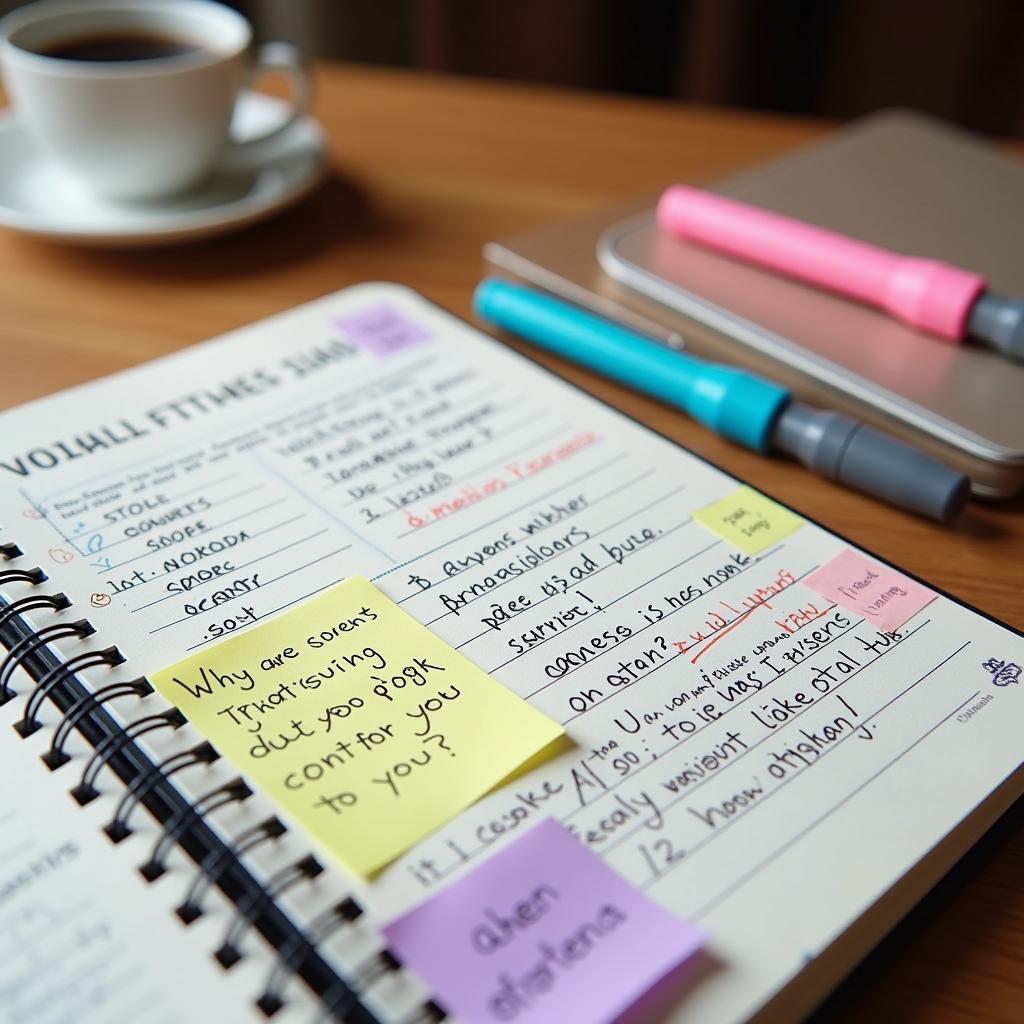 Sổ ghi chép từ vựng IELTS Speaking với các cụm từ về sự kiện và kỳ vọng tương lai
Khi chuẩn bị cho đề tài tương tự như describe a person who has a positive influence on others, bạn cũng nên chú ý đến việc sử dụng các cấu trúc ngữ pháp đa dạng để thể hiện relationships và influences một cách sophisticated.
Chiến Lược Tổng Thể Để Đạt Band Cao
Chuẩn Bị Trước Khi Thi
1. Build Your Story Bank
Thay vì học thuộc answers, hãy chuẩn bị một “ngân hàng câu chuyện” về các events trong cuộc sống của bạn: family celebrations (weddings, birthdays, anniversaries), educational milestones (graduation, exams), travel experiences, festivals and cultural events, career-related events (interviews, promotions), personal achievements. Mỗi story nên có emotional connection và specific details mà bạn có thể elaborate.
2. Practice Flexibility
Luyện tập adapt một story cho different questions. Ví dụ, một wedding story có thể dùng cho “describe an event you’re looking forward to”, “describe a celebration”, “describe a family gathering”, “describe a memorable day”. Ability to flexibly modify stories là key skill.
3. Record and Review
Record yourself speaking và listen back critically. Pay attention to: hesitations và fillers (um, uh, you know), repetitive vocabulary, grammar mistakes, pronunciation issues, pace (too fast or too slow). Self-assessment is crucial for improvement.
4. Build Vocabulary in Context
Đừng học vocabulary lists isolated. Instead, learn words and phrases trong context của sentences và stories. Create your own example sentences relevant to your life. Practice using new vocabulary immediately trong speaking practice. Review regularly to move words from passive to active vocabulary.
Trong Phòng Thi
1. Listen Carefully
Đảm bảo bạn understand câu hỏi hoàn toàn trước khi trả lời. Nếu không clear, ask examiner to repeat: “Sorry, could you repeat that?” hoặc “Could you rephrase the question?” Paying attention to key words trong câu hỏi helps you stay on topic.
2. Give Yourself Thinking Time
Sử dụng discourse markers để buy thinking time một cách natural: “Well, that’s an interesting question…”, “Let me think about that for a moment…”, “That’s a good point…”. Đừng rush vào answer immediately – brief pause shows you’re thinking thoughtfully.
3. Expand Your Answers Naturally
Structure cho Part 1 và 3: Direct answer → Reason/Explanation → Example/Detail. Ví dụ:
- Question: “Do you enjoy celebrating events?”
- Answer: “Yes, I do” (direct)
- Reason: “because they give me something to look forward to” (explanation)
- Example: “For instance, I’m currently planning…” (specific detail)
4. Show Enthusiasm
Especially cho chủ đề “looking forward to”, show genuine excitement through: intonation và vocal variety, appropriate facial expressions, natural gestures, positive language choices. Enthusiasm is contagious và makes examiner more engaged.
5. Don’t Panic If You Make Mistakes
Everyone makes mistakes, kể cả native speakers. Nếu you realize a mistake: either self-correct quickly và move on, hoặc ignore it và continue. Don’t dwell on mistakes – it disrupts fluency và affects confidence. Examiner is assessing overall performance, not expecting perfection.
Lời Khuyên Từ Examiner
What Impresses Examiners:
Natural communication: Speaking như you’re having a conversation, không reciting memorized answers. Good examiners can easily spot rehearsed responses.
Personality: Letting your personality shine through. Authentic responses về your real experiences và feelings are more impressive than generic perfect answers.
Depth of thinking: Especially trong Part 3, showing you can analyze issues from multiple angles, acknowledge complexity, và provide nuanced responses.
Risk-taking: Attempting sophisticated vocabulary và structures, even if not always perfect. Examiners reward ambition more than playing it safe with basic language.
Engagement: Showing interest trong conversation, responding to follow-up questions naturally, và building on examiner’s questions.
What Doesn’t Impress:
Template language: Obvious memorized phrases like “There are several reasons for this. Firstly… Secondly… Last but not least…” sound robotic.
Off-topic rambling: Speaking a lot but not addressing the question, hoặc going off on tangents.
Over-rehearsed answers: When every answer sounds too polished và prepared, it raises red flags.
Inappropriate formality: Using overly formal hoặc academic language that doesn’t suit speaking context.
Silent pauses: Long awkward silences without any communication – even saying “Let me think” is better than dead silence.
Rất nhiều thí sinh thành công trong phần nói về describe a memorable walk in a forest or nature trail đều áp dụng chiến lược này: họ kết hợp stories thật với vocabulary đã chuẩn bị, tạo ra câu trả lời vừa authentic vừa impressive.
Lộ Trình Luyện Tập 4 Tuần
Tuần 1: Foundation Building
Focus: Vocabulary và basic fluency
Daily tasks:
- Learn 10-15 topic-related words/phrases với context
- Record 2-3 Part 1 style answers (1-2 phút mỗi recording)
- Listen back và identify areas for improvement
- Practice pronunciation của new vocabulary
Weekly goal: Build vocabulary foundation của 50-70 words/phrases related to events, celebrations, và anticipation
Tuần 2: Part 2 Mastery
Focus: Long turn practice và storytelling
Daily tasks:
- Practice 1-2 Part 2 cue cards
- Time yourself – ensure bạn speak for full 2 phút
- Record và transcribe một answer để analyze vocabulary và grammar
- Work on adding more descriptive details và emotional language
Weekly goal: Be comfortable speaking for 2 phút without preparation, với clear structure và good vocabulary range
Tuần 3: Part 3 Development
Focus: Abstract discussion và critical thinking
Daily tasks:
- Practice 3-4 Part 3 questions
- Focus on extending answers với reasons, examples, và different perspectives
- Practice hedging và expressing uncertainty appropriately
- Work on discourse markers để structure longer responses
Weekly goal: Develop ability to discuss abstract concepts fluently với sophisticated language
Tuần 4: Integration và Mock Tests
Focus: Full test practice và refinement
Daily tasks:
- Complete full mock Speaking tests (all 3 parts)
- Focus on transition between parts smoothly
- Review và improve weakest areas
- Practice với different topics để improve flexibility
Weekly goal: Achieve consistent performance across all parts với natural, confident delivery
Nhiều học viên tôi từng chấm đạt band 8.0+ thường tự tin chia sẻ về describe a time when you were very happy with your work bởi họ đã thực hành đủ để có thể nói tự nhiên về bất kỳ achievement hay expectation nào trong cuộc sống.
Những Sai Lầm Cần Tránh
Lỗi Về Nội Dung
1. Trả lời quá chung chung, thiếu specific details
❌ Bad: “I’m looking forward to a family event. It will be nice and fun.”
✅ Good: “I’m looking forward to my grandmother’s 80th birthday celebration next month. We’re organizing a surprise party with relatives coming from different cities, và I’m particularly excited about presenting her with a photo album I’ve been compiling for months.”
2. Không trả lời đúng câu hỏi
Ví dụ nếu hỏi “Why are you looking forward to this event?” mà bạn chỉ describe event without explaining reasons.
3. Tự mâu thuẫn trong câu trả lời
Nói “I’m very excited” nhưng không show enthusiasm trong voice hoặc contradict yourself trong different parts của answer.
Lỗi Về Ngôn Ngữ
1. Lạm dụng từ “very” và “really”
❌ Avoid: “very good”, “very excited”, “very important”
✅ Better: “excellent”, “thrilled”, “crucial”
2. Lặp lại vocabulary nhiều lần
Track các từ bạn use frequently (happy, good, nice, interesting) và prepare synonyms:
- happy → delighted, elated, overjoyed, thrilled
- good → excellent, wonderful, fantastic, remarkable
- interesting → fascinating, intriguing, captivating, compelling
3. Sử dụng thì sai
Với topic “looking forward to” (future event), cần dùng future tenses correctly:
- ✅ “The wedding will take place…”
- ✅ “I’m going to attend…”
- ❌ “The wedding is happened…” (wrong tense)
4. Pronunciation issues với word endings
Pay attention to: -ed endings (looked /lʊkt/, not /lʊkɪd/), -s endings (helps /helps/, not /helpsɪz/), word stress (ANticipate, not antiCIPate)
Lỗi Về Delivery
1. Speaking too fast due to nervousness
Fast speaking often leads to: more pronunciation mistakes, missing word endings, less clear articulation, appearing less confident. Solution: Practice với conscious slowdown, pause naturally between ideas, breathe properly.
2. Monotone delivery
Varied intonation shows: enthusiasm về topic, confidence trong speaking, natural communication style, engagement với conversation. Practice emphasizing key words và varying pitch.
3. Over-reliance on memorized phrases
Examiner can spot memorization when: every answer sounds equally polished, you use same structures repeatedly, phrases don’t quite fit questions, delivery sounds unnatural. Solution: Have flexible frameworks, not fixed scripts.
4. Inadequate eye contact
Good eye contact demonstrates: confidence, engagement, natural communication. Don’t stare at ceiling, floor, hoặc wall while speaking.
Với tư cách là examiner, tôi đã chứng kiến nhiều thí sinh có vocabulary tốt nhưng fail to achieve high band vì những lỗi delivery này. Remember, IELTS Speaking đánh giá communication ability, not just language knowledge.
Kết Luận
Chủ đề “Describe an event that you are looking forward to” là một trong những topics vừa practical vừa personal trong IELTS Speaking. Với proper preparation, bạn hoàn toàn có thể turn this topic thành opportunity để showcase your English abilities một cách impressive.
Key takeaways từ bài viết này:
Vocabulary is crucial: Build a strong vocabulary bank với specific, sophisticated words về events, celebrations, emotions, và anticipation. Don’t rely on basic words như “happy”, “good”, “nice”.
Structure your responses: Có clear organization trong answers, especially cho Part 2 và 3. Use discourse markers effectively để guide examiner through your ideas.
Be authentic: Nói về real events trong your life với genuine emotion. Authenticity always sounds better than memorized generic responses.
Practice all three parts: Each part tests different skills. Part 1 tests natural conversation ability, Part 2 tests sustained speech về specific topic, Part 3 tests abstract thinking và discussion skills.
Think beyond personal experience: Especially trong Part 3, demonstrate ability to discuss broader social, cultural, và psychological aspects của celebrations và expectations.
Grammar diversity matters: Use a range of structures naturally – conditionals, relative clauses, passive voice, participles. But accuracy is more important than complexity.
Fluency doesn’t mean speed: Speaking clearly và coherently với appropriate pace is better than rushing through answers.
Embrace imperfection: Making minor mistakes is acceptable. What matters is overall communication effectiveness và your ability to keep going confidently.
Remember, IELTS Speaking is fundamentally về communication. Examiners want to see that you can engage in meaningful conversation, express your ideas clearly, và demonstrate language proficiency trong natural context. The best preparation combines systematic language building với authentic speaking practice.
I wish you the very best trong your IELTS journey. With dedicated practice và the right approach, achieving your target band score is absolutely within reach. Keep practicing, stay confident, và most importantly, enjoy the process of improving your English communication skills!


