
Mở bài
Chủ đề “Describe An Interesting Neighbor You Have” là một đề bài vô cùng phổ biến trong IELTS Speaking Part 2, thường xuyên xuất hiện ở các kỳ thi từ 2020 đến nay với tần suất cao. Đây là dạng câu hỏi “Describe a person” – một trong những dạng bài kinh điển mà thí sinh cần chuẩn bị kỹ lưỡng. Khả năng xuất hiện trong tương lai của chủ đề này là Cao vì nó liên quan trực tiếp đến đời sống hàng ngày và mối quan hệ xã hội.
Điều đặc biệt của chủ đề này là nó không chỉ yêu cầu bạn miêu tả ngoại hình hay tính cách của người hàng xóm, mà còn phải giải thích tại sao họ “interesting” – đây chính là phần ghi điểm quan trọng nhất. Examiner muốn nghe về những đặc điểm độc đáo, những hành động hoặc sở thích bất ngờ khiến người này khác biệt.
Trong bài viết này, bạn sẽ học được: Câu hỏi thường gặp trong cả 3 Part về chủ đề hàng xóm và cộng đồng, bài mẫu chi tiết theo từng band điểm 6-7, 7.5-8 và 8.5-9 với phân tích sâu, kho từ vựng chuyên biệt về miêu tả con người và mối quan hệ láng giềng, chiến lược trả lời hiệu quả từ góc nhìn Examiner, và những lỗi thường gặp của học viên Việt Nam cần tránh để đạt điểm cao nhất.
IELTS Speaking Part 1: Introduction and Interview
Tổng Quan Về Part 1
Thời gian: 4-5 phút với khoảng 10-12 câu hỏi ngắn về các chủ đề quen thuộc. Đặc điểm của Part 1 là câu hỏi về cuộc sống hàng ngày, sở thích cá nhân, và môi trường xung quanh bạn. Chiến lược tốt nhất là trả lời tự nhiên như một cuộc trò chuyện bình thường, mở rộng câu trả lời đến 2-3 câu với cấu trúc: Direct answer + Reason/Example + Additional detail.
Lỗi thường gặp của học viên Việt Nam:
- Trả lời quá ngắn chỉ “Yes” hoặc “No” mà không mở rộng
- Dùng từ vựng quá đơn giản như “good”, “nice”, “interesting” lặp lại nhiều lần
- Thiếu ví dụ cụ thể từ kinh nghiệm bản thân
- Nói quá nhanh hoặc quá chậm do căng thẳng
Các Câu Hỏi Thường Gặp
Question 1: Do you know your neighbors well?
Question 2: How often do you talk to your neighbors?
Question 3: What kind of relationship do you have with your neighbors?
Question 4: Do you think it’s important to have a good relationship with neighbors?
Question 5: Have your neighbors ever helped you?
Question 6: Would you prefer to have young or old neighbors?
Question 7: What qualities make a good neighbor?
Question 8: How has the relationship between neighbors changed in recent years?
Phân Tích và Gợi Ý Trả Lời Chi Tiết
Question: Do you know your neighbors well?
🎯 Cách tiếp cận:
- Trả lời trực tiếp Yes/No hoặc To some extent
- Giải thích mức độ quen biết
- Đưa ra lý do hoặc ví dụ cụ thể
📝 Sample Answer – Band 6-7:
“Yes, I know some of my neighbors quite well. I live in an apartment building and I often meet them in the elevator or the parking lot. We usually say hello and sometimes chat about the weather or local news. However, I’m not very close to all of them because everyone is quite busy.”
Phân tích:
- Điểm mạnh: Câu trả lời rõ ràng, có examples về nơi gặp gỡ và nội dung trò chuyện
- Hạn chế: Từ vựng còn basic (quite well, say hello, chat about), thiếu idioms hoặc collocations nâng cao
- Tại sao Band 6-7: Grammar chính xác nhưng đơn giản, ideas adequate nhưng chưa detailed, vocabulary functional nhưng chưa sophisticated
📝 Sample Answer – Band 8-9:
“Well, I’d say I have a fairly good rapport with most of my neighbors, particularly those living on the same floor. We’ve struck up quite a friendly relationship over the years, often exchanging pleasantries when we bump into each other in the communal areas. There’s this elderly couple next door who I’m especially fond of – we occasionally share homemade dishes and they’ve been absolutely invaluable when I needed someone to water my plants during holidays.”
Phân tích:
- Điểm mạnh: Sử dụng collocations tự nhiên (have a good rapport, struck up, exchanging pleasantries, fond of), vocabulary precise và sophisticated (communal areas, invaluable), structure đa dạng với relative clauses
- Tại sao Band 8-9: Demonstrates flexible use of language, natural idiomatic expressions, complex sentence structures with subordinate clauses, detailed examples showing depth of response
💡 Key Vocabulary & Expressions:
- have a good rapport with someone: có mối quan hệ tốt, hòa hợp với ai đó
- strike up a relationship/friendship: bắt đầu một mối quan hệ/tình bạn
- exchange pleasantries: trao đổi những lời chào hỏi lịch sự
- be fond of someone: quý mến ai đó
- invaluable: vô cùng quý giá, không thể thay thế
Question: How often do you talk to your neighbors?
🎯 Cách tiếp cận:
- Nêu tần suất cụ thể (daily, weekly, occasionally)
- Giải thích hoàn cảnh khi nói chuyện
- Đề cập đến nội dung cuộc trò chuyện nếu có thể
📝 Sample Answer – Band 6-7:
“I talk to my neighbors maybe two or three times a week. It’s usually just quick conversations when we see each other in the corridor or at the entrance. We talk about simple things like the weather or ask how each other is doing. Sometimes we discuss problems in the building like noise or maintenance issues.”
Phân tích:
- Điểm mạnh: Frequency rõ ràng, có context và examples về chủ đề trò chuyện
- Hạn chế: Sentence structures khá đơn giản, thiếu linking devices phức tạp
- Tại sao Band 6-7: Clear communication nhưng thiếu sophistication trong vocabulary và grammar
📝 Sample Answer – Band 8-9:
“Actually, it varies quite a bit depending on how hectic my schedule is. On average, I’d say we have casual chats perhaps three or four times a week – nothing too in-depth, just catching up on each other’s lives when our paths cross. Having said that, there’s one neighbor who’s become a close friend, and we make a point of having proper heart-to-heart conversations over coffee at least once a fortnight. We tend to discuss everything from mundane daily hassles to more thought-provoking topics like current affairs.”
Phân tích:
- Điểm mạnh: Natural discourse markers (Actually, Having said that), sophisticated collocations (casual chats, catching up, heart-to-heart conversations, mundane daily hassles, thought-provoking topics), shows nuance và personal variation
- Tại sao Band 8-9: Fluent and flexible language use, wide range of vocabulary with precision, complex grammar structures, demonstrates ability to discuss topic from different angles
💡 Key Vocabulary & Expressions:
- casual chats: những cuộc trò chuyện thông thường, không trang trọng
- catch up on: cập nhật, trao đổi về những gì đã xảy ra
- when our paths cross: khi chúng tôi tình cờ gặp nhau
- make a point of doing something: cố gắng làm điều gì đó một cách có chủ đích
- heart-to-heart conversation: cuộc trò chuyện thân mật, chân thành
- mundane daily hassles: những phiền toái hàng ngày tầm thường
- thought-provoking topics: những chủ đề kích thích tư duy
 Hai người hàng xóm đang trò chuyện vui vẻ ở hành lang chung cư với ánh sáng tự nhiên
Question: What qualities make a good neighbor?
🎯 Cách tiếp cận:
- List 2-3 qualities quan trọng
- Giải thích tại sao những qualities này important
- Có thể đưa ra counter-example về bad neighbor
📝 Sample Answer – Band 6-7:
“I think a good neighbor should be friendly and respectful. They should not make too much noise, especially at night when people are sleeping. Also, they should be helpful when others need assistance, like lending things or helping in emergencies. Being polite and greeting each other is also important for a good relationship.”
Phân tích:
- Điểm mạnh: Lists clear qualities, có explanations về mỗi quality
- Hạn chế: Vocabulary basic (friendly, respectful, helpful, polite), ideas predictable và surface-level
- Tại sao Band 6-7: Communicates meaning effectively nhưng thiếu depth và sophistication
📝 Sample Answer – Band 8-9:
“From my perspective, the hallmark of a good neighbor is mutual respect – particularly when it comes to maintaining reasonable noise levels and respecting personal boundaries. I also value neighbors who strike a balance between being friendly and not being intrusive. Equally important is having a sense of community spirit – people who are willing to lend a hand during emergencies or look out for each other’s property when someone’s away. That said, I don’t think neighbors need to be best friends; sometimes cordial distance works better than forced intimacy.”
Phân tích:
- Điểm mạnh: Sophisticated vocabulary (hallmark, mutual respect, maintaining reasonable noise levels, respecting personal boundaries, strike a balance, intrusive, community spirit, cordial distance, forced intimacy), shows critical thinking với balanced view, complex sentence structures với subordinate clauses
- Tại sao Band 8-9: Demonstrates ability to present and justify opinions, uses abstract nouns effectively, shows nuanced understanding of topic, uses hedging language appropriately
💡 Key Vocabulary & Expressions:
- hallmark: dấu hiệu đặc trưng, đặc điểm nổi bật
- mutual respect: sự tôn trọng lẫn nhau
- maintain reasonable noise levels: giữ mức độ tiếng ồn hợp lý
- respect personal boundaries: tôn trọng ranh giới cá nhân
- strike a balance: tìm được sự cân bằng
- intrusive: xâm phạm, quá can thiệp vào đời tư
- community spirit: tinh thần cộng đồng
- lend a hand: giúp đỡ
- look out for: trông nom, quan tâm đến
- cordial distance: khoảng cách thân thiện nhưng tôn trọng
- forced intimacy: sự thân thiết gượng ép
IELTS Speaking Part 2: Long Turn (Cue Card)
Tổng Quan Về Part 2
Thời gian chuẩn bị: 1 phút để ghi chú keywords, không viết câu hoàn chỉnh. Thời gian nói: 2-3 phút nói liên tục không bị ngắt. Đây là phần độc thoại trong đó bạn cần kể chi tiết về một chủ đề cụ thể được cho sẵn.
Chiến lược hiệu quả:
- Sử dụng hết 1 phút để brainstorm và note down keywords cho mỗi bullet point
- Không viết câu đầy đủ, chỉ ghi từ khóa để nhắc nhở
- Nói ít nhất 1.5 phút, tốt nhất là đủ 2 phút
- Trả lời đầy đủ tất cả bullet points theo thứ tự
- Dành nhiều thời gian nhất cho câu “explain” vì đây là phần ghi điểm cao
- Sử dụng thì quá khứ nếu miêu tả người/sự kiện đã gặp, thì hiện tại nếu vẫn còn quen biết
Lỗi thường gặp:
- Không tận dụng hết 1 phút chuẩn bị nên bí ý
- Nói dưới 1.5 phút vì thiếu chi tiết
- Bỏ sót một hoặc nhiều bullet points
- Chỉ miêu tả bề ngoài mà không explain why interesting
- Lạc đề sang chủ đề khác không liên quan
Cue Card
Describe an interesting neighbor you have
You should say:
- Who this person is
- How long you have known him/her
- What he/she does or what makes him/her interesting
- And explain why you think this neighbor is interesting
Phân Tích Đề Bài
Dạng câu hỏi: Describe a person – yêu cầu miêu tả một người hàng xóm thú vị
Thì động từ: Có thể dùng hiện tại (nếu vẫn còn là hàng xóm) hoặc quá khứ (nếu đã chuyển đi). Tốt nhất là dùng hiện tại để dễ mở rộng và có nhiều detail hơn.
Bullet points phải cover:
- Who this person is: Name (có thể dùng tên giả), age range, living situation
- How long you have known him/her: Specific time frame, how you first met
- What he/she does or what makes him/her interesting: Occupation, hobbies, unique characteristics, unusual habits
- Explain why interesting: Đây là phần quan trọng nhất – phải elaborate về những khía cạnh độc đáo, impact của người này lên bạn, những điều bất ngờ hoặc admirable
Câu “explain” quan trọng: Phần này chiếm 40-50% thời gian nói. Đừng chỉ nói “because he is friendly” mà phải elaborate với examples cụ thể, personal feelings, và broader implications về tại sao những qualities này make them stand out.
📝 Sample Answer – Band 6-7
Thời lượng: Khoảng 1.5-2 phút
I’d like to talk about my neighbor Mr. Chen, who lives in the apartment next to mine. He is around 65 years old and retired from his job about five years ago.
I have known Mr. Chen for approximately three years, since I moved into this building. We first met in the elevator and he introduced himself in a very friendly way. After that, we started greeting each other regularly.
What makes Mr. Chen interesting is that he has a very unusual hobby. He grows vegetables on his balcony. Even though he lives in an apartment, he has created a small garden with tomatoes, cucumbers, and various herbs. Every morning, I can see him taking care of his plants. Sometimes he gives me fresh vegetables when they are ready to harvest.
I think Mr. Chen is interesting for several reasons. First, it’s not common to see people growing vegetables in apartments in the city. Second, he is very knowledgeable about plants and always shares useful tips with me. Third, he is very generous and kind. Whenever I need help with something, like borrowing tools or getting advice about fixing things, he is always willing to help. He makes the neighborhood feel more friendly and connected. His positive attitude and interesting hobby make him stand out from other neighbors.
Phân Tích Band Điểm
| Tiêu chí | Band | Nhận xét |
|---|---|---|
| Fluency & Coherence | 6-7 | Speaks at length với reasonable coherence, có linking words cơ bản (First, Second, Third, After that), không có nhiều hesitation, tuy nhiên structure còn predictable |
| Lexical Resource | 6-7 | Vocabulary adequate cho topic (retired, unusual hobby, knowledgeable, generous), có attempts sử dụng less common words nhưng chưa nhiều collocations nâng cao |
| Grammatical Range & Accuracy | 6-7 | Mix của simple và complex sentences, majority của structures accurate, có relative clauses và time clauses nhưng chưa đa dạng lắm |
| Pronunciation | 6-7 | Generally clear pronunciation, có thể hiểu được dễ dàng, word stress và sentence stress cơ bản tốt |
Điểm mạnh:
- ✅ Trả lời đầy đủ tất cả bullet points theo thứ tự logic
- ✅ Có specific details (age, time frame, types of vegetables)
- ✅ Phần explain có structure với reasons được list rõ ràng
- ✅ Length appropriate khoảng 1.5-2 phút
Hạn chế:
- ⚠️ Vocabulary còn basic và predictable (friendly, interesting, kind)
- ⚠️ Thiếu idioms hoặc advanced expressions
- ⚠️ Grammar structures chưa đủ sophisticated, thiếu variety
- ⚠️ Personal feelings và emotional connection chưa được express deeply
📝 Sample Answer – Band 7.5-8
Thời lượng: Khoảng 2-2.5 phút
I’d like to describe my neighbor, Mrs. Patel, who I consider to be one of the most fascinating people I’ve ever encountered in my neighborhood. She’s a woman in her early seventies who lives in the apartment directly above mine.
I’ve known Mrs. Patel for roughly four years now, ever since I moved into this building. Our first meeting was quite memorable – I was struggling with several heavy boxes on moving day, and she immediately came to my rescue, despite her age. That initial act of kindness really broke the ice between us.
What makes Mrs. Patel truly interesting is her remarkable background and current lifestyle. She’s a retired university professor who specialized in anthropology, and she spent over three decades traveling to remote regions around the world for her research. What’s even more impressive is that she hasn’t let retirement slow her down. She keeps herself occupied by giving free language lessons to immigrant children in our community center, teaching them English, Hindi, and surprisingly, some basic Swahili. Her apartment is like a mini museum, filled with artifacts and photographs from her travels.
I find Mrs. Patel interesting for multiple reasons. For one thing, her life story is absolutely captivating – she’s lived in over 20 countries and has countless fascinating anecdotes about her adventures. Moreover, she embodies this wonderful combination of wisdom and youthfulness. Despite her age, she’s remarkably open-minded and always eager to learn about new technologies and modern trends. She even asked me to teach her how to use Instagram last month! On top of that, her sense of community is truly inspiring. She’s single-handedly organized several neighborhood events and has this amazing ability to bring people from different backgrounds together.
What I admire most about her is how she demonstrates that age is truly just a number. She’s living proof that you can remain curious, engaged, and relevant at any stage of life. Her presence in my building has genuinely enriched my experience of living here.
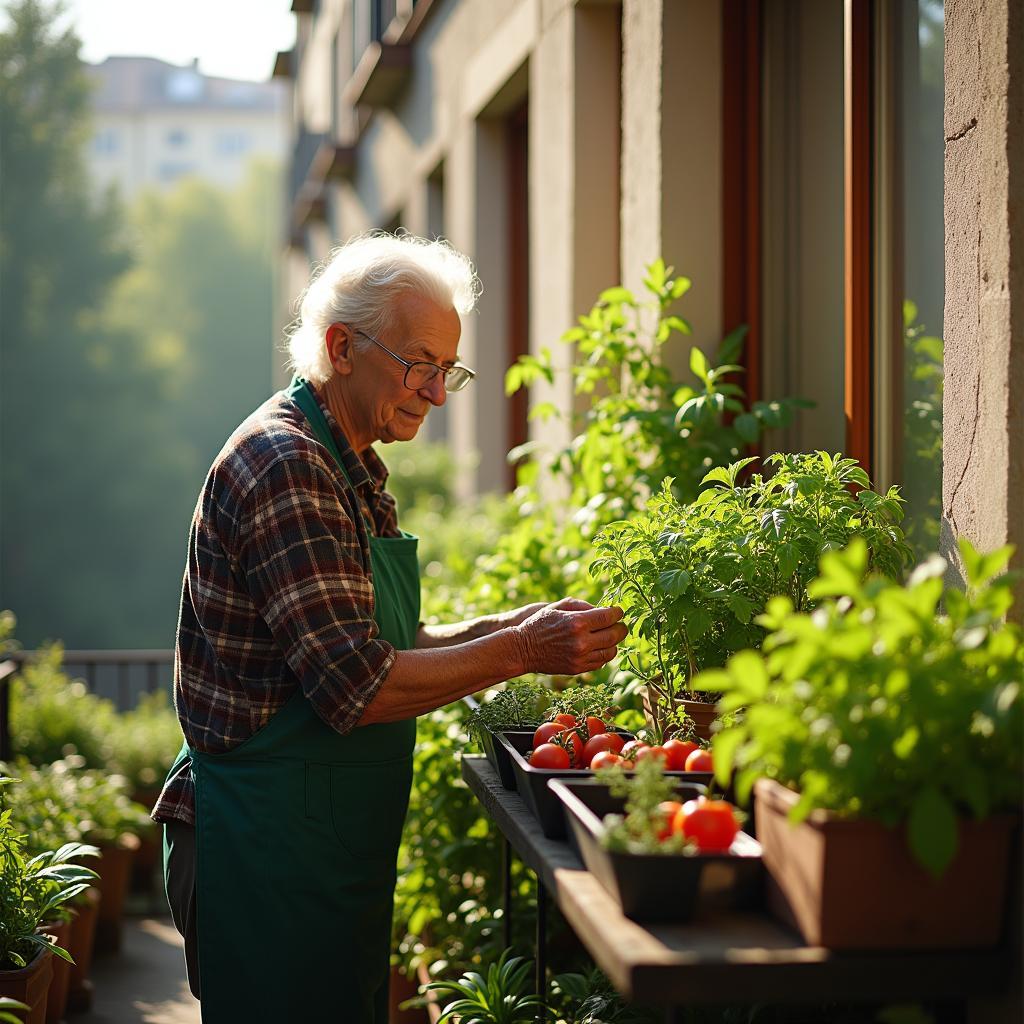 Người hàng xóm cao tuổi đang chăm sóc vườn rau trên ban công chung cư với nhiều cây xanh tươi tốt
Phân Tích Band Điểm
| Tiêu chí | Band | Nhận xét |
|---|---|---|
| Fluency & Coherence | 7.5-8 | Speaks fluently với minimal hesitation, uses cohesive devices effectively (For one thing, Moreover, On top of that, What I admire most), logical progression of ideas với excellent organization |
| Lexical Resource | 7.5-8 | Wide range of vocabulary used flexibly và precisely (fascinating, struggling with, came to my rescue, broke the ice, remarkable, captivating, embodies, single-handedly), good use of less common idiomatic expressions và collocations |
| Grammatical Range & Accuracy | 7.5-8 | Wide range of structures với flexibility (relative clauses, participle clauses, complex sentences), majority of sentences error-free, some sophisticated structures (What’s even more impressive, What I admire most) |
| Pronunciation | 7.5-8 | Clear pronunciation throughout, appropriate stress và intonation patterns, easy to understand with minimal effort |
So Sánh Với Band 6-7
| Khía cạnh | Band 6-7 | Band 7.5-8 |
|---|---|---|
| Vocabulary | “friendly way”, “unusual hobby”, “very knowledgeable” | “came to my rescue”, “broke the ice”, “remarkable background”, “captivating”, “embodies” |
| Grammar | “He is very generous and kind” (simple structure) | “Despite her age, she’s remarkably open-minded and always eager to learn” (complex với contrast) |
| Ideas | Lists qualities một cách straightforward | Explores deeper meanings và personal impact, shows reflection |
| Details | “grows vegetables on his balcony” | “filled with artifacts and photographs from her travels”, “gives free language lessons to immigrant children” |
📝 Sample Answer – Band 8.5-9
Thời lượng: 2.5-3 phút đầy đủ
I’d like to tell you about my neighbor, David, who I genuinely believe is one of the most intriguing characters I’ve come across in my entire life. He’s a man in his mid-forties who resides in the corner unit of our apartment complex, and his lifestyle is nothing short of extraordinary.
I’ve been acquainted with David for approximately five years, dating back to when I first took up residence in this building. Our initial encounter was rather serendipitous – I happened to be locked out of my apartment late one evening, and he took it upon himself to help me contact a locksmith while offering me tea and conversation in the meantime. That experience gave me my first glimpse into his exceptionally hospitable nature.
What renders David particularly interesting is his remarkably unconventional career path and the way he defies societal expectations. By day, he works as a forensic accountant, which sounds rather mundane, but by night and on weekends, he transforms into something completely different – he’s an accomplished jazz pianist who performs at various venues around the city. What’s particularly striking about this is how he seamlessly bridges these two vastly different worlds. He often jokes that his day job exercises the left side of his brain while music nourishes his creative right side.
Beyond his professional life, David has this infectious enthusiasm for what he calls “micro-adventures.” Rather than taking conventional holidays, he embarks on unusual local expeditions – things like urban foraging for edible plants, exploring abandoned buildings for photography, or organizing impromptu jam sessions in unexpected places like parking garages or laundromats. He’s perpetually curious about the world around him and has this remarkable knack for finding beauty and interest in the most ordinary circumstances.
I find David interesting for several interconnected reasons. Primarily, he challenges the conventional notion that people need to fit into neat professional categories. In a society that often pressures us to choose one path and stick to it, David epitomizes the idea that humans are multifaceted beings capable of excelling in diverse fields. Furthermore, his approach to life has genuinely influenced my own perspective. Prior to knowing him, I was quite risk-averse and tended to stick to familiar routines. However, observing his zest for life and willingness to embrace uncertainty has inspired me to be more adventurous and open-minded.
What I find most admirable, though, is the ripple effect he’s had on our entire community. He’s inadvertently created this sense of collective creativity in our building – he’s started a community garden initiative, organized neighborhood talent nights, and somehow managed to foster connections between residents who might otherwise remain strangers. He has this extraordinary gift for making people feel valued and included, regardless of their background or circumstances.
In essence, David isn’t just interesting because of what he does, but because of who he is as a person. He embodies this rare combination of professional success, creative fulfillment, and genuine human connection. Living next to him has been an education in itself – a constant reminder that life is meant to be lived fully, authentically, and with unapologetic enthusiasm. He’s proof that being interesting isn’t about doing extraordinary things in far-off places; it’s about bringing extraordinary passion to everyday life, right where you are.
Phân Tích Band Điểm
| Tiêu chí | Band | Nhận xét |
|---|---|---|
| Fluency & Coherence | 8.5-9 | Speaks fluently với minimal to no hesitation, sophisticated use of cohesive devices (Primarily, Furthermore, In essence, Prior to, Beyond), seamless progression through complex ideas với excellent coherence |
| Lexical Resource | 8.5-9 | Sophisticated và precise vocabulary usage (intriguing characters, serendipitous, took it upon himself, defies societal expectations, seamlessly bridges, infectious enthusiasm, perpetually curious, epitomizes, multifaceted beings, risk-averse, ripple effect, inadvertently created, unapologetic enthusiasm), natural idiomatic expressions và collocations throughout |
| Grammatical Range & Accuracy | 8.5-9 | Full range của structures used accurately và appropriately, sophisticated constructions (relative clauses, participle clauses, cleft sentences, inversion for emphasis), error-free performance throughout |
| Pronunciation | 8.5-9 | Precise pronunciation, natural use of connected speech, appropriate intonation và stress patterns consistently, effortless to understand |
Tại Sao Bài Này Xuất Sắc
🎯 Fluency Hoàn Hảo:
Bài nói flow tự nhiên như một câu chuyện được kể bởi một storyteller giỏi. Không có hesitation, pauses được sử dụng strategically để emphasize points chứ không phải vì thiếu từ vựng. Discourse markers được dùng một cách sophisticated để guide listener through complex ideas.
📚 Vocabulary Tinh Vi:
- “nothing short of extraordinary” – cụm từ này powerful hơn nhiều so với “very special” hay “very interesting”
- “serendipitous encounter” – sophisticated hơn “lucky meeting”
- “defies societal expectations” – shows academic vocabulary usage
- “infectious enthusiasm” – vivid collocation thay vì “very enthusiastic”
- “ripple effect” – metaphorical expression showing abstract thinking
- “unapologetic enthusiasm” – precise adjective choice demonstrating nuance
📝 Grammar Đa Dạng:
- “Rather than taking conventional holidays, he embarks on unusual local expeditions” – comparative structure với participle
- “What renders David particularly interesting is…” – cleft sentence để emphasize
- “In a society that often pressures us to choose one path…” – complex relative clause với embedded clause
- “Prior to knowing him, I was quite risk-averse” – sophisticated time expression
- “He has this extraordinary gift for making people feel valued” – gerund phrases với complex object complement
💡 Ideas Sâu Sắc:
Thay vì chỉ list qualities, bài nói explore deeper meanings: impact của người này lên bản thân và community, philosophical reflections về life approach, connection giữa different aspects of his personality. Shows critical thinking và ability to discuss abstract concepts naturally.
Follow-up Questions (Rounding Off Questions)
Examiner có thể hỏi thêm 1-2 câu ngắn sau Part 2 để transition sang Part 3:
Question 1: Do you still see this neighbor regularly?
Band 6-7 Answer:
“Yes, I still see David quite often, maybe two or three times a week. We usually meet in the building and chat for a few minutes.”
Band 8-9 Answer:
“Absolutely, we’ve actually become quite close over the years. We make it a point to catch up at least once a fortnight for coffee, and I occasionally attend his jazz performances. Our relationship has evolved from casual neighbors to genuine friends who genuinely value each other’s company.”
Question 2: Would you like to have more neighbors like him?
Band 6-7 Answer:
“Yes, definitely. I think having more neighbors like David would make the building more interesting and friendly. It would be nice to have more people who are open and social.”
Band 8-9 Answer:
“Without a doubt. Having someone like David in the community raises the bar for what neighborly relationships can be. That said, I think what makes him special is his uniqueness – if everyone were exactly like him, he wouldn’t stand out. What I’d really appreciate is more neighbors who, like David, bring their own authentic selves to the community rather than trying to blend into the background.”
IELTS Speaking Part 3: Two-way Discussion
Tổng Quan Về Part 3
Thời gian: 4-5 phút với 4-6 câu hỏi abstract và thought-provoking. Đặc điểm của Part 3 là examiner muốn test khả năng analyze, evaluate, và discuss issues từ nhiều perspectives khác nhau. Đây không còn là kể chuyện cá nhân như Part 2 mà là thảo luận về broader social issues.
Yêu cầu:
- Phân tích causes and effects của phenomena
- So sánh past và present, hoặc different situations
- Đưa ra opinions có supporting arguments
- Xem xét multiple viewpoints của một issue
- Speculate về future trends
Chiến lược hiệu quả:
- Mở rộng câu trả lời 3-5 câu với structure: Direct answer → Elaboration → Example/Reason → Alternative view/Conclusion
- Sử dụng discourse markers để organize ideas (Well, Actually, From my perspective, On the one hand…)
- Đưa ra examples từ society, not just personal experience
- Thừa nhận complexity của issues (It depends on, There are both advantages and disadvantages)
- Don’t be afraid to say “That’s an interesting question” để buy time suy nghĩ
Lỗi thường gặp của học viên Việt Nam:
- Trả lời quá ngắn như Part 1, không elaborate đủ
- Chỉ nói về personal experience thay vì societal trends
- Thiếu từ vựng abstract và academic
- Không present balanced views, quá one-sided
- Hesitate quá nhiều vì không quen với abstract thinking trong tiếng Anh
 Nhóm hàng xóm đa dạng lứa tuổi đang tham gia hoạt động cộng đồng ngoài trời thân thiện
Các Câu Hỏi Thảo Luận Sâu
Theme 1: Changes in Neighbor Relations
Question 1: How has the relationship between neighbors changed compared to the past?
🎯 Phân tích câu hỏi:
- Dạng: Compare and contrast – past vs. present
- Key words: relationship, neighbors, changed, past
- Cách tiếp cận: Describe past situation → Describe current situation → Explain reasons for changes → Evaluate if positive or negative
📝 Sample Answer – Band 6-7:
“I think relationships between neighbors have changed a lot. In the past, people knew their neighbors very well and often helped each other. They would visit each other’s homes and share food. But nowadays, people are busier with work and don’t have much time to talk to neighbors. Also, many people live in apartments and don’t know who lives next door. Technology like smartphones also makes people less interested in face-to-face communication. So I think neighbor relationships are not as close as before.”
Phân tích:
- Structure: Has comparison between past và present, explains reasons
- Vocabulary: Basic descriptive words (a lot, very well, busier) without sophisticated expressions
- Tại sao Band 6-7: Communicates main ideas clearly nhưng lacks depth, limited range of vocabulary, simple sentence structures predominate
📝 Câu trả lời mẫu – Band 8-9:
“Well, this is quite a fascinating social shift that I’ve observed and read about extensively. Traditionally, particularly in rural communities and older urban neighborhoods, neighbor relationships were characterized by what we might call deep-rooted social bonds. People relied heavily on one another for practical support, social interaction, and even economic cooperation. There was this implicit understanding that neighbors were an extended family of sorts.
However, contemporary neighbor relationships have undergone a significant transformation, particularly in urban settings. Several factors have contributed to this shift. Primarily, the proliferation of digital technology has meant that people can maintain social connections virtually, reducing their dependence on geographically close relationships. Coupled with this, modern work culture, with its demanding schedules and emphasis on career advancement, leaves people with limited bandwidth for cultivating neighborhood relationships.
That being said, I don’t think this change is entirely negative. While we may have lost some of that tight-knit community feeling, we’ve gained privacy and independence. Moreover, I’ve noticed an interesting countertrend emerging, where people are deliberately seeking to revive community connections through initiatives like neighborhood apps, community gardens, and local social events. So perhaps we’re entering a phase where people are finding a healthy balance between modern independence and traditional community values.”
Phân tích:
- Structure: Well-organized với clear progression: past situation → present situation → multiple reasons → balanced evaluation → future trend. Shows sophisticated thinking pattern.
- Vocabulary: Precise và sophisticated (fascinating social shift, deep-rooted social bonds, relied heavily on, implicit understanding, undergone a significant transformation, proliferation of, limited bandwidth, tight-knit community, countertrend, deliberately seeking to revive)
- Grammar: Complex structures xuất hiện tự nhiên (what we might call, which has meant that, with its demanding schedules, where people are deliberately seeking)
- Critical Thinking: Shows ability to see multiple dimensions – acknowledges losses but also gains, identifies emerging trends, doesn’t oversimplify the issue
💡 Key Language Features:
- Discourse markers: Well, Traditionally, However, Primarily, Coupled with this, That being said, Moreover
- Tentative language: I think, might call, perhaps we’re entering, shows academic caution
- Abstract nouns: transformation, proliferation, dependence, emphasis, bandwidth, independence
- Academic expressions: have undergone, contributed to this shift, countertrend emerging
Question 2: Do you think people today are less willing to help their neighbors than in the past?
🎯 Phân tích câu hỏi:
- Dạng: Opinion with comparison – evaluate past vs. present behavior
- Key words: less willing, help, neighbors, today vs. past
- Cách tiếp cận: Give nuanced answer → Provide reasons for changed behavior → Present alternative perspective → Conclude with balanced view
📝 Sample Answer – Band 6-7:
“I think it depends on the situation. Some people today are still willing to help their neighbors, but maybe not as much as before. People are busier now and have less free time. Also, in big cities, many people don’t know their neighbors well, so they might feel uncomfortable offering help. However, I still see people helping each other during emergencies or when someone really needs it. So I think the willingness is still there, but the opportunity to help is less.”
Phân tích:
- Structure: Shows some nuance với “it depends”, mentions exceptions
- Vocabulary: Functional nhưng repetitive (people, help, busy)
- Tại sao Band 6-7: Presents relevant ideas nhưng lacks sophisticated argumentation và precise vocabulary
📝 Câu trả lời mẫu – Band 8-9:
“That’s quite a loaded question, actually, because I think it oversimplifies a complex social dynamic. Rather than saying people are less willing to help, I’d argue that the nature and expression of helpfulness have evolved.
In previous generations, helping neighbors was often about tangible, practical assistance – lending tools, helping with repairs, or providing food. These opportunities for help were abundant because people lived in closer proximity và had more overlapping daily routines. Nowadays, while these traditional forms of help may be less common, people express neighborly support in different ways – perhaps through online community groups where they share information, or by being mindful of security and looking out for suspicious activity.
What has changed, I believe, is not willingness but opportunity and necessity. Modern infrastructure và services have made us less dependent on immediate neighbors for survival needs. For instance, if something breaks, we call a professional rather than asking the neighbor. This doesn’t reflect unwillingness but rather changed circumstances.
That said, there’s evidence to suggest that in times of genuine crisis – natural disasters, pandemics, or personal emergencies – communities still rally together remarkably well. The COVID-19 pandemic actually demonstrated this beautifully, with neighbors helping elderly residents with shopping and checking in on isolated individuals. So I’d contend that the willingness to help remains fundamentally human; it’s the everyday expressions of it that have transformed with societal changes.”
Phân tích:
- Structure: Sophisticated argumentation: challenges premise → redefines terms → provides evidence → acknowledges different perspective → reaches nuanced conclusion
- Vocabulary: Precise terminology (loaded question, oversimplifies, complex social dynamic, tangible assistance, overlapping routines, express neighborly support, rally together)
- Grammar: Advanced structures (Rather than saying…, I’d argue that…, What has changed is not X but Y, There’s evidence to suggest that)
- Critical Thinking: Demonstrates ability to question assumptions, reframe questions, consider multiple perspectives, provide concrete evidence
💡 Key Language Features:
- Discourse markers: Actually, Rather than, Nowadays, For instance, That said, So
- Hedging devices: I’d argue, I believe, may be, perhaps, suggests
- Cohesive devices: These opportunities, This doesn’t reflect, So I’d contend that
Theme 2: Community Living
Question 1: What are the advantages and disadvantages of knowing your neighbors well?
🎯 Phân tích câu hỏi:
- Dạng: Balanced discussion – advantages and disadvantages
- Key words: advantages, disadvantages, knowing neighbors well
- Cách tiếp cận: Discuss 2-3 advantages with examples → Discuss 2-3 disadvantages with examples → Conclude với personal stance hoặc it depends statement
📝 Sample Answer – Band 6-7:
“There are both advantages and disadvantages to knowing your neighbors well. The main advantage is that you can get help easily when you need it. For example, if you go on vacation, they can help watch your house. Also, it makes the neighborhood more friendly and safe. But there are also disadvantages. Sometimes neighbors might gossip about you or know too much about your private life. They might also disturb you too often if they think you are close friends. So I think it’s good to know your neighbors but keep some distance too.”
Phân tích:
- Structure: Clear organization với advantages và disadvantages, có examples
- Vocabulary: Adequate (help, friendly, safe, gossip, private life, disturb) nhưng lacks sophistication
- Tại sao Band 6-7: Presents both sides clearly nhưng analysis remains surface-level, limited vocabulary range
📝 Câu trả lời mẫu – Band 8-9:
“This is an interesting question because it really highlights the delicate balance we must strike in community living.
On the positive side, having well-established relationships with neighbors offers numerous tangible and intangible benefits. First and foremost, it creates a genuine sense of security and mutual support network. Should an emergency arise – whether it’s a medical crisis, a break-in, or a natural disaster – having neighbors you trust can literally be lifesaving. Beyond practical considerations, strong neighborly bonds contribute to what sociologists call social capital – that feeling of belonging and community cohesion that’s increasingly rare in modern society. Research has shown that people who know their neighbors well report higher levels of life satisfaction and lower stress levels.
On the flip side, there are legitimate drawbacks to consider. Primarily, there’s the potential erosion of privacy. When neighbors know you too well, it can blur the boundaries between public and private life, leading to uncomfortable situations where personal matters become fodder for neighborhood gossip. Additionally, close proximity coupled with familiarity can sometimes breed conflict – what starts as a small disagreement about noise or shared spaces can escalate when there’s no professional distance. There’s also what I call the “obligation trap” – feeling compelled to participate in social activities or provide help even when it’s inconvenient, simply because you’ve established that precedent.
In my view, the key lies in cultivating what I’d call “friendly distance” – being cordial, helpful, and aware without becoming overly enmeshed in each other’s lives. It’s about establishing mutual respect and clear boundaries from the outset. Ultimately, the advantages generally outweigh the disadvantages if we approach these relationships with emotional intelligence and clear communication.”
Phân tích:
- Structure: Masterful organization: Introduction acknowledging complexity → Advantages với multiple dimensions (practical + psychological + sociological) → Disadvantages với specific scenarios → Balanced conclusion với personal insight
- Vocabulary: Sophisticated và varied (highlights the delicate balance, well-established relationships, tangible and intangible benefits, erosion of privacy, blur the boundaries, fodder for gossip, proximity coupled with familiarity, breed conflict, obligation trap, compelled to, overly enmeshed, outweigh)
- Grammar: Full range of complex structures (should an emergency arise, what starts as X can escalate, that feeling of belonging, cultivating what I’d call)
- Critical Thinking: References research, uses sociological concepts, introduces original ideas (“friendly distance”, “obligation trap”), shows deep analytical thinking
💡 Key Language Features:
- Discourse markers: First and foremost, Beyond practical considerations, On the flip side, Primarily, Additionally, In my view, Ultimately
- Academic vocabulary: numerous tangible and intangible benefits, social capital, erosion of privacy, emotional intelligence
- Hedging and nuance: can literally be, potential drawbacks, sometimes breed conflict, generally outweigh
Question 2: In some countries, people prefer to live alone rather than with family or roommates. Why do you think this trend is happening?
🎯 Phân tích câu hỏi:
- Dạng: Cause analysis – explain reasons for social trend
- Key words: prefer, live alone, trend, why
- Cách tiếp cận: Acknowledge trend → Explain multiple causes (economic, cultural, psychological) → Consider implications → Optional: mention exceptions or countertrends
📝 Sample Answer – Band 6-7:
“I think more people want to live alone because of several reasons. First, people value their independence and privacy more nowadays. Living alone means they can do whatever they want without considering others. Second, people are richer than before, so they can afford to rent or buy their own place. Third, social attitudes have changed – it’s not unusual anymore for single people to live alone. Also, some people have bad experiences living with roommates, so they prefer to be alone. However, living alone can also be lonely sometimes.”
Phân tích:
- Structure: Lists multiple reasons logically
- Vocabulary: Basic (value, independence, privacy, afford, unusual, lonely)
- Tại sao Band 6-7: Covers main points adequately nhưng lacks analytical depth và sophisticated vocabulary
📝 Câu trả lời mẫu – Band 8-9:
“This is indeed a striking demographic shift that we’re witnessing across many developed and even developing nations, and I think it stems from a confluence of economic, cultural, and psychological factors.
From an economic standpoint, this trend is closely tied to increased affluence and the growth of the service economy. As societies become wealthier, individual living becomes more financially feasible for a larger segment of the population. What’s more, urban development has responded to this demand with the proliferation of studio apartments and micro-living spaces designed specifically for solo dwellers. The gig economy and remote work arrangements have also made location independence possible, allowing people to choose living situations based on preference rather than economic necessity.
Culturally, we’re seeing a fundamental reimagining of what constitutes a successful life. Traditional markers like marriage and multigenerational households are no longer universally viewed as prerequisites for happiness or social legitimacy. There’s been a seismic shift toward valuing personal autonomy, self-discovery, and individual fulfillment. Younger generations in particular have witnessed their parents’ generation struggle with constraining family obligations and are consciously choosing different paths. Social media and digital connectivity have also created an illusion of social fulfillment that can partially substitute for in-person companionship.
From a psychological perspective, living alone offers unparalleled control over one’s environment and schedule – something particularly appealing in our overstimulating, hyperconnected world. It provides a sanctuary where people can truly decompress without navigating interpersonal dynamics or compromising on lifestyle choices. For many, especially those in high-stress occupations, solo living represents a form of self-care and mental health preservation.
However, I think it’s important to note that this trend isn’t without significant societal implications. There are concerns about increasing social isolation, declining birth rates, and the sustainability of social welfare systems that were designed around different family structures. Moving forward, I believe we’ll see more innovative housing models emerge – co-living spaces that offer privacy with built-in community, intergenerational housing, and shared living arrangements designed to balance independence with connection.”
Phân tích:
- Structure: Exceptionally well-organized: Introduction với thesis statement → Economic factors (detailed analysis) → Cultural factors (deep exploration) → Psychological factors (personal dimension) → Societal implications và future outlook. Shows sophisticated analytical framework.
- Vocabulary: Advanced và precise (striking demographic shift, confluence of factors, closely tied to, proliferation of, solo dwellers, fundamental reimagining, constitutes, seismic shift toward, unparalleled control, hyperconnected world, sanctuary, decompress)
- Grammar: Full range of sophisticated structures demonstrating native-like competence
- Critical Thinking: Multi-dimensional analysis covering economics, culture, and psychology; considers implications and future trends; demonstrates deep understanding of complex social phenomena
💡 Key Language Features:
- Discourse markers: From an economic standpoint, Culturally, From a psychological perspective, However, Moving forward
- Academic expressions: stems from a confluence of, closely tied to, fundamental reimagining, seismic shift toward, significant societal implications
- Complex noun phrases: unparalleled control over one’s environment and schedule, sustainability of social welfare systems, innovative housing models
Theme 3: Urban vs. Rural Communities
Question 1: How do neighbor relationships differ between cities and rural areas?
🎯 Phân tích câu hỏi:
- Dạng: Compare and contrast – urban vs. rural
- Key words: neighbor relationships, differ, cities, rural areas
- Cách tiếp cận: Describe urban situation → Describe rural situation → Explain reasons for differences → Consider if one is better or depends on context
📝 Sample Answer – Band 6-7:
“I think there are big differences between cities and rural areas. In rural areas, people usually know each other very well because the communities are small. Everyone knows everyone’s business. Neighbors often help each other with farming or other work. But in cities, people are more anonymous. Many people don’t even know their neighbors’ names. This is because cities are crowded and people are busy with work. Also, people in cities might not stay in one place for long, so they don’t build relationships. I think rural areas have stronger neighbor relationships, but city life offers more privacy.”
Phân tích:
- Structure: Clear comparison với reasons for differences
- Vocabulary: Simple và functional (big differences, know each other well, anonymous, crowded, busy)
- Tại sao Band 6-7: Addresses question adequately nhưng lacks sophisticated analysis và vocabulary
📝 Câu trả lời mẫu – Band 8-9:
“This is a fascinating dichotomy that really speaks to how physical environment shapes social behavior.
In rural settings, neighbor relationships tend to be characterized by what sociologists call “gemeinschaft” – intimate, enduring, and multifaceted connections. These relationships often span generations, with families knowing each other for decades or even centuries. The reasons for this are multifold. Geographically, lower population density means people encounter the same individuals repeatedly in daily life – at local shops, community events, or simply while going about their routines. Economically, rural communities often involve interdependent livelihoods – farmers helping each other during harvest, neighbors sharing equipment, or pooling resources for community projects. There’s also a practical element – in areas where professional services may be scarce or distant, neighbors become your de facto support system for everything from childcare emergencies to equipment repairs.
Urban neighbor relationships, by contrast, operate under entirely different parameters. The sheer density of city living means you’re surrounded by people, yet paradoxically can feel more isolated. Anonymity becomes both a feature and a bug of urban life – it offers freedom from social surveillance but can also erode the sense of community accountability that exists in smaller settings. Modern urban architecture exacerbates this – high-rise apartments with separate entrances, minimal shared spaces, and increasingly transient populations make sustained relationship-building challenging. Furthermore, the fast-paced urban lifestyle, with its long commutes and demanding work schedules, leaves limited bandwidth for cultivating neighborhood connections.
That being said, I think we’re seeing interesting developments that challenge this dichotomy. Some urban areas are deliberately designing spaces to foster community – shared rooftop gardens, co-working spaces within residential buildings, and neighborhood micro-communities within larger cities. Meanwhile, rural areas aren’t immune to modern trends – improved internet connectivity means even rural residents can maintain primarily digital social lives rather than face-to-face community engagement.
Ultimately, I don’t think one model is inherently superior. Rather, they cater to different human needs – rural community for those who value deep social integration and urban anonymity for those who prioritize independence and diversity. The key is ensuring that whichever environment we choose, we have the option and means to form meaningful connections if we wish to.”
Phân tích:
- Structure: Masterfully organized với sophisticated comparative framework: Rural characteristics với multiple analytical lenses (geographic, economic, practical) → Urban characteristics với nuanced analysis → Recognition of evolving trends → Balanced philosophical conclusion
- Vocabulary: Exceptional range và precision (fascinating dichotomy, speaks to, characterized by, gemeinschaft, intimate and enduring connections, span generations, multifold, encounter the same individuals, interdependent livelihoods, pooling resources, de facto support system, sheer density, paradoxically, anonymity becomes both a feature and a bug, erode the sense of community accountability, exacerbates, transient populations, challenging this dichotomy, foster community, cater to different human needs)
- Grammar: Native-like sophistication với complex embeddings, nominalization, và varied structures
- Critical Thinking: Uses sociological terminology, considers multiple dimensions, recognizes complexity và evolving trends, avoids oversimplification, presents philosophical perspective
💡 Key Language Features:
- Discourse markers: In rural settings, By contrast, Furthermore, That being said, Meanwhile, Ultimately
- Academic vocabulary: dichotomy, characterized by, multifold, paradoxically, exacerbates, dichotomy, cater to, inherently superior
- Sophisticated expressions: speaks to how, operate under entirely different parameters, anonymity becomes both a feature and a bug, challenge this dichotomy
Từ vựng và cụm từ quan trọng
Topic-Specific Vocabulary
| Từ vựng/Cụm từ | Loại từ | Phiên âm | Nghĩa tiếng Việt | Ví dụ | Collocation |
|---|---|---|---|---|---|
| have a good rapport with | phrase | /ræˈpɔːr/ | có mối quan hệ tốt với | I have a good rapport with most of my neighbors. | build/establish/develop a rapport, maintain rapport |
| strike up | phrasal verb | /straɪk ʌp/ | bắt đầu (một cuộc trò chuyện/mối quan hệ) | We struck up a conversation at the mailbox. | strike up a conversation/friendship/relationship, strike up with someone |
| exchange pleasantries | phrase | /ɪksˈtʃeɪndʒ ˈplezəntrɪz/ | trao đổi những lời chào hỏi xã giao | We usually just exchange pleasantries in passing. | exchange greetings/remarks, brief pleasantries |
| be fond of | phrase | /fɒnd/ | yêu quý, thích | I’m quite fond of my elderly neighbor. | grow fond of, particularly/especially fond of, very/extremely fond |
| invaluable | adj | /ɪnˈvæljuəbl/ | vô cùng quý giá | Her help has been invaluable during difficult times. | invaluable help/assistance/support/advice, prove invaluable |
| catch up on | phrasal verb | /kætʃ ʌp/ | cập nhật, trao đổi tin tức | We catch up on each other’s lives every weekend. | catch up on news/gossip/events, catch up with someone |
| heart-to-heart | adj/noun | /ˌhɑːrt tə ˈhɑːrt/ | thân mật, chân thành (cuộc trò chuyện) | We had a heart-to-heart conversation about family issues. | have a heart-to-heart, heart-to-heart talk/chat/discussion |
| thought-provoking | adj | /ˈθɔːt prəvoʊkɪŋ/ | kích thích tư duy | Our discussions are always thought-provoking. | thought-provoking question/topic/discussion/book/film |
| mutual respect | noun phrase | /ˈmjuːtʃuəl rɪˈspekt/ | sự tôn trọng lẫn nhau | Good neighbor relationships are built on mutual respect. | based on/built on mutual respect, show/demonstrate mutual respect |
| intrusive | adj | /ɪnˈtruːsɪv/ | xâm phạm, quá can thiệp | Some neighbors can be overly intrusive. | intrusive questions/behavior, too/overly intrusive |
| community spirit | noun phrase | /kəˈmjuːnəti ˈspɪrɪt/ | tinh thần cộng đồng | There’s a strong community spirit in our neighborhood. | foster/build/create community spirit, sense of community spirit |
| lend a hand | idiom | /lend ə hænd/ | giúp đỡ | My neighbor always lends a hand when I need help. | willing to lend a hand, lend a helping hand |
| look out for | phrasal verb | /lʊk aʊt fɔːr/ | trông nom, quan tâm | We look out for each other’s property when traveling. | look out for someone, look out for each other |
| strike a balance | phrase | /straɪk ə ˈbæləns/ | đạt được sự cân bằng | It’s important to strike a balance between friendliness and privacy. | strike a balance between X and Y, strike the right balance |
| tight-knit community | noun phrase | /ˌtaɪt ˈnɪt/ | cộng đồng gắn kết chặt chẽ | They grew up in a tight-knit community. | tight-knit group/family/community, close-knit |
| social capital | noun phrase | /ˈsoʊʃl ˈkæpɪtl/ | vốn xã hội (mạng lưới quan hệ) | Knowing your neighbors builds social capital. | build/accumulate/generate social capital, high/low social capital |
| erosion of privacy | noun phrase | /ɪˈroʊʒn əv ˈpraɪvəsi/ | sự xâm phạm quyền riêng tư | Living too close can lead to erosion of privacy. | gradual/steady erosion, erosion of trust/confidence/values |
| blur the boundaries | phrase | /blɜːr ðə ˈbaʊndriz/ | làm mờ ranh giới | Close friendships with neighbors can blur the boundaries. | blur boundaries/lines, blurred boundaries between |
| breed conflict | phrase | /briːd ˈkɒnflɪkt/ | gây ra xung đột | Familiarity can sometimes breed conflict. | breed contempt/resentment/suspicion/distrust |
| cordial distance | noun phrase | /ˈkɔːrdiəl ˈdɪstəns/ | khoảng cách thân thiện nhưng tôn trọng | Maintaining cordial distance works best for me. | keep/maintain cordial distance, polite but distant |
Idiomatic Expressions & Advanced Phrases
| Cụm từ | Nghĩa | Ví dụ sử dụng | Band điểm |
|---|---|---|---|
| come to someone’s rescue | đến giúp đỡ ai đó | She came to my rescue when I locked myself out. | 7.5-8 |
| break the ice | phá vỡ sự ngượng ngùng, bắt đầu làm quen | His friendly joke really broke the ice between us. | 7.5-8 |
| make a point of doing something | cố ý làm gì đó một cách có chủ đích | I make a point of greeting all my neighbors. | 8-8.5 |
| single-handedly | một mình, độc lập | She single-handedly organized the neighborhood festival. | 8-9 |
| living proof | bằng chứng sống | He’s living proof that age is just a number. | 7.5-8 |
| nothing short of | không gì khác hơn là, hoàn toàn | His lifestyle is nothing short of extraordinary. | 8-9 |
| take it upon oneself | tự nguyện đảm nhận | He took it upon himself to help me that evening. | 8-8.5 |
| defy expectations | thách thức kỳ vọng, làm điều bất ngờ | She defies expectations with her unconventional career. | 8-9 |
| bridge the gap | kết nối, thu hẹp khoảng cách | His friendliness helps bridge the gap between generations. | 7.5-8 |
| ripple effect | hiệu ứng lan tỏa | His positive attitude has a ripple effect on the community. | 8-9 |
| inadvertently create | vô tình tạo ra | He inadvertently created a sense of community. | 8-8.5 |
| rally together | tập hợp lại, đoàn kết | The community rallied together during the crisis. | 7.5-8 |
Discourse Markers (Từ Nối Ý Trong Speaking)
Để bắt đầu câu trả lời:
- 📝 Well,… – Dùng khi cần thời gian suy nghĩ hoặc để câu trả lời tự nhiên hơn
- 📝 Actually,… – Khi muốn đưa ra góc nhìn khác hoặc thông tin surprising
- 📝 To be honest/frank,… – Khi muốn nhấn mạnh sự chân thành trong quan điểm
- 📝 I’d say that… – Cách sophisticated để đưa ra opinion
- 📝 From my perspective/point of view,… – Academic cách thể hiện quan điểm
- 📝 It’s interesting that… – Để acknowledge một aspect thú vị của câu hỏi
Để bổ sung ý:
- 📝 On top of that,… – Thêm vào đó, hơn thế nữa
- 📝 What’s more,… – Hơn nữa (formal hơn “also”)
- 📝 Not to mention… – Chưa kể đến
- 📝 Beyond that,… – Ngoài ra
- 📝 Furthermore/Moreover,… – Hơn nữa (formal/academic)
- 📝 In addition to that,… – Thêm vào đó
Để đưa ra quan điểm cân bằng:
- 📝 On the one hand,… On the other hand,… – Một mặt… mặt khác
- 📝 While it’s true that…, we also need to consider… – Mặc dù đúng là… nhưng cũng cần xem xét
- 📝 Having said that,… – Dù vậy, tuy nhiên (sophisticated way)
- 📝 That being said,… – Điều đó nói lên rằng
- 📝 By contrast/In contrast,… – Ngược lại
Để đưa ra ví dụ:
- 📝 For instance/For example,… – Ví dụ
- 📝 Take… for example – Lấy… làm ví dụ
- 📝 A case in point is… – Một trường hợp điển hình là
- 📝 To illustrate this point,… – Để minh họa điểm này
Để giải thích nguyên nhân:
- 📝 The reason for this is that… – Lý do cho điều này là
- 📝 This stems from… – Điều này xuất phát từ
- 📝 This is largely due to… – Điều này chủ yếu do
- 📝 Several factors contribute to this… – Nhiều yếu tố góp phần vào điều này
Để kết luận:
- 📝 All in all,… – Tóm lại, xét tổng thể
- 📝 At the end of the day,… – Cuối cùng thì
- 📝 In conclusion/To conclude,… – Kết luận (formal)
- 📝 Ultimately,… – Sau cùng, xét về lâu dài
Để thể hiện sự nuanced (không chắc chắn 100%):
- 📝 I would say/I’d say… – Tôi có thể nói rằng
- 📝 It seems to me that… – Có vẻ như với tôi
- 📝 To some extent,… – Ở một mức độ nào đó
- 📝 To a certain degree,… – Ở một mức độ nhất định
- 📝 Generally speaking,… – Nói chung thì
Grammatical Structures Ấn Tượng
1. Conditional Sentences (Câu điều kiện):
- Mixed conditional: “If I hadn’t met my neighbor that day, I would still be struggling with my garden now.”
- Inversion for emphasis: “Should you ever need assistance, my neighbors are always willing to help.”
- Had + past participle: “Had I known how helpful he would be, I would have introduced myself earlier.”
2. Relative Clauses (Mệnh đề quan hệ):
- Non-defining với which thay cho cả mệnh đề: “He organized community events, which brought everyone together.”
- Preposition + whom/which: “The neighbor with whom I share a garden is extremely knowledgeable.”
- What clauses: “What makes him interesting is his unconventional lifestyle.”
3. Passive Voice (Câu bị động):
- It is thought/believed/said that…: “It is widely believed that knowing your neighbors improves quality of life.”
- Advanced passive: “Having been helped by neighbors before, I’m always ready to return the favor.”
4. Cleft Sentences (Câu chẻ để nhấn mạnh):
- What I find most… is…: “What I find most admirable about him is his generosity.”
- The thing that… is…: “The thing that makes her interesting is her diverse background.”
- It is/was… that…: “It was her kindness that first made an impression on me.”
5. Participle Clauses (Rút gọn mệnh đề):
- Present participle: “Living next to such interesting people, I’ve learned a lot about different cultures.”
- Past participle: “Surrounded by supportive neighbors, I feel safe in this community.”
- Perfect participle: “Having lived here for five years, I’ve developed close relationships with several neighbors.”
6. Inversion for Emphasis:
- Not only… but also: “Not only does he help with practical matters, but he also provides emotional support.”
- Rarely/Seldom: “Rarely have I met someone so genuinely interested in others.”
- So/Such: “So interesting is his life story that people could write a book about it.”
7. Subjunctive Mood:
- It is important/essential/crucial that…: “It’s essential that neighbors respect each other’s boundaries.”
- I suggest/recommend that…: “I would suggest that people make an effort to know their neighbors.”
Trên đây là hướng dẫn toàn diện và chi tiết về cách xử lý đề tài “describe an interesting neighbor you have” trong IELTS Speaking Test. Với những bài mẫu phân tích kỹ lưỡng theo từng band điểm, kho từ vựng phong phú, và chiến lược trả lời hiệu quả, bạn đã có đầy đủ công cụ cần thiết để tự tin đạt điểm cao. Hãy nhớ rằng điều quan trọng nhất là trả lời một cách tự nhiên, chân thực, và thể hiện được khả năng ngôn ngữ linh hoạt của bạn. Chúc bạn thành công trong kỳ thi IELTS sắp tới.

