
Mở Bài
Chủ đề làm việc từ xa và tác động kinh tế của nó lên năng suất lao động đã trở thành một trong những đề tài nóng hổi nhất trong kỳ thi IELTS Reading những năm gần đây. Với sự thay đổi mạnh mẽ của môi trường làm việc toàn cầu, đặc biệt sau đại dịch, Cambridge và IDP đã tăng cường đưa các bài đọc liên quan đến remote work, digital transformation và workplace productivity vào đề thi chính thức.
Bài viết này cung cấp một bộ đề thi IELTS Reading hoàn chỉnh gồm 3 passages với độ khó tăng dần từ Easy đến Hard, bao gồm đầy đủ 40 câu hỏi theo đúng format thi thật. Bạn sẽ được luyện tập với các dạng câu hỏi đa dạng như True/False/Not Given, Matching Headings, Multiple Choice, Summary Completion và nhiều dạng khác. Đặc biệt, mỗi câu hỏi đều có đáp án chi tiết kèm giải thích cụ thể về vị trí thông tin trong bài và kỹ thuật paraphrase.
Đề thi này phù hợp cho học viên từ band 5.0 trở lên, giúp bạn làm quen với cấu trúc bài thi thực tế, nâng cao vốn từ vựng học thuật về kinh tế và công nghệ, đồng thời rèn luyện kỹ năng quản lý thời gian hiệu quả cho kỳ thi IELTS sắp tới.
Hướng Dẫn Làm Bài IELTS Reading
Tổng Quan Về IELTS Reading Test
IELTS Reading test kéo dài 60 phút với 3 passages và tổng cộng 40 câu hỏi. Mỗi câu trả lời đúng tương ứng với 1 điểm, và thang điểm được chuyển đổi thành band score từ 1-9.
Phân bổ thời gian khuyến nghị:
- Passage 1 (Easy): 15-17 phút
- Passage 2 (Medium): 18-20 phút
- Passage 3 (Hard): 23-25 phút
Lưu ý rằng không có thời gian bổ sung để chuyển đáp án sang phiếu trả lời, vì vậy bạn cần viết đáp án trực tiếp vào answer sheet trong 60 phút.
Các Dạng Câu Hỏi Trong Đề Này
Đề thi mẫu này bao gồm 7 dạng câu hỏi phổ biến nhất trong IELTS Reading:
- Multiple Choice – Chọn đáp án đúng từ các lựa chọn A, B, C, D
- True/False/Not Given – Xác định thông tin đúng, sai hoặc không được nhắc đến
- Matching Headings – Nối tiêu đề phù hợp với các đoạn văn
- Sentence Completion – Hoàn thành câu với thông tin từ bài đọc
- Summary Completion – Điền từ vào đoạn tóm tắt
- Matching Features – Nối thông tin với các đặc điểm được liệt kê
- Short-answer Questions – Trả lời câu hỏi ngắn trong giới hạn từ quy định
IELTS Reading Practice Test
PASSAGE 1 – The Remote Work Revolution and Economic Transformation
Độ khó: Easy (Band 5.0-6.5)
Thời gian đề xuất: 15-17 phút
The way we work has undergone a dramatic transformation in recent years, with remote work emerging as a defining feature of the modern economy. What began as a temporary response to global health concerns has evolved into a permanent shift in how businesses operate and employees structure their daily lives. This change has brought about significant economic implications that extend far beyond individual companies, affecting entire industries, urban planning, and national economies.
Remote work, also known as telecommuting or working from home, refers to a work arrangement where employees perform their job duties outside of a traditional office environment. This can include working from home, co-working spaces, or any location with internet connectivity. The practice is not entirely new – it has existed in various forms for decades – but recent technological advances and changing attitudes toward work-life balance have made it increasingly viable and desirable.
One of the most immediate economic benefits of remote work is the reduction in overhead costs for businesses. Companies no longer need to maintain large office spaces, pay for utilities, or provide on-site amenities for all employees. A recent study by Global Workplace Analytics found that employers can save an average of $11,000 per year for each employee who works remotely half of the time. These savings come from reduced real estate costs, lower utility bills, and decreased spending on office supplies and equipment. For small businesses and startups, this cost reduction can be particularly significant, allowing them to allocate resources more efficiently toward growth and innovation.
Employees also experience substantial financial benefits from remote work arrangements. The elimination of daily commutes saves workers both time and money. Transportation costs, including fuel, public transit fees, parking, and vehicle maintenance, can add up to thousands of dollars annually. Additionally, remote workers often spend less on professional attire, meals out, and other work-related expenses. A survey conducted by FlexJobs revealed that remote workers save an average of $4,000 per year on these various costs. This increased disposable income can boost consumer spending in other sectors of the economy, creating a ripple effect of economic activity.
The impact of remote work on productivity has been a subject of considerable debate among economists and business leaders. Early skeptics worried that employees working from home would be less productive due to distractions and lack of supervision. However, numerous studies have challenged this assumption. Research from Stanford University showed that remote workers were 13% more productive than their office-based counterparts. The study attributed this increase to fewer breaks, shorter breaks, and fewer sick days. Remote workers also reported higher job satisfaction and were 50% less likely to quit their jobs, reducing turnover costs for employers.
Several factors contribute to the enhanced productivity observed in remote work environments. First, employees save time previously spent commuting, which can be redirected toward work tasks or personal well-being activities that improve overall performance. Second, remote workers often have more control over their work environment, allowing them to create conditions that maximize their concentration and efficiency. Third, the flexibility of remote work enables employees to work during their most productive hours, rather than adhering to a rigid 9-to-5 schedule. This autonomy can lead to better work output and greater innovation.
However, the economic effects of remote work are not uniformly positive across all sectors and demographics. Industries that rely heavily on face-to-face interaction, such as hospitality, retail, and personal services, have seen different impacts. Urban centers that previously thrived on office worker traffic have experienced economic challenges as foot traffic decreased in downtown areas. Small businesses like restaurants, coffee shops, and dry cleaners that depended on office workers have had to adapt their business models or face closure. This has led to what economists call urban economic restructuring, where city centers must reinvent themselves to remain economically viable.
The shift to remote work has also created new economic opportunities and industries. The demand for home office equipment, video conferencing software, cybersecurity solutions, and collaboration tools has surged. Companies providing these products and services have seen tremendous growth. Additionally, the rise of remote work has enabled businesses to tap into global talent pools, hiring skilled workers regardless of their geographic location. This has the potential to reduce wage inequality by providing opportunities to workers in regions with fewer local job prospects, though it may also increase competition for positions.
Looking ahead, economists predict that hybrid work models – combining both remote and office-based work – will become the dominant arrangement for many industries. This approach aims to capture the benefits of both worlds: the productivity and cost savings of remote work, alongside the collaboration and social interaction benefits of in-person work. As companies continue to refine these models, the long-term economic effects will become clearer. What remains certain is that the remote work revolution has permanently altered the economic landscape, creating both challenges and opportunities that will shape the future of work for generations to come.
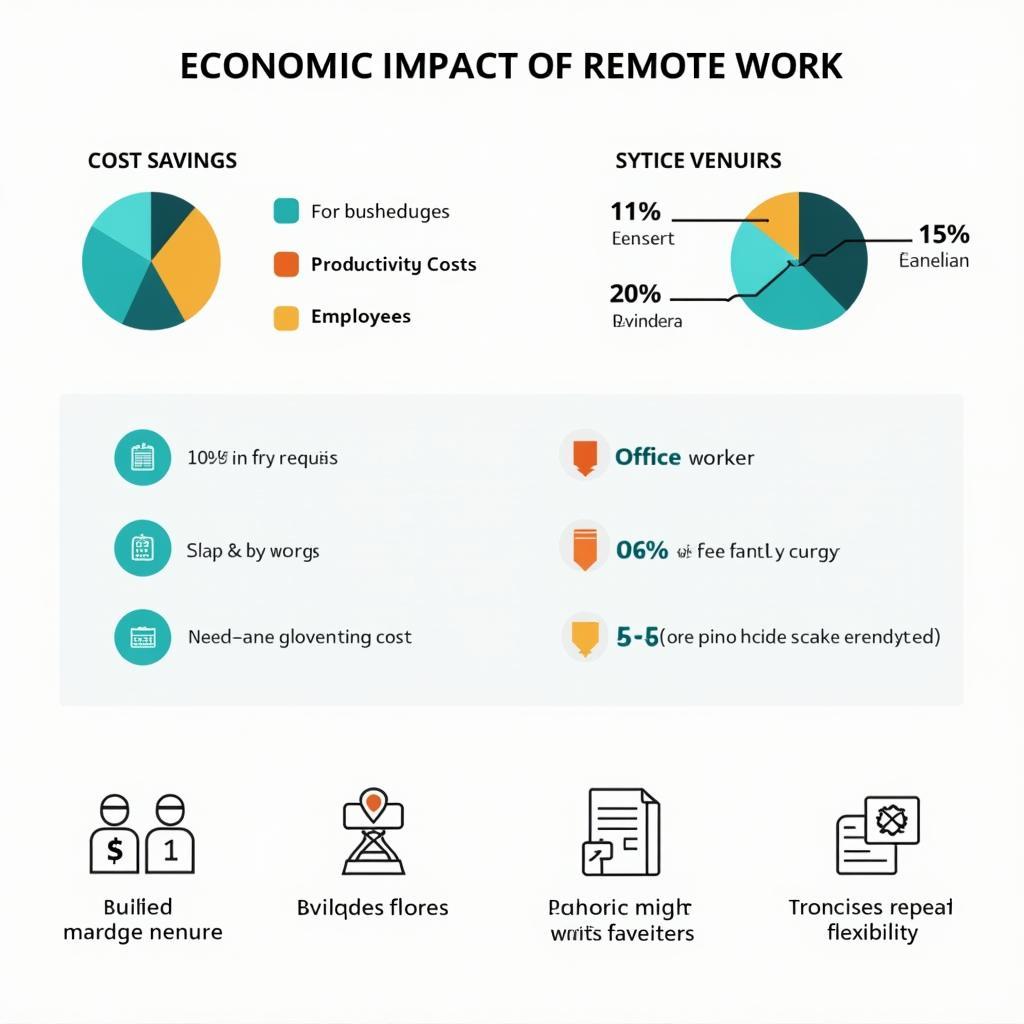 Biểu đồ phân tích tác động kinh tế của làm việc từ xa lên năng suất lao động và tiết kiệm chi phí doanh nghiệp
Questions 1-13
Questions 1-5: Multiple Choice
Choose the correct letter, A, B, C or D.
1. According to the passage, remote work initially became widespread as a result of:
A. advances in technology
B. employee preferences for flexibility
C. responses to health issues
D. cost-saving measures by companies
2. Global Workplace Analytics found that companies can save approximately:
A. $4,000 per remote employee annually
B. $11,000 per half-time remote employee yearly
C. 13% on operational costs
D. 50% on office space
3. The Stanford University research showed that remote workers were:
A. 50% less likely to be productive
B. 13% more productive than office workers
C. equally productive as office workers
D. more likely to take sick days
4. According to the passage, which businesses have been negatively affected by remote work?
A. Technology companies
B. Home office equipment suppliers
C. Restaurants near office buildings
D. Video conferencing services
5. The passage suggests that the future of work will likely involve:
A. complete remote work for all industries
B. a return to traditional office arrangements
C. a combination of remote and office work
D. entirely new work structures
Questions 6-9: True/False/Not Given
Write TRUE if the statement agrees with the information, FALSE if the statement contradicts the information, or NOT GIVEN if there is no information on this.
6. Remote work has existed in some form for several decades before becoming widespread.
7. All employees prefer working remotely to working in traditional offices.
8. Remote workers typically spend less money on work clothes and meals than office workers.
9. The increase in remote work has benefited all types of businesses equally.
Questions 10-13: Sentence Completion
Complete the sentences below. Choose NO MORE THAN TWO WORDS from the passage for each answer.
10. Remote work allows companies to hire employees from __ regardless of where they live.
11. The flexibility of remote work enables people to work during their most __ hours.
12. Urban areas that depended on office workers have experienced __ as fewer people visit city centers.
13. The shift to remote work has increased demand for products like home office equipment and __ solutions.
PASSAGE 2 – Measuring Productivity in the Digital Workplace
Độ khó: Medium (Band 6.0-7.5)
Thời gian đề xuất: 18-20 phút
The transition to remote work has forced organizations and economists to reconsider fundamental assumptions about how productivity is measured and evaluated. Traditional metrics based on physical presence and observable activity in an office setting have become increasingly irrelevant in a world where work happens across different locations and time zones. This shift has sparked an important debate about what productivity truly means in the digital economy and how it should be quantified to reflect the complex realities of modern work.
Historically, workplace productivity was often equated with visibility and time spent at a desk. Managers relied on direct observation to assess whether employees were working diligently, and the standard eight-hour workday served as a proxy for productivity. This approach, however, conflates activity with actual output. In remote work environments, where managers cannot easily observe employees, there has been a necessary shift toward outcomes-based evaluation. Rather than measuring hours worked, progressive organizations now focus on deliverables, quality of work, and achievement of objectives. This paradigm shift represents a more sophisticated understanding of productivity that emphasizes results over mere presence.
Economic research has revealed several counterintuitive findings about remote work productivity. A comprehensive study published by the National Bureau of Economic Research examined call center employees who transitioned to remote work. The study found that performance metrics actually improved among remote workers, with a 13% increase in the number of calls handled. Interestingly, this improvement came primarily from working more minutes per shift rather than handling calls more quickly. Remote workers took fewer breaks and were absent less frequently. However, the study also noted that not all tasks are equally suited to remote work. Jobs requiring extensive collaboration, spontaneous brainstorming, or hands-on training presented greater challenges in virtual environments.
The economic concept of information asymmetry takes on new dimensions in remote work contexts. In traditional offices, managers have relatively easy access to information about employee activities and challenges. Remote work, however, creates information gaps that can affect both productivity and managerial decision-making. Employees may struggle with technical issues, interpersonal conflicts, or unclear expectations without the immediate support available in physical workplaces. Conversely, managers may have incomplete information about employee workload, obstacles faced, or needed resources. Addressing these asymmetries requires investing in robust communication systems and establishing clear protocols for information sharing.
From a macroeconomic perspective, the productivity implications of remote work extend beyond individual companies to affect national economic performance. Labor economists have identified several aggregate effects worth considering. First, remote work can expand the effective labor force by enabling participation from individuals who face barriers to traditional employment, such as those with disabilities, caregiving responsibilities, or geographic constraints. This inclusive expansion of the workforce represents a net economic gain, bringing previously underutilized talent into productive activity. Second, the reduction in commuting time translates to more hours available for either work or leisure, potentially increasing both economic output and quality of life.
However, economists also caution about potential productivity pitfalls associated with widespread remote work. Social capital – the networks of relationships that facilitate information exchange, trust, and collaboration – may erode when workers have fewer opportunities for informal interaction. Innovation, which often emerges from serendipitous encounters and spontaneous collaboration, might suffer in remote environments where interactions are more scheduled and transactional. A longitudinal study by Microsoft Research found that remote work led to more siloed communication patterns, with employees interacting primarily within their immediate teams rather than across the broader organization. Such organizational fragmentation could hinder knowledge transfer and cross-functional innovation over the long term.
The economic impact of remote work on productivity also varies significantly across different sectors and job categories. Knowledge workers in fields like software development, writing, data analysis, and design often thrive in remote settings where deep focus is more important than real-time collaboration. By contrast, industries requiring physical presence – manufacturing, healthcare, hospitality – cannot easily replicate their operations remotely. This creates a bifurcated economy where some workers enjoy the flexibility and productivity benefits of remote work while others continue to face traditional workplace constraints. Such disparities may exacerbate existing inequalities in job quality and economic opportunity.
Technological infrastructure plays a crucial role in determining whether remote work enhances or hinders productivity. Reliable high-speed internet, sophisticated collaboration platforms, and secure digital systems are prerequisites for effective remote work. Regions or populations lacking this infrastructure face productivity disadvantages that can compound economic disparities. Studies have shown that the digital divide – the gap between those with access to modern information technology and those without – has become more economically consequential in the remote work era. Governments and organizations must address these infrastructure gaps to ensure that the productivity benefits of remote work are broadly accessible rather than concentrated among already-advantaged groups.
Looking forward, economists emphasize that maximizing the productivity benefits of remote work requires intentional organizational design and policy frameworks. Companies need to develop new management practices suited to remote environments, including clearer goal-setting, regular feedback mechanisms, and investments in digital tools that facilitate seamless collaboration. At the policy level, governments should consider how tax structures, labor regulations, and infrastructure investments can support productive remote work while addressing potential negative externalities such as reduced urban economic activity. The optimal approach likely involves flexibility that allows different organizations and workers to find arrangements that maximize productivity based on their specific contexts and needs.
The measurement of productivity in remote work environments ultimately reflects broader questions about the nature of economic value in the 21st century. As economies become increasingly service-oriented and knowledge-based, traditional industrial-era metrics of productivity become less applicable. The remote work revolution has accelerated this transition, forcing economists, managers, and policymakers to develop more nuanced frameworks for understanding and measuring productive activity. These new approaches recognize that productivity is multidimensional, encompassing not just quantity of output but also quality, innovation, employee wellbeing, and sustainable work practices. This holistic perspective on productivity may prove to be one of the most significant economic legacies of the remote work era.
Questions 14-26
Questions 14-18: Yes/No/Not Given
Write YES if the statement agrees with the claims of the writer, NO if the statement contradicts the claims of the writer, or NOT GIVEN if it is impossible to say what the writer thinks about this.
14. Traditional methods of measuring productivity are well-suited for remote work environments.
15. Remote work requires organizations to focus more on results than on time spent working.
16. All types of jobs are equally effective when performed remotely.
17. The reduction in commuting time from remote work can benefit both economic productivity and personal wellbeing.
18. Remote work will completely replace traditional office work within the next decade.
Questions 19-23: Matching Headings
Choose the correct heading for sections A-E from the list of headings below.
List of Headings:
i. The role of technology infrastructure in remote productivity
ii. Traditional approaches to measuring workplace performance
iii. Concerns about long-term collaborative innovation
iv. Sector-specific variations in remote work success
v. Economic benefits of expanding workforce participation
vi. Government policies for remote work regulation
vii. Training requirements for remote employees
viii. The changing nature of managerial information
Section A: Paragraph 2 (Historically, workplace productivity…)
19. Section A __
Section B: Paragraph 4 (The economic concept of information asymmetry…)
20. Section B __
Section C: Paragraph 5 (From a macroeconomic perspective…)
21. Section C __
Section D: Paragraph 6 (However, economists also caution…)
22. Section D __
Section E: Paragraph 8 (Technological infrastructure plays…)
23. Section E __
Questions 24-26: Summary Completion
Complete the summary below. Choose NO MORE THAN TWO WORDS from the passage for each answer.
The National Bureau of Economic Research conducted a study on call center employees working remotely. The research found that remote workers showed improved (24) __ metrics, with productivity increasing by 13%. This improvement was mainly due to employees working more minutes during each shift and taking fewer (25) __. However, the study also observed that certain types of work, especially those requiring (26) __ brainstorming, were more difficult to perform in virtual settings.
 Hệ thống đo lường năng suất làm việc từ xa hiện đại với các chỉ số KPI và công cụ phân tích hiệu suất
PASSAGE 3 – The Macroeconomic Implications of Distributed Workforces
Độ khó: Hard (Band 7.0-9.0)
Thời gian đề xuất: 23-25 phút
The proliferation of remote work represents far more than a mere reconfiguration of where employees perform their daily tasks; it constitutes a fundamental restructuring of economic geography and labor market dynamics with profound implications for macroeconomic stability, urban development, income distribution, and international competitiveness. As economists grapple with this transformation, they are uncovering complex interdependencies between remote work adoption rates and broader economic phenomena, ranging from real estate valuations to monetary policy effectiveness. Understanding these macroeconomic ramifications is essential for policymakers seeking to harness the benefits of remote work while mitigating its potential disruptive effects on established economic structures.
One of the most consequential macroeconomic impacts concerns the spatial redistribution of economic activity. For decades, economic theory has emphasized agglomeration effects – the productivity benefits that emerge when workers, firms, and industries cluster in urban centers. These benefits include knowledge spillovers, specialized labor pools, shared infrastructure, and network effects that amplify innovation and economic efficiency. Remote work, however, attenuates many of these agglomeration advantages by enabling productive work to occur outside traditional urban centers. This has triggered significant migration patterns, with workers relocating from expensive coastal cities to more affordable regions, a trend that has accelerated dramatically since 2020.
The economic implications of this geographic dispersion are multifaceted and sometimes contradictory. On one hand, the decentralization of economic activity may promote more equitable regional development, channeling investment and consumer spending to previously economically stagnant areas. This redistribution could reduce the stark disparities between thriving metropolitan areas and struggling rural regions that have characterized recent decades. Smaller cities and towns stand to benefit from an influx of remote workers who bring higher incomes and professional skills, potentially revitalizing local economies and tax bases. From this perspective, remote work serves as a decentralizing force that could ameliorate some of the spatial inequalities that have proven so economically and politically destabilizing.
Conversely, the exodus from major cities threatens to undermine the economic foundations of urban centers that have served as engines of innovation and economic growth. Cities like New York, San Francisco, and London have thrived on the concentration of high-skilled workers, financial institutions, creative industries, and research institutions. The agglomeration benefits generated by these concentrations have produced disproportionate economic value relative to these cities’ populations. If remote work permanently reduces urban density, cities may experience diminished agglomeration effects, potentially hampering their ability to generate the innovation and productivity growth that benefits the broader economy. Moreover, urban fiscal systems designed around property taxes and business revenues face structural challenges as commercial real estate values decline and economic activity disperses.
The relationship between remote work and labor market efficiency presents another crucial macroeconomic consideration. Economic theory suggests that frictionless labor markets – where workers and jobs can easily find optimal matches – enhance overall productivity and economic output. Remote work has the potential to reduce several important labor market frictions. Geographic constraints that previously limited job opportunities for many workers become less binding when physical presence is unnecessary. A talented software engineer in rural Mississippi can now access job opportunities previously available only to those willing to relocate to Silicon Valley. This expanded matching possibility should theoretically improve allocative efficiency, placing workers in positions where they can contribute most productively.
However, remote work may simultaneously introduce new labor market frictions or exacerbate existing ones. Information asymmetries between employers and potential employees may increase when traditional interview processes and workplace observations are replaced by virtual interactions. Employers may struggle to assess candidates’ abilities and cultural fit without in-person interaction, potentially leading to more hiring mismatches. Additionally, remote work may intensify competition for positions, as geographic protections that once limited labor supply for specific jobs dissipate. While this increased competition could benefit employers and consumers through lower wages or better service, it may simultaneously create downward pressure on compensation for workers who previously enjoyed locational advantages.
From a monetary policy perspective, the shift toward remote work introduces several complications for central banks attempting to manage macroeconomic stability. The traditional Phillips Curve relationship between unemployment and inflation rests partly on assumptions about labor market tightness and wage-setting mechanisms that may no longer hold when labor markets become truly national or international rather than local. If remote work enables employers to substitute workers across geographic regions more easily, the wage pressure that typically emerges in tight labor markets might be dampened, potentially reducing the effectiveness of traditional monetary policy tools. Furthermore, the sectoral disruptions caused by remote work – with some industries thriving while others struggle – complicate the central bank’s task of promoting balanced economic growth without triggering excessive inflation or unemployment.
The international competitiveness implications of remote work deserve particular attention from policymakers concerned with national economic performance. Countries that successfully develop institutional frameworks, digital infrastructure, and regulatory environments conducive to productive remote work may gain competitive advantages in the global economy. Nations offering attractive living conditions, political stability, and favorable tax treatment could attract internationally mobile remote workers, bringing human capital and consumer spending that bolsters domestic economies. This has sparked interest in “digital nomad visas” and other policies designed to attract remote workers, effectively treating them as a form of economic development resource.
Conversely, countries or regions that fail to adapt risk competitive disadvantages. Inadequate digital infrastructure, restrictive labor regulations, or unfavorable tax policies might repel remote workers and companies, leading to economic stagnation relative to more adaptive jurisdictions. This creates potential for regulatory competition and “race to the bottom” dynamics where governments compete to offer ever more favorable conditions to attract remote work, possibly at the expense of worker protections or tax revenue needed for public services. Balancing competitiveness with social objectives represents a significant policy challenge in the remote work era.
The implications for income inequality constitute perhaps the most contentious macroeconomic aspect of the remote work transition. Remote work opportunities are unevenly distributed across the occupational spectrum, with high-skilled knowledge workers far more likely to have remote options than those in service, manufacturing, or manual labor occupations. This bifurcation risks exacerbating existing inequalities, as those with remote work capabilities enjoy greater flexibility, reduced commuting costs, and access to geographically dispersed opportunities, while others face continued workplace constraints without these benefits. If remote work becomes a marker of occupational privilege, it could deepen socioeconomic divisions with far-reaching consequences for social cohesion and political stability.
Yet remote work also offers potential pathways toward greater income equality. By enabling workers in lower-cost regions to access higher-paying jobs previously concentrated in expensive cities, remote work could reduce the cost-of-living adjusted income disparities that have widened in recent decades. A remote worker earning a San Francisco salary while living in a lower-cost region effectively receives a substantial real income increase. Moreover, the ability to access remote work opportunities may provide upward mobility pathways for workers in regions with limited local job prospects, potentially reducing entrenched geographic inequality. Whether remote work ultimately amplifies or ameliorates income inequality will depend largely on how accessibility to remote opportunities evolves and whether policies promote inclusive access or allow further stratification.
The productivity paradox – the observation that periods of rapid technological advancement do not always correspond with measured productivity growth – may manifest in particularly complex ways with remote work. While individual companies and workers may experience productivity gains from remote arrangements, these micro-level improvements may not aggregate into measurable macroeconomic productivity growth for several reasons. First, measurement challenges may obscure genuine productivity gains, as official statistics struggle to capture the value of increased flexibility, improved work-life balance, and enhanced job satisfaction. Second, transition costs associated with adopting remote work – including technology investments, reorganization expenses, and learning periods – may temporarily depress measured productivity even if long-term benefits eventually materialize.
Furthermore, the sectoral disruptions caused by remote work create winners and losers whose effects may offset each other in aggregate statistics. While technology companies and knowledge-intensive industries may see substantial productivity gains, the economic challenges faced by urban-serving businesses – restaurants, commercial real estate, transportation services – represent productivity losses in those sectors. The net macroeconomic effect depends on the relative magnitudes of these countervailing forces and on the economy’s ability to reallocate resources from declining to growing sectors. Historical evidence suggests such structural transitions often involve prolonged periods of adjustment with uncertain productivity outcomes.
Looking forward, economists emphasize that the macroeconomic trajectory of the remote work revolution remains highly path-dependent, shaped by policy choices, technological developments, and cultural adaptations that will unfold over the coming decades. Rather than deterministic outcomes, remote work presents multiple possible futures, ranging from scenarios where it catalyzes more equitable, efficient, and sustainable economic growth to alternatives where it deepens divisions, undermines urban prosperity, and creates new forms of economic vulnerability. Navigating toward favorable outcomes requires proactive policy frameworks that maximize the economic benefits of remote work while addressing its disruptive aspects through investments in infrastructure, education, and social safety nets that ensure broadly shared prosperity in this transformed economic landscape.
Questions 27-40
Questions 27-31: Multiple Choice
Choose the correct letter, A, B, C or D.
27. According to the passage, agglomeration effects traditionally result from:
A. remote work technologies
B. geographic dispersion of workers
C. concentration of workers and firms in cities
D. declining urban populations
28. The passage suggests that the migration of remote workers to smaller cities might:
A. solve all regional economic problems
B. reduce geographic economic inequalities
C. eliminate the need for urban centers
D. increase costs for local residents
29. What concern does the passage raise about major cities losing population?
A. They may lose their capacity for innovation
B. They will become completely abandoned
C. Remote work will be impossible there
D. Their populations will age rapidly
30. According to the passage, remote work could improve labor market efficiency by:
A. eliminating all geographic constraints
B. reducing the importance of skills
C. allowing better matching of workers and jobs
D. guaranteeing higher wages for all workers
31. The passage indicates that the relationship between remote work and income inequality is:
A. clearly positive in all cases
B. definitely negative overall
C. complex with potentially contradictory effects
D. completely unrelated to economic factors
Questions 32-36: Matching Features
Match each concept (32-36) with the correct economic effect (A-H) according to the passage.
Concepts:
32. Digital infrastructure quality
33. Information asymmetries in hiring
34. Geographic dispersion of workers
35. Agglomeration effects
36. Sectoral disruptions
Economic Effects:
A. May reduce the effectiveness of monetary policy
B. Could create competitive advantages for countries
C. Enhances innovation through clustering
D. Might lead to more hiring mismatches
E. Causes offsetting productivity changes across industries
F. Always increases productivity
G. Threatens urban tax revenues
H. Guarantees income equality
Questions 37-40: Short-answer Questions
Answer the questions below. Choose NO MORE THAN THREE WORDS from the passage for each answer.
37. What type of workers are most likely to have remote work opportunities according to the passage?
38. What does the passage call the observation that technological advancement doesn’t always increase measured productivity?
39. What does the passage suggest governments use to attract remote workers to their countries?
40. According to the final paragraph, what does the future of remote work’s economic impact depend on?
 Sơ đồ tái cấu trúc kinh tế vĩ mô do làm việc từ xa gây ra với các yếu tố địa lý và phân bố thu nhập
Answer Keys – Đáp Án
PASSAGE 1: Questions 1-13
- C
- B
- B
- C
- C
- TRUE
- NOT GIVEN
- TRUE
- FALSE
- global talent pools
- productive
- economic challenges
- cybersecurity
PASSAGE 2: Questions 14-26
- NO
- YES
- NO
- YES
- NOT GIVEN
- ii
- viii
- v
- iii
- i
- performance
- breaks
- spontaneous
PASSAGE 3: Questions 27-40
- C
- B
- A
- C
- C
- B
- D
- G
- C
- E
- high-skilled knowledge workers (hoặc knowledge workers)
- productivity paradox
- digital nomad visas
- policy choices
Giải Thích Đáp Án Chi Tiết
Passage 1 – Giải Thích
Câu 1: C
- Dạng câu hỏi: Multiple Choice
- Từ khóa: remote work, initially, widespread
- Vị trí trong bài: Đoạn 1, dòng 2-3
- Giải thích: Bài viết nói rõ “What began as a temporary response to global health concerns” – điều này được paraphrase thành “responses to health issues” trong đáp án C. Các đáp án khác đề cập đến các yếu tố góp phần vào sự phát triển lâu dài nhưng không phải nguyên nhân ban đầu.
Câu 2: B
- Dạng câu hỏi: Multiple Choice
- Từ khóa: Global Workplace Analytics, save
- Vị trí trong bài: Đoạn 3, dòng 4-6
- Giải thích: Bài viết nêu rõ “employers can save an average of $11,000 per year for each employee who works remotely half of the time”. Cần chú ý “half of the time” được paraphrase thành “half-time remote employee” trong đáp án.
Câu 3: B
- Dạng câu hỏi: Multiple Choice
- Từ khóa: Stanford University, remote workers, productive
- Vị trí trong bài: Đoạn 5, dòng 4-5
- Giải thích: “Research from Stanford University showed that remote workers were 13% more productive than their office-based counterparts” – thông tin được trích dẫn trực tiếp từ bài.
Câu 4: C
- Dạng câu hỏi: Multiple Choice
- Từ khóa: businesses, negatively affected
- Vị trí trong bài: Đoạn 7, dòng 4-6
- Giải thích: Bài viết nêu “Small businesses like restaurants, coffee shops, and dry cleaners that depended on office workers have had to adapt their business models or face closure”. Đáp án C “Restaurants near office buildings” là ví dụ cụ thể nhất về loại hình kinh doanh bị ảnh hưởng tiêu cực.
Câu 5: C
- Dạng câu hỏi: Multiple Choice
- Từ khóa: future of work
- Vị trí trong bài: Đoạn 9, dòng 1-2
- Giải thích: “Economists predict that hybrid work models – combining both remote and office-based work – will become the dominant arrangement” được paraphrase thành đáp án C “a combination of remote and office work”.
Câu 6: TRUE
- Dạng câu hỏi: True/False/Not Given
- Từ khóa: remote work, existed, decades
- Vị trí trong bài: Đoạn 2, dòng 3-4
- Giải thích: “The practice is not entirely new – it has existed in various forms for decades” khẳng định đúng nội dung câu hỏi.
Câu 7: NOT GIVEN
- Dạng câu hỏi: True/False/Not Given
- Từ khóa: all employees, prefer, remotely
- Giải thích: Bài viết không đề cập đến sở thích của TẤT CẢ nhân viên. Chỉ nói về lợi ích và những người hài lòng với remote work, nhưng không có tuyên bố rằng mọi người đều thích hơn.
Câu 8: TRUE
- Dạng câu hỏi: True/False/Not Given
- Từ khóa: remote workers, spend less, work clothes, meals
- Vị trí trong bài: Đoạn 4, dòng 3-4
- Giải thích: “Remote workers often spend less on professional attire, meals out, and other work-related expenses” phù hợp với nội dung câu hỏi.
Câu 9: FALSE
- Dạng câu hỏi: True/False/Not Given
- Từ khóa: remote work, benefited, all types of businesses, equally
- Vị trí trong bài: Đoạn 7, toàn đoạn
- Giải thích: Đoạn văn rõ ràng chỉ ra “the economic effects of remote work are not uniformly positive” và một số doanh nghiệp như nhà hàng, quán cà phê gần văn phòng gặp khó khăn, trong khi các công ty công nghệ phát triển.
Câu 10: global talent pools
- Dạng câu hỏi: Sentence Completion
- Từ khóa: hire employees, regardless, where they live
- Vị trí trong bài: Đoạn 8, dòng 4-5
- Giải thích: “The rise of remote work has enabled businesses to tap into global talent pools, hiring skilled workers regardless of their geographic location.”
Câu 11: productive
- Dạng câu hỏi: Sentence Completion
- Từ khóa: flexibility, work during, hours
- Vị trí trong bài: Đoạn 6, dòng 4-5
- Giải thích: “The flexibility of remote work enables employees to work during their most productive hours.”
Câu 12: economic challenges
- Dạng câu hỏi: Sentence Completion
- Từ khóa: urban areas, depended, office workers, experienced
- Vị trí trong bài: Đoạn 7, dòng 2-3
- Giải thích: “Urban centers that previously thrived on office worker traffic have experienced economic challenges as foot traffic decreased.”
Câu 13: cybersecurity
- Dạng câu hỏi: Sentence Completion
- Từ khóa: demand, home office equipment
- Vị trí trong bài: Đoạn 8, dòng 2-3
- Giải thích: “The demand for home office equipment, video conferencing software, cybersecurity solutions, and collaboration tools has surged.”
Passage 2 – Giải Thích
Câu 14: NO
- Dạng câu hỏi: Yes/No/Not Given
- Từ khóa: traditional methods, measuring productivity, well-suited, remote work
- Vị trí trong bài: Đoạn 1, dòng 2-4
- Giải thích: Tác giả nói rằng “Traditional metrics based on physical presence and observable activity in an office setting have become increasingly irrelevant” – điều này trái ngược với câu hỏi rằng các phương pháp truyền thống phù hợp với remote work.
Câu 15: YES
- Dạng câu hỏi: Yes/No/Not Given
- Từ khóa: remote work, focus, results, time spent
- Vị trí trong bài: Đoạn 2, dòng 5-7
- Giải thích: “There has been a necessary shift toward outcomes-based evaluation. Rather than measuring hours worked, progressive organizations now focus on deliverables, quality of work, and achievement of objectives” – rõ ràng ủng hộ quan điểm trong câu hỏi.
Câu 16: NO
- Dạng câu hỏi: Yes/No/Not Given
- Từ khóa: all types of jobs, equally effective, remotely
- Vị trí trong bài: Đoạn 3, dòng 7-9
- Giải thích: “The study also noted that not all tasks are equally suited to remote work. Jobs requiring extensive collaboration, spontaneous brainstorming, or hands-on training presented greater challenges” – tác giả rõ ràng phản đối quan điểm này.
Câu 17: YES
- Dạng câu hỏi: Yes/No/Not Given
- Từ khóa: reduction, commuting time, benefit, economic productivity, personal wellbeing
- Vị trí trong bài: Đoạn 5, dòng 5-7
- Giải thích: “The reduction in commuting time translates to more hours available for either work or leisure, potentially increasing both economic output and quality of life” – hoàn toàn phù hợp với câu hỏi.
Câu 18: NOT GIVEN
- Dạng câu hỏi: Yes/No/Not Given
- Từ khóa: remote work, completely replace, within next decade
- Giải thích: Bài viết không đưa ra bất kỳ dự đoán cụ thể nào về việc remote work sẽ hoàn toàn thay thế văn phòng truyền thống trong 10 năm tới.
Câu 19: ii (Traditional approaches to measuring workplace performance)
- Vị trí: Đoạn 2
- Giải thích: Đoạn này mô tả “Historically, workplace productivity was often equated with visibility and time spent at a desk” – đây chính là cách tiếp cận truyền thống để đo lường hiệu suất.
Câu 20: viii (The changing nature of managerial information)
- Vị trí: Đoạn 4
- Giải thích: Đoạn này thảo luận về “information asymmetry” và cách remote work tạo ra “information gaps” ảnh hưởng đến thông tin mà nhà quản lý có được.
Câu 21: v (Economic benefits of expanding workforce participation)
- Vị trí: Đoạn 5
- Giải thích: Đoạn văn nói về “macroeconomic perspective” và cách remote work “expand the effective labor force by enabling participation from individuals who face barriers to traditional employment.”
Câu 22: iii (Concerns about long-term collaborative innovation)
- Vị trí: Đoạn 6
- Giải thích: Đoạn này cảnh báo về các vấn đề tiềm ẩn, đặc biệt là “Innovation, which often emerges from serendipitous encounters and spontaneous collaboration, might suffer in remote environments.”
Câu 23: i (The role of technology infrastructure in remote productivity)
- Vị trí: Đoạn 8
- Giải thích: Đoạn văn bắt đầu bằng “Technological infrastructure plays a crucial role” và thảo luận về tầm quan trọng của infrastructure đối với năng suất remote work.
Câu 24: performance
- Vị trí trong bài: Đoạn 3, dòng 3-4
- Giải thích: “The study found that performance metrics actually improved among remote workers.”
Câu 25: breaks
- Vị trí trong bài: Đoạn 3, dòng 5-6
- Giải thích: “Remote workers took fewer breaks and were absent less frequently.”
Câu 26: spontaneous
- Vị trí trong bài: Đoạn 3, dòng 8-9
- Giải thích: “Jobs requiring extensive collaboration, spontaneous brainstorming, or hands-on training presented greater challenges.”
Passage 3 – Giải Thích
Câu 27: C
- Dạng câu hỏi: Multiple Choice
- Từ khóa: agglomeration effects, traditionally result from
- Vị trí trong bài: Đoạn 2, dòng 2-4
- Giải thích: “Economic theory has emphasized agglomeration effects – the productivity benefits that emerge when workers, firms, and industries cluster in urban centers” – rõ ràng chỉ ra sự tập trung địa lý là nguồn gốc của agglomeration effects.
Câu 28: B
- Dạng câu hỏi: Multiple Choice
- Từ khóa: migration, remote workers, smaller cities
- Vị trí trong bài: Đoạn 3, dòng 2-5
- Giải thích: “The decentralization of economic activity may promote more equitable regional development… This redistribution could reduce the stark disparities between thriving metropolitan areas and struggling rural regions” – được tóm lược thành đáp án B.
Câu 29: A
- Dạng câu hỏi: Multiple Choice
- Từ khóa: major cities, losing population, concern
- Vị trí trong bài: Đoạn 4, dòng 5-7
- Giải thích: “If remote work permanently reduces urban density, cities may experience diminished agglomeration effects, potentially hampering their ability to generate the innovation and productivity growth” – lo ngại về năng lực đổi mới.
Câu 30: C
- Dạng câu hỏi: Multiple Choice
- Từ khóa: remote work, improve, labor market efficiency
- Vị trí trong bài: Đoạn 5, dòng 4-7
- Giải thích: “Geographic constraints that previously limited job opportunities… This expanded matching possibility should theoretically improve allocative efficiency, placing workers in positions where they can contribute most productively” – về việc match công việc và người lao động tốt hơn.
Câu 31: C
- Dạng câu hỏi: Multiple Choice
- Từ khóa: remote work, income inequality, relationship
- Vị trí trong bài: Đoạn 9-10, toàn bộ
- Giải thích: Hai đoạn này trình bày cả khía cạnh tiêu cực (exacerbating inequalities) và tích cực (pathways toward greater equality), cho thấy mối quan hệ phức tạp với các hiệu ứng có thể mâu thuẫn.
Câu 32: B
- Giải thích: Đoạn 8 nói “Countries that successfully develop… digital infrastructure… may gain competitive advantages in the global economy.”
Câu 33: D
- Giải thích: Đoạn 6 đề cập “Information asymmetries between employers and potential employees may increase… potentially leading to more hiring mismatches.”
Câu 34: G
- Giải thích: Đoạn 4 nói về “urban fiscal systems… face structural challenges as commercial real estate values decline and economic activity disperses” – đe dọa nguồn thu thuế đô thị.
Câu 35: C
- Giải thích: Đoạn 2 mô tả agglomeration effects bao gồm “amplify innovation and economic efficiency” thông qua clustering.
Câu 36: E
- Giải thích: Đoạn 11 thảo luận về “sectoral disruptions caused by remote work create winners and losers whose effects may offset each other” – gây ra thay đổi năng suất bù trừ lẫn nhau giữa các ngành.
Câu 37: high-skilled knowledge workers (hoặc knowledge workers)
- Vị trí trong bài: Đoạn 9, dòng 2-3
- Giải thích: “Remote work opportunities are unevenly distributed across the occupational spectrum, with high-skilled knowledge workers far more likely to have remote options.”
Câu 38: productivity paradox
- Vị trí trong bài: Đoạn 11, dòng 1
- Giải thích: “The productivity paradox – the observation that periods of rapid technological advancement do not always correspond with measured productivity growth.”
Câu 39: digital nomad visas
- Vị trí trong bài: Đoạn 8, dòng 5-6
- Giải thích: “This has sparked interest in ‘digital nomad visas’ and other policies designed to attract remote workers.”
Câu 40: policy choices
- Vị trí trong bài: Đoạn 12, dòng 1-2
- Giải thích: “The macroeconomic trajectory of the remote work revolution remains highly path-dependent, shaped by policy choices, technological developments, and cultural adaptations.” (Có thể chấp nhận cả “technological developments” hoặc “cultural adaptations” nhưng “policy choices” được nhắc đến đầu tiên).
Từ Vựng Quan Trọng Theo Passage
Passage 1 – Essential Vocabulary
| Từ vựng | Loại từ | Phiên âm | Nghĩa tiếng Việt | Ví dụ từ bài | Collocation |
|---|---|---|---|---|---|
| dramatic transformation | n phrase | /drəˈmætɪk ˌtrænsfəˈmeɪʃn/ | sự chuyển đổi mạnh mẽ | The way we work has undergone a dramatic transformation | undergo a dramatic transformation |
| overhead costs | n phrase | /ˈoʊvərhɛd kɔsts/ | chi phí hoạt động chung | One of the most immediate economic benefits is the reduction in overhead costs | reduce overhead costs |
| viable | adj | /ˈvaɪəbl/ | khả thi, có thể thực hiện được | Recent technological advances have made it increasingly viable | economically viable, viable option |
| allocate resources | v phrase | /ˈæləkeɪt rɪˈsɔrsɪz/ | phân bổ nguồn lực | Allowing them to allocate resources more efficiently | allocate resources efficiently/effectively |
| substantial | adj | /səbˈstænʃəl/ | đáng kể, lớn | Employees also experience substantial financial benefits | substantial benefits/savings/increase |
| disposable income | n phrase | /dɪˈspoʊzəbl ˈɪnkʌm/ | thu nhập khả dụng | This increased disposable income can boost consumer spending | increase/boost disposable income |
| ripple effect | n phrase | /ˈrɪpl ɪˈfɛkt/ | hiệu ứng lan tỏa | Creating a ripple effect of economic activity | have/create a ripple effect |
| turnover costs | n phrase | /ˈtɜrnˌoʊvər kɔsts/ | chi phí luân chuyển nhân sự | Reducing turnover costs for employers | reduce/minimize turnover costs |
| concentration | n | /ˌkɑnsənˈtreɪʃn/ | sự tập trung | Allowing them to create conditions that maximize their concentration | improve/maximize concentration |
| autonomy | n | /ɔˈtɑnəmi/ | quyền tự chủ | This autonomy can lead to better work output | give/grant autonomy, professional autonomy |
| restructuring | n | /ˌriˈstrʌktʃərɪŋ/ | tái cơ cấu | This has led to what economists call urban economic restructuring | economic/corporate restructuring |
| tremendous | adj | /trəˈmɛndəs/ | to lớn, khổng lồ | Companies providing these services have seen tremendous growth | tremendous growth/impact/success |
Passage 2 – Essential Vocabulary
| Từ vựng | Loại từ | Phiên âm | Nghĩa tiếng Việt | Ví dụ từ bài | Collocation |
|---|---|---|---|---|---|
| reconsider fundamental assumptions | v phrase | /ˌrikənˈsɪdər ˌfʌndəˈmɛntl əˈsʌmpʃənz/ | xem xét lại các giả định cơ bản | Organizations must reconsider fundamental assumptions about productivity | reconsider assumptions/decisions |
| metrics | n | /ˈmɛtrɪks/ | các chỉ số đo lường | Traditional metrics based on physical presence | performance/productivity metrics |
| quantified | v (past) | /ˈkwɑntɪfaɪd/ | được lượng hóa | How it should be quantified | quantify results/benefits |
| conflates | v | /kənˈfleɪts/ | pha trộn, nhầm lẫn | This approach conflates activity with actual output | conflate with, conflate two concepts |
| outcomes-based evaluation | n phrase | /ˈaʊtkʌmz beɪst ɪˌvæljuˈeɪʃn/ | đánh giá dựa trên kết quả | A necessary shift toward outcomes-based evaluation | outcomes-based approach/assessment |
| paradigm shift | n phrase | /ˈpærədaɪm ʃɪft/ | sự thay đổi mô hình tư duy | This paradigm shift represents a more sophisticated understanding | undergo/experience a paradigm shift |
| counterintuitive | adj | /ˌkaʊntərɪnˈtuɪtɪv/ | trái với trực giác | Research has revealed several counterintuitive findings | counterintuitive finding/result |
| comprehensive study | n phrase | /ˌkɑmprɪˈhɛnsɪv ˈstʌdi/ | nghiên cứu toàn diện | A comprehensive study published by NBER | conduct/publish a comprehensive study |
| information asymmetry | n phrase | /ˌɪnfərˈmeɪʃn əˈsɪmətri/ | bất cân xứng thông tin | The concept of information asymmetry takes on new dimensions | reduce/address information asymmetry |
| aggregate effects | n phrase | /ˈægrɪgət ɪˈfɛkts/ | các hiệu ứng tổng hợp | Labor economists have identified several aggregate effects | measure/analyze aggregate effects |
| erode | v | /ɪˈroʊd/ | xói mòn, suy giảm | Social capital may erode when workers have fewer interactions | gradually erode, erode trust/confidence |
| serendipitous | adj | /ˌsɛrənˈdɪpɪtəs/ | tình cờ, bất ngờ may mắn | Innovation often emerges from serendipitous encounters | serendipitous discovery/encounter |
| longitudinal study | n phrase | /ˌlɑndʒɪˈtudənl ˈstʌdi/ | nghiên cứu dọc | A longitudinal study by Microsoft Research found | conduct a longitudinal study |
| bifurcated economy | n phrase | /ˈbaɪfərˌkeɪtɪd ɪˈkɑnəmi/ | nền kinh tế phân đôi | This creates a bifurcated economy | create/lead to a bifurcated economy |
| prerequisites | n | /priˈrɛkwəzɪts/ | điều kiện tiên quyết | Reliable internet and digital systems are prerequisites | essential/necessary prerequisites |
Passage 3 – Essential Vocabulary
| Từ vựng | Loại từ | Phiên âm | Nghĩa tiếng Việt | Ví dụ từ bài | Collocation |
|---|---|---|---|---|---|
| proliferation | n | /prəˌlɪfəˈreɪʃn/ | sự phổ biến nhanh chóng | The proliferation of remote work represents | nuclear proliferation, proliferation of weapons |
| reconfiguration | n | /riˌkənfɪgjəˈreɪʃn/ | sự cấu hình lại | More than a mere reconfiguration of where employees work | organizational reconfiguration |
| macroeconomic | adj | /ˌmækroʊˌɛkəˈnɑmɪk/ | thuộc kinh tế vĩ mô | With profound implications for macroeconomic stability | macroeconomic policy/indicators |
| ramifications | n | /ˌræmɪfɪˈkeɪʃnz/ | hệ quả, hậu quả | Understanding these macroeconomic ramifications is essential | political/economic ramifications |
| spatial redistribution | n phrase | /ˈspeɪʃl ˌridɪstrəˈbjuʃn/ | phân bổ lại không gian | One impact concerns the spatial redistribution of economic activity | spatial redistribution of wealth/resources |
| agglomeration effects | n phrase | /əˌglɑməˈreɪʃn ɪˈfɛkts/ | hiệu ứng tích tụ | Economic theory has emphasized agglomeration effects | benefit from agglomeration effects |
| attenuates | v | /əˈtɛnjuˌeɪts/ | làm suy yếu, giảm bớt | Remote work attenuates many of these advantages | attenuate the impact/effect |
| decentralization | n | /diˌsɛntrələˈzeɪʃn/ | phi tập trung hóa | The decentralization of economic activity | political/economic decentralization |
| exodus | n | /ˈɛksədəs/ | sự di cư hàng loạt | The exodus from major cities threatens | mass exodus, urban exodus |
| frictionless | adj | /ˈfrɪkʃnləs/ | không ma sát, trơn tru | Economic theory suggests frictionless labor markets | frictionless transaction/market |
| allocative efficiency | n phrase | /ˈæləˌkeɪtɪv ɪˈfɪʃnsi/ | hiệu quả phân bổ | This should improve allocative efficiency | improve/enhance allocative efficiency |
| downward pressure | n phrase | /ˈdaʊnwərd ˈprɛʃər/ | áp lực giảm xuống | Create downward pressure on compensation | put downward pressure on prices/wages |
| Phillips Curve | n phrase | /ˈfɪlɪps kɜrv/ | đường cong Phillips | The traditional Phillips Curve relationship | Phillips Curve trade-off |
| dampened | v (past) | /ˈdæmpənd/ | bị giảm bớt, triệt tiêu | The wage pressure might be dampened | dampen enthusiasm/spirits |
| bolsters | v | /ˈboʊlstərz/ | củng cố, tăng cường | Bringing consumer spending that bolsters domestic economies | bolster confidence/support |
| bifurcation | n | /ˌbaɪfərˈkeɪʃn/ | sự phân đôi | This bifurcation risks exacerbating existing inequalities | economic/social bifurcation |
| pathways | n | /ˈpæθˌweɪz/ | con đường, lối đi | Remote work offers potential pathways toward equality | career pathways, pathways to success |
| path-dependent | adj | /pæθ dɪˈpɛndənt/ | phụ thuộc vào lộ trình | The trajectory remains highly path-dependent | path-dependent process/development |
Kết Bài
Chủ đề “Economic Effects Of Remote Work On Productivity” đã và đang là một trong những đề tài được ưa chuộng trong IELTS Reading, phản ánh tầm quan trọng và tính thời sự của nó trong bối cảnh kinh tế toàn cầu đang chuyển đổi. Bộ đề thi mẫu này đã cung cấp cho bạn một trải nghiệm hoàn chỉnh với ba passages có độ khó tăng dần, từ Easy (Band 5.0-6.5) đến Medium (Band 6.0-7.5) và Hard (Band 7.0-9.0), bao gồm đầy đủ 40 câu hỏi theo đúng format thi thật.
Qua việc luyện tập với đề thi này, bạn đã được tiếp xúc với 7 dạng câu hỏi phổ biến nhất trong IELTS Reading, từ Multiple Choice, True/False/Not Given, đến Matching Headings và Summary Completion. Mỗi câu hỏi đều có đáp án chi tiết kèm giải thích cụ thể về vị trí thông tin trong bài và kỹ thuật paraphrase, giúp bạn hiểu rõ cách Cambridge thiết kế đề thi và cách tiếp cận hiệu quả.
Đặc biệt, bộ từ vựng học thuật về kinh tế, công nghệ và năng suất lao động được tổng hợp trong bài sẽ là tài sản quý giá cho việc ôn thi của bạn. Các collocation và cấu trúc ngữ pháp được làm đậm trong passages không chỉ giúp bạn nâng cao vốn từ mà còn cải thiện khả năng đọc hiểu academic English.
Hãy nhớ rằng, thành công trong IELTS Reading không chỉ đến từ việc hiểu nội dung mà còn từ khả năng quản lý thời gian, nhận diện dạng câu hỏi nhanh chóng và áp dụng kỹ thuật làm bài phù hợp. Luyện tập thường xuyên với các đề thi chất lượng như thế này sẽ giúp bạn tự tin hơn và đạt được band điểm mục tiêu trong kỳ thi IELTS sắp tới. Chúc bạn học tốt và thành công!


