Mở Bài
Chuyển đổi năng lượng toàn cầu và xu hướng hướng tới tính bền vững đang là một trong những chủ đề được xuất hiện ngày càng thường xuyên trong bài thi IELTS Reading. Với bối cảnh biến đổi khí hậu và nhu cầu năng lượng tăng cao, chủ đề Global Energy Transitions And The Shift Towards Sustainability không chỉ có tính thời sự mà còn mang đến nhiều khía cạnh học thuật đa dạng – điều mà IELTS đặc biệt ưa chuộng.
Qua kinh nghiệm giảng dạy hơn 20 năm, tôi nhận thấy chủ đề này xuất hiện với tần suất cao trong Cambridge IELTS từ quyển 12 trở đi, đặc biệt trong các đề thi Academic Reading. Bài viết này sẽ cung cấp cho bạn một bộ đề thi hoàn chỉnh gồm 3 passages với độ khó tăng dần (từ Easy đến Hard), 40 câu hỏi đa dạng giống thi thật 100%, đáp án chi tiết kèm giải thích cụ thể, và hệ thống từ vựng quan trọng được phân tích kỹ lưỡng.
Bộ đề này phù hợp cho học viên có trình độ từ band 5.0 trở lên, giúp bạn làm quen với format bài thi thực tế, rèn luyện kỹ năng đọc hiểu học thuật và nâng cao khả năng quản lý thời gian – ba yếu tố then chốt để đạt band điểm cao trong IELTS Reading.
Hướng Dẫn Làm Bài IELTS Reading
Tổng Quan Về IELTS Reading Test
IELTS Reading Test kéo dài 60 phút với 3 passages và tổng cộng 40 câu hỏi. Điểm số được tính dựa trên số câu trả lời đúng, không bị trừ điểm khi sai. Để tối ưu hóa thời gian, bạn nên phân bổ như sau:
- Passage 1 (Easy): 15-17 phút
- Passage 2 (Medium): 18-20 phút
- Passage 3 (Hard): 23-25 phút
Lưu ý dành 2-3 phút cuối để chuyển đáp án vào Answer Sheet. Đây là bước quan trọng mà nhiều bạn thường quên và mất điểm oan uổng.
Các Dạng Câu Hỏi Trong Đề Này
Bộ đề thi mẫu này bao gồm 8 dạng câu hỏi phổ biến nhất trong IELTS Reading:
- Multiple Choice – Câu hỏi trắc nghiệm
- True/False/Not Given – Xác định tính đúng sai
- Yes/No/Not Given – Xác định quan điểm tác giả
- Matching Headings – Nối tiêu đề với đoạn văn
- Matching Information – Tìm thông tin trong đoạn văn
- Sentence Completion – Hoàn thành câu
- Summary Completion – Hoàn thành tóm tắt
- Short-answer Questions – Câu hỏi trả lời ngắn
Mỗi dạng câu hỏi yêu cầu một chiến lược làm bài khác nhau, và việc luyện tập đa dạng sẽ giúp bạn tự tin hơn trong phòng thi.
IELTS Reading Practice Test
PASSAGE 1 – The Rise of Solar Power: From Niche to Mainstream
Độ khó: Easy (Band 5.0-6.5)
Thời gian đề xuất: 15-17 phút
The transformation of solar energy from an expensive novelty to a mainstream power source represents one of the most remarkable success stories in modern renewable energy development. In the early 1970s, solar panels were primarily used in space applications and remote locations where conventional electricity was unavailable. The cost of photovoltaic cells – the technology that converts sunlight into electricity – was prohibitively expensive, at around $100 per watt. This meant that solar power was nearly 100 times more costly than electricity generated from fossil fuels.
However, several decades of sustained research, government subsidies, and manufacturing improvements have dramatically reduced these costs. By 2020, the price of solar electricity had fallen to below $0.05 per kilowatt-hour in many locations, making it competitive with or even cheaper than coal and natural gas. This dramatic price reduction, often called the “solar revolution,” has been driven by improvements in panel efficiency, economies of scale in manufacturing, and streamlined installation processes. Countries like China have played a crucial role in this transformation by investing heavily in solar panel production facilities, creating a global supply chain that has made solar technology accessible worldwide.
The environmental benefits of solar power are substantial and well-documented. Unlike traditional power plants that burn fossil fuels, solar installations produce no direct greenhouse gas emissions during operation. A typical residential solar system can offset approximately 3-4 tons of carbon dioxide annually – equivalent to planting over 100 trees each year. Additionally, solar power requires no water for electricity generation, unlike coal and nuclear plants which consume vast quantities for cooling purposes. This characteristic makes solar particularly valuable in water-scarce regions where competition for water resources is intense.
Technological innovations continue to expand solar energy’s potential applications. Traditional silicon-based solar panels now achieve conversion efficiencies of over 22%, meaning they can convert more than one-fifth of incoming sunlight into usable electricity. Emerging technologies like perovskite solar cells promise even higher efficiencies and lower manufacturing costs. Meanwhile, solar storage systems using advanced batteries allow households and businesses to store excess energy generated during sunny periods for use during nighttime or cloudy conditions, addressing one of solar power’s primary limitations.
The integration of solar technology into building design represents another significant trend. Building-integrated photovoltaics (BIPV) incorporate solar cells directly into construction materials such as roof tiles, windows, and facades. This approach eliminates the need for separate panel installations and creates aesthetically pleasing designs that appeal to property owners concerned about visual impact. Some innovative designs feature transparent solar panels that can be installed on windows, generating electricity while still allowing natural light to enter buildings.
Despite these advances, solar energy faces ongoing challenges that must be addressed for continued growth. The intermittent nature of solar power – it only generates electricity when the sun shines – requires grid infrastructure upgrades and backup power sources. Weather patterns and seasonal variations significantly affect output, with production dropping substantially during winter months in higher latitudes. Energy storage remains expensive, though costs are declining as battery technology improves. Furthermore, solar panel manufacturing requires rare materials and energy-intensive processes, raising questions about the complete lifecycle environmental impact of solar installations.
Government policies have proven essential in accelerating solar adoption. Feed-in tariffs, which guarantee solar panel owners a fixed price for electricity they supply to the grid, have successfully stimulated investment in countries like Germany and Japan. Tax incentives and rebate programs reduce upfront installation costs for residential and commercial customers. Some jurisdictions have implemented renewable portfolio standards requiring utility companies to source a minimum percentage of electricity from renewable sources, creating guaranteed markets for solar power. The most successful policies combine financial incentives with streamlined permitting processes that reduce bureaucratic barriers to installation.
Looking ahead, experts predict that solar energy will become the world’s largest source of electricity by 2050, surpassing all fossil fuels and other renewables. This projection is based on continued cost reductions, technological improvements, and growing recognition of climate change urgency. Emerging markets in Africa, Southeast Asia, and Latin America present enormous growth opportunities, as many communities currently lack reliable electricity access. For these regions, distributed solar systems – small installations serving individual buildings or villages – may prove more practical than extending traditional power grids across vast distances. The solar transition represents not just an energy revolution but a fundamental shift in how human civilization produces and consumes power.
Questions 1-5: Multiple Choice
Choose the correct letter, A, B, C, or D.
1. In the 1970s, solar panels were mainly used in:
A. residential buildings
B. commercial facilities
C. space programs and isolated areas
D. industrial manufacturing
2. The dramatic reduction in solar power costs has been primarily caused by:
A. government regulations only
B. improved efficiency, larger production scale, and easier installation
C. decreased demand for electricity
D. competition from wind power
3. According to the passage, a typical home solar system can offset carbon emissions equal to:
A. planting 50 trees per year
B. planting over 100 trees per year
C. planting 200 trees per year
D. removing one car from the road
4. Building-integrated photovoltaics (BIPV) are advantageous because they:
A. are cheaper than traditional panels
B. produce more electricity
C. combine solar generation with building materials
D. work better in cold climates
5. According to the passage, by 2050 solar energy is expected to:
A. provide 50% of global electricity
B. become the largest electricity source worldwide
C. replace all fossil fuels completely
D. be limited to developing countries
Questions 6-9: True/False/Not Given
Do the following statements agree with the information given in the passage?
Write:
- TRUE if the statement agrees with the information
- FALSE if the statement contradicts the information
- NOT GIVEN if there is no information on this
6. Solar panel manufacturing requires no rare earth materials.
7. China has been instrumental in making solar technology more affordable globally.
8. Solar panels work more efficiently in tropical climates than in temperate regions.
9. Germany and Japan have successfully used feed-in tariffs to promote solar energy adoption.
Questions 10-13: Sentence Completion
Complete the sentences below. Choose NO MORE THAN THREE WORDS from the passage for each answer.
10. Modern silicon-based solar panels can achieve __ of more than 22%.
11. One major advantage of solar power is that it requires no __ for generating electricity, unlike coal plants.
12. The __ of solar power means it only produces energy when sunlight is available.
13. For remote communities, __ may be more practical than connecting to traditional electricity networks.
PASSAGE 2 – Wind Energy: Harnessing Nature’s Power at Scale
Độ khó: Medium (Band 6.0-7.5)
Thời gian đề xuất: 18-20 phút
The utilization of wind as an energy source dates back millennia, from sailing ships to traditional windmills grinding grain. However, the modern wind power industry represents a technological leap of extraordinary magnitude, transforming an ancient concept into a sophisticated engineering enterprise capable of generating terawatts of clean electricity annually. Contemporary wind turbines bear little resemblance to their historical predecessors, incorporating advanced materials, aerodynamic design principles, and digital control systems that optimize performance under varying atmospheric conditions. This evolution reflects broader trends in sustainable development in urban planning and represents a critical component of humanity’s response to anthropogenic climate change.
The fundamental physics of wind energy conversion remains elegantly simple: moving air possesses kinetic energy, which turbine blades capture and convert into rotational mechanical energy, subsequently transformed into electricity by generators. However, the engineering challenges involved in maximizing this conversion efficiency are formidable. The Betz limit – a theoretical maximum established by German physicist Albert Betz in 1919 – dictates that wind turbines cannot extract more than 59.3% of the kinetic energy in moving air. Modern commercial turbines typically achieve 45-50% efficiency, approaching this theoretical ceiling through precisely engineered blade profiles, variable-speed operations, and pitch control mechanisms that adjust blade angles to optimize performance across different wind speeds.
 Tua-bin gió hiện đại ngoài khơi với thiết kế cánh tối ưu và hệ thống điều khiển số
The geographical distribution of wind resources significantly influences deployment strategies and economic viability. Coastal regions, mountain passes, and open plains typically offer the most consistent and powerful wind regimes, with average speeds exceeding 6.5 meters per second – the threshold generally required for commercial viability. Offshore wind farms, positioned in ocean waters where wind speeds are higher and more consistent than onshore locations, have emerged as particularly promising. The European Union has pioneered offshore wind development, with installations in the North Sea and Baltic Sea collectively generating over 25 gigawatts of capacity. These marine installations utilize larger turbines than land-based equivalents, with some recent models featuring rotor diameters exceeding 220 meters and rated capacities surpassing 14 megawatts per turbine.
The intermittency challenge that characterizes all weather-dependent renewable energy sources presents both technical and economic complications for wind power integration. Unlike dispatchable power sources such as natural gas plants that can increase or decrease output on demand, wind generation fluctuates according to meteorological conditions beyond human control. This variability occurs across multiple timescales: minute-by-minute fluctuations, diurnal patterns, seasonal cycles, and even multi-year climate variations. Addressing this challenge requires sophisticated grid management strategies including demand response programs, energy storage systems, geographic diversification of wind farms, and maintaining reserve capacity from flexible conventional generators. The future of renewable energy in Asia will depend heavily on successfully managing these intermittency challenges.
Economic considerations surrounding wind energy have shifted dramatically over the past two decades. The levelized cost of energy (LCOE) – a metric comparing the lifetime costs of different power generation technologies – for wind has declined by approximately 70% since 2009. In favorable locations, new wind installations now produce electricity at costs between $20-$50 per megawatt-hour, undercutting fossil fuel alternatives without requiring subsidies. This dramatic cost reduction stems from technological improvements, manufacturing scale efficiencies, and accumulated operational experience. Turbine designs have evolved toward larger rotors mounted on taller towers, accessing stronger and more consistent winds at higher altitudes. A turbine installed in 2020 typically generates 2-3 times more electricity than models from 2000, despite only modest increases in rated capacity.
Nevertheless, wind energy development confronts multiple impediments that constrain rapid expansion. Visual and noise impacts generate local opposition to projects, particularly in scenic rural areas where residents value undisturbed landscapes. Although modern turbines operate more quietly than earlier generations, the low-frequency sound they produce travels considerable distances and some individuals report health complaints, though scientific evidence for “wind turbine syndrome” remains controversial and contested. Wildlife concerns center primarily on bird and bat mortality from collisions with rotating blades, though properly sited installations can minimize these impacts. The manufacture and installation of turbines require substantial upfront capital investment, and the specialized components involved – particularly the massive blades and tower sections – present logistical challenges for transportation to remote sites.
The integration of wind power into existing electrical infrastructure necessitates significant grid modernization. Traditional power systems were designed around centralized generation facilities located near population centers, with unidirectional power flows from producers to consumers. Wind energy’s distributed nature and variable output require bidirectional grid capabilities, advanced forecasting systems predicting generation patterns hours or days ahead, and enhanced transmission capacity connecting wind-rich regions to demand centers potentially hundreds of kilometers distant. Some jurisdictions have implemented negative electricity pricing during periods of excess wind generation, actually paying consumers to use power – an economically paradoxical situation highlighting the technical constraints of current grid infrastructure.
Looking forward, several emerging technologies promise to expand wind energy’s role in global electricity systems. Floating offshore platforms enable turbine deployment in deep waters previously inaccessible to fixed-foundation structures, opening vast oceanic territories to development. Airborne wind energy systems, which use tethered aircraft or kites to capture wind at high altitudes where speeds are greater and more consistent, remain experimental but show intriguing potential. Meanwhile, hybrid renewable facilities combining wind turbines with solar panels and battery storage on single sites optimize land use and provide more stable output profiles. As climate policy increasingly prioritizes decarbonization, wind energy’s combination of technological maturity, economic competitiveness, and environmental benefits positions it as an indispensable pillar of the energy transition reshaping global power systems.
Questions 14-18: Yes/No/Not Given
Do the following statements agree with the views of the writer in the passage?
Write:
- YES if the statement agrees with the views of the writer
- NO if the statement contradicts the views of the writer
- NOT GIVEN if it is impossible to say what the writer thinks about this
14. Modern wind turbines have achieved the maximum theoretical efficiency established by the Betz limit.
15. Offshore wind farms generally offer superior conditions compared to land-based installations.
16. The scientific community unanimously agrees that wind turbines cause health problems in nearby residents.
17. Wind energy has become cost-competitive with fossil fuels in many locations without government subsidies.
18. Traditional electrical grids were designed to accommodate distributed, variable renewable energy sources.
Questions 19-23: Matching Information
The passage has eight paragraphs. Which paragraph contains the following information?
Write the correct letter, A-H.
(Paragraph A = paragraph 1, B = paragraph 2, etc.)
19. A description of how wind turbines convert atmospheric movement into electrical power
20. Examples of locations where wind resources are most abundant
21. An explanation of why some electricity prices can become negative
22. Information about the size specifications of recent large turbine models
23. A discussion of how turbine efficiency has improved over two decades
Questions 24-26: Summary Completion
Complete the summary below. Choose NO MORE THAN TWO WORDS from the passage for each answer.
Wind energy faces several challenges despite its growing economic competitiveness. The 24. __ of wind power means generation fluctuates according to weather conditions, requiring sophisticated management strategies. Additionally, some projects encounter local resistance due to 25. __ on surrounding landscapes and communities. The electrical grid must also undergo significant 26. __ to accommodate wind energy’s distributed and variable nature.
PASSAGE 3 – The Political Economy of Energy Transitions: Navigating Structural Transformation
Độ khó: Hard (Band 7.0-9.0)
Thời gian đề xuất: 23-25 phút
The transition from fossil fuel-based energy systems to renewable alternatives represents far more than a mere technological substitution; it constitutes a profound restructuring of economic arrangements, geopolitical relationships, and social contracts that have defined industrial civilization for over two centuries. This epochal transformation, while imperative for mitigating anthropogenic climate change, engenders complex political dynamics and distributional conflicts that significantly influence the pace, trajectory, and ultimate success of decarbonization efforts. Understanding these political-economic dimensions proves essential for policymakers, industry stakeholders, and civil society actors seeking to navigate the turbulent waters of energy system transformation, particularly as these shifts intersect with the role of renewable energy in driving technological innovation.
Path dependency – the tendency of established systems to perpetuate themselves through accumulated investments, institutional arrangements, and behavioral patterns – constitutes a formidable obstacle to rapid energy transitions. The existing fossil fuel infrastructure represents trillions of dollars in sunk capital, from coal mines and oil refineries to natural gas pipelines and petroleum-fueled transportation networks. These assets possess substantial residual economic value and their premature retirement imposes significant stranded asset risks on investors, corporations, and governments. The International Energy Agency estimates that achieving carbon neutrality by mid-century would necessitate leaving approximately 80% of known coal reserves, 50% of gas reserves, and 30% of oil reserves permanently unexploited – an economically wrenching prospect for resource-rich nations whose fiscal structures depend heavily on fossil fuel revenues. This dynamic partially explains the recalcitrance of certain petrostates in international climate negotiations, as rapid decarbonization threatens their fundamental economic viability.
The distributional consequences of energy transitions extend beyond national boundaries to affect regions, industries, and socioeconomic groups in markedly disparate ways. Labor market disruptions loom particularly large in fossil fuel-dependent communities, where mine closures and plant decommissions eliminate employment opportunities without automatically generating equivalent alternatives. While renewable energy industries create substantial employment – the International Renewable Energy Agency reports that the sector employed 12 million people globally in 2020 – these jobs frequently emerge in different locations, require different skill sets, and offer different compensation structures than fossil fuel positions. This spatial and occupational mismatch exacerbates regional inequalities and generates political opposition to transition policies among affected constituencies, as evidenced by populist backlashes in coal-mining regions across multiple continents. The concept of “just transition” has emerged as a policy framework attempting to address these distributional concerns through retraining programs, economic diversification initiatives, and social support mechanisms, though implementation remains uneven and contested.
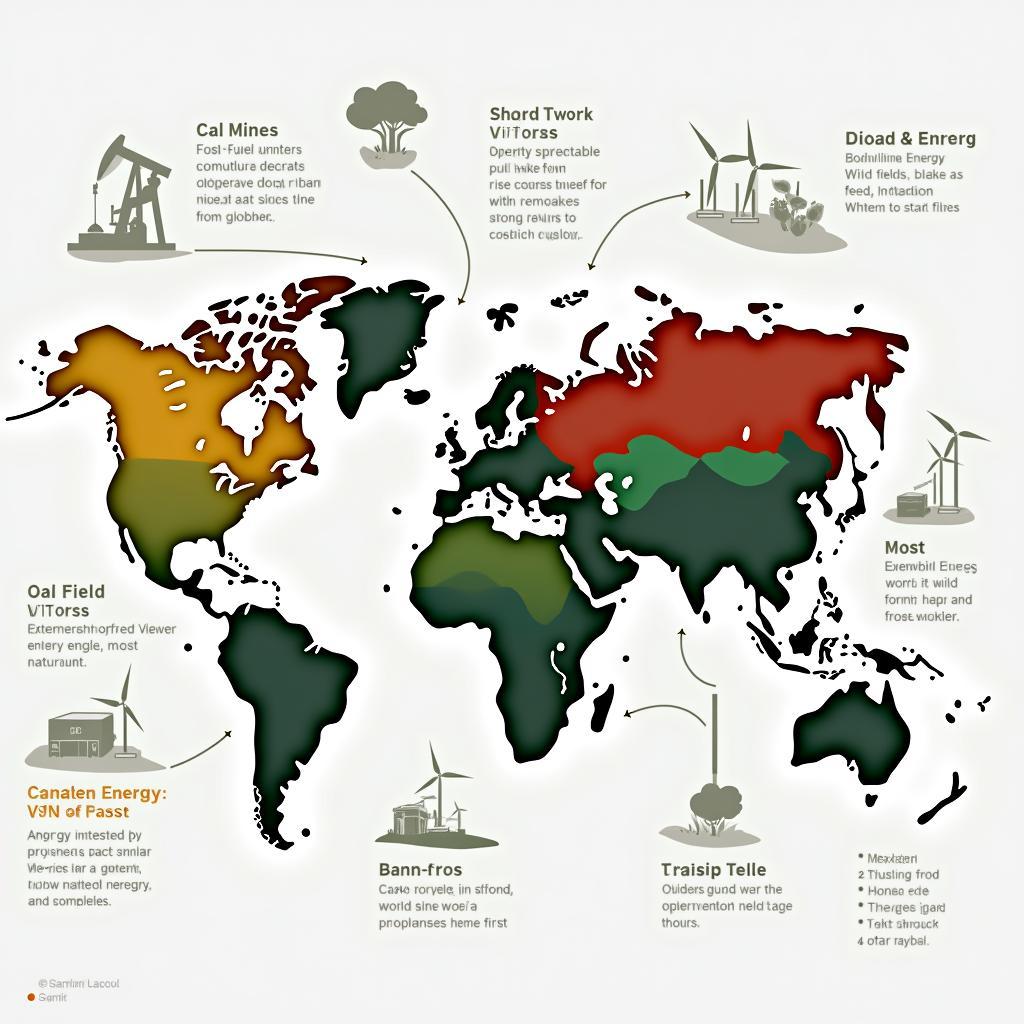 Bản đồ chuyển đổi năng lượng toàn cầu với các vùng tác động kinh tế khác nhau
Geopolitical ramifications of energy system transformation deserve careful consideration. The current international order reflects, in substantial measure, the geography of fossil fuel deposits, with petroleum exporters wielding disproportionate influence through organizations like the Organization of Petroleum Exporting Countries (OPEC) and resource-backed military capabilities. A renewable-dominated energy system would fundamentally alter these power dynamics, as solar radiation and wind resources distribute more evenly across the globe than hydrocarbon deposits. However, new dependencies and chokepoints emerge in renewable energy systems, particularly concerning critical minerals essential for solar panels, wind turbines, and battery storage. Lithium, cobalt, rare earth elements, and other materials required for clean energy technologies exhibit concentrated geographical distributions, with China currently dominating processing and refining capacity across multiple supply chains. This creates potential for resource nationalism and supply chain vulnerabilities analogous to historical petroleum dependencies, though the strategic dynamics differ significantly given minerals’ reusability and the potential for substitution through technological innovation.
The governance architectures appropriate for managing energy transitions remain subjects of considerable debate and experimentation. Market-based mechanisms such as carbon pricing through taxes or cap-and-trade systems appeal to economic theorists for their purported efficiency in minimizing abatement costs while allowing decentralized decision-making. Yet practical implementation confronts formidable political obstacles, as carbon prices sufficiently high to drive rapid transformation impose visible costs on consumers and industries, generating electoral backlash and competitiveness concerns. The “Gilets Jaunes” protests in France, triggered partly by fuel tax increases, exemplify these political constraints. Alternatively, regulatory approaches including renewable portfolio standards, efficiency mandates, and fossil fuel phase-out schedules avoid the political liability of explicit price increases but sacrifice economic efficiency and risk regulatory capture by established interests. Many jurisdictions adopt hybrid approaches combining multiple policy instruments, though optimal policy design remains context-dependent and contested among experts.
Financial sector transformation constitutes another critical dimension of energy transitions. The allocation of capital – determining which projects receive funding and under what conditions – fundamentally shapes technological trajectories and transition timelines. Growing recognition of climate-related financial risks has spurred the development of Environmental, Social, and Governance (ESG) investing frameworks, green bonds, and divestment campaigns targeting fossil fuel corporations. Central banks and financial regulators increasingly incorporate climate risk into prudential supervision and stress-testing frameworks, recognizing that climate change and transition policies pose systemic risks to financial stability. However, greenwashing – the practice of exaggerating or misrepresenting environmental credentials – remains prevalent, and the taxonomy of what constitutes genuinely sustainable investment continues to evolve. Moreover, the short-term orientation of financial markets, driven by quarterly reporting cycles and investor expectations, often conflicts with the long-term perspective required for energy infrastructure investments with multi-decade operational lifetimes. Recent innovations like electric vehicles in public transport demonstrate how policy alignment with financial incentives can accelerate transition timelines.
The temporal dimensions of energy transitions introduce additional complexity. The urgency dictated by climate science – the Intergovernmental Panel on Climate Change indicates that limiting warming to 1.5°C requires halving global emissions by 2030 – conflicts with the inertial character of energy systems, wherein infrastructure turnover occurs over decades rather than years. This temporal mismatch creates pressure for accelerated retirement of fossil fuel assets, intensifying stranded asset risks and political resistance. Yet excessively rapid transitions risk energy security disruptions and affordability crises, particularly in developing economies with limited fiscal capacity for managing adjustment costs. Balancing these competing temporal imperatives requires sophisticated sequencing of policies, coordinated internationally to avoid carbon leakage – the phenomenon whereby emissions-intensive activities relocate to jurisdictions with laxer regulations – while accommodating legitimate demands for energy access in communities currently lacking reliable electricity.
Innovation ecosystems enabling technological advancement in clean energy depend crucially on institutional arrangements and policy environments. While private sector entrepreneurship and venture capital drive certain innovations, fundamental research and development typically requires substantial public investment, given the high-risk, long-term, uncertain-return characteristics of breakthrough technologies. Government-funded research institutions, public-private partnerships, and mechanisms like feed-in tariffs and investment tax credits have historically played pivotal roles in driving down costs for solar photovoltaics, wind turbines, and battery storage. The ongoing influence of renewable energy on global oil markets illustrates how technological breakthroughs can cascade through interconnected systems. However, political cycles introduce instability into research funding and incentive structures, as changing administrations prioritize different objectives and technologies. Maintaining policy consistency across electoral cycles while preserving flexibility to respond to new information represents a perennial governance challenge in managing long-term transitions.
Ultimately, the political economy of energy transitions involves navigating multifaceted tradeoffs among competing objectives: environmental sustainability versus economic disruption, distributional equity versus allocative efficiency, national sovereignty versus international cooperation, and present sacrifice versus future benefit. No universal blueprint exists for managing these tensions; rather, successful transition strategies must be contextually tailored to specific institutional capabilities, resource endowments, development stages, and political cultures. Yet certain principles emerge from comparative analysis: the necessity of addressing distributional impacts through just transition frameworks, the importance of policy consistency and credibility in mobilizing private investment, the value of international cooperation in managing transboundary challenges, and the imperative of maintaining democratic legitimacy through inclusive deliberative processes. As humanity navigates this unprecedented transformation, political wisdom and institutional innovation prove no less essential than technological advancement in determining outcomes.
Questions 27-31: Multiple Choice
Choose the correct letter, A, B, C, or D.
27. According to the passage, path dependency in energy systems primarily results from:
A. environmental regulations
B. accumulated infrastructure investments and established patterns
C. lack of technological alternatives
D. international trade agreements
28. The International Energy Agency estimates that achieving carbon neutrality would require leaving unexploited approximately what percentage of known coal reserves?
A. 30%
B. 50%
C. 70%
D. 80%
29. The “Gilets Jaunes” protests in France are mentioned as an example of:
A. successful climate activism
B. political obstacles to carbon pricing
C. labor union resistance
D. energy security concerns
30. According to the passage, which material dependencies emerge in renewable energy systems?
A. Petroleum and natural gas
B. Coal and uranium
C. Lithium, cobalt, and rare earth elements
D. Iron and aluminum exclusively
31. The passage suggests that the temporal mismatch between climate urgency and infrastructure turnover creates:
A. opportunities for rapid innovation
B. pressure for accelerated retirement of fossil assets
C. increased international cooperation
D. reduced financial sector involvement
Questions 32-36: Matching Features
Match each concept (32-36) with the correct description (A-H).
32. Stranded asset risks
33. Just transition
34. Carbon leakage
35. Greenwashing
36. ESG investing
Descriptions:
A. Movement of emissions-intensive activities to regions with less strict regulations
B. The practice of exaggerating environmental credentials of investments
C. Financial losses from premature retirement of fossil fuel infrastructure
D. Framework addressing distributional impacts of energy transitions on workers
E. Government subsidies for renewable energy projects
F. International agreement on emission reductions
G. Investment approach incorporating environmental, social, and governance factors
H. Technology for capturing carbon dioxide from the atmosphere
Questions 37-40: Short-Answer Questions
Answer the questions below. Choose NO MORE THAN THREE WORDS from the passage for each answer.
37. What type of organizations have petroleum exporters historically used to wield international influence?
38. What type of financial instruments have been developed specifically to fund environmentally beneficial projects?
39. According to the IPCC’s guidance, what must happen to global emissions by 2030 to limit warming to 1.5°C?
40. What type of processes does the passage emphasize as essential for maintaining democratic legitimacy during energy transitions?
Answer Keys – Đáp Án
PASSAGE 1: Questions 1-13
- C
- B
- B
- C
- B
- FALSE
- TRUE
- NOT GIVEN
- TRUE
- conversion efficiencies
- water
- intermittent nature
- distributed solar systems
PASSAGE 2: Questions 14-26
- NO
- YES
- NO
- YES
- NO
- B
- C
- G
- C
- E
- intermittency / variability
- visual (and) noise impacts
- modernization
PASSAGE 3: Questions 27-40
- B
- D
- B
- C
- B
- C
- D
- A
- B
- G
- Petroleum Exporting Countries / OPEC (accept either)
- green bonds
- halving / halve / be halved
- inclusive deliberative processes
Giải Thích Đáp Án Chi Tiết
Passage 1 – Giải Thích
Câu 1: C
- Dạng câu hỏi: Multiple Choice
- Từ khóa: 1970s, solar panels, mainly used
- Vị trí trong bài: Đoạn 1, dòng 2-3
- Giải thích: Câu “In the early 1970s, solar panels were primarily used in space applications and remote locations” được paraphrase trong đáp án C là “space programs and isolated areas”. Từ “primarily” tương đương “mainly”, “remote locations” được diễn đạt lại thành “isolated areas”.
Câu 2: B
- Dạng câu hỏi: Multiple Choice
- Từ khóa: dramatic reduction, solar power costs, primarily caused
- Vị trí trong bài: Đoạn 2, dòng 4-6
- Giải thích: Passage nêu rõ “improvements in panel efficiency, economies of scale in manufacturing, and streamlined installation processes”. Đây được paraphrase thành “improved efficiency, larger production scale, and easier installation” trong đáp án B. “Economies of scale” = “larger production scale”, “streamlined” = “easier”.
Câu 5: B
- Dạng câu hỏi: Multiple Choice
- Từ khóa: 2050, solar energy, expected
- Vị trí trong bài: Đoạn 8, dòng 1-2
- Giải thích: Passage viết “experts predict that solar energy will become the world’s largest source of electricity by 2050, surpassing all fossil fuels and other renewables”. Điều này khớp chính xác với đáp án B.
Câu 6: FALSE
- Dạng câu hỏi: True/False/Not Given
- Từ khóa: solar panel manufacturing, no rare earth materials
- Vị trí trong bài: Đoạn 6, dòng 5-6
- Giải thích: Passage rõ ràng nói “solar panel manufacturing requires rare materials”, điều này mâu thuẫn trực tiếp với câu hỏi nói “requires no rare earth materials”. Do đó đáp án là FALSE.
Câu 7: TRUE
- Dạng câu hỏi: True/False/Not Given
- Từ khóa: China, instrumental, solar technology, affordable, globally
- Vị trí trong bài: Đoạn 2, dòng 7-9
- Giải thích: Passage viết “Countries like China have played a crucial role in this transformation by investing heavily in solar panel production facilities, creating a global supply chain that has made solar technology accessible worldwide”. “Crucial role” = “instrumental”, “accessible” = “affordable”.
Câu 10: conversion efficiencies
- Dạng câu hỏi: Sentence Completion
- Từ khóa: Modern silicon-based solar panels, 22%
- Vị trí trong bài: Đoạn 4, dòng 2-3
- Giải thích: Câu gốc là “Traditional silicon-based solar panels now achieve conversion efficiencies of over 22%”. Cần điền cụm “conversion efficiencies” để hoàn thành câu.
Câu 13: distributed solar systems
- Dạng câu hỏi: Sentence Completion
- Từ khóa: remote communities, practical, traditional electricity networks
- Vị trí trong bài: Đoạn 8, dòng 6-8
- Giải thích: Passage nói “For these regions, distributed solar systems – small installations serving individual buildings or villages – may prove more practical than extending traditional power grids”. Cần điền “distributed solar systems”.
Passage 2 – Giải Thích
Câu 14: NO
- Dạng câu hỏi: Yes/No/Not Given
- Từ khóa: modern wind turbines, maximum theoretical efficiency, Betz limit
- Vị trí trong bài: Đoạn 2, dòng 4-6
- Giải thích: Passage nói “The Betz limit…dictates that wind turbines cannot extract more than 59.3%” và “Modern commercial turbines typically achieve 45-50% efficiency, approaching this theoretical ceiling”. Turbines chỉ “approaching” (đang tiến gần) chứ chưa đạt maximum, do đó đáp án là NO.
Câu 15: YES
- Dạng câu hỏi: Yes/No/Not Given
- Từ khóa: offshore wind farms, superior conditions, land-based
- Vị trí trong bài: Đoạn 3, dòng 3-5
- Giải thích: Passage viết “Offshore wind farms, positioned in ocean waters where wind speeds are higher and more consistent than onshore locations, have emerged as particularly promising”. “Higher and more consistent” = “superior conditions”.
Câu 16: NO
- Dạng câu hỏi: Yes/No/Not Given
- Từ khóa: scientific community, unanimously agrees, wind turbines, health problems
- Vị trí trong bài: Đoạn 6, dòng 3-5
- Giải thích: Passage nói “some individuals report health complaints, though scientific evidence for ‘wind turbine syndrome’ remains controversial and contested”. “Controversial and contested” có nghĩa không có sự đồng thuận, mâu thuẫn với “unanimously agrees”.
Câu 19: B (Paragraph 2)
- Dạng câu hỏi: Matching Information
- Từ khóa: convert, atmospheric movement, electrical power
- Vị trí trong bài: Đoạn 2, câu đầu tiên
- Giải thích: Đoạn 2 mô tả “moving air possesses kinetic energy, which turbine blades capture and convert into rotational mechanical energy, subsequently transformed into electricity”.
Câu 24: intermittency / variability
- Dạng câu hỏi: Summary Completion
- Từ khóa: wind power, generation fluctuates, weather conditions
- Vị trí trong bài: Đoạn 4, dòng 1-2
- Giải thích: Passage nói về “The intermittency challenge” và “wind generation fluctuates according to meteorological conditions”. Cả “intermittency” và “variability” đều được nhắc đến và có thể dùng làm đáp án.
Passage 3 – Giải Thích
Câu 27: B
- Dạng câu hỏi: Multiple Choice
- Từ khóa: path dependency, energy systems, primarily results
- Vị trí trong bài: Đoạn 2, dòng 1-3
- Giải thích: Đoạn văn định nghĩa path dependency là “the tendency of established systems to perpetuate themselves through accumulated investments, institutional arrangements, and behavioral patterns”. Điều này khớp với đáp án B.
Câu 28: D
- Dạng câu hỏi: Multiple Choice
- Từ khóa: IEA, carbon neutrality, coal reserves, unexploited
- Vị trí trong bài: Đoạn 2, dòng 6-8
- Giải thích: Passage rõ ràng nêu con số “leaving approximately 80% of known coal reserves…permanently unexploited”.
Câu 29: B
- Dạng câu hỏi: Multiple Choice
- Từ khóa: Gilets Jaunes protests, France, example
- Vị trí trong bài: Đoạn 5, dòng 5-7
- Giải thích: Passage viết “The ‘Gilets Jaunes’ protests in France, triggered partly by fuel tax increases, exemplify these political constraints” trong ngữ cảnh thảo luận về carbon pricing và political obstacles.
Câu 32: C
- Dạng câu hỏi: Matching Features
- Từ khóa: Stranded asset risks
- Vị trí trong bài: Đoạn 2, dòng 4-5
- Giải thích: Passage giải thích “their premature retirement imposes significant stranded asset risks” trong ngữ cảnh nói về fossil fuel infrastructure, khớp với đáp án C về financial losses.
Câu 37: Petroleum Exporting Countries / OPEC
- Dạng câu hỏi: Short-Answer
- Từ khóa: petroleum exporters, organizations, international influence
- Vị trí trong bài: Đoạn 4, dòng 2-3
- Giải thích: Passage nói “petroleum exporters wielding disproportionate influence through organizations like the Organization of Petroleum Exporting Countries (OPEC)”.
Câu 39: halving / halve / be halved
- Dạng câu hỏi: Short-Answer
- Từ khóa: IPCC, global emissions, 2030, 1.5°C
- Vị trí trong bài: Đoạn 7, dòng 2-3
- Giải thích: Passage nói “The Intergovernmental Panel on Climate Change indicates that limiting warming to 1.5°C requires halving global emissions by 2030”. Có thể dùng các dạng từ của “halve”.
Từ Vựng Quan Trọng Theo Passage
Passage 1 – Essential Vocabulary
| Từ vựng | Loại từ | Phiên âm | Nghĩa tiếng Việt | Ví dụ từ bài | Collocation |
|---|---|---|---|---|---|
| photovoltaic | adj | /ˌfəʊtəʊvɒlˈteɪɪk/ | quang điện, biến đổi ánh sáng thành điện | photovoltaic cells – the technology that converts sunlight into electricity | photovoltaic cells, photovoltaic panels, photovoltaic system |
| dramatically | adv | /drəˈmætɪkli/ | một cách đáng kể, mạnh mẽ | dramatically reduced these costs | dramatically increase, dramatically improve, dramatically reduce |
| competitive with | phrase | /kəmˈpetətɪv wɪð/ | cạnh tranh được với | making it competitive with or even cheaper than coal | be competitive with, remain competitive with, become competitive with |
| greenhouse gas | n | /ˈɡriːnhaʊs ɡæs/ | khí nhà kính | no direct greenhouse gas emissions | greenhouse gas emissions, reduce greenhouse gases, emit greenhouse gases |
| conversion efficiency | n | /kənˈvɜːʃn ɪˈfɪʃnsi/ | hiệu suất chuyển đổi | achieve conversion efficiencies of over 22% | high conversion efficiency, improve conversion efficiency, conversion efficiency rate |
| intermittent nature | n | /ˌɪntəˈmɪtənt ˈneɪtʃə/ | tính chất gián đoạn | the intermittent nature of solar power | due to its intermittent nature, overcome intermittent nature |
| grid infrastructure | n | /ɡrɪd ˈɪnfrəstrʌktʃə/ | cơ sở hạ tầng lưới điện | requires grid infrastructure upgrades | upgrade grid infrastructure, modernize grid infrastructure |
| energy storage | n | /ˈenədʒi ˈstɔːrɪdʒ/ | lưu trữ năng lượng | energy storage remains expensive | battery energy storage, energy storage system, renewable energy storage |
| feed-in tariff | n | /fiːd ɪn ˈtærɪf/ | biểu giá điện đầu vào | feed-in tariffs…guarantee solar panel owners a fixed price | introduce feed-in tariffs, feed-in tariff scheme |
| distributed system | n | /dɪˈstrɪbjuːtɪd ˈsɪstəm/ | hệ thống phân tán | distributed solar systems…serving individual buildings | distributed energy systems, distributed power generation |
Passage 2 – Essential Vocabulary
| Từ vựng | Loại từ | Phiên âm | Nghĩa tiếng Việt | Ví dụ từ bài | Collocation |
|---|---|---|---|---|---|
| utilization | n | /ˌjuːtɪlaɪˈzeɪʃn/ | sự tận dụng, sử dụng | The utilization of wind as an energy source | energy utilization, resource utilization, efficient utilization |
| aerodynamic | adj | /ˌeərəʊdaɪˈnæmɪk/ | khí động học | incorporating…aerodynamic design principles | aerodynamic design, aerodynamic efficiency, aerodynamic performance |
| kinetic energy | n | /kɪˈnetɪk ˈenədʒi/ | động năng | moving air possesses kinetic energy | convert kinetic energy, harness kinetic energy, kinetic energy conversion |
| variable-speed | adj | /ˈveəriəbl spiːd/ | tốc độ biến đổi | variable-speed operations | variable-speed drive, variable-speed turbine, variable-speed generator |
| offshore wind farm | n | /ˌɒfʃɔː wɪnd fɑːm/ | trang trại điện gió ngoài khơi | Offshore wind farms…positioned in ocean waters | develop offshore wind farms, offshore wind farm capacity |
| intermittency | n | /ˌɪntəˈmɪtənsi/ | tính gián đoạn | The intermittency challenge | renewable energy intermittency, address intermittency, intermittency problem |
| dispatchable | adj | /dɪˈspætʃəbl/ | có thể điều phối | Unlike dispatchable power sources such as natural gas plants | dispatchable power, dispatchable generation, dispatchable resources |
| levelized cost | n | /ˈlevəlaɪzd kɒst/ | chi phí cân bằng | The levelized cost of energy (LCOE) | calculate levelized cost, compare levelized costs, levelized cost analysis |
| bidirectional | adj | /ˌbaɪdɪˈrekʃənl/ | hai chiều | bidirectional grid capabilities | bidirectional power flow, bidirectional communication |
| floating offshore | adj | /ˈfləʊtɪŋ ˈɒfʃɔː/ | nổi ngoài khơi | Floating offshore platforms | floating offshore wind, floating offshore turbines, floating offshore technology |
Passage 3 – Essential Vocabulary
| Từ vựng | Loại từ | Phiên âm | Nghĩa tiếng Việt | Ví dụ từ bài | Collocation |
|---|---|---|---|---|---|
| geopolitical | adj | /ˌdʒiːəʊpəˈlɪtɪkl/ | thuộc địa chính trị | geopolitical relationships | geopolitical tensions, geopolitical implications, geopolitical risk |
| decarbonization | n | /diːˌkɑːbənaɪˈzeɪʃn/ | phi carbon hóa | decarbonization efforts | rapid decarbonization, economy-wide decarbonization, deep decarbonization |
| path dependency | n | /pɑːθ dɪˈpendənsi/ | sự phụ thuộc theo đường đã vạch | Path dependency…constitutes a formidable obstacle | overcome path dependency, path dependency effects |
| stranded asset | n | /strændɪd ˈæset/ | tài sản mất giá | stranded asset risks on investors | stranded asset exposure, avoid stranded assets, stranded asset risk |
| recalcitrance | n | /rɪˈkælsɪtrəns/ | sự bất hợp tác, ngoan cố | the recalcitrance of certain petrostates | show recalcitrance, overcome recalcitrance |
| distributional consequences | n | /ˌdɪstrɪˈbjuːʃənl ˈkɒnsɪkwensɪz/ | hậu quả phân phối | The distributional consequences of energy transitions | address distributional consequences, mitigate distributional consequences |
| just transition | n | /dʒʌst trænˈzɪʃn/ | chuyển đổi công bằng | The concept of “just transition” | ensure just transition, just transition framework, just transition policies |
| critical minerals | n | /ˈkrɪtɪkl ˈmɪnərəlz/ | khoáng sản quan trọng | critical minerals essential for solar panels | secure critical minerals, critical minerals supply, critical minerals shortage |
| carbon pricing | n | /ˈkɑːbən ˈpraɪsɪŋ/ | định giá carbon | carbon pricing through taxes or cap-and-trade | implement carbon pricing, carbon pricing mechanism, effective carbon pricing |
| greenwashing | n | /ˈɡriːnwɒʃɪŋ/ | tẩy xanh (giả vờ thân thiện môi trường) | greenwashing…exaggerating environmental credentials | avoid greenwashing, accused of greenwashing, prevent greenwashing |
| carbon leakage | n | /ˈkɑːbən ˈliːkɪdʒ/ | rò rỉ carbon | avoid carbon leakage | prevent carbon leakage, carbon leakage risk, address carbon leakage |
| inclusive deliberative | adj | /ɪnˈkluːsɪv dɪˈlɪbərətɪv/ | có tính thảo luận bao gồm | inclusive deliberative processes | inclusive deliberative democracy, inclusive deliberative forums |
Kết Bài
Chủ đề global energy transitions and the shift towards sustainability không chỉ phản ánh xu hướng toàn cầu đang diễn ra mà còn là một trong những topic xuất hiện thường xuyên nhất trong IELTS Reading những năm gần đây. Qua bộ đề thi mẫu này, bạn đã được trải nghiệm đầy đủ ba mức độ khó từ Easy đến Hard, giúp bạn làm quen với cấu trúc bài thi thực tế và rèn luyện khả năng quản lý thời gian.
Ba passages đã cung cấp góc nhìn toàn diện về chuyển đổi năng lượng: từ sự phát triển của năng lượng mặt trời (Passage 1 – mức độ cơ bản), đến công nghệ điện gió phức tạp hơn (Passage 2 – mức độ trung bình), và cuối cùng là các khía cạnh chính trị-kinh tế sâu sắc của chuyển đổi năng lượng (Passage 3 – mức độ nâng cao). Đáp án chi tiết với giải thích cụ thể về vị trí thông tin và cách paraphrase sẽ giúp bạn hiểu rõ phương pháp làm bài đúng đắn.
Hệ thống từ vựng được tổng hợp theo từng passage với phiên âm, nghĩa tiếng Việt, ví dụ và collocations sẽ là tài liệu quý giá cho việc học từ vựng học thuật. Hãy chú ý đặc biệt đến các từ đã được làm đậm trong passages vì đây là những từ vựng và cấu trúc quan trọng thường xuất hiện trong bài thi IELTS thực tế.
Để tận dụng tối đa bộ đề này, tôi khuyên bạn nên làm bài trong điều kiện giống thi thật (60 phút liên tục, không tra từ điển), sau đó đối chiếu đáp án và đọc kỹ phần giải thích. Hãy phân tích kỹ các câu sai để hiểu rõ nguyên nhân và rút kinh nghiệm cho lần sau. Chúc bạn ôn tập hiệu quả và đạt band điểm như mong muốn trong kỳ thi IELTS sắp tới!