
Mở Bài
Chủ đề về ảnh hưởng của mạng xã hội đến hình ảnh cơ thể và lòng tự trọng là một trong những chủ đề xã hội đương đại xuất hiện thường xuyên trong kỳ thi IELTS Reading. Với sự phát triển mạnh mẽ của các nền tảng mạng xã hội như Instagram, TikTok, Facebook, vấn đề này đang nhận được sự quan tâm lớn từ giới nghiên cứu khoa học và cộng đồng giáo dục toàn cầu.
Bài viết này cung cấp cho bạn một đề thi IELTS Reading hoàn chỉnh với 3 passages từ dễ đến khó, bao gồm 40 câu hỏi đa dạng giống với đề thi thật. Bạn sẽ được luyện tập với các dạng câu hỏi phổ biến như Multiple Choice, True/False/Not Given, Matching Headings, và Summary Completion. Mỗi câu hỏi đều có đáp án chi tiết kèm giải thích rõ ràng, giúp bạn hiểu cách xác định thông tin và paraphrase trong bài đọc.
Đề thi này phù hợp cho học viên từ band 5.0 trở lên, với độ khó tăng dần qua từng passage. Ngoài việc luyện tập kỹ năng làm bài, bạn còn được trang bị vốn từ vựng học thuật quan trọng liên quan đến tâm lý học, truyền thông xã hội và sức khỏe tinh thần – những chủ đề thường xuyên xuất hiện trong IELTS Reading.
Hướng Dẫn Làm Bài IELTS Reading
Tổng Quan Về IELTS Reading Test
IELTS Reading Test kéo dài 60 phút với 3 passages và tổng cộng 40 câu hỏi. Mỗi câu trả lời đúng được tính 1 điểm, không bị trừ điểm khi trả lời sai. Điểm số sau đó được chuyển đổi sang thang điểm band từ 1-9.
Phân bổ thời gian khuyến nghị:
- Passage 1 (Easy): 15-17 phút
- Passage 2 (Medium): 18-20 phút
- Passage 3 (Hard): 23-25 phút
Bạn nên dành 2-3 phút cuối để kiểm tra và chuyển đáp án vào answer sheet. Lưu ý rằng không có thời gian bổ sung để chuyển đáp án như trong Listening Test.
Các Dạng Câu Hỏi Trong Đề Này
Đề thi mẫu này bao gồm 7 dạng câu hỏi phổ biến nhất trong IELTS Reading:
- Multiple Choice – Chọn đáp án đúng từ các phương án cho sẵn
- True/False/Not Given – Xác định thông tin đúng, sai hoặc không được đề cập
- Matching Information – Ghép thông tin với đoạn văn tương ứng
- Sentence Completion – Hoàn thành câu với từ trong bài đọc
- Matching Headings – Chọn tiêu đề phù hợp cho mỗi đoạn
- Summary Completion – Điền từ vào đoạn tóm tắt
- Short-answer Questions – Trả lời câu hỏi ngắn với từ trong bài
IELTS Reading Practice Test
PASSAGE 1 – The Social Media Mirror: How Online Platforms Shape Our Self-Image
Độ khó: Easy (Band 5.0-6.5)
Thời gian đề xuất: 15-17 phút
In the past decade, social media platforms have transformed from simple communication tools into powerful forces that shape how we perceive ourselves and others. With over 4.5 billion active users worldwide, platforms like Instagram, Facebook, TikTok, and Snapchat have become digital mirrors in which people constantly view and evaluate their appearance, achievements, and lifestyle choices. This unprecedented exposure to carefully curated images and videos has sparked growing concerns among psychologists and health professionals about the impact on body image and self-esteem, particularly among young people.
Body image refers to the subjective picture a person has of their own physical appearance, including thoughts, feelings, and perceptions about their body. It is closely linked to self-esteem, which is the overall sense of self-worth or personal value. Traditionally, body image concerns were influenced by magazines, television, and advertising. However, social media has amplified these effects in several distinctive ways. Unlike traditional media, social media is interactive, immediate, and personal. Users don’t just passively consume content; they actively create, share, and compare their lives with others on a constant basis.
One of the most significant features of social media is the prevalence of edited images. Studies show that approximately 90% of young women use filters or editing tools before posting photos of themselves online. These tools can smooth skin, whiten teeth, slim faces, and even alter body proportions with just a few clicks. While users know these images are digitally enhanced, the constant exposure to such perfected versions of reality can create unrealistic beauty standards. When people compare their unedited reality to others’ enhanced images, they often feel inadequate or dissatisfied with their own appearance.
The concept of social comparison has been well-studied in psychology. Social comparison theory suggests that people determine their own social and personal worth based on how they stack up against others. On social media, this comparison happens continuously and automatically. Every time someone scrolls through their feed, they are bombarded with images of friends, celebrities, and influencers who appear to have perfect bodies, flawless skin, and enviable lifestyles. Research has found that upward social comparison – comparing oneself to those perceived as better – is particularly detrimental to self-esteem and can lead to negative body image.
Young people are especially vulnerable to these effects. Adolescence is a critical period for identity development and self-concept formation. During these years, teenagers are particularly sensitive to peer feedback and social acceptance. A 2021 study conducted by the American Psychological Association found that teenagers who spent more than three hours per day on social media were twice as likely to report poor mental health, including symptoms of depression and anxiety related to body image concerns. Girls, in particular, showed higher rates of body dissatisfaction correlated with social media use.
The like and comment culture on social media creates a feedback loop that can reinforce body image concerns. When users post photos, they often anxiously await the reactions of their online audience. Photos that receive many likes and positive comments can provide a temporary boost to self-esteem, while those that don’t perform well can lead to feelings of rejection and inadequacy. This creates a situation where external validation becomes increasingly important, and individuals may begin to measure their self-worth by the number of likes or followers they have.
However, the relationship between social media and body image is complex and multifaceted. Not all effects are negative, and the impact varies depending on how platforms are used and individual personality traits. Some research suggests that social media can also be a source of body positivity and support. Movements like body positivity and body neutrality have gained significant traction online, with influencers and everyday users sharing unedited photos and authentic stories about their struggles with body image. These communities can provide validation and encouragement for people who feel marginalized by traditional beauty standards.
Questions 1-6: Multiple Choice
Choose the correct letter, A, B, C or D.
-
According to the passage, social media differs from traditional media because:
A) It reaches more people worldwide
B) It allows users to interact and create content
C) It shows more advertisements
D) It is easier to access -
What percentage of young women use editing tools on their photos?
A) About 50%
B) Less than 75%
C) Approximately 90%
D) Nearly 100% -
Social comparison theory suggests that people:
A) Always compare themselves to celebrities
B) Judge their worth based on comparisons with others
C) Avoid comparing themselves on social media
D) Only compare their appearance, not other aspects -
Teenagers who spend more than three hours daily on social media are:
A) More likely to be popular
B) Better at communication
C) Twice as likely to have poor mental health
D) Less concerned about body image -
The “like and comment culture” creates:
A) More opportunities for friendship
B) A feedback loop affecting self-esteem
C) Better quality photos
D) Less time spent online -
The passage suggests that body positivity movements:
A) Are ineffective on social media
B) Only help young people
C) Can provide positive effects through social media
D) Are more popular than negative content
Questions 7-10: True/False/Not Given
Do the following statements agree with the information given in the passage?
Write:
- TRUE if the statement agrees with the information
- FALSE if the statement contradicts the information
- NOT GIVEN if there is no information on this
- Over 4.5 billion people currently use social media worldwide.
- Men are more affected by social media body image issues than women.
- All effects of social media on body image are negative.
- Body image concerns only appeared after social media was invented.
Questions 11-13: Sentence Completion
Complete the sentences below. Choose NO MORE THAN TWO WORDS from the passage for each answer.
- Body image is described as the __ picture a person has of their physical appearance.
- During adolescence, teenagers are especially sensitive to __ and social acceptance.
- Some users share __ photos as part of body positivity movements.
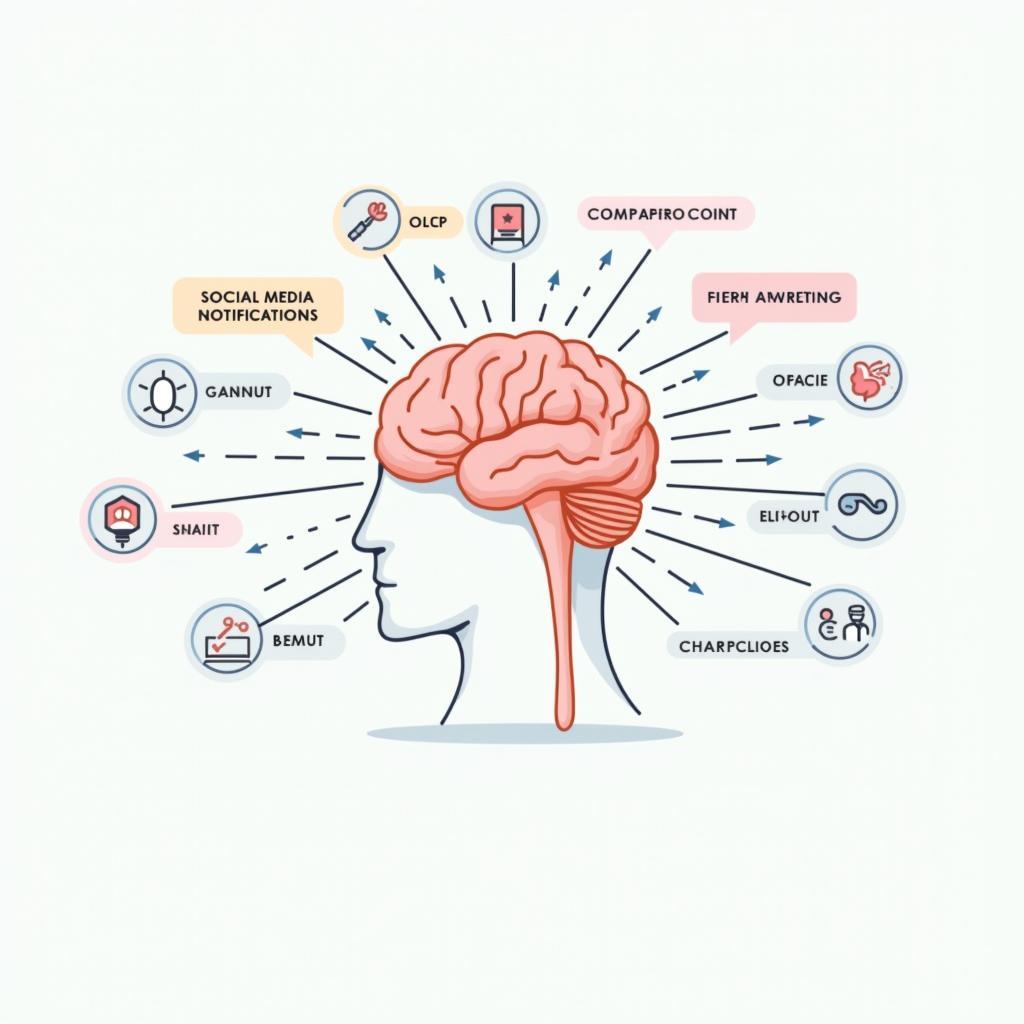
 Minh họa ảnh hưởng của mạng xã hội đến nhận thức về hình ảnh cơ thể và tâm lý thanh thiếu niên
PASSAGE 2 – The Psychological Mechanisms Behind Social Media’s Impact on Self-Worth
Độ khó: Medium (Band 6.0-7.5)
Thời gian đề xuất: 18-20 phút
The intricate relationship between social media engagement and psychological well-being has become a focal point of contemporary research in psychology, sociology, and communication studies. While the previous generation experienced body image pressures primarily through mass media channels, today’s digital natives face an altogether different landscape – one characterized by constant connectivity, algorithmic curation, and the blurring of boundaries between public and private life. Understanding the underlying psychological mechanisms that mediate this relationship is crucial for developing effective interventions and promoting healthier digital habits.
A. The Comparison Trap
Central to the discussion is the intensification of social comparison processes in the digital age. Leon Festinger’s seminal work on social comparison theory, developed in 1954, proposed that individuals have an innate drive to evaluate themselves by comparing their abilities and opinions with those of others. In the pre-digital era, such comparisons were limited in scope and frequency. Today, however, social media provides an endless stream of comparison opportunities, creating what researchers term “comparison overload.”
Dr. Sarah Mitchell, a psychologist at Stanford University, explains that social media platforms are “comparison engines by design.” The algorithmic architecture of these platforms prioritizes content that generates engagement, which often means showing users images and updates that provoke emotional responses, including envy and inadequacy. A 2022 study published in the Journal of Social and Clinical Psychology found that participants who limited their social media use to 30 minutes per day showed significant reductions in loneliness and depression compared to a control group, suggesting a causal relationship between social media exposure and psychological distress.
B. The Filter Effect
The proliferation of photo-editing applications and built-in filters has created a phenomenon researchers call “Snapchat dysmorphia” – a condition where individuals seek cosmetic procedures to resemble their filtered selfies. Dr. Neelam Vashi, director of the Ethnic Skin Center at Boston Medical Center, reports a substantial increase in patients bringing in edited photos of themselves as reference images for desired procedures. This represents a troubling reversal: rather than cosmetic surgery helping people achieve their natural ideal, filters are establishing artificial ideals that people then pursue surgically.
The psychological impact extends beyond those seeking surgery. A study by the University of Pennsylvania involving 1,800 participants found that exposure to digitally manipulated images – even when users were explicitly informed about the editing – still resulted in decreased body satisfaction and increased anxiety about appearance. This suggests that cognitive awareness of image manipulation is insufficient to counteract its psychological effects, indicating that the impact operates at a subconscious level.
C. The Validation Economy
Social media has created what sociologists call a “validation economy” or “attention economy,” where likes, comments, shares, and followers function as social currency. This gamification of social interaction activates the brain’s reward system in ways similar to gambling. Neuroimaging studies have shown that receiving likes on social media posts activates the nucleus accumbens, the brain region associated with reward processing and dopamine release.
This neurological response creates a feedback mechanism that can become problematic. When individuals post content and receive positive feedback, they experience a dopamine rush. However, when posts don’t receive expected engagement, it can trigger feelings of rejection and disappointment. Over time, this can lead to compulsive checking behaviors and an unhealthy reliance on external validation for self-worth. Dr. Robert Thompson, a neuroscientist at UCLA, describes this as “outsourcing your self-esteem,” where internal validation is increasingly replaced by the need for constant external affirmation.
D. The Paradox of Connectivity
Paradoxically, while social media promises enhanced connectivity, research suggests it may actually increase feelings of isolation and loneliness. The cultivation theory, originally applied to television, proposes that prolonged exposure to media content shapes perceptions of reality. Applied to social media, this means that continuous exposure to others’ highlight reels – carefully selected moments that showcase achievements, beauty, and happiness – can distort perceptions of what normal life should look like.
A longitudinal study conducted by researchers at the University of Pittsburgh tracked 1,000 young adults over two years and found that those with higher social media usage were three times more likely to feel socially isolated compared to those with minimal usage. The researchers proposed that social media interaction might displace more authentic face-to-face interactions, or that seeing others’ social activities might heighten feelings of exclusion – a phenomenon termed “FOMO” (fear of missing out).
E. Gender Differences and Vulnerabilities
While both males and females experience negative impacts from social media, research indicates distinct patterns in how these effects manifest. Women and girls tend to experience more appearance-related pressures, with greater emphasis on physical attractiveness, thinness, and beauty standards. Men and boys, conversely, face increasing pressure regarding muscularity, athletic performance, and financial success.
A meta-analysis of 50 studies involving over 10,000 participants found that the relationship between social media use and body dissatisfaction was consistently stronger in females across all age groups. However, emerging research suggests that body image concerns among males are rising rapidly, particularly related to muscular ideal internalization promoted through fitness influencers and physique-focused content.
Questions 14-19: Matching Headings
Choose the correct heading for sections A-E from the list of headings below.
List of Headings:
i. The neurological basis of social media addiction
ii. How algorithms intensify comparison behaviors
iii. Surgical interventions inspired by digital images
iv. Different impacts across genders
v. The contradiction between connection and isolation
vi. Economic factors in social media development
vii. The role of reward systems in validation seeking
viii. Historical development of social comparison
- Section A
- Section B
- Section C
- Section D
- Section E
Questions 19-23: Yes/No/Not Given
Do the following statements agree with the claims of the writer?
Write:
- YES if the statement agrees with the claims of the writer
- NO if the statement contradicts the claims of the writer
- NOT GIVEN if it is impossible to say what the writer thinks about this
- Social comparison opportunities were more limited before the digital age.
- Knowing that images are edited completely prevents negative psychological effects.
- Social media platforms intentionally design features to promote comparison.
- Face-to-face interactions are always more meaningful than online interactions.
- Body image concerns among males are increasing at a faster rate than among females.
Questions 24-26: Summary Completion
Complete the summary below. Choose NO MORE THAN TWO WORDS from the passage for each answer.
Social media creates a system called the 24. __, where engagement metrics function as social currency. When users receive positive feedback, it triggers a 25. __ in the brain, similar to gambling. This can lead to 26. __ behaviors and excessive dependence on external validation.
 Cơ chế tâm lý và thần kinh học giải thích ảnh hưởng mạng xã hội đến lòng tự trọng và sức khỏe tinh thần
PASSAGE 3 – Intervention Strategies and the Future of Digital Well-being
Độ khó: Hard (Band 7.0-9.0)
Thời gian đề xuất: 23-25 phút
The burgeoning body of evidence linking social media use to deleterious effects on body image and self-esteem has galvanized researchers, policymakers, and technology companies to develop and implement intervention strategies. However, the complexity of the issue – spanning individual psychology, social dynamics, technological design, and commercial imperatives – necessitates a multifaceted approach. The challenge lies not merely in understanding the problem but in translating that understanding into pragmatic solutions that can operate at scale while respecting individual autonomy and the legitimate benefits that social media platforms provide.
From a clinical perspective, cognitive-behavioral interventions have shown considerable promise in mitigating the negative psychological impacts of social media use. Dr. Jacqueline Sperling, a psychologist at McLean Hospital and Harvard Medical School, has developed a therapeutic protocol specifically targeting social media-related body image concerns. The intervention focuses on enhancing media literacy, challenging cognitive distortions, and developing healthier self-evaluation strategies. In a randomized controlled trial involving 240 adolescents, participants who received the intervention demonstrated statistically significant improvements in body satisfaction and self-esteem, with effects persisting at six-month follow-up. Critically, the intervention did not require participants to abandon social media entirely but rather to cultivate a more critical and mindful engagement with digital content.
The concept of digital literacy has emerged as a cornerstone of prevention efforts. Unlike traditional literacy, which focuses on the ability to read and write, digital literacy encompasses the capacity to critically evaluate online content, understand algorithmic mechanisms, recognize persuasive techniques, and navigate digital spaces in ways that promote well-being. Educational initiatives implementing comprehensive digital literacy curricula have shown encouraging results. A longitudinal study conducted across 50 secondary schools in the United Kingdom found that students who received structured digital literacy education exhibited greater resilience to social media pressures, demonstrating both improved body image and more balanced social media usage patterns compared to control groups.
Technological interventions represent another promising avenue, albeit one fraught with complexity. Some researchers and designers advocate for “ethical design” or “humane technology” – approaches that prioritize user well-being over engagement metrics. Instagram’s 2021 decision to hide like counts in certain regions was predicated on research suggesting that visible metrics exacerbate comparison behaviors and validation-seeking. While the initiative received mixed reactions, preliminary data suggests modest but meaningful reductions in anxiety among users in test markets. However, critics argue that such surface-level modifications fail to address the fundamental business model of social media platforms, which inherently relies on maximizing user engagement to generate advertising revenue.
The regulatory landscape is also evolving, with policymakers grappling with the question of how to safeguard vulnerable populations, particularly minors, without impinging upon freedom of expression or stifling innovation. The United Kingdom’s Age-Appropriate Design Code, implemented in 2021, mandates that digital services likely to be accessed by children must incorporate privacy protections and design features that prioritize child safety and well-being. Similarly, proposed legislation in several U.S. states would require social media companies to conduct and disclose impact assessments regarding potential harms to young users. Such regulatory approaches reflect a paradigm shift toward holding platforms accountable for the societal implications of their design choices.
Paradoxically, social media itself has become a vehicle for counter-movements aimed at challenging unrealistic beauty standards and promoting body acceptance. The body positivity movement, which gained momentum in the 2010s, has leveraged social media’s democratizing potential to amplify diverse voices and representations. Influencers and activists use platforms to share unretouched images, discuss body image struggles openly, and critique the narrow beauty ideals perpetuated by mainstream media and advertising. Research by Dr. Rachel Cohen at Harvard University suggests that exposure to body-positive content can serve as a protective factor, buffering against the negative effects of idealized imagery. However, she cautions that the movement itself has become commodified and co-opted by brands, potentially diluting its transformative potential.
The trajectory of this issue will likely be shaped by several converging trends. Advances in artificial intelligence and augmented reality promise to make image manipulation even more sophisticated and ubiquitous, potentially intensifying existing challenges. Simultaneously, growing awareness and advocacy may catalyze meaningful changes in platform design, regulatory frameworks, and individual behavior. Some researchers envision a future where personalized interventions – leveraging data analytics to identify individuals at risk and deliver targeted support – could preemptively address problems before they escalate. Others emphasize the importance of structural changes that address the root causes: the attention economy and the commercialization of social interaction.
Ultimately, addressing the impact of social media on body image and self-esteem requires acknowledging that technology is neither inherently beneficial nor harmful; rather, its effects are contingent upon how it is designed, regulated, and used. The goal should not be to demonize social media or retreat to a pre-digital existence but to foster a digital ecosystem that aligns technological affordances with human flourishing. This demands collaboration across disciplines and sectors: psychologists providing evidence-based insights, educators cultivating critical digital citizens, technologists prioritizing ethical design, policymakers crafting thoughtful regulations, and users themselves advocating for and practicing healthier digital habits. In this collective endeavor lies the possibility of harnessing social media’s connective power while mitigating its potential harms, ultimately creating a digital landscape that enhances rather than undermines individual and collective well-being.
Questions 27-30: Multiple Choice
Choose the correct letter, A, B, C or D.
-
According to the passage, cognitive-behavioral interventions:
A) Require participants to stop using social media completely
B) Focus on developing critical engagement with social media
C) Are only effective for adults, not adolescents
D) Have shown no significant long-term effects -
Digital literacy differs from traditional literacy because it:
A) Is easier to teach in schools
B) Only focuses on reading digital texts
C) Includes understanding algorithms and persuasive techniques
D) Replaces the need for reading and writing skills -
Instagram’s decision to hide like counts was based on:
A) Financial considerations
B) Government regulations
C) Research about comparison behaviors
D) User complaints -
The author suggests that the body positivity movement:
A) Has been entirely successful in changing beauty standards
B) May have been weakened through commercialization
C) Only exists on social media platforms
D) Is rejected by most researchers
Questions 31-35: Matching Features
Match each researcher/organization (31-35) with the correct contribution (A-H).
Researchers/Organizations:
31. Dr. Jacqueline Sperling
32. Dr. Rachel Cohen
33. United Kingdom (schools study)
34. United Kingdom (regulatory)
35. McLean Hospital
Contributions:
A. Conducted research on protective effects of body-positive content
B. Implemented age-appropriate design code
C. Developed therapeutic protocol for social media body image concerns
D. Created the first social media platform
E. Conducted longitudinal study on digital literacy education
F. Banned social media for minors
G. Affiliated with a researcher developing interventions
H. Studied the effects of advertising
Questions 36-40: Short-answer Questions
Answer the questions below. Choose NO MORE THAN THREE WORDS from the passage for each answer.
- What type of design do some researchers advocate for that prioritizes user well-being?
- What does the fundamental business model of social media platforms rely on maximizing?
- What has the body positivity movement used to amplify diverse voices?
- What two technologies may make image manipulation more sophisticated in the future?
- According to the passage, what should technological affordances align with?
 Chiến lược can thiệp và giải pháp nâng cao sức khỏe tinh thần trong kỷ nguyên mạng xã hội số
Answer Keys – Đáp Án
PASSAGE 1: Questions 1-13
- B
- C
- B
- C
- B
- C
- TRUE
- NOT GIVEN
- FALSE
- FALSE
- subjective
- peer feedback
- unedited
PASSAGE 2: Questions 14-26
- ii
- iii
- vii (hoặc i)
- v
- iv
- YES
- NO
- YES
- NOT GIVEN
- NOT GIVEN
- validation economy
- dopamine rush (hoặc dopamine release)
- compulsive checking
PASSAGE 3: Questions 27-40
- B
- C
- C
- B
- C
- A
- E
- B
- G
- ethical design (hoặc humane technology)
- user engagement
- democratizing potential
- artificial intelligence, augmented reality (cả hai từ, có thể viết: AI and AR)
- human flourishing
Giải Thích Đáp Án Chi Tiết
Passage 1 – Giải Thích
Câu 1: B
- Dạng câu hỏi: Multiple Choice
- Từ khóa: social media differs, traditional media
- Vị trí trong bài: Đoạn 2, dòng 6-8
- Giải thích: Bài viết nêu rõ “Unlike traditional media, social media is interactive, immediate, and personal. Users don’t just passively consume content; they actively create, share, and compare their lives with others.” Điều này được paraphrase trong đáp án B về việc cho phép users tương tác và tạo nội dung.
Câu 2: C
- Dạng câu hỏi: Multiple Choice – Thông tin cụ thể
- Từ khóa: percentage, young women, editing tools
- Vị trí trong bài: Đoạn 3, dòng 2-3
- Giải thích: Bài viết nêu rõ con số “approximately 90% of young women use filters or editing tools before posting photos.”
Câu 7: TRUE
- Dạng câu hỏi: True/False/Not Given
- Từ khóa: 4.5 billion, social media, worldwide
- Vị trí trong bài: Đoạn 1, dòng 2-3
- Giải thích: Câu “With over 4.5 billion active users worldwide” khớp chính xác với thông tin trong câu hỏi.
Câu 9: FALSE
- Dạng câu hỏi: True/False/Not Given
- Từ khóa: all effects, negative
- Vị trí trong bài: Đoạn 7, dòng 1-2
- Giải thích: Bài viết nói rõ “Not all effects are negative” và đề cập đến các phong trào body positivity có tác động tích cực, mâu thuẫn với câu hỏi.
Câu 11: subjective
- Dạng câu hỏi: Sentence Completion
- Từ khóa: body image, picture, physical appearance
- Vị trí trong bài: Đoạn 2, dòng 1-2
- Giải thích: Câu trong bài: “Body image refers to the subjective picture a person has of their own physical appearance.”
Passage 2 – Giải Thích
Câu 14: ii (Section A)
- Dạng câu hỏi: Matching Headings
- Từ khóa: comparison, algorithms, intensification
- Vị trí trong bài: Section A nói về “comparison overload” và “algorithmic architecture”
- Giải thích: Section A tập trung vào việc algorithms của social media làm tăng cường (intensify) hành vi so sánh, với các cụm từ như “comparison engines by design” và “algorithmic architecture prioritizes content.”
Câu 16: vii (Section C)
- Dạng câu hỏi: Matching Headings
- Từ khóa: validation economy, reward system, likes
- Vị trí trong bài: Section C
- Giải thích: Section này nói về “validation economy” và cách hệ thống reward trong não (nucleus accumbens, dopamine) hoạt động khi nhận được likes. Heading vii “The role of reward systems in validation seeking” khớp chính xác.
Câu 20: NO
- Dạng câu hỏi: Yes/No/Not Given
- Từ khóa: knowing images edited, completely prevents, negative effects
- Vị trí trong bài: Section B, đoạn 2
- Giải thích: Bài viết nói “exposure to digitally manipulated images – even when users were explicitly informed about the editing – still resulted in decreased body satisfaction” và “cognitive awareness of image manipulation is insufficient to counteract its psychological effects.” Điều này mâu thuẫn trực tiếp với câu hỏi.
Câu 24: validation economy
- Dạng câu hỏi: Summary Completion
- Từ khóa: system, engagement metrics, social currency
- Vị trí trong bài: Section C, câu đầu tiên
- Giải thích: “Social media has created what sociologists call a ‘validation economy’ or ‘attention economy,’ where likes, comments, shares, and followers function as social currency.”
Passage 3 – Giải Thích
Câu 27: B
- Dạng câu hỏi: Multiple Choice
- Từ khóa: cognitive-behavioral interventions
- Vị trí trong bài: Đoạn 2, dòng 4-6
- Giải thích: Bài viết nói “the intervention did not require participants to abandon social media entirely but rather to cultivate a more critical and mindful engagement with digital content” – paraphrase của đáp án B.
Câu 29: C
- Dạng câu hỏi: Multiple Choice
- Từ khóa: Instagram, hide like counts
- Vị trí trong bài: Đoạn 4, dòng 3-4
- Giải thích: “Instagram’s 2021 decision to hide like counts in certain regions was predicated on research suggesting that visible metrics exacerbate comparison behaviors” – nghĩa là quyết định dựa trên nghiên cứu về hành vi so sánh.
Câu 31: C
- Dạng câu hỏi: Matching Features
- Từ khóa: Dr. Jacqueline Sperling
- Vị trí trong bài: Đoạn 2, dòng 1-2
- Giải thích: “Dr. Jacqueline Sperling… has developed a therapeutic protocol specifically targeting social media-related body image concerns.”
Câu 36: ethical design
- Dạng câu hỏi: Short-answer Questions
- Từ khóa: researchers advocate, prioritizes user well-being
- Vị trí trong bài: Đoạn 4, dòng 2
- Giải thích: “Some researchers and designers advocate for ‘ethical design’ or ‘humane technology’ – approaches that prioritize user well-being.”
Câu 40: human flourishing
- Dạng câu hỏi: Short-answer Questions
- Từ khóa: technological affordances, align with
- Vị trí trong bài: Đoạn cuối, dòng 2-3
- Giải thích: “to foster a digital ecosystem that aligns technological affordances with human flourishing.”
Từ Vựng Quan Trọng Theo Passage
Passage 1 – Essential Vocabulary
| Từ vựng | Loại từ | Phiên âm | Nghĩa tiếng Việt | Ví dụ từ bài | Collocation |
|---|---|---|---|---|---|
| shape | v | /ʃeɪp/ | định hình, tạo hình | shape how we perceive ourselves | shape perception, shape identity |
| curated | adj | /kjʊəˈreɪtɪd/ | được tuyển chọn kỹ lưỡng | carefully curated images | curated content, curated feed |
| amplify | v | /ˈæmplɪfaɪ/ | khuếch đại, tăng cường | amplified these effects | amplify concerns, amplify impact |
| prevalence | n | /ˈprevələns/ | sự phổ biến, tỷ lệ cao | prevalence of edited images | high prevalence, prevalence rate |
| inadequate | adj | /ɪnˈædɪkwət/ | không đầy đủ, thiếu sót | feel inadequate | feel inadequate, inadequate response |
| stack up | phrasal v | /stæk ʌp/ | so sánh, đối chiếu | how they stack up against others | stack up against, stack up well |
| bombarded | v | /bɒmˈbɑːdɪd/ | bị tấn công dồn dập | bombarded with images | bombarded with information |
| detrimental | adj | /ˌdetrɪˈmentl/ | có hại, bất lợi | detrimental to self-esteem | detrimental effect, detrimental impact |
| vulnerable | adj | /ˈvʌlnərəbl/ | dễ bị tổn thương | especially vulnerable | vulnerable population, vulnerable to |
| feedback loop | n | /ˈfiːdbæk luːp/ | vòng phản hồi | creates a feedback loop | positive feedback loop, negative feedback loop |
| traction | n | /ˈtrækʃn/ | sức hút, sự ủng hộ | gained significant traction | gain traction, gather traction |
| marginalized | adj | /ˈmɑːdʒɪnəlaɪzd/ | bị gạt ra ngoài lề | feel marginalized | marginalized groups, marginalized communities |
Passage 2 – Essential Vocabulary
| Từ vựng | Loại từ | Phiên âm | Nghĩa tiếng Việt | Ví dụ từ bài | Collocation |
|---|---|---|---|---|---|
| intricate | adj | /ˈɪntrɪkət/ | phức tạp, rắc rối | intricate relationship | intricate details, intricate system |
| focal point | n | /ˈfəʊkl pɔɪnt/ | trọng tâm, điểm tập trung | focal point of research | central focal point, main focal point |
| mediate | v | /ˈmiːdieɪt/ | làm trung gian, điều hòa | mechanisms that mediate | mediate relationship, mediate conflict |
| intensification | n | /ɪnˌtensɪfɪˈkeɪʃn/ | sự tăng cường | intensification of comparison | intensification process, intensification of pressure |
| seminal | adj | /ˈsemɪnl/ | có ảnh hưởng sâu sắc | seminal work | seminal study, seminal research |
| innate | adj | /ɪˈneɪt/ | bẩm sinh,타고nan | innate drive | innate ability, innate characteristic |
| proliferation | n | /prəˌlɪfəˈreɪʃn/ | sự gia tăng nhanh chóng | proliferation of apps | proliferation of technology, rapid proliferation |
| substantial | adj | /səbˈstænʃl/ | đáng kể, lớn | substantial increase | substantial evidence, substantial impact |
| explicitly | adv | /ɪkˈsplɪsɪtli/ | một cách rõ ràng | explicitly informed | explicitly stated, explicitly mentioned |
| subconscious | adj | /sʌbˈkɒnʃəs/ | tiềm thức | operates at subconscious level | subconscious mind, subconscious level |
| gamification | n | /ˌɡeɪmɪfɪˈkeɪʃn/ | trò chơi hóa | gamification of interaction | gamification strategy, gamification element |
| neuroimaging | n | /ˌnjʊərəʊˈɪmɪdʒɪŋ/ | chụp ảnh thần kinh | neuroimaging studies | neuroimaging technique, neuroimaging data |
| compulsive | adj | /kəmˈpʌlsɪv/ | bắt buộc, ám ảnh | compulsive checking behaviors | compulsive behavior, compulsive disorder |
| longitudinal | adj | /ˌlɒŋɡɪˈtjuːdɪnl/ | theo chiều dọc, dài hạn | longitudinal study | longitudinal research, longitudinal data |
| manifest | v | /ˈmænɪfest/ | biểu hiện, thể hiện | how effects manifest | manifest symptoms, manifest clearly |
Passage 3 – Essential Vocabulary
| Từ vựng | Loại từ | Phiên âm | Nghĩa tiếng Việt | Ví dụ từ bài | Collocation |
|---|---|---|---|---|---|
| burgeoning | adj | /ˈbɜːdʒənɪŋ/ | đang phát triển nhanh | burgeoning body of evidence | burgeoning industry, burgeoning interest |
| deleterious | adj | /ˌdeləˈtɪəriəs/ | có hại | deleterious effects | deleterious impact, deleterious consequences |
| galvanize | v | /ˈɡælvənaɪz/ | thúc đẩy mạnh mẽ | galvanized researchers | galvanize action, galvanize support |
| multifaceted | adj | /ˌmʌltiˈfæsɪtɪd/ | nhiều mặt, đa chiều | multifaceted approach | multifaceted problem, multifaceted solution |
| pragmatic | adj | /præɡˈmætɪk/ | thực dụng, thực tế | pragmatic solutions | pragmatic approach, pragmatic decision |
| mitigate | v | /ˈmɪtɪɡeɪt/ | giảm nhẹ, làm dịu | mitigating the negative impacts | mitigate risk, mitigate damage |
| protocol | n | /ˈprəʊtəkɒl/ | quy trình, giao thức | therapeutic protocol | treatment protocol, research protocol |
| encompass | v | /ɪnˈkʌmpəs/ | bao gồm, bao hàm | encompasses the capacity | encompass range, encompass variety |
| fraught with | adj phrase | /frɔːt wɪð/ | đầy rẫy, chứa đựng nhiều | fraught with complexity | fraught with danger, fraught with difficulty |
| predicate on | v phrase | /ˈpredɪkeɪt ɒn/ | dựa trên | predicated on research | predicate argument, predicate decision |
| exacerbate | v | /ɪɡˈzæsəbeɪt/ | làm trầm trọng hơn | exacerbate comparison behaviors | exacerbate problem, exacerbate situation |
| grapple with | v phrase | /ˈɡræpl wɪð/ | vật lộn với, đối phó với | grappling with the question | grapple with issue, grapple with problem |
| impinge upon | v phrase | /ɪmˈpɪndʒ əpɒn/ | xâm phạm, ảnh hưởng đến | without impinging upon freedom | impinge on rights, impinge upon privacy |
| paradigm shift | n phrase | /ˈpærədaɪm ʃɪft/ | sự chuyển đổi mô hình | paradigm shift toward | paradigm shift in thinking |
| commodify | v | /kəˈmɒdɪfaɪ/ | thương mại hóa | become commodified | commodify culture, commodify experience |
| trajectory | n | /trəˈdʒektəri/ | quỹ đạo, xu hướng phát triển | trajectory of this issue | career trajectory, development trajectory |
| ubiquitous | adj | /juːˈbɪkwɪtəs/ | có mặt khắp nơi | more ubiquitous | ubiquitous technology, ubiquitous presence |
| contingent upon | adj phrase | /kənˈtɪndʒənt əpɒn/ | phụ thuộc vào | contingent upon how it is designed | contingent upon circumstances |
Kết Bài
Chủ đề về ảnh hưởng của mạng xã hội đến hình ảnh cơ thể và lòng tự trọng không chỉ là một vấn đề xã hội cấp thiết mà còn là chủ đề thường xuyên xuất hiện trong IELTS Reading. Qua bài thi mẫu này với 3 passages đầy đủ từ mức độ dễ đến khó, bạn đã được trải nghiệm một bài thi hoàn chỉnh với 40 câu hỏi đa dạng giống thi thật.
Ba passages đã cung cấp cho bạn góc nhìn toàn diện về vấn đề: từ những tác động cơ bản của mạng xã hội (Passage 1), đến các cơ chế tâm lý phức tạp đằng sau (Passage 2), và cuối cùng là các chiến lược can thiệp cùng tương lai của sức khỏe kỹ thuật số (Passage 3). Độ khó tăng dần không chỉ về mặt từ vựng mà còn về cấu trúc câu và yêu cầu tư duy phản biện.
Đáp án chi tiết kèm giải thích đã giúp bạn hiểu rõ cách xác định thông tin trong bài, nhận biết paraphrase và áp dụng các kỹ thuật làm bài hiệu quả. Hãy chú ý đến các từ khóa, vị trí thông tin và cách bài đọc diễn đạt lại ý trong câu hỏi. Việc phân tích kỹ càng các câu trả lời sai sẽ giúp bạn tránh những lỗi tương tự trong tương lai.
Từ vựng học thuật trong ba passages không chỉ hữu ích cho phần Reading mà còn có thể áp dụng trong Writing Task 2 và Speaking Part 3, đặc biệt khi thảo luận về các chủ đề liên quan đến công nghệ, xã hội và sức khỏe. Hãy lưu lại những collocations và cách sử dụng từ trong ngữ cảnh để nâng cao vốn từ vựng của bạn.
Chúc bạn ôn tập hiệu quả và đạt band điểm cao trong kỳ thi IELTS sắp tới!


[…] Xem thêm: IELTS Reading: Ảnh Hưởng Mạng Xã Hội Đến Hình Ảnh Cơ Thể – Đề Thi Mẫu Có … […]