Chủ đề về cách thức du học sinh thích ứng với môi trường văn hóa khác biệt là một trong những đề tài xuất hiện thường xuyên trong IELTS Reading, đặc biệt ở các đề thi từ năm 2018 đến nay. Với sự gia tăng của giáo dục quốc tế và xu hướng toàn cầu hóa, Cambridge và các tổ chức ra đề IELTS thường xuyên lựa chọn các bài đọc về vấn đề này để kiểm tra khả năng đọc hiểu của thí sinh trong bối cảnh học thuật đa văn hóa.
Bài viết này cung cấp cho bạn một đề thi IELTS Reading hoàn chỉnh với 3 passages tăng dần độ khó từ band 5.0 đến 9.0. Bạn sẽ làm quen với đa dạng các dạng câu hỏi thường gặp như Multiple Choice, True/False/Not Given, Matching Headings, Summary Completion và nhiều dạng khác. Mỗi câu hỏi đều được thiết kế sát với format thi thật, kèm theo đáp án chi tiết và giải thích cụ thể về vị trí thông tin, kỹ thuật paraphrase và chiến lược làm bài hiệu quả.
Đề thi này phù hợp cho học viên từ band 5.0 trở lên, những người đang chuẩn bị cho kỳ thi IELTS Academic và muốn nâng cao kỹ năng đọc hiểu về chủ đề giáo dục quốc tế, văn hóa và xã hội.
Hướng Dẫn Làm Bài IELTS Reading
Tổng Quan Về IELTS Reading Test
Bài thi IELTS Reading kéo dài 60 phút cho 3 passages với tổng cộng 40 câu hỏi. Mỗi câu trả lời đúng được tính 1 điểm, sau đó quy đổi sang band điểm từ 0-9. Điều quan trọng là bạn cần quản lý thời gian hiệu quả để hoàn thành cả 3 bài đọc.
Phân bổ thời gian khuyến nghị:
- Passage 1 (Easy): 15-17 phút – Đây là bài dễ nhất, bạn nên giải quyết nhanh để dành thời gian cho các bài khó hơn
- Passage 2 (Medium): 18-20 phút – Độ khó trung bình với từ vựng học thuật và cấu trúc câu phức tạp hơn
- Passage 3 (Hard): 23-25 phút – Bài khó nhất yêu cầu kỹ năng phân tích và suy luận cao
Lưu ý quan trọng: Không có thời gian thêm để chép đáp án vào phiếu trả lời, vì vậy bạn cần viết trực tiếp vào answer sheet trong 60 phút.
Các Dạng Câu Hỏi Trong Đề Này
Đề thi mẫu này bao gồm 7 dạng câu hỏi phổ biến nhất trong IELTS Reading:
- Multiple Choice – Câu hỏi trắc nghiệm nhiều lựa chọn
- True/False/Not Given – Xác định thông tin đúng, sai hay không được đề cập
- Matching Information – Nối thông tin với đoạn văn tương ứng
- Matching Headings – Chọn tiêu đề phù hợp cho các đoạn văn
- Summary Completion – Hoàn thành đoạn tóm tắt
- Sentence Completion – Hoàn thành câu
- Short-answer Questions – Trả lời câu hỏi ngắn
IELTS Reading Practice Test
PASSAGE 1 – The First Steps: Understanding Culture Shock
Độ khó: Easy (Band 5.0-6.5)
Thời gian đề xuất: 15-17 phút
When international students first arrive in a foreign country to pursue their education, they often experience what psychologists call “culture shock”. This phenomenon, first described by anthropologist Kalervo Oberg in 1960, refers to the feelings of confusion, anxiety, and disorientation that people feel when they encounter a culture significantly different from their own. Understanding this process is the first crucial step in successful cultural adaptation.
The experience of culture shock typically unfolds in four distinct stages. The first stage, known as the “honeymoon phase”, usually lasts for the first few weeks or months after arrival. During this period, students are excited about their new environment and tend to focus on the positive aspects of their host country. Everything seems fascinating and exotic – from the local food and architecture to the way people interact. Many students describe feeling energized and enthusiastic during this initial period, often sharing countless photos on social media and maintaining frequent contact with friends and family back home.
However, this initial excitement typically gives way to the second stage, called the “frustration phase” or “crisis stage”. This usually occurs after the first few months, when the novelty wears off and students begin to encounter practical challenges in their daily lives. Language barriers become more apparent, especially when dealing with bureaucratic procedures such as opening a bank account, registering with local authorities, or understanding university administration systems. Simple tasks that were effortless in their home country now require significant mental energy. Cultural differences that initially seemed charming may now appear frustrating or illogical. For example, a student from a culture that values direct communication might find it difficult to understand the indirect communication style common in countries like the United Kingdom or Japan. Similarly, differences in classroom expectations, such as the emphasis on independent learning versus teacher-directed instruction, can cause academic stress.
During the frustration phase, students commonly experience homesickness, feelings of isolation, and even symptoms of mild depression. They may withdraw from social interactions, spend excessive time communicating with friends from their home country, or develop critical attitudes toward the host culture. Research conducted by the University of California found that approximately 60% of international students experience moderate to severe culture shock during their first year abroad, with the peak typically occurring between months three and six.
The third stage, called the “adjustment phase”, marks a turning point in the cultural adaptation process. Students begin to develop coping strategies and a better understanding of the cultural norms and expectations in their new environment. They start to build meaningful relationships with local students and other international peers, which provides crucial social support. Language skills improve significantly, making everyday tasks less daunting. Students learn to navigate the public transportation system, find their favorite local restaurants, and understand unwritten social rules. During this phase, they begin to appreciate both their own culture and the host culture, recognizing that differences are neither superior nor inferior, simply different. Many students report feeling more confident and capable during this stage, with a growing sense of belonging to their new community.
Finally, the fourth stage is the “adaptation phase” or “acceptance phase”, where students feel comfortable and at home in their new cultural environment. They have developed a bicultural identity, maintaining connections to their home culture while successfully participating in the host culture. Students at this stage can function effectively in both cultures, understanding the nuances and context-dependent behaviors appropriate to each setting. They have established a support network, know where to seek help when needed, and feel confident navigating both academic and social situations. Research indicates that reaching this stage typically takes between six months to two years, depending on individual factors such as personality traits, previous international experience, language proficiency, and the degree of cultural distance between the home and host countries.
Understanding these stages helps international students recognize that the emotional challenges they face are normal and temporary. Universities and educational institutions can support students by providing orientation programs, peer mentoring schemes, and counseling services specifically designed to address culture shock. Student support offices often organize cultural events, conversation clubs, and buddy programs that facilitate interaction between international and local students. These initiatives not only help with cultural adaptation but also enrich the university experience for all students involved. Research from the British Council shows that institutions with comprehensive support programs see significantly higher rates of academic success and student satisfaction among their international student population, with dropout rates reduced by up to 40% compared to institutions without such support systems.
Questions 1-6
Do the following statements agree with the information given in Passage 1?
Write:
- TRUE if the statement agrees with the information
- FALSE if the statement contradicts the information
- NOT GIVEN if there is no information on this
- Culture shock was first identified as a concept in the 1960s.
- All international students experience culture shock in exactly the same way.
- The honeymoon phase typically lasts for several years.
- Language barriers become more noticeable during the frustration phase.
- Students from direct communication cultures always fail to adapt to indirect communication styles.
- Universities with support programs have lower dropout rates among international students.
Questions 7-10
Complete the summary below using words from the passage.
Choose NO MORE THAN TWO WORDS from the passage for each answer.
During the adjustment phase, students develop better 7) __ and begin to understand the cultural expectations of their new environment. They build 8) __ with both local and international students, which helps them feel supported. As their 9) __ improve, everyday activities become easier. Students in this phase start to develop a 10) __, maintaining their original cultural identity while participating in the new culture.
Questions 11-13
Choose the correct letter, A, B, C, or D.
-
According to the passage, what typically happens during the honeymoon phase?
- A) Students experience severe depression
- B) Students feel excited about their new environment
- C) Students struggle with bureaucratic procedures
- D) Students withdraw from social activities
-
Research from the University of California found that:
- A) All students experience severe culture shock
- B) Culture shock usually peaks in the first month
- C) About 60% of students face moderate to severe culture shock in their first year
- D) Students never recover from culture shock
-
How long does it typically take to reach the adaptation phase?
- A) One to three months
- B) Three to six months
- C) Six months to two years
- D) More than five years
PASSAGE 2 – Building Bridges: Strategies for Successful Cultural Integration
Độ khó: Medium (Band 6.0-7.5)
Thời gian đề xuất: 18-20 phút
The process of cultural adaptation for international students extends far beyond simply surviving the initial culture shock. Successful integration into a new academic environment requires deliberate strategies, resilience, and an understanding of the complex intercultural dynamics at play. Recent research in cross-cultural psychology has identified several key factors that distinguish students who thrive in their new environments from those who struggle to adapt.
A. The Role of Cultural Intelligence
One of the most significant predictors of successful cultural adaptation is what researchers call “cultural intelligence” or CQ (Cultural Quotient). Unlike emotional intelligence (EQ) or intellectual intelligence (IQ), cultural intelligence specifically refers to an individual’s capability to function effectively in culturally diverse settings. Developed by Christopher Earley and Soon Ang in 2003, the CQ framework comprises four dimensions: metacognitive CQ (cultural awareness and strategic thinking), cognitive CQ (knowledge of cultural norms and practices), motivational CQ (interest and drive to adapt), and behavioral CQ (ability to modify verbal and non-verbal behavior appropriately).
Students with high cultural intelligence demonstrate a remarkable ability to suspend judgment when encountering unfamiliar customs. Rather than immediately categorizing differences as “strange” or “wrong,” they approach new experiences with curiosity and openness. For instance, when confronted with different communication patterns—such as the emphasis on harmony and indirect feedback in many Asian academic contexts versus the direct, critical discourse valued in Western universities—culturally intelligent students analyze these differences systematically. They recognize that pedagogical approaches are deeply rooted in cultural values, and what appears as contradictory teaching methods often reflects fundamental philosophical differences about the nature of learning and knowledge construction.
B. Language Proficiency Beyond Basic Communication
While achieving functional language proficiency is obviously essential, research conducted at multiple international universities reveals that true academic success requires what linguists term “academic literacy”—the ability to engage with discipline-specific discourse, understand implicit cultural references, and navigate the subtleties of academic conventions. A study published in the Journal of International Students tracked 500 international students across ten universities and found that those who actively engaged with idiomatic expressions, colloquialisms, and culturally specific humor reported significantly higher levels of social integration and academic achievement.
This finding challenges the conventional assumption that formal language instruction alone is sufficient. Instead, students need immersive language experiences that extend beyond the classroom. Extracurricular activities, such as joining drama clubs, participating in debate societies, or volunteering in community organizations, provide invaluable opportunities to develop nuanced language skills. These settings allow students to encounter language as it is actually used in authentic social contexts, complete with the interruptions, overlaps, and negotiation of meaning that characterize natural conversation but are often absent from structured language lessons.
C. The Importance of Intercultural Friendships
Perhaps counterintuitively, research suggests that international students who form friendships predominantly with co-nationals—people from their own country—experience slower cultural adaptation and lower levels of host country satisfaction. While these relationships provide important psychological comfort and help maintain cultural identity, they can inadvertently create an “enclave effect”, limiting exposure to the host culture. Conversely, students who develop meaningful cross-cultural friendships report enhanced understanding of local customs, improved language proficiency, and greater overall life satisfaction.
However, forming these relationships is not always straightforward. Structural barriers within university systems can hinder intercultural interaction. Many institutions inadvertently create segregated social spaces through international student housing, separate orientation programs, or tracking systems that place international students in remedial language courses. Progressive universities are now implementing intentional integration strategies, such as mixed-nationality housing assignments, international peer mentoring programs where domestic students are trained to support newcomers, and collaborative learning projects that require diverse teams. The University of Melbourne’s “Cultural Bridging Program”, for example, pairs international students with domestic students for semester-long partnerships involving both academic collaboration and social activities. Evaluation data shows that participants in this program demonstrate significantly accelerated cultural adaptation and report deeper intercultural understanding compared to control groups.
D. Maintaining Cultural Identity While Adapting
A critical insight from recent research is that successful cultural adaptation does not require abandoning one’s original cultural identity. In fact, students who maintain strong connections to their home culture while simultaneously engaging with the host culture—a strategy known as “integration” in acculturation theory—typically experience the most positive outcomes. This contrasts with “assimilation” (adopting the host culture while rejecting the home culture), “separation” (maintaining only the home culture), or “marginalization” (rejecting both cultures).
Universities can support this integrative approach by validating and celebrating cultural diversity. Multicultural events, international food festivals, and cultural presentation opportunities allow students to share their heritage with pride while learning about others. When students see their culture represented positively within the institutional environment—through library resources in multiple languages, recognition of diverse cultural holidays, or curriculum content that includes non-Western perspectives—they feel valued as whole individuals rather than being pressured to conform completely to host culture norms.
E. Digital Technology and Cultural Adaptation
The role of digital technology in cultural adaptation presents a paradox. On one hand, the ability to maintain constant contact with family and friends back home through video calls, social media, and messaging apps can provide crucial emotional support during difficult periods. On the other hand, excessive use of these technologies may prevent students from fully engaging with their new environment, creating what some researchers call “psychological presence elsewhere”—being physically present in the host country but mentally and emotionally remaining in the home country.
Studies suggest that the key lies in achieving balanced digital engagement. Successful students establish structured communication routines with home—perhaps a weekly video call rather than continuous messaging—while actively using technology to enhance local integration. This might include joining local community social media groups, using language exchange apps to connect with native speakers, or following local news and cultural content. Research from the Institute of International Education found that students who employed this balanced approach reported 40% higher satisfaction with their international experience compared to those at either extreme of digital engagement.
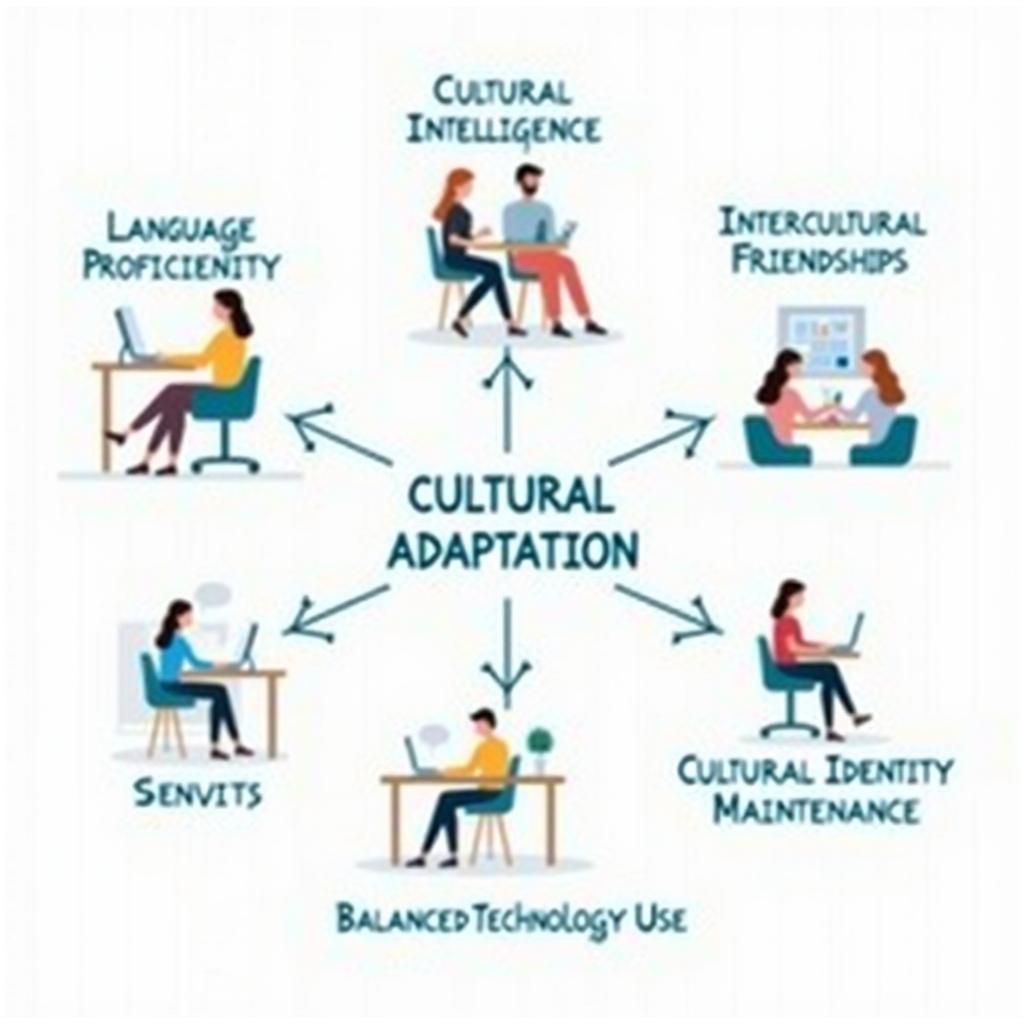 Chiến lược thích ứng văn hóa hiệu quả cho du học sinh quốc tế
Questions 14-19
The passage has five sections, A-E. Which section contains the following information?
Write the correct letter, A-E.
NB: You may use any letter more than once.
- A description of how universities can create opportunities for students to celebrate their heritage
- Information about the components that make up cultural intelligence
- Research findings about the relationship between language skills and social integration
- An explanation of why maintaining contact with home can be both beneficial and problematic
- Details about a specific university program designed to facilitate cultural adaptation
- Evidence that friendships with people from the same country can slow down adaptation
Questions 20-23
Complete the sentences below.
Choose NO MORE THAN THREE WORDS from the passage for each answer.
- Students with high cultural intelligence approach unfamiliar situations with __.
- True academic success requires what linguists call __, not just basic language skills.
- Universities sometimes unintentionally create __ through separate housing and programs for international students.
- Students who use technology in a balanced way reported __ higher satisfaction with their experience abroad.
Questions 24-26
Choose THREE letters, A-G.
Which THREE of the following are mentioned as benefits of developing cross-cultural friendships?
A) Better understanding of local customs
B) Guaranteed high grades
C) Improved language abilities
D) Free accommodation
E) Greater overall happiness with life
F) Automatic visa extensions
G) Lower living costs
PASSAGE 3 – Theoretical Frameworks and Institutional Responsibilities in Facilitating Cross-Cultural Adaptation
Độ khó: Hard (Band 7.0-9.0)
Thời gian đề xuất: 23-25 phút
The phenomenon of international student migration has undergone exponential growth over the past three decades, with current estimates suggesting that over 5.3 million students pursue tertiary education outside their countries of origin annually. This unprecedented mobility has precipitated a paradigm shift in how educational institutions conceptualize their responsibilities toward culturally diverse student populations. No longer is it sufficient for universities to merely provide administrative support and assume that adaptation occurs organically. Instead, contemporary scholarship in international education emphasizes the need for systematic, evidence-based interventions grounded in robust theoretical frameworks that account for the multifaceted nature of cross-cultural adaptation.
Acculturation Theory and its Educational Applications
The foundational theoretical framework for understanding cultural adaptation remains Berry’s Acculturation Model, first articulated in 1974 and subsequently refined through decades of empirical research. Berry’s model posits that individuals navigating intercultural contact face two fundamental questions: “Is it considered to be of value to maintain my cultural identity and characteristics?” and “Is it considered to be of value to maintain relationships with the larger society?” The intersection of responses to these questions yields four acculturation strategies: integration (maintaining home culture while engaging with host culture), assimilation (adopting host culture while relinquishing home culture), separation (maintaining exclusively home culture), and marginalization (rejecting both cultures). Empirical investigations consistently demonstrate that integration correlates with the most favorable psychosocial outcomes, including lower acculturative stress, higher academic achievement, and greater psychological well-being.
However, critical scholars have raised important caveats regarding Berry’s framework. Chirkov argues that the model insufficiently accounts for power differentials and structural constraints that shape acculturation experiences. International students do not approach cultural adaptation as entirely autonomous agents making free choices; rather, their options are circumscribed by institutional policies, societal attitudes, and systemic barriers. For instance, a student may wish to pursue integration but find that discriminatory practices, linguistic gatekeeping, or xenophobic attitudes within the host society effectively preclude meaningful participation. This critique underscores the necessity for universities to examine not merely individual adaptation processes but also the institutional structures and campus climates that either facilitate or impede integration.
The Cognitive and Affective Dimensions of Cultural Learning
Recent advances in cognitive psychology and neuroscience have illuminated the neurological underpinnings of cultural adaptation, revealing it to be a far more complex process than previously understood. When individuals encounter culturally incongruent information—situations that violate their culturally learned schemas and expectations—this activates the anterior cingulate cortex and prefrontal cortex, brain regions associated with cognitive conflict resolution and executive function. Essentially, navigating cultural differences requires sustained cognitive effort, depleting mental resources and contributing to the psychological exhaustion many international students report.
This neurological perspective helps explain why seemingly minor cultural differences can prove so taxing. Consider the differential norms surrounding classroom participation across cultures. In many Western academic contexts, particularly North American universities, verbal participation is explicitly valued and often constitutes a component of course grades. Students are expected to engage in spontaneous questioning, offer unsolicited opinions, and even challenge professorial assertions as demonstrations of critical thinking. Conversely, in numerous Asian, African, and Middle Eastern educational traditions, attentive listening, reflective silence, and deference to authority are considered markers of scholarly seriousness and respect. International students acculturated to these latter norms must not simply learn new behaviors but fundamentally restructure their cognitive schemas about what constitutes appropriate academic conduct. This cognitive restructuring is neurologically demanding and time-intensive, occurring through repeated exposure and consolidation over months or years rather than through mere intellectual understanding.
Moreover, cultural learning possesses a crucial affective dimension often overlooked in purely cognitive approaches. Kim’s Cross-Cultural Adaptation Theory emphasizes that adaptation inherently involves a “stress-adaptation-growth” dynamic. Each encounter with cultural difference generates stress, which, when successfully navigated, leads to adaptive growth. However, this process is not linear but rather follows a “draw-back-to-leap” pattern, wherein individuals experience alternating periods of progress and regression. Understanding this pattern is essential for both students and support personnel, as temporary setbacks do not indicate adaptation failure but rather constitute a normal component of the developmental trajectory.
Institutional Responsibilities and Structural Interventions
Given the complexity of cultural adaptation and its systemic determinants, progressive educational institutions are moving beyond deficit models—which locate adaptation challenges solely within individual students and their purported “lack” of skills—toward ecological approaches that examine the entire campus ecosystem. The Inclusive Excellence Framework, developed by the Association of American Colleges and Universities, provides a useful heuristic for institutional self-examination. This framework posits that genuinely inclusive institutions attend to four dimensions: access (recruiting diverse students), climate (creating welcoming environments), achievement (ensuring equitable outcomes), and engagement (facilitating meaningful participation).
Several universities have pioneered innovative structural interventions aligned with ecological thinking. The University of British Columbia’s International Student Initiative redesigned first-year curricula to incorporate intercultural learning objectives across all disciplines rather than relegating such content to specialized workshops. This curriculum internationalization ensures that all students—domestic and international alike—develop intercultural competencies as core academic outcomes. Assessment data reveals that this approach not only benefits international students but enhances global literacy among domestic students, better preparing them for increasingly interconnected professional environments.
Similarly, institutions are recognizing that faculty development constitutes a critical leverage point for improving international student experiences. Many academics, despite expertise in their disciplines, lack training in culturally responsive pedagogy or awareness of how their teaching practices may inadvertently privilege students from particular cultural backgrounds. The University of Sydney’s Teaching in the Global Classroom program provides faculty with evidence-based strategies for creating inclusive learning environments, such as explicitly teaching discipline-specific discourse conventions, providing multiple participation formats beyond verbal contributions, and incorporating diverse epistemological perspectives into course content. Program evaluations indicate significant improvements in international student engagement and achievement in courses taught by faculty who completed this training.
Ethical Considerations and Future Directions
As international education continues to expand, ethical questions become increasingly salient. Critics have noted the commodification of international students, with some institutions recruiting aggressively for revenue generation while providing inadequate support infrastructure. This raises fundamental questions about institutional responsibilities: Do universities have moral obligations beyond providing education to ensuring holistic well-being and successful adaptation? How should resources be allocated between recruitment and support services?
Furthermore, the unidirectional nature of most adaptation frameworks merits critical examination. Current models predominantly position international students as those who must adapt to host institutions and cultures, with limited expectation that institutions themselves should adapt to increasingly diverse student bodies. Some scholars advocate for bidirectional adaptation models that recognize cultural exchange as a reciprocal process, wherein domestic students, faculty, and institutional cultures also undergo transformation through engagement with international perspectives. This reconceptualization aligns with universities’ oft-stated commitments to preparing students for globalized societies and suggests that international student presence should be leveraged not merely for financial sustainability but as a catalyst for pedagogical innovation and institutional evolution.
Looking forward, emerging research directions include examining how virtual exchange programs and collaborative online international learning might supplement physical mobility, investigating long-term adaptation trajectories beyond the typical focus on initial adjustment periods, and exploring how intersectional identities—the complex interplay of culture, race, gender, socioeconomic status, and other dimensions—shape adaptation experiences in ways that unidimensional frameworks fail to capture. As global higher education becomes increasingly complex and contested, rigorous scholarship on cultural adaptation will remain essential for ensuring that international education fulfills its promise of fostering intercultural understanding and global citizenship rather than merely reproducing existing inequalities on an international scale.
Questions 27-30
Choose the correct letter, A, B, C, or D.
-
According to the passage, what is the main limitation of Berry’s Acculturation Model identified by critics?
- A) It focuses too much on psychological well-being
- B) It does not adequately consider power imbalances and structural barriers
- C) It only applies to students from Western countries
- D) It is too complex to be implemented in practice
-
The passage suggests that navigating cultural differences is cognitively demanding because:
- A) International students lack intelligence
- B) It requires the brain to resolve conflicts between learned expectations and new information
- C) Universities do not provide enough information
- D) Language barriers prevent all communication
-
What does the “stress-adaptation-growth” dynamic in Kim’s theory emphasize?
- A) Students should avoid all stressful situations
- B) Adaptation is a linear process without setbacks
- C) Stress from cultural encounters can lead to growth when successfully managed
- D) Cultural adaptation is impossible for most students
-
The Inclusive Excellence Framework focuses on:
- A) Only recruiting more international students
- B) Four dimensions: access, climate, achievement, and engagement
- C) Reducing the number of international students
- D) Eliminating all cultural differences
Questions 31-35
Complete the summary below.
Choose NO MORE THAN TWO WORDS from the passage for each answer.
Berry’s model identifies four acculturation strategies based on how individuals answer two questions about maintaining their cultural identity and relationships with the larger society. Research shows that the 31) __ strategy, which involves maintaining home culture while engaging with the host culture, leads to the best outcomes. However, critics like Chirkov argue that the model doesn’t sufficiently consider 32) __ that limit students’ choices. Recent research in neuroscience has shown that cultural adaptation involves specific brain regions and requires significant 33) __. The process follows a pattern that Kim describes as 34) __, involving alternating periods of progress and setbacks. Universities are now moving from deficit models toward 35) __ that examine the entire campus environment.
Questions 36-40
Do the following statements agree with the claims of the writer in Passage 3?
Write:
- YES if the statement agrees with the claims of the writer
- NO if the statement contradicts the claims of the writer
- NOT GIVEN if it is impossible to say what the writer thinks about this
- Berry’s Acculturation Model has remained unchanged since 1974.
- International students have complete freedom in choosing their acculturation strategy.
- Faculty training in culturally responsive pedagogy can improve international student outcomes.
- All universities recruit international students primarily for educational rather than financial reasons.
- Future research should examine how multiple aspects of identity interact to shape adaptation experiences.
Answer Keys – Đáp Án
PASSAGE 1: Questions 1-13
- TRUE
- NOT GIVEN
- FALSE
- TRUE
- FALSE
- TRUE
- coping strategies
- meaningful relationships
- language skills
- bicultural identity
- B
- C
- C
PASSAGE 2: Questions 14-26
- D
- A
- B
- E
- C
- C
- curiosity and openness
- academic literacy
- segregated social spaces
- 40%
24-26. A, C, E (in any order)
PASSAGE 3: Questions 27-40
- B
- B
- C
- B
- integration
- power differentials / structural constraints
- cognitive effort
- draw-back-to-leap
- ecological approaches
- NO
- NO
- YES
- NOT GIVEN
- YES
Giải Thích Đáp Án Chi Tiết
Passage 1 – Giải Thích
Câu 1: TRUE
- Dạng câu hỏi: True/False/Not Given
- Từ khóa: culture shock, first identified, 1960s
- Vị trí trong bài: Đoạn 1, câu 2
- Giải thích: Bài đọc nói rõ “This phenomenon, first described by anthropologist Kalervo Oberg in 1960” – khái niệm văn hóa sốc được mô tả lần đầu năm 1960, tức là trong thập niên 1960s.
Câu 2: NOT GIVEN
- Dạng câu hỏi: True/False/Not Given
- Từ khóa: all international students, exactly the same way
- Vị trí trong bài: Không có thông tin
- Giải thích: Bài đọc mô tả quá trình chung culture shock trải qua các giai đoạn nhưng không đề cập đến việc tất cả sinh viên trải nghiệm giống hệt nhau hay khác nhau.
Câu 3: FALSE
- Dạng câu hỏi: True/False/Not Given
- Từ khóa: honeymoon phase, several years
- Vị trí trong bài: Đoạn 2, câu 2
- Giải thích: Bài viết nói “usually lasts for the first few weeks or months” – chỉ vài tuần hoặc vài tháng, không phải vài năm.
Câu 4: TRUE
- Dạng câu hỏi: True/False/Not Given
- Từ khóa: language barriers, more noticeable, frustration phase
- Vị trí trong bài: Đoạn 3, câu 3
- Giải thích: “Language barriers become more apparent” – rào cản ngôn ngữ trở nên rõ ràng hơn trong giai đoạn frustration.
Câu 5: FALSE
- Dạng câu hỏi: True/False/Not Given
- Từ khóa: direct communication cultures, always fail
- Vị trí trong bài: Đoạn 3
- Giải thích: Bài viết chỉ nói họ gặp khó khăn (“might find it difficult”) chứ không nói họ luôn thất bại. Từ “always fail” quá tuyệt đối.
Câu 6: TRUE
- Dạng câu hỏi: True/False/Not Given
- Từ khóa: universities, support programs, lower dropout rates
- Vị trí trong bài: Đoạn 7, câu cuối
- Giải thích: “dropout rates reduced by up to 40%” – tỷ lệ bỏ học giảm, tức là thấp hơn.
Câu 7: coping strategies
- Dạng câu hỏi: Summary Completion
- Vị trí trong bài: Đoạn 5, câu 2
- Giải thích: “Students begin to develop coping strategies” – chiến lược đối phó.
Câu 8: meaningful relationships
- Dạng câu hỏi: Summary Completion
- Vị trí trong bài: Đoạn 5, câu 3
- Giải thích: “They start to build meaningful relationships with local students…”
Câu 9: language skills
- Dạng câu hỏi: Summary Completion
- Vị trí trong bài: Đoạn 5, câu 4
- Giải thích: “Language skills improve significantly, making everyday tasks less daunting.”
Câu 10: bicultural identity
- Dạng câu hỏi: Summary Completion
- Vị trí trong bài: Đoạn 6, câu 2
- Giải thích: “They have developed a bicultural identity” – bản sắc song văn hóa.
Câu 11: B
- Dạng câu hỏi: Multiple Choice
- Vị trí trong bài: Đoạn 2
- Giải thích: Giai đoạn honeymoon được mô tả là “students are excited about their new environment” – sinh viên cảm thấy phấn khích.
Câu 12: C
- Dạng câu hỏi: Multiple Choice
- Vị trí trong bài: Đoạn 4, câu 2
- Giải thích: “approximately 60% of international students experience moderate to severe culture shock during their first year abroad.”
Câu 13: C
- Dạng câu hỏi: Multiple Choice
- Vị trí trong bài: Đoạn 6, câu cuối
- Giải thích: “reaching this stage typically takes between six months to two years.”
Passage 2 – Giải Thích
Câu 14: D (Section D)
- Dạng câu hỏi: Matching Information
- Từ khóa: celebrate heritage
- Vị trí trong bài: Section D, đoạn 2
- Giải thích: “Multicultural events, international food festivals, and cultural presentation opportunities allow students to share their heritage with pride.”
Câu 15: A (Section A)
- Dạng câu hỏi: Matching Information
- Từ khóa: components, cultural intelligence
- Vị trí trong bài: Section A, đoạn 2
- Giải thích: Liệt kê 4 thành phần: metacognitive CQ, cognitive CQ, motivational CQ, và behavioral CQ.
Câu 16: B (Section B)
- Dạng câu hỏi: Matching Information
- Từ khóa: language skills, social integration
- Vị trí trong bài: Section B, đoạn 2
- Giải thích: “students who actively engaged with idiomatic expressions… reported significantly higher levels of social integration.”
Câu 17: E (Section E)
- Dạng câu hỏi: Matching Information
- Từ khóa: contact with home, beneficial and problematic
- Vị trí trong bài: Section E, đoạn 1
- Giải thích: Mô tả “paradox” – vừa có lợi vừa có hại của việc duy trì liên lạc với nhà.
Câu 18: C (Section C)
- Dạng câu hỏi: Matching Information
- Từ khóa: specific university program
- Vị trí trong bài: Section C, đoạn 3
- Giải thích: Mô tả “Cultural Bridging Program” của University of Melbourne.
Câu 19: C (Section C)
- Dạng câu hỏi: Matching Information
- Từ khóa: friendships same country, slow adaptation
- Vị trí trong bài: Section C, đoạn 1
- Giải thích: “students who form friendships predominantly with co-nationals… experience slower cultural adaptation.”
Câu 20: curiosity and openness
- Dạng câu hỏi: Sentence Completion
- Vị trí trong bài: Section A, đoạn 3, câu 2
- Giải thích: “they approach new experiences with curiosity and openness.”
Câu 21: academic literacy
- Dạng câu hỏi: Sentence Completion
- Vị trí trong bài: Section B, đoạn 1
- Giải thích: “true academic success requires what linguists term ‘academic literacy’.”
Câu 22: segregated social spaces
- Dạng câu hỏi: Sentence Completion
- Vị trí trong bài: Section C, đoạn 2, câu 2
- Giải thích: “Many institutions inadvertently create segregated social spaces…”
Câu 23: 40%
- Dạng câu hỏi: Sentence Completion
- Vị trí trong bài: Section E, đoạn 2, câu cuối
- Giải thích: “reported 40% higher satisfaction with their international experience.”
Câu 24-26: A, C, E
- Dạng câu hỏi: Multiple Choice (chọn 3 đáp án)
- Vị trí trong bài: Section C, đoạn 1, câu cuối
- Giải thích: Ba lợi ích được đề cập: “enhanced understanding of local customs” (A), “improved language proficiency” (C), và “greater overall life satisfaction” (E).
Passage 3 – Giải Thích
Câu 27: B
- Dạng câu hỏi: Multiple Choice
- Từ khóa: limitation, Berry’s model
- Vị trí trong bài: Đoạn 2, câu 2-3
- Giải thích: Chirkov chỉ ra mô hình “insufficiently accounts for power differentials and structural constraints.”
Câu 28: B
- Dạng câu hỏi: Multiple Choice
- Từ khóa: cognitively demanding
- Vị trí trong bài: Đoạn 3, câu 2
- Giải thích: “culturally incongruent information” kích hoạt các vùng não liên quan đến “cognitive conflict resolution.”
Câu 29: C
- Dạng câu hỏi: Multiple Choice
- Từ khóa: stress-adaptation-growth dynamic
- Vị trí trong bài: Đoạn 4, câu 2
- Giải thích: “Each encounter with cultural difference generates stress, which, when successfully navigated, leads to adaptive growth.”
Câu 30: B
- Dạng câu hỏi: Multiple Choice
- Từ khóa: Inclusive Excellence Framework
- Vị trí trong bài: Đoạn 5, câu 3
- Giải thích: Framework chú trọng “four dimensions: access, climate, achievement, and engagement.”
Câu 31: integration
- Dạng câu hỏi: Summary Completion
- Vị trí trong bài: Đoạn 2, câu 3
- Giải thích: “Empirical investigations consistently demonstrate that integration correlates with the most favorable psychosocial outcomes.”
Câu 32: power differentials / structural constraints
- Dạng câu hỏi: Summary Completion
- Vị trí trong bài: Đoạn 2, câu 2
- Giải thích: Có thể dùng một trong hai cụm từ này.
Câu 33: cognitive effort
- Dạng câu hỏi: Summary Completion
- Vị trí trong bài: Đoạn 3, câu 2
- Giải thích: “navigating cultural differences requires sustained cognitive effort.”
Câu 34: draw-back-to-leap
- Dạng câu hỏi: Summary Completion
- Vị trí trong bài: Đoạn 4, câu 3
- Giải thích: “this process… follows a ‘draw-back-to-leap’ pattern.”
Câu 35: ecological approaches
- Dạng câu hỏi: Summary Completion
- Vị trí trong bài: Đoạn 5, câu 1
- Giải thích: “moving beyond deficit models… toward ecological approaches.”
Câu 36: NO
- Dạng câu hỏi: Yes/No/Not Given
- Vị trí trong bài: Đoạn 2, câu 1
- Giải thích: Mô hình được “subsequently refined through decades of empirical research” – đã được tinh chỉnh, không phải không thay đổi.
Câu 37: NO
- Dạng câu hỏi: Yes/No/Not Given
- Vị trí trong bài: Đoạn 2, câu 3
- Giải thích: “their options are circumscribed by institutional policies, societal attitudes, and systemic barriers” – lựa chọn bị giới hạn, không phải tự do hoàn toàn.
Câu 38: YES
- Dạng câu hỏi: Yes/No/Not Given
- Vị trí trong bài: Đoạn 6, đoạn cuối
- Giải thích: “Program evaluations indicate significant improvements in international student engagement and achievement in courses taught by faculty who completed this training.”
Câu 39: NOT GIVEN
- Dạng câu hỏi: Yes/No/Not Given
- Vị trí trong bài: Đoạn 7
- Giải thích: Bài viết đề cập đến việc một số trường tuyển sinh để tạo doanh thu nhưng không nói về TẤT CẢ các trường.
Câu 40: YES
- Dạng câu hỏi: Yes/No/Not Given
- Vị trí trong bài: Đoạn 8, câu 2
- Giải thích: “exploring how intersectional identities… shape adaptation experiences” – nghiên cứu tương lai nên xem xét các khía cạnh đa chiều của bản sắc.
Từ Vựng Quan Trọng Theo Passage
Passage 1 – Essential Vocabulary
| Từ vựng | Loại từ | Phiên âm | Nghĩa tiếng Việt | Ví dụ từ bài | Collocation |
|---|---|---|---|---|---|
| culture shock | n | /ˈkʌltʃə ʃɒk/ | Cú sốc văn hóa | They often experience what psychologists call “culture shock” | experience culture shock, overcome culture shock |
| disorientation | n | /dɪsˌɔːriənˈteɪʃn/ | Sự mất phương hướng | Feelings of confusion, anxiety, and disorientation | sense of disorientation, cause disorientation |
| adaptation | n | /ˌædæpˈteɪʃn/ | Sự thích nghi | Understanding this process is crucial for successful cultural adaptation | cultural adaptation, successful adaptation |
| honeymoon phase | n | /ˈhʌnɪmuːn feɪz/ | Giai đoạn trăng mật | The first stage, known as the “honeymoon phase” | enter the honeymoon phase, during the honeymoon phase |
| host country | n | /həʊst ˈkʌntri/ | Nước chủ nhà | Focus on the positive aspects of their host country | arrive in host country, adapt to host country |
| frustration phase | n | /frʌˈstreɪʃn feɪz/ | Giai đoạn thất vọng | This gives way to the “frustration phase” | reach frustration phase, overcome frustration phase |
| language barriers | n | /ˈlæŋɡwɪdʒ ˈbæriəz/ | Rào cản ngôn ngữ | Language barriers become more apparent | overcome language barriers, face language barriers |
| homesickness | n | /ˈhəʊmsɪknəs/ | Nỗi nhớ nhà | Students commonly experience homesickness | suffer from homesickness, cope with homesickness |
| adjustment phase | n | /əˈdʒʌstmənt feɪz/ | Giai đoạn điều chỉnh | The third stage, called the “adjustment phase” | enter adjustment phase, during adjustment phase |
| coping strategies | n | /ˈkəʊpɪŋ ˈstrætədʒiz/ | Chiến lược đối phó | Students develop coping strategies | develop coping strategies, effective coping strategies |
| bicultural identity | n | /baɪˈkʌltʃərəl aɪˈdentəti/ | Bản sắc song văn hóa | They have developed a bicultural identity | develop bicultural identity, maintain bicultural identity |
| support network | n | /səˈpɔːt ˈnetwɜːk/ | Mạng lưới hỗ trợ | They have established a support network | build support network, strong support network |
Passage 2 – Essential Vocabulary
| Từ vựng | Loại từ | Phiên âm | Nghĩa tiếng Việt | Ví dụ từ bài | Collocation |
|---|---|---|---|---|---|
| resilience | n | /rɪˈzɪliəns/ | Sức bền, khả năng phục hồi | Successful integration requires resilience | build resilience, demonstrate resilience |
| cultural intelligence | n | /ˈkʌltʃərəl ɪnˈtelɪdʒəns/ | Trí thông minh văn hóa | One of the most significant predictors is cultural intelligence | develop cultural intelligence, high cultural intelligence |
| intercultural dynamics | n | /ˌɪntəˈkʌltʃərəl daɪˈnæmɪks/ | Động lực liên văn hóa | Understanding the complex intercultural dynamics | study intercultural dynamics, navigate intercultural dynamics |
| pedagogical approaches | n | /ˌpedəˈɡɒdʒɪkəl əˈprəʊtʃɪz/ | Phương pháp sư phạm | Pedagogical approaches are deeply rooted in cultural values | different pedagogical approaches, effective pedagogical approaches |
| academic literacy | n | /ˌækəˈdemɪk ˈlɪtərəsi/ | Hiểu biết học thuật | True success requires what linguists term “academic literacy” | develop academic literacy, improve academic literacy |
| idiomatic expressions | n | /ˌɪdiəˈmætɪk ɪkˈspreʃnz/ | Thành ngữ | Students who engaged with idiomatic expressions | learn idiomatic expressions, understand idiomatic expressions |
| immersive experiences | n | /ɪˈmɜːsɪv ɪkˈspɪəriənsɪz/ | Trải nghiệm hòa nhập | Students need immersive language experiences | provide immersive experiences, create immersive experiences |
| co-nationals | n | /kəʊ ˈnæʃnəlz/ | Đồng hương | Students who form friendships with co-nationals | socialize with co-nationals, rely on co-nationals |
| enclave effect | n | /ˈenkleɪv ɪˈfekt/ | Hiệu ứng biệt lập | These relationships can create an “enclave effect” | avoid enclave effect, reduce enclave effect |
| cross-cultural friendships | n | /krɒs ˈkʌltʃərəl ˈfrendʃɪps/ | Tình bạn xuyên văn hóa | Students who develop cross-cultural friendships | form cross-cultural friendships, benefit from cross-cultural friendships |
| structural barriers | n | /ˈstrʌktʃərəl ˈbæriəz/ | Rào cản cấu trúc | Structural barriers can hinder intercultural interaction | overcome structural barriers, identify structural barriers |
| integration strategies | n | /ˌɪntɪˈɡreɪʃn ˈstrætədʒiz/ | Chiến lược hòa nhập | Universities are implementing intentional integration strategies | develop integration strategies, effective integration strategies |
| acculturation theory | n | /əˌkʌltʃəˈreɪʃn ˈθɪəri/ | Lý thuyết tiếp biến văn hóa | A strategy known as “integration” in acculturation theory | study acculturation theory, apply acculturation theory |
| multicultural events | n | /ˌmʌltiˈkʌltʃərəl ɪˈvents/ | Sự kiện đa văn hóa | Universities can celebrate diversity through multicultural events | organize multicultural events, attend multicultural events |
| digital engagement | n | /ˈdɪdʒɪtl ɪnˈɡeɪdʒmənt/ | Tương tác kỹ thuật số | The key lies in achieving balanced digital engagement | manage digital engagement, healthy digital engagement |
Passage 3 – Essential Vocabulary
| Từ vựng | Loại từ | Phiên âm | Nghĩa tiếng Việt | Ví dụ từ bài | Collocation |
|---|---|---|---|---|---|
| exponential growth | n | /ˌekspəˈnenʃl ɡrəʊθ/ | Tăng trưởng theo cấp số nhân | International student migration has undergone exponential growth | experience exponential growth, demonstrate exponential growth |
| paradigm shift | n | /ˈpærədaɪm ʃɪft/ | Sự thay đổi mô hình | This has precipitated a paradigm shift | represent paradigm shift, undergo paradigm shift |
| tertiary education | n | /ˈtɜːʃəri ˌedʒuˈkeɪʃn/ | Giáo dục đại học | Over 5.3 million students pursue tertiary education abroad | access tertiary education, complete tertiary education |
| evidence-based interventions | n | /ˈevɪdəns beɪst ˌɪntəˈvenʃnz/ | Can thiệp dựa trên bằng chứng | Universities need evidence-based interventions | implement evidence-based interventions, design evidence-based interventions |
| acculturation strategies | n | /əˌkʌltʃəˈreɪʃn ˈstrætədʒiz/ | Chiến lược tiếp biến văn hóa | Four acculturation strategies: integration, assimilation, separation, marginalization | adopt acculturation strategies, different acculturation strategies |
| psychosocial outcomes | n | /ˌsaɪkəʊˈsəʊʃl ˈaʊtkʌmz/ | Kết quả tâm lý xã hội | Integration correlates with favorable psychosocial outcomes | achieve positive psychosocial outcomes, measure psychosocial outcomes |
| acculturative stress | n | /əˈkʌltʃərətɪv stres/ | Căng thẳng thích ứng văn hóa | Lower acculturative stress among integrated students | experience acculturative stress, reduce acculturative stress |
| power differentials | n | /ˈpaʊə ˌdɪfəˈrenʃlz/ | Sự chênh lệch quyền lực | The model insufficiently accounts for power differentials | recognize power differentials, address power differentials |
| structural constraints | n | /ˈstrʌktʃərəl kənˈstreɪnts/ | Ràng buộc cấu trúc | Their options are circumscribed by structural constraints | face structural constraints, overcome structural constraints |
| neurological underpinnings | n | /ˌnjʊərəˈlɒdʒɪkəl ˌʌndəˈpɪnɪŋz/ | Nền tảng thần kinh học | Research has illuminated the neurological underpinnings of adaptation | study neurological underpinnings, understand neurological underpinnings |
| cognitive schemas | n | /ˈkɒɡnətɪv ˈskiːməz/ | Lược đồ nhận thức | Students must fundamentally restructure their cognitive schemas | develop cognitive schemas, modify cognitive schemas |
| executive function | n | /ɪɡˈzekjətɪv ˈfʌŋkʃn/ | Chức năng điều hành | Brain regions associated with executive function | improve executive function, impaired executive function |
| deficit models | n | /ˈdefɪsɪt ˈmɒdlz/ | Mô hình thiếu hụt | Moving beyond deficit models toward ecological approaches | reject deficit models, challenge deficit models |
| ecological approaches | n | /ˌiːkəˈlɒdʒɪkəl əˈprəʊtʃɪz/ | Phương pháp sinh thái | Institutions are adopting ecological approaches | implement ecological approaches, favor ecological approaches |
| culturally responsive pedagogy | n | /ˈkʌltʃərəli rɪˈspɒnsɪv ˈpedəɡɒdʒi/ | Phương pháp sư phạm nhạy cảm văn hóa | Faculty lack training in culturally responsive pedagogy | practice culturally responsive pedagogy, develop culturally responsive pedagogy |
| commodification | n | /kəˌmɒdɪfɪˈkeɪʃn/ | Sự thương mại hóa | Critics note the commodification of international students | resist commodification, criticize commodification |
| bidirectional adaptation | n | /ˌbaɪdaɪˈrekʃənl ˌædæpˈteɪʃn/ | Thích ứng hai chiều | Some scholars advocate for bidirectional adaptation models | promote bidirectional adaptation, study bidirectional adaptation |
| intersectional identities | n | /ˌɪntəˈsekʃənl aɪˈdentətiz/ | Bản sắc giao thoa | Exploring how intersectional identities shape adaptation experiences | recognize intersectional identities, examine intersectional identities |
Kết Luận
Chủ đề về cách thức du học sinh thích ứng với môi trường văn hóa khác biệt không chỉ là một đề tài phổ biến trong IELTS Reading mà còn phản ánh thực tế của hàng triệu sinh viên quốc tế trên toàn cầu. Qua ba passages với độ khó tăng dần, bạn đã được làm quen với nhiều dạng câu hỏi khác nhau, từ True/False/Not Given, Multiple Choice, đến Matching Headings và Summary Completion – tất cả đều là các dạng câu hỏi xuất hiện thường xuyên trong kỳ thi IELTS thực tế.
Bộ đề thi mẫu này đã cung cấp cho bạn 40 câu hỏi hoàn chỉnh với đáp án chi tiết và giải thích cụ thể về vị trí thông tin, kỹ thuật paraphrase và chiến lược làm bài. Bạn cũng đã học được hơn 50 từ vựng quan trọng liên quan đến chủ đề thích ứng văn hóa, giáo dục quốc tế và tâm lý xã hội – những từ vựng không chỉ hữu ích cho IELTS Reading mà còn cho cả Writing và Speaking.
Để đạt kết quả tốt nhất trong IELTS Reading, hãy luyện tập thường xuyên với các đề thi mẫu như thế này, chú ý quản lý thời gian hiệu quả và rèn luyện kỹ năng skimming (đọc lướt) và scanning (đọc tìm kiếm thông tin cụ thể). Đừng quên rằng việc nâng cao vốn từ vựng học thuật và hiểu biết về các chủ đề xã hội, văn hóa, khoa học là chìa khóa để đạt band điểm cao. Cách thức giáo dục quốc tế thúc đẩy sự thành công học thuật liên văn hóa có nhiều điểm tương đồng với quá trình thích ứng văn hóa mà chúng ta vừa nghiên cứu.
Chúc bạn ôn tập hiệu quả và đạt được band điểm như mong muốn trong kỳ thi IELTS sắp tới!