Mở Bài
Chủ đề năng lượng tái tạo và tác động của nó đến thị trường năng lượng toàn cầu là một trong những chủ đề phổ biến và quan trọng trong kỳ thi IELTS Reading. Với xu hướng chuyển đổi năng lượng đang diễn ra mạnh mẽ trên toàn thế giới, các đề thi IELTS thường xuyên khai thác chủ đề này ở nhiều góc độ khác nhau như công nghệ, kinh tế, môi trường và chính sách năng lượng.
Bài viết này cung cấp cho bạn một bộ đề thi IELTS Reading hoàn chỉnh với 3 passages được thiết kế theo đúng cấu trúc và độ khó của kỳ thi thực tế. Bạn sẽ được luyện tập với 40 câu hỏi đa dạng, bao gồm tất cả các dạng câu hỏi phổ biến như Multiple Choice, True/False/Not Given, Matching Headings, Summary Completion và nhiều dạng khác. Mỗi passage tăng dần về độ khó từ Easy đến Hard, giúp bạn làm quen với áp lực thời gian và độ phức tạp của đề thi thật.
Đặc biệt, bài viết không chỉ cung cấp đáp án mà còn có phần giải thích chi tiết cho từng câu hỏi, phân tích kỹ thuật paraphrase và vị trí thông tin trong bài đọc. Bạn cũng sẽ được trang bị bộ từ vựng quan trọng với phiên âm, nghĩa tiếng Việt và collocation thực tế từ các passages.
Đề thi này phù hợp cho học viên từ band 5.0 trở lên, giúp bạn rèn luyện kỹ năng đọc hiểu, quản lý thời gian và nâng cao vốn từ vựng học thuật để đạt band điểm mong muốn.
1. Hướng Dẫn Làm Bài IELTS Reading
Tổng Quan Về IELTS Reading Test
IELTS Reading Test kéo dài 60 phút với 3 passages và tổng cộng 40 câu hỏi. Độ khó của các passages tăng dần từ Passage 1 đến Passage 3, đồng thời các câu hỏi cũng trở nên phức tạp và đòi hỏi kỹ năng phân tích cao hơn.
Phân bổ thời gian khuyến nghị:
- Passage 1: 15-17 phút (độ khó Easy – Band 5.0-6.5)
- Passage 2: 18-20 phút (độ khó Medium – Band 6.0-7.5)
- Passage 3: 23-25 phút (độ khó Hard – Band 7.0-9.0)
Lưu ý rằng bạn cần tự quản lý thời gian và chuyển đáp án vào Answer Sheet trong thời gian này. Không có thời gian bổ sung để chép đáp án như phần Listening.
Các Dạng Câu Hỏi Trong Đề Này
Đề thi mẫu này bao gồm 7 dạng câu hỏi phổ biến nhất trong IELTS Reading:
- Multiple Choice – Câu hỏi trắc nghiệm với 3-4 lựa chọn
- True/False/Not Given – Xác định thông tin đúng, sai hoặc không được đề cập
- Matching Headings – Nối tiêu đề với các đoạn văn
- Summary Completion – Hoàn thành đoạn tóm tắt
- Sentence Completion – Hoàn thành câu với từ trong bài
- Matching Features – Nối thông tin với các đối tượng
- Short-answer Questions – Câu hỏi ngắn yêu cầu trả lời từ bài đọc
Mỗi dạng câu hỏi đòi hỏi kỹ năng và chiến lược riêng, vì vậy hãy đọc kỹ instructions trước khi làm bài.
2. IELTS Reading Practice Test
PASSAGE 1 – The Rise of Renewable Energy
Độ khó: Easy (Band 5.0-6.5)
Thời gian đề xuất: 15-17 phút
The global energy landscape is undergoing a fundamental transformation as renewable energy sources gain increasing prominence in electricity generation worldwide. Over the past decade, the cost of producing energy from renewable sources such as solar panels and wind turbines has decreased dramatically, making these technologies increasingly competitive with traditional fossil fuels. This shift represents one of the most significant changes in how humanity generates power since the Industrial Revolution.
Solar photovoltaic (PV) technology has experienced particularly remarkable growth. In 2010, the average cost of solar electricity was approximately $0.40 per kilowatt-hour (kWh), but by 2020, this figure had plummeted to just $0.05 per kWh in many regions. This dramatic reduction in costs has been driven by improvements in manufacturing efficiency, economies of scale, and technological innovations in solar cell design. Countries like China, the United States, and Germany have led the way in solar installation capacity, with China alone accounting for more than 30% of global solar capacity.
Wind energy has followed a similar trajectory. Offshore wind farms, in particular, have become increasingly viable as turbine technology has advanced. Modern wind turbines are significantly larger and more efficient than their predecessors, with some offshore installations featuring blades longer than a football field. Denmark has emerged as a global leader in wind energy, generating more than 40% of its electricity from wind power. The Danish experience demonstrates that high penetration rates of wind energy are technically feasible when supported by appropriate grid infrastructure and energy storage solutions.
The growth of renewable energy has had profound implications for global energy markets. Traditional utility companies that once relied exclusively on coal and natural gas are now investing billions of dollars in renewable infrastructure. In 2019, global investment in renewable energy exceeded $300 billion for the fifth consecutive year. This investment has created millions of jobs in manufacturing, installation, and maintenance sectors. The International Renewable Energy Agency (IRENA) estimates that the renewable energy sector employed approximately 11.5 million people globally in 2019, representing a 6% increase from the previous year.
However, the transition to renewable energy faces several challenges. The intermittent nature of solar and wind power—they only generate electricity when the sun shines or wind blows—requires significant investment in energy storage systems and grid modernization. Battery technology, particularly lithium-ion batteries, has improved substantially, but storage remains expensive and limited in capacity for grid-scale applications. Some regions have addressed this challenge by developing pumped hydro storage facilities, which use excess electricity to pump water uphill and then release it through turbines when power is needed.
Government policies have played a crucial role in accelerating renewable energy adoption. Feed-in tariffs, which guarantee renewable energy producers a fixed price for the electricity they generate, have been particularly effective in countries like Germany and Spain. Tax incentives and renewable energy mandates have also encouraged both commercial and residential adoption. The European Union has set ambitious targets to generate 32% of its energy from renewable sources by 2030, while several countries, including Costa Rica and Iceland, already generate nearly all their electricity from renewable sources.
Despite these advances, renewable energy still accounts for only about 26% of global electricity generation, with hydroelectric power representing the largest share. Coal, natural gas, and nuclear power continue to dominate in many countries, particularly in Asia where energy demand is growing rapidly. Nevertheless, the trend is clear: renewable energy is becoming increasingly cost-effective and technologically mature, positioning it to play a dominant role in the global energy system of the future.
Questions 1-13
Questions 1-5: Multiple Choice
Choose the correct letter, A, B, C, or D.
-
What is mentioned as the main factor making renewable energy more competitive?
A. Government regulations
B. Reduced production costs
C. Environmental concerns
D. Technological complexity -
According to the passage, China’s share of global solar capacity is:
A. Less than 20%
B. Approximately 25%
C. More than 30%
D. Nearly 50% -
What characteristic of modern offshore wind turbines is highlighted?
A. Their color
B. Their cost
C. Their size
D. Their weight -
How much did global investment in renewable energy exceed in 2019?
A. $200 billion
B. $250 billion
C. $300 billion
D. $350 billion -
What percentage of global electricity generation currently comes from renewable energy?
A. About 15%
B. About 26%
C. About 32%
D. About 40%
Questions 6-9: True/False/Not Given
Do the following statements agree with the information given in the passage?
Write:
- TRUE if the statement agrees with the information
- FALSE if the statement contradicts the information
- NOT GIVEN if there is no information on this
- The cost of solar electricity decreased by more than 80% between 2010 and 2020.
- Denmark generates the highest percentage of electricity from wind power in the world.
- Battery technology is now affordable enough for all grid-scale applications.
- Costa Rica generates almost all its electricity from renewable sources.
Questions 10-13: Sentence Completion
Complete the sentences below.
Choose NO MORE THAN TWO WORDS from the passage for each answer.
- The intermittent nature of renewable energy requires investment in __ and grid upgrades.
- Some regions use __ facilities to store excess electricity by pumping water uphill.
- In Germany and Spain, __ have guaranteed renewable producers a fixed electricity price.
- Renewable energy is becoming more __ and technologically advanced for future dominance.
PASSAGE 2 – Economic Disruption in Traditional Energy Markets
Độ khó: Medium (Band 6.0-7.5)
Thời gian đề xuất: 18-20 phút
The rapid expansion of renewable energy capacity has fundamentally altered the economic dynamics of global energy markets, creating both opportunities and challenges for established energy companies and emerging clean technology firms. This transition represents what economists term a “disruptive innovation”—a change so profound that it reshapes entire industries and redistributes economic power among nations and corporations. Understanding these shifts is crucial for policymakers, investors, and energy professionals navigating this period of unprecedented transformation.
One of the most significant economic impacts has been the phenomenon known as “merit order effect.” In electricity markets, power plants are typically dispatched in order of their marginal cost—the cost of producing one additional unit of electricity. Since renewable energy sources like solar and wind have near-zero marginal costs once installed, they are dispatched first, pushing higher-cost fossil fuel generators further down the dispatch order. This mechanism has led to a substantial reduction in wholesale electricity prices during periods of high renewable generation. In Germany, for instance, wholesale electricity prices have decreased by an average of 10% annually during peak solar production hours, a trend that has profound implications for the profitability of conventional power plants.
 Biểu đồ minh họa tác động của năng lượng tái tạo đến giá điện bán buôn và thứ tự vận hành nhà máy điện truyền thống
This price compression has created a “missing money” problem for traditional power generators. While renewable energy reduces average electricity prices, the power system still requires dispatchable capacity—power plants that can ramp up quickly when renewable generation is insufficient. However, these plants now operate fewer hours per year and at lower profit margins, making it difficult to recover their fixed costs. Some countries have responded by implementing capacity markets, which pay power plants simply for being available, regardless of whether they actually generate electricity. Critics argue this approach subsidizes fossil fuel infrastructure, while proponents contend it ensures grid reliability during the transition period.
The renewable energy transition has also triggered a geographical redistribution of energy-related economic activity. Countries rich in fossil fuel reserves, such as Saudi Arabia, Russia, and Venezuela, face declining revenues as global oil and gas demand potentially peaks and then declines. Conversely, nations with abundant renewable resources or strong manufacturing capabilities in clean technology are positioned to benefit. China has emerged as the dominant force in solar panel manufacturing, controlling approximately 70% of global production capacity. This dominance has raised concerns about supply chain vulnerability and technology dependence among Western nations, prompting initiatives to develop domestic renewable energy manufacturing capacity.
For renewable energy adoption to accelerate further, significant infrastructure investment is required. The International Energy Agency estimates that achieving global climate targets will require annual investments of approximately $4 trillion in clean energy by 2030, nearly triple current levels. This investment must encompass not only generation capacity but also grid modernization, energy storage, and demand-side management technologies. The scale of required investment represents both a challenge and an opportunity, potentially stimulating economic growth while addressing climate change.
Financial markets have begun to recognize these shifts, with increasing capital flowing toward renewable energy and away from fossil fuels. The concept of “stranded assets”—fossil fuel reserves and infrastructure that may become economically unviable before the end of their technical lifetime—has gained prominence among investors. Major institutional investors, including pension funds and insurance companies, have announced divestment from coal and, increasingly, from oil and gas companies. Meanwhile, the market valuation of renewable energy companies has surged, with some solar and wind developers now valued more highly than established utility companies with vastly larger generation capacity.
The employment implications of this transition are complex and geographically uneven. While renewable energy creates more jobs per unit of energy generated than fossil fuels, these jobs are often in different locations and require different skills than traditional energy sector employment. Coal mining regions in the United States, Poland, and Australia face economic dislocation as mines close, while manufacturing centers for solar panels and wind turbines experience growth. This spatial mismatch has created political tensions and underscores the need for “just transition” policies that support workers and communities affected by the decline of fossil fuel industries.
Moreover, the integration of renewable energy has sparked innovation in business models and market structures. Peer-to-peer energy trading, enabled by blockchain technology, allows consumers with rooftop solar panels to sell excess electricity directly to neighbors. Virtual power plants aggregate thousands of small-scale renewable generators and battery systems, allowing them to participate in electricity markets as if they were a single large power plant. These innovations challenge the traditional centralized utility model and suggest a future energy system that is more decentralized, flexible, and consumer-centric.
Questions 14-26
Questions 14-18: Yes/No/Not Given
Do the following statements agree with the views of the writer in the passage?
Write:
- YES if the statement agrees with the views of the writer
- NO if the statement contradicts the views of the writer
- NOT GIVEN if it is impossible to say what the writer thinks about this
- The merit order effect has universally benefited all participants in electricity markets.
- Capacity markets represent a controversial solution to the missing money problem.
- China’s dominance in solar manufacturing creates supply chain concerns for Western countries.
- Current investment levels in clean energy are sufficient to meet global climate targets.
- Renewable energy creates more employment opportunities per energy unit than fossil fuels.
Questions 19-22: Matching Headings
Choose the correct heading for paragraphs C-F from the list of headings below.
List of Headings:
i. The challenge of maintaining reliable power supply
ii. Geographic winners and losers in energy transition
iii. Employment challenges across different regions
iv. How renewable energy affects wholesale prices
v. New technologies transforming energy markets
vi. Investment requirements for climate goals
vii. Financial sector responses to energy transition
- Paragraph C
- Paragraph D
- Paragraph E
- Paragraph F
Questions 23-26: Summary Completion
Complete the summary below.
Choose NO MORE THAN TWO WORDS from the passage for each answer.
The renewable energy transition has created what economists call the 23. __, where traditional power plants struggle to cover their 24. __ despite being necessary for grid reliability. This has led some countries to establish 25. __, which compensate power plants for availability. Additionally, the concept of 26. __ refers to fossil fuel assets that may lose economic value prematurely.
PASSAGE 3 – Technological Innovation and Grid Integration Challenges
Độ khó: Hard (Band 7.0-9.0)
Thời gian đề xuất: 23-25 phút
The integration of variable renewable energy sources into existing electrical grid infrastructure represents one of the most formidable technical challenges confronting energy systems worldwide. Unlike conventional thermal power plants—which can modulate their output in response to demand fluctuations—solar and wind generators produce electricity only when environmental conditions permit, creating significant operational complexities for grid operators tasked with maintaining the precise balance between electricity supply and demand at every moment. This fundamental incompatibility between the stochastic nature of renewable generation and the deterministic requirements of grid stability has necessitated innovations across multiple technological domains, from advanced forecasting systems to novel energy storage architectures.
Grid frequency regulation, a critical function in maintaining power system stability, exemplifies these challenges. In conventional power systems, the rotational inertia of large synchronous generators—massive turbines spinning at constant speed—provides a natural buffer against sudden changes in electricity supply or demand. When consumption spikes unexpectedly, the kinetic energy stored in these rotating masses instantaneously releases into the grid, preventing frequency from dropping precipitously before governors can increase fuel input. However, solar photovoltaic systems and modern wind turbines interface with the grid through power electronic converters that provide virtually no inherent inertia. As renewable penetration increases and conventional generators are displaced, system inertia declines, potentially rendering grids more vulnerable to frequency excursions and cascading failures.
Addressing this inertia deficit has spurred development of synthetic inertia technologies. Grid-forming inverters, representing a significant advancement over conventional grid-following inverters, can emulate the behavior of synchronous generators by actively regulating voltage and frequency rather than merely responding to grid conditions. These sophisticated devices utilize advanced control algorithms to provide fast frequency response—injecting or absorbing power within milliseconds of detecting frequency deviations. Several jurisdictions with high renewable penetration, including South Australia and Ireland, have mandated that new renewable installations include fast frequency response capabilities. Nevertheless, the long-term adequacy of synthetic inertia solutions remains an active area of research, with some engineers advocating for retention of minimum levels of synchronous generation to ensure grid resilience.
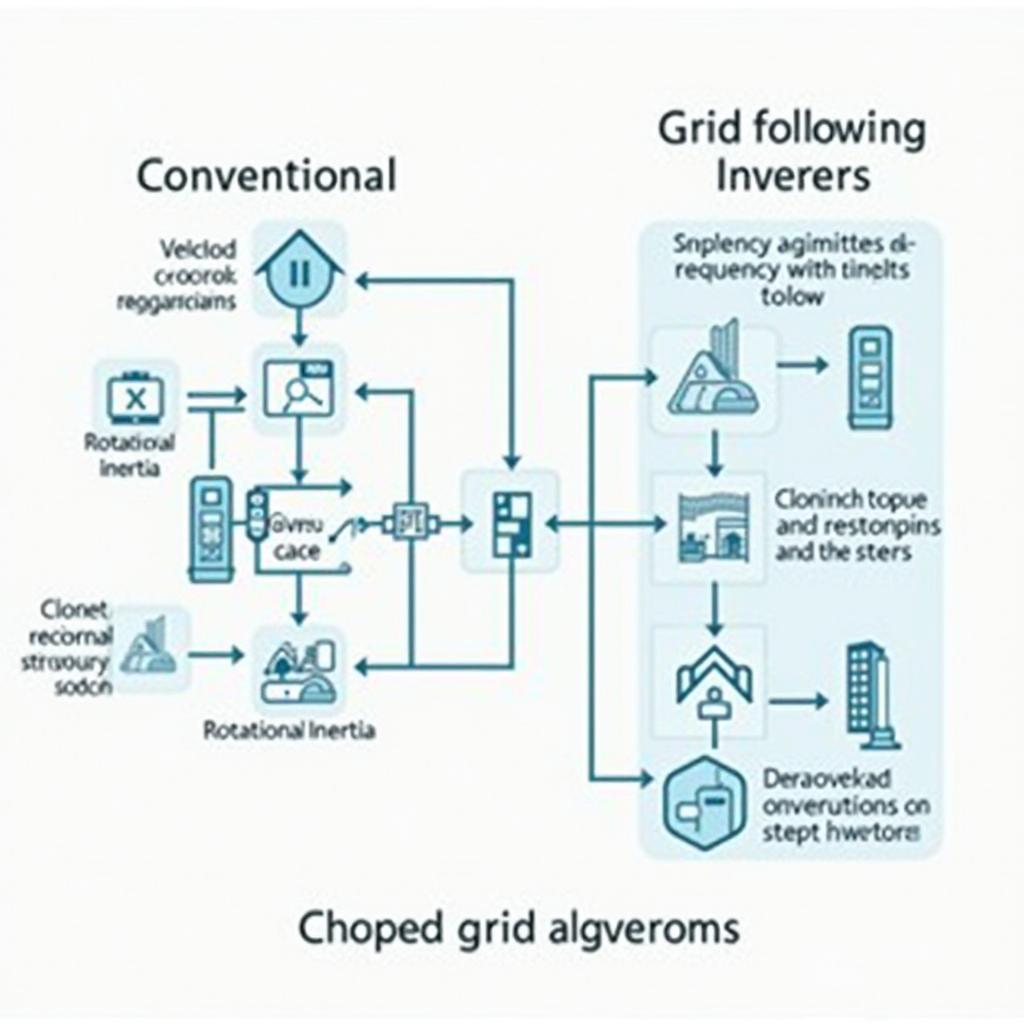 Sơ đồ kỹ thuật so sánh biến tần truyền thống và biến tần đồng bộ giả trong hệ thống lưới điện với năng lượng tái tạo
Energy storage systems constitute another critical enabler of renewable integration. While pumped hydro storage has provided bulk energy storage for decades, its geographical limitations—requiring specific topological features—constrain deployment potential. Battery energy storage systems (BESS), particularly those utilizing lithium-ion chemistry, have emerged as the dominant alternative for short-duration storage applications. The cost of lithium-ion batteries has declined by approximately 90% since 2010, making grid-scale battery installations increasingly economically viable. However, lithium-ion technology faces constraints regarding duration limitations (typically 2-4 hours of discharge at rated power), degradation characteristics (performance declining over charge-discharge cycles), and concerns about raw material availability, particularly cobalt and lithium supplies.
These limitations have catalyzed research into alternative storage technologies for long-duration applications. Flow batteries, which store energy in liquid electrolytes housed in external tanks, offer the potential for scalable storage duration independent of power capacity—simply by increasing tank size. Liquid air energy storage (LAES) systems liquefy air using off-peak electricity, then vaporize it to drive turbines during peak demand periods, offering storage durations of 8-12 hours. Hydrogen production through electrolysis—using renewable electricity to split water molecules—represents perhaps the most promising pathway for seasonal energy storage, though current round-trip efficiency of approximately 40% (electricity to hydrogen and back to electricity) presents economic challenges. Similar to how electric vehicles impact oil markets, these storage innovations are reshaping energy infrastructure fundamentally.
Demand-side flexibility offers a complementary approach to managing renewable variability. Rather than exclusively matching generation to inflexible demand, emerging technologies enable consumption patterns to adapt to generation availability. Smart grid technologies, incorporating advanced metering infrastructure (AMI) and internet-of-things (IoT) devices, facilitate real-time communication between utilities and consumers’ electrical devices. Demand response programs can automatically reduce or shift electricity consumption during periods of system stress or high prices. For instance, industrial processes with thermal inertia—such as aluminum smelting or cold storage facilities—can modulate their power consumption across hours or even days without compromising operations. Residential technologies like smart thermostats and controllable water heaters aggregate millions of small loads into virtual power plants that can be dispatched like conventional generators.
The integration of electric vehicle (EV) charging infrastructure presents both challenges and opportunities for grid management. Uncontrolled charging—where EVs draw power immediately upon connection—could significantly exacerbate peak demand periods, potentially requiring substantial grid reinforcement. However, smart charging protocols that schedule charging during off-peak hours can instead help absorb excess renewable generation. More ambitiously, vehicle-to-grid (V2G) technology would enable EVs to discharge electricity back into the grid during periods of high demand or low renewable generation, effectively transforming millions of vehicles into a distributed energy storage resource. While technical standards for V2G exist, commercial deployment remains limited due to concerns about battery degradation and regulatory ambiguity regarding compensation mechanisms.
Advanced forecasting methodologies have become indispensable for grid operators managing high renewable penetration. Modern numerical weather prediction (NWP) models, combined with machine learning algorithms trained on historical generation data, can forecast solar and wind output with increasing accuracy. State-of-the-art systems achieve mean absolute percentage errors below 10% for day-ahead forecasts and below 5% for hour-ahead predictions. These capabilities enable grid operators to anticipate renewable generation patterns and schedule conventional generators and energy storage systems accordingly. However, forecast errors remain probabilistically inevitable, necessitating maintenance of operating reserves—generating capacity held in standby to compensate for unforeseen deviations.
Inter-regional transmission expansion represents a further strategy for accommodating renewable variability. Geographical diversity of wind and solar resources means that when generation is low in one region, it may be abundant elsewhere. High-voltage transmission lines spanning large distances can effectively pool renewable resources across wide areas, reducing aggregate variability. The economic and environmental benefits of transmission expansion must be weighed against substantial capital costs, lengthy permitting processes, and occasional local opposition to new infrastructure corridors. Nevertheless, studies consistently demonstrate that enhanced interconnection substantially reduces the cost of achieving high renewable penetration levels.
Questions 27-40
Questions 27-31: Multiple Choice
Choose the correct letter, A, B, C, or D.
-
According to the passage, what is the primary challenge of integrating renewable energy into power grids?
A. The high cost of renewable technology
B. The variable nature of renewable generation
C. Opposition from fossil fuel companies
D. Lack of skilled workers -
What function does rotational inertia serve in conventional power systems?
A. Generating additional electricity
B. Reducing transmission losses
C. Buffering against sudden supply-demand changes
D. Improving power generation efficiency -
Grid-forming inverters differ from grid-following inverters by:
A. Being less expensive to manufacture
B. Actively regulating voltage and frequency
C. Requiring less maintenance
D. Consuming less energy -
What is cited as a limitation of lithium-ion batteries for grid applications?
A. They cannot be recycled
B. They are too heavy for transportation
C. They have limited discharge duration
D. They require constant cooling -
The round-trip efficiency of hydrogen energy storage is approximately:
A. 20%
B. 40%
C. 60%
D. 80%
Questions 32-36: Matching Features
Match each technology (A-H) with the correct characteristic (Questions 32-36).
Technologies:
A. Pumped hydro storage
B. Flow batteries
C. Liquid air energy storage
D. Smart thermostats
E. Vehicle-to-grid technology
F. Numerical weather prediction
G. High-voltage transmission
H. Grid-forming inverters
- Enables storage duration scaling independent of power capacity
- Provides geographical diversity benefits for renewable resources
- Achieves prediction accuracy with errors below 10% for day-ahead forecasts
- Transforms vehicles into distributed storage resources
- Requires specific topographical conditions for deployment
Questions 37-40: Short-answer Questions
Answer the questions below.
Choose NO MORE THAN THREE WORDS from the passage for each answer.
- What type of facilities can modulate power consumption due to their thermal characteristics?
- What term describes the phenomenon when EVs draw power immediately after connection?
- What must grid operators maintain to compensate for forecast errors?
- What is necessary to weigh against transmission expansion benefits?
3. Answer Keys – Đáp Án
PASSAGE 1: Questions 1-13
- B
- C
- C
- C
- B
- TRUE
- NOT GIVEN
- FALSE
- TRUE
- energy storage (systems)
- pumped hydro storage
- Feed-in tariffs
- cost-effective
PASSAGE 2: Questions 14-26
- NO
- YES
- YES
- NO
- YES
- i
- ii
- vi
- vii
- missing money (problem)
- fixed costs
- capacity markets
- stranded assets
PASSAGE 3: Questions 27-40
- B
- C
- B
- C
- B
- B
- G
- F
- E
- A
- industrial processes / aluminum smelting / cold storage (any one)
- uncontrolled charging
- operating reserves
- capital costs / permitting processes / local opposition (any one)
4. Giải Thích Đáp Án Chi Tiết
Passage 1 – Giải Thích
Câu 1: B
- Dạng câu hỏi: Multiple Choice
- Từ khóa: main factor, competitive
- Vị trí trong bài: Đoạn 1, dòng 2-4
- Giải thích: Bài văn nói rõ “the cost of producing energy from renewable sources such as solar panels and wind turbines has decreased dramatically, making these technologies increasingly competitive with traditional fossil fuels.” Đây là paraphrase của “reduced production costs.”
Câu 6: TRUE
- Dạng câu hỏi: True/False/Not Given
- Từ khóa: cost of solar electricity, decreased, 80%, 2010-2020
- Vị trí trong bài: Đoạn 2, dòng 2-3
- Giải thích: Bài văn cho biết giá giảm từ $0.40 xuống $0.05 per kWh, tức giảm $0.35/$0.40 = 87.5%, nhiều hơn 80%. Do đó câu này đúng.
Câu 8: FALSE
- Dạng câu hỏi: True/False/Not Given
- Từ khóa: Battery technology, affordable, grid-scale applications
- Vị trí trong bài: Đoạn 5, dòng 3-4
- Giải thích: Bài văn nói “storage remains expensive and limited in capacity for grid-scale applications”, điều này trái ngược với “affordable enough for all grid-scale applications.”
Câu 10: energy storage (systems)
- Dạng câu hỏi: Sentence Completion
- Từ khóa: intermittent nature, requires investment
- Vị trí trong bài: Đoạn 5, dòng 1-2
- Giải thích: Câu gốc: “requires significant investment in energy storage systems and grid modernization.” Đáp án chính xác là “energy storage” hoặc “energy storage systems.”
Passage 2 – Giải Thích
Câu 14: NO
- Dạng câu hỏi: Yes/No/Not Given
- Từ khóa: merit order effect, universally benefited
- Vị trí trong bài: Đoạn B-C
- Giải thích: Bài văn chỉ ra merit order effect làm giảm giá điện bán buôn nhưng tạo ra “missing money problem” cho các nhà máy truyền thống, cho thấy không phải ai cũng được lợi. Từ “universally” khiến câu này sai.
Câu 15: YES
- Dạng câu hỏi: Yes/No/Not Given
- Từ khóa: capacity markets, controversial solution
- Vị trí trong bài: Đoạn C, dòng 7-9
- Giải thích: Bài văn nói “Critics argue this approach subsidizes fossil fuel infrastructure, while proponents contend it ensures grid reliability”, cho thấy đây là giải pháp gây tranh cãi.
Câu 19: i
- Dạng câu hỏi: Matching Headings
- Vị trí: Paragraph C
- Giải thích: Đoạn C tập trung vào “missing money problem” và các giải pháp như capacity markets để đảm bảo dispatchable capacity và grid reliability – khớp với tiêu đề “The challenge of maintaining reliable power supply.”
Câu 23: missing money (problem)
- Dạng câu hỏi: Summary Completion
- Từ khóa: economists call, struggle to cover costs
- Vị trí trong bài: Đoạn C, dòng 1
- Giải thích: Câu gốc: “This price compression has created a ‘missing money problem’ for traditional power generators.”
Passage 3 – Giải Thích
Câu 27: B
- Dạng câu hỏi: Multiple Choice
- Từ khóa: primary challenge, integrating renewable energy
- Vị trí trong bài: Đoạn A, dòng 1-3
- Giải thích: Bài văn nói rõ “solar and wind generators produce electricity only when environmental conditions permit, creating significant operational complexities”, cho thấy tính biến đổi (variable nature) là thách thức chính.
Câu 28: C
- Dạng câu hỏi: Multiple Choice
- Từ khóa: rotational inertia, function
- Vị trí trong bài: Đoạn B, dòng 3-5
- Giải thích: Bài văn mô tả “provides a natural buffer against sudden changes in electricity supply or demand” và “preventing frequency from dropping precipitously”, khớp với đáp án C.
Câu 32: B (Flow batteries)
- Dạng câu hỏi: Matching Features
- Đặc điểm: Storage duration scaling independent of power capacity
- Vị trí trong bài: Đoạn E, dòng 5-6
- Giải thích: “Flow batteries…offer the potential for scalable storage duration independent of power capacity—simply by increasing tank size.”
Câu 37: industrial processes / aluminum smelting / cold storage
- Dạng câu hỏi: Short-answer Questions
- Từ khóa: facilities, modulate power consumption, thermal characteristics
- Vị trí trong bài: Đoạn F, dòng 5-6
- Giải thích: “industrial processes with thermal inertia—such as aluminum smelting or cold storage facilities—can modulate their power consumption.”
5. Từ Vựng Quan Trọng Theo Passage
Passage 1 – Essential Vocabulary
| Từ vựng | Loại từ | Phiên âm | Nghĩa tiếng Việt | Ví dụ từ bài | Collocation |
|---|---|---|---|---|---|
| fundamental transformation | noun phrase | /ˌfʌndəˈmentl ˌtrænsfəˈmeɪʃn/ | sự chuyển đổi căn bản | The global energy landscape is undergoing a fundamental transformation | undergo transformation, complete transformation |
| renewable sources | noun phrase | /rɪˈnjuːəbl ˈsɔːrsɪz/ | nguồn năng lượng tái tạo | the cost of producing energy from renewable sources | alternative sources, sustainable sources |
| competitive | adjective | /kəmˈpetətɪv/ | có tính cạnh tranh | making these technologies increasingly competitive | highly competitive, remain competitive |
| economies of scale | noun phrase | /ɪˈkɒnəmiz əv skeɪl/ | quy mô kinh tế | driven by improvements in economies of scale | achieve economies of scale, benefit from economies |
| offshore installations | noun phrase | /ˈɒfʃɔː ˌɪnstəˈleɪʃnz/ | các công trình ngoài khơi | some offshore installations featuring blades | construct installations, maintain installations |
| penetration rates | noun phrase | /ˌpenɪˈtreɪʃn reɪts/ | tỷ lệ thâm nhập, xâm nhập | high penetration rates of wind energy | increase penetration rates, market penetration |
| profound implications | noun phrase | /prəˈfaʊnd ˌɪmplɪˈkeɪʃnz/ | những tác động sâu sắc | had profound implications for global energy markets | have implications, far-reaching implications |
| intermittent nature | noun phrase | /ˌɪntəˈmɪtənt ˈneɪtʃə/ | bản chất gián đoạn | The intermittent nature of solar and wind power | inherent nature, variable nature |
| energy storage systems | noun phrase | /ˈenədʒi ˈstɔːrɪdʒ ˈsɪstəmz/ | hệ thống lưu trữ năng lượng | requires investment in energy storage systems | develop storage systems, battery storage |
| grid-scale applications | noun phrase | /ɡrɪd skeɪl ˌæplɪˈkeɪʃnz/ | các ứng dụng quy mô lưới điện | storage remains expensive for grid-scale applications | large-scale applications, commercial applications |
| crucial role | noun phrase | /ˈkruːʃl rəʊl/ | vai trò quan trọng | Government policies have played a crucial role | play a role, vital role |
| cost-effective | adjective | /kɒst ɪˈfektɪv/ | hiệu quả về chi phí | renewable energy is becoming increasingly cost-effective | highly cost-effective, prove cost-effective |
Passage 2 – Essential Vocabulary
| Từ vựng | Loại từ | Phiên âm | Nghĩa tiếng Việt | Ví dụ từ bài | Collocation |
|---|---|---|---|---|---|
| economic dynamics | noun phrase | /ˌiːkəˈnɒmɪk daɪˈnæmɪks/ | động lực kinh tế | altered the economic dynamics of global energy markets | market dynamics, social dynamics |
| disruptive innovation | noun phrase | /dɪsˈrʌptɪv ˌɪnəˈveɪʃn/ | đổi mới đột phá | what economists term a disruptive innovation | technological innovation, drive innovation |
| merit order effect | noun phrase | /ˈmerɪt ˈɔːdə ɪˈfekt/ | hiệu ứng thứ tự ưu tiên | the phenomenon known as merit order effect | demonstrate effect, significant effect |
| marginal cost | noun phrase | /ˈmɑːdʒɪnl kɒst/ | chi phí biên | power plants are dispatched in order of their marginal cost | reduce marginal cost, low marginal cost |
| profitability | noun | /ˌprɒfɪtəˈbɪləti/ | khả năng sinh lời | implications for the profitability of conventional plants | improve profitability, assess profitability |
| dispatchable capacity | noun phrase | /dɪˈspætʃəbl kəˈpæsəti/ | công suất có thể điều phối | the system still requires dispatchable capacity | maintain capacity, adequate capacity |
| capacity markets | noun phrase | /kəˈpæsəti ˈmɑːkɪts/ | thị trường công suất | implementing capacity markets | establish markets, energy markets |
| grid reliability | noun phrase | /ɡrɪd rɪˌlaɪəˈbɪləti/ | độ tin cậy lưới điện | ensures grid reliability during the transition | maintain reliability, improve reliability |
| supply chain vulnerability | noun phrase | /səˈplaɪ tʃeɪn ˌvʌlnərəˈbɪləti/ | tính dễ tổn thương của chuỗi cung ứng | concerns about supply chain vulnerability | address vulnerability, reduce vulnerability |
| stranded assets | noun phrase | /ˈstrændɪd ˈæsets/ | tài sản mắc cạn | The concept of stranded assets | risk of stranded assets, avoid stranded assets |
| divestment | noun | /daɪˈvestmənt/ | sự rút vốn đầu tư | announced divestment from coal | complete divestment, fossil fuel divestment |
| just transition policies | noun phrase | /dʒʌst trænˈzɪʃn ˈpɒləsiz/ | chính sách chuyển đổi công bằng | the need for just transition policies | implement policies, fair transition |
| peer-to-peer energy trading | noun phrase | /pɪə tə pɪə ˈenədʒi ˈtreɪdɪŋ/ | giao dịch năng lượng ngang hàng | Peer-to-peer energy trading enabled by blockchain | facilitate trading, energy trading platform |
| virtual power plants | noun phrase | /ˈvɜːtʃuəl ˈpaʊə plɑːnts/ | nhà máy điện ảo | Virtual power plants aggregate thousands of generators | operate virtual plants, distributed power |
| decentralized | adjective | /diːˈsentrəlaɪzd/ | phi tập trung | a future energy system that is more decentralized | highly decentralized, fully decentralized |
Passage 3 – Essential Vocabulary
| Từ vựng | Loại từ | Phiên âm | Nghĩa tiếng Việt | Ví dụ từ bài | Collocation |
|---|---|---|---|---|---|
| variable renewable energy | noun phrase | /ˈveəriəbl rɪˈnjuːəbl ˈenədʒi/ | năng lượng tái tạo biến đổi | integration of variable renewable energy sources | intermittent energy, fluctuating renewable |
| stochastic nature | noun phrase | /stəˈkæstɪk ˈneɪtʃə/ | bản chất ngẫu nhiên | the stochastic nature of renewable generation | random nature, probabilistic nature |
| deterministic requirements | noun phrase | /dɪˌtɜːmɪˈnɪstɪk rɪˈkwaɪəmənts/ | các yêu cầu xác định | the deterministic requirements of grid stability | strict requirements, precise requirements |
| rotational inertia | noun phrase | /rəʊˈteɪʃənl ɪˈnɜːʃə/ | quán tính quay | the rotational inertia of large synchronous generators | mechanical inertia, system inertia |
| power electronic converters | noun phrase | /ˈpaʊər ɪlekˈtrɒnɪk kənˈvɜːtəz/ | bộ chuyển đổi điện tử công suất | interface with the grid through power electronic converters | grid-tied converters, inverter technology |
| frequency excursions | noun phrase | /ˈfriːkwənsi ɪkˈskɜːʃnz/ | dao động tần số | more vulnerable to frequency excursions | large excursions, avoid excursions |
| grid-forming inverters | noun phrase | /ɡrɪd ˈfɔːmɪŋ ɪnˈvɜːtəz/ | biến tần tạo lưới | Grid-forming inverters representing advancement | advanced inverters, next-generation inverters |
| synthetic inertia | noun phrase | /sɪnˈθetɪk ɪˈnɜːʃə/ | quán tính tổng hợp | development of synthetic inertia technologies | provide synthetic inertia, virtual inertia |
| fast frequency response | noun phrase | /fɑːst ˈfriːkwənsi rɪˈspɒns/ | đáp ứng tần số nhanh | to provide fast frequency response | rapid response, immediate response |
| lithium-ion chemistry | noun phrase | /ˈlɪθiəm ˈaɪən ˈkemɪstri/ | công nghệ hóa học lithium-ion | those utilizing lithium-ion chemistry | battery chemistry, advanced chemistry |
| degradation characteristics | noun phrase | /ˌdeɡrəˈdeɪʃn ˌkærəktəˈrɪstɪks/ | đặc tính suy giảm | degradation characteristics over charge cycles | performance degradation, battery degradation |
| flow batteries | noun phrase | /fləʊ ˈbætəriz/ | pin dòng chảy | Flow batteries store energy in liquid electrolytes | redox flow batteries, vanadium flow |
| electrolysis | noun | /ɪˌlekˈtrɒləsɪs/ | điện phân | Hydrogen production through electrolysis | water electrolysis, perform electrolysis |
| round-trip efficiency | noun phrase | /raʊnd trɪp ɪˈfɪʃnsi/ | hiệu suất khứ hồi | current round-trip efficiency of approximately 40% | improve efficiency, overall efficiency |
| demand-side flexibility | noun phrase | /dɪˈmɑːnd saɪd ˌfleksəˈbɪləti/ | tính linh hoạt phía cầu | Demand-side flexibility offers complementary approach | increase flexibility, operational flexibility |
| advanced metering infrastructure | noun phrase | /ədˈvɑːnst ˈmiːtərɪŋ ˈɪnfrəstrʌktʃə/ | hạ tầng đo đếm tiên tiến | incorporating advanced metering infrastructure | smart metering, deploy infrastructure |
| vehicle-to-grid technology | noun phrase | /ˈviːəkl tə ɡrɪd tekˈnɒlədʒi/ | công nghệ xe-đến-lưới | vehicle-to-grid (V2G) technology would enable EVs | V2G capability, bidirectional charging |
| numerical weather prediction | noun phrase | /njuːˈmerɪkl ˈweðə prɪˈdɪkʃn/ | dự báo thời tiết số | Modern numerical weather prediction models | weather forecasting, climate prediction |
Kết Bài
Chủ đề năng lượng tái tạo và tác động của nó đến thị trường năng lượng toàn cầu không chỉ là một trong những vấn đề nóng hổi của thời đại mà còn là chủ đề xuất hiện thường xuyên trong kỳ thi IELTS Reading. Qua bộ đề thi mẫu này, bạn đã được trải nghiệm với 3 passages được thiết kế tỉ mỉ theo đúng cấu trúc và độ khó của đề thi thực tế, từ cấp độ Easy với Passage 1 giới thiệu các khái niệm cơ bản, đến Medium với Passage 2 phân tích các tác động kinh tế phức tạp, và cuối cùng là Hard với Passage 3 đi sâu vào các thách thức kỹ thuật và công nghệ tiên tiến.
Bộ 40 câu hỏi đa dạng trong đề thi bao gồm tất cả các dạng câu hỏi phổ biến nhất của IELTS Reading như Multiple Choice, True/False/Not Given, Yes/No/Not Given, Matching Headings, Summary Completion, Matching Features và Short-answer Questions. Việc luyện tập với đầy đủ các dạng câu hỏi này giúp bạn làm quen với format và phát triển chiến lược làm bài hiệu quả cho từng dạng.
Phần đáp án chi tiết không chỉ cung cấp câu trả lời đúng mà còn giải thích rõ ràng tại sao đó là đáp án chính xác, chỉ ra vị trí cụ thể trong bài đọc và phân tích kỹ thuật paraphrase giữa câu hỏi và passage. Điều này giúp bạn hiểu sâu hơn về cách IELTS sử dụng từ đồng nghĩa và cách diễn đạt khác để kiểm tra khả năng đọc hiểu của thí sinh.
Bộ từ vựng được tổng hợp từ 3 passages cung cấp cho bạn hơn 40 từ và cụm từ quan trọng với đầy đủ phiên âm, nghĩa tiếng Việt, ví dụ thực tế và các collocation thông dụng. Đây là những từ vựng học thuật có giá trị cao không chỉ cho bài thi Reading mà còn cho cả Writing và Speaking.
Hãy sử dụng đề thi này như một công cụ luyện tập thực chiến, thực hiện theo đúng thời gian quy định và tự đánh giá kết quả của mình. Lặp lại nhiều lần với các chủ đề khác nhau sẽ giúp bạn nâng cao khả năng đọc hiểu, tốc độ làm bài và tự tin hơn khi bước vào phòng thi IELTS thực tế.