
Mở bài
Chủ đề “How schools prepare children for their future life” (Nhà trường chuẩn bị cho trẻ em cho cuộc sống tương lai như thế nào) là một trong những đề tài phổ biến và quan trọng trong IELTS Speaking. Đây là chủ đề thuộc nhóm Education – một trong những chủ đề xuất hiện thường xuyên nhất trong các kỳ thi IELTS từ năm 2020 đến nay.
Chủ đề này đặc biệt phổ biến vì nó liên quan trực tiếp đến một khía cạnh quan trọng của xã hội hiện đại: vai trò của giáo dục trong việc chuẩn bị thế hệ trẻ cho thế giới đang thay đổi nhanh chóng. Examiner có thể tiếp cận chủ đề này từ nhiều góc độ khác nhau: kỹ năng sống, kỹ năng học thuật, phát triển cá nhân, chuẩn bị nghề nghiệp, hoặc vai trò của giáo dục trong xã hội.
Tần suất xuất hiện: Chủ đề này xuất hiện thường xuyên trong các đề thi IELTS từ 2020 đến nay, đặc biệt trong Part 3 khi thảo luận về các vấn đề giáo dục. Dự đoán khả năng xuất hiện trong tương lai: Cao – do tính cấp thiết của việc cải cách giáo dục trong bối cảnh toàn cầu hóa và công nghệ 4.0.
Những gì bạn sẽ học được từ bài viết này:
- 20+ câu hỏi thực tế về chủ đề giáo dục và chuẩn bị cho tương lai
- Bài mẫu chi tiết cho cả 3 Part với band điểm từ 6-9
- 50+ từ vựng và cụm từ chuyên ngành giáo dục ăn điểm
- Chiến lược trả lời hiệu quả cho từng dạng câu hỏi
- Phân tích sâu về tiêu chí chấm điểm từ góc nhìn Examiner
- Những lỗi thường gặp của học viên Việt Nam và cách khắc phục
IELTS Speaking Part 1: Introduction and Interview
Tổng Quan Về Part 1
Part 1 của IELTS Speaking là phần mở đầu, kéo dài 4-5 phút, nơi examiner sẽ hỏi các câu hỏi về bản thân bạn, cuộc sống hàng ngày, và các chủ đề quen thuộc. Đây là phần “warm-up” giúp bạn làm quen với examiner và môi trường thi.
Đặc điểm của Part 1:
- Câu hỏi ngắn gọn, dễ hiểu, về các chủ đề đời sống
- Thời gian trả lời mỗi câu: 2-3 câu (khoảng 10-20 giây)
- Không cần trả lời quá dài hoặc quá phức tạp
- Tập trung vào việc nói tự nhiên và mở rộng ý một chút
Chiến lược hiệu quả:
- Trả lời trực tiếp câu hỏi ngay trong câu đầu tiên
- Mở rộng bằng cách đưa ra lý do hoặc ví dụ cụ thể
- Sử dụng từ vựng đa dạng nhưng tự nhiên
- Tránh học thuộc câu trả lời – hãy nói như đang trò chuyện
Lỗi thường gặp của học viên Việt Nam:
- Trả lời quá ngắn kiểu “Yes/No” hoặc chỉ một câu đơn
- Sử dụng từ vựng quá đơn giản hoặc lặp lại từ trong câu hỏi
- Thiếu ví dụ cụ thể từ kinh nghiệm bản thân
- Nói như đang đọc văn viết, không tự nhiên
- Lo lắng quá mức về ngữ pháp dẫn đến nói ngập ngừng
Các Câu Hỏi Thường Gặp
Question 1: What did you enjoy most about school when you were younger?
Question 2: Do you think schools today are different from schools in the past?
Question 3: What subjects did you find most useful at school?
Question 4: Did your teachers prepare you well for life after school?
Question 5: What life skills do you think schools should teach?
Question 6: Do you think homework is important for students?
Question 7: How has your school experience influenced your career choices?
Question 8: What would you change about the education system in your country?
Question 9: Do you keep in touch with your school friends?
Question 10: What’s your opinion on the use of technology in schools?
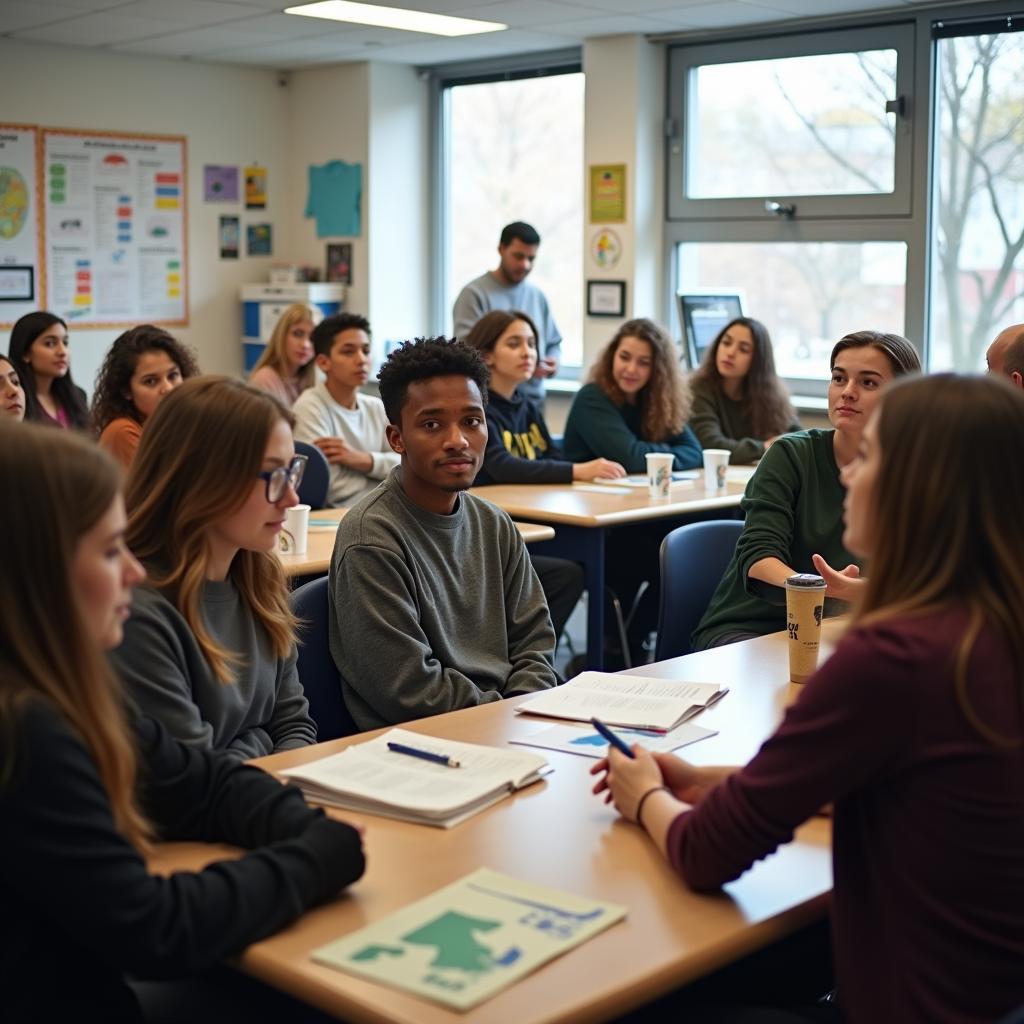 Học sinh trao đổi thảo luận trong lớp học về chủ đề giáo dục IELTS Speaking Part 1
Phân Tích và Gợi Ý Trả Lời Chi Tiết
Question: What did you enjoy most about school when you were younger?
🎯 Cách tiếp cận:
- Chọn một khía cạnh cụ thể (môn học, hoạt động, bạn bè…)
- Giải thích tại sao bạn thích điều đó
- Thêm một ví dụ hoặc chi tiết để câu trả lời sinh động hơn
📝 Sample Answer – Band 6-7:
“I really enjoyed sports activities at school, especially football. I liked it because it helped me relax after studying and I could play with my friends. We had PE lessons twice a week and I always looked forward to them.”
Phân tích:
- Điểm mạnh: Trả lời trực tiếp, có lý do rõ ràng, đề cập đến tần suất cụ thể
- Hạn chế: Từ vựng còn đơn giản (really enjoyed, liked), thiếu chi tiết cụ thể về trải nghiệm
- Tại sao Band 6-7: Câu trả lời đủ dài, có cấu trúc rõ ràng nhưng vocabulary và grammar chưa thực sự impressive. Sử dụng các từ phổ thông như “relax”, “play with friends” mà không có sự đa dạng về cách diễn đạt.
📝 Sample Answer – Band 8-9:
“Looking back, I’d say the extracurricular activities were definitely the highlight of my school years. I was particularly passionate about the drama club, which allowed me to step out of my comfort zone and develop my confidence. I vividly remember putting on Shakespeare’s Macbeth in my final year – it was both nerve-wracking and exhilarating, and it taught me invaluable lessons about teamwork and perseverance.”
Phân tích:
-
Điểm mạnh:
- Vocabulary tinh tế: “extracurricular activities”, “highlight”, “step out of comfort zone”, “nerve-wracking and exhilarating”
- Cấu trúc đa dạng: “Looking back, I’d say…”, “I vividly remember…”
- Ý tưởng sâu sắc: không chỉ nói về hoạt động mà còn nói về bài học rút ra
- Chi tiết cụ thể: “Shakespeare’s Macbeth in my final year”
-
Tại sao Band 8-9:
- Fluency & Coherence: Câu trả lời trôi chảy với linking phrases tự nhiên (“Looking back”, “particularly”, “I vividly remember”)
- Lexical Resource: Sử dụng collocations chính xác (“step out of comfort zone”, “putting on a play”) và từ vựng mô tả cảm xúc tinh tế (“nerve-wracking”, “exhilarating”)
- Grammar: Relative clauses (“which allowed me to…”), past continuous (“putting on”), compound adjectives
- Pronunciation: Từ vựng được chọn cho phép thể hiện word stress và intonation tốt
💡 Key Vocabulary & Expressions:
- extracurricular activities: hoạt động ngoại khóa
- highlight: điểm nổi bật, khoảnh khắc đáng nhớ nhất
- step out of one’s comfort zone: bước ra khỏi vùng an toàn
- nerve-wracking: căng thẳng, hồi hộp đến nỗi lo lắng
- exhilarating: phấn khích, hứng khởi
- perseverance: sự kiên trì, bền bỉ
Question: Do you think schools today are different from schools in the past?
🎯 Cách tiếp cận:
- So sánh một hoặc hai khía cạnh cụ thể
- Đưa ra ví dụ minh họa cho sự khác biệt
- Có thể đề cập đến sự thay đổi tích cực hoặc tiêu cực
📝 Sample Answer – Band 6-7:
“Yes, I think schools are quite different now. In the past, students mainly studied from textbooks, but now they use computers and tablets a lot. Also, teaching methods have changed – teachers now encourage more group work and discussions instead of just lecturing.”
Phân tích:
- Điểm mạnh: So sánh rõ ràng giữa quá khứ và hiện tại, đưa ra hai điểm khác biệt cụ thể
- Hạn chế: Từ vựng và cấu trúc còn đơn giản, thiếu ví dụ cá nhân hoặc quan sát cụ thể
- Tại sao Band 6-7: Câu trả lời có cấu trúc logic và đủ thông tin nhưng chưa thể hiện được sự tinh tế trong việc sử dụng ngôn ngữ. Các cụm từ như “quite different”, “a lot”, “instead of” là những expressions cơ bản.
📝 Sample Answer – Band 8-9:
“Absolutely, there’s been a dramatic shift in the educational landscape. The most striking difference is probably the integration of technology – when I was at school, we relied heavily on printed materials and chalkboards, whereas nowadays students have instant access to a wealth of information through tablets and interactive whiteboards. Beyond that, there’s been a fundamental change in pedagogical approaches – the focus has shifted from rote learning towards developing critical thinking skills and fostering creativity.”
Phân tích:
-
Điểm mạnh:
- Vocabulary chuyên ngành: “pedagogical approaches”, “integration of technology”, “rote learning”
- So sánh tinh tế: “relied heavily on… whereas nowadays…”
- Cấu trúc phức tạp: “The most striking difference is…”, “the focus has shifted from… towards…”
- Ý tưởng có chiều sâu: không chỉ nói về công nghệ mà còn về phương pháp giảng dạy
-
Tại sao Band 8-9:
- Fluency: Câu trả lời mạch lạc với discourse markers (“Absolutely”, “Beyond that”)
- Lexical Resource: Collocations xuất sắc (“dramatic shift”, “striking difference”, “wealth of information”, “fundamental change”)
- Grammar: Complex sentences với relative clauses, contrast structures
- Content: Thể hiện hiểu biết sâu về xu hướng giáo dục
💡 Key Vocabulary & Expressions:
- dramatic shift: sự thay đổi mạnh mẽ, đáng kể
- educational landscape: bối cảnh giáo dục
- integration of technology: sự tích hợp công nghệ
- printed materials: tài liệu in ấn
- pedagogical approaches: phương pháp sư phạm
- rote learning: học vẹt, học thuộc lòng
- critical thinking skills: kỹ năng tư duy phản biện
- fostering creativity: nuôi dưỡng sự sáng tạo
Question: What life skills do you think schools should teach?
🎯 Cách tiếp cận:
- Chọn 2-3 kỹ năng cụ thể
- Giải thích tại sao những kỹ năng này quan trọng
- Có thể đưa ra ví dụ về ứng dụng thực tế
📝 Sample Answer – Band 6-7:
“I think schools should teach practical skills like money management and time management. These skills are very important for adult life but many students don’t know about them. Also, communication skills are essential because we need to work with other people in most jobs.”
Phân tích:
- Điểm mạnh: Đưa ra được 3 kỹ năng cụ thể với lý do hợp lý
- Hạn chế: Vocabulary lặp lại (“skills”, “management”), thiếu ví dụ minh họa, cách diễn đạt còn đơn giản
- Tại sao Band 6-7: Nội dung đầy đủ và relevant nhưng ngôn ngữ chưa sophisticated. Sử dụng các cấu trúc cơ bản như “I think”, “very important”, “we need to”.
📝 Sample Answer – Band 8-9:
“I strongly believe that financial literacy should be a core component of the curriculum. So many young adults struggle with managing their finances because they’ve never been taught the basics of budgeting, saving, or understanding compound interest. Equally important is emotional intelligence – the ability to navigate relationships, handle stress, and resolve conflicts constructively. These are the skills that truly determine whether someone thrives in their personal and professional life, yet they’re often overlooked in traditional academic settings.”
Phân tích:
-
Điểm mạnh:
- Vocabulary chuyên sâu: “financial literacy”, “emotional intelligence”, “compound interest”
- Collocations tự nhiên: “core component”, “struggle with”, “navigate relationships”
- Ý tưởng thuyết phục: không chỉ liệt kê mà còn giải thích impact thực tế
- Cấu trúc phức tạp: “the ability to…”, “these are the skills that…”
- Contrast: “yet they’re often overlooked”
-
Tại sao Band 8-9:
- Fluency: Câu trả lời tự nhiên với hedging (“I strongly believe”), emphasis (“truly determine”)
- Lexical Resource: Precise vocabulary (“thrives”, “navigate”, “resolve conflicts constructively”)
- Grammar: Complex noun phrases, relative clauses, passive voice
- Critical Thinking: Nhận xét sâu sắc về gap trong giáo dục hiện tại
💡 Key Vocabulary & Expressions:
- financial literacy: hiểu biết về tài chính
- core component: thành phần cốt lõi
- struggle with: vật lộn với, gặp khó khăn với
- budgeting: lập ngân sách
- compound interest: lãi kép
- emotional intelligence: trí tuệ cảm xúc
- navigate relationships: điều hướng các mối quan hệ
- resolve conflicts: giải quyết xung đột
- thrive: phát triển mạnh mẽ, thành công
- overlooked: bị bỏ qua
Tương tự như describe a person who has motivated you to stay connected with others, chủ đề giáo dục trong IELTS Speaking cũng đòi hỏi bạn phải kết nối những trải nghiệm cá nhân với những ý tưởng trừu tượng hơn về sự phát triển kỹ năng.
IELTS Speaking Part 2: Long Turn (Cue Card)
Tổng Quan Về Part 2
Part 2 là phần độc thoại, nơi bạn có 1 phút chuẩn bị và phải nói liên tục trong 2-3 phút về một chủ đề cụ thể được đưa ra trên thẻ cue card. Đây là phần thử thách nhất vì bạn phải duy trì câu chuyện mà không có sự tương tác từ examiner.
Đặc điểm của Part 2:
- Thời gian chuẩn bị: 1 phút (có giấy và bút để ghi chú)
- Thời gian nói: 2-3 phút không bị ngắt quãng
- Có 3-4 bullet points cần cover
- Câu cuối “and explain…” thường quan trọng nhất
Chiến lược hiệu quả:
Trong 1 phút chuẩn bị:
- KHÔNG viết câu hoàn chỉnh – chỉ ghi keywords
- Lập outline nhanh theo từng bullet point
- Nghĩ trước về vocabulary khó sẽ dùng
- Chuẩn bị câu mở đầu và kết thúc
Khi nói:
- Nói với tốc độ vừa phải – không quá nhanh
- Dùng past tense nếu kể về sự kiện đã qua
- Mở rộng chi tiết để đủ 2 phút
- Chú ý đến câu “explain” – đây là nơi ghi điểm cao
Lỗi thường gặp:
- Không sử dụng hết thời gian chuẩn bị hoặc viết quá nhiều
- Nói dưới 1.5 phút (quá ngắn)
- Bỏ sót một hoặc nhiều bullet points
- Không mở rộng câu “explain”, chỉ nói surface level
- Dùng quá nhiều filler words (um, ah, well…)
- Nói như đang đọc thuộc bài
Cue Card
Describe a skill you learned at school that you found useful in your adult life
You should say:
- What the skill was
- How you learned this skill
- When you started using this skill in your adult life
- And explain why you think this skill has been useful for you
Phân Tích Đề Bài
Dạng câu hỏi: Describe a skill (Mô tả một kỹ năng)
Thì động từ chủ đạo:
- Past Simple khi nói về quá trình học (bullet 2)
- Past Simple/Present Perfect khi nói về việc bắt đầu sử dụng (bullet 3)
- Present tense khi explain tại sao useful (bullet 4)
Bullet points phải cover:
- What the skill was: Xác định rõ kỹ năng gì – có thể là academic skill (critical thinking, research), practical skill (presentation, time management), hoặc social skill (teamwork, communication)
- How you learned this skill: Mô tả quá trình học – qua môn học nào, giáo viên nào, phương pháp nào
- When you started using this skill in your adult life: Thời điểm và hoàn cảnh bắt đầu áp dụng
- And explain why useful: Đây là phần QUAN TRỌNG NHẤT – giải thích impact, benefits cụ thể
Câu “explain” quan trọng:
Đây là nơi thể hiện critical thinking. Đừng chỉ nói “it’s useful” mà phải explain HOW và WHY nó useful với examples cụ thể. Đây là điểm phân biệt giữa band 6 và band 8+.
Lựa chọn kỹ năng: Nên chọn những kỹ năng có câu chuyện cụ thể, dễ mở rộng như: public speaking, time management, problem-solving, research skills, critical thinking, teamwork, hoặc thậm chí kỹ năng practical như typing, basic coding.
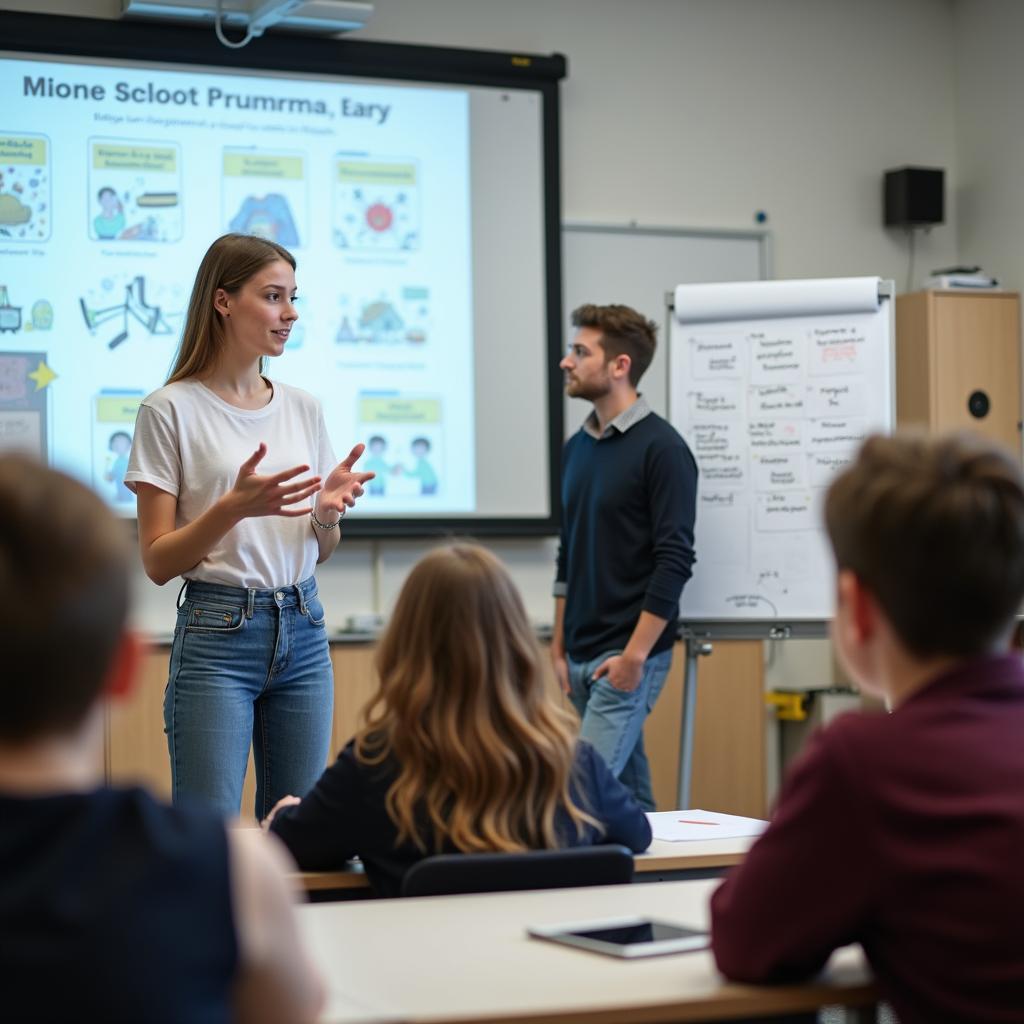 Học sinh thuyết trình rèn luyện kỹ năng nói trước lớp cho IELTS Speaking Part 2
📝 Sample Answer – Band 6-7
Thời lượng: Khoảng 1.5-2 phút
“I’d like to talk about public speaking, which is a skill I learned during my high school years.
I learned this skill through my English classes. My teacher often asked us to give presentations about different topics. At first, I was very nervous when speaking in front of the class. However, my teacher gave us useful tips about how to prepare slides, organize our ideas, and speak clearly. We practiced regularly, and gradually I became more confident.
I started using this skill when I entered university. In my first year, I had to present a project to about 50 students and some professors. I remembered the techniques my teacher taught me, like making eye contact and speaking slowly. The presentation went well and I got positive feedback.
I think this skill has been very useful for several reasons. First, it helped me succeed in my studies because many courses required presentations. Second, it’s important for my career now because I often need to present ideas to my colleagues and clients. Being able to speak confidently in front of people has opened many opportunities for me. Without learning this skill at school, I would find my job much more difficult today.”
Phân Tích Band Điểm
| Tiêu chí | Band | Nhận xét |
|---|---|---|
| Fluency & Coherence | 6-7 | Câu chuyện có cấu trúc rõ ràng theo thứ tự thời gian. Sử dụng linking words cơ bản (At first, However, First, Second). Có vài chỗ còn đơn giản về cách diễn đạt. |
| Lexical Resource | 6-7 | Từ vựng đủ dùng và phù hợp (public speaking, presentations, eye contact, positive feedback). Một số collocations tốt nhưng chưa sophisticated. |
| Grammatical Range & Accuracy | 6-7 | Sử dụng đúng các thì (past simple cho quá khứ, present cho hiện tại). Có một số câu phức (which, when, because) nhưng chủ yếu vẫn là câu đơn và ghép. |
| Pronunciation | 6-7 | Giả định rằng phát âm rõ ràng, dễ hiểu với ít lỗi ảnh hưởng đến meaning. |
Điểm mạnh:
- ✅ Trả lời đầy đủ tất cả bullet points
- ✅ Có cấu trúc rõ ràng, dễ theo dõi
- ✅ Đưa ra examples cụ thể (presentation to 50 students)
- ✅ Giải thích được tại sao useful với 2 lý do
Hạn chế:
- ⚠️ Vocabulary còn basic (very nervous, went well, very useful)
- ⚠️ Thiếu descriptive details để câu chuyện sinh động hơn
- ⚠️ Phần explain chưa thực sự sâu sắc, chỉ liệt kê lý do
- ⚠️ Một số expressions lặp lại (this skill, presentations)
📝 Sample Answer – Band 7.5-8
Thời lượng: Khoảng 2-2.5 phút
“I’d like to talk about critical thinking, which is arguably one of the most valuable skills I acquired during my secondary school education.
I developed this skill primarily through my literature and history classes. Our teacher, Mrs. Thompson, had a rather unique teaching approach – instead of simply lecturing us on historical events or literary works, she constantly challenged us to question the information presented. I vividly remember analyzing George Orwell’s ‘1984’ and being asked not just to summarize the plot, but to evaluate the author’s perspective on totalitarianism and draw parallels with contemporary society. We were encouraged to back up our arguments with evidence and consider multiple viewpoints before forming conclusions.
I began applying this skill extensively when I started my university studies in business administration. During my first semester, we had a case study analysis where we needed to assess a company’s strategic decisions. Rather than accepting the textbook solution at face value, I found myself digging deeper, questioning the underlying assumptions, and considering alternative approaches. This analytical mindset really set my work apart.
This skill has proven invaluable in both my academic and professional life. In my current role as a marketing analyst, I’m constantly required to interpret data, identify trends, and make recommendations. The ability to think critically helps me avoid jumping to conclusions based on surface-level information. Moreover, it’s enhanced my problem-solving abilities – when faced with challenges, I can break down complex issues into manageable components and evaluate potential solutions objectively. I genuinely believe that without this foundation from school, I wouldn’t be as effective in my career today.”
Phân Tích Band Điểm
| Tiêu chí | Band | Nhận xét |
|---|---|---|
| Fluency & Coherence | 7.5-8 | Câu chuyện trôi chảy với cohesive devices đa dạng (primarily, instead of, rather than, moreover). Các ý được phát triển logic và tự nhiên. |
| Lexical Resource | 7.5-8 | Vocabulary chính xác và đa dạng (acquired, lecturing, evaluate, draw parallels, invaluable, analytical mindset). Sử dụng less common words appropriately. |
| Grammatical Range & Accuracy | 7.5-8 | Đa dạng cấu trúc: passive voice (were encouraged), relative clauses (which is arguably), gerunds (avoid jumping), complex sentences. Ít lỗi ngữ pháp. |
| Pronunciation | 7.5-8 | Giả định rằng pronunciation rõ ràng với appropriate stress và intonation. |
So Sánh Với Band 6-7
| Khía cạnh | Band 6-7 | Band 7.5-8 |
|---|---|---|
| Vocabulary | “very useful”, “helpful”, “important” | “invaluable”, “proven essential”, “analytical mindset” |
| Grammar | Simple & compound sentences chủ yếu | Complex structures: “Rather than accepting… at face value, I found myself digging deeper” |
| Ideas | “It helped me in my studies and career” | Cụ thể hóa: case study analysis, data interpretation, problem-solving examples |
| Details | “My teacher taught us” | “Mrs. Thompson had a rather unique teaching approach – instead of simply lecturing…” |
Điểm nổi bật:
- Specific examples: analyzing ‘1984’, case study in business course
- Sophisticated vocabulary: “draw parallels”, “underlying assumptions”, “analytical mindset”
- Clear progression: school → university → career
- Strong explanation với concrete benefits
📝 Sample Answer – Band 8.5-9
Thời lượng: 2.5-3 phút đầy đủ
“I’d like to talk about time management, which I consider to be one of the most transformative skills I picked up during my school years – and surprisingly, it wasn’t taught in any formal classroom setting.
The skill actually emerged through my participation in the school’s debate team when I was around 15. Our coach, Mr. Chen, was notoriously demanding – we had to juggle intensive research sessions, regular practice debates, and numerous tournaments, all while maintaining our academic performance. What really forced me to up my game was the realization that I simply couldn’t do everything haphazardly. Mr. Chen introduced us to various productivity frameworks, including the Eisenhower Matrix for prioritizing tasks and the Pomodoro Technique for maintaining sustained focus. Initially, I was skeptical – it seemed like just another time-consuming task to add to my already overflowing plate. However, as I began implementing these strategies, I noticed a remarkable shift in my efficiency and, more importantly, my stress levels.
I really began to reap the benefits of this skill when I transitioned into the working world about three years ago. In my role as a project coordinator at a tech startup, I’m constantly bombarded with competing deadlines and high-stakes deliverables. The time management principles I learned back in my school days have become my go-to toolkit. For instance, every Monday morning, I spend 30 minutes mapping out my week using the prioritization framework Mr. Chen taught us, which helps me distinguish between urgent firefighting and important strategic work.
The impact of this skill on my life has been nothing short of profound. On a practical level, it’s enabled me to maintain a healthy work-life balance – something many of my colleagues struggle with. I can confidently say that I rarely work overtime, yet I consistently meet or exceed my performance targets. Beyond that, though, it’s cultivated a sense of agency and control over my life. Rather than feeling like I’m perpetually playing catch-up, I approach each day with a clear plan. What strikes me as particularly valuable is how this skill has a compounding effect – the better I manage my time, the more opportunities I can pursue, whether that’s taking on challenging projects at work, maintaining my fitness routine, or investing in meaningful relationships. Looking back, I’m genuinely grateful that my school experience, albeit inadvertently, equipped me with this fundamental life skill.”
Phân Tích Band Điểm
| Tiêu chí | Band | Nhận xét |
|---|---|---|
| Fluency & Coherence | 8.5-9 | Extremely fluent với natural flow. Sophisticated cohesive devices (Initially, However, Beyond that, Looking back). Ý tưởng phát triển logic và comprehensive. |
| Lexical Resource | 8.5-9 | Wide range of vocabulary với precise meaning: “transformative”, “notoriously demanding”, “haphazardly”, “reap the benefits”, “compounding effect”. Natural use of idioms và collocations. |
| Grammatical Range & Accuracy | 8.5-9 | Full range of structures: inversion (Rarely do I…), cleft sentences (What strikes me…), complex noun phrases, perfect tenses. Virtually error-free. |
| Pronunciation | 8.5-9 | Giả định pronunciation xuất sắc với subtle features của native speech. |
Tại Sao Bài Này Xuất Sắc
🎯 Fluency Hoàn Hảo:
- Không có hesitation, tất cả connecting phrases đều tự nhiên
- Use của “actually”, “surprisingly”, “initially” cho thấy spontaneous speech
- Smooth transitions giữa các phần: school → work → impact
📚 Vocabulary Tinh Vi:
- “transformative” (thay vì “useful/helpful”)
- “notoriously demanding” (vivid description)
- “juggle” (metaphorical use)
- “up my game” (idiomatic)
- “reap the benefits” (formal collocation)
- “perpetually playing catch-up” (vivid imagery)
- “compounding effect” (sophisticated concept)
📝 Grammar Đa Dạng:
- Present Perfect: “has been nothing short of profound”
- Past Perfect: “had become my go-to toolkit”
- Participle clauses: “maintaining our academic performance”
- Cleft sentences: “What really forced me… was…”
- Complex conditionals implied: “the better I manage…, the more opportunities…”
💡 Ideas Sâu Sắc:
- Không chỉ mô tả skill mà còn explain evolution của nó
- Specific frameworks mentioned (Eisenhower Matrix, Pomodoro)
- Honest admission: “Initially, I was skeptical”
- Deep reflection: “sense of agency and control”
- Recognition of compound benefits: không chỉ work mà cả life balance và relationships
🎯 Structure Xuất Sắc:
- Introduction: Hook + context
- Development: Detailed story với specific examples
- Application: Clear transition to adult life với concrete examples
- Explanation: Multi-layered – practical benefits, psychological benefits, long-term impact
- Conclusion: Reflective và thoughtful
Follow-up Questions (Rounding Off Questions)
Sau Part 2, examiner thường hỏi 1-2 câu ngắn liên quan đến topic bạn vừa nói. Đây là cầu nối sang Part 3.
Question 1: Do you think this skill is still important today?
Band 6-7 Answer:
“Yes, definitely. I think it’s even more important now because life is becoming busier and we have more things to do every day.”
Band 8-9 Answer:
“Absolutely, I’d argue it’s become increasingly critical in today’s world. With the constant digital distractions and the blurring of boundaries between work and personal life, the ability to manage time effectively is what separates those who thrive from those who simply survive. If anything, it’s a skill that’s more relevant than ever.”
Phân tích: Band 8-9 answer sử dụng hedging language (“I’d argue”), sophisticated vocabulary (“increasingly critical”, “blurring of boundaries”), và strong statement với justification. Band 6-7 answer đúng nhưng general và lack depth.
Question 2: Would you recommend this skill to young people today?
Band 6-7 Answer:
“Yes, I would recommend it. Young people today are very busy with school and activities, so they need to learn how to manage their time well.”
Band 8-9 Answer:
“Without a doubt. In fact, I wish it were formally incorporated into the school curriculum rather than being something students have to stumble upon by chance. Given the unprecedented pressures young people face today – from academic expectations to social media demands – equipping them with robust time management strategies early on could be genuinely life-changing.”
Phân tích: Band 8-9 answer goes beyond simple agreement, suggests systematic change (“formally incorporated”), acknowledges modern challenges (“unprecedented pressures”, “social media demands”), và uses strong language (“genuinely life-changing”). Nó shows critical thinking về education system.
Khi nói về việc chuẩn bị cho tương lai, bạn cũng có thể tham khảo cách tiếp cận trong describe a time when you had to troubleshoot a technical issue, vì kỹ năng giải quyết vấn đề là một phần quan trọng mà nhà trường cần dạy cho học sinh.
IELTS Speaking Part 3: Two-way Discussion
Tổng Quan Về Part 3
Part 3 là phần thảo luận hai chiều, nơi examiner sẽ hỏi các câu hỏi trừu tượng, phức tạp hơn liên quan đến chủ đề của Part 2. Đây là phần khó nhất và là nơi phân biệt giữa band 7 và band 8+.
Đặc điểm của Part 3:
- Thời gian: 4-5 phút
- Câu hỏi trừu tượng, yêu cầu phân tích sâu
- Không còn là personal experience mà là general issues
- Yêu cầu critical thinking và ability to discuss abstract ideas
Yêu cầu:
- Analyze, evaluate, compare, hypothesize
- Đưa ra quan điểm có lý lẽ rõ ràng
- Xem xét nhiều perspectives
- Sử dụng examples từ society/world, không chỉ personal
Chiến lược:
- Mở rộng câu trả lời (3-5 câu tối thiểu)
- Bắt đầu với discourse markers (Well, Actually, I think…)
- Structure: Direct answer → Reason/Explanation → Example → Additional point/Conclusion
- Thể hiện you can see both sides of an issue
- Use tentative language (It seems to me, I would say, To some extent…)
Lỗi thường gặp của học viên Việt Nam:
- Trả lời quá ngắn (1-2 câu) vì sợ sai
- Không có examples để support opinions
- Thiếu từ vựng abstract và formal
- Không show được critical thinking
- Trả lời “Yes/No” rồi im lặng đợi câu hỏi tiếp
- Nói về personal experience thay vì general trends/issues
Các Câu Hỏi Thảo Luận Sâu
 Giáo viên áp dụng phương pháp giảng dạy hiện đại trong lớp học về chủ đề giáo dục
Theme 1: The Role of Education in Society
Question 1: What do you think is the primary purpose of education?
🎯 Phân tích câu hỏi:
- Dạng: Opinion question về fundamental purpose
- Key words: “primary purpose” – examiner muốn bạn prioritize hoặc identify the most important goal
- Cách tiếp cận:
- Đưa ra direct answer về purpose bạn cho là quan trọng nhất
- Explain why đó là primary purpose
- Có thể acknowledge other purposes nhưng explain tại sao cái bạn chọn là most important
- Sử dụng examples từ educational systems hoặc society
📝 Sample Answer – Band 6-7:
“I think the main purpose of education is to prepare students for their future careers. Schools teach knowledge and skills that students will use in their jobs later. For example, math and science are important for many professions. Also, education helps people become good citizens by teaching them about society and how to behave properly.”
Phân tích:
- Structure: Direct answer → Example → Additional point
- Vocabulary: Basic (main purpose, teach knowledge, good citizens)
- Tại sao Band 6-7: Answer relevant và coherent nhưng lacks sophistication. Giải thích chưa sâu, example chưa developed fully. Không thể hiện được nuanced thinking về complexity của education.
📝 Câu trả lời mẫu – Band 8-9:
“Well, I’d argue that while education certainly serves multiple functions, its primary purpose should be to cultivate critical thinking and foster intellectual curiosity rather than simply imparting knowledge. You see, in today’s rapidly changing world, specific information quickly becomes outdated, but the ability to analyze, question, and synthesize new information remains invaluable.
Take the example of Finland’s education system, which is often regarded as one of the world’s best – they place enormous emphasis on developing students’ problem-solving abilities and creative thinking rather than rote memorization. This approach has proven far more effective in preparing young people for the uncertainties of the modern job market.
That said, I do believe education also has a crucial societal function – it should instill values like civic responsibility, empathy, and respect for diversity. These soft skills are what enable individuals to contribute meaningfully to society, not just economically but also as engaged citizens. Ultimately, I’d say the purpose of education is to empower individuals to be lifelong learners who can adapt to change and contribute positively to the world around them.”
Phân tích:
-
Structure:
- Opening: Clear position with caveat (while… its primary purpose should be…)
- Development: Justification với reference đến modern context
- Example: Specific case (Finland) để support argument
- Balance: Acknowledgment of other purposes
- Conclusion: Synthesis of main points
-
Vocabulary:
- Abstract concepts: “cultivate critical thinking”, “foster intellectual curiosity”, “imparting knowledge”
- Formal expressions: “I’d argue that”, “regarded as”, “proven far more effective”
- Topic-specific: “rote memorization”, “civic responsibility”, “lifelong learners”
-
Grammar:
- Complex sentences: “while education certainly serves…, its primary purpose should be…”
- Relative clauses: “These soft skills are what enable…”
- Participle clauses: “Take the example of Finland’s education system, which is often regarded as…”
-
Critical Thinking:
- Shows understanding of education’s multifaceted nature
- Compares traditional vs. modern approaches
- Uses international example (Finland)
- Balances different perspectives
- Addresses both individual và societal benefits
💡 Key Language Features:
- Discourse markers: Well, You see, That said, Ultimately
- Tentative language: I’d argue, I’d say, should be
- Abstract nouns: intellectual curiosity, civic responsibility, uncertainties, empathy
- Strong collocations: cultivate critical thinking, foster curiosity, instill values, contribute meaningfully
Question 2: How has the role of teachers changed in modern education?
🎯 Phân tích câu hỏi:
- Dạng: Compare/Contrast về change over time
- Key words: “changed” – cần compare past và present
- Cách tiếp cận:
- Identify specific aspects đã thay đổi
- Explain what teachers did before vs. what they do now
- Discuss reasons for these changes
- Có thể evaluate whether changes are positive/negative
📝 Sample Answer – Band 6-7:
“Teachers’ roles have changed a lot in recent years. In the past, teachers were the main source of information for students. They gave lectures and students listened and took notes. But now, with the internet, students can find information easily by themselves. So teachers now focus more on guiding students and helping them develop skills. They also use more technology in teaching, like computers and online platforms.”
Phân tích:
- Structure: Past → Present contrast, clear comparison
- Vocabulary: Adequate but basic (main source, gave lectures, focus more on)
- Tại sao Band 6-7: Answer addresses question directly với clear examples của change nhưng lacks depth trong analysis. Không explain why changes occurred hoặc evaluate impact. Language còn straightforward mà chưa sophisticated.
📝 Câu trả lời mẫu – Band 8-9:
“The role of teachers has undergone a dramatic transformation, shifting from being primary knowledge providers to becoming facilitators of learning. In traditional education models, teachers were essentially gatekeepers of information – they held the knowledge and dispensed it to students through didactic instruction. Students were largely passive recipients, expected to absorb and regurgitate information.
However, the advent of technology and the democratization of information through the internet have fundamentally altered this dynamic. Today’s teachers are more akin to learning coaches or mentors. Their role is to help students navigate the overwhelming abundance of information available, teaching them not just what to learn, but how to learn – distinguishing reliable sources from misinformation, synthesizing diverse perspectives, and applying knowledge to real-world contexts.
Moreover, there’s been a paradigm shift towards personalized learning. Rather than delivering a one-size-fits-all curriculum, effective teachers now differentiate instruction to accommodate various learning styles and paces. They’re also expected to foster not just academic growth but holistic development, paying attention to students’ emotional intelligence and well-being.
Interestingly, this evolution has made teaching arguably more demanding than ever before. Teachers need to be technologically savvy, culturally sensitive, and equipped with diverse pedagogical strategies. It’s no longer sufficient to be an expert in your subject – you need to be an expert in how people learn.”
Phân tích:
-
Structure:
- Introduction: Clear thesis about transformation
- Body 1: Traditional role với vivid description
- Body 2: Modern role với explanation of why
- Body 3: Additional dimension (personalized learning)
- Conclusion: Reflection on implications
-
Vocabulary:
- Sophisticated descriptors: “dramatic transformation”, “gatekeepers of information”, “didactic instruction”
- Precise verbs: “dispense”, “absorb and regurgitate”, “navigate”, “differentiate”
- Advanced collocations: “advent of technology”, “democratization of information”, “paradigm shift”
- Topic-specific: “facilitators of learning”, “learning coaches”, “holistic development”
-
Grammar:
- Complex comparisons: “more akin to… than…”
- Participle clauses: “teaching them not just what to learn, but how…”
- Passive constructions: “were expected to”, “are now required to”
- Emphatic structures: “It’s no longer sufficient…”
-
Critical Thinking:
- Historical perspective (traditional → modern)
- Causal analysis (technology → role change)
- Multiple dimensions considered (knowledge → skills → personalization)
- Evaluation of implications (more demanding)
- Nuanced understanding (not just change but fundamental transformation)
💡 Key Language Features:
- Contrast markers: However, Moreover, Rather than
- Emphatic language: fundamentally altered, dramatically transformed, no longer sufficient
- Qualification: arguably, essentially, largely
- Abstract concepts: democratization of information, paradigm shift, holistic development
Theme 2: Skills for the Future
Question 1: What skills do you think will be most important for future generations?
🎯 Phân tích câu hỏi:
- Dạng: Prediction/Future trends question
- Key words: “future generations”, “most important” – cần forward-thinking và prioritization
- Cách tiếp cận:
- Identify 2-3 critical skills
- Explain why these skills will be important (link to future trends)
- Consider context: automation, globalization, climate change, etc.
- Possibly contrast with skills important today
📝 Sample Answer – Band 6-7:
“I think technological skills will be very important in the future because technology is developing very fast. People will need to know how to use computers and new technologies at work. Also, communication skills are important because people will work with others from different countries. Problem-solving skills are also necessary because the world is changing and people need to solve new problems.”
Phân tích:
- Structure: Lists 3 skills with brief explanations
- Vocabulary: General (technological skills, communication skills, problem-solving)
- Tại sao Band 6-7: Answer identifies relevant skills nhưng explanations are superficial. Không có specific examples hoặc deep analysis về why these particular skills. Language basic và repetitive (“important”, “necessary”, “need to”).
📝 Câu trả lời mẫu – Band 8-9:
“Looking ahead, I believe adaptability and resilience will be paramount – perhaps even more crucial than specific technical skills. We’re entering an era of unprecedented change, where entire industries can be disrupted virtually overnight. The ability to embrace change, learn rapidly, and pivot when necessary will distinguish those who thrive from those who struggle.
Closely related to this is what I’d call digital fluency – not just the ability to use technology, but to understand its underlying principles and potential implications. As artificial intelligence and automation increasingly pervade every sector, people will need to understand how to collaborate with these technologies rather than simply being displaced by them. This requires a fundamental grasp of concepts like data literacy, algorithmic thinking, and cybersecurity awareness.
That said, I’d argue that the uniquely human skills will become increasingly valuable precisely because they can’t be easily replicated by machines. Emotional intelligence, creative problem-solving, ethical reasoning, and the ability to build meaningful relationships – these are the capabilities that will remain firmly in human domain. For instance, while AI can process data and identify patterns, it’s humans who must decide how to apply that information ethically and compassionately.
Finally, I think global competence – the ability to work across cultures, languages, and perspectives – will be essential. The challenges facing humanity, from climate change to pandemic response, require international collaboration. Future generations will need to be comfortable with ambiguity, able to navigate cultural nuances, and committed to finding collective solutions to shared problems.”
Phân tích:
-
Structure:
- Skill 1: Adaptability/resilience với justification
- Skill 2: Digital fluency với specific breakdown
- Skill 3: Human skills với contrast to AI
- Skill 4: Global competence với real-world context
- Each section: Claim → Explanation → Example/Context
-
Vocabulary:
- Sophisticated adjectives: “paramount”, “unprecedented”, “uniquely human”
- Precise technical terms: “algorithmic thinking”, “cybersecurity awareness”, “data literacy”
- Strong verbs: “distinguish”, “pervade”, “replicate”, “navigate”
- Abstract concepts: “digital fluency”, “emotional intelligence”, “global competence”
-
Grammar:
- Future forms: “will be paramount”, “will need to understand”
- Conditional logic: “those who thrive from those who struggle”
- Contrasts: “not just… but…”, “rather than…”
- Causal structures: “precisely because”
- Complex noun phrases: “the ability to embrace change, learn rapidly, and pivot”
-
Critical Thinking:
- Forward-thinking: links skills to emerging trends (AI, automation, globalization)
- Nuanced categorization: technical vs. human skills
- Comparative analysis: what machines can vs. can’t do
- Real-world examples: climate change, pandemic response
- Recognition of complexity: “ambiguity”, “nuances”
- Holistic view: individual skills + collective capabilities
💡 Key Language Features:
- Forward-looking language: Looking ahead, Future generations will, As AI increasingly…
- Emphasis: perhaps even more crucial, increasingly valuable, firmly in human domain
- Contrast: rather than, while AI can… it’s humans who, precisely because
- Hedging: I believe, I’d argue, I think
- Sophisticated linking: Closely related to this, That said, Finally
Question 2: Do you think traditional academic subjects are still relevant in preparing students for the future?
🎯 Phân tích câu hỏi:
- Dạng: Evaluation question with potential debate
- Key words: “traditional academic subjects”, “still relevant” – implies change và questioning status quo
- Cách tiếp cận:
- Define what “traditional academic subjects” means
- Present balanced view: acknowledge value + limitations
- Consider what might need to change
- Link to future workplace demands
📝 Sample Answer – Band 6-7:
“Yes, I think traditional subjects like math and science are still important because they provide basic knowledge that students need. However, schools should also teach new subjects that are useful for modern life, such as computer programming and financial management. The traditional subjects give students a good foundation, but they need to be combined with practical skills that are necessary for today’s jobs.”
Phân tích:
- Structure: Direct answer → Qualification → Suggestion
- Vocabulary: Adequate (basic knowledge, good foundation, practical skills)
- Tại sao Band 6-7: Answer shows balanced thinking nhưng analysis còn surface-level. Không explore deeply why traditional subjects valuable hoặc what specifically needs to change. Examples general rather than specific.
📝 Câu trả lời mẫu – Band 8-9:
“This is quite a contentious issue, and I think the answer is nuanced. On one hand, I’d argue that core academic subjects remain fundamentally important – but perhaps not for the reasons traditionally espoused. For example, mathematics isn’t valuable simply because we need to calculate things; it’s valuable because it develops logical reasoning, pattern recognition, and analytical thinking. Similarly, literature and history cultivate critical reading skills, cultural awareness, and the ability to understand complex narratives – all highly transferable competencies.
However, I think there’s a compelling case for reimagining how these subjects are taught. Rather than treating them as isolated disciplines, we should be teaching them in more integrated, project-based ways that mirror real-world applications. For instance, instead of learning chemistry in a vacuum, students could explore it through the lens of environmental sustainability or medical innovation.
What concerns me is the opportunity cost of maintaining a curriculum that’s remained largely unchanged for decades. The time spent memorizing dates or formulas that are readily available online might be better invested in developing skills that are genuinely scarce – things like design thinking, entrepreneurship, digital citizenship, or even basic coding.
Ultimately, I believe we need both – a grounding in traditional disciplines to develop cognitive foundations, combined with contemporary skills that address the realities of modern life. The key is achieving the right balance and ensuring that traditional subjects evolve to remain relevant rather than being taught in ways that feel anachronistic.”
Phân tích:
-
Structure:
- Introduction: Acknowledges complexity
- Point 1: Defense of traditional subjects với reframing
- Point 2: Critique of current approach
- Point 3: Concern about opportunity cost
- Conclusion: Balanced synthesis
-
Vocabulary:
- Sophisticated descriptors: “contentious issue”, “nuanced”, “compelling case”
- Academic language: “fundamentally important”, “highly transferable”, “opportunity cost”
- Precise verbs: “espoused”, “reimagining”, “mirror”, “address”
- Strong collocations: “isolated disciplines”, “cognitive foundations”, “anachronistic”
-
Grammar:
- Conditional structures: “might be better invested”
- Contrast: “Rather than…, we should”, “not for the reasons… but because”
- Concessive: “However”, “What concerns me”
- Participle phrases: “maintaining a curriculum that’s remained largely unchanged”
- Emphatic: “it’s… that”, “what is genuinely scarce”
-
Critical Thinking:
- Reframes question: traditional subjects valuable but for different reasons
- Multiple perspectives: value + critique + synthesis
- Specific examples: mathematics for logical reasoning, chemistry through sustainability lens
- Identifies deeper issue: not subjects themselves but how they’re taught
- Forward-looking: suggests evolution rather than abandonment
- Acknowledges trade-offs: opportunity cost
- Avoids black-and-white thinking: “we need both”
💡 Key Language Features:
- Hedging và Nuance: quite a contentious issue, I’d argue, I think, Ultimately
- Balanced language: On one hand… However, both X and Y
- Critical vocabulary: concerns me, compelling case, opportunity cost
- Academic tone: fundamentally important, highly transferable, cognitive foundations
Khi thảo luận về kỹ năng cho tương lai, cách tiếp cận vấn đề có thể học hỏi từ describe a situation where you were forced to think outside the box, vì tư duy sáng tạo là một trong những kỹ năng quan trọng mà học sinh cần phát triển.
Theme 3: Educational Challenges and Inequalities
Question 1: Why do you think some students succeed academically while others struggle?
🎯 Phân tích câu hỏi:
- Dạng: Cause/Reason question về complex social issue
- Key words: “some… while others” – requires comparison và multiple factors
- Cách tiếp cận:
- Identify multiple factors (không chỉ một nguyên nhân)
- Consider: socioeconomic factors, family support, individual differences, school quality
- Avoid oversimplification
- Show awareness of systemic issues
- Balance individual vs. structural factors
📝 Sample Answer – Band 6-7:
“There are many reasons why some students do better than others. First, family background is important – students from educated families often get more support at home. Second, some students are naturally smarter or more motivated to study. Third, the quality of schools matters too – good schools have better teachers and facilities. Also, some students have better study habits and time management skills.”
Phân tích:
- Structure: Lists multiple factors systematically
- Vocabulary: Basic descriptors (better, good, important)
- Tại sao Band 6-7: Answer identifies relevant factors nhưng chưa explore deeply. Các explanations còn surface-level. Phrase “naturally smarter” problematic – shows chưa sophisticated understanding. Thiếu nuance về complexity of issue.
📝 Câu trả lời mẫu – Band 8-9:
“This is a profoundly complex question that touches on numerous interconnected factors. I think it’s crucial to recognize that academic success isn’t simply a matter of innate ability or individual effort – although those certainly play a role. Rather, it’s heavily influenced by systemic factors that create vastly unequal starting points.
Socioeconomic background is perhaps the most significant predictor of academic achievement. Students from affluent families have access to resources that dramatically enhance their chances of success – from private tutoring and enrichment activities to simply having a quiet space to study and nutritious meals that support cognitive development. Conversely, students facing economic hardship may need to work part-time, lack access to basic learning materials, or deal with unstable housing – all of which severely impede their educational progress.
Beyond economics, parental involvement and educational capital matter enormously. Parents who understand how the education system works can advocate for their children, help with homework, and instill the importance of education. Meanwhile, first-generation students may lack this guidance, not because their families don’t care, but because they’re navigating unfamiliar terrain.
The quality of schooling itself creates further disparities. Schools in underprivileged areas often grapple with overcrowded classrooms, underfunded programs, and difficulty attracting experienced teachers – creating a vicious cycle where students who need the most support receive the least.
That said, individual factors like intrinsic motivation, resilience, and growth mindset do matter, but I think it’s reductive to focus primarily on these without acknowledging the structural barriers many students face. Some students overcome tremendous obstacles, but we shouldn’t mistake their exceptional perseverance for evidence that systemic issues don’t exist. Rather, we should ask why these obstacles exist in the first place and work to dismantle them.”
Phân tích:
-
Structure:
- Introduction: Sets up complexity of issue
- Factor 1: Socioeconomic – extensively developed với examples
- Factor 2: Parental involvement – nuanced explanation
- Factor 3: School quality – systemic perspective
- Factor 4: Individual factors – acknowledged but contextualized
- Conclusion: Critical reflection on how we frame the issue
-
Vocabulary:
- Sophisticated analysis: “profoundly complex”, “interconnected factors”, “systemic factors”
- Precise descriptors: “significant predictor”, “dramatically enhance”, “severely impede”
- Social issues vocabulary: “socioeconomic background”, “educational capital”, “structural barriers”
- Strong verbs: “advocate for”, “instill”, “grapple with”, “dismantle”
- Academic collocations: “innate ability”, “vicious cycle”, “growth mindset”
-
Grammar:
- Complex causation: “isn’t simply… Rather, it’s heavily influenced by…”
- Contrast structures: “Conversely”, “Meanwhile”, “That said”
- Conditional logic: “not because… but because…”
- Emphatic structures: “It’s crucial to recognize”, “do matter, but…”
- Parallel structures: “from private tutoring… to simply having…”
-
Critical Thinking:
- Rejects simplistic explanations (not just ability or effort)
- Multiple factors explored with depth
- Awareness of systemic inequality
- Specific examples for each factor
- Acknowledges individual agency but contextualizes it
- Critical of deficit-focused narratives
- Calls for systemic change rather than blaming individuals
- Sophisticated understanding: “mistake exceptional perseverance for evidence”
💡 Key Language Features:
- Academic hedging: I think, perhaps, may, do matter but
- Emphasis: profoundly complex, enormously, dramatically, severely
- Contrast: Rather, Conversely, Meanwhile, That said, Beyond
- Critical language: it’s reductive to, we shouldn’t mistake, structural barriers
- Cause-effect: creates further disparities, severely impede, dramatically enhance
Question 2: What can governments do to improve educational opportunities for all students?
🎯 Phân tích câu hỏi:
- Dạng: Problem-Solution question
- Key words: “governments”, “all students” – về policy và equity
- Cách tiếp cận:
- Suggest concrete policy measures
- Address multiple dimensions (funding, access, quality)
- Consider different types of inequality
- Acknowledge challenges in implementation
- Possibly compare different countries’ approaches
📝 Sample Answer – Band 6-7:
“Governments should invest more money in education, especially for schools in poor areas. They need to provide better facilities and hire good teachers. Also, they could offer financial support to students from low-income families so they can afford to stay in school. Making sure all children have access to technology and internet is also important nowadays.”
Phân tích:
- Structure: Lists several solutions
- Vocabulary: Basic action verbs (invest, provide, offer, make sure)
- Tại sao Band 6-7: Answer identifies relevant solutions nhưng lacks specificity và depth. Không explain how these would be implemented hoặc address potential challenges. Language straightforward without sophisticated policy vocabulary.
📝 Câu trả lời mẫu – Band 8-9:
“I believe governments need to take a multi-pronged approach that addresses both immediate needs and long-term systemic reform.
First and foremost, there needs to be equitable funding – and by that, I don’t mean equal funding, but rather needs-based allocation where schools serving disadvantaged communities receive proportionally more resources. This is the model used in countries like Finland, and it’s proven effective in narrowing achievement gaps. These resources should go towards attracting and retaining high-quality teachers through competitive salaries and professional development opportunities, reducing class sizes, and providing comprehensive support services like counseling and health care.
Beyond funding, governments should invest heavily in early childhood education. Research consistently shows that the achievement gap begins forming well before formal schooling starts. Universal access to high-quality pre-kindergarten programs can be transformative, particularly for children from less privileged backgrounds.
Crucially, there needs to be a concerted effort to address digital inequality. The pandemic has starkly exposed how the digital divide exacerbates educational disparities. Governments should ensure every student has access to devices and reliable internet – this is no longer a luxury but a fundamental requirement for modern education.
I’d also argue for curriculum reform that makes education more inclusive and relevant. This means incorporating diverse perspectives, acknowledging historical injustices, and connecting academic content to students’ lived experiences. When students see themselves reflected in their education, engagement naturally increases.
Finally, governments should tackle the underlying socioeconomic factors that impede educational success – things like food insecurity, unstable housing, and lack of healthcare. Wraparound services that address these holistic needs can dramatically improve educational outcomes. Schools in some communities are already functioning as community hubs, providing not just education but also meals, healthcare referrals, and family support services.
That said, I think we need to be realistic about the challenges. These initiatives require substantial investment and political will, and results may take years to materialize. But the long-term dividends – a more educated, equitable society – are well worth the investment.”
Phân tích:
-
Structure:
- Introduction: Frames comprehensive approach
- Solution 1: Equitable funding – detailed với example
- Solution 2: Early childhood education – với research backing
- Solution 3: Digital access – contextualizes with pandemic
- Solution 4: Curriculum reform – với rationale
- Solution 5: Holistic support – broader social factors
- Conclusion: Acknowledges challenges, affirms importance
-
Vocabulary:
- Policy language: “multi-pronged approach”, “needs-based allocation”, “wraparound services”
- Academic precision: “proportionally more”, “achievement gap”, “digital divide”
- Strong verbs: “exacerbates”, “materialize”, “tackle”, “impede”
- Evidence language: “research consistently shows”, “proven effective”
- Sophisticated expressions: “well worth the investment”, “long-term dividends”
-
Grammar:
- Conditional: “When students see themselves…”
- Purpose: “in order to”, “to ensure that”
- Emphasis: “First and foremost”, “Crucially”, “I’d also argue”
- Qualification: “That said”, “I think we need to be realistic”
- Complex noun phrases: “a concerted effort to address digital inequality”
-
Critical Thinking:
- Distinguishes equity from equality
- References research and international examples
- Multiple dimensions: funding, access, quality, relevance, holistic support
- Acknowledges upstream factors (poverty, housing, healthcare)
- Realistic about implementation challenges
- Long-term perspective
- Shows understanding of interconnected issues
- Avoids simplistic solutions
💡 Key Language Features:
- Structuring: First and foremost, Beyond, Crucially, Finally, That said
- Evidence: Research consistently shows, proven effective, pandemic has exposed
- Emphasis: need to, should, substantial investment, dramatically improve
- Qualification: I believe, I’d argue, I think we need to be realistic
- Policy vocabulary: equitable funding, universal access, curriculum reform, political will
 Trường học tích hợp công nghệ hiện đại để dạy kỹ năng tương lai cho học sinh
Khi thảo luận về vai trò của chính phủ trong giáo dục, bạn có thể tham khảo cách phân tích vấn đề xã hội trong describe a historical site you wish to visit, vì hiểu biết về lịch sử cũng giúp học sinh phát triển tư duy phản biện về các vấn đề đương đại.
Từ vựng và cụm từ quan trọng
Topic-Specific Vocabulary
| Từ vựng/Cụm từ | Loại từ | Phiên âm | Nghĩa tiếng Việt | Ví dụ | Collocation |
|---|---|---|---|---|---|
| critical thinking | n | /ˈkrɪtɪkəl ˈθɪŋkɪŋ/ | tư duy phản biện | Schools should foster critical thinking rather than rote memorization. | develop critical thinking, cultivate critical thinking, critical thinking skills, lack of critical thinking |
| pedagogical approach | n | /ˌpedəˈɡɒdʒɪkəl əˈprəʊtʃ/ | phương pháp sư phạm | Modern pedagogical approaches emphasize student-centered learning. | innovative pedagogical approach, traditional pedagogical approach, effective pedagogical approach |
| educational equity | n | /ˌedʒuˈkeɪʃənəl ˈekwɪti/ | công bằng giáo dục | The government is working to improve educational equity across all regions. | promote educational equity, achieve educational equity, lack of educational equity |
| achievement gap | n | /əˈtʃiːvmənt ɡæp/ | khoảng cách về thành tích học tập | The achievement gap between wealthy and poor students continues to widen. | narrow the achievement gap, close the achievement gap, significant achievement gap |
| lifelong learning | n | /ˌlaɪflɒŋ ˈlɜːnɪŋ/ | học tập suốt đời | Education should instill a passion for lifelong learning. | commitment to lifelong learning, culture of lifelong learning, embrace lifelong learning |
| rote learning | n | /rəʊt ˈlɜːnɪŋ/ | học vẹt, học thuộc lòng | Rote learning is less effective than understanding concepts deeply. | rely on rote learning, move away from rote learning, emphasis on rote learning |
| curriculum reform | n | /kəˈrɪkjələm rɪˈfɔːm/ | cải cách chương trình giảng dạy | The country is undergoing major curriculum reform to prepare students for the digital age. | implement curriculum reform, comprehensive curriculum reform, curriculum reform initiative |
| digital literacy | n | /ˈdɪdʒɪtəl ˈlɪtərəsi/ | hiểu biết về kỹ thuật số | Digital literacy is now as fundamental as reading and writing. | develop digital literacy, improve digital literacy, digital literacy skills |
| socioeconomic background | n | /ˌsəʊsiəʊˌiːkəˈnɒmɪk ˈbækɡraʊnd/ | xuất thân kinh tế xã hội | A student’s socioeconomic background significantly influences their educational opportunities. | diverse socioeconomic backgrounds, disadvantaged socioeconomic background, privileged socioeconomic background |
| vocational training | n | /vəʊˈkeɪʃənəl ˈtreɪnɪŋ/ | đào tạo nghề | Vocational training provides practical skills for specific careers. | quality vocational training, vocational training programs, access to vocational training |
| extracurricular activities | n | /ˌekstrəkəˈrɪkjələr ækˈtɪvɪtiz/ | hoạt động ngoại khóa | Extracurricular activities help develop well-rounded individuals. | participate in extracurricular activities, wide range of extracurricular activities, valuable extracurricular activities |
| facilitate | v | /fəˈsɪlɪteɪt/ | tạo điều kiện thuận lợi, hỗ trợ | Teachers should facilitate learning rather than just transmit information. | facilitate learning, facilitate discussion, facilitate development |
| cultivate | v | /ˈkʌltɪveɪt/ | trau dồi, nuôi dưỡng | Schools need to cultivate creativity and innovation. | cultivate skills, cultivate curiosity, cultivate talent |
| instill | v | /ɪnˈstɪl/ | thấm nhuần, gieo vào | Education should instill values like integrity and respect. | instill confidence, instill values, instill discipline |
| foster | v | /ˈfɒstə(r)/ | nuôi dưỡng, khuyến khích | Good teachers foster intellectual curiosity in their students. | foster creativity, foster development, foster collaboration |
| equip | v | /ɪˈkwɪp/ | trang bị | Schools must equip students with skills for the 21st century. | equip students with, well-equipped, equip someone to do something |
| holistic | adj | /həˈlɪstɪk/ | toàn diện | A holistic approach to education considers academic, emotional, and social development. | holistic education, holistic approach, holistic development |
| inclusive | adj | /ɪnˈkluːsɪv/ | bao trùm, toàn diện | Schools should create inclusive environments for all learners. | inclusive education, inclusive curriculum, more inclusive |
| marginalized | adj | /ˈmɑːdʒɪnəlaɪzd/ | bị thiệt thòi, bị gạt ra ngoài lề | Educational policies should focus on marginalized communities. | marginalized groups, marginalized students, historically marginalized |
| transferable | adj | /trænsˈfɜːrəbl/ | có thể chuyển giao, áp dụng được | Communication is a transferable skill useful in any career. | transferable skills, highly transferable, transferable knowledge |
Idiomatic Expressions & Advanced Phrases
| Cụm từ | Nghĩa | Ví dụ sử dụng | Band điểm |
|---|---|---|---|
| step out of one’s comfort zone | bước ra khỏi vùng an toàn | Drama classes encouraged me to step out of my comfort zone and develop confidence. | 7.5-9 |
| level the playing field | tạo sân chơi bình đẳng | Government interventions aim to level the playing field for disadvantaged students. | 7.5-9 |
| a wealth of information | một nguồn thông tin phong phú | The internet provides students with a wealth of information at their fingertips. | 7-8 |
| think outside the box | suy nghĩ sáng tạo, không theo khuôn mẫu | Good education encourages students to think outside the box. | 7-8 |
| one-size-fits-all | áp dụng chung cho tất cả (thường không hiệu quả) | A one-size-fits-all curriculum doesn’t accommodate diverse learning needs. | 7.5-9 |
| fall through the cracks | bị bỏ sót, không được chú ý | Students from disadvantaged backgrounds often fall through the cracks in the education system. | 8-9 |
| vicious cycle | vòng luẩn quẩn | Poor funding creates a vicious cycle of underperformance in schools. | 7.5-9 |
| food for thought | điều đáng để suy nghĩ | The teacher’s question gave us food for thought about our future careers. | 7-8 |
| bridge the gap | lấp khoảng cách | Technology can help bridge the gap between urban and rural education. | 7-8 |
| at face value | theo nghĩa đen, không suy nghĩ sâu | Critical thinking means not accepting information at face value. | 7.5-9 |
| navigate uncharted territory | khám phá, đi vào lĩnh vực chưa biết | First-generation students are navigating uncharted territory without family guidance. | 8-9 |
| put theory into practice | đưa lý thuyết vào thực hành | Internships allow students to put theory into practice. | 7-8 |
Discourse Markers (Từ Nối Ý Trong Speaking)
Để bắt đầu câu trả lời:
- 📝 Well,… – Dùng khi cần thời gian suy nghĩ ngắn hoặc đưa ra quan điểm cân nhắc
- 📝 Actually,… – Khi đưa ra thông tin có thể khác với kỳ vọng hoặc góc nhìn mới
- 📝 To be honest,… – Khi muốn thể hiện sự chân thành trong quan điểm
- 📝 I’d say that… – Cách mềm mại để đưa ra ý kiến
- 📝 Looking at it from X perspective,… – Khi phân tích từ góc độ cụ thể
- 📝 Interestingly,… – Khi đưa ra điểm thú vị, đáng chú ý
Để bổ sung ý:
- 📝 On top of that,… – Thêm ý hỗ trợ vào ý chính
- 📝 What’s more,… – Nối thêm thông tin quan trọng
- 📝 Not to mention… – Nhấn mạnh thêm điểm quan trọng
- 📝 Beyond that,… – Mở rộng thảo luận ra khía cạnh khác
- 📝 Moreover,… – Formal hơn, thích hợp cho Part 3
- 📝 In addition to this,… – Thêm yếu tố mới vào discussion
Để đưa ra quan điểm cân bằng:
- 📝 On the one hand,… On the other hand,… – So sánh hai mặt của vấn đề
- 📝 While it’s true that…, we also need to consider… – Thừa nhận một mặt nhưng bổ sung mặt khác
- 📝 That said,… – Chuyển sang quan điểm khác sau khi đưa ra một ý
- 📝 Having said that,… – Tương tự “That said”
- 📝 Conversely,… – Đưa ra ý đối lập
- 📝 By contrast,… – So sánh tương phản
Để kết luận:
- 📝 All in all,… – Tóm gọn lại ý chính
- 📝 At the end of the day,… – Kết luận về điều quan trọng nhất
- 📝 Ultimately,… – Điểm cuối cùng, quan trọng nhất
- 📝 In the final analysis,… – Formal, kết luận sau khi phân tích
- 📝 To sum up,… – Tóm tắt các ý đã nói
Để làm rõ hoặc nhấn mạnh:
- 📝 What I mean is… – Giải thích rõ hơn ý vừa nói
- 📝 In other words,… – Diễn đạt lại theo cách khác
- 📝 To put it another way,… – Paraphrase ý kiến
- 📝 The key point here is… – Nhấn mạnh điểm chính
- 📝 Essentially,… – Rút gọn về bản chất vấn đề
- 📝 What strikes me as particularly important is… – Nhấn mạnh điểm đặc biệt quan trọng
Grammatical Structures Ấn Tượng
1. Conditional Sentences (Câu điều kiện):
Mixed conditional:
- Formula: If + past simple/past perfect, would/could + infinitive (hoặc ngược lại)
- Ví dụ: “If schools had focused more on life skills, I would be better prepared for my career now.”
- Khi nào dùng: Khi nói về tình huống giả định ở quá khứ với kết quả ở hiện tại hoặc ngược lại
Inversion in conditionals:
- Formula: Had/Were/Should + subject + verb, main clause
- Ví dụ: “Had I been taught financial literacy at school, I wouldn’t have made so many money mistakes in my twenties.”
- Khi nào dùng: Formal style, đặc biệt tốt cho Part 3. Thể hiện grammatical range cao.
2. Relative Clauses (Mệnh đề quan hệ):
Non-defining relative clauses:
- Formula: …, which/who/where + clause, …
- Ví dụ: “Finland’s education system, which is often regarded as one of the best, emphasizes student well-being.”
- Khi nào dùng: Thêm thông tin bổ sung, làm câu phong phú hơn
Reduced relative clauses:
- Formula: Noun + V-ing/V-ed
- Ví dụ: “Students facing economic hardship often struggle academically.” (= students who face…)
- Khi nào dùng: Làm câu gọn gàng, tránh lặp “who/which”
3. Passive Voice (Câu bị động):
Impersonal passive:
- Formula: It is thought/believed/said/reported that…
- Ví dụ: “It is widely believed that early childhood education has long-lasting benefits.”
- Khi nào dùng: Nói về general beliefs, research findings mà không cần cite nguồn cụ thể
Passive + infinitive:
- Formula: Subject + be + past participle + to infinitive
- Ví dụ: “Teachers are expected to be not only subject experts but also mentors and counselors.”
- Khi nào dùng: Nói về expectations, requirements, obligations
4. Cleft Sentences (Câu chẻ):
What-cleft:
- Formula: What + clause + be + noun/that clause
- Ví dụ: “What concerns me most is the growing inequality in educational opportunities.”
- Khi nào dùng: Nhấn mạnh điểm bạn muốn focus, làm nổi bật ý quan trọng
It-cleft:
- Formula: It + be + focus + that/who + clause
- Ví dụ: “It was my history teacher who inspired my love of learning.”
- Khi nào dùng: Nhấn mạnh người, vật, thời gian cụ thể
5. Inversion for Emphasis:
Negative inversion:
- Formula: Never/Rarely/Seldom/Not only + auxiliary + subject + main verb
- Ví dụ: “Never before have students had access to such a wealth of information.”
- Khi nào dùng: Nhấn mạnh mạnh mẽ, particularly impressive trong Part 3
Only inversion:
- Formula: Only + time/condition + auxiliary + subject + verb
- Ví dụ: “Only when we address systemic inequalities can we achieve true educational equity.”
- Khi nào dùng: Nhấn mạnh điều kiện cần thiết
6. Participle Clauses:
Present participle (-ing):
- Formula: V-ing…, main clause HOẶC Main clause, V-ing…
- Ví dụ: “Having studied abroad, I appreciate the value of cross-cultural education.”
- Khi nào dùng: Giải thích nguyên nhân, nối hai hành động liên tiếp
Past participle (-ed):
- Formula: V-ed…, main clause
- Ví dụ: “Equipped with critical thinking skills, students can navigate complex information.”
- Khi nào dùng: Mô tả trạng thái hoặc điều kiện
7. Subjunctive and Tentative Language:
Should subjunctive:
- Formula: It is essential/crucial/important that + subject + (should) + base verb
- Ví dụ: “It is essential that schools provide equal opportunities to all students.”
- Khi nào dùng: Nói về necessity, recommendations trong formal context
Tentative modals:
- Formula: may/might/could + verb
- Ví dụ: “This approach might prove more effective in developing practical skills.”
- Khi nào dùng: Thể hiện uncertainty, possibilities – quan trọng để tránh overgeneralizing
Lời khuyên tổng kết từ góc nhìn Examiner
Sau hơn hai thập kỷ chấm thi IELTS Speaking, tôi muốn chia sẻ một số insights quan trọng về chủ đề giáo dục và cách chuẩn bị cho tương lai – một trong những topics phổ biến và quan trọng nhất:
🎯 Những điều examiners thực sự đánh giá cao:
-
Authenticity over perfection: Chúng tôi có thể phân biệt được giữa câu trả lời tự nhiên và câu học thuộc. Một câu trả lời với một vài lỗi ngữ pháp nhỏ nhưng natural và thoughtful sẽ score cao hơn một câu perfect về grammar nhưng rigid và rehearsed.
-
Depth of thinking: Đặc biệt trong Part 3, ability to analyze, compare, và evaluate quan trọng hơn là việc sử dụng fancy vocabulary. Chúng tôi muốn thấy bạn CAN think critically, không chỉ recite information.
-
Relevant examples: Examples từ personal experience (Part 1, 2) hoặc from society/world (Part 3) làm câu trả lời convincing và memorable. Đừng chỉ nói abstract ideas mà không có concrete illustrations.
⚠️ Common pitfalls của học viên Việt Nam:
-
Over-reliance on templates: Nhiều bạn học các cấu trúc kiểu “There are several reasons for this. Firstly,… Secondly,… Finally…” và áp dụng cứng nhắc. Điều này làm câu trả lời mechanical. Thay vào đó, hãy vary cách bạn structure ideas.
-
Thiếu personal voice: Đừng sợ nói “I think”, “In my experience”, “From what I’ve observed”. Personal opinions và observations làm bạn sound engaged và authentic.
-
Vocabulary showing off: Sử dụng từ khó không phù hợp context hoặc sai collocation worse hơn là dùng từ đơn giản nhưng chính xác. Hãy nhớ: precision > complexity.
-
Answering too briefly in Part 3: Part 3 là nơi demonstrate advanced English. Câu trả lời 2-3 câu là insufficient. Aim for 4-6 câu với development đầy đủ.
💡 Specific tips cho chủ đề Education:
-
Stay balanced: Khi discuss education topics, tránh extreme positions. Thay vì nói “Traditional education is completely useless”, hãy nói “While traditional education has certain limitations, it still provides valuable foundational knowledge.”
-
Update your knowledge: Đề cập đến current trends (online learning, AI in education, skill-based learning) shows bạn engaged with contemporary issues. Nhưng đừng make up facts – nếu không chắc, dùng tentative language: “I believe”, “It seems that”.
-
Connect to personal experience smartly: Trong Part 3, khi được hỏi general questions, bạn CAN reference personal experience nhưng then expand to broader implications. Ví dụ: “In my own schooling, I noticed that… and I think this reflects a broader trend in education where…”
📚 How to prepare effectively:
-
Record yourself: Listen back và identify filler words (um, uh, you know), repetitive vocabulary, hoặc grammatical patterns bạn overuse. Self-awareness is the first step to improvement.
-
Think in themes, not questions: Thay vì memorize answers cho từng câu hỏi, prepare ideas và vocabulary cho themes: traditional vs modern education, skills for future, educational inequality, role of technology, etc. Điều này cho flexibility to adapt.
-
Practice with nuance: Khi practice, đừng chỉ answer câu hỏi. Push yourself to add: “However”, “That said”, “Looking at it from another angle”. Này develops critical thinking skills naturally.
-
Build a personal bank of examples: Có 3-4 personal stories bạn có thể adapt cho different topics. Với education, có thể là: một teacher ảnh hưởng đến bạn, một skill bạn learned, một challenge bạn overcame, một moment bạn realized education’s importance.
🎙️ On the day:
-
First 30 seconds matter: Trong Part 1, hai câu trả lời đầu set the tone. Even nếu nervous, force yourself to expand và speak clearly ngay từ đầu.
-
Use the preparation time wisely: Trong Part 2, don’t write sentences – jot down keywords và structure. Spend 10-15 seconds thinking về câu mở đầu và kết thúc engaging.
-
Engage with the examiner in Part 3: Đây là discussion, không phải interrogation. Occasional eye contact, reacting naturally đến câu hỏi (“That’s an interesting question”, “I’ve never thought about it that way”) makes interaction more natural.
Final thoughts:
Education là topic mà ai cũng có personal connection, và đó là advantage của bạn. Đừng think của nó như một academic subject mà như conversations about something you’ve lived through. The best candidates là những người bring both knowledge và personal insight, combining sophistication của language với authenticity của personal reflection.
Remember: examiners are human. Chúng tôi appreciate when candidates show genuine interest trong topic, think independently, và communicate naturally. Perfection không phải là goal – effective communication is.
Good luck với IELTS Speaking preparation! Hãy embrace the learning process, đừng sợ make mistakes khi practice, và tin rằng authentic voice của bạn, combined với solid preparation, sẽ shine through trong exam room.
Một số tài nguyên bổ ích:
- Practice platforms: IELTS Liz, IELTS Simon, British Council LearnEnglish
- Vocabulary building: Academic Word List, Topic-specific vocabulary lists
- Authentic materials: TED Talks about education, podcasts về learning và development
- Speaking practice: Language exchange platforms (iTalki, Cambly), speaking clubs
Và quan trọng nhất: Speak English as much as possible, even với bản thân. Narrate your day, discuss news articles với yourself, explain concepts to imaginary audience. Fluency comes from regular practice, không phải last-minute cramming.


