Mở Bài
Trong thế giới công việc hiện đại, khả năng xây dựng và duy trì một mạng lưới chuyên nghiệp vững mạnh đã trở thành yếu tố then chốt quyết định sự thành công trong sự nghiệp. Chủ đề “How To Build A Strong Professional Network” không chỉ xuất hiện thường xuyên trong bài thi IELTS Reading mà còn phản ánh xu hướng toàn cầu về tầm quan trọng của networking trong môi trường làm việc đương đại.
Bài viết này cung cấp cho bạn một bộ đề thi IELTS Reading hoàn chỉnh với ba passages có độ khó tăng dần từ Easy đến Hard, bao gồm đầy đủ 40 câu hỏi giống như kỳ thi thật. Bạn sẽ được luyện tập với nhiều dạng câu hỏi đa dạng như Multiple Choice, True/False/Not Given, Yes/No/Not Given, Matching Headings, và Summary Completion. Mỗi câu hỏi đều có đáp án chi tiết kèm giải thích cụ thể về cách xác định thông tin trong đoạn văn.
Đề thi này phù hợp cho học viên có trình độ từ band 5.0 trở lên, giúp bạn làm quen với cấu trúc bài thi thực tế, rèn luyện kỹ năng đọc hiểu học thuật, và tích lũy vốn từ vựng quan trọng về chủ đề networking và phát triển nghề nghiệp.
Hướng Dẫn Làm Bài IELTS Reading
Tổng Quan Về IELTS Reading Test
IELTS Reading Test kéo dài trong 60 phút với 3 passages và tổng cộng 40 câu hỏi. Mỗi passage có độ dài khoảng 700-1000 từ và độ khó tăng dần. Để tối ưu hóa thời gian làm bài, bạn nên phân bổ như sau:
- Passage 1: 15-17 phút (độ khó Easy, phù hợp band 5.0-6.5)
- Passage 2: 18-20 phút (độ khó Medium, phù hợp band 6.0-7.5)
- Passage 3: 23-25 phút (độ khó Hard, phù hợp band 7.0-9.0)
Lưu ý rằng không có thời gian bổ sung để chép đáp án, vì vậy bạn cần ghi câu trả lời trực tiếp vào phiếu trả lời trong khi làm bài.
Các Dạng Câu Hỏi Trong Đề Này
Đề thi mẫu này bao gồm các dạng câu hỏi phổ biến nhất trong IELTS Reading:
- Multiple Choice – Câu hỏi trắc nghiệm với 3-4 đáp án
- True/False/Not Given – Xác định tính đúng/sai/không có thông tin
- Yes/No/Not Given – Xác định ý kiến của tác giả
- Matching Headings – Nối tiêu đề với đoạn văn
- Summary Completion – Hoàn thành đoạn tóm tắt
- Sentence Completion – Hoàn thành câu
- Matching Features – Nối thông tin với đặc điểm
IELTS Reading Practice Test
PASSAGE 1 – The Foundation of Professional Networking
Độ khó: Easy (Band 5.0-6.5)
Thời gian đề xuất: 15-17 phút
Building a strong professional network has become an essential skill in today’s interconnected business world. Whether you are a recent graduate entering the job market or an experienced professional looking to advance your career, the ability to create and maintain meaningful connections can significantly impact your professional success. Research shows that up to 85% of jobs are filled through networking, highlighting its critical importance in career development.
The first step in building a professional network is understanding what networking truly means. Networking is not simply about collecting business cards or adding connections on social media platforms. Instead, it is about developing genuine relationships based on mutual respect and shared interests. Effective networking involves creating a web of contacts who can provide support, advice, and opportunities throughout your career journey. These connections should be reciprocal, meaning that you should be prepared to offer help and value to others just as you hope to receive it.
Many people feel intimidated by the prospect of networking, especially if they are introverted or new to their industry. However, networking does not have to involve attending large, crowded events or making cold approaches to strangers. Some of the most productive networking happens in comfortable, familiar settings. This could include professional associations related to your field, alumni groups from your university, or even online communities focused on your industry. The key is to find environments where you feel comfortable and where you can engage in authentic conversations about topics that genuinely interest you.
Professional development through networking requires consistency and patience. Building a robust network is not something that happens overnight. It is a gradual process that involves regular engagement with your contacts. This might mean attending monthly industry meetups, participating in online forums, or simply reaching out to colleagues for coffee meetings. The important thing is to maintain regular contact without being pushy or opportunistic. People can sense when someone is only interested in what they can gain, rather than building a genuine relationship.
One of the most underutilized strategies in networking is the power of giving first. When you meet new professional contacts, focus on what you can offer them rather than what they can do for you. This could be as simple as sharing a relevant article, making an introduction to someone in your network who could help them, or offering your expertise on a topic they are struggling with. This generosity creates a positive impression and establishes you as someone who adds value to relationships. Over time, this approach builds goodwill and trust, making others more willing to help you when you need support.
The digital age has transformed networking in many ways. Online platforms like LinkedIn have made it easier than ever to connect with professionals across the globe. However, digital networking comes with its own set of best practices. Your online presence should be professional and reflect your expertise and interests. Regularly sharing thoughtful content, commenting on others’ posts, and participating in group discussions can help you stay visible and engaged with your network. Nevertheless, it is important not to rely solely on digital interactions. Face-to-face meetings, whether in person or through video calls, help deepen relationships in ways that text-based communication cannot match.
Attending industry conferences and professional events remains one of the most effective ways to expand your network. These gatherings bring together people who share your professional interests and provide natural opportunities for conversation. To make the most of these events, set clear goals before attending. You might aim to meet three new people in different areas of your industry or to have an in-depth conversation with a leader you admire. Preparation is also crucial. Research the speakers and attendees beforehand, and prepare some conversation starters related to current industry trends or challenges.
Following up after initial meetings is where many networking efforts fail. Within 24-48 hours of meeting someone new, send a brief message referencing your conversation and expressing your interest in staying connected. This timely follow-up reinforces the connection and makes you more memorable. Some people find it helpful to keep a networking journal where they record details about the people they meet, including personal information shared during conversations. This allows for more personalized follow-up and shows genuine interest in the other person.
 Chiến lược xây dựng mạng lưới chuyên nghiệp hiệu quả cho sự nghiệp phát triển bền vững
Questions 1-13
Questions 1-5: Multiple Choice
Choose the correct letter, A, B, C or D.
1. According to the passage, what percentage of jobs are filled through networking?
- A. 75%
- B. 80%
- C. 85%
- D. 90%
2. The passage suggests that effective networking is based on:
- A. Collecting as many business cards as possible
- B. Adding numerous connections on social media
- C. Developing genuine relationships with mutual respect
- D. Attending every networking event available
3. What does the author say about introverted people and networking?
- A. They should avoid networking altogether
- B. They must learn to be more extroverted
- C. They can network in comfortable, familiar settings
- D. They will never succeed at networking
4. According to the passage, one underutilized networking strategy is:
- A. Asking for help immediately
- B. Focusing on what you can offer others
- C. Attending as many events as possible
- D. Collecting contact information
5. The passage states that face-to-face meetings are important because:
- A. They are more convenient than online meetings
- B. They help deepen relationships better than text-based communication
- C. They are required for professional advancement
- D. Digital networking is ineffective
Questions 6-9: True/False/Not Given
Write TRUE if the statement agrees with the information, FALSE if the statement contradicts the information, or NOT GIVEN if there is no information on this.
6. Building a professional network happens quickly if you use the right strategies.
7. Online platforms have made it possible to connect with professionals worldwide.
8. Industry conferences are the only effective way to build a professional network.
9. Most networking efforts fail because people do not follow up after initial meetings.
Questions 10-13: Sentence Completion
Complete the sentences below. Choose NO MORE THAN TWO WORDS from the passage for each answer.
10. Networking should be __, meaning both parties should be willing to help each other.
11. Building a robust network is a __ that requires regular engagement.
12. When attending professional events, you should prepare __ related to current industry trends.
13. Some people keep a __ to record details about people they meet.
PASSAGE 2 – Strategic Networking for Career Advancement
Độ khó: Medium (Band 6.0-7.5)
Thời gian đề xuất: 18-20 phút
The concept of strategic networking has evolved considerably over the past decade, moving beyond transactional exchanges to become a sophisticated approach to career management and professional growth. While traditional networking focused primarily on expanding the quantity of connections, contemporary research emphasizes the importance of network quality, diversity, and strategic positioning within professional communities. Understanding these nuances can significantly enhance your ability to leverage relationships for mutual benefit and long-term success.
Social capital theory provides a valuable framework for understanding professional networking. This theory suggests that relationships constitute a form of capital that can be invested, developed, and drawn upon when needed. Just as financial capital enables economic transactions, social capital facilitates the flow of information, resources, and opportunities through networks. However, not all connections contribute equally to your social capital. The strength and nature of relationships matter considerably. Weak ties – acquaintances with whom you have infrequent contact – can be surprisingly valuable because they provide access to information and opportunities outside your immediate circle. Conversely, strong ties – close colleagues and friends – offer deeper trust and more substantial support during challenging times.
The architecture of your network plays a crucial role in determining its effectiveness. Networks can be characterized as either dense or sparse. A dense network consists of people who largely know each other, creating a tight-knit community where information circulates quickly but may become redundant. A sparse network, in contrast, contains many connections who do not know each other, potentially providing access to more diverse information and opportunities. Research by sociologist Ronald Burt introduced the concept of structural holes – gaps in information flow between different clusters in a network. Individuals who bridge these structural holes, connecting otherwise disconnected groups, often gain significant advantages in terms of information access and innovation potential. Tương tự như The role of mentorship in promoting cross-cultural academic success, việc xây dựng mạng lưới đa dạng giúp bạn tiếp cận nhiều nguồn thông tin và cơ hội khác nhau.
Strategic network cultivation requires intentional effort in several dimensions. First, consider the composition of your network. Does it include people from various industries, functional areas, and hierarchical levels? A diverse network exposes you to different perspectives and increases the likelihood of accessing non-obvious opportunities. Second, evaluate the balance between internal and external contacts. Internal networks within your organization help you navigate company politics and access resources, while external networks provide market intelligence and potential opportunities beyond your current employer. Third, assess whether you have connections across different geographic locations, which can be particularly valuable in an increasingly globalized economy.
The digital transformation of networking has created both opportunities and challenges. While platforms like LinkedIn enable unprecedented reach, they have also led to what researchers call network inflation – the phenomenon of having numerous superficial connections that provide little real value. To combat this, adopt a quality-over-quantity approach to online networking. Be selective about connection requests, accepting only those that align with your professional interests or goals. Once connected, invest time in nurturing these relationships through meaningful engagement rather than passive observation. Share insights, comment thoughtfully on others’ content, and use direct messaging to maintain personal connections.
Networking across generational divides presents unique opportunities and requires cultural sensitivity. Different generations often have distinct communication preferences and professional values. Baby Boomers might prefer phone calls and face-to-face meetings, while Millennials and Gen Z professionals often favor digital communication channels. Understanding these preferences and adapting your approach accordingly demonstrates emotional intelligence and respect for others’ comfort zones. Moreover, cross-generational networking provides access to different types of knowledge – older professionals offer historical perspective and wisdom accumulated through experience, while younger colleagues bring fresh perspectives and insights into emerging trends and technologies.
The relationship between networking and organizational dynamics deserves careful consideration. While building connections across hierarchical levels can accelerate career progression, it must be done with political acumen. Bypassing your immediate supervisor to cultivate relationships with senior leaders can create tension if not managed carefully. Similarly, networking with competitors requires ethical awareness and respect for confidentiality obligations. The goal is to build relationships that enhance your professional standing without compromising loyalty or integrity.
Mentorship relationships represent a particularly valuable subset of professional networks. Unlike general networking contacts, mentors provide sustained guidance, advocacy, and support for your career development. However, successful mentorship requires clarity about expectations and regular communication. The traditional model of a single, long-term mentor has increasingly given way to the concept of a personal board of advisors – a diverse group of individuals who can provide guidance on different aspects of your career. This might include a technical expert in your field, a leader who exemplifies the career trajectory you aspire to, and a peer who understands your current challenges.
Reciprocity remains fundamental to sustainable networking, but it extends beyond simple tit-for-tat exchanges. The principle of generalized reciprocity suggests that contributing value to your network without expecting immediate returns creates a culture of mutual support where assistance flows more freely. This approach requires a long-term perspective and confidence that your contributions will ultimately be recognized and reciprocated, though not necessarily by the same individuals you help. Organizations with strong cultures of generalized reciprocity tend to exhibit higher levels of collaboration, innovation, and employee satisfaction.
Questions 14-26
Questions 14-18: Yes/No/Not Given
Do the following statements agree with the views of the writer in the passage? Write:
- YES if the statement agrees with the views of the writer
- NO if the statement contradicts the views of the writer
- NOT GIVEN if it is impossible to say what the writer thinks about this
14. Modern networking emphasizes network quality over the number of connections.
15. Weak ties are always less valuable than strong ties in professional networking.
16. Dense networks provide more diverse information than sparse networks.
17. Digital networking platforms have made it easier to maintain meaningful relationships.
18. Cross-generational networking requires understanding different communication preferences.
Questions 19-22: Matching Headings
The passage has eight paragraphs. Choose the correct heading for paragraphs B, D, F, and G from the list of headings below.
List of Headings:
- i. The importance of digital presence
- ii. Understanding social capital theory
- iii. Mentorship as a networking subset
- iv. Strategic considerations for network composition
- v. Generational differences in networking
- vi. Balancing organizational politics in networking
- vii. The evolution of networking concepts
- viii. Managing online connection quality
19. Paragraph B
20. Paragraph D
21. Paragraph F
22. Paragraph G
Questions 23-26: Summary Completion
Complete the summary below. Choose NO MORE THAN TWO WORDS from the passage for each answer.
Social capital theory explains how relationships function as a type of capital. Networks can be either dense or sparse, with sparse networks providing more (23) __. The concept of (24) ____ refers to gaps between different clusters in a network. People who bridge these gaps gain advantages in accessing information. When building your network online, it’s important to avoid (25) __, which occurs when you have many superficial connections. Instead, focus on (26) ____** through meaningful engagement with your contacts.
PASSAGE 3 – The Neuroscience and Psychology of Professional Relationship Formation
Độ khó: Hard (Band 7.0-9.0)
Thời gian đề xuất: 23-25 phút
The formation and maintenance of professional networks represent complex psychosocial phenomena that intersect with fundamental aspects of human cognition, emotion, and behavior. Recent advances in neuroscience, social psychology, and organizational behavior have illuminated the neurobiological substrates and psychological mechanisms underlying successful relationship building, offering insights that transcend conventional networking advice. Understanding these deeper dynamics can empower professionals to approach networking with greater intentionality and effectiveness, while also recognizing the inherent cognitive biases and emotional factors that influence relationship formation.
The neurochemistry of social bonding plays a pivotal role in establishing professional connections. Oxytocin, often termed the “bonding hormone,” facilitates trust and prosocial behavior during interpersonal interactions. Research by neuroeconomist Paul Zak has demonstrated that oxytocin levels increase during positive social exchanges, creating a neurochemical foundation for trust and connection. Interestingly, simple acts such as active listening, maintaining appropriate eye contact, and demonstrating genuine interest in others’ perspectives can stimulate oxytocin release, thereby facilitating rapport building. This neurobiological process operates largely outside conscious awareness, suggesting that authentic engagement naturally promotes the chemical conditions conducive to relationship formation. Conversely, interactions perceived as transactional or disingenuous fail to trigger these neurochemical responses, potentially explaining why instrumental networking approaches often feel uncomfortable and produce suboptimal results.
Cognitive schemas significantly influence how individuals perceive and categorize potential networking contacts. These mental frameworks, developed through experience and cultural conditioning, create heuristic shortcuts that guide social perception and decision-making. The similarity-attraction paradigm posits that people naturally gravitate toward others who share similar backgrounds, interests, or viewpoints, a tendency rooted in cognitive efficiency and threat reduction. While this inclination can facilitate initial connection, it also contributes to homophily – the tendency for networks to become homogeneous – potentially limiting exposure to diverse perspectives and opportunities. Metacognitive awareness of this bias enables professionals to consciously seek connections beyond their natural affinity groups, thereby cultivating more diverse and strategically valuable networks.
The psychological concept of reciprocal disclosure provides insight into relationship deepening. Self-disclosure – sharing personal information, perspectives, or vulnerabilities – typically prompts reciprocal sharing from others, creating iterative cycles of increasing intimacy and trust. Research by social psychologist Arthur Aron has shown that structured reciprocal disclosure can create feelings of closeness remarkably quickly, even between strangers. However, the effectiveness of self-disclosure in professional contexts depends critically on calibration – sharing too little maintains superficiality, while oversharing can violate professional norms and create discomfort. Skilled networkers demonstrate social intelligence in gauging appropriate disclosure levels for different contexts and relationship stages, progressively deepening connections through well-timed vulnerability. Đối với những ai quan tâm đến Impact of digital technology on global communications, việc hiểu rõ cơ chế tâm lý này càng trở nên quan trọng trong thời đại số hóa.
Social anxiety represents a significant barrier to networking for many professionals, with research suggesting that approximately 40% of adults experience some level of social anxiety in professional settings. This anxiety stems from multiple sources, including fear of negative evaluation, performance concerns, and anticipatory anxiety about potential rejection or awkwardness. Neuroscience research reveals that social anxiety involves hyperactivation of the amygdala – the brain’s threat detection center – combined with reduced activity in prefrontal regions responsible for emotional regulation. Understanding the neurobiological basis of social anxiety can help individuals reframe their experiences and employ evidence-based strategies for management, such as cognitive restructuring, exposure therapy principles, and mindfulness techniques. Moreover, recognizing that many others share similar anxieties can reduce feelings of isolation and encourage more compassionate self-evaluation.
The temporal dynamics of relationship formation follow predictable patterns that have implications for networking strategy. Social penetration theory, developed by Irwin Altman and Dalmas Taylor, describes relationship development as a gradual process moving from superficial to increasingly intimate exchanges across multiple dimensions. This framework suggests that attempting to accelerate relationship development beyond natural progression can trigger psychological reactance – a defensive response to perceived pressure that actually impedes connection. Effective networkers respect these temporal dynamics, allowing relationships to evolve organically while providing appropriate inputs at each stage. This patience aligns with research on relationship investment, which demonstrates that sustained, moderate attention typically yields stronger connections than sporadic intense engagement.
Emotional intelligence emerges as a critical competency in sophisticated networking. Defined as the ability to recognize, understand, and manage emotions in oneself and others, emotional intelligence encompasses several dimensions relevant to relationship building: self-awareness enables recognition of one’s emotional states and their impact on interactions; self-regulation facilitates appropriate emotional expression across contexts; social awareness allows accurate interpretation of others’ emotional states and social dynamics; and relationship management encompasses skills for influencing, inspiring, and developing others. Research by Daniel Goleman and colleagues has demonstrated that emotional intelligence predicts leadership effectiveness and career success more reliably than traditional intelligence measures, largely because it enables the sophisticated interpersonal navigation that characterizes effective networking.
The phenomenon of status anxiety in networking contexts warrants examination. Sociological research indicates that perceived status differentials significantly influence interaction dynamics, with lower-status individuals often experiencing increased anxiety and reduced authentic self-presentation when interacting with higher-status contacts. This dynamic can create self-fulfilling prophecies wherein anxiety undermines performance, confirming feared negative impressions. However, reframing status differences through what psychologists call a learning orientation – viewing high-status individuals as potential sources of knowledge rather than judges of worth – can reduce anxiety and enable more productive interactions. Additionally, research on status characteristics theory suggests that emphasizing domain-specific expertise rather than general status can level interaction dynamics, as expertise represents a form of situational status that transcends formal hierarchies.
The integration of technology into networking practices has introduced novel psychological considerations. Computer-mediated communication alters traditional interaction dynamics in ways both advantageous and challenging. The asynchronous nature of much digital communication reduces real-time performance pressure, potentially benefiting individuals with social anxiety. However, it also eliminates nonverbal cues that facilitate emotional attunement and rapport. The hyperpersonal model of computer-mediated communication suggests that digital interactions can sometimes foster stronger connections than face-to-face encounters, particularly when individuals invest effort in thoughtful, well-crafted messages. Nevertheless, the medium richness theory indicates that complex or sensitive communications benefit from richer media that convey more social cues, suggesting that strategic communicators should match medium to message according to relationship stage and communication purpose. Một ví dụ chi tiết về Challenges of maintaining biodiversity in urban areas cho thấy sự cân bằng giữa công nghệ và tương tác tự nhiên là vô cùng quan trọng.
Contemporary network science has revealed that network topology – the structural patterns of connections – influences information diffusion, resource access, and career outcomes in ways that transcend individual relationship quality. Positions within network structures confer different advantages: central positions provide influence and visibility; bridging positions connecting otherwise separate clusters offer access to diverse information and brokerage opportunities; peripheral positions can provide autonomy and protection from network obligations. Strategic networking involves not just accumulating connections but positioning oneself advantageously within broader network structures. This requires structural awareness – understanding one’s position within larger networks and how specific relationships alter that positioning. Such metacognitive network analysis enables more intentional relationship cultivation aligned with strategic objectives.
 Tâm lý học và thần kinh học về hình thành mạng lưới quan hệ chuyên nghiệp
Questions 27-40
Questions 27-31: Multiple Choice
Choose the correct letter, A, B, C or D.
27. According to the passage, oxytocin is important in professional networking because it:
- A. Makes people more intelligent
- B. Facilitates trust and prosocial behavior
- C. Increases energy levels during meetings
- D. Helps people remember names better
28. The similarity-attraction paradigm suggests that:
- A. People prefer to network with those different from themselves
- B. Diversity is automatically achieved in networks
- C. People naturally connect with those who share similar backgrounds
- D. Professional networks should be homogeneous
29. Research on self-disclosure in professional contexts shows that:
- A. Sharing personal information should be avoided entirely
- B. The effectiveness depends on appropriate calibration
- C. More disclosure always leads to better relationships
- D. Professional relationships do not benefit from disclosure
30. According to social penetration theory, relationships:
- A. Should develop as quickly as possible
- B. Develop gradually from superficial to intimate exchanges
- C. Are best when they remain superficial
- D. Require intense engagement from the beginning
31. The passage suggests that emotional intelligence:
- A. Is less important than traditional intelligence for career success
- B. Cannot be developed or improved
- C. Predicts career success more reliably than traditional intelligence
- D. Only matters for people in leadership positions
Questions 32-36: Matching Features
Match each concept with the correct description. Choose the correct letter, A-H.
Concepts:
-
- Homophily
-
- Psychological reactance
-
- Hyperpersonal model
-
- Central positions
-
- Structural holes
Descriptions:
- A. Gaps in information flow between network clusters
- B. Defensive response to perceived pressure in relationships
- C. Tendency for networks to become homogeneous
- D. Digital interactions fostering stronger connections than face-to-face
- E. Network positions providing influence and visibility
- F. Theory about network topology
- G. Concept related to status differences
- H. Method of reducing social anxiety
Questions 37-40: Short-answer Questions
Answer the questions below. Choose NO MORE THAN THREE WORDS from the passage for each answer.
37. What percentage of adults experience social anxiety in professional settings according to research?
38. Which brain region shows hyperactivation during social anxiety?
39. What type of communication eliminates nonverbal cues that help with emotional attunement?
40. What kind of awareness enables professionals to understand their position within larger networks?
Answer Keys – Đáp Án
PASSAGE 1: Questions 1-13
- C
- C
- C
- B
- B
- FALSE
- TRUE
- FALSE
- NOT GIVEN
- reciprocal
- gradual process
- conversation starters
- networking journal
PASSAGE 2: Questions 14-26
- YES
- NO
- NO
- NOT GIVEN
- YES
- ii
- iv
- vi
- iii
- diverse information
- structural holes
- network inflation
- quality-over-quantity approach / meaningful engagement
PASSAGE 3: Questions 27-40
- B
- C
- B
- B
- C
- C
- B
- D
- E
- A
- 40% / Approximately 40%
- amygdala / the amygdala
- computer-mediated communication / digital communication
- structural awareness
Giải Thích Đáp Án Chi Tiết
Passage 1 – Giải Thích
Câu 1: C
- Dạng câu hỏi: Multiple Choice
- Từ khóa: percentage, jobs, filled, networking
- Vị trí trong bài: Đoạn A, dòng 3-4
- Giải thích: Passage nói rõ “Research shows that up to 85% of jobs are filled through networking”. Đáp án C là chính xác.
Câu 2: C
- Dạng câu hỏi: Multiple Choice
- Từ khóa: effective networking, based on
- Vị trí trong bài: Đoạn B, dòng 3-5
- Giải thích: Bài đọc khẳng định “it is about developing genuine relationships based on mutual respect and shared interests”. Đáp án C paraphrase chính xác ý này.
Câu 3: C
- Dạng câu hỏi: Multiple Choice
- Từ khóa: introverted people, networking
- Vị trí trong bài: Đoạn C, dòng 2-4
- Giải thích: Passage đề cập “networking does not have to involve attending large, crowded events” và đề xuất “comfortable, familiar settings”. Đáp án C phản ánh đúng quan điểm này.
Câu 4: B
- Dạng câu hỏi: Multiple Choice
- Từ khóa: underutilized strategy
- Vị trí trong bài: Đoạn E, dòng 1-2
- Giải thích: Đoạn văn nói “One of the most underutilized strategies in networking is the power of giving first” và giải thích “focus on what you can offer them”. Đáp án B đúng.
Câu 5: B
- Dạng câu hỏi: Multiple Choice
- Từ khóa: face-to-face meetings, important
- Vị trí trong bài: Đoạn F, dòng 6-8
- Giải thích: Passage khẳng định “Face-to-face meetings… help deepen relationships in ways that text-based communication cannot match”. Đáp án B paraphrase chính xác ý này.
Câu 6: FALSE
- Dạng câu hỏi: True/False/Not Given
- Từ khóa: building network, happens quickly
- Vị trí trong bài: Đoạn D, dòng 1-2
- Giải thích: Passage nói rõ “Building a robust network is not something that happens overnight. It is a gradual process”. Điều này trái ngược với câu hỏi, nên đáp án là FALSE.
Câu 7: TRUE
- Dạng câu hỏi: True/False/Not Given
- Từ khóa: online platforms, connect, professionals, worldwide
- Vị trí trong bài: Đoạn F, dòng 1-2
- Giải thích: Bài đọc khẳng định “Online platforms like LinkedIn have made it easier than ever to connect with professionals across the globe”. Đáp án TRUE.
Câu 8: FALSE
- Dạng câu hỏi: True/False/Not Given
- Từ khóa: industry conferences, only effective way
- Vị trí trong bài: Đoạn G, dòng 1
- Giải thích: Passage nói “remains one of the most effective ways” không phải “the only effective way”. Đáp án FALSE.
Câu 9: NOT GIVEN
- Dạng câu hỏi: True/False/Not Given
- Từ khóa: most networking efforts fail, do not follow up
- Vị trí trong bài: Đoạn H, dòng 1
- Giải thích: Mặc dù passage đề cập “where many networking efforts fail” nhưng không nói “most”. Không đủ thông tin để xác nhận, nên là NOT GIVEN.
Câu 10: reciprocal
- Dạng câu hỏi: Sentence Completion
- Từ khóa: networking should be, both parties help
- Vị trí trong bài: Đoạn B, dòng 7-8
- Giải thích: Passage sử dụng từ “reciprocal, meaning that you should be prepared to offer help and value to others”.
Câu 11: gradual process
- Dạng câu hỏi: Sentence Completion
- Từ khóa: building robust network, regular engagement
- Vị trí trong bài: Đoạn D, dòng 2
- Giải thích: Bài đọc nói rõ “It is a gradual process that involves regular engagement”.
Câu 12: conversation starters
- Dạng câu hỏi: Sentence Completion
- Từ khóa: professional events, prepare, current industry trends
- Vị trí trong bài: Đoạn G, dòng 5-6
- Giải thích: Passage đề cập “prepare some conversation starters related to current industry trends or challenges”.
Câu 13: networking journal
- Dạng câu hỏi: Sentence Completion
- Từ khóa: people keep, record details
- Vị trí trong bài: Đoạn H, dòng 3-4
- Giải thích: Bài đọc nói “Some people find it helpful to keep a networking journal where they record details”.
 Kỹ thuật làm bài IELTS Reading hiệu quả với chiến lược tìm từ khóa và paraphrase
Passage 2 – Giải Thích
Câu 14: YES
- Dạng câu hỏi: Yes/No/Not Given
- Từ khóa: modern networking, quality over quantity
- Vị trí trong bài: Đoạn A, dòng 2-3
- Giải thích: Passage khẳng định “contemporary research emphasizes the importance of network quality”. Đây là quan điểm của tác giả.
Câu 15: NO
- Dạng câu hỏi: Yes/No/Not Given
- Từ khóa: weak ties, less valuable, strong ties
- Vị trí trong bài: Đoạn B, dòng 7-9
- Giải thích: Bài đọc nói “Weak ties… can be surprisingly valuable” vì chúng cung cấp thông tin từ bên ngoài vòng tròn thân thiết. Quan điểm này trái ngược với câu hỏi.
Câu 16: NO
- Dạng câu hỏi: Yes/No/Not Given
- Từ khóa: dense networks, more diverse information, sparse networks
- Vị trí trong bài: Đoạn C, dòng 3-6
- Giải thích: Passage nói dense networks có thể có thông tin “redundant” trong khi sparse networks cung cấp “more diverse information”. Câu hỏi trái với quan điểm này.
Câu 17: NOT GIVEN
- Dạng câu hỏi: Yes/No/Not Given
- Từ khóa: digital networking platforms, easier, maintain meaningful relationships
- Vị trí trong bài: Đoạn E
- Giải thích: Mặc dù đoạn E nói về digital networking và “network inflation”, nhưng không có quan điểm rõ ràng về việc platforms có làm cho việc duy trì mối quan hệ ý nghĩa dễ dàng hơn hay không.
Câu 18: YES
- Dạng câu hỏi: Yes/No/Not Given
- Từ khóa: cross-generational networking, understanding, communication preferences
- Vị trí trong bài: Đoạn F, dòng 1-3
- Giải thích: Passage nói rõ “requires cultural sensitivity” và “Different generations often have distinct communication preferences”. Đây là quan điểm của tác giả.
Câu 19: ii (Understanding social capital theory)
- Dạng câu hỏi: Matching Headings
- Vị trí trong bài: Đoạn B
- Giải thích: Đoạn B bắt đầu bằng “Social capital theory provides a valuable framework” và giải thích chi tiết về lý thuyết này.
Câu 20: iv (Strategic considerations for network composition)
- Dạng câu hỏi: Matching Headings
- Vị trí trong bài: Đoạn D
- Giải thích: Đoạn D thảo luận về “Strategic network cultivation” và đưa ra nhiều cân nhắc về composition, balance, và diversity của network.
Câu 21: vi (Balancing organizational politics in networking)
- Dạng câu hỏi: Matching Headings
- Vị trí trong bài: Đoạn F (đoạn về organizational dynamics)
- Giải thích: Đoạn này nói về “organizational dynamics”, “political acumen”, và cách cân bằng relationships với hierarchical levels.
Câu 22: iii (Mentorship as a networking subset)
- Dạng câu hỏi: Matching Headings
- Vị trí trong bài: Đoạn G
- Giải thích: Đoạn G bắt đầu bằng “Mentorship relationships represent a particularly valuable subset of professional networks”.
Câu 23: diverse information
- Dạng câu hỏi: Summary Completion
- Từ khóa: sparse networks, providing more
- Vị trí trong bài: Đoạn C, dòng 5-6
- Giải thích: Passage nói “sparse network… potentially providing access to more diverse information”.
Câu 24: structural holes
- Dạng câu hỏi: Summary Completion
- Từ khóa: gaps between clusters
- Vị trí trong bài: Đoạn C, dòng 7-8
- Giải thích: Bài đọc định nghĩa “structural holes – gaps in information flow between different clusters in a network”.
Câu 25: network inflation
- Dạng câu hỏi: Summary Completion
- Từ khóa: many superficial connections
- Vị trí trong bài: Đoạn E, dòng 2-3
- Giải thích: Passage giải thích “network inflation – the phenomenon of having numerous superficial connections”.
Câu 26: quality-over-quantity approach / meaningful engagement
- Dạng câu hỏi: Summary Completion
- Từ khóa: focus on, through meaningful engagement
- Vị trí trong bài: Đoạn E, dòng 4-6
- Giải thích: Bài đọc đề xuất “adopt a quality-over-quantity approach” và “meaningful engagement rather than passive observation”.
Passage 3 – Giải Thích
Câu 27: B
- Dạng câu hỏi: Multiple Choice
- Từ khóa: oxytocin, important, professional networking
- Vị trí trong bài: Đoạn B, dòng 1-3
- Giải thích: Passage nói rõ “Oxytocin… facilitates trust and prosocial behavior during interpersonal interactions”. Đáp án B chính xác.
Câu 28: C
- Dạng câu hỏi: Multiple Choice
- Từ khóa: similarity-attraction paradigm
- Vị trí trong bài: Đoạn C, dòng 3-5
- Giải thích: Bài đọc giải thích “The similarity-attraction paradigm posits that people naturally gravitate toward others who share similar backgrounds, interests, or viewpoints”.
Câu 29: B
- Dạng câu hỏi: Multiple Choice
- Từ khóa: self-disclosure, professional contexts
- Vị trí trong bài: Đoạn D, dòng 5-7
- Giải thích: Passage nói “the effectiveness of self-disclosure in professional contexts depends critically on calibration”.
Câu 30: B
- Dạng câu hỏi: Multiple Choice
- Từ khóa: social penetration theory, relationships
- Vị trí trong bài: Đoạn F, dòng 2-3
- Giải thích: Bài đọc giải thích “Social penetration theory… describes relationship development as a gradual process moving from superficial to increasingly intimate exchanges”.
Câu 31: C
- Dạng câu hỏi: Multiple Choice
- Từ khóa: emotional intelligence
- Vị trí trong bài: Đoạn G, dòng 8-10
- Giải thích: Passage khẳng định “emotional intelligence predicts leadership effectiveness and career success more reliably than traditional intelligence measures”.
Câu 32: C (Homophily – Tendency for networks to become homogeneous)
- Dạng câu hỏi: Matching Features
- Vị trí trong bài: Đoạn C, dòng 6-7
- Giải thích: Passage định nghĩa “homophily – the tendency for networks to become homogeneous”.
Câu 33: B (Psychological reactance – Defensive response to perceived pressure)
- Dạng câu hỏi: Matching Features
- Vị trí trong bài: Đoạn F, dòng 4-5
- Giải thích: Bài đọc giải thích “psychological reactance – a defensive response to perceived pressure that actually impedes connection”.
Câu 34: D (Hyperpersonal model – Digital interactions fostering stronger connections)
- Dạng câu hỏi: Matching Features
- Vị trí trong bài: Đoạn I, dòng 5-7
- Giải thích: Passage nói “The hyperpersonal model… suggests that digital interactions can sometimes foster stronger connections than face-to-face encounters”.
Câu 35: E (Central positions – Network positions providing influence and visibility)
- Dạng câu hỏi: Matching Features
- Vị trí trong bài: Đoạn J, dòng 3-4
- Giải thích: Bài đọc nói “central positions provide influence and visibility”.
Câu 36: A (Structural holes – Gaps in information flow between network clusters)
- Dạng câu hỏi: Matching Features
- Vị trí trong bài: Đoạn C (Passage 2), được tham chiếu trong Passage 3
- Giải thích: Định nghĩa “structural holes – gaps in information flow between different clusters in a network” được đề cập.
Câu 37: 40% / Approximately 40%
- Dạng câu hỏi: Short-answer Questions
- Từ khóa: percentage, adults, social anxiety, professional settings
- Vị trí trong bài: Đoạn E, dòng 1-2
- Giải thích: Passage nói rõ “approximately 40% of adults experience some level of social anxiety in professional settings”.
Câu 38: amygdala / the amygdala
- Dạng câu hỏi: Short-answer Questions
- Từ khóa: brain region, hyperactivation, social anxiety
- Vị trí trong bài: Đoạn E, dòng 3-4
- Giải thích: Bài đọc giải thích “social anxiety involves hyperactivation of the amygdala – the brain’s threat detection center”.
Câu 39: computer-mediated communication / digital communication
- Dạng câu hỏi: Short-answer Questions
- Từ khóa: eliminates, nonverbal cues, emotional attunement
- Vị trí trong bài: Đoạn I, dòng 3-4
- Giải thích: Passage nói “it also eliminates nonverbal cues that facilitate emotional attunement and rapport” khi đề cập đến computer-mediated communication.
Câu 40: structural awareness
- Dạng câu hỏi: Short-answer Questions
- Từ khóa: awareness, understand position, larger networks
- Vị trí trong bài: Đoạn J, dòng 7-8
- Giải thích: Bài đọc nói “This requires structural awareness – understanding one’s position within larger networks”.
Từ Vựng Quan Trọng Theo Passage
Passage 1 – Essential Vocabulary
| Từ vựng | Loại từ | Phiên âm | Nghĩa tiếng Việt | Ví dụ từ bài | Collocation |
|---|---|---|---|---|---|
| essential | adj | /ɪˈsenʃl/ | thiết yếu, cần thiết | “Building a strong professional network has become an essential skill” | essential skill, essential element |
| interconnected | adj | /ˌɪntəkəˈnektɪd/ | được kết nối lẫn nhau | “in today’s interconnected business world” | interconnected world, interconnected systems |
| genuine | adj | /ˈdʒenjuɪn/ | chân thành, thật thà | “developing genuine relationships” | genuine interest, genuine concern |
| reciprocal | adj | /rɪˈsɪprəkl/ | có đi có lại, qua lại | “These connections should be reciprocal” | reciprocal relationship, reciprocal agreement |
| intimidated | adj | /ɪnˈtɪmɪdeɪtɪd/ | bị đe dọa, sợ hãi | “Many people feel intimidated by the prospect” | feel intimidated, intimidated by |
| introverted | adj | /ˈɪntrəvɜːtɪd/ | hướng nội | “especially if they are introverted” | introverted personality, naturally introverted |
| authentic | adj | /ɔːˈθentɪk/ | xác thực, chân thật | “engage in authentic conversations” | authentic conversation, authentic experience |
| gradual | adj | /ˈɡrædʒuəl/ | dần dần, từ từ | “It is a gradual process” | gradual process, gradual change |
| opportunistic | adj | /ˌɒpətjuːˈnɪstɪk/ | cơ hội, lợi dụng | “without being pushy or opportunistic” | opportunistic behavior, opportunistic approach |
| underutilized | adj | /ˌʌndərˈjuːtɪlaɪzd/ | chưa được sử dụng hết | “One of the most underutilized strategies” | underutilized resource, underutilized potential |
| goodwill | n | /ˌɡʊdˈwɪl/ | thiện chí, thiện ý | “This approach builds goodwill and trust” | build goodwill, create goodwill |
| conference | n | /ˈkɒnfərəns/ | hội nghị, hội thảo | “Attending industry conferences” | industry conference, professional conference |
Passage 2 – Essential Vocabulary
| Từ vựng | Loại từ | Phiên âm | Nghĩa tiếng Việt | Ví dụ từ bài | Collocation |
|---|---|---|---|---|---|
| strategic | adj | /strəˈtiːdʒɪk/ | chiến lược | “The concept of strategic networking” | strategic planning, strategic approach |
| transactional | adj | /trænˈzækʃənl/ | mang tính giao dịch | “moving beyond transactional exchanges” | transactional relationship, transactional approach |
| sophisticated | adj | /səˈfɪstɪkeɪtɪd/ | tinh vi, phức tạp | “a sophisticated approach to career management” | sophisticated method, sophisticated system |
| leverage | v | /ˈlevərɪdʒ/ | tận dụng, khai thác | “to leverage relationships for mutual benefit” | leverage opportunities, leverage resources |
| reciprocal | adj | /rɪˈsɪprəkl/ | qua lại, có đi có lại | “mutual benefit and long-term success” | reciprocal relationship, reciprocal benefits |
| redundant | adj | /rɪˈdʌndənt/ | thừa, dư thừa | “information circulates quickly but may become redundant” | redundant information, redundant system |
| sparse | adj | /spɑːs/ | thưa thớt, rải rác | “A sparse network, in contrast” | sparse network, sparse population |
| cultivation | n | /ˌkʌltɪˈveɪʃn/ | sự trau dồi, nuôi dưỡng | “Strategic network cultivation requires intentional effort” | network cultivation, skill cultivation |
| composition | n | /ˌkɒmpəˈzɪʃn/ | thành phần, cấu tạo | “consider the composition of your network” | network composition, team composition |
| globalized | adj | /ˈɡləʊbəlaɪzd/ | toàn cầu hóa | “in an increasingly globalized economy” | globalized economy, globalized world |
| superficial | adj | /ˌsuːpəˈfɪʃl/ | hời hợt, nông cạn | “numerous superficial connections” | superficial relationship, superficial understanding |
| acumen | n | /əˈkjuːmən/ | sự nhạy bén, sắc sảo | “it must be done with political acumen” | business acumen, political acumen |
| confidentiality | n | /ˌkɒnfɪdenʃiˈæləti/ | tính bí mật | “respect for confidentiality obligations” | maintain confidentiality, breach confidentiality |
| advocacy | n | /ˈædvəkəsi/ | sự ủng hộ, biện hộ | “mentors provide sustained guidance, advocacy” | advocacy role, advocacy support |
| trajectory | n | /trəˈdʒektəri/ | quỹ đạo, lộ trình | “the career trajectory you aspire to” | career trajectory, development trajectory |
Passage 3 – Essential Vocabulary
| Từ vựng | Loại từ | Phiên âm | Nghĩa tiếng Việt | Ví dụ từ bài | Collocation |
|---|---|---|---|---|---|
| psychosocial | adj | /ˌsaɪkəʊˈsəʊʃl/ | tâm lý xã hội | “complex psychosocial phenomena” | psychosocial factors, psychosocial development |
| neuroscience | n | /ˈnjʊərəʊsaɪəns/ | khoa học thần kinh | “Recent advances in neuroscience” | cognitive neuroscience, neuroscience research |
| neurobiological | adj | /ˌnjʊərəʊbaɪəˈlɒdʒɪkl/ | thuộc sinh học thần kinh | “the neurobiological substrates” | neurobiological basis, neurobiological mechanism |
| intentionality | n | /ɪnˌtenʃəˈnæləti/ | tính có chủ đích | “approach networking with greater intentionality” | strategic intentionality, conscious intentionality |
| prosocial | adj | /prəʊˈsəʊʃl/ | hướng về xã hội | “facilitates trust and prosocial behavior” | prosocial behavior, prosocial actions |
| rapport | n | /ræˈpɔː(r)/ | sự hòa hợp, đồng cảm | “thereby facilitating rapport building” | build rapport, establish rapport |
| disingenuous | adj | /ˌdɪsɪnˈdʒenjuəs/ | không chân thành, giả dối | “interactions perceived as disingenuous” | disingenuous behavior, disingenuous approach |
| heuristic | adj/n | /hjʊəˈrɪstɪk/ | khám phá, quy tắc đơn giản | “create heuristic shortcuts” | heuristic method, heuristic approach |
| homophily | n | /həˈmɒfɪli/ | xu hướng đồng nhất | “also contributes to homophily” | social homophily, network homophily |
| metacognitive | adj | /ˌmetəˈkɒɡnətɪv/ | siêu nhận thức | “Metacognitive awareness of this bias” | metacognitive skills, metacognitive strategies |
| calibration | n | /ˌkælɪˈbreɪʃn/ | sự điều chỉnh chính xác | “depends critically on calibration” | careful calibration, precise calibration |
| hyperactivation | n | /ˌhaɪpərˌæktɪˈveɪʃn/ | sự kích hoạt quá mức | “involves hyperactivation of the amygdala” | hyperactivation response, neural hyperactivation |
| asynchronous | adj | /eɪˈsɪŋkrənəs/ | không đồng bộ | “The asynchronous nature of digital communication” | asynchronous communication, asynchronous learning |
| topology | n | /təˈpɒlədʒi/ | cấu trúc mạng | “network topology” | network topology, system topology |
| brokerage | n | /ˈbrəʊkərɪdʒ/ | vai trò trung gian | “offer access to diverse information and brokerage opportunities” | brokerage role, brokerage position |
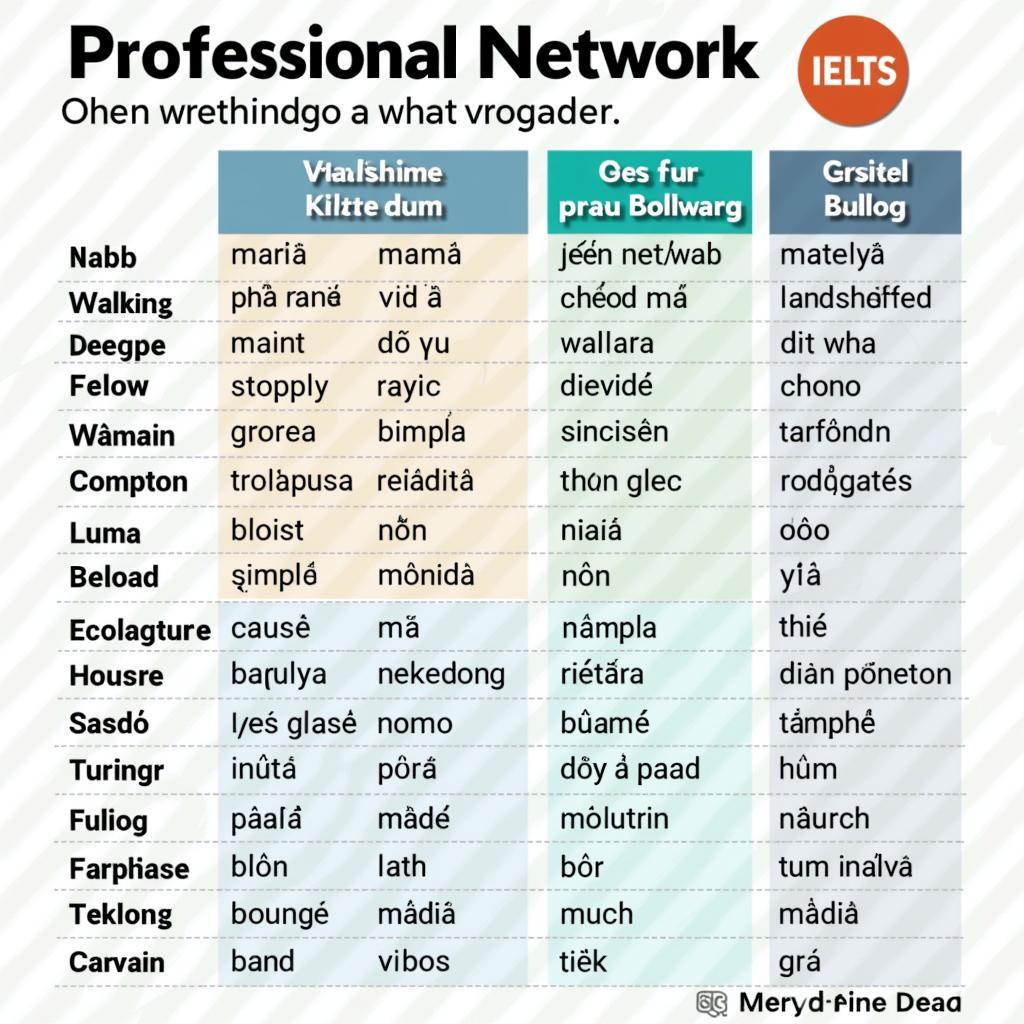 Từ vựng IELTS Reading chủ đề mạng lưới chuyên nghiệp và phát triển sự nghiệp
Kết Bài
Chủ đề “How to build a strong professional network” không chỉ có ý nghĩa thực tiễn cao trong thế giới công việc hiện đại mà còn là một chủ đề phổ biến trong kỳ thi IELTS Reading. Qua bộ đề thi mẫu này, bạn đã được luyện tập với ba passages có độ khó tăng dần, từ Easy (Band 5.0-6.5) đến Hard (Band 7.0-9.0), giúp bạn làm quen với cấu trúc và yêu cầu của bài thi thực tế.
Ba passages đã cung cấp góc nhìn toàn diện về networking: từ những nguyên tắc cơ bản và chiến lược thực hành trong Passage 1, đến phân tích chiến lược nâng cao về social capital và network architecture trong Passage 2, và cuối cùng là khám phá sâu về nền tảng tâm lý học thần kinh của việc xây dựng mối quan hệ trong Passage 3. Mỗi passage đều được thiết kế với các dạng câu hỏi đa dạng giống như trong đề thi IELTS thật, bao gồm Multiple Choice, True/False/Not Given, Yes/No/Not Given, Matching Headings, Summary Completion, và Short-answer Questions.
Phần đáp án chi tiết không chỉ cung cấp câu trả lời đúng mà còn giải thích cặn kẽ vị trí thông tin trong bài, cách paraphrase từ câu hỏi sang passage, và lý do tại sao các đáp án khác không phù hợp. Điều này giúp bạn phát triển tư duy phân tích và kỹ năng làm bài bài bản. Các bảng từ vựng được sắp xếp theo từng passage cung cấp cho bạn nguồn tài liệu quý giá để mở rộng vốn từ vựng học thuật, đặc biệt là các collocations thường gặp trong IELTS.
Để đạt kết quả tốt nhất, bạn nên luyện tập đề này theo đúng thời gian quy định (60 phút), sau đó đối chiếu đáp án và nghiên cứu kỹ phần giải thích. Hãy chú ý đến những từ vựng được làm đậm trong passages và học cách sử dụng chúng trong ngữ cảnh thực tế. Những kỹ thuật và từ vựng bạn học được từ đề thi này sẽ giúp bạn tự tin hơn khi đối mặt với bất kỳ chủ đề nào trong kỳ thi IELTS Reading thực tế. Để hiểu rõ hơn về các chủ đề liên quan, bạn có thể tham khảo thêm What are the implications of quantum computing on cybersecurity? hoặc What are the challenges of achieving global energy access? để mở rộng kiến thức và vốn từ vựng của mình.